Part III Reports of Officers and Department Chiefs (continued 2)
Reading edition
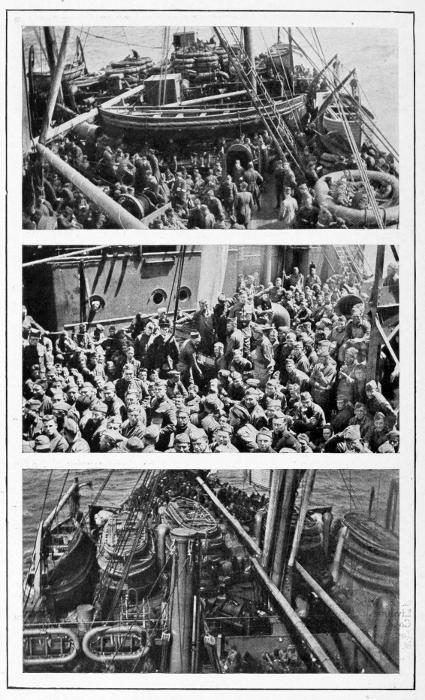
As the Leviathan transported nearly one hundred and twenty thousand men to Europe during the war, and has brought back nearly as many since, it requires no active imagination to realize that the medical department has had its hands full. The percentage of sickness bound to occur among thirteen thousand men was enough to keep nine doctors busy, and this was only a small part of their work. Sanitation on such a huge ship was in itself a problem. Samples of food and water had to be examined and accepted or rejected; troop compartments and every nook and corner of the ship were inspected daily and a high sanitary standard maintained; quotative examinations of the air in the troop spaces were made at different hours both day and night to determine the temperature, humidity, and amount of carbon dioxide in these places; these observations were made the subjects of various reports and resulted in the installation of new ventilating systems and correction of those already in operation; during threatened epidemics of infectious diseases it was often necessary to take cultures and do other laboratory work among hundreds of men. In July, 1918, the Leviathan began transporting wounded men and has carried a large number of them to date. The wounded required much attention and the manner in which they have been cared for on board this vessel reflects great credit upon the medical department.
A new departure for ships of war was the Nurse Corps. The corps consists of Mary M. Robinson, Head Nurse, U. S. N., Irene Reed, U. S. N., Charlotte F. Hyde, U. S. N., Ruby F. Nutling, U. S. N. R. F., Ruby Russell, U. S. N. R. F., Madelon Stowell, U. S. N. R. F., Alice B. Newcomb, U. S. N. R. F., Vera O. Harmon, U. S. N., Mary A. O’Neill, U. S. N. R. F. These were the first nurses who ever had duty on a man-o’-war. Their duties have been supervisory over the hospital corps, and their training and experience as nurses have made them of invaluable assistance.
The Influenza Epidemic
The following are extracts from reports of the influenza epidemic submitted to commanding officer by Lieut. Com. H. A. May, M. C., October 11th, 1918:
There were 260 officers and 8,873 enlisted men of all grades reported as present when the ship left the dock in Hoboken. These made up the personnel of several organizations—the 323d Field Signal Corps, the 401st, 467th and 468th Engineers, the 302d Water Tank Train, a September Automatic Replacement Draft, the 57th Pioneer Infantry, and the 73d Medical Replacement Section. In addition, there were 191 members of the 60th and 62d units, Army Nurse Corps.
The ship sailed on September 29th. Because troop space H-8 was deemed unfit for occupancy by reason of inadequate ventilation, troops quartered there were moved on the 30th to other compartments, causing congestion in many spaces. All available bunks in the sick bay were filled by army sick before the morning of September 30th. Arrangements were then made to empty F room section 3, port side, containing 200 standees. These bunks were filled within a few minutes with sick men picked up from the decks. When this space was found to be insufficient E room section 2, starboard side, 415 bunks, was vacated (October 1st), and the occupants sent down to H-8 regardless of improper ventilation. On October 3d, the port side of E room section 2, 463 bunks, was vacated by the Army guard, those sick in F. H. S. 3 were moved up to E. R. S. 2, and the guard sent below to be scattered wherever they could find space. Thus, on the night of October 3d, there was, beside the sick bay, a ward on E-deck capable of bunking 878 men. As the bunks are arranged four in a tier, one above the other, the top bunk could not be used for the sick, except in emergencies, because nurses could not climb up to them nor could sick men climb down to go to toilets.
The Navy medical officers confined their efforts mostly to those in the sick bay spaces, while all the sick quarters below were turned over to the army medical officers. The army chief surgeon, Colonel Decker, and two of his juniors became ill on October 1st, leaving but eleven army doctors to hold sick call, treat patients below, and care for about thirty nurses and twenty officers who were ill in rooms. The navy medical officers stood watches in E. R. S. 3 at such times as they could be spared from the sick bay work, and relays of army nurses were assigned to duty below, with the pneumonia cases in the isolation ward, with sick officers in the officer’s ward, and with sick nurses and officers in staterooms. In fact every available medical officer, nurse and hospital corpsman was utilized to the extreme of endurance. Below, in the E-deck ward, every possible appliance for the care of the sick was furnished to the army surgeons on duty. The commissary officer placed at our disposal stewards, cooks and mess men, and furnished just the kind of food required, in the best possible fashion. The Medical Department of the ship owes, and I wish here to acknowledge, a great debt of gratitude to the Commissary Department, and to Paymaster Farwell and Chief Commissary Steward Flowers, especially, for their co-operation in this matter, the success with which they gave comfort and aid to the sick, and removed from our shoulders the always worrisome burden of feeding men unable to eat regular diet.
Course of the Epidemic
This was influenced materially by these main factors:
First, the widespread infection of several organizations before they embarked, and their assignment to many different parts of the ship.
Second, the type of men comprising the most heavily infected group. These men were particularly liable to infection.
Third, the absolute lassitude of those becoming ill caused them to lie in their bunks without complaint until their infection had become profound and pneumonia had begun. The severe epistaxis which ushered in the disease in a very large proportion of the cases, caused a lowering of resisting powers which was added to by fright, by the confined space, and the motion of the ship. Where pneumonia set in, not one man was in condition to make a fight for life.
As noted above, the sick bay was filled a few hours after leaving Hoboken. All pneumonia cases were placed in one isolation ward at the beginning, and another isolation unit was set aside for measles and mumps, both of which diseases were present among the troops. The other isolation units were first filled with influenza cases and later with pneumonias. Until the fifth day of the voyage, few patients could be sent to duty because of great weakness following the drop in temperature as they grew better. Only the worst cases in E-deck ward were sent to sick bay at any time, and all were potentially pneumonias. The E-deck ward was more than full all the time and there were many ill men in various troop spaces in other parts of the ship.
There are no means of knowing the actual number of sick at any one time, but it is estimated that fully 700 cases had developed by the night of September 30th. They were brought to the sick bay from all parts of the ship, in a continuous stream, only to be turned away because all beds were occupied. Most of them then lay down on the decks, inside and out, and made no effort to reach the compartment where they belonged. In fact practically no one had the slightest idea where he did belong, and he left his blankets, clothing, kit, and all his possessions to be salvaged at the end of the voyage.
During October 1st, every effort was made to increase hospital space below, as noted above. The heretofore satisfactory arrangements for army sick call were not adhered to by the army medical officers, and hundreds of men applied for treatment at the E-deck ward instead of going to the twelve outlying sick call stations. On this day, Colonel Decker, the Chief Army Surgeon, became ill. As he was the only army medical officer who had had army experience in administrative matters there was now no competent head to the army organization. Two other medical officers also became ill and remained in their rooms to the end of the voyage.
Late in the evening of this day the E-deck ward was opened on the starboard side and was filled before morning. Twenty army nurses were detailed for duty during the night. When patients were brought up, their mates carefully left their blankets and clothing below and scouting parties had to be sent through the compartments to gather up all loose blankets for use of the sick. Fortunately we had about 100 army blankets in the medical storeroom which had been salvaged on other voyages. These were used while they lasted.
Horrors of War
The conditions during this night cannot be visualized by any one who has not actually seen them.
The morning of October 2nd brought no relief. Things seemed to grow worse instead of better. Cleaning details were demanded of the army, but few men responded. Those who came would stay awhile and wander away, never to be seen again. No N. C. O.’s were sent, and there was no organization for control. The nurses made a valiant effort to clean up and the navy hospital corpsmen did marvels of work, but always against tremendous odds. Only by constant patrolling between the bunks could any impression be made upon the litter and finally our own sailors were put on the job. They took hold like veterans and the place was kept respectably clean thereafter.
The first death from pneumonia occurred on this day, and the body was promptly embalmed and encased in a navy standard casket.
When evening came no impression had been made upon the great number of sick men about the decks and in their own bunks. So arrangements were made to enlarge the hospital space by including the port side of E. R. S. 2. On October 3rd this was accomplished and from that time to the end of the voyage we had enough bunks to accommodate practically all the worst cases. Three deaths occurred this day and all were embalmed and encased. After going through the hospital and troop spaces that night it was estimated that there were about 900 cases of influenza in the ship. In the wards we sent back to bunks below all men whose temperature reached 99 and kept all bunks filled with cases of higher fever.
October 4th, seven deaths during the day. The sea was rough and the ship rolled heavily. Hundreds of men were thoroughly miserable from seasickness and other hundreds who had been off the farm but a few weeks, were miserable from terror of the strange surroundings and the ravages of the epidemic. Dozens of these men applied at the wards for treatment and the inexperience of army doctors in the recognition of seasickness caused a great many needless admissions to the hospital.
Many officers and nurses were ill in their rooms, and required the constant attention of a corps of well nurses, and an army medical officer to attend them.
Each succeeding day of the voyage was like those preceding, a nightmare of weariness and anxiety on the part of nurses, doctors, and hospital corpsmen. No one thought of bed for himself and all hands worked day and night. On the 5th there were 10 deaths, on the 6th there were 24, and on the 7th, the day of arrival at our destination, the toll was 31. The army ambulance boat was promptly alongside, and debarkation of the sick began about noon. The sick bay was cleared first and we at once began to clean up in preparation for the wounded to be carried westbound. E-deck was then evacuated, but all the sick could not be handled before night, about 200 remaining on board.
On the 8th these were taken off by the army, but not before fourteen more deaths had occurred. Although on this day almost the entire personnel (army) had gone, the nurses remained until the last sick man was taken off.
Pneumonia
It is the opinion of myself and the other medical officers attached to the ship that there were fully 2,000 cases of influenza on board. How many developed pneumonia there are no means of knowing. Over 75 cases of the latter disease were admitted to the sick bay, most of them moribund. Of these, 3 improved so much that they went back to their compartments, 29 were transferred to hospital ashore, and about 40 died. As the records required to transfer patients from the army to the navy medical officers were furnished in but few cases, and as my records embrace all the dead, I had no means of knowing how many died in the sick bay and how many in the E-deck ward. Cases of pneumonia were found dying in various parts of the ship and many died in the E-deck ward a few minutes after admission. Owing to the public character of that ward, men passing would see a vacant bunk and lie down in it without applying to a medical officer at all. Records were impossible, and even identification of patients was extremely difficult because hundreds of men had blank tags tied about their necks. Many were either delirious or too ill to know their own names. Nine hundred and sixty-six patients were removed by the army hospital authorities in France.
Deaths
Ninety-one deaths occurred among the army personnel, of whom one was an officer, as follows:
October 2 1 death
” 3 3 deaths
” 4 7 deaths
” 5 10 deaths
” 6 24 deaths
” 7 31 deaths
” 8 14 deaths
” 10 1 death
The sick officer was treated in the open air on B deck, had a special army nurse during the day, and a navy hospital corpsman at night.
Hospital Corps
I cannot speak in terms of sufficient commendation of the work of the hospital corps of this ship. Every man was called upon to exert himself to the limit of endurance during the entire round trip. No one complained, every man was on the job. Many of them worked twenty-four hours at a stretch amid conditions that can never be understood by one ashore or on a man-of-war. Some of the embalming detail, worked at their gruesome task forty-eight hours at a stretch without complaint, and at the end I had to drive them away to a bath and bed.
I have learned that the following named men of the Commissary Department voluntarily remained on duty with the sick on E-deck during the entire voyage.
George Willis CCS
H. L. Ringrose SC-2
A. Barbel SC-4
R. Steinman SC-4
Had we been in the midst of smallpox or plague they would doubtless have done the same. The actual danger to all hands was extremely great and all these men deserve the highest commendation for their actions.

Commissary Department
Feeding the Troops
F. L. F.
As soon as the decision was made that the Navy would have charge of the commissary departments on the transports, plans were promptly made to effect the most complete and satisfactory arrangements for the subsistence of the troops en route. A board of three expert commissary officers was appointed with instructions to prepare a well-balanced standard bill-of-fare for use on board all of the transports. The bill-of-fare for a fourteen-day period submitted by the board, was approved and copies forwarded to the commanding officers of all transports for their guidance with the request that it be followed as nearly as possible. Experienced officers of the Supply Corps were then recommended for assignment to the transports and nothing was left undone which would contribute in any way to perfect arrangements for the satisfactory feeding of the troops. This work was new to the navy, as transports were heretofore operated exclusively by the army.
On this account and because, as stated by the Secretary of the Navy, “The success of the transfer of the army troops will depend to a large extent on the conduct of the commissary service on each vessel.
“It is especially gratifying to be able to report that the subsistence of the troops en route overseas has been satisfactory in every respect. This fact is confirmed by reports received from time to time.”
This extract from the Paymaster General’s report marks the success of the enormous task given the Bureau of Supplies and Accounts of feeding the A. E. F. while being carried overseas on American transports.
The menus mentioned in the report actually originated from the Leviathan, and the general instructions at that time were to “live up to the standard required by the sample menu, and to do better, if possible.” This was the slogan of all the general messes in the transport service, and it is a well-known fact that the army as a whole has had nothing but praise for the Navy Commissariat.
The Leviathan, being the largest carrier of all the transport fleet, naturally placed the supply officer, Paymaster Geo. C. Schafer and his assistants, headed by H. B. Judkins, Ensign, U. S. N. R. F., Pay Corps, on their mettle to make a success of this enormous undertaking, although at that time and even up to the time the first meal was served to the troops, the huge task was hardly realized.
During the period of fitting out and on the first trip, there were only five men in the Commissary Department who were known to be familiar with the navy general mess requirements and navy discipline, the rest of the Commissary Department was made up from men taken from all walks of life—lawyers, college men, horseshoers, business men, actors, etc.; only about thirty men having any experience as cooks and bakers, and among these only a comparative few who had any seagoing experience. Even these men were of an unknown quantity until tried out, in the actual experience of cooking and serving food to 10,000 troops and crew, the proportionate number carried the first trip through the war-zone. This was the biggest feeding task ever undertaken in the history of the maritime world.
These men came from various sources of recruiting, mostly from the headquarters and commissary schools connected with the Third Naval District, arriving in batches of one to ten almost every day until ready to sail. None of them came fully equipped or uniformed and the first real muster of the Commissary Department was unique in the history of the ship, about three hundred men falling in on B-deck. An attempt was made to drill them into something near the navy standard. At that time it seemed a hopeless task—none seemed to know what was required of them, even to the simple movement of opening ranks for inspection. The inspection was a joke, no one in uniform, and the expression “Coxey’s Army” would describe the general appearance of the men.
However, the spirit was there, and in an incredibly short time the men were properly uniformed and at the first crew inspection made a very creditable showing, even in the opinion of the old-timers.
Most of these men had the American knack of adaptiveness and soon fitted into the duties required of them; showed such a splendid desire to make good that after the first trip we were able to compare the Commissary Department, and by no means discreditably, with that on the huge British transports, Olympic and Mauretania.
The system steadily improved, and it is safe to assume that we are unexcelled by any other similar sea-going organization.
Because of the “training afloat” system laid out by the Navy Department it is estimated that about 100 trained men have left the Leviathan, trained by actual experience in cooking and baking, thus giving the growing navy a trained personnel, not only cooks and bakers, but American man-o’-war’s men, developed as such by the stern requirements of war conditions.
Horseshoer Thinks Cooking Easy
Each man reporting aboard was required to fill out a questionaire blank stating experience, etc. This was done so that men could be placed to the best advantage in the galley, bakery, storerooms and offices. Some of the answers were laughable. For instance, one stated that his sole experience was cooking for his sisters when mother was obliged to go out. Another had been a horseshoer for about eighteen years, another had no experience, but he knew that cooking was very easy to learn and that he was there for that purpose. One man made a strong bid for the billet of head waiter and informed the Commissary Steward that if he gave him the job he would send at once to Chicago for his Tuxedo.
German Secret Service Interested
During this time it was well known that the German Secret Service was much interested in the Leviathan and for that reason all new arrivals were carefully watched. One suspicious commissary recruit was picked out and turned over to the authorities. He was so clearly German, both in speech and appearance, that it would have been impossible for him to get by, and although nothing was heard of his fate, it is safe to assume that he was interned in a safe place until the end of the war.
The actual fitting out was a tremendous problem, most of the German kitchen machinery and utensils were found either in bad condition or useless for the coming needs and almost a new installation was built, using, however, the German kettles and ranges when possible, discarding anything not absolutely essential. It was often a matter of considerable thought and discussion to decide what should be kept and what discarded.
There were found on the ship seven complete kitchens, counting the two Jewish kitchens which were designed for Kosher cooking. These were intended to provide for the large number of Jewish immigrants carried over in the third class or steerage compartments and all these galleys had been splendidly fitted out to care for about 5,000 passengers and 1,000 crew. As the problem was to prepare for about 15,000 it can be readily seen that some drastic changes were required.
In connection with this it might be well to state that the first letter written about commissary affairs asked that 27 steam kettles of 100 gallons capacity, 3 dough mixers of two barrel capacity, and 7 navy standard bake ovens be obtained. These were installed in addition to the German equipment left, after the rip-out period was finished.
All except the first and second class galley were dismantled. All the kettles and one large electric bake oven were installed in the first class galley compartment, thus consolidating the cooking machinery in the present spaces which were renamed the Troop Galley.
On E-deck aft, the third class galley was ripped out and a blacksmith and coppersmith shop installed. The third class dining room, later the engineer’s force mess room, became temporarily the crew mess room until the number became too large and the first class saloon was used until the deck force quarters were fitted up. It was during this time that a large number of the crew were ptomaine poisoned by eating hash that was prepared from infected corned beef, probably made so by defective tinning. The entire Medical Department was busy all that day, but luckily no lives were lost. The rumor leaked out that in some way “Fritz” had got in some fine work, but this was denied upon investigation.
Storage
Another phase of the preparation presented itself, the storage of provisions. The combined experience of the leading men in the department was brought into play to solve the many problems involved, to provide for storing and keeping of over two millions of pounds of provisions in the space allotted. The principal items and their quantities required for this loading were as follows: 200,000 lbs. of flour, 60,000 lbs. tinned meats, 25,000 lbs. salt meats, 120,000 lbs. smoked meats, 260,000 lbs. fresh meats, 25,000 lbs. turkey and fowl, 30,000 doz. eggs, 140,000 lbs. beans, 75,000 tinned vegetables, 420,000 fresh vegetables, 22,000 cereals, 145,000 dried, tinned and preserved fruits, 175,000 fresh fruits, 40,000 lbs. coffee, 3,000 lbs. cocoa, 2,500 lbs. tea, 60,000 evaporated milk, 5,000 qts. fresh milk, 5,000 qts. of cream, 40,000 lbs. fresh butter, 15,000 lbs. of lard, 15,000 lbs. salt, 175,000 lbs. of sugar.
These quantities were estimated to subsist 10,000 troops twenty-five days and 1,400 crew one hundred and twenty days.
Careful consideration had to be given to the location, size, drainage and estimated temperatures of the various storerooms and cold storage. Also the items of provisions and quantities of each item required and the storeroom best adapted by size and accessibility. This was worked out so successfully that when the actual provisioning was finished only about five hundred packages were left out of the allotted spaces due to the fact that at the last moment, passages had to be left in several rooms to give access to manhole plates leading into the double bottoms.
The cold storage spaces were an unknown quantity, only uncertain data (not from German sources) being available concerning the temperatures of the various compartments. However, this part of the provisioning was also successfully finished and it might be well to state that since the first loading, to the end of hostilities, only about 3,000 pounds of meats, and 6,000 pounds of fruits and vegetables were lost through deterioration.
Enough provisions were carried in the ship to approximate the supply of ten battleships and one supply ship. This comparison was often used when explaining to distinguished guests the enormous size of the Leviathan’s larder.
During this phase of the work great consideration was given to the method of issuing the food to the individual soldier. No data was obtainable except the general requirements of the army regulation. How to make these requirements fit into the planned system of feeding was a problem, which however was so successfully solved that the Leviathan system of issue was, either in whole or in part, practically adopted for all transports.
The general scheme is an elaboration on a rough, but efficient system of feeding landing forces of sailors at Guantanamo, where it was the custom to land the various ship battalions and go into camp at Deer Point for small arms practice.
The equipment then was a limited one, namely, a mess table at the foot of each company street and four syrup barrels filled with soap and water for washing the mess gear. From this crude idea was built up a system that operates as follows:
In the after end of the troop mess hall are placed twelve tanks fitted with direct steam jets. These tanks have specially fitted tops and are capable of holding eight insets or food containers, each container holding about seventy pounds of food or coffee. The steam jet is turned on when the tank is filled with the food containers, thus enabling the food to be placed ready for serving, some time before the messing, keeping the food warm and palatable.
This tank, or serving station, contains such items of the meal as meats, gravy, vegetables and beverages. In addition to each serving station is an auxiliary serving table from which is served, bread, butter and desserts. Each serving station and table has a detail of four men and a messing sergeant who draws the food from the galley and serves to the men as they file past their particular station.
The men march from their compartments under control of their compartment officer in four lines, two from forward and two from aft, meeting on E-deck at the grand staircase leading into the troop mess hall coming down the staircase four abreast. When in the mess hall the column is split into twelve lines and pass the serving stations at a slow walk through to the mess tables. When finished, they go on to the forward end of the mess hall, where there are the washing tanks somewhat similar to the tanks at the serving stations. These tanks have hot soapy and clear water in which the men wash and rinse their mess gear, returning to their compartments by other established routes. All the mess lines, both to and from the mess, are kept under control so that in case of an emergency during the messing the men may be brought to their proper stations quickly and without confusion. This arrangement of the messing lines and mess hall has kept intact and separate the feeding space of the troops from their sleeping quarters, an arrangement of much sanitary value and in evidence only upon United States Navy transports.
World’s Feeding Record
The system holds the world’s record for feeding the largest number of men in the shortest period of time, ashore or afloat. Nine thousand men in an average time of ninety minutes were fed. The best time, however, for the same number of men was sixty-seven minutes; this means that during the messing one soldier was served a ration every thirty-six seconds.
It must be remembered that these huge commissary problems has been solved with deep thought and precision, overcoming the enormous difficulties presented on shipboard by the confined space and the mass of floating population equal that of a large town or small city.
On the afternoon of December 14th, the day previous to the starting on that historical first trip, the first meal was served. Previous to serving this meal, the carefully planned organization had to be put into operation. This required numerous army details for messing, kitchen work and working parties. These reported to the commissary office and after being properly stationed were given instructions to carry on the messing.
This was done about two hours after the troops were embarked and the mess movement was started in the troop mess hall. There were many hitches in the mess movement to the serving stations, but all the troops were fed in about two and one half hours and after the second day the messing organization “shook down” so well, that the Commissary Department was able to report that the messing system was a success. In fact, the first meal had not been going ten minutes when it was realized, much to the relief and joy of those who had worked so hard on the fitting out the messing organization, that the system planned was very effective. One strict rule had to be made in connection with the embarkation, which was that no meals would be served until all messing details were stationed, and although it seemed harsh, an amusing incident proved its value. Soldiers are akin to sailors, inasmuch as they are blessed with healthy appetites, so that invariably when troops arrive aboard they are hungry, and if not restrained naturally gravitate to the kitchen. The first troops aboard followed their natural instincts and wormed their way into the galley. Their tales of hunger told to the sailor-cooks in the galley so worked on their sympathies that a relief party began issuing sandwiches. In a few minutes by some mysterious way the good news was passed that the good-natured sailors were handing out “chow” and in about ten minutes a thousand hungry troopers were crowded into the galley clamoring for “eats.” The resulting confusion almost upset the embarkation and a hurried S. O. S. to the army headquarters was made to get the soldiers to clear the galley. It is needless to say that the galley cooks never allowed their good nature to get the best of them again during other embarkations.
Although the start was splendid it must not be thought that it was plain sailing on following days for the Commissary Department. In fact, it was much to the contrary and the men who had the responsibility of the undertaking speak of that trip as a nightmare.
The winter days were short and war conditions required that nearly all lights, inside the ship and out, must be extinguished one hour before sunset. This condition meant that most of the work had to be done in almost total darkness. No refuse could be disposed of until one hour after sunset and all wood had to be burned. The men detailed for this purpose were compelled to grope their way about a strange ship in the dark.
The galley and bake shop were conducted under much the same conditions, but the troops were fed. The Leviathan’s standard bill-of-fare was carried out in every detail.
Who Said Pie?
Because the Leviathan was expected to arrive in port on Christmas eve, a regular navy holiday dinner with all the fixings was given to all hands on the day before. This dinner was given complete and went off smoothly with but one hitch. As said before, soldiers have healthy appetites and a strong affection for pie, and, in order to get more pie than their share, a great many doubled back in the mess lines and perhaps more than once, for there were over 15,000 rations of pie served out on that strenuous day. For a while it looked as if we were going to be overwhelmed and that the last thousand troops to go through the mess lines would not get any holiday dinner, but a good substitute dinner was provided and it is recorded that everybody was made happy.
All this work was accomplished under such adverse conditions and with the added strain incidental to our first trip through the war zone, that it was with relief we arrived in port and fed the soldiers their last navy meal alongside the landing stage in Liverpool. Each man leaving the ship was given a lunch to stay him on the next stage of his journey and with it went the good wishes of the Leviathan’s crew. The practice of providing a lunch to debarking troops has been carried out in all succeeding disembarkations.
Improvements
The big feat was accomplished and the rest given by the necessarily long stay in Liverpool was well earned and enjoyed. As a result of the experience of the trip, many improvements were made in the messing organization and galley installation, the most noteworthy of which was the abandoning of the galley forward, moving the kettles, etc., to the troop galley and giving up the two other mess hall spaces for berthing—messing all the troops in the present large mess hall. This brought about a consolidation of the general mess and made the task easier.
Subsequent trips saw consistent improvement until a new record was established during the thirteenth trip when about eleven thousand home-coming troops were fed in seventy-six minutes best time and an average time of about ninety minutes. Over 150,000 overseas troops have been fed on the Leviathan’s trips and the good ship’s commissariat has become famous wherever the A. E. F. have gone. The Leviathan’s apple pie has been, to quote a returning wounded soldier, placed second in popularity with the justly famous Salvation Army doughnut.
The success of the first trip was undoubtedly due to the earnest work of all hands under the able direction of Paymaster Simon Pietri, Supply Officer and Assistant Paymaster H. B. Judkins. The work in the galley was ably directed by ship’s cook 1st class, later Chief Commissary Steward, Martin J. Flynn, and it can be said without fear of contradiction, that the entire success of the enormous undertaking depended largely on his splendid judgment and ability. This must in justice also be said of Chief Commissary Steward W. J. Linn, who took entire charge of the stores and whose long and varied commissary experience helped us over difficulties which at times seemed unsurmountable.
Subsequent trips under the direction of Paymaster Farwell and Paymaster Edwards, his successor and present Supply Officer, have brought in their wake many improvements so that now the Leviathan’s Commissariat is considered the standard of its kind.
The following is a sample of a day’s menu on board the Leviathan:
MENU
SUNDAY, APRIL 20, 1919
Breakfast
Oat Meal
Milk
Boiled Eggs
Fresh Fruit
Bread and Butter
Coffee
Dinner
Turkey
Tinned Asparagus
Mashed Potatoes
Pie and Cake
Bread and Butter
Coffee
Supper
Head Cheese
Creamed Potatoes
Bread and Butter
Coffee
Quantities Used to Provide the Above
Lbs.
Oat Meal 1150
Milk 1056
Sugar 1500
Eggs (doz.) 3180
Butter 660
Apples 6470
Coffee 400
Milk 480
Salt 10
Turkey 15581
Chicken 2021
Asparagus 2856
Mashed Potatoes 5850
Butter 675
Coffee 400
Milk 480
Sugar 400
Salt 40
Cake 5740
Head Cheese 425
Potatoes 800
Coffee 200
Sugar 200
Salt 20
Bake Shop:
Flour 7800
Yeast 135
Lard 130
Salt 100
Sugar 200
Cinnamon 4
Rations issued to 13,699.

The Supply Department
G. F. P.
“When do we eat? When’s pay day? When can I draw a pair of shoes? Got any ‘Bull’-an’ soap-an’ peanut brittle? Can you get us a piano, an anchor, a car of lumber and a dozen 13 inch gadjets before we shove off?”—questions that are part of the sailors’ existence and the cause of the Supply Officer’s dilemma.
How well they are answered speaks volumes for the organization, zeal and efficiency of the Supply Department. To feed fourteen thousand men (and a thousand or so women, generals, admirals, diplomats, lieutenants and bo’sns); to operate canteens throughout the ship that rival in their activities Woolworth’s chain of stores; to keep the storerooms stocked with every conceivable kind of supplies which are or may in any emergency be required in the many departments of the ship; to clothe properly the crew of more than two thousand men; to keep the accounts of these men and to pay them twice a month; to—but limited space does not permit. Enough to state that the patience of Job, the wisdom of Solomon, the agility of Mercury and the persistency of Bryan are among the requirements necessary to manage successfully the diversified activities of the Supply Department. Verily, the life of the Supply Officer is far from being a bed of roses.
Five distinct divisions of the Supply Department were organized during the early days of going into commission—Commissary, Disbursing, Sales, Storekeeping, and Officers’ Mess—each in charge of an Assistant Supply Officer. The original plans of organization and operation, evolved by Captain G. C. Schafer, were developed and carried out by Lieut.-Comdr. F. Simonpietri, upon whom rested the responsibility of filling the office of Senior Supply Officer on the Leviathan’s maiden trip with more than ten thousand men on board. Under his able guidance the routine of the various divisions were systematized, improved and proven. Each subsequent trip brought forth new problems which were masterfully dealt with and solved by Lieut.-Comdr. Simonpietri and his able successors, Lieut.-Comdr. N. B. Farwell and Lieut.-Comdr. E. C. Edwards. A silent tribute to the results achieved by these Supply Officers is the fact that to the large transports commissioned later the Leviathan was called upon to furnish many trained men as a nucleus for the Supply Departments of these new ships, where Leviathan methods were introduced and are being successfully carried out.
During the early voyages Assistant Supply Officers Colburn, Barker, Poggi, Waters and Judkins wrestled with their respective divisional duties by day, and by way of diversion alternated as Senior Lookout Officers by night, making hourly rounds of the lookout stations, from the forepeak to the after crow’s-nest, fair weather and foul. Inclined a bit toward rotundness, it was a ne’er to be forgotten privilege to see the form of “Jeff” Colburn silhouetted against the starry heavens, en route to the crow’s-nest. “Behold!” quoted “Doc” Carroll one cold evening, when he espied “Jeff’s” figure looming in the shrouds like a square-rigger, “behold yon sylph-like Romeo seeking his fair Juliet!”
Other assistant supply officers who have been assigned to the Leviathan for duty or instruction are Messrs. Carter, Wrigley, Bishop, Harris, Schuler, Hoffman, O’Shaughnessy, Stevens, Ingram, Finstemacher and Miller. Of the “old timers” but Waters and Poggi remained to continue “carrying on” in charge of the Storekeeping and Sales Divisions respectively.
Sales Division
The Sales Division comprises live ship’s stores (canteens) and the clothing and small stores issue room. With troops on board, the canteens, which are located in accessible parts of the ship, make approximately ten thousand separate sales each day, with a total daily cash receipt of about $5,000. The largest day’s business amounted to $6,498, another record to be added to the many laurels already won by the Rainbow Division, units of which were being transported at the time. As one of the canteen storekeepers put it, “If those Rainbows can fight like they can spend, I’d like to see them in action!”
On the shelves of these canteens may be found the usual line of necessities—and luxuries—carried in all Navy canteens, but in unusual quantities; from the most commonplace pair of shoe laces to the most dainty package of bon-bons. Naturally, a vast amount of small items must be handled to make up $5,000 worth of daily sales. And these sales are made, not in leisurely lady-like fashion, over counter and show-case, but through the canteen window to a never-ending line of clamoring sailors and doughboys by but five storekeepers—one to each canteen. These five “salesmen,” especially selected and trained for this type of duty, wait on more “customers” in a day, it is believed, than any other sales people in existence, including the busiest dispenser of wet-goods on Broadway during that torrid spell just prior to July 1st, 1919.
In view of the reported atrocious activities of the Hun in our country during the war, every precaution was taken to procure uncontaminated supplies for use of the crew and troops. As a safeguard, samples of edible stores taken on board were submitted to Surgeon Dunlap for examination in the ship’s laboratory.
While the duties of the sales force are necessarily active and exacting, discretion and tact are exercised in handling such a large body of waiting “customers,” which accounts for the fact that errors and “kicks” are few and far between.
In studying the likes and dislikes of the troops being transported, in order to ascertain the varieties and quantities of canteen stores to carry for sale, it was readily discovered that tastes of the various units differ as widely as do their geographic origins. Hence, when a division that originated in Dixie embarks, peanut candy to the tune of from six to eight tons will be consumed during the voyage, together with prodigious packs of cigarettes; when a mid-western outfit takes passage, peanut candy and cigarette sales fall off, but large inroads are made in the stock of chocolates, chewing tobacco and Navy postcards; when far westerners like the Sunset Division come aboard mountains of “Bull Durham,” brown cigarette papers, caramels and playing cards are broken out of the store rooms, for the boys of the West are not strong for chocolate and peanut candy, though they do “roll their own” and wear out the ship’s police force by endeavoring to keep pinochle games going in every conceivable part of the ship. But regardless of geographic origin, stormy weather creates desires much akin to all doughboys—a desire to lay off such joys as chocolates, bon-bons and poker; a desire to be left alone, not too far from the out board rail, with a package of that wonderful panacea, lemon drops, of which as many as three tons will be consumed during a particularly stormy crossing. During a bit of heavy weather, one of the ship’s wits, feigning much excitement, rushed into a group of forlorn sea-sick warriors, to inform them that “Here comes a torpedo—straight for us!” “Thank God,” came the answering chorus.
Aside from the fifteen tons of various candies loaded in Hoboken, each trip witnesses the consumption of approximately two hundred thousand cigarettes, twenty thousand cigars, three thousand packages of Bull Durham and eleven thousand pieces of soap.
The Clothing and Small Stores issue to the crew about nine thousand dollars’ worth of wearing apparel monthly. This active branch of the Sales Division carries a stock of supplies valued at fifty thousand dollars—from three cent spools of thread to twenty dollar overcoats. For the hard to fit and the Beau Brummel C. P. O.’s, the made-to-measure business is no small item.
The total annual business done by the Sales Division—sales to the crew and troops, including transfers of stores to other ships and stations in Europe, amounts to nearly half a million dollars. All items handled by the ship’s stores are sold at cost, with but a very small margin of profit. In some instances the selling price is lower than the cost. It is endeavored to make not over ten per cent profit, the money thus accumulated going to the entertainment fund, which provides the means of entertaining the crew and troops with movie shows each night, and various other activities and equipments which are necessary to keep the boys amused and happy. The Disbursing Division of the Supply organization is just what the name implies, and expends more real cash than a flock of youthful Pittsburgh millionaires. Besides paying the volumes of never-ending bills for never-ending supplies used on board, the pay roll of the ship’s officers and men are kept by the yeomen, who comprise the personnel of this division. The Disbursing Officer peels off seventy thousand cold iron men each pay day, which happens twice a month. Pay day, the day the Eagle does his big stunt, to the sailors is “Der Tag.” The annual wages paid to the ship’s company approximates one million eight hundred thousand dollars.
The Storekeeping Section procure and carry in stock all the varied supplies used on board for the operation and maintenance of the ship. The store-rooms are veritable storehouses, stocked with every conceivable kind of supplies from deck swabs to grate bars.
One of the chief difficulties encountered during the early days was to find spare parts for the German electrical equipment. Our American standard equipment does not fit the German installations, and unless spares could be obtained the whole electrical system would have to be replaced with standard American fittings. Fortunately, there was quite a stock of German equipment remaining in England since the pre-war days. This had been carried in stock for the use of German ships calling at English ports. Practically all of this stock was purchased by the Leviathan, and was sufficient to run the ship until our own factories could be equipped to turn out this type of supplies and equipment. When the Army, Navy Yards and Shipping Board were clamoring for supplies, the task of procuring stock in quantities demanded by such a huge ship was indeed a difficult one. Thanks to the loyal co-operation of New York and New Jersey business men, and the Naval Commandeering Board, sufficient quantities of supplies were secured to keep going. A typical example of the difficulties encountered can be illustrated by the activity necessary to equip the ship’s hospital. The market was bare of such supplies, due to the incessant demands from our own and our Allies Army and Navy Medical Departments. Manufacturers of surgical supplies from all over the country were appealed to. Some had one kind of instrument, some another; from all of them finally evolved a complete and excellently equipped hospital, equalled by none afloat and surpassed by few ashore. This one purchase required nearly six weeks of effort and search to complete.
Some idea of the volume of supplies necessary to keep the good ship running may be gathered from the following:
For washing the interior decks, etc., about six tons of soap, six tons of soap-powder, and two tons of lye are used each trip.
The canvas bunk-bottoms represent an $85,000 purchase, while $6,000 would be necessary to replace the bed sheets. Blankets for the staterooms and hospital represent an expenditure of $30,000, while one of the many manila mooring lines, each 720 feet long, thirteen inches in circumference, and weighing 7,631 pounds, cost $2,403.77. The four-inch anchor chain cost $2,869.42 for each ninety foot length.
Returning Doughboys