APPENDICES.
Reading edition
I.—ON THE SILPHIUM.
IN the foregoing chapters reference has occasionally been made to the Silphium of Cyrene, the identification of which has given rise to considerable discussion among modern travellers and botanists.
Della Cella, Beechey, and Pacho agree in the opinion that the Silphium of the Greeks is identical with a plant growing in abundance at the present day in the neighbourhood of Cyrene, partly from the description of it given by Pliny, and the general resemblance of the drawing on the coins of Cyrene.
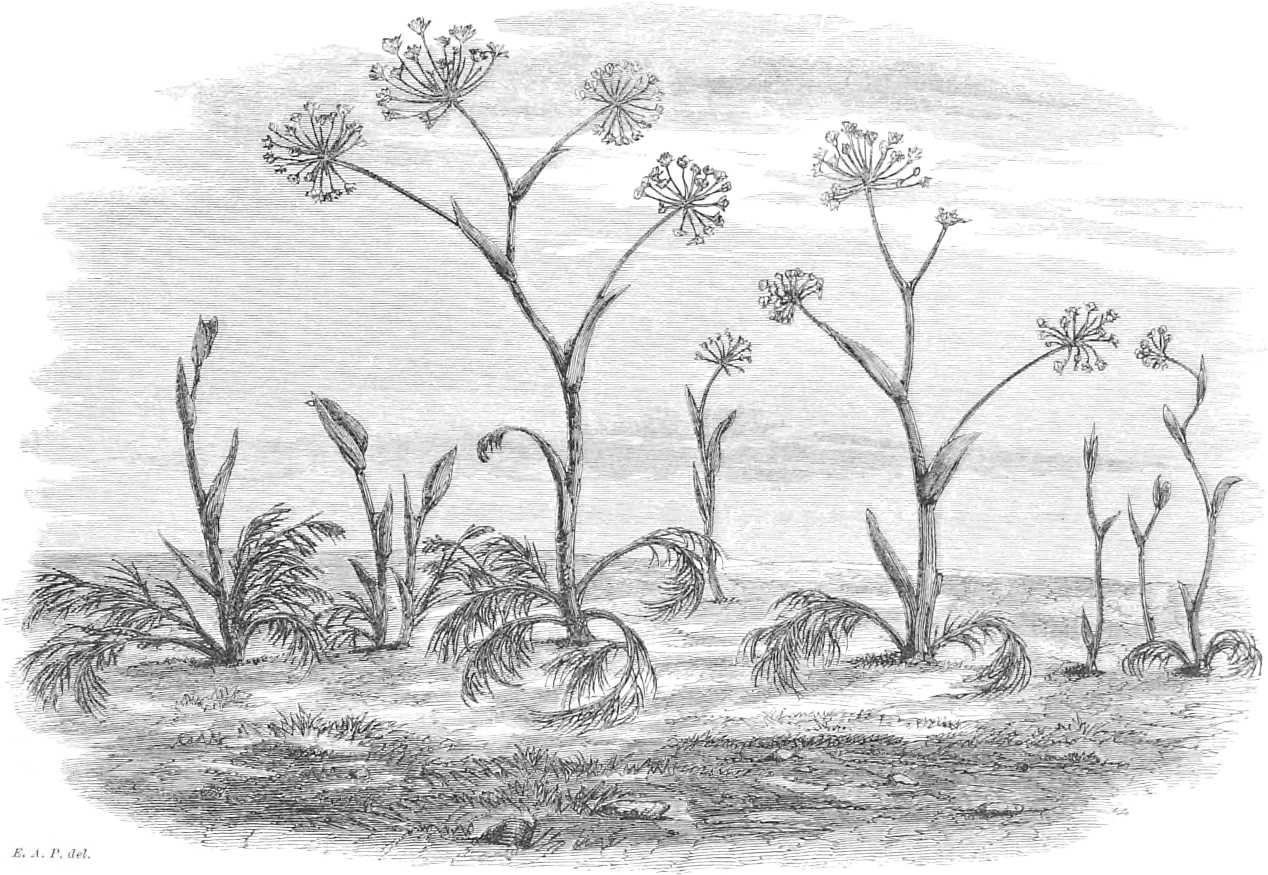
Plate 60.—Thapsia Garganica.
Dr. Schroff has lately published an article on the subject, which seems to be the most important hitherto written, and having gone minutely into the accounts given by Hippocrates and Dioscorides of the properties of the ancient Silphium, and the experiments made from the plant now growing there, it is quite evident that they are not the same.
From the following account it will be seen that the present plant, of which a drawing is shown in Plate 60, is proved to be the Thapsia Garganica, and agrees with the plant well known to the ancients under the name of Thapsia, but has none of the properties of the true Silphium.
It is called Drias by the Arabs, and abounds at Cyrene and the immediate vicinity, disappearing altogether about thirty miles to the westward of it; and we observed it occasionally as far as Derna in the opposite direction. This plant appears above the ground in the month of October, when the autumnal rains commence, and is in flower in May, when it attains the height of 4 feet on the average, occasionally measuring 4¾ feet, and dying down to the ground again in July and August.
The following description of the plant has been kindly translated by Professor Oliver from the German article of Dr. Schroff.
The question as to the identity or otherwise of Thapsia Garganica, now so abundant about the site of the ancient Cyrene, as well as elsewhere on Mediterranean shores, with the Silphium of the Greeks, has been recently very carefully investigated by Dr. C. Schroff.
The results of his inquiry appeared in the “Zeitschrift der K. K. Gesellschaft der Aerzte” of Vienna, Part I., 1862.[7] They are briefly these: he finds that the properties, &c., of Thapsia Garganica do not accord with those attributed by classical writers to their Silphium; on the other hand, they do accord with the properties ascribed by Theophrastus, Dioscorides, and others to a plant called by them Thapsia. Dr. Schroff therefore rejects the prevalent notion that the ancient Silphium of Cyrene is represented by Thapsia Garganica, now growing wild on its site, and confidently identifies the latter with the Thapsia of the Greeks and Romans.[8] He does not attempt to indicate the present representative of the true Silphium.
With regard to the properties of Thapsia Garganica, it is stated by Von Heinzmann (by whom specimens of the drug—the rind of the root—now in use at Tripoli, obtained from T. Garganica, were sent to Europe) that the fruit is very poisonous to camels, a single fruit (so-called seed) sufficing to kill a large and powerful camel. The Arabs in travelling through districts where the Thapsia abounds, at the time when the fruit is ripe, are accustomed to muzzle their camels to prevent their feeding upon the plant. The green herbage of the Thapsia, however, is eaten by them without ill effect.
A very high value is ascribed to the rind of the root as an application to foul wounds or ulcers, whether of man or beast. A portion of the rind is laid upon or into the sore and it heals forthwith. M. Heinzmann experimented with the tincture upon bad wounds of different kinds with “die wunderbarsten Resultate.” When the tincture is applied to the sound skin, it occasions almost unendurable itching, and gives rise at length to blisters or pustules, without causing much inflammation. Neither itching nor burning is felt when the drug is applied to a wound. Six to eight grains of the powdered rind of the root taken internally are stated to occasion the following symptoms: giddiness, buzzing in the ears, confusion of ideas, great feeling of weakness, with tendency to vomit, and actual vomiting and purging. The most striking symptom, however, is a long-continued, heavy perspiration. Experiments repeated in Europe lead to the Thapsia Garganica being classed as a drastic cathartic, and, to a certain extent, confirm its usefulness as an external application.
The properties of the plant Thapsia, described by Theophrastus, Dioscorides, and Pliny, agree with those just cited as characteristic of Thapsia Garganica. Dr. Schroff says a comparison of the description given by the above writers of their Thapsia with the character, both as to structure and properties, of T. Garganica, leaves no doubt as to their identity.
With regard to the ancient Silphium. Our most precise information respecting it is derived from the Cyrenian coins and the writings of Theophrastus and Dioscorides. It is referred to by Pliny (with admixture of error), as well as by many of the more ancient classical writers. The fresh root, prepared with vinegar, was eaten, and the stem was highly prized as a delicacy.—(See Knights of Aristophanes.) It was also used as a spice and condiment. Its application in medicine (the inspissated juice) is fully detailed by Dioscorides. It was in great repute as an antidote to poisons and the bite of venomous reptiles, scorpions, mad dogs, &c.
The older Cyrenian coins bear a representation (according to Dr. Schroff) of the fruit of the Silphium. It is represented as obcordate, with a narrow wing. This does not agree at all with the form of the fruit of T. Garganica, nor can the account given of the use of the Silphium as a table delicacy and condiment be reconciled with the active properties of that species.
In conclusion Dr. Schroff says: “If, then, our researches establish beyond all doubt that the plant now known as Thapsia Garganica, L., and Thapsia Silphium, Viv., is not, as so many travellers and botanists have asserted, the original Cyrenaic Silphium, on the other hand, the result of this inquiry is not purely negative in reference to the Flora of the ancients, for we have proved that the plant in question may be certainly identified with another plant used in ancient medicine, the Thapsia of the Greeks and Romans.”
This extract clearly establishes the fact that the Drias of the Arabs is the Thapsia Garganica. At the time the Romans took possession of the country, the Silphium seems to have been grown in large quantities, and was considered an excellent medicine, and sold for its weight in silver. The medicinal properties of the gum are described as having the smell of myrrh, but more mild and agreeable.
It was said by Pliny to have grown not far from the Gardens of the Hesperides and the Great Syrtis; but, in his time, it had so entirely disappeared that a single plant was sent as a rare and valuable gift to the Emperor Nero. This scarcity had been caused by the barbaric races that overran the country, as well as by the Cyrenians themselves, who aided in its extirpation in order to free themselves of the enormous tax which the Romans had laid upon it.
No. II.
DESCRIPTION OF THE SCULPTURES FOUND AT CYRENE.
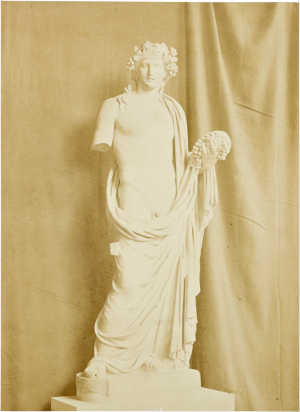
Plate 61.—BACCHUS.
Height 5 feet 9 inches; found in a temple of Bacchus. (See ante, p. 40.)
The god is represented under his youthful type, holding a bunch of grapes in his left hand, and with his head encircled with a vine-wreath and diadem. The right arm, now wanting, appears to have hung down by his side, as a little below the hip is a projection for the attachment of the hand. A mantle passes round the lower half of his body and over his left arm and shoulder. This statue is remarkable for the admirable preservation of the face. The form has a certain effeminate beauty, though the style is somewhat mannered and meretricious. The drapery is carelessly executed, especially at the back. When it was first found, red colour was very visible in the eyes and wreath round the head.
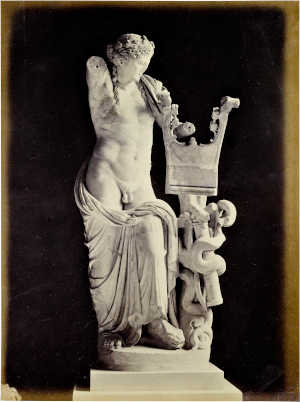
Plate 62.—APOLLO CITHARŒDUS.
Height, inclusive of the plinth, 7 feet 6 inches.
This statue was found, as has been already stated (ante, p. 41), in the Temple of Apollo, and originally stood on a lofty base within the cella. The god is represented in a musing attitude, as if pausing between the strains of his music. His left hand, now broken off, must have played over the strings of his lyre; his right arm has been raised; the right hand, resting on the crown of his head, has held the plectrum, with which he is about to strike the lyre. On the hair may be seen a projection where this hand has been attached. The lyre rests on the trunk of a tree, round which a serpent is twined. A bow and quiver hang from the tree. The head of the serpent is upturned, as if he were listening to the music of the god. Red colour may be seen on the tree and quiver.
This statue is probably a copy from some celebrated original, as two other nearly similar figures exist, one in the Capitoline Museum at Rome, the other in the Museo Borbonico at Naples. (See Clarac, Musée de Sculpture, iii. pl. 479, fig. 921B; and ibid., pl. 489, fig. 954.)
The countenance has a suave and beautiful expression, and the general attitude is very harmoniously composed. The body is finely modelled, but the drapery very inferior to the nude part; the lower limbs seem rather short and clumsy, but perhaps, if this statue were placed on a higher base, this want of proportion would be less apparent. This statue when found was broken into 123 pieces, all of which have been rejoined since its arrival at the British Museum.
Plate 63.—THE EMPEROR HADRIAN (?).
Height 6 feet 7 inches.
This Plate represents a male personage clad in a mantle thrown over his left shoulder, under which the folds of a chiton are seen on the breast; on his feet are sandals; the right arm is crossed over the breast under the mantle, the left hand holds a sprig of laurel; the head is bound with a pine wreath, and has been inserted into a socket at the base of the neck. This head is evidently a portrait, and appears to be intended for the Emperor Hadrian, though the likeness is not a very strong one. As, however, the statue was found in the Temple of Apollo, close to a base inscribed with a dedication to Hadrian (see ante, p. 42), it may be presumed that it represents that emperor. It is possible that the head may have been substituted for that which originally belonged to this statue, as the general character of the drapery would be rather suitable to a poet or a philosopher than to a Roman emperor. Both hands have been joined on at the wrist, and were found detached. The left hand seems not to be made of the same marble as the rest of the statue, and it is very doubtful whether it belongs to the figure.
The pine-wreath on the head would indicate a victory either in the Great Isthmia, or in some smaller festival bearing the same name. There does not, however, seem to be evidence to show the connection of the Emperor Hadrian with such contests.
Plate 64.—HEAD OF PALLAS ATHENE.
Height 1 foot 2 inches.
This head was found near the middle of the Cella in the Temple of Apollo, near the preceding statue, supposed to represent the Emperor Hadrian.—(See ante, p. 42.) It is in unusually fine preservation, and from the purity and whiteness of the marble is an attractive object to the uncritical eye. It is, however, rather coarse and heavy in execution, and belongs, therefore, probably, to the Roman period.
The helmet, which is of the kind called Corinthian, has had the point of the nasal broken off. In other respects this head is uninjured.
UNKNOWN MALE HEAD WITH INLAID EYES.
Life Size.
On Plate 64 is also represented a male head, which is especially interesting, as an example of polychrome or inlaid sculpture. The crown of the head is cut away, so as to form a joint, and it is evident that a helmet or other head-dress has been fitted on to it, doubtless, of a different coloured marble. The eyes are inserted in hollow sockets. The whites of the eyes, formed of marble, still remain in these sockets. The pupils, which have, probably, been made of coloured vitreous pastes, have fallen out. All round the marble eyes the edge of a thin bronze plate intervenes between the eye and the upper and lower eyelids; this edge has probably been serrated so as to indicate by its projection the upper and lower eyelashes, as is the case with the bronze head, Plate 66.
This head is greatly disfigured by the mutilation of the nose, and by the want of the eyes and the part above the forehead. What remains is, however, finely modelled, and is, probably, the work of a Greek artist of a good period.
Plate 65.—HEAD OF CNÆUS CORNELIUS LENTULUS MARCELLINUS, PROPRÆTOR OF CYRENE.
Life Size.
This head was found in the Temple of Apollo, in the western half of the Cella. With it was found a marble base, on which was graven the inscription No. 1, recording the dedication of a statue, by the people of Cyrene, to Cnæus Lentulus Marcellinus, styled here Proprætor, Patron, and Saviour of Cyrene. (See ante, p. 42.)
With this base was found a square pedestal, 10 inches broad and 5 feet high, which fitted into a square socket in the base, and which had at the top a deep socket into which the head fitted. This pedestal, which establishes the connection between the base and the head, was unfortunately left behind, on the final embarkation of the marbles, on account of the insufficient means of transport at the command of the expedition. It has been already noticed that the back of this head is cut flat, as if to enable it to be placed like a pilaster.
As a specimen of provincial sculpture in the Roman period, this head is very well worthy of study. It seems singular that a work of art possessing so much merit should have been united to its pedestal in so rude and unsightly a manner. It is, however, possible that the head originally belonged to a statue, and that, after this statue was broken by an earthquake or other accident, the head was remounted in this clumsy fashion.
The Cnæus Cornelius Lentulus Marcellinus whose portrait we have here was the son of P. Cornelius Lentulus Marcellinus, of the illustrious family of Marcelli, and a man of some note in the latter years of the Republic. While yet a young man he supported the cause of the Sicilians against Verres, B.C. 70. He held the office of Prætor, B.C. 59, and presided over the trial of C. Antonius, the colleague of Cicero. The following year he went to Syria, and administered that province for two years. He was Consul B.C. 56, and took a prominent part in resisting the factious violence of Clodius; and Cicero, whose cause he greatly favoured, declared him to be one of the best Consuls he had ever known. We hear very little of him after the expiration of his Consulship, and the period of his death is wholly unknown.
Ancient writers are not agreed as to the precise date when Cyrene was first made a Roman province. The conflicting authorities are examined by Thrige (Res Cyren. pp. 274-277), who adopts for this event the date B.C. 75. Borghesi, who reconsiders the question very fully in his Œuvres Complètes, Paris, 1864, II. pp. 396-407, prefers the later date, B.C. 65, in which he is followed by Falbe and Lindberg (Numismatique de l’Ancienne Afrique, I. p. 7). According to these two latter authorities, Lollius, whose name appears on the coins of Cyrene, was its first Proprætor; but it is not unlikely that he was preceded by Cn. Lentulus Marcellinus, whether we take the earlier or the later of the above-mentioned dates for the establishment of the Roman province there. He may be the same as a Cnæus Lentulus whose name appears on a Roman family coin (Cohen, Description Générale, p. 104, No. 25) as Quæstor, and who was probably Quæstor in Spain with Metellus, about B.C. 79-75.
Plate 66.—BRONZE ICONIC HEAD.
Life Size.
This head is in very fine condition, and a most interesting example of ancient portraiture in bronze.
The person whom it represents has not yet been identified; the type of the features seems rather African than Greek or Roman, and it is possible, therefore, that this head may represent some king of Numidia or Mauritania. The eyes have been inlaid in vitreous pastes, portions of which still remain in the sockets. The eyelashes are indicated by notched lines. The under lip is formed of a separate piece of bronze, the junction of which may be traced along the edge of the lip.
It is probable that the lips were covered with a thin plate of silver or some artificial substance which served to represent their difference of colour. The hair and beard are finished with great care and refinement of treatment. Throughout there is a scrupulous adherence to nature, and this head may be considered as an interesting example of that realistic school of portraiture which seems to have originated in the time of Lysippus.
It was found in the Temple of Apollo, on the original floor of the eastern part of the cella, 11 feet beneath a mosaic pavement superadded in Roman times. Near it were some small fragments of bronze horses, very much injured, as if by fire, some bits of gold leaf, and several terra-cotta lamps. (See ante, pp. 42, 43.)
Plate 67.—APHRODITE.
Height 2 feet 4 inches.
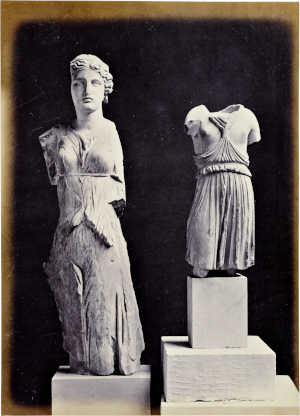
This statuette is broken off below the knees. The figure is draped in a tunic, reaching probably to the feet, and girt at the waist; a peplos passes round the right hip. The arms are wanting. The head is bound with a diadem.
This figure has been so mutilated that it is difficult to judge of it as a composition. The marble is of an exquisite quality, and is wrought with a refined skill, which shows that this statuette belongs to the best period of Greek art. The countenance is one of great beauty. The long eyes and general type of the features are characteristic of Aphrodite.
Though Praxiteles is said to have first made nude statues of this goddess, draped representations of her are comparatively rare, except those executed in the archaic period.
CYRENE.
Height 1 foot 3 inches.
On this Plate is also represented a female torso, attired in a tunic reaching only to the knees. The head, arms, and legs of this figure are wanting. Above the girdle the fashion of the tunic is peculiar. The sides are left open, so as to expose the breasts, between which the folds are gathered together in a broad band. On this band and on the folds near it traces of red colour may yet be seen.
The composition of the drapery in this statuette is remarkable for severe and simple beauty. It is probably executed by a Greek sculptor of the best period. The type and costume are those of a young girl trained to the chase or athletic exercises. These characteristics make it probable that in this statuette we have the nymph Cyrene herself, of whom there are two other representations in this collection of sculptures. (See Pl. 76, and No. 6, post.) Both these statuettes were found in a large temple near the Stadium, with some other fragments of sculpture of a very fine character. (See ante, p. 75.)
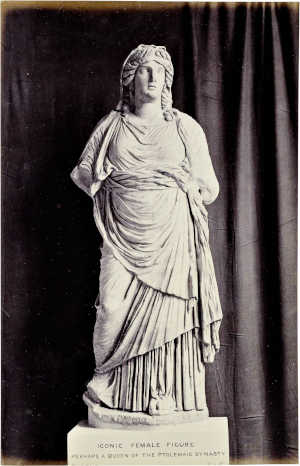
Plate 68.—ICONIC FEMALE FIGURE.
Height 6 feet 6½ inches.
This figure is clad in a tunic reaching to the feet, over which is an ample mantle or peplos wound round the body. Her head is bound with a diadem, and covered at the back with a veil. From the character of the features, it may be inferred that this statue is a portrait rather than the representation of any ideal personage. If such is the case, it is probably the portrait of some queen, perhaps of the family of the Egyptian Ptolemies, as several of the queens of this dynasty are represented on their coins wearing the diadem and veil. Though this figure has rather an imposing effect at a distance, near inspection shows that it is very coarsely executed. The proportions are very clumsy. It was found in some ruins on the north side of the Temple of Apollo.
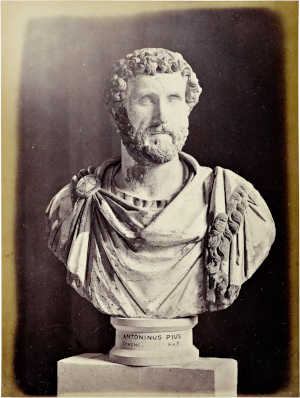
Plate 69.—BUST OF THE EMPEROR ANTONINUS PIUS.
Height 2 feet 4½ inches.
This bust is well sculptured and in very fine condition. The features are intact. The Emperor is represented clad in the paludamentum, or military cloak, which is fastened by a circular fibula on the right shoulder over a tunic and cuirass. This bust was found on the site of a building marked “Palace” on the Plan, but which, from the number of Imperial busts discovered in it, was probably an Augusteum. (See ante, p. 76.)
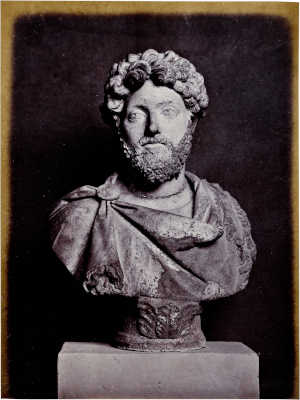
Plate 70.—BUST OF THE EMPEROR MARCUS AURELIUS.
Height 2 feet 4¼ inches, inclusive of plinth.
This bust is in very fine condition, having sustained no injury except the fracture of the neck. The Emperor wears on his shoulders the paludamentum, fastened on the right shoulder by a fibula. The hair is skilfully disposed in clustering masses, and the general treatment of the head is simple and dignified, though as a work of art this bust is inferior to the Antoninus already described. It was found in the building marked “Palace” on the Plan, which, as has been already remarked, was, probably, an Augusteum.
Plate 71.—APHRODITE EUPLOIA.
Height 1 foot 9 inches.
A small statuette representing Venus in the act of adjusting the sandal of her left foot. She leans forward standing on her right leg, and resting her left thigh against a pillar. The toes of her raised foot, now broken away, have been supported by a dolphin. Her left arm, which is also wanting, is drawn back, and probably rested on the pillar; as the head is broken away at the base of the neck, it is uncertain in which direction it turned. Drapery hangs from the column, against which a rudder is leaning. Many varieties and repetitions of this figure are extant, in marble and bronze, among which the following may be cited:—
1. A small bronze figure in the British Museum. (Millingen, in the Transactions of the Royal Society of Literature, 2nd series, i. p. 62.)
2. A small bronze figure found at Herculaneum. (Antichità di Ercol., vi. 14; Müller, Denkmäler d.a. Kunst, ii. Taf. xxxvi., fig. 283.)
3. A small bronze torso in the British Museum. (Clarac, Musée de Sculpture, i. pl. 628, fig. 1354.)
4. A small bronze figure. (Galeotti, Mus. Odeschalc., ii. pl. 35.)
5. A small marble torso in the British Museum. (Museum Marbles, x. pl. 20, p. 43.)
6. A similar figure occurs on the bronze coins of Aphrodisias during the Roman period. (Mionnet, Recueil, iii. p. 323, No. 109.)
Several small torsos in marble, which represent the same subject, have been found in Crete, Rhodes, Cos, and Calymnos. It is evident, front the number of repetitions of this figure, that they are all derived from some celebrated original. The name of Aphrodite Euploia has been given to this figure because, in two instances, the statuette now under consideration and the bronze figure in the British Museum, published by Millingen (No. 1, supra), the goddess leans on a rudder. The veil held over her head in the latter bronze seems to represent the sail filled by a favourable wind. These nautical emblems would accord well with the epithet Euploia, “the giver of a favourable voyage,” which was given to Aphrodite. In this character she was an object of special worship at Cnidus. The number of small statuettes with this type which have been found in cities of the Archipelago suggests the notion that they may have been dedicated by seafaring men after a voyage.
This statuette was found with several other statues of Venus in a small temple, marked on the Plan “Temple of Venus.” (See ante, p. 77.) The composition is very graceful, but the forms rather coarse and clumsy. It is, probably, of the Roman period.
Plate 72.—GROUP OF APHRODITE AND EROS.
Height 3 feet 2½ inches.
The hands and head of the Venus being wanting, the motive of the figure is uncertain, but it is probable that the goddess was represented engaged in her toilette: her drapery is gathered round her lower limbs; on her feet are sandals. The Cupid bestrides a dolphin, in which attitude he is frequently represented at the side of statues of Venus. In Clarac’s Musée de Sculpture are two groups of Aphrodite and Eros, in which the drapery is similarly disposed,—Pl. 607, fig. 1339, and Pl. 615, fig. 1366. This group, though rather coarse in execution, is copied from a good original. It was found in the Temple of Venus.
Plate 73.—UNKNOWN FEMALE FIGURE OF THE ROMAN PERIOD.
Height 5 feet 9½ inches.
This figure is clad in a tunic reaching to the feet, and a mantle, the end of which she is casting over her left shoulder, and in the folds of which her left hand is partially muffled. Her hair is plaited and wound round her head, after a fashion prevalent in the time of the Empress Sabina, the period to which this figure may therefore be assigned with probability. It is evidently a portrait, but has not as yet been identified. The countenance is very expressive, and the whole figure, though not finely executed, is interesting from the simplicity of the conception and the impression it conveys of a faithful rendering from nature. The right forearm, which was a separate piece of marble, has been broken away. It was found in the Temple of Venus. (See ante, p. 77.)
Plate 74.—ICONIC FEMALE BUST.
Height 1 foot 10½ inches.
This bust is remarkable for the singular headdress, composed of plaits coiled round in a conical mass.
This headdress seems a caricature of that which prevailed in the time of the Empress Faustina the Elder; and as the bust is evidently a portrait, it may represent some lady of the period of that Empress. The sculpture is very inferior to that of the busts of Antoninus and Aurelius already described. This bust, with another nearly identical, was found on the site of the supposed “Temple of Venus.” (See ante, p. 77.)
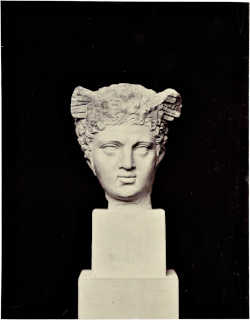
Plate 75.—HEAD OF PERSEUS.
Height 4 inches.
This head has wings, which are characteristic either of Mercury or of Perseus. The countenance, however, has an intense expression, which seems more suitable to the hero than the god. This head is probably broken off from a statuette representing Perseus holding in his hand the head of the slain Medusa. A very similar head occurs among the reliefs which ornament the cuirass of a Roman emperor on the torso described post, No. 107, p. 104.
The features are very forcibly modelled. This head is probably a work of the Macedonian period. It was found in the Temple of Venus. (See ante, p. 77.)
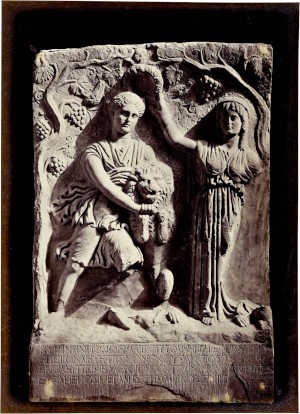
Plate 76.—CYRENE CROWNED BY LIBYA.
Group in Relief, 3 feet 4 inches by 2 feet 3 inches.
This relief represents the nymph Cyrene in the act of strangling a lion, while, to commemorate this triumph, a crown is held over her head by Libya. Below is the inscription engraved Pl. 82, No. 19, which may be thus translated:—
“Here over the architrave, Carpos, making this dedication in token of great hospitality, has placed the lion-slaying Cyrene, whom Libya, having the glory of three continents, herself crowns.”
In this group the nymph Cyrene is represented in attire very like that of Diana Venatrix. She wears a succinct chiton reaching to the knees, over which is a mantle, and buskins; her hair is drawn back from her face.
Libya wears a talaric chiton girt at the waist, and a mantle fastened at the breast and falling down behind; her hair, bound with a diadem, is arranged over her forehead in long regular curls, and falls down her neck; at her side is an animal couchant, of which the head is broken off, and which is probably a gazelle.
According to one legend, Cyrene was the daughter of Hypseus, king of the Lapithæ, in Thessaly, whose flocks she guarded against wild beasts. Apollo seeing her slay a lion in the valley of Pelion, became enamoured of her, and carried her off to the parts of Libya which afterwards bore her name. According to another legend, Eurypylus, king of Libya, having promised a portion of his kingdom to the person who would slay a lion then dreaded for his ravages, Cyrene performed this exploit, and received in reward the promised district. It is probably in connection with this latter legend that Libya is introduced crowning Cyrene in this relief. Aristæus, the mythic founder of Cyrene according to some, was the son of Apollo and Cyrene. The composition of this relief suggests the idea that it may have been a metope. Hence the words ὑπὲρ μελάθροιο in the inscription have been translated “above the architrave.” It was found in the Temple of Venus.
BACCHUS, No. 61.
APOLLO CITHARŒDES, No. 62.
THE EMPEROR HADRIAN? No. 63.
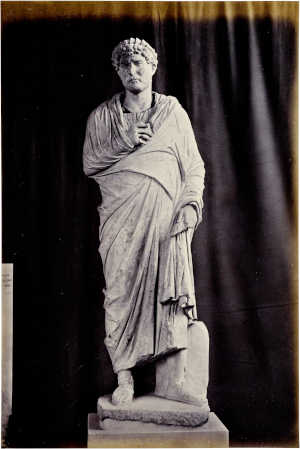
MINERVA & A MALE HEAD, No. 64.
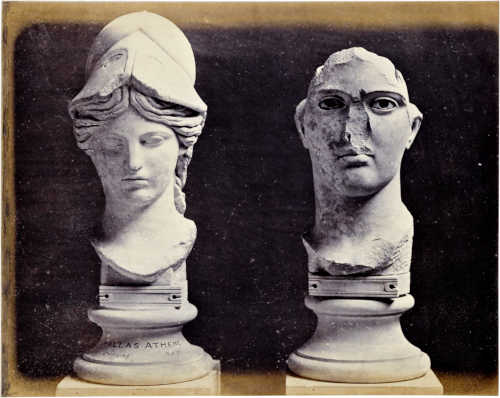
CNÆUS CORNELIUS LENTULUS MARCELLINUS, (PROPRÆTOR OF CYRENE.) No. 65.
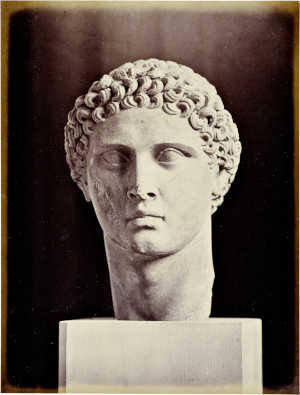
BRONZE ICONIC HEAD, No. 66.
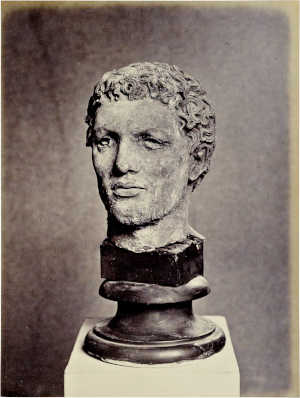
APHRODITE & FEMALE TORSO, No. 67.
ICONIC FEMALE STATUE, No. 68.
THE EMPEROR ANTONINUS PIUS, No. 69.
BUST OF A ROMAN EMPEROR, No. 70.
APHRODITE EUPLOIA, No. 71.
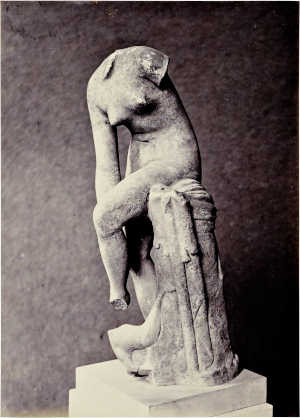
APHRODITE AND EROS, No. 72.
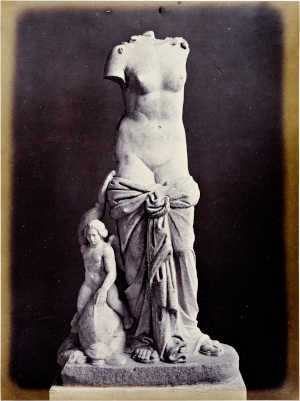
ICONIC FEMALE FIGURE, No. 73.
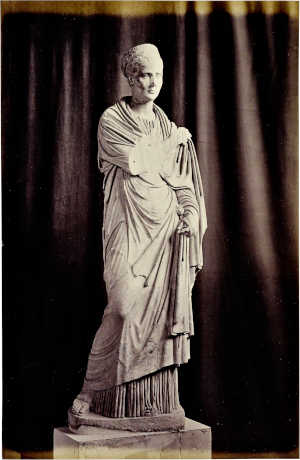
FEMALE BUST OF ROMAN PERIOD, No. 74.
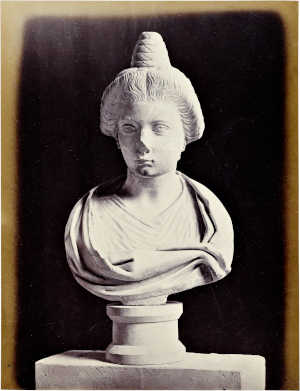
HEAD OF PERSEUS, No. 75.
THE NYMPH CYRENE OVERCOMING A LION & BEING CROWNED BY LYBYA, No. 76.
No. III.
LIST OF SCULPTURES FOUND ON VARIOUS SITES AT CYRENE.
Note.—The Nos. subjoined to each object are those now affixed to them in the British Museum.
TEMPLE OF APOLLO.
1. Apollo Citharœdus.—Pl. 62.
2. The Emperor Hadrian.—Pl. 63.
3. Bronze iconic head.—Pl. 66.
4. Head of Pallas Athene.—Pl. 64.
5. Head of Cnæus Lentulus Marcellinus.—Pl. 65.
6. Group of the nymph Cyrene overcoming a lion by strangling him. The nymph is attired like Diana for the chase. Her hair is bound with a diadem, and gathered into a club behind. Height, 2 ft. 10½ in. (3).
7. Jupiter Ammon; round his lower limbs a mantle; right hand broken away, left hand placed behind his back. On the face are traces of red colour.—Representations of Jupiter Ammon are rare in sculpture. The head of this deity is one of the principal types on the coins of Cyrene, and other towns in the Cyrenaica, and occurs on the cuirass of the Roman emperor. (See post, No. 107.) Height, 2 ft. 10 in. (7).
8. Youthful male figure, wearing a mantle, gathered round his waist and leaving the right side of his chest bare; his head bound with a twisted diadem. His left hand is placed behind his back; his right hand has been extended in front of him. The head, which is inserted in a socket, and may not belong to this figure, bears some resemblance to that of Alexander the Great. The right arm is wanting. At his feet, on the left, is a conical object, possibly intended to represent the Delphic omphalos: unfinished at the back. Height, 3 ft. 9 in. (26).
9. A beardless figure, wearing a chiton, a mantle, and sandals; his head laurelled; his right hand held across his breast; in his left hand a laurel-branch; at left side, some object, perhaps a case for rolls of MS. This figure looks up, and may represent either a priest or a poet taking part in the worship of the temple. Style very late and coarse. Height, 3 ft. (4).
10. A figure precisely similar. Height, 2 ft. 10½ in. (5).
11. Female figure, wearing talaric chiton and diploidion; over forehead, sphendone: head looks up. Arms wanting from the elbow; head and lower arms have been inserted in sockets. This figure may possibly be a Juno. Art late and bad. Height, 4 ft. 5 in. (6).
12. Female figure, probably Hygieia, clad in a talaric chiton and diploidion, over which is a peplos wound round the body. Round right arm a serpent twisted; the right hand wanting; the action of the left arm suggests that she has held a patera to feed the snake. Over the forehead is a radiated sphendone, in the centre of which a flower. Unfinished at the back. The head has been fitted to a socket on the neck, but it is doubtful whether that now adjusted belong to this figure. Art very late and coarse. Height, 3 ft. 8 in. (25).
13. Artemis moving rapidly forward: she wears a talaric chiton, a peplos, and sandals; her hair is gathered up over her forehead like that of Apollo; her arms, which are wanting, and her feet, have been fitted on at a joint; her neck is let into a socket. Height, 3 ft. 3½ in. (8).
14. Female figure, wearing low sphendone, talaric chiton, girt at the waist, peplos, and shoes. Height, 2 ft. 8 in. (52).
15. Small winged figure in relief, broken off at hips, which probably represents Somnus reclining. Height, 8 in. (107).
16. Torso of small figure of Eros (?). Height, 5½ in. (109).
17. Right leg, broken off halfway up the thigh, from statue of youthful Bacchus. At side, trunk of tree, encircled with vine-bearing branches. Height, 1 ft. 6 in. (103).
18. Right leg from a colossal statue. This leg is broken off above the ancle, and terminates just above the knee, in a joint which has probably been concealed by drapery falling over it; it may, therefore, have belonged to an acrolithic statue. It is in a very fine style, and may have been executed in the Macedonian period. Height, 2 ft. 1 in. (15).
19. Archaic head of Apollo. The back hair long, and wound round the crown in a braid; in front short curls. The chin broken away. This head is copied from the same original as the Apollo of the Phygalian room. (Marbles in British Museum, vol. xi. Pl. 32.) In the Theseium at Athens is a similar figure. Height, 11 in. (53).
20. Youthful heroic head, looking to the right; the top of the head cut off flat. Roman art. Height, 10 in. (55).
21. Female head bound with diadem; broken away at back of head. Blue marble. Height, 5¼ in. (64).
22. Head of Ariadne (?); hair bound with ivy; crown cut off. Height, 6½ in. (127).
23. Head of Diana; hair gathered into a high topknot, and bound with diadem; eyes have been made of vitreous paste, which remains in one eye. Height, 7 in. (128).
24. Head of Diana; hair gathered into a high topknot, and bound with diadem. Height, 5½ in. (129).
25. Head of Diana; hair gathered into a high topknot, and bound with diadem. Late art. Height, 7 in. (131).
26. Youthful heroic head (Theseus?); hair bound with twisted diadem; back of head broken off flat. A fine type. Height, 5¼ in. (124).
27. Two fragments of a female head bound with a diadem. Blue marble; diadem painted black; eyes and hair red. Injured by fire. Height, 8½ in. (145).
28. Left side of a female head wearing a stephane and veil. Height, 5½ in. (143).
29. Female head, bound with low stephane. Much defaced. Height, 6 in. (137).
30. Female head looking up; hair slightly waved, a single ringlet falls on each side of neck; back of head and neck cut flat. Style mean and late. Height, 1 ft. 2½ in. (86).
31. Panther or lioness sitting on its haunches; hind-quarter broken away. Very rude. Height, 7½ in. (122).
RUINS NORTH OF TEMPLE OF APOLLO.
32. Female figure.—Pl. 68.
33. Diana Venatrix, wearing a succinct chiton, a chlamys hanging over left arm, and endromides; at her side a hound; her left hand is advanced, and probably held a bow; a quiver rests against her right leg. Art very late and bad. Height, 3 ft. 11 in. (159).
34. Male figure, clad in a chiton and mantle; broken away below the knees; hands and nose wanting; his right arm, muffled in his mantle, is passed across his breast. The countenance is that of an aged person. The head being bound with a fillet, perhaps this figure may represent a poet. He is beardless. (See ante, p. 75.) Present height, 5 ft. 2 in. (37).
35. Seated female figure, clad in a talaric chiton, and a peplos covering the back of her head; her feet and forearms are wanting; she wears a girdle tied in a singular knot under her bosom, with ornamented ends hanging down; her peplos has a deep fringe at the edge. The edges of her girdle are painted in vermilion, which is still very fresh, and the same colour appears at the joints where the forearms are broken off. She is seated on an oblong seat with a cushion; her feet have rested on a footstool. This figure was found close to another female seated figure of colossal size, but in other respects resembling it very closely, which was inscribed with the name of Archippe, daughter of Ptolemaios, a priestess. It is therefore probable that the smaller seated figure may also be a priestess. (See ante, p. 75, where it is erroneously stated that Archippe is one of the Ptolemaic dynasty.) This statue is unfinished at the back, and the crown of the head has been cut away. It probably stood in a niche. Height, 4 ft. 2 in. (36).
36. Youthful Bacchus crowned with vine-leaves. The feet remain, but the legs are wanting from the knees. The right forearm and the nose are broken away; the left elbow rests on the trunk of a tree, round which is twined a vine. The right hand has hung down by the side, and has held some object, to support which two square projections are left on right hip and thigh. The proportions of this figure are good, and it is fairly modelled. Height, 3 ft. 2 in. (27).
37. Female figure, clad in a chiton and peplos; in right hand oinochoe. Head broken off at neck, which is let into a socket. Poor art. Height, 2 ft. 6 in. (41).
38. Legs from a male figure, life size, wearing hunting-boots; at the side a nebris, or fawn-skin, flung over the trunk of a tree. Height, 2 ft. 1 in. (150).
39. Head of Venus (?) bound with diadem; hair in deep waves, cut away at the back. Broken off, probably, from a statue. Height, 1 ft. 1½ in. (61).
40. Female head; hair gathered into a knot on the crown; probably meant for Artemis. Art late and bad. Height, 6 in. (132).
SMALL BUILDING TO THE WEST OF TEMPLE OF APOLLO.
41. Torso of seated female figure, wearing peplos and talaric chiton bound with girdle. Height, 1 ft. 4½ in. (93).
NEIGHBOURHOOD OF TEMPLE OF APOLLO.
42. Female head, cut off flat above the forehead, to receive the hair, which must have been sculptured on a different piece of marble. Height, 11½ in. (88).
43. Youthful male (?) head; traces of red colour in the eyes. The top of the head cut off flat to receive the hair, which must have been fitted on, as in the case of the head last described. Height, 8 in. (89).
44. Female head; hair waved. Style late and bad. Height, 8 in. (90).
45. Head of Bacchus wearing a diadem and a crown of vine-leaves, with bunches of grapes hanging down on each side of the cheek. Height, 7½ in. (92).
TEMPLE OF VENUS.
46. Female bust.—Pl. 74.
47. Statue, probably of an empress.—Pl. 73.
48. Group of nymph Cyrene crowned by Libya.—Pl. 76.
49. Female bust.—The head-dress is similar to that of Faustina the Elder, whom this bust may therefore represent, though the features have little likeness to that empress. The shoulders are draped. The sculpture is mean, and deficient in style. The end of the nose is slightly injured, but in other respects this head is in good condition. Height, 1 ft. 11 in. (117).
50. Aphrodite Euploia.—Pl. 71.
51. Group of Venus, with Cupid on a dolphin.—Pl. 72.
52. Similar group.—The Venus wants arms and head. Her drapery falls over a stelé on left, in front of which is the Cupid. Sculpture late and coarse. Height, 1 ft. 1½ in. (75).
53. Fragment from similar group. Eros on dolphin, holding up part of the drapery with right hand; at his left hand part of left leg of Venus. Height, 8½ in. (71).
54. Fragment from similar group. No remains of the Venus. Height, 7 in. (72).
55. Venus; lower half draped; at left side dolphin. Head and right arm wanting. Height, 11 in. (66).
56. Draped statuette of Venus, from waist downwards. This fragment appears to be Greek marble, and the sculpture is of a fine period. Height, 1 ft. 2½ in. (22).
57. Torso of nude Venus. Headless; right leg broken off halfway up thigh, left leg below knee; right arm broken off above wrist, left below shoulder; on each arm, armlet. Right arm advanced, as if to cover pubes. Fair Roman sculpture. Height, 1 ft. 2 in. (104).
58. Head of Venus bound with opisthosphendone. Height, 6 in. (139).
59. Upper part of reclining figure of Somnus, in relief; in right hand two poppy-heads. Left hand supports head. Length, 6½ in. (74).
60. Dolphin from a group, placed head downwards; a female hand rests on his tail. Height, 1 ft. 1 in. (153).
61. Torso of Eros, with ringlets falling on either side of neck. Sculpture of a good period. Height, 6 in. (105).
62. Youthful male head, in conical cap, with flowing hair,—Atys (?). Height, 9½ in. (59).
63. Torso from knees to neck of statuette of Diana Polymammia. Wants arms; round neck two archaic bracelets. Height, 6 in. (20).
64. Torso of triple Hekate. Heads broken away; at the feet of one of the figures, a hound looking up. All these figures have their arms hanging down. One of them holds in her right hand an oinochoe; the others hold in the right hand some uncertain object. Height, 7½ in. (73).
65. Torso of female statuette, wearing short chiton and nebris. Artemis (?). Fair sculpture. Height, 1 ft. 1½ in. (111).
66. Within a fold of pendent drapery, perhaps broken off from a statue, a female term, clad in a panther’s skin, and placed on a base. Artemis (?). Broken off at neck. Height, 6 in. (154).
67. Demeter Dadophoros. Rudely sculptured in stone of the country. She wears a talaric chiton and a peplos thrown over the head; in her right hand she holds ears of corn, in her left a torch. Height, 1 ft. 11 in. (50).
68. Seated male figure, Jupiter (?), holding in right hand some twisted object, perhaps a distaff; lower half draped. Sculptured in freestone. Height, 1 ft. 8 in. (97).
69. Isis; bust in alabaster. Broken away below breasts. The bust clad in a chiton and fringed peplos, which is fastened by the nodus Isiacus. On the crown of the head is a hole for the attachment of some ornament; the hair bound with a sphendone, and falling on the neck in long ringlets; at the back of the head a cluster either of curls or of fruit. Height, 11 in. (83).
70. Isis, clad in a talaric chiton and a mantle, which is fastened on the breast in the nodus Isiacus. The ends of a fringed veil hang down on her shoulders; wants head. Fair sculpture. Height, 1 ft. 9 in. (84).
71. Lower part of seated male statuette, of which the left leg and thigh, part of the right thigh, and the base of the lyre alone remain. At left side, gryphon. The proportions seem rather those of Hercules than of Apollo; but as the sculpture is of a late period, this deviation from the usual type may be only the result of ignorance in the artist. Height, 7 in. (101).
72. Relief representing the oracular shrine of Apollo. On right, Apollo seated, with right foot on omphalos, the lower part of his body draped; by his side a tripod. On left, gryphon seated, and bearded ithyphallic term, probably of Dionysos. On the plinth, the inscription No. 34. Sculpture very rude and in bad condition. Height, 10 in. by 8½ in. (77).
73. Pilaster in form of Pan: on his head a bracket. Round the body a mantle, in which his right hand and arm are muffled; in left hand, syrinx. The bracket is ornamented with palm-branches. Red colour is quite distinct on the drapery and bracket. Height, 3 ft. 6 in. (28).
74. Aristæus (?) Round the lower half of his body a mantle, falling over his left shoulder, his right hand on his hip; under left arm a staff, round which a snake is coiled. His hair is long; his head bound with a diadem, above which has been some kind of crown or upright head-dress; the crown of the head has been worked flat; his left hand, which has rested on his staff, is wanting. At the side of left foot, a conical object, which may be either a rude representation of the omphalos, or a mere support. In this figure, the features and attributes resemble those of Apollo, but the general type is rather heroic than divine. It may, therefore, be considered with probability a statue of Aristæus, the mythic founder of Cyrene, who, as the son of Apollo by the nymph Cyrene, was said to resemble him in features. Height, 4 ft. 6 in. (158).
75. Head of Athene in Corinthian helmet. Well preserved. Height, 10 in. (60).
76. Head of bearded Bacchus, from term. The hair falls in long tresses, and is clustered behind each temple in the archaic fashion. On the crown of the head a hole for the insertion of an ornament. Height, 8½ in. (81).
77. Torso of youthful satyr, naked; head, arms, and both legs wanting. Well sculptured, in Greek marble. Height, 8 in. (82).
78. Seated female figure, wearing a chiton girt at the waist, over which is a peplos; on each side of the chair, a sphinx. Head, both hands, and head of sphinx on right wanting. Height, 11½ in. (76).
79. Youthful male figure, wearing helmet, chiton exomis girt up above the knee and fastened over left shoulder; shoulder-belt and high boots,—endromides, as if attired for the chase. Both arms wanting; the back is unfinished, as if this statue had stood in a niche. The right arm has been raised and the head turned that way. At right side, trunk of tree. Sculpture very rude and coarse. Height, 6 ft. 4 in. (68).
80. Similar figure. Wants head; sculpture very rude and coarse. Height, 4 ft. 11 in. (149).
81. Fragment, probably of a group of a hunter and goat, of which all that remains is the goat standing on his hind legs, the hand which holds it, and one leg of the man, wearing a hunting-boot. Sculpture coarse and late. Height, 1 ft. ½ in. (116).
82. Fragment of relief; legs clad in endromides; from standing male figure, broken off at knees. Height, 10½ in. (99).
83. Draped term. Wanting head; the left hand placed across the breast, under the drapery, in an attitude similar to that of a female term in the Græco-Roman gallery at the British Museum, thought to be the Venus Architis. (See Museum Marbles, vol. ii. Pl. 37.) Height, 1 ft. 4½ in. (161).
84. Torso of male figure, wearing cuirass and chlamys girt by a belt. Broken off at knees and neck; much worn. Height, 10½ in. (79).
85. Female figure, clad in talaric chiton and diploidion fastened on right shoulder. Wants head and arms. Height, 1 ft. 10 in. (120).
86. Youthful male torso; a peplos wound round his waist and over left forearm; right arm advanced across body. Height, 1 ft. (106).
87. Fragment of relief. Female figure seated, clad in a talaric chiton and peplos. This is probably a fragment of a votive tablet, as the figure seems looking round to the right. Height, 8½ in. by 4 in. (96).
88. Part of votive tablet in relief; a male and a female figure, standing side by side. The male figure wears a mantle round the lower part of his body; the female, a talaric chiton. Heads wanting. Height, 1 ft. by 10½ in. (78).
89. Female head, with conical head-dress; similar to that given Pl. 74.—The apex of the cone is pierced as if for suspension. It is possible, therefore, that this head was used as a weight, as the bronze weights of Roman steelyards were sometimes fashioned in the form of heads. This head, like that engraved Pl. 74, is evidently a portrait. Height, 11 in. (40).
90. Female head, bound with a sphendone and wreath of ears of corn. Height, 6 in. (140).
91. Female head; hair tied in a knot over the crown; face in bad condition. Height, 4 in. (130).
92. Female head, bound with stephane. Height, 5½ in. (133).
93. Heroic (?) head, bound with diadem; hair unfinished. Height, 4 in. (135).
94. Youthful heroic head, looking to right; hair in short curls. Height, 10 in. (56).
95. Head of boy; at back of head, drapery. Height, 9 in. (57).
96. Aged male head; portrait. Broken off at neck; nose slightly injured. Height, 7 in. (58).
97. Youthful male head, in conical cap. Atys (?). Hair long. Height, 9½ in. (59).
98. Female head, bound with diadem; the crown cut off. Traces of red colour in the hair. Height, 6 in. (144).
99. Vine branch round trunk from statue. Height, 6 in. (123).
100. Fragment of group representing lion on back of bull. Rude and late. Height, 8 in. (112).
101. Head of bull. Rude. Height, 5 in. (113).
102. Legs of standing figure, clad in talaric chiton and sandals; has been coloured red. Height, 9 in. (100).
103. Dog standing on hind legs, from group. Height, 9½ in. (121).
104. Head of Venus.—Hair covered with coif and bound with diadem. Badly preserved. Height, 4¼ in. (141).
AUGUSTEUM.
105. Bust of Antoninus Pius.—Pl. 69.
106. Bust of Marcus Aurelius.—Pl. 70.
107. Head of Lucius Verus, broken at the neck.—Nose broken off; sculpture good, but condition indifferent. Height, 1 ft. (16).
108. Torso of a Roman emperor in a cuirass.—This is the torso which was seen by Beechey lying on the ground, and which he supposes to have belonged to the statue of a Ptolemy. The building near which it was found (marked “Palace” on the plan of Cyrene,—see ante, p. 76) was, probably, an Augusteum, or temple dedicated to one or more Roman emperors, as several imperial busts and statues were discovered here. This cuirass is very richly ornamented with reliefs. On the breastplate is a female figure, draped to the feet, representing Rome. On either side a Victory flies towards her to crown her; the Victory on the right carries a cornucopia and a sash, the one on the left a trumpet. The feet of Rome rest on the back of the wolf suckling the twins Romulus and Remus, whose figures have been broken away. On the lower part of the cuirass are, in the centre, the head of Jupiter Ammon, and on either side a winged youthful head, probably Perseus, between which and the head of Ammon is, on either side, an eagle with spreading wings. Under the cuirass is a jerkin, on which are two helmets and two swords in sheaths, arranged alternately with the reliefs already described. On either flank of the cuirass is an elephant’s head. This torso evidently belongs to the figure of a Roman emperor. As the reliefs are finely executed, it is probably a work of the Augustan age. Height, 4 ft. 6 in. (35).
109. A female figure, clad in a talaric chiton girt at the waist and looped on the sleeves, over which falls a peplos, gathered over left arm; on the feet, shoes. The head and forearms wanting. Art coarse and late. Height, 5 ft. 9½ in. (33).
110. Bust, perhaps intended to represent the Empress Faustina the Younger, as the hair is waved and gathered up behind like hers. The nose is broken away, which makes it very difficult to identify the person represented. The shoulders are covered with a peplos, under which is a tunic. Fair Roman art. Height, 1 ft. 10 in. (18).
111. A block tapering upwards, which has perhaps been fitted into a niche. On one face is represented in low relief a youthful male figure wearing the Phrygian cap (Atys); his body is naked: on either side is a sword pointed downwards. Two holes are drilled in the plane of the relief, one on each side of the figure, apparently for the attachment of some ornament. Height, 8 in. (102).
LARGE TEMPLE NEAR THE STADIUM. (See ante, p. 71.)
112. Part of a male head, rather larger than life; much injured by fire; the nose is destroyed, and the head broken in two pieces. This head is finely executed; the lips are painted red, the beard black. Height, 1 ft. 2½ in. (162).
113. Lower half of seated female figure, wearing a talaric chiton and peplos. Demeter (?). Coarsely sculptured in stone of the country. Height, 6 in. (98).
SMALL TEMPLE NEAR THE STADIUM. (See ante, p. 75.)
114. Female torso, perhaps the nymph Cyrene.—Pl. 67.
115. Aphrodite.—Pl. 67.
116. Fragment of face from colossal head; coarsely sculptured in blue marble. The nose, right cheek, and part of left eye, have been broken away; in the hair are traces of red colour. Height, 1 ft. 6 in. (54).
117. Fragment of a group representing a bull attacked by a lion. The bull is crouching; of the lion, who has sprung on him from behind, the fore paws only remain; the head of the bull is wanting. Height, 5¼ in. (115).
TEMPLE OF BACCHUS.
118. Statue of Bacchus.—Pl. 61.
119. Panther, half couching; head to left; left paw raised; round neck wreath of ivy; right leg and lower jaw broken away. In the stone of the country. Height, 1 ft. 11 in. (156).
FROM NEAR COLONNADE WEST OF TEMPLE OF BACCHUS.
120. Female figure, draped in talaric chiton and diploidion, over which is a peplos wound round the body and left arm. The right hand rests on the hip; the head and left hand are wanting. The drapery is well composed, and from the goodness of the sculpture, this statue is, probably, of the Augustan age, and may represent some member of the imperial family. Height, 5 ft. 7 in. (39).
121. Pallas Athene, clad in a talaric chiton, over which a peplos is wound round the body. The ægis is shown on the bosom, apparently attached to the edge of the peplos, where it is doubled back between the breasts. The head and forearms are wanting. The drapery of this figure is well composed; the execution probably Roman. Height, 4 ft. 9½ in. (31).
122. Female figure, wearing a talaric chiton and a peplos drawn over the back of her head. The hair is waved in front, and bound with a stephane? Underneath the veil the hair is plaited, and twisted round the head, forming a sort of crown at the back. Red colour is very distinct on the chiton, over the left thigh. This figure is evidently a portrait, perhaps of a priestess. The execution is late and bad. The head-dress seems to be that of the time of Faustina the Elder. Height, 3 ft. 11 in. (24).
SCULPTURES OF WHICH THE PLACE OF DISCOVERY HAS NOT BEEN NOTED.
123. Torso of male figure wearing a chiton girt at the waist, over which is a chlamys fastened on the breast and falling over the left arm and side; on the neck traces of red colour. The drapery is well composed and delicately sculptured. This torso belongs to the finest period of Greek art. Head, right arm, and shoulder, left hand and legs, wanting. Height, 12 in. (163).
124. Naked male torso; the head, right leg and thigh, left leg, left arm, and nearly all the right arm, wanting. The figure is youthful, the right shoulder and arm advanced, as if he was bending a bow; at back of right shoulder a deep circular hole, and on the same shoulder a depression, showing that a quiver has been attached behind. The type of this figure suggests an Eros; but as there are no wings, it is probably an Apollo bending his bow. The marble has been much injured by fire; but the sculpture is superior to that of most of the Cyrene sculptures. Height, 1 ft. 1 in. (118).
125. Group of Aphrodite and Eros. The goddess wears a peplos, which falls from her left shoulder, covering the left arm and side, and is wound round the right leg and thigh, partially concealing the left thigh; the left arm is bent, and near the shoulder is a projection where the hand has probably been attached; the action of the right arm, now wanting, cannot be ascertained; the left knee is bent; the head is wanting. At her right side has stood an Eros, of whom all that remains is the right leg and left foot. The Aphrodite is fairly modelled. This group probably came from the Temple of Venus. (See ante, No. 51.) Height, 1 ft. 10½ in. (69).
126. Relief. Lower half of Aphrodite, holding a slight fold of drapery across the hips; at her left side a dolphin, head downwards. Sculpture very late and coarse, in stone of the country. Probably from Temple of Venus, like No. 69. Height, 7½ in. (70).
127. Aristæus (?) Round the body a mantle which leaves the right arm and side bare to the waist, and is gathered up under left arm, being supported by the end of a long knotted staff on which this figure is leaning, and round which a serpent is twisted; at left side the omphalos of Apollo: the head and left hand are wanting. The attitude, arrangement of the drapery, and staff with serpent, suggest an Æsculapius; but the form is too youthful, and the omphalos connects the figure with Apollo. The name Aristæus seems, therefore, a probable attribution, as in the case of Nos. 158 and 65. Sculpture late and bad. Height, 2 ft. (85).
128. Male head, bearded; the nose wanting; probably a Roman emperor. It bears some resemblance to Pertinax. Art late and coarse. Height, 1 ft. ⁵⁄₁₀ in. (9).
129. Female figure seated in a chair, clad in a talaric chiton, girt at the waist, and a peplos thrown over her lower limbs; her feet on a footstool; right arm thrown back over rail of chair, left arm bent; head, part of left foot, and both hands, wanting. Composition good. Height, 11½ in. (94).
130. Dionysos; in his right hand, now broken away, he has held an amphora; by his left foot is a jar; his hair is bound with ivy; he wears a mantle which leaves the right shoulder and chest, as far as the waist, bare. Sculpture very coarse and late, in stone of the country. Height, 1 ft. 3½ in. (80).
131. Head of Ariadne (?) bound with an ivy wreath, and a diadem over the forehead; the hair hangs down the neck; the teeth are shown as the lips were smiling; broken off at neck. Fair sculpture. This head seems too feminine in type for Bacchus, and may therefore be called with probability Ariadne (cf. No. 127). Height, 8½ in. (125).
132. Cybele seated in a chair, clad in a talaric chiton and peplos; in right hand phiale, in lap a lion; on either side of chair, lion seated on his haunches. Height, 11½ in. (44).
133. Hermaphroditos; the body draped from the feet to below the hips; the left hand holds up drapery on the thigh; head and both arms wanting; hair has flowed down the back; the ends of a diadem hang down on each shoulder. Rudely sculptured. Height, 3 ft. 3½ in. (45).
134. Male head wearing pointed helmet, which appears to be covered with linen; the hair in thick and wavy masses over the forehead; the lower jaw broken away; the front teeth of the upper jaw are seen. Perhaps this head represents Atys; broken off at neck from statuette. Height, 4¼ in. (142).
135. Part of draped female statuette: with her right hand she is throwing a mantle over her shoulder, advancing left leg at the same time; head, left arm from shoulder, and both feet, wanting. Height, 1 ft. 8 in. (16).
136. Female bust, shoulders draped; hair waved and falling down on either side neck; inscribed on base with the name Nemesis, daughter of Orion, and the date 16. (See Inscription No. 35.) Obtained from the Arabs. Height, 9½ in. (91).
137. Female torso, wearing chiton and peplos; head, legs, right forearm, and left hand, wanting: the left hand has held a cornucopia. This figure may therefore represent the goddess Fortune. Height, 7¼ in. (152).
138. Fragment from high relief, probably votive. Upper portion of male and female figure bearing offerings, probably to a divinity; the male figure stoops forward, holding in right hand some object, perhaps a flower; he is naked and bearded; the female figure who follows him holds up in right hand a fruit, perhaps a pomegranate; she wears a chiton and peplos; her hair is gathered into a knot behind. Obtained from the Arabs. Height, 6 in. by 10 in. (95).
139. Male figure, right hand on hip; a mantle is wound round left shoulder and over right hip; head, right arm from shoulder to wrist, and left hand, wanting. Height, 9½ in. (63).
140. Male figure, wearing a mantle, which passes over left arm and across the chest, being gathered up under the right arm. This figure stands on the left leg, the right knee being bent; the left arm is placed behind the back. From the attitude, and arrangement of the drapery, it is probable that the right side leant on a staff, as in No. 158. In that case, we may suppose this figure to be Aristæus. (See ante, No. 85.) The head and nearly all the right arm are wanting. Height, 1 ft. 2 in. (65).
141. Torso of female figure, wearing talaric chiton, girt at the waist, and peplos passing across the body and gathered over left arm; long hair falls over the shoulders behind. Coarsely sculptured in stone of the country. Height, 10 in. (108).
142. Female head, crowned with turreted stephanos, in front of which is a circular flower; hair in short curls. Broken off from statuette at neck. Height, 4½ in. (134).
143. Female head; hair gathered into a knot behind, and drawn back from the face; over the forehead a diadem; on the right-hand side of the head a projection, perhaps representing a mass of hair fastened over the diadem. Height, 4½ in. (138).
144. Upper portion of youthful male head; hair growing away from the face; broken off at the eyes; much damaged by fire; unfinished at the back. Probably from an heroic figure. Height, 3½ in. (147).
145. Iconic female bust; the hair drawn back from the face and gathered into a knot at the back of the head; a ringlet falls down each side of neck; shoulders draped. Sculpture late and bad. Height, 11 in. (148).
146. Lioness seated on hind legs. Very coarse and late. Height, 1 ft. 2 in. (155).
147. Bull’s head broken off at neck. Rudely sculptured in stone of the country. Height, 8¼ in. (114).
148. Relief, representing a votive ear. Coarse and late sculpture. Length, 10 in. by 6¾ in. (21).
No. IV.
INSCRIPTIONS DISCOVERED OR FOUND AT CYRENE.
Most of the inscriptions which have been discovered at Cyrene are of the Roman period. In the following series those which are certainly of a date antecedent to the Roman annexation of Cyrene are indicated as belonging to “a good period.” In most of these inscriptions the Doric dialect is used, and appears to have prevailed at Cyrene till the Roman period, when the κοινή was gradually introduced.
No. 1.—Pl. 77.
Γ]νάϊον Κορνήλον Λέντολον
Ποπλίω υἱὸν Μαρκελλῖνον, πρεσ-
βευτὰν ἀντιστράταγον, τὸν
πάτρωνα καὶ σωτῆρα, Κυραναῖοι.
A dedication by the people of Cyrene to Cnæus Cornelius Lentulus Marcellinus, son of Publius, here styled Ambassador, Proprætor, Patron, and Saviour. This inscription is engraved on a marble base found in the temple of Apollo, together with a pedestal, and a head representing the person to whom the dedication is made. (See ante, p. 42 and 93.) In the British Museum.
No. 2.
. . . . . . . . Ἱπποκλεῦς
Ἀγασικλῆς Φιλοκλεῦς
Ἀπόλλωνι δεκάταν.
A dedication of a tenth to Apollo, by Agasikles, son of Philokles, and some one, son of Hippokles. On a slab of marble found in some ruins to the north of the temple of Apollo. The upper part of this slab has been broken away. The letters are of a good period.
No. 3.
Πολιάνθης Ἀνάξιος
τὸμ πατέρα Ἄναξιν
Ξευξιμάχω τῷ Ἀπόλλωνι
δεκάταν ἀνέθηκε.
A dedication of a statue of Anaxis, son of Xeuximachos, by his son Polianthes, as a tenth to Apollo. On a slab of marble found on the site of the temple of Apollo, before excavations were commenced there. The letters are of a good period. Published, Böckh, Corpus Inscriptionum, III. 5133, but incorrectly. See ibid. p. 1240.
No. 4.
Τείσων Ἰάσονος
On a marble base found in some ruins on the north of the temple of Apollo. The letters are of the best period of Greek art.
No. 5.
ατη . . . . . . . .
το] ὺς ἑαυτοῦ
Ἀπόλλωνι.
On a small slab of marble, 1 foot 7 inches by 6 inches by 4 inches, found under the mosaic pavement in the temple of Apollo. It is evidently part of a dedication to Apollo. In the British Museum.
No. 6.—Pl. 78, 79.
. . . . . . . . . . . . . . . . . . . .
λ]οχαγοὶ τεθ[ρίππ]ων
Μναστοκλῆς Βαθυκλεῦς
Πίθακος Ἀριστωνύμω
Ἀρισταγόρας Φιλοκώμω
(5) Ἀριστοφάνης Κλευγένευς
Δαμασίστρατος Καλλίππω
Ἀριστόπολις Εὐρυπτολέμω.
λοχαγοὶ μονίππων
Αριστοκλῆς Στεφάνω
(10) Υξαν (sic) Εὐπτολέμω
Στράτων Κάρνιος
Πρᾶξις θευχρήστω
Πρατομήδης Φιλίππω.
Τριακατιάρχαι
(15) Πολυκλῆς Μελανίππω τῶ Ἀριστάνδρω
Ἀριστοφάνης Παρα[ι]βάτα
Καλλίμαχος Ἀνν[ικ]έριος
Βαθυκλῆς Νικοστράτω
Ἰάσων Δαιμένευς
(20) Πρῶρος Κύκνω
Θαλίαρχος Εὐρυπτολέμω
Κλέων Χάρωνος
Λύσις Ἐπικλεῦς
Φίλων Ἀννικέριος
(25) Ἡρίλοχος Ἐ[πι]βάτα
Καλλίστρατος Χριστωνύμω
Νίκανδρος Ἀλεσάνδρω
Χάρων Ἰάσονος
Νικόδαμος Θα . . . .
(30) Ὀνυμοκλῆς Πολυκλεῦς
Ἱππόδαμος Φιλο[δάμ]ω.
λοχαγοὶ πεζῶν
Πολυάρατος Παρατ . . ος
Φιλοκλῆς Θεν . . . .
(35) Ἀντίπατρος Πολ . . . . . . ος
Πασίας Ἱπποδ[άμω
Χαιρεσίλας Ἀν[αξ]αγόρας
Ψάφων Ἀγλωμάχω
Εὐκλῆς Θευχρήστω
(40) Σίφυρος Πιθάκω
Φίλων Θευχρήστω
Τιμῶχος Πολυτίμω
Περίανδρος Θρασυλλίωνος
Θεύδωρος Καλλιμάχω
(45) Φρασσάμενος Ἀριστοτέλε[υς
Ἄναξις Δαμώνακτος
Πράταρχος Ὀνυμάρχω
Τιμόλας Πιθάκω
Θεύμανδρος Λυσίππω
(50) Δαϊλέων Θευχρήστω.
λοχαγοὶ πελταστᾶν συμμ . . . .
τοῖς τριακατίοις
Ἀνδροκλῆς Κα[λλιμ]άχω
Ἀριστομένης Α . . . . . . . .
(55) Πρῶρος Σωσία . .
Ἀριστοφ[ῶν . . . . . . . .
Τελεσα . . . . . .
Ευκ . . . . . .
On a marble block, 4 feet 6 inches by 2 feet 1 inch by 1 foot, found in the Pronaos of the large temple near the Stadium. (See ante, p. 71.) This inscription gives a list of λοχαγοί, captains, of charioteers, τέθριπποι; of cavalry, μόνιπποι; of πεζοί, infantry; of πελτασταί, or light-armed infantry; and τριακατίαρχαι, or commanders of τριακάδες, which latter appear to have been divisions of the Ephebi in a tribe. L. 51, συμμ. This word appears to govern τοῖς τριακατίοις. After the second Μ has been Ν (see the fac-simile). For τριακάτιοι see Ahrens, Dial. Dor. p. 280; Müller, Dor. II. p. 304, ed. Germ. The letters are of a good period.
No. 7.—Pl. 79.
Μελά]νιππος Λυσισβάτω
Πολύαρχος Παυσανία
. . . . Δα]μοκρίτω Χάρων Φαυστίω
. . . . Μελανίππω Ξεῦξις Αἰταχίννω (sic)
(5) . . . . Ἐρυσίππω Καλλίστρατος Νικαίω
. . . . αχος Ἀρτύλα Ἑλικὰν Λεντίχω
. . . . ατης Ὑπερόχω Λύκος Εὐρυμάχω
. . . . ρχος Ποδώκευς Νίκιππος Εὐφρονίω
. . . . καρτης Θράσωνο[ς Ἀρίστων Λύκων [ος
(10) . . . . ος Φράσωνος Φιλόξηνος Μελανίππω
. . νιππος Ἁγήμονος Τελέσαρχος Κρησίλα
. . Θάλωνος Ἀντίμαχος Φιλοκώμω
. . αν Πρώρω Ἀντίφιλος Αὔσαν [ος
. . λας Εὐκλείδα Ἀλεξίβιος Σμυρναίω
(15) . . αμος Μνάσιος Ἀμμώνιος Ξήνιος
. . της Ἀκέσωνος Ἐπήρατος Πολυδώρω
Ἀριστ]οτέλης Πράτιος Ἄλεξις Λύγαντος
. . αρχος Παυσανία Ἀρίστ[α]ρχος Θράσυος
. . οίδας Λυσάνορος Ἀνάξανδρος Σχίδα
(20) . . . Ἀριστοβώλω Βάραιβις Μοιρισθένευς
. . ενης Χαιριείδευς Ἐξακέστας Ἀριστίππω
. . . . . Πείσιος Ἀλεξίμαχος Ἄλκιος
. . . . ος Νέωνος Προκλῆς Ἰάσονος
. . . . . . άμιος Εὐρυφῶν Ἀρίστιος.
. . . . . . λύκω
On a marble slab, 16 inches by 15 inches by 3 inches, found in the Pronaos of the large temple near the Stadium. (See ante, p. 71.) This inscription gives a list of names, probably Ephebi. (Compare No. 6, ante.) L. 10, col. 2, φιλόξηνος, Doricè for φιλόξενος. In L. 18, col. 2, ΑΡΙΣΤΡΟΧΣ is by mistake written for ΑΡΙΣΤΑΡΧΟΣ. The letters are of a good period. In the British Museum.
No. 8.—Pl. 80. Νο. 9.
[Ὑπὲρ τῆς τοῦ Αὐτο- κας . . . . . . . . . .
κράτορος Τρα- χεριων . . . . . . . .
ϊανοῦ Γερ]μ[α- μοιηα . . . . . . . .
νικοῦ] Δακικο[ῦ τῇ (?) ἐκ το[ῦ. . . .
(5) νίκης] καὶ δια- (5) νος ετο . . . . . . . .
μο]νῆς καὶ τοῦ καὶ αὐ . . . . . . . .
σύμ] παντος [αὐ- νε . . . . . . . . . . . .
τοῦ] οἴκου καὶ . . . . . . . . . . . . . .
τῆς ἱερᾶς συν-
(10) κλ]ήτου καὶ δήμ-
ου Ῥωμαίων
Ἀντωνία Μεγώ
Μ. Ἀντωνίο[υ ἱερατ-
εύ]σαντος [τοῦ δεῖνα
(15) κ]αὶ . . . . . . . .
νίου Σω . . . . . .
καὶ Ἡγισαν . . . .
τοῦ Βωλακλέος Ἱ-
έρεια Ἀρτέμιδος
(20) ἀριστιει τὰς τὴν
πόλιν καὶ τὴν χώρ-
αν κα]τοικούσας παρ-
[θένους . . . . . . . . . .
On two fragments of a narrow slab of marble found in ruins to the north of the temple of Apollo. (See ante, p. 75.) No. 8 measures 1 foot 10 inches by 9½ inches; No. 9, 11 inches by 7½ inches. The first part of this inscription is probably a dedication in honour of the Emperor Trajan, identified here by the epithet ΔΑΚΙΚΟ[Υ. In the latter lines a priestess of Artemis is mentioned, who promises to give a breakfast, ἀριστιει, to all the virgins dwelling in the city and territory of Cyrene. The name Μεγώ, l. 12, occurs in a list of priestesses of Cyrene (Corpus Inscript. No. 5143). ἀριστιει would appear to be an error of the lapidary for ἀριστίζει, as there is no such form as ἀριστίω. The fragment No. 9 is too mutilated to admit of any conjectural restoration, but it belongs to the same slab. In the British Museum.
No. 10.—Pl. 80.
. . . . . . . . . . . . . . . .
Ἀγκάρηνος . . . .
Τι. Κλαύδιος Τορκο . . . .
ἡ πόλις
Τ. Φλάβιος Βαρκα[ῖος (?)
(5) ἡ πόλις
Τ. Φλάβιος Ἀγχιοτ . . . .
Μ. Οὔλπιος Ἀριο . . . . . .
δεγμος Κασκέλλ[ιος
Τ]ι. Κλαύδιος Βατ . . . .
(10) Φιλιππο . . . . . .
On a block of marble lying on the mosaic pavement in the temple of Apollo. This inscription contains a list of names, but it is too mutilated to admit of the purport being ascertained.
No. 11.—Pl. 80.
Διὸς Σωτῆρος.
On a column of sandstone, 1 foot 5 inches in diameter, broken at the top, but present height 3 feet; found in ruins to the north of the temple of Apollo. (See ante, p. 75.) The inscription shows that the altar was dedicated to Zeus Soter.
No. 12.—Pl. 81.
ὑπὲρ τῆς Νέρωνος Κλαυδίου
Καίσαρος νίκης καὶ σωτηρίας
καὶ τοῦ οἴκου αὐτοῦ παντὸς
Ἀπόλλωνι Ἀποβατηρίῳ
Μ. Ἀντώνιος Γέμελλος ἐκ τῶν τοῦ
Ἀπόλλωνος.
On a block of blue marble, 2 feet 3½ inches by 2 feet 9½ inches by 12½ inches, found in some ruins north of the temple of Apollo. (See ante, p. 75.) This is a dedication to the Apollo Apobaterios, “the protector of persons landing,” offered by M. Antonius Gemellus, from the funds of the temple of Apollo, as a vow for the success and safety of the Emperor Nero and all his family. From the epithet ἀποβατήριος applied to Apollo in this inscription, it may be inferred that the emperor was then engaged in some voyage. The name ΝΕΡΩΝΟΣ, in l. 1, is nearly erased. In the British Museum.
No. 13.—Pl. 81.
ὑπὲρ τῆς Νέρωνος Κλαυδίου
Καίσαρος νίκης καὶ σωτηρίας
καὶ τοῦ οἴκου αὐτοῦ παντὸς
Ἀπόλλωνι Μυρτώῳ Μ. Ἀντώνιος
Γέμελλος ἐκ τῶν τοῦ Ἀπόλλωνος.
On a block of blue limestone found in some ruins to the north of the temple of Apollo. (See ante, p. 75.) This is a dedication to the Myrtoan Apollo, offered by M. Antonius Gemellus, from the funds of the temple of Apollo, as a vow for the success and safety of the Emperor Nero and all his family. Published, Böckh, Corpus Inscript., III. No. 5138.
No. 14.—Pl. 81.
Φι] λῖνος Φιλίνου
ἱαριτεύων
ἀνέθηκε.
On a circular marble pedestal or altar, 2 feet 1 inch by 1 foot 10 inches, found near the north-east angle of the temple of Apollo. (See ante, p. 75.) A dedication by Philinos, son of Philinos, priest, probably, of Apollo.
No. 15.—Pl. 82.
. . . . . . . . . . . . . .
. . . . . . επισ. . . .
δημαρχι]κῆς ἐξ[ουσίας
τὸ γ′ ὑπ[άτῳ
τὸ γ′ πατρὶ πατρἰ-
δος ἡ Κυρηναίω[ν
πόλις, ἀφιερώσα[ν-
τος Α. Μινικίου
Ῥούφου ἀνθυπάτου.
On a block of sandstone found in the temple of Apollo. (See ante, p. 43.) This appears to be the dedication, by the Proconsul of Cyrene, A. Minicius Rufus, to some emperor, in his third consulship and third tribuneship; but these dates do not serve to identify him. The dedication is made in the name of the people of Cyrene. The name A. Minicius Rufus does not occur in Gruter’s Corpus Inscript. Latin.
No. 16.—Pl. 82.
. . . . . . Πτο]λεμαῖον Σωτήρων
. . . . . . ιστων Λυσιφάνευς
ἀνέθηκε.
On a slab of marble built into the corner of a wall, in the restored part of the temple of Apollo, on the second story. As the inscribed face was turned inwards, this marble must have been taken from some earlier edifice. This is a dedication by some one, son of Lysiphanes. The letters are of a good period.
No. 17.—Pl. 82.
. . . . χως Ἡσυχίῳ τῷ κτίστῃ.
On a pedestal, 2 feet 9 inches by 1 foot 7½ inches by 1 foot 7 inches, ornamented with enriched mouldings, found between the temple of Venus and the building marked “Palace” on the Plan, but which is probably an Augusteum.
No. 18.—Pl. 83.
Εὐβάτας Ἀκεσάνδρω Ἀλεξίμαχος Αἰγα . . . .
Ἡρίλοχος Στράτητος Ἐτυμοκλῆς Ἀρις . .
Ἁγήσαρχος Κλέωνος δαμοκοσμοθε . . . .
Τελεσφορέντες τὰν θ[εόν (?)
On a slab of marble found in a building near the temple of Bacchus, marked “Palace” on the Plan, but which is probably an Augusteum. (See ante, p. 76.) Ll. 3, 4 cannot be read satisfactorily. The Ο at the end of δαμο is quite clear in the rubbing, otherwise we might read Ἀρισ[τοδάμω κοσμοθ[έται]. Τελεσφορέντες is also perfectly clear, but how it can be formed from τελεσφορέω is not so clear. It may be either miswritten for τελεσφορεῦντες? or formed from τελεσφόρημι. In Hom. we have φορῆναι, φορήμεναι, &c.
No. 19.—Pl. 82.
Κυρήνην πολίων μητρόπτολιν, ἣν στέφει αὐτὴ
ἠπείρων Λιβύη τρισσὸν ἔχουσα κλέος,
Ἐνθάδ’ ὑπὲρ μελάθροιο λεοντοφόνον θέτο Κάρπος,
Εὐξάμενος μεγάλης σῆμα φιλοξενίης.
At the foot of a bas-relief found on the site of the temple of Venus. (See ante, p. 77 and p. 97.) The inscription records the dedication of the relief, in token of great hospitality, by one Karpos, who, it may be presumed, had as a stranger been hospitably received by the people of Cyrene. The subject of the relief is stated to be the crowning of the lion-slaying nymph Cyrene by Libya, who has the triple glory of continents—ἠπείρων τρισσὸν ἔχουσα κλέος. This seems to refer to the threefold population of Libya, native Africans, and European and Asiatic colonists. The relief is to be placed ὑπὲρ μελάθροιο, which must be translated “above the architrave,” for the relief is evidently a metope.
No. 20.—Pl. 83.
Γ]άϊος Νώνιο[ς . . . . εινος
τῇ θεῷ
Μιλήσιος ὁ καὶ Κυρηνε . . . . . . ενος
On a marble pedestal found in the cella of the temple of Venus. (See ante, p. 77.) A statue must have stood on this pedestal, as part of the feet remained.
No. 21.—Pl. 83.
. . . . . . . . . . . . . .
. . . . . . σαγόρα φ Ἀννικέρ[ιος
. . . . . . Ξούθω φ Λυσι . . . .
. . . . Ἀ]λέξιος φ Φιλοκώ[μω
. . . . Θευχρήστω φ Σωσικράτευς
Βιάνδρω φ Λυ . . . .
Ἀναξ. . . .
Fragment of a slab of marble found in the Augusteum. (See ante, p. 76.) This inscription seems to be part of a list of subscribers to some public contribution.
No. 22.—Pl. 83.
Ἀστυκράτης
Εὐκλείδα
On a marble pedestal, 4 feet by 1 foot 6 inches by 1 foot, found in the pronaos of the temple of Venus. (See ante, p. 77.) The letters are of a good period.
No. 23.—Pl. 83.
Αὐτοκράτορα Καίσαρα Τεῖτον Αἴ]λιον Ἀδριανὸν
Ἀντωνεῖνον Σεβαστὸν θεῶ Ἀδριανοῦ] υἱὸν, θεῶ
Τραϊανοῦ Παρθικοῦ] υἱωνὸν, θεῶ
Νερούα ἔγγονον, σωτῆρα κ]αὶ εὐεργέταν
. . . . . . . . . . . . . . . . . . . . . . ὑπὸ Τείτου
Fragment of a slab of marble found in the Augusteum. (See ante, p. 76.) This appears to be part of a dedication to the Emperor Antoninus Pius, whose bust was found in the same building.
No. 24.—Pl. 84.
Μ. Ἀντώνιος Κερέαδις
Πτολεμαίου Ι.Ι.Ι.Ι. υἱός
Αἰγλάνωρ
Μητρόδωρος Ι. τοῦ
Μητροδώρου
Lρη. Τι. Κλαύδιος Ἀρχίππου
υἱὸς Ἄρχιππος
Lpθ Μ. Ἀντώνιος Μ. Ἀντωνίου
Φλάμμα υἱὸς Κασκέλλιος.
On a large marble slab, measuring 3 feet 1 inch by 2 feet 7 inches by 1 foot 1 inch, built into a partition wall in the temple of Apollo, the writing turned inwards. It contains a list of names of priests of Apollo. This is shown by the inscription from Cyrene (Corpus Inscript., III. No. 5144), where the name M. Antonius Kaskellios occurs with the same date. Λ is Λυκάβαντι, in the year . . . The two dates ρη and pθ refer to the era of Actium. (See Franz, Corpus Inscript., loc. cit. &c., p. 1241.) The four vertical strokes which precede the word υἱός, l. 2, probably indicate that the ancestors of M. Antonios Kereadis for four generations had been called Ptolemaios. The use of vertical strokes is peculiar here. The usual way of marking the successive generations is either by letters, α′ β′ γ′, or by the words δίς, τρίς, κ.τ.λ. (See Franz, Elementa Epigraphices Græcæ, p. 304.) So Μητρόδωρος Ι. τοῦ Μητροδώρου is Metrodoros, grandson of Metrodoros. The M. Antonius Flamma mentioned in this inscription is probably the same as the Antonius Flamma mentioned by Tacitus, Hist. IV. 45.
No. 25.—Pl. 84.
Ἀσκλαπὸν Ἀσκλαπῶ ἱερατεύον-
τα τῶ Ἀπόλλωνος ἀρετᾶς ἕ[νε-
κα καὶ εὐνοίας ἅς ἔχων δια[τε-
λεῖ ἔς τε τὸς κοινὸς εὐεργ[έτας
Ῥωμαίος καὶ ἐς τὰν πόλιν κα[ὶ
τὸς ἱαρὲς καὶ τᾶς ποτὶ τὸ[ς θεὸς
χάριν εὐ]σεβείας οἱ ἱαρὲς τ[ῶ
Ἀπ]όλλωνος ἀνέθ[ηκαν.
On a slab of marble built into a rough modern wall about 20 yards to the westward of the temple of Apollo. Published, Böckh, Corpus Inscript., III. No. 5131, from a copy taken before the marble was broken at the edges, and which is therefore more complete; and Letronne, Journal des Savans, 1848, p. 372.
On the reverse of the same slab—
No. 26.—Pl. 84.
Τ. Κλαύδιος Ἀριστομέ-
νης Μάγνος, ὁ καὶ
Περικλῆς, ἱαρειτεύων
ἕκταν τᾶν τῶ Ἀπόλλω-
νος προσόδων.
This is a dedication of a statue in honour of Asclapos, priest of Apollo, on account of his services to the city, the Romans, and the priests, and his piety to the gods. The dedication is made by the priests of Apollo. This records a dedication made out of a sixth part of the revenues of the temple of Apollo by T. Claudius Aristomenes Magnus, priest of Apollo. Published by Franz, Corpus Inscript., III. No. 5137, who reads ἐκ τᾶν τῶ Ἀπόλλωνος, and rejects the second ΤΑΝ as an erroneous repetition; but the reading is certain. (See Letronne, Journal des Savans, 1848, p. 371.)
No. 27.—Pl. 85.
Ἀριστοτέλης
Σώσιος, ἱαρεὺς
Ἀπόλλωνος, μηθέ-
να ἐντίθη . .
In large letters over one of the recesses in a large tomb on the south-east side of the city, adjoining the path leading to Sassaf and Gheigheb. L. 4, ἐντίθη for ἐντίθει. Published, Böckh, Corpus Inscript., III. No. 5154.
No. 28.—Pl. 85.
Γάϊος Ἀπείσιος Διονύσω
Νίγερ πρεσβύτερος ἱερεὺς
σν
Over a compartment in the interior of a small tomb in the Eastern Necropolis. This inscription contains the name of Caius Apeisios Niger, a priest of Dionysos, a temple of which Deity was discovered in the course of the excavations.
No. 29.—Pl. 86.
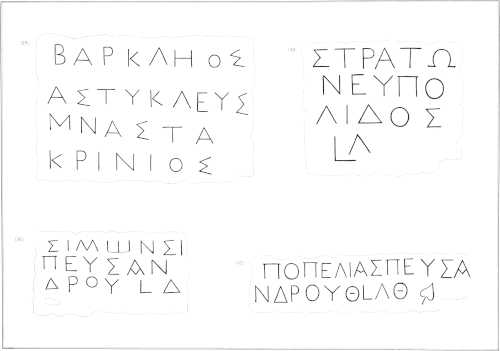
Βαρκλῆος
Ἀστυκλεῦς
Μνάστα
Κρίνιος.
Over a recess in the same tomb whence No. 27 is taken. Published, Corpus Inscript., III. No. 5166; and Pacho, tab. LXV. 10, where the first name is incorrectly read Χ]αρ[ι]κλῆος.
No. 30.—Pl. 86. No. 31.—Pl. 86.
Σίμων Σι . . . . . . . . Στράτω-
Πευσάν- ν Εὐπό-
δρου L δ′. λιδος
L λ′.
No. 32.—Pl. 86.
Ποπελίας Πευσά-
νδρου ΘLλθ′.
Nos. 30, 31, 32 are round the entrance of a small tomb in the Eastern Necropolis. The four last letters of l. 2 seem to be ΘΛ[υκάβαντι] λθ′, the year 38, recording probably the age at which Popelias died. The significance of the Θ which precedes the L must be left to conjecture; perhaps it stands for θεοῖς.
No. 33.
. . . . ΡΑΙΑΝΩΙΑΔΡΙΑΝΩ. . . .
. . . . ΟΝΣΥΝΤΩΙΠΡΟΝ . . . .
ΤΩ . . . . ΦΛ . . . . ΦΛ . . . .
Τ]ραϊανῷ Ἀδριανῷ
τὸν να]ὸν σὺν τῷ πρόν[αῳ
τω φλ φλ
On a piece of architrave of sandstone, found in ruins to the north of the temple of Apollo. This appears to be part of the dedication of a temple to the Emperor Trajan.
THE END.
CYRENE. PL. 77. Day & Son, Lithrs. to the Queen INSCRIPTIONS
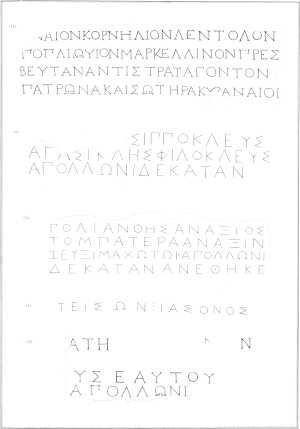
CYRENE. PL. 78. Day & Son, Lithrs. to the Queen INSCRIPTIONS
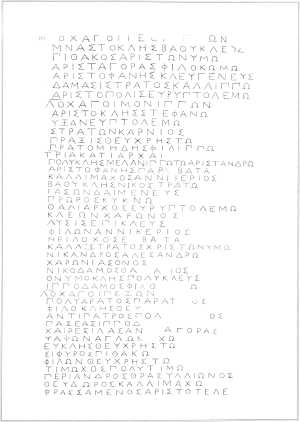
CYRENE. PL. 79. Day & Son, Lithrs. to the Queen INSCRIPTIONS
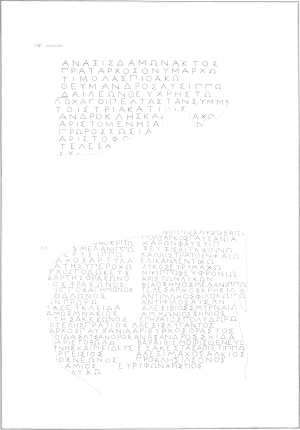
CYRENE. PL. 80. Day & Son, Lithrs. to the Queen INSCRIPTIONS
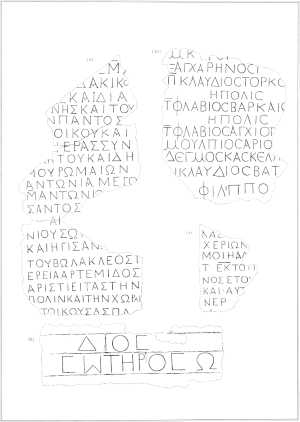
CYRENE. PL. 81. Day & Son, Lithrs. to the Queen INSCRIPTIONS
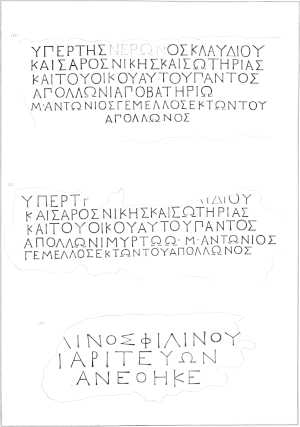
CYRENE. PL. 82. Day & Son, Lithrs. to the Queen INSCRIPTIONS
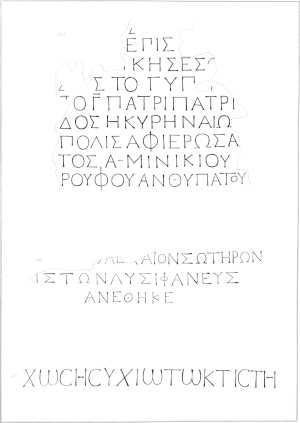
CYRENE. PL. 83. Day & Son, Lithrs. to the Queen INSCRIPTIONS
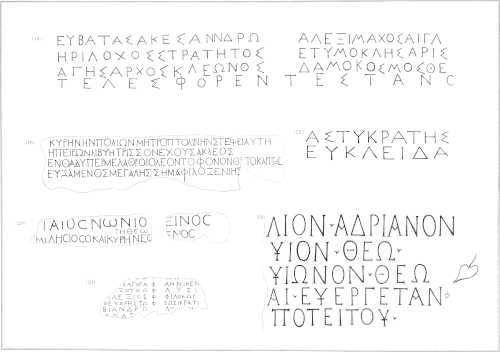
CYRENE. PL. 84. Day & Son, Lithrs. to the Queen INSCRIPTIONS
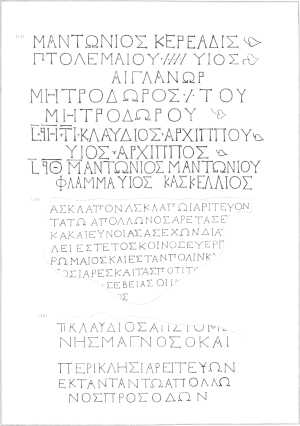
CYRENE. PL. 85. Day & Son, Lithrs. to the Queen INSCRIPTIONS
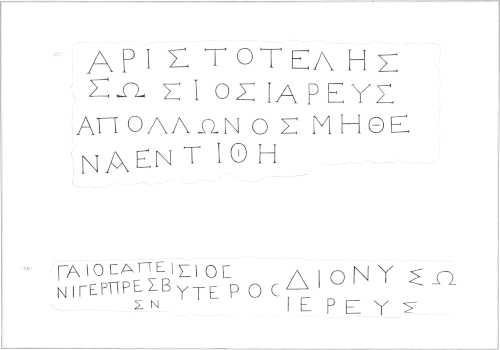
CYRENE. PL. 86. Day & Son, Lithrs. to the Queen INSCRIPTIONS