Chapter VII · THE SIGNIFICANCE OF THE ORDINANCE OF 1787
Reading edition
The name “Old Northwest” implies that the five states included in it share a common historical and social background. Between its southern end, which looks down upon the beautiful Ohio, and its northern extremity, lapped by the blue waters of Huron and Superior, there are wide variations of geographic and economic conditions; yet the teeming millions who now inhabit this region are conscious of an identity of interests, and of a common outlook upon life, which gives to this section an individuality as distinct as that possessed by the people of New England, or of the Old South.
Any explanation of this individuality leads inevitably to the Ordinance of 1787. As mountain peaks overtop the surrounding plain, a few great legislative acts in our history tower above the vast body of statutes which fill the books in our law libraries. Magna Charta, extorted from reluctant King John at Runnymede 700 years ago, is one such document; the Quebec Act of 1774, fateful for the future of Canada and the United States, is another. Of like character are our Federal Constitution, and the Ordinance of 1787, both drafted in the same year; one for the government of the American nation, the other for the government of the land lying north and west of the Ohio River.
The Old Northwest was chiefly a wilderness in 1787, but it was not a vacant wilderness. Everywhere were the native red men, who quite naturally viewed the country as their own, to be defended to the last extremity of their power. At many points—Detroit, Maumee Rapids, Fort Wayne, Vincennes, Kaskaskia, Cahokia, St. Joseph, Prairie du Chien, Green Bay, and Mackinac, to mention a few—were civilized communities which had been founded by the French during the century which ended with the English Conquest of Canada in 1760. Following this, British officials and army officers, traders and adventurers, had entered the western country, and in many instances had inter-married with the older French and Indian population. Although the Treaty of Paris of 1783 had given the West to the new United States, with the Great Lakes and the Mississippi as its northern and western boundaries, the close of the Revolution found Great Britain and the Indians in actual possession of all but the southern tip of the Old Northwest, and this possession she did not surrender until the summer of 1796.
Thus before settlers from the seaboard colonies could occupy the country north of the Ohio, the British government must be expelled from it, and the Indian tribes must be conquered by the United States. The leaders who formed the Ohio Company were substantial New Englanders, many of whom had been officers in the Revolutionary War. They were familiar from infancy with the New England system of local government, and while they were ready to remove to the western country, to develop new homes in the wilderness, they had no thought of abandoning the shelter of organized government. South of the Ohio, settlers had moved into the western country on their individual responsibility, depending upon Virginia and their own resources for protection against savages and wilderness alike. This had been possible because the Kentucky country was not only a rich land of mild climate, but because it had long been a vacant wilderness, where no Indians lived, and no foreign government exercised jurisdiction. So the Boones and Kentons, and their comrades, had moved in before asking permission or protection from any civilized government. The New Englanders, on the contrary, had occupied the wilderness by organized communities, and from ancient habit had organized new towns as fast as they pushed the line of frontier settlement westward and northward. The Indians in the Ohio country were determined to keep the Americans out of it, and they enjoyed the sympathy and support of the British officials. Thus there was every reason why the intruding settlers should insist upon having an organized government go with them into the Northwest.
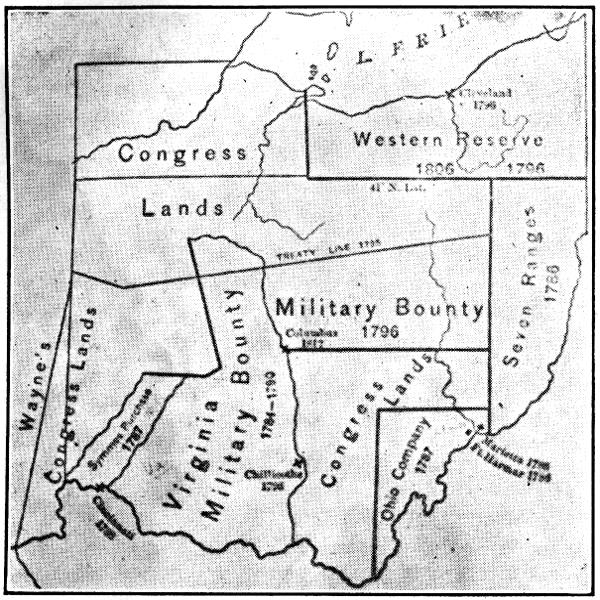
LAND SURVEYS IN OHIO WITH EARLY POSTS AND SETTLEMENTS
So their spokesman went to New York, and persuaded the Confederation Congress to give them the government they wished, and the Ordinance of 1787 was passed. It has been described in earlier chapters, and the purpose of this final section is to show how it influenced the future development of the Old Northwest, and the United States.
The object of the Ordinance is fully stated in its title, “An Ordinance for the Government of the Territory of the United States Northwest of the Ohio River.” It contains two principal parts; the first describes the actual scheme of the government to be erected, while the second contains six articles which are declared to be a “compact” between the people of the original states and the people of the Northwest Territory. At that time the word “compact” was applied to the most solemn agreement known to political science, and the six articles of the present one were to “forever remain unalterable,” unless changed by the common consent of the two parties concerned in it.
The thirteen colonies, which in 1776 declared their independence from England, all lay east of the Alleghany Mountains, with their settled portions extending barely two hundred miles inland from the seashore. Today our country extends from ocean to ocean, a distance of three thousand miles. It was the governmental conception which first found concrete expression in the Ordinance of 1787 which made possible this vast westward expansion of our country, and its development from a union of thirteen seaboard states into a continent-wide nation of forty-eight.
It came about this way: Before the American Revolution, colonies were universally regarded as dependencies, to be governed by the mother country for the promotion of its own advantage. After the conquest of Canada, the British ministry decided to maintain a standing army in America, and since the colonies were to be protected by it, the ministry determined that they should be taxed to support it. The colonists, however, refused to submit to such taxation, and after a long period of argument and debate, made good their refusal by waging a successful war against their king. This success marked the death of the old British Empire, and led directly to one of the most momentous political discoveries in human history.
The colonists had refused to be treated any longer as mere dependents, subject to the control of a distant parliament, in which they were not represented. But even before independence had been won, they found themselves face to face with the same problem, how to govern a dependency, which had baffled the wit of the British ministry. Some of the colonies had claims to portions of land west of the Alleghanies. Other colonies had none, and Maryland in particular demanded that all should share in the ownership of the western country which had been won by the “common blood and treasure” of all the colonies.
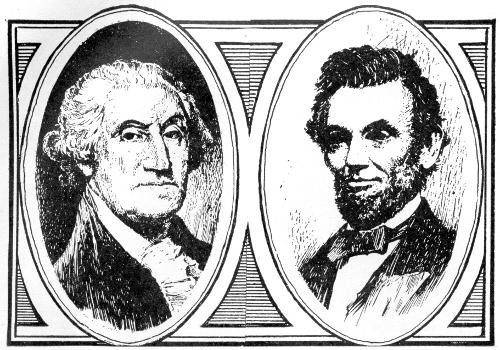
“No colony in America was ever settled under such favorable auspices as that which has just commenced at the Muskingum. I know most of the men personally, and there never were men better calculated to promote the welfare of such a community.”—George Washington.
“—that ordinance was constantly looked to whenever a new territory was to become a state. Congress always traced their course by the Ordinance of 1787.”—Abraham Lincoln.
The debate over this issue went on for several years in the Continental Congress, Maryland, meanwhile, stoutly refusing to accept any federal government until her demand concerning the western country should be met. Out of the long debate was gradually evolved a new political conception for the government of dependencies. The states having claims to lands in the western wilderness ceded them to the general government, to be administered for the common benefit of all; and Congress solemnly pledged that the country thus given to the nation should be organized into new states, which would be admitted to the Union on a basis of equality with the existing states.
This program for the government of America’s own colonial domain eliminated at a single stroke the grievance which had driven the older colonies into rebellion against their king and country. For their complaint, at bottom, was that they were regarded as politically inferior to their countrymen at home, subject to be governed forever by the latter, without regard to their own views or desires. The American program said, in effect, to the western colonists: “While you are few in numbers, strangers to one another, and menaced by hostile forces outside yourselves, the nation will govern and protect you, as a parent governs and protects his child; but as soon as you reach a state of maturity where you can do these things for yourselves, you will be admitted to the union of states, with the same powers and privileges that all the rest enjoy.”
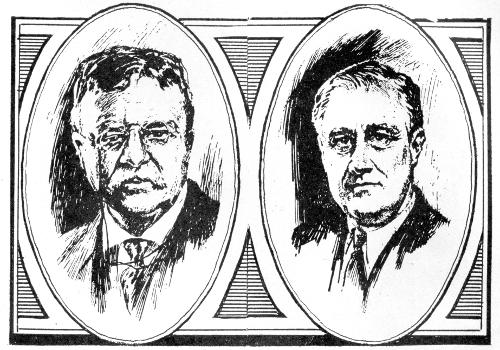
“In truth the Ordinance of 1787 was so wide reaching in its effect, was drawn in accordance with so lofty a morality and such far seeing statesmanship, and was fraught with such weal for the nation, that it will ever rank among the foremost of American State papers.”—Theodore Roosevelt.
“—with respect to that third great charter—the Northwest Ordinance. The principles therein embodied served as the highway, broad and safe, over which poured the westward march of our civilization. On this plan was the United States built.”—Franklin D. Roosevelt.
Thus, and only thus, could the American nation ever have been extended “from sea to shining sea.” The great political discovery which made this extension possible was hammered out in the heat of debate over the formation of our first national union, the government of the Confederation, which came into being in 1781. But it was first given concrete application in the Ordinance of 1787, which provided the form of government for the territory northwest of the Ohio River. This principle, unconfined by the boundaries of the Old Northwest, extends to all the continental expansion of the United States; while Great Britain, profiting by the lessons of experience, has granted self-rule to Canada, South Africa, New Zealand, and Australia, and is gradually extending it to India and Egypt.
The ordinance provided for two stages of government. In the beginning, all political control was entrusted to a governor and three judges, appointed by the federal government, who exercised the supreme executive, legislative, and judicial powers of the territory, and were answerable solely to the President and Congress of the United States. The territory in this first stage was a colony, whose citizens were without the powers of self-government.
As soon, however, as there were 5,000 free adult male inhabitants in the territory, the second stage of government was to be set up. This provided for a general assembly of two houses: the members of one elected by the voters; of the other, by a procedure in which both the voters and the national government shared. To resort again to the analogy of the minor child, we may compare the territory in this second stage with a boy of fourteen or fifteen, old enough to govern himself in ordinary matters, but still in need of parental guidance and control whenever more important problems arise. This state of partial self-government was to be terminated whenever the population of any of the future states (for which Article 5 of the compact made provision) should equal 60,000 free inhabitants. At such time the people might frame a state constitution and government, and be admitted to the Union “on an equal footing with the original states in all respects whatever.” The child had now become a man, invested with all the privileges and responsibilities of manhood’s estate.
Turning to the articles of the compact, Article 5 provides that not less than three, nor more than five, states should be formed from the entire territory, and the north-south boundaries of the three were fixed at approximately the present Ohio-Indiana and Indiana-Illinois lines, extended northward to Canada. If Congress should later see fit to do so, however, it might organize either one or two states in that portion of the territory lying north of an east and west line through the southern extreme of Lake Michigan. Congress eventually organized two northern states, but the provision concerning their southern boundary was ignored, and Ohio, Indiana, and Illinois all gained important accessions of territory north of the “Ordinance line,” at the expense, of course, of the two northern states. Although there was much opposition in Michigan and Wisconsin to these changes, in the end the will of Congress prevailed, and the compact of the ordinance with respect to boundaries was disregarded.
Thus, the five great commonwealths of the Old Northwest owe their existence, and the approximate location of their boundaries, to the Ordinance of 1787. All were governed as territories on the plan prescribed by the ordinance before their admission to statehood. The territorial period for each was marked by political discord, and numerous complaints were made against the officials the President placed over the territories. Many of these complaints were well-founded, but one would hesitate to affirm that any other form of government could have been devised to operate better. The inhabitants always had the consolation of knowing that their period of political dependence was but temporary, and that as soon as they should have the necessary population they would be invested with the powers and responsibilities of statehood.
We must now note briefly certain matters which are closely associated with the story of the Ordinance of 1787.
The corner-stone of our civilization is the institution of private property. Before the Northwest could be settled, the government had to provide for the division of the land into suitable tracts, and its sale to settlers. In 1785 the ordinance creating our national land-survey system was passed, and not long thereafter the first survey of federal lands, that of the Seven Ranges in southeastern Ohio, was begun.
Beginning in 1790, the government waged a five-year war in Ohio and Indiana, resulting in the overthrow of the Indian Confederacy. In 1796 the British government withdrew its garrisons, and its de facto government, which had continued until then in all the northern two-thirds of the Old Northwest, ceased to exist. In 1812 the region was reconquered by the British, but their rule this time lasted only a year, when it was ended for all time by the gun-fire of Commodore Perry’s cannon in the battle of Lake Erie. Meanwhile, by a long series of treaties with the Indians, beginning with Anthony Wayne’s Treaty of Greenville in 1795, the red man’s title to the country was quieted. Government surveyors swarmed over the land, preparing it for purchase and occupancy by the oncoming tide of white settlers. Just sixty years after the appearance on the Ohio of the little band of Yankees who founded Marietta, Wisconsin, youngest of the five commonwealths of the Old Northwest, was admitted to the Union of States. The red race had given place to the white; civilization had succeeded barbarism; the wilderness had been transformed into cultivated fields and thriving cities and towns.
Certain of the articles of compact between the old states and the new demonstrate the advanced thought of the men who framed the ordinance. The first article guarantees forever complete freedom of religious belief and worship. Probably most Americans accept this precious privilege as they do the air they breathe, without giving any particular thought to its value or how it came to them. Yet even today, in many parts of the civilized world, freedom of religious belief and worship is conspicuously lacking.
In other important respects, too, the framers of the ordinance were far in advance of their age—in advance, even, of that more famous body of legislators who framed our national constitution. Included in the articles of compact is a provision guaranteeing the sanctity of private contracts—the first appearance of such a guarantee in any charter of government. This was copied into the United States Constitution, where it became the basis of the vast development of private corporations with which we are today familiar. In 1819 the Supreme Court, in the famous Dartmouth College Case, carried this guarantee to its logical conclusion by ruling that a charter or franchise is a contract, which, once granted by a state legislature or other governing body, cannot be withdrawn.
Of tremendous portent to our social system of today was the abolition of the age-old law of primogeniture, the concept that the eldest son alone should inherit the real estate of his parents. Thomas Jefferson had long contended in the Virginia legislature for the adoption of this reform, but it remained for the Ordinance of 1787 to make the first legal provision whereby children should share equally the estates of their parents.
Another provision, well in advance of the age, affords perhaps the most notable sentence in the entire document: “Religion, morality, and knowledge, being necessary to good government and the happiness of mankind, schools and the means of education shall forever be encouraged.” In 1787 “schools and the means of education” found very little encouragement over most of the face of the globe. Today, America is dedicated to the ideal of universal education, and nowhere is more liberal encouragement extended to education than in the five states of the Old Northwest.
In its original contract with the Ohio Company, Congress agreed to give two townships of land for “the uses of a university.” In 1795, with the ink scarcely dry on General Wayne’s treaty with the red men at Greenville, the “college townships” were located and surveyed. In 1802 the legislature of the Northwest Territory passed an act establishing a university in the village of Athens—the first legislative act passed west of the Alleghany Mountains, for the advancement of higher education. Today, each of the five states not only maintains at public expense a great state university, but the pattern set in 1787 has resulted in a nationwide system of colleges and universities aided by grants of public lands. The principle, here originated, of devoting fixed portions of the public lands to the support of schools and education has produced the broadest plan of universal education in the world, providing thereby the most essential aid to the existence of democratic self-government.
In still another respect the ordinance expressed a noble ideal, which, unfortunately, was destined not to be realized. At a time when the Indians of the Old Northwest were determined to prevent the Americans from ever entering the country, the ordinance held out to them the doctrine of the Golden Rule; they should ever be treated with the utmost good faith, their rights and liberties should be respected, and “laws founded in justice and humanity” should be enacted for preserving peace and friendship with them. If such an ideal could be generally realized between nations today, it would free a war-oppressed world from the greatest menace which threatens the continued existence of civilized society.
Another article in the compact proclaimed navigable waters leading into the Mississippi and the St. Lawrence to be common highways, “forever free” to the people of the United States. It is this guarantee which permits the humblest citizen of our country to use and enjoy the rivers and lakes of the Old Northwest for purposes of recreation and travel—a freedom which, but for this guarantee, would frequently be denied him by individual and corporate owners of real estate.
One final provision demands our attention. In 1787 the institution of human slavery existed in all but one of the states of the Union. But many humane and far-sighted men recognized its evils, and one in particular, Thomas Jefferson of Virginia, was unwearied in his efforts to abate it. Although Jefferson was not the author of the Ordinance of 1787, it was largely because of his influence that its final article dedicated the Old Northwest—then, of course, the new Northwest—to freedom. “There shall be neither slavery nor involuntary servitude in the said territory ...” the article begins, continuing with certain provisos respecting criminals and fugitives from justice. Several decades were to pass before the soil of the Old Northwest endured its last pollution from the footprints of a slave, but the prohibition proved an effective ban against the widespread expansion of slavery over the territory, and eventually exterminated it here completely. In doing so, the ordinance prepared the way for its ultimate extermination in the nation; for when civil war came and North and South faced each other on the field of battle during four awful years, it was the exuberant might of the free Northwest which decided the issue in favor of permanent Union and human freedom.
In 1787 the United States was a feeble confederacy of less than three million souls, almost all of whom dwelt within two hundred miles of the Atlantic seaboard. Today it stretches from sea to sea with a population of nearly 130,000,000. The thirteen original states have increased to forty-eight great and harmonious commonwealths. In the five states of the Old Northwest dwell 26,000,000 people. Mere numbers do not mean everything, however, else China and India would be the world’s foremost nations. The Old Northwest is today the political and industrial heart of the nation and, although the territory comprises but one-twelfth of the land area, one-fifth of the nation’s population lives within its boundaries.
The time that has elapsed since 1787 may be spanned by the lives of two elderly men, yet the changes which have been wrought in the Old Northwest since the first feeble American beginnings at Marietta would have staggered the imagination of any man then alive. Here began the political expansion of the United States; here the principles which made possible the development of the nation we know today were first concretely applied. Such is the historical significance of the Ordinance of 1787.
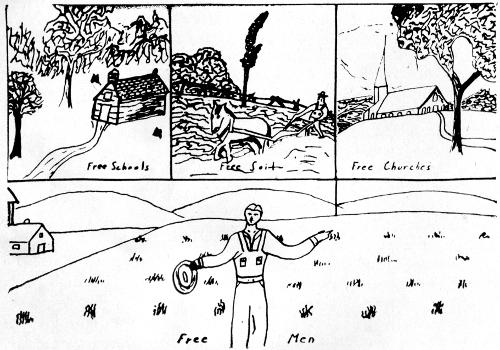
FREE SCHOOLS, FREE CHURCHES, FREE SOIL, FREE MEN
Drawn by Mary Brent Davis, Coshocton, Ohio