FORTY-EIGHTH REGIMENT M. V. M. (continued 2)
Reading edition
The regiment, as finally made up, represented all classes. It contained recruits from the best old New England families in Essex and Middlesex, and from emigrants recently from foreign countries. A good example of the former was the late Samuel Hoar of Concord (son of the late Judge E. Rockwood Hoar and nephew of the late Senator George F. Hoar), who left college to enlist as a private soldier in Company E, and who served the full term, then re-entered and graduated at Harvard College. He subsequently became a very able lawyer and distinguished citizen. He died April 11th, 1904, aged 59 years.
Col. Eben F. Stone was a man of high character and standing in the community in which he lived, and that had much to do with his selection to command the regiment. As time went on he failed somewhat as a tactician, and the regiment was at a disadvantage on this account, although he could have passed an excellent examination in tactics. He was a brave officer and well liked by the officers and soldiers of his regiment. Colonel Stone, after the war, made an honorable record in the civil service of the government. He served two years in the State Senate and two terms in Congress.
Lieut.-Col. O’Brien was regarded as a good officer and brave to the degree of recklessness.
Capt. Stanwood earned the promotion which he received by a unanimous election as Lieutenant-Colonel by able, faithful, and patriotic services.
Dr. Yorick G. Hurd was one of the best surgeons of the Civil War. The death rate from sickness in our regiment was less than in any other in the Department, and that was due in great part to the faithful, conscientious, and untiring services of Dr. Hurd. He had not a lazy bone in his body. After the war he rendered good services in the military and civil service of the State. He was medical director of the Division on the Staff of General B. F. Butler, with rank of Colonel, from 1867 to 1876. He served two years in the State Senate. He did for many years excellent service as Master of the House of Correction and Superintendent of the Insane Asylum at Ipswich.
Capt. Edgar J. Sherman (of the same family of Roger Sherman and General William T. Sherman), enlisted as a private soldier and was subsequently elected Captain of Company F.
When the regiment advanced on Port Hudson he was in the hospital sick of malarial fever. Hearing of the affair of Plains Store, the Captain, somewhat relieved of the fever but weak and emaciated, decided to join the regiment. The surgeons tried to induce him to remain a while longer, but not succeeding in this, gave orders forbidding it. The next morning the Captain put on his uniform, left the hospital, and took the early steamer for Springfield Landing. There he was met by the surgeons who called him a “walking ghost,” and ordered him back to Baton Rouge. The Captain said he was not going on duty but only to visit the surgeon of his regiment and he was allowed to proceed.
He was there several days, remaining with Dr. Hurd, when he learned that there was to be a charge on the enemy’s works the next day. He at once determined to go on duty. The Colonel and surgeon advised against it, withholding their consent, the doctor saying, “Captain, if you go into this fight and are not killed, your fever will come back and you will leave your bones in Louisiana.” Capt. Sherman made the long march that night, with the aid of his soldiers, and led his two companies which carried the colors in the charge next day. When the charge did not succeed and the order came to get off the field, the Captain finally reached the ravine on the left, and was subsequently carried on a stretcher to the rear. Dr. Hurd found him exhausted, with the fever returning, and ordered him sent at once to the hospital at Baton Rouge.
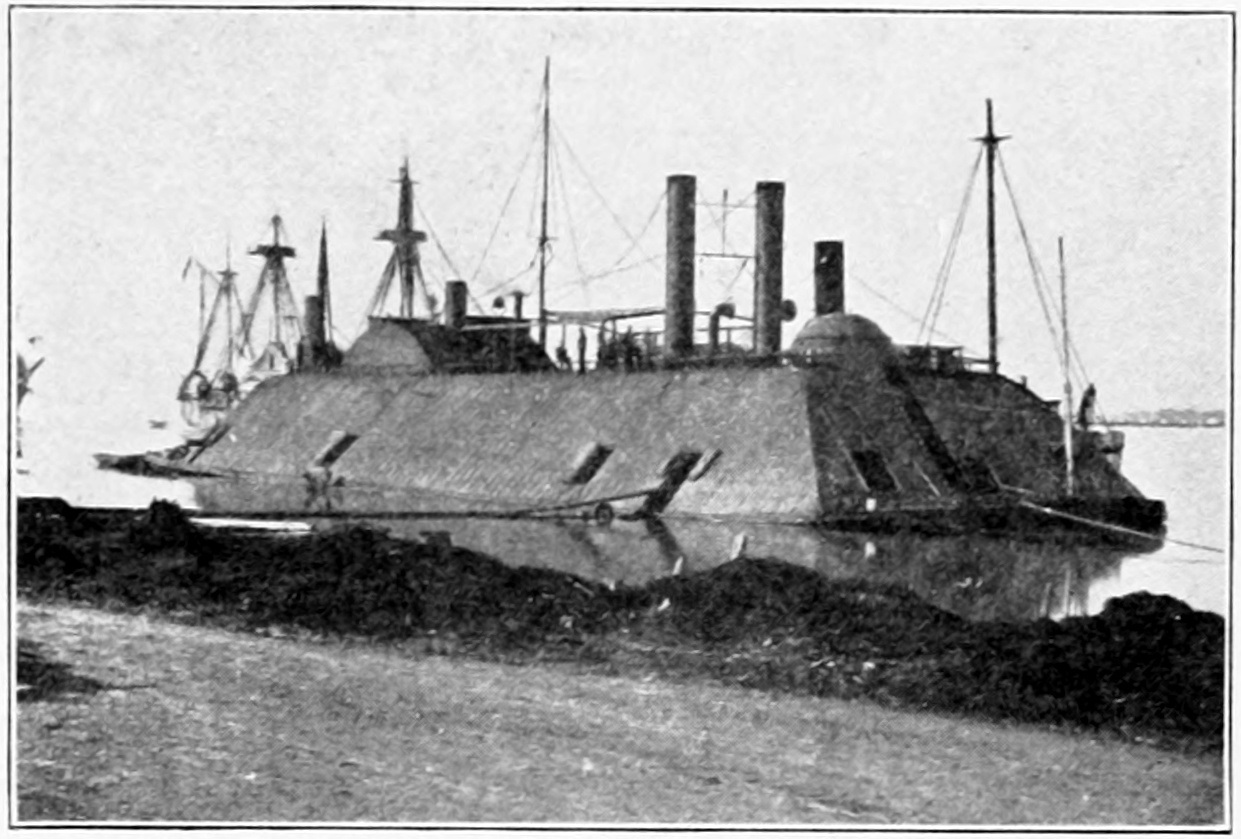
THE IRONCLAD ESSEX.
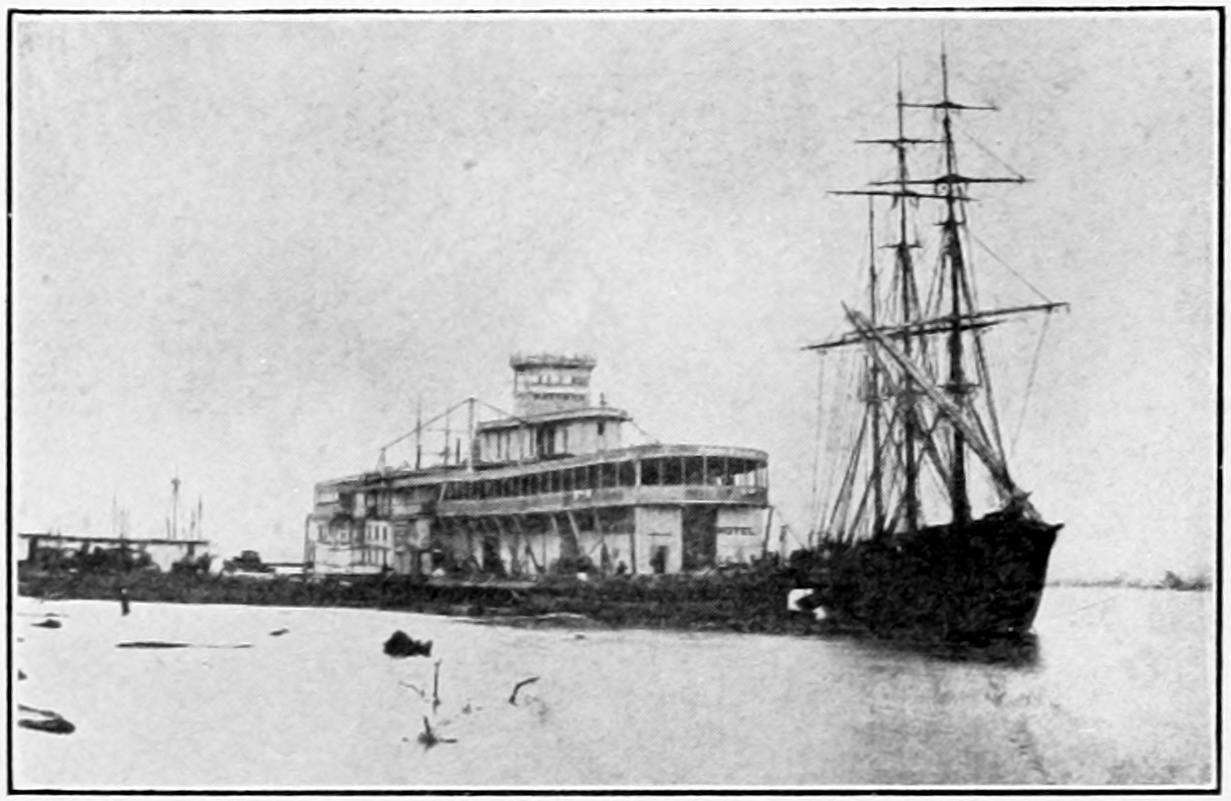
WHARF BOAT NATCHEZ,
At Baton Rouge, La., 1863.
Just as the Captain was being put into the ambulance he said to Dr. Hurd, “It is too bad about poor Captain Todd; he went down right in front of me and we went right on over his dead body.” “Not by a d—— sight!” said the Doctor. “I took an old broken French bayonet three inches long out of his mouth and he is all right.”
Captain Sherman was seriously and dangerously ill for some time, and it was feared that the Doctor’s prophecy might become true,—that the Captain would “leave his bones in Louisiana,” but he recovered sufficiently to return home with the regiment.
Officers and men were so much needed at the time that Captain Sherman’s disobedience of the order “not to leave the hospital” was condoned, and upon the recommendation of his superior officers, he was brevetted Major “for gallant and meritorious services.”
Major Sherman subsequently served in the military and civil services of the State. In 1864, at the time of General Early’s raid on Washington, he raised a company for one hundred days and was elected its Captain, and the company became Company K of the 6th Regiment.
He served as Assistant Adjutant General, with the rank of Colonel, and as Chief of Staff of the Division, General B. F. Butler’s, from 1867 to 1876. He served fourteen years as District Attorney for Essex County, five years as Attorney General, and now a Justice of the Superior Court, where he has served since 1887.
Capt. J. Scott Todd was an excellent officer, always faithful to every duty.
He was wounded and disabled in the charge on June 14. The enemy were short of ammunition and they used broken iron. An old piece of a French bayonet three inches long struck him in the mouth, knocking out his upper and under front teeth, cutting his tongue in two, its full length, and finally embedded itself in the roof of his mouth. The blow was so severe that the Captain lay on the field stunned and unconscious for a long time. With assistance he finally reached the rear and the doctor removed the iron and he was soon in condition for duty.
After the war the Captain did honorable service in the civil government of the State. He served two years in the State Senate. He also served for many years as a Trial Justice.
The following is taken from Hanson’s History of the Sixth Regiment:
“Company K, Capt. Edgar J. Sherman, Lawrence.
“This company was a new one, raised mostly in Lawrence upon the call of the Governor for five thousand one hundred days men. Recruiting commenced on the 11th day of July, the company was filled on the 12th, went into camp on the 13th, was mustered into service on the 14th and on the 15th and 16th the men were clothed, armed and equipped throughout and ready to move on the 17th—just six days after the first movement was made.
“Captain Sherman, says the Lawrence American (edited by Captain Merrill, who was at Port Hudson in the Fourth Regiment), under extraordinary difficulties, raised a company of nine months men, enlisting himself as a private, from which he was promoted to a Captaincy, and, as we personally know, no braver or more faithful officer has left our city. Always attentive to the needs of his men, and even when weak and emaciated with sickness, as we saw him at Port Hudson (in the 48th Massachusetts) leaving the hospital, against the positive prohibition of the surgeon, to lead his men in the assault. He was brevetted Major for ‘gallant and meritorious services.’”