VII. THE FEED INDUSTRY OF THE UNITED STATES
Reading edition
"Sixty years ago (1853) there was no knowledge of scientific feeding in the United States. Sixty years ago there was no feed industry in the United States. Thirty years ago (1883) the teaching of scientific feeding in the United States began. Thirty years ago the feed industry in the United States began. When I say that sixty years ago there was no feed industry in the United States, I mean that there was no feed industry such as we of the present day apply to the term. At that time, the population of the United States was only one-fourth what it is today. The problem of feeding domestic animals, as well as human beings, was simplicity itself, in fact it was not a problem. We had more land than we knew what to do with. The owner of livestock raised more grain and more hay and had more pasturage than he had animals to consume or than he had a market for. Domestic animals were fed on the natural grains and hays, grown upon the same farms as themselves. The city or town owner of horses or livestock bought his feed stuffs mostly direct from the farmer who grew them. By-product materials of the greatest feeding value, while produced in far smaller quantities than at the present day, were not sufficiently appreciated nor sufficiently needed to cause the farmer to make the effort to haul them from the mill or factory to his farm, much less to buy them. Scientific feeding with a knowledge of the balanced ration had not as yet been taught in our state universities. The value of grinding the natural grains was only slightly understood and was practiced only in a very limited way by a few of the more progressive and thoughtful feeders. Flour mills experienced the greatest difficulty in finding a market for their bran and middlings. While these by-products were probably the first to be recognized as of great feeding value, yet hundreds of thousands of tons were sold for a few dollars a ton, or burned, or run into streams, for there was no market. Cottonseed meal as a feeding stuff was at that time unknown. Holes were dug into the ground at the cotton gins and the seed was buried as a means of getting rid of it. Distillers' and brewers' grains, starch factory by-products, molasses, oatmeal by-products, oat clippings, and many others were frequently piled up on vacant lots to decay or run into the streams, or given to such farmers as could be induced to haul them away, and the earliest practical use of them was by the manufacturers who fed cattle with them in their wet or underground state at the factories. No attempt was made to dry them or put them into form to be utilized commercially. Instead of being sources of great revenue to the manufacturer, they were, in many instances, the cause of great expense. Because of the waste and expense and the low prices realized, the cost of the main products—the food for human beings—was very greatly increased."[39]
"Here is a fact worth careful noting, that in these days of close competition, every cent realized for a by-product is credited to the cost of producing the main product—the human food—and that in addition to itself being converted into additional food for man, that is, into meat, dairy products, poultry, eggs, etc., its sale operates directly in a very large way as a saving to the consumer upon the main product from which it is derived. In other words, there is only one profit figured, and that is upon the main product—the food for man—the by-product being figured solely as such, sold for what it will bring, and the returns credited to the cost in figuring cost prices for the main product.
"The problem of feeding the world—much less the problem of feeding the people of the United States—had not as yet commenced to trouble the scientist, the statesman, or the business man of the day. No one expected that in the short space of sixty years, all of our available lands would be occupied and that our population would have increased from 31,000,000 to 91,000,000 people, and that the problem of the cost of living, the cost of food, would, during the lives of people then living, be the thought and problem uppermost in the minds of our people. That this is the thought uppermost in the minds of our population today is evidenced by the daily conversations of our friends, by what we read in the newspapers, and by the action of Congress and our National Government in providing a commission for investigation of its cause."
The following data was taken from the Statistical Report of the Illinois State Board of Agriculture, December 1, 1913,—(Assessor's Reports)
Illinois Pasture Lands
Year Acreage
1877 4,367,603
1878 3,983,450
1879 4,193,884
1880 4,257,054
1881 2,206,621
1882 4,697,966
1883 4,752,828
1884 5,085,817
1885 5,417,147
1886 5,537,873
1887 5,630,571
1888 5,796,935
1889 5,679,874
1890 5,083,438
1891 4,681,972
1892 4,338,899
1893 4,954,871
1894 5,052,952
1895 4,631,270
1896 4,389,666
1897 4,745,917
1898 4,669,270
1899 4,880,101
1900 4,857,961
1901 4,774,062
1902 4,569,905
1903 4,447,287
1904 4,377,486
1905 4,359,426
1906 4,243,030
1907 4,308,402
1908 4,022,598
1909 3,807,796
1910 3,970,302
1911 3,819,412
1912 3,593,523
1913 3,521,966
(United States Census, and Year Books of Agricultural Department)
Year Acres of Imp. Land Av. Val. of F. and Build's. per acre Av. Val. Per Farm Acres of Far. Land Percent Increase in Farms Percent Increase in Farm Land Percent of Land Area in Farms Percent of Farm Land Improved Farm Land in Ill.
Total Cultivated
1850 5,039,545 $ 7.99 $ 1,663 12,037,412 33.6 41.9 35,867,520 32,522,937
1860 13,096,374 15.96 3,480 20,911,989 88.1 73.7 58.3 62.6
1870 19,329,952 28.45 4,358 25,882,861 41.5 23.8 72.2 74.7
1880 26,115,154 31.87 4,598 31,673,645 26.1 22.4 88.3 82.5
1890 25,669,060 41.41 6,140 30,498,277 -5.9 -3.7 85.0 84.2
1900 27,669,219 53.84 7,588 32,794,728 9.8 7.5 91.4 84.5
1910 28,048,323 108.32 15,505 32,522,937 -4.6 -0.8 90.7 86.2
(United States Census Report)
Year Population No. Farms Average Size of Farms No. B. C. Per Farm No. B. C. Per Capita (Population) No. B. C. Per Acre Farm Land
1790
1800 5,641
1810 24,520
1820 147,178
1830 343,031
1840 685,866
1850 851,470 76,208 158. acres 7.1 .63 .0045
1860 1,711,951 143,310 145.9 " 9.9 .83 .0067
1870 2,539,891 202,803 127.6 " 7.7 .62 .0060
1880 3,077,871 255,741 123.8 " 7.8 .65 .0063
1890 3,826,352 240,681 126.7 " 7.1 .46 .0056
1900 4,821,550 264,151 124.2 " 7.07 .38 .0057
1910 5,638,591 251,872 129.1 " 4.9 .22 .0038
The Corn Crop of Illinois for Fifty-four Years.
Year Acreage Yield Price
1860 3,839,159 30 42½
1861 3,839,159 30 24
1862 3,458,903 40 23
1863 3,773,349 22 62
1864 4,192,610 33 75
1865 5,032,996 35 29½
1866 4,931,783 32 43
1867 4,583,655 24 68
1868 3,928,742 34 48
1869 5,237,068 23 57
1870 5,720,965 35 35
1871 5,310,469 38 32
1872 5,468,040 40 24
1873 6,839,714 21 32
1874 7,421,055 18 56
1875 8,163,265 34 34
1876 8,920,000 25 31
1877 8,935,411 30 28
1878 8,672,088 29 22
1879 7,918,881 39 32
1880 7,754,545 33 33
1881 7,157,334 24 53
1882 7,371,950 24 42
1883 7,304,596 25 36
1884 6,898,819 33 29
1885 7,212,657 32 28
1886 7,153,289 25 30
1887 6,719,126 19 41
1888 7,047,813 39 28
1889 6,988,267 35 23
1890 6,114,226 27 45
1891 5,754,147 38 38
1892 5,188,432 26 35
1893 6,416,488 26 30
1894 6,705,476 31 39
1895 6,922,921 39 21
1896 6,881,400 42 17
1897 7,051,527 34 21
1898 6,943,992 31 26
1899 6,941,548 37 26
1900 8,050,550 38 31
1901 8,077,621 23 58
1902 8,199,031 39 35
1903 7,955,980 35 34
1904 7,875,471 36 39
1905 7,698,411 40 38
1906 7,621,562 37 36
1907 7,294,873 35 44
1908 6,780,507 31 57
1909 7,288,563 36 52
1910 6,889,721 41 37
1911 6,623,579 38 55
1912 6,878,797 39 40
1913 6,635,847 27 63
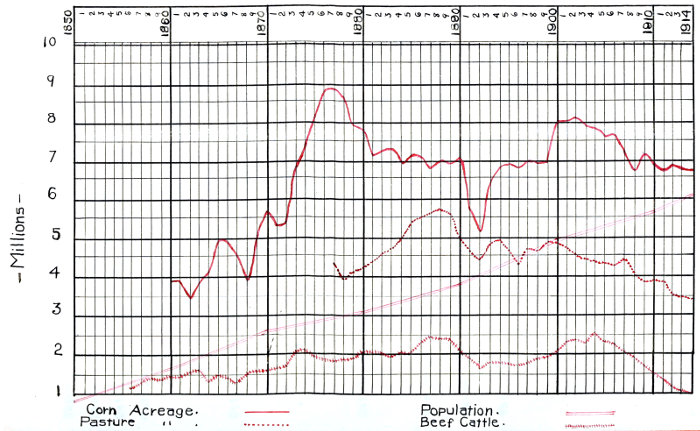
Showing the corn acreage, pasture acreage, number of beef cattle, and the population of the state of Illinois from 1850 to 1914 inclusive.