APPENDIX VI. THE BATTALION CANTEEN.
Reading edition
A thoughtful enemy provided the Battalion with most of its excitement, and a deal of its amusement, during the Great War. An equally thoughtful War Office arranged for rations, and a limited supply of such luxuries as tobacco and cigarettes for the men. But it was left to the Battalion to supply itself with a canteen. And it was Sergt. F. Smith who made that institution such a great success.
The Canteen had its beginning in a small affair, started for the benefit of the transport men, in August, 1915. Lieut. J. G. Mowat, who was Transport Officer at the time, provided the necessary capital. Pte. F. Smith, then employed in the Q.M. Stores, managed the Canteen in his spare time. From the very first, the new departure was a great success. Goods were sold out almost as soon as they were displayed, and the small library which was opened was also very popular.
Early in its history, this first Canteen nearly came to an untimely end. One night the roof was found to be in flames, which rapidly spread to the wooden supports of the building. The “proprietor” alone knew that a store of petrol and bombs was lying in the hut. But, largely through the energy of that trained fireman, Cpl. E. Ashworth, the fire was put out before it reached them.
In September, 1915, the transport canteen developed into a battalion institution. Plenty of money was forthcoming to start it, and it soon “set up shop” in a dugout on the Canal Bank. This was not an ideal spot for business, and there is no doubt that it was the first canteen to be set up in that area. When the Battalion went back into rest the Canteen accompanied it, and, before long, it was looked upon as a permanent institution.
In the spring of 1916, the Canteen closed down for a time. Lance-Cpl. F. Smith had been evacuated sick, and no one else was deemed suitable to carry on the business. He returned to the 147th Infantry Brigade late in the Battle of the Somme, but was posted to the 1/5th Battalion Duke of Wellington’s Regt. However, shortly after, through the courtesy of that battalion, he returned to his old unit, and the Canteen was immediately restarted.
At Fonquevillers it did excellent service. Stationed in a broken-down building in the village, and frequently annoyed by enemy shelling, it soon became the admiration of all units in the neighbourhood. At first it had only been intended for the use of men of the Battalion, but it was now thrown open to all comers. Within less than a mile of the firing line, it provided such luxuries as fresh fish, eggs, butter, fruit and vegetables. Needless to say, it did a “roaring” trade.
During the rest at Halloy, it was much to the fore, and its activities were greatly extended. In addition to an enormous retail business, it catered for all the Christmas dinners and for many smaller parties. It also became a buying agency, through which officers and other ranks could obtain goods which they required but which were not ordinarily kept in stock.
When the Battalion went into the line near Berles-au-Bois, the Canteen was set up as usual. There it narrowly escaped a violent death. A shell entered by the roof one day and blew out a side of the shelter, wounding a man who was there, and scattering the cash which was being counted at the time. During the terribly cold weather of that period, hot coffee and rum were supplied free to many a half-frozen man.
Senechal Farm and the Ferme du Bois Sector provided plenty of scope for the Canteen’s initiative. Good shopping centres were plentiful in the district, and supplies easily procurable. “Hawking” goods in the front line became quite an institution there, and it was continued in the Cordonnerie Sector. In the line near Hulluch the facilities were not so good. A Canteen was set up near Battalion H.Q., but it was difficult to get goods up to it; and twice the staff was gassed out.
Little could be done in the Nieuport Sector, though the Canteen still acted as a buying agency. But while the Battalion was training on the coast it was very active. There, whole-day training schemes were not uncommon, and it became customary for a limber to accompany the troops and set up a stall on the ground.
The winter of 1917–18 was a very difficult period. There was never accommodation for a canteen when the Battalion was in the front line; but it was always at work during rest periods. Its presence in the Westhoek Dugouts was a great success; beer was never lacking during that rest period.
The sudden order to move from Maida Camp, early in April, 1918, caused much consternation, for the Canteen was particularly well stocked at the time. However, the stock was somehow cleared, and the takings on the last day in that area amounted to 4,500 francs—a Battalion record.
Little business was possible during the Battles of the Lys and Mont Kemmel, but an increase in trade followed the Battalion’s return to the neighbourhood of Ypres. Trade again declined when the Battalion went into battle in the autumn; but the indefatigable Sergt. Smith succeeded in getting a large supply of cigarettes up to the Battalion in Vordon Wood—at a time when there was not a cigarette to be had for miles around.
During the Armistice, trade was good at Auby, in spite of the competition of a number of estaminets and shops which were soon opened in the village. There Sergt. F. Smith laid down his duties and devoted himself to education for the short period before he was demobilised. Yet, right up to the end, the Canteen survived at Douai.
In its long and chequered history the Canteen had many homes. Dugouts and shelters, within easy range of the front line, were occupied on many occasions. Barns, stables, even a pig-sty, did duty in various places when the Battalion was in rest. But, whatever its surroundings might be, it always proved a source of much comfort to the men. There were many rumours of the “row of houses” which was being built in Halifax, for few people were well acquainted with current prices. But actually, the profit was never more than 5 per cent. Out of this profit all expenses had to be paid; the whole of the balance was then spent on the men of the Battalion, who were the chief customers. When the demobilisation of the Battalion was complete, the surplus funds were handed over to the Old Comrades’ Association.
The Canteen staff had many duties besides those of buying and selling. The Battalion library, which was run almost continuously for about three and a half years, was in its charge. When billets were available, reading and recreation rooms were organised. Sports material was looked after. Concerts, whist drives, and other social functions were catered for. In all these activities, the efforts of Sergt. Smith were ably seconded by his faithful henchmen, “Jack” Baines and “Johnny” Jackson.
The Battalion was particularly fortunate in having so many good friends at home. Chief among these should be mentioned Mr. W. E. Denison and the Halifax Courier Fund. Books, periodicals, whist drive prizes, lamps, and countless other articles, which helped to make life happier for the men at the “Front,” were provided by them.
The Battalion had several different Seconds-in-Command and all took great interest in, and spent much time over, the Canteen. But it had only one Sergt. F. Smith. To him was mainly due the reputation of the 4th Battalion Canteen as the most successful institution of its kind in the 49th Division. Everyone was delighted when the Meritorious Service Medal rewarded his great services.
Stott Brothers Limited, Printers, Mount Street Works, Halifax.
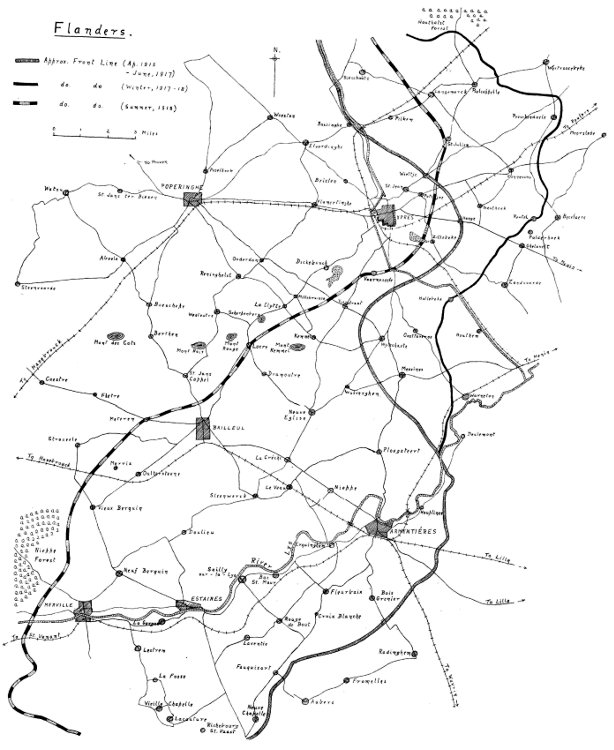
Flanders.
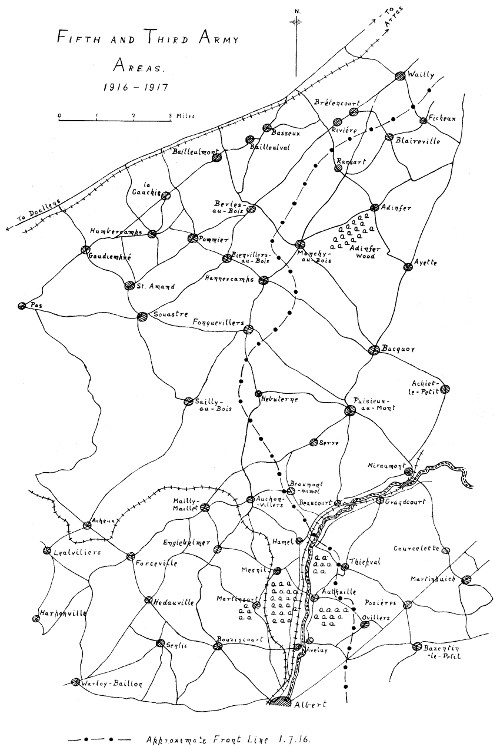
Fifth and Third Army Areas.
1916–1917
—·—·—Approximate Front Line 1.7.16.