NEW BRUNSWICK (continued 4)
Reading edition
Many of the Loyalists who came in the spring had gone further up the river, but they were little better off for provisions than we were at St. Ann's. Supplies expected before the close of navigation did not come, and at one time starvation stared us in the face. It was a dreary contrast to our former conditions. Some of our men had to go down the river with hand-sleds or toboggans to get food for their famishing families. A full supply of provisions was looked for in the Spring, but the people were betrayed by those they depended upon to supply them. All the settlers were reduced to great straits and had to live after the Indian fashion. A party of Loyalists who came before us late in the spring, had gone up the river further, but they were no better off than those at St. Ann's. The men caught fish and hunted moose when they could. In the spring we made maple sugar. We ate fiddle heads, grapes and even the leaves of trees to allay the pangs of hunger. On one occasion some poisonous weeds were eaten along with the fiddle heads; one or two died, and Dr. Earle had all he could do to save my life.
As soon as the snow was off the ground we began to build log houses, but were obliged to desist for want of food. Your grandfather went up the river to Captain McKay's for provisions, and found no one at home but an old colored slave woman, who said her master and his man had gone out to see if they could obtain some potatoes or meal, having in the house only half a box of biscuits. Some of the people at St. Ann's, who had planted a few potatoes, were obliged to dig them up and eat them.
Again a few comments will show the reliability of the old lady's narrative. The three houses she mentions on the site of Fredericton were those of Benjamin Atherton, built about 1767 at the upper end of the town, near the site of the old Government House; Philip Weade's, which stood on the river bank in front of the Cathedral, and Olivier Thibodeau's, an Acadian, whose log house was at the lower end of town. The tradition regarding the massacre of some of the first settlers at St. Ann's refers doubtless to the destruction of the French settlement there by McCurdy's New England Rangers in February, 1759, as is described at page 242 in Dr. Raymond's "St. John River History." The party of Loyalists, who had gone further up the river in the late Spring of 1783, were the King's American Dragoons, who settled in Prince William. Resuming once more the narrative, the grandmother says:
In our distress we were gladdened by the discovery of some large patches of pure white beans, marked with a black cross. They had probably been originally planted by the French, but were, now growing wild. In our joy at the discovery we called them at first the "Royal Provincials' bread," but afterwards "The staff of life and hope of the starving." I planted some of these beans with my own hands, and the seed was preserved in our family for many years. There was great rejoicing when the first schooner arrived with corn-meal and rye. In those days the best passages up and down the river took from three to five days. Sometimes the schooners were a week or ten days on the way. It was not during the first year alone that we suffered from want of food, other years were nearly as bad.
The first summer after our arrival all hands united in building their log houses. Dr. Earle's was the first that was finished. Our people had but few tools and those of the rudest sort. They had neither bricks or lime, and chimneys and fireplaces were built of stone laid in yellow clay. They covered the roofs of the houses with bark bound over with small poles. The windows had only four small panes of glass.
The first store was kept by a man named Cairns, who lived in an old house on the bank of the river near the gate of the first Church built in Fredericton [in front of the present Cathedral]. He used to sell fish at one penny each and butternuts at two for a penny. He also sold tea at $2.00 per lb. which was to us a great boon. We greatly missed our tea. Sometimes we used an article called Labrador, and sometimes steeped spruce or hemlock bark for drinking, but I despised it.
There were no domestic animals in our settlement at first except one black and white cat, which was a great pet. Some wicked fellows, who came from the States, killed, roasted and ate the cat, to our great indignation. A man named Conley owned the first cow. Poor Conley afterwards hanged himself, the reason for which was never known.
For years there were no teams, and our people had to work hard to get their provisions. Potatoes were planted among the black stumps and turned out well. Pigeons used to come in great numbers and were shot or caught by the score in nets. We found in their crops some small round beans, which we planted; they grew very well and made excellent green beans, which we ate during the summer. In the winter time our people had sometimes to haul their provisions by hand fifty or a hundred miles over the ice or through the woods. In summer they came in slow sailing vessels. On one occasion Dr. Earle and others went up the river to Canada on snowshoes with hand sleds, returning with bags of flour and biscuits. It was a hard and dangerous journey, and they were gone a long time.
For several years we lived in dread of the Indians, who were sometimes very bold. I have heard that the Indians from Canada once tried to murder the people on the St. John River. Coming down the river they captured an Indian woman of the St. John tribe, and the chief said they would spare her if she would be their guide. They had eleven canoes in all, and they were tied together and the canoe of the guide attached to the hindermost. As they drew near the Grand Falls, most of the party were asleep; and the rest were deceived by the woman, who told them that the roaring they heard was caused by a fall at the mouth of the stream which here joined the main river. At the critical moment the Indian woman cut the cord which fastened her canoe to the others and escaped to the shore, while the Canada Indians went over the fall and were lost.1
In the early days of the settlement at St. Ann's, some fellows that had come from the States used to disturb the other settlers. They procured liquor at Vanhorne's tavern and drank heavily. They lived in a log cabin which soon became a resort for bad characters. They formed a plot to go up the river and plunder the settlers—provisions being their chief object. They agreed that if any of their party were killed in the expedition they should prevent discovery of their identity by putting him into a hole cut in the ice. While they were endeavoring to effect an entrance into a settler's house, a shot, fired out of a window, wounded a young man in the leg. The others then desisted from their attempt, but cut a hole in the ice and thrust the poor fellow in, who had been shot, although he begged to be allowed to die in the woods, and promised, if found alive not to betray them, but they would not trust him.
Here the story of the old grandmother comes abruptly to an end. Enough, however, is preserved in these extracts to indicate the source of a good deal of the very valuable information concerning the early experience of the Loyalists in the New Brunswick wilderness, which appears in Mr. Fisher's "Sketches of New-Brunswick." Doubtless what he has related on this topic in his little book is based upon what he learned from the lips of his mother. To her care and devotion, in all human probability, he owed his preservation during the first eventful winter spent under canvas on the old St. Ann's plain.
Peter Fisher acquired a pretty good education, for those days. A fac simile of his signature is here given, which shows that his penmanship was excellent, and compared more than favorably with that of his son and name-sake, Lewis Peter Fisher, who was for some thirty odd years mayor of Woodstock, and the leading barrister of that place, and whose signature is also here given for comparison.
Signature of Peter Fisher and Lewis Peter Fisher
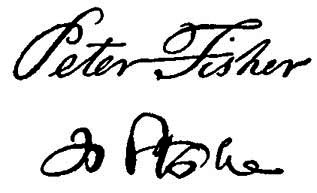
The advantages of education were not great in the elder Peter Fisher's day, but he had a pretty competent instructor in an English school master, Bealing Stephens Williams, who was born in Cornwall in 1754, and came to Nova-Scotia, a clerk in the navy in 1779. He settled in Cumberland, N.S., where he taught school and was married, removing to Fredericton in 1790, where he again taught school for nearly forty years. He was an accomplished penman and an expert in arithmetic and the elementary mathematics. There can be no doubt, I think, that Fisher was indebted to this gentleman for an education that was very fair indeed, in the then circumstances of the country. Fisher unquestionably possessed a good deal of natural ability, and was something of a philosopher, as will appear when we come to consider his writings. He carried on quite an extensive business in lumbering at one time. He was noted as a tireless pedestrian and there were few, even among his juniors, who could keep pace with him in a walk of fifty miles, which he thought nothing of. He married on August 15, 1807, Susanna Stephens Williams, the Rev. George Pidgeon, rector of Fredericton, officiating at the wedding. Their family was a large one, seven sons and four daughters.2 The late Judge Charles Fisher, who was born September 16, 1808, was the oldest. Another son, Henry Fisher, was Chief Superintendent of Education of New-Brunswick. Lewis Peter Fisher, a younger son, was for years Woodstock's most prominent citizen and a very eminent lawyer. Another son, William Fisher, was for some years Indian Commissioner. One of the daughters was the wife of Hon. Charles Connell, Postmaster General, at one time in the local government, and a member of the first Dominion Parliament for the County of Carleton. At least three of the sons of Peter Fisher were actively interested in education. Of these Charles Fisher received the degree of B.A. at King's College, now the University of New Brunswick, in 1830. His was the first class to graduate after the incorporation of the college by Royal Charter, under the name of King's College with the style and privileges of a University. He read law with Judge Street, then Advocate General, was admitted attorney in 1831 and barrister in 1833. He spent a year at one of the Inns of Court in England. His Alma Mater conferred on him the degree of D.C.L. in 1866. Judge Fisher during his public life was a warm friend of the College at Fredericton. At the session of the provincial legislature, in 1859, he moved the bill under which the old King's College was transformed into the University of New-Brunswick. He was later a member of the Senate of the University.
Henry Fisher has already been mentioned as one of the early Chief Superintendents of Education. His portrait may be seen in the office of Dr. W. S. Carter, Chief Superintendent of Education, in Fredericton.
Lewis Peter Fisher, of Woodstock, was for years an active Trustee of the Carleton County Grammar School, and a strenuous advocate of Free School Education. He had no children. By his will he left his large fortune to establish a number of institutions of an educational and philanthropic character in the town of Woodstock, the affairs of which he had long ably administered as mayor. These institutions include:
The Fisher Memorial Hospital, established at a cost of $ 50,000 00
Fisher Memorial Public School 60,000 00
Fisher Vocational School 48,000 00
Fisher Free Public Library 50,000 00
Total $208,000 00
This is the largest individual benefaction to any community in New-Brunswick, if not in the Maritime Provinces. The memorial buildings are all situated within the limits of the town of Woodstock, and, with the exception of the hospital, are handsome substantial brick buildings. In addition to the gift of the buildings and their equipment, the estate contributes from time to time to their maintenance, under the capable administration of the trustees, A. B. Connell, K. C., and Col. F. H. J. Dibblee. It will thus be seen that although the late Mayor of Woodstock left no child to perpetuate his name, his memory will be kept green for future generations as a philanthropist and a man of high ideals.
Space will not admit of any extended reference to the descendants of our first provincial historian. A short sketch of the life of the Hon. Charles Fisher will be found in Lawrence's "Judges of New-Brunswick and their Times," pages 528-532. As a man who in his day rendered essential service to his native province, Charles Fisher deserves a more extensive biography than has hitherto been attempted by any writer.
Footnotes
1 It is of interest to know that this legend was told by the Indians to the English settlers shortly after their arrival. The name of the Indian heroine is given as Malobianah, or Malabeam.
2 I am pretty certain that Susanna Stephens Williams was a daughter of Bealing Stephens Williams, the school master.—W. O. R.