Volume 8 — CHAPTER I—SENNACHERIB (705-681 B.C.) (continued 2)
M. L. McClure translation
Drawn by Faucher-Gudin, from Layard.
Formerly the erection of such edifices cost much in suffering to the artificers employed on them, but Sennacherib brought his great enterprise to a prompt completion without extravagant outlay or unnecessary hardship inflicted on his workmen. He proceeded to annex the neighbouring quarters of the city, relegating the inhabitants to the suburbs while he laid out a great park on the land thus cleared; this park was well planted with trees, like the heights of Amanus, and in it flourished side by side all the forest growths indigenousnto the Cilician mountains and the plains of Chaldæa. A lake, fed by a canal leading from the Khuzur, supplied it with water, which was conducted in streams and rills through the thickets, keeping them always fresh and green. Vines trained on trellises afforded a grateful shade during the sultry hours of the day; birds sang in the branches, herds of wild boar and deer roamed through the coverts, in order that the prince might enjoy the pleasures of the chase without quitting his own private grounds.
Drawn by Faucher-Gudin, from a sketch in Layard.
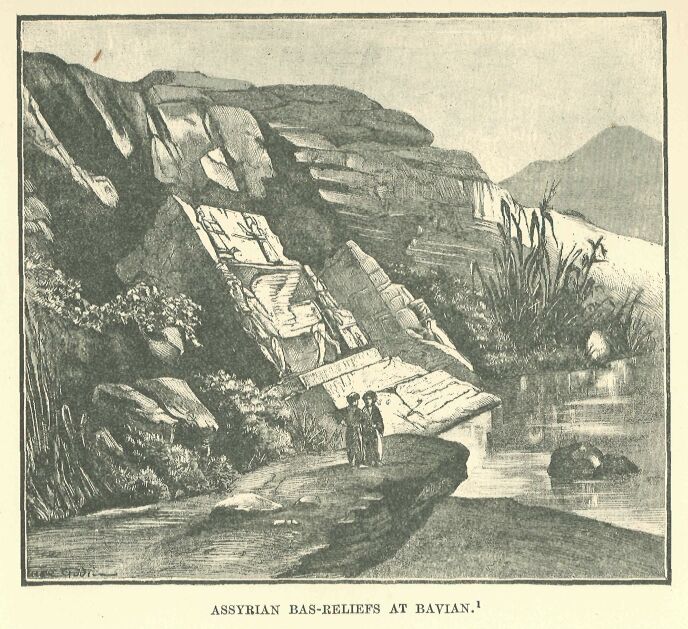
The main part of these constructions was finished about 700 B.C., but many details were left incomplete, and the work was still proceeding after the court had long been in residence on the spot. Meanwhile a smaller palace, as well as barracks and a depot for arms and provisions, sprang up elsewhere. Eighteen aqueducts, carried across the country, brought the water from the Muzri to the Khuzur, and secured an adequate supply to the city; the Ninevites, who had hitherto relied upon rain-water for the replenishing of their cisterns, awoke one day to find themselves released from all anxiety on this score. An ancient and semi-subterranean canal, which Assur-nazir-pal had constructed nearly two centuries before, but which, owing to the neglect of his successors, had become choked up, was cleaned out, enlarged and repaired, and made capable of bringing water to their doors from the springs of Mount Tas, in the same year as that in which the battle of Khalulê took place.* At a later date, magnificent bas-reliefs, carved on the rock by order of Esar-haddon, representing winged bulls, figures of the gods and of the king, with explanatory inscriptions, marked the site of the springs, and formed a kind of monumental façade to the ravine in which they took their rise.**
* Mount Tas is the group of hills enclosing the ravine of Bavian. These works were described in the Bavian inscription, of which they occupy the whole of the first part. ** The Bavian text speaks of six inscriptions and statues which the king had engraved on the Mount of Tas, at the source of the stream.
It would be hard to account for the rapidity with which these great works were completed, did one not remember that Sargon had previously carried out extensive architectural schemes, in which he must have employed all the available artists in his empire. The revolutions which had shattered the realm under the last descendants of Assur-nazir-pal, and the consequent impoverishment of the kingdom, had not been without a disastrous effect on the schools of Assyrian sculpture.
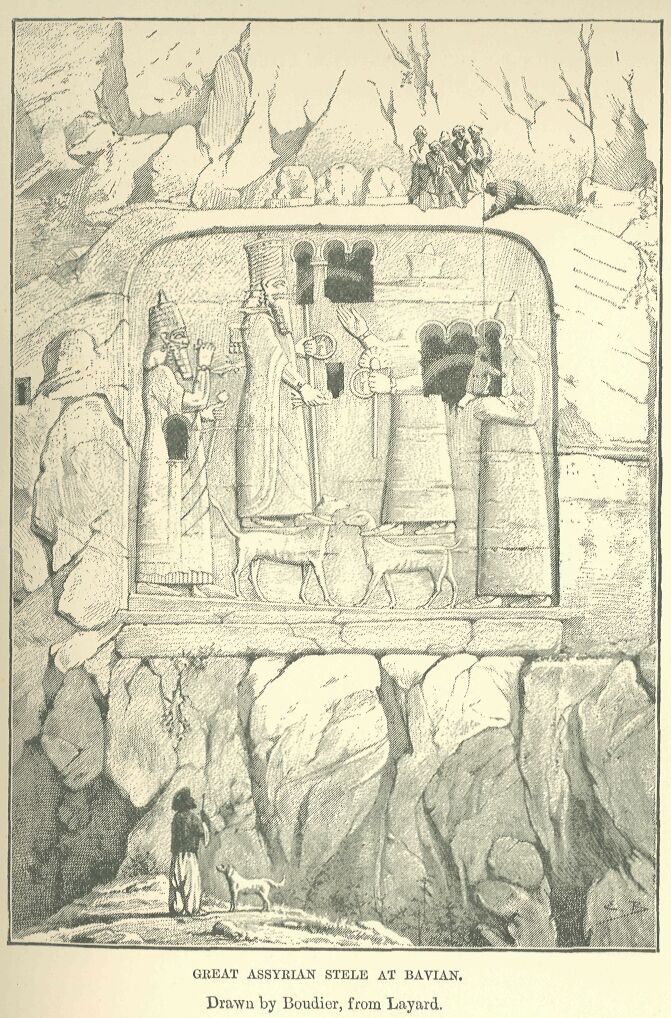
Drawn by Boudior, from Layard.
Since the royal treasury alone was able to bear the expense of those vast compositions in which the artistic skill of the period could have free play, the closing of the royal workshops, owing to the misfortunes of the time, had the immediate effect of emptying the sculptors’ studios. Even though the period of depression lasted for the space of two or three generations only, it became difficult to obtain artistic workmen; and those who were not discouraged from the pursuit of art by the uncertainty of employment, no longer possessed the high degree of skill attained by their predecessors, owing to lack of opportunity to cultivate it. Sculpture was at a very low ebb when Tiglath-pileser III. desired to emulate the royal builders of days gone by, and the awkwardness of composition noticeable in some of his bas-reliefs, and the almost barbaric style of the stelae erected by persons of even so high a rank as Belharrân-beluzur, prove the lamentable deficiency of good artists at that epoch, and show that the king had no choice but to employ all the surviving members of the ancient guilds, whether good, bad, or indifferent workmen. The increased demand, however, soon produced an adequate supply of workers, and when Sargon ascended the throne, the royal guild of sculptors had been thoroughly reconstituted; the inefficient workmen on whom Tiglath-pileser and Shalmaneser had been obliged to rely had been eliminated in course of time, and many of the sculptures which adorned the palace at Khorsabad display a purity of design and boldness of execution comparable to that of the best Egyptian art. The composition still shows traces of Chaldæan stiffness, and the exaggerated drawing of the muscles produces an occasionally unpleasing-heaviness of outline, but none the less the work as a whole constitutes one of the richest and most ingenious schemes of decoration ever devised, which, while its colouring was still perfect, must have equalled in splendour the great triumphal battle-scenes at Ibsambul or Medinet-Habu. Sennacherib found ready to his hand a body of well-trained artists, whose number had considerably increased during the reign of Sargon, and he profited by the experience which they had acquired and the talent that many of them had developed. What immediately strikes the spectator in the series of pictures produced under his auspices, is the great skill with which his artists covered the whole surface at their disposal without overcrowding it. They no longer treated their subject, whether it were a warlike expedition, a hunting excursion, a sacrificial scene, or an episode of domestic life, as a simple juxtaposition of groups of almost equal importance ranged at the same elevation along the walls, the subject of each bas-relief being complete in itself and without any necessary connection with its neighbour. They now selected two or three principal incidents from the subjects proposed to them for representation, and round these they grouped such of the less important episodes as lent themselves best to picturesque treatment, and scattered sparingly over the rest of the field the minor accessories which seemed suitable to indicate more precisely the scene of the action. Under the auspices of this later school, Assyrian foot-soldiers are no longer depicted attacking the barbarians of Media or Elam on backgrounds of smooth stone, where no line marks the various levels, and where the remoter figures appear to be walking in the air without anything to support them. If the battle represented took place on a wooded slope crowned by a stronghold on the summit of the hill, the artist, in order to give an impression of the surroundings, covered his background with guilloche patterns by which to represent the rugged surface of the mountains; he placed here and there groups of various kinds of trees, especially the straight cypresses and firs which grew upon the slopes of the Iranian table-land: or he represented a body of lancers galloping in single file along the narrow woodland paths, and hastening to surprise a distant enemy, or again foot-soldiers chasing their foes through the forest or engaging them in single combat; while in the corners of the picture the wounded are being stabbed or otherwise despatched, fugitives are trying to escape through the undergrowth, and shepherds are pleading with the victors for their lives. It is the actual scene the sculptor sets himself to depict, and one is sometimes inclined to ask, while noting the precision with which the details of the battle are rendered, whether the picture was not drawn on the spot, and whether the conqueror did not carry artists in his train to make sketches for the decorators of the main features of the country traversed and of the victories won. The masses of infantry seem actually in motion, a troop of horsemen rush blindly over uneven ground, and the episodes of their raid are unfolded in all their confusion with unfailing animation.
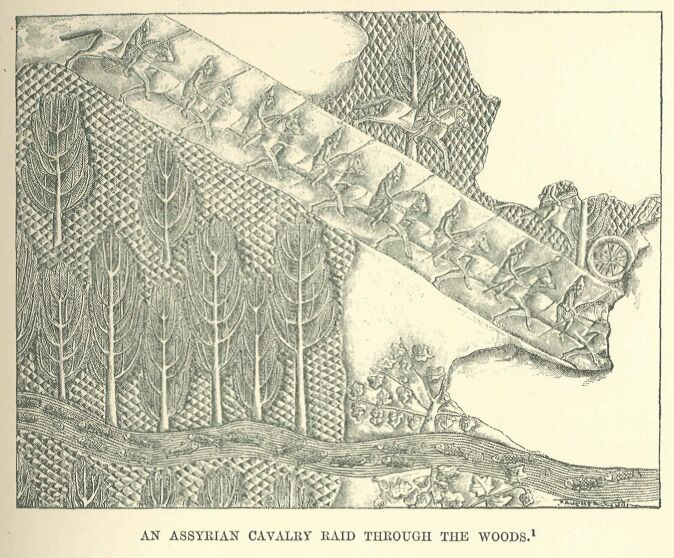
Drawn by Faucher-Gudin, from Layard.
For the first time a spectator can realise Assyrian warfare with its striking contrasts of bravery and unbridled cruelty; he is no longer reduced to spell out laboriously a monotonous narrative of a battle, for the battle takes place actually before his eyes. And after the return from the scene of action, when it is desired to show how the victor employed his prisoners for the greater honour of his gods and his own glory, the picture is no less detailed and realistic.
ENLARGE TO FULL SIZE
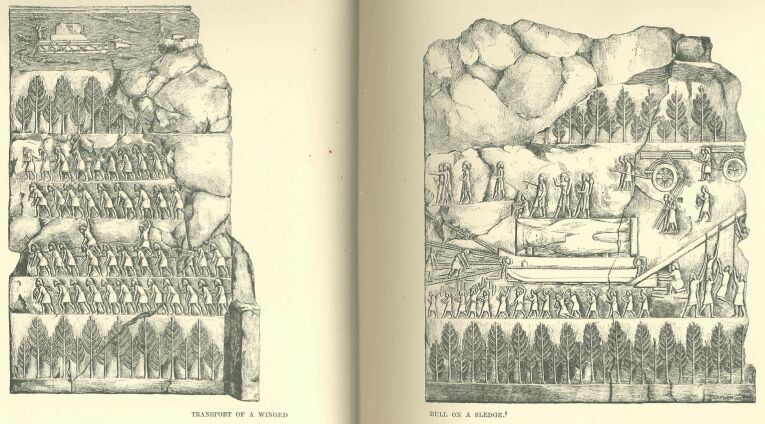
Drawn by Faucher-Gudin, from Layard.
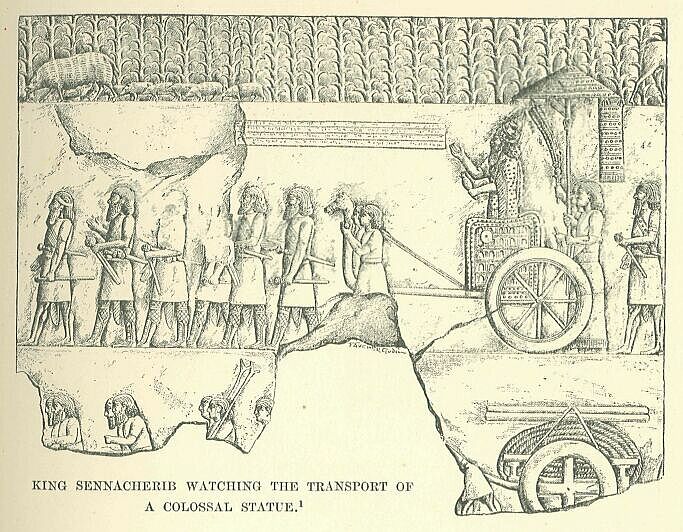
There we see them, the noble and the great of all the conquered nations, Chaldæans and Elamites, inhabitants of Cilicia, Phoenicia, and Judaea, harnessed to ropes and goaded by the whips of the overseers, dragging the colossal bull which is destined to mount guard at the gates of the palace: with bodies bent, pendant arms, and faces contorted with pain, they, who had been the chief men in their cities, now take the place of beasts of burden, while Sennacherib, erect on his state chariot, with steady glance and lips compressed, watches them as they pass slowly before him in their ignominy and misery.
Drawn by Faucher- Gudin, from Layard.
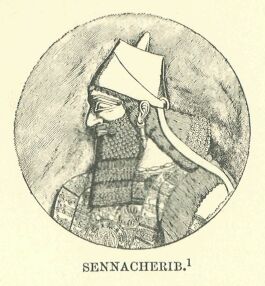
After the destruction of Babylon there is a pause in the history of the conqueror, and with him in that of Assyria itself. It seems as if Nineveh had been exhausted by the greatness of her effort, and was stopping to take breath before setting out on a fresh career of conquest: the other nations also, as if overwhelmed by the magnitude of the catastrophe, appear to have henceforth despaired of their own security, and sought only how to avoid whatever might rouse against them the enmity of the master of the hour. His empire formed a compact and solid block in their midst, on which no human force seemed capable of making any impression. They had attacked it each in turn, or all at once, Elam in the east, Urartu in the north, Egypt in the south-west, and their efforts had not only miserably failed, but had for the most part drawn down upon them disastrous reprisals. The people of Urartu remained in gloomy inaction amidst their mountains, the Elamites had lost their supremacy over half the Aramæan tribes, and if Egypt was as yet inaccessible beyond the intervening deserts, she owed it less to the strength of her armies than to the mysterious fatality at Libnah. In one half-century the Assyrians had effectually and permanently disabled the first of these kingdoms, and inflicted on the others such serious injuries that they were slow in recovering from them. The fate of these proud nations had intimidated the inferior states—Arabs, Medes, tribes of Asia Minor, barbarous Cimmerians or Scythians,—all alike were careful to repress their natural inclinations to rapine and plunder. If occasionally their love of booty overpowered their prudence, and they hazarded a raid on some defenceless village in the neighbouring border territory, troops were hastily despatched from the nearest Assyrian garrison, who speedily drove them back across the frontier, and pursuing them into their own country, inflicted on them so severe a punishment that they remained for some considerable time paralysed by awe and terror. Assyria was the foremost kingdom of the East, and indeed of the whole world, and the hegemony which she exercised over all the countries within her reach cannot be accounted for solely by her military superiority. Not only did she excel in the art of conquest, as many before her had done—Babylonians, Elamites, Hittites, and Egyptians—but she did what none of them had been able to accomplish; she exacted lasting obedience from the conquered nations, ruling them with a firm hand, and accustoming them to live on good terms with one another in spite of diversity of race, and this with a light rein, with unfailing tact, and apparently with but little effort. The system of deportation so resolutely carried out by Tiglath-pileser III. and Sargon began to produce effect, and up to this time the most happy results only were discernible. The colonies which had been planted throughout the empire from Palestine to Media, some of them two generations previously, others within recent years, were becoming more and more acclimatised to their new surroundings, on which they were producing the effect desired by their conquerors; they were meant to hold in check the populations in whose midst they had been set down, to act as a curb upon them, and also to break up their national unity and thus gradually prepare them for absorption into a wider fatherland, in which they would cease to be exclusively Damascenes, Samaritans, Hittites, or Aramæans, since they would become Assyrians and fellow-citizens of a mighty empire. The provinces, brought at length under a regular system of government, protected against external dangers and internal discord, by a well-disciplined soldiery, and enjoying a peace and security they had rarely known in the days of their independence, gradually became accustomed to live in concord under the rule of a common sovereign, and to feel themselves portions of a single empire. The speech of Assyria was their official language, the gods of Assyria were associated with their national gods in the prayers they offered up for the welfare of the sovereign, and foreign nations with whom they were brought into communication no longer distinguished between them and their conquerors, calling their country Assyria, and regarding its inhabitants as Assyrians. As is invariably the case, domestic peace and good administration had caused a sudden development of wealth and commercial activity. Although Nineveh and Calah never became such centres of trade and industry as Babylon had been, yet the presence of the court and the sovereign attracted thither merchants from all parts of the world.
The Medes, reaching the capital by way of the passes of Kowândîz and Suleimaniyeh, brought in the lapis-lazuli, precious stones, metals, and woollen stuffs of Central Asia and the farthest East, while the Phoenicians and even Greeks, who were already following in their foot steps, came thither to sell in the à bazaars of Assyria the most precious of the wares brought back by their merchant vessels from the shores of the Mediterranean, the Atlantic, and the farthest West. The great cities of the triangle of Assyria were gradually supplanting all the capitals of the ancient world, not excepting Memphis, and becoming the centres of universal trade; unexcelled for centuries in the arts of war, Assyria was in a fair way to become mistress also in the arts of peace. A Jewish prophet thus described the empire at a later date: “The Assyrian was a cedar in Lebanon with fair branches, and with a shadowing shroud, and of an high stature; and his top was among the thick clouds. The waters nourished him, the deep made him grow: therefore his stature was exalted above all the trees of the field, and his boughs were multiplied, and his branches became long by reason of many waters, when he shot them forth. All the fowls of the heaven made their nests in his boughs, and under his branches did all the beasts of the field bring forth their young, and under his shadow dwelt all great nations. Thus was he fair in his greatness, in the length of his branches: for his root was by many waters. The cedars in the garden of God could not hide him: the fir trees were not like his boughs, and the plane trees were not as his branches; nor was any tree like unto him in beauty: so that all the trees of Eden, that were in the garden of God, envied him.” (Ezek. xxxi. 3-9).
THE POWER OF ASSYRIA AT ITS ZENITH. ESARHADDON AND ASSUR-BANI-PAL
THE MEDES AND CIMMERIANS: LYDIA—THE CONQUEST OF EGYPT, OP ARABIA, AND OF ELAM.
Last years of Sennacherib—New races appear upon the scene—The Medes: Deiokes and the foundation of Ecbatana, the Bit-Dayaukku and their origin—The races of Asia Minor—The Phrygians, their earliest rulers, their conquests, and their religion—Last of the Heraclidæ in Lydia, trade and constitution of their kingdom—The Tylonidæ, and Mermnadæ—The Cimmerians driven back into Asia by the Scythians—The Treves.
Murder of Sennacherib and accession of Esarhaddon: defeat of Sharezer (681 B.C.)—Campaigns against the Kaldd, the Cimmerians, the tribes of Cilicia, and against Sidon (680-679 B.C.); Cimmerian and Scythian invasions, revolt of vie Mannai, and expeditions against the Medes; submission of the northern Arabs (678-676 B.C.)—Egyptian affairs; Taharqa (Tirhakah), his building operations, his Syrian policy—Disturbances on the frontiers of Elam and Urartu.
First invasion of Egypt and subjection of the country to Nineveh (670 B.C.)—Intrigues of rival claimants to the throne, and division of the Assyrian empire between Assùr-bani-pal and Shamash shumukîn (668 B.C.)—Revolt of Egypt and death of Esarhaddon (668 B.C.); accession of Assur-bani-pal; his campaign against Kirbît; defeat of Taharqa and reconstitution of the Egyptian province (667 B.C.)—Affairs of Asia Minor: Gyges (693 B.C.), his tears against the Greeks and Cimmerians; he sends ambassadors to Nineveh (664 B.C.).
Tanuatamanu reasserts the authority of Ethiopia in Egypt (664 B.C.), and Tammaritu of Elam invades Karduniash; reconquest of the Said and sack of Thebes—Psammetichus I. and the rise of the XXVIth dynasty—Disturbances among the Medes and Mannai—War against Teumman and the victory of Tulliz (660 B.C.): Elam yields to the Assyrians for the first time—Shamash-shumukin at Babylon; is at first on good terms with his brother, then becomes dissatisfied, and forms a coalition against the Ninevite supremacy.
The Uruk incident and outbreak of the war between Karduniash, Elam, and Assyria; Elam disabled by domestic discords—Siege and capture of Babylon; Assur-bani-pal ascends the throne under the name of Kandalanu (648-646 B.C.)—Revolt of Egypt: defeat and death of Gyges (642 B.C. ): Ardys drives out the Cimmerians and Dugdamis is killed in Cilicia—Submission of Arabia.
Revolution in Elam—Attack on Indabigash—Tammaritu restored to power—Pillage and destruction of Susa—Campaign against the Arabs of Kedar and the Nabatæans: suppression of the Tyrian rebellion —Dying struggles of Elam—Capture of Madaktu and surrender of Khumban-khaldash—The power of Assyria reaches its zenith.