Volume 7 — CHAPTER II—TIGLATH-PILESER III. AND THE ORGANISATION OF THE ASSYRIAN EMPIRE FROM 745 TO 722 B.C. (continued 3)
M. L. McClure translation
* Akhizukhîna is probably identical with Arzukhîna = “the City of Zukhma,” which is referred to as being situated in the basin of the Lesser Zab. ** Razappa is the biblical Rezeph (2 Kings xix. 12; Isa. xxxvii. 12) and the Resapha of Ptolemy, now Er-Rasafa, to the south of the Euphrates, on one of the routes leading to Palmyra.
Most of them included—in addition to the territory under the immediate control of the governor—a number of vassal states, kingdoms, cities, and tribes, which enjoyed a certain measure of independence, but were liable to pay tribute and render military service.
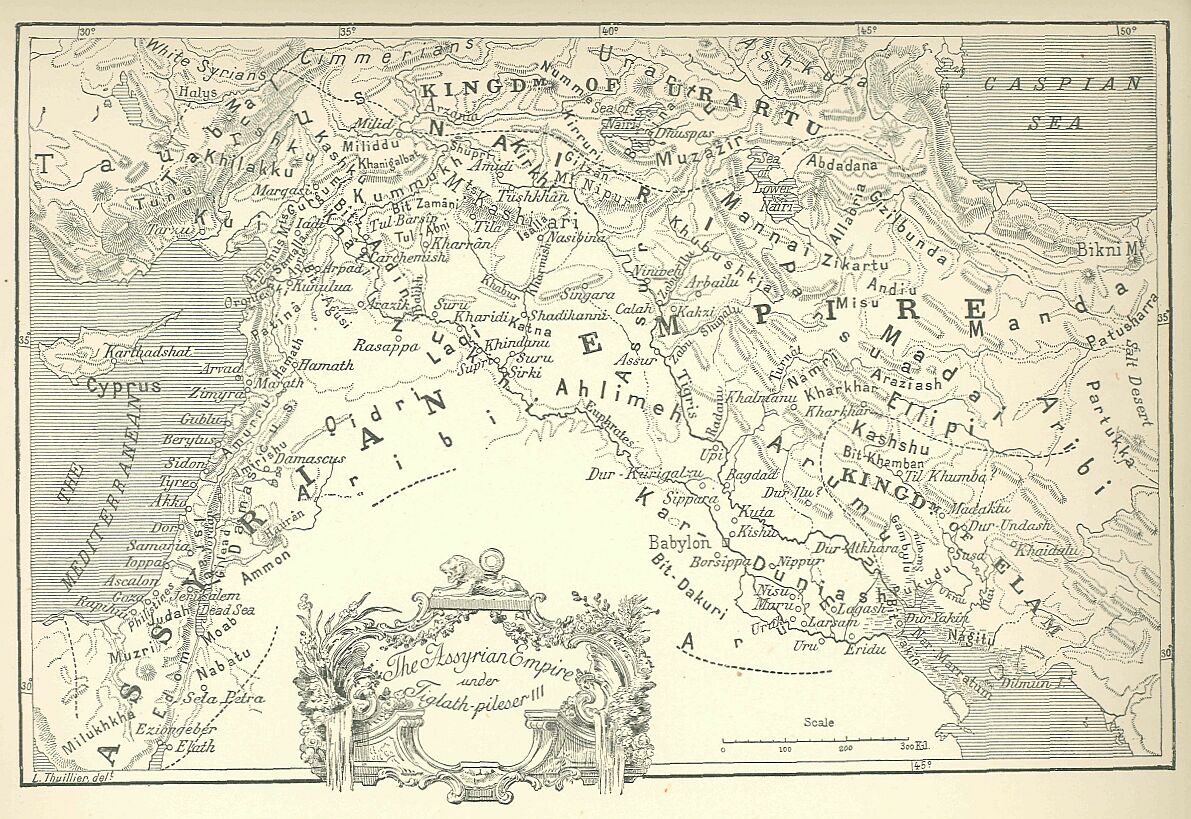
Each new country was annexed, as soon as conquered, to the nearest province, or, if necessary, was converted into a distinct province by itself; thus we find that Assur-nazir-pal, after laying hands on the upper valleys of the Radanu and the Turnat, rebuilt the ruined city of Atlîla, re-named it Dur-Assur, placed a commandant, cavalry, and eunuchs there, and established within it storehouses for the receipt of contributions from the neighbouring barbarians. He followed the same course on each occasion when the fortune of war brought him fresh subjects;* and his successors, Shalmaneser III., Samsi-rammân IV., and Rammân-nirâri did the same thing in Media, in Asia Minor, and in Northern Syria;** Tiglath-pileser III. had only to follow their example and extend the application of their system to the countries which he gradually forced to submit to his rule.***
* We read of the appointment of a governor in Bît-Khalupi, at Tush-khân, in Naîri, and in the country of the Patina. ** The territory of the Bit-Adini was converted into a province by Shalmaneser III. *** We find the formation of an Aramæan province, with Kar- Assur as its capital, mentioned in the Annals of Tiglatli- pileser III. Provinces were also established in Media, in Unki, in the basin of the Orontes, and in Lebanon, from nineteen districts formerly belonging to Hamath, six maritime provinces in Northern Phoenicia and in Coele-Syria, in Galilee, at Gaza.
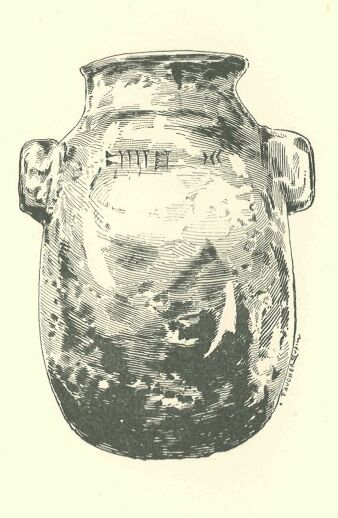
Drawn by Boudier, from the photograph published by Father Scheil.
In his case, however, certain elements came into play which forced him to modify several of their methods, and to have recourse to others which they had seldom or never employed. The majority of the countries hitherto incorporated had been near enough to the capital—whether it were Assur, Calah, or Nineveh—to permit of strict watch being kept for any sign of disaffection, and they could be promptly recalled to order if they attempted to throw off the yoke. These provinces were, moreover, of moderate area and sparsely populated: once drawn within the orbit of Assyria’s attraction, they were unable to escape from its influence by their own unaided efforts; on the contrary, they gradually lost their individuality, and ended by becoming merged in the body of the nation. The Aramaean tribes of the Khabur and the Balikh, the Cossæans of the Turnat, the marauding shepherds of the Gordyæan hills and the slopes of the Masios, gradually became assimilated to their conquerors after a more or less protracted resistance, till at length—in spite of differences of origin, creed, and speech—they became the best of Assyrians, every whit as devoted to the person of their king and as jealous of his honour as the aboriginal Assyrians themselves. A similar result could not be looked for in the case of the cities recently subdued. It was not to be expected that Babylon and Damascus—to name but two of the most important—would allow themselves to be influenced and to become reconciled to their lot by artifices which had been successful enough with the Medes and in the country of Tul-Abnî.
To take the case of Babylon first. It was no mere conglomeration of tribes, nor a state of minor importance, but an actual empire, nearly as large as that of Assyria itself, and almost as solidly welded together. It extended from the Turnat and the mountains of Blam to the Arabian desert and the Nâr-Marratûtn, and even though the Cossæans, Elamites, Kaldâ, Sumerians, Akkadians, and other remnants of ancient peoples who formed its somewhat motley population, had dwelt there for centuries in a state of chronic discord, they all agreed—in theory, at any rate—in recognising the common suzerainty of Babylon. Babylon was, moreover, by general acknowledgment, the ancient metropolis to which Assyria owed its whole civilisation; it was the holy city whose gods and whose laws had served as a prototype for the gods and laws of Assyria; from its temples and its archives the Assyrian scribes had drawn such knowledge as they had of the history of the ancient world, their religious doctrines and ceremonies, their methods of interpreting the omens and of forecasting the future—in short, their whole literature, both sacred and profane. The King of Nineveh might conquer Babylon, might even enter within its gates in the hour of triumph, and, when once he had it at his mercy, might throw down its walls, demolish its palaces, destroy its ziggurât, burn its houses, exterminate or carry off its inhabitants, and blot out its name from the list of nations; but so long as he recoiled from the sacrilege involved in such irreparable destruction, he was not merely powerless to reduce it to the level of an ordinary leading provincial town, such as Tela or Tushkhân, but he could not even deprive it in any way of its rank as a capital, or hope to make it anything less than the second city of his empire. As long as it remained in existence, it necessarily took precedence of all others, thanks to its extensive area, the beauty and antiquity of its buildings, and the number of its inhabitants. The pride of its nobles and priests, subdued for a moment by defeat, would almost instantly have reasserted itself, had the victor sought to lower the dignity of their city; Babylon only consented to accept an alien master provided he bowed himself respectfully before its superiority, and was willing to forget that he was a stranger within its gates, and was ready to comply with its laws and masquerade as a Babylonian. Tiglath-pileser III. never dreamt, therefore, of treating the Babylonians as slaves, or of subordinating them to their Assyrian descendants, but left their liberties and territory alike unimpaired. He did not attempt to fuse into a single empire the two kingdoms which his ability had won for him; he kept them separate, and was content to be monarch of both on similar terms. He divided himself, as it were, into two persons, one of whom reigned in Calah, while the other reigned in Karduniash, and his Chaldæan subjects took care to invest this dual rôle —based on a fiction so soothing to their pride—with every appearance of reality; he received from them, together with all the titles of the Babylonian kings, that name of Pulu, which later on found its way into their chronicles, and which was so long a puzzle to historians, both ancient and modern. Experience amply proved that this was the only means by which it was possible to yoke temporarily together the two great powers of the Euphrates and the Tigris. Among the successors of Tiglath-pileser, the only sovereigns to rule over Babylon without considerable difficulty were those who followed the precedent set by him and were satisfied to divide their functions and reign as dual kings over a dual kingdom.*
* This was so in the case of Tiglath-pileser III.‘s immediate successor, Shalmaneser V., of Esarhaddon, and of Assur-bani-pal; Shalmaneser was known at Babylon by the name of Ululai, Assur-bani-pal by that of Kanda-lanu.
This combination, while gratifying to the ambition of its rulers, was, perhaps, more a source of loss than of gain to Assyria itself. It is true that the power of Karduniash had decreased under the previous dynasty, but it had still been strong enough to hold back the Aramæans of the Persian Gulf on one side, and the Elamite hordes on the other. It lay like a broad barrier between these barbarians and the cities of the Middle Tigris; when an unusually vigorous attack compelled it to give way at some point, it appealed to Nineveh for help, and an Assyrian army, entering the country at the fords of the Zab, hastened to drive back the aggressors to the place from which they had set out. When, however, the kings of Assyria had become kings of Babylon as well, the situation was altered. Several branches of the Kaldâ had hitherto held possession of the city, and still possessed representatives and allies among the other tribes, especially among the Bît-Yakîn, who believed themselves entitled to reassert their supremacy within in. The Elamite princes, on their part, accustomed to descend at will into the plains that lay between the Tigris and the Euphrates, and to enrich themselves by frequent raids, could not make up their minds to change the habits of centuries, until they had at least crossed swords with the new despot, and put his mettle to the test. The Ninevite King of Babylon was thus in duty bound to protect his subjects against the same enemies that had ceaselessly harassed his native-born predecessors, and as the unaided resources of Karduniash no longer enabled him to do so effectively, he was, naturally, obliged to fall back on the forces at his disposal as King of Assyria. Henceforward it was no longer the Babylonian army that protected Nineveh, but rather that of Nineveh which had to protect Babylon, and to encounter, almost every year, foes whom in former days it had met only at rare intervals, and then merely when it chose to intervene in their affairs. Where the Assyrian sovereigns had gained a kingdom for themselves and their posterity, Assyria itself found little else but fresh battle-fields and formidable adversaries, in the effort to overcome whom its energies were all but exhausted. In Syria and on the shores of the Mediterranean, Tiglath-pileser had nations of less stubborn vitality to deal with, nor was he bound by the traditions of a common past to show equal respect to their prejudices. Arpad, Unki, the Bekâa, Damascus, and Gilead were all consecutively swallowed up by Assyria, but, the work of absorption once completed, difficulties were encountered which now had to be met for the first time. The subordinate to whom he entrusted the task of governing these districts* had one or two Assyrian regiments assigned him as his body-guard,** and these exercised the same ascendency over the natives as the Egyptian archers had done in days gone by: it was felt that they had the whole might of Assyria behind them, and the mere fact of their presence in the midst of the conquered country was, as a rule, sufficient to guarantee the safety of the Assyrian governor and ensure obedience to his commands.
* The governor was called Shaknu = “he whom the king has established in his place,” and pekhu = “the pilot,” “the manager,” whence pikhatu = “a district,” and bel-pikhati = “the master of a district.” It seems that the shaknu was of higher rank than the bel-pikhati, and often had the latter under his command. ** Thus Assur-nazir-pal selected the horsemen and other soldiers who were to form the body-guard of the governor of Parzindu.
This body-guard was never a very numerous one, for the army would have melted away in the course of a campaign or two, had it been necessary, after each fresh conquest, to detach from it a sufficient force to guard against rebellion. It was strengthened, it is true, by auxiliaries enlisted on the spot, and the tributary chiefs included in the provincial district were expected to furnish a reasonable quota of men in case of need;* but the loyalty of all these people was, at the best, somewhat doubtful, and in the event of their proving untrustworthy at a critical moment, the little band of Assyrian horse and foot would be left to deal with the revolt unaided until such time as the king could come and relieve them.
* In a despatch from Belibni to Assur-bani-pal we find Aramæans from the Persian Gulf submitting to the authority of an Assyrian officer, and fighting in Elam side by side with his troops. Again, under Assur-bani-pal, an army sent to repress a revolt on the part of Kedar and the Nabatseans included contingents from Ammon, Moab, and Edom, together with the Assyrian garrisons of the Haurân and Zobah.
The distance between the banks of the Jordan or Abana and those of the Tigris was a long one, and in nearly every instance it would have been a question of months before help could arrive. Meanwhile, Egypt was at hand, jealous of her rival, who was thus encroaching on territory which had till lately been regarded as her exclusive sphere of influence, and vaguely apprehensive of the fate which might be in store for her if some Assyrian army, spurred by the lust of conquest, were to cross the desert and bear down upon the eastern frontiers of the Delta. Distrustful of her own powers, and unwilling to assume a directly offensive attitude, she did all she could to foment continual disturbances among the Hebrews and Phoenicians, as well as in Philistia and Aram; she carried on secret intrigues with the independent princes, and held out tempting hopes of speedy intervention before the eyes of their peoples; her influence could readily be traced in every seditious movement. The handful of men assigned to the governors of the earlier provinces close to the capital would have been of little avail against perils of this kind. Though Tiglath-pileser added colony to colony in the distant regions annexed by him, he organised them on a different plan from that which had prevailed before his time. His predecessors had usually sent Assyrians to these colonies, and filled the villages vacated by them with families taken from the conquered region: a transfer of inhabitants was made, for instance, from Naîri or from Media into Assyria, and vice versâ. By following this system, Tiglath-pileser would soon have scattered his whole people over the dependencies of his empire, and have found his hereditary states peopled by a motley and incoherent collection of aliens; he therefore left his Assyrians for the most part at home, and only effected exchanges between captives. In his earlier campaigns he brought back with him, on one occasion, 65,000 prisoners from the table-land of Iran, in order to distribute them over a province which he was organising on the banks of the Turnat and the Zab: he levied contributions of this kind without mercy from all the states that he conquered from year to year, and dispersed the captives thus obtained over the length and breadth of his empire; he transplanted the Aramæans of the Mesopotamian deserts, and the Kaldâ to the slopes of Mount Amanus or the banks of the Orontes, the Patinians and Hamathæans to Ulluba, the inhabitants of Damascus to Kîr or to the borders of Elam,* and the Israelites to some place in Assyria.**
* 2 Kings xvi. 9. ** 2 Kings xv. 29.
He allowed them to take with them their wives and their children, their herds, their chattels, their gods, and even their money. Drafted into the towns and country districts in batches sufficiently numerous to be self-supporting, but yet not large enough to allow of their at once re-establishing themselves as a distinct nation in their new home, they seem to have formed, even in the midst of the most turbulent provinces, settlements of colonists who lived unaffected by any native influence or resentment. The aborigines hated them because of their religion, their customs, their clothing, and their language; in their eyes they were mere interlopers, who occupied the property of relations or fellow-countrymen who had fallen in battle or had been spirited away to the other end of the world. And even when, after many years, the native owners of the soil had become familiarised with them, this mutual antipathy had struck such deep root in their minds that any understanding between the natives and the descendants of the immigrants was quite out of the question: what had been formerly a vast kingdom, occupied by a single homogeneous race, actuated by a common patriotic spirit, became for many a year a region capriciously subdivided and torn by the dissensions of a number of paltry antagonistic communities. The colonists, exposed to the same hatreds as the original Assyrian conquerors, soon forgot to look upon the latter as the oppressors of all, and, allowing their present grudge to efface the memory of past injuries, did not hesitate to make common cause with them. In time of peace, the governor did his best to protect them against molestation on the part of the natives, and in return for this they rallied round him whenever the latter threatened to get out of hand, and helped him to stifle the revolt or hold it in check until the arrival of reinforcements. Thanks to their help, the empire was consolidated and maintained without too many violent outbreaks in regions far removed from the capital and beyond the immediate reach of the sovereign.* We possess very few details with regard to the administration of these prefects.**
* This was the history of the only one of those colonies whose fate is known to us—that founded at Samaria by Sargon and his successors. ** The texts contain a certain number of names of offices, the precise nature of which it is not easy to ascertain, e.g. the Khâzanu, the Labuttu, and others. One of them, apparently, should be read Shuparshak, and identical with one of the titles mentioned in Ezra (v. 6, vi. 6) as being in existence during the Persian epoch.
Drawn by Boudier, from a photograph by Mansell.
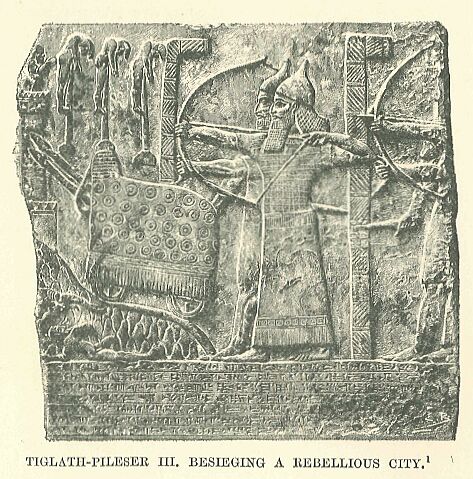
The various functionaries, governors of towns, tax-collectors, heads of stations, and officers whose duty it was to patrol the roads and look after the safety of merchants, were, for the most part, selected from among natives who had thrown in their lot with Assyria, and probably few Assyrians were to be found outside the more turbulent cities and important fortresses. The kings and chiefs whose territory was attached to a given province, either took their instructions direct from Nineveh, or were sometimes placed under the control of a resident, or kipu, with some sort of escort at his back, who kept watch over their movements and reported them to the suzerain, and saw that the tribute was paid regularly, and that the military service provided for in the treaties was duly rendered. Governors and residents alike kept up a constant correspondence with the court, and such of their letters as have chanced to come down to us show what a minute account of even the most trifling occurrences was required of them by the central authorities. They were not only obliged to report any fluctuation in the temper or attitude of their subordinates, or any intrigues that were being entered into across the frontier; they had also to record the transfer of troops, the return of fugitives, the pursuit of deserters, any chance scuffle between soldiers and natives, as well as the punishment inflicted on the rebellious, the appearance of a portent in the heavens, or omens noticed by the augurs. There were plenty of envious or officious tongues among their followers to report to headquarters the slightest failure of duty, and to draw attention to their negligence. Moreover, it seems certain that the object of thus compelling them to refer to the king at every turn, was not merely in order to keep him informed of all that took place in his dependencies, but also to lay bare the daily life of his prefects before his eyes. The latter were entrusted with the command of seasoned troops; they had considerable sums of money passing through their hands, and were often obliged to take prompt decisions and enter into diplomatic or military transactions on their own responsibility; in short, most of them, at any rate, who were stationed at the furthest confines of the empire were really kings in all but title, insignia, and birth. There was always the danger lest some among them should be tempted to reassert, in their own interest, the independence of the countries under their rule, and seek to found a dynasty in their midst. The strict supervision maintained over these governors generally nipped any ambition of this kind in the bud; in some cases, however, it created the very danger it was intended to prevent. If a governor who had been recalled to Nineveh or Calah in order to explain his conduct failed to clear himself completely, he at once fell into disgrace; and disgrace in Assyria, as in other countries of the East, meant, nine times out of ten, confiscation of property, mutilation and lifelong imprisonment, or death in its most hideous form. He would, therefore, think twice before quitting his post, and if he had any reason to suppose himself suspected, or viewed with disfavour in high quarters, he would be in no hurry to obey a summons to the capital. A revolt was almost certain to be crushed without fail, and offered merely a very precarious chance of escape, but the governor was seldom likely to hesitate between almost certain condemnation and the vague possibility of a successful rising; in such a case, therefore, he staked everything on a single throw.
The system was a defective on, in that it exposed to strong temptation the very functionaries whose loyalty was most essential to the proper working of the administration, but its dangers were out weighed by such important advantages that we cannot but regard it as a very real improvement on the haphazard methods of the past. In the first place, it opened up a larger recruiting-ground for the army, and, in a measure, guaranteed it against that premature exhaustion which had already led more than once to an eclipse of the Assyrian power. It may be that the pick of these provincial troops were, preferably, told off for police duties, or for the defence of the districts in which they were levied, and that they seldom left it except to do battle in the adjacent territory;* but, even with these limitations they were none the less of inestimable value, since they relieved the main army of Assyria from garrison duties in a hundred scattered localities, and allowed the king to concentrate it almost in its entirety about his own person, and to direct it en masse upon those points where he wished to strike a decisive blow.
* Thus, in the reign of Assur-bani-pal, we find the militia of the governor of Uruk marching to battle against the Gambulu.
On the other hand, the finances of the kingdom were put on a more stable and systematic basis. For nearly the whole of the two previous centuries, during which Assyria had resumed its victorious career, the treasury had been filled to some extent by taxes in kind or in money, and by various dues claimed from the hereditary kingdom and its few immediate dependencies, but mainly by booty and by tribute levied after each campaign from the peoples who had been conquered or had voluntarily submitted to Assyrian rule. The result was a budget which fluctuated greatly, since all forays were not equally lucrative, and the new dependencies proved so refractory at the idea of perpetual tribute, that frequent expeditions were necessary in order to persuade them to pay their dues. We do not know how Tiglath-pileser III. organised the finances of his provinces, but certain facts recorded here and there in the texts show that he must have drawn very considerable amounts from them. We notice that twenty or thirty years after his time, Carchemish was assessed at a hundred talents, Arpad and Kuî at thirty each, Megiddo and Manzuatu at fifteen, though the purposes to which these sums were applied is not specified.
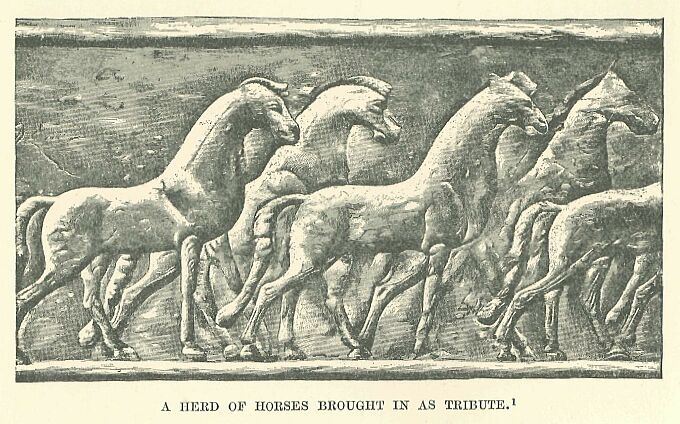
Drawn by Faucher-Gudin, from one of the bronze bas-reliefs on the gates of Balawat. The breed here represented seems to have been common in Urartu, as well as in Cappadocia and Northern Syria.
On the other hand, we know the precise object to which the contributions of several other cities were assigned; as, for instance, so much for the maintenance of the throne in the palace, or for the divans of the ladies of the harem; so much for linen garments, for dresses, and for veils; twenty talents from Nineveh for the armaments of the fleet, and ten from the same city for firewood. Certain provinces were expected to maintain the stud-farms, and their contributions of horses were specially valuable, now that cavalry played almost as important a part as infantry in military operations. The most highly prized animals came, perhaps, from Asia Minor; the nations of Mount Taurus, who had supplied chargers to Israel and Egypt five centuries earlier, now furnished war-horses to the squadrons of Nineveh. The breed was small, but robust, inured to fatigue and hard usage, and in every way similar to that raised in these countries at the present day. In war, horses formed a very considerable proportion of the booty taken; in time of peace, they were used as part of the payment of the yearly tribute, and a brisk trade in them was carried on with Mesopotamia.
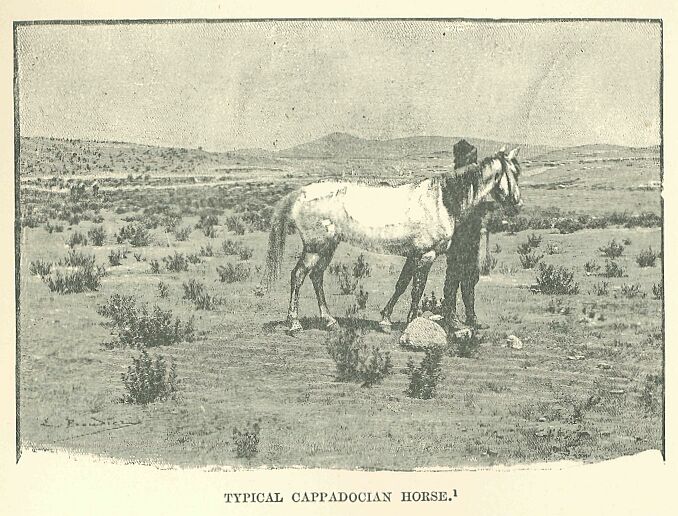
Drawn by Boudier, from a photograph by M. Alfred Boissier.
Reproduced by Faucher- Gudin, from the restoration published by Luschan.
After the king had deducted from his receipts enough to provide amply for the wants of his family and court, the salaries of the various functionaries and officials, the pay and equipment of his army, the maintenance and construction of palaces and fortresses, he had still sufficient left over to form an enormous reserve fund on which he and his successors might draw in the event of their ordinary sources of income being depleted by a series of repeated reverses.
Tiglath-pileser thus impressed upon Assyria the character by which it was known during the most splendid century of its history, and the organisation which he devised for it was so admirably adapted to the Oriental genius that it survived the fall of Nineveh, and served as a model for every empire-maker down to the close of the Macedonian era and even beyond it.
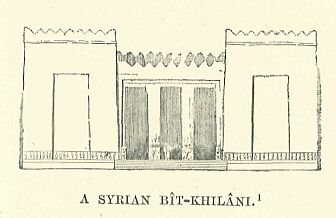
The wealth of the country grew rapidly, owing to the influx of capital and of foreign population; in the intervals between their campaigns its rulers set to work to remove all traces of the ruins which had been allowed to accumulate during the last forty years. The king had built himself a splendid palace at Calah, close to the monuments of Assur-nazir-pal and Shalmaneser III., and its terraces and walls overhung the waters of the Tigris. The main entrance consisted of a Bît-khilâni, one of those porticoes, flanked by towers and supported by columns or pillars, often found in Syrian towns, the fashion for which was now beginning to spread to Western Asia.*
* The precise nature of the edifices referred to in the inscriptions under the name of Bît-khilâni is still a matter of controversy. It has been identified with the pillared hall, or audience-chamber, such as we find in Sargon’s palace at Khorsabad, and with edifices or portions of edifices which varied according to the period, but which were ornamented with columns. It seems clear, however, that it was used of the whole series of chambers and buildings which formed the monumental gates of Assyrian palaces, something analogous to the Migdol of Ramses III. at Medinet-Habu, and more especially to the gates at Zinjirli.
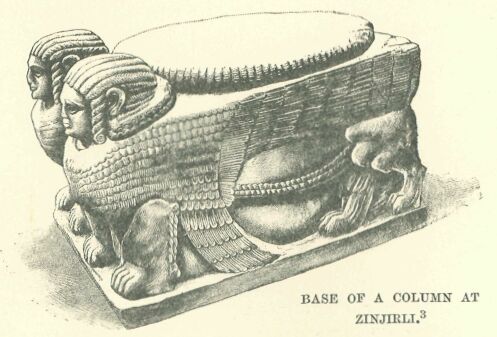
Those discovered at Zinjirli afford fine examples of the arrangements adopted in buildings of this kind; the lower part of the walls was covered with bas-reliefs, figures of gods and men, soldiers mounted or on foot, victims and fantastic animal shapes; the columns, where there were any, rested on the back of a sphinx or on a pair of griffins of a type which shows a curious mixture of Egyptian and Semitic influences.
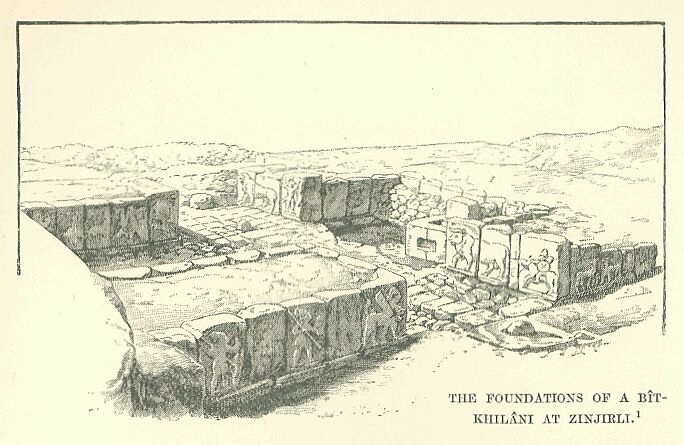
Drawn by Boudier, from a sketch published by Luschan.
The wood-work of the Ninevite Bît-khilâni was of cedar from Mount Amanus, the door-frames and fittings were of various rare woods, inlaid with ivory and metal. The entrance was guarded by the usual colossal figures, and the walls of the state reception-rooms were covered with slabs of alabaster; on these, in accordance with the usual custom,* were carved scenes from the royal wars, with explanatory inscriptions. The palace was subsequently dismantled, its pictures defaced and its inscriptions obliterated,** to mark the hatred felt by later generations towards the hero whom they were pleased to regard as a usurper; we can only partially succeed in deciphering his annals by the help of the fragmentary sentences which have escaped the fury of the destroyer.
* The building of Tiglath-pileser’s palace is described in the Nimroud Inscription. It stood near the centre of the platform of Nimroud. ** The materials were utilised by Esarhaddon, but it does not necessarily follow that the palace was dismantled by that monarch; this was probably done by Sargon or by Sennacherib.
Drawn by Faucher-Gudin, from a photograph published by Luschan.
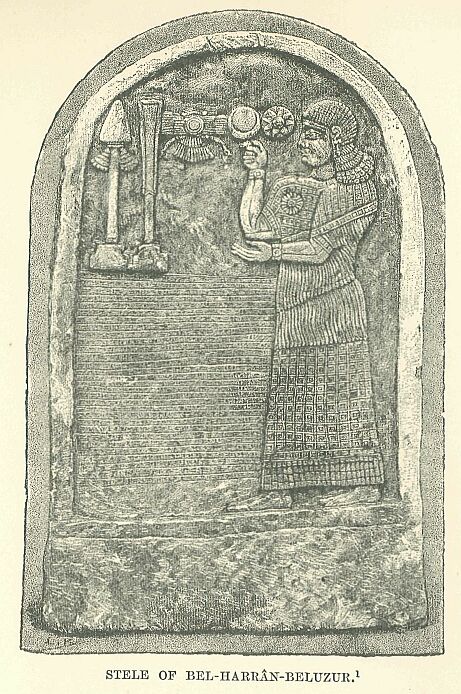
The cities and fortresses which he raised throughout the length and breadth of Assyria proper and its more recently acquired provinces have similarly disappeared; we can only conjecture that the nobles of his court, fired by his example, must have built and richly endowed more than one city on their hereditary estates, or in the territories under their rule. Bel-harrân-beluzur, the marshal of the palace, who twice gave his name to years of the king’s reign, viz. in 741 and 727 B.C., possessed, it would seem, an important fief a little to the north of Assur, near the banks of the Tharthar, on the site of the present Tel-Abta. The district was badly cultivated, and little better than a wilderness; by express order of the celestial deities—Marduk, Nabu, Shamash, Sin, and the two Ishtars—he dug the foundations of a city which he called Dur-Bel-harrân-beluzur. The description he gives of it affords conclusive evidence of the power of the great nobles, and shows how nearly they approached, by their wealth and hereditary privileges, to the kingly rank. He erected, we are told, a ziggurât on a raised terrace, in which he placed his gods in true royal fashion; he assigned slaves, landed property, and a yearly income to their priests, in order that worship might be paid to them in perpetuity; he granted sanctuary to all freemen who settled within the walls or in the environs, exemption from forced labour, and the right to tap a water-course and construct a canal. A decree of foundation was set up in the temple in memory of Bel-harrân-beluzur, precisely as if he were a crowned king. It is a stele of common grey stone with a circular top. The dedicator stands erect against the background of the carving, bare-foot and bare-headed, his face cleanshaven, dressed in a long robe embroidered in a chessboard pattern, and with a tunic pleated in horizontal rows; his right elbow is supported by the left hand, while the right is raised to a level with his eyes, his fist is clenched, and the thumb inserted between the first and second fingers in the customary gesture of adoration.
What the provost of the palace had done on his land, the other barons in all probability did on theirs; most of the departments which had fallen away and languished during the disturbances at the close of the previous dynasty, took a new lease of life under their protection. Private documents—which increase in number as the century draws to an end—contracts, official reports, and letters of scribes, all give us the impression of a wealthy and industrious country, stirred by the most intense activity, and in the enjoyment of unexampled prosperity. The excellent administration of Tiglath-pileser and his nobles had paved the way for this sudden improvement, and had helped to develop it, and when Shalmaneser V. succeeded his father on the throne it continued unchecked.* The new-comer made no changes in the system of government which had been so ably inaugurated. He still kept Assyria separate from Karduniash; his Babylonian subjects, faithful to ancient custom, soon devised a nickname for him, that of Ululai, as though seeking to persuade themselves that they had a king who belonged to them alone; and it is under this name that their annalists have inscribed him next to Pulu in the list of their dynasties.**
His reign was, on the whole, a calm and peaceful one; the Kaldâ, the Medes, Urartu, and the races of Mount Taurus remained quiet, or, at any rate, such disorders as may have arisen among them were of too trifling a nature to be deemed worthy of notice in the records of the time. Syria alone was disturbed, and several of its independent states took advantage of the change of rulers to endeavour to shake off the authority of Assyria.
* It was, for a long time, an open question with the earlier Assyriologists whether or not Shalmaneser and Sargon were different names for one and the same monarch. As for monuments, we possess only one attributed to Shalmaneser, a weight in the form of a lion, discovered by Layard at Nimroud, in the north-west palace. The length of his reign, and the scanty details we possess concerning it, have been learnt from the Eponym Canon and Pinches’ Babylonian Chronicle, and also from the Hebrew texts (2 Kings xvii. 3- 6; xviii. 9-12). ** The identity of Ululai and Shalmaneser V., though still questioned by Oppert, has been proved by the comparison of Babylonian records, in some of which the names Pulu and Ululai occur in positions exactly corresponding with those occupied, in others, by Tiglath-pileser and Shalmaneser. The name Ululai was given to the king because he was born in the month of Ulul; in Pinches’ list we find a gloss, “Dynasty of Tinu,” which probably indicates the Assyrian town in which Tiglath-pileser III. and his son were born.
Egypt continued to give them secret encouragement in these tactics, though its own internal dissensions prevented it from offering any effective aid. The Tanite dynasty was in its death-throes. Psamuti, the last of its kings, exercised a dubious sovereignty over but a few of the nomes on the Arabian frontier.*
* He is the Psammous mentioned by Manetho. The cartouches attributed to him by Lepsius really belong to the Psammuthis of the XXIXth dynasty. It is possible that one of the marks found at Karnak indicating the level of the Nile belong to the reign of this monarch.
His neighbours the Saites were gradually gaining the upper hand in the Delta and in the fiefs of middle Egypt, at first under Tafnakhti, and then, after his death, under his son Bukunirînif, Bocchoris of the Greek historians. They held supremacy over several personages who, like themselves, claimed the title and rank of Pharaoh; amongst others, over a certain Rudamanu Mîamun, son of Osorkon: their power did not, however, extend beyond Siut, near the former frontier of the Theban kingdom. The withdrawal of Piônkhi-Mîamun, and his subsequent death, had not disturbed the Ethiopian rule in the southern half of Egypt, though it somewhat altered its character. While an unknown Ethiopian king filled the place of the conquerer at Napata, another Ethiopian, named Kashta, made his way to the throne in Thebes.
ENLARGE TO FULL SIZE
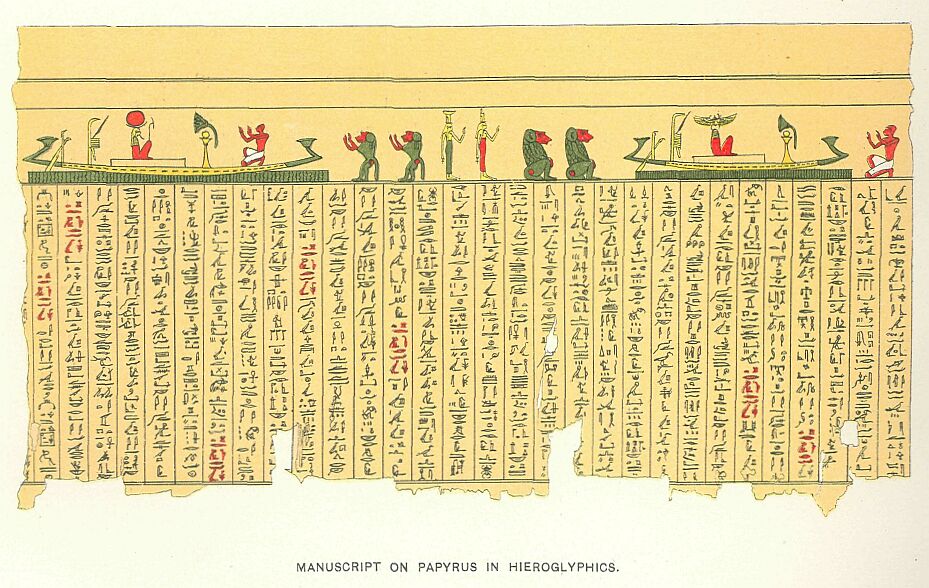
Drawn by Faucher-Gudin, after Prisse d’Avennes.
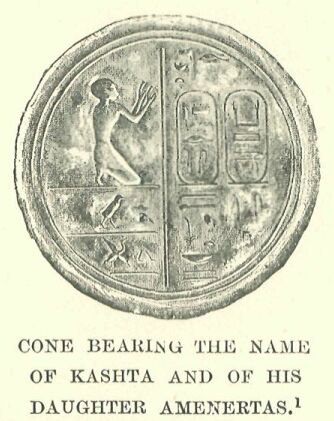
It is possible that he was a son of Piônkhi, and may have been placed in supreme power by his father when the latter reinstated the city in its place as capital. With all their partiality for real or supposed descendants of the Ramesside dynasty, the Thebans were, before all things, proud of their former greatness, and eagerly hoped to regain it without delay. When, therefore, they accepted this Kushite king who, to their eyes, represented the only family possessed of a legitimate claim to the throne, it was mainly because they counted on him to restore them to their former place among the cities of Egypt. They must have been cruelly disappointed when he left them for the Sacred Mountain. His invasion, far from reviving their prosperity, merely served to ratify the suppression of that pontificate of Amon-Râ which was the last remaining evidence of their past splendour.
All hope of re-establishing it had now to be abandoned, since the sovereign who had come to them from Napata was himself by birth and hereditary privelege and hereditary sole priest of Anion: in his absence the actual head of the Theban religion could lay claim only to an inferior office, and indeed, even then, the only reason for accepting a second prophet was that he might direct the worship of the temple at Karnak. The force of circumstances compelled the Ethiopians to countenance in the Thebaid what their Tanite or Bubastite predecessors had been obliged to tolerate at Hermopolis, Heracleopolis, Sais, and in many another lesser city; they turned it into a feudatory kingdom, and gave it a ruler who, like Auîti, half a century earlier, had the right to use the cartouches. Once installed, Kashta employed the usual methods to secure his seat on the throne, one of the first being a marriage alliance. The disappearance of the high priests had naturally increased the importance of the princesses consecrated to the service of Amon. From henceforward they were the sole visible intermediaries between the god and his people, the privileged guardians of his body and his double, and competent to perpetuate the line of the solar kings. The Theban appanage constituted their dowry, and even if their sex prevented them from discharging all those civil, military, and religious duties required by their position, no one else had the right to do so on their behalf, unless he was expressly chosen by them for the purpose. When once married they deputed their husbands to act for them; so long as they remained either single or widows, some exalted personage, the prophet of Amon or Montu, the ruler of Thebes, or the administrator of the Said, managed their houses and fiefs for them with such show of authority that strangers were at times deceived, and took him for the reigning monarch of the country.*
* Thus Harua, in the time of Amenertas, was prince and chief over the servants of the “Divine Worshipper.” Mantumihâit, in the time of Taharqa and of Tanuatamanu, was ruler of Thebes, and fourth prophet of Amon, and it is he who is described in the Assyrian monuments as King of Thebes.
The Pharaohs had, therefore, a stronger incentive than ever to secure exclusive possession of these women, and if they could not get all of them safely housed in their harems, they endeavoured, at any rate, to reserve for themselves the chief among them, who by purity of descent or seniority in age had attained the grade of Divine Worshipper. Kashta married a certain Shapenuapît, daughter of Osorkon III. and a Theban pallacide;* it is uncertain whether he eventually became king over Ethiopia and the Sudan or not. So far, we have no proof that he did, but it seems quite possible when we remember that one of his children, Shabaku (Sabaco), subsequently occupied the throne of Napata in addition to that of Thebes. Kashta does not appear to have possessed sufficient energy to prevent the Delta and its nomes from repudiating the Ethiopian supremacy. The Saites, under Tafnakhti or Bocchoris, soon got the upper hand, and it was to them that the Syrian vassals of Nineveh looked for aid, when death removed the conqueror who had trampled them so ruthlessly underfoot. Ever since the fall of Arpad, Hadrach, and Damascus, Shabaraîn, a town situated somewhere in the valley of the Orontes or of the Upper Litany,** and hitherto but little known, had served as a rallying-point for the disaffected Aramaean tribes: on the accession of Shalmaneser V. it ventured to rebel, probably in 727 B.C., but was overthrown and destroyed, its inhabitants being led away captive.
* It may be that, in accordance with a custom which obtained during the generations that followed, and which possibly originated about this period, this daughter of Osorkon III. was only the adoptive mother of Amenertas. ** Shabaraîn was originally confounded with Samaria by the early commentators on the Babylonian Chronicle. Halévy, very happily, referred it to the biblical Sepharvaîm, a place always mentioned in connection with Hamath and Arpad (2 Kings xvii. 24, 31; xviii. 34; xix. 13: cf. Isa. xxxvi. 19; xxxvii. 13), and to the Sibraim of Ezekiel (xlvii. 16), called in the Septuagint Samarêim. Its identification with Samaria has, since then, been generally rejected, and its connection with Sibraim admitted. Sibraim (or Sepharvaîm, or Samarêîm) has been located at Shomerîyeh, to the east of the Bahr-Kades, and south of Hamath.
This achievement proved, beyond the possibility of doubt, that in spite of their change of rulers the vengeance of the Assyrians was as keen and sharp as ever. Not one of the Syrian towns dared to stir, and the Phonician seaports, though their loyalty had seemed, for a moment, doubtful, took care to avoid any action which might expose them to the terrors of a like severity.* The Israelites and Philistines, alone of the western peoples, could not resign themselves to a prudent policy; after a short period of hesitation they drew the sword from its scabbard, and in 725 war broke out.**
* The siege of Tyre, which the historian Menander, in a passage quoted by Josephus, places in the reign of Shalmaneser, ought really to be referred to the reign of Sennacherib, or the fragment of Menander must be divided into three parts dealing with three different Assyrian campaigns against Tyre, under Tiglath-pileser, Sennacherib, and Esarhaddon respectively. ** The war cannot have begun earlier, for the Eponym Canon, in dealing with 726, has the words “in the country,” thus proving that no expedition took place in that year; in the case of the year 725, on the other hand, it refers to a campaign against some country whose name has disappeared. The passages in the Book of Kings (2 Kings xvii. 1-6, and xviii. 9-12) which deal with the close of the kingdom of Israel, have been interpreted in such a way as to give us two campaigns by Shalmaneser against Hoshea: (1) Hoshea having failed to pay the tribute imposed upon him by Tiglath-pileser, Shalmaneser made war upon him and compelled him to resume its payment (2 Kings xvii. 1-3); (2) Hoshea having intrigued with Egypt, and declined to pay tribute, Shalmaneser again took the field against him, made him prisoner, and besieged Samaria for three years (2 Kings xvii. 4-6; xviii. 9-12). The first expedition must, in this case, have taken place in 727, while the second must have lasted from 725-722. Most modern historians believe that the Hebrew writer has ascribed to Shalmaneser the subjection of Hoshea which was really the act of Tiglath-pileser, as well as the final war against Israel. According to Winckler, the two portions of the narrative must have been borrowed from two different versions of the final war, which the final editor inserted one after the other, heedless of the contradictions contained in them.
Hoshea, who had ascended the throne with the consent of Tiglath-pileser, was unable to keep them quiet. The whole of Galilee and Gilead was now an Assyrian province, subject to the governor of Damascus; Jerusalem, Moab, Ammon, and the Bedâwin had transferred their allegiance to Nineveh; and Israel, with merely the central tribes of Ephraim, Manasseh, and Benjamin left, was now barely equal in area and population to Judah. Their tribute weighed heavily on the Israelites; passing armies had laid waste their fields, and townsmen, merchants, and nobles alike, deprived of their customary resources, fretted with impatience under the burdens and humiliations imposed on them by their defeat; convinced of their helplessness, they again looked beyond their own borders for some nation or individual who should restore to them their lost prosperity. Amid the tottering fortunes of their neighbours, Egypt alone stood erect, and it was, therefore, to Egypt that they turned their eyes. Negotiations were opened, not with Pharaoh himself, but with Shabi, one of the petty kings on the eastern frontier of the Delta, whose position made him better qualified than any other to deal with Syrian affairs.*
* This individual is called Sua, Seveh, and So in the Hebrew text (2 Kings xvii. 4), and the Septuagint gives the transliteration Sebek side by side with Sêgôs. He is found again under the forms Shibahi, Shabi, Shabé, in Sargon’s inscriptions.
Hannon of Gaza had by this time returned from exile, and it was, doubtless, owing to Shabi’s support that he had been able to drive out the Assyrian generals and recover his crown.* The Israelite aristocracy was led away by his example, but Shalmaneser hastened to the spot before the Egyptian bowmen had time to cross the isthmus. Hoshea begged for mercy, and was deported into Assyria and condemned to lifelong imprisonment.** Though deserted by her king, Samaria did not despair; she refused to open her gates, and, being strongly fortified, compelled the Assyrians to lay regular siege to the city. It would seem that at one moment, at the beginning of operations, when it was rumoured on all sides that Pharaoh would speedily intervene, Ahaz began to fear for his own personal safety, and seriously considered whether it would not be wiser to join forces with Israel or with Egypt.***
* This seems to be the inference from Sargon’s inscription, in which he is referred to as relying on the army of Shabi, the tartan of Egypt. ** 2 Kings xvii. 4. *** The Second Book of Kings (xviii. 9,10; cf. xvii. 6) places the beginning of the siege of Samaria in the seventh year of Hoshea ( = fourth year of Hezekiah), and the capture of the town in the ninth year of Hoshea ( = sixth year of Hezekiah); further on it adds that Sennacherib’s campaign against Hezekiah took place in the fourteenth year of the latter’s reign (2 Kings xviii. 13; cf. Isa. xxxvi. 1). Now, Sennacherib’s campaign against Hezekiah took place (as will be shown later on, in vol. viii. Chapter I.) in 702 B.C., and Samaria was captured in 722. The synchronisms in the Hebrew narrative are therefore fictitious, and rest on no real historical basis—at any rate, in so far as the king who occupied the throne of Judah at the time of the fall of Samaria is concerned; Ahaz was still alive at that date, and continued to reign till 716 or 715, or perhaps only till 720.
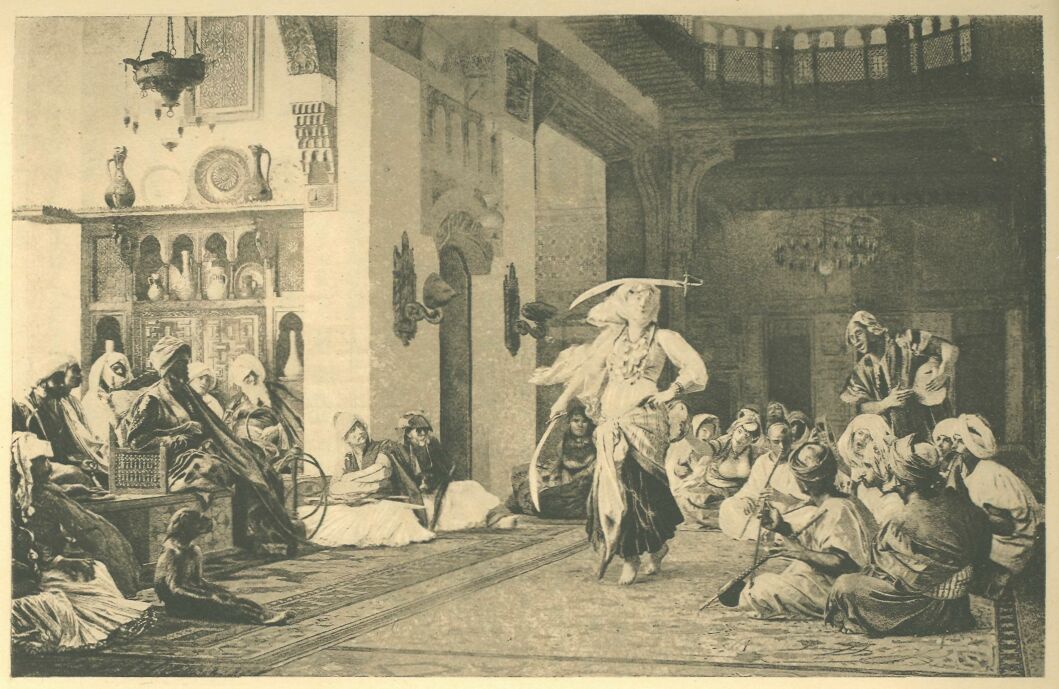
After Painting by Gerome
The rapid sequence of events, however, backed by the counsel of Isaiah, speedily recalled him to a more reasonable view of the situation. The prophet showed him Samaria spread out before him like one of those wreaths of flowers which the guests at a banquet bind round their brows, and which gradually fade as their wearers drink deeper and deeper. “Woe to the crown of pride of the drunkards of Ephraim, and to the fading flower of his glorious beauty, which is on the head of the fat valley of them that are overcome with wine. Behold, the Lord hath a mighty and strong one; as a tempest of hail, a destroying storm, as a tempest of mighty waters overflowing, shall be cast down to the earth with violence. The crown of the pride of the drunkards of Ephraim shall be trodden underfoot, and the fading flower of his glorious beauty, which is on the head of the fat valley, shall be as the first ripe fig before the summer; which when he that looketh upon it seeth, while it is yet in his hand he eateth it up.” While the cruel fate of the perverse city was being thus accomplished, Jahveh Sabaoth was to be a crown of glory to those of His children who remained faithful to Him; but Judah, far from submitting itself to His laws, betrayed Him even as Israel had done. Its prophets and priests were likewise distraught with drunkenness; they staggered under the effects of their potations, and turned to scorn the true prophet sent to proclaim to them the will of Jehovah. “Whom,” they stammered between their hiccups—“whom will He teach knowledge? and whom will He make to understand the message? them that are weaned from the milk and drawn from the breasts? For it is precept upon precept, precept upon precept, line upon line, line upon line, here a little and there a little!” And sure enough it was by the mouth of a stammering people, by the lips of the Assyrians, that Jahveh was to speak to them. In vain did the prophet implore them: “This is the rest, give ye rest to him that is weary;” they did not listen to him, and now Jahveh turns their own gibes against them: “Precept upon precept, precept upon precept, line upon line, line upon line, here a little and there a little,”—“that they may go and fall backward, and be broken and snared and taken.” There was to be no hope of safety for Jerusalem unless it gave up all dependence on human counsels, and trusted solely to God for protection.*
* Isa. xxviii. Giesebrecht has given it as his opinion that only verses 1-6, 23-29 of the prophecy were delivered at this epoch: the remainder he believes to have been written during Sennacherib’s campaign against Judah, and suggests that the prophet added on his previous oracle to them, thus diverting it from its original application. Others, such as Stade and Wellhausen, regard the opening verses as embodying a mere rhetorical figure. Jerusalem, they say, appeared to the prophet as though changed into Samaria, and it is this transformed city which he calls “the crown of pride of the drunkards of Ephraim.”
Samaria was doomed; this was the general belief, and men went about repeating it after Isaiah, each in his own words; every one feared lest the disaster should spread to Judah also, and that Jahveh, having once determined to have done with the northern kingdom, would turn His wrath against that of the south as well. Micah the Morashtite, a prophet born among the ranks of the middle class, went up and down the land proclaiming misery to be the common lot of the two sister nations sprung from the loins of Jacob, as a punishment for their common errors and weaknesses. “The Lord cometh forth out of His place, and will come and tread upon the high places of the earth. And the mountains shall be molten under Him, and the valleys shall be cleft, as wax before the fire, as waters that are poured down a steep place. For the transgression of Jacob is all this, and for the sins of the house of Israel. What is the transgression of Jacob? is it not Samaria? and what are the high places of Judah? are they not Jerusalem?” The doom pronounced against Samaria was already being carried out, and soon the hapless city was to be no more than “an heap of the field, and as the plantings of a vineyard; and I will pour down the stones thereof into the valley,” saith the Lord, “and I will discover the foundations thereof. And all her graven images shall be beaten to pieces, and all her hires shall be burned with fire, and all her idols will I lay desolate; for of the hire of an harlot hath she gathered them, and into the hire of an harlot shall they return.” Yet, even while mourning over Samaria, the prophet cannot refrain from thinking of his own people, for the terrible blow which had fallen on Israel “is come even unto Judah; it reacheth unto the gate of my people, even to Jerusalem.” Doubtless the Assyrian generals kept a watchful eye upon Ahaz during the whole time of the siege, from 724 to 722, and when once the first heat of enthusiasm had cooled, the presence of so formidable an army within striking distance must have greatly helped the king to restrain the ill-advised tendencies of some of his subjects. Samaria still held out when Shalmaneser died at Babylon in the month of Tebeth, 722. Whether he had no son of fit age to succeed him, or whether a revolution, similar to that which had helped to place Tiglath-pileser on the throne, broke out as soon as he had drawn his last breath, is not quite clear. At any rate, Sargon, an officer who had served under him, was proclaimed king on the 22nd day of Tebeth, and his election was approved by the whole of Assyria. After some days of hesitation, Babylon declined to recognise him, and took the oath of allegiance to a Kaldu named Marduk-abalidinna, or Merodach-baladan. While these events were taking place in the heart of the empire, Samaria succumbed; perhaps to famine, but more probably to force. It was sacked and dismantled, and the bulk of its population, amounting to 27,280 souls, were carried away into Mesopotamia and distributed along the Balîkh, the Khabur, the banks of the river of Gozân, and among the towns of the Median frontier.*
* Sargon does not mention where he deported the Israelites to, but we learn this from the Second Book of Kings (xvii. 6; xviii. 11). There has been much controversy as to whether Samaria was taken by Shalmanoser, as the Hebrew chronicler seems to believe (2 Kings xvii. 3-6; xviii. 9, 10), or by Sargon, as the Assyrian scribes assure us. At first, several scholars suggested a solution of the difficulty by arguing that Shalmaneser and Sargon were one and the same person; afterwards the theory took shape that Samaria was really captured in the reign of Shalmaneser, but by Sargon, who was in command of the besieging army at the time, and who transferred this achievement, of which he was naturally proud, to the beginning of his own reign. The simplest course seems to be to accept for the present the testimony of contemporary documents, and place the fall of Samaria at the beginning of the reign of Sargon, being the time indicated by Sargon in his inscriptions.
Sargon made the whole territory into a province; an Assyrian governor was installed in the palace of the kings of Israel, and soon the altars of the strange gods smoked triumphantly by the side of the altars of Jahveh (722 B.C.).*
* Kings xvii. 24-41, a passage to which I shall have occasion to refer farther on in the present volume. The following is a list of the kings of Israel, after the division of the tribes:—
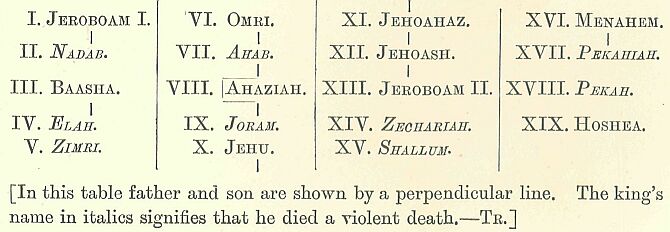
[In this table father and son are shown by a perpendicular line. The king’s name in italics signifies that he died a violent death.—Tr.]
Thus fell Samaria, and with Samaria the kingdom of Israel, and with Israel the last of the states which had aspired, with some prospect of success, to rule over Syria. They had risen one after another during the four centuries in which the absence of the stranger had left them masters of their own fate—the Hittites in the North, the Hebrews and the Philistines in the South, and the Aramæans and Damascus in the centre; each one of these races had enjoyed its years of glory and ambition in the course of which it had seemed to prevail over its rivals. Then those whose territory lay at the extremities began to feel the disadvantages of their isolated position, and after one or two victories gave up all hope of ever establishing a supremacy over the whole country. The Hittite sphere of influence never at any time extended much further southwards than the sources of the Orontes, while that of the Hebrews in their palmiest days cannot have gone beyond the vicinity of Hamath. And even progress thus far had cost both Hebrews and Hittites a struggle so exhausting that they could not long maintain it. No sooner did they relax their efforts, than those portions of Coele-Syria which they had annexed to their original territory, being too remote from the seat of power to feel its full attraction, gradually detached themselves and resumed their independence, their temporary suzerains being too much exhausted by the intensity of their own exertions to retain hold over them. Damascus, which lay almost in the centre, at an equal distance from the Euphrates and the “river of Egypt,” could have desired no better position for grouping the rest of Syria round her.
Drawn by Faucher-Gudin, from a sketch by Flandin.
If any city had a chance of establishing a single kingdom, it was Damascus, and Damascus alone. But lulled to blissful slumbers in her shady gardens, she did not awake to political life and to the desire of conquest until after all the rest, and at the very moment when Nineveh was beginning to recover from her early reverses. Both Ben-hadads had had a free hand given them during the half-century which followed, and they had taken advantage of this respite to reduce Coele-Syria, the Lebanon, Arvadian Phoenicia, Hamath, and the Hebrews—in fact, two-thirds of the whole country—to subjection, and to organise that league of the twelve kings which reckoned Ahab of Israel among its leaders. This rudimentary kingdom had scarcely come into existence, and its members had not yet properly combined, when Shalmaneser III. arose and launched his bands of veterans against them; it however successfully withstood the shock, and its stubborn resistance at the beginning of the struggle shows us what it might have done, had its founders been allowed time in which to weld together the various elements at their disposal. As it was, it was doomed to succumb—not so much to the superiority of the enemy as to the insubordination of its vassals and its own internal discords. The league of the twelve kings did not survive Ben-hadad II.; Hazael and his successors wore themselves out in repelling the attacks of the Assyrians and in repressing the revolts of Israel; when Tiglath-pileser III. arrived on the scene, both princes and people, alike at Damascus and Samaria, were so spent that even their final alliance could not save them from defeat. Its lack of geographical unity and political combination had once more doomed Syria to the servitude of alien rule; the Assyrians, with methodical procedure, first conquered and then made vassals of all those states against which they might have hurled their battalions in vain, had not fortune kept them divided instead of uniting them in a compact mass under the sway of a single ruler. From Carchemish to Arpad, from Hamath to Damascus and Samaria, their irresistible advance had led the Assyrians on towards Egypt, the only other power which still rivalled their prestige in the eyes of the world; and now, at Gaza, on the frontier between Africa and Asia, as in days gone by on the banks of the Euphrates or the Balîkh, these two powers waited face to face, hand on hilt, each ready to stake the empire of the Asiatic world on a single throw of the dice.