Volume 3 — CHAPTER II—THE TEMPLES AND THE GODS OF CHALDÆA (continued 2)
M. L. McClure translation
Drawn by Faucher-Gudin, from Layard.

The sun of the complete day, the sun in the full possession of his strength, could alone win back the attributes of power which the morning sun had allowed himself to be despoiled of. From that time forth the privilege of delivering immortal decrees to mortals was never taken out of the hands of the gods of light.
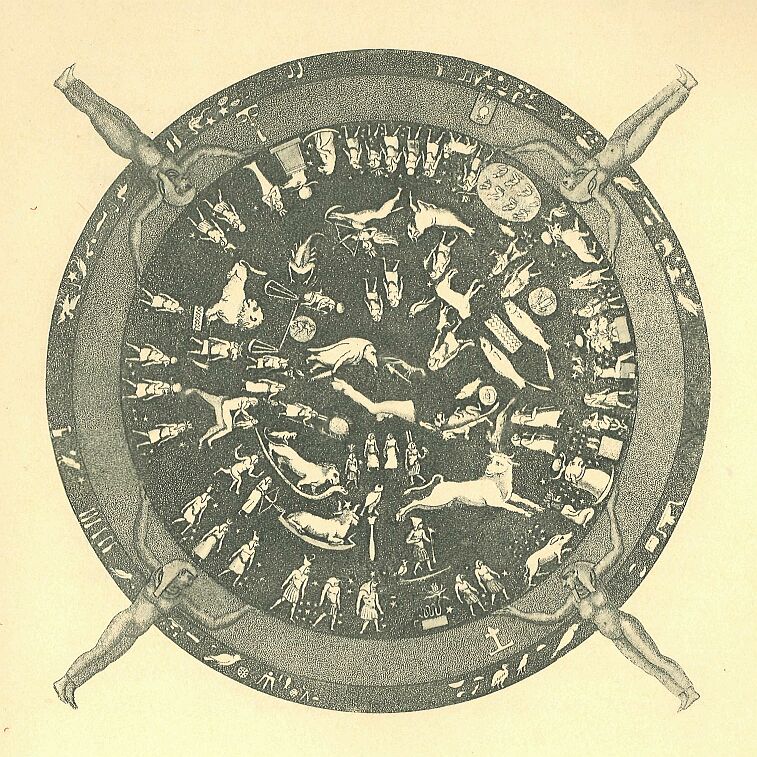
Destinies once fixed on the earth became a law—“mamit”—a good or bad fate, from which no one could escape, but of which any one might learn the disposition beforehand if he were capable of interpreting the formulas of it inscribed on the book of the sky. The stars, even those which were most distant from the earth, were not unconcerned in the events which took place upon it. They were so many living beings endowed with various characteristics, and their rays as they passed across the celestial spaces exercised from above an active control on everything they touched. Their influences became modified, increased or weakened according to the intensity with which they shed them, according to the respective places they occupied in the firmament, and according to the hour of the night and the month of the year in which they rose or set. Each division of time, each portion of space, each category of existences—and in each category each individual—was placed under their rule and was subject to their implacable tyranny. The infant was born their slave, and continued in this condition of slavery until his life’s end: the star which was in the ascendent at the instant of his birth became his star, and ruled his destiny. The Chaldæans, like the Egyptians, fancied they discerned in the points of light which illuminate the nightly sky, the outline of a great number of various figures—men, animals, monsters, real and imaginary objects, a lance, a bow, a fish, a scorpion, ears of wheat, a bull, and a lion. The majority of these were spread out above their heads on the surface of the celestial vault; but twelve of these figures, distinguishable by their brilliancy, were arranged along the celestial horizon in the pathway of the sun, and watched over his daily course along the walls of the world. These divided this part of the sky into as many domains or “houses,” in which they exercised absolute authority, and across which the god could not go without having previously obtained their consent, or having brought them into subjection beforehand. This arrangement is a reminiscence of the wars by which Bel-Merodach, the divine bull, the god of Babylon, had succeeded in bringing order out of chaos: he had not only killed Tiâmat, but he had overthrown and subjugated the monsters which led the armies of darkness. He meets afresh, every year and every day, on the confines of heaven and earth, the scorpion-men of his ancient enemy, the fish with heads of men or goats, and many more. The twelve constellations were combined into a zodiac, whose twelve signs, transmitted to the Greeks and modified by them, may still be read on our astronomical charts. The constellations, immovable, or actuated by a slow motion, in longitude only, contain the problems of the future, but they are not sufficient of themselves alone to furnish man with the solution of these problems. The heavenly bodies capable of explaining them, the real interpreters of destiny, were at first the two divinities who rule the empires of night and day—the moon and the sun; afterwards there took part in this work of explanation the five planets which we call Jupiter, Venus, Saturn, Mars, and Mercury, or rather the five gods who actuate them, and who have controlled their course from the moment of creation—Merodach, Ishtar, Ninib, Nergal, and Nebo. The planets seemed to traverse the heavens in every direction, to cross their own and each other’s paths, and to approach the fixed stars or recede from them; and the species of rhythmical dance in which they are carried unceasingly across the celestial spaces revealed to men, if they examined it attentively, the irresistible march of their own destinies, as surely as if they had made themselves master of the fatal tablets of Shamash, and could spell them out line by line.
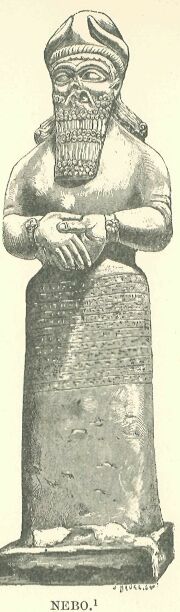
The Chaldæns were disposed to regard the planets as perverse sheep who had escaped from the fold of the stars to wander wilfully in search of pasture.* At first they were considered to be so many sovereign deities, without other function than that of running through the heavens and furnishing there predictions of the future; afterwards two of them descended to the earth, and received upon it the homage of men* —Ishtar from the inhabitants of the city of Dilbat, and Nebo* from those of Borsippa. Nebo assumed the rôle of a soothsayer and a prophet. He knew and foresaw everything, and was ready to give his advice upon any subject: he was the inventor of the method of making clay tablets, and of writing upon them. Ishtar was a combination of contradictory characteristics.****
* Their generic name, read as “lubat,” in Sumero-Accadian, “bibbu” in Semitic speech (Fr. Lenormant, Essai de Commentaire de Bérose, pp. 370, 371), denoted a quadruped, the species of which Lenormant was not able to define; Jensen (Die Kosmologie, pp. 95-99) identified it with the sheep and the ram. At the end of the account of the creation, Merodach-Jupiter is compared with a shepherd who feeds the flock of the gods on the pastures of heaven (cf. p. 15 of the present work). ** The site of Dilbat is unknown: it has been sought in the neighbourhood of Kishu and Babylon (Delitzsch, Wo lag das Paradies? p. 219); it is probable that it was in the suburbs of Sippara. The name given to the goddess was transcribed AeXckit (Hesychius, sub voce), and signifies the herald, the messenger of the day. *** The rôle of Nebo was determined by the early Assyriologists (Rawlin-son, On the Religion of the Babylonians and Assyrians, pp. 523-52G; Oppeet, Expédition en Mésopotamie, vol. ii. p. 257; Lenormant, Essai de Commentaire de Bérose, pp. 114-116). He owed his functions partly to his alliance with other gods (Sayce, Religion of the Ancient Babylonians, pp. 118, 119). **** See the chapter devoted by Sayce to the consideration of Ishtar in his Religion of the Ancient Babylonians (IV. Tammuz and Ishtar, p. 221, et seq.), and the observations made by Jeremias on the subject in the sequel of his Izdubar-Nimrod (Ishtar-Astarte im Izdubar-Epos), pp. 56-66.
Drawn by Faucher-Gudin, from a heliogravure in Ménant’s Recherches sur la Glyptique orientale.
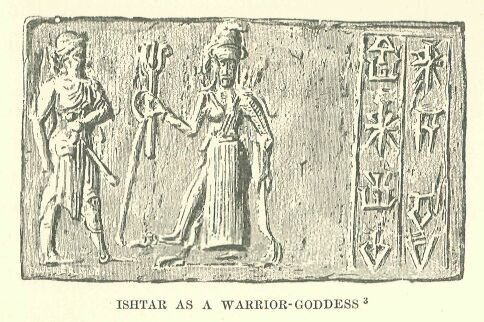
In Southern Chaldæa she was worshipped under the name of Nanâ, the supreme mistress.* The identity of this lady of the gods, “Bêlit-ilânit,” the Evening Star, with Anunit, the Morning Star, was at first ignored, and hence two distinct goddesses were formed from the twofold manifestation of a single deity: having at length discovered their error, the Chaldæans merged these two beings in one, and their names became merely two different designations for the same star under a twofold aspect. The double character, however, which had been attributed to them continued to be attached to the single personality.
* With regard to Nana, consult, with reserve, Fk. Lenormant, Essai de Commentaire de Bérose, pp. 100-103, 378, 379, where the identity of Ishtar and Nana is still unrecognized.
The Evening Star had symbolized the goddess of love, who attracted the sexes towards one another, and bound them together by the chain of desire; the Morning Star, on the other hand, was regarded as the cold-blooded and cruel warrior who despised the pleasures of love and rejoiced in warfare: Ishtar thus combined in her person chastity and lasciviousness, kindness and ferocity, and a peaceful and warlike disposition, but this incongruity in her characteristics did not seem to disconcert the devotion of her worshippers. The three other planets would have had a wretched part to play in comparison with Nebo and Ishtar, if they had not been placed under new patronage. The secondary solar gods, Merodach, Ninib, and Nergal, led, if we examine their rôle carefully, but an incomplete existence: they were merely portions of the sun, while Shamash represented the entire orb. What became of them apart from the moment in the day and year in which they were actively engaged in their career? Where did they spend their nights, the hours during which Shamash had retired into the firmament, and lay hidden behind the mountains of the north? As in Egypt the Horuses identified at first with the sun became at length the rulers of the planets, so in Chaldæa the three suns of Ninib, Merodach, and Nergal became respectively assimilated to Saturn, Jupiter, and Mars;* and this identification was all the more easy in the case of Saturn, as he had been considered from the beginning as a bull belonging to Shamash. Henceforward, therefore, there was a group of five powerful gods—distributed among the stars of heaven, and having abodes also in the cities of the earth—whose function it was to announce the destinies of the universe. Some, deceived by the size and brilliancy of Jupiter, gave the chief command to Merodach, and this opinion naturally found a welcome reception at Babylon, of which he was the feudal deity. Others, taking into account only the preponderating influence exercised by the planets over the fortunes of men, accorded the primacy to Ninib, placing Merodach next, followed respectively by Ishtar, Nergal, and Nebo. The five planets, like the six triads, were not long before they took to themselves consorts, if indeed they had not already been married before they were brought together in a collective whole. Ninib chose for wife, in the first place, Bau, the daughter of Anu, the mistress of Uru, highly venerated from the most remote times; afterwards Gula, the queen of physicians, whose wisdom alleviated the ills of humanity, and who was one of the goddesses sometimes placed in the harem of Shamash himself. Merodach associated with him Zirbanit, the fruitful, who secures from generation to generation the permanence and increase of living beings. Nergal distributed his favours sometimes to Laz, and sometimes to Esharra, who was, like himself, warlike and always victorious in battle. Nebo provided himself with a mate in Tashmit, the great bride, or even in Ishtar herself. But Ishtar could not be content with a single husband: after she had lost Dumuzi-Tammuz, the spouse of her youth, she gave herself freely to the impulses of her passions, distributing her favours to men as well as gods, and was sometimes subject to be repelled with contempt by the heroes upon whom she was inclined to bestow her love. The five planets came thus to be actually ten, and advantage was taken of these alliances to weave fresh schemes of affiliation: Nebo was proclaimed to be the son of Merodach and Zirbanit, Merodach the son of Ba, and Ninib the offspring of Bel and Esharra.
1. Drawn by Faucher-Gudin, from an Assyrian statue in alabaster in the British Museum. * Ishtar, Nebo, Sin, and Shamash being heavenly bodies, to begin with, and the other great gods, Anu, Bel, Ea, and Ramman having their stars in the heavens, the Chaldæans were led by analogy to ascribe to the gods which represented the phases of the sun, Merodach, Ninib, and Nergal, three stars befitting their importance, i.e. three planets.
There were two councils, one consisting of twelve members, the other of ten; the former was composed of the most popular gods of Southern Chaldæa, representing the essential elements of the world, while the latter consisted of the great deities of Northern Chaldæa, whose function it was to regulate or make known the destinies of men. The authors of this system, who belonged to Southern Chaldæa, naturally gave the position to their patron gods, and placed the twelve above the ten. It is well known that Orientals display a great respect for numbers, and attribute to them an almost irresistible power; we can thus understand how it was that the Chaldæans applied them to designate their divine masters, and we may calculate from these numbers the estimation in which each of these masters was held. The goddesses had no value assigned to them in this celestial arithmetic, Ishtar excepted, who was not a mere duplication, more or less ingenious, of a previously existing deity, but possessed from the beginning an independent life, and could thus claim to be called goddess in her own right. The members of the two triads were arranged on a descending scale, Anu taking the highest place: the scale was considered to consist of a soss of sixty units in length, and each of the deities who followed Anu was placed ten of these units below his predecessor, Bel at 50 units, Ea at 40, Sin at 30, Shamash at 20, Ramman at 10 or 6. The gods of the planets were not arranged in a regular series like those of the triads, but the numbers attached to them expressed their proportionate influence on terrestrial affairs: to Ninib was assigned the same number as had been given to Bel, 50, to Merodach perhaps 25, to Ishtar 15, to Nergal 12, and to Nebo 10. The various spirits were also fractionally estimated, but this as a class, and not as individuals: the priests would not have known how to have solved the problem if they had been obliged to ascribe values to the infinity of existences.* As the Heliopolitans were obliged to eliminate from the Ennead many feudal divinities, so the Chaldæans had left out of account many of their sovereign deities, especially goddesses, Bau of Uru, Nana of Uruk, and Allât; or if they did introduce them into their calculations, it was by a subterfuge, by identifying them with other goddesses, to whom places had been already assigned; Bau being thus coupled with Ohila, Nana with Ishtar, and Allât with Ninhl-Beltis. If figures had been assigned to the latter proportionate to the importance of the parts they played, and the number of their votaries, how comes it that they were excluded from the cycle of the great gods? They were actually placed alongside rather than below the two councils, and without insistence upon the rank which they enjoyed in the hierarchy. But the confusion which soon arose among divinities of identical or analogous nature opened the way for inserting all the neglected personalities in the framework already prepared for them. A sky-god, like Dagan, would mingle naturally with Anu, and enjoy like honours with him. The gods of all ranks associated with the sun or fire, Nusku, Gibil, and Dumuzi, who had not been at first received among the privileged group, obtained a place there by virtue of their assimilation to Shamash, and his secondary forms, Bel-Merodach, Ninib, and Nergal. Ishtar absorbed all her companions, and her name put in the plural, Ishtarati, “the Ishtars,” embraced all goddesses in general, just as the name Hani took in all the gods. Thanks to this compromise, the system flourished, and was widely accepted: local vanity was always able to find a means for placing in a prominent place within it the feudal deity, and for reconciling his pretensions to the highest rank with the order of precedence laid down by the theologians of Uruk. The local god was always the king of the gods, the father of the gods, he who was worshipped above the others in everyday life, and whose public cult constituted the religion of the State or city.
* As far as we can at present determine, the most ancient series established was that of the planetary gods, whose values, following each other irregularly, are not calculated on a scheme of mathematical progression, but according to the empirical importance, which a study of predictions had ascribed to each planet. The regular series, that of the great gods, bears in its regularity the stamp of its later introduction: it was instituted after the example of the former, but with corrections of what seemed capricious, and fixing the interval between the gods always at the same figure.
The temples were miniature reproductions of the arrangement of the universe. The “ziggurat” represented in its form the mountain of the world, and the halls ranged at its feet resembled approximately the accessory parts of the world: the temple of Merodach at Babylon comprised them all up to the chambers of fate, where the sun received every morning the tablets of destiny. The name often indicated the nature of the patron deity or one of his attributes: the temple of Shamash at Larsam, for instance was called E-Babbara, “the house of the sun,” and that of Nebo at Borsippa, E-Zida, “the eternal house.” No matter where the sanctuary of a specific god might be placed, it always bore the same name; Shamash, for example, dwelt at Sippara as at Larsam in an E-Babbara. In Chaldæa, as in Egypt, the king or chief of the State was the priest par excellence, and the title of “vicegerent,” so frequent in the early period, shows that the chief was regarded as representing the divinity among his own people; but a priestly body, partly hereditary, partly selected, fulfilled for him his daily sacerdotal functions, and secured the regularity of the services. A chief priest—“ishshakku”—was at their head, and his principal duty was the pouring out of the libation. Each temple had its “ishshakku,” but he who presided over the worship of the feudal deity took precedence of all the others in the city, as in the case of the chief priests of Bel-Merodach at Babylon, of Sin at Uru, and of Shamash at Larsam or Sippara. He presided over various categories of priests and priestesses whose titles and positions in the hierarchy are not well known. The “sangutu” appear to have occupied after him the most important place, as chamberlains attached to the house of the god, and as his liegemen. To some of these was entrusted the management of the harem of the god, while others were overseers of the remaining departments of his palace. The “kîpu” and the “shatammu” were especially charged with the management of his financial interests, while the “pashishu” anointed with holy and perfumed oil his statues of stone, metal, or wood, the votive stelæ set up in the chapels, and the objects used in worship and sacrifice, such as the great basins, the “seas” of copper which contained the water employed in the ritual ablutions, and the victims led to the altar. After these came a host of officials, butchers and their assistants, soothsayers, augurs, prophets,—in fact, all the attendants that the complicated rites, as numerous in Chaldæa as in Egypt, required, not to speak of the bands of women and men who honoured the god in meretricious rites. Occupation for this motley crowd was never lacking. Every day and almost every hour a fresh ceremony required the services of one or other member of the staff, from the monarch himself, or his deputy in the temple, down to the lowest sacristan. The 12th of the month Blul was set apart at Babylon for the worship of Bel and Beltis: the sovereign made a donation to them according as he was disposed, and then celebrated before them the customary sacrifices, and if he raised his hand to plead for any favour, he obtained it without fail. The 13th was dedicated to the moon, the supreme god; the 14th to Beltis and Nergal; the 15th to Shamash; the 16th was a fast in honour of Merodach and Zirbanit; the 17th was the annual festival of Nebo and Tashmit; the 18th was devoted to the laudation of Sin and Shamash; while the 19th was a “white day” for the great goddess Gula. The whole year was taken up in a way similar to this casual specimen from the calendar. The kings, in founding a temple, not only bestowed upon it the objects and furniture required for present exigencies, such as lambs and oxen, birds, fish, bread, liquors, incense, and odoriferous essences; they assigned to it an annual income from the treasury, slaves, and cultivated lands; and their royal successors were accustomed to renew these gifts or increase them on every opportunity. Every victorious campaign brought him his share in the spoils and captives; every fortunate or unfortunate event which occurred in connection with the State or royal family meant an increase in the gifts to the god, as an act of thanksgiving on the one hand for the divine favour, or as an offering on the other to appease the wrath of the god. Gold, silver, copper, lapis-lazuli, gems and precious woods, accumulated in the sacred treasury; fields were added to fields, flocks to flocks, slaves to slaves; and the result of such increase would in a few generations have made the possessions of the god equal to those of the reigning sovereign, if the attacks of neighbouring peoples had not from time to time issued in the loss of a part of it, or if the king himself had not, under financial pressure, replenished his treasury at the expense of the priests. To prevent such usurpations as far as possible, maledictions were hurled at every one who should dare to lay a sacrilegious hand on the least object belonging to the divine domain; it was predicted of such “that he would be killed like an ox in the midst of his prosperity, and slaughtered like a wild urus in the fulness of his strength!... May his name be effaced from his stelæ in the temple of his god! May his god see pitilessly the disaster of his country, may the god ravage his land with the waters of heaven, ravage it with the waters of the earth. May he be pursued as a nameless wretch, and his seed fall under servitude! May this man, like every one who acts adversely to his master, find nowhere a refuge, afar off, under the vault of the skies or in any abode of man whatsoever.” These threats, terrible as they were, did not succeed in deterring the daring, and the mighty men of the time were willing to brave them, when their interests promoted them. Gulkishar, Lord of the “land of the sea,” had vowed a wheat-field to Nina, his lady, near the town of Deri, on the Tigris. Seven hundred years later, in the reign of Belnadinabal, Ekarrakaîs, governor of Bîtsinmagir, took possession of it, and added it to the provincial possessions, contrary to all equity. The priest of the goddess appealed to the king, and prostrating himself before the throne with many prayers and mystic formulas, begged for the restitution of the alienated land. Belnadinabal acceded to the request, and renewed the imprecations which had been inserted on the original deed of gift: “If ever, in the course of days, the man of law, or the governor of a suzerain who will superintend the town of Bîtsinmagir, fears the vengeance of the god Zikum or the goddess Nina, may then Zikum and Nina, the mistress of the goddesses, come to him with the benediction of the prince of the gods; may they grant to him the destiny of a happy life, and may they accord to him days of old age, and years of uprightness! But as for thee, who hast a mind to change this, step not across its limits, do not covet the land: hate evil and love justice.” If all sovereigns were not so accommodating in their benevolence as Belnadinabal, the piety of private individuals, stimulated by fear, would be enough to repair the loss, and frequent legacies would soon make up for the detriment caused to the temple possessions by the enemy’s sword or the rapacity of an unscrupulous lord. The residue, after the vicissitudes of revolutions, was increased and diminished from time to time, to form at length in the city an indestructible fief whose administration was a function of the chief priest for life, and whose revenue furnished means in abundance for the personal exigencies of the gods as well as the support of his ministers.
This was nothing more than justice would prescribe. A loyal and universal faith would not only acknowledge the whole world to be the creation of the gods, but also their inalienable domain. It belonged to them at the beginning; every one in the State of which the god was the sovereign lord, all those, whether nobles or serfs, vicegerents or kings, who claimed to have any possession in it, were but ephemeral lease-holders of portions of which they fancied themselves the owners. Donations to the temples were, therefore, nothing more than voluntary restitutions, which the gods consented to accept graciously, deigning to be well pleased with the givers, when, after all-, they might have considered the gifts as merely displays of strict honesty, which merited neither recognition nor thanks. They allowed, however, the best part of their patrimony to remain in the hands of strangers, and they contented themselves with what the pretended generosity of the faithful might see fit to assign to them. Of their lands, some were directly cultivated by the priests themselves; others were leased to lay people of every rank, who took off the shoulders of the priesthood all the burden of managing them, while rendering at the same time the profit that accrued from them; others were let at a fixed rent according to contract. The tribute of dates, corn, and fruit, which was rendered to the temples to celebrate certain commemorative ceremonies in the honour of this or that deity, were fixed charges upon certain lands, which at length usually fell entirely into the hands of the priesthood as mortmain possessions. These were the sources of the fixed revenues of the gods, by means of which they and their people were able to live, if not luxuriously, at least in a manner befitting their dignity. The offerings and sacrifices were a kind of windfall, of which the quantity varied strangely with the seasons; at certain times few were received, while at other times there was a superabundance. The greatest portion of them was consumed on the spot by the officials of the sanctuary; the part which could be preserved without injury was added to the produce of the domain, and constituted a kind of reserve for a rainy day, or was used to produce more of its kind. The priests made great profit out of corn and metals, and the skill with which they conducted commercial operations in silver was so notorious that no private person hesitated to entrust them with the management of his capital: they were the intermediaries between lenders and borrowers, and the commissions which they obtained in these transactions was not the smallest or the least certain of their profits. They maintained troops of slaves, labourers, gardeners, workmen, and even women-singers and sacred courtesans of which mention has been made above, all of whom either worked directly for them in their several trades, or were let out to those who needed their services. The god was not only the greatest cultivator in the State after the king, sometimes even excelling him in this respect, but he was also the most active manufacturer, and many of the utensils in daily use, as well as articles of luxury, proceeded from his workshops. His possessions secured for him a paramount authority in the city, and also an influence in the councils of the king: the priests who represented him on earth thus became mixed up in State affairs, and exercised authority on his behalf in the same measure as the officers of the crown.
Drawn by Faucher-Gudin, from a Chaldæan intaglio in the Berlin Museum.
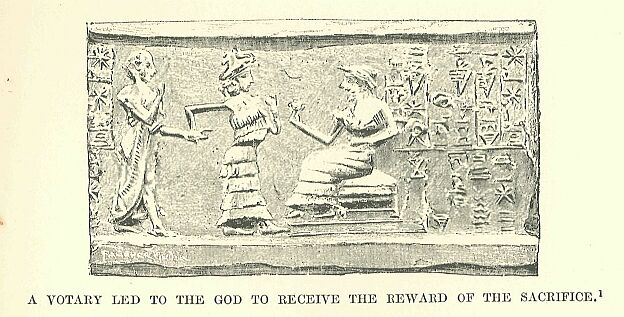
He, had, indeed, as much need of riches and renown as the least of his clients. As he was subject to all human failings, and experienced all the appetites of mankind, he had to be nourished, clothed, and amused, and this could be done only at great expense. The stone or wooden statues erected to him in the sanctuaries furnished him with bodies, which he animated with his breath, and accredited to his clients as the receivers of all things needful to him in his mysterious kingdom. The images of the gods were clothed in vestments, they were anointed with odoriferous oils, covered with jewels, served with food and drink; and during these operations the divinities themselves, above in the heaven, or down in the abyss, or in the bosom of the earth, were arrayed in garments, their bodies were perfumed with unguents, and their appetites fully satisfied: all that was further required for this purpose was the offering of sacrifices together with prayers and prescribed rites. The priest began by solemnly inviting the gods to the feast: as soon as they sniffed from afar the smell of the good cheer that awaited them, they ran “like a swarm of flies” and prepared themselves to partake of it.
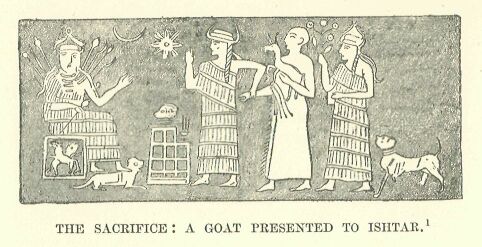
Drawn by Faucher-Gudin, from an Assyrian intaglio illustrated in A. Rich, Narrative of a Journey to the Site of Babylon in 1811. The sacrifice of the goat, or rather its presentation to the god, is not infrequently represented on the Assyrian bas-reliefs.
The supplications having been heard, water was brought to the gods for the necessary ablutions before a repast. “Wash thy hands, cleanse thy hands,—may the gods thy brothers wash their hands!—From a clean dish eat a pure repast,—from a clean cup drink pure water.” The statue, from the rigidity of the material out of which it was carved, was at a loss how to profit by the exquisite things which had been lavished upon it: the difficulty was removed by the opening of its mouth at the moment of consecration, thus enabling it to partake of the good fare to its satisfaction.* The banquet lasted a long time, and consisted of every delicacy which the culinary skill of the time could prepare: the courses consisted of dates, wheaten flour, honey, butter, various kinds of wines, and fruits, together with roast and boiled meats.
* This operation, which was also resorted to in Egypt in the case of the statues of the gods and deceased persons, is clearly indicated in a text of the second Chaldæan empire published in W. A. Insc, vol. iv. pi. 25. The priest who consecrates an image makes clear in the first place that “its mouth not being open it can partake of no refreshment: it neither eats food nor drinks water.” Thereupon he performs certain rites, which he declares were celebrated, if not at that moment, at least for the first time by Ea himself: “Ea has brought thee to thy glorious place,—to thy glorious place he has brought thee,—brought thee with his splendid hand,—brought also butter and honey;—he has poured consecrated water into thy mouth—and by magic has opened thy mouth.” Henceforward the statue can eat and drink like an ordinary living being the meat and beverages offered to it during the sacrifice.
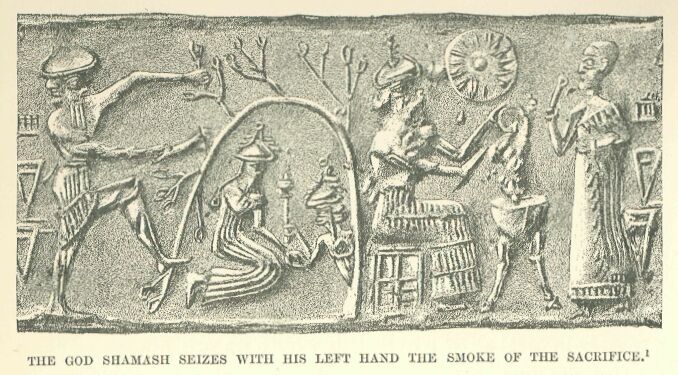
Drawn by Faucher-Gudin, from a Chaldæan intaglio pointed out by Heuzey-Sarzcc; the original is in the Louvre. The scene depicted behind Shamash deals with a legend still unknown. A goddess, pursued by a genius with a double face, has taken refuge under a tree, which bows down to protect her; while the monster endeavours to break down the obstacle branch by branch, a god rises from the stem and hands to the goddess a stone-headed mace to protect her against her enemy.
In the most ancient times it would appear that even human sacrifices were offered, but this custom was obsolete except on rare occasions, and lambs, oxen, sometimes swine’s flesh, formed the usual elements of the sacrifice. The gods seized as it arose from the altar the unctuous smoke, and fed on it with delight. When they had finished their repast, the supplication of a favour was adroitly added, to which they gave a favourable hearing. Services were frequent in the temples: there was one in the morning and another in the evening on ordinary days, in addition to those which private individuals might require at any hour of the day. The festivals assigned to the local god and his colleagues, together with the acts of praise in which the whole nation joined, such as that of the New Year, required an abundance of extravagant sacrifices, in which the blood of the victims flowed like water. Days of sorrow and mourning alternated with these days of joy, during which the people and the magnates gave themselves up to severe fasting and acts of penitence. The Chaldeans had a lively sense of human frailty, and of the risks entailed upon the sinner by disobedience to the gods. The dread of sinning haunted them during their whole life; they continually subjected the motives of their actions to a strict scrutiny, and once self-examination had revealed to them the shadow of an evil intent, they were accustomed to implore pardon for it in a humble manner. “Lord, my sins are many, great are my misdeeds!—O my god, my sins are many, great my misdeeds!—O my goddess, my sins are many, great my misdeeds!—I have committed faults and I knew them not; I have committed sin and I knew it not; I have fed upon misdeeds and I knew them not; I have walked in omissions and I knew them not.—The lord, in the anger of his heart, he has stricken me,—the god, in the wrath of his heart, has abandoned me,—Ishtar is enraged against me, and has treated me harshly!—I make an effort, and no one offers me a hand,—I weep, and no one comes to me,—I cry aloud, and no one hears me:—I sink under affliction, I am overwhelmed, I can no longer raise up my head,—I turn to my merciful god to call upon him, and I groan!... Lord reject not thy servant,—and if he is hurled into the roaring waters, stretch to him thy hand;—the sins I have committed, have mercy upon them,—the misdeeds I have committed, scatter them to the winds—and my numerous faults, tear them to pieces like a garment.” Sin in the eyes of the Chaldæan was not, as with us, an infirmity of the soul; it assaulted the body like an actual virus, and the fear of physical suffering or death engendered by it, inspired these complaints with a note of sincerity which cannot be mistaken.
Every individual is placed, from the moment of his birth, under the protection of a god and goddess, of whom he is the servant, or rather the son, and whom he never addresses otherwise than as his god and his goddess. These deities accompany him night and day, not so much to protect him from visible dangers, as to guard him from the invisible beings which ceaselessly hover round him, and attack him on every side. If he is devout, piously disposed towards his divine patrons and the deities of his country, if he observes the prescribed rites, recites the prayers, performs the sacrifices—in a word, if he acts rightly—their aid is never lacking; they bestow upon him a numerous posterity, a happy old age, prolonged to the term fixed by fate, when he must resign himself to close his eyes for ever to the light of day. If, on the contrary, he is wicked, violent, one whose word cannot be trusted, “his god cuts him down like a reed,” extirpates his race, shortens his days, delivers him over to demons who possess themselves of his body and afflict it with sicknesses before finally despatching him. Penitence is of avail against the evil of sin, and serves to re-establish a right course of life, but its efficacy is not permanent, and the moment at last arrives in which death, getting the upper hand, carries its victim away. The Chaldæans had not such clear ideas as to what awaited them in the other world as the Egyptians possessed: whilst the tomb, the mummy, the perpetuity of the funeral revenues, and the safety of the double, were the engrossing subjects in Egypt, the Chaldæan texts are almost entirely silent as to the condition of the soul, and the living seem to have had no further concern about the dead than to get rid of them as quickly and as completely as possible. They did not believe that everything was over at the last breath, but they did not on that account think that the fate of that which survived was indissolubly associated with the perishable part, and that the disembodied soul was either annihilated or survived, according as the flesh in which it was sustained was annihilated or survived in the tomb. The soul was doubtless not utterly unconcerned about the fate of the larva it had quitted: its pains were intensified on being despoiled of its earthly case if the latter were mutilated, or left without sepulture, a prey to the fowls, of the air. This feeling, however, was not sufficiently developed to create a desire for escape from corruption entirely, and to cause a resort to the mummifying process of the Egyptians.
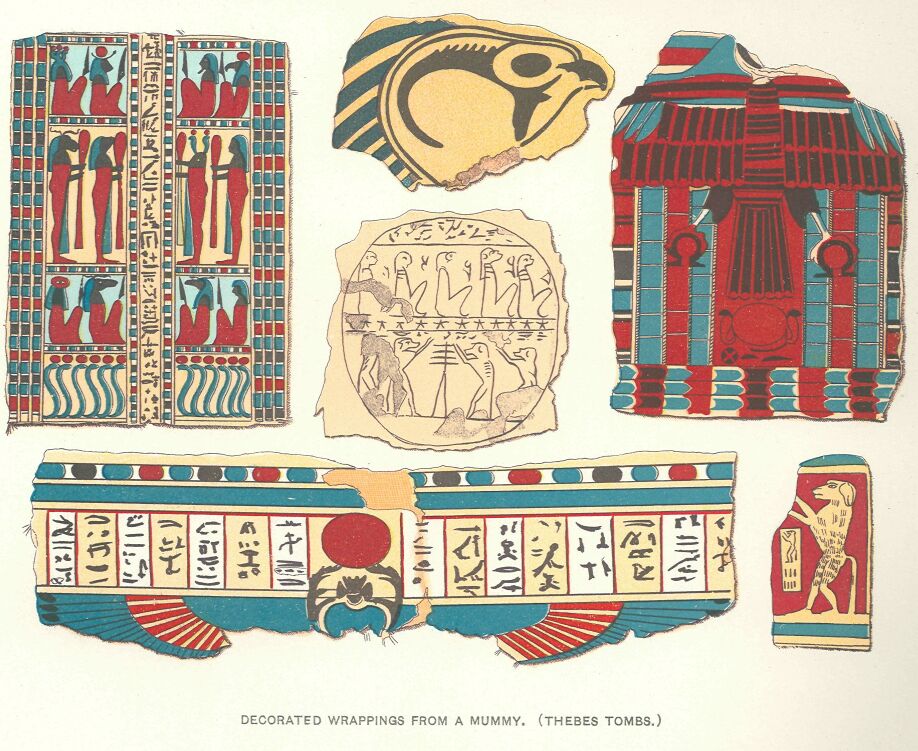
The Chaldæans did not subject the body, therefore, to those injections, to those prolonged baths in preserving fluids, to that laborious swaddling which rendered it indestructible; whilst the family wept and lamented, old women who exercised the sad function of mourners washed the dead body, perfumed it, clad it in its best apparel, painted its cheeks, blackened its eyelids, placed a collar on its neck, rings on its fingers, arranged its arms upon its breast, and stretched it on a bed, setting up at its head a little altar for the customary offerings of water, incense, and cakes.
Drawn by Faucher-Gudin, from a sketch by Taylor.
Drawn by Faucher-Gudin, from a sketch by Taylor.
Evil spirits, prowled incessantly around the dead bodies of the Chaldæans, either to feed upon them, or to use them in their sorcery: should they succeed in slipping into a corpse, from that moment it could be metamorphosed into a vampire, and return to the world to suck the blood of the living. The Chaldæans were, therefore, accustomed to invite by prayers beneficent genii and gods to watch over the dead. Two of these would take their invisible places at the head and foot of the bed, and wave their hands in the act of blessing: these were the vassals of Ea, and, like their master, were usually clad in fish-skins. Others placed themselves in the sepulchral chamber, and stood ready to strike any one who dared to enter: these had human figures, or lions’ heads joined to the bodies of men. Others, moreover, hovered over the house in order to drive off the spectres who might endeavour to enter through the roof. During the last hours in which the dead body remained among its kindred, it reposed under the protection of a legion of gods.
We must not expect to find on the plains of the Euphrates the rock-cut tombs, the mastabas or pyramids, of Egypt. No mountain chain ran on either side of the river, formed of rock soft enough to be cut and hollowed easily into chambers or sepulchral halls, and at the same time sufficiently hard to prevent the tunnels once cut from falling in.
Drawn by Faucher-Gudin, from a sketch by Taylor.
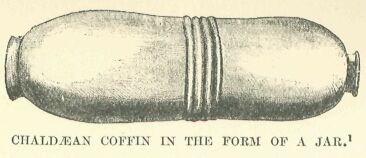
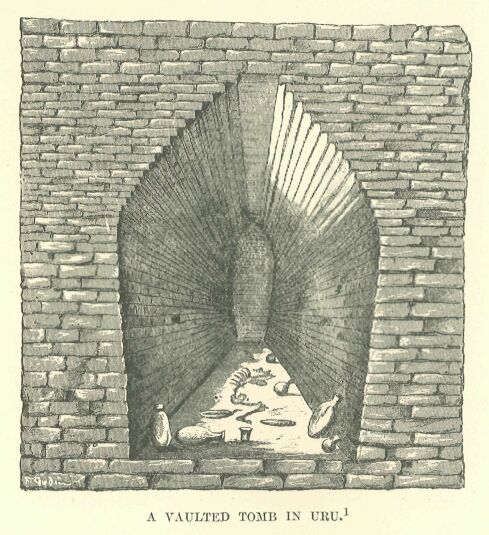
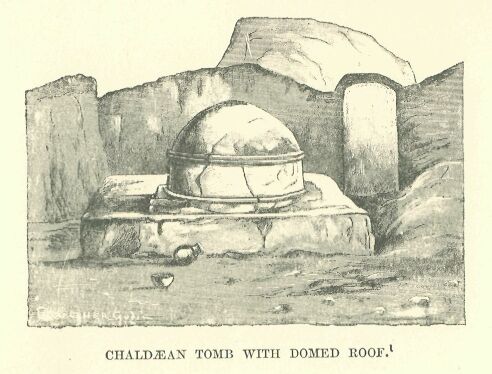
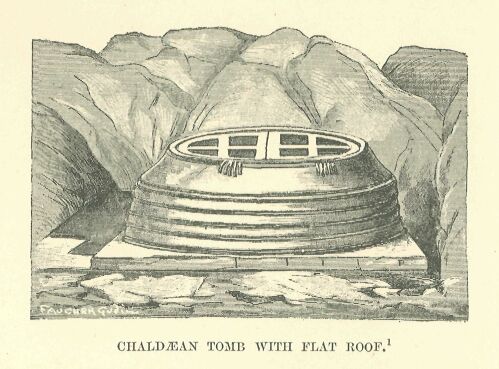
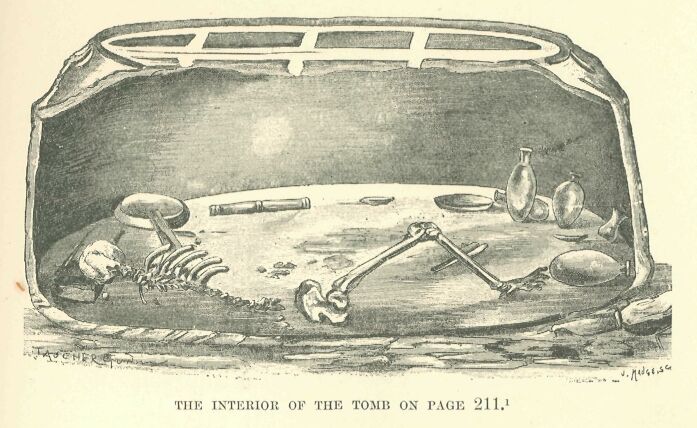
The alluvial soil upon which the Chaldæan cities were built, far from, preserving the dead body, rapidly decomposed it under the influence of heat and moisture: vaults constructed in it would soon be invaded by water in spite of masonry; paintings and sculpture would soon be eaten away by nitre, and the funereal furniture and the coffin quickly destroyed. The dwelling-house of the Chaldæan dead could not, therefore, properly be called, as those of Egypt, an “eternal house.” It was constructed of dried or burnt brick, and its form varied much from the most ancient times. Sometimes it was a great vaulted chamber, the courses forming the roof being arranged corbel-wise, and contained the remains of one or two bodies walled up within it.* At other times it consisted merely of an earthen jar, in which the corpse had been inserted in a bent-up posture, or was composed of two enormous cylindrical jars, which, when united and cemented with bitumen, formed a kind of barrel around the body. Other tombs are represented by wretched structures, sometimes oval and sometimes round in shape, placed upon a brick base and covered by a flat or domed roof. The interior was not of large dimensions, and to enter it was necessary to stoop to a creeping posture. The occupant of the smallest chambers was content to have with him his linen, his ornaments, some bronze arrowheads, and metal or clay vessels. Others contained furniture which, though not as complete as that found in Egyptian sepulchres, must have ministered to all the needs of the spirit. The body was stretched, fully clothed, upon a mat impregnated with bitumen, the head supported by a cushion or flat brick,** the arms laid across the breast, and the shroud adjusted by bands to the loins and legs. Sometimes the corpse was placed on its left side, with the legs slightly bent, and the right hand, extending over the left shoulder, was inserted into a vase, as if to convey the contents to the mouth.
* Vaulted chambers are confined chiefly to the ancient cemeteries of Uru at Mugheir; they are rather over six to seven feet long, with a breadth of five and a half feet. The walls are not quite perpendicular, but are somewhat splayed up to two-thirds of their height, where they begin to narrow into the vaulted roof. ** The object placed under the head of the skeleton is the dried brick mentioned in the text; the vessel to which the hand is stretched out was of copper; the other vessels were of earthenware, and contained water, or dates, of which the stones were found. The small cylinders on the side were of stone; the two large cylinders, between the copper vessel and those of earthenware, were pieces of bamboo, of whose use we are ignorant.
Drawn by Faucher-Gudin, from a sketch by Taylor
Clay jars and dishes, arranged around the body, contained the food and drink required for the dead man’s daily fare—his favourite wine, dates, fish, fowl, game, occasionally also a boar’s head—and even stone representations of provisions, which, like those of Egypt, were lasting substitutes for the reality. The dead man required weapons also to enable him to protect his food-store, and his lance, javelins and baton of office were placed alongside him, together with a cylinder bearing his name, which he had employed as his seal in his lifetime. Beside the body of a woman or young girl was arranged an abundance of spare ornaments, flowers, scent-bottles, combs, cosmetic pencils, and cakes of the black paste with which they were accustomed to paint the eyebrows and the edges of the eyelids.
Cremation seems in many cases to have been preferred to burial in a tomb. The funeral pile was constructed at some distance from the town, on a specially reserved area in the middle of the marshes. The body, wrapped up in coarse matting, was placed upon a heap of reeds and rushes saturated with bitumen: a brick wall, coated with moist clay, was built around this to circumscribe the action of the flames, and, the customary prayers having been recited, the pile was set on fire, masses of fresh material, together with the funerary furniture and usual viaticum, being added to the pyre. When the work of cremation was considered to be complete, the fire was extinguished, and an examination made of the residue. It frequently happened that only the most accessible and most easily destroyed parts of the body had been attacked by the flames, and that there remained a black and disfigured mass which the fire had not consumed. The previously prepared coating of mud was then made to furnish a clay covering for the body, so as to conceal the sickening spectacle from the view of the relatives and spectators. Sometimes, however, the furnace accomplished its work satisfactorily, and there was nothing to be seen at the end but greasy ashes and scraps of calcined bones. The remains were frequently left where they were, and the funeral pile became their tomb. They were, however, often collected and disposed of in a manner which varied with their more or less complete combustion. Bodies insufficiently burnt were interred in graves, or in public chapels; while the ashes of those fully cremated, together with the scraps of bones and the débris of the offerings, were placed in long urns. The heat had contorted the weapons and half melted the vessels of copper; and the deceased was thus obliged to be content with the fragments only of the things provided for him. These were, however, sufficient for the purpose, and his possessions, once put to the test of the flames, now accompanied him whither he went: water alone was lacking, but provision was made for this by the construction on the spot of cisterns to collect it. For this purpose several cylinders of pottery, some twenty inches broad, were inserted in the ground one above the other from a depth of from ten to twelve feet, and the last cylinder, reaching the level of the ground, was provided with a narrow neck, through which the rainwater or infiltrations from the river flowed into this novel cistern. Many examples of these are found in one and the same chamber,* thus giving the soul an opportunity of finding water in one or other of them. The tombs at Uruk, arranged closely together with coterminous walls, and gradually covered by the sand or by the accumulation and débris of new tombs, came at length to form an actual mound. In cities where space was less valuable, and where they were free to extend, the tombs quickly disappeared without leaving any vestiges above the surface, and it would now be necessary to turn up a great deal of rubbish before discovering their remains. The Chaldæa of to-day presents the singular aspect of a country almost without cemeteries, and one would be inclined to think that its ancient inhabitants had taken pains to hide them.** The sepulture of royal personages alone furnishes us with monuments of which we can determine the site. At Babylon these were found in the ancient palaces in which the living were no longer inclined to dwell: that of Shargina, for instance, furnished a burying-place for kings more than two thousand years after the death of its founder. The chronicles devoutly indicate the spot where each monarch, when his earthly reign was over, found a last resting-place; and where, as the subject of a ceremonial worship similar to that of Egypt, his memory was preserved from the oblivion which had overtaken most of his illustrious subjects.
* The German expedition of 1886-87 found four of these reservoirs in a single chamber, and nine distributed in the chambers of a house entirely devoted to the burial of the dead. ** Various explanations have been offered to account for this absence of tombs, Without mentioning the desperate attempt to get rid of the difficulty by the assumption that the dead bodies were cast into the river, Loftus thinks that the Chaldæans and Assyrians were accustomed to send them to some sanctuary in Southern Chaldæa, especially to Uru and Uruk, whose vast cemeteries, he contends, would have absorbed during the centuries the greater part of the Euphratean population; his opinion has been adopted by some historians, and, as far only as the later period is concerned, by Hommel.
The dead man, or rather that part of him which survived—his “ekimmu”—dwelt in the tomb, and it was for his comfort that there were provided, at the time of sepulture or cremation, the provisions and clothing, the ornaments and weapons, of which he was considered to stand in need. Furnished with these necessities by his children and heirs, he preserved for the donors the same affection which he had felt for them in his lifetime, and gave evidence of it in every way he could, watching over their welfare, and protecting them from malign influences. If they abandoned or forgot him, he avenged himself for their neglect by returning to torment them in their homes, by letting sickness attack them, and by ruining them with his imprecations: he became thus no less hurtful than the “luminous ghost” of the Egyptians, and if he were accidentally deprived of sepulture, he would not be merely a plague to his relations, but a danger to the entire city. The dead, who were unable to earn an honest living, showed little pity to those who were in the same position as themselves: when a new-comer arrived among them without prayers, libations, or offerings, they declined to receive him, and would not give him so much as a piece of bread out of their meagre store. The spirit of the unburied dead man, having neither place of repose nor means of subsistence, wandered through the town and country, occupied with no other thought than that of attacking and robbing the living. He it was who, gliding into the house during the night, revealed himself to its inhabitants with such a frightful visage as to drive them distracted with terror. Always on the watch, no sooner does he surprise one of his victims than he falls upon him, “his head against his victim’s head, his hand against his hand, his foot against his foot.” He who has been thus attacked, whether man or beast, would undoubtedly perish if magic were not able to furnish its all-powerful defence against this deadly embrace.* This human survival, who is so forcibly represented both in his good and evil aspects, was nevertheless nothing more than a sort of vague and fluid existence—a double, in fact, analogous in appearance to that of the Egyptians.
* The majority of the spells employed against sickness contain references to the spirits against which they contend—“the wicked ekimmu who oppresses men during the night,” or simply “the wicked ekimmu,” the ghost.
With the faculty of roaming at will through space, and of going forth from and returning to his abode, it was impossible to regard him as condemned always to dwell in the case of terra-cotta in which his body lay mouldering: he was transferred, therefore, or rather he transferred himself, into the dark land—the Aralu—situated very far away—according to some, beneath the surface of the earth; according to others, in the eastern or northern extremities of the universe. A river which opens into this region and separates it from the sunlit earth, finds its source in the primordial waters into whose bosom this world of ours is plunged. This dark country is surrounded by seven high walls, and is approached through seven gates, each of which is guarded by a pitiless warder. Two deities rule within it—Nergal, “the lord of the great city,” and Beltis-Allat, “the lady of the great land,” whither everything which has breathed in this world descends after death. A legend relates that Allât, called in Sumerian Erishkigal, reigned alone in Hades, and was invited by the gods to a feast which they had prepared in heaven. Owing to her hatred of the light, she sent a refusal by her messenger Narntar, who acquitted himself on this mission with such a bad grace, that Ann and Ea were incensed against his mistress, and commissioned Nergal to descend and chastise her; he went, and finding the gates of hell open, dragged the queen by her hair from the throne, and was about to decapitate her, but she mollified him by her prayers, and saved her life by becoming his wife. The nature of Nergal fitted him well to play the part of a prince of the departed: for he was the destroying sun of summer, and the genius of pestilence and battle. His functions, however, in heaven and earth took up so much of his time that he had little leisure to visit his nether kingdom, and he was consequently obliged to content himself with the rôle of providing subjects for it by despatching thither the thousands of recruits which he gathered daily from the abodes of men or from the field of battle. Allât was the actual sovereign of the country. She was represented with the body of a woman, ill-formed and shaggy, the grinning muzzle of a lion, and the claws of a bird of prey. She brandished in each hand a large serpent—a real animated javelin, whose poisonous bite inflicted a fatal wound upon the enemy. Her children were two lions, which she is represented as suckling, and she passed through her empire, not seated in the saddle, but standing upright or kneeling on the back of a horse, which seems oppressed by her weight. Sometimes she set out on an expedition upon the river which communicates with the countries of light, in order to meet the procession of newly arrived souls ceaselessly despatched to her: she embarked in this case upon an enchanted vessel, which made its way without sail or oars, its prow projecting like the beak of a bird, and its stern terminating in the head of an ox. She overcomes all resistance, and nothing can escape from her: the gods themselves can pass into her empire only on the condition of submitting to death like mortals, and of humbly avowing themselves her slaves.
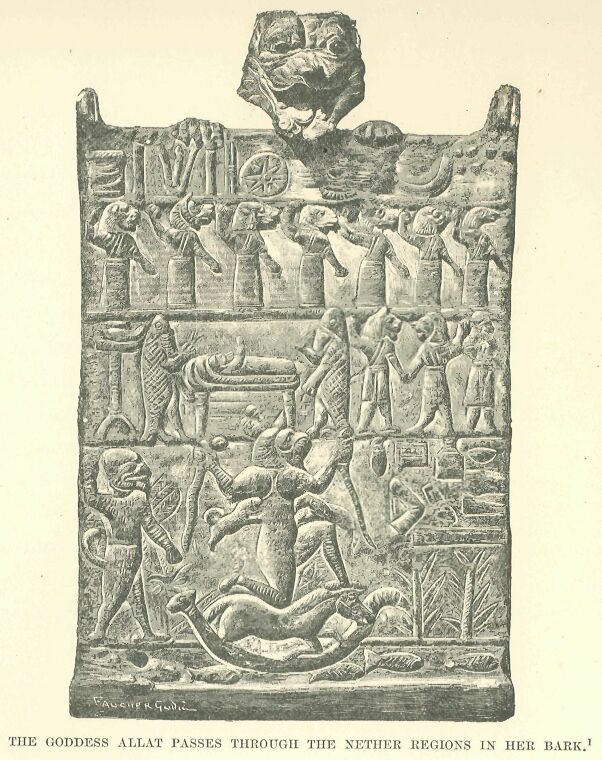
Drawn by Faucher-Gudin, from a bronze plaque of which an engraving was published by Clermont-Ganneau. The original, which belonged to M. Péretié, is now in the collection of M. de Clercq
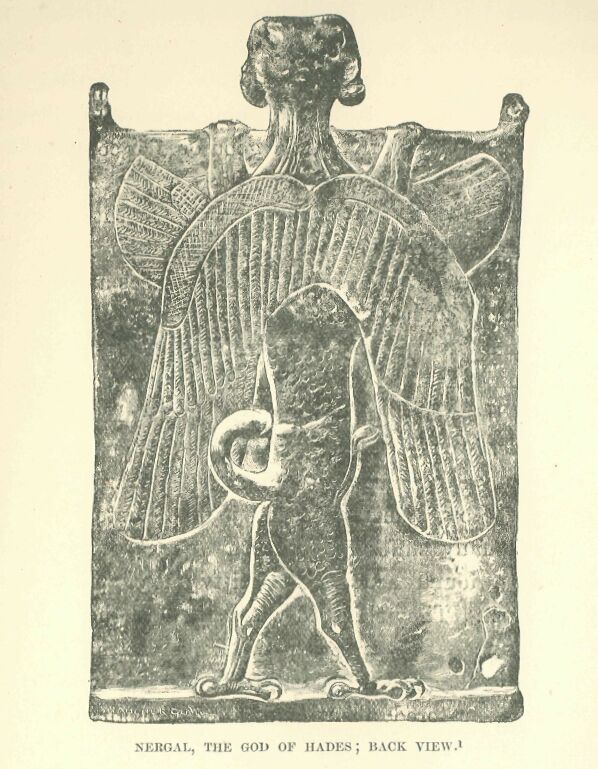
Drawn by Faucher-Gudin. This is the back of the bronze plate represented on the preceding page; the animal-head of the god appears in relief at the top of the illustration.
The warders at the gates despoiled the new-comers of everything which they had brought with them, and conducted them in a naked condition before Allât, who pronounced sentence upon them, and assigned to each his place in the nether world. The good or evil committed on earth by such souls was of little moment in determining the sentence: to secure the favour of the judge, it was of far greater importance to have exhibited devotion to the gods and to Allât herself, to have lavished sacrifices and offerings upon them and to have enriched their temples. The souls which could not justify themselves were subjected to horrible punishment: leprosy consumed them to the end of time, and the most painful maladies attacked them, to torture them ceaselessly without any hope of release. Those who were fortunate enough to be spared from her rage, dragged out a miserable and joyless existence. They were continually suffering from the pangs of thirst and hunger, and found nothing to satisfy their appetites but clay and dust. They shivered with cold, and they obtained no other garment to protect them than mantles of feathers—the great silent wings of the night-birds, invested with which they fluttered about and filled the air with their screams. This gloomy and cruel conception of ordinary life in this strange kingdom was still worse than the idea formed of the existence in the tomb to which it succeeded. In the cemetery the soul was, at least, alone with the dead body; in the house of Allât, on the contrary, it was lost as it were among spirits as much afflicted as itself, and among the genii born of darkness. None of these genii had a simple form, or approached the human figure in shape; each individual was a hideous medley of human and animal parts, in which the most repellent features were artistically combined. Lions’ heads stood out from the bodies of scorpion-tailed jackals, whose feet were armed with eagles’ claws: and among such monsters the genii of pestilence, fever, and the south-west wind took the chief place. When once the dead had become naturalized among this terrible population, they could not escape from their condition, unless by the exceptional mandate of the gods above. They possessed no recollection of what they had done upon earth. Domestic affection, friendships, and the memory of good offices rendered to one another,—all were effaced from their minds: nothing remained there but an inexpressible regret at having been exiled from the world of light, and an excruciating desire to reach it once more. The threshold of Allat’s palace stood upon a spring which had the property of restoring to life all who bathed in it or drank of its waters: they gushed forth as soon as the stone was raised, but the earth-spirits guarded it with a jealous care, and kept at a distance all who attempted to appropriate a drop of it. They permitted access to it only by order of Ea himself, or one of the supreme gods, and even then with a rebellious heart at seeing their prey escape them. Ancient legends related how the shepherd Dumuzi, son of Ea and Damkina, having excited the love of Ishtar while he was pasturing his flocks under the mysterious tree of Eridu, which covers the earth with its shade, was chosen by the goddess from among all others to be the spouse of her youth, and how, being mortally wounded by a wild boar, he was cast into the kingdom of Allat. One means remained by which he might be restored to the light of day: his wounds must be washed in the waters of the wonderful spring, and Ishtar resolved to go in quest of this marvellous liquid. The undertaking was fraught with danger, for no one might travel to the infernal regions without having previously gone through the extreme terrors of death, and even the gods themselves could not transgress this fatal law. “To the land without return, to the land which thou knowest—Ishtar, the daughter of Sin, turned her thoughts: she, the daughter of Sin, turned her thoughts—to the house of darkness, the abode of Irkalla—to the house from which he who enters can never emerge—to the path upon which he who goes shall never come back—to the house into which he who enters bids farewell to the light—the place where dust is nourishment and clay is food; the light is not seen, darkness is the dwelling, where the garments are the wings of birds—where dust accumulates on door and bolt.” Ishtar arrives at the porch, she knocks at it, she addresses the guardian in an imperious voice: “‘Guardian of the waters, open thy gate—open thy gate that I may enter, even I.—If thou openest not the door that I may enter, even I,—I will burst open the door, I will break the bars, I will break the threshold, I will burst in the panels, I will excite the dead that they may eat the living,—and the dead shall be more numerous than the living.’—The guardian opened his mouth and spake, he announced to the mighty Ishtar: ‘Stop, O lady, and do not overturn the door until I go and apprise the Queen Allât of thy name.’ Allat hesitates, and then gives him permission to receive the goddess: ‘Go, guardian, open the gate to her—but treat her according to the ancient laws. Mortals enter naked into the world, and naked must they leave it: and since Ishtar has decided to accept their lot, she too must be prepared to divest herself of her garments.’” The guardian went, he opened his mouth: ‘Enter, my lady, and may Kutha rejoice—may the palace and the land without return exult in thy presence! ‘He causes her to pass through the first gate, divests her, removes the great crown from her head:—‘Why, guardian, dost thou remove the great crown from my head?’—‘Enter, my lady, such is the law of Allât.’ The second gate, he causes her to pass through it, he divests her—removes the rings from her ears:—‘Why, guardian, dost thou remove the rings from my ears?’—‘Enter, my lady, such is the law of Allât.’” And from gate to gate he removes some ornament from the distressed lady—now her necklace with its attached amulets, now the tunic which covers her bosom, now her enamelled girdle, her bracelets, and the rings on her ankles: and at length, at the seventh gate, takes from her her last covering. When she at length arrives in the presence of Allat, she throws herself upon her in order to wrest from her in a terrible struggle the life of Dumuzi; but Allat sends for Namtar, her messenger of misfortune, to punish, the rebellious Ishtar. “Strike her eyes with the affliction of the eyes—strike her loins with the affliction of the loins—strike her feet with the affliction of the feet—strike her heart with the affliction of the heart—strike her head with the affliction of the head—strike violently at her, at her whole body!” While Ishtar was suffering the torments of the infernal regions, the world of the living was wearing mourning on account of her death. In the absence of the goddess of love, the rites of love could no longer be performed. The passions of animals and men were suspended. If she did not return quickly to the daylight, the races of men and animals would become extinct, the earth would become a desert, and the gods would have neither votaries nor offerings.
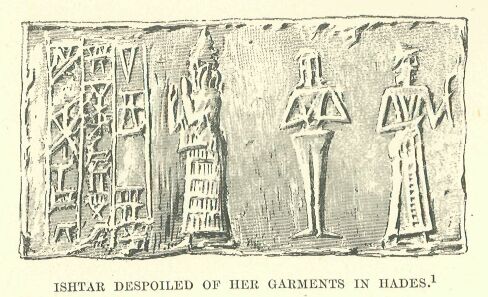
Drawn by Faucher-Gudin, from a Chaldæan intaglio in the Hague Museum. Salomon Reinach has demonstrated that the naked figure is not the goddess herself, but a statue of the goddess which was adored in one of the temples.
“Papsukal, the servant of the great gods, tore his face before Shamash—clothed in mourning, filled with sorrow. Shamash went—he wept in the presence of Sin, his father,—and his tears flowed in the presence of Ea, the king:—‘Ishtar has gone down into the earth, and she has not come up again!—And ever since Ishtar has descended into the land without return... [the passions of men and beasts have been suspended]... the master goes to sleep while giving his command, the servant goes to sleep on his duty.’” The resurrection of the goddess is the only remedy for such ills, but this is dependent upon the resurrection of Damuzi: Ishtar will never consent to reappear in the world, if she cannot bring back her husband with her. Ea, the supreme god, the infallible executor of the divine will—he who alone can modify the laws imposed upon creation—at length decides to accord to her what she desires. “Ea, in the wisdom of his heart, formed a male being,—formed Uddushunâmir, the servant of the gods:—‘Go then, Uddushunâmir, turn thy face towards the gate of the land without return; —the seven gates of the land without return—may they become open at thy presence—may Allât behold thee, and rejoice in thy presence! When her heart shall be calm, and her wrath appeased, charm her in the name of the great gods—turn thy thoughts to the spring’—‘May the spring, my lady, give me of its waters that I may drink of them.’” Allât broke out into a terrible rage, when she saw herself obliged to yield to her rival; “she beat her sides, she gnawed her fingers,” she broke out into curses against the messenger of misfortune. “‘Thou hast expressed to me a wish which should not be made!—Fly, Uddushunâmir, or I will shut thee up in the great prison—the mud of the drains of the city shall be thy food—the gutters of the town shall be thy drink—the shadow of the walls shall be thy abode—the thresholds shall be thy habitation—confinement and isolation shall weaken thy strength.’”* She is obliged to obey, notwithstanding; she calls her messenger Namtar and commands him to make all the preparations for resuscitating the goddess. It was necessary to break the threshold of the palace in order to get at the spring, and its waters would have their full effect only in presence of the Anunnas. “Namtar went, he rent open the eternal palace,—he twisted the uprights so that the stones of the threshold trembled;—he made the Anunnaki come forth, and seated them on thrones of gold,—he poured upon Ishtar the waters of life, and brought her away.” She received again at each gate the articles of apparel she had abandoned in her passage across the seven circles of hell: as soon as she saw the daylight once more, it was revealed to her that the fate of her husband was henceforward in her own hands. Every year she must bathe him in pure water, and anoint him with the most precious perfumes, clothe him in a robe of mourning, and play to him sad airs upon a crystal flute, whilst her priestesses intoned their doleful chants, and tore their breasts in sorrow: his heart would then take fresh life, and his youth flourish once more, from springtime to springtime, as long as she should celebrate on his behalf the ceremonies already prescribed by the deities of the infernal world.
* It follows from this passage that Ishtar could be delivered only at the cost of another life: it was for this reason, doubtless, that Ea, instead of sending the ordinary messenger of the gods, created a special messenger. Allât, furious at the insignificance of the victim sent to her, contents herself with threatening Uddushanâmir with an ignominious treatment if he does not escape as quickly as possible.
Dumuzi was a god, the lover, moreover, of a goddess, and the deity succeeded where mortals failed.* Ea, Nebo, Gula, Ishtar, and their fellows possessed, no doubt, the faculty of recalling the dead to life, but they rarely made use of it on behalf of their creatures, and their most pious votaries pleaded in vain from temple to temple for the resurrection of their dead friends; they could never obtain the favour which had been granted by Allât to Dumuzi.
* Merodach is called “the merciful one who takes pleasure in raising the dead to life,” and “the lord of the pure libation,” the “merciful one who has power to give life.” In Jeremias may be found the list of the gods who up to the present are known to have had the power to resuscitate the dead; it is probable that this power belonged to all the gods and goddesses of the first rank.
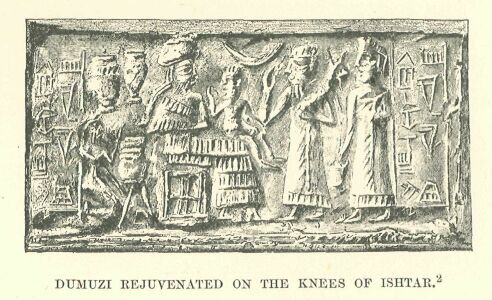
Drawn by Faucher-Gudin, from a Chaldæan intaglio.
When the dead body was once placed in the tomb, it rose up no more, it could no more be reinstated in the place in the household it had lost, it never could begin once more a new earthly existence. The necromancers, indeed, might snatch away death’s prey for a few moments. The earth gaped at the words of their invocations, the soul burst forth like a puff of wind and answered gloomily the questions proposed to it; but when the charm was once broken, it had to retrace its steps to the country without return, to be plunged once more in darkness. This prospect of a dreary and joyless eternity was not so terrifying to the Chaldæans as it was to the Egyptians. The few years of their earthly existence were of far more concern to them than the endless ages which were to begin their monotonous course on the morrow of their funeral. The sum of good and evil fortune assigned to them by destiny they preferred to spend continuously in the light of day on the fair plains of the Euphrates and Tigris: if they were to economize during this period with the view of laying up a posthumous treasure of felicity, their store would have no current value beyond the tomb, and would thus become so much waste. The gods, therefore, whom they served faithfully would recoup them, here in their native city, with present prosperity, with health, riches, power, glory, and a numerous offspring, for the offerings of their devotion; while, if they irritated the deities by their shortcomings, they had nothing to expect but overwhelming calamities and sufferings. The gods would “cut them down like a reed,” and their “names would be annihilated, their seed destroyed;—they would end their days in affliction and hunger,—their dead bodies would be at the mercy of chance, and would receive no sepulture.” They were content to resign themselves, therefore, to the dreary lot of eternal misery which awaited them after death, provided they enjoyed in this world a long and prosperous existence. Some of them felt and rebelled against the injustice of the idea, which assigned one and the same fate, without discrimination, to the coward and the hero killed on the battle-field, to the tyrant and the mild ruler of his people, to the wicked and the righteous. These therefore supposed that the gods would make distinctions, that they would separate such heroes from the common herd, welcome them in a fertile, sunlit island, separated from the abode of men by the waters of death—the impassable river which leads to the house of Allât. The tree of life flourished there, the spring of life poured forth there its revivifying waters; thither Ea transferred Xisuthros after the Deluge; Gilgames saw the shores of this island and returned from it, strong and healthy as in the days of his youth. The site of this region of delights was at first placed in the centre of the marshes of the Euphrates, where this river flows into the sea; afterwards when the country became better known, it was transferred beyond the ocean. In proportion as the limits of the Chaldæan horizon were thrust further and further away by mercantile or warlike expeditions, this mysterious island was placed more and more to the east, afterwards to the north, and at length at a distance so great that it tended to vanish altogether. As a final resource, the gods of heaven themselves became the hosts, and welcomed into their own kingdom the purified souls of the heroes.
These souls were not so securely isolated from humanity that the inhabitants of the world were not at times tempted to rejoin them before their last hour had come. Just as Gilgames had dared of old the dangers of the desert and the ocean in order to discover the island of Khasisadra, so Etana darted through the air in order to ascend to the sky of Anu, to become incorporated while still living in the choir of the blessed. The legend gives an account of his friendship with the eagle of Shamash, and of the many favours he had obtained from and rendered to the bird. It happened at last, that his wife could not bring forth the son which lay in her womb; the hero, addressing himself to the eagle, asked from her the plant which alleviates the birth-pangs of women and facilitates their delivery. This was only to be found, however, in the heaven of Anu, and how could any one run the risk of mounting so high, without being destroyed on the way by the anger of the gods? The eagle takes pity upon the sorrow of his comrade, and resolves to attempt the enterprise with him. “‘Friend,’ she says, ‘banish the cloud from thy face! Come, and I will carry thee to the heaven of the god Anu. Place thy breast against my breast—place thy two hands upon the pinions of my wings—place thy side against my side.’ He places his breast against the breast of the eagle, he places his two hands upon the pinions of the wings, he places his side against her side;—he adjusts himself firmly, and his weight was great.” The Chaldæan artists have more than once represented the departure of the hero. They exhibit him closely attached to the body of his ally, and holding her in a strong embrace. A first flight has already lifted them above the earth, and the shepherds scattered over the country are stupefied at the unaccustomed sight: one announces the prodigy to another, while their dogs seated at their feet extend their muzzles as if in the act of howling with terror. “For the space of a double hour the eagle bore him—then the eagle spake to him, to him Etana: ‘Behold, my friend, the earth what it is; regard the sea which the ocean contains! See, the earth is no more than a mountain, and the sea is no more than a lake.’ The space of a second double hour she bore him, then the eagle spake to him, to him Etana: ‘Behold, my friend, the earth what it is; the sea appears as the girdle of the earth! ‘The space of a third double hour she bore him, then the eagle spake to him, to him Etana: ‘See, my friend, the earth, what it is:—the sea is no more than the rivulet made by a gardener.’”
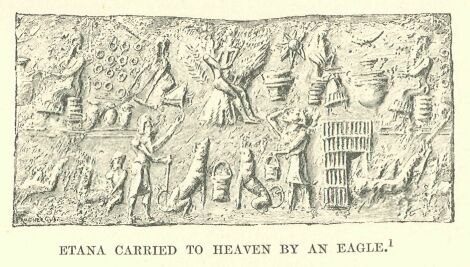
Drawn by Faucher-Gudin, from a Chaldæan intaglio.
“They at length arrive at the heaven of Anu, and rest there for a moment. Etana sees around him nothing but empty space—no living thing within it—not even a bird: he is struck with terror, but the eagle reassures him, and tells him to proceed on his way to the heaven of Ishtar. “‘Come, my friend, let me bear thee to Ishtar,—and I will place thee near Ishtar, the lady,—and at the feet of Ishtar, the lady, thou shalt throw thyself.—Place thy side against my side, place thy hands on the pinions of my wings.’ The space of a double hour she bore him: ‘Friend, behold the earth what it is.—The face of the earth stretches out quite flat—and the sea is no greater than a mere.’ The space of a second double hour she bore him: ‘Friend, behold the earth what it is,—the earth is no more than a square plot in a garden, and the great sea is not greater than a puddle of water.’” At the third hour Etana lost courage, and cried, “Stop!” and the eagle immediately descended again; but, Etana’s strength being exhausted, he let go his hold, and was dashed to pieces on the ground.
The eagle escaped unhurt this time, but she soon suffered a more painful death than that of Etana. She was at war with the serpent, though the records which we as yet possess do not vouchsafe the reason, when she discovered in the roots of a tree the nest in which her enemy concealed its brood. She immediately proposed to her young ones to pounce down upon the growing snakes; one of her eaglets, wiser than the rest, reminded her that they were under the protection of Shamash, the great righter of wrongs, and cautioned her against any transgression of the divine laws. The old eagle felt herself wiser than her son, and rebuked him after the manner of wise mothers: she carried away the serpent’s young, and gave them as food to her own brood. The hissing serpent crawled as far as Shamash, crying for vengeance: “The evil she has done me, Shamash—behold it! Come to my help, Shamash! thy net is as wide as the earth—thy snares reach to the distant mountain—who can escape thy net?—The criminal Zu, Zu who was the first to act wickedly, did he escape it?” Shamash refused to interfere personally, but he pointed out to the serpent an artifice by which he might satisfy his vengeance as securely as if Shamash himself had accomplished it. “Set out upon the way, ascend the mountain,—and conceal thyself in a dead bull;—make an incision in his inside—tear open his belly,—take up thy abode—establish thyself in his belly. All the birds of the air will pounce upon it....—and the eagle herself will come with them, ignorant that thou art within it;—she will wish to possess herself of the flesh, she will come swiftly—she will think of nothing but the entrails within. As soon as she begins to attack the inside, seize her by her wings, beat down her wings, the pinions of her wings and her claws, tear her and throw her into a ravine of the mountain, that she may die there a death of hunger and thirst.”
The serpent did as Shamash advised, and the birds of the air began to flock round the carcase in which she was hidden. The eagle came with the rest, and at first kept aloof, looking for what should happen. When she saw that the birds flew away unharmed all fear left her. In vain did the wise eaglet warn her of the danger that was lurking within the prey; she mocked at him and his predictions, dug her beak into the carrion, and the serpent leaping out seized her by the wing. Then “the eagle her mouth opened, and spake unto the snake, ‘Have mercy upon me, and according to thy pleasure a gift I will lavish upon thee!’ The snake opened her mouth and spake unto the eagle, ‘Did I release thee, Shamash would take part against me; and the doom would fall upon me, which now I fulfil upon thee.’ She tore out her wings, her feathers, her pinions; she tore her to pieces, she threw her into a cleft, and there she died a death of hunger and of thirst.”
The gods allowed no living being to penetrate with impunity into their empire: he who was desirous of ascending thither, however brave he might be, could do so only by death. The mass of humanity had no pretensions to mount so high. Their religion gave them the choice between a perpetual abode in the tomb, or confinement in the prison of Allât; if at times they strove to escape from these alternatives, and to picture otherwise their condition in the world beyond, their ideas as to the other life continued to remain vague, and never approached the minute precision of the Egyptian conception. The cares of the present life were too absorbing to allow them leisure to speculate upon the conditions of a future existence.
==============================
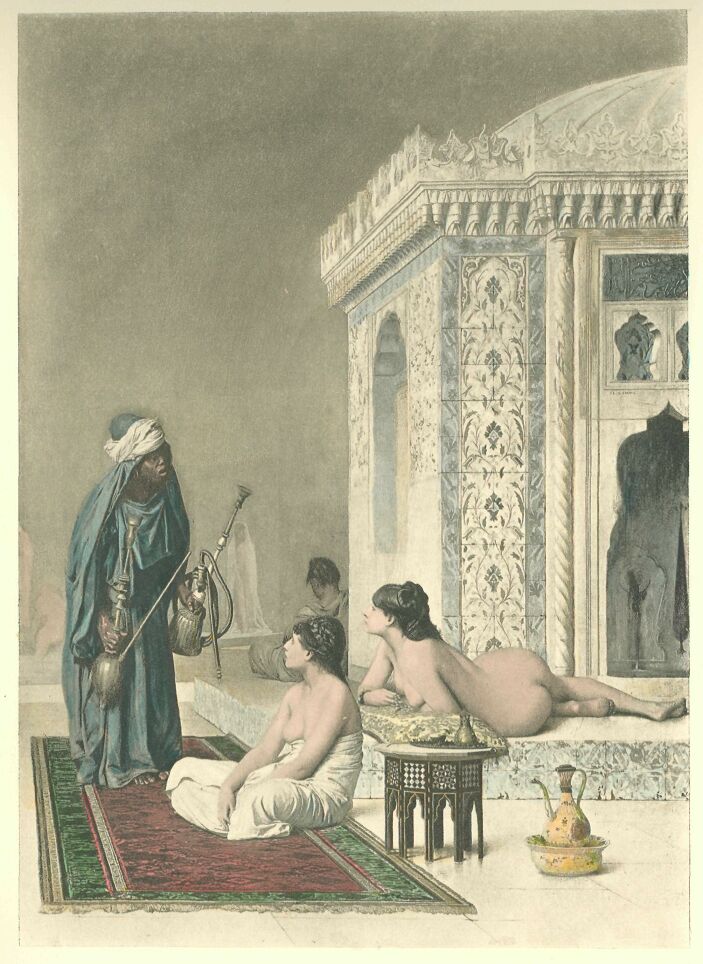
Drawn by Boudier, after J. Dieulafoy. The vignette, which is by Faucher-Gudin, is reproduced from an intaglio in the Cabinet des Médailles.
CHALDÆAN CIVILIZATION—ROYALTY—THE CONSTITUTION OF THE FAMILY AND ITS PROPERTY—CHALMAN COMMERCE AND INDUSTRY.
The kings not gods, but the vicegerents of the gods: their sacerdotal character—The queens and the women of the royal family: the sons and the order of succession to the throne—The royal palaces: description of the palace of Gudea at Lagash, the façades, the zigurât, the private apartments, the furniture, the external decoration—Costume of the men and women: the employees of the palace and the method of royal administration; the military and the great lords.
The scribe and the clay books.—Cuneiform writing: its hieroglyphic origin; the Protean character of the sounds which may be assigned to the ideograms, grammatical tablets, and dictionaries—Their contracts, and their numerous copies of them: the finger-nail mark, the seal.
The constitution of the family: the position held by the wife—Marriage, the contract, the religious ceremonies—Divorce: the rights of wealthy women; woman and marriage among the lower classes—Adopted children, their position in the family; ordinary motives for adoption—Slaves, their condition, their enfranchisement.
The Chaldæan towns: the aspect and distribution of the houses, domestic life—The family patrimony: division of the inheritance—Lending on usury, the rate of interest, commercial intercourse by land and sea—Trade corporations: brick-making, industrial implements in stone and metal, goldsmiths, engravers of cylinders, weavers; the state of the working classes.
Farming and cultivation of the ground: landmarks, slaves, and agricultural labourers—Scenes of pastoral life: fishing, hunting—Archaic literature; positive sciences: arithmetic and geometry, astronomy and astrology, the science of foretelling the future—The physician; magic and its influence on neighbouring countries.
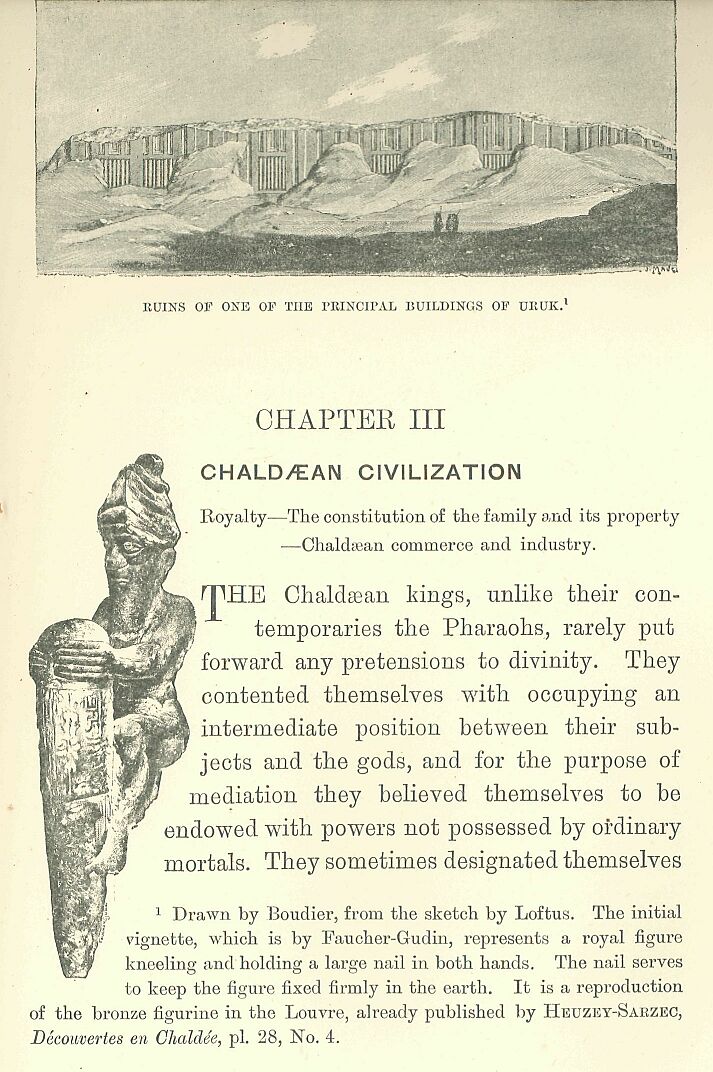
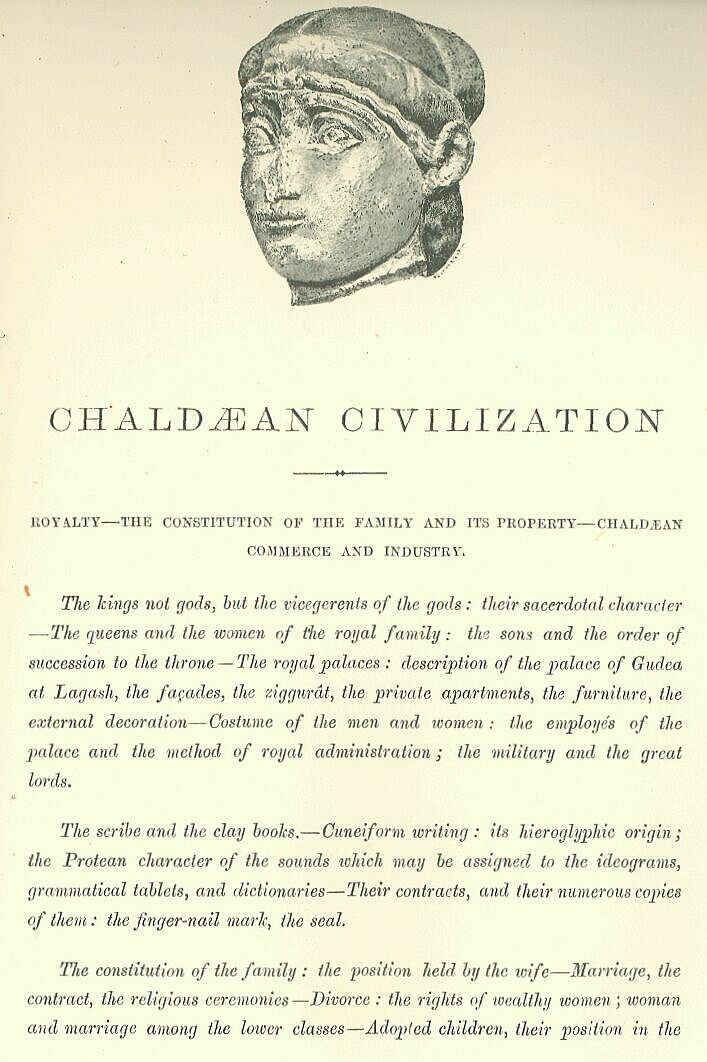
Drawn by Boudier, from the sketch by Loftus. The initial vignette, which is by Faucher-Gudin, represents a royal figure kneeling and holding a large nail in both hands. The nail serves to keep the figure fixed firmly in the earth. It is a reproduction of the bronze figurine in the Louvre, already published by Heuzey-Sakzeo, Découvertes en Chaldée, pl. 28, No. 4.