Volume 1 — THE LEGENDARY HISTORY OF EGYPT (continued 3)
M. L. McClure translation
* This is an episode from the legend of Osiris: at Phihe, in the little building of the Antonines, may be seen a representation of a crocodile crossing the Nile, carrying on his back the mummy of the god. The same episode is also found in the tale of Onus el Ujûd and of Uard f'il-Ikmâm, where the crocodile leads the hero to his beautiful prisoner in the Island of Philæ. Ebers, Ægypte, French trans., vol. ii. pp. 415, 416, has shown how this episode in the Arab story must have been inspired by the bas-relief at Philæ and by the scene which it portrays: the temple is still called "Kasr," and the island "Geziret Onus el-Ujûd." ** In popular romances, this was the usual end of criminals of every kind; we shall see that another king, Akhthoes the founder of the IXth dynasty, after committing horrible misdeeds, was killed, in the same way as Menés, by a hippopotamus.
They also related that the Saïte Tafnakhti, returning from an expedition against the Arabs, during which he had been obliged to renounce the pomp and luxuries of royal life, had solemnly cursed him, and had caused his imprecations to be inscribed upon a stele set up in the temple of Amon at Thebes. Nevertheless, in the memory that Egypt preserved of its first Pharaoh, the good outweighed the evil. He was worshipped in Memphis side by side with Phtah and Ramses II.; his name figured at the head of the royal lists, and his cult continued till the time of the Ptolemies.
His immediate successors had an actual existence, and their tombs are there in proof of it. We know where Usaphais, Miebis, and Semempses[*] were laid to rest, besides more than a dozen other princes whose real names and whose position in the official lists are still uncertain. The order of their succession was often a matter of doubt to the Egyptians themselves, but perhaps the discoveries of the next few years will enable us to clear up and settle definitely matters which were shrouded in mystery in the time of the Theban Pharaohs. As a fact, the forms of such of their names as have been handed down to us by later tradition, are curt and rugged, indicative of an early state of society, and harmonizing with the more primitive civilization to which they belong: Ati the Wrestler, Teti the Runner, Qenqoni the Crusher, are suitable rulers for a people, the first duty of whose chief was to lead his followers into battle, and to strike harder than any other man in the thickest of the fight.[**]
* Flinders Pétrie, The 'Royal Tombs of the First Dynasty, vol. i. p. 56. ** The Egyptians were accustomed to explain the meaning of the names of their kings to strangers, and the Canon of Eratosthenes has preserved several of their derivations, of which a certain number, as, for instance, that of Menés from aùovioç, the "lasting," are tolerably correct. M. Krall is, to my knowledge, the only Egyptologist who has attempted to glean from the meaning of these names indications of the methods by which the national historians of Egypt endeavoured to make up the lists of the earliest dynasties.
Some of the monuments they have left us, seem to show that their reigns were as much devoted to war as those of the later Pharaohs. The king whose Horus name was Nârumîr, is seen on a contemporary object which has come down to us, standing before a heap of beheaded foes; the bodies are all stretched out on the ground, each with his head placed neatly between his legs: the king had overcome, apparently in some important engagement, several thousands of his enemies, and was inspecting the execution of their leaders. That the foes with whom these early kings contended were in most cases Egyptian princes of the nomes, is proved by the list of city names which are inscribed on the fragments of another document of the same nature, and we gather from them that Dobu (Edfu), Hasutonu (Cynopolis), Habonu (Hipponon), Hakau (Memphis) and others were successively taken and dismantled.[*]
* Palette resembling the preceding one, and with it deposited in the Gîzeh Museum; reproduced by Steindokff, and by J. de Morgan. The names of the towns were enclosed within the embattled line which was used later on to designate foreign countries. The animals which surmount them represent the gods of Egypt, the king's protectors; and the king himself, identified with these gods, is making a breach in the wall with a pick-axe. The names of the towns have not been satisfactorily identified: Hat-kau, for instance, may not be Memphis, but it appears that there is no doubt with regard to Habonu. Cf. Sayce, The Beginnings of the Egyptian Monarchy in the Proceedings of the Biblical Archæological Society, 1898, vol. xx. pp, 99-101.
On this fragment King Den is represented standing over a prostrate chief of the Bedouin, striking him with his mace. Sondi, who is classed in the IInd dynasty, received a continuous worship towards the end of the IIIrd dynasty. But did all those whose names preceded or followed his on the lists, really exist as he did? and if they existed, to what extent do the order and the relation assigned to them agree with the actual truth? The different lists do not contain the same names in the same positions; certain Pharaohs are added or suppressed without appreciable reason. Where Manetho inscribes Kenkenes and Ouenephes, the tables of the time of Seti I. gave us Ati and Ata; Manetho reckons nine kings to the IInd dynasty, while they register only five.[*]
* The impossibility of reconciling the names of the Greek with those of the Pharaonic lists has been admitted by most of the savants who have discussed the matter, viz. Mariette, E. de Rouge, Lieblein, Wiedemann; most of them explain the differences by the supposition that, in many cases, one of the lists gives the cartouche name, and the other the cartouche prenomen of the same king.
The monuments, indeed, show us that Egypt in the past obeyed princes whom her annalists were unable to classify: for instance, they associate with Sondi a Pirsenû, who is not mentioned in the annals. We must, therefore, take the record of all this opening period of history for what it is—namely, a system invented at a much later date, by means of various artifices and combinations—to be partially accepted in default of a better, but without according to it that excessive confidence which it has hitherto received. The two Thinite dynasties, in direct descent from the first human king Menés, furnish, like this hero himself, only a tissue of romantic tales and miraculous legends in the place of history. A double-headed stork, which had appeared in the first year of Teti, son of Menés, had foreshadowed to Egypt a long prosperity, but a famine under Ouenephes, and a terrible plague under Semempses, had depopulated the country: the laws had been relaxed, great crimes had been committed, and revolts had broken out. During the reign of Boêthos, a gulf had opened near Bubastis, and swallowed up many people, then the Nile had flowed with honey for fifteen days in the time of Nephercheres, and Sesochris was supposed to have been a giant in stature. A few details about royal edifices were mixed up with these prodigies. Teti had laid the foundation of the great palace of Memphis, Ouenephes had built the pyramids of Ko-komè near Saqqara. Several of the ancient Pharaohs had published books on theology, or had written treatises on anatomy and medicine; several had made laws which lasted down to the beginning of the Christian era. One of them was called Kakôû, the male of males, or the bull of bulls. They explained his name by the statement that he had concerned himself about the sacred animals; he had proclaimed as gods, Hâpis of Memphis, Mnevis of Heliopolis, and the goat of Mendes. After him, Binôthris had conferred the right of succession upon all the women of the blood-royal. The accession of the IIIrd dynasty, a Memphite one according to Manetho, did not at first change the miraculous character of this history. The Libyans had revolted against Necherophes, and the two armies were encamped before each other, when one night the disk of the moon became immeasurably enlarged, to the great alarm of the rebels, who recognized in this phenomenon a sign of the anger of heaven, and yielded without fighting. Tosorthros, the successor of Necherophes, brought the hieroglyphs and the art of stone-cutting to perfection. He composed, as Teti did, books of medicine, a fact which caused him to be identified with the healing god Imhotpu. The priests related these things seriously, and the Greek writers took them down from their lips with the respect which they offered to everything emanating from the wise men of Egypt.
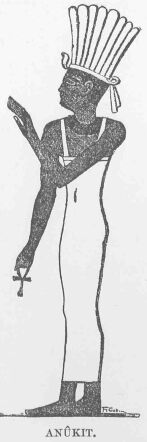
What they related of the human kings was not more detailed, as we see, than their accounts of the gods. Whether the legends dealt with deities or kings, all that we know took its origin, not in popular imagination, but in sacerdotal dogma: they were invented long after the times they dealt with, in the recesses of the temples, with an intention and a method of which we are enabled to detect flagrant instances on the monuments. Towards the middle of the third century before our era, the Greek troops stationed on the southern frontier, in the forts at the first cataract, developed a particular veneration for Isis of Philæ. Their devotion spread to the superior officers who came to inspect them, then to the whole population of the Thebàid, and finally reached the court of the Macedonian kings. The latter, carried away by force of example, gave every encouragement to a movement which attracted worshippers to a common sanctuary, and united in one cult the two races over which they ruled. They pulled down the meagre building of the Sa'ite period which had hitherto sufficed for the worship of Isis, constructed at great cost the temple which still remains almost intact, and assigned to it considerable possessions in Nubia, which, in addition to gifts from private individuals, made the goddess the richest landowner in Southern Egypt. Khnûmû and his two wives, Anûkit and Satît, who, before Isis, had been the undisputed suzerains of the cataract, perceived with jealousy their neighbour's prosperity: the civil wars and invasions of the centuries immediately preceding had ruined their temples, and their poverty contrasted painfully with the riches of the new-comer.
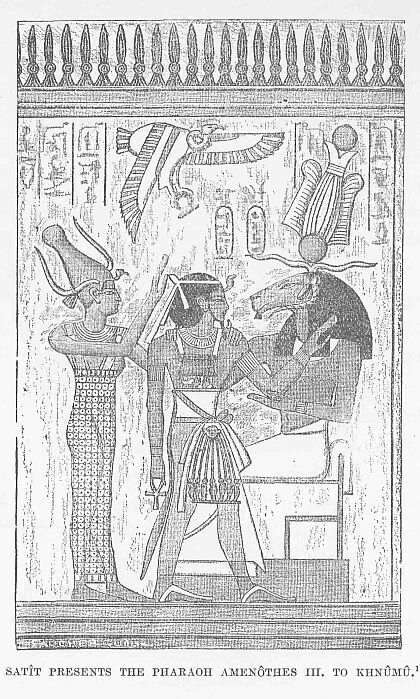
1 Drawn by Faucher-Gudin, from one of the bas-reliefs of the temple of Khnûmû, at Elephantine. This bas-relief is now destroyed.
The priests resolved to lay this sad state of affairs before King Ptolemy, to represent to him the services which they had rendered and still continued to render to Egypt, and above all to remind him of the generosity of the ancient Pharaohs, whose example, owing to the poverty of the times, the recent Pharaohs had been unable to follow.
Doubtless authentic documents were wanting in their archives to support their pretensions: they therefore inscribed upon a rock, in the island of Sehel, a long inscription which they attributed to Zosiri of the IIIrd dynasty. This sovereign had left behind him a vague reputation for greatness. As early as the XIIth dynasty Usirtasen III. had claimed him as "his father"—his ancestor—and had erected a statue to him; the priests knew that, by invoking him, they had a chance of obtaining a hearing. The inscription which they fabricated, set forth that in the eighteenth year of Zosiri's reign he had sent to Madîr, lord of Elephantine, a message couched in these terms: "I am overcome with sorrow for the throne, and for those who reside in the palace, and my heart is afflicted and suffers greatly because the Nile has not risen in my time, for the space of eight years. Corn is scarce, there is a lack of herbage, and nothing is left to eat: when any one calls upon his neighbours for help, they take pains not to go. The child weeps, the young man is uneasy, the hearts of the old men are in despair, their limbs are bent."
Ptolemies admit the claims which the local priests attempted to deduce from this romantic tale? and did the god regain possession of the domains and dues which they declared had been his right? The stele shows us with what ease the scribes could forge official documents, when the exigencies of they crouch on the earth, they fold their hands; the courtiers have no further resources; the shops formerly furnished with rich wares are now filled only with air, all that was in them has disappeared.
"My spirit also, mindful of the beginning of things, seeks to call upon the Saviour who was here where I am, during the centuries of the gods, upon Thot-Ibis, that great wise one, upon Imhotpû, son of Phtah of Memphis. Where is the place in which the Nile is born? Who is the god or goddess concealed there? What is his likeness?"
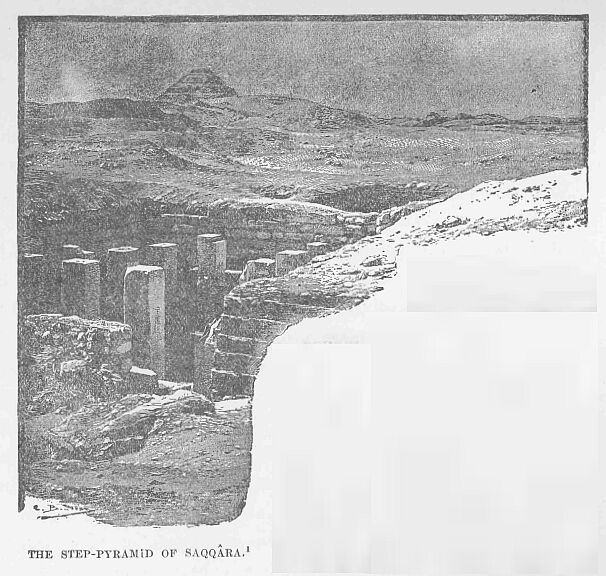
1 Drawn by Boudier, from a photograph by Dévèria (1864); in the foreground, the tomb of Ti.
The lord of Elephantine brought his reply in person. He described to the king, who was evidently ignorant of it, the situation of the island and the rocks of the cataract, the phenomena of the inundation, the gods who presided over it, and who alone could relieve Egypt from her disastrous plight. Zosiri repaired to the temple of the principality and offered the prescribed sacrifices; the god arose, opened his eyes, panted and cried aloud, "I am Khnûmû who created thee!" and promised him a speedy return of a high Nile and the cessation of the famine. Pharaoh was touched by the benevolence which his divine father had shown him; he forthwith made a decree by which he ceded to the temple all his rights of suzerainty over the neighbouring nomes within a radius of twenty miles. Henceforward the entire population, tillers and vinedressers, fishermen and hunters, had to yield the tithe of their incomes to the priests; the quarries could not be worked without the consent of Khnûmû, and the payment of a suitable indemnity into his coffers, and finally, all metals and precious woods shipped thence for Egypt had to submit to a toll on behalf of the temple. Did the daily life forced the necessity upon them; it teaches us at the same time how that fabulous chronicle was elaborated, whose remains have been preserved for us by classical writers. Every prodigy, every fact related by Manetho, was taken from some document analogous to the supposed inscription of Zosiri.[*]
* The legend of the yawning gulf at Bubastis must be connected with the gifts supposed to have been offered by King Boêthos to the temple of that town, to repair the losses sustained by the goddess on that occasion; the legend of the pestilence and famine is traceable to some relief given by a local god, and for which Semempses and Ùenephes might have shown their gratitude in the same way as Zosiri. The tradition of the successive restorations of Denderah accounts for the constructions attributed to Teti I. and to Tosorthros; finally, the prête tided discoveries of sacred books, dealt with elsewhere, show how Manetho was enabled to attribute to his Pharaohs the authorship of works on medicine or theology.
The real history of the early centuries, therefore, eludes our researches, and no contemporary record traces for us those vicissitudes which Egypt passed through before being consolidated into a single kingdom, under the rule of one man. Many names, apparently of powerful and illustrious princes, had survived in the memory of the people; these were collected, classified, and grouped in a regular manner into dynasties, but the people were ignorant of any exact facts connected with the names, and the historians, on their own account, were reduced to collect apocryphal traditions for their sacred archives. The monuments of these remote ages, however, cannot have entirely disappeared: they exist in places where we have not as yet thought of applying the pick, and chance excavations will some day most certainly bring them to light. The few which we do possess barely go back beyond the IIIrd dynasty: namely, the hypogeum of Shiri, priest of Sondi and Pirsenû; possibly the tomb of Khûîthotpû at Saqqâra; the Great Sphinx of Gîzeh; a short inscription on the rocks of the Wady Maghâra, which represents Zosiri (the same king of whom the priests of Khnûmû in the Greek period made a precedent) working the turquoise or copper mines of Sinai; and finally the Step-Pyramid where this same Pharaoh rests.[*]
* The stele of Sehêl has enabled us to verify the fact that the preamble [a string of titles] to the inscription of the king, buried in the Step-Pyramid, is identical with that of King Zosiri: it was, therefore, Zosiri who constructed, or arranged for the construction of this monument as his tomb. The Step-Pyramid of Saqqâra was opened in 1819, at the expense of the Prussian General Minutoli, who was the first to give a brief description of the interior, illustrated by plans and drawings.
It forms a rectangular mass, incorrectly orientated, with a variation from the true north of 4° 35', 393 ft. 8 in. long from east to west, and 352 ft. deep, with a height of 159 ft. 9 in. It is composed of six cubes, with sloping sides, each being about 13 ft. less in width than the one below it; that nearest to the ground measures 37 ft. 8 in. in height, and the uppermost one 29 ft. 9 in. It was entirely constructed of limestone from the neighbouring mountains. The blocks are small, and badly cut, the stone courses being concave to offer a better resistance to downward thrust and to shocks of earthquake. When breaches in the masonry are examined, it can be seen that the external surface of the steps has, as it were, a double stone facing, each facing being carefully dressed. The body of the pyramid is solid, the chambers being cut in the rock beneath. These chambers have been often enlarged, restored, and reworked in the course of centuries, and the passages which connect them form a perfect labyrinth into which it is dangerous to venture without a guide. The columned porch, the galleries and halls, all lead to a sort of enormous shaft, at the bottom of which the architect had contrived a hiding-place, destined, no doubt, to contain the more precious objects of the funerary furniture. Until the beginning of this century, the vault had preserved its original lining of glazed pottery. Three quarters of the wall surface were covered with green tiles, oblong and slightly convex on the outer side, but flat on the inner: a square projection pierced with a hole, served to fix them at the back in a horizontal line by means of flexible wooden rods.
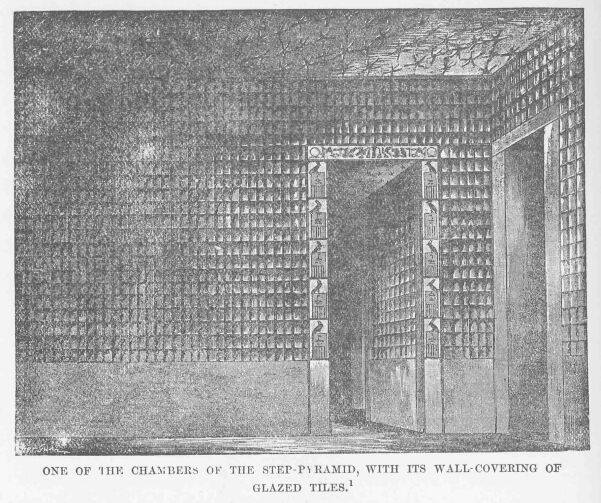
1 Drawn by Faucher-Gudin, from the coloured sketch by Sogato. M. Stern attributes the decoration of glazed pottery to the XXVI '' dynasty, which opinion is shared by Borchardt. The yellow and green glazed tiles hearing the cartouche of Papi I., show that the Egyptians of the Memphite dynasties used glazed facings at that early date; we may, therefore, believe, if the tiles of the vault of Zosiri are really of the Saïte period, that they replaced a decoration of the same kind, which belonged to the time of its construction, and of which some fragments still exist among the tiles of more recent date.
The three bands which frame one of the doors are inscribed with the titles of the Pharaoh: the hieroglyphs are raised in either blue, red, green, or yellow, on a fawn-coloured ground. Other kings had built temples, palaces, and towns,—as, for instance, King Khâsakhimu, of whose constructions some traces exist at Hieracônpolis, opposite to El-Kab, or King Khâsakhmui, who preceded by a few years the Pharaohs of the IVth dynasty—but the monuments which they raised to be witnesses of their power or piety to future generations, have, in the course of ages, disappeared under the tramplings and before the triumphal blasts of many invading hosts: the pyramid alone has survived, and the most ancient of the historic monuments of Egypt is a tomb.