Volume 7 — CHAPTER II—TIGLATH-PILESER III. AND THE ORGANISATION OF THE ASSYRIAN EMPIRE FROM 745 TO 722 B.C. (continued 2)
M. L. McClure translation
* Sos. vii. 1-4, 7. ** 2 Kings xiv. 22; in 2 Ghron. xxvi. 6-15 he is credited with the reorganisation of the army and of the Judsean fortress, in addition to campaigns against the Philistines and Arabs. *** 2 Kings xv. 5; cf. 2 Ghron. xxvi. 19-21. Azariah is also abbreviated into Uzziah. Tappuakh was a town situated on the borders of Ephraim and Manasseh (Josh. xvi. 8; xvii. 7, 8).
His long life had been passed uneventfully, and without any disturbance, under the protection of Jeroboam; but the very same defects which had led to the ruin of Israel were at work also in Judah, and Menahem, in spite of his enfeebled condition, had nothing to fear in this direction.
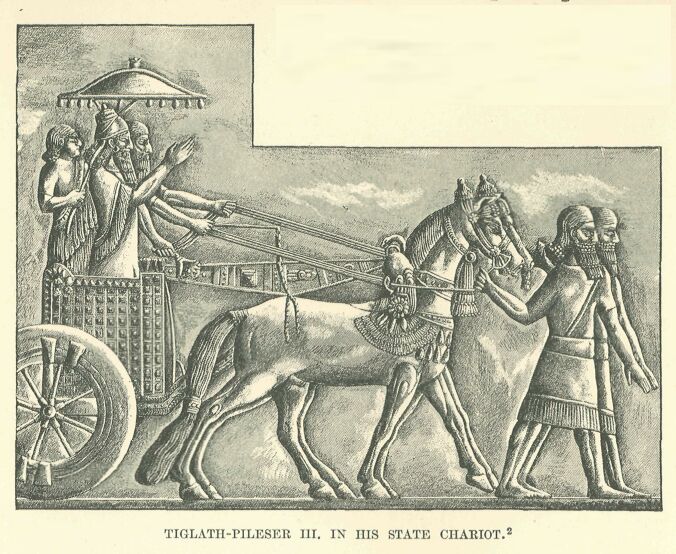
Drawn by Faucher-Gudin, from a sketch published by Layard.
The danger which menaced him came rather from the east and the north, where Damascus, aroused from its state of lethargy by Rezôn [Rezin] II., had again begun to strive after the hegemony of Syria.*
* The name of this king, written Rezin in the Bible (2 Kings xv. 37; xvi. 5, 6, 9), is given as Razunu in the Assyrian texts; he was therefore Ilezôn II. A passage in the Annals seems to indicate that Rezin’s father was prince of a city dependent on Damascus, not king of Damascus itself; unfortunately the text is too much mutilated to warrant us in forming any definite conclusion on this point.
All these princes, when they found that the ambition of Tiglath-pileser threatened to interfere with their own intrigues, were naturally tempted to combine against him, and were willing to postpone to a more convenient season the settlement of their own domestic quarrrels. But Tiglath-pileser did not give them time for this; he routed Azriyahu, and laid waste Kullani,* the chief centre of revolt, ravaged the valley of the Orontes, and carried off the inhabitants of several towns, replacing them with prisoners taken the year before during his campaign in Naîri.
* Kullani is the Calno or Calneh mentioned by Isaiah (x. 9) and Amos (vi. 2), which lay somewhere between Arpad and Hamath; the precise spot is not yet known.
After this feat the whole of Syria surrendered. Rezin and Menahem were among the first to tender their homage, and the latter paid a thousand talents of silver for the firman which definitely confirmed his tenure of the throne; the princes of Tyre, Byblos, Hamath, Carchemish, Milid, Tabal, and several others followed their example—even a certain Zabibi, queen of an Arab tribe, feeling compelled to send her gifts to the conqueror.
A sudden rising among the Aramæan tribes on the borders of Elam obliged Tiglath-pileser to depart before he had time to take full advantage of his opportunity. The governors of Lullumi and Naîri promptly suppressed the outbreak, and, collecting the most prominent of the rebels together, sent them to the king in order that he might distribute them throughout the cities of Syria: a colony of 600 prisoners from the town of Amlati was established in the territory of Damaunu, 5400 from Dur were sent to the fortresses of Unki, Kunalia, Khuzarra, Taî, Tarmanazi, Kulmadara, Khatatirra, and Sagillu, while another 10,000 or so were scattered along the Phoenician seaboard and among the adjacent mountains. The revolt had meanwhile spread to the nations of Media, where it was, perhaps, fomented by the agents of Urartu; and for the second time within seven years (737 B.C.) Tiglath-pileser trampled underfoot the countries over which he had ridden in triumph at the beginning of his career—the Bît-Kapsi, the Bît-Sangibuti, the Bît-Tazzakki, the Bît-Zulazash, the Bît-Matti, and Umliash. The people of Upash, among the Bît-Kapsi, entrenched themselves on the slopes of Mount Abirus; but he carried their entrenchments by storm. Ushuru of Taddiruta and Burdadda of Nirutakta were seized with alarm, and hid themselves in their mountain gorges; but he climbed up in pursuit of them, drove them out of their hiding-places, seized their possessions, and made them prisoners. Similar treatment was meted out to all those who proved refractory; some he despoiled, others he led captive, and “bursting upon the remainder like the downpour of Bammân,” permitted none of them to escape. He raised trophies all along his line of march: in Bau, a dependency of Bît-Ishtar, he set up a pointed javelin dedicated to Ninip, on which he had engraved a panegyric of the virtues of his master Assur; near Shilkhazi, a town founded, in bygone days, by the Babylonians, he erected a statue of himself, and a pillar consecrated to Marduk in Til-ashshur. In the following year he again attacked Urartu and occupied the mountain province of Nâl, which formed one of its outlying defences (736). The year after he entered on the final struggle with Sharduris, and led the flower of his forces right under the walls of Dhuspas,* the enemy’s capital.
* The name is written Turuspas in the inscriptions of Tiglath-pileser III.
Dhuspas really consisted of two towns joined together. One of these, extending over the plain by the banks of the Alaîs and in the direction of the lake, was surrounded by fertile gardens and villas, in which the inhabitants spent the summer at their ease. It was protected by an isolated mass of white and red nummulitic chalk, the steep sides of which are seamed with fissures and tunnelled with holes and caverns from top to bottom.
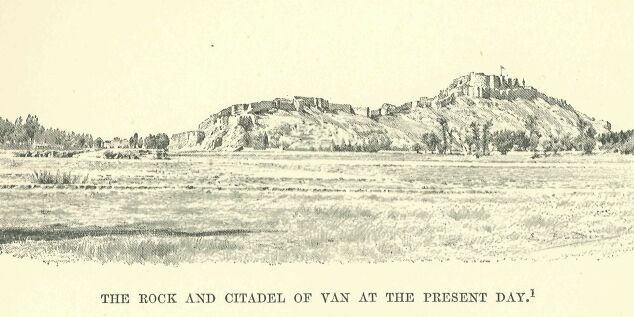
Drawn by Boudier, from a photograph by M. Binder.
The plateau in which it terminates, and which rises to a height of 300 feet at its loftiest point, is divided into three main terraces, each completely isolated from the other two, and forming, should occasion arise, an independent fortress, Ishpuinis, Menuas, Argistis, and Sharduris II. had laboured from generation to generation to make this stronghold impregnable, and they had succeeded in the attempt.
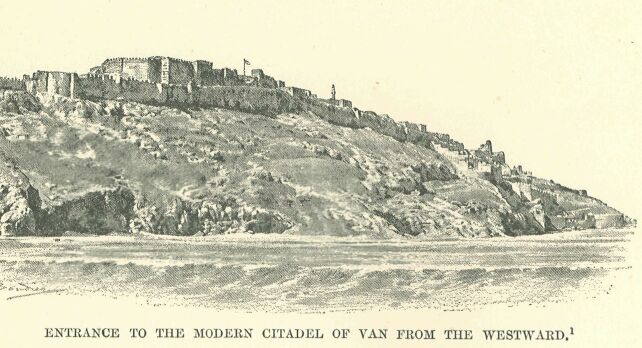
Drawn by Boudier, from a photograph by M. Binder.
There can be little or no doubt, however, that this is merely a variant of the name usually written as Tuspas, Tuspana, Dhuspana, the Thospia of classical times; properly speaking, it was the capital of Biainas. The only access to it was from the western side, by a narrow bridle-path, which almost overhung the precipice as it gradually mounted to the summit. This path had been partially levelled, and flanked with walls and towers which commanded the approach throughout its whole length; on the platforms at the summit a citadel had been constructed, together with a palace, temples, and storehouses, in which was accumulated a sufficient supply of arms and provisions to enable the garrison to tire out the patience of any ordinary foe; treason or an unusually prolonged siege could only get the better of such a position. Tiglath-pileser invested the citadel and ravaged its outskirts without pity, hoping, no doubt, that he would thus provoke the enemy into capitulating. Day after day, Sharduris, perched in his lofty eyrie, saw his leafy gardens laid bare under the hatchet, and his villages and the palaces of his nobles light up the country round as far as the eye could reach: he did not flinch, however, and when all had been laid waste, the Assyrians set up a statue of their king before the principal gate of the fortress, broke up their camp, and leisurely retired. They put the country to fire and sword, destroyed its cities, led away every man and beast they could find into captivity, and then returned to Nineveh laden with plunder. Urartu was still undaunted, and Sharduris remained king as before; but he was utterly spent, and his power had sustained a blow from which it never recovered. He had played against Assur with the empire of the whole Asiatic world as the stake, and the dice had gone against him: compelled to renounce his great ambitions from henceforth, he sought merely to preserve his independence. Since then, Armenia has more than once challenged fortune, but always with the same result; it fared no better under Tigranes in the Roman epoch, than under Sharduris in the time of the Assyrians; it has been within an ace of attaining the goal of its ambitions, then at the last moment its strength has failed, and it has been forced to retire worsted from the struggle. Its position prevented it from exercising very wide influence; hidden away in a corner of Asia at the meeting-point of three or four great mountain ranges, near the source of four rivers, all flowing in different directions, it has lacked that physical homogeneity without which no people, however gifted, can hope to attain supremacy; nature has doomed it to remain, like Syria, split up into compartments of unequal size and strength, which give shelter to half a score of independent principalities, each one of them perpetually jealous of the rest. From time to time it is invested with a semblance of unity, but for the most part it drags on an uneventful existence, dismembered into as many fragments as there happen to be powerful states around it, its only chance of complete reunion lying in the possibility of one or other of these attaining sufficient predominance to seize the share of the others and absorb it.
The subjection of Urartu freed Assyria from the only rival which could at this moment have disputed its supremacy on the banks of the Euphrates and the Tigris. The other nations on its northern and eastern frontiers as yet possessed no stability; they might, in the course of a passing outburst, cut an army to pieces or annex part of a province, but they lacked strength to follow up their advantage, and even their most successful raids were sure, in the long run, to lead to terrible reprisals, in which their gains were two or three times outweighed by their losses in men and treasure. For nearly a hundred years Nineveh found its hands free, and its rulers were able to concentrate all their energy on two main points of the frontier—to the south-west on Syria and Egypt, to the south-east on Chaldæa and Elam. Chaldæa gave little trouble, but the condition of Syria presented elements of danger. The loyalty of its princes was more apparent than real; they had bowed their necks after the fall of Unki, but afterwards, as the years rolled on without any seeming increase in the power of Assyria, they again took courage and began once more to quarrel among themselves. Menahem had died, soon after he had paid his tribute (737 B.c.); his son Pekahiah had been assassinated less than two years later (736)* and his murderer, Pekah, son of Remaliah, was none too firmly seated on the throne. Anarchy was triumphant throughout Israel; so much so that Judah seized the opportunity for throwing off the yoke it had borne for well-nigh a hundred years. Pekah, conscious of his inability to suppress the rebellion, called in Rezin to help him. The latter was already on the way when Jotham was laid with his fathers (736 B.C.), and it was Ahaz, the son of Jotham, who had to bear the brant of the assault. He was barely twenty years old, a volatile, presumptuous, and daring youth, who was not much dismayed by his position.** Jotham had repaired the fortifications of Jerusalem, which had been left in a lamentable state ever since the damage done to them in the reign of Amaziah;*** his successor now set to work to provide the city with the supply of water indispensable for its defence,**** and, after repairing the ancient aqueducts, conceived the idea of constructing a fresh one in the spur of Mount Sion, which extends southwards.
* 2 Kings xv. 22-26. The chronology of the events which took place between the death of Menahem and the fall of Samaria, as presented by the biblical documents in the state in which they have been transmitted to us, is radically inaccurate: following the example of most recent historians, I have adhered exclusively to the data furnished by the Assyrian texts, merely indicating in the notes the reasons which have led me to adopt certain dates in preference to others. ** 2 Kings xv. 38, xvi. 1, 2. Ahaz is called Iaukhazi, i.e. Jehoahaz, in the Assyrian texts, and this would seem to have been the original form of the name. *** The restoration of the walls of Jerusalem by Jotham is only mentioned in 2 Chron. xxvii. 3. **** We may deduce this from the words of Isaiah (vii. 3), where he represents Ahaz “at the end of the conduit of the upper pool, in the highway of the fuller’s field.” Ahaz had gone there to inspect the works intended for the defence of the aqueduct.
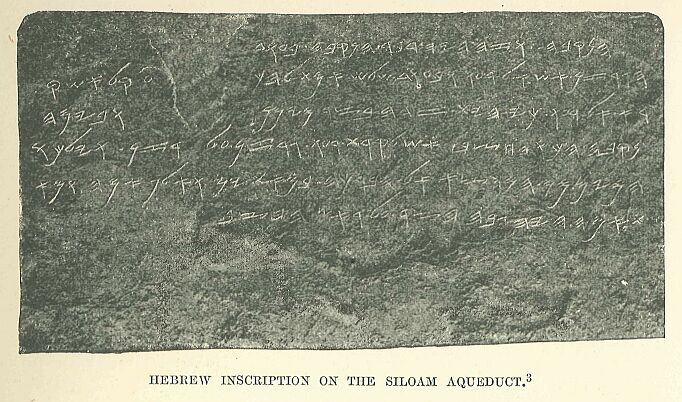
As time pressed, the work was begun simultaneously at each end; the workmen had made a wide detour underground, probably in order to avoid the caves in which the kings of Judah had been laid to rest ever since the time of David,* and they were beginning to despair of ever uniting the two sections of the tunnel, when they suddenly heard one another through the wall of rock which divided them. A few blows with the pick-axe opened a passage between them, and an inscription on the wall adjoining the entrance on the east side, the earliest Hebrew inscription we possess, set forth the vicissitudes of the work for the benefit of future generations. It was scarcely completed when Kezin, who had joined forces with Pekah at Samaria, came up and laid regular siege to Jerusalem.**
* This is the highly ingenious hypothesis put forward and defended with much learning by Clermont-Ganneau, in order to account for the large curve described by the tunnel. ** 2 Kings xvi. 5; cf. 2 Chron. xxviii. 5-8. It was on this occasion that Isaiah delivered the prophecies which, after subsequent revision, furnished the bulk of chaps, vi. 1—x. 4.
The allies did not propose to content themselves with exacting tribute from the young king; they meant to dethrone him, and to set up in his room a son of Tabeel, whom they had brought with them; they were nevertheless obliged to retire without effecting a breach in his defences and leave the final assault till the following campaign. Rezin, however, had done as much injury as he could to Judah; he had laid waste both mountain and plain, had taken Elath by storm and restored it to the Edomites,* and had given a free hand to the Philistines (735).**
* 2 Kings xvi. 6, where the Massoretic text states that the Syrians retained the town, while the Septuagint maintain that he restored it to the Edomites. ** Chron. xxviii. 18, where a list is given of the towns wrested from Judah by the Philistines. The delight felt by the Philistines at the sight of Judah’s abasement seems to be referred to in the short prophecy of Isaiah (xiv. 29-32), wrongly ascribed to the year of Ahaz’s death.
Drawn by Faucher- Gudin, from Lanzone’s statuette.
A direct reproduction from a plaster cast now in Paris. The inscription discovered by Schick, in 1880, has since been mutilated, and only the fragments are preserved in the museum at Constantinople. Some writers think it was composed in the time of Hezekiah; for my own part, I agree with Stade in assigning it to the period of Ahaz.
The whole position seemed so hopeless, that a section of the people began to propose surrendering to the mercy of the Syrians.*
* This seems to be an obvious inference from the words of Isaiah (viii. 6): “Forasmuch as this people hath refused the waters of Shiloah that go softly, and lose courage because of Rezin and Bemaliali’s son.” [The R.V. reads “rejoice in” Rezin, etc.—Tr.]
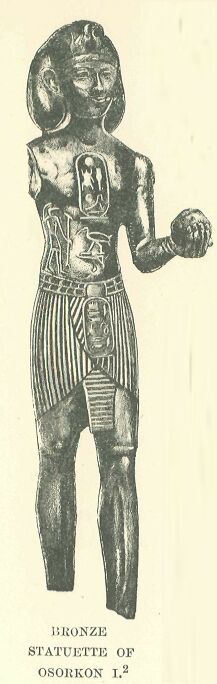
Ahaz looked around him in search of some one on whom he might call for help. All his immediate neighbours were hostile; but behind them, in the background, were two great powers who might be inclined to listen to his appeal—Egypt and Assyria. Ever since the expedition of Sheshonq into Asia, Egypt seemed to have lost all interest in foreign politics. Osorkon had not inherited the warlike propensities of his father, and his son, Takelôti I., and his grandson, Osorkon II., followed his example.*
* The chronology of this period is still very uncertain, and the stelae of the Serapseum, which enable us to fix the order of the various reigns, yield no information as to their length. Sheshonq I. did not reign much longer than twenty-one years, which is his latest known date, and we may take the reign of twenty-one years attributed to him by Manetho as being substantially correct. The latest dates we possess are as follows: Osorkon I., twelfth year, and Takelôti I., sixth year or seventh year. Lastly, we have a twenty-ninth year in the case of Osorkon II., with a reference in the case of the twenty-eighth year to the fifth year of a Takelôti whose first cartouche is missing, and who perhaps died before his father and co-regent. In Manetho, Osorkon I. is credited with a reign of fifteen years, and his three next successors with a total of twenty-five years between them, which is manifestly incorrect, since the monuments give twenty-nine years, or twenty-three at the very least, if we take into account the double date in the case of the first two of these kings. The wisest course seems to be to allow forty-five years to Osorkon and his two successors: if Sheshonq, as I believe, died in 924, the fifty years allotted to the next three Pharaohs would bring us down to 880, and it is in this year that I am, for the present, inclined to place the death of Osorkon II.
These monarchs regarded themselves as traditionary suzerains of the country of Kharu, i.e. of Israel, Judah, Ammon, and Moab, and their authority may perhaps have been recognised by the Philistines in the main, but they seldom stirred from their own territory, and contented themselves with protecting their frontiers against the customary depredations of the Libyan and Asiatic nomads.*
* Repressive measures of this kind are evidently referred to in passages similar to those in which Osorkon II. boasts of having “overthrown beneath his feet the Upper and Lower Lotanu,” and speaks of the exploits of the sons of Queen Kalamâît against certain tribes whose name, though mutilated, seems to have been Libyan in character.
Drawn by Boudier, from a photograph by Naville.
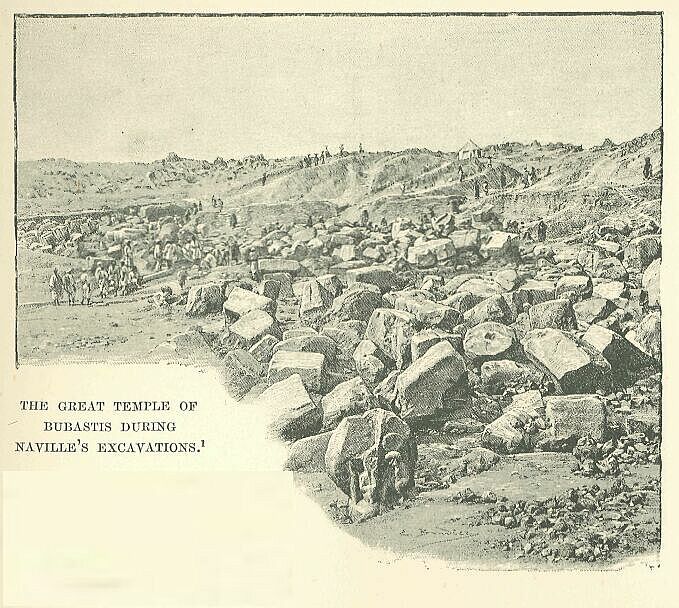
Under their rule, Egypt enjoyed fifty years of profound peace, which was spent in works of public utility, especially in the Delta, where, thanks to their efforts, Bubastis came to be one of the most splendid among the cities of secondary importance.*
* All our knowledge of the history of the temple of Bubastis dates from Naville’s excavations.
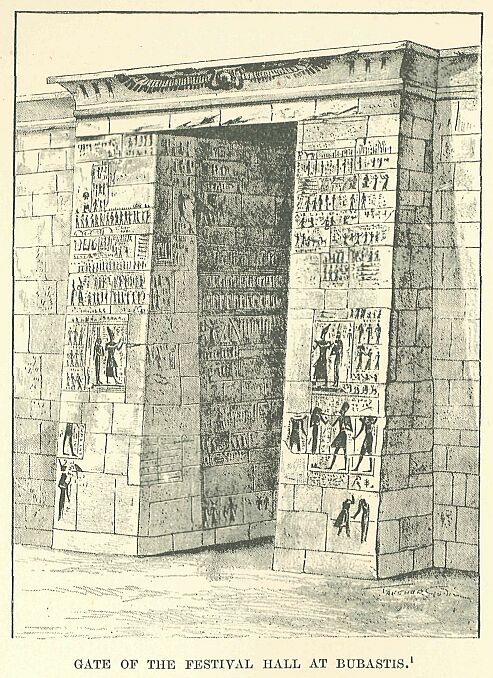
Its temple, which had been rebuilt by Ramses II. and decorated by the Rames-sides, was in a sorry plight when the XXIInd dynasty came into power. Sheshonq I. did little or nothing to it, but Osorkon I. entirely remodelled it, and Osorkon II. added several new halls, including, amongst others, one in which he celebrated, in the twenty-second year of his reign, the festival of his deification. A record of some of the ceremonies observed has come down to us in the mural paintings. There we see the king, in a chapel, consecrating a statue of himself in accordance with the ritual in use since the time of Amenôthes III., and offering the figure devout and earnest worship; all the divinities of Egypt have assembled to witness the enthronement of this new member of their confraternity, and take part in the sacrifices accompanying his consecration. This gathering of the gods is balanced by a human festival, attended by Nubians and Kushites, as well as by the courtiers and populace. The proceedings terminated, apparently, with certain funeral rites, the object being to make the identification of Osorkon with Osiris complete.
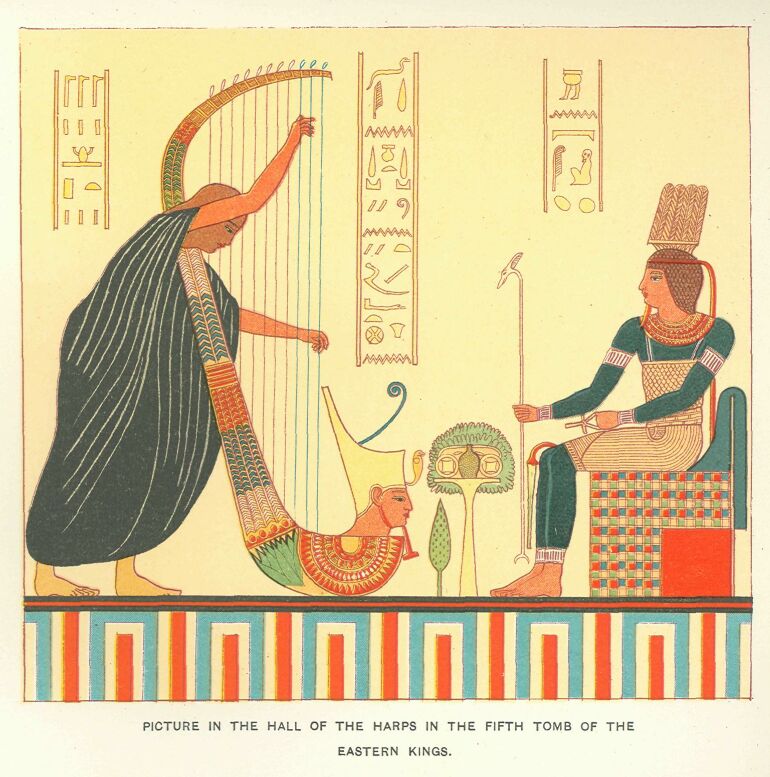
The Egyptian deities served in a double capacity, as gods of the dead as well as of the living, and no exception could be made in favour of the deified Osorkon; while yet living he became an Osiris, and his double was supposed to animate those prophetic statues in which he appeared as a mummy no less than those which represented him as still alive.
Drawn by Faucher-Gudin, from a restoration by Naville.
Another temple of small size, also dedicated to Bastîfc or Pasht, which had been built in the time of Ramses II., was enlarged by Osorkon I., and richly endowed with workshops, lands, cattle, slaves, and precious metals: Tumu-Khopri of Heliopolis, to mention but one of the deities worshipped there, received offerings of gold in value by weight.£120,000, and silver ingots worth £12,000.*
* This is the small temple afterwards described by Herodotus as being dedicated to Hermes.
A country which could afford to indulge in extravagances of this nature must have been in a flourishing condition, and everything goes to prove that Egypt prospered under the rule of the early Bubastite kings.
The very same causes, however, which had ruined the Ramessides and the Tanites were now openly compassing the downfall of the Bubastite dynasty. The military feudalism from which it had sprung, suppressed for a time by Sheshonq I., developed almost unchecked under his successors. They had thought to break it up and turn it to their own advantage, by transferring the more important religious functions and the principal fiefs to their own sons or nephews. They governed Memphis through the high priests of Phtah; a prince of the blood represented them at Khmunu,* another at Khninsu** (Heracleopolis), and others in various cities of the Delta, each of them being at the head of several thousand Mashauasha, or Libyan soldiers on whose fidelity they could entirely rely.
* E.g. Namrôti, under Piônkhi-Mîamun, whose rights were such that he adopted the protocol of the Pharaohs. ** Stole 1959 of the Serapæum contains the names of five successive princes of this city, the first of whom was Namrôti, son of Osorkon II., and high priest of Thebes; a member of the same family, named Pefzââbastît, had taken cartouches under Osorkon III. of the XXIIIrd dynasty.
Thebes alone had managed to exclude these representatives of the ruling dynasty, and its princes, guided in this particular by the popular prejudice, persistently refused to admit into their bodyguard any but the long-tried Mâzaîu. Moreover, Thebes lost no opportunity of proving itself to be still the most turbulent of the baronies. Its territory had suffered no diminution since the time of Hrihor, and half of Upper Egypt, from Elephantine to Siut, acknowledged its sway.1
* It is evident that this was so from the first steps taken by Piônkhi-Miamun’s generals: they meet the army and fleet of Tafnakhti and the princes of the north right under the walls of Hormopolis, but say nothing of any feudal princes of the south. Their silence is explained if we assume that Thebes, being a dependency of Ethiopia, retained at that date, i.e. in the time of the XXIInd dynasty, the same or nearly the same boundaries which it had won for itself under the XXIst.
Drawn by Faucher-Gudin, from the original now i n the Louvre.
Through all the changes of dynasty its political constitution had remained unaltered; Amon still ruled there supreme as ever, and nothing was done until he had been formally consulted in accordance with ancient usage. Anputi, in spite of his being a son of Sheshonq, was compelled to adopt the title of high priest in order to rule in peace, and had married some daughter or niece of the last of the Painotmu. After his death, good care was taken to prevent the pontificate from passing to one of his children, as this would have re-established a Theban dynasty which might have soon proved hostile to that of Bubastis. To avoid this, Osorkon I. made over the office and fief to his own son Sheshonq. The latter, after a time, thought he was sufficiently powerful to follow the example of Paînotmu and adopt the royal cartouches; but, with all his ambition, he too failed to secure the succession to the male line of his descendants, for Osorkon II. appointed his own son Namrôti, already prince of Khninsu, to succeed him. The amalgamation of these two posts invested the person on whom they were conferred with almost regal power; Khninsu was, indeed, as we know, the natural rampart of Memphis and Lower Egypt against invasion from the south, and its possessor was in a position to control the fate of the empire almost as he pleased. Osorkon must have had weighty reasons for taking a step which placed him practically at the mercy of his son, and, indeed, events proved that but little reliance could be placed on the loyalty of the Thebans, and that energetic measures were imperative to keep them in the path of duty or lead them back to it. The decadence of the ancient capital had sadly increased since the downfall of the descendants of Hrihor.
The few public works which they had undertaken, and which Sheshonq I. encouraged to the best of his ability, had been suspended owing to want of money, and the craftsmen who had depended on them for support were suffering from poverty: the makers of small articles of a religious or funerary character, carvers of wood or stone, joiners, painters of mummy-cases, and workers in bronze, alone managed to eke out a bare livelihood, thanks to commissions still given to them by officials attached to the temples. Theban art, which in its best period had excelled in planning its works on a gigantic scale, now gladly devoted itself to the production of mere knick-knacks, in place of the colossal figures of earlier days.
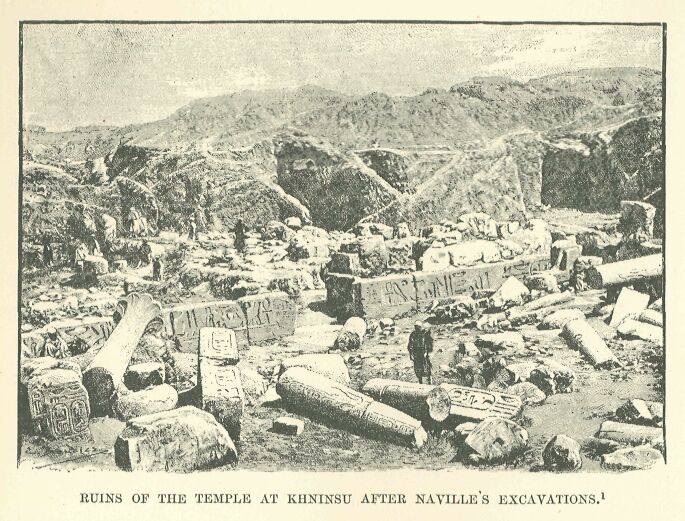
Drawn by Boudier, from a photograph in Naville. The illustration shows what now remains of the portions of the temple rebuilt in the time of Ramses II.
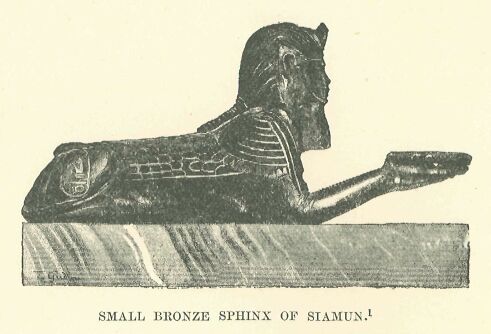
We have statuettes some twelve or fifteen inches high, crudely coloured, wooden stelæ, shapeless ushâbti redeemed from ugliness by a coating of superb blue enamel, and, above all, those miniature sphinxes representing queens or kings, which present with two human arms either a table of offerings or a salver decorated with cartouches. The starving populace, its interests and vanity alike mortified by the accession of a northern dynasty, refused to accept the decay of its fortunes with resignation, and this spirit of discontent was secretly fomented by the priests or by members of the numerous families which boasted of their descent from the Eamessides. Although hereditary claims to the throne and the pontificate had died out or lost their force in the male line, they were still persistently urged by the women: consecrated from their birth to the service of Amon, and originally reserved to sing his praises or share his nuptial couch, those of them who married transmitted to their children, and more especially to their daughters, the divine germ which qualified them for the throne. They and their followers never ceased to look for the day when the national deity should shake off his apathy, and, becoming the champion of their cause against the Bubastite or Tanite usurpers, restore their city to the rank and splendour from which it had fallen. Namrôti married one of these Theban princesses, and thus contrived to ward off the danger of revolt during his lifetime; but on his death or disappearance an insurrection broke out. Sheshonq II. had succeeded Osorkon II., and he, in his turn, was followed by Takelôti II. Takelôti chose Kala-mâit, daughter of Namrôti, as his lawful wife, formally recognised her as queen, and set up numerous statues and votive monuments in her honour. But all in vain: this concession failed to conciliate the rebellious, and the whole Thebaid rose against him to a man. In the twelfth year of his reign he entrusted the task of putting down the revolt to his son Osorkon, at the same time conferring upon him the office of high priest. It took several years to repress the rising; defeated in the eleventh year, the rebels still held the field in the fifteenth year of the king, and it was not till some time after, between the fifteenth and twenty-second year of Takelôti II., that they finally laid down their arms.* At the end of this struggle the king’s power was quite exhausted, while that of the feudal magnates had proportionately increased. Before long, Egypt was split up into a number of petty states, some of them containing but a few towns, while others, following the example of Thebes, boldly annexed several adjacent nomes. A last remnant of respect for the traditional monarchy kept them from entirely repudiating the authority of Pharaoh. They still kept up an outward show of submission to his rule; they paid him military service when called upon, and appealed to him as umpire in their disputes, without, however, always accepting his rulings, and when they actually came to blows among themselves, were content to exercise their right of private warfare under his direction.** The royal domain gradually became narrowed down to the Memphite nome and the private appanages of the reigning house, and soon it no longer yielded the sums necessary for the due performance of costly religious ceremonies, such as the enthronement or burial of an Apis. The pomp and luxury usually displayed on such occasions grew less and less under the successors of Takelôti II., Sheshonq III., Pimi, and Sheshonq IV.***
* The story of these events is told in several greatly mutilated inscriptions to be found at Karnak on the outer surface of the south wall of the Hall of Columns. ** It is evident that this was so, from a romance discovered by Krall. *** One need only go to the Louvre and compare the Apis stelae erected during this period with those engraved in the time of the XXVIth dynasty, in order to realise the low ebb to which the later kings of the XXIInd dynasty had fallen: the fact that the chapel and monuments were built under their direction shows that they were still masters of Memphis. We have no authentic date for Sheshonq II., and the twenty-ninth year is the latest known in the case of Takelôti II., but we know that Sheshonq III. reigned fifty- two years, and, after two years of Pimi, we find a reference to the thirty-seventh year of Sheshonq IV. If we allow a round century for these last kings we are not likely to be far out: this would place the close of the Bubastite dynasty somewhere about 780 B.C.
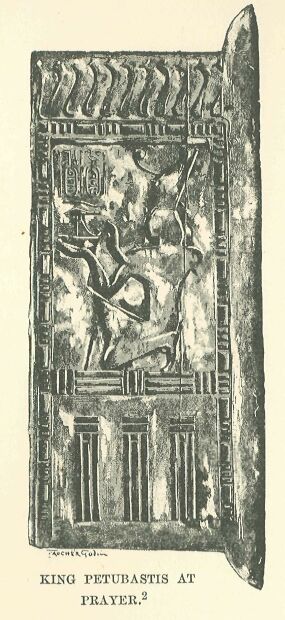
When the last of these passed away after an inglorious reign of at least thirty-seven years, the prestige of his race had so completely declined that the country would have no more of it; the sceptre passed into the hands of another dynasty, this time of Tanite origin.* It was probably a younger branch of the Bubastite family allied to the Ramessides and Theban Pallacides. Petu-bastis, the first of the line, secured recognition in Thebes,** and throughout the rest of Egypt as well, but his influence was little greater than that of his predecessors; as in the past, the real power was in the hands of the high priests.
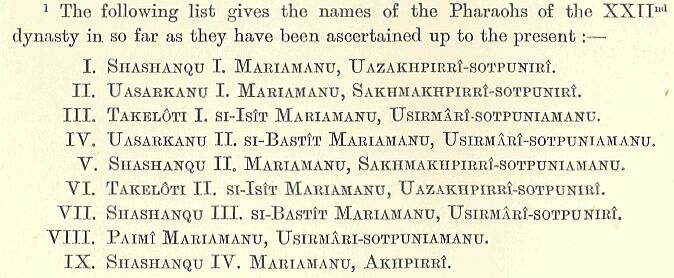
* The following list gives the names of the Pharaohs of the XXIIth dynasty in so far as they have been ascertained up to the present:—
Drawn by Faucher-Gudin, from a small door now in the Louvre.
** This fact has recently been placed beyond doubt by inscriptions found on the quay at Karnak near the water- marks of the Nile.
One of them, Auîti by name, even went so far, in the fourteenth or fifteenth year, as to declare himself king, and had his cartouches inscribed on official documents side by side with those of the Tanite monarch.* His kingship died with him, just as that of Patnotmu had done in similar circumstances, and two years later we find his successor, Harsiisît, a mere high priest without pretensions to royalty.
* No. 26 of Legrain’s inscriptions tells us the height of the Nile in the sixteenth year of Petubastît, which was also the second year of King Auîti. Seeing that Auîti’s name occurs in the place occupied by that of the high priest of Thebes in other inscriptions of the same king, I consider it probable that he was reigning in Thebes itself, and that he was a high priest who had become king in the same way as Paînotmu under the XXIst dynasty.
Doubtless his was not an isolated case; all the grandees who happened to be nearly related either to the dethroned or to the reigning houses acted in like manner, and for the first time for many years Egypt acknowledged the simultaneous sway of more than one legitimate Pharaoh. Matters became still worse under Osorkon III.; although he, too, introduced a daughter of Anion into his harem, this alliance failed to give him any hold over Thebes, and even the Seven Nomes and the Delta were split up to such an extent that at one time they included something like a score of independent principalities, three of which, Hermopolis, Heracleopolis, and Tentramu, were administered by kings who boasted cartouches similar to those of Tanis and Bubastis.
About 740 B.C. there appeared in the midst of these turbulent and extortionate nobles a man who, by sheer force of energy and talent, easily outstripped all competitors. Tafnakhti was a chief of obscure origin, whose hereditary rights extended merely over the village of Nutirît and the outskirts of Sebennytos. One or two victories gained over his nearest neighbours encouraged him to widen the sphere of his operations. He first of all laid hands on those nomes of the Delta which extended to the west of the principal arm of the Nile, the Saite, Athribite, Libyan, and Memphite nomes; these he administered through officers under his own immediate control; then, leaving untouched the eastern provinces, over which Osorkon III. exercised a make-shift, easygoing rule, he made his way up the river. Maitumu and the Fayum accepted him as their suzerain, but Khninsu and its king, Pefzââbastît, faithful to their allegiance,* offered strenuous resistance.
* Pefzââbastît, King of Heracleopolis, seems to be identical with the Pharaoh Pefzâbastît of the Berlin sarcophagus.
He then crossed over to the right bank, and received the homage of Heliopolis and Phebtepahê; he put the inhabitants of Uabu to ransom, established a close blockade of Khninsu, and persuaded Namrôti, King of Khmunu, to take an oath of allegiance. At length, those petty kings and princes of the Said and the Delta who still remained unconquered called upon Ethiopia, the only power capable of holding its ground against him, for help. The “vile Kaushu” (Cush) probably rose to be an independent state about the time when Sheshonq and the Bubastite kings came into power.
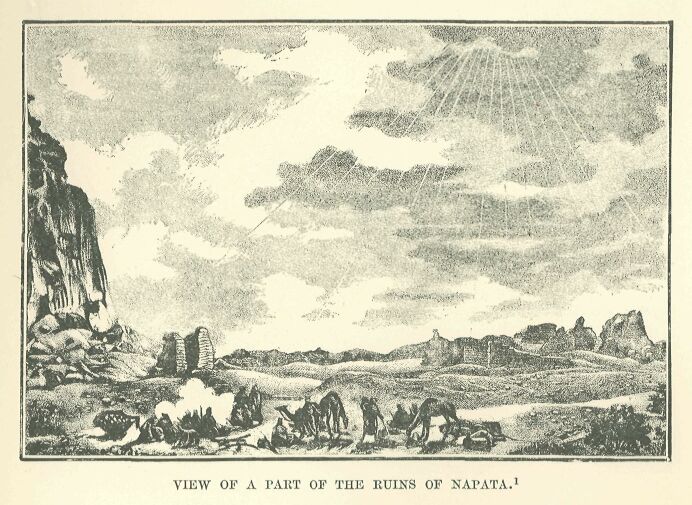
Reproduced by Faucher-Gudin, from a lithograph published in Cailliaud.
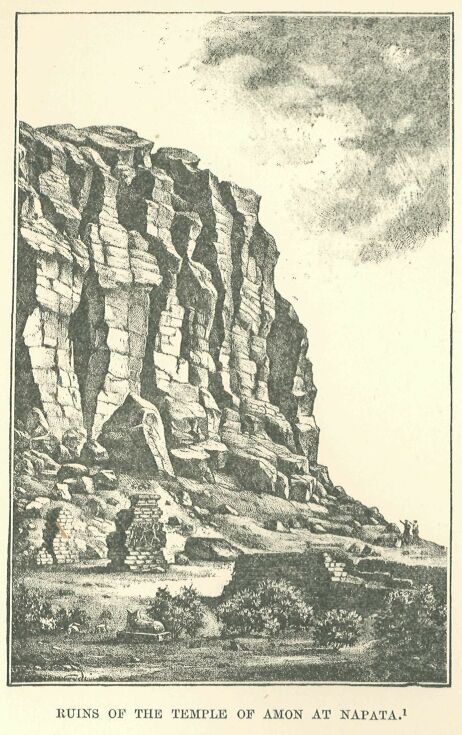
Peopled by Theban settlers, and governed by the civil and religious code of Thebes, the provinces which lay between the cataract of Hannek and the confluence of the two Mies soon became a second Thebaid, more barren and less wealthy than the first, but no less tied to the traditions of the past. Napata, its capital, lay in the plain at the foot of a sandstone cliff, which rose perpendicularly to a height of nearly two hundred feet, its summit, when viewed from the southwest, presenting an accidental resemblance to a human profile.* This was the Du-uabu, or Sacred Mount, in the heart of which the god was supposed to have his dwelling; the ruins of several temples can still be seen near the western extremity of the hill, the finest of them being dedicated to a local Amon-Râ.
* The natives believe this profile to have been cut by human hands—an error which has been shared by more than one modern traveller.
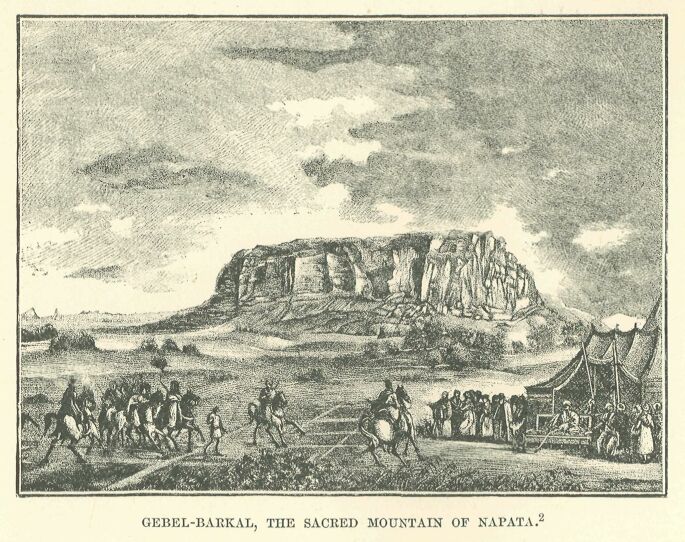
Reproduced by Faucher-Gudin, from a lithograph in Cailliaud.
This Amon was a replica of the Theban Amon on a smaller scale, and was associated with the same companions as his prototype, Maut, his consort, and Khonsu, his son. He owed his origin to the same religious concepts, and was the central figure of a similar myth, the only difference being that he was represented in composite shape, with a ram’s head; perhaps a survival from some earlier indigenous deity, such as Didun, for instance, who had been previously worshipped in those parts; his priests lived in accordance with the rules of the Theban hierarchy.
We can readily believe that when Hrihor extorted the title of “Royal Son of Kaushu” from the weaklings who occupied the throne at the close of the Ramesside dynasty, he took care to install one of the members of his family as high priest at Napata, and from henceforward had the whole country at his bidding. Subsequently, when Paînotmu II. was succeeded by Auputi at Thebes, it seems that the Ethiopian priests refused to ratify his election. Whether they conferred the supreme power on one of their own number, or whether some son of Paînotmu, flying from the Bubastite kings, arrived at the right moment to provide them with a master, is not quite clear.
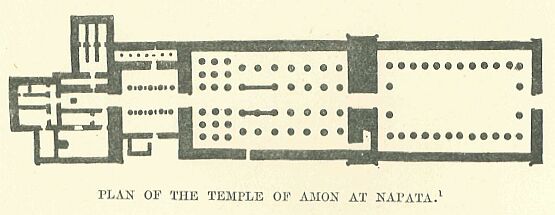
Reproduced by Faucher-Gudin, from the plan drawn up and published by Cailliaud.
Drawn by Faucher-Gudin, from Lepsius.
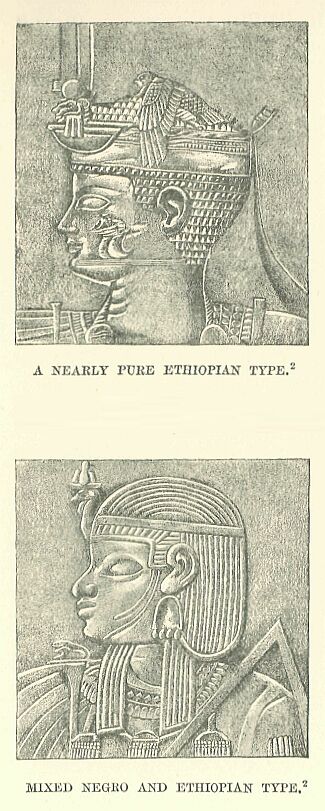
The kings of Ethiopia, priests from the first, never lost their sacerdotal character. They continued to be men of God, and as such it was necessary that they should be chosen by the god himself. On the death of a sovereign, Amon at once became regent in the person of his prophet, and continued to act until the funeral rites were celebrated. As soon as these ceremonies were completed, the army and the people collected at the foot of the Sacred Mount; the delegates of the various orders of the state were led into the sanctuary, and then, in their presence, all the males of the royal family—“the king’s brothers,” as they were called—were paraded before the statue of the god; he on whom the god laid his hand as he passed was considered to be the chosen one of Amon, and consecrated king without delay.*
* This is the ritual described in the Stele of the Enthronement. Perhaps it was already in use at Thebes under the XXIst and XXIInd dynasties, at the election of the high priest, whether he happened to be a king or not; at any rate, a story of the Ptolemaic period told by Synesius in The Egyptian seems to point to this conclusion.
As may be readily imagined, the new monarch thus appointed by divine dictation was completely under the control of the priests, and before long, if he failed to prove sufficiently tractable, they claimed the right to dispense with him altogether; they sent him an order to commit suicide, and he obeyed. The boundaries of this theocratic state varied at different epochs; originally it was confined to the region between the First Cataract and the mouth of the Blue Nile. The bulk of the population consisted of settlers of Egyptian extraction and Egyptianised natives; but isolated, as they were, from Egypt proper by the rupture of the political ties which had bound them to the metropolis, they ceased to receive fresh reinforcements from the northern part of the valley as they had formerly done, and daily became more closely identified with the races of various origin which roamed through the deserts of Libya or Arabia. This constant infiltration of free or slavish Bedâwin blood and the large number of black women found in the harems of the rich, and even in the huts of the common people, quickly impaired the purity of the race, even among the tipper classes of the nation, and the type came to resemble that of the negro tribes of Equatorial Africa.*
* Taharqa furnishes us with a striking example of this degeneration of the Egyptian type. His face shows the characteristic features of the black race, both on the Egyptian statue as well as on the Assyrian stele of Sinjirli.
Reproduced by Faucher-Gudin, from a lithograph published by Cailliaud.
The language fared no better in the face of this invasion, and the written character soon became as corrupt as the language; words foreign to the Egyptian vocabulary, incorrect expressions, and barbarous errors in syntax were multiplied without stint. The taste for art decayed, and technical ability began to deteriorate, the moral and intellectual standard declined, and the mass of the people showed signs of relapsing into barbarism: the leaders of the aristocracy and the scribes alone preserved almost intact their inheritance from an older civilisation. Egypt still attracted them: they looked upon it as their rightful possession, torn from them by alien usurpers in defiance of all sense of right, and they never ceased to hope that some day, when the god saw fit, they would win back their heritage. Were not their kings of the posterity of Sibu, the true representatives of the Ramessides and the solar race, compared with whom the northern Pharaohs, even those whose mothers ranked as “worshippers” of Amon, were but mere mushroom kings? Thebes admitted the validity of their claims: it looked to them for help, and the revolts by which it had been torn ever since the reign of Osorkon II. were, perhaps, instigated by the partisans of Ethiopia. In the time of Petubastis its high priests, Harsiisît and Takelôti, were still connected with the Tanites; after that it placed itself under the immediate orders of Ethiopia, and the pontificate disappeared. The accession of a sovereign who was himself invested by hereditary right with the functions and title of high priest of Amon henceforth rendered the existence of such an office superfluous at Thebes: it would almost have meant an imperium in imperio. The administration of religious, and perhaps also of political, affairs was, therefore, handed over to the deputy prophet, and this change still further enhanced the importance of the “female worshippers of the god.” In the absence of the king, who had his capital at Napata, they remained the sole representatives of legitimate authority in the Thebaid: the chief among them soon came to be regarded as a veritable Lady of Thebes, and, subject to the god, mistress of the city and its territory.
It is not quite clear whether it was Piônkhi Miamun or one of his immediate predecessors who took possession of the city. The nomes dependent on Amon followed the example of the capital, and the whole Theban territory as far as Siut had been occupied by Ethiopian troops, when in the twenty-first year of the king’s reign the princes of the Delta and Middle Egypt appealed to the court of Napata for help.
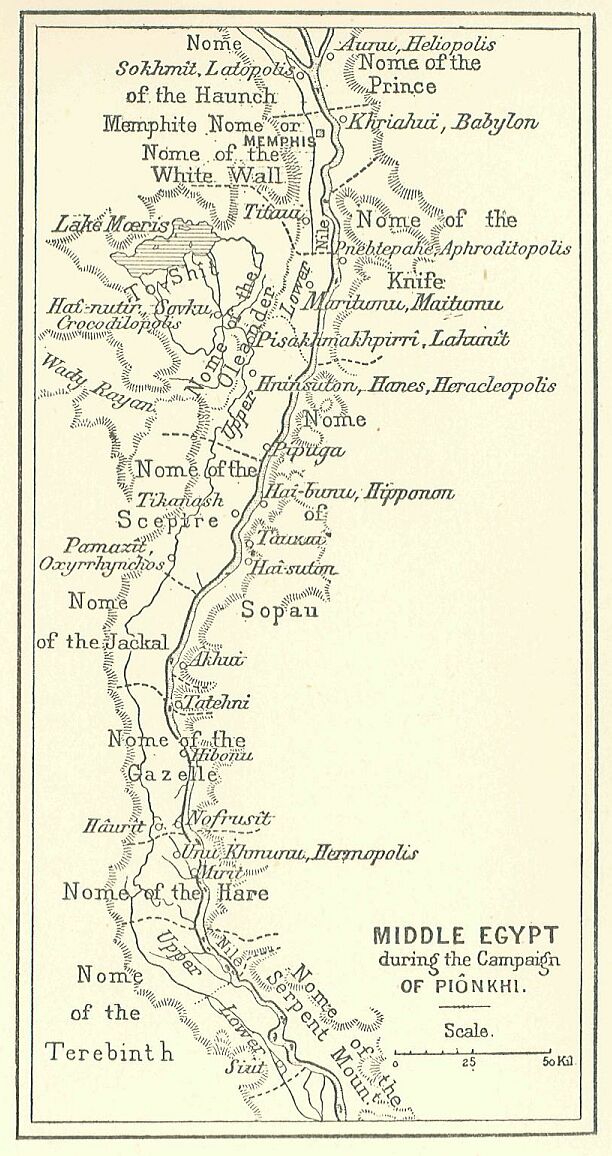
Even had they not begged it to do so, it would have been compelled before long to intervene, for Tafnakhti was already on his way to attack it; Piônkki charged Luâmarsakni and Pu-arama, the generals he had already stationed in the Thebaid, to hold Tafnakhti in check, till he was able to get together the remainder of his army and descend the Nile to support them. Their instructions were to spare none of the rebellious towns, but to “capture their men and their beasts, and their ships on the river; to allow none of the fellaheen to go out into the fields, nor any labourer to his labour, but to attack Hermopolis and harass it daily.” They followed out these orders, though, it would seem, without result, until the reinforcements from Nubia came up: their movements then became more actively offensive, and falling on Tafnakhti’s ships, which were making for Thebes heavily laden with men and stores, they sunk several of them.
Drawn by Boudier, from an engraving in Vivant Denon.
Anxious to profit by this first success, they made straight for Heracleopolis with a view to relieving it. Tafnakhti, accompanied by the two kings Namrôti and Auputi, was directing the siege in person; he had under his command, in addition to contingents from Busiris, Mendès, Thoth, and Pharbaîthos, all the vassals of Osorkon III., the successor of Petubastis and titular Pharaoh of the whole country. The Ethiopian fleet engaged the Egyptian ships at the end of the island of Heracleopolis, near the mouth of the canal leading from the Nile to the Bahr-Yusuf.* Tafnakhti was defeated, and the remnants of his squadron took refuge in Pipuga under cover of his land forces.** At dawn, the next day, the Ethiopians disembarked and gave battle. The struggle was long and fierce, but indecisive. Luâmarsakni and Puarama claimed the victory, but were obliged to effect a retreat on the day following their so-called success, and when they dropped anchor in the harbour of Hermopolis, they found that Namrôti had made his way back to the city by land and forestalled them. Powerless to hold the field without support, he collected all the men and cattle he could lay hands on, and awaited the progress of events behind his ramparts. The Ethiopians invested the town, and wrote to inform Piônkhi of what they had done—not, however, without some misgiving as to the reception which awaited their despatches. And sure enough, “His Majesty became enraged thereat, even as a panther: ‘If they have allowed a remnant of the warriors of the north to remain, if they have let one of them escape to tell of the fight, if they make him not to die in their slaughter, then by my life, by the love of Râ, by the praise of Amon for me, I will myself go down and overthrow that which Tafnakhti hath done,*** I will compel him to give up war for ever! Therefore, after celebrating the festivals of the New Year, when I shall have sacrificed to Amon of [Napata], my father, in his excellent festival wherein he appears in his procession of the New Year, when he shall have sent me in peace to look upon the [Theban] Amon in his festivals at Thebes, and when I shall have carried his image in procession to Luxor, in the festival celebrated in his honour among the festivals of Thebes, on the night of the feast appointed in the Thebaid, established by Râ at the creation, when I have led him in the procession and brought him unto his throne, on the day for introducing the god, even the second of Athyr, then will I make the enemy taste the savour of my claws.’”
* The ancient geographers looked upon the nome of Heraoleopolis as a large island, its southern boundary being, probably, the canal of Harabshent: the end of the island, which the Egyptians called “the forepart of Khninsu,” was probably Harabshent and its environs. ** Pi-puga is probably El-Fokâ, on the Nile, to the north of Harabshent. *** The king does not mention his adversary by name in the text; he is content to indicate him by a pronoun in the third person—“that which he hath done... then will I make him taste,” etc.
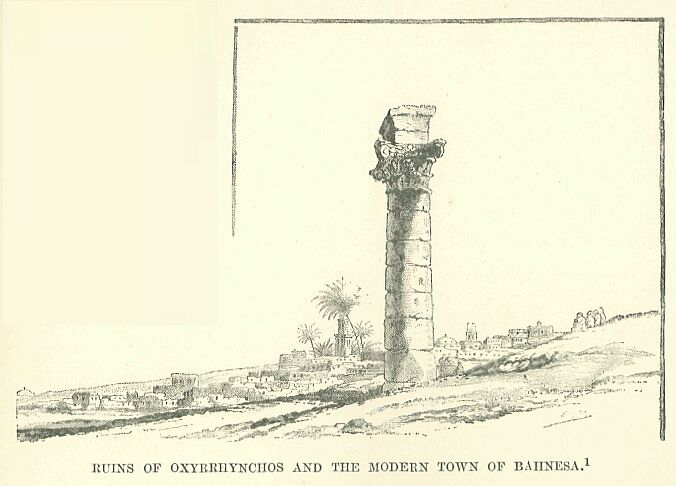
The generals did their very utmost to appease their master’s wrath before he appeared on the scene. They told off a force to keep watch over Hermopolis while they themselves marched against the nome of Uabu; they took Oxyrrhynchos by storm, with “the fury of a water-spout,” and informed the king of this achievement; but “his heart was not softened thereby.” They crossed over to the right bank; they crushed the people of the north under the walls of Tatehni,* they forced the walls of the town with the battering-ram, and killed many of the inhabitants, amongst others a son of Tafnakhti, whose body they sent to the king; but “his heart was not softened thereby.”
They then pushed on as far as Haït Bonua** and sacked it, but still failed to regain favour. On the 9th of Thoth, Piônkhi came down to Thebes, and after hasty attendance at the services to Amon, went to rejoin the vanguard of his army under the walls of Hermopolis.
* The modern Tehneh, on the right bank of the Nile, a little below Minieh. ** Hâit-Bonu, or Hâbonu, is the Hipponon of the Greco-Roman geographers.
Drawn by Faucher-Gudin, from an impression of the stele in the Gizeh Museum.
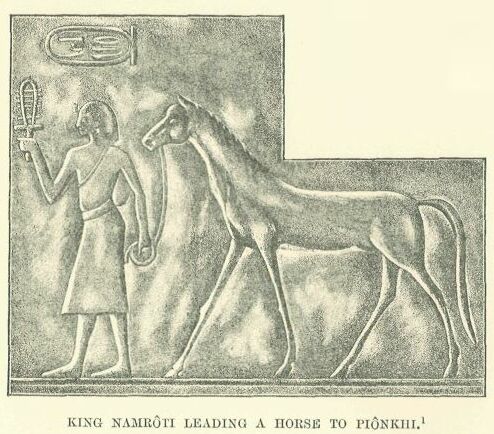
“No sooner had his Majesty quitted the cabin of his ship, than the horses were harnessed and the charioteers in their places; the fear of his Majesty spread even to the Nomads of Asia, and all hearts trembled before him.” Piônkhi drove back the enemy behind their walls, pitched his tent to the south-west of the city, threw up earth-works, and built terraces so as to place his bowmen and sling-ers on a level with the battlements of its towers. At the end of three days, Namrôti, finding himself hard pressed on every side, resolved to surrender. He sent envoys to Piônkhi laden with rich presents, and despatched Queen Nsitentmahît after them, to beg for mercy from the women who had accompanied the Ethiopian, his wives, concubines, daughters, or royal sisters. Their entreaties were graciously received, and Namrôti ventured to come in person, leading a horse with his right hand and shaking in his left a sistrum of gold and lapis-lazuli; he knelt down and presented with his salutations the long train of gifts which had gone before him. Piônkhi visited the temple of Thoth, and there, amidst the acclamations of soldiers and priests, offered up the customary sacrifices.
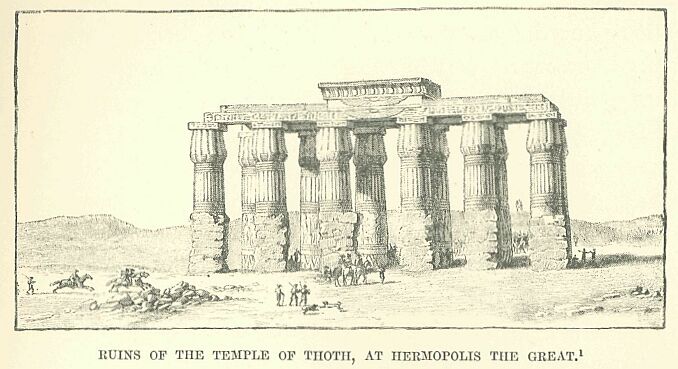
Drawn by Boudier, from an engraving in Vivant Denon. The portico was destroyed about 1820 by the engineers who constructed the sugar refinery at Rodah, and now only a few shapeless fragments of it remain.
He then made his way to the palace and inspected its courts, chambers, treasury, and storehouses, and reviewed the whole household, including even Namrôti’s own wives and daughters, though “he turned not his face towards any one of them.” He next went on to the stud-farms, and was indignant to find that the horses had suffered from hunger during the siege. Thoroughbreds were probably somewhat scarce at Napata, and he had, no doubt, reckoned on obtaining new blood and a complete relay of chargers from the Egyptian stables; his chances of doing so seemed likely to vanish if brood mares and stallions had everywhere been debilitated by the hardships of war. He reserved a part of the booty for himself, handed over the balance to the priests of Amon at Karnak, and also, before he left, received tribute from Heracleopolis. Pefzââbastît brought him horses, the pick of his stables, slaves laden with gold and silver and precious stones; then burying his face in the dust, he offered worship to his liberator: “Hell had swallowed me up, I was plunged into darkness, and lo, now a light has been given me. Since I have found no man to love me in the day of adversity, or to stand by me in the day of battle, save only thee, O victorious king, who hast torn away the night from above me, I will be thy servant, I and all my house, and Khninsu shall pay tribute into thy treasury. For, as to thee, thou art Harmakhis, chief of the imperishable stars, thou art king, even as he is king, and even as he doth not destroy himself, neither shalt thou destroy thyself!”
The downfall of Khmunu led all who might still have shown resistance in Middle Egypt to lay down their arms also. The fortress of Pisakhmakhpirrî* dominated the gorges of Lahunît, and thus commanded the entrance to the Fayum; but the son of Tafnakhti agreed to surrender it, provided he were allowed to march out with the honours of war.
* This fortress, which bears a name compounded with that of Osorkon I., must have been rebuilt by that monarch on the site of an earlier fort; the new name remained in use under the XXIInd and XXIIIth dynasties, after which the old one reappears. It is Illahun, where Petrie discovered the remains of a flourishing town of the Bubastite epoch.
Shortly after, Maîtumu threw open its gates, and its example was followed by Titauî; at Maîtumu there was rioting among the Egyptians in the streets, one party wishing to hold out, the other to surrender, but in the end the latter had their way.* Piônkhi discharged his priestly duties wherever he went, and received the local taxes, always being careful to reserve a tenth for the treasury of Amon-Râ; the fact that his army was kept under rigid control, and that he showed great clemency to the vanquished, helped largely to conciliate those who were not bound by close ties of interest to the cause of Tafnakhti. On reaching Memphis, Piônkhi at once had recourse to the persuasive methods which had hitherto served him so well, and entered into negotiations with the garrison. “Shut not yourselves up in forts, and fight not against the Upper Country,** for Shu the god of creation, when I enter, he entereth, and when I go out, he goeth out, and none may repel my attacks. I will present offerings to Phtah and to the divinities of the White Wall, I will honour Sokari in his mysterious coffer, I will contemplate Eîsânbuf,*** then I will return from thence in peace. If ye will trust in me, Memphis shall be prosperous and healthy, even the children shall not cry therein. Behold the nomes of the South; not a soul has been massacred there, saving only the impious who blasphemed God, and these rebels have been executed.”
* Maritumu, or Maîtumu, is the modern Meîdum, associated in the inscription with the characteristic epithet, Pisokari- Nibu-Suazu, or “temple of Sokari, master of the transfiguration.” Titauî lay exactly on the frontier between Upper and Lower Egypt—hence its name, which signifies “commanding the two regions;” it was in the Memphite nome, and Brugsch identifies it with the Greek city of Acanthos, near Dahshur, but this position appears to me to be too close to Memphis and too far from the boundary of the nome; I should prefer to place Titauî at Kafr el-Ayat or thereabouts. ** I.e. against Piônkhi, who was master of the Upper Country, that is, of Thebes and Ethiopia, and the forces from the whole of the valley to the south of Memphis who accompanied him. *** Lit., “He who is on the South of his Wall,” a name given to one of the quarters of Memphis, and afterwards applied to the god Phtah, who was worshipped in that quarter.
This eloquence, however, was of no avail. A detachment of archers, sailors, and engineers sent to make a reconnaissance of the harbour was taken by surprise and routed with loss, and on the following night Tafnakhti suddenly made his appearance on the spot. He had the 8000 men who were defending it paraded before him, and made them a speech, in which he pointed out the great natural strength of the position, the stoutness of the walls and the abundance of provisions; he then mounted his horse, and making his way a second time through the enemy’s outposts, headed straight for the Delta in order to levy reinforcements there. The next day, Piônkhi went in person to examine the approaches of the city in which his ancestors had once been throned. There was a full Nile, and the river came right up to the walls. He sailed close in along the whole of the eastern front, and landed on the north, much vexed and discomfited at finding it so strongly fortified. Even the common soldiers were astonished, and began to discuss among themselves the difficulties of the undertaking with a certain feeling of discouragement. It would be necessary, they declared, to open a regular siege, “to make an inclined plane leading to the city, throw up- earthworks against its walls, bind ladders, set up masts and erect spars all around it.” Piônkhi burst into a rage when these remarks were repeated to him: a siege in set form would have been a most serious enterprise, and would have allowed the allied princes time to get together fresh troops. He drove his ships full speed against the line of boats anchored in the harbour, and broke through it at the first onset; his sailors then scaled the bank and occupied the houses which overlooked it. Reinforcements concentrated on this point gradually penetrated into the heart of the city, and after two days’ fighting the garrison threw down their arms. The victor at once occupied the temples to save them from pillage: he then purified Memphis with water and natron, ascended in triumph to the temple of Phtah, and celebrated there those rites which the king alone was entitled to perform. The other fortresses in the neighbourhood surrendered without further hesitation. King Auputi of Tentramu,* prince Akaneshu,** and prince Petisis tendered the homage of their subjects in person, and the other sovereigns of the Delta merely waited for a demonstration in force on the part of the Ethiopians before following their example.
* Probably the original of the statue discovered by Naville at Tel-el-Yahudîyeh. Tentramu and Taânu, the cities of Auputi, are perhaps identical with the biblical Elim (Exod. xvi. 1) and the Daneon Portus of Pliny on the Red Sea, but Naville prefers to identify Daneon with the Tonu of the Berlin Papyrus No. 1. I believe that we ought to look for the kingdom of Auputi in the neighbourhood of Menzaleh, near Tanis. ** Akaneshu ruled over Sebennytos and in the XVIIth nome. Naville discovered at Samannud the statue of one of his descendants, a king of the same name, perhaps his grandson, who was prince of Sebennytos in the time of Psammetichus I.
Piônkhi crossed the Nile and marched in state to Heliopolis, there to receive the royal investiture.
He offered up prayers at the various holy places along the route, such as the sanctuary of Tumu at Khriâhu and the temple of the Ennead who dwelt in the cavern from which the Northern Nile was supposed to spring; he then crossed over Mount Ahu, bathed his face in the reputed source of the river, and at length penetrated into the dwelling-place of Râ. He ascended the steps leading to the great chapel in order that he might there “see Râ in Hâît-Banbonu even himself. All unattended, he drew the bolt, threw open the doors, contemplated his father Râ in Hâît-Banbonu, adjusted Ra’s boat Mâdît and the Saktit of Shu, then closed the doors again, affixed a seal of clay, and impressed it with the royal signet.” He had thus submitted his conduct for the approval of the god in whom all attributes of royalty were vested, and the god had legitimatised his claims to universal rule: he was henceforth the master, not merely de jure but de facto as well, and the kings who had hitherto declined to recognise him were now obliged to bow reverently before his authority.
Osorkon was the first to submit, and did so before the close of Piônkhi’s stay at Heliopolis; when the latter pitched his camp near Kahani* in the Athribite nome, the nobles of the Eastern Delta, both small and great, came one after another with their followers; among them Patinifi of Pisapti, Paimau of Busiris, Pabîsa of Khriâhu and of Pihâpi,** besides a dozen others.
* Kahani is, perhaps, the modern Kaha, some distance to the north of Qaliub. ** Pisapti stood on the present site of Shaft-el-ïïineh. Khriâhu, as we know, formed part of the Heliopolitan nome, and is, very possibly, to be identified with Babylon of Egypt, the Postât of the Arabs; Pihâpi was a place not far from the supposed source of the Southern Nile.
He extended his favour to all alike, merely stipulating that they should give him the best of their horses, and undertake to keep careful watch over the prosperity of their stud farms. But Tafnakhti still held out, and seemed determined to defy him to the end; he had set fire to his palace and taken refuge in the islands on the river, and had provided a hiding-place for himself at Masudît among the marshes on the coast in case of final defeat. A victory gained over him by the Ethiopian generals suddenly induced him to sue for peace. He offered to disband his men and pay tribute, provided he was guaranteed undisturbed possession of Sais and of the western districts of the Delta; he refused, however, to sue for pardon in person, and asked that an envoy should be sent to receive his oath of allegiance in the temple of Nit. Though deserted by his brother princes and allies, he still retained sufficient power to be a thorn in his conqueror’s side; his ultimate overthrow was certain, but it would have entailed many a bloody struggle, while a defeat might easily have shaken the fidelity of the other feudatory kings, and endangered the stability of the new dynasty. Piônkhi, therefore, accepted the terms offered him without modification, and asked for no guarantee beyond the oath taken in the presence of the gods. News was brought him about this time that Cynopolis and Aphroditopolis had at last thrown open their gates, and accordingly he summoned his vassals for the last time to his camp near Athribis. With the exception of Tafnakhti, they all obeyed the call, including two minor kings of Upper and two of Lower Egypt, together with barons of lesser rank; but of these, Namrôti alone was admitted to the royal apartments, because he alone was circumcised and ate no fish; after this the camp was broken up, and the Ethiopians set out on their return journey southwards. Piônkhi may well have been proud of the result of this campaign, both for himself and for his country. The empire of the Pharaohs, which had for the last hundred and fifty years been divided, was now re-established from the confluence of the Niles to the shores of the Mediterranean, but it was no longer Egypt that benefited by the change. It was now, after many years of slavery, the turn of Ethiopia to rule, and the seat of power was transferred from Thebes or Memphis to Napata. As a matter of fact, the fundamental constitution of the kingdom underwent no great modification; it had merely one king the more to rule over it—not a stranger, as we are often tempted to conclude, when we come to measure these old-world revolutions by our modern standards of patriotism, but a native of the south, who took the place of those natives of the north who had succeeded one another on the throne since the days of Smendes. In fact, this newly crowned son of Râ lived a very long way off; he had no troops of his own further north than Siut, and he had imposed his suzerainty on the rival claimants and reigning princes without thereby introducing any change in the constitution of the state. In tendering their submission to him, the heads of the different nomes had not the slightest intention of parting with their liberty; they still retained it, even though nominally dependent, and continued, as in the past, to abuse it without scruple. Namrôti was king at Khmunu, Pefzââbastît at Khninsu, Auputi at Tentramu, and Osorkon III. at Bubastis; the prestige investing the Tanite race persisted so effectively that the annalists give to the last-named precedence over the usurpers of the Ethiopian dynasty; the Tanites continued to be the incarnate representatives of legitimate power, and when Osorkon III. died, in 732, it was his son Psamutis who was regarded as the Lord of Egypt. Tafnakhti had, in his defeat, gained formal recognition of his royalty. He was no longer a mere successful adventurer, a hero of the hour, whose victories were his only title-deeds, whose rights rested solely on the argument of main force. Piônkhi, in granting him amnesty, had conferred official investiture on him and on his descendants. Henceforth his rule at Sais was every whit as legitimate as that of Osorkon at Bubastis, and he was not slow in furnishing material proof of this, for he granted himself cartouches, the uraeus, and all the other insignia of royalty. These changes must have been quickly noised abroad throughout Asia. Commercial intercourse between Syria and Egypt was maintained as actively as ever, and the merchant caravans and fleets exported with regularity the news of events as well as the natural products of the soil or of industry. The tidings of an Ethiopian conquest and of the re-establishment of an undivided empire in the valley of the Nile, coming as they did at the very moment when the first effects of the Assyrian revival began to be so keenly felt, could not fail to attract the attention and arouse the hopes of Syrian statesmen. The Philistines, who had never entirely released themselves from the ties which bound them to the Pharaohs of the Delta, felt no repugnance at asking for a renewal of their former protection.
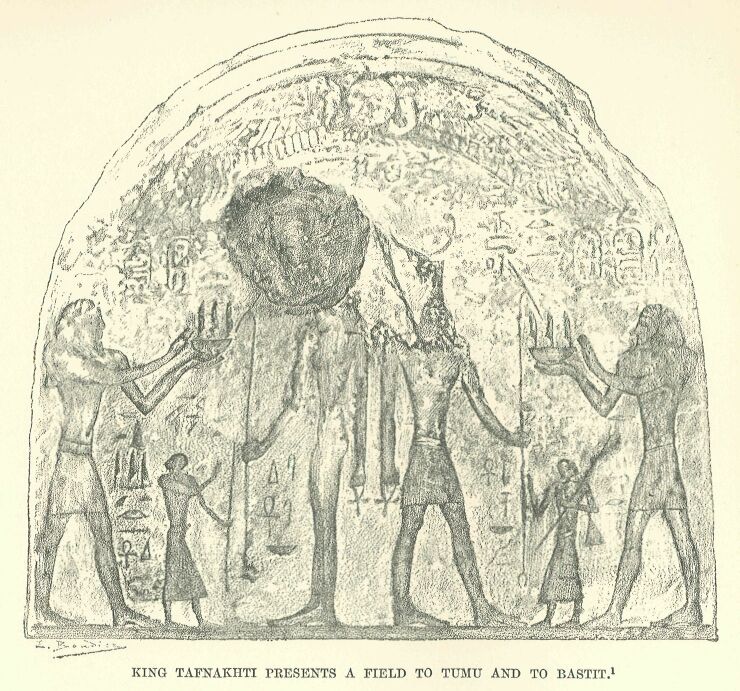
Drawn by Boudier, from Mallet’s photograph of the stele in the Museum at Athens.
As for the Phoenicians, the Hebrews, Edom, Moab, Ammon, and Damascus, they began to consider whether they had not here, in Africa, among the members of a race favourably disposed towards them by the memories of the past and by its ambition, hereditary allies against Nineveh. The fact that Egypt was torn by domestic dissensions and divided into a score of rival principalities in no way diminished their traditional admiration for its wealth or their confidence in its power; Assyria itself was merely an agglomeration of turbulent provinces, vassal cities, and minor kingdoms, artificially grouped round the ancient domain of Assur, and yet the convulsions by which it was periodically shaken had not prevented it from developing into the most formidable engine of war that had ever threatened the peace of Asia. The African hosts, whether led by ordinary generals or by a king of secondary rank, formed none the less a compact army well fitted by numbers and organisation to hold its own against any forces which Tiglath-pileser might put into the field; and even should the supreme Pharaoh be unwilling to throw the full weight of his authority into the balance, yet an alliance with one of the lesser kings, such as the lord of Sais or of Bubastis, would be of inestimable assistance to any one fortunate enough to secure it. It is true that, in so far as the ultimate issue was concerned, there was little to be gained by thus pitting the two great powers together and persuading one to fight against the other; the victor must, in the long run, remain master alike of those who had appealed for help and of those who had fought against him, and if Egypt emerged triumphant, there would be nothing for it but to accept her supremacy. In either event, there could be no question of independence; it was a choice between the hegemony of Egypt or that of Assyria.
From the moment that Tiglath-pileser had made his appearance on the northern horizon, the nations of Southern Syria had instinctively looked to Pharaoh for aid. There seems to have been an Egyptian faction in Samaria, even during the disorders which broke out after the death of Jeroboam II., and perhaps it was a hope of overcoming it easily which led Menahem of his own accord to invoke the still remote suzerainty of Nineveh, after the fall of Unki in 738;* later on, when Pekah had assassinated Pekahiah and entered into alliance with Eezin, he adopted the view of those who saw no hope of safety save from the banks of the Nile, his only reason for doing so being, apparently, because the kings of the fallen dynasty had received support from the valley of the Tigris. Hosea continually reproached his countrymen with this vacillating policy, and pointed out the folly of it: “Ephraim is like a silly dove without understanding; they call unto Egypt, they go unto Assyria; when they shall go I will spread My net upon them,” said the Eternal.**
* The existence of an Egyptian faction at this period has been admitted by Kittel. Winckler has traced to the Arabian or Idumæan Muzri everything previously referred to Egypt. His arguments seem to me to be, in many cases, convincing, as I shall point out where necessary, but I think he carries his theory too far when he systematically excludes Egypt and puts Muzri in its place. Egypt, even in its decadent state, was a far more important power than the Arabian Muzri, and it seems unreasonable to credit it with such a limited share in the politics of the time. I cannot believe that any other power is intended in most of those passages in the Hebrew writings and Assyrian inscriptions in which the words Mizraîm and Muzri occur. ** Hos. vii. 11, 12.
They were to be given up to Assyria and dispersed, and while some were to go into Assur and eat unclean food, Ephraim was to return into Egypt; “for, lo, they are gone away from destruction, yet Egypt shall gather them up, Memphis shall bury them.” * Nevertheless, they persisted in negotiating with Egypt, and though there was as yet no formal alliance between Samaria and Sais or Tanis, their relations were so close that no enemy of Israel could look for protection from Psamuti or his vassals. Ahaz had, therefore, nothing to hope from this quarter, and was compelled by the force of circumstances to throw himself into the arms of Assyria, if he decided to call in outside aid at all. His prophets, like those of Pekah, strenuously forbade him to do so, and among them was one who was beginning to exert a marvellous influence over all classes of society—Isaiah, the son of Amoz. He had begun his career in the year that Uzziah died,** and had continued to prophesy without interruption during the brief reign of Jotham.***
* Hos. ix. 3-6. ** Isa. vi. 1. *** The fragments which can be assigned to this period now occur as follows: chap. ii. 2-5 (verses 2-4 are also found in Micah iv. 1-3, and were, perhaps, borrowed from some third prophet), ii. 6-22, iii., iv., v. 1-24 (the Parable of the Vineyard), and lastly, chap, vi., in so far as the substance is concerned; it seems to have been put into its present form long after the events.
When Jahveh first appeared to him, in the smoke of the altar, seated on a throne and surrounded by seraphim, a sense of his own unworthiness filled him with fear, but an angel purified his lips with a live coal, and he heard the voice of the Lord saying, “Whom shall I send, and who will go for us?” and he replied, “Here am I; send me,” whereupon Jahveh gave him this message: “Hear ye indeed, but understand not; and see ye indeed, but perceive not. Make the heart of this people fat, and make their ears heavy, and shut their eyes; lest they see with their eyes and hear with their ears, and understand with their heart, and turn again and be healed.” Then the prophet asked, “Lord, how long?” And Jahveh answered, “Until cities be waste without inhabitant and houses without man, and the land become utterly waste, and Jahveh have removed men far away, and the forsaken places be many in the midst of the land. And if there be yet a tenth in it, it shall be eaten up; as a terebinth, and as an oak, whose stock remaineth when they are felled, so the holy seed is the stock thereof.” *
* An explanatory gloss, “the fierce anger of Rezin and Syria and of the son of Remaliah,” which formed no part of the original prophecy, is here inserted in the text.
Judah, though less powerful, was quite as corrupt as his brethren of Israel, and the divine wrath threatened him no less than them; it rested with himself, however, to appease it by repentance, and to enter again into divine favour after suffering his punishment; the Eternal would then gather together on Mount Sion those of His faithful people who had survived the crisis, and would assure them a long period of prosperity under His law. The prophet, convinced that men could in no wise alter the decrees of the Highest, save by repentance alone, was astonished that the heads of the state should strive to impede the progress of events that were happening under their very eyes, by the elaborately useless combinations of their worldly diplomacy. To his mind, the invasion of Pekah and Eezin was a direct manifestation of the divine anger, and it filled him with indignation that the king should hope to escape from it by begging for an alliance against them with one of the great powers: when Jahveh should decide that the punishment was sufficient for the crime, He would know how to shatter His instruments without any earthly help. Indeed, Isaiah had already told his master, some days before the allied kings appeared, while the latter was busy superintending the works intended to supply Jerusalem with water, to “Take heed, and be quiet; fear not, neither let thy heart be faint, because of these two tails of smoking firebrands.... Because Syria hath counselled evil against thee, Ephraim also, and the son of Bemaliah, saying, Let us go up against Judah, hem it in, carry it by storm, and set up the son of Tabeel as king: thus saith the Lord God, It shall not stand, neither shall it come to pass.” If, however, the course of the divine justice was to be disturbed by the intervention of a purely human agency, the city would doubtless be thereby saved, but the matter would not be allowed to rest there, and the people would suffer even more at the hands of their allies than they had formerly endured from their enemies. “Behold, a virgin shall conceive and bear a son, and shall call his name Immanuel—God with us.... For before the child shall know to refuse the evil and choose the good, the land whose two kings thou abhorrest shall be forsaken,” and yet “Jahveh shall bring upon thee, and upon thy people, and upon thy father’s house, days that have not come, from the day that Ephraim departed from Judah.” * And then, employing one of those daring apologues, common enough in his time, the prophet took a large tablet and wrote upon it in large letters two symbolical names—Spoil-speedeth, Prey-hasteth—and set it up in a prominent place, and with the knowledge of credible witnesses went in unto the prophetess his wife. When the child was born in due course, Jahveh bade him call it Spoil-speedeth, Prey-hasteth, “for before he shall have knowledge to cry, My father and, My mother, the riches of Damascus and the spoil of Samaria shall be carried away before the King of Assyria.” But the Eternal added, “Forasmuch as this people hath refused the waters of Shiloah that go softly, and rejoice in Rezin and Remaliah’s son; now therefore, behold, the Lord bringeth up upon them the waters of the river [the Euphrates], strong and many:* and he shall come up over all his channels, and go over all his banks: and he shall sweep onward into Judah; he shall overflow and pass through; he shall reach even to the neck, and the stretching of his wings shall fill the breadth of thy land, O Immanuel [God-with-us]!”*** Finding that Egypt was in favour of his adversaries, Ahaz, in spite of the prophet’s warnings, turned to Assyria.****
* Isa. vii. 10-17. ** A marginal gloss has here been inserted in the text, indicating that it was «the King of Assyria and all his glory » that the prophet referred to *** Isa. viii. 1-8. **** The following portions of Isaiah are accepted as belonging to the period of this Syrian war: in addition to chap, vii., chaps, viii.-ix 6. xi 1-9. xxii. 1-11; i. 4-9, 18-32; to these Kuenen adds chap, xxiii. 1-8
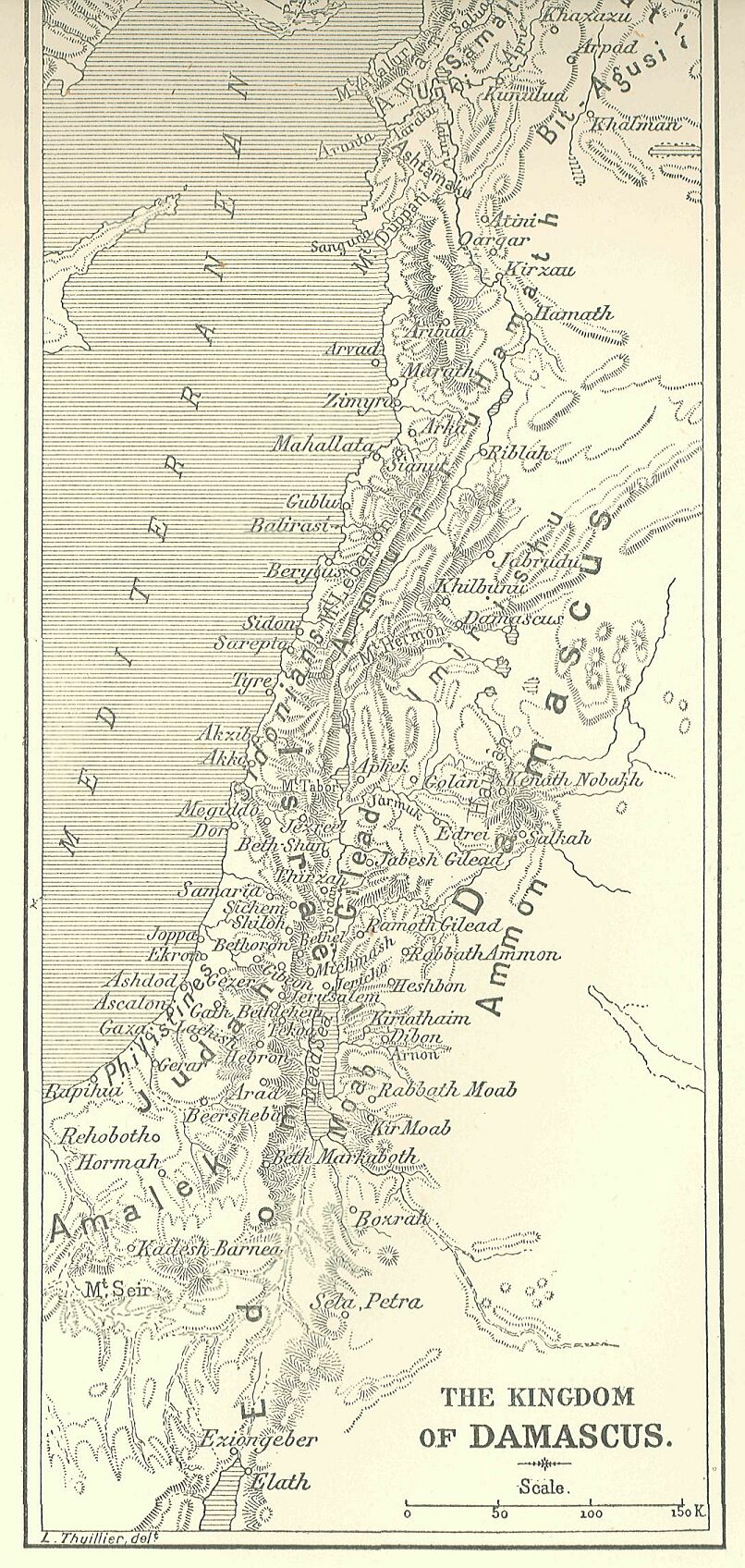
At one time he had found himself so hard pressed that he invoked the aid of the Syrian gods, and made his eldest son pass through the fire in order to propitiate them:* he collected together all the silver and gold he could find in his own treasury or in that of the temple and sent it to Tiglath-pileser, with this message: “I am thy servant and thy son: come up and save me out of the hand of the King of Syria, and out of the hand of the King of Israel, which rise up against me.” **
* 2 Kings xvi. 3 (cf. 2 Chron. xxviii. 3). There is nothing to indicate the date, but most historians place the event at the beginning of the Syrian war, a little before or during the siege. ** Kings xvi. 7, 8; cf. 2 Chron. xxviii. 16, 20, 21.
Drawn by Faucher -Gudin, from Layard.
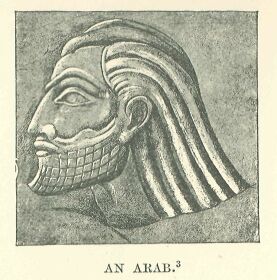
Tiglath-pileser came in haste, and Rezin and Pekah, at the mere tidings of his approach, desisted from their attack on Jerusalem, separated, and retired each to his own kingdom. The Assyrian king did not immediately follow them up. He took the road leading along the coast, after leaving the plains of the middle Orontes, and levied tribute from the Phoenician cities as he passed; he then began by attacking the western frontier of Israel, and sent a body of troops against the Philistines, who were ceaselessly harassing Judah. Hannon, King of Gaza, did not await the attack, but fled to Egypt for safety, and Ahaz breathed freely, perhaps for the first time since his accession. This, however, was only a beginning; the real struggle took place in the following year, and was hotly contested. In spite of the sorry pass to which its former defeats and present discords had brought it, Damascus still possessed immense wealth, and its army, when reinforced by the Arabian and Israelite contingents, was capable of holding its own for a long time against the battalions of Assyria, even if it could not hope to conquer them. Unfortunately for its chances, Eezin had failed to inherit the military capacity of his great predecessors, Ben-hadad and Hazael; he allowed Tiglath-pileser to crush the Hebrews without rendering them any effective assistance. Pekah fought his best, but he lost, one after another, the strongholds which guarded his northern frontier—Ijon, Abel-beth-maacah, Janoah, Kedesh, and Hazor; he saw the whole of Naphtali and Gilead laid waste, and their inhabitants carried off into Assyria without his being able to prevent it; he himself being obliged to evacuate Samaria and take refuge in the mountains almost unattended. Judah followed, with mingled exultation and disquietude, the vicissitudes of the tragic drama which was thus enacted before its eyes, and Isaiah foretold the speedy ruin of the two peoples who had but yesterday threatened to enslave it. He could already see the following picture in his mind’s eye: “Damascus is taken away from being a city, and it shall be a ruinous heap. The cities of Aroer are forsaken: they shall be for flocks, which shall lie down, and none shall make them afraid.” *
* Both of these Aroêrs lay beyond Jordan—one in Reuben, afterwards Moab (Judg. xi. 26; Jer. xlviii. 19); the other in Amnion, afterwards Gad (Josh. xiii. 25; 2 Sam. xxiv. 5); here they stand for the countries beyond Jordan which Tiglath-pileser had just laid waste. The tradition preserved in 1 Citron, v. 26 stated that these inhabitants of Gad and Reuben were led into captivity by Pul, i.e. Tiglath-pileser.
“The fortress also shall cease from Ephraim, and the kingdom from Damascus, and the remnant of Syria: they shall be as the glory of the children of Israel, saith the Lord of hosts! And it shall come to pass in that day, that the glory of Jacob shall be made thin, and the fatness of his flesh shall wax lean. And it shall be as when the harvestman gathereth the standing corn, and his arm reapeth the ears; yea, it shall be as when one gleaneth ears in the valley of Ephraim. Yet there shall be left therein gleanings, as the shaking of an olive tree, two or three berries in the top of the uppermost bough, four or five in the outmost branches of a fruitful tree, saith Jahveh, the God of Israel!... In that day shall his strong cities be as the forsaken places in the wood, and on the mountain top, which were forsaken from before the children of Israel:* and it shall be as a desolation. For thou hast forgotten the God of thy salvation.” **
* This is probably an allusion to the warlike exploits performed during Rezin and Pekah’s invasion of Judaea, a year or two previously. ** Isa. xvii. 1-6, 9, 10.
Samaria was doomed to helplessness for many a day to come, if not for ever, but it had taken a whole year to lay it low (733); Tiglath-pileser returned in 732, and devoted yet another year to the war against Damascus. Eezin had not been dismayed by the evil fortune of his friends, and had made good his losses by means of fresh alliances. He had persuaded first Mutton II. of Tyre, then Mitinti of Askalon, and with the latter a section of the Philistines, to throw in their lot with him; he had even won over Shamshieh, queen of the Arabs, and with her a number of the most warlike of the desert tribes; for himself, he had taken up a position on the further side of Anti-Lebanon, and kept strict watch from Mount Hermon on the roads leading from the valley of the Jordan to the plains of the Abana, in order to prevent the enemy from outflanking him and taking him in the rear. But all to no purpose; Tiglath-pileser bore directly down upon him, overwhelmed him in a pitched battle, obliged him to take refuge behind the walls of Damascus, and there besieged him.
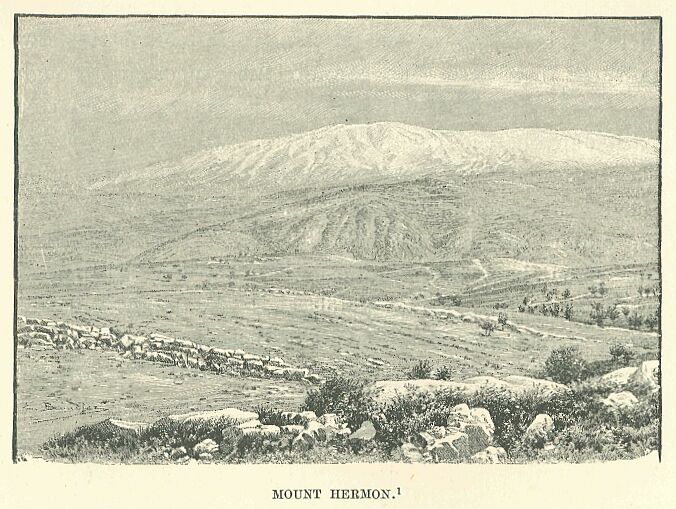
Drawn by Boudier, from a photograph brought back by Lortet.
The city was well fortified, amply supplied with provisions, and strongly garrisoned; the siege was, therefore, a long one, and the Assyrians filled up the time by laying waste the fertile country at the foot of Anti-Lebanon. At last Rezin yielded, gave himself up unconditionally, and was forthwith executed: eight thousand of his followers were carried off to Kîr, on the confines of Elam,* his kingdom was abolished, and a Ninevite governor was installed in his palace, by whom the former domain of Damascus and the territory lately wrested from Israel were henceforth to be administered.
* 2 Kings xvi. 9. Kîr is generally located in Armenia, Media, or Babylonia; a passage in Isaiah (xxii. 6), however, seems to point to its having been somewhere in the direction of Elam, and associated with the Aramæans on the banks of the Tigris. The Assyrian monuments have not, as yet, yielded confirmation of the details given by the Book of the Kings in regard to the captivity of the inhabitants of Damascus. A fragmentary tablet, giving an account of the death of Rezin, was discovered by H. Raw-linson, but it was left in Assyria, and no one knows what has since become of it.
The coalition he had formed did not long survive its leader.* Mutton hastily came to an understanding with the conqueror; Mitinti, like Hannon, fled into Egypt, and his place was taken by Kukibtu, a partisan of Assyria. Hoshea, son of Elah, rebelled against Pekah, assassinated him, and purchased the right to reign over what was left of Israel for ten talents of gold.** Shamshieh alone held out.
* The following is a list of the kings of Damascus from the time of David, as far as is known up to the present time:—
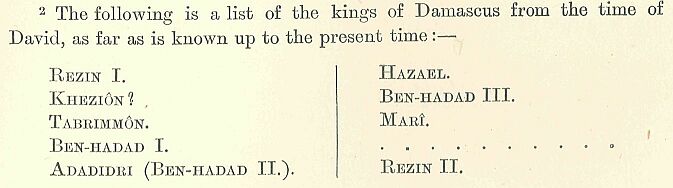
** 2 Kings xv. 30. The inscription published by H. Rawlinson, merely states that “they overthrew Pekah, their king, and I promoted Auzi [to the kingship] over them. I received [from him] X talents of gold and... talents of silver....”
She imagined herself to be safe among the sands of the desert, and it never occurred to her that the heavy masses of the Assyrian army would dream of venturing into these solitudes. Detachments of light cavalry were sent in pursuit of her, and at first met with some difficulties; they were, however, eventually successful; the Armenian and Cappadocian steeds of the Ninevite horsemen easily rode down the queen’s meharis.
Their success made a great impression on the Arab tribes, and induced the Mashaî, Timaî Sabasans, Khaiapæans, Badanæans, and Khattiæans to bend the knee before Assyria. They all sent envoys bearing presents of gold and silver, camels, both male and female, and spices:* even the Muzri, whose territory lay to the south of the Dead Sea, followed their example, and a certain Idibiel was appointed as their chief.**
* Delitzsch has identified the names of several of these races with names mentioned in the Bible, such as the Temah, Massah, Ephah, Sheba. ** The name Muzri, as Winckler has shown, here refers, not to Egypt, but to a canton near Edom, the Nabatsea of the Greco-Roman geographers.
While his lieutenants were settling outstanding issues in this fashion, Tiglath-pileser held open courts at Damascus, where he received the visits and homage of the Syrians. They came to assure themselves by the evidence of their own eyes of the downfall of the power which had for more than one hundred years checked the progress of Assyria. Those who, like Uassarmi of Tabal, showed any sign of disaffection were removed, the remainder were confirmed in their dignities, subject to payment of the usual tribute, and Mutton of Tyre was obliged to give one hundred talents of gold to ransom his city. Ahaz came to salute his preserver, and to obtain a nearer view of the soldiers to whom he owed continued possession of Jerusalem;* the kings of Ammon, Moab, Edom, and Askalon, the Philistines and the nomads of the Arabian desert, carried away by the general example, followed the lead of Judah, until there was not a single prince or lord of a city from the Euphrates to the river of Egypt who had not acknowledged himself the humble vassal of Nineveh.
* 2 Kings xvi. 10-12. The Nimroud Inscrip. merely mentions his tribute among that of the Syrian kings.
With the downfall of rezin, Syria’s last hope of recovery had vanished; the few states which still enjoyed some show of independence were obliged, if they wished to retain it, to make a parade of unalterable devotion to their Ninevite master, or—if they found his suzerainty intolerable—had to risk everything by appealing to Egypt for help.
Much as they may have wished from the very first to do so, it was too early to make the attempt so soon after the conference at Damascus; Tiglath-pileser had, therefore, no cause to fear a rebellion among them, at any rate for some years to come, and it was just as well that this was so, for at the moment of his triumph on the shores of the Mediterranean his interests in Chaldæa were threatened by a serious danger. Nabonazîr, King of Karduniash, had never swerved from the fidelity which he had sworn to his mighty ally after the events of 745, but the tranquillity of his reign had been more than once disturbed by revolt. Borsippa itself had risen on one occasion, and endeavoured to establish itself as an independent city side by side with Babylon.
When Nabonazîr died, in 734, he was succeeded by his son Nabunâdinzîri, but at the end of a couple of years the latter was assassinated during a popular outbreak, and Nabushumukîn, one of his sons, who had been implicated in the rising, usurped the crown (732). He wore it for two months and twelve days, and then abdicated in favour of a certain Ukînzîr.*
* The following is as complete a list as can at present be compiled of this Babylonian dynasty, the eighth of those registered in Pinches’ Canons (cf. Rost, Untersucli. zur altorient. Gesch., p. 27):—
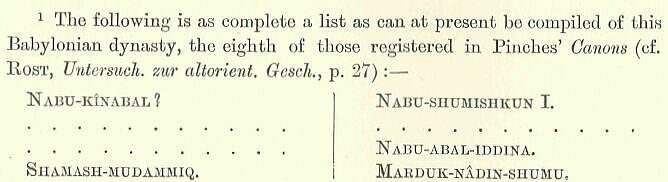
It included twenty-two kings, and lasted for about three hundred and fifty years.
The latter was chief of the Bît-Amukkâni, one of the most important among the Chaldæan communities;* the descendants of the Aramaean nomads were thus once more placed upon the throne, and their accession put an end to the relations which had existed for several centuries between Assyria and Karduniash.
* The chronicle is silent with regard to the origin of Ukînzîr, but Tiglath-pileser, who declines to give him the title of “King of Babylon,” says that he was mar Amuhlcâni = son of Amukkâni. Pinches’ Canon indicates that Ukînzîr belonged to a dynasty the name of which may be read either Shashi or Shapi. The reading Shapi at once recalls the name of Shapîa, one of the chief cities of the Bît Amukkâni; it would thus confirm the evidence of the Nimroud Inscription.
Drawn by Faucher-Gudin, from the bas-relief reproduced by Layard.
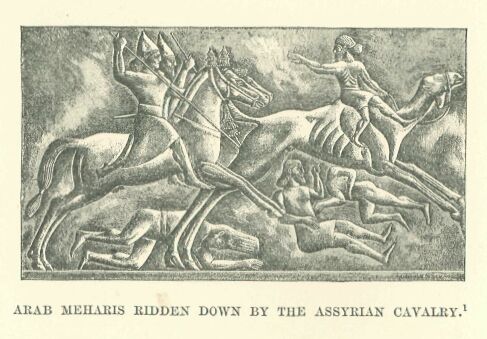
These marauders, who had always shown themselves impatient of any settled authority, and had never proffered more than a doubtful submission to even the most triumphant invader, were not likely to accept the subordinate position which members of the presiding dynasty had been, for the most part, content to occupy. It was more probable that they would, from the very first, endeavour to throw off the suzerainty of Nineveh. Tiglath-pileser gave the new dynasty no time to settle itself firmly on the throne: the year after his return from Syria he got together an army and marched against it. He first cleared the right bank of the Tigris, where the Pukudu (Pekod) offered but a feeble resistance; he annexed their territory to the ancient province of Arrapkha, then crossed the river and attacked the Kaldi scattered among the plains and marshes of the Shatt el-Haî.
Drawn by Faucher- Gudin, from a woodcut published by Tomkins
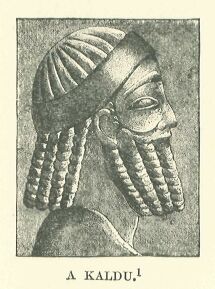
The Bît-Shilâni were the first to succumb; their king Nabushabshi was impaled before one of the gates of his capital, Sarrabânu, the town itself was taken by storm, plundered and dismantled, and 55,000 of its inhabitants were led captive into Assyria. After the Bît-Shilâni, came the turn of the Bît-Shaali. Dur-Illataî, their capital, was razed to the ground, and its population, numbering 50,400 men and women, was deported. Their chief, Lakiru, who had shown great bravery in the struggle, escaped impalement, but was sent into captivity with his people, a Ninevite governor being appointed in his place. Ukînzîr, who was, as we know, hereditary prince of the Bit-Amuk-kâni, came up in haste to defend his appanage, and threw himself into his fortress at Shapîa: Tiglath-pileser cut down the gardens and groves of palms which lent it beauty, burnt the surrounding farms and villages, and tried, without success, to make a breach in the walls; he still, however, maintained the siege, but when winter came on and the place still held out, he broke up his camp and retreated in good order, leaving the districts which he had laid waste occupied by an Assyrian force. Before his departure, he received homage and tribute from most of the Aramæan chiefs, including those of Balasu and the Bît-Dakkuri, of Nadînu, and even of the Bît-Yakîn and Merodach-baladan, whose ancestors had never before “kissed the foot” of an Assyrian conqueror. In this campaign he had acquired nearly three-fourths of the whole Babylonian kingdom; but Babylon itself still refused to yield, and it was no easy task to compel it to do so. Tiglath-pileser spent the whole of the year 730 in preparing for another attack, and in 729 he again appeared in front of Shapîa, this time with greater success: Ukînzîr fell into his hands, Babylon opened its gates, and he caused himself to be proclaimed King of Sumir and Akkad within its walls.* Many centuries had passed since the two empires had been united under the rule of a single master, or an Assyrian king had “taken the hands of Bel.” Tiglath-pileser accepted the condition attached to this solemn investiture, which obliged him to divide his time between Calah and Babylon, and to repeat at every festival of the New Year the mystic ceremony by which the god of the city confirmed him in his office.**
* Contemporary documents do not furnish us with any information as to these events. The Eponym Canon tells us that “the king took the hands of Bel.” Pinches’ Chronicle adds that “in the third year of Ukînzîr, Tiglath-pileser marched against Akkad, laid waste the Bît- Amukkâni, and took Ukînzîr prisoner; Ukînzîr had reigned three years in Babylon. Tiglath-pileser followed him upon the throne of Babylon.” ** The Eponym Canon proves that in 728 B.C., the year of his death, he once more took the hands of Bel.
His Babylonian subjects seem to have taken a liking to him, and perhaps in order to hide from themselves their dependent condition, they shortened his purely Assyrian name of Tukulti-abal-esharra into the familiar sobriquet of Puru or Pulu, under which appellation the native chroniclers later on inscribed him in the official list of kings: he did not long survive his triumph, but died in the month of Tebeth, 728 B.C., after having reigned eighteen years over Assyria, and less than two years over Babylon and Chaldæa.
The formulae employed by the scribes in recording historical events vary so little from one reign to another, that it is, in most cases, a difficult matter to make out, under the mask of uniformity by which they are all concealed, the true character and disposition of each successive sovereign. One thing, however, is certain—the monarch who now came upon the scene after half a century of reverses, and in a brief space restored to his armies the skill necessary to defeat such formidable foes as the Armenians or the Syrians of Damascus, must have been an able general and a born leader of men. Yet Nineveh had never suffered long from a lack of capable generals, and there would be little to distinguish Tiglath-pileser from any of his predecessors, if we could place nothing more than a few successful campaigns to his credit. His claim to a pre-eminent place among them rests on the fact that he combined the talents of the soldier with the higher qualities of the administrator, and organised his kingdom in a manner at once so simple and so effective, that most of the Oriental powers down to the time of the Grecian conquest were content to accept it as a model. As soon as the ambition of the Assyrian kings began to extend beyond the region confined between the Khabur and the Greater Zab, they found it necessary to parcel out their territory into provinces under the authority of prefects for the purpose of preserving order among the vanquished peoples, and at the same time of protecting them from the attacks of adjacent tribes; these representatives of the central power were supported by garrisons, and were thus enabled to put down such minor insurrections as broke out from time to time. Some of these provinces were already in existence in the reigns of Shalmaneser or Tiglath-pileser I.; after the reverses in the time of Assurirba, their number decreased, but it grew rapidly again as Assur-nazir-pal and Shalmaneser III. gradually extended the field of their operations and of their victories. From this epoch onwards, the monuments mention over a score of them, in spite of the fact that the list thus furnished is not a complete one; the provinces of which we know most are those whose rulers were successively appointed to act as limmi, each of them giving their name to a year of a reign. Assyria proper contained at least four, viz. Assur (called the country, as distinguished from all others), Calah, Nineveh, and Arbela. The basin of the Lesser Zab was divided into the provinces of Kakzi, Arrapkha, and Akhizukhîna;* that of the Upper Tigris into those of Amidi, Tushkhân, and Gôzan. Kirruri was bounded by Mazamua, and Mazamua by Arrapkha and Lake Urumiah. We hear of the three spheres of Nazibina (Nisibis), Tela, and Kazappa in Mesopotamia,** the two former on the southern watersheds of the Masios, on the highways leading into Syria; the latter to the south of the Euphrates, in the former kingdom of the Laqî.