Volume 3 — CHAPTER III—CHALDÆAN CIVILIZATION
M. L. McClure translation
Royalty—The constitution of the family and its property—Chaldæan commerce and industry.
The Chaldæan kings, unlike their contemporaries the Pharaohs, rarely put forward any pretensions to divinity. They contented themselves with occupying an intermediate position between their subjects and the gods, and for the purpose of mediation they believed themselves to be endowed with powers not possessed by ordinary mortals. They sometimes designated themselves the sons of Ea, or of Nînsun, or some other deity, but this involved no belief in a divine parentage, and was merely pious hyperbole: they entertained no illusions with regard to any descent from a god or even from one of his doubles, but they desired to be recognized as his vicegerents here below, as his prophets, his well-beloved, his pastors, elected by him to rule his human flocks, or as priests devotedly attached to his service. While, however, the ordinary priest chose for himself a single master to whom he devoted himself, the priest-king exercised universal sacerdotal functions and claimed to be pontiff of all the national religions. His choice naturally was directed by preference to the patrons of his city, those who had raised his ancestors from the dust, and had exalted him to the supreme rank, but there were other divinities who claimed their share of his homage and expected of him a devotion suited to their importance. If he had attempted to carry out these duties personally in detail, he would have had to spend his whole life at the foot of the altar; even when he had delegated as many of them as he could to the regular clergy, there still remained sufficient to occupy a large part of his time. Every month, every day, brought its inevitable round of sacrifices, prayers, and processions. On the 1st of the second Elul, the King of Babylon had to present a gazelle without blemish to Sin; he then made an offering of his own choosing to Shamash, and cut the throats of his victims before the god. These ceremonies were repeated on the 2nd without any alteration, but from the 3rd to the 12th they took place during the night, before the statues of Merodach and Ishtar, in turn with those of Nebo and Tashmit, of Mullil and Ninlil, of Eamman and of Zirbanit; sometimes at the rising of a particular constellation—as, for instance, that of the Great Bear, or that of the sons of Ishtar; sometimes at the moment when the moon “raised above the earth her luminous crown.” On such a date a penitential psalm or a litany was to be recited; at another time it was forbidden to eat of meat either cooked or smoked, to change the body-linen, to wear white garments, to drink medicine, to sacrifice, to put forth an edict, or to drive out in a chariot. Not only at Babylon, but everywhere else, obedience to the religious rites weighed heavily on the local princes; at Uru, at Lagash, at Nipur, and in the ruling cities of Upper and Lower Chaldæa. The king, as soon as he succeeded to the throne, repaired to the temple to receive his solemn investiture, which differed in form according to the gods he worshipped: at Babylon, he addressed himself to the statue of Bel-Merodach in the first days of the month Nisan which followed his accession, and he “took him by the hands” to do homage to him. From thenceforth, he officiated for Merodach here below, and the scrupulously minute devotions, which daily occupied hours of his time, were so many acts of allegiance which his fealty as a vassal constrained him to perform to his suzerain. They were, in fact, analogous to the daily audiences demanded of a great lord by his steward, for the purpose of rendering his accounts and of informing him of current business: any interruption not justified by a matter of supreme importance would be liable to be interpreted as a want of respect or as revealing an inclination to rebel. By neglecting the slightest ceremonial detail the king would arouse the suspicions of the gods, and excite their anger against himself and his subjects: the people had, therefore, a direct interest in his careful fulfilment of the priestly functions, and his piety was not the least of his virtues in their eyes. All other virtues—bravery, equity, justice—depended on it, and were only valuable from the divine aid which piety obtained for them. The gods and heroes of the earliest ages had taken upon themselves the task of protecting the faithful from all their enemies, whether men or beasts. If a lion decimated their flocks, or a urus of gigantic size devastated their crops, it was the king’s duty to follow the example of his fabulous predecessors and to set out and overcome them. The enterprise demanded all the more courage and supernatural help, since these beasts were believed to be no mere ordinary animals, but were looked on as instruments of divine wrath the cause of which was often unknown, and whoever assailed these monsters, provoked not only them but the god who instigated them. Piety and confidence in the patron of the city alone sustained the king when he set forth to drive the animal back to its lair; he engaged in close combat with it, and no sooner had he pierced it with his arrows or his lance, or felled it with axe and dagger, than he hastened to pour a libation upon it, and to dedicate it as a trophy in one of the temples. His exalted position entailed on him no less perils in time of war: if he did not personally direct the first attacking column, he placed himself at the head of the band composed of the flower of the army, whose charge at an opportune moment was wont to secure the victory.
What would have been the use of his valour, if the dread of the gods had not preceded his march, and if the light of their countenances had not struck terror into the ranks of the enemy? As soon as he had triumphed by their command, he sought before all else to reward them amply for the assistance they had given him. He poured a tithe of the spoil into the coffers of their treasury, he made over a part of the conquered country to their domain, he granted them a tale of the prisoners to cultivate their lands or to work at their buildings. Even the idols of the vanquished shared the fate of their people: the king tore them from the sanctuaries which had hitherto sheltered them, and took them as prisoners in his train to form a court of captive gods about his patron divinity. Shamash, the great judge of heaven, inspired him with justice, and the prosperity which his good administration obtained for the people was less the work of the sovereign than that of the immortals.
We know too little of the inner family life of the kings, to attempt to say how they were able to combine the strict sacerdotal obligations incumbent on them with the routine of daily life. We merely observe that on great days of festival or sacrifice, when they themselves officiated, they laid aside all the insignia of royalty during the ceremony and were clad as ordinary priests. We see them on such occasions represented with short-cut hair and naked breast, the loin-cloth about their waist, advancing foremost in the rank, carrying the heavily laden “kufa,” or reed basket, as if they were ordinary slaves; and, as a fact, they had for the moment put aside their sovereignty and were merely temple servants, or slaves appearing before their divine master to do his bidding, and disguising themselves for the nonce in the garb of servitors. The wives of the sovereign do not seem to have been invested with that semi-sacred character which led the Egyptian women to be associated with the devotions of the man, and made them indispensable auxiliaries in all religious ceremonies; they did not, moreover, occupy that important position side by side with the man which the Egyptian law assigned to the queens of the Pharaohs. Whereas the monuments on the banks of the Nile reveal to us princesses sharing the throne of their husbands whom they embrace with a gesture of frank affection, in Chaldæa the wives of the prince, his mother, sisters, daughters, and even his slaves, remain invisible to posterity.
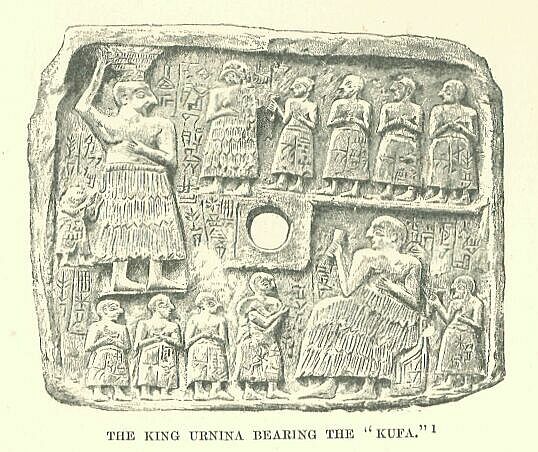
Drawn by Faucher-Gudin, from Heuzey Sarzec.
The harem in which they were shut up by custom, rarely opened its doors: the people seldom caught sight of them, their relatives spoke of them as little as possible, those in power avoided associating them in any public acts of worship or government, and we could count on our fingers the number of those whom the inscriptions mention by name. Some of them were drawn from the noble families of the capital, others came from the kingdoms of Chaldæa or from foreign courts; a certain number never rose above the condition of mere concubines, many assumed the title of queen, while almost all served as living pledges of alliances made with rival states, or had been given as hostages at the concluding of a peace on the termination of a war.* As the kings, who put forward no pretensions to a divine origin, were not constrained, after the fashion of the Pharaohs, to marry their sisters in order to keep up the purity of their race, it was rare to find one among their wives who possessed an equal right to the crown with themselves: such a case could be found only in troublous times, when an aspirant to the throne, of base extraction, legitimated his usurpation by marrying a sister or daughter of his predecessor.
* Political marriage-alliances between Egypt and Chaldæa were of frequent occurrence, according to the Tel el-Amarna tablets, and at a later period between Chaldæa and Assyria; among the few queens of the very earliest times, the wife of Nammaghani is the daughter of Urbau, vicegerent of Lagash, and consequently the cousin or niece of her husband, while the wife of Rimsin appears to be the daughter of a nobleman of the name of Rimnannar.
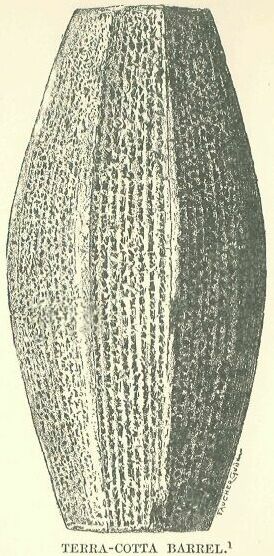
Drawn by Faucher-Gudin, from the facsimile by Place.
The original status of the mother almost always determined that of her children, and the sons of a princess were born princes, even if their father were of obscure or unknown origin.* These princes exercised important functions at court, or they received possessions which they administered under the suzerainty of the head of the family; the daughters were given to foreign kings, or to scions of the most distinguished families. The sovereign was under no obligation to hand down his crown to any particular member of his family; the eldest son usually succeeded him, but the king could, if he preferred, select his favourite child as his successor even if he happened to be the youngest, or the only one born of a slave. As soon as the sovereign had made known his will, the custom of primogeniture was set aside, and his word became law. We can well imagine the secret intrigues formed both by mothers and sons to curry favour with the father and bias his choice; we can picture the jealousy with which they mutually watched each other, and the bitter hatred which any preference shown to one would arouse in the breasts of all the others. Often brothers who had been disappointed in their expectations would combine secretly against the chosen or supposed heir; a conspiracy would break out, and the people suddenly learn that their ruler of yesterday had died by the hand of an assassin and that a new one filled his place.
Sometimes discontent spread beyond the confines of the palace, the army became divided into two hostile camps, the citizens took the side of one or other of the aspirants, and civil war raged for several years till some decisive action brought it to a close. Meantime tributary vassals took advantage of the consequent disorder to shake off the yoke, the Blamites and various neighbouring cities joined in the dispute and ranged themselves on the side of the party from which there was most to be gained: the victorious faction always had to pay dearly for this somewhat dubious help, and came out impoverished from the struggle. Such an internecine war often caused the downfall of a dynasty—at times, indeed, that of the entire state.**
* This fact is apparent from the introduction to the inscription in which Sargon I. is supposed to give an account of his life: “My father was unknown, my mother was a princess;” and it was, indeed, from his mother that he inherited his rights to the crown of Agade.
** The above is perfectly true of the later Assyrian and Chalæan periods: it is scarcely needful to recall to the reader the murders of Sargon II. and Sennacherib, or the revolt of Assurdaînpal against his father Shalmaneser III. With regard to the earliest period we have merely indications of what took place; the succession of King Urnina of Lagash appears to have been accompanied by troubles of this kind, and it is certain that his successor Akurgal was not the eldest of his sons, but we do not at present know to what events Akurgal owed his elevation.
The palaces of the Chaldæan kings, like those of the Egyptians, presented the appearance of an actual citadel: the walls had to be sufficiently thick to withstand an army for an indefinite period, and to protect the garrison from every emergency, except that of treason or famine. One of the statues found at Telloh holds in its lap the plan of one of these residences: the external outline alone is given, but by means of it we can easily picture to ourselves a fortified place, with its towers, its forts, and its gateways placed between two bastions. It represents the ancient palace of Lagash, subsequently enlarged and altered by Oudea or one of the vicegerents who succeeded him, in which many a great lord of the place must have resided down to the time of the Christian era. The site on which it was built in the Girsu quarter of. the city was not entirely unoccupied at the time of its foundation. Urbau had raised a ziggurat on that very spot some centuries previously, and the walls which he had constructed were falling into ruin.
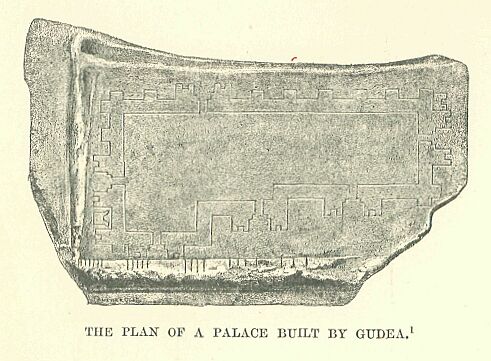
Drawn by Faucher-Gudin, from Heuzey-Sarzec. The plan is traced upon the tablet held in the lap of Statue E in the Louvre. Below the plan can be seen the ruler marked with the divisions used by the architect for drawing his designs to the desired scale; the scribe’s stylus is represented lying on the left of the plan. [Prof. Pétrie has shown that the unit of measurement represented on this ruler is the cubit of the Pyramid-builders of Egypt.—Te.]
Gudea did not destroy the work of his remote predecessor, he merely incorporated it into the substructures of the new building, thus showing an indifference similar to that evinced by the Pharaohs for the monuments of a former dynasty. The palaces, like the temples, never rose directly from the soil, but were invariably built on the top of an artificial mound of crude brick. At Lagash, this solid platform rises to the height of 40 feet above the plain, and the only means of access to the top is by a single narrow steep staircase, easily cut off or defended.
The palace which surmounts this artificial eminence describes a sort of irregular rectangle, 174 feet long by 69 feet wide, and had, contrary to the custom in Egypt, the four angles orientated to the four cardinal points. The two principal sides are not parallel, but swell out slightly towards the middle, and the flexion of the lines almost follows the contour of one of those little clay cones upon which the kings were wont to inscribe their annals or dedications. This flexure was probably not intentional on the part of the architect, but was owing to the difficulty of keeping a wall of such considerable extent in a straight line from one end to another; and all Eastern nations, whether Chaldæans or Egyptians, troubled themselves but little about correctness of alignment, since defects of this kind were scarcely ever perceptible in the actual edifice, and are only clearly revealed in the plan drawn out to scale with modern precision.*
* Mons. Heuzey thinks that the outward deflection of the lines is owing “merely to a primitive method of obtaining greater solidity of construction, and of giving a better foundation to these long façades, which are placed upon artificial terraces of crude brick always subject to cracks and settlements.” I think that the explanation of the facts which I have given in the text is simpler than that ingeniously proposed by Mons. Heuzey: the masons, having begun to build the wall at one end, were unable to carry it on in a straight line until it reached the spot denoted on the architect’s plan, and therefore altered the direction of the wall when they detected their error; or, having begun to build the wall from both ends simultaneously, were not successful in making the two lines meet correctly, and they have frankly patched up the junction by a mass of projecting brickwork which conceals their unskilfulness.
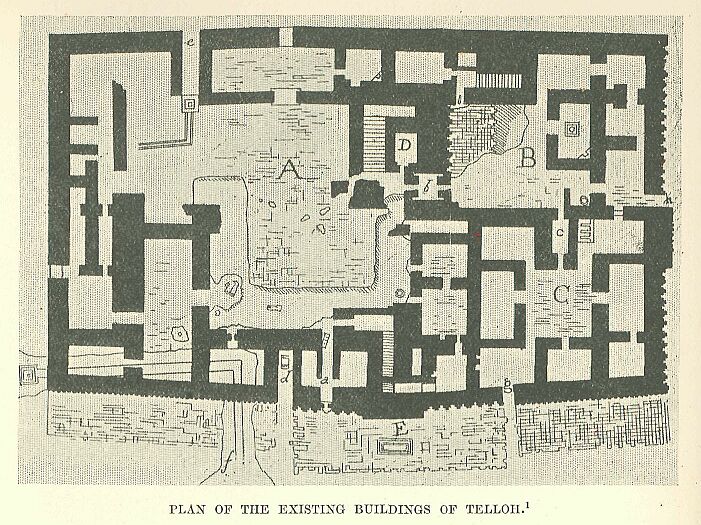
Drawn by Faucher-Gudin, from Heuzey-Sarzec.
The façade of the building faces south-east, and is divided into three blocks of unequal size. The centre of the middle block for a length of 18 feet projects some 3 feet from the main front, and, by directly facing the spectator, ingeniously masks the obtuse angle formed by the meeting of the two walls. This projection is flanked right and left by rectangular grooves, similar to those which ornament the façades of the fortresses and brick houses of the Ancient Empire in Egypt: the regular alternation of projections and hollows breaks the monotony of the facing by the play of light and shade. Beyond these, again, the wall surface is broken by semicircular pilasters some 17 inches in diameter, without bases, capitals, or even a moulding, but placed side by side like so many tree-trunks or posts forming a palisade.
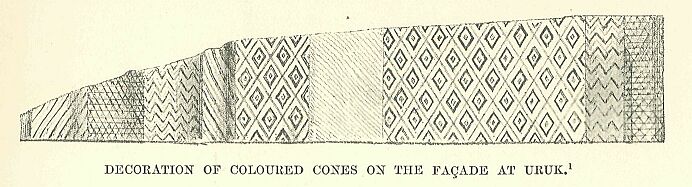
Drawn by Faucher-Gudin, from the sketch by Loftus.
Various schemes of decoration succeed each other in progressive sequence, less ornate and at greater distances apart, the further they recede from the central block and the nearer they approach to the extremities of the façade. They stop short at the southern angle, and the two sides of the edifice running from south to west, and again from west to north, are flat, bare surfaces, unbroken by projection or groove to relieve the poverty and monotony of their appearance. The decoration reappears on the north-east front, where the arrangement of the principal façade is partly reproduced. The grooved divisions here start from the angles, and the engaged columns are wanting, or rather they are transferred to the central projection, and from a distance have the effect of a row of gigantic organ-pipes. We may well ask if this squat and heavy mass of building, which must have attracted the eye from all parts of the town, had nothing to relieve the dull and dismal colour of its component bricks.
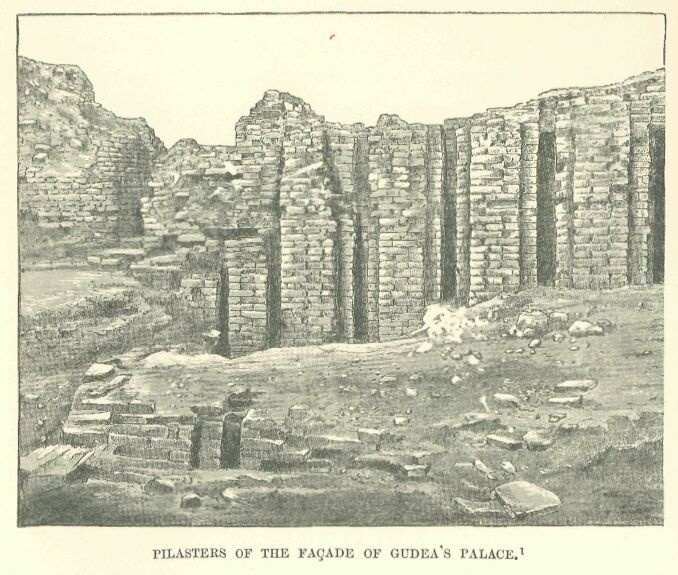
Drawn by Faucher-Gudin, from Heuzey-Sarzec
The idea might not have occurred to us had we not found elsewhere an attempt to lessen the gloomy appearance of the architecture by coloured plastering. At Uruk, the walls of the palace are decorated by means of terra-cotta cones, fixed deep into the solid plaster and painted red, black, or yellow, forming interlaced or diaper patterns of chevrons, spirals, lozenges, and triangles, with a very fair result: this mosaic of coloured plaster covered all the surfaces, both flat and curved, giving to the building a cheerful aspect entirely wanting in that of Lagash.
A long narrow trough of yellowish limestone stood in front of the palace, and was raised on two steps: it was carved in relief on the outside with figures of women standing with outstretched hands, passing to each other vases from which gushed forth two streams of water. This trough formed a reservoir, which was filled every morning for the use of the men and beasts, and those whom some business or a command brought to the palace could refresh themselves there while waiting to be received by the master. The gates which gave access to the interior were placed at somewhat irregular intervals: two opened from the principal façade, but on each of the other sides there was only one entrance. They were arched and so low that admittance was not easily gained; they were closed with two-leaved doors of cedar or cypress, provided with bronze hinges, which turned upon two blackish stones firmly set in the masonry on either side, and usually inscribed with the name of the founder or that of the reigning sovereign. Two of the entrances possessed a sort of covered way, in which the soldiers of the external watch could take shelter from the heat of the sun by day, from the cold at night, and from the dews at dawn. On crossing the threshold, a corridor, flanked with two small rooms for porters or warders, led into a courtyard surrounded with buildings of sufficient depth to take up nearly half of the area enclosed within the walls. This court was moreover a semi-public place, to which tradesmen, merchants, suppliants, and functionaries of all ranks had easy access. A suite of three rooms shut off in the north-east angle did duty for a magazine or arsenal. The southern portion of the building was occupied by the State apartments, the largest of which measures only 40 feet in length. In these rooms Gudea and his successors gave audience to their nobles and administered justice. The administrative officers and the staff who had charge of them were probably located in the remaining part of the building. The roof was flat, and ran all round the enclosing wall, forming a terrace, access to it being gained by a staircase built between the principal entrance and the arsenal. At the northern angle rose a ziggurat. Custom demanded that the sovereign should possess a temple within his dwelling, where he could fulfil his religious duties without going into the town and mixing with the crowd. At Lagash the sacred tower was of older date than the palace, and possibly formed part of the ancient building of Urbau. It was originally composed of three stories, but the lower one was altered by Gudea, and disappeared entirely in the thickness of the basal platform. The second story thus became the bottom one; it was enlarged, slightly raised above the neighbouring roofs, and was probably crowned by a sanctuary dedicated to Ningirsu. It was, indeed, a monument of modest proportions, and most of the public temples soared far above it; but, small as it was, the whole town might be seen from the summit, with its separate quarters and its belt of gardens; and beyond, the open country intersected with streams, studded with isolated villages, patches of wood, pools and weedy marshes left by the retiring inundation, and in the far distance the lines of trees and bushes which bordered the banks of the Euphrates and its confluents. Should a troop of enemies venture within the range of sight, or should a suspicious tumult arise within the city, the watchers posted on the highest terrace would immediately give the alarm, and ‘through their warning the king would have time to close his gates, and take measures to resist the invading enemy or crush the revolt of his subjects.
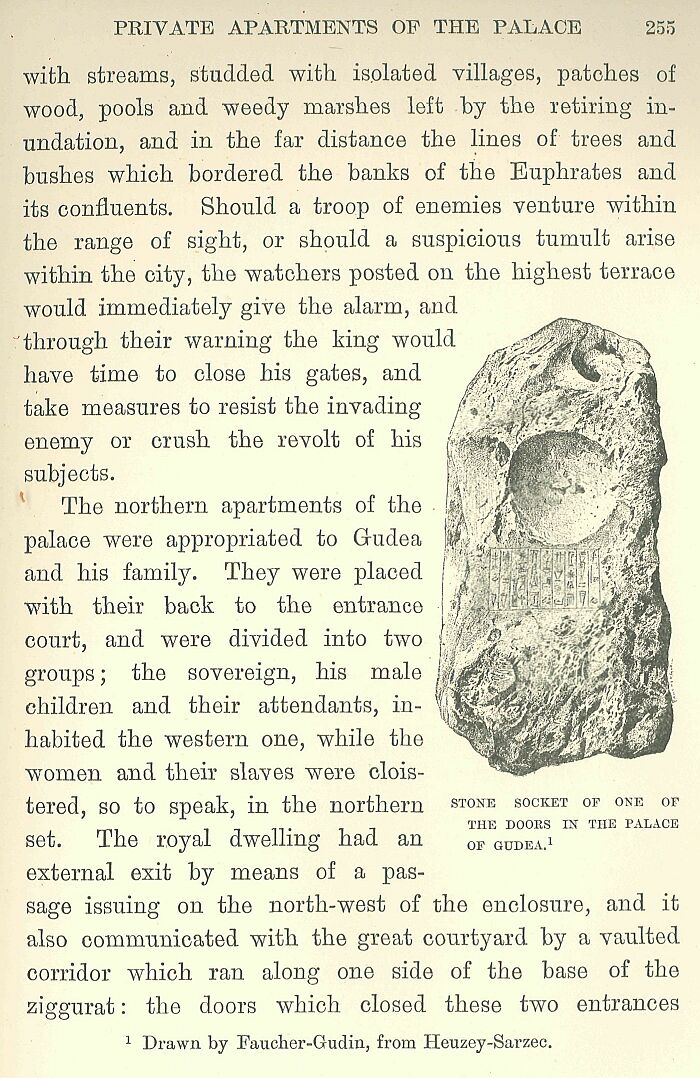
Drawn by Faucher-Gudin, from Heuzey-Sarzec.
The northern apartments of the palace were appropriated to Gudea and his family. They were placed with their back to the entrance court, and were divided into two groups; the sovereign, his male children and their attendants, inhabited the western one, while the women and their slaves were cloistered, so to speak, in the northern set. The royal dwelling had an external exit by means of a passage issuing on the north-west of the enclosure, and it also communicated with the great courtyard by a vaulted corridor which ran along one side of the base of the ziggurat: the doors which, closed these two entrances opened wide enough to admit only one person at a time, and to the right and left were recesses in the wall which enabled the guards to examine all comers unobserved, and stab them promptly if there were anything suspicious in their behaviour. Eight chambers were lighted from the courtyard. In one of them were kept all the provisions for the day, while another served as a kitchen: the head, cook carried on his work at a sort of rectangular dresser of moderate size, on which several fireplaces were marked out by little dividing walls of burnt bricks, to accommodate as many pots or pans of various sizes. A well sunk in the corner right down below the substructure provided the water needed for culinary purposes. The king and his belongings accommodated themselves in the remaining five or six rooms as best they could. A corridor, guarded as carefully as the one previously described, led to his private apartments and to those of his wives: these comprised a yard, some half-dozen cells varying in size, a kitchen, a well, and a door through which the servants could come and go, without passing through the men’s quarters. The whole description in no way corresponds with the marvellous ideal of an Oriental palace which we form for ourselves: the apartments are mean and dismal, imperfectly lighted by the door or by some small aperture timidly cut in the ceiling, arranged so as to protect the inmates from the heat and dust, but without a thought given to luxury or display. The walls were entirely void of any cedar woodwork inlaid with gold, or panels of mosaic such as we find in the temples, nor were they hung with dyed or embroidered draperies such as we moderns love to imagine, and which we spread about in profusion, when we attempt to reproduce the interior of an ancient house or palace.*
* Mons. de Sarzec expressly states that he was unable to find anywhere in the palace of Gudea “the slightest trace of any coating on the walls, either of colour or glazed brick. The walls appear to have been left bare, without any decoration except the regular joining of the courses of brickwork.” The wood panelling was usually reserved for the temples or sacred edifices: Mons. de Sarzec found the remains of carbonized cedar panels in the ruins of a sanctuary dedicated to Ningirsu. According to Mons. Heuzey, the wall-hangings were probably covered with geometrical designs, similar to those formed by the terra-cotta cones on the walls of the palace at Uruk; the inscriptions, however, which are full of minute details with regard to the construction and ornamentation of the temples and palaces, have hitherto contained nothing which would lead us to infer that hangings were used for mural decoration in Chaldoa or Assyria.
The walls had to remain bare for the sake of coolness: at the most they were only covered with a coat of white plaster, on which were painted, in one or two colours, some scene of civil or religious life, or troops of fantastic monsters struggling with one another, or men each with a bird seated on his Wrist. The furniture was not less scanty than the decoration; there were mats on the ground, coffers in which were kept the linen and wearing apparel, low beds inlaid with ivory and metal and provided with coverings and a thin mattress, copper or wooden stands to support lamps or vases, square stools on four legs united by crossbars, armchairs with lions’ claw feet, resembling the Egyptian armchairs in outline, and making us ask if they were brought into Chaldaea by caravans, or made from models which had come from some other country. A few rare objects of artistic character might be found, which bore witness to a certain taste for elegance and refinement; as, for instance, a kind of circular trough of black stone, probably used to support a vase. Three rows of imbricated scales surrounded the base of this, while seven small sitting figures lean back against the upper part with an air of satisfaction which is most cleverly rendered. The decoration of the larger chambers used for public receptions and official ceremonies, while never assuming the monumental character which we observe in contemporary Egyptian buildings, afforded more scope for richness and variety than was offered by the living-rooms.
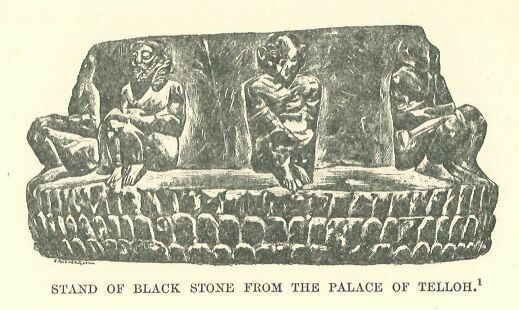
Drawn by Faucher-Gudin, from Heuzey-Sarzec.
Small tablets of brownish limestone, let into the wall or affixed to its surface by terra-cotta pegs, and decorated with inscriptions, represented in a more or less artless fashion the figure of the sovereign officiating before some divinity, while his children and servants took part in the ceremony by their chanting. Inscribed bricks celebrating the king’s exploits were placed here and there in conspicuous places. These were not embedded like the others in two layers of bitumen or lime, but were placed in full view upon bronze statues of divinities or priests, fixed into the ground or into some part of the masonry as magical nails destined to preserve the bricks from destruction, and consequently to keep the memory of the dedicator continually before posterity. Stelaa engraved on both sides recalled the wars of past times, the battle-field, the scenes of horror which took place there, and the return of the victor and his triumph. Sitting or standing figures of diorite, silicious sandstone or hard limestone, bearing inscriptions on their robes or shoulders, perpetuated the features of the founder or of members of his family, and commemorated the pious donations which had obtained for him the favour of the gods: the palace of Lagash contained dozens of such statues, several of which have come down to us almost intact—one of the ancient Urbau, and nine of Gudea.
To judge by the space covered and the arrangement of the rooms, the vicegerents of Lagash and the chiefs of towns of minor importance must, as a rule, have been content with a comparatively small number of servants; their court probably resembled that of the Egyptian barons who lived much about the same period, such as Khnûmhotpû of the nome of the Gazelle, or Thothotpû of Hermopolis. In great cities such as Babylon the palace occupied a much larger area, and the crowd of courtiers was doubtless as great as that which thronged about the Pharaohs. No exact enumeration of them has come down to us, but the titles which we come across show with what minuteness they defined the offices about the person of the sovereign. His costume alone required almost as many persons as there were garments. The men wore the light loin-cloth or short-sleeved tunic which scarcely covered the knees; after the fashion of the Egyptians, they threw over the loin-cloth and the tunic a large “abayah,” whose shape and material varied with the caprice of fashion. They often chose for this purpose a sort of shawl of a plain material, fringed or ornamented with a flat stripe round the edge; often they seem to have preferred it ribbed, or artificially kilted from top to bottom.*
* The relatively modern costume was described by Herodotus, i. 114; it was almost identical with the ancient one, as proved by the representations on the cylinders and monuments of Telloh. The short-sleeved tunic is more rarely represented, and the loin-cloth is usually hidden under the abayah in the case of nobles and kings. We see the princes of Lagash wearing the simple loin-cloth, on the monuments of Urninâ, for example. For the Egyptian abayah, and the manner of representing it, cf. vol. i. pp. 69, 71.
The favourite material in ancient times, however, seems to have been a hairy, shaggy cloth or woollen stuff, whose close fleecy thread hung sometimes straight, sometimes crimped or waved, in regular rows like flounces one above another. This could be arranged squarely around the neck, like a mantel, but was more often draped crosswise over the left shoulder and brought under the right arm-pit, so as to leave the upper part of the breast and the arm bare on that side. It made a convenient and useful garment—an excellent protection in summer from the sun, and from the icy north wind in the winter. The feet were shod with sandals, a tight-fitting cap covered the head, and round it was rolled a thick strip of linen, forming a sort of rudimentary turban, which completed the costume.*
*Cf. the head belonging to one of the statues of Telloh, which is reproduced on p. 112 of this volume. We notice the same head-dress on several intaglios and monuments, and also on the terra-cotta plaque which will be found on p. 330 of this volume, and which represents a herdsman wrestling with a lion. Until we have further evidence, we cannot state, as G. Raw-linson did, that this strip forming a turban was of camel’s hair; the date of the introduction of the camel into Chaldoa still remains uncertain.
It is questionable whether, as in Egypt, wigs and false beards formed part of the toilette. On some monuments we notice smooth faces and close-cropped heads; on others the men appear with long hair, either falling loose or twisted into a knot on the back of the neck.* While the Egyptians delighted in garments of thin white linen, but slightly plaited or crimped, the dwellers on the banks of the Euphrates preferred thick and heavy stuffs patterned and striped with many colours. The kings wore the same costume as their subjects, but composed of richer and finer materials, dyed red or blue, decorated with floral, animal, or geometrical designs;** a high tower-shaped tiara covered the forehead,*** unless replaced by a diadem of Sin or some of the other gods, which was a conical mitre supporting a double pair of horns, and sometimes surmounted by a sort of diadem of feathers and mysterious figures, embroidered or painted on the cap. Their arms were loaded with massive bracelets and their fingers with rings; they wore necklaces and earrings, and carried each a dagger in the belt.
* Dignitaries went bareheaded and shaved the chin; see, for example, the two bas-reliefs given on pp. 105 and 244 of this volume; cf. the heads reproduced as tailpieces on pp. 2, 124. The knot of hair behind on the central figure is easily distinguished in the vignette on p. 266 of this volume. ** The details of colour and ornamentation, not furnished by the Chaldæan monuments, are given in the wall-painting at Beni-Nasan representing the arrival of Asiatics in Egypt, which belongs to a period contemporary with or slightly anterior to the reign of Gudea. The resemblance of the stuffs in which they are clothed to those of the Chaldæan garments, and the identity of the patterns on them with the geometrical decoration of painted cones on the palace at Uruk, have been pointed out with justice by H. G. Tomkins *** The high tiara is represented among others on the head of Mardukna-dinakhe, King of Babylon: cf. what is said of the conical mitre, the headdress of Sin, on pp. 14, 169 of this volume.
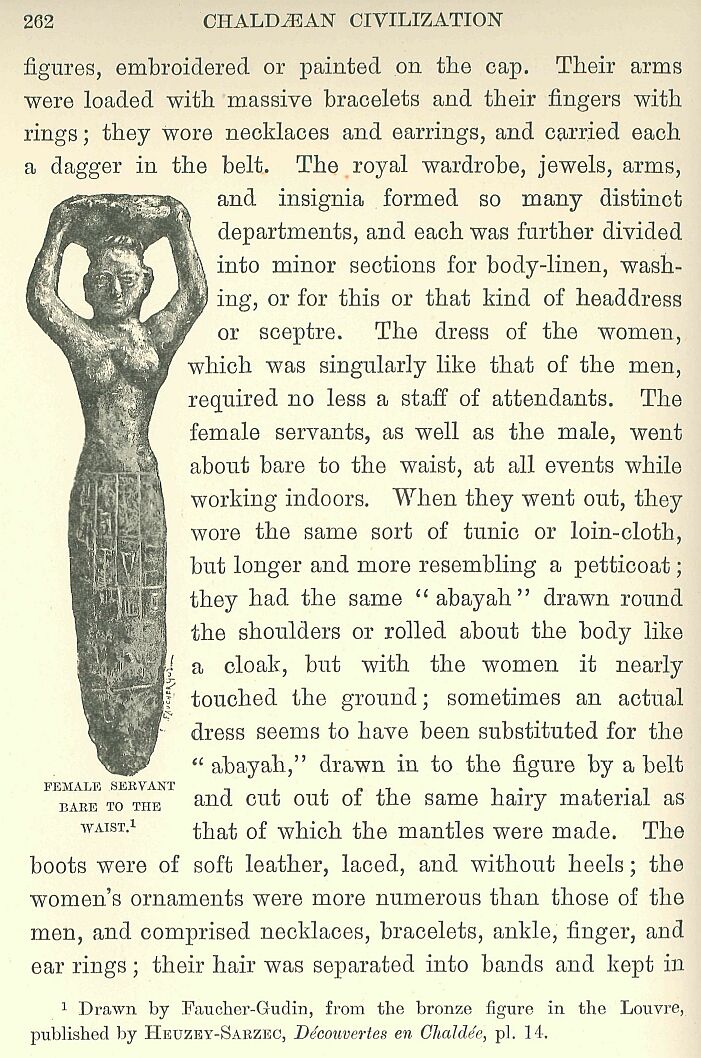
Drawn by Faucher-Gudin, from the bronze figure in the Louvre, published by Heuzey-Sarzec, Découvertes en Chaldée, pl. 14.
The royal wardrobe, jewels, arms, and insignia formed so many distinct departments, and each was further divided into minor sections for body-linen, washing, or for this or that kind of headdress or sceptre. The dress of the women, which was singularly like that of the men, required no less a staff of attendants. The female servants, as well as the male, went about bare to the waist, at all events while working indoors. When they went out, they wore the same sort of tunic or loin-cloth, but longer and more resembling a petticoat; they had the same “abayah” drawn round the shoulders or rolled about the body like a cloak, but with the women it nearly touched the ground; sometimes an actual dress seems to have been substituted for the “abayah,” drawn in to the figure by a belt and cut out of the same hairy material as that of which the mantles were made. The boots were of soft leather, laced, and without heels; the women’s ornaments were more numerous than those of the men, and comprised necklaces, bracelets, ankle, finger, and ear rings; their hair was separated into bands and kept in place on the forehead by a fillet, falling in thick plaits or twisted into a coil on the nape of the neck.
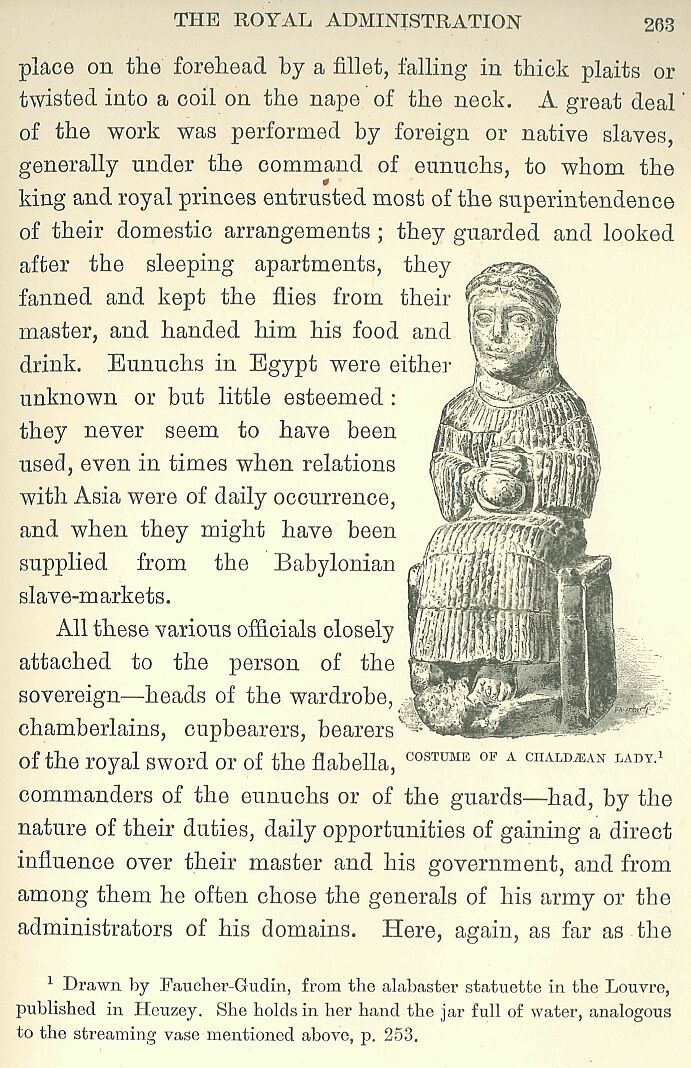
Drawn by Faucher-Gudin, from the alabaster statuette in the Louvre, published in Heuzey. She holds in her hand the jar full of water, analogous to the streaming vase mentioned above.
A great deal of the work was performed by foreign or native slaves, generally under the command of eunuchs, to whom the king and royal princes entrusted most of the superintendence of their domestic arrangements; they guarded and looked after the sleeping apartments, they fanned and kept the flies from their master, and handed him his food and drink. Eunuchs in Egypt were either unknown or but little esteemed: they never seem to have been used, even in times when relations with Asia were of daily occurrence, and when they might have been supplied from the Babylonian slave-markets.
All these various officials closely attached to the person of the sovereign—heads of the wardrobe, chamberlains, cupbearers, bearers of the royal sword or of the flabella, commanders of the eunuchs or of the guards—had, by the nature of their duties, daily opportunities of gaining a direct influence over their master and his government, and from among them he often chose the generals of his army or the administrators of his domains. Here, again, as far as the few monuments and the obscurity of the texts permit of our judging, we find indications of a civil and military organization analogous to that of Egypt: the divergencies which contemporaries may have been able to detect in the two national systems are effaced by the distance of time, and we are struck merely by the resemblances. As all business transactions were carried on by barter or by the exchange of merchandise for weighed quantities of the precious metals, the taxes were consequently paid in kind: the principal media being corn and other cereals, dates, fruits, stuffs, live animals and slaves, as well as gold, silver, lead, and copper, either in its native state or melted into bars fashioned into implements or ornamented vases. Hence we continually come across fiscal storehouses, both in town and country, which demanded the services of a whole troop of functionaries and workmen: administrators of corn, cattle, precious metals, wine and oil; in fine, as many administrators as there were cultures or industries in the country presided over the gathering of the products into the central depots and regulated their redistribution. A certain portion was reserved for the salaries of the employés and the pay of the workmen engaged in executing public works: the surplus accumulated in the treasury and formed a reserve, which was not drawn upon except in cases of extreme necessity. Every palace, in addition to its living-rooms, contained within its walls large store-chambers filled with provisions and weapons, which made it more or less a fortress, furnished with indispensable requisites for sustaining a prolonged siege either against an enemy’s troops or the king’s own subjects in revolt. The king always kept about him bodies of soldiers who perhaps were foreign mercenaries, like the Mazaiû of the armies of the Pharaohs, and who formed his permanent body-guard in times of peace. When a war was imminent, a military levy was made upon his domains, but we are unable to find out whether the recruits thus raised were drawn indiscriminately from the population in general, or merely from a special class, analogous to that of the warriors which we find in Egypt, who were paid in the same way by grants of land. The equipment of these soldiers was of the rudest kind: they had no cuirass, but carried a rectangular shield, and, in the case of those of higher rank at all events, a conical metal helmet, probably of beaten copper, provided with a piece to protect the back of the neck; the heavy infantry were armed with a pike tipped with bronze ox-copper, an axe or sharp adze, a stone-headed mace, and a dagger; the light troops were provided only with the bow and sling. As early as the third millennium b.c., the king went to battle in a chariot drawn by onagers, or perhaps horses; he had his own peculiar weapon, which was a curved bâton probably terminating in a metal point, and resembling the sceptre of the Pharaohs. Considerable quantities of all these arms were stored in the arsenals, which contained depots for bows, maces, and pikes, and even the stones needed for the slings had their special department for storage. At the beginning of each campaign, a distribution of weapons to the newly levied troops took place; but as soon as the war was at an end, the men brought back their accoutrements, which were stored till they were again required. The valour of the soldiers and their chiefs was then rewarded; the share of the spoil for some consisted of cattle, gold, corn, a female slave, and vessels of value; for others, lands or towns in the conquered country, regulated by the rank of the recipients or the extent of the services they had rendered.
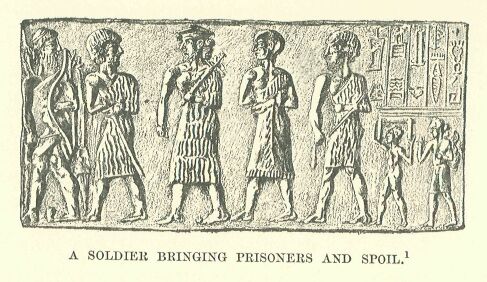
Drawn by Faucher-Gudin, from the Chaldæan intaglio in the British. Museum.
Property thus given was hereditary, and privileges were often added to it which raised the holder to the rank of a petty prince: for instance, no royal official was permitted to impose a tax upon such lands, or take the cattle off them, or levy provisions upon them; no troop of soldiers might enter them, not even for the purpose of arresting a fugitive. Most of the noble families possessed domains of this kind, and constituted in each kingdom a powerful and wealthy feudal aristocracy, whose relations to their sovereign were probably much the same as those which bound the nomarchs to the Pharaoh. The position of these nobles was not more stable than that of the dynasties under which they lived: while some among them gained power by marriages or by continued acquisitions of land, others fell into disgrace and were ruined. As the soil belonged to the gods, it is possible that these nobles were supposed, in theory, ‘to depend upon the gods; but as the kings were the vicegerents of the gods upon earth, it was to the king, as a matter of fact, that they owed their elevation. Every state, therefore, comprised two parts, each subject to a distinct régime: one being the personal domain of the suzerain, which he managed himself, and from which he drew the revenues; the other was composed of fiefs, whose lords paid tribute and owed certain obligations to the king, the nature of which we are as yet unable to define.
The Chaldæan, like the Egyptian scribe, was the pivot on which the machinery of this double royal and seignorial administration turned. He does not appear to have enjoyed as much consideration as his fellow-official in the Nile Valley: the Chaldæan princes, nobles, priests, soldiers, and temple or royal officials, did not covet the title of scribe, or pride themselves upon holding that office side by side with their other dignities, as we see was the case with their Egyptian contemporaries. The position of a scribe, nevertheless, was an important one. We continually meet with it in all grades of society—in the palace, in the temples, in the storehouses, in private dwellings; in fine, the scribe was ubiquitous, at court, in the town, in the country, in the army, managing affairs both small and great, and seeing that they were carried on regularly. His education differed but little from that given to the Egyptian scribe; he learned the routine of administrative or judicial affairs, the formularies for correspondence either with nobles or with ordinary people, the art of writing, of calculating quickly, and of making out bills correctly. We may well ask whether he ever employed papyrus or prepared skins for these purposes. It would, indeed, seem strange that, after centuries of intercourse, no caravan should have brought into Chaldæan any of those materials which were in such constant use for literary purposes in Africa;* yet the same clay which furnished the architect with such an abundant building material appears to have been the only medium for transmitting the language which the scribes possessed. They were always provided with slabs of a fine plastic clay, carefully mixed and kept sufficiently moist to take easily the impression of an object, but at the same time sufficiently firm to prevent the marks once made from becoming either blurred or effaced. When a scribe had a text to copy or a document to draw up, he chose out one of his slabs, which he placed flat upon his left palm, and taking in the right hand a triangular stylus of flint, copper, bronze, or bone,** he at once set to work. The instrument, in early times, terminated in a fine point, and the marks made by it when it was gently pressed upon the clay were slender and of uniform thickness; in later times, the extremity of the stylus was cut with a bevel, and the impression then took the shape of a metal nail or a wedge.
* On the Assyrian monuments we frequently see scribes taking a list of the spoil, or writing letters on tablets and some other soft material, either papyrus or prepared skin. Sayce has given good reasons for believing that the Chaldæanns of the early dynasties knew of the papyrus, and either made it themselves, or had it brought from Egypt. ** See the triangular stylus of copper or bronze reproduced by the side of the measuring-rule, and the plan on the tablet of Gudea, p. 248 of this volume. The Assyrian Museum in the Louvre possesses several large, flat styli of bone, cut to a point at one end, which appear to have belonged to the Assyrian scribes. Taylor discovered in a tomb at Eridu a flint tool, which may have served for the same purpose as the metal or bone styli.
ENLARGE TO FULL SIZE
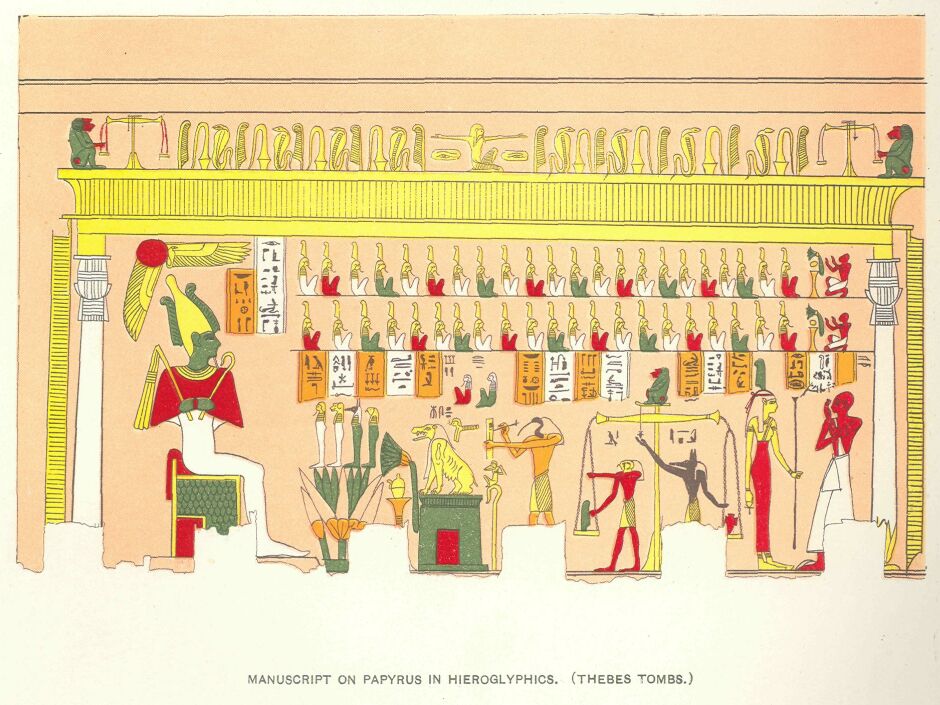
They wrote from left to right along the upper part of the tablet, and covered both sides of it with closely written lines, which sometimes ran over on to the edges. When the writing was finished, the scribe sent his work to the potter, who put it in the kiln and baked it, or the writer may have had a small oven at his own disposition, as a clerk with us would have his table or desk. The shape of these documents varied, and sometimes strikes us as being peculiar: besides the tablets and the bricks, we find small solid cones, or hollow cylinders of considerable size, on which the kings related their exploits or recorded the history of their wars or the dedication of their buildings. This method had a few inconveniences, but many advantages. These clay books were heavy to hold and clumsy to handle, while the characters did not stand out well from the brown, yellow, and whitish background of the material; but, on the other hand, a poem, baked and incorporated into the page itself, ran less danger of destruction than if scribbled in ink on sheets of papyrus. Fire could make no impression on it; it could withstand water for a considerable length of time; even if broken, the pieces were still of use: as long as it was not pulverized, the entire document could be restored, with the exception, perhaps, of a few signs, or ‘some scraps of a sentence. The inscriptions which have been saved from the foundations of the most ancient temples, several of which date back forty or fifty centuries, are for the most part as clear and legible as when they left the hands of the writer who engraved them or of the workmen who baked them. It is owing to the material to which they were committed that we possess the principal works of Chaldæan literature which have come down to us—poems, annals, hymns, magical incantations; how few fragments of these would ever have reached us had their authors confided them to parchment or paper, after the manner of the Egyptian scribes! The greatest danger that they ran was that of being left forgotten in the corner of the chamber in which they had been kept, or buried under the rubbish of a building after a fire or some violent catastrophe; even then the débris were the means of preserving them, by falling over them and covering them up. Protected under the ruins, they would lie there for centuries, till the fortunate explorer should bring them to light and deliver them over to the patient study of the learned.
The cuneiform character in itself is neither picturesque nor decorative. It does not offer that delightful assemblage of birds and snakes, of men and quadrupeds, of heads and limbs, of tools, weapons, stars, trees, and boats, which succeed each other in perplexing order on the Egyptian monuments, to give permanence to the glory of Pharaoh and the greatness of his gods. Cuneiform writing is essentially composed of thin short lines, placed in juxtaposition or crossing each other in a somewhat clumsy fashion; it has the appearance of numbers of nails scattered about at haphazard, and its angular configuration, and its stiff and spiny appearance, gives the inscriptions a dull and forbidding aspect which no artifice of the engraver can overcome.
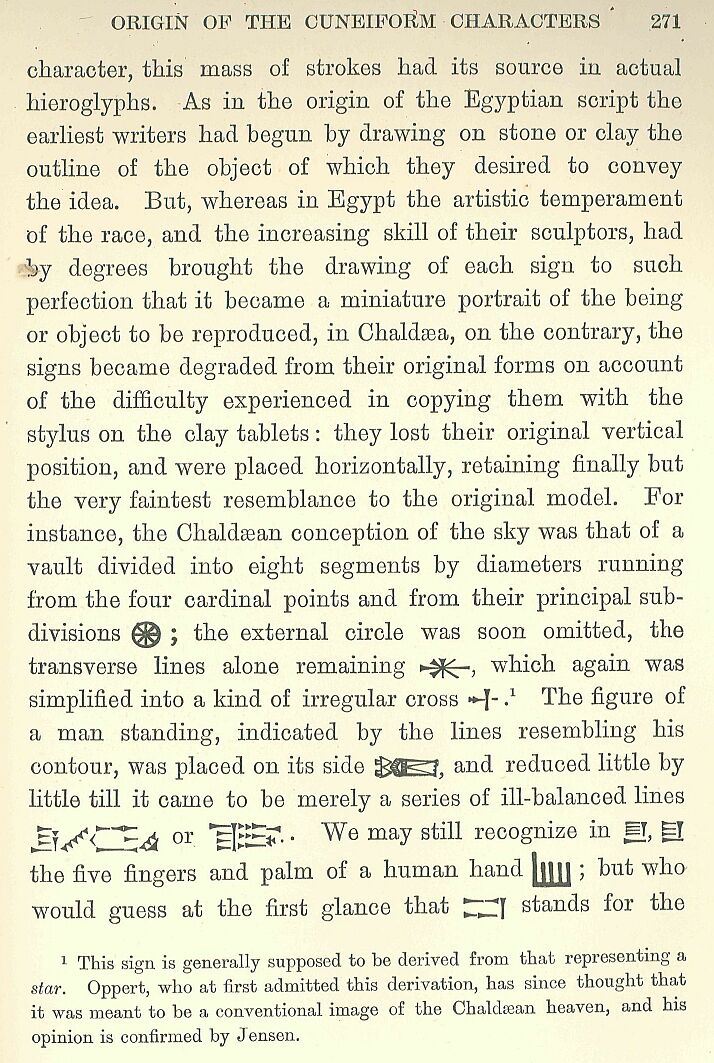
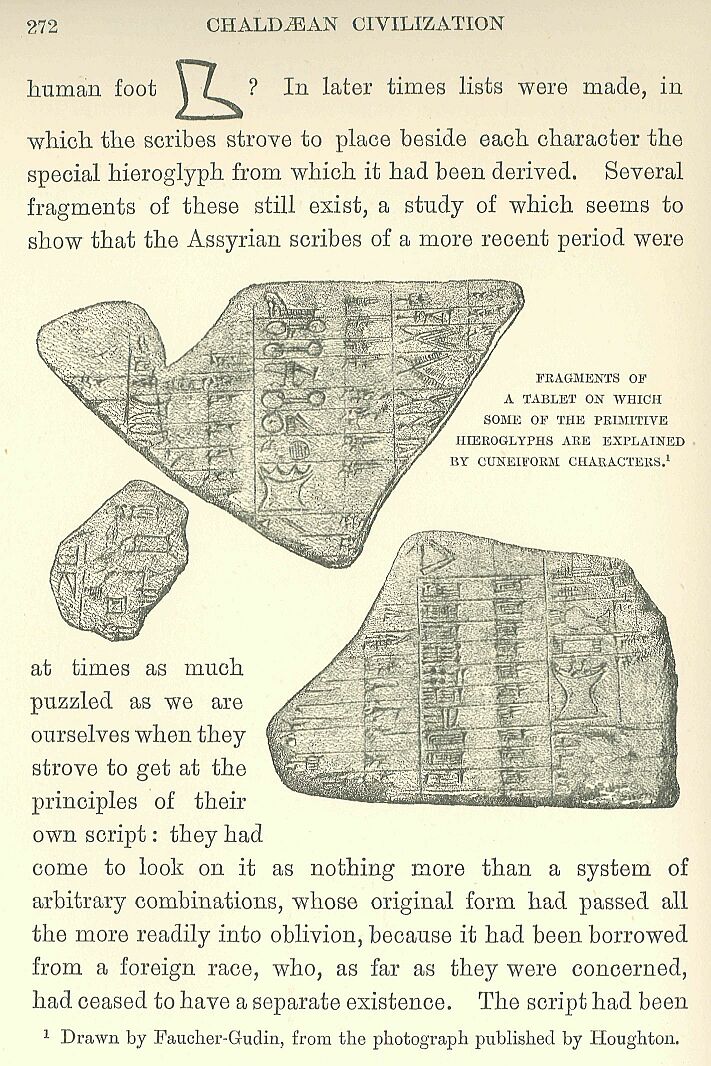
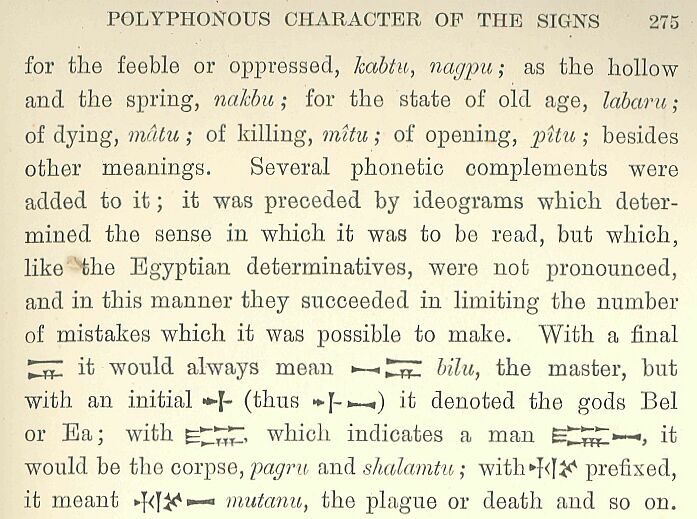
Yet, in spite of their seemingly arbitrary character, this mass of strokes had its source in actual hieroglyphs. As in the origin of the Egyptian script the earliest writers had begun by drawing on stone or clay the outline of the object of which they desired to convey the idea. But, whereas in Egypt the artistic temperament of the race, and the increasing skill of their sculptors, had by degrees brought the drawing of each sign to such perfection that it became a miniature portrait of the being or object to be reproduced, in Chaldæa, on the contrary, the signs became degraded from their original forms on account of the difficulty experienced in copying them with the stylus on the clay tablets: they lost their original vertical position, and were placed horizontally, retaining finally but the very faintest resemblance to the original model. For instance, the Chaldaean conception of the sky was that of a vault divided into eight segments by diameters running from the four cardinal points and from their principal subdivisions [symbol] the external circle was soon omitted, the transverse lines alone remaining [symbol], which again was simplified into a kind of irregular cross [symbol]. The figure of a man standing, indicated by the lines resembling his contour, was placed on its side [symbol] and reduced little by little till it came to be merely a series of ill-balanced lines [symbol] [symbol]. We may still recognize in [symbol] the five fingers and palm of a human hand [symbol]; but who would guess at the first glance that [symbol] stands for the foot which the scribes strove to place beside each character the special hieroglyph from which it had been derived. Several fragments of these still exist, a study of which seems to show that the Assyrian scribes of a more recent period were at times as much puzzled as we are ourselves when they strove to get at the principles of their own script: they had come to look on it as nothing more than a system of arbitrary combinations, whose original form had passed all the more readily into oblivion, because it had been borrowed from a foreign race, who, as far as they were concerned, had ceased to have a separate existence. The script had been invented by the Sumerians in the very earliest times, and even they may have brought it in an elemental condition from their distant fatherland. The first articulate sounds which, being attached to the hieroglyphs, gave to each an unalterable pronunciation, were words in the Sumerian tongue; subsequently, when the natural progress of human thought led thi Chaldæans to replace, as in Egypt, the majority of the signs representing ideas by those representing sounds, the syllabic values which were developed side by side with the ideographic values were purely Sumerian. The group [symbol] throughout all its forms, designates in the first place the sky, then the god of the sky, and finally the concept of divinity in general. In its first two senses it is read ana, but in the last it becomes dingir, dimir; and though it never lost its double force, it was soon separated from the ideas which it evoked, to be used merely to denote the syllable an wherever it occurred, even in cases where it had no connection with the sky or heavenly things. The same process was applied to other signs with similar results: after having merely denoted ideas, they came to stand for the sounds corresponding to them, and then passed on to be mere syllables—complex syllables in which several consonants may be distinguished, or simple syllables composed of only one consonant and one vowel, or vice versa. The Egyptians had carried this system still further, and in many cases had kept only one part of the syllable, namely, a mute consonant: they detached, for example, the final u from pu and bu, and gave only the values b and p to the human leg J and the mat Q. The peoples of the Euphrates stopped halfway, and admitted actual letters for the vowel sounds a, i, and u only. Their system remained a syllabary interspersed with ideograms, but excluded an alphabet.
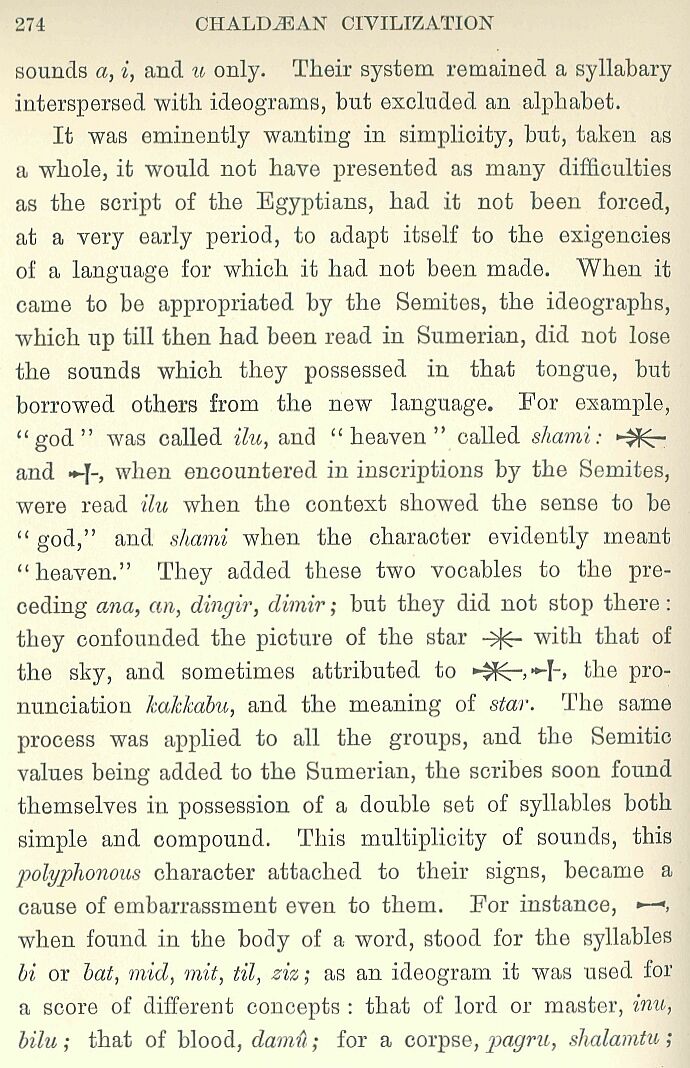
It was eminently wanting in simplicity, but, taken as a whole, it would not have presented as many difficulties as the script of the Egyptians, had it not been forced, at a very early period, to adapt itself to the exigencies of a language for which it had not been made. When it came to be appropriated by the Semites, the ideographs, which up till then had been read in Sumerian, did not lose the sounds which they possessed in that tongue, but borrowed others from the new language. For example, “god” was called ilu, and “heaven” called shami: [symbol], when encountered in inscriptions by the Semites, were read [symbol] when the context showed the sense to be “god,” and shami when the character evidently meant “heaven.” They added these two vocables to the preceding ana, an, dingir, dimir; but they did not stop there: they confounded the picture of the star [symbol] with that of the sky, and sometimes attributed to [symbol], the pronunciation kakkabu, and the meaning of star. The same process was applied to all the groups, and the Semitic values being added to the Sumerian, the scribes soon found themselves in possession of a double set of syllables both simple and compound. This multiplicity of sounds, this polyphonous character attached to their signs, became a cause of embarrassment even to them. For instance, [symbol] when found in the body of a word, stood for the syllables hi or hat, mid, mit, til, ziz; as an ideogram it was used for a score of different concepts: that of lord or master, inu, bilu; that of blood, damû; for a corpse, pagru, shalamtu; for the feeble or oppressed, kahtu, nagpu; as the hollow and the spring, nakbu; for the state of old age, labaru; of dying, mâtu; of killing, mîtu; of opening, pîtu; besides other meanings. Several phonetic complements were added to it; it was preceded by ideograms which determined the sense in which it was to be read, but which, like the Egyptian determinatives, were not pronounced, and in this manner they succeeded in limiting the number of mistakes which it was possible to make. With a final [symbol] it would always mean [symbol] bilu, the master, but with an initial [symbol] (thus [symbol]) it denoted the gods Bel or Ea; with [symbol]. which indicates a man [symbol], it would be the corpse, pagru and shalamtu; with [symbol] prefixed, it meant [symbol]—mutanu, the plague or death and so on. In spite of these restrictions and explanations, the obscurity of the meaning was so great, that in many cases the scribes ran the risk of being unable to make out certain words and understand certain passages; many of the values occurred but rarely, and remained unknown to those who did not take the trouble to make a careful study of the syllabary and its history. It became necessary to draw up tables for their use, in which all the signs were classified and arranged, with their meanings and phonetic transcriptions. These signs occupied one column, and in three or four corresponding columns would be found, first, the name assigned to it; secondly, the spelling, in syllables, of the phonetic values which the signs expressed, thirdly, the Sumerian and Assyrian words which they served to render, and sometimes glosses which completed the explanation.
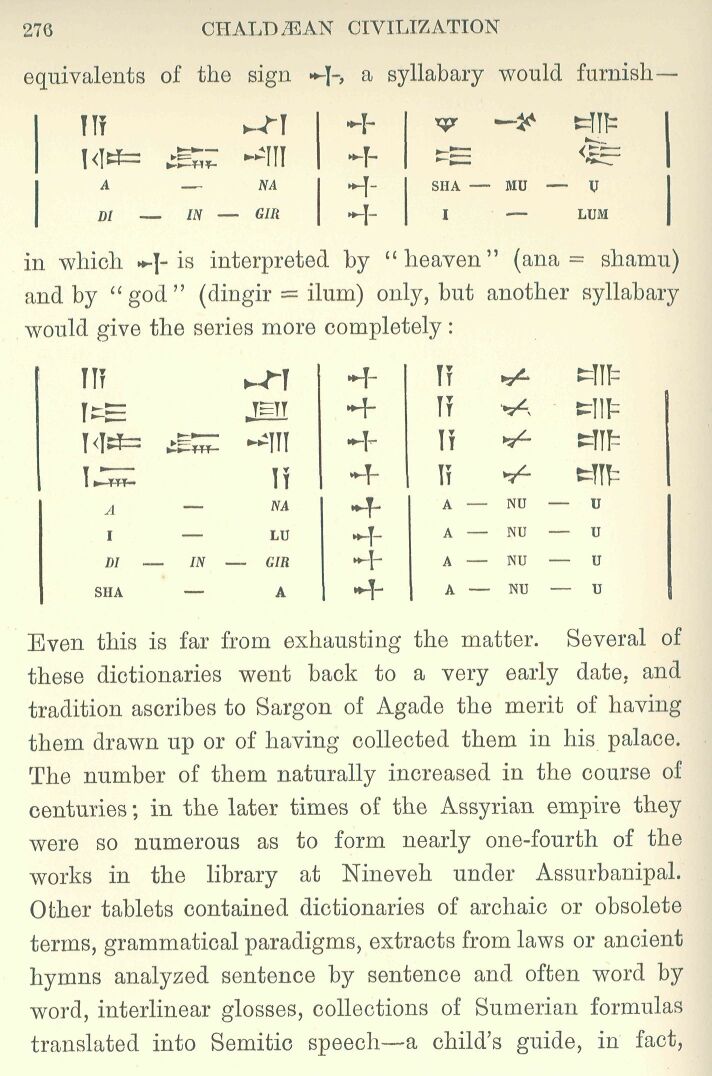
Even this is far from exhausting the matter. Several of these dictionaries went back to a very early date, and tradition ascribes to Sargon of Agade the merit of having them drawn up or of having collected them in his palace. The number of them naturally increased in the course of centuries; in the later times of the Assyrian empire they were so numerous as to form nearly one-fourth of the works in the library at Nineveh under Assurbanipal. Other tablets contained dictionaries of archaic or obsolete terms, grammatical paradigms, extracts from laws or ancient hymns analyzed sentence by sentence and often word by word, interlinear glosses, collections of Sumerian formulas translated into Semitic speech—a child’s guide, in fact, which the savants of those times consulted with as much advantage as those of our own day have done, and which must have saved them from many a blunder.
When once accustomed to the difficulties and intricacies of their calling, the scribes were never at a standstill. The stylus was plied in Chaldæa no less assiduously than was the calamus in Egypt, and the indestructible clay, which the Chaldæans were as a rule content to use, proved a better medium in the long run than the more refined material employed by their rivals: the baked or merely dried clay tablets have withstood the assaults of time in surprising quantities, while the majority of papyri have disappeared without leaving a trace behind. If at Babylon we rarely meet with those representations, which we find everywhere in the tombs of Saqqara or Gîzeh, of the people themselves and their families, their occupations, amusements, and daily intercourse, we possess, on the other hand, that of which the ruins of Memphis have furnished us but scanty instances up to the present time, namely, judicial documents, regulating the mutual relations of the people and conferring a legal sanction on the various events of their life. Whether it were a question of buying lands or contracting a marriage, of a loan on interest, or the sale of slaves, the scribe was called in with his soft tablets to engross the necessary agreement. In this he would insert as many details as possible—the day of the month, the year of the reigning sovereign, and at times, to be still more precise, an allusion to some important event which had just taken place, and a memorial of which was inserted in official annals, such as the taking of a town, the defeat of a neighbouring king, the dedication of a temple, the building of a wall or fortress, the opening of a canal, or the ravages of an inundation: the names of the witnesses and magistrates before whom the act was confirmed were also added to those of the contracting parties. The method of sanctioning it was curious. An indentation was made with the finger-nail on one of the sides of the tablet, and this mark, followed or preceded by the mention of a name, “Nail of Zabudamik,” “Nail of Abzii,” took the place of our more or less complicated sign-manuals. In later times, only the buyer and witnesses approved by a nail-mark, while the seller appended his seal; an inscription incised above the impress indicating the position of the signatory. Every one of any importance possessed a seal, which he wore attached to his wrist or hung round his neck by a cord; he scarcely ever allowed it to be separated from his person during his lifetime, and after death it was placed with him in the tomb in order to prevent any improper use being made of it. It was usually a cylinder, sometimes a truncated cone with a convex base, either of marble, red or green jasper, agate, cornelian, onyx or rock crystal, but rarely of metal. Engraved upon it in intaglio was an emblem or subject chosen by the owner, such as the single figure of a god or goddess, an act of adoration, a sacrifice, or an episode in the story of Gilgames, followed sometimes by the inscription of a name and title. The cylinder was rolled, or, in the case of the cone, merely pressed on the clay, in the space reserved for it. In several localities the contracting parties had recourse to a very ingenious procedure to prevent the agreements being altered or added to by unscrupulous persons. When the document had been impressed on the tablet, it was enveloped in a second coating of clay, upon which an exact copy of the original was made, the latter thus becoming inaccessible to forgers: if by chance, in course of time, any disagreement should take place, and an alteration of the visible text should be suspected, the outer envelope was broken in the presence of witnesses, and a comparison was made to see if the exterior corresponded exactly with the interior version. Families thus had their private archives, to which additions were rapidly made by every generation; every household thus accumulated not only the evidences of its own history, but to some extent that of other families with whom they had formed alliances, or had business or friendly relations.*
* The tablets of Tell-Sifr come from one of these family collections. They all, in number about one hundred, rested on three enormous bricks, and they had been covered with a mat of which the half-decayed remains were still visible: three other crude bricks covered the heap. The documents contained in them relate for the most part to the families of Sininana and Amililâni, and form part of their archives.
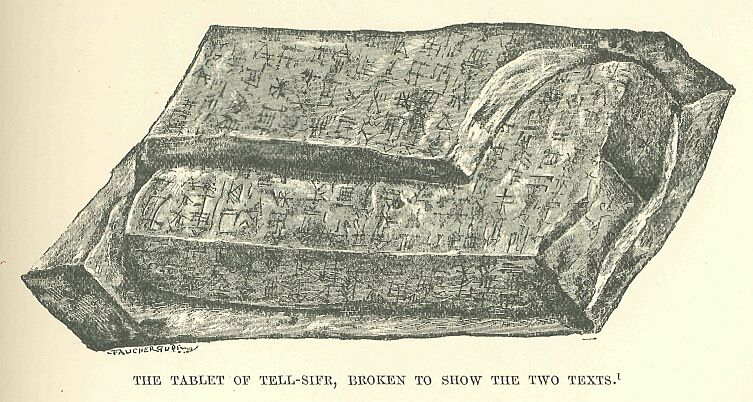
Drawn by Faucher-Gudin, from Loftus.
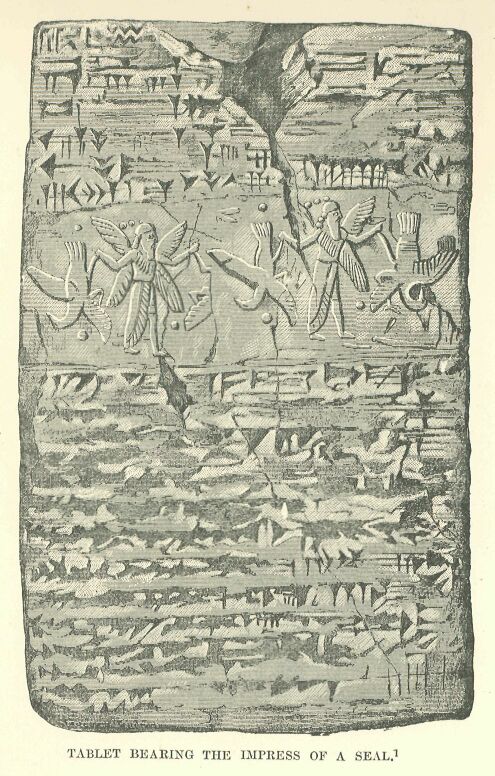
Drawn by Faucher-Gudin, from a sketch by Layard.
The constitution of the family was of a complex character. It would appear that the people of each city were divided into clans, all of whose members claimed to be descended from a common ancestor, who had flourished at a more or less remote period. The members of each clan were by no means all in the same social position, some having gone down in the world, others having raised themselves; and amongst them we find many different callings—from agricultural labourers to scribes, and from merchants to artisans. No mutual tie existed among the majority of these members except the remembrance of their common origin, perhaps also a common religion, and eventual rights of succession or claims upon what belonged to each one individually. The branches which had become gradually separated from the parent stock, and which, taken all together, formed the clan, possessed each, on the contrary, a very strict organization. It is possible that, at the outset, the woman occupied the more important position, but at an early date the man became the head of the family,* and around him were ranged the wives, children, servants, and slaves, all of whom had their various duties and privileges.
* The change in the condition of women would be due to the influence of Semitic ideas and customs in Chaldæa.
He offered the household worship to the gods of his race, in accordance with special rites which had come down to him from his father; he made at the tombs of his ancestors, at such times as were customary, the offerings and prayers which assured their repose in the other world, and his powers were as extensive in civil as in religious matters. He had absolute authority over all the members of his household, and anything undertaken by them without his consent was held invalid in the eyes of the law; his sons could not marry unless he had duly authorized them to do so. For this purpose he appeared before the magistrate with the future couple, and the projected union could not be held as an actual marriage, until he had affixed his seal or made his nail-mark on the contract tablet. It amounted, in fact, to a formal deed of sale, and the parents of the girl parted with her only in exchange for a proportionate gift from the bridegroom. One girl would be valued at a silver shekel by weight, while another was worth a mina, another much less;* the handing over of the price was accompanied with a certain solemnity. When the young man possessed no property as yet of his own, his family advanced him the sum needed for the purchase. On her side, the maiden did not enter upon her new life empty handed; her father, or, in the case of his death, the head of the family at the time being, provided her with a dowry suited to her social position, which was often augmented by considerable presents from her grandmother, aunts, and cousins.**
* Shamashnazir receives, as the price of his daughter, ten shekels of silver, which appears to have been an average price in the class of life to which he belonged. ** The nature of the dowry in ancient times is clear from the Sumero-Assyrian tablets in which the old legal texts are explained, and again from the contents of the contracts of Tell-Sifr, and the documents on stone, such as the Micliaux stone, in which we see women bringing their possessions into the community by marriage, and yet retaining the entire disposition of them.
The dowry would consist of a carefully marked out field of corn, a grove of date-palms, a house in the town, a trousseau, furniture, slaves, or ready money; the whole would be committed to clay, of which there would be three copies at least, two being given by the scribe to the contracting parties, while the third would be deposited in the hands of the magistrate. When the bride and bridegroom both belonged to the same class, or were possessed of equal fortunes, the relatives of the woman could exact an oath from the man that he would abstain from taking a second wife during her lifetime; a special article of the marriage agreement permitted the woman to go free should the husband break his faith, and bound him to pay an indemnity as a compensation for the insult he had offered her. This engagement on the part of the man, however, did not affect his relations with his female servants. In Chaldæa, as in Egypt, and indeed in the whole of the ancient world, they were always completely at the mercy of their purchaser, and the permission to treat them as he would had become so much of a custom that the begetting of children by their master was desired rather than otherwise: the complaints of the despised slave, who had not been taken into her master’s favour, formed one of the themes of popular poetry at a very early period. When the contract tablet was finally sealed, one of the witnesses, who was required to be a free man, joined the hands of the young couple; nothing then remained to be done but to invite the blessing of the gods, and to end the day by a feast, which would unite both families and their guests. The evil spirits, however, always in quest of an easy prey, were liable to find their way into the nuptial chamber, favoured by the confusion inseparable from all household rejoicing: prudence demanded that their attempts should be frustrated, and that the newly married couple should be protected from their attacks. The companions of the bridegroom took possession of him, and, hand to hand and foot to foot, formed as it were a rampart round him with their bodies, and carried him off solemnly to his expectant bride. He then again repeated the words which he had said in the morning: “I am the son of a prince, gold and silver shall fill thy bosom; thou, even thou, shalt be my wife, I myself will be thy husband;” and he continued: “As the fruits borne by an orchard, so great shall be the abundance which I shall pour out upon this woman.” * The priest then called down upon him benedictions from on high: “Therefore, O ye (gods), all that is bad and that is not good in this man, drive it far from him and give him strength. As for thee, O man, exhibit thy manhood, that this woman may be thy wife; thou, O woman, give that which makes thy womanhood, that this man may be thy husband.” On the following morning, a thanksgiving sacrifice celebrated the completion of the marriage, and by purifying the new household drove from it the host of evil spirits.**
* This part of the ceremony is described on a Sumero- Assyrian tablet, of which two copies exist, discovered and translated by Pinches. The interpretation appears to me to result from the fact that mention is made, at the commencement of the column, of impious beings without gods, who might approach the man; in other places magical exorcisms indicate how much those spirits were dreaded “who deprived the bride of the embraces of the man.” As Pinches remarks, the formula is also found in the part of the poem of Gilgames, where Ishtar wishes to marry the hero, which shows that the rite and its accompanying words belong to a remote past. ** The text that describes these ceremonies was discovered and published by Pinches. As far as I can judge, it contained an exorcism against the “knotting of the tag,” and the mention of this subject called up that of the marriage rites. The ceremony commanded on the day following the marriage was probably a purification: as late as the time of Herodotus, the union of man and woman rendered both impure, and they had to perform an ablution before recommencing their occupations.
The woman, once bound, could only escape from the sovereign power of her husband by death or divorce; but divorce for her was rather a trial to which she submitted than a right of which she could freely make use. Her husband could repudiate her at will without any complicated ceremonies. It was enough for him to say: “Thou art not my wife!” and to restore to her a sum of money equalling in value the dowry he had received with her;* he then sent her back to her father, with a letter informing him of the dissolution of the conjugal tie.** But if in a moment of weariness or anger she hurled the fatal formula at him: “Thou are not my husband!” her fate was sealed: she was thrown into the river and drowned.***
* The sum is fixed at half a mina by the text of the Sumerian laws; but it was sometimes less, e.g. ten shekels, and sometimes more, e.g. a whole mina. ** Repudiation of a wife, and the ceremonial connected with it, are summarized, as far as ancient times are concerned, by a passage in the Sumero-Assyrian tablet, published by Rawlinson, and translated by Oppert-Menant. Bertin, on the contrary, takes the same text to be a description of the principal marriage-rites, and from it he draws the conclusion that the possibility of divorce was not admitted in Chaldæa between persons of noble family. Meissner very rightly returns to Oppert’s interpretation, a few details in which he corrects. *** This fact was evident from the text of the so-called Sumerian Laws concerning the Organization of the Family, according to the generally received interpretation: according to that proposed by Oppert-Menant, it was the woman who had the right of causing the husband who had wronged her to be thrown into the river. The publication of the contracts of Iltani and of Bashtum appear to have shown conclusively the correctness of the ordinary translation: uncertainty with regard to one word prevents us from knowing whether the guilty wife were strangled before being thrown into the water, or if she were committed to the river alive.
The adulteress was also punished with death, but with death by the sword: and when the use of iron became widespread, the blade was to be of that metal. Another ancient custom only spared the criminal to devote her to a life of infamy: the outraged husband stripped her of her fleecy garments, giving her merely the loin-cloth in its place, which left her half naked, and then turned-her out of the house into the street, where she was at the mercy of the first passer-by. Women of noble or wealthy families found in their fortune a certain protection from the abuse of marital authority. The property which they brought with them by their marriage contract, remained at their own disposal.* They had the entire management of it, they farmed it out, they sold it, they spent the income from it as they liked, without interference from any one: the man enjoyed the comforts which it procured, but he could not touch it, and his hold upon it was so slight that his creditors could not lay their hands on it.
* In the documents of the New Chaldæan Empire we find instances of married women selling their property themselves, and even of their being present, seated, at the conclusion of the sale, or of their ceding to a married daughter some property in their own possession, thus renouncing the power of disposing of it, and keeping merely the income from it; we have also instances of women reclaiming valuables of gold which their husbands had given away without their authorisation, and also obtaining an indemnity for the wrong they had suffered; also of their lending money to the mother-in-law of their brother; in fine, empowered to deal with their own property in every respect like an ordinary proprietor.
If by his own act he divorced his wife, he not only lost all benefit from her property, but he was obliged to make her an allowance or to pay her an indemnity;* at his death, the widow succeeded to these, without prejudice to what she was entitled to by her marriage contract or the will of the deceased. The woman with a dowry, therefore, became more or less emancipated by virtue of her money. As her departure deprived the household of as much as, and sometimes more than, she had brought into it, every care was taken that she should have no cause to retire from it, and that no pretext should be given to her parents for her recall to her old home; her wealth thus obtained for her the consideration and fair treatment which the law had, at the outset, denied to her.
* The restitution of the dowry after divorce is ascertained, as far as later times are concerned, from documents similar to that published by Kohler-Peiser, in which we see the second husband of a divorced wife claiming the dowry from the first husband. The indemnity was fixed beforehand at six silver minæ, in the marriage contract published by Oppert.
When, however, the wife was poor, she had to bear without complaint the whole burden of her inferior position. Her parents had no other resource than to ask the highest possible price for her, according to the rank in which they lived, or in virtue of the personal qualities she was supposed to possess, and this amount, paid into their hands when they delivered her over to the husband, formed, if not an actual dowry for her, at least a provision for her in case of repudiation or widowhood: she was not, however, any less the slave of her husband—a privileged slave, it is true, and one whom he could not sell like his other slaves,* but of whom he could easily rid himself when her first youth was passed, or when she ceased to please him.**
* It appears, however, in certain cases not clearly specified, that the husband could sell his wife, if she were a shrew, as a slave. ** This form of marriage, which was of frequent occurrence in ancient times, fell into disuse among the upper classes, at least of Babylonian society. A few examples, however, are found in late times. It continued in use among the lower classes, and Herodotus affirms that in his time marriage markets were held regularly, as in our own time fairs are held for hiring male and female servants.
In many cases the fiction of purchase was set aside, and mutual consent took the place of all other formalities, marriage then becoming merely cohabitation, terminating at will. The consent of the father was not required for this irregular union, and many a son contracted a marriage after this fashion, unknown to his relatives, with some young girl either in his own or in an inferior station: but the law refused to allow her any title except that of concubine, and forced her to wear a distinctive mark, perhaps that of servitude, namely, the representation of an olive in some valuable stone or in terra-cotta, bearing her own and her husband’s name, with the date of their union, which she kept hung round her neck by a cord. Whether they were legitimate wives or not, the women of the lower and middle classes enjoyed as much independence as did the Egyptian women of a similar rank. As all the household cares fell to their share, it was necessary that they should be free to go about at all hours of the day: and they could be seen in the streets and the markets, with bare feet, their head and face uncovered, wearing their linen loin-cloth or their long draped garments of hairy texture.* Their whole life was expended in a ceaseless toil for their husbands and children: night and morning they went to fetch water from the public well or the river, they bruised the corn, made the bread, spun, wove, and clothed the entire household in spite of the frequent demands of maternity.** The Chaldæan women of wealth or noble birth, whose civil status gave them a higher position, did not enjoy so much freedom. They were scarcely affected by the cares of daily life, and if they did any work within their houses, it was more from a natural instinct, a sense of duty, or to relieve the tedium of their existence, than from constraint or necessity; but the exigencies of their rank reduced them to the state of prisoners. All the luxuries and comforts which money could procure were lavished on them, or they obtained them for themselves, but all the while they were obliged to remain shut in the harem within their own houses; when they went out, it was only to visit their female friends or their relatives, to go to some temple or festival, and on such occasions they were surrounded with servants, eunuchs, and pages, whose serried ranks shut out the external world.
* For the long garment of the women, see the statue represented on p. 263 of the present work; for the loin- cloth, which left the shoulders and bust exposed, see the bronze figure on p. 262. The latter was no doubt the garment worn at home by respectable women; we see by the punishment inflicted on adulteresses that it was an outdoor garment for courtesans, and also, doubtless, for slaves and women of the lower classes. ** Women’s occupations are mentioned in several texts and on several ancient monuments. On the seal, an impress of which is given on p. 233 of this volume, we see above, on the left, a woman kneeling and crushing the corn, and before her a row of little disks, representing, no doubt, the loaves prepared for baking. The length of time for suckling a child is fixed at three years by the Sumero-Assyrian tablet relating the history of the foundling; protracted suckling was customary also in Egypt.
There was no lack of children in these houses when the man had several mistresses, either simultaneously or successively. Maternity was before all things a woman’s first duty: should she delay in bearing children, or should anything happen to them, she was considered as accursed or possessed, and she was banished from the family lest her presence should be a source of danger to it.* In spite of this many households remained childless, either because a clause inserted in the contract prevented the dismissal of the wife if barren, or because the children had died when the father was stricken in years, and there was little hope of further offspring. In such places adoption filled the gaps left by nature, and furnished the family with desired heirs. For this purpose some chance orphan might be brought into the household—one of those poor little creatures consigned by their mothers to the river, as in the case of Shargani, according to the ancient legend; or who had been exposed at the cross-roads to excite the pity of passers-by,** like the foundling whose story is given us in an old ballad. “He who had neither father nor mother,—he who knew not his father or mother, but whose earliest memory is of a well—whose entry into the world was in the street,” his benefactor “snatched him from the jaws of dogs—and took him from the beaks of ravens.—He seized the seal before witnesses—and he marked him on the sole of the foot with the seal of the witness,—then he entrusted him to a nurse,—and for three years he provided the nurse with flour, oil, and clothing.” When the weaning was accomplished, “he appointed him to be his child,—he brought him up to be his child,—he inscribed him as his child,—and he gave him the education of a scribe.” The rites of adoption in these cases did not differ from those attendant upon birth. On both occasions the newly born infant was shown to witnesses, and it was marked on the soles of its feet to establish its identity; its registration in the family archives did not take place until these precautions had been observed, and children adopted in this manner were regarded thenceforward in the eyes of the world as the legitimate heirs of the family.
* Divorce for sterility was customary in very early times. Complete sterility or miscarriage was thought to be occasioned by evil spirits; a woman thus possessed with a devil came to be looked on as a dangerous being whom it was necessary to exorcise.
** Many of these children were those of courtesans or women who had been repudiated, as we learn from the Sumero- Assyrian tablet of Rawlinson: “She will expose her child alone in the street, where the serpents in the road may bite it, and its father and mother will know it no more.”
People desiring to adopt a child usually made inquiries among their acquaintances, or poor friends, or cousins who might consent to give up one of their sons, in the hope of securing a better future for him. When he happened to be a minor, the real father and mother, or, in the case of the death of one, the surviving parent, appeared before the scribe, and relinquished all their rights in favour of the adopting parents; the latter, in accepting this act of renunciation, promised henceforth to treat the child as if he were of their own flesh and blood, and often settled upon him, at the same time, a certain sum chargeable on their own patrimony. When the adopted son was of age, his consent to the agreement was required, in addition to that of his parents. The adoption was sometimes prompted by an interested motive, and not merely by the desire for posterity or its semblance. Labour was expensive, slaves were scarce, and children, by working for their father, took the place of hired servants, and were content, like them, with food and clothing. The adoption of adults was, therefore, most frequent in ancient times. The introduction of a person into a fresh household severed the ties which bound him to the old one; he became a stranger to those who had borne him; he had no filial obligations to discharge to them, nor had he any right to whatever property they might possess, unless, indeed, any unforeseen circumstance prevented the carrying out of the agreement, and legally obliged him to return to the status of his birth. In return, he undertook all the duties and enjoyed the privileges of his new position; he owed to his adopted parents the same amount of work, obedience, and respect that he would have given to his natural parents; he shared in their condition, whether for good or ill, and he inherited their possessions. Provision was made for him in case of his repudiation by those who had adopted him, and they had to make him compensation: he received the portion which would have accrued to him after their death, and he then left them. Families appear to have been fairly united, in spite of the elasticity of the laws which governed them, and of the divers elements of which they were sometimes composed. No doubt polygamy and frequently divorce exercised here as elsewhere a deleterious influence; the harems of Babylon were constantly the scenes of endless intrigues and quarrels among the women and children of varied condition and different parentage who filled them. Among the people of the middle classes, where restricted means necessarily prevented a man having many wives, the course of family life appears to have been as calm and affectionate as in Egypt, under the unquestioned supremacy of the father: and in the event of his early death, the widow, and later the son or son-in-law, took the direction of affairs. Should quarrels arise and reach the point of bringing about a complete rupture between parents and children, the law intervened, not to reconcile them, but to repress any violence of which either side might be guilty towards the other. It was reckoned as a misdemeanour for any father or mother to disown a child, and they were punished by being kept shut up in their own house, as long, doubtless, as they persisted in disowning it; but it was a crime in a son, even if he were an adopted son, to renounce his parents, and he was punished severely. If he had said to his father, “Thou art not my father!” the latter marked him with a conspicuous sign and sold him in the market. If he had said to his mother, “As for thee, thou art not my mother!” he was similarly branded, and led through the streets or along the roads, where with hue and cry he was driven from the town and province.*
* I have adopted the generally received meaning of this document as a whole, but I am obliged to state that Oppert- Menant admit quite a different interpretation. According to them, it would appear to be a sweeping renunciation of children by parents, and of parents by children, at the close of a judicial condemnation. Oppert has upheld this interpretation against Haupt, and still keeps to his opinion. The documents published by Meissner show that the text of the ancient Sumerian laws applied equally to adopted children, but made no distinction between the insult offered to the father and that offered to the mother: the same penalty was applicable in both cases.
The slaves were numerous, but distributed in unequal proportion among the various classes of the population: whilst in the palace they might be found literally in crowds, it was rare among the middle classes to meet with any family possessing more than two or three at a time. They were drawn partly from foreign races; prisoners who had been wounded and carried from the field of battle, or fugitives who had fallen into the hands of the victors after a defeat, or Elamites or Gutis who had been surprised in their own villages during some expedition; not to mention people of every category carried off by the Bedouin during their raids in distant parts, such as Syria or Egypt, whom they were continually bringing for sale to Babylon and Uru, and, indeed, to all those cities to which they had easy access. The kings, the vicegerents, the temple administration, and the feudal lords, provided employment for vast numbers in the construction of their buildings or in the cultivation of their domains; the work was hard and the mortality great, but gaps were soon filled up by the influx of fresh gangs. The survivors intermarried, and their children, brought up to speak the Chaldæan tongue and conforming to the customs of the country, became assimilated to the ruling race; they formed, beneath the superior native Semite and Sumerian population,an inferior servile class, spread alike throughout the towns and country, who were continually reinforced by individuals of the native race, such as foundlings, women and children sold by husband or father, debtors deprived by creditors of their liberty, and criminals judicially condemned. The law took no individual account of them, but counted them by heads, as so many cattle: they belonged to their respective masters in the same fashion as did the beasts of his flock or the trees of his garden, and their life or death was dependent upon his will, though the exercise of his rights was naturally restrained by interest and custom. He could use them as pledges or for payment of debt, could exchange them or sell them in the market. The price of a slave never rose very high: a woman might be bought for four and a half shekels of silver by weight, and the value of a male adult fluctuated between ten shekels and the third of a mina. The bill of sale was inscribed on clay, and given to the purchaser at the time of payment: the tablets which were the vouchers of the rights of the former proprietor were then broken, and the transfer was completed. The master seldom ill-treated his slaves, except in cases of reiterated disobedience, rebellion, or flight; he could arrest his runaway slaves wherever he could lay his hands on them; he could shackle their ankles, fetter their wrists, and whip them mercilessly. As a rule, he permitted them to marry and bring up a family; he apprenticed their children, and as soon as they knew a trade, he set them up in business in his own name, allowing them a share in the profits. The more intelligent among them were trained to be clerks or stewards; they were taught to read, write, and calculate, the essential accomplishments of a skilful scribe; they were appointed as superintendents over their former comrades, or overseers of the administration of property, and they ended by becoming confidential servants in the household. The savings which they had accumulated in their earlier years furnished them with the means of procuring some few consolations: they could hire themselves out for wages, and could even acquire slaves who would go out to work for them, in the same way as they themselves had been a source of income to their proprietors. If they followed a lucrative profession and were successful in it, their savings sometimes permitted them to buy their own freedom, and, if they were married, to pay the ransom of their wife and children. At times, their master, desirous of rewarding long and faithful service, liberated them of his own accord, without waiting till they had saved up the necessary money or goods for their enfranchisement: in such cases they remained his dependants, and continued in his service as freemen to perform the services they had formerly rendered as slaves. They then enjoyed the same rights and advantages as the old native race; they could leave legacies, inherit property, claim legal rights, and acquire and possess houses and lands. Their sons could make good matches among the daughters of the middle classes, according to their education and fortune; when they were intelligent, active, and industrious, there was nothing to prevent them from rising to the highest offices about the person of the sovereign.
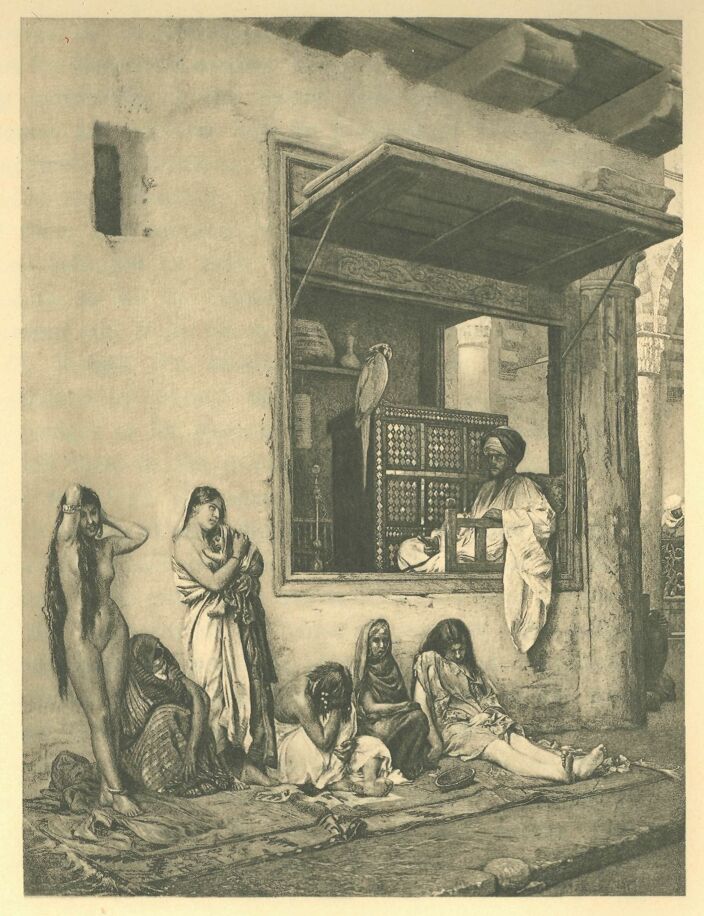
If we knew more of the internal history of the great Chaldæan cities, we should no doubt come to see what an important part the servile element played in them; and could we trace it back for a few generations, we should probably discover that there were few great families who did not reckon a slave or a freedman among their ancestors. It would be interesting to follow this people, made up of such complex elements, in all their daily work and recreation, as we are able to do in the case of contemporary Egyptians; but the monuments which might furnish us with the necessary materials are scarce, and the positive information to be gleaned from them amounts to but little. We are tolerably safe, however, in supposing the more wealthy cities to have been, as a whole, very similar in appearance to those existing at the present day in the regions which as yet have been scarcely touched by the advent of European civilization. Sinuous, narrow, muddy streets, littered with domestic refuse and organic detritus, in which flocks of ravens and wandering packs of dogs perform with more or less efficiency the duties of sanitary officers; whole quarters of the town composed of huts made of reeds and puddled clay, low houses of crude brick, surmounted perhaps even in those times with the conical domes we find later on the Assyrian bas-reliefs; crowded and noisy bazaars, where each trade is located in its special lanes and blind alleys; silent and desolate spaces occupied by palaces and gardens, in which the private life of the wealthy was concealed from public gaze; and looking down upon this medley of individual dwellings, the palaces and temples with their ziggurats crowned with gilded and painted sanctuaries. In the ruins of Uru, Eridu, and Uruk, the remains of houses belonging doubtless to well-to-do families have been brought to light. They are built of fine bricks, whose courses are cemented together with a thin layer of bitumen, but they they are only lighted internally by small appertures pierced at irregular distances in the upper part of the walls: the low arched doorway, closed by a heavy two-leaved door, leads into a blind passage, which opens as a rule on the courtyard in the centre of the building.