Volume 3 — CHAPTER III—CHALDÆAN CIVILIZATION (continued 2)
M. L. McClure translation
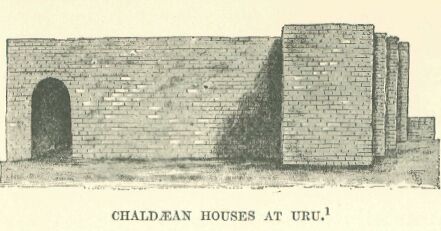
Drawn by Faucher-Gudin, from the sketch by Taylor.
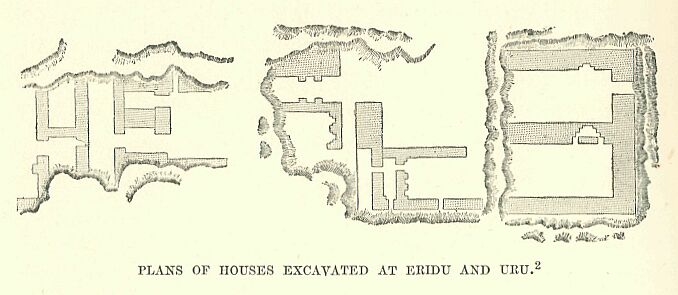
These plans were drawn by Faucher-Gudin, from sketches by Taylor. The houses reproduced to the left of the plan were those uncovered in the ruins of Uru; those on the right belong to the ruins of Eridu. On the latter, the niches mentioned in the text will be found indicated.
In the interior may still be distinguished the small oblong rooms, sometimes vaulted, sometimes roofed with a flat, ceiling supported by trunks of palm trees;* the walls are often of a considerable thickness, in which are found narrow niches here and there. The majority of the rooms were merely store-chambers, and contained the family provisions and treasures; others served as living-rooms, and were provided with furniture. The latter, in the houses of the richer citizens no less than in those of the people, was of a very simple kind, and was mostly composed of chairs and stools, similar to those in the royal palaces; the bedrooms contained the linen chests and the beds with their thin mattresses, coverings, and cushions, and perhaps wooden head-rests, resembling those found in Africa,** but the Chaldæans slept mostly on mats spread on the ground.
* Taylor, Notes on the Ruins of Mugeyer, in the Journ. of the Royal As. Soc, vol. xv. p. 266, found the remains of the palm-tree beams which formed the terrace still existing. He thinks (Notes on Tel-el-Lahm, etc., in the Journ, of the Royal As. Soc., vol. xv. p. 411) with Loftus that some of the chambers were vaulted. Cf. upon the custom of vaulting in Chaldæan houses, Piereot-Cupiez, Histoire de l’Art, vol. ii. p. 163, et seq. ** The dressing of the hair in coils and elaborate erections, as seen in the various figures engraved upon Chaldæan intaglios (cf. what is said of the different ways of arranging the hair on p. 262 of this volume), appears to have necessitated the use of these articles of furniture; such complicated erections of hair must have lasted several days at least, and would not have kept in condition so long except for the use of the head-rest.
An oven for baking occupied a corner of the courtyard, side by side with the stones for grinding the corn; the ashes on the hearth were always aglow, and if by chance the fire went out, the fire-stick was always at hand to relight it, as in Egypt. The kitchen utensils and household pottery comprised a few large copper pans and earthenware pots rounded at the base, dishes, water and wine jars, and heavy plates of coarse ware; metal had not as yet superseded stone, and in the same house we meet with bronze axes and hammers side by side with the same implements in cut flint, besides knives, scrapers, and mace-heads.*
* Implements in flint and other kinds of stone have been discovered by Taylor, and are now in the British Museum. The bronze implements come partly from the tombs of Mugheîr, and partly from the ruins explored by Loftus at Tell-Sifr—that is to say, the ancient cities of Uru and Larsam: the name of Tell-Sifr, the “mound of copper,” comes from the quantity of objects in copper which have been discovered there.
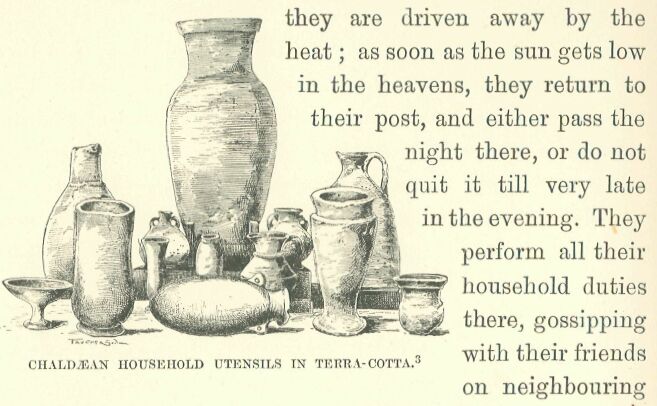
Drawn by Faucher-Gudin, from the sketch by G. Rawlinson, and the heliogravure in Heuzey-Sarzec.
At the present day the women of the country of the Euphrates spend a great part of their time on the roofs of their dwellings.* They install themselves there in the morning, till they are driven away by the heat; as soon as the sun gets low in the heavens, they return to their post, and either pass the day on neighbouring roofs whilst they bake, cook, wash and dry the linen; or, if they have slaves to attend to such menial occupations, they sew and embroider in the open air.
* Olivier, Voyage dans l’Empire Othoman, vol. ii. pp. 356, 357, 381, 382, 392, 393.
They come down into the interior of the house during the hottest hours of the day. In most of the wealthy houses, the coolest room is one below the level of the courtyard, into which but little light can penetrate. It is paved with plaques of polished gypsum, which resembles our finest grey-and-white marble, and the walls are covered with a coat of delicate plastering, smooth to the touch and agreeable to the eye. This is watered several times during the day in hot weather, and the evaporation from it cools the air. The few ruined habitations which have as yet been explored seem to bear witness to a considerable similarity between the requirements and customs of ancient times and those of to-day. Like the modern women of Bagdad and Mosul, the Chaldæan women of old preferred an existence in the open air, in spite of its publicity, to a seclusion within stuffy rooms or narrow courts. The heat of the sun, cold, rain, and illness obliged them at times to seek a refuge within four walls, but as soon as they could conveniently escape from them, they climbed up on to their roof to pass the greater part of their time there.
Many families of the lower and middle classes owned the houses which they occupied. They constituted a patrimony which the owners made every effort to preserve intact through all reverses of fortune.* The head of the family bequeathed it to his widow or his eldest son, or left it undivided to his heirs, in the assurance, no doubt, that one of them would buy up the rights of the others.
* A house could be let for various lengths of time—for three months, for a year, for five years, for an indefinite term, but with a minimum of six months, since the rent is payable at the beginning and in the middle of each year.
The remainder of his goods, farms, gardens, corn-lands, slaves, furniture, and jewels, were divided among the brothers or natural descendants, “from the mouth to the gold;” that is to say, from the moment of announcing the beginning of the business, to that when each one received his share. In order to invest this act with greater solemnity, it took place usually in the presence of a priest. Those interested repaired to the temple, “to the gate of the god;” they placed the whole of the inheritance in the hands of the chosen arbitrator, and demanded of him to divide it justly; or the eldest brother perhaps anticipated the apportionment, and the priest had merely to sanction the result, or settle the differences which might arise among the lawful recipients in the course of the operation. When this was accomplished, the legatees had to declare themselves satisfied; and when no further claims arose, they had to sign an engagement before the priestly arbitrator that they would henceforth refrain from all quarrelling on the subject, and that they would never make a complaint one against the other. By dint of these continual redistributions from one generation to another, the largest fortunes soon became dispersed: the individual shares became smaller and smaller, and scarcely sufficed to keep a family, so that the slightest reverse obliged the possessor to have recourse to usurers. The Chaldæans, like the Egyptians, were unacquainted with the use of money, but from the earliest times the employment of precious metals for purposes of exchange was practised among them to an enormous extent. Though copper and gold were both used, silver was the principal medium in these transactions, and formed the standard value of all purchaseable objects. It was never cut into flat rings or twists of wire, as was the case with the Egyptian “tabnu;” it was melted into small unstamped ingots, which were passed from hand to hand by weight, being tested in the scales at each transaction. “To weigh” was in the ordinary language the equivalent for “payment in metal,” whereas “to measure” denoted that the payment was in grain. The ingots for exchange were, therefore, designated by the name of the weights to which they corresponded. The lowest unit was a shekel, weighing on an average nearly half an ounce, sixty shekels making a mina, and sixty minas a talent. It is a question whether the Chaldæanns possessed in early times, as did the Assyrians of a later period, two kinds of shekels and minas, one heavy and the other light. Whether the loan were in metal, grain, or any other substance, the interest was very high.* A very ancient law fixed it in certain cases at twelve drachmas per mina, per annum—that is to say, at twenty per cent.—and more recent texts show us that, when raised to twenty-five per cent., it did not appear to them abnormal.
* We find several different examples, during the Second Chaldæann Empire, of an exchange of corn for provisions and liquids, or of beams for dates. As a fact, exchange has never completely died out in these regions, and at the present day, in Chaldæa, as in Egypt, corn is used in many cases either to pay Government taxes or to discharge commercial debts.
The commerce of the chief cities was almost entirely concentrated in the temples. The large quantities of metals and cereals constantly brought to the god, either as part of the fixed temple revenue, or as daily offerings, accumulated so rapidly, that they would have overflowed the storehouses, had not a means been devised of utilizing them quickly: the priests treated them as articles of commerce and made a profit out of them.* Every bargain necessitated the calling in of a public scribe. The bill, drawn up before witnesses on a clay tablet, enumerated the sums paid out, the names of the parties, the rate per cent., the date of repayment, and sometimes a penal clause in the event of fraud or insolvency; the tablet remained in the possession of the creditor until the debt had been completely discharged. The borrower often gave as a pledge either slaves, a field, or a house, or certain of his friends would pledge on his behalf their own personal fortune; at times he would pay by the labour of his own hands the interest which he would otherwise have been unable to meet, and the stipulation was previously made in the contract of the number of days of corvée which he should periodically fulfil for his creditor. If, in spite of all this, the debtor was unable to procure the necessary funds to meet his engagements, the principal became augmented by a fixed sum—for instance, one-third—and continued to increase at this rate until the total value of the amount reached that of the security:** the slave, the field, or the house then ceased to belong to their former, master, subject to a right of redemption, of which he was rarely able to avail himself for lack of means.***
* It was to the god himself—Shamash, for example—that the loan was supposed to be made, and it is to him that the contracts stipulate that the capital and interest shall be paid. It is curious to lind among the most successful money- lenders several princesses consecrated to the sun-god. ** It is easy to foresee, from the contracts of the New Assyrian or Babylonian Empire, how in this manner the original sum lent became doubled and trebled; generally the interest accumulated till it was quadrupled, after which, no doubt, the security was taken by the creditor. They probably calculated that the capital and compound interest was by then equal in value to the person or object given as a security. *** The creditors protected themselves against this right of redemption by a maledictory formula inserted at the end of the contracts against those who should avail themselves of it; it is generally inscribed on the boundary stones of the First Chaldæan Empire.
The small tradesman or free workman, who by some accident had become involved in debt, seldom escaped this progressive impoverishment except by strenuous efforts and incessant labour. Foreign commerce, it is true, entailed considerable risk, but the chances of acquiring wealth were so great that many individuals launched upon it in preference to more sure but less lucrative undertakings. They would set off alone or in companies for Elam or the northern regions, for Syria, or even for so distant a country as Egypt, and they would bring back in their caravans all that was accounted precious in those lands. Overland routes were not free from dangers; not only were nomad tribes and professional bandits constantly hovering round the traveller, and obliging him to exercise ceaseless vigilance, but the inhabitants of the villages through which he passed, the local lords and the kings of the countries which he traversed, had no scruple in levying blackmail upon him in obliging him to pay dearly for right of way through their marches or territory.** There were less risks in choosing a sea route: the Euphrates on one side, the Tigris, the Ulaî, and the Uknu on the other, ran through a country peopled with a rich industrial population, among whom Chaldæan merchandise was easily and profitably sold or exchanged for commodities which would command a good price at the end of the voyage. The vessels generally were keleks or “kufas,” but the latter were of immense size.
* We have no information from Babylonian sources relating to the state of the roads, and the dangers which merchants encountered in foreign lands; the Egyptian documents partly supply what is here lacking. The “instructions” contained in the Sallier Papyrus, No. ii., show what were the miseries of the traveller, and the Adventures of Sinuhît allude to the insecurity of the roads in Syria, by the very care with which the hero relates all the precautions which he took for his protection. These two documents are of the XIIth or XIIIth dynasty—that is to say, contemporaneous with the kings, of Uru and with Gudea.
Several individuals, as a rule, would club together to hire one of these boats and freight it with a suitable cargo.* The body of the boat was very light, being made of osier or willow covered with skins sewn together; a layer of straw was spread on the bottom, on which were piled the bales or chests, which were again protected by a rough thatch of straw. The crew was composed of two oarsmen at least, and sometimes a few donkeys: the merchants then pursued their way up stream till they had disposed of their cargo, and taken in a sufficient freight for their return voyage. The dangers, though apparently not so great as those by the land route, were not the less real. The boat was liable to sink or run aground near the bank, the dwellers in the neighbourhood of the river might intercept it and pillage its contents, a war might break out between two contiguous kingdoms and suspend all commerce: the merchants’ career continually vacillated between servitude, death, and fortune.
* The payment demanded was something considerable: the only contract which I know of existing for such a transaction is of the time of Darius I., and exacts a silver shekel per day for the hire of boat and crew.
Business carried on at home in the towns was seldom the means of enriching a man, and sometimes scarcely afforded him a means of livelihood. Rent was high for those who had not a house of their own; the least they could expect to pay was half a silver shekel per annum, but the average price was a whole shekel. On taking possession they paid a deposit which sometimes amounted to one-third of the whole sum, the remainder being due at the end of the year. The leases lasted, as a rule, merely a twelvemonth, though sometimes they were extended for terms of greater length, such as two, three, or even eight years. The cost of repairs and of keeping the house in good condition fell usually upon the lessee, who was also allowed to build upon the land he had leased, in which case it was declared free of all charges for a period of about ten years, but the house, and, as a rule, all he had built, then reverted to the landlord. Most possessors of shops made their own goods for sale, assisted by slaves or free apprentices. Every workman taught his own trade to his children, and these in their turn would instruct theirs; families which had an hereditary profession, or from generation to generation had gathered bands of workmen about them, formed themselves into various guilds, or, to use the customary term, into tribes, governed by chiefs and following specified customs. A workman belonged to the tribe of the weavers, or of the blacksmiths, or of the corn-merchants, and the description of an individual would not have been considered as sufficiently exact, if the designation of his tribe were not inserted after his name in addition to his paternal affiliation. The organization was like that of Egypt, but more fully developed. The various trades, moreover, were almost the same among the two peoples, the exceptions being such as are readily accounted for by the differences in the nature of the soil and physical constitution of the respective countries. We do not meet on the banks of the Euphrates with those corporations of stone-cutters and marble workers which were so numerous in the valley of the Nile. The vast Chaldæan plain, in the absence of mountains or accessible quarries, would have furnished no occupation for them: the Chaldæans had to go a long way in quest of the small quantities of limestone, alabaster, or diorite which they required, and which they reserved only for details of architectural decoration for which a small number of artisans and sculptors were amply sufficient. The manufacture of bricks, on the other hand, made great progress; the crude bricks were larger than those of Egypt, and they were more enduring, composed of finer clay and better executed; the manufacture of burnt brick too was carried to a degree of perfection to which Memphis or Thebes never attained. An ancient legend ascribes the invention of the bricks, and consequently the construction of the earliest cities, jointly to Sin, the eldest son of Bel, and Ninib his brother: this event was said to have taken place in May-June, and from that time forward the third month of the year, over which the twins presided, was called, Murga in Sumerian, Simanu in the Semitic speech, the month of brick. This was the season which was especially devoted to the processes of their manufacture: the flood in the rivers, which was very great in the preceding months, then began to subside, and the clay which was deposited by the waters during the weeks of overflow, washed and refined as it was, lent itself readily to the operation. The sun, moreover, gave forth sufficient heat to dry the clay blocks in a uniform and gradual manner: later, in July and August, they would crack under the ardour of his rays, and become converted externally into a friable mass, while their interior would remain too moist to allow them to be prudently used in carefully built structures. The work of brick-making was inaugurated with festivals and sacrifices to Sin, Merodach, Nebo, and all the deities who were concerned in the art of building: further religious ceremonies were observed at intervals during the month to sanctify the progress of the work. The manufacture did not cease on the last day of the month, but was continued with more or less activity, according to the heat of the sun, and the importance of the orders received, until the return of the inundation: but the bricks intended for public buildings, temples, or palaces, could not be made outside a prescribed limit of time. The shades of colour produced naturally in the process of burning—red or yellow, grey or brown—were not pleasant to the eye, and they were accustomed, therefore, to coat the bricks with an attractive enamel which preserved them from the disintegrating effects of sun and rain. The paste was laid on the edges or sides while the brick was in a crude state, and was incorporated with it by vitrification in the heat of the kiln. The process was known from an early date in Egypt, but was rarely employed there in the decoration of buildings, while in Chaldæa the use of such enamelled plaques was common. The substructures of palaces and the exterior walls of temples were left unadorned, but the shrines which crowned the “ziggurat,” the reception-halls, and the headings of doors were covered with these many-coloured tiles. Fragments of them are found to-day in the ruins of the cities, and the analysis of these pieces shows the marvellous skill of the ancient workers in enamel; the shades of colour are pure and pleasant to the eye, while the material is so evenly put on and so solid, that neither centuries of burial in a sodden soil, nor the wear and tear of transport, nor the exposure to the damp of our museums, have succeeded in diminishing their brilliance and freshness.
To get a clear idea of the industrial operations of the country, it would be necessary to see the various corporations at their work, as we are able to do, in the case of Egypt in the scenes of the mastabas of Saqqâra, or of the rock-chambers of Beni-Hasan. The manufacture of stone implements gave considerable employment, and the equipment of the dead in the tombs of Uru would have been a matter of small moment, if we were to exclude its flint implements, its knives, cleavers, scrapers, adzes, axes, and hammers. The cutting of these objects is bold, and the final touches show skill, but we rarely meet with that purity of contour and intensity of polish which distinguish similar objects among Western peoples. A few examples, it is true, are of fairly artistic shape, and bear engraved inscriptions: one of these, a flint hammer of beautiful form, belonged to a god, probably Eamman, and seems to have come from a temple in which one of its owners had deposited it.
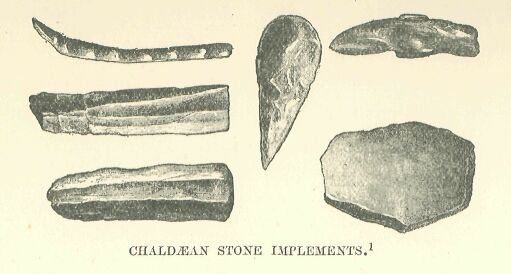
Drawn by Faucher-Gudin, from the sketches published by Taylor and by ‘G. Rawlinson. On the left a scraper and two knives one above the other, an axe in the middle, on the right an axe and a hammer. All these objects were found in Taylor’s excavations, and are now in the British Museum.
It is an exception, and a remarkable exception. Stone was the material of the implements of the poor—implements which were coarse in shape, and cost little: if much care were given to their execution, they would come to be so costly that no one would buy them, or, if sold for a moderate sum, the seller would obtain no profit from the transaction. Beyond a certain price, it was more advantageous to purchase metal implements, of copper in the early ages, afterwards of bronze, and lastly of iron. Among the metal-founders and smiths all kinds of examples of these were to be found—axes of an elegant and graceful design, hammers and knives, as well as culinary and domestic utensils, cups, cauldrons, dishes, mountings of doors and coffers, statuettes of men, bulls, monsters, and gods—which could be turned to weapons of all descriptions—arrow and lance heads, swords, daggers, and rounded helmets with neck-piece or visor.
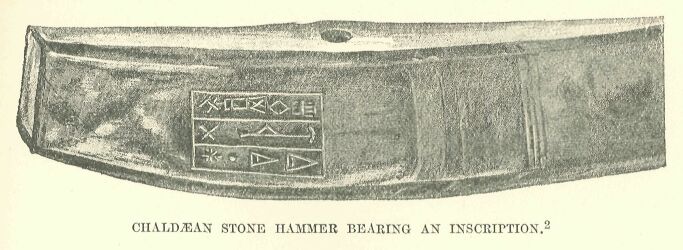
Drawn by Faucher-Gudin, from the illustration published by Fr. Lenormant.
Drawn by Faucher-Gudin, from Rawlinson’sFive Great Monarchies. On the right two axes, in the middle a hammer, on the left a knife, and below the head of a lance.
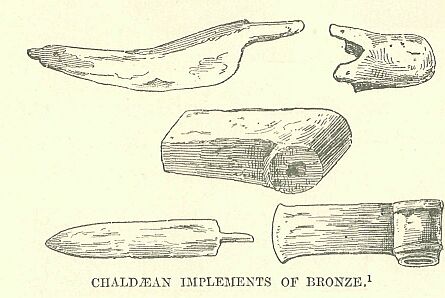
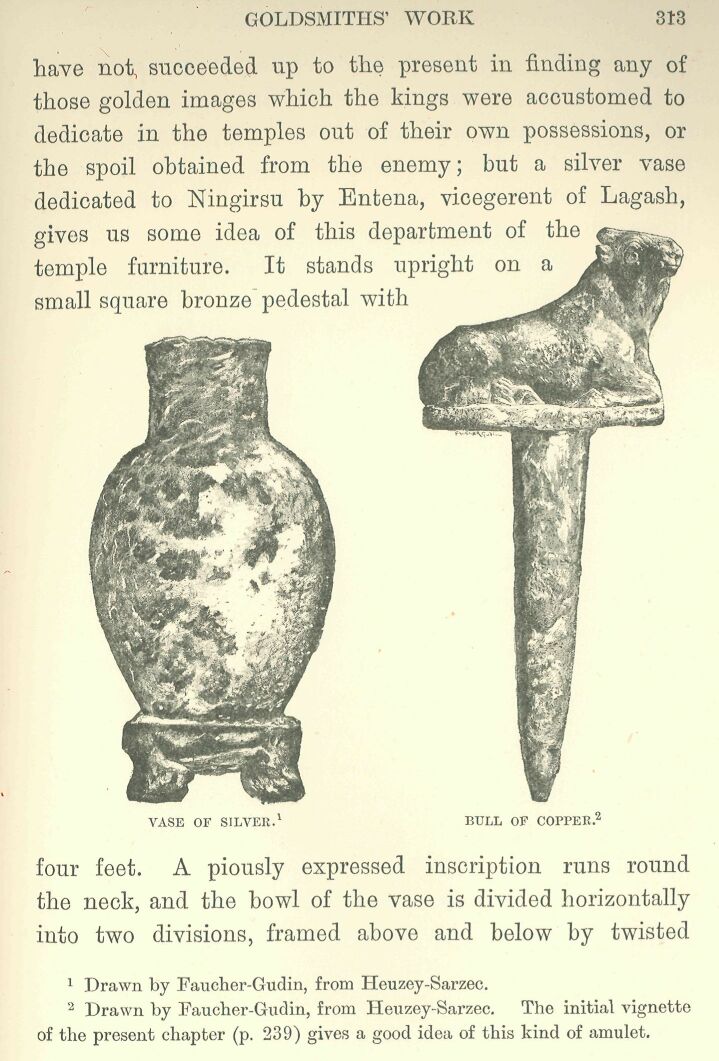
Some of the metal objects manufactured by the Chaldaeans attained large dimensions; for instance, the “brazen seas” which were set up before each sanctuary, either for the purpose of receiving the libations, or for the prescribed rites of purification. As is often the case among half-civilized peoples, the goldsmiths worked in the precious metals with much facility and skill. We have not, succeeded up to the present in finding any of those golden images which the kings were accustomed to dedicate in the temples out of their own possessions, or the spoil obtained from the enemy; but a silver vase dedicated to Ningirsu by Entena, vicegerent of Lagash, gives us some idea of this department of the temple furniture. It stands upright on a small square bronze pedestal with four feet. A piously expressed inscription runs round the neck, and the bowl of the vase is divided horizontally into two divisions, framed above and below by twisted cord-work. Four two-headed eagles, with outspread wings and tail, occupy the lower division; they are in the act of seizing with their claws two animals, placed back to back, represented in the act of walking: the intervals between the eagles are filled up alternatively by two lions, two wild goats, and two stags. Above, and close to the rise of the neck, are disposed seven heifers lying down and all looking in the same direction: they are all engraved upon the flat metal, and are without relief or incrustation. The whole composition is harmoniously put together, the posture of the animals and their general form are well conceived and boldly rendered, but the details of the mane of the lions and the feathers of the eagles are reproduced with a realism and attention to minutio which belong to the infancy of art. This single example of ancient goldsmiths’work would be sufficient to prove that the early Chaldæns were not a whit behind the Egyptians in this handicraft, even if we had not the golden ornaments, the bracelets, ear and finger rings to judge from, with which the tombs have furnished us in considerable numbers.
Alongside the goldsmiths there must have been a whole army of lapidaries and gem-cutters occupied in the engraving of cylinders. Numerous and delicate operations were required to metamorphose a scrap of crude rock, marble, granite, agate, onyx, green and red jasper, crystal or lapis-lazuli, into one of those marvellous seals which are now found by the hundred scattered throughout the museums of Europe. They had to be rounded, reduced to the proper proportions, and polished, before the subject or legend could be engraved upon them with the burin. To drill a hole through them required great dexterity, and some of the lapidaries, from a dread of breaking the cylinder, either did not pierce it at all, or merely bored a shallow hole into each extremity to allow it to roll freely in its metallic mounting. The tools used in engraving were similar to those employed at the present day, but of a rougher kind. The burin, which was often nothing more than a flint point, marked out the area of the design, and sketched out the figures; the saw was largely employed to cut away the depressions when these required no detailed handling; and lastly, the drill, either worked with the hand or in a kind of lathe, was made to indicate the joints and muscles of the individual by a series of round holes. The object thus summarily dealt with might be regarded as sufficiently worked for ordinary clients; but those who were willing to pay for them could obtain cylinders from which every mark of the tool had been adroitly removed, and where the beauty of the workmanship vied with the costliness of the material.
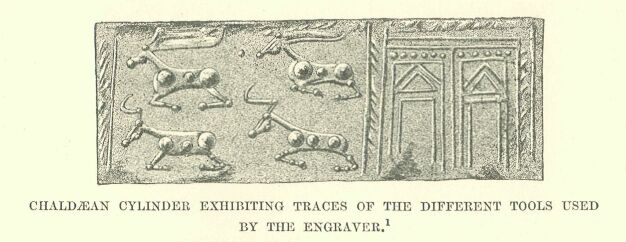
Drawn by Faucher-Gudin, from a heliogravure in Ménant’s Catalogue de la collection de M. de Clercq
The seal of Shargani, King of Agadê, that of Bingani-shar-ali, and many others which have been picked up by chance in the excavations, are true bas-reliefs, reduced and condensed, so to speak, to the space of something like a square inch of surface, but conceived with an artistic ingenuity and executed with a boldness which modern engravers have rarely equalled and never surpassed. There are traces on them, it is true, of some of the defects which disfigured the latter work of the Assyrians—heaviness of form, exaggerated prominence of muscles and hardness of outline—but there are also all the qualities which distinguish an original and forcible art.
The countries of the Euphrates were renowned in classic times for the beauty of the embroidered and painted stuffs which they manufactured.* Nothing has come down to us of these Babylonian tissues of which the Greek and Latin writers extolled the magnificence, but we may form some idea, from the statues and the figures engraved on cylinders, of what the weavers and embroiderers of this ancient time were capable. The loom which they made use of differed but slightly from the horizontal loom commonly employed in the Nile Valley, and everything tends to show that their plain linen cloths were of the kind represented in the swathings and fragments of clothing still to be found in the sepulchral chambers of Memphis and Thebes. The manufacture of fleecy woollen garments so much affected by men and women alike indicates a great dexterity. When once the threads of the woof had been stretched, those of the warp were attached to them by knots in as many parallel lines—at regular intervals—as there were rows of fringe to be displayed on the surface of the cloth, the loops thus formed being allowed to hang down in their respective places: sometimes these loops were retained just as they stood, sometimes they were cut and the ends frayed out so as to give the appearance of a shaggy texture.
* Most modern writers understand by tapestry what the ancients were accustomed to call needle embroidery or painting on stuffs: I can find no indication on the most ancient monuments of Chaldæan or Egypt of the manufacturing of real tapestry.
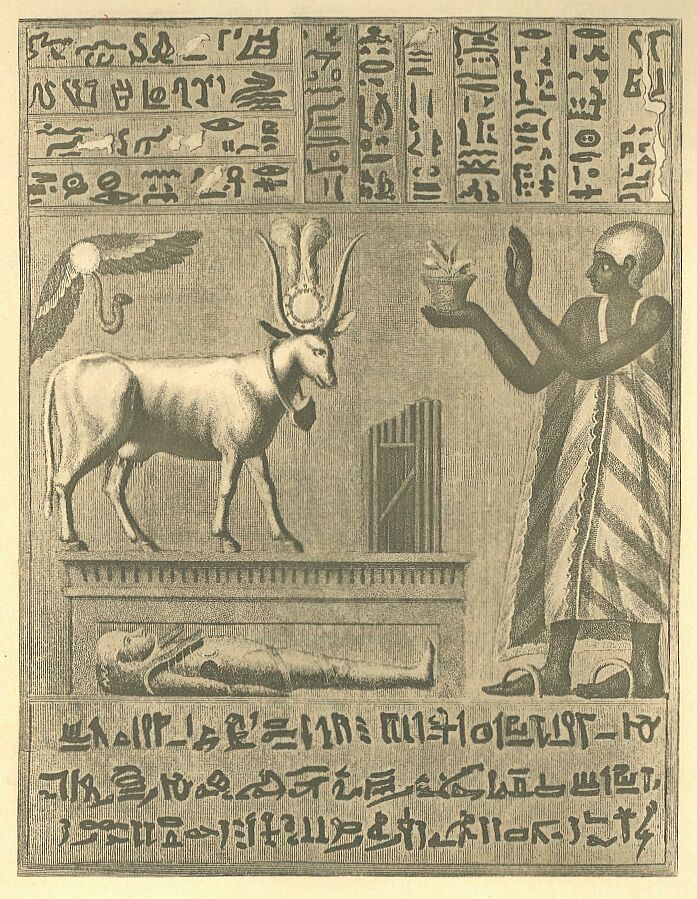
Part of an Egyptian Manuscript found in the Swathing of a Mummy

Most of these stuffs preserved their original white or creamy colour—especially those woven at home by the women for the requirements of their own toilet, and for the ordinary uses of the household. The Chaldæans, however, like many other Asiatic peoples, had a strong preference for lively colours, and the outdoor garments and gala attire of the rich were distinguished by a profusion of blue patterns on a red ground, or red upon blue, arranged in stripes, zigzags, checks, and dots or circles. There must, therefore, have been as much occupation for dyers as there was for weavers; and it is possible that the two operations were carried out by the same hands. We know nothing of the bakers, butchers, carriers, masons, and other artisans who supplied the necessities of the cities: they were doubtless able to make two ends meet and nothing more, and if we should succeed some day in obtaining information about them, we shall probably find that their condition was as miserable as that of their Egyptian contemporaries. The course of their lives was monotonous enough, except when it was broken at prescribed intervals by the ordinary festivals in honour of the gods of the city, or by the casual suspensions of work occasioned by the triumphant return of the king from some warlike expedition, or by his inauguration of a new temple.
The gaiety of the people on such occasions was the more exuberant in proportion to the undisturbed monotony or misery of the days which preceded them. As soon, for instance, as Gudea had brought to completion Ininnu, the house of his patron Ningirsu, “he felt relieved from the strain and washed his hands. For seven days, no grain was bruised in the quern, the maid was the equal of her mistress, the servant walked in the same rank as his master, the strong and the weak rested side by side in the city.” The world seemed topsy-turvy as during the Roman Saturnalia; the classes mingled together, and the inferiors were probably accustomed to abuse the unusual licence which they momentarily enjoyed: when the festival was over, social distinctions reasserted themselves, and each one fell back into his accustomed position. Life was not so pleasant in Chaldæa as in Egypt. The innumerable promissory notes, the receipted accounts, the contracts of sale and purchase—these cunningly drawn up deeds which have been deciphered by the hundred—reveal to us a people greedy of gain, exacting, litigious, of artisans in Egypt. This is taken from a source belonging to the XIIth or possibly the XIIIth dynasty. We may assume, from the fact that the two civilizations were about on the same level, that the information supplied in this respect by the Egyptian monuments is generally applicable to the condition of Chaldæan workmen of the same period.
(Unreadable) and almost exclusively absorbed by material concerns. The climate, too, variable and oppressive in summer and winter alike, imposed upon the Chaldæan painful exactions, and obliged him to work with an energy of which the majority of Egyptians would not have felt themselves capable. The Chaldæan, suffering greater and more prolonged hardships, earned more doubtless, but was not on this account the happier. However lucrative his calling might be, it was not sufficiently so to supply him always with domestic necessities, and both tradespeople and operatives were obliged to run into debt to supplement their straitened means. When they had once fallen into the hands of the usurer, the exorbitant interest which they had to pay kept them a long time in his power. If when the bill fell due there was nothing to meet it, it had to be renewed under still more disastrous conditions; as the pledge given was usually the homestead, or the slave who assisted in the trade, or the garden which supplied food for the family, the mortgagor was reduced to the extreme of misery if he could not satisfy his creditors, This plague of usury was not, moreover, confined to the towns; it raged with equal violence in the country, and the farmers also became its victims.
If, theoretically, the earth belonged to the gods, and under them to the kings, the latter had made, and continued daily to make, such large concessions of it to their vassals, that the greater part of their domains were always in the hands of the nobles or private individuals. These could dispose of their landed property at pleasure, farm it out, sell it or distribute it among their heirs and friends.
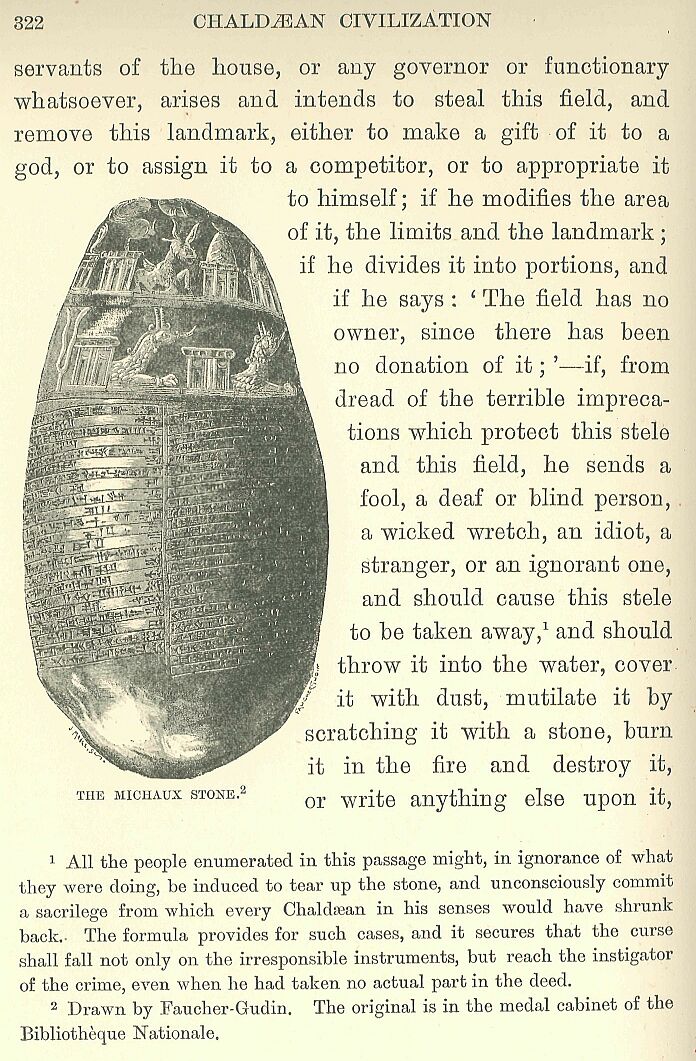
They paid on account of it a tax which varied at different epochs, but which was always burthensome; but when they had once satisfied this exaction, and paid the dues which the temples might claim on behalf of the gods, neither the State nor any individual had the right to interfere in their administration of it, or put any restrictions upon them. Some proprietors cultivated their lands themselves—the poor by their own labour, the rich by the aid of some trustworthy slave whom they interested in the success of his farming by assigning him a certain percentage on the net return. Sometimes the lands were leased out in whole or in part to free peasants who relieved the proprietors of all the worry and risks of managing it themselves. A survey of the area of each state had been made at an early age, and the lots into which it had been divided were registered on clay tablets containing the name of the proprietor as well as those of his neighbours, together with such indications of the features of the land, dykes, canals, rivers, and buildings as would serve to define its boundaries: rough plans accompanied the description, and in the most complicated instances interpreted it to the eye. This survey was frequently repeated, and enabled the sovereign to arrange his scheme of taxation on a solid basis, and to calculate the product of it without material error. Gardens and groves of date-palms, together with large regions devoted to rough attempts at vegetable culture, were often to be met with, especially in the neighbourhood of towns; these paid their contributions to the State, as well as the owners’rent, in kind—in fruit, vegetables, and fresh or dried dates. The best soil was reserved, for the growth of wheat and other cereals, and its extent was measured in terms of corn; corn was also the standard in which the revenue was reckoned both in public and private contracts. Such and such a field required about fifty litres of seed to the arura. Another needed sixty-two or seventy-five according to the fertility of the land and its locality. Landed property was placed under the guardianship of the gods, and its transfer or cession was accompanied by formalities of a half-religious, half-magical character: the party giving delivery of it called down upon the head of any one who would dare in the future to dispute the validity of the deed, imprecations of which the text was inserted on a portion of the surface of an egg-shaped nodule of flint, basalt, or other hard stone. These little monuments display on their cone-shaped end a series of figures, sometimes arranged in two parallel divisions, sometimes scattered over the surface, which represent the deities invoked to watch over the sanctity of the contract. It was a kind of representation in miniature of the aspect which the heavens presented to the Chaldæans. The disks of the sun and moon, together with Venus-Ashtar, are the prominent elements in the scene: the zodiacal figures, or the symbols employed to represent them, are arranged in an apparent orbit around these—such as the Scorpion, the Bird, the Dog, the Thunderbolt of Ramman, the mace, the horned monsters, half hidden by the temples they guard, and the enormous Dragon who embraces in his folds half the entire firmament. “If ever, in the course of days, any one of the brothers, children, family, men or women, slaves or servants of the house, or any governor or functionary whatsoever, arises and intends to steal this field, and remove this landmark, either to make a gift of it to a god, or to assign it to a competitor, or to appropriate it to himself; if he modifies the area of it, the limits and the landmark; if he divides it into portions, and if he says: ‘The field has no owner, since there has been no donation of it; ‘—if, from dread of the terrible imprecations which protect this stele and this field, he sends a fool, a deaf or blind person, a wicked wretch, an idiot, a stranger, or an ignorant one, and should cause this stele to be taken away,* and should throw it into the water, cover it with dust, mutilate it by scratching it with a stone, burn it in the fire and destroy it, or write anything else upon it, or carry,it away to a place where it will be no longer seen,—this man, may Anu, Bel, Ea, the exalted lady, the great gods, cast upon him looks of wrath, may they destroy his strength, may they exterminate his race.” All the immortals are associated in this excommunication, and each one promises in his turn the aid of his power.
* All the people enumerated in this passage might, in ignorance of what they were doing, be induced to tear up the stone, and unconsciously commit a sacrilege from which every Chaldæan in his senses would have shrunk back. The formula provides for such cases, and it secures that the curse shall fall not only on the irresponsible instruments, but reach the instigator of the crime, even when he had taken no actual part in the deed.
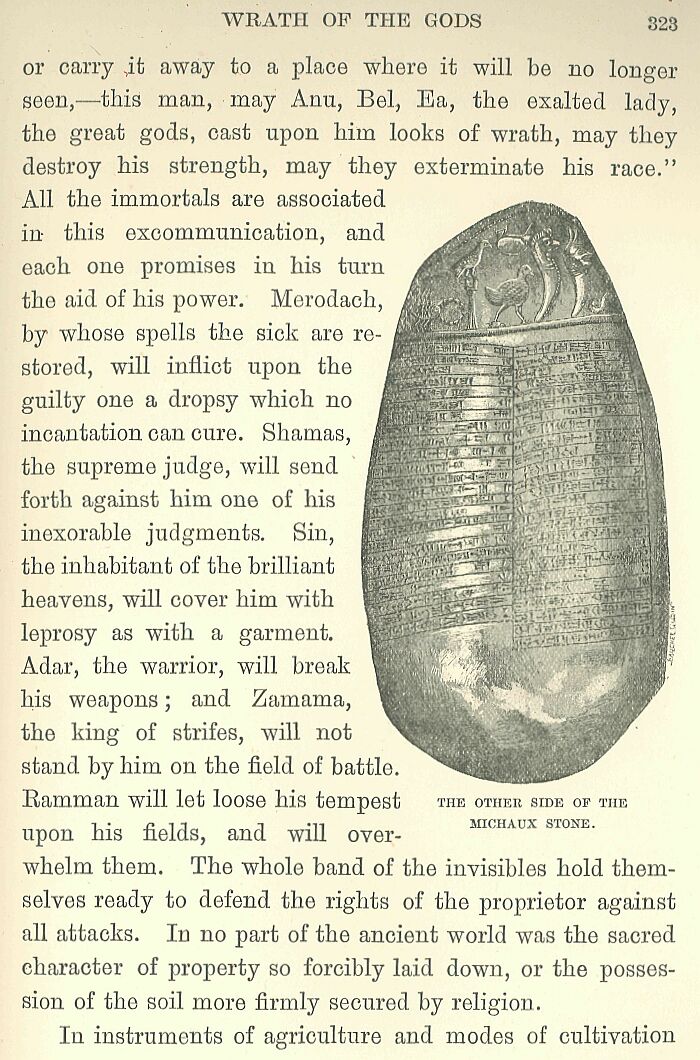
Merodach, by whose spells the sick are re stored, will inflict upon the guilty one a dropsy which no incantation can cure. Shamas, the supreme judge, will send forth against him one of his inexorable judgments. Sin, the inhabitant of the brilliant heavens, will cover him with leprosy as with a garment. Adar, the warrior, will break his weapons; and Zamama, the king of strifes, will not stand by him on the field of battle. Eamman will let loose his tempest upon his fields, and will overwhelm them. The whole band of the invisibles hold themselves ready to defend the rights of the proprietor against all attacks. In no part of the ancient world was the sacred character of property so forcibly laid down, or the possession of the soil more firmly secured by religion.
In instruments of agriculture and modes of cultivation Chaldæa was no better off than Egypt. The rapidity with which the river rose in the spring, and its variable subsidence from year to year, furnished little inducement to the Chaldæans to entrust to it the work of watering their lands; on the contrary, they were compelled to protect themselves from it, and to keep at a distance the volume of waters it brought down. Each property, whether of square, triangular, or any other shape, was surrounded with a continuous earth-built barrier which bounded it on every side, and served at the same time as a rampart against the inundation.
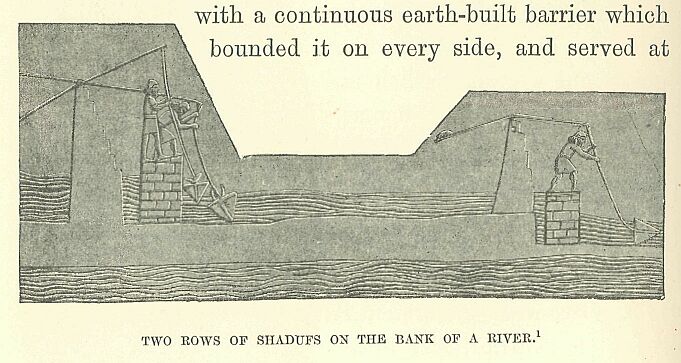
Drawn by Faucher-Gudin, from an Assyrian bas-relief from Koyunjik.
Rows of shadufs installed along the banks of the canals or streams provided for the irrigation of the lands.* The fields were laid out like a chess-board, and the squares, separated from each other by earthen ridges, formed as it were so many basins: when the elevation of the ground arrested the flow of the waters, these were collected into reservoirs, whence by the use of other shadufs they were raised to a higher level.
* In Mesopotamia and Chaldæa there may still be seen “everywhere ruins of ancient canals; and there are also to be met with, in many places, ridges of earth, which stretch for considerable distances in a straight line, and surround lands perfectly level.” (Olivier).
The plough was nothing more than an obliquely placed mattock, whose handle was lengthened in order to harness oxen to it. Whilst the ploughman pressed heavily on the handle, two attendants kept incessantly goading the beasts, or urging them forward with voice and whip, and a third scattered the seed in the furrow. A considerable capital was needed to ensure success in agricultural undertakings: contracts were made for three years, and stipulated that payments should be made partly in metal and partly in the products of the soil.
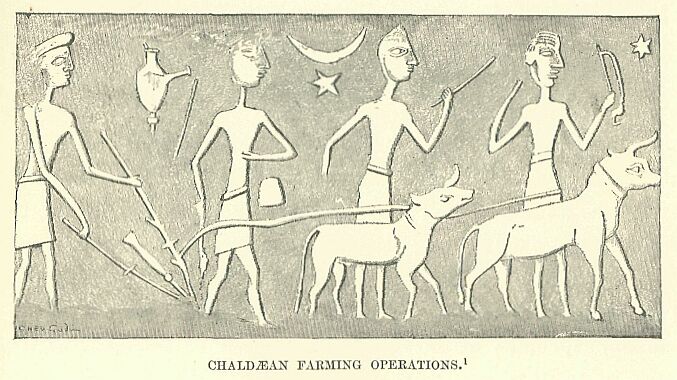
Drawn by Faucher-Gudin, from a Chaldæan intaglio reproduced in Layard. The original is in the cabinet of medals in the Bibliothèque Nationale.
The farmer paid a small sum when entering into possession, and the remainder of the debt was gradually liquidated at the end of each twelve months, the payment being in silver one year, and in corn the two following. The rent varied according to the quality of the soil and the facilities which it afforded for cultivation: a field, for instance, of three bushels was made to pay nine hundred measures, while another of ten bushels had only eighteen hundred to pay. In many instances the peasant preferred to take the proprietor into partnership, the latter in such case providing all the expenses of cultivation, on the understanding that he should receive two-thirds of the gross product. The tenant was obliged to administer the estate as a careful householder during the term of his lease: he was to maintain the buildings and implements in good repair, to see that the hedges were kept up, to keep the shadufs in working order, and to secure the good condition of the watercourses. He had rarely enough slaves to manage the business with profit: those he had purchased were sufficient, with the aid of his wives and children, to carry on ordinary operations, but when any pressure arose, especially at harvest-time, he had to seek elsewhere the additional labourers he required. The temples were the chief sources for the supply of these. The majority of the supplementary labourers were free men, who were hired out by their family, or engaged themselves for a fixed term, during which they were subject to a sort of slavery, the conditions of which were determined by law. The workman renounced his liberty for fifteen days, or a month, or for a whole year; he disposed, so to speak, of a portion of his life to the provisional master of his choice, and if he did not enter upon his work at the day agreed upon, or if he showed himself inactive in the duties assigned to him, he was liable to severe punishment. He received in exchange for his labour his food, lodging, and clothing; and if an accident should occur to him during the term of his service, the law granted him an indemnity in proportion to the injury he had sustained.
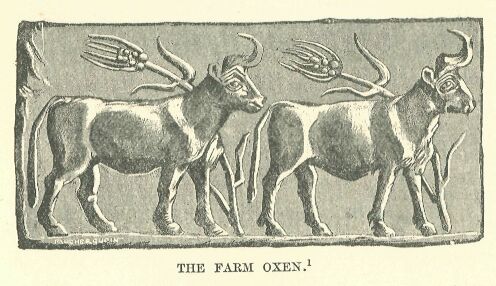
Drawn by Faucher-Gudin, from a green marble cylinder in the Louvre.
His average wage was from four to six shekels of silver per annum. He was also entitled by custom to another shekel in the form of a retaining fee, and he could claim his pay, which was given to him mostly in corn, in monthly instalments, if his agreement were for a considerable time, and daily if it were for a short period.
The mercenary never fell into the condition of the ordinary serf: he retained his rights as a man, and possessed in the person of the patron for whom he laboured, or whom he himself had selected, a defender of his interests. When he came to the end of his engagement, he returned to his family, and resumed his ordinary occupation until the next occasion. Many of the farmers in a small way earned thus, in a few weeks, sufficient means to supplement their own modest personal income. Others sought out more permanent occupations, and hired themselves out as regular farm-servants.
The lands which neither the rise of the river nor the irrigation system could reach so as to render fit for agriculture, were reserved for the pasture of the flocks in the springtime, when they were covered with rich grass. The presence of lions in the neighbourhood, however, obliged the husbandmen to take precautions for the safety of their flocks. They constructed provisional enclosures into which the animals were driven every evening, when the pastures were too far off to allow of the flocks being brought back to the sheepfold. The chase was a favourite pastime among them, and few days passed without the hunter’s bringing back with him a young gazelle caught in a trap, or a hare killed by an arrow. These formed substantial additions to the larder, for the Chaldæans do not seem to have kept about them, as the Egyptians did, such tamed animals as cranes or herons, gazelles or deer: they contented themselves with the useful species, oxen, asses, sheep, and goats. Some of the ancient monuments, cylinders, and clay tablets reproduce in a rough manner scenes from pastoral life. The door of the fold opens, and we see a flock of goats sallying forth to the cracking of the herdsman’s whip: when they reach the pasture they scatter over the meadows, and while the shepherd keeps his eye upon them, he plays upon his reed to the delight of his dog. In the mean time the farm-people are engaged in the careful preparation of the evening meal: two individuals on opposite sides of the hearth watch the pot boiling between them, while a baker makes his dough into round cakes.
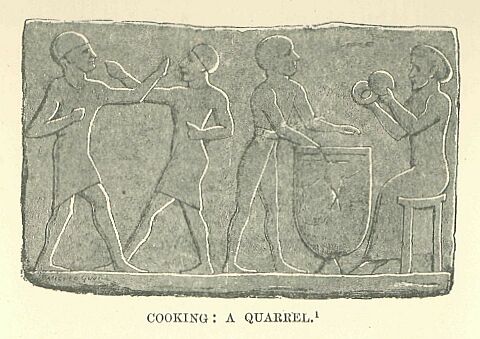
Drawn by Faucher-Gudin, from one of the terra-cotta plaques discovered by Loftus.
Sometimes a quarrel breaks out among the comrades, and leads to a stand-up fight with the fists; or a lion, perhaps, in quest of a meal, surprises and kills one of the bulls: the shepherd runs up, his axe in his hand, to contend bravely with the marauder for the possession of his beast. The shepherd was accustomed to provide himself with assistance in the shape of enormous dogs, who had no more hesitation in attacking beasts of prey than they had in pursuing game. In these combats the natural courage of the shepherd was stimulated by interest: for he was personally responsible for the safety of his flock, and if a lion should find an entrance into one of the enclosures.
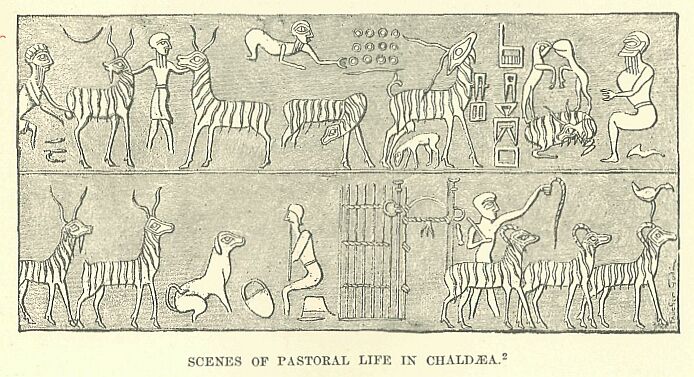
Drawn by Faucher-Gudin, from a Chaldæan intaglio from Layard. Another cylinder of the same kind is reproduced at p. 233 of the present work; it represents Etana arising to heaven by the aid of his friend the eagle, while the pastoral scene below resembles in nearly all particulars that given above.
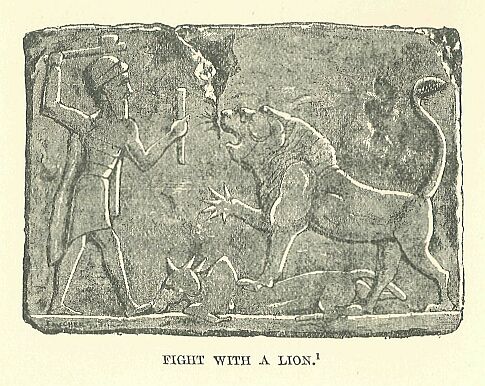
Drawn by Faucher-Gudin, from one of the terra-cotta tablets discovered by Loftus.
Fishing was not so much a pastime as a source of livelihood; for fish occupied a high place in the bill of fare of the common folk. Caught by the line, net, or trap, it was dried,in the sun, smoked, or salted. The chase was essentially the pastime of the great noble—the pursuit of the lion and the bear in the wooded covers or the marshy thickets of the river-bank; the pursuit of the gazelle, the ostrich, and bustard on the elevated plains or rocky tablelands of the desert. The onager of Mesopotamia is a very beautiful animal, with its grey glossy coat, and its lively and rapid action.
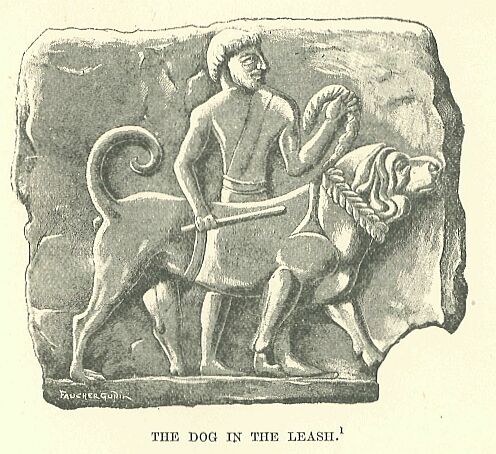
Drawn by Faucher-Gudin, from a terra-cotta tablet discovered by Sir H. Rawlinson in the ruins of Babylon, and now in the British Museum
Drawn by Faucher-Gudin, from one of the terra-cotta tablets discovered by Loftus.
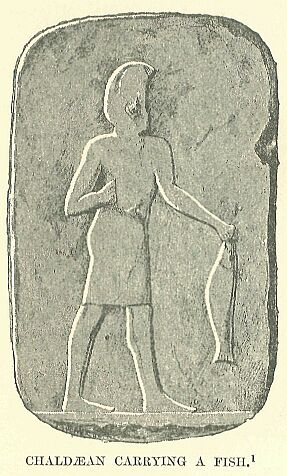
If it is disturbed, it gives forth a cry, kicks up its heels, and dashes off: when at a safe distance, it stops, turns round, and faces its pursuer: as soon as he approaches, it starts off again, stops, and takes to its heels again, continuing this procedure as long as it is followed. The Chaldæans found it difficult to catch by the aid of dogs, but they could bring it down by arrows, or perhaps catch it alive by stratagem. A running noose was thrown round its neck, and two men held the ends of the ropes. The animal struggled, made a rush, and attempted to bite, but its efforts tended only to tighten the noose still more firmly, and it at length gave in, half strangled; after alternating struggles and suffocating paroxysms, it became somewhat calmer, and allowed itself to be led. It was finally tamed, if not to the extent of becoming useful in agriculture, at least for the purposes of war: before the horse was known in Chaldæa, it was used to draw the chariot. The original habitat of the horse was the great table-lands of Central Asia: it is doubtful whether it was brought suddenly into the region of the Tigrus and Euphrates by some barbaric invasion, or whether it was passed on from tribe to tribe, and thus gradually reached that country. It soon became acclimatized, and its cross-breeding with the ass led for centuries to the production of magnificent mules. The horse was known to the kings of Lagash, who used it in harness. The sovereigns of neighbouring cities were also acquainted with it, but it seems to have been employed solely by the upper classes of society, and never to have been generally used in the war-chariot or as a charger in cavalry operations.
The Chaldæans carried agriculture to a high degree of perfection, and succeeded in obtaining from the soil everything it could be made to yield.
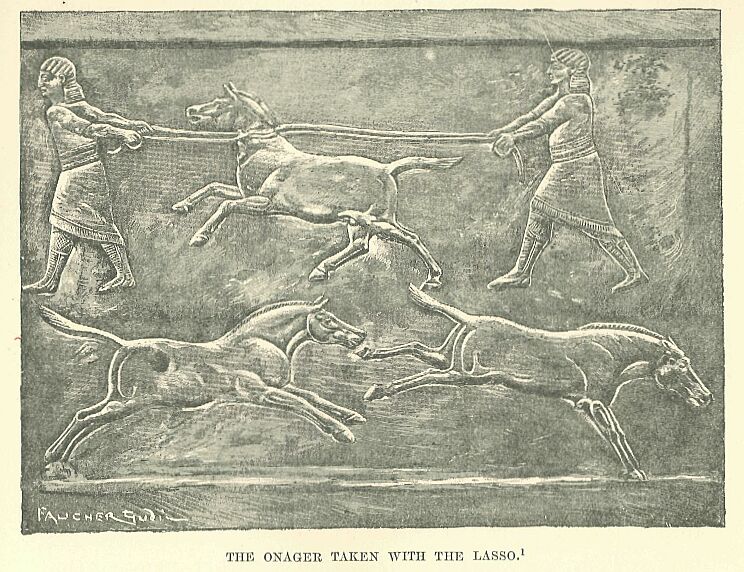
Drawn by Faucher-Gudin, from the Assyrian bas-relief of Nimrud. See p. 35 of the present work for an illustration of onagers pierced by arrows in the chase.
Their methods, transmitted in the first place to the Greeks, and afterwards to the Arabs, were perpetuated long after their civilization had disappeared, and were even practised by the people of Iraq under the Abbasside Caliphs. Agricultural treatises on clay, which contained an account of these matters, were deposited in one or other of the sacred libraries in which the priests of each city were long accustomed to collect together documents from every source on which they could lay their hands. There were to be found in each of these collections a certain number of works which were unique, either because the authors were natives of the city, or because all copies of them had been destroyed in the course of centuries—the Epic of Grilgames, for instance, at Uruk; a history of the Creation, and of the battles of the gods with the monsters at Kutha: all of them had their special collections of hymns or psalms, religious and magical formulas, their lists of words and grammatical phraseology, their glossaries and syllabaries, which enabled them to understand and translate texts drawn up in Sumerian, or to decipher those whose writing presented more than ordinary difficulty. In these libraries there was, we find, as in the inscriptions of Egypt, a complete literature, of which only some shattered fragments have come down to us. The little we are able to examine has produced upon our modern investigators a complex impression, in which astonishment rather than admiration contends with a sense of tedious-ness. There may be recognized here and there, among the wearisome successions of phrases, with their rugged proper names, episodes which seem something like a Chaldaean “Genesis” or “Veda;” now and then a bold flight of fancy, a sudden exaltation of thought, or a felicitous expression, arrests the attention and holds it captive for a time. In the narrative of the adventures of Grilgames, for instance, there is a certain nobility of character, and the sequence of events, in their natural and marvellous development, are handled with gravity and freedom: if we sometimes encounter episodes which provoke a smile or excite our repugnance, we must take into account the rudeness of the age with which they deal, and remember that the men and gods of the later Homeric epic are not a whit behind the heroes of Babylonian story in coarseness. The recognition of divine omnipotence, and the keenly felt afflictions of the soul, awakened in the Chaldæan psalmist feelings of adoration and penitence which still find, in spite of the differences of religion, an echo in our own hearts; and the unknown scribe, who related the story of the descent of Ishtar to the infernal regions, was able to express with a certain gloomy energy the miseries of the “Land without return. “These instances are to be regarded, however, as exceptional: the bulk of Chaldæan literature seems nothing more than a heap of pretentious trash, in which even the best-equipped reader can see no meaning, or, if he can, it is of such a character as to seem unworthy of record. His judgment is natural in the circumstances, for the ancient East is not, like Greece and Italy, the dead of yesterday whose soul still hovers around us, and whose legacies constitute more than the half of our patrimony: on the contrary, it was buried soul and body, gods and cities, men and circumstances, ages ago, and even its heirs, in the lapse of years, have become extinct. In proportion as we are able to bring its civilization to light, we become more and more conscious that we have little or nothing in common with it. Its laws and customs, its methods of action and its modes of thought, are so far apart from those of the present day, that they seem to us to belong to a humanity utterly different from our own. The names of its deities do not appeal to our imagination like those of the Olympian cycle, and no traditional respect serves to do away with the sense of uncouthness which we experience from the jingle of syllables which enter into them. Its artists did not regard the world from the same point of view as we do, and its writers, drawing their inspiration from an entirely different source, made use of obsolete methods to express their feelings and co-ordinate their ideas. It thus happens that while we understand to a shade the classical language of the Greeks and Romans, and can read their works almost without effort, the great primitive literatures of the world, the Egyptian and Chaldæan, have nothing to offer us for the most part but a sequence of problems to solve or of enigmas to unriddle with patience. How many phrases, how many words at which we stumble, require a painstaking analysis before we can make ourselves master of their meaning! And even when we have determined to our satisfaction their literal signification, what a number of excursions we must make in the domain of religious, ethical, and political history before we can compel them to render up to us their full import, or make them as intelligible to others as they are to ourselves! When so many commentaries are required to interpret the thought of an individual or a people, some difficulty must be experienced in estimating the value of the expression which they have given to it. Elements of beauty were certainly, and perhaps are still, within it; but in proportion as we clear away the rubbish which encumbers it, the mass of glossaries necessary to interpret it fall in and bury it so as to stifle it afresh.
While the obstacles to our appreciation of Chaldæann literature are of such a serious character, we are much more at home in our efforts to estimate the extent and depth of their scientific knowledge. They were as well versed as the Egyptians, but not more, in arithmetic and geometry in as far as these had an application to the affairs of everyday life: the difference between the two peoples consisted chiefly in their respective numerical systems—the Egyptians employing almost exclusively the decimal system of notation, while the Chaldæans combined its use with the duodecimal.
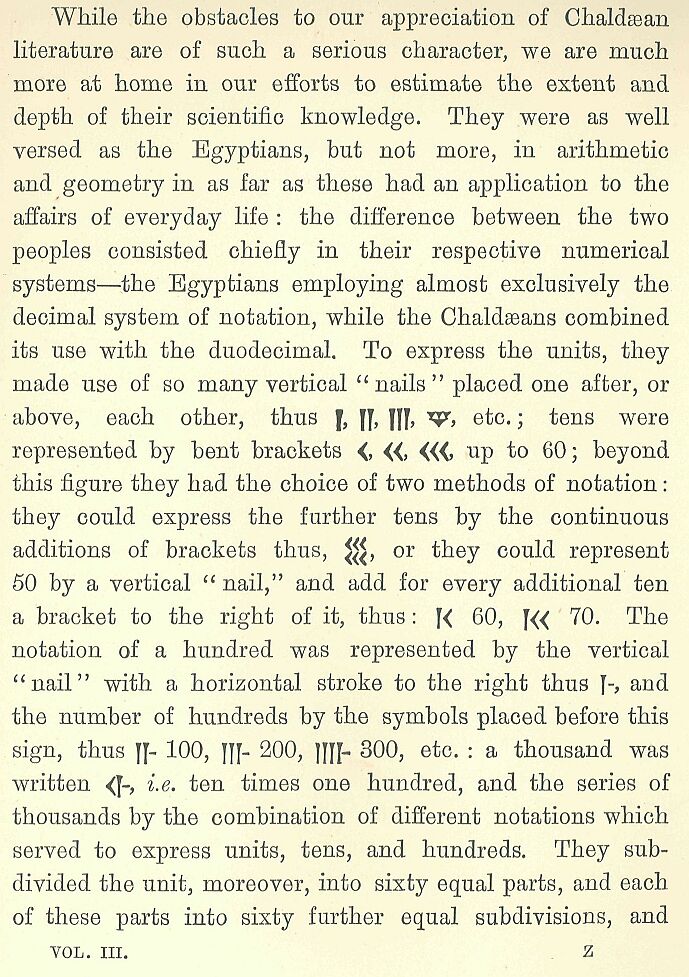
To express the units, they made use of so many vertical “nails” placed one after, or above, each other, thus [symbols] etc.; tens were represented by bent brackets [symbols], up to 60; beyond this figure they had the choice of two methods of notation: they could express the further tens by the continuous additions of brackets thus, [symbols] or they could represent 50 by a vertical “nail,” and add for every additional ten a bracket to the right of it, thus: [symbols]. The notation of a hundred was represented by the vertical “nail” with a horizontal stroke to the right thus [symbols], and the number of hundreds by the symbols placed before this sign, thus [symbols], etc.: a thousand was written [symbols] i.e. ten times one hundred, and the series of thousands by the combination of different notations which served to express units, tens, and hundreds. They subdivided the unit, moreover, into sixty equal parts, and each of these parts into sixty further equal subdivisions, and this system of fractions was used in all kinds of quantitive measurements. The fathom, the foot and its square, talents and bushels, the complete system of Chaldæan weights and measures, were based on the intimate alliance and parallel use of the decimal and duodecimal systems of notation. The sixtieth was more frequently employed than the hundredth when large quantities were in question: it was called a “soss,” and ten sosses were equal to a “ner,” while sixty ners were equivalent to a “sar;” the series, sosses, ners, and sars, being employed in all estimations of values. Years and measures of length were reckoned in sosses, while talents and bushels were measured in sosses and sars. The fact that these subdivisions were all divisible by 10 or 12, rendered calculations by means of them easy to the merchant and workmen as well as to the mathematical expert. The glimpses that we have been able to obtain up to the present of Chaldaean scientific methods indicate that they were on a low level, but they were sufficiently advanced to furnish practical rules for application in everyday affairs: helps to memory of different kinds, lists of figures with their names phonetically rendered in Sumerian and Semitic speech, tables of squares and cubes, and rudimentary formulas and figures for land-surveying, furnished sufficient instructions to enable any one to make complicated calculations in a ready manner, and to work out in figures, with tolerable accuracy, the superficial area of irregularly shaped plots of land. The Chaldaeans could draw out, with a fair amount of exactness, plans of properties or of towns, and their ambition impelled them even to attempt to make maps of the world. The latter were, it is true, but rough sketches, in which mythological beliefs vitiated the information which merchants and soldiers had collected in their journeys. The earth was represented as a disk surrounded by the ocean stream: Chaldæa took up the greater part of it, and foreign countries did not appear in it at all, or held a position out in the cold at its extremities. Actual knowledge was woven in an extraordinary manner with mystic considerations, in which the virtues of numbers, their connections with the gods, and the application of geometrical diagrams to the prediction of the future, played an important part. We know what a brilliant fortune these speculations attained in after-years, and the firm hold they obtained for centuries over Western nations, as formerly over the Bast. It was not in arithmetic and geometry alone, moreover, that the Chaldaeans were led away by such deceits: each branch of science in its turn was vitiated by them, and, indeed, it could hardly be otherwise when we come to consider the Chaldæan outlook upon the universe. Its operations, in their eyes, were not carried on under impersonal and unswerving laws, but by voluntary and rational agents, swayed by an inexorable fate against which they dared not rebel, but still free enough and powerful enough to avert by magic the decrees of destiny, or at least to retard their execution. From this conception of things each subordinate science was obliged to make its investigations in two perfectly distinct regions: it had at first to determine the material facts within its competence—such as the position of the stars, for instance, or the symptoms of a malady; it had then to discover the beings which revealed themselves through these material manifestations, their names and their characteristics. When once it had obtained this information, and could lay its hands upon them, it could compel them to work on its behalf: science was thus nothing else than the application of magic to a particular class of phenomena.
The number of astronomical facts with which the Chaldæans had made themselves acquainted was considerable.
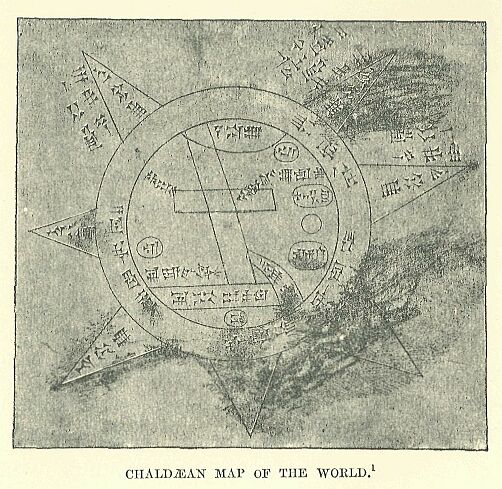
Drawn by Faucher-Gudin, from a sketch by Peiser.
It was a question in ancient times whether they or the Egyptians had been the first to carry their investigations into the infinite depths of celestial space: when it came to be a question as to which of the two peoples had made the greater progress in this branch of knowledge, all hesitation vanished, and the pre-eminence was accorded by the ancients to the priests of Babylon rather than to those of Heliopolis and Memphis.*
* Clement of Alexandria, Lucien, Diogenes Laertius, Macrobius, attribute the origin of astronomy to the Egyptians, and Diodorus Sioulus asserts that they were the teachers of the Babylonians; Josephus maintains, on the contrary, that the Egyptians were the pupils of the Chaldæans.
The Chaldaeans had conducted astronomical observations from remote antiquity.* Callisthenes collected and sent to his uncle Aristotle a number of these observations, of which the oldest had been made nineteen hundred and three years before his time—that is, about the middle of the twenty-third century before our era: he could have transcribed many of a still earlier date if the archives of Babylon had been fully accessible to him.
* Epigenes asserts that their observations extended back to 720,000 years before the time of Alexander, while Berossus and Critodemus limit their antiquity to 490,000 years, which was further reduced to 473,000 years by Diodorus, to 470,000 by Cicero, and to 270,000 by Hipparchus.
The Chaldæan priests had been accustomed from an early date to record on their clay tablets the aspect of the heavens and the changes which took place in them night after night, the appearance of the constellations, their comparative brilliancy, the precise moments of their rising and setting and culmination, together with the more or less rapid movements of the planets, and their motions towards or from one another. To their unaided eyes, sharpened by practice and favoured by the transparency of the air, many stars were visible, as to the Egyptians, which we can perceive only by the aid of the telescope. These thousands of brilliant bodies, scattered apparently at random over the face of the sky, moved, however, with perfect regularity, and the period between their departure from and their return to the same point in the heavens was determined at an early date: their position could be predicted at any hour, their course in the firmament being traced so accurately that its various stages were marked out and indicated beforehand. The moon, they discovered, had to complete two hundred and twenty-three revolutions of twenty-nine days and a half each, before it returned to the point from which it had set out. This period of its career being accomplished, it began a second of equal length, then a third, and so on, in an infinite series, during which it traversed the same celestial houses and repeated in them the same acts of its life: all the eclipses which it had undergone in one period would again afflict it in another, and would be manifest in the same places of the earth in the same order of time.* Whether they ascribed these eclipses to some mechanical cause, or regarded them as so many unfortunate attacks made upon Sin by the seven, they recognized their periodical character, and they were acquainted with the system of the two hundred and twenty-three lunations by which their occurrence and duration could be predicted. Further observations encouraged the astronomers to endeavour to do for the sun what they had so successfully accomplished in regard to the moon.
* This period of two hundred and twenty-three lunations is that described by Ptolemy in the fourth book of his “Astronomy,” in which he deals with the average motion of the moon. The Chaldæans seem not to have been able to make a skilful use of it, for their books indicate the occurrence of lunar eclipses outside the predicted periods.
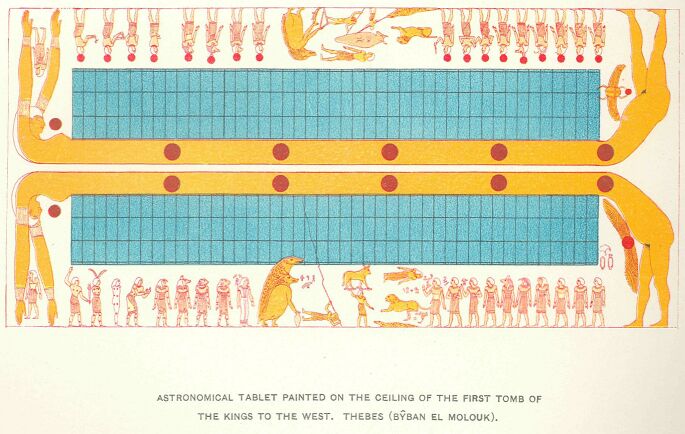
No long experience was needed to discover the fact that the majority of solar eclipses were followed some fourteen days and a half after by an eclipse of the moon; but they were unable to take sufficient advantage of this experience to predict with certainty the instant of a future eclipse of the sun, although they had been so struck with the connection of the two phenomena as to believe that they were in a position to announce it approximately.* They were frequently deceived in their predictions, and more than one eclipse which they had promised did not take place at the time expected:** but their successful prognostications were sufficiently frequent to console them for their failures, and to maintain the respect of the people and the rulers for their knowledge. Their years were vague years of three hundred and sixty days. The twelve equal months of which they were composed bore names which were borrowed, on the one hand, from events in civil life, such as “Simanu,” from the making of brick, and “Addaru,” from the sowing of seed, and, on the other, from mythological occurrences whose origin is still obscure, such as “Nisanu,” from the altar of Ea, and “Elul,” from a message of Ishtar. The adjustment of this year to astronomical demands was roughly carried out by the addition of a month every six years, which was called a second Adar, Blul, or Nisan, according to the place in which it was intercalated.
* Tannery is of opinion that the Chaldæans must have predicted eclipses of the sun by means of the period of two hundred and twenty-three lunations, and shows by what a simple means they could have arrived at it. ** An astronomer mentions, in the time of Assurbanipal, that on the 28th, 29th, and 30th of the month he prepared for the observation of an eclipse; but the sun continued brilliant, and the eclipse did not take place.
The neglect of the hours and minutes in their calculation of the length of the year became with them, as with the Egyptians, a source of serious embarrassment, and we are still ignorant as to the means employed to meet the difficulty. The months had relations to the signs of the zodiac, and the days composing them were made up of twelve double hours each. The Chaldæns had invented two instruments, both of them of a simple character, to measure time—the clepsydra and the solar clock, the latter of which in later times became the source of the Greek “polos.” The sun-dial served to determine a number of simple facts which were indispensable in astronomical calculations, such as the four cardinal points, the meridian of the place, the solstitial and equinoctial epochs, and the elevation of the pole at the position of observation. The construction of the sundial and clepsydra, if not of the polos also, is doubtless to be referred back to a very ancient date, but none of the texts already brought to light makes mention of the employment of these instruments.*
* Herodotus (ii. 109) formally attributes the invention of the sun-dial and polos to the Babylonians. The “polos” was a solar clock. It consisted of a concave hemisphere with a style rising from its centre: the shadow of the style described every day an arc of a circle parallel to the equator, and the daily parallels were divided into twelve or twenty-four equal parts. Smith discovered, in the palace of Sennacherib at Koyunjik, a portion of an astrolabe, which is now in the British Museum.
All these discoveries, which constitute in our eyes the scientific patrimony of the Chaldæans, were regarded by themselves as the least important results of their investigations. Did they not know, thanks to these investigations, that the stars shone for other purposes than to lighten up the nights—to rule, in fact, the destinies of men and kings, and, in ruling that of kings, to determine the fortune of empires? Their earliest astronomers, by their assiduous contemplation of the nightly heavens, had come to the conclusion that the vicissitudes of the heavenly bodies were in fixed relations with mundane phenomena and events. If Mercury, for instance, displayed an unusual brilliancy at his rising, and his disk appeared as a two-edged sword, riches and abundance, due to the position of the luminous halo which surrounded him, would be scattered over Chaldæa, while discords would cease therein, and justice would triumph over iniquity. The first observer who was struck by this coincidence noted it down; his successors confirmed his observations, and at length deduced, in the process of the years, from their accumulated knowledge, a general law. Henceforward, each time that Mercury assumed the same aspect it was of favourable augury, and kings and their subjects became the recipients of his bounty. As long as he maintained this appearance no foreign ruler could install himself in Chaldæa, tyranny would be divided against itself, equity would prevail, and a strong monarch bear sway; while the landholders and the king would be confirmed in their privileges, and obedience, together with tranquillity, would rule everywhere in the land. The number of these observations increased to such a degree that it was found necessary to classify them methodically to avoid confusion. Tables of them were drawn up, in which the reader could see at one and the same moment the aspect of the heavens on such and such a night and hour, and the corresponding events either then happening, or about to happen, in Chaldæan, Syria, or some foreign land. If, for instance, the moon displayed the same appearance on the 1st and 27th of the month, Elam was threatened; but “if the sun, at his setting, appears double his usual size, with three groups of bluish rays, the King of Chaldæa is ruined.” To the indications of the heavenly bodies, the Chaldæans added the portents which could be deduced from atmospheric phenomena: if it thundered on the 27th of Tammuz, the wheat-harvest would be excellent and the produce of the ears magnificent; but if this, should occur six days later, that is, on the 2nd of Abu, floods and rains were to be apprehended in a short time, together with the death of the king and the division of his empire. It was not for nothing that the sun and moon surrounded themselves in the evening with blood-red vapours or veiled themselves in dark clouds; that they grew suddenly pale or red after having been intensely bright; that unexpected fires blazed out on the confines of the air, and that on certain nights the stars seemed to have become detached from the firmament and to be falling upon the earth. These prodigies were so many warnings granted by the gods to the people and their kings before great crises in human affairs: the astronomer investigated and interpreted them, and his predictions had a greater influence than we are prepared to believe upon the fortunes of individuals and even of states. The rulers consulted and imposed upon the astronomers the duty of selecting the most favourable moment for the execution of the projects they had in view. From an early date each temple contained a library of astrological writings, where the people might find, drawn up as in a. code, the signs which bore upon their destinies. One of these libraries, consisting of not less than seventy clay tablets, is considered to have been first drawn up in the reign of Sargon of Agadê, but to have been so modified and enriched with new examples from time to time that the original is well-nigh lost. This was the classical work on the subject in the VIIth century before our era, and the astronomers-royal, to whom applications were accustomed to be made to explain a natural phenomenon or a prodigy, drew their answers ready-made from it. Astronomy, as thus understood, was not merely the queen of sciences, it was the mistress of the world: taught secretly in the temples, its adepts—at least, those who had passed through the regular curriculum of study which it required—became almost a distinct class in society. The occupation was a lucrative one, and its accomplished professors had numerous rivals whose educational antecedents were unknown, but who excited the envy of the experts in their trading upon the credulity of the people. These quacks went about the country drawing up horoscopes, and arranging schemes of birthday prognostications, of which the majority were without any authentic warranty. The law sometimes took note of the fact that they were competing with the official experts, and interfered with their business: but if they happened to be exiled from one city, they found some neighbouring one ready to receive them.
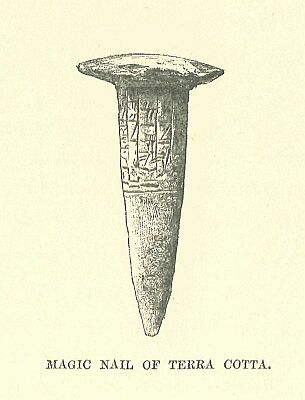
Chaldæa abounded with soothsayers and necromancers no less than with astrologers; she possessed no real school of medicine, such as we find in Egypt, in which were taught rational methods of diagnosing maladies and of curing them by the use of simples. The Chaldaeans were content to confide the care of their bodies to sorcerers and exorcists, who were experts in the art of casting out demons and spirits, whose presence in a living being brought about those disorders to which humanity is prone. The facial expression of the patient during the crisis, the words which escaped from him in delirium, were, for these clever individuals, so many signs revealing the nature and sometimes the name of the enemy to be combated—the Fever-god, the Plague-god, the Headache-god. Consultations and medical treatment were, therefore, religious offices, in which were involved purifications, offerings, and a whole ritual of mysterious words and gestures. The magician lighted a fire of herbs and sweet-smelling plants in front of his patient, and the clear flame arising from this put the spectres to flight and dispelled the malign influences, a prayer describing the enchantments and their effects being afterwards recited. “The baleful imprecation like a demon has fallen upon a man;—wail and pain have fallen upon him,—direful wail has fallen upon him,—the baleful imprecation, the spell, the pains in the head!—This man, the baleful imprecation slaughters him like a sheep,—for his god has quitted his body—his goddess has withdrawn herself in displeasure from him,—a wail of pain has spread itself as a garment upon him and has overtaken him!” The harm done by the magician, though terrible, could be repaired by the gods, and Merodach was moved to compassion betimes. Merodach cast his eyes on the patient, Merodach entered into the house of his father Ea, saying: “My father, the baleful curse has fallen like a demon upon the man!” Twice he thus speaks, and then adds: “What this man ought to do, I know not; how shall he be healed?” Ea replies to his son Merodach: “My son, what is there that I could add to thy knowledge?—Merodach, what is there that I could add to thy knowledge?—That which I know, thou knowest it:—go then, my son, Merodach,—lead him to the house of purification of the god who prepares remedies,—and break the spell that is upon him, draw away the charm which is upon him,—the ill which afflicts his body,—which he suffers by reason of the curse of his father,—or the curse of his mother,—or the curse of his eldest brother,—or by the curse of a murderess who is unknown to the man.—The curse, may it be taken from him by the charm of Ea,—like a clove of garlic which is stripped skin by skin,—like a cluster of dates may it be cut off,—like a bunch of flowers may it be uprooted! The spell, may heaven avert it,—may the earth avert it!” The god himself deigned to point out the remedy: the sick man was to take a clove of garlic, some dates, and a stalk bearing flowers, and was to throw them into the fire, bit by bit, repeating appropriate prayers at each stage of the operation. “In like manner as this garlic is peeled and thrown into the fire,—and the burning flame consumes it,—as it will never be planted in the vegetable garden, it will never draw moisture from the pond or from the ditch,—its root will never again spread in the earth,—its stalk will not pierce the ground and behold the sun,—it will not serve as food for the gods or the king,—so may it remove the baleful curse, so may it loose the bond—of sickness, of sin, of shortcomings, of perversity, of crime!—The sickness which is in my body, in my flesh, in my muscles,—like this garlic may it be stripped off,—and may the burning flame consume it in this day;—may the spell of the sorcerer be cast out, that I may behold the light!” The ceremony could be prolonged at will: the sick person pulled to pieces the cluster of dates, the bunch of flowers, a fleece of wool, some goats’ hair, a skein of dyed thread, and a bean, which were all in turn consumed in the fire. At each stage of the operation he repeated the formula, introducing into it one or two expressions characterizing the nature of the particular offering; as, for instance, “the dates will no more hang from their stalks, the leaves of the branch will never again be united to the tree, the wool and the hair will never again lie on the back of the animal on which they grew, and will never be used for weaving garments.” The use of magical words was often accompanied by remedies, which were for the most part both grotesque and disgusting in their composition: they comprised bitter or stinking wood-shavings, raw meat, snake’s flesh, wine and oil, the whole reduced to a pulp, or made into a sort of pill and swallowed on the chance of its bringing relief. The Egyptian physicians employed similar compounds, to which they attributed wonderful effects, but they made use of them in exceptional circumstances only. The medical authorities in Chaldæa recommended them before all others, and their very strangeness reassured the patient as to their efficacy: they filled the possessing spirits with disgust, and became a means of relief owing to the invincible horror with which they inspired the persecuting demons. The Chaldæans were not, however, ignorant of the natural virtues of herbs, and at times made use of them; but they were not held in very high esteem, and the physicians preferred the prescriptions which pandered to the popular craving for the supernatural. Amulets further confirmed the effect produced by the recipes, and prevented the enemy, once cast out, from re-entering the body; these amulets were made of knots of cord, pierced shells, bronze or terra-cotta statuettes, and plaques fastened to the arms or worn round the neck. On each of the latter kind were roughly drawn the most terrible images that they could conceive, a shortened incantation was scrawled on its surface, or it was covered with extraordinary characters, which when the spirits perceived they at once took flight, and the possessor of the talisman escaped the threatened illness.
However laughable, and at the same time deplorable, this hopeless medley of exact knowledge and gross superstition may appear to us at the present day, it was the means of bringing a prosperity to the cities of Chaldæa which no amount of actual science would ever have produced. The neighbouring barbaric peoples were imbued with the same ideas as the Chaldæns regarding the constitution of the world and the nature of the laws which governed it. They lived likewise in perpetual fear of those invisible beings whose changeable and arbitrary will actuated all visible phenomena; they attributed all the reverses and misfortunes which overtook them to the direct action of these malevolent beings; they believed firmly in the influence of stars on the course of events; they were constantly on the look out for prodigies, and were greatly alarmed by them, since they had no certain knowledge of the number and nature of their enemies, and the means they had invented for protecting themselves from them or of overcoming them too often proved inefficient. In the eyes of these barbarians, the Chaldeans seemed to be possessed of the very powers which they themselves lacked. The magicians of Chaldæa had forced the demons to obey them and to unmask themselves before them; they read with ease in the heavens the present and future of men and nations; they interpreted the will of the immortals in its smallest manifestations, and with them this faculty was not a limited and ephemeral power, quickly exhausted by use: the rites and formulas known to them enabled them to exercise it freely at all times, in all places, alike upon the most exalted of the gods and the most dreaded of mortals, without its ever becoming weakened.
Drawn by Faucher-Gudin, from a sketch by Loftus. The original is in the British Museum.
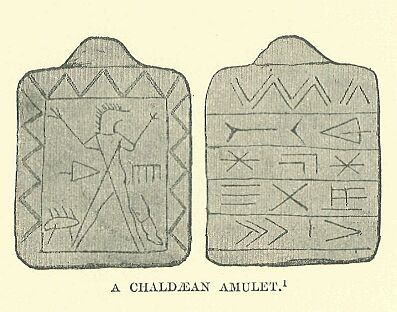
A race so endowed with wisdom was, indeed, destined to triumph over its neighbours, and the latter would have no chance of resisting such a nation unless they borrowed from it its manners, customs, industry, writing, and all the arts and sciences which had brought about their superiority. Chaldæann civilization spread into Elam and took possession of the inhabitants of the shores of the Persian Gulf, and then, since its course was impeded on the south by the sea, on the west by the desert, and on the east by the mountains, it turned in the direction of the great northern plains and proceeded up the two rivers, beside whose lower waters it had been cradled. It was at this very time that the Pharaohs of the XIIIth dynasty had just completed the conquest of Nubia. Greater Egypt, made what she was by the efforts of twenty generations, had become an African power. The sea formed her northern boundary, the desert and the mountains enclosed her on all sides, and the Nile appeared the only natural outlet into a new world: she followed it indefatigably from one cataract to another, colonizing as she passed all the lands fertilized by its waters. Every step which she made in this direction increased the distance between her capitals and the Mediterranean, and brought her armies further south. Asia would have practically ceased to exist, as far as Egypt was concerned, had not the repeated incursions of the Bedouin obliged her to make advances from time to time in that direction; still she crossed the frontier as seldom as possible, and recalled her troops as soon as they had reduced the marauders to order: Ethiopia alone attracted her, and it was there that she firmly established her empire. The two great civilized peoples of the ancient world, therefore, had each their field of action clearly marked out, and neither of them had ever ventured into that of the other. There had been no lack of intercourse between them, and the encounter of their armies, if it ever really had taken place, had been accidental, had merely produced passing results, and up till then had terminated without bringing to either side a decisive advantage.