Volume 1 — THE NILE AND EGYPT (continued 2)
M. L. McClure translation
* The wooden club most commonly represented is the usual insignia of a nobleman. Several kinds of clubs, somewhat difficult for us moderns to distinguish, yet bearing different names, formed a part of funereal furniture. ** The crook is the sceptre of a prince, a Pharaoh, or a god; the white mace has still the value apparently of a weapon in the hands of the king who brandishes it over a group of prisoners or over an ox which he is sacrificing to a divinity. Most museums possess specimens of the stone heads of these maces, but until lately their use was not known. I had several placed in the Boulak Museum. It already possessed a model of one entirely of wood. *** Cf. the description of these pools given by Geoffroy- Saint-Hilaire in speaking of the fahaka. Even at the present day the jackals come down from the mountains in the night, and regale themselves with the fish left on the ground by the gradual drying up of these ponds.
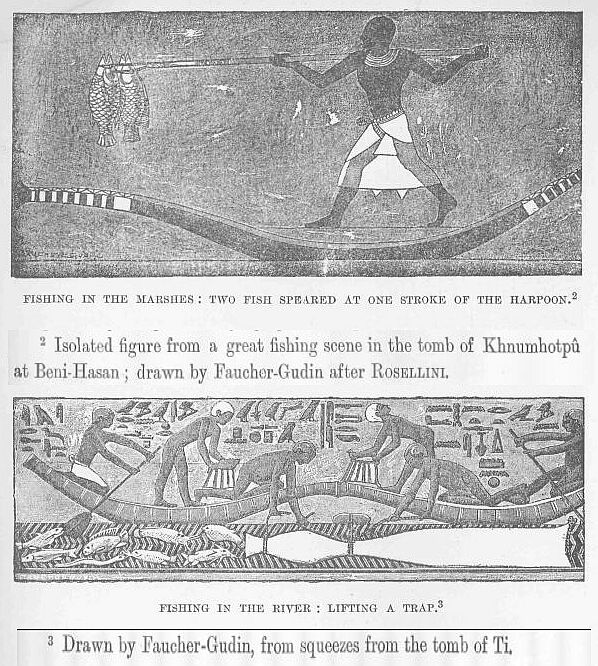
Other pools, however, remained till the returning inundation, as so many vivaria in which the fish were preserved for dwellers on the banks. Fishing with the harpoon, made either of stone or of metal, with the line, with a net or with traps, were all methods of fishing known and used by the Egyptians from early times. Where the ponds failed, the neighbouring Nile furnished them with inexhaustible supplies. Standing in light canoes, or rather supported by a plank on bundles of reeds bound together, they ventured into mid-stream, in spite of the danger arising from the ever-present hippopotamus; or they penetrated up the canals amid a thicket of aquatic plants, to bring down with the boomerang the birds which found covert there.
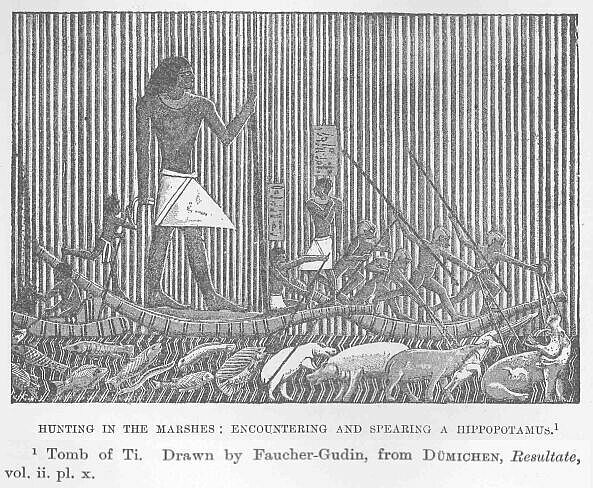
1 Tomb of Ti. Drawn by Faucher-Gudin, from Dûmichen, Besultate, vol. ii. pl. x.
The fowl and fish which could not be eaten fresh, were dried, salted, or smoked, and kept for a rainy day. Like the river, the desert had its perils and its resources. Only too frequently, the lion, the leopard, the panther, and other large felidse were met with there.
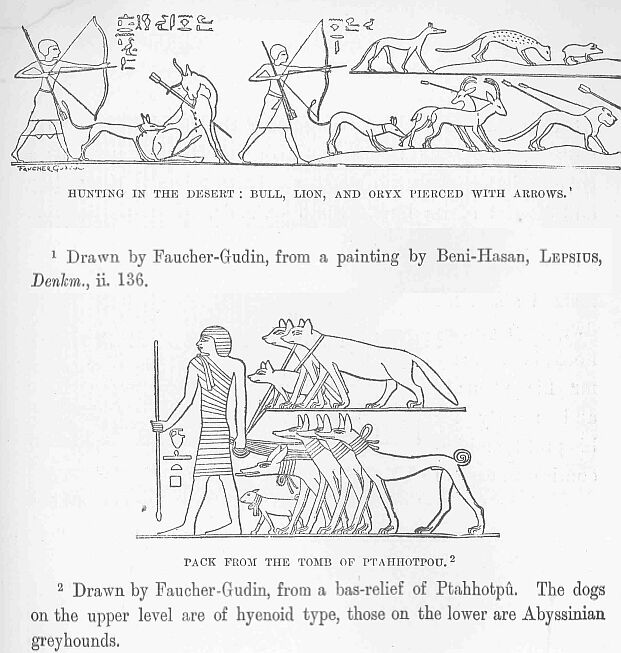
1 Drawn by Faucher-Gudin, from a painting by Beni-Hasan, Lepsius, Denhm., ii. 136. 2 Drawn by Faucher-Gudin, from a bas-relief of Ptahhotpû. The dogs on the upper level are of hyenoid type, those on the lower are Abyssinian greyhounds.
The nobles, like the Pharaohs of later times, deemed it as their privilege or duty to stalk and destroy these animals, pursuing them even to their dens. The common people preferred attacking the gazelle, the oryx, the mouflon sheep, the ibex, the wild ox, and the ostrich, but did not disdain more humble game, such as the porcupine and long-eared hare: nondescript packs, in which the jackal and the hyena ran side by side with the wolf-dog and the lithe Abyssinian greyhound, scented and retrieved for their master the prey which he had pierced with his arrows. At times a hunter, returning with the dead body of the mother, would be followed by one of her young; or a gazelle, but slightly wounded, would be taken to the village and healed of its hurt.
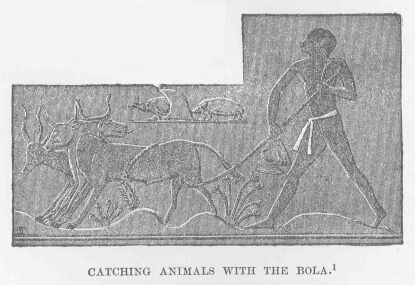
1 Drawn by Faucher-Gudin, from a bas-relief of Ptahhotpû. Above are seen two porcupines, the foremost of which, emerging from his hole, has seized a grasshopper.
Such animals by daily contact with man, were gradually tamed, and formed about his dwelling a motley flock, kept partly for his pleasure and mostly for his profit, and becoming in case of necessity a ready stock of provisions.[**]
** In the same way, before the advent of Europeans, the half-civilized tribes of North America used to keep about their huts whole flocks of different animals, which were tame, but not domesticated.
Efforts were therefore made to enlarge this flock, and the wish to procure animals without seriously injuring them, caused the Egyptians to use the net for birds and the lasso and the bola for quadrupeds,[*]—weapons less brutal than the arrow and the javelin. The bola was made by them of a single rounded stone, attached to a strap about five yards in length. The stone once thrown, the cord twisted round the legs, muzzle, or neck of the animal pursued, and by the attachment thus made the pursuer, using all his strength, was enabled to bring the beast down half strangled. The lasso has no stone attached to it, but a noose prepared beforehand, and the skill of the hunter consists in throwing it round the neck of his victim while running. They caught indifferently, without distinction of size or kind, all that chance brought within their reach. The daily chase kept up these half-tamed flocks of gazelles, wild goats, water-bucks, stocks, and ostriches, and their numbers are reckoned by hundreds on the monuments of the ancient empire.[**]
* Hunting with the bola is constantly represented in the paintings both of the Memphite and Theban periods. Wilkinson has confounded it with lasso-hunting, and his mistake has been reproduced by other Egyptologists. Lasso-hunting is seen in Lepsius, Denhn., ii. 96, in Dùmichen, resultate, vol. i. pl. viii., and particularly in the numerous sacrificial scenes where the king is supposed to be capturing the bull of the north or south, previous to offering it to the god. ** As the tombs of the ancient empire show us numerous flocks of gazelles, antelopes, and storks, feeding under the care of shepherds, Fr. Lenormant concluded that the Egyptians of early times had succeeded in domesticating some species, nowadays rebels to restraint. It is my belief that the animals represented were tamed, but not domesticated, and were the result of great hunting expeditions in the desert. The facts which Lenormant brought forward to support his theory may be used against him. For instance, the fawn of the gazelle nourished by its mother does not prove that it was bred in captivity; the gazelle may have been caught before calving, or just after the birth of its young. The fashion of keeping flocks of animals taken from the desert died out between the XIIth and XVIIIth dynasties. At the time of the new empire, they had only one or two solitary animals as pets for women or children, the mummies of which were sometimes buried by the side of their mistresses.
Experience alone taught the hunter to distinguish between those species from which he could draw profit, and others whose wildness made them impossible to domesticate. The subjection of the most useful kinds had not been finished when the historic period opened.
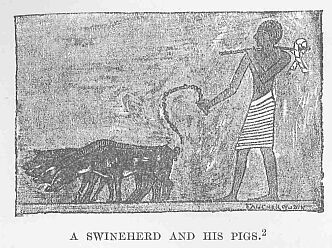
2 Drawn by Faucher-Gudin, from a painting in a Theban tomb of the XVIIIth dynasty.
The ass, the sheep, and the goat were already domesticated, but the pig was still out in the marshes in a semi-wild state, under the care of special herdsmen,[*] and the religious rites preserved the remembrance of the times in which the ox was so little tamed, that in order to capture while grazing the animals needed for sacrifice or for slaughter, it was necessary to use the lasso.[***]
* The hatred of the Egyptians for the pig (Herodotus, ii. 47) is attributed to mythological motives. Lippert thinks this antipathy did not exist in Egypt in primitive times. At the outset the pig would have been the principal food of the people; then, like the dog in other regions, it must have been replaced at the table by animals of a higher order— gazelles, sheep, goats, oxen—and would have thus fallen into contempt. To the excellent reasons given by Lippert could be added others drawn from the study of the Egyptian myths, to prove that the pig has often been highly esteemed. Thus, Isis is represented, down to late times, under the form of a sow, and a sow, whether followed or not by her young is one of the amulets placed in the tomb with the deceased, to secure for him the protection of the goddess. *** Mariette, Abydos (vol. i. pl. 48 b, 53). To prevent the animal from evading the lasso and escaping during the sacrifice, its right hind foot was fastened to its left horn.
Europeans are astonished to meet nowadays whole peoples who make use of herbs and plants whose flavour and properties are nauseating to us: these are mostly so many legacies from a remote past; for example, castor-oil, with which the Berbers rub their limbs, and with which the fellahîn of the Saïd flavour their bread and vegetables, was preferred before all others by the Egyptians of the Pharaonic age for anointing the body and for culinary use.[*] They had begun by eating indiscriminately every kind of fruit which the country produced. Many of these, when their therapeutic virtues had been learned by experience, were gradually banished as articles of food, and their use restricted to medicine; others fell into disuse, and only reappeared at sacrifices, or at funeral feasts; several varieties continue to be eaten to the present time—the acid fruits of the nabeca and of the carob tree, the astringent figs of the sycamore, the insipid pulp of the dam-palm, besides those which are pleasant to our Western palates, such as the common fig and the date. The vine flourished, at least in Middle and Lower Egypt; from time immemorial the art of making wine from it was known, and even the most ancient monuments enumerate half a dozen famous brands, red or white.[**]
* I have often been obliged, from politeness, when dining with the native agents appointed by the European powers at Port Saïd, to eat salads and mayonnaise sauces flavoured with castor-oil; the taste was not so disagreeable as might be at first imagined. ** The four kinds of canonical wine, brought respectively from the north, south, east, and west of the country, formed part of the official repast and of the wine-cellar of the deceased from remote antiquity.
Vetches, lupins, beans, chick-peas, lentils, onions, fenugreek,[*] the bamiâ,[**] the meloukhia,[***] the arum colocasia, all grew wild in the fields, and the river itself supplied its quota of nourishing plants.
* All these species have been found in the tombs and identified by savants in archaeological botany—Kunth, Unger, Schweinfurth (Loret, La Flore Pharaonique, pp. 17, 40, 42, 43, Nos. 33, 97, 102, 104, 105, 106). ** The bamiâ, Hibiscus esculentus, L., is a plant of the family of the Malvaceae, having a fruit of five divisions, covered with prickly hairs, and pontaining round, white, soft seeds, slightly sweet, but astringent in taste, and very mucilaginous. It figures on the monuments of Pharaonic times. *** The meloukhia, Corchorus Olitorius, L., is a plant belonging to the Tilliacese, which is chopped up and cooked much the same as endive is with us, but which few Europeans can eat with pleasure, owing to the mucilage it contains. Theophrastus says it was celebrated for its bitterness; it was used as food, however, in the Greek town of Alexandria.
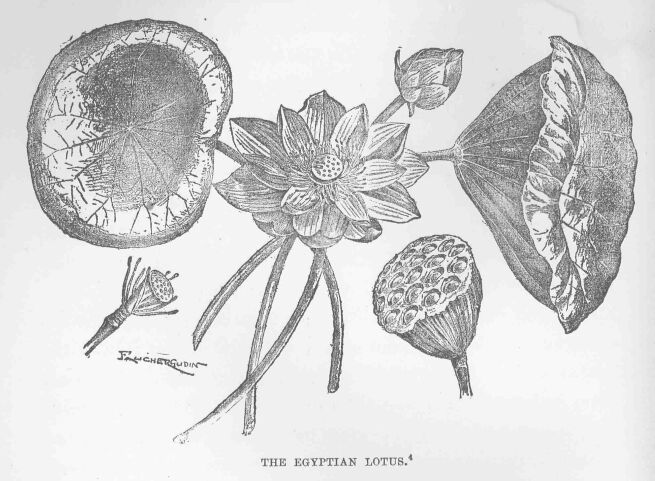
4 Drawn by Faucher-Gudin from the Description de l'Egypte, Histoire Naturelle, pl. 61.
Two of the species of lotus which grew in the Nile, the white and the blue, have seed-vessels similar to those of the poppy: the capsules contain small grains of the size of millet-seed. The fruit of the pink lotus "grows on a different stalk from that of the flower, and springs directly from the root; it resembles a honeycomb in form," or, to take a more prosaic simile, the rose of a watering-pot. The upper part has twenty or thirty cavities, "each containing a seed as big as an olive stone, and pleasant to eat either fresh or dried." This is what the ancients called the bean of Egypt. "The yearly shoots of the papyrus are also gathered. After pulling them up in the marshes, the points are cut off and rejected, the part remaining being about a cubit in length. It is eaten as a delicacy and is sold in the markets, but those who are fastidious partake of it only after baking." Twenty different kinds of grain and fruits, prepared by crushing between two stones, are kneaded and baked to furnish cakes or bread; these are often mentioned in the texts as cakes of nabeca, date cakes, and cakes of figs. Lily loaves, made from the roots and seeds of the lotus, were the delight of the gourmand, and appear on the tables of the kings of the XIXth dynasty.[*]
* Tiû, which is the most ancient word for bread, appears in early times to have been used for every kind of paste, whether made with fruits or grain; the more modern word âqû applies specially to bread made from cereals. The lily loaves are mentioned in the Papyrus Anastasi, No. 4, p. 14. 1. 1.
Bread and cakes made of cereals formed the habitual food of the people. Durrah is of African origin; it is the "grain of the South" of the inscriptions. On the other hand, it is supposed that wheat and six-rowed barley came from the region of the Euphrates. Egypt was among the first to procure and cultivate them.[*] The soil there is so kind to man, that in many places no agricultural toil is required.
* The position which wheat and barley occupy in the lists of offerings, proves the antiquity of their existence in Egypt. Mariette found specimens of barley in the tombs of the Ancient Empire at Saqqarah.
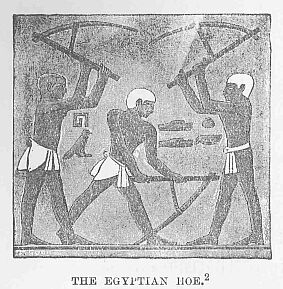
2 Bas-relief from the tomb of Ti; drawn by Faucher-Gudin, from a photograph by Emil Brugsch-Bey.
As soon as the water of the Nile retires, the ground is sown without previous preparation, and the grain, falling straight into the mud, grows as vigorously as in the best-ploughed furrows. Where the earth is hard it is necessary to break it up, but the extreme simplicity of the instruments with which this was done shows what a feeble resistance it offered. For a long time the hoe sufficed. It was composed either of a large stone tied to a wooden handle, or was made of two pieces of wood of unequal length, united at one of their extremities, and held together towards the middle by a slack cord: the plough, when first invented was but a slightly enlarged hoe, drawn by oxen. The cultivation of cereals, once established on the banks of the Nile, developed, from earliest times, to such a degree as to supplant all else: hunting, fishing, the rearing of cattle, occupied but a secondary place compared with agriculture, and Egypt became, that which she still remains, a vast granary of wheat. The part of the valley first cultivated was from Gebel Silsileh to the apex of the Delta.[*]
* This was the tradition of all the ancients. Herodotus related that, according to the Egyptians, the whole of Egypt, with the exception of the Theban nome, was a vast swamp previous to the time of Menés. Aristotle adds that the Red Sea, the Mediterranean, and the area now occupied by the Delta, formed one sea. Cf. pp. 3-5 of this volume, on the formation of the Delta.
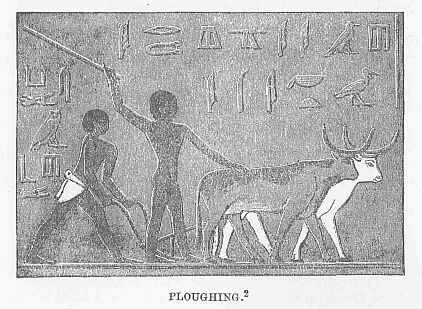
2 Bas-relief from the tomb of Ti; drawn by Faucher-Gudin, from a photograph by Emil Brugsch-Bey.
Between the Libyan and Arabian ranges it presents a slightly convex surface, furrowed lengthways by a depression, in the bottom of which the Nile is gathered and enclosed when the inundation is over. In the summer, as soon as the river had risen higher than the top of its banks, the water rushed by the force of gravity towards the lower lands, hollowing in its course long channels, some of which never completely dried up, even when the Nile reached its lowest level.[*] Cultivation was easy in the neighbourhood of these natural reservoirs, but everywhere else the movements of the river were rather injurious than advantageous to man. The inundation scarcely ever covered the higher ground in the valley, which therefore remained unproductive; it flowed rapidly over the lands of medium elevation, and moved so sluggishly in the hollows that they became weedy and stagnant pools.[**]
* The whole description of the damage which can be done by the Nile in places where the inundation is not regulated, is borrowed from Linant de Bellefonds, Mémoire sur les principaux travaux d'utilité publique, p. 3. ** This physical configuration of the country explains the existence at a very early date of those gigantic serpents which I have already mentioned.
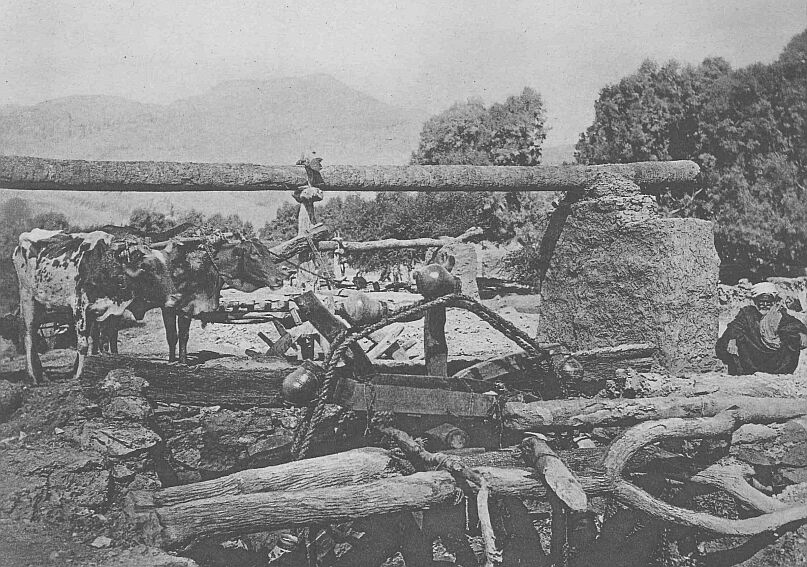
In any year the portion not watered by the river was invaded by the sand: from the lush vegetation of a hot country, there was but one step to absolute aridity. At the present day an ingeniously established system of irrigation allows the agriculturist to direct and distribute the overflow according to his needs. From Gebel Ain to the sea, the Nile and its principal branches are bordered by long dykes, which closely follow the windings of the river and furnish sufficiently stable embankments. Numerous canals lead off to right and left, directed more or less obliquely towards the confines of the valley; they are divided at intervals by fresh dykes, starting at the one side from the river, and ending on the other either at the Bahr Yusuf or at the rising of the desert. Some of these dykes protect one district only, and consist merely of a bank of earth; others command a large extent of territory, and a breach in them would entail the ruin of an entire province. These latter are sometimes like real ramparts, made of crude brick carefully cemented; a few, as at Qosheish, have a core of hewn stones, which later generations have covered with masses of brickwork, and strengthened with constantly renewed buttresses of earth. They wind across the plain with many unexpected and apparently aimless turns; on closer examination, however, it may be seen that this irregularity is not to be attributed to ignorance or caprice. Experience had taught the Egyptians the art of picking out, upon the almost imperceptible relief of the soil, the easiest lines to use against the inundation: of these they have followed carefully the sinuosities, and if the course of the dykes appears singular, it is to be ascribed to the natural configuration of the ground. Subsidiary embankments thrown up between the principal ones, and parallel to the Nile, separate the higher ground bordering the river from the low lands on the confines of the valley; they divide the larger basins into smaller divisions of varying area, in which the irrigation is regulated by means of special trenches. As long as the Nile is falling, the dwellers on its banks leave their canals in free communication with it; but they dam them up towards the end of the winter, just before the return of the inundation, and do not reopen them till early in August, when the new flood is at its height. The waters then flowing in by the trenches are arrested by the nearest transverse dyke and spread over the fields. When they have stood there long enough to saturate the ground, the dyke is pierced, and they pour into the next basin until they are stopped by a second dyke, which in its turn forces them again to spread out on either side. This operation is renewed from dyke to dyke, till the valley soon becomes a series of artificial ponds, ranged one above another, and flowing one into another from Grebel Silsileh to the apex of the Delta. In autumn, the mouth of each ditch is dammed up anew, in order to prevent the mass of water from flowing back into the stream. The transverse dykes, which have been cut in various places, are also repaired, and the basins become completely landlocked, separated by narrow causeways. In some places, the water thus imprisoned is so shallow that it is soon absorbed by the soil; in others, it is so deep, that after it has been kept in for several weeks, it is necessary to let it run off into a neighbouring depression, or straight into the river itself.
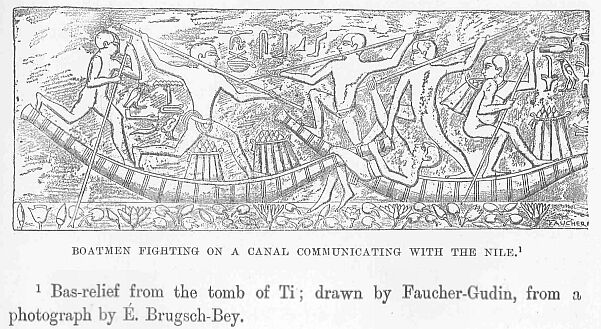
1 Bas-relief from the tomb of Ti; drawn by Faucher-Gudin, from a photograph by E. Brugsch-Bey.
History has left us no account of the vicissitudes of the struggle in which the Egyptians were engaged with the Nile, nor of the time expended in bringing it to a successful issue. Legend attributes the idea of the system and its partial working out to the god Osiris: then Menés, the first mortal king, is said to have made the dyke of Qosheish, on which depends the prosperity of the Delta and Middle Egypt, and the fabulous Mceris is supposed to have extended the blessings of the irrigation to the Fayûm. In reality, the regulation of the inundation and the making of cultivable land are the work of unrecorded generations who peopled the valley. The kings of the historic period had only to maintain and develop certain points of what had already been done, and Upper Egypt is to this day chequered by the network of waterways with which its earliest inhabitants covered it. The work must have begun simultaneously at several points, without previous agreement, and, as it were, instinctively. A dyke protecting a village, a canal draining or watering some small province, demanded the efforts of but few individuals; then the dykes would join one another, the canals would be prolonged till they met others, and the work undertaken by chance would be improved, and would spread with the concurrence of an ever-increasing population. What happened at the end of last century, shows us that the system grew and was developed at the expense of considerable quarrels and bloodshed. The inhabitants of each district carried out the part of the work most conducive to their own interest, seizing the supply of water, keeping it and discharging it at pleasure, without considering whether they were injuring their neighbours by depriving them of their supply or by flooding them; hence arose perpetual strife and fighting. It became imperative that the rights of the weaker should be respected, and that the system of distribution should be co-ordinated, for the country to accept a beginning at least of social organization analogous to that which it acquired later: the Nile thus determined the political as well as the physical constitution of Egypt.
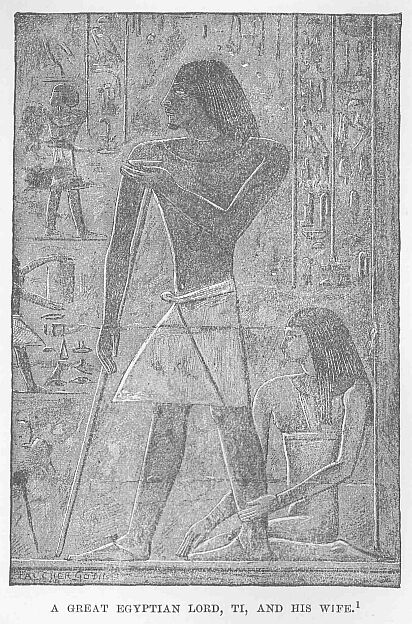
1 Drawn by Faucher-Gudin, from a photograph by Dûmichen, Resultate, vol. ii. pl. vit
The country was divided among communities, whose members were supposed to be descended from the same seed (paît) and to belong to the same family (pâîtû): the chiefs of them were called ropâîtû, the guardians, or pastors of the family, and in later times their name became a title applicable to the nobility in general. Families combined and formed groups of various importance under the authority of a head chief—ropâîtû-hâ. They were, in fact, hereditary lords, dispensing justice, levying taxes in kind on their subordinates, reserving to themselves the redistribution of land, leading their men to, battle, and sacrificing to the gods.[*] The territories over which they exercised authority formed small states, whose boundaries even now, in some places, can be pointed out with certainty. The principality of the Terebinth[**] occupied the very heart of Egypt, where the valley is widest, and the course of the Nile most advantageously disposed by nature—a country well suited to be the cradle of an infant civilization. Siaût (Siût), the capital, is built almost at the foot of the Libyan range, on a strip of land barely a mile in width, which separates the river from the hills. A canal surrounds it on three sides, and makes, as it were, a natural ditch about its walls; during the inundation it is connected with the mainland only by narrow causeways—shaded with mimosas—and looking like a raft of verdure aground in the current.[***]
* These prerogatives were still exercised by the princes of the nomes under the Middle and New Empires; they only enjoyed them then by the good will of the reigning sovereign. ** The Egyptian word for the tree which gives its name to this principality is atf, iatf, iôtf: it is only by a process of elimination that I have come to identify it with the Pistacia Terebinthus, L., which furnished the Egyptians with the scented resin snûtir. *** Boudier's drawing, reproduced on p. 31, and taken from a photograph by Beato, gives most faithfully the aspect presented by the plain and the modern town of Siout during the inundation.
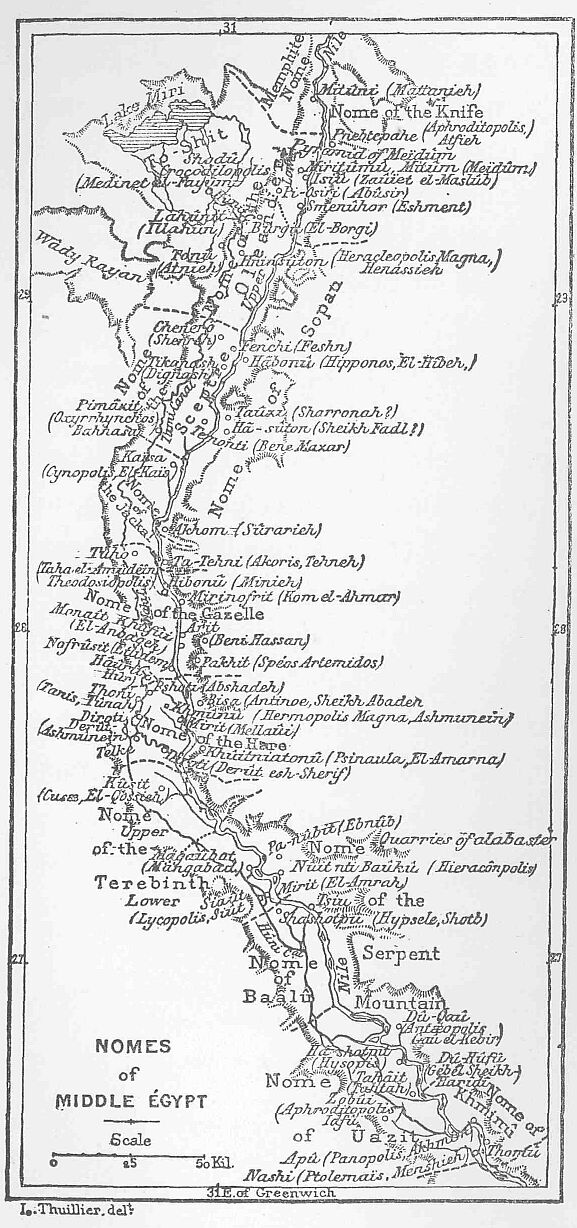
The site is as happy as it is picturesque; not only does the town command the two arms of the river, opening or closing the waterway at will, but from time immemorial the most frequented of the routes into Central Africa has terminated at its gates, bringing to it the commerce of the Soudan. It held sway, at the outset, over both banks, from range to range, northward as far as Deyrût, where the true Bahr Yusuf leaves the Nile, and southward to the neighbourhood of Gebel Sheikh Haridi. The extent and original number of the other principalities is not so easily determined.
The most important, to the north of Siût, were those of the Hare and the Oleander. The principality of the Hare never reached the dimensions of that of its neighbour the Terebinth, but its chief town was Khmûnû, whose antiquity was so remote, that a universally accepted tradition made it the scene of the most important acts of creation.[*] That of the Oleander, on the contrary, was even larger than that of the Terebinth, and from Hininsû, its chief governor ruled alike over the marshes of the Fayûm and the plains of Beni-Suef.[**] To the south, Apû on the right bank governed a district so closely shut in between a bend of the Nile and two spurs of the range, that its limits have never varied much since ancient times. Its inhabitants were divided in their employment between weaving and the culture of cereals. From early times they possessed the privilege of furnishing clothing to a large part of Egypt, and their looms, at the present day, still make those checked or striped "melayahs" which the fellah women wear over their long blue tunics.[***]
* Khmûnû, the present Ashmûneîn, is the Hermopolis of the Greeks, the town of the god Thot. ** Hininsû is the Heraecleopolis Magna of the Greeks, the present Henassieh, called also Ahnas-el-Medineh. The Egyptian word for the tree which gives its name to this principality, is Nârît. Loret has shown that this tree, Nârît, is the oleander. *** Apû was the Panopolis or Chemmis of the Greeks, the town of the god Mîn or ithyphallic Khimû. Its manufactures of linen are mentioned by Strabo; the majority of the beautiful Coptic woven fabrics and embroideries which have been brought to Europe lately, come from the necropolis of the Arab period at Apû.
Beyond Apû, Thinis, the Girgeh of the Arabs, situate on both banks of the river, rivalled Khmûnû in antiquity and Siût in wealth: its plains still produce the richest harvests and feed the most numerous herds of sheep and oxen in the Said.
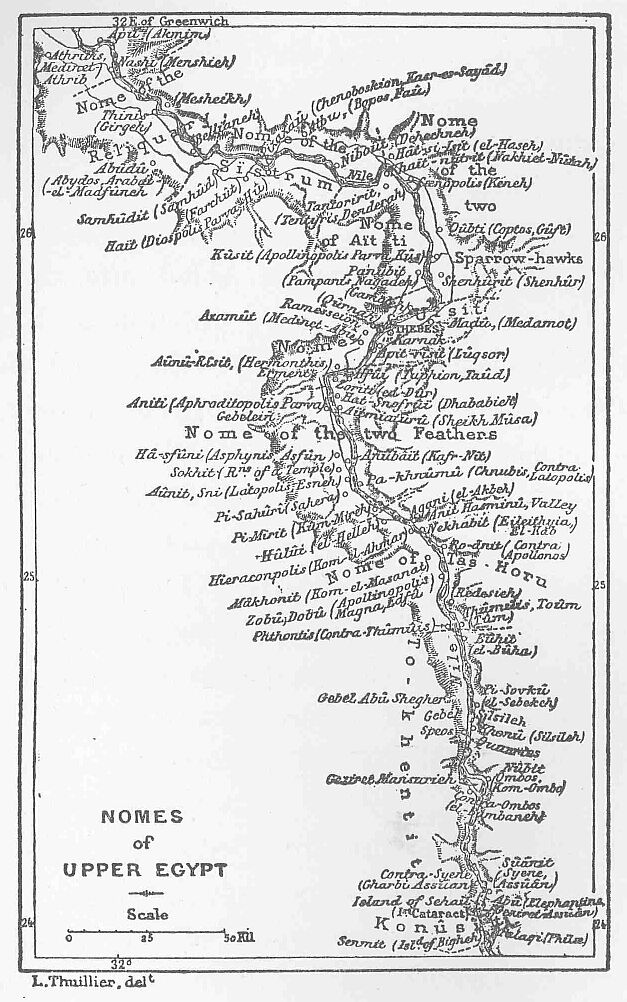
As we approach the cataract, information becomes scarcer. Qûbti and Aûnû of the South, the Coptos and Hermonthis of the Greeks, shared peaceably the plain occupied later on by Thebes and its temples, and Nekhabît and Zobû watched over the safety of Egypt. Nekhabît soon lost its position as a frontier town, and that portion of Nubia lying between Gebel Silsileh and the rapids of Syene formed a kind of border province, of which Nubît-Ombos was the principal sanctuary and Abu-Elephantine the fortress: beyond this were the barbarians, and those inaccessible regions whence the Nile descended upon our earth.
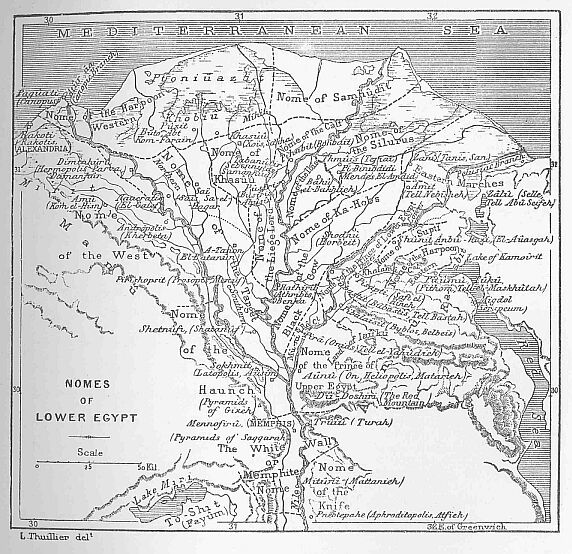
The organization of the Delta, it would appear, was more slowly brought about. It must have greatly resembled that of the lowlands of Equatorial Africa, towards the confluence of the Bahr el Abiad and the Bahr el Ghazâl. Great tracts of mud, difficult to describe as either solid or liquid, marshes dotted here and there with sandy islets, bristling with papyrus reeds, water-lilies, and enormous plants through which the arms of the Nile sluggishly pushed their ever-shifting course, low-lying wastes intersected with streams and pools, unfit for cultivation and scarcely available for pasturing cattle. The population of such districts, engaged in a ceaseless struggle with nature, always preserved relatively ruder manners, and a more rugged and savage character, impatient of all authority. The conquest of this region began from the outer edge only. A few principalities were established at the apex of the Delta in localities where the soil had earliest been won from the river. It appears that one of these divisions embraced the country south of and between the bifurcation of the Nile: Aûnû of the North, the Heliopolis of the Greeks, was its capital. In very early times the principality was divided, and formed three new states, independent of each other. Those of Aûnû and the Haunch were opposite to each other, the first on the Arabian, the latter on the Libyan bank of the Nile. The district of the White Wall marched with that of the Haunch on the north, and on the south touched the territory of the Oleander. Further down the river, between the more important branches, the governors of Sai's and of Bubastis, of Athribis and of Busiris, shared among themselves the primitive Delta. Two frontier provinces of unequal size, the Arabian on the east in the Wady Tumilat, and the Libyan on the west to the south of Lake Mareotis, defended the approaches of the country from the attacks of Asiatic Bedâwins and of African nomads. The marshes of the interior and the dunes of the littoral, were not conducive to the development of any great industry or civilization. They only comprised tracts of thinly populated country, like the principalities of the Harpoon and of the Cow, and others whose limits varied from century to century with the changing course of the river. The work of rendering the marshes salubrious and of digging canals, which had been so successful in the Nile Valley, was less efficacious in the Delta, and proceeded more slowly. Here the embankments were not supported by a mountain chain: they were continued at random across the marshes, cut at every turn to admit the waters of a canal or of an arm of the river. The waters left their usual bed at the least disturbing influence, and made a fresh course for themselves across country. If the inundation were delayed, the soft and badly drained soil again became a slough: should it last but a few weeks longer than usual, the work of several generations was for a long time undone. The Delta of one epoch rarely presented the same aspect as that of previous periods, and Northern Egypt never became as fully mistress of her soil as the Egypt of the south.
ENLARGE TO FULL SIZE
Click on the Image to Enlarge to Full Size
These first principalities, however small they appear to us, were yet too large to remain undivided. In those times of slow communication, the strong attraction which a capital exercised over the provinces under its authority did not extend over a wide radius. That part of the population of the Terebinth, living sufficiently near to Siût to come into the town for a few hours in the morning, returning in the evening to the villages when business was done, would not feel any desire to withdraw from the rule of the prince who governed there. On the other hand, those who lived outside that restricted circle were forced to seek elsewhere some places of assembly to attend the administration of justice, to sacrifice in common to the national gods, and to exchange the produce of the fields and of local manufactures. Those towns which had the good fortune to become such rallying-points naturally played the part of rivals to the capital, and their chiefs, with the district whose population, so to speak, gravitated around them, tended to become independent of the prince. When they succeeded in doing this, they often preserved for the new state thus created, the old name, slightly modified by the addition of an epithet. The primitive territory of Siût was in this way divided into three distinct communities; two, which remained faithful to the old emblem of the tree—the Upper Terebinth, with Siût itself in the centre, and the Lower Terebinth, with Kûsit to the north; the third, in the south and east, took as their totem the immortal serpent which dwelt in their mountains, and called themselves the Serpent Mountain, whose chief town was that of the Sparrow Hawk. The territory of the Oleander produced by its dismemberment the principality of the Upper Oleander, that of the Lower Oleander, and that of the Knife. The territory of the Harpoon in the Delta divided itself into the Western and Eastern Harpoon. The fission in most cases could not have been accomplished without struggles; but it did take place, and all the principalities having a domain of any considerable extent had to submit to it, however they may have striven to avoid it. This parcelling out was continued as circumstances afforded opportunity, until the whole of Egypt, except the half desert districts about the cataract, became but an agglomeration of petty states nearly equal in power and population.[*]
* Examples of the subdivision of ancient nomes and the creation of fresh nomes are met with long after primitive times. We find, for example, the nome of the Western Harpoon divided under the Greeks and Romans into two districts—that of the Harpoon proper, of which the chief town was Sonti- nofir; and that of Ranûnr, with the Onûphis of classical geographers for its capital.
The Greeks called them nomes, and we have borrowed the word from them; the natives named them in several ways, the most ancient term being "nûît," which may be translated domain, and the most common appellation in recent times being "hospû," which signifies district. The number of the nomes varied considerably in the course of centuries: the hieroglyphic monuments and classical authors fixed them sometimes at thirty-six, sometimes at forty, sometimes at forty-four, or even fifty. The little that we know of their history, up to the present time, explains the reason of this variation. Ceaselessly quarrelled over by the princely families who possessed them, the nomes were alternately humbled and exalted by civil wars, marriages, and conquest, which caused them continually to pass into fresh hands, either entire or divided. The Egyptians, whom we are accustomed to consider as a people respecting the established order of things, and conservative of ancient tradition, showed themselves as restless and as prone to modify or destroy the work of the past, as the most inconstant of our modern nations. The distance of time which separates them from us, and the almost complete absence of documents, gives them an appearance of immobility, by which we are liable to be unconsciously deceived; when the monuments still existing shall have been unearthed, their history will present the same complexity of incidents, the same agitations, the same instability, which we suspect or know to have been characteristic of most other Oriental nations. One thing alone remained stable among them in the midst of so many revolutions, and which prevented them from losing their individuality and from coalescing in a common unity. This was the belief in and the worship of one particular deity. If the little capitals of the petty states whose origin is lost in a remote past—Edfû and Denderah, Nekhabît and Bûto, Siûfc, Thinis, Khmûnû, Sais, Bubastis, Athribis—had only possessed that importance which resulted from the presence of an ambitious petty prince, or from the wealth of their inhabitants, they would never have passed safe and sound through the long centuries of existence which they enjoyed from the opening to the close of Egyptian history. Fortune raised their chiefs, some even to the rank of rulers of the world, and in turn abased them: side by side with the earthly ruler, whose glory was but too often eclipsed, there was enthroned in each nome a divine ruler, a deity, a god of the domain, "nûtir nûiti," whose greatness never perished. The princely families might be exiled or become extinct, the extent of the territory might diminish or increase, the town might be doubled in size and population or fall in ruins: the god lived on through all these vicissitudes, and his presence alone preserved intact the rights of the state over which he reigned as sovereign. If any disaster befell his worshippers, his temple was the spot where the survivors of the catastrophe rallied around him, their religion preventing them from mixing with the inhabitants of neighbouring towns and from becoming lost among them. The survivors multiplied with that extraordinary rapidity which is the characteristic of the Egyptian fellah, and a few years of peace sufficed to repair losses which apparently were irreparable. Local religion was the tie which bound together those divers elements of which each principality was composed, and as long as it remained, the nomes remained; when it vanished, they disappeared with it. remained; when it vanished, they disappeared with it. ====================