Volume 1 — THE LEGENDARY HISTORY OF EGYPT (continued 2)
M. L. McClure translation
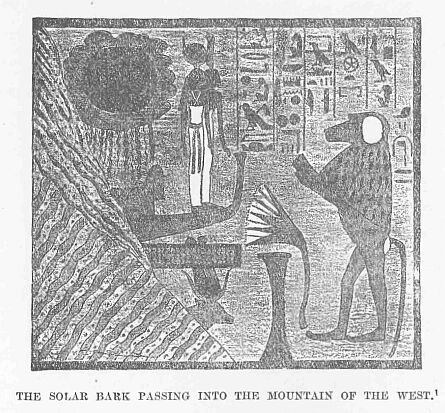
1 Drawn by Faucher-Gudin, from a very small photograph published in the Catalogue of the Minutoli Sale.
As soon as his bark appeared at the last bend of the celestial Nile, the cynocephali, who guarded the entrance into night, began to dance and gesticulate upon the banks as they intoned their accustomed hymn. The gods of Abydos mingled their shouts of joy with the chant of the sacred baboons, the bark lingered for a moment upon the frontiers of day, and initiated souls seized the occasion to secure their recognition and their reception on board of it.[*] Once admitted, they took their share in the management of the boat, and in the battles with hostile deities; but they were not all endowed with the courage or equipment needful to withstand the perils and terrors of the voyage. Many stopped short by the way in one of the regions which it traversed, either in the realm of Khontamentît, or in that of Sokaris, or in those islands where the good Osiris welcomed them as though they had duly arrived in the ferry-boat, or upon the wing of Thot. There they dwelt in colonies under the suzerainty of local gods, rich, and in need of nothing, but condemned to live in darkness, excepting for the one brief hour in which the solar bark passed through their midst, irradiating them with beams of light.[**]
* This description of the embarkation and voyage of the soul is composed from indications given in one of the vignettes of chap. xvi. of the Book of the Dead (Naville's edition, vol. i. pl. xxii.), combined with the text of a formula which became common from the times of the XIth and XIIth dynasties (Maspero, Études de Mythologie et l'Archéologie Égyptiennes, vol. i. pp. 14-18, and Études Égyptiennes, vol. i. pp. 122, 123).
** Maspero, Études de Mythologie et d'Archéologie Égyptiennes, vol. ii. pp. 44, 45.
The few persevered, feeling that they had courage to accompany the sun throughout, and these were indemnified for their sufferings by the most brilliant fate ever dreamed of by Egyptian souls., Born anew with the sun-god and appearing with him at the gates of the east, they were assimilated to him, and shared his privilege of growing old and dying, only to be ceaselessly rejuvenated and to live again with ever-renewed splendour. They disembarked where they pleased, and returned at will into the world. If now and then they felt a wish to revisit all that was left of their earthly bodies, the human-headed sparrow-hawk descended the shaft in full flight, alighted upon the funeral couch, and, with hands softly laid upon the spot where the heart had been wont to beat, gazed upwards at the impassive mask of the mummy.
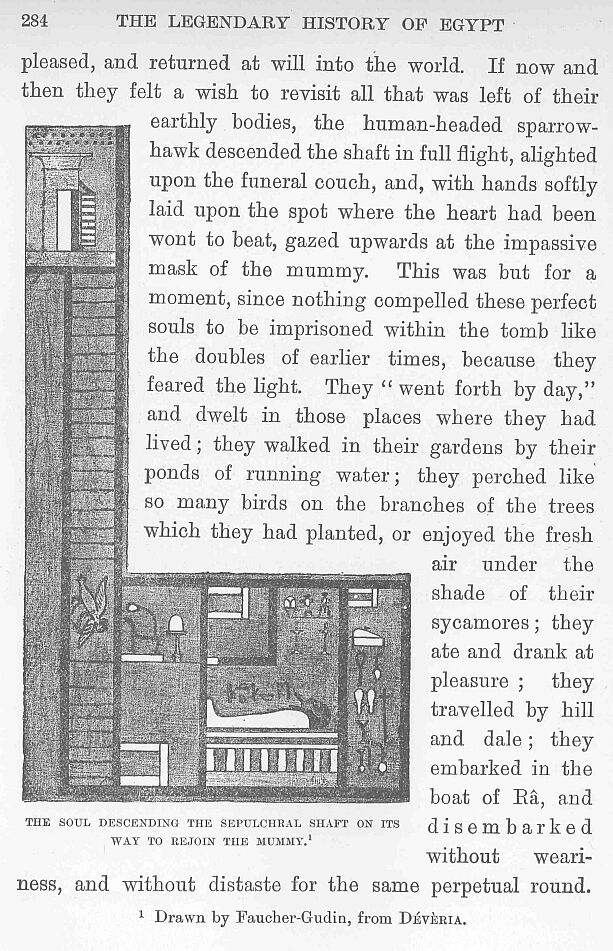
1 Drawn by Faucher-Gudin, from Dévèria.
This was but for a moment, since nothing compelled these perfect souls to be imprisoned within the tomb like the doubles of earlier times, because they feared the light. They "went forth by day," and dwelt in those places where they had lived; they walked in their gardens by their ponds of running water; they perched like so many birds on the branches of the trees which they had planted, or enjoyed the fresh air under the shade of their sycamores; they ate and drank at pleasure; they travelled by hill and dale; they embarked in the boat of Râ, and disembarked without weariness, and without distaste for the same perpetual round.
This conception, which was developed somewhat late, brought the Egyptians back to the point from which they had started when first they began to speculate on the life to come.
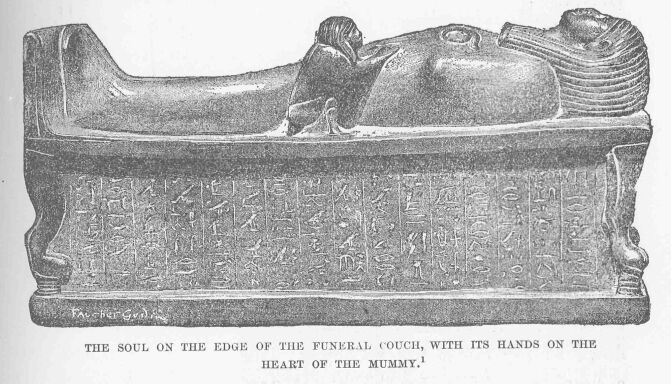
1 Drawn by Faucher-Gudin, from a photograph by Emil Brugsch- Bey, reproducing the miniature sarcophagus of the scribe Râ (Maspero, Guide du Visiteur, pp. 130, 131, No. 1621).
The soul, after having left the place of its incarnation to which in the beginning it clung, after having ascended into heaven and there sought congenial asylum in vain, forsook all havens which it had found above, and unhesitatingly fell back upon earth, there to lead a peaceful, free, and happy life in the full light of day, and with the whole valley of Egypt for a paradise.
The connection, always increasingly intimate between Osiris and Râ, gradually brought about a blending of the previously separate myths and beliefs concerning each. The friends and enemies of the one became the friends and enemies of the other, and from a mixture of the original conceptions of the two deities, arose new personalities, in which contradictory elements were blent together, often without true fusion. The celestial Horuses one by one were identified with Horus, son of Isis, and their attributes were given to him, as his in the same way became theirs. Apopi and the monsters—the hippopotamus, the crocodile, the wild boar—who lay in wait for Râ as he sailed the heavenly ocean, became one with Sît and his accomplices. Sit still possessed his half of Egypt, and his primitive brotherly relation to the celestial Horus remained unbroken, either 'on account of their sharing one temple, as at Nûbît, or because they were worshipped as one in two neighbouring nomes, as, for example, at Oxyrrhynchos and at Heracleopolis Magna. The repulsion with which the slayer of Osiris was regarded did not everywhere dissociate these two cults: certain small districts persisted in this double worship down to the latest times of paganism. It was, after all, a mark of fidelity to the oldest traditions of the race, but the bulk of the Egyptians, who had forgotten these, invented reasons taken from the history of the divine dynasties to explain the fact. The judgment of Thot or of Sibû had not put an end to the machinations of Sît: as soon as Horus had left the earth, Sît resumed them, and pursued them, with varying fortune, under the divine kings of the second Ennead. Now, in the year 363 of Harmakhis, the Typhonians reopened the campaign. Beaten at first near Edfû, they retreated precipitately northwards, stopping to give battle wherever their partisans predominated,—at Zatmîfc in the Theban nome,[*] at Khaîtnûtrît to the north-east of Denderah, and at Hibonû in the principality of the Gazelle.
* Zatmît appears to have been situate at some distance from Bayadîyéh, on the spot where the map published by the Egyptian Commission marks the ruins of a modern village. There was a necropolis of considerable extent there, which furnishes the Luxor dealers with antiquities, many of which belong to the first Theban empire.
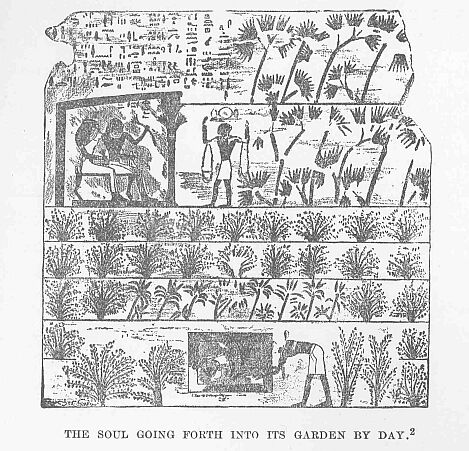
2 Copied by Faucher-Gudin from the survey-drawings of the tomb of Anni by Boussac, member of the Mission française in Egypt (1891). The inscription over the arbour gives the list of the various trees in the garden of Anni during his lifetime.
Several bloody combats, which took place between Oxyrrhynchos and Heracleopolis Magna, were the means of driving them finally out of the Nile Valley; they rallied for the last time in the eastern provinces of the Delta, were beaten at Zalû, and giving up all hope of success on land, they embarked at the head of the Gulf of Suez, in order to return to the Nubian Desert, their habitual refuge in times of distress. The sea was the special element of Typhon, and upon it they believed themselves secure. Horus, however, followed them, overtook them near Shas-hirît, routed them, and on his return to Edfu, celebrated his victory by a solemn festival. By degrees, as he made himself master of those localities which owed allegiance to Sit, he took energetic measures to establish in them the authority of Osiris and of the solar cycle. In all of them he built, side by side with the sanctuary of the Typhonian divinities, a temple to himself, in which he was enthroned under the particular form he was obliged to assume in order to vanquish his enemies. Metamorphosed into a hawk at the battle of Hibonû, we next see him springing on to the back of Sit under the guise of a hippopotamus; in his shrine at Hibonû he is represented as a hawk perching on the back of a gazelle, emblem of the nome where the struggle took place. Near to Zalû he became incarnate as a human-headed lion, crowned with the triple diadem, and having feet armed with claws which cut like a knife; it was under the form, too, of a lion that he was worshipped in the temple at Zalû. The correlation of Sit and the celestial Horus was not, therefore, for these Egyptians of more recent times a primitive religious fact; it was the consequence, and so to speak the sanction, of the old hostility between the two gods.
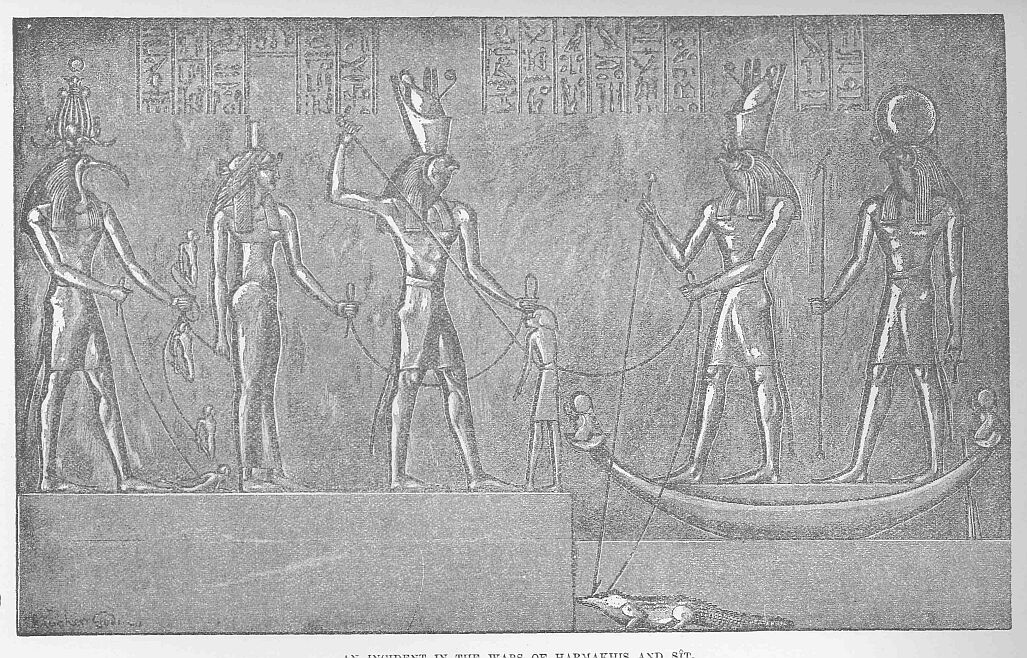
Horus had treated his enemy in the same fashion that a victorious Pharaoh treated the barbarians conquered by his arms: he had constructed a fortress to keep his foe in check, and his priests formed a sort of garrison as a precaution against the revolt of the rival priesthood and the followers of the rival deity. In this manner the battles of the gods were changed into human struggles, in which, more than once, Egypt was deluged with blood. The hatred of the followers of Osiris to those of Typhon was perpetuated with such implacability, that the nomes which had persisted in adhering to the worship of Sit, became odious to the rest of the population: the image of their master on the monuments was mutilated, their names were effaced from the geographical lists, they were assailed with insulting epithets, and to pursue and slay their sacred animals was reckoned a pious act. Thus originated those skirmishes which developed into actual civil wars, and were continued down to Roman times. The adherents of Typhon only became more confirmed in their veneration for the accursed god; Christianity alone overcame their obstinate fidelity to him.[*]
* This incident in the wars of Horus and Sit is drawn by Faucher-Gudin from a bas-relief of the temple of Edfû. On the right, Har-Hûdîti, standing up in the solar bark, pierces with his lance the head of a crocodile, a partisan of Sît, lying in the water below; Harmâkhis, standing behind him, is present at the execution. Facing this divine pair, is the young Horus, who kills a man, another partisan of Sît, while Isis and Har-Hûdîti hold his chains; behind Horus, Isis and Thot are leading four other captives bound and ready to be sacrificed before Harmâkhis.
The history of the world for Egypt was therefore only the history of the struggle between the adherents of Osiris and the followers of Sît; an interminable warfare in which sometimes one and sometimes the other of the rival parties obtained a passing advantage, without ever gaining a decisive victory till the end of time. The divine kings of the second and third Ennead devoted most of the years of their earthly reign to this end; they were portrayed under the form of the great warrior Pharaohs, who, from the eighteenth to the twelfth century before our era, extended their rule from the plains of the Euphrates to the marshes of Ethiopia. A few peaceful sovereigns are met with here and there in this line of conquerors—a few sages or legislators, of whom the most famous was styled Thot, the doubly great, ruler of Hermopolis and of the Hermopolitan Ennead. A legend of recent origin made him the prime minister of Horus, son of Isis; a still more ancient tradition would identify him with the second king of the second dynasty, the immediate successor of the divine Horuses, and attributes to him a reign of 3226 years. He brought to the throne that inventive spirit and that creative power which had characterized him from the time when he was only a feudal deity. Astronomy, divination, magic, medicine, writing, drawing—in fine, all the arts and sciences emanated from him as from their first source. He had taught mankind the methodical observation of the heavens and of the changes that took place in them, the slow revolutions of the sun, the rapid phases of the moon, the intersecting movements of the five planets, and the shapes and limits of the constellations which each night were lit up in the sky. Most of the latter either remained, or appeared to remain immovable, and seemed never to pass out of the regions accessible to the human eye. Those which were situate on the extreme margin of the firmament accomplished movements there analogous to those of the planets.
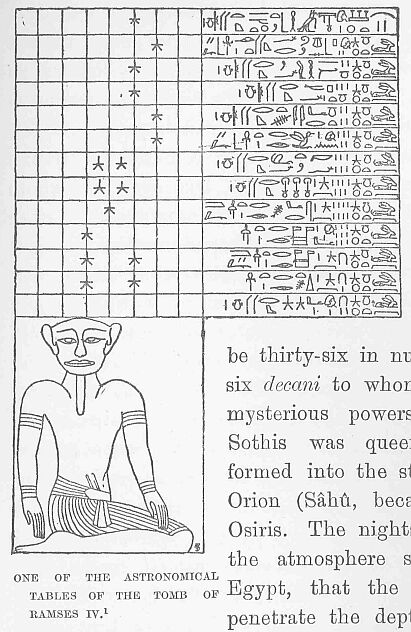
1 Drawn by Faucher-Gudin, from a copy by Lepsius, Denkm., iii. 227, 3.
Every year at fixed times they were seen to sink one after another below the horizon, to disappear, and rising again after an eclipse of greater or less duration, to regain insensibly their original positions. The constellations were reckoned to be thirty-six in number, the thirty-six decani to whom were attributed mysterious powers, and of whom Sothis was queen—Sothis transformed into the star of Isis, when Orion (Sâhû), became the star of Osiris. The nights are so clear and the atmosphere so transparent in Egypt, that the eye can readily penetrate the depths of space, and distinctly see points of light which would be invisible in our foggy climate. The Egyptians did not therefore need special instruments to ascertain the existence of a considerable number of stars which we could not see without the help of our telescopes; they could perceive with the naked eye stars of the fifth magnitude, and note them upon their catalogues.[*] It entailed, it is true, a long training and uninterrupted practice to bring their sight up to its maximum keenness; but from very early times it was a function of the priestly colleges to found and maintain schools of astronomy. The first observatories established on the banks of the Nile seem to have belonged to the temples of the sun; the high priests of Râ—who, to judge from their title, were alone worthy to behold the sun face to face—were actively employed from the earliest times in studying the configuration and preparing maps of the heavens. The priests of other gods were quick to follow their example: at the opening of the historic period, there was not a single temple, from one end of the valley to the other, that did not possess its official astronomers, or, as they were called, "watchers of the night."[**]
* Biot, however, states that stars of the third and fourth magnitude "are the smallest which can be seen with the naked eye." I believe I am right in affirming that several of the fellahîn and Bedawîn attached to the "service des Antiquités" can see stars which are usually classed with those of the fifth magnitude. ** Urshu: this word is also used for the soldiers on watch during the day upon the walls of a fortress. Birch believed he had discovered in the British Museum a catalogue of observations made at Thebes by several astronomers upon a constellation which answered to the Hyades or the Pleiades; it was merely a question in this text of the quantity of water supplied regularly to the astronomers of a Theban temple for their domestic purposes.
In the evening they went up on to the high terraces above the shrine, or on to the narrow platforms which terminated the pylons, and fixing their eyes continuously on the celestial vault above them, followed the movements of the constellations and carefully noted down the slightest phenomena which they observed. A portion of the chart of the heavens, as known to Theban Egypt between the eighteenth and twelfth centuries before our era, has survived to the present time; parts of it were carved by the decorators on the ceilings of temples, and especially on royal tombs. The deceased Pharaohs were identified with Osiris in a more intimate fashion than their subjects. They represented the god even in the most trivial details; on earth—where, after having played the part of the beneficent Onnophris of primitive ages, they underwent the most complete and elaborate embalming, like Osiris of the lower world; in Hades—where they embarked side by side with the Sun-Osiris to cross the night and to be born again at daybreak; in heaven—where they shone with Orion-Sâhu under the guardianship of Sothis, and, year by year, led the procession of the stars. The maps of the firmament recalled to them, or if necessary taught them, this part of their duties: they there saw the planets and the decani sail past in their boats, and the constellations follow one another in continuous succession. The lists annexed to the charts indicated the positions occupied each month by the principal heavenly bodies—their risings, their culminations, and their settings. Unfortunately, the workmen employed to execute these pictures either did not understand much about the subject in hand, or did not trouble themselves to copy the originals exactly: they omitted many passages, transposed others, and made endless mistakes, which made it impossible for us to transfer accurately to a modern map the information possessed by the ancients.
In directing their eyes to the celestial sphere, Thot had at the same time revealed to men the art of measuring time, and the knowledge of the future. As he was the moon-god par excellence, he watched with jealous care over the divine eye which had been entrusted to him by Horus, and the thirty days during which he was engaged in conducting it through all the phases of its nocturnal life, were reckoned as a month. Twelve of these months formed the year, a year of three hundred and sixty days, during which the earth witnessed the gradual beginning and ending of the circle of the seasons. The Nile rose, spread over the fields, sank again into its channel; to the vicissitudes of the inundation succeeded the work of cultivation; the harvest followed the seedtime: these formed three distinct divisions of the year, each of nearly equal duration. Thot made of them the three seasons,—that of the waters, Shaît; that of vegetation, Pirûît; that of the harvest, Shômû—each comprising four months, numbered one to four; the 1st, 2nd, 3rd, and 4th months of Shaît; the 1st, 2nd, 3rd, and 4th months of Pirûît; the 1st, 2nd, 3rd, and 4th months of Shômû. The twelve months completed, a new year began, whose birth was heralded by the rising of Sothis in the early days of August. The first month of the Egyptian year thus coincided with the eighth of ours. Thot became its patron, and gave it his name, relegating each of the others to a special protecting divinity; in this manner the third month of Shaît fell to Hathor, and was called after her; the fourth of Pirûît belonged to Ranûît or Ramûît, the lady of harvests, and derived from her its appellation of Pharmûti. Official documents always designated the months by the ordinal number attached to them in each season, but the people gave them by preference the names of their tutelary deities, and these names, transcribed into Greek, and then into Arabic, are still used by the Christian inhabitants of Egypt, side by side with the Mussulman appellations. One patron for each month was, however, not deemed sufficient: each month was subdivided into three decades, over which presided as many decani, and the days themselves were assigned to genii appointed to protect them. A number of festivals were set apart at irregular intervals during the course of the year: festivals for the new year, festivals for the beginning of the seasons, months and decades, festivals for the dead, for the supreme gods, and for local divinities. Every act of civil life was so closely allied to the religious life, that it could not be performed without a sacrifice or a festival. A festival celebrated the cutting of the dykes, another the opening of the canals, a third the reaping of the first sheaf, or the carrying of the grain; a crop gathered or stored without a festival to implore the blessing of the gods, would have been an act of sacrilege and fraught with disaster. The first year of three hundred and sixty days, regulated by the revolutions of the moon, did not long meet the needs of the Egyptian people; it did not correspond with the length of the solar year, for it fell short of it by five and a quarter days, and this deficit, accumulating from twelvemonth to twelvemonth, caused such a serious difference between the calendar reckoning and the natural seasons, that it soon had to be corrected. They intercalated, therefore, after the twelfth month of each year and before the first day of the ensuing year, five epagomenal days, which they termed the "five days over and above the year."[*]
* There appears to be a tendency among Egyptologists now to doubt the existence, under the Ancient Empire, of the five epagomenal days, and as a fact they are nowhere to be found expressly mentioned; but we know that the five gods of the Osirian cycle were born during the epagomenal day (cf. p. 247 of this History), and the allusions to the Osirian legend which are met with in the Pyramid texts, prove that the days were added long before the time when those inscriptions were cut. As the wording of the texts often comes down from prehistoric times, it is most likely that the invention of the epagomenal days is anterior to the first Thinite and Memphite dynasties.
The legend of Osiris relates that Thot created them in order to permit Nûît to give birth to all her children. These days constituted, at the end of the "great year," a "little month," which considerably lessened the difference between the solar and lunar computation, but did not entirely do away with it, and the six hours and a few minutes of which the Egyptians had not taken count gradually became the source of fresh perplexities. They at length amounted to a whole day, which needed to be added every four years to the regular three hundred and sixty days, a fact which was unfortunately overlooked. The difficulty, at first only slight, which this caused in public life, increased with time, and ended by disturbing the harmony between the order of the calendar and that of natural phenomena: at the end of a hundred and twenty years, the legal year had gained a whole month on the actual year, and the 1st of Thot anticipated the heliacal rising of Sothis by thirty days, instead of coinciding with it as it ought. The astronomers of the Græco-Roman period, after a retrospective examination of all the past history of their country, discovered a very ingenious theory for obviating this unfortunate discrepancy. If the omission of six hours annually entailed the loss of one day every four years, the time would come, after three hundred and sixty-five times four years, when the deficit would amount to an entire year, and when, in consequence, fourteen hundred and sixty whole years would exactly equal fourteen hundred and sixty-one incomplete years. The agreement of the two years, which had been disturbed by the force of circumstances, was re-established of itself after rather more than fourteen and a half centuries: the opening of the civil year became identical with the beginning of the astronomical year, and this again coincided with the heliacal rising of Sirius, and therefore with the official date of the inundation. To the Egyptians of Pharaonic times, this simple and eminently practical method was unknown: by means of it hundreds of generations, who suffered endless troubles from the recurring difference between an uncertain and a fixed year, might have consoled themselves with the satisfaction of knowing that a day would come when one of their descendants would, for once in his life, see both years coincide with mathematical accuracy, and the seasons appear at their normal times. The Egyptian year might be compared to a watch which loses a definite number of minutes daily. The owner does not take the trouble to calculate a cycle in which the total of minutes lost will bring the watch round to the correct time: he bears with the irregularity as long as his affairs do not suffer by it; but when it causes him inconvenience, he alters the hands to the right hour, and repeats this operation each time he finds it necessary, without being guided by a fixed rule. In like manner the Egyptian year fell into hopeless confusion with regard to the seasons, the discrepancy continually increasing, until the difference became so great, that the king or the priests had to adjust the two by a process similar to that employed in the case of the watch.
The days, moreover, had each their special virtues, which it was necessary for man to know if he wished to profit by the advantages, or to escape the perils which they possessed for him. There was not one among them that did not recall some incident of the divine wars, and had not witnessed a battle between the partisans of Sit and those of Osiris or Râ; the victories or the disasters which they had chronicled had as it were stamped them with good or bad luck, and for that reason they remained for ever auspicious or the reverse. It was on the 17th of Athyr that Typhon had enticed his brother to come to him, and had murdered him in the middle of a banquet. Every year, on this day, the tragedy that had taken place in the earthly abode of the god seemed to be repeated afresh in the heights of heaven. Just as at the moment of the death of Osiris, the powers of good were at their weakest, and the sovereignty of evil everywhere prevailed, so the whole of Nature, abandoned to the powers of darkness, became inimical to man. Whatever he undertook on that day issued in failure. If he went out to walk by the river-side, a crocodile would attack him, as the crocodile sent by Sît had attacked Osiris. If he set out on a journey, it was a last farewell which he bade to his family and friends: death would meet him by the way. To escape this fatality, he must shut himself up at home, and wait in inaction until the hours of danger had passed and the sun of the ensuing day had put the evil one to flight.[*]
* On the 20th of Thot no work was to be done, no oxen killed, no stranger received. On the 22nd no fish might be eaten, no oil lamp was to be lighted. On the 23rd "put no incense on the fire, nor kill big cattle, nor goats, nor ducks; eat of no goose, nor of that which has lived." On the 26th "do absolutely nothing on this day," and the same advice is found on the 7th of Paophi, on the 18th, on the 26th, on the 27th, and more than thirty times in the remainder of the Sallier Calendar. On the 30th of Mechir it is forbidden to speak aloud to any one.
It was to his interest to know these adverse influences; and who would have known them all, had not Thot pointed them out and marked them in his calendars? One of these, long fragments of which have come down to us, indicated briefly the character of each day, the gods who presided over it, the perils which accompanied their patronage, or the good fortune which might be expected of them. The details of it are not always intelligible to us, as we are still ignorant of many of the episodes in the life of Osiris. The Egyptians were acquainted with the matter from childhood, and were guided with sufficient exactitude by these indications. The hours of the night were all inauspicious; those of the day were divided into three "seasons" of four hours each, of which some were lucky, while others were invariably of ill omen. "The 4th of Tybi: good, good, good. Whatsoever thou seest on this day will be fortunate. Whosoever is born on this day, will die more advanced in years than any of his family; he will attain to a greater age than his father. The 5th of Tybi: inimical, inimical, inimical. This is the day on which the goddess Sokhîfc, mistress of the double white Palace, burnt the chiefs when they raised an insurrection, came forth, and manifested themselves. Offerings of bread to Shû, Phtah, Thot: burn incense to Râ, and to the gods who are his followers, to Phtah, Thot, Hû-Sû, on this day. Whatsoever thou seest on this day will be fortunate. The 6th of Tybi: good, good, good. Whatsoever thou seest on this day will be fortunate. The 7th of Tybi: inimical, inimical, inimical. Do not join thyself to a woman in the presence of the Eye of Horus. Beware of letting the fire go out which is in thy house. The 8th of Tybi: good, good, good. Whatsoever thou seest with thine eye this day, the Ennead of the gods will grant to thee: the sick will recover. The 9th of Tybi: good, good, good. The gods cry out for joy at noon this day. Bring offerings of festal cakes and of fresh bread, which rejoice the heart of the gods and of the manes. The 10th of Tybi: inimical, inimical, mimical. Do not set fire to weeds on this day: it is the day on which the god Sap-hôû set fire to the land of Btito. The 11th of Tybi: inimical, inimical, inimical. Do not draw nigh to any flame on this day, for Râ entered the flames to strike all his enemies, and whosoever draws nigh to them on this day, it shall not be well with him during his whole life. The 12th of Tybi: inimical, inimical, inimical. See that thou beholdest not a rat on this day, nor approachest any rat within thy house: it is the day wherein Sokhît gave forth the decrees." In these cases a little watchfulness or exercise of memory sufficed to put a man on his guard against evil omens; but in many circumstances all the vigilance in the world would not protect him, and the fatality of the day would overtake him, without his being able to do ought to avert it. No man can at will place the day of his birth at a favourable time; he must accept it as it occurs, and yet it exercises a decisive influence on the manner of his death. According as he enters the world on the 4th, 5th, or 6th of Paophi, he either dies of marsh fever, of love, or of drunkenness. The child of the 23rd perishes by the jaws of a crocodile: that of the 27th is bitten and dies by a serpent. On the other hand, the fortunate man whose birthday falls on the 9th or the 29th lives to an extreme old age, and passes away peacefully, respected by all.
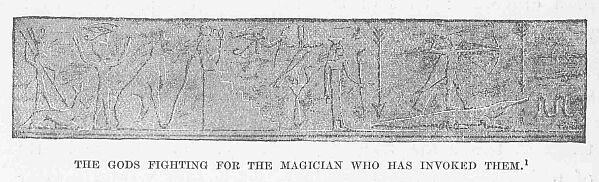
1 Drawn by Faucher-Gudin, from the tracing by Golbnischeff, Die Metternich-Stele, pi, iii. 14.
Thot, having pointed out the evil to men, gave to them at the same time the remedy. The magical arts of which he was the repository, made him virtual master of the other gods. He knew their mystic names, their secret weaknesses, the kind of peril they most feared, the ceremonies which subdued them to his will, the prayers which they could not refuse to grant under pain of misfortune or death. His wisdom, transmitted to his worshippers, assured to them the same authority which he exercised upon those in heaven, on earth, or in the nether world. The magicians instructed in his school had, like the god, control of the words and sounds which, emitted at the favourable moment with the "correct voice," would evoke the most formidable deities from beyond the confines of the universe: they could bind and loose at will Osiris, Sit, Anubis, even Thot himself; they could send them forth, and recall them, or constrain them to work and fight for them. The extent of their power exposed the magicians to terrible temptations; they were often led to use it to the detriment of others, to satisfy their spite, or to gratify their grosser appetites. Many, moreover, made a gain of their knowledge, putting it at the service of the ignorant who would pay for it. When they were asked to plague or get rid of an enemy, they had a hundred different ways of suddenly surrounding him without his suspecting it: they tormented him with deceptive or terrifying dreams; they harassed him with apparitions and mysterious voices; they gave him as a prey to sicknesses, to wandering spectres, who entered into him and slowly consumed him. They constrained, even at a distance, the wills of men; they caused women to be the victims of infatuations, to forsake those they had loved, and to love those they had previously detested. In order to compose an irresistible charm, they merely required a little blood from a person, a few nail-parings, some hair, or a scrap of linen which he had worn, and which, from contact with his skin, had become impregnated with his personality. Portions of these were incorporated with the wax of a doll which they modelled, and clothed to resemble their victim; thenceforward all the inflictions to which the image was subjected were experienced by the original; he was consumed with fever when his effigy was exposed to the fire, he was wounded when the figure was pierced by a knife. The Pharaohs themselves had no immunity from these spells.[*]
* Spells were employed against Ramses III., and the evidence in the criminal charge brought against the magicians explicitly mentions the wax figures and the philters used on this occasion.
These machinations were wont to be met by others of the same kind, and magic, if invoked at the right moment, was often able to annul the ills which magic had begun. It was not indeed all-powerful against fate: the man born on the 27th of Paophi would die of a snake-bite, whatever charm he might use to protect himself. But if the day of his death were foreordained, at all events the year in which it would occur was uncertain, and it was easy for the magician to arrange that it should not take place prematurely. A formula recited opportunely, a sentence of prayer traced on a papyrus, a little statuette worn about the person, the smallest amulet blessed and consecrated, put to flight the serpents who were the instruments of fate. Those curious stelae on which we see Horus half naked, standing on two crocodiles and brandishing in his fists creatures which had reputed powers of fascination, were so many protecting talismans; set up at the entrance to a room or a house, they kept off the animals represented and brought the evil fate to nought.
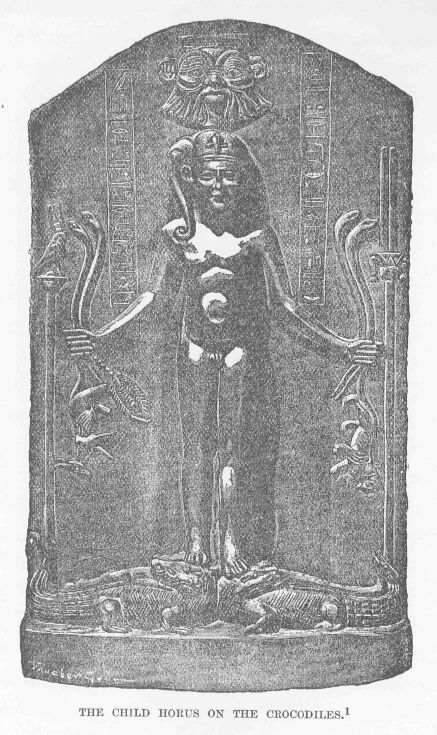
1 Drawn by Faucher-Gudin, from an Alexandrian stele in the Gîzeh Museum. The reason for the appearance of so many different animals in this stele and in others of the same nature, has been given by Maspero, Études de Mythologie et d'Archéologie Égyptiennes, vol. ii. pp. 417- 419; they were all supposed to possess the evil eye and to be able to fascinate their victim before striking him.
Sooner or later destiny would doubtless prevail, and the moment would come when the fated serpent, eluding all precautions, would succeed in carrying out the sentence of death. At all events the man would have lived, perhaps to the verge of old age, perhaps to the years of a hundred and ten, to which the wisest of the Egyptians hoped to attain, and which period no man born of mortal mother might exceed. If the arts of magic could thus suspend the law of destiny, how much more efficacious were they when combating the influences of secondary deities, the evil eye, and the spells of man? Thot, who was the patron of sortilege, presided also over exorcisms, and the criminal acts which some committed in his name could have reparation made for them by others in his name. To malicious genii, genii still stronger were opposed; to harmful amulets, those which were protective; to destructive measures, vitalizing remedies; and this was not even the most troublesome part of the magicians' task. Nobody, in fact, among those delivered by their intervention escaped unhurt from the trials to which, he had been subjected. The possessing spirits when they quitted their victim generally left behind them traces of their occupation, in the brain, heart, lungs, intestines—in fact, in the whole body. The illnesses to which the human race is prone, were not indeed all brought about by enchanters relentlessly persecuting their enemies, but they were all attributed to the presence of an invisible being, whether spectre or demon, who by some supernatural means had been made to enter the patient, or who, unbidden, had by malice or necessity taken up his abode within him. It was needful, after expelling the intruder, to re-establish the health of the sufferer by means of fresh remedies. The study of simples and other materiæ medicæ would furnish these; Thot had revealed himself to man as the first magician, he became in like manner for them the first physician and the first surgeon.
Egypt is naturally a very salubrious country, and the Egyptians boasted that they were "the healthiest of all mortals;" but they did not neglect any precautions to maintain their health. "Every month, for three successive days, they purged the system by means of emetics or clysters. The study of medicine with them was divided between specialists; each physician attending to one kind of illness only. Every place possessed several doctors; some for diseases of the eyes, others for the head, or the teeth, or the stomach, or for internal diseases." But the subdivision was not carried to the extent that Herodotus would make us believe. It was the custom to make a distinction only between the physician trained in the priestly schools, and further instructed by daily practice and the study of books,—the bone-setter attached to the worship of Sokhit who treated fractures by the intercession of the goddess,—and the exorcist who professed to cure by the sole virtue of amulets and magic phrases. The professional doctor treated all kinds of maladies, but, as with us, there were specialists for certain affections, who were consulted in preference to general practitioners. If the number of these specialists was so considerable as to attract the attention of strangers, it was because the climatic character of the country necessitated it. Where ophthalmia and affections of the intestines raged violently, we necessarily find many oculists[*] as well as doctors for internal maladies. The best instructed, however, knew but little of anatomy. As with the Christian physicians of the Middle Ages, religious scruples prevented the Egyptians from cutting open or dissecting, in the cause of pure science, the dead body which was identified with that of Osiris. The processes of embalming, which would have instructed them in anatomy, were not intrusted to doctors; the horror was so great with which any one was regarded who mutilated the human form, that the "paraschite," on whom devolved the duty of making the necessary incisions in the dead, became the object of universal execration: as soon as he had finished his task, the assistants assaulted him, throwing stones at him with such violence that he had to take to his heels to escape with his life.[**]
* Affections of the eyes occupy one-fourth of the Ebers Papyrus. ** Diodorus Siculus, i. 91.
The knowledge of what went on within the body was therefore but vague. Life seemed to be a little air, a breath which was conveyed by the veins from member to member. "The head contains twenty-two vessels, which draw the spirits into it and send them thence to all parts of the body. There are two vessels for the breasts, which communicate heat to the lower parts. There are two vessels for the thighs, two for the neck, two for the arms, two for the back of the head, two for the forehead, two for the eyes, two for the eyelids, two for the right ear by which enter the breaths of life, and two for the left ear which in like manner admit the breaths of death."
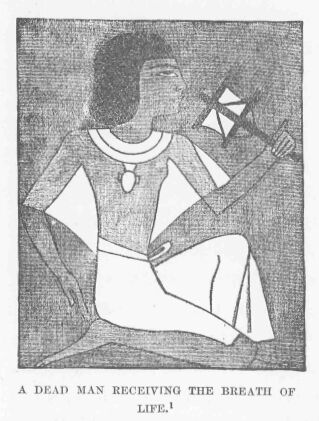
1 Drawn by Faucher-Gudin, from a sketch by Naville, in the Ægyptische Todtenbuch, vol. i. pl. lxix. The deceased carries in this hand a sail inflated by the wind, symbolizing the air, and holds it to his nostrils that he may inhale the breaths which will fill anew his arteries, and bring life to his limbs.
The "breaths" entering by the right ear, are "the good airs, the delicious airs of the north;" the sea-breeze which tempers the burning of summer and renews the strength of man, continually weakened by the heat and threatened with exhaustion. These vital spirits, entering the veins and arteries by the ear or nose, mingled with the blood, which carried them to all parts of the body; they sustained the animal, and were, so to speak, the cause of its movement. The heart, the perpetual mover—hâîti—collected them and redistributed them throughout the body: it was regarded as "the beginning of all the members," and whatever part of the living body the physician touched, "whether the head, the nape of the neck, the hands, the breast, the arms, the legs, his hand lit upon the heart," and he felt it beating under his fingers. Under the influence of the good breaths, the vessels were inflated and worked regularly; under that of the evil, they became inflamed, were obstructed, were hardened, or gave way, and the physician had to remove the obstruction, allay the inflammation, and re-establish their vigour and elasticity. At the moment of death, the vital spirits "withdrew with the soul; the blood," deprived of air, "became coagulated, the veins and arteries emptied themselves, and the creature perished" for want of breaths.
The majority of the diseases from which the ancient Egyptians suffered, are those which still attack their successors; ophthalmia, affections of the stomach, abdomen, and bladder, intestinal worms, varicose veins, ulcers in the leg, the Nile pimple, and finally the "divine mortal malady," the divinus morbus of the Latins, epilepsy. Anaemia, from which at least one-fourth of the present population suffers, was not less prevalent than at present, if we may judge from the number of remedies which were used against hematuria, the principal cause of it. The fertility of the women entailed a number of infirmities or local affections which the doctors attempted to relieve, not always with success.[*]
* With regard to the diseases of women, cf. Ebers Papyrus, pis. xciii., xcviii., etc. Several of the recipes are devoted to the solution of a problem which appears to have greatly exercised the mind of the ancients, viz. the determination of the sex of a child before its birth.
The science of those days treated externals only, and occupied itself merely with symptoms easily determined by sight or touch; it never suspected that troubles which showed themselves in two widely remote parts of the body might only be different effects of the same illness, and they classed as distinct maladies those indications which we now know to be the symptoms of one disease. They were able, however, to determine fairly well the specific characteristics of ordinary affections, and sometimes described them in a precise and graphic fashion. "The abdomen is heavy, the pit of the stomach painful, the heart burns and palpitates violently. The clothing oppresses the sick man and he can barely support it. Nocturnal thirsts. His heart is sick, as that of a man who has eaten of the sycamore gum. The flesh loses its sensitiveness as that of a man seized with illness. If he seek to satisfy a want of nature he finds no relief. Say to this, 'There is an accumulation of humours in the abdomen, which makes the heart sick. I will act.'" This is the beginning of gastric fever so common in Egypt, and a modern physician could not better diagnose such a case; the phraseology would be less flowery, but the analysis of the symptoms would not differ from that given us by the ancient practitioner. The medicaments recommended comprise nearly everything which can in some way or other be swallowed, whether in solid, mucilaginous, or liquid form. Vegetable remedies are reckoned by the score, from the most modest herb to the largest tree, such as the sycamore, palm, acacia, and cedar, of which the sawdust and shavings were supposed to possess both antiseptic and emollient properties. Among the mineral substances are to be noted sea-salt, alum, nitre, sulphate of copper, and a score of different kinds of stones—among the latter the "memphite stone" was distinguished for its virtues; if applied to parts of the body which were lacerated or unhealthy, it acted as an anaesthetic and facilitated the success of surgical operations. Flesh taken from the living subject, the heart, the liver, the gall, the blood—either dried or liquid—of animals, the hair and horn of stags, were all customarily used in many cases where the motive determining their preference above other materiæ medicæ is unknown to us. Many recipes puzzle us by their originality and by the barbaric character of the ingredients recommended: "the milk of a woman who has given birth to a boy," the dung of a lion, a tortoise's brains, an old book boiled in oil.[*]
* Ebers Papyrus, pl. lxxviii. 1. 22—lxxix. 1. 1: "To relieve a child who is constipated.—An old book. Boil it in oil, and apply half to the stomach, to provoke evacuation." It must not be forgotten that, the writings being on papyrus, the old book in question, once boiled, would have an effect analogous to that of our linseed-meal poultices. If the physician recommended taking an old one, it was for economical reasons merely; the Egyptians of the middle classes would always have in their possession a number of letters, copy-books, and other worthless waste papers, of which they would gladly rid themselves in such a profitable manner.
The medicaments compounded of these incongruous substances were often very complicated. It was thought that the healing power was increased by multiplying the curative elements; each ingredient acted upon a specific region of the body, and after absorption, separated itself from the rest to bring its influence to bear upon that region. The physician made use of all the means which we employ to-day to introduce remedies into the human system, whether pills or potions, poultices, or ointments, draughts or clysters. Not only did he give the prescriptions, but he made them up, thus combining the art of the physician with that of the dispenser. He prescribed the ingredients, pounded them either separately or together, he macerated them in the proper way, boiled them, reduced them by heating, and filtered them through linen. Fat served him as the ordinary vehicle for ointments, and pure water for potions; but he did not despise other liquids, such as wine, beer (fermented or un-fermented), vinegar, milk, olive oil, "ben" oil either crude or refined, even the urine of men and animals: the whole, sweetened with honey, was taken hot, night and morning. The use of more than one of these remedies became worldwide; the Greeks borrowed them from the Egyptians; we have piously accepted them from the Greeks; and our contemporaries still swallow with resignation many of the abominable mixtures invented on the banks of the Nile, long before the building of the Pyramids.
It was Thot who had taught men arithmetic; Thot had revealed to them the mysteries of geometry and mensuration; Thot had constructed instruments and promulgated the laws of music; Thot had instituted the art of drawing, and had codified its unchanging rules. He had been the inventor or patron of all that was useful or beautiful in the Nile valley, and the climax of his beneficence was reached by his invention of the principles of writing, without which humanity would have been liable to forget his teaching, and to lose the advantage of his discoveries. It has been sometimes questioned whether writing, instead of having been a benefit to the Egyptians, did not rather injure them. An old legend relates that when the god unfolded his discovery to King Thamos, whose minister he was, the monarch immediately raised an objection to it.
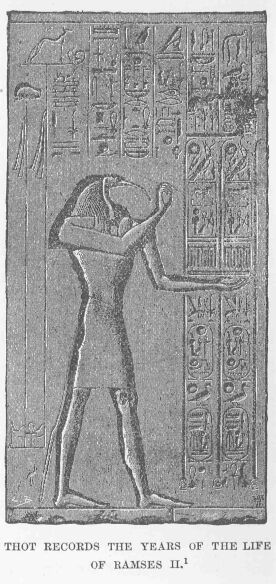
1 Bas-relief of the temple of Seti I. at Abydos, drawn by Boudier; from a photograph by Beato. The god is marking with his reed-pen upon the notches of a long frond of palm, the duration in millions of years of the reign of Pharaoh upon this earth, in accordance with the decree of the gods.
Children and young people, who had hitherto been forced to apply themselves diligently to learn and retain whatever was taught them, now that they possessed a means of storing up knowledge without trouble, would cease to apply themselves, and would neglect to exercise their memories. Whether Thamos was right or not, the criticism came too late: "the ingenious art of painting words and of speaking to the eyes" had once for all been acquired by the Egyptians, and through them by the greater part of mankind. It was a very complex system, in which were united most of the methods fitted for giving expression to thought, namely: those which were limited to the presentment of the idea, and those which were intended to suggest sounds.
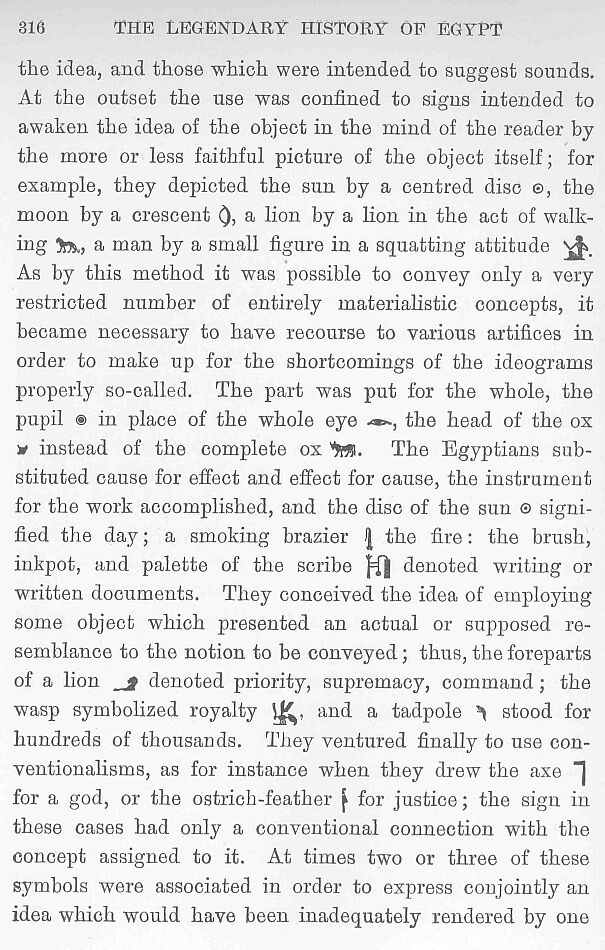
At the outset the use was confined to signs intended to awaken the idea of the object in the mind of the reader by the more or less faithful picture of the object itself; for example, they depicted the sun by a centred disc, the moon by a crescent, a lion by a lion in the act of walking, a man by a small figure in a squatting attitude. As by this method it was possible to convey only a very restricted number of entirely materialistic concepts, it became necessary to have recourse to various artifices in order to make up for the shortcomings of the ideograms properly so-called. The part was put for the whole, the pupil in place of the whole eye, the head of the ox instead of the complete ox. The Egyptians substituted cause for effect and effect for cause, the instrument for the work accomplished, and the disc of the sun signified the day; a smoking brazier the fire: the brush, inkpot, and palette of the scribe denoted writing or written documents. They conceived the idea of employing some object which presented an actual or supposed resemblance to the notion to be conveyed; thus, the foreparts of a lion denoted priority, supremacy, command; the wasp symbolized royalty, and a tadpole stood for hundreds of thousands. They ventured finally to use conventionalisms, as for instance when they drew the axe for a god, or the ostrich-feather for justice; the sign in these cases had only a conventional connection with the concept assigned to it. At times two or three of these symbols were associated in order to express conjointly an idea which would have been inadequately rendered by one of them alone: a five-pointed star placed under an inverted crescent moon denoted a month, a calf running before the sign for water indicated thirst.
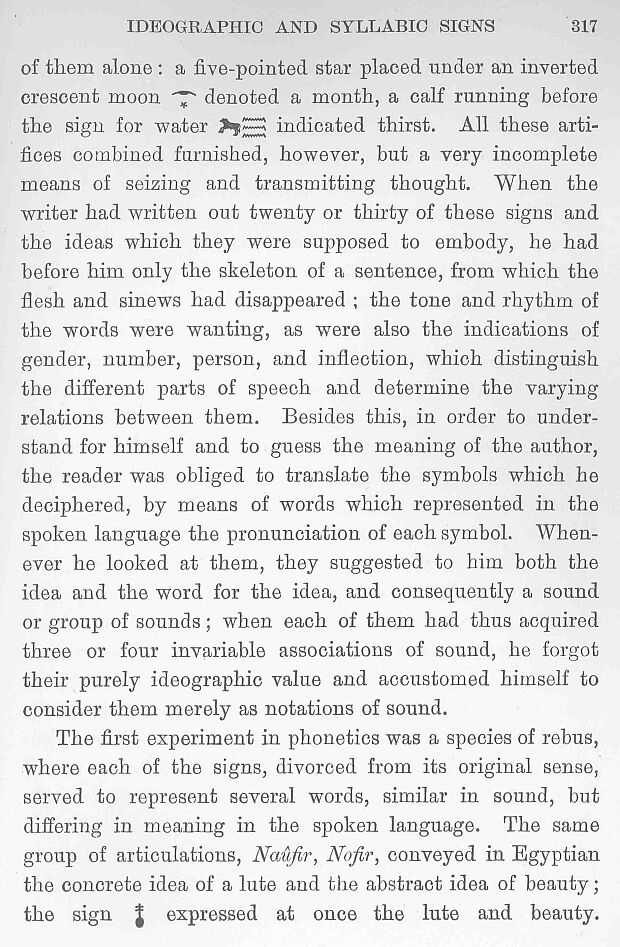
All these artifices combined furnished, however, but a very incomplete means of seizing and transmitting thought. When the writer had written out twenty or thirty of these signs and the ideas which they were supposed to embody, he had before him only the skeleton of a sentence, from which the flesh and sinews had disappeared; the tone and rhythm of the words were wanting, as were also the indications of gender, number, person, and inflection, which distinguish the different parts of speech and determine the varying relations between them. Besides this, in order to understand for himself and to guess the meaning of the author, the reader was obliged to translate the symbols which he deciphered, by means of words which represented in the spoken language the pronunciation of each symbol. Whenever he looked at them, they suggested to him both the idea and the word for the idea, and consequently a sound or group of sounds; when each of them had thus acquired three or four invariable associations of sound, he forgot their purely ideographic value and accustomed himself to consider them merely as notations of sound.
The first experiment in phonetics was a species of rebus, where each of the signs, divorced from its original sense, served to represent several words, similar in sound, but differing in meaning in the spoken language. The same group of articulations, Naûfir, Nofir, conveyed in Egyptian the concrete idea of a lute and the abstract idea of beauty; the sign expressed at once the lute and beauty.
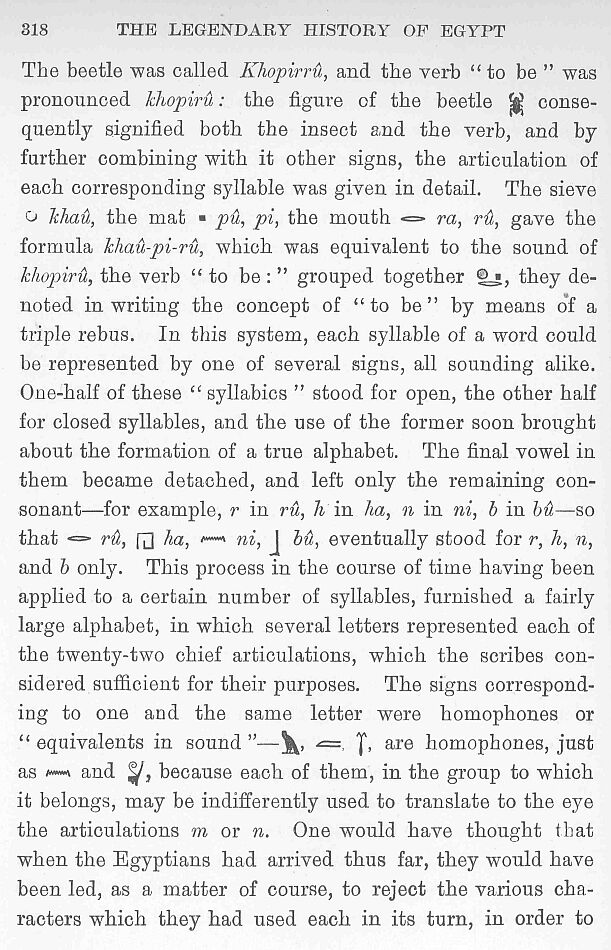
The beetle was called Khopirru, and the verb "to be" was pronounced khopirû: the figure of the beetle & consequently signified both the insect and the verb, and by further combining with it other signs, the articulation of each corresponding syllable was given in detail. The sieve Miaû, the mat pu, pi, the mouth ra, rû, gave the formula khaû-pi-rû, which was equivalent to the sound of khopirû, the verb "to be:" grouped together, they denoted in writing the concept of "to be" by means of a triple rebus. In this system, each syllable of a word could be represented by one of several signs, all sounding alike. One-half of these "syllables" stood for open, the other half for closed syllables, and the use of the former soon brought about the formation of a true alphabet. The final vowel in them became detached, and left only the remaining consonant—for example, r in rû, h in ha, n in ni, b in bû—so that rû, ha, bû, eventually stood for r, h, n, and b only. This process in the course of time having been applied to a certain number of syllables, furnished a fairly large alphabet, in which several letters represented each of the twenty-two chief articulations, which the scribes considered sufficient for their purposes. The signs corresponding to one and the same letter were homophones or "equivalents in sound"—[ ] are homophones, just as [ ] and [ ], because each of them, in the group to which it belongs, may be indifferently used to translate to the eye the articulations m or n. One would have thought that when the Egyptians had arrived thus far, they would have been led, as a matter of course, to reject the various characters which they had used each in its turn, in order to retain an alphabet only.
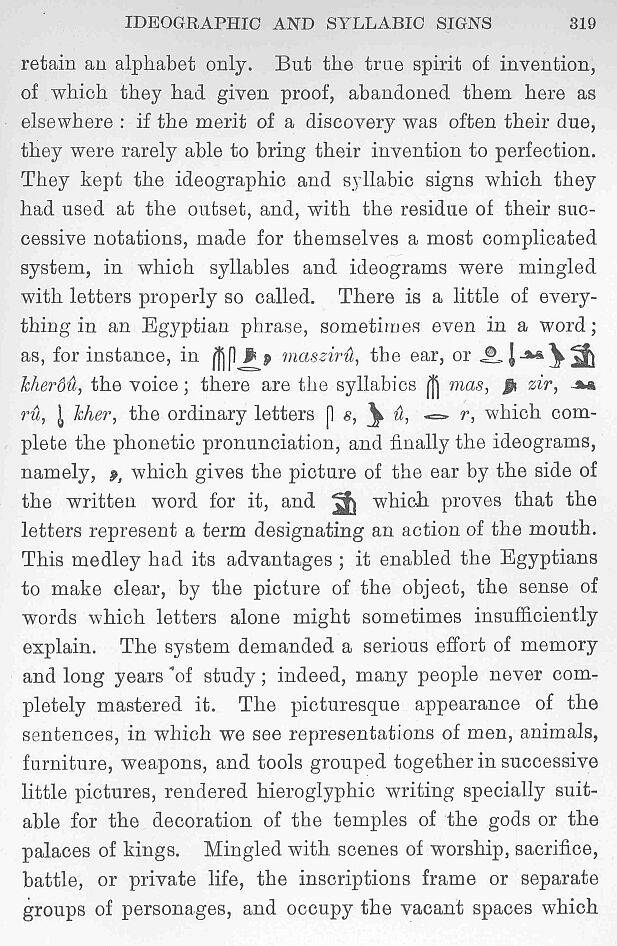
But the true spirit of invention, of which they had given proof, abandoned them here as elsewhere: if the merit of a discovery was often their due, they were rarely able to bring their invention to perfection. They kept the ideographic and syllabic signs which they had used at the outset, and, with the residue of their successive notations, made for themselves a most complicated system, in which syllables and ideograms were mingled with letters properly so called. There is a little of everything in an Egyptian phrase, sometimes even in a word; as, for instance, in [ ] maszirû, the ear, or [ ] kherôû, the voice; there are the syllables [ ] kher, the ordinary letters [ ], which complete the phonetic pronunciation, and finally the ideograms, namely, [ ], which gives the picture of the ear by the side of the written word for it, and [ ] which proves that the letters represent a term designating an action of the mouth. This medley had its advantages; it enabled the Egyptians to make clear, by the picture of the object, the sense of words which letters alone might sometimes insufficiently explain. The system demanded a serious effort of memory and long years of study; indeed, many people never completely mastered it. The picturesque appearance of the sentences, in which we see representations of men, animals, furniture, weapons, and tools grouped together in successive little pictures, rendered hieroglyphic writing specially suitable for the decoration of the temples of the gods or the palaces of kings. Mingled with scenes of worship, sacrifice, battle, or private life, the inscriptions frame or separate groups of personages, and occupy the vacant spaces which the sculptor or painter was at a loss to fill; hieroglyphic writing is pre-eminently a monumental script. For the ordinary purposes of life it was traced in black or red ink on fragments of limestone or pottery, or on wooden tablets covered with stucco, and specially on the fibres of papyrus. The exigencies of haste and the unskilfulness of scribes soon changed both its appearance and its elements; the characters when contracted, superimposed and united to one another with connecting strokes, preserved only the most distant resemblance to the persons or things which they had originally represented. This cursive writing, which was somewhat incorrectly termed hieratic, was used only for public or private documents, for administrative correspondence, or for the propagation of literary, scientific, and religious works.
It was thus that tradition was pleased to ascribe to the gods, and among them to Thot—the doubly great—the invention of all the arts and sciences which gave to Egypt its glory and prosperity. It was clear, not only to the vulgar, but to the wisest of the nation, that, had their ancestors been left merely to their own resources, they would never have succeeded in raising themselves much above the level of the brutes. The idea that a discovery of importance to the country could have risen in a human brain, and, once made known, could have been spread and developed by the efforts of successive generations, appeared to them impossible to accept. They believed that every art, every trade, had remained unaltered from the outset, and if some novelty in its aspect tended to show them their error, they preferred to imagine a divine intervention, rather than be undeceived. The mystic writing, inserted as chapter sixty-four in the Book of the Dead, and which subsequently was supposed to be of decisive moment to the future life of man, was, as they knew, posterior in date to the other formulas of which this book was composed; they did not, however, regard it any the less as being of divine origin. It had been found one day, without any one knowing whence it came, traced in blue characters on a plaque of alabaster, at the foot of the statue of Thot, in the sanctuary of Hermopolis. A prince, Hardiduf, had discovered it in his travels, and regarding it as a miraculous object, had brought it to his sovereign. This king, according to some, was Hûsaphaîti of the first dynasty, but by others was believed to be the pious Mykerinos. In the same way, the book on medicine, dealing with the diseases of women, was held not to be the work of a practitioner; it had revealed itself to a priest watching at night before the Holy of Holies in the temple of Isis at Coptos. "Although the earth was plunged into darkness, the moon shone upon it and enveloped it with light. It was sent as a great wonder to the holiness of King Kheops, the just of speech." The gods had thus exercised a direct influence upon men until they became entirely civilized, and this work of culture was apportioned among the three divine dynasties according to the strength of each. The first, which comprised the most vigorous divinities, had accomplished the more difficult task of establishing the world on a solid basis; the second had carried on the education of the Egyptians; and the third had regulated, in all its minutiae, the religious constitution of the country. When there was nothing more demanding supernatural strength or intelligence to establish it, the gods returned to heaven, and were succeeded on the throne by mortal men. One tradition maintained dogmatically that the first human king whose memory it preserved, followed immediately after the last of the gods, who, in quitting the palace, had made over the crown to man as his heir, and that the change of nature had not entailed any interruption in the line of sovereigns. Another tradition would not allow that the contact between the human and divine series had been so close. Between the Ennead and Menés, it intercalated one or more lines of Theban or Thinite kings; but these were of so formless, shadowy, and undefined an aspect, that they were called Manes, and there was attributed to them at most only a passive existence, as of persons who had always been in the condition of the dead, and had never been subjected to the trouble of passing through life. Menés was the first in order of those who were actually living. From his time, the Egyptians claimed to possess an uninterrupted list of the Pharaohs who had ruled over the Nile valley. As far back as the XVIIIth dynasty this list was written upon papyrus, and furnished the number of years that each prince occupied the throne, or the length of his life.[*]
* The only one of these lists which we possess, the "Turin Royal Papyrus," was bought, nearly intact, at Thebes, by Drovetti, about 1818, but was accidentally injured by him in bringing home. The fragments of it were acquired, together with the rest of the collection, by the Piedmontese Government in 1820, and placed in the Turin Museum, where Champollion saw and drew attention to them in 1824. Seyffarth carefully collected and arranged them in the order in which they now are; subsequently Lepsius gave a facsimile of them in 1840, in his Auswahl der wichtigsten Urhunden, pls. i.-vi., but this did not include the verso; Champollion-Figeac edited in 1847, in the Revue Archéologique, 1st series, vol. vi., the tracings taken by the younger Champollion before Seyffarth's arrangement; lastly, Wilkinson published the whole in detail in 1851. Since then, the document has been the subject of continuous investigation: E. de Rougé has reconstructed, in an almost conclusive manner, the pages containing the first six dynasties, and Lauth, with less certainty, those which deal with the eight following dynasties.
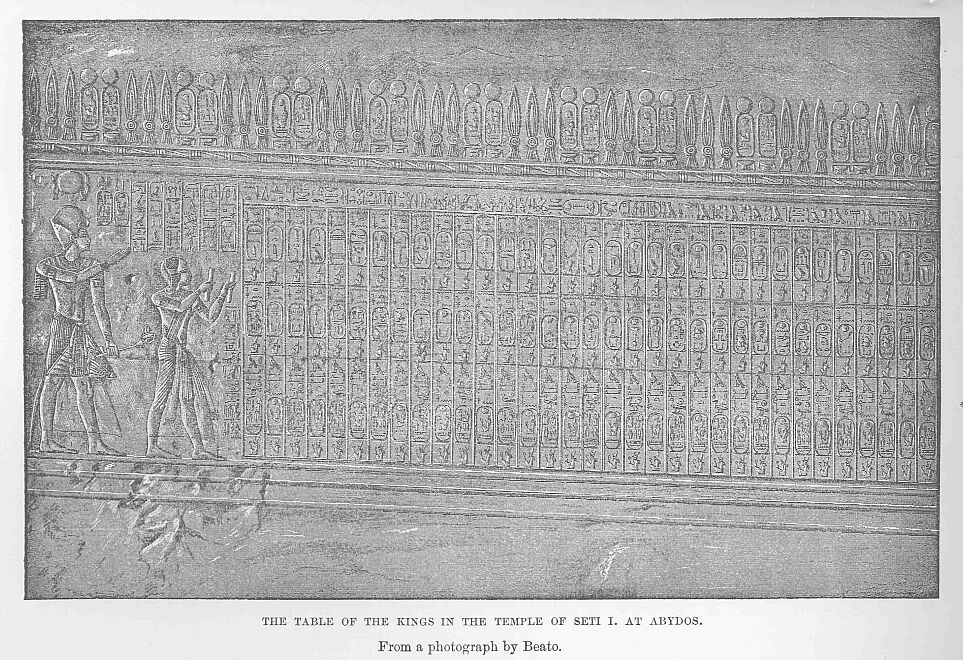
Extracts from it were inscribed in the temples, or even in the tombs of private persons; and three of these abridged catalogues are still extant, two coming from the temples of Seti I. and Ramses II. at Abydos,[*] while the other was discovered in the tomb of a person of rank named Tunari, at Saqqâra.[**] They divided this interminable succession of often problematical personages into dynasties, following in this division, rules of which we are ignorant, and which varied in the course of ages. In the time of the Ramessides, names in the list which subsequently under the Lagides formed five groups were made to constitute one single dynasty.[***]
* The first table of Abydos, unfortunately incomplete, was discovered in the temple of Ramses II. by Banks, in 1818; the copy published by Caillaud and by Salt served as a foundation for Champollion's first investigations on the history of Egypt. The original, brought to France by Mimaut, was acquired by England, and is now in the British Museum. The second table, which is complete, all but a few signs, was brought to light by Mariette in 1864, in the excavations at Abydos, and was immediately noticed and published by Dùmichen. The text of it is to be found in Mariette, La Nouvelle Table d'Abydos (Revue Archéologique, 2nd series, vol. xiii.), and Abydos, vol. i. pl. 43. ** The table of Saqqâra, discovered in 1863, has been published by Mariette, La Table de Saqqâra (Revue Archéologique, 2nd series, vol. x. p. 169, et seq.), and reproduced in the Monuments Divers, pl. 58. *** The Royal Canon of Turin, which dates from the Ramesside period, gives, indeed, the names of these early kings without a break, until the list reaches Unas; at this point it sums up the number of Pharaohs and the aggregate years of their reigns, thus indicating the end of a dynasty. In the intervals between the dynasties rubrics are placed, pointing out the changes which took place in the order of direct succession. The division of the same group of sovereigns into five dynasties has been preserved to us by Manetho.
Manetho of Sebennytos, who wrote a history of Europe for the use of Alexandrine Greeks, had adopted, on some unknown authority, a division of thirty-one dynasties from Menés to the Macedonian Conquest, and his system has prevailed—not, indeed, on account of its excellence, but because it is the only complete one which has come down to us.[*] All the families inscribed in his lists ruled in succession.[**]
* The best restoration of the system of Manetho is that by Lepsius, Das Konigsbuch der Alten Ægypter, which should be completed and corrected from the memoirs of Lauth, Lieblein, Krall, and Unger. A common fault attaches to all these memoirs, so remarkable in many respects. They regard the work of Manetho, not as representing a more or less ingenious system applied to Egyptian history, but as furnishing an authentic scheme of this history, in which it is necessary to enclose all the royal names which the monuments have revealed, and are still daily revealing to us. ** E. de Rougé triumphantly demonstrated, in opposition to Bunsen, now nearly fifty years ago, that all Manetho's dynasties are successive, and the monuments discovered from year to year in Egypt have confirmed his demonstration in every detail.
The country was no doubt frequently broken up into a dozen or more independent states, each possessing its own kings during several generations; but the annalists had from the outset discarded these collateral lines, and recognized only one legitimate dynasty, of which the rest were but vassals. Their theory of legitimacy does not always agree with actual history, and the particular line of princes which they rejected as usurpers represented at times the only family possessing true rights to the crown.[*]
* It is enough to give two striking examples of this. The royal lists of the time of the Ramessides suppress, at the end of the XVIIIth dynasty, Amenôthes IV. and several of his successors, and give the following sequence—Amenôthes III., Harmhabît, Ramses I., without any apparent hiatus; Manetho, on the contrary, replaces the kings who were omitted, and keeps approximately to the real order between Horos (Amenôthes III.) and Armais (Harmhabît). Again, the official tradition of the XXth dynasty gives, between Ramses II. and Ramses III., the sequence—Mînephtah, Seti IL, Nakht-Seti; Manetho, on the other hand, gives Amenemes followed by Thûôris, who appear to correspond to the Amenmeses and Siphtah of contemporary monuments, but, after Mînephtah, he omits Seti II. and Nakhîtou-Seti, the father of Ramses III.
In Egypt, as elsewhere, the official chroniclers were often obliged to accommodate the past to the exigencies of the present, and to manipulate the annals to suit the reigning party; while obeying their orders the chroniclers deceived posterity, and it is only by a rare chance that we can succeed in detecting them in the act of falsification, and can re-establish the truth.
The system of Manetho, in the state in which it has been handed down to us by epitomizers, has rendered, and continues to render, service to science; if it is not the actual history of Egypt, it is a sufficiently faithful substitute to warrant our not neglecting it when we wish to understand and reconstruct the sequence of events. His dynasties furnish the necessary framework for most of the events and revolutions, of which the monuments have preserved us a record. At the outset, the centre to which the affairs of the country gravitated was in the extreme north of the valley. The principality which extended from the entrance of the Fayûm to the apex of the Delta, and subsequently the town of Memphis itself, imposed their sovereigns upon the remaining nomes, served as an emporium for commerce and national industries, and received homage and tribute from neighbouring peoples. About the time of the VIth dynasty this centre of gravity was displaced, and tended towards the interior; it was arrested for a short time at Heracleo-polis (IXth and Xth dynasties), and ended by fixing itself at Thebes (XIth dynasty). From henceforth Thebes became the capital, and furnished Egypt with her rulers. With the exception of the XIVth Xoïte dynasty, all the families occupying the throne from the XIth to the XXth dynasty were Theban. When the barbarian shepherds invaded Africa from Asia, the Thebaïd became the last refuge and bulwark of Egyptian nationality; its chiefs struggled for many centuries against the conquerors before they were able to deliver the rest of the valley. It was a Theban dynasty, the XVIIIth, which inaugurated the era of foreign conquest; but after the XIXth, a movement, the reverse of that which had taken place towards the end of the first period, brought back the centre of gravity, little by little, towards the north of the country. From the time of the XXIst dynasty, Thebes ceased to hold the position of capital: Tanis, Bubastis, Mendes, Sebennytos, and above all, Sais, disputed the supremacy with each other, and political life was concentrated in the maritime provinces. Those of the interior, ruined by Ethiopian and Assyrian invasions, lost their influence and gradually dwindled away. Thebes became impoverished and depopulated; it fell into ruins, and soon was nothing more than a resort for devotees or travellers. The history of Egypt is, therefore, divided into three periods, each corresponding to the suzerainty of a town or a principality:—
I.—Memphite Period, usually called the "Ancient Empire," from the Ist to the Xth dynasty: kings of Memphite origin ruled over the whole of Egypt during the greater part of this epoch.
II.—Theban Period, from the XIth to the XXth dynasty. It is divided into two parts by the invasion of the Shepherds (XVIth dynasty):
a. The first Theban Empire (Middle Empire), from the XIth to the XIVth dynasty.
b. The new Theban Empire, from the XVIIth to the XXth dynasty.
III.—Saïte Period, from the XXIst to the XXXth dynasty, divided into two unequal parts by the Persian Conquest:
a. The first Saïte period, from the XXIst to the XXVIth dynasty.
b. The second Saïte period, from the XXVIIIth to the XXXth dynasty.
The Memphites had created the monarchy. The Thebans extended the rule of Egypt far and wide, and made of her a conquering state: for nearly six centuries she ruled over the Upper Nile and over Western Asia. Under the Saïtes she retired gradually within her natural frontiers, and from having been aggressive became assailed, and suffered herself to be crushed in turn by all the nations she had once oppressed.[*]
* The division into Ancient, Middle, and New Empire, proposed by Lepsius, has the disadvantage of not taking into account the influence which the removal of the seat of the dynasties exercised on the history of the country. The arrangement which I have here adopted was first put forward in the Revue critique, 1873, vol. i. pp. 82, 83.
The monuments have as yet yielded no account of the events which tended to unite the country under the rule of one man; we can only surmise that the feudal principalities had gradually been drawn together into two groups, each of which formed a separate kingdom. Heliopolis became the chief focus in the north, from which civilization radiated over the rich plains and the marshes of the Delta. Its colleges of priests had collected, condensed, and arranged the principal myths of the local religions; the Ennead to which it gave conception would never have obtained the popularity which we must acknowledge it had, if its princes had not exercised, for at least some period, an actual suzerainty over the neighbouring plains. It was around Heliopolis that the kingdom of Lower Egypt was organized; everything there bore traces of Heliopolitan theories—the protocol of the kings, their supposed descent from Râ, and the enthusiastic worship which they offered to the sun. The Delta, owing to its compact and restricted area, was aptly suited for government from one centre; the Nile valley proper, narrow, tortuous, and stretching like a thin strip on either bank of the river, did not lend itself to so complete a unity. It, too, represented a single kingdom, having the reed and the lotus for its emblems; but its component parts were more loosely united, its religion was less systematized, and it lacked a well-placed city to serve as a political and sacerdotal centre. Hermopolis contained schools of theologians who certainly played an important part in the development of myths and dogmas; but the influence of its rulers was never widely felt. In the south, Siût disputed their supremacy, and Heracleopolis stopped their road to the north. These three cities thwarted and neutralized one another, and not one of them ever succeeded in obtaining a lasting authority over Upper Egypt. Each of the two kingdoms had its own natural advantages and its system of government, which gave to it a particular character, and stamped it, as it were, with a distinct personality down to its latest days. The kingdom of Upper Egypt was more powerful, richer, better populated, and was governed apparently by more active and enterprising rulers. It is to one of the latter, Mini or Menés of Thinis, that tradition ascribes the honour of having fused the two Egypts into a single empire, and of having inaugurated the reign of the human dynasties. Thinis figured in the historic period as one of the least of Egyptian cities. It barely maintained an existence on the left bank of the Nile, if not on the exact spot now occupied by Girgeh, at least only a short distance from it.[*]
* The site of Thinis is not yet satisfactorily identified. It is neither at Kom-es-Sultân, as Mariette thought, nor, according to the hypothesis of A. Schmidt, at El-Kherbeh. Brugsch has proposed to fix the site at the village of Tineh, near Berdis, and is followed in this by Dumichen. The present tendency is to identify it either with Girgeh itself, or with one of the small neighbouring towns—for example, Birbeh—where there are some ancient ruins; this was also the opinion of Champollion and of Nester L'hôte. I may mention that, in a frequently quoted passage of Hellanicos, Zoèga corrects the reading [Greek phrase], which would once more give us the name of Thinis: the mention of this town as being "situated on the river," would be a fresh reason for its identification with Girgeh.
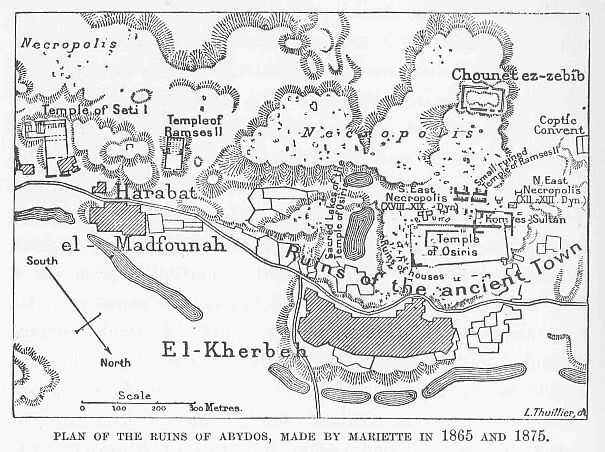
The principality of the Osirian Reliquary, of which it was the metropolis, occupied the valley from one mountain range to the other, and gradually extended across the desert as far as the Great Theban Oasis. Its inhabitants worshipped a sky-god, Anhûri, or rather two twin gods, Anhûri-Shû, who were speedily amalgamated with the solar deities and became a warlike personification of Râ. Anhûri-Shû, like all the other solar manifestations, came to be associated with a goddess having the form or head of a lioness—a Sokhît, who took for the occasion the epithet of Mîhît, the northern one. Some of the dead from this city are buried on the other side of the Nile, near the modern village of Mesheikh, at the foot of the Arabian chain, whose steep cliffs here approach somewhat near the river: the principal necropolis was at some distance to the east, near the sacred town of Abydos. It would appear that, at the outset, Abydos was the capital of the country, for the entire nome bore the same name as the city, and had adopted for its symbol the representation of the reliquary in which the god reposed. In very early times Abydos fell into decay, and resigned its political rank to Thinis, but its religious importance remained unimpaired. The city occupied a long and narrow strip of land between the canal and the first slopes of the Libyan mountains. A brick fortress defended it from the incursions of the Bedouin, and beside it the temple of the god of the dead reared its naked walls. Here, Anhûri, having passed from life to death, was worshipped under the name of Khontamentît, the chief of that western region whither souls repair on quitting this earth. It is impossible to say by what blending of doctrines or by what political combinations this Sun of the Night came to be identified with Osiris of Mendes, since the fusion dates back to a very remote antiquity; it had become an established fact long before the most ancient sacred books were compiled. Osiris Khontamentît grew rapidly in popular favour, and his temple attracted annually an increasing number of pilgrims. The Great Oasis had been considered at first as a sort of mysterious paradise, whither the dead went in search of peace and happiness. It was called Uîfc, the Sepulchre; this name clung to it after it had become an actual Egyptian province, and the remembrance of its ancient purpose survived in the minds of the people, so that the "cleft," or gorge in the mountain through which the doubles journeyed towards it, never ceased to be regarded as one of the gates of the other world. At the time of the New Year festivals, spirits flocked thither from all parts of the valley; they there awaited the coming of the dying sun, in order to embark with him and enter safely the dominions of Khontamentît. Abydos, even before the historic period, was the only town, and its god the only god, whose worship, practised by all Egyptians, inspired them all with an equal devotion. The excavations of the last few years have brought to light some, at all events, of the oldest Pharaohs known to the Egyptian annalists, namely, those whom they placed in their first human dynasties; and the locality where the monuments of these princes were discovered, shows us that these writers were correct in representing Thinis as playing an important part in the history of the early ages of their country. If the tomb of Menés—that sovereign whom we are inclined to look upon as the first king of the official lists—lies near the village of Nagadeh, not far from Thebes,[*] those of his immediate successors are close to Thinis, in the cemeteries of Abydos.[**] They stand at the very foot of the Libyan hills, near the entrance to the ravine—the "Cleft"—through which the mysterious oasis was reached, and thither the souls flocked in order that they might enter by a safe way the land beyond the grave.[***]
* The objects found during these excavations are now in the Gîzeh Museum. ** The credit of having discovered this important necropolis, and of having brought to light the earliest known monuments of the first dynasties, is entirely due to Amélineau. He carried on important work there during four years, from 1895 to 1899: unfortunately its success was impaired by the theories which he elaborated with regard to the new monuments, and by the delay in publishing an account of the objects which remained in his possession. *** For the "Cleft," cf. supra, pp. 281, 282, 334.
The mass of pottery, whole and broken, which has accumulated on this site from the offerings of centuries has obtained for it among the Fellahin the name of Omm-el-G-aâb—"the mother of pots." The tombs there lie in serried ranks. They present for the most part a rough model of the pyramids of the Memphite period—rectangular structures of bricks without mortar rising slightly above the level of the plain. The funeral chamber occupies the centre of each, and is partly hollowed out of the soil, like a shallow well, the sides being bricked. It had a flat timber roof, covered by a layer of about three feet of sand; the floor also was of wood, and in several cases the remains of the beams of both ceiling and pavement have been brought to light. The body of the royal inmate was laid in the middle of the chamber, surrounded by its funeral furniture and by a part of the offerings. The remainder was placed in the little rooms which opened out of the principal vault, sometimes on the same level, sometimes on one higher than itself; after their contents had been laid within them, the entrance to these rooms was generally walled up. Human bodies have been found inside them, probably those of slaves killed at the funeral that they might wait upon the dead in his life beyond the grave.[*] The objects placed in these chambers were mostly offerings, but besides these were coarse stelae bearing the name of a person, and dictated to "the double of his luminary."[**] Some of them mention a dwarf[***] or a favourite dog of the sovereign, who accompanied his master into the tomb. Tablets of ivory or bone skilfully incised furnish us with scenes representing some of the ceremonies of the deification of the king in his lifetime and the sacrifices offered at the time of his burial;[****] in rarer instances they record his exploits.
* El. Petrie, The Royal Tombs of the First Dynasty, part i. p. 14. ** The "luminous double" or the "double of his luminary" is doubtless that luminous spectre which haunted the tombs and even the houses of the living during the night, and which I have mentioned, supra, p. 160. *** Petrie found the skeletons of two dwarfs, probably the very two to whom the two stelae (Nos. 36, 37) in the tomb of Semempses were raised. Was one of these dwarfs one of the Danga of Puanît who were sought after by the Pharaohs of the Memphite dynasties? **** This was the ceremony called by the Egyptians "The Festival of the Foundation "—habu sadu.
The offerings themselves were such as we meet with in burials of a subsequent age—bread, cakes, meat, and poultry of various sorts—indeed, everything we find mentioned in the lists inscribed in the tombs of the later dynasties, particularly the jars of wine and liquors, on the clay bungs of which are still legible the impression of the signet bearing the name of the sovereign for whose use they were sealed. Besides stuffs and mats, the furniture comprised chairs, beds, stools, an enormous number of vases, some in coarse pottery for common use, others in choice stone such as diorite, granite, or rock crystal very finely worked, on the fragments of all of which may be read cut in outline the names and preamble of the Pharaoh to whom the object belonged. The ceremonial of the funerary offering and its significance was already fully developed at this early period; this can be gathered by the very nature of the objects buried with the deceased, by their number, quantity, and by the manner in which they were arranged. Like their successors in the Egypt of later times, these ancient kings expected to continue their material existence within the tomb, and they took precautions that life there should be as comfortable as circumstances should permit. Access to the tomb was sometimes gained by a sloping passage or staircase; this made it possible to see if everything within was in a satisfactory condition. After the dead had been enclosed in his chamber, and five or six feet of sand had been spread over the beams which formed its roof, the position of the tomb was shown merely by a scarcely perceptible rise in the soil of the necropolis, and its site would soon have been forgotten, if its easternmost limits had not been marked by two large stelae on which were carefully engraved one of the appellations of the king—that of his double, or his Horus name.[*]
* For the Horus name of the Pharaohs, see vol. ïi., pp. 23- 25.
It was on this spot, upon an altar placed between the two stelæ, that the commemorative ceremonies were celebrated, and the provisions renewed on certain days fixed by the religious law. Groups of private tombs were scattered around,—the resting-places of the chief officers of the sovereign, the departed Pharaoh being thus surrounded in death by the same courtiers as those who had attended him during his earthly existence.
The princes, whose names and titles have been revealed to us by the inscriptions on these tombs, have not by any means been all classified as yet, the prevailing custom at that period having been to designate them by their Horus names, but rarely by their proper names, which latter is the only one which figures in the official lists which we possess of the Egyptian kings. A few texts, more explicit than the rest, enable us to identify three of them with the Usaphais, the Miebis, and the Semempses of Manetho—the fifth, sixth, and seventh kings of the Ist dynasty.[*] The fact that they are buried in the necropolis of Abydos apparently justifies the opinion of the Egyptian chroniclers that they were natives of Thinis. Is the Menés who usually figures at their head[**] also a Thinite prince?
* The credit is due to Sethe of having attributed their ordinary names to several of the kings of the Ist dynasty with Horus names only which were found by Amélineau, and these identifications have been accepted by all Egyptologists. Pétrie discovered quite recently on some fragments of vases the Horus names of these same princes, together with their ordinary names. The Usaphais, the Miebis, and the Semempses of Manetho are now satisfactorily identified with three of the Pharaohs discovered by Amélineau and by Pétrie. ** In the time of Seti I. and Ramses II. he heads the list of the Table of Abydos. Under Ramses II. his statue was carried in procession, preceding all the other royal statues. Finally, the "Royal Papyrus" of Turin, written in the time of Ramses I., begins the entire series of the human Pharaohs with his name.
Several scholars believe that his ordinary name, Mini, is to be read on an ivory tablet engraved for a sovereign whose Horus name—Ahauîti, the warlike—is known to us from several documents, and whose tomb also has been discovered, but at Nagadeh. It is a great rectangular structure of bricks 165 feet long and 84 broad, the external walls of which were originally ornamented by deep polygonal grooves, resembling those which score the façade of Chaldæan buildings, but the Nagadeh tomjb has a second brick wall which fills up all the hollows left in the first one, and thus hides the primitive decoration of the monument. The building contains twenty-one chambers, five of which in the centre apparently constituted the dwelling of the deceased, while the others, grouped around these, serve as storehouses from whence he could draw his provisions at will. Did the king buried within indeed bear the name of Menés,[*] and if such was the case, how are we to reconcile the tradition of his Thinite origin with the existence of his far-off tomb in the neighbourhood of Thebes?
* The sign Manu, which appears on the ivory tablet found in this tomb, has been interpreted as a king's name, and consequently inferred to be Menés. This reading has been disputed on various sides, and the point remains, therefore, a contested one until further discovery.
Objects bearing his Horus name have been found at Omm-el-Gaâb, and it is evident that he belonged to the same age as the sovereigns interred in this necropolis. If, indeed, Menés was really his personal name, there is no reason against his being the Menés of tradition, he whom the Pharaohs of the glorious Theban dynasties regarded as the earliest of their purely human ancestors. Whether he was really the first king who reigned over the whole of Egypt, or whether he had been preceded by other sovereigns whose monuments we may find in some site still unexplored, is a matter for conjecture. That princes had exercised authority in various parts of the country is still uncertain, but that the Egyptian historians did not know them, seems to prove that they had left no written records of their names. At any rate, a Menés lived who reigned at the outset of history, and doubtless before long the Nile valley, when more carefully explored, will yield us monuments recording his actions and determining his date. The civilization of the Egypt of his time was ruder than that with which we have hitherto been familiar on its soil, but even at that early period it was almost as complete. It had its industries and its arts, of which the cemeteries furnish us daily with the most varied examples: weaving, modelling in clay, wood-carving, the incising of ivory, gold, and the hardest stone were all carried on; the ground was cultivated with hoe and plough; tombs were built showing us the model of what the houses and palaces must have been; the country had its army, its administrators, its priests, its nobles, its writing, and its system of epigraphy differs so little from that to which we are accustomed in later ages, that we can decipher it with no great difficulty. Frankly speaking, all that we know at present of the first of the Pharaohs beyond the mere fact of his existence is practically nil, and the stories related of him by the writers of classical times are mere legends arranged to suit the fancy of the compiler. "This Menés, according to the priests, surrounded Memphis with dykes. For the river formerly followed the sandhills for some distance on the Libyan side. Menés, having dammed up the reach about a hundred stadia to the south of Memphis, caused the old bed to dry up, and conveyed the river through an artificial channel dug midway between the two mountain ranges. Then Menés, the first who was king, having enclosed a firm space of ground with dykes, there founded that town which is still called Memphis; he then made a lake round it, to the north and west, fed by the river, the city being bounded on the east by the Nile."[*]
* The dyke supposed to have been made by Menés is evidently that of Qosheîsh, which now protects the province of Gîzeh, and regulates the inundation in its neighbourhood.
The history of Memphis, such as it can be gathered from the monuments, differs considerably from the tradition current in Egypt at the time of Herodotus. It appears, indeed, that at the outset, the site on which it subsequently arose was occupied by a small fortress, Anbû-hazû—the white wall—which was dependent on Heliopolis, and in which Phtah possessed a sanctuary. After the "white wall" was separated from the Heliopolitan principality to form a nome by itself, it assumed a certain importance, and furnished, so it was said, the dynasties which succeeded the Thinite. Its prosperity dates only, however, from the time when the sovereigns of the Vth and VIth dynasties fixed on it for their residence; one of them, Papi L, there founded for himself and for his "double" after him, a new town, which he called Minnofîrû, from his tomb. Minnofîrû, which is the correct pronunciation and the origin of Memphis, probably signified "the good refuge," the haven of the good, the burying-place where the blessed dead came to rest beside Osiris. The people soon forgot the true interpretation, or probably it did not fall in with their taste for romantic tales. They were rather disposed, as a rule, to discover in the beginnings of history individuals from whom the countries or cities with which they were familiar took their names: if no tradition supplied them with this, they did not experience any scruple in inventing one. The Egyptians of the time of the Ptolemies, who were guided in their philological speculations by the pronunciation in vogue around them, attributed the patronship of their city to a Princess Memphis, a daughter of its founder, the fabulous Uchoreus; those of preceding ages before the name had become altered, thought to find in Minnofîrû a "Mini Nofir," or "Menés the Good," the reputed founder of the capital of the Delta. Menés the Good, divested of his epithet, is none other than Menés, the first king, and he owes this episode in his life to a popular attempt at etymology. The legend which identifies the establishment of the kingdom with the construction of the city, must have originated at the time when Memphis was still the residence of the kings and the seat of government, at latest about the end of the Memphite period. It must have been an old tradition in the time of the Theban dynasties, since they admitted unhesitatingly the authenticity of the statements which ascribed to the northern city so marked a superiority over their own country.
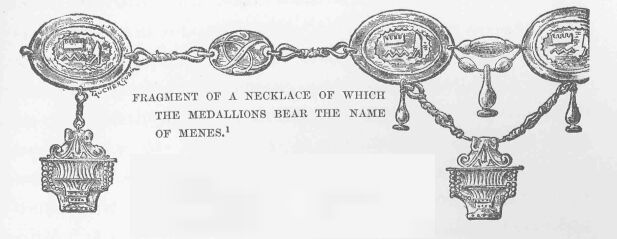
1 Drawn by Faucher-Gudin after Prisse d'Avenues. The gold medallions engraved with the name of Menés are ancient, and perhaps go back to the XXth dynasty; the setting is entirely modern, with the exception of the three oblong pendants of cornelian.
When once this half-mythical Menés was firmly established in his position, there was little difficulty in inventing a story which would portray him as an ideal sovereign. He was represented as architect, warrior, and statesman; he had begun the temple of Phtah, written laws and regulated the worship of the gods, particularly that of Hâpis, and he had conducted expeditions against the Libyans. When he lost his only son in the flower of his age, the people improvised a hymn of mourning to console him—the "Maneros"—both the words and the tune of which were handed down from generation to generation. He did not, moreover, disdain the luxuries of the table, for he invented the art of serving a dinner, and the mode of eating it in a reclining posture. One day, while hunting, his dogs, excited by something or other, fell upon him to devour him. He escaped with difficulty, and, pursued by them, fled to the shore of Lake Moeris, and was there brought to bay; he was on the point of succumbing to them, when a crocodile took him on his back and carried him across to the other side.[*] In gratitude he built a new town, which he called Crocodilopolis, and assigned to it for its god the crocodile which had saved him; he then erected close to it the famous labyrinth and a pyramid for his tomb. Other traditions show him in a less favourable light. They accuse him of having, by horrible crimes, excited against him the anger of the gods, and allege that after a reign of sixty to sixty-two years, he was killed by a hippopotamus which came forth from the Nile.[**]