HISTORY OF DENMARK, SWEDEN AND NORWAY,
Reading edition
BY
S. A. DUNHAM,
Author of “The History of Spain & Portugal”
VOL. II.
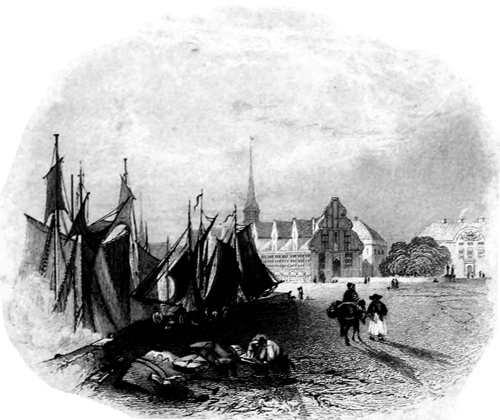
Copenhagen. E. Finden sc
London:
PRINTED FOR LONGMAN, ORME, BROWN, GREEN, & LONGMANS, PATERNOSTER-ROW
AND JOHN TAYLOR, UPPER GOWER STREET.
1839.
vTABLE,
ANALYTICAL AND CHRONOLOGICAL,
TO THE SECOND VOLUME OF
THE HISTORY OF SCANDINAVIA.
CHAPTER IV.—continued.
MARITIME EXPEDITIONS OF THE NORTHMEN DURING THE
PAGAN TIMES.
SECTION II.
IN THE ORKNEYS, THE HEBRIDES, ICELAND, GREENLAND, NORTH
AMERICA, RUSSIA, ETC.
795–1026.
ESTABLISHMENT OF A GOVERNMENT IN THE ORKNEYS.—SUCCESSION OF JARLS, ROGNEVALD, SIGURD, HALLAD, EINAR, SIGURD II., ETC.—DISCOVERY AND COLONIZATION OF ICELAND.—DISCOVERY AND COLONIZATION OF GREENLAND.—ALLEGED DISCOVERY OF NORTH AMERICA.—STATEMENT OF FACTS CONNECTED WITH IT.—FOUNDATION OF THE RUSSIAN EMPIRE BY THE SCANDINAVIAN RURIC.
Page
888. Establishment of a Government in the Orkneys by Harald Harfagre; Sigurd, the first Jarl 1
889–892. Able Administration of Sigurd; he is succeeded by Einar 2
893–936. Administration of Einar 4
936–943. Of Arnkel and Erlend, the Sons of Einar 5
946–980. Succession of Jarls 5
vi980–1014. Sigurd, the next Jarl, compelled to embrace Christianity; Legend 6
Piratical Depredations on the neighbouring Islands 8
861, &c. Iceland Discovered by the Norwegian Naddod, who is followed by other Navigators 9
874. Iceland first colonised by Ingulf; Fate of Jorleif 10
884. Other Colonists, especially Thorolf, the Priest of Thor; Manner in which he established the new Colony 11
874–936. Progress of the new Colonies 13
Formation of a Northern Code 14
930. Internal Economy of this important Island; the great Chief of the Law 15
Circumstances which led to the Discovery of Greenland by Eric the Red 16
Christianity Introduced into Greenland by Leif, the Son of Eric 17
1001. Alleged Discovery of North America by Biarn, a Descendant of Ingulf 17
The newly-discovered Country visited by Leif, the Son of Eric 18
Remarks on this Relation 19
1004–1008. Voyage of Thorwald, who dies in the Country called Vinland 19
1009. Thorfin, a Norwegian Chief, makes the first Attempt at Colonisation 20
1026–1121. The Country visited by other People, especially by the Missionaries 21
The Balance of Evidence decidedly in favour of the alleged Discovery of the American Continent many Ages before Columbus 22
862. A Scandinavian Dynasty founded in Russia by Ruric 23
Circumstances connected with that memorable Event; how far probable 24
861, 862. Novogrod the Seat of the new Dynasty 25
The Domination of the Strangers extended to Kief; two Governments 26
882. Evils arising from the Creation of two States; Kief subdued by the Regent of Novogrod 27
Maritime Expeditions of the Northmen into Germany, Belgium, Spain, Italy, Greece, &c. 27
CHAP. V.
COSMOGONY AND RELIGION OF SCANDINAVIA.
INTRODUCTION.
THE TWO EDDAS, THE ELDER AND THE YOUNGER, THE POETIC AND THE PROSE.—CONTENTS OF THE FORMER.—DIVISION INTO viiCLASSES. 1. THE MYSTICAL. 2. THE MYTHIC-DIDACTIC. 3. THE PURELY MYTHOLOGICAL. 4. THE MYTHIC-HISTORICAL.—POEMS OF EACH CLASS.—THE PROSE EDDA.—SNORRO STURLESON.
Page
Religion of the Pagan Northmen an interesting Subject of Inquiry 30
The Two Eddas 30
I. Sæmund, reputed Compiler of the Poetic Edda; its slow Publication 31
Poems included in the Elder Edda divisible into four Classes 31
1. The Mystic Class:—
The Voluspa 32
The Grougaldor 32
The Magic of Odin similar in many Respects to that of Zoroaster 33
2. The Mytho-didactic Class:—
The Vafthrudnis-mâl 34
Grimnis-mâl 34
Other Pieces of this Class 36
The Hava-mâl 36
3. The purely Mythologic Class:—
The Hymis-guida 37
The Hamars-heimt 37
The Rafna-galdur Odins 37
The Skirnirs-for 37
The Vegtams-Quida 38
Undoubted Antiquity of the preceding Poems 38
4. The Mytho-historical Class 38
II. The Prose or Younger Edda, usually ascribed to Snorro Sturleson 39
Some Account of that celebrated Man 40
Sources from which he drew 42
SECTION I.
THE SCANDINAVIAN UNIVERSE, ITS WORLDS, AND THEIR INHABITANTS IN GENERAL, WITH THE PHYSICAL INTERPRETATION.
CREATION OF THE UNIVERSE.—YMER.—THE GIANTS.—THE GODS.—OTHER BEINGS.—THE NINE WORLDS, WITH THEIR POSITION AND PHYSICAL INTERPRETATION.—THE TWELVE HOUSES OF ASGARD.—SWARTALFAHEIM.—INHABITANTS OF THE NINE WORLDS.—THE ASER.—THE VEVER, ETC.
Page
Progress of Creation according to that venerable Authority, the Elder Edda 43
The Waters of Nifleheim flow into the Abyss and freeze 43
But they are thawed by the Fires of Muspelheim 44
viiiTo the Operation of Cold and Heat on the Waters of Nifleheim must be ascribed the Origin of this visible Universe 44
Generation of Ymer, the Patriarch of the Frost Giants 44
Creation of the Cow Andumbla, which calls Burè into Existence 45
From this new Being, half Deity, half Giant, arose Odin, Vilè, and Vè 45
Ymer destroyed, and the Universe formed from his Body 45
Affinities between the Scandinavian and other Systems of Mythology 46
The Cow, as a Symbol, very generally diffused 47
Physical Interpretation of the Mythos 47
Physical Interpretation of another Mythos, the Destruction of Ymer and his Offspring 48
Notions concerning a Supreme, Eternal Being entertained by the Scandinavians 49
Creation of other Beings, especially the Dwarfs 50
Creation of Man 51
Page
The Nine Worlds.
Page
Gimlè and Muspelheim 53
Midgard and Utgard 53
Asgard 55
Divine Residences in Asgard:—
1. Ydale 56
2. Alfheim 57
3. Valaskialf 57
4. Soequabeck 58
5. Gladsheim 58
6. Thrymheim 58
7. Breidablik 59
8. Himmelbierg 60
9. Folkvangur 60
10. Glitner 61
11. Noatun 61
12. Landvide 61
Residences of Odin 62
Diversions of the Einheriar 62
Ascent of slain Heroes from Earth to Heaven 63
Bloodthirsty Character of the Odinists 63
Swartalfaheim 64
Residences of the Alfs or Elves 64
Their Nature according to Thorlacius 64
Origin of the Word 65
Universality of the Word 66
Traditions still rife respecting them 67
Scandinavian Dwarfs 69
Two Legends respecting them 70
Their wondrous Manufactures at the Instance of Loke 70
Physical Interpretation 72
Thorston and the Dwarf 73
Helheim and Nifleheim 74
ixThe Yggdrasil 75
Explanation of this Mythos 77
Races which inhabited the Scandinavian Universe 78
Were the Aser Gods, or Mortals only, or deified Mortals? 79
Some Reasons for the Inference that Odin and his Followers really existed 80
Hypothesis of two Odins, how far reconcileable with Facts 81
Did Odin, in his own Case, inculcate the Doctrine of Metempsychosis? 82
Conclusion that Odin and his Companions actually existed on Earth; but how account for the divine Attributes claimed by them? still more, how account for the extraordinary Diffusion of their Worship? 82
Their Policy in the North 83
Two distinct Systems of Religion evidently prevalent in the North,—the Native and the Foreign,—that of Thor, and that of Odin 84
And also two distinct Systems of Magic 85
Another Argument for this Distinction 86
Progress of Odin and his Companions towards Deification 88
Geographical Position of the Aser and Vanir led to their celestial Location 89
The Union of two Systems—the Native and the Foreign, the Finnish and the Gothic—every where discernible in the Eddas 91
SECTION II.
CHIEF MYTHOLOGICAL PERSONAGES OF SCANDINAVIA.
ODIN, THOR, AND LOKE.—THEIR CHARACTERS PHYSICALLY INTERPRETED.—THEIR WIVES AND OFFSPRING.—THE THREE DEMON CHILDREN OF LOKE.—INFLUENCE OF THIS DEITY OVER THE FATE OF THE UNIVERSE.—HE IS PRESENT IN EVERY GREAT MYTHOS.—RAPE OF IDUNA.—THOR’S VISITS TO JOTUNHEIM.—THOR AND THE GIANT HYMIR.—THOR AND THE GIANT THRYM.—NIVOD, FREYR, FREYA.—EXPEDITION OF SKIRNIR-ÆGIR AND RAN.—OTHER DEITIES.—BALDER.—PUNISHMENT OF LOKE.—RAGNAROK.—RECOGNITION OF A GREAT FIRST CAUSE BY THE PAGAN SCANDINAVIANS.
Odin, Thor, Loke.
Page
Wives and Sons of Odin 92
His Functions, Abodes, and Ministers 93
The three Valkyrs 93
Legend of Odin and Sterkodder 94
This Legend furnishes another Proof of the Fact that Odin was a foreign Deity 95
Thor, his Superiority over Odin in the more ancient System of the North, and his three Treasures 96
xMythical Interpretation 97
Thor peculiarly worshipped in Norway 97
The Giants, the everlasting Enemies of Thor 98
This Article of popular Belief essentially Celtic 98
Loke 99
His Description 100
His Offspring three:—
1. The Great Serpent 101
2. Hela, Queen of Death 101
3. The Wolf Fenris 102
Manner in which the last-named Demon was bound by the Gods 102
Loke originally the same with Utgardelok, and the Personification of Evil in the Celtic Creed 103
Mythological Fables in which Loke is concerned 104
Rape of Iduna.
Page
Odin, Hoenir, and Loke visit Utgard 105
Loke compelled to promise that he will deliver Iduna into the Power of Thiasse 105
He performs his Promise 106
Consequent Wrath of the Gods, who compel him to restore her 106
Interpretation of this Mythos 107
Thor’s Visits to Utgard.
Page
Loke, taken by the Giants, is compelled to promise that he will bring Thor without Belt or Hammer 108
Thor accordingly undertakes the Journey; his Punishment of Geyruth, and the Daughters of that Giant 109
Second Journey of Thor to Utgard, accompanied by Loke 110
Adventure in the Cottage 110
Dreary Wastes through which the Travellers passed 111
Adventure in the desert Heath 112
Adventures in Utgard itself 113
Thor and the Giant Hymir.
Page
Banquet of the Sea-god Ægir 114
Thor and Tyr proceed to Giant-land to steal a Caldron 114
Adventures at the House of Hymir 115
Physical Meaning of this Mythos 116
The same Adventures paraphrased by the Danish Poet Ohlenschlager 117
Thor and the Giant Thrym.
Page
Thor loses Miölner 124
Loke discovers the Thief, who is the Giant Thrym 125
Thrym will not restore it, unless he have Freya to Wife 125
xiWhen Freya refuses, Thor is persuaded to assume Female Apparel, and go to Jotunheim 126
Adventures there 127
Metrical Version of this Legend 128
Magnussen’s Interpretation 129
Sif, the Wife of Thor 131
Niord, Freyr, Freya.
Page
Niord, Lord of the Vaner, and a God 132
His second Wife is Skada, from whom he separates 133
Freyr, the Son of Niord, in love with a Giant Maiden 133
Skirnir, his Attendant, goes to Jotunheim and wins her 134
Metrical Version of Skirnir’s Expedition 135
Freya, the Daughter of Niord, and the Goddess of Love 136
Her Functions and Authority in Asgard 140
Ægir and Ran.
Page
Ægir, the God of the Deep, more clement than Ran, his Queen 141
Another Feast given by the Sea-god, in which Loke is abusive 142
Other Deities.
Page
The Nornies 143
Night and Day 143
The Giant of Winter 144
Balder.
Page
His Fate connected with that of the Universe; his Dreams, and consequent Anxiety of the Gods 145
Interpretation of the Mythos 146
Punishment of Loke.
Page
He is bound, like Prometheus, to the Flinty Rock; Poison; Fidelity of his Wife 146
Ragnarok, the Twilight of the Gods.
Page
Account of that great Consummation extracted from the Prose Edda 147
Corroborated by the Voluspa 150
xiiSECTION III.
INTRODUCTION OF CHRISTIANITY INTO DENMARK AND
SWEDEN.
OBSCURE EFFORTS OF THE ANGLO-SAXON MISSIONARIES TO CHRISTIANISE FRISIA AND DENMARK.—VICTORIES OF CHARLEMAGNE PREPARE THE WAY FOR A WIDER DIFFUSION OF CHRISTIANITY.—FEALTY OF HARALD KLAK.—MISSIONARIES SENT INTO THE NORTH.—ST. ANSCAR.—CREATION OF AN ARCHBISHOPRIC.—ST. REMBERT.—SUCCEEDING ARCHBISHOPS.—FLUCTUATIONS IN THE STATE OF THE NEW RELIGION.—ITS ULTIMATE ESTABLISHMENT IN THE KINGDOMS OF THE NORTH.
A. D. Page
Early Efforts of the Anglo-Saxon Missionaries to Christianise the North; very little effected in the Eighth Century 151
822. But in the Ninth there is more Success 152
826–830. St. Anscar, Monk of Corbey 153
He repairs first to Denmark, and next to Sweden 154
His Reception by the Swedish King, and his Return to Germany 155
830–852. He is made Archbishop of Hamburg, with the Primacy over the North 155
Difficulties of his Position 156
852. He goes Ambassador to the North; Opposition to him in Sweden 157
853–865. But that Opposition he overcomes through the royal Aid 158
865–889. St. Rembert, his Biographer and Successor 160
Adalgar, his Coadjutor 160
889–936. Adalgar and Hoger, in succession Archbishops of Bremen, have no great Zeal for the Cause 161
But Unnus has; his Success 161
936–988. Progress of Christianity in Denmark under Adalrag; Erection of four Episcopal Sees 162
988–1026. Pontificate of Libentis 163
xiiiBOOK II.
THE MIDDLE AGE.
CHAPTER I.
DENMARK.
1014–1387.
CANUTE THE GREAT.—HARDA-CANUTE.—MAGNUS.—ROMANTIC ADVENTURES OF HARALD HARDRADE.—SWEYN II.—HARALD III.—CANUTE IV.—OLAF II.—ERIC III.—NICHOLAS.—ERIC IV.—ERIC V.—CANUTE V. AND SWEYN III.—VALDEMAR I.—HIS ABLE REIGN.—ARCHBISHOPS ESKIL AND ABSALOM.—CANUTE VI.—VALDEMAR II.—DECLINE OF THE DANISH POWER AND THE CAUSES WHICH LED TO IT.—ERIC VI.—ABEL.—CHRISTOPHER I.—ERIC VII.—ERIC VIII.—CHRISTOPHER II.—INTERREGNUM.—VALDEMAR III.—MEMORABLE TRANSACTIONS WITH NORWAY AND SWEDEN.—OLAF III.—UNION OF DENMARK AND NORWAY.
Canute the Great.
1015–1035.
Page
1014. Canute the Great succeeds his Father Sweyn in both Denmark and England 165
1016–1028. He conquers Norway 167
1028–1035. Character of his Administration 167
His personal Character 167
He divides his Dominions among his Sons 168
Harda-Canute.
1035–1042.
Page
1035–1040. Loses Denmark by the Usurpation of his Brother Harald, but recovers it on that Prince’s Death 171
1040–1042. His Administration of England 171
1035–1042. And of Denmark 171
His Compact with Magnus, King of Norway 172
xiv
Magnus I.
1042–1047.
Page
1042–1044. Succeeds in virtue of his Compact with Harda-Canute, and is well received in Denmark 172
His Impolicy in regard to Sweyn, the Nephew of Canute the Great, whom he makes Viceroy of Denmark 173
The Viceroy rebels, and is vanquished 173
1044, 1045. Magnus triumphs over the Pirates 173
1045. A new Enemy appears in Harald Hardrade; his romantic Adventures 174
1045, 1046. Harald allies with Sweyn, but Magnus dissolves the Alliance by his Policy 177
1047. Magnus leaves the Danish Crown to Sweyn 178
Sweyn II.
1047–1076.
Page
1048–1070. Transactions with Norway, England, &c. 178
1066–1070. And with the Church, which his Incontinence provokes 179
1070. He commits Murder also, and does Penance for it 180
1070–1076. Character of this Monarch, and Description of Denmark, by Adam, Canon of Bremen 181
Harald III.
SURNAMED HEIN, OR THE GENTLE.
1076–1080.
Page
1076. Harald, a Bastard Son of Sweyn II, is elected by the States 183
1076–1080. His Reign affords no Materials for History 183
Canute IV.
SURNAMED THE SAINT.
1080–1086.
Page
1080–1085. His foreign Preparations 184
1080–1086. His vigorous Administration 184
His impolitic Indulgence to the Church 185
His Enforcement of the Tithe 186
1086. His tragical End 186
His Semi-deification 187
He is succeeded by Olaf, Duke of Sleswic 187
xv
Olaf II.
SURNAMED FAMELICUS, OR THE HUNGRY.
1087–1095.
Page
1087–1095. During his Reign, the Realm wasted by Famine 187
Eric III.
SURNAMED THE GOOD.
1095–1103.
Page
1095, 1096. His vigorous Administration 188
1097–1103. Lund erected into a Metropolis independent of Bremen 189
His Pilgrimage to the Holy Land 189
1103. His Death and Character 190
Nicholas.
1105–1134.
Page
1103–1105. Interregnum of two Years, when Nicholas is elected 190
1105–1126. His Jealousy of his Nephew Canute 191
1126–1132. Civil Wars 192
1132–1134. Civil Wars continued; Murder of Nicholas 193
Eric IV.
SURNAMED EMUND.
1134–1137.
Page
1131–1137. His Reign has no Materials for History 193
Eric V.
SURNAMED THE LAME.
1137–1147.
Page
1137–1147. Vanquishes a Competitor for the Throne, and retires to the Cloister 194
Double Election 195
Canute V.
1147–1156.
Sweyn III.
1147–1157.
Page
1147–1152. Civil Wars 195
1152–1156. Continued; Actions of Prince Valdemar 196
1156, 1157. After the Death of Canute, Sweyn contends with Valdemar 197
xvi
Valdemar I.
SURNAMED THE GREAT.
1157–1182.
Page
1157–1169. Valdemar, Monarch of Denmark, destroys the Pirates of Rugen 198
1169–1175. Other Transactions with the Pagans of Vandalia 200
Archbishop Eskil, Primate 202
1175–1179. Archbishop Absalom, the Successor of Eskil 203
1176–1179. Valdemar exacts the Tithe; Disturbances in consequence 205
1180. His Transactions with the Empire 206
1182. His Character and Administration 207
Canute VI.
1182–1202.
Page
1182–1189. Prosperity of this Monarch 208
1183–1188. He quarrels with the Emperor 209
1191–1202. His Troubles through Bishop Valdemar 209
Flourishing State of Denmark in his Reign 211
Valdemar II.
SURNAMED THE VICTORIOUS.
1202–1241.
Page
1202–1204. His early Transactions with Holstein 212
1204–1210. His Expedition against the Livonians 212
1205–1218. His Disputes with the Empire 213
1219–1223. His Transactions with Esthonia 214
1223. He is made Prisoner by one of his Vassals 215
1223–1226. Negotiations for his Ransom, which is at length effected 216
1226–1238. His unfortunate Projects 216
1238–1241. His internal Administration 217
1240. His Character as a Legislator 217
Eric VI.
SURNAMED PLOGPENNING, OR PLOUGHPENNY.
1241–1250.
Page
1241. Eric, prior to his Accession, had been Duke of Sleswic 218
1241–1248. His unfortunate Dispute with his Brother Abel, and its Results 218
xvii1249. His Expedition into Livonia 219
1250. His War with the Count of Holstein led to his Murder by his Brother Abel 220
Abel.
1250–1252.
Page
1250–1252. The royal Fratricide undertakes an Expedition against the Frisians, and is slain in a Morass 221
1252. In the popular Creed he becomes a Vampire 222
Christopher I.
1252–1259.
Page
1252–1258. Troubled Reign of this Prince 223
1256–1257. His Disputes with the Church, especially with Jacob Erlandsen, Bishop of Roskild 224
1257. Violent Measures of the King 225
1258, 1259. To sustain the Vengeance of the Church, he allies himself with his royal Neighbours, but dies 226
1259. Was his Death natural? 227
Eric VII.
SURNAMED GLIPPING.
1259–1286.
Page
1259–1263. Troubles during the Minority of this King 227
1261–1264. He and his Mother Prisoners, but both eventually released 229
1272–1275. He is reconciled with the Church 230
1280–1286. But he is embroiled with other Enemies, who deprive him of Life 231
His Reign disastrous 231
Eric VIII.
SURNAMED MOENVED.
1286–1319.
Page
1286–1308. Troubles of the Minority; Efforts to recal the Murderers of the late King 232
1292–1299. The King embroiled with the Church 233
1299–1319. Other Troubles; Eric a Legislator; before his Death (without Issue) he advises the States not to elect his turbulent Brother 234
1310. But that Brother procures the Crown 235
xviii
Christopher II.
1320–1334.
Page
1320–1323. Prodigality of the new King to secure himself on the Throne 236
1324, 1325. He violates his Pledges 236
1325. Dissatisfaction of his People, who expel him 237
1326–1328. Rapacity of the Nobles during his Exile; he returns 238
1329–1331. His ruinous Promises 239
1331, 1332. Proceedings in regard to Scania, which becomes the Prize of Sweden 240
1332, 1333. Last Days of Christopher 241
Interregnum.
Page
1333, 1334. State of the Country 241
1334–1340. Rapacity of the Regents, especially Count Gerard, who is murdered 242
1340. Election of a new King 243
Valdemar IV.
SURNAMED ATTERDAG.
1340–1375.
Page
1340. State of the Kingdom on the Accession of Valdemar 244
His vigilant Administration 244
1344. He sells Scania, but redeems many other Places 245
1345–1348. He sells Esthenia, and makes good Use of the Money 245
1348–1350. He obtains Money from another Quarter 246
1351–1357. His Rigour occasions Rebellion, which, however, he suppresses 247
1357–1360. He recovers Scania 247
1360–1363. By helping Magnus of Sweden, he offends the Hanse Towns 248
1362, 1363. His artful Policy in regard to the Union of his Daughter with Hako of Norway 250
1363. Important Consequences of this Union 250
1364, 1365. Valdemar abroad 251
1367–1370. Again. Why? 251
1370–1375. Closing Years of his Reign 252
Olaf III.
1376–1387.
Page
1375, 1376. Olaf, Son of Hako, elected; his Mother Regent 253
1373. Lavish Promises of Margaret 254
xix Opinion respecting them 255
1376–1380. She triumphs over all Competitors 255
1380–1386. Olaf becomes King of Norway; ambitious Policy of the Queen-Mother 256
1386. Transactions with the House of Holstein 257
1387. Sudden Death of Olaf 258
CHAP. II.
NORWAY.
1030–1387.
CANUTE THE GREAT.—SWEYN.—MAGNUS I.—HARALD HARDRADE.—OLAF III.—MAGNUS II.—MAGNUS BAREFOOT.—EVILS OF A DIVIDED SOVEREIGNTY.—ROMANTIC ADVENTURES OF SIGURD I.—MAGNUS IV.—CIVIL WARS.—EXTRAORDINARY ADVENTURES OF SWERRO.—HAKO IV.—MAGNUS VI.—ERIC II.—HAKO V.—OTHER SOVEREIGNS.—UNION OF NORWAY WITH DENMARK.
Page
1030–1035. Canute the Great.—Sweyn 260
1035. The Norwegians look to Magnus, a bastard Son of St. Olaf 261
1035, 1036. Magnus I. enters into a Treaty with the King of Denmark 262
1038–1040. His Mother and Stepmother 262
1042–1046. He becomes King of Denmark 262
1047. Last Days of this Monarch 263
1047–1064. Harald Hardrade 263
1066. He falls in England 264
1066–1069. Two Kings in Norway 264
1069–1093. Olaf alone 264
1093–1095. Magnus Barefoot 265
1096–1099. His Expedition to the British Isles 265
1099–1101. His War with Sweden 266
1102–1103. His second Expedition to these Islands, and his Death in Ireland 266
1103. Partition of the Sovereignty between his three Sons 267
1103–1122. Fate of two of them 268
1107–1111. Romantic Adventures of the third Son, Sigurd I. 268
1111–1123. His Severity against Idolaters 269
1124–1130. His strange Conduct 270
1130. Magnus IV. compelled to share the Kingdom with an Adventurer 271
1130–1152. Harald IV.—Sigurd II., &c. 272
1152. Arrival of a Papal Legate 273
1153–1161. Internal Troubles 274
xx1161–1164. Continued 275
1164–1170. Transactions with Denmark 276
1166–1169. Troubles; Rival for the Throne 276
1173–1177. A second Rival 277
1174–1178. A third, the celebrated Swerro 277
1178–1186. His romantic Adventures 278
1186–1194. Swerro’s vigorous Rule 280
1194–1200. His unscrupulous Conduct 282
1194–1202. Internal Troubles 283
1202. His Death and Character 283
1202–1204. Hako III. 284
1204–1207. Guthrum 284
1207. Ordeal to prove the Descent of Hako from King Swerro 284
1208–1241. Hako IV.; his troubled Minority 285
1242–1260. Internal Events of his Reign 286
1263. His Transactions with the Scots 287
His famous Expedition 288
1263–1266. Magnus VI. 289
1263–1280. Internal Changes during this Reign 290
1280–1289. Eric II. 291
1289–1299. Transactions with Scotland 292
1299–1319. Hako V. 292
1319. Under this Prince, Norway declines 293
1319–1387. Succeeding Kings 294
CHAP. III.
SWEDEN.
1001–1389.
OLAF.—EMUND I.—EMUND II.—STENKILL.—INGE I.—PHILIP.—INGE II.—SWERKER I.—CHARLES.—ST. ERIC.—INTERNAL TROUBLES.—BIRGER JARL.—VALDEMAR I.—MAGNUS I.—BIRGER.—MAGNUS II.—ERIC IV.—ALBERT OF MECKLENBURG.—UNION OF SWEDEN WITH DENMARK.
Page
Chronological Difficulties 295
1001–1026. Olaf Skatkonung 295
1026–1051. Emund I. 296
1051–1148. Emund II., and succeeding Kings 296
1148–1154. Swerker I.; double Election 298
1155–1167. St. Eric and Charles 299
1161–1167. Charles the sole King 300
1167–1192. Canute 301
xxi1192–1210. Swerker II. 301
1210–1250. Other Rulers 302
1250. Valdemar I. 303
1251–1266. Regency of Birger 303
1266–1276. Troubled Reign of Valdemar 304
1276–1279. He is compelled to resign the Throne of Sweden 305
1279, 1280. Magnus I. 305
1281–1290. His internal Administration 306
1290–1305. Birger; his guilty Impudence 307
1305–1319. He is exiled 308
1319–1320. And his Son Beheaded 309
1319–1354. Magnus II.; his Minority, and subsequent Actions 310
1354–1357. His Weakness 311
1357–1363. His Unpopularity 312
1363. Election of Albert 313
1364–1371. Actions of this Prince 313
1371–1376. He too is unpopular 314
1377–1387. He quarrels with his Diet 314
1388, 1389. He is defeated and captured by Margaret of Denmark 315
APPENDIX.
Page
St. Canute, King of Denmark 317
xxiii