LE COLLET
Reading edition
August 12th, the day we left Ventron, was hot, and being crowded into a dusty truck added nothing to the enjoyment of the trip. We wound up and up the sides of the picturesque Vosges mountains, passing many an old Frenchman plodding along with his oxen and logging wagon. Once we pulled into the gutter to let a long truck train pass, going down the hill. Shortly afterwards one of our trucks, heavily loaded with litters, boxes and men, ran into a hole and came near tipping over the steep bank. After about two hours' work it was gotten out, although it had to be unloaded and reloaded. No further trouble was encountered, and we reached the top of the hill in due time. After the hustle and bustle of unloading we had supper. After supper everyone began to look for a spot to sleep, and most of the men ended the search by making beds on the grass on the hillside.
LOOKING NORTHWEST INTO VARENNES.
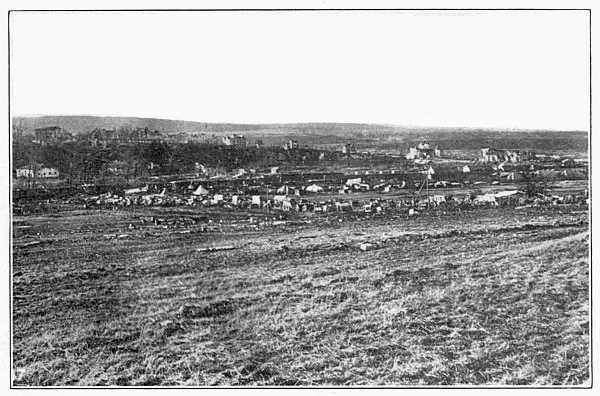
CHAUDRON EME. AND MONTREBEAU WOOD.
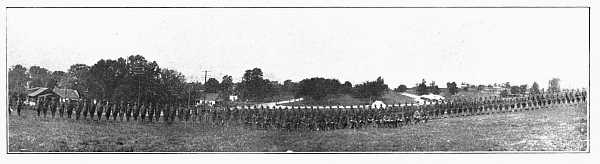
MEMBERS OF 139TH AMBULANCE COMPANY BEFORE UNIFORMS WERE ISSUED.
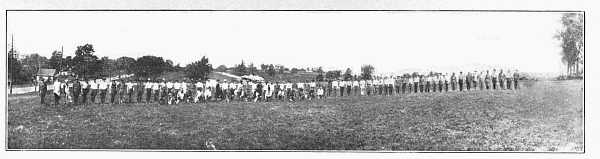
MEMBERS OF 139TH AMBULANCE COMPANY AFTER UNIFORMS WERE ISSUED.
It was dark when we arrived at Le Collet, and the next morning we had our first view of the camp. Situated on a high range of hills, it would have commanded a wonderful view of the surrounding country but for the tall trees which covered the hills in every direction. The camp was composed of several long, low French barracks, arranged in haphazard style on one side of the road on the hilltop, and many more down the valley, between and on both sides of the forked road leading down to the city of Gerardmer, about twenty kilometres distant. One of the barracks on the hilltop, just at the fork of the road, was used for a triage, our office, supply room and sleeping quarters for several men. About one hundred feet back of this barrack, and reached by a narrow rock road, was a big shed used for housing Gen. McClure's limousine and one or two Ford ambulances. To one side of this road and just in front of the shed was our kitchen, covered by a fly tent.
A French canteen, Red Cross, Y. M. C. A. and Major du Cantonement occupied the remainder of the hilltop barracks. Across the road from the triage was a large barnlike structure which served as the terminal of the electric tramway. This tramway connected Le Collet with Gerardmer by a steam road which came about half way. Its many cars groaning up and down the hill was one of the most noticeable features of Le Collet. It was used for bringing up supplies and also to evacuate patients to the hospitals at Gerardmer.
The 69th Infantry Brigade was ordered to take over from the French the sector immediately north of the front being held at that time by the 70th Brigade. We were ordered to accompany the brigade and evacuate it to Field Hospital 138, which went into action at the little summer resort town of Gerardmer. We were to establish a triage at the camp of Le Collet, which was perched on top of the divide which formerly marked the boundary line between France and Germany.
Our work in this sector, except that of the triage, was carried on at three advanced dressing stations and a relay station. Running from south to north, the dressing stations were Nicholas, Morlier and Richard. The relay post was at Spitzenfels, situated on the road from Le Collet, where it forked to go to Nicholas and Morlier.
The work at Nicholas was taken over by Lieut. Siberts and a detachment of twenty-five men, who established a dressing station in connection with the French Alpine Ambulance Service. The entire detachment, with the exception of six men who remained at the station, was sent to the battalion aid stations to act as litter bearers, their duties consisting of carrying patients from the battalion aid stations to the ambulance station. Detachments were also sent out to Moriez, Miradore, Jourdan, Eck and Amphersbach.
The activities in this area were very small, consisting principally of sniping by machine guns and an occasional artillery duel. The latter sometimes became interesting to the party at Nicholas, because the artillery was directly behind the station and the arc of fire was overhead, both for the Boche and our own boys. Many were the times when they all ducked for a friendly dugout door, to the tune of a screaming shell.
In connection with this station there was a motorcycle with litter sidecar operated by an Englishman. He carried all single cases to Spitzenfels thus relieving the ambulances from extra runs. This Englishman was a good scout and was liked by all.
Lieut. Siberts was relieved a few days after the station was established by a lieutenant of the 162 Ambulance Company, and reported at the company triage to operate that station.
The detail for the dressing station at Morlier left Le Collet shortly after dinner on August 13th, under command of Lieut. Vardon. Our program was to go by truck to Spitzenfels, where, after dark, for much of the road to be traveled was under enemy observation, we were to be picked up by a supply train and taken to our destination. But the best laid plans will sometimes go wrong, and in this case a confusion of orders stopped the supply train before it had gone far, and there was nothing for us to do but proceed on foot. The road was a long one, winding up the mountainside, past the ruins of many buildings that had once been the homes of shepherds, lighted up now and then by a brilliant star-shell, while an occasional rifle shot, or rather a machine gun, sounding almost underneath us, broke the silence. Finally about midnight, after following the many twists and turns in the road, each of which it seemed must be the last, we arrived at our destination.
Morlier was situated about five miles north of Nicholas, on the same ridge of hills. It was built on the opposite side of a small hill from the lines, and about a quarter mile distant. Dugouts and small shacks formed the principal part of the camp, and most of the best dugouts had heavy half-circular corrugated steel ceilings. This metal was painted white to make the interior light. Several rooms in the Alpine Ambulance Station were fixed this way.
The dressing station was established in the Alpine Ambulance. Lieut. Vardon and about nine men formed the personnel of this place. The one outpost was Barbarot, about a half mile to the north. Morlier was approachable by night only by a rock road which wound up the hillside in full view of the German lines. In daylight the only safe way was by a gallery about a mile long which ran over the hill from Camp Bouquet, a branch of which ran down to Barbarot. The gallery was a trench about six feet deep, sided up and roofed over with branches and camouflaged.
In the Alpine Ambulance we found such luxuries as electric lights, piano and talking machine and furniture much better than we had been used to, all taken from "Altenberg," the former summer home of the Kaiser, which was near by. The French and British soldiers there proved to be excellent companions and treated us royally.
We were close to the lines and under constant observation, but when the first two days passed uneventfully our boldness grew. However, just at supper time on the third day "Jerry" woke us up by planting eight shells in the kitchen, and from then on did not let us forget that he was near by. Bombardments were frequent, while wandering German patrols paid our vicinity frequent visits at night. Our work consisted mostly of handling the sick, as there were very few wounded, this being a "quiet" sector.
Our stay was not without its humorous incidents, such as the time when one of our dignified "non-coms," at the sound of the first exploding shell, dove into bed, and, pulling the blankets over his head, remarked that "even a blanket might help some if a shell hit," and the time when our commanding officer, deceived by a false gas alarm, wore his gas mask for nearly three hours in the middle of the night before discovering that we would be breathing only the purest of mountain air without it.
Our pleasant stay at Morlier came to an end when the division was relieved on the night of September 1st. The enemy, scenting a troop movement, kept up a steady bombardment, and it was well towards morning before we were able to make a getaway. The trip was an exciting one, as it was necessary to run a gauntlet of exploding shells. Gas was also encountered, but, in spite of it all, we all arrived safely about daybreak at company headquarters.
Richard was situated in a narrow gap on the bank of Lac Noir (meaning Black Lake). The dressing station there was established by Lieut. Monteith and a detachment of twenty-five men. The outposts were Vignal and Pairis, and detachments of litter bearers were sent to each of those places, which were occupied by the Infantry Battalion Aid Stations. Later Lieut. Bates and six men arrived from Rudlin, where a station had been established but abandoned. Relay litter squads were formed, thus making the work lighter.
The men on outpost duty at Pairis were billeted in an old hotel basement, where there was running water, electric lights and real beds, but even with these luxuries at their disposal they can hardly be said to have had an enjoyable time. This hotel had a road running alongside, and whenever anyone appeared in the road, the Boche immediately opened up on the hotel with high explosives and shrapnel. The boys got to be experts at hitting the cellar entrance on a moment's notice—in fact, they stayed pretty close to it at all times, unless at the kitchen, which was about three hundred yards distant.
The outpost at Vignal was not so well situated, but was rarely shelled. This party took part in a raid which was pulled off just before they were relieved. They went out with the raiding party to its starting point and remained until the raid was over, when they evacuated the wounded to the foot of the hill below Richard, from where the litter cases were taken to the top of the hill by squads from Richard. At Richard there was big preparation when word of the intended raid was received. Two spare ambulances and twelve men were ordered out from Le Collet. When the word was telephoned up that three litter cases were on the way, a detachment of nineteen men went to the bottom of the hill and brought the wounded to the station, where they were dressed and sent to the triage.
The work of both the outposts was highly complimented by the battalion surgeons. The Americans at Richard were relieved by French Colonials. In coming in, the French seemed to have attracted the attention of the Boche, and as a result they received an unmerciful shelling. One litter case and two walking cases was the toll, and they were evacuated through our station, much to the satisfaction of the French authorities.
On August 13th a detachment of six men and two ambulances was sent from Le Collet to the relay post at Spitzenfels. Ambulances and drivers from the 162nd Ambulance Company, 41st Division, were attached to our company to furnish motor transportation to and from the different stations, as we had no ambulances at that time. Spitzenfels was a French Red Cross post and an ambulance relay station. It was located on a mountain side in the midst of a thick pine forest and at a junction of the Paris-Strassburg road, about three kilometres inside of the France-Alsace boundary line. The place had not been shelled by the Germans for four years and was very quiet. The billets were comfortable and rainproof, making it an ideal place to stay.
Upon first taking over the station at Spitzenfels we worked with the French medical men, but they soon left, leaving the entire station to us. The duties were comparatively light, consisting of making a sick call at 9 A. M. to two infantry aid stations, and transferring the sick and wounded back to the triage. Another duty was to give out Red Cross supplies, mostly tobacco and hot chocolate, to the passing soldiers. Most of the Red Cross business was with the French troop, as very few of the American forces knew of the station, and thus were unable to take advantage of it.
At the triage Lieut. Siberts was in charge, with the assistance of a sergeant and three men, and their work testified that they were on the job. They had to unload all ambulances, register all cases, sort out the ones for the various hospitals and reload them into the ambulances, or onto the tram car. They were compelled to work at all hours.
One incident to be long remembered by all the company was the big fire of the truck at Le Collet on the night all the posts were relieved. Two men were attempting to fill a Pierce-Arrow truck with gasoline, by the aid of a candle, when there was an explosion and the entire truck caught fire. The blaze shot thirty feet into the air and could be seen for miles around. It was a wonder that the place was not shelled, because it was as light as day and crowded with soldiers.
On September 1st the order came to move again, and the old routine of packing and loading was on. We were not sorry to leave Le Collet, because our stay had not been long enough to let us become attached to the place. We were not sorry, for another reason. Rumor was, now that our training was over, that we were to go north and take active part in the great battles that were then raging on the western front. The term "shock troops" came into use, and all were proud to belong to a division so designated. With our movement came orders to turn over our dressing stations and triage to Ambulance Company 39, of the 6th Division. This was their first trip up to the front, and as none of them had ever heard a Boche shell ring, we had a lot of fun yarning to them about the things they would soon experience.