HISTORICAL RECORD (continued 2)
Reading edition
General the Earl Cornwallis, with a view to intimidate the garrison, encamped with the army within four miles of Nundydroog, on the 18th of October, and in the evening of that day the troops were told off for an assault upon the two breaches, which had been pronounced practicable. The attacks commenced at eleven o’clock at night, the grenadiers assaulting the right breach and the light companies the left. The forlorn hope of the right attack consisted of twenty grenadiers, volunteers from the Thirty-sixth and Seventy-first regiments. Captain Robert Burne supported, with the Thirty-sixth grenadiers, the right attack, and Captain William Hartley, with the light company of that regiment, the left attack; Major-General Medows animated the whole with his presence.
The assailants were soon discovered; blue lights immediately illuminated the fort, and a heavy fire opened from the works; this fire was fortunately ill-directed, but the large stones hurled down the hill, and acquiring great velocity as they bounded from the rock in their descent, were extremely formidable. The storming party, however, soon mounted the breaches, and pursuing the enemy closely prevented his barricading the gate of the inner wall. This was forced open, and the troops entered. Captain Robertson, seeing that the place was carried, used every endeavour to prevent the unnecessary effusion of blood. The flank companies which formed the storming party had two men killed and twenty-eight wounded, the latter principally from bruises by the stones thrown from the rock. The loss during the siege amounted to forty Europeans and eighty sepoys and pioneers, killed and wounded. At this place Lieutenant John Eyre, of the regiment, died of his wounds.
In this manner Nundydroog, in the course of three weeks, was taken, a place defended by seventeen pieces of cannon, principally iron guns of large calibre; this fort was not captured by Hyder Ali from the Mahrattas until after a defence which lasted three years.
After the fall of Nundydroog, the other hill fort of Cumeldroog, adjacent and dependent thereon, although a place of great strength, surrendered on being summoned.
Lord Cornwallis, in General Orders of the 19th of October, stated, that “having been witness of the extraordinary obstacles, both of nature and art, which were opposed to the detachment of the army that attacked Nundydroog, he cannot too highly applaud the firmness and exertions which were manifested by all ranks in carrying on the operations of the siege, or the valour and discipline which were displayed by the flank companies of His Majesty’s Thirty-sixth and Seventy-first regiments.”
In a few days afterwards the army retraced its route to Bangalore. Savendroog and several hill forts were captured by detachments in December, but the Thirty-sixth regiment remained with the main body of the army.
1792.
On the 31st of January 1792 the army under General the Earl Cornwallis was reviewed by the Poonah and Hyderabad chiefs, and on the following day commenced its march towards Seringapatam, passing by Hooleadroog, Tajilly, and Carrycode. The troops came in sight of Tippoo’s capital on the 5th of February, and encamped at the French rocks. The enemy’s horse showed itself on the 4th and 5th, but attempted nothing hostile. The Sultan took up a formidable position to cover his capital, and was attacked during the night of the 6th of February.
The entrenched camp of Tippoo was reconnoitred on the 6th of February, and at dark the army was formed in three columns of attack. The right, under Major-General Medows, consisting of the Thirty-sixth and Seventy-sixth King’s regiments. The centre under the Commander-in-Chief, General the Earl Cornwallis, consisting of the Fifty-second, Seventy-first, and Seventy-fourth King’s regiments. The left, under Lieutenant-Colonel Maxwell, of the Seventy-fourth, was composed of the Seventy-second regiment. The native troops were divided among the three columns.
The right column, to which the Thirty-sixth regiment was attached, under the command of Major-General Medows, was directed to penetrate the left of Tippoo’s line, and turning to the left, overthrow the troops of the enemy there posted, and proceed on until it joined Lord Cornwallis in the centre column, and receive further orders; but the officer charged to guide the column led it wrong, bringing it to the advanced redoubt on the left of Tippoo’s lines, known by the name of the Ead-gah redoubt,—which was mounted by eight pieces of cannon, and was defended with great bravery. The grenadiers of the Thirty-sixth rushed steadily forward to escalade the work, with the officer of engineers in charge of the scaling ladders, but a heavy fire of grape shot and musketry killed most of the men in charge of the ladders, which, being consequently lost, it appeared impossible to enter the redoubt.
The work near the gorge had not been quite finished; the troops again rushed forward, but the enemy’s fire was so destructive as to sweep all opposed to it; a momentary pause ensued, and at this crisis Captain Andrew Wight, who commanded the Thirty-sixth regiment, Brevet Lieut.-Colonel the Honourable John Knox having charge of a brigade, observing a narrow pathway leading to the rampart, ordered his corps to follow him, when the soldiers resumed the attack with increased animation, and advancing with the bayonet carried the work; only a few of the defenders escaped instant death, and that by leaping from the embrasure into the ditch, which, from its height, must have proved equally fatal to them. The loss of the enemy at the Ead-gah redoubt was more considerable than at any other post of his lines.
The loss in private men fell chiefly on the Thirty-sixth, that regiment and the flank companies of the Seventy-sixth being the troops which formed the front division of the column. The grenadiers of the Thirty-sixth, who led, in advancing to the redoubt, had twenty men killed and wounded.[12]
After leaving a sufficient force in this strongwork, including four companies of the Thirty-sixth, under Captain John Austin, who had commanded the leading company of the column, the troops under Major-General Medows moved to the left, intending to fall on the enemy’s left wing, instead of which they came in view of another redoubt of equal strength and magnitude with the former, which it was deemed imprudent to attack. The column then recrossed the bound-hedge, moved to the left of the British army, which it did not find until daybreak, when the action was over.
Lord Cornwallis, on joining Major-General Medows at the Pagoda hill, on the morning of the 7th of February, detached the remaining six companies of the Thirty-sixth regiment and the third battalion of Bengal sepoys towards the Sultan’s redoubt; but they were afterwards ordered to proceed to the island, where the enemy had commenced an attack on the troops, which was gallantly repulsed.
The foregoing details show what an active part the Thirty-sixth sustained in these operations, and testify the share which the regiment deserved of the following general commendation bestowed by the Earl Cornwallis in his orders issued on the evening of the 7th of February.
“The conduct and valour of the officers and soldiers of this army have often merited Lord Cornwallis’s encomiums; but the zeal and gallantry which were so successfully displayed last night in the attack of the enemy’s whole army, in a position that had cost him so much time and labour to fortify, can never be sufficiently praised; and his satisfaction on an occasion, which promises to be attended with the most substantial advantages, has been greatly heightened by learning from the commanding officers of divisions, that this meritorious behaviour was universal through all ranks, to a degree that has rarely been equalled.
“Lord Cornwallis, therefore, requests that the army in general will accept of his most cordial thanks for the noble and gallant manner in which they have executed the plan of the attack. It covers themselves with honour, and will ever command his warmest sentiments of admiration.”
In the assault of Tippoo Sultan’s fortified camp and island of Seringapatam on the 6th and 7th of February 1792, the total loss of the right division, under Major-General Medows, including officers, amounted to twenty-seven killed and sixty-five wounded. Lieutenant Alexander David Robertson, of the Seventy-third, doing duty with the Thirty-sixth, from which he had been promoted, and Ensign Pooley Smith, of the Thirty-sixth, were killed. Lieutenants Thomas Brownrigg, Robert Campbell, and John Campbell,[13] of the Thirty-sixth, were wounded.
The enemy’s loss was very severe, being estimated at 20,000 hors de combat. Eighty pieces of cannon were taken by the British.
On the 9th of February the army took up its final position for the siege of Seringapatam, and on the 15th Major-General Robert Abercromby joined with the Bombay force, consisting of the Seventy-third, Seventy-fifth, and Seventy-seventh regiments, beside native troops, making a total of about six thousand men.
Preparations were now made for the siege of Seringapatam, and the approaches were carried on with the greatest activity until the 24th of February, when the general orders announced that the preliminary articles of peace had been signed, and in consequence all hostile measures immediately ceased.
On the 26th of February the two sons of Tippoo Saib, Abdel Kalek and Mooza-ud-Deen, the former ten years of age, and the latter eight, were brought to the British camp, as hostages for the due performance of the preliminary articles.[14]
In consequence of some obstacles which had been opposed by Tippoo to the arrangement of the definitive Treaty, working parties were ordered, and the guns replaced in the batteries on the 10th of March. This state of suspicion and preparation lasted until the 15th of March, when it was discontinued, and on the 18th of that month, the definitive Treaty being duly executed and signed, was delivered by the young Abdel Kalek to each of the confederates. On the 20th the counterpart was sent off to Tippoo Saib.
Thus terminated a war in which the confederates wrested from the enemy seventy fortresses, eight hundred pieces of cannon, and destroyed or dispersed at least fifty thousand men. By the articles of the Treaty Tippoo was bound to pay a large sum of money and to cede one half of his dominions.
The Governor-General and Commander-in-Chief in India granted from this money a sum equal to six months’ batta for all ranks, and the Court of Directors afterwards made a similar grant.
On the 26th of March the exchange of the definitive treaty being completed, the British commenced moving towards Bangalore, from whence they proceeded to the Pednaigdurgum Pass, where the Bengal troops were ordered to their own Presidency.
1793.
The French revolution, which had commenced a few years previously, had at this period assumed a character which called forth the efforts of other countries to arrest the progress of its destructive principles; and, on the 1st of February 1793, shortly after the decapitation of Louis XVI., war was declared by the National Convention of France against Great Britain and Holland.
News of this event arrived in India in May 1793; in June the Thirty-sixth regiment was ordered to prepare to take the field; it marched soon afterwards against the French settlement of Pondicherry, on the Coromandel coast; the troops employed on this service were commanded by Colonel John Brathwaite.
The siege of Pondicherry was commenced in the early part of August, the army encamping in a thick wood where tigers were so numerous that the natives durst not travel in the night. On the 22d of August a white flag was displayed by the garrison, with a request to be allowed to surrender. The French soldiers in the fortress had embraced democratical principles, and were particularly insubordinate; they insisted that the Governor should surrender; but after the white flag was displayed, they fired two shells, which killed several men. During the night they were guilty of every species of outrage: breaking into houses, and becoming intoxicated. On the following morning a number of them environed the house of the Governor-General Charmont, and threatened to hang him before the door, when application was made to the British for protection. The English soldiers rushed into the town, overpowered the insurgents, rescued the Governor, and preserved the inhabitants from further violence. After this service the regiment returned to Madras.[15]
1794.
During the year 1794 the Thirty-sixth regiment was stationed at Trichinopoly.
1795.
In 1795 the regiment proceeded to Negapatam.
1796.
During the years 1796 and 1797 the regiment was stationed at Warriore, near Trichinopoly.
1798. 1799.
In the beginning of 1798 the regiment was stationed at Pondicherry, and subsequently at Wallahabad. The men fit for service were afterwards drafted into the Seventy-fourth and Seventy-sixth regiments, and the remainder of the Thirty-sixth embarked at Madras for Europe on the 15th of October 1798. Previously to the regiment returning to England, orders were issued by the Governor in Council, and by the Commander-in-Chief of Madras, dated 24th of September and 14th of October 1798, which are highly complimentary of the regiment, and are inserted at page 121 of the Appendix. The want of convoy caused the fleet of Indiamen to be detained three months at St. Helena, and the regiment did not arrive in England until the 26th of July 1799, when it landed at Greenhithe;—it subsequently proceeded to Cirencester, and thence to Winchester, where the corps was completed to its establishment by volunteers from the militia.
1800.
The Thirty-sixth regiment embarked at Portsmouth, in January 1800, for Ireland, and disembarked at Tarbert and Cork; it afterwards proceeded to Fermoy, Clonmel, and thence to Cork, where the regiment embarked with an expedition under Brigadier-General the Honorable Sir Thomas Maitland, and landed in the beginning of June at the Isle de Houat, on the coast of France; on the 4th of June the light company of the Thirty-sixth regiment landed at Quiberon, and destroyed some batteries, after which it re-embarked for the Mediterranean, and the regiment arrived at Minorca in July, which island had surrendered to Great Britain in November 1798.
1801.
During the year 1801 the regiment was stationed at Minorca.
1802.
On the 27th of March 1802 a treaty of peace was signed at Amiens between the French Republic, Spain, and the Batavian Republic on the one part, and Great Britain on the other; by this treaty the Island of Minorca was restored to Spain.
In August 1802 the Thirty-sixth regiment returned to Cork from Minorca, marched to Galway, and occupied the barracks at that place.
1803.
The conduct of Napoleon Bonaparte had occasioned hostilities to be renewed in May 1803, when the British army was augmented, and preparations were made to repel a threatened invasion by the French. The “Army of Reserve Act” was passed in June 1803 for raising men for home service by ballot; and numerous volunteer and yeomanry corps were formed in every part of the Kingdom.
The regiment was suddenly ordered to proceed by forced marches from Galway to Dublin in July 1803, where a serious riot had occurred on the 23d of that month, when Lord Chief Justice Kilwarden, and his nephew the Rev. Richard Wolfe, were attacked in his carriage, and murdered by the rioters.
1804.
On the 18th of May 1804 Napoleon was invested with the dignity of Emperor of the French; and on the 26th of May of the following year he was crowned King of Italy, at Milan.
Further measures of defence were adopted by Great Britain, and the “Additional Force Act” was passed on the 29th of June 1804, by which a second battalion was added to the Thirty-sixth regiment, to be formed of men raised in the county of Durham for limited service; the second battalion was placed on the establishment of the army from the 25th of December following.
On the 12th of December 1804 the Court of Spain issued a declaration of war against England, in consequence of the capture of some frigates off Cadiz, which had been intercepted on their way to France with cargoes of treasure for the use of Napoleon, Spain having agreed to furnish a powerful aid to that ruler.
During the year 1804 the first battalion of the regiment continued in garrison at Dublin.
1805.
On the 3d of August 1805 the first battalion of the regiment marched from Dublin, having been selected to form part of the army under Lieut.-General Lord Cathcart; it encamped on the Curragh of Kildare until the 20th of September, marched from thence to Bandon, and occupied the barracks there; on the 29th of October the battalion embarked at Cork for Germany.
The second battalion remained in Great Britain during 1805, and three following years.
1806.
The first battalion of the Thirty-sixth regiment arrived in Germany on the 1st of January 1806, and occupied cantonments in Bramstead and Bokell until February, when it again marched and embarked for Great Britain, the British troops having been recalled to England in consequence of the events which followed Napoleon’s victory over the Russians and Austrians at Austerlitz in December of the preceding year;—the battalion landed at Ramsgate early in March.
In the autumn of 1806 the first battalion was directed to proceed to Portsmouth for the purpose of joining the expedition under Brigadier-General Robert Craufurd, about to be employed on secret service; and the battalion embarked at Portsmouth on the 22d of September.
1807.
The expedition, which consisted of the first battalions of the Fifth, Thirty-sixth, Forty-fifth, and Eighty-eighth regiments, five companies of the Rifle corps, two squadrons of the Sixth dragoon guards, and two companies of Royal Artillery, did not sail from Falmouth until the 12th of November 1806; and after remaining at St. Jago, in the Cape de Verde Islands, from the 14th of December 1806 to the 11th of January 1807, arrived in Table Bay, Cape of Good Hope, on the 22d of March following. Here the troops were landed for refreshment and exercise under Brigadier-General Craufurd. From the Cape the expedition sailed again on the 6th of April; reached St. Helena on the 21st of April, where the stock of water and provisions was completed; and, quitting that island on the 26th, arrived on the 14th of June at Monte Video, then occupied by the British troops under Lieut.-General John Whitelocke, who had arrived there in the preceding May, and had assumed the command of the whole British force in South America.[16]
Great preparations were made to effect a landing of the troops, which took place on the 28th of June at Ensenada da Baragon, about thirty-two miles distant from Buenos Ayres, without firing a shot. The first battalions of the Thirty-sixth and Eighty-eighth regiments were brigaded together under the orders of Brigadier-General the Honourable William Lumley. On the 29th the troops moved forward; the light brigade, composed of the Rifle corps and nine light infantry companies, formed the advance, which was supported by Brigadier-General Lumley’s brigade, and followed by the other corps in succession. On the 1st of July the army was concentrated near the village of Reduction, about seven miles from Buenos Ayres, from whence it again advanced on the following day, crossed the Chuelo, a rivulet, by a ford called the Chico, and traversed the low ground on the opposite bank, at the extremity of which is situated the City of Buenos Ayres.
The light company was at the attack and carrying of the enemy’s advance field-work on the 2d of July; on the 5th of that month the right wing of the Thirty-sixth, commanded by Lieut.-Colonel Robert Burne, and the left wing by Captain William Cross, stormed and established themselves in Buenos Ayres. Upon this severe service Captains Alexander, Williamson, and Henry Cole Johnson, with Lieutenant Robert Whittell, two serjeants, one drummer, and forty-one rank and file, were killed; Captains William Wright Swain and Henry Vernon, Lieutenants William Wingfield, William Cotton, John Chaloner, and John White, seven serjeants, and thirty-six rank and file, were wounded.
Notwithstanding the intrepidity displayed by the advancing troops, upon whom a destructive fire was poured from the tops of houses and every other advantageous position, the enterprise failed. On the following morning the Governor-General Liniers sent a letter to Lieut.-General Whitelocke, offering to restore the prisoners taken in this action, and also those made with Brigadier-General Beresford, on condition that the whole of the British forces should be withdrawn from South America, which proposals were accepted. The Lieut.-General’s conduct subsequently became the subject of inquiry by a Court-martial, and he was cashiered.
The first battalion of the regiment re-embarked at Buenos Ayres, and descended the River Plate to Monte-Video, whence it embarked on the 9th of September for Europe, and arrived at Cork on the 17th of December following.
1808.
The battalion occupied the barracks at Cork until February 1808, when it proceeded to Fermoy, where it remained until the 5th of July, when it marched to Cork for embarkation, having been selected to form part of a force, under the command of Lieut.-General the Honorable Sir Arthur Wellesley, destined to proceed to the Peninsula to aid the Spanish and Portuguese patriots in their efforts against Napoleon, who had placed his brother Joseph on the throne of Spain, and was endeavouring to reduce the Peninsula under his domination.
In May 1808 the second battalion proceeded to Jersey, but returned to England in July following.
On the 9th of July the first battalion embarked at Cork, and landed at Figuiera, in Portugal, on the 1st of August. The battalion under the command of Brevet Colonel Robert Burne, advanced with the troops under Lieut.-General the Honorable Sir Arthur Wellesley towards Lisbon. The division, consisting of about four thousand men, under Major-General Sir Brent Spencer, K.B., having joined the army from Cadiz, a change was made in the arrangement of the brigades, and the first battalions of the Thirty-sixth, Fortieth, and Seventy-first regiments were placed in that commanded by Major-General Ronald Craufurd Ferguson. After a short halt the army was again put in motion to occupy a more forward position, where it remained for some days. On the 17th of August the enemy, commanded by General Laborde, was encountered near Roleia. The first battalion under the command of Colonel Robert Burne shared in this action, Captain William Cross being detached in charge of three companies. The position was attacked and carried, with great loss to the French, who retreated on Torres Vedras.
The Thirty-sixth subsequently received the Royal Authority to bear the word “Roleia” on the regimental colour and appointments, in commemoration of this victory.
Lieut.-General the Honorable Sir Arthur Wellesley, after this battle, did not pursue the enemy by the high roads, but keeping to the right near the sea marched to Vimiera, to cover the landing of a brigade commanded by Major-General Anstruther, which was effected on the 20th of August.
The morning of the 21st of August was given up to the troops in order to prepare and repose themselves. The men were engaged in washing and cleaning their equipments when the approach of the enemy, moving to the left, was discovered at eight o’clock in the morning; and the brigades commanded by Major-General Ferguson, Brigadier-Generals Nightingall, Acland, and Bowes, were consequently moved across a valley from the heights on the west to those on the east of Vimiera.
Marshal Junot, Duke of Abrantes, moved his army to the attack of the position, and commenced it on the British centre, where the Fiftieth regiment was posted, moving along the front gradually to the left, until the whole line became engaged.
THIRTY-SIXTH REGIMENT.
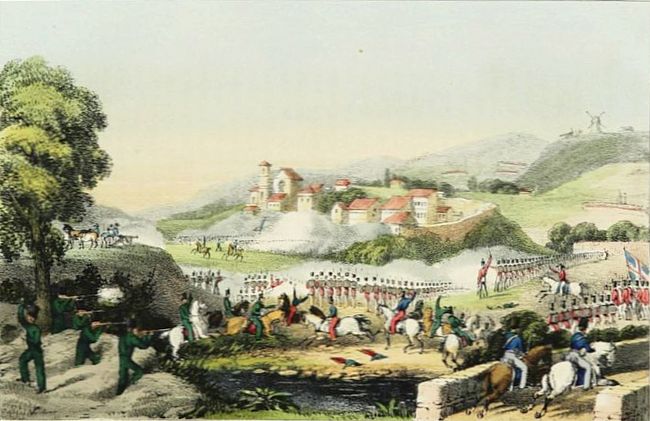
BATTLE OF VIMIERA, Augt 21st 1808.
The Thirty-sixth had the good fortune to take a distinguished share in the battle of Vimiera on the 21st of August; and the gallantry of the battalion was particularly noticed by Lieut.-General the Honorable Sir Arthur Wellesley in the General Orders of that day.
The battalion had nine rank and file killed; Captain Paul Minchin Hobart; Lieutenants H. S. Hart, Thomas Wright, and Walter Ewart; Ensign Peter Joseph Bone; Lieutenant and Adjutant John Povah, and twenty-three rank and file, were wounded.
The conduct of the battalion and of its commanding officer, Colonel Burne, was thus specially noticed by Lieut.-General the Honorable Sir Arthur Wellesley in his despatch of the 21st of August;—
“In mentioning Colonel Burne, and the Thirty-sixth regiment, to you upon this occasion, I cannot avoid to add that the regular and orderly conduct of this corps throughout this service, and their gallantry and discipline in action have been conspicuous.”
In a letter dated 22d of August 1808 (inserted in the Appendix, page 122), addressed to Viscount Castlereagh, Secretary of State, Lieut.-General the Honorable Sir Arthur Wellesley bore further testimony to the merits of Colonel Burne, and stated, that “the Thirty-sixth regiment is an example to the army.”
The thanks of both Houses of Parliament were conferred on the troops, and the Thirty-sixth subsequently received the Royal Authority to bear the word “Vimiera” on the regimental colour and appointments in commemoration of this battle.[17]
The “Convention of Cintra” was the result of this victory, and it was signed on the 30th of August; by its provisions the French army evacuated Portugal, which country became freed from its oppressors.
The British army was ordered to move forward to Lisbon, some of the reinforcements for it having proceeded by water, and occupied the forts at the mouth of the Tagus. The French army having by this convention fallen back on Lisbon, the British proceeded to the vicinity of Fort St. Julien, and encamped.
All the objects of the expedition being carried into effect, and the French troops embarked for France, the British army remained for some time at Lisbon and its vicinity. At this period (September) Lieut.-General Sir John Moore, having assumed the command, made dispositions for entering Spain.
The first battalions of the Thirty-sixth, Seventy-first, and Ninety-second regiments were brigaded under Brigadier-General Catlin Craufurd, and placed in the division under the command of Lieut.-General the Honorable John Hope, afterwards the Earl of Hopetoun. On the 27th of October the division was put in motion, and after a short stay at Badajoz resumed the march to Talavera-de-la-Reyna. From this town the column proceeded to the Escurial, seven leagues to the north-west of Madrid, where it arrived and halted on the 22d of November.
Intelligence was here received of the enemy’s approach towards Madrid; the division was in consequence put in motion across the Guadarama mountains on the 27th of November towards Villa Castin, at which place Lieut.-General the Honorable John Hope, in consequence of the information he received of the enemy’s movements, made a night march to the left, by Avila and Peneranda, and finally proceeded to Alba-de-Tormes, where a junction was formed with a detachment from the army under Lieut.-General Sir John Moore, then at Salamanca. The army under Sir John Moore was shortly afterwards put in motion towards Valladolid, and subsequently to the left, to effect a junction with Lieut.-General Sir David Baird’s division, which had landed at Corunna.
Previously to this period, the Spanish armies under General Blake, near Bilboa on the left, General Castanos in the centre, and General Palafox lower down the Ebro on the right, had been completely defeated; Lieut.-General Sir John Moore consequently made arrangements for a retreat on Portugal by Ciudad Rodrigo, but it having been represented to him that Madrid held out against the French, he was induced to form a junction with Lieut.-General Sir David Baird, in order to make a diversion in favour of Madrid, by attacking Marshal Soult on the river Carion.
The British force, twenty-nine thousand strong, joined at Toro on the 21st of December, and on the 23d of that month Sir John Moore advanced with the whole army. The cavalry had already met with that of the enemy, and the infantry were within two hours march of him, when an intercepted letter informed the British commander that Napoleon, who had entered Madrid on the 4th of December, was then in full march for Salamanca and Benevente. A retreat on Corunna, through Gallicia, was immediately decided on, that through Portugal being then impracticable.
Accordingly the several divisions marched towards the Esla, the greater part crossing by the bridge of Benevente on the 26th of December, when, after a day’s halt, the cavalry, under Lieut.-General Lord Paget and Brigadier-General the Honorable Charles Stewart, had an engagement with some of the Imperial guards that had forded the river Esla under General LeFevre, who was made prisoner with several of his men.
At this period the situation of the British army was dispiriting in the extreme. In the midst of winter, in a dreary and desolate country, the soldiers chilled and drenched with the heavy rains, and wearied by long and rapid marches, were almost destitute of fuel to cook their victuals, and it was with extreme difficulty that they could procure shelter. Provisions were scarce, irregularly issued, and difficult of attainment. The waggons, in which were their magazines, baggage, and stores, were often deserted in the night by the Spanish drivers, who were terrified by the approach of the French. Thus baggage, ammunition, stores, and even money were destroyed to prevent them falling into the hands of the enemy; and the weak, the sick, and the wounded were necessarily left behind.
1809.
On the 5th of January 1809, the troops took up a position at Lugo, where they remained bivouacked in order of battle until the 9th of that month, when they marched in the night, and arrived at Corunna on the 11th of January. The British army, having accomplished one of the most celebrated retreats recorded in modern history, repulsing the pursuing enemy in all his attacks, and having traversed two hundred and fifty miles of mountainous country under very disheartening circumstances, accompanied by severe privation, was not destined to embark for England without a battle.
Marshal Soult, Duke of Dalmatia, having taken up a position above the town of Corunna, made arrangements for attacking the British army as soon as the troops should commence their embarkation. The sick men, the women, and baggage having been conveyed on board ship, preparations were made for embarking the troops on the 16th of January 1809. The French instantly descended from the heights, and advanced, about two o’clock, to attack the British position in front of Corunna; a sanguinary action ensued, and before dark the French were defeated in all their attacks. Lieut.-General Sir John Moore was killed, and the battle was scarcely ended, when, wrapped in a military cloak, his remains were interred in the citadel of Corunna, over which Marshal Soult, with the chivalrous feeling of a true soldier, erected a monument.
This victory enabled the British troops to be embarked without further molestation. In this battle the first battalion of the Thirty-sixth was posted on the left of the British line.
During the retreat to Corunna, and its services there, the battalion had Lieutenant John White wounded, and one serjeant and two rank and file killed; one serjeant, three drummers, and one hundred and fifty-three rank and file, were taken prisoners.
In commemoration of this battle, and of the conduct of the battalion during the expedition, the Thirty-sixth, in common with the army employed under Lieut.-General Sir John Moore, received the Royal authority to bear the word “Corunna” on the regimental colour and appointments.[18]
The army also received the thanks of both Houses of Parliament “for its distinguished discipline, firmness, and valour in the battle of Corunna.”
On the 17th of January the battalion embarked at Corunna for England; portions landed at Plymouth, Portsmouth, and Deal, but the several divisions were assembled at Battle, in Sussex, during the month of February.
Immense preparations had been made by the British Government to fit out the most formidable armament that had for a long time proceeded from England. The troops amounted to forty thousand men, commanded by Lieut.-General the Earl of Chatham; the naval portion consisted of thirty-nine ships of the line, thirty-six frigates, and numerous gun-boats and bomb-vessels, and other small craft, under Admiral Sir Richard Strachan. The object of the expedition was to obtain possession of the islands at the mouth of the Scheldt, and to destroy the French ships in that river, with the docks and arsenals at Antwerp. The first battalion of the Thirty-sixth regiment received orders to prepare itself for this service, and on the 16th of July embarked at Portsmouth for Walcheren, under the command of Colonel Burne. The expedition sailed from the Downs on the 28th of July, and on the morning of the 1st of August the Thirty-sixth and other corps were landed, and on the same day the troops advanced to the investment of Flushing, which operation was warmly contested by the enemy.
By the 13th of August, the preparations for the attack on the town were completed, and on the night of the 14th one of the enemy’s batteries, advanced upon the sea dyke in front of Lieut.-General Alexander Mackenzie Fraser’s position, was most gallantly carried at the point of the bayonet by detachments from the Thirty-sixth, Seventy-first, and the light battalions of the King’s German legion, under Lieut.-Colonel Denis Pack, of the Seventy-first, although opposed to great superiority of numbers; the troops took forty prisoners, and killed and wounded a great many of the enemy. Flushing capitulated on the 15th of August; the garrison becoming prisoners of war.
From the 8th to the 15th of August the Thirty-sixth had three rank and file killed; Major Alexander Mackenzie was dangerously wounded; two serjeants and seven rank and file were wounded.
An epidemic disease of a fatal character broke out among the troops, and the following officers and men of the Thirty-sixth regiment died of fever:—Captains Waddle, C. Douglas, and Alexander Barbor, Lieutenant McDermott, Assistant-Surgeon James McFarlane, fourteen serjeants, two drummers, and two hundred rank and file.
On the 10th of December 1809 the first battalion embarked for England, and arrived at Woolwich on the 22d of that month; it subsequently returned to Battle in Sussex.
1810.
During the year 1810 the first battalion was stationed at Battle.
The second battalion was moved from Worcester to Kidderminster in the spring, and in the summer to Cirencester, and subsequently to Horsham.
1811.
The first battalion occupied the barracks at Battle until January 1811, on the 28th of which month it embarked at Portsmouth under the command of Lieut.-Colonel the Honorable Basil Cochrane on board His Majesty’s ship “Victory,” and landed at Lisbon on the 5th of March. The battalion immediately joined in the pursuit of Marshal Massena from Santarem, and was in position at the expulsion of the enemy from Guarda on the 29th of March.
The battalion was next employed in the blockade of Almeida, and Marshal Massena, having concentrated his forces, crossed the Agueda on the 2d of May for the purpose of relieving the place. This movement led to the actions at Fuentes d’Onor on the 3d and 5th of May. In the battle of the 5th the battalion was in position, but was not actively engaged. The French were defeated, after a prolonged contest, and Marshal Massena left Almeida to its fate. The place was evacuated by General Brennier at midnight of the 10th of May, when the enemy blew up the works, and the greater part of the garrison succeeded in effecting its escape during the night.
On the 11th of May, when the garrison of Almeida effected its escape through the corps on duty, Lieut.-Colonel the Honorable Basil Cochrane, with about half of the first battalion of the Thirty-sixth regiment, had the good fortune to come up with the French at the bridge of Barba del Puerco; and, in conjunction with the Grenadier company of the Fourth foot under Captain Thomas Burke, caused them considerable loss. Many were killed and wounded, and three hundred were taken prisoners, but the rest escaped.
The remainder of the battalion took another road in the pursuit, under the orders of Brigadier-General Robert Burne, Lieut.-Colonel of the Thirty-sixth, and intercepted many stragglers, whom they made prisoners.
The casualties under Lieut.-Colonel the Honorable Basil Cochrane were two killed;—Lieutenant Charles Moody and eight rank and file were taken prisoners.
Early in June 1811 the battalion commenced its march for the south of Portugal, and continued at the camp of Arronches until the 18th of July, when it again returned to the north, and was in cantonments at Barquilla, in Spain, during August and September; on the 25th of September it was in position at the affair of Especha, when the enemy advanced to relieve Ciudad Rodrigo, which was blockaded by the Allied army. The battalion was likewise in position at the subsequent affair near Ronda on the 27th of September.
On the 30th of September the British army went into cantonments, the Thirty-sixth occupying the village of Pinziu. There Lieut.-Colonel the Honorable Basil Cochrane found his health so much on the decline that he was compelled to apply for leave to return to England; and on the 13th of October he quitted the corps for that purpose, the command of which then devolved on Major William Cross.
On the 24th of November the battalion marched to Gallegos, in Spain, with the view of intercepting a convoy of provisions intended for the garrison of Ciudad Rodrigo, but the incessant rain had so flooded the rivers that it was found impossible to cross at the points intended, which circumstance enabled the convoy to reach its destination.
The battalion commenced its march to new cantonments at Mongualda on the 27th of November, which it reached on the 3d of December.
1812.
On the 14th of January 1812 the battalion was moved from Mongualda, by forced marches, to assist in the siege of Ciudad Rodrigo, which, however, was taken on the night of the 19th of January by the troops under Viscount Wellington, just as the Thirty-sixth were on the point of leaving Nava d’Aver, within ten miles of the scene of operations; the battalion remained at Nava d’Aver until Ciudad Rodrigo was secured against a coup de main, and then marched into cantonments at Meda, which it reached on the 3d of February.
Major-General Henry Clinton arrived and assumed the command of the sixth division on the 11th of February. On the 20th of that month the battalion marched for the south of Portugal, reached Estremos on the 6th of March, and remained there until the 14th, on which day it proceeded to Borba, and on the 15th to the camp at Elvas, where the army was assembled. On the following day it marched to aid in investing Badajoz, and from thence proceeded with the covering army, under Lieut.-General Sir Thomas Graham (afterwards Lord Lynedoch), which, after the affairs of Usagré, Llerena, Berlonga, and Asuaga, effected the expulsion of the enemy from Spanish Estremadura, and then returned to support the attack on Badajoz. The battalion reached Albuhera on the 6th of April, on the night of which Badajoz was stormed and carried.
The enemy being thus thwarted in all his views against the south, in which the principal part of the British troops was assembled, made a sudden invasion of the north of Portugal, and advanced as far as Castello Branco. The sixth division was in consequence moved with the utmost rapidity in that direction, but on its approach the enemy retired, and the division again returned to the south, the Thirty-sixth taking up cantonments at Castello de Vide on the 30th of April.
On the 5th May 1812, Lieut.-Colonel Lewis Davies arrived, and assumed the command of the Thirty-sixth; towards the end of the month Major William Cross, who had been in very bad health for several weeks, proceeded to join the second battalion in England.
The battalion marched to Azumar on the 8th of May, and on the 13th to Arronches, from which it moved towards the end of the month to Puebla, in Spain, then to Badajoz, where it halted five days, thence to Castello de Vide for two days, from which it marched through Castello Branco in the direction of Salamanca, which it reached on the 17th of June, and operations were then immediately commenced against the Forts at Salamanca by the light companies of the division under Colonel Samuel Venables Hinde, of the Thirty-second regiment. They were attacked without success on the 23d, and carried on the 27th of June by a party under the command of Lieut.-Colonel Davies, of the Thirty-sixth, with a loss to the battalion of Lieutenant George Mackenzie and eleven rank and file killed, and Captain Paul Minchin Hobart and twenty-five rank and file wounded. Captain Hobart, who was promoted to the brevet rank of Major on the 23d of July 1812, died of his wounds.
The battalion then occupied different villages in the neighbourhood, and on the 22d of July it took a considerable share in the battle of Salamanca. The change of the allied position and various manœuvres occupied the day without any close engagement, excepting on the left for the possession of the Arapiles; the battle of Salamanca did not commence in earnest until after three o’clock, when the French left, having been very much extended by the advance of the division of General Thomières, with the light cavalry and fifty pieces of artillery, along a range of heights parallel with the British line, to cut off the right of the allies from the Ciudad Rodrigo road, the third division was ordered to advance in four columns, supported by cavalry to turn the French left. The evolutions of this great battle are too varied to be clearly described with brevity. The sixth division under Major-General Clinton, of which the Thirty-sixth formed part, was placed at first in reserve, but at a critical period in the action it was ordered up to relieve the fourth division, and the battle was soon restored to its former success.
The enemy’s right, reinforced by the troops which had fled from his left, and by those which had by this time retired from the Arapiles, still continued to resist; and while other corps were directed to turn the right, the sixth division, supported by the third and fifth, attacked the front. It was dark before this point was carried by the sixth division, and the enemy then fled through the woods towards the Tormes.
Lieut.-General Sir William Napier, in his History of the Peninsular War, thus sums up the account of this victory:—
“The battle of Salamanca, remarkable in many points of view, was not least so in this, that it was the first decided victory gained by the allies in the Peninsula. In former actions the French had been repulsed, here they were driven headlong, as it were, before a mighty wind, without help or stay, and the results were proportionate.”
The Thirty-sixth had Captains William Tulloh and Alexander Middleton, Lieutenants Arthur Parker and Richard Barton, one serjeant, and fifteen rank and file killed. Brevet-Major John Fox, Lieutenants Walter Ewart, and David Price, Ensigns Richard James Bourchier, William Wainwright, with four serjeants and seventy rank and file, were wounded. Lieutenant Ewart subsequently died of his wounds.
Lieut.-Colonel Davies obtained the medal issued for the victory gained at Salamanca; and the Thirty-sixth subsequently received the Royal Authority to bear the word “Salamanca” on the regimental colour and appointments, in commemoration of the gallantry displayed in that battle.
On the 23d of July the battalion was employed in pursuit of the enemy by the route of Alba de Tormes, and in August went into cantonments at Cuellar; towards the end of that month it marched again, and encamped before Burgos, which the Marquis of Wellington (that title having been conferred upon him after the victory at Salamanca) ordered should be forthwith invested.
Major Molyneux Smith, of the Thirty-sixth, died on the 21st of August 1812, and Brevet-Major John Fox was appointed his successor on the 1st of October following. The battalion took an active share in all the operations against Burgos, from which the British army retired on the 21st of October. The Thirty-sixth, during the siege, had seven rank and file killed and eleven wounded.
After this most harassing retreat, rendered so by the severity of the weather and the dreadful state of the roads, as well as by a numerous and active-pursuing enemy, the battalion, early in December, reached Falgosa de Medelina, in Portugal, where it halted for some weeks.
1813.
In February 1813 the battalion marched from Falgosa de Medelina to Toraish, where it remained until May. There Lieut.-Colonel Davies, in consequence of ill-health, left the corps for England, when the command devolved on Brevet Lieut.-Colonel John Ward.
On the 14th of May the allied army again advanced, crossed the Douro on the 19th, and halted on the 20th at Toro de Monte Corva; on the 24th reached Malhadus, and halted until the 27th, and on the 29th entered Spain by crossing the Corsa, near Murga, where the troops, of which the Thirty-sixth formed part, halted until the 31st. On the 1st of June they crossed the Esla by a pontoon bridge, and continued the march until the 19th, when they halted at Madina to observe General Clausel’s corps, and cover the British stores and ammunition.
The battalion reached Vittoria on the 22d of June, the day following the victory gained there by the Marquis of Wellington, and halted at that place during the 23d and 24th, still observing General Clausel. On the 26th the battalion marched to Mondragoa, and afterwards retrograded to Montinca, whence Clausel was pursued to the bridge of Lagosa, where the battalion arrived on the 30th of June; and, marching again on the 1st of July, it encamped near Pampeluna on the 5th of that month.
There the battalion halted until the 13th of July, and on the following day it marched to Lanz, where it remained until the 22d; and on the 23d it crossed the Low Pyrenees to the valley of San Estevan; on the 27th the battalion re-crossed the Pyrenees to Torrossa.
On the 28th of July the battalion was in position near Pampeluna, and was warmly engaged, the light company under Captain William Campbell being detached in smart skirmishing. On the following day both armies remained quiet; but on the 30th of July the battalion was again engaged early in the morning, the light company being, as before, detached, under Captain Campbell, to expel the enemy from the village of Sorauren. About eight o’clock Major Martin Leggatt arrived, and assumed the command, when Brevet Lieut.-Colonel Ward immediately proceeded to join the light company in Sorauren. Marshal Soult was however foiled, and about two o’clock in the afternoon the enemy was in general retreat, being pursued by the whole army.
In approbation of the conduct of Major Leggatt, Brevet Lieut.-Colonel Ward and Captain Campbell on the three last-mentioned days, His Royal Highness the Prince Regent, in the name and behalf of His Majesty, was graciously pleased to present each of them with a medal for the battles of the Pyrenees, and to promote Captain Campbell to the brevet rank of Major.
The Thirty-sixth subsequently received the Royal Authority to bear on the regimental colour and appointments the word “Pyrenees,” in commemoration of the services of the first battalion in the actions which occurred there, and which have been designated the “Battles of the Pyrenees.”
On the 1st of August the battalion reached Bargetta, and halted there until the 3d; on the following day it pursued the enemy to the valley of Alduides; and on the 5th and 6th the battalion was in position;—on the 7th it marched and encamped in the valley near Maya, and on the 8th moved to the camp at the Pass of Maya, where the battalion remained until the 9th of September.
Major William Cross arrived at the camp of Maya on the 10th of September, and resumed the command of the battalion.
The battalion was present in the affair of Urdax on the 7th of October, and had forty-six rank and file killed and wounded.
The British army was put in motion at an early hour in the morning of the 10th of November, and advanced to attack the enemy in his fortified position on the Nivelle. In the battle which ensued, it was the proud lot of the sixth division, of which the Thirty-sixth formed part, to charge and carry the enemy’s breastwork and principal redoubt on the heights of Ainhoa, with the loss of one drummer and five rank and file killed.
The Marquis of Wellington, in his despatch of the 13th of November, thus alluded to the conduct of the Thirty-sixth on this occasion:—
“I had the pleasure of seeing the sixth division under Lieut.-General Sir Henry Clinton, after having crossed the Nivelle, and having driven in the enemy’s piquets on both banks, and having covered the passage of the Portuguese division under Lieut.-Colonel Sir John Hamilton, on its right, make a most handsome attack upon the right of the enemy’s position behind Ainhoa, and on the right of the Nivelle, and carry all the entrenchments, and the redoubt on that flank. Lieut.-General Sir John Hamilton, supported with the Portuguese division, the sixth division on its right, and both co-operated in the attack of the second redoubt, which was immediately carried.”
In this battle the Thirty-sixth had Captains Robert Blakeney and William Gillam, Lieutenants Thomas L’Estrange and William Tunstall, Ensigns James McCabe and John Skerry, one serjeant and fifty-eight rank and file, wounded.
Major Cross, for his services on this day, was promoted to the brevet rank of Lieutenant-Colonel, and was with Brevet-Major Campbell honoured with the medal for the battle of the Nivelle.
The Thirty-sixth subsequently received the Royal Authority to bear the word “Nivelle” on the regimental colour and appointments, in commemoration of the gallantry of the first battalion in that battle.
After this victory the battalion was in cantonments at Usteritz, on the river Nive, observing the enemy,—who was in force on the opposite side,—until the 9th of December, when the passage of the river was forced, and the battle of the Nive ensued. In the passage of the Nive the Thirty-sixth had only three rank and file wounded.
The enemy having failed in all his attacks, with his whole force, on the British left, withdrew into his entrenchments on the night of the 12th of December, and passed a large force through Bayonne, with which, on the morning of the 13th, he made a most desperate attack on the troops under Lieut.-General Sir Rowland Hill; the Marquis of Wellington, in expectation of this attack, had given orders that the Lieut.-General should be reinforced with the sixth division, which crossed the Nive at daylight on that morning. The Thirty-sixth were accordingly in position at Bidart, but Lieut.-General Sir Rowland Hill defeated the enemy with the troops under his own immediate command on the 13th of December, with immense loss, before the arrival of the reinforcement, although the march of the sixth division afforded him great facility in making his movements.
In commemoration of the operations connected with the passage of the river Nive, the Thirty-sixth subsequently received the Royal Authority to bear the word “Nive” on the regimental colour and appointments.
On the 14th of December the Thirty-sixth occupied cantonments at Ville Franque, and commenced the severe duty of the blockade of Bayonne.
1814.
The battalion was employed on this duty until the 21st of February 1814, on which day the army advanced, the Thirty-sixth being selected by Lieut.-General Sir Henry Clinton, K.B., for the important duty of protecting the artillery of the division from an apprehended attack upon it by the enemy’s garrison of St. Jean Pied de Port, which the dreadful state of the roads obliged it nearly to pass. This obstacle fortunately surmounted, by forced marches the Thirty-sixth rejoined the army on the 26th of February, and shared in the battle of Orthes on the following day.
On the day previous to the battle the third division forded the river Gave de Pau, and a pontoon bridge was afterwards laid at Bereaux, by which the fourth and sixth divisions crossed on the morning of the 27th, at which time the third division was already posted with skirmishers thrown out close upon the left centre of the French position. The sixth division, of which the Thirty-sixth formed part, was placed on the right between the third division and the river, and the light division on its left in rear as a reserve. During the whole morning there had been occasional skirmishing by the third division, but the real attack commenced at nine o’clock by the third and sixth divisions on the French left centre, and the fourth and seventh divisions on their right, which last was intended to be the principal point of attack; but it having been found, after three hours’ hard fighting, that the enemy was there too strongly posted, the Marquis of Wellington ordered an advance of the third and sixth divisions, with the Fifty-second regiment, from the centre upon the left centre of the French position, which they carried, and thus secured the victory; while Lieut.-General Sir Rowland Hill, with the second division, had crossed the river above Orthes, and nearly cut off the only line of retreat open to the enemy, who then retired from the field, but without confusion, and constantly resisting the advance. The allies followed, keeping up an incessant fire and cannonade, but lost many men, particularly of the third division, which was the most strongly opposed; this continued until the French nearly reached the Luy de Bearn river, when their retreat became a flight, and they effected their escape by the fords and one bridge, which they destroyed, having lost four thousand men and six guns.
In commemoration of this victory, the Thirty-sixth subsequently received the Royal Authority to bear the word “Orthes” on the regimental colour and appointments.
The battalion shared in the affairs of Vic Bigorre and Tarbes on the 19th and 20th of March. The movement of the sixth division under Lieut.-General Sir Henry Clinton is stated by the Marquis of Wellington, in his despatch, to have been very ably made, and it was completely successful.
During the night Marshal Soult retreated towards Toulouse, followed on the 21st of March by the allies, who continued their advance, until on the 26th they arrived in presence of the French army. The town of Toulouse is surrounded on three sides by the Canal of Languedoc and the Garonne; on the left of that river, the suburb, which the enemy had fortified with strong field-works in front of the ancient wall, formed a good tête-de-pont. The city itself was only accessible from the south, and its strong though old-fashioned walls had been rendered more defensible by redoubts, and by an exterior line of entrenchments on a strong and rugged range of heights, about two miles in length beyond the canal. On the 28th the enemy’s troops were driven within the suburb of St. Cyprien, and several attempts were made to attack them by crossing the Garonne above Toulouse. Operations were, however, impeded by the floods and rapidity of the river, until the 3d of April, when the third, fourth, and sixth divisions, with three brigades of cavalry, under Marshal Beresford, passed over by a pontoon bridge fifteen miles below Toulouse; but the crossing of the remainder of the army was again impeded by the rising of the river, which caused the removal of the bridges, until the 8th, when the Marquis of Wellington crossed, and advanced within five miles of Toulouse; Lieut.-General Sir Rowland Hill, with two divisions, remaining on the left bank.
In the battle of Toulouse, which began about six o’clock in the morning of the 10th of April, it was the good fortune of the Thirty-sixth to commence the attack of the sixth division. The Marquis of Wellington’s plan of attack was for Marshal Sir William Beresford, who was on the right of the Ers with the fourth and sixth divisions, to cross that river at the bridge of Croix d’Orade, to gain possession of Montblanc, and to march up to the left of the Ers to turn the enemy’s right, while Lieut.-General Don Manuel Freyre, with the Spanish corps under his command, supported by the British cavalry, attacked the front.
Marshal Sir William Beresford crossed the Ers, formed his corps in three columns of lines in the village of Croix d’Orade, and immediately carried Montblanc. He then moved up the Ers in the same order, over most difficult ground, in a direction parallel to the enemy’s fortified position, and as soon as he reached the point at which he turned it, he formed his lines, and moved to the attack. The gallant efforts of Lieut.-General Don Manuel Freyre did not meet with success, but they were highly applauded by the Marquis of Wellington. Meanwhile Marshal Sir William Beresford, with the fourth division under the command of Lieut.-General Sir Lowry Cole, and the sixth division under Lieut.-General Sir Henry Clinton, attacked and carried the heights on the enemy’s right, and the redoubt which covered and protected that flank; and he lodged those troops on the same heights with the enemy, who were, however, still in possession of four redoubts, and of the entrenchments and fortified houses.
The badness of the roads had induced the Marshal to leave his artillery in the village of Montblanc; some time elapsed before it could be brought up, and before Lieut.-General Don Manuel Freyre’s corps could be re-formed and led again to the attack. As soon as this was effected, the Marshal continued his movement along the ridge, and earned, with Major-General Denis Pack’s brigade of the sixth division, the two principal redoubts and fortified houses in the enemy’s centre. The enemy made a desperate effort from the canal to regain these redoubts, but they were repulsed with considerable loss; and the sixth division continuing its movement along the ridge of the height, and the Spanish troops continuing a corresponding movement upon the front, the French were driven from the two redoubts and entrenchments on the left, and the whole range of heights were gained by the British.
The Marquis of Wellington, in his despatch, added—
“We did not gain this advantage, however, without severe loss, particularly in the brave sixth division.
“The Thirty-sixth, Forty-second, Sixty-first, and Seventy-ninth regiments lost considerable numbers, and were highly distinguished throughout the day.
“I cannot sufficiently applaud the ability and conduct of Marshal Sir William Beresford throughout the operations of the day, nor that of Lieutenant-Generals Sir Lowry Cole, Sir Henry Clinton, Major-Generals Pack and Lambert, and the troops under their command.
“The fourth division, although exposed on their march along the enemy’s front in a galling fire, were not so much engaged as the sixth division, and did not suffer so much; but they conducted themselves with their usual gallantry.”
By this last paragraph it is shown, that the sixth division, of which the first battalion of the Thirty-sixth regiment had for some time formed a part, bore the brunt of this hard-fought, but, as it proved unnecessary, battle.
The killed and wounded of the Thirty-sixth were one hundred and fifty-three, of all ranks, out of two hundred and fifty; namely, Ensign James Cromie, three serjeants and thirty-five rank and file killed, Brevet Lieut.-Colonel William Cross, Brevet Major William Campbell, Lieutenants James Prendergast, Thomas L’Estrange, Peter Joseph Bone, William Henry Robertson, and Edward Lewis, Ensigns Thomas M. Taylor, and James McCabe, eight serjeants, and ninety-seven rank and file wounded.
Brevet Lieut.-Colonel Cross was so severely wounded as to oblige him to be carried off the field, and the command of the battalion devolved upon Major Martin Leggatt.
In approbation of the services of Lieut.-Colonel Cross at the battles of the Nivelle, Nive, Orthes, and Toulouse, His Royal Highness the Prince Regent, in the name and behalf of His Majesty, was graciously pleased to confer upon that officer a cross, and to nominate him a Companion of the Most Honourable Military Order of the Bath; His Royal Highness was likewise pleased to bestow on Major Leggatt a medal for the battle of Toulouse.
The Thirty-sixth subsequently received the Royal Authority to bear the word “Toulouse” on the regimental colour and appointments, in commemoration of the distinguished gallantry of the first battalion in that battle; also the word “Peninsula” in testimony of its services in Spain and Portugal.
During the night of the 11th of April the French troops evacuated Toulouse, and a white flag was hoisted. On the following day the Marquis of Wellington entered the city, amidst the acclamations of the inhabitants. In the course of the afternoon of the 12th of April intelligence was received of the abdication of Napoleon, and had not the express been delayed on the journey by the French police, the sacrifice of many valuable lives would have been prevented.
A disbelief in the truth of this intelligence occasioned much unnecessary bloodshed at Bayonne, the garrison of which made a desperate sortie on the 14th of April, and Lieut.-General Sir John Hope (afterwards Earl of Hopetoun) was taken prisoner, Major-General Andrew Hay was killed, and Major-General Stopford was wounded. This was the last action of the Peninsular war.
A Treaty of Peace was established between Great Britain and France; Louis XVIII. was restored to the throne of his ancestors; and Napoleon Bonaparte was permitted to reside at Elba, the sovereignty of that island having been conceded to him by the allied powers.
The first battalion of the Thirty-sixth regiment embarked at Pouillac on the 22d of June 1814, and arrived at the Cove of Cork on the 11th of the following month, and subsequently proceeded to Kilkenny.
The second battalion of the Thirty-sixth, which had been employed on home duty during the Peninsular War, was disbanded at Plymouth on the 24th of October 1814, and the men fit for service were transferred to the first battalion:—the detachment accordingly embarked for Ireland on the 30th of October.
1815.
The tranquillity which Europe appeared to have gained by the splendid successes over the French in the Peninsula, was again to be disturbed. Napoleon, who had been accustomed to imperial sway, was naturally discontented with his small sovereignty of Elba. Besides, the correspondence kept up by him with his adherents in France gave him hopes of regaining his former power, which were, for a short time, fully realized. Napoleon Bonaparte landed at Cannes, in Provence, on the 1st of March 1815, with a small body of men, and on the 20th of that month entered Paris at the head of an army, which had joined him on the road. This could not be matter of wonder, for the officers and soldiers had won their fame under his command, and gladly welcomed their former leader, under whom they probably expected to acquire fresh honours, which might cancel the memory of the defeats sustained in the Peninsula and south of France.
Louis XVIII., unable to stem the torrent, withdrew from Paris to Ghent, and Napoleon resumed his former dignity of Emperor of the French. This assumption the allied powers determined not to acknowledge, and resolved to deprive him of his sovereignty, by again restoring the ancient dynasty.
Napoleon was finally defeated on the plains of Waterloo on the 18th of June 1815, and the allies advanced on Paris. The first battalion of the Thirty-sixth regiment embarked at Cork on the 3d of July, and landed at Ostend on the 11th of that month. The battalion marched from thence to Paris.
The Thirty-sixth regiment remained in the neighbourhood of Paris until December 1815, on the 22d of which month it embarked at Calais for England; and, landing at Dover and Ramsgate, it subsequently proceeded to Portsmouth.
1816.
During the year 1816 the regiment was stationed at Portsmouth.
Colonel the Honourable Basil Cochrane, who had been serving as Assistant-Quartermaster-General in Ireland, died on his passage from Newry to Liverpool on the 14th of May 1816. Brevet Lieut.-Colonel William Cross was appointed to succeed him as Lieut.-Colonel of the Thirty-sixth regiment on the 23d of May, and Brevet Major William Wright Swain was promoted to the vacant majority.
The word “Firm” being an old regimental acquirement, it was deemed necessary to apply to Sir George Nayler, York Herald, Inspector of Regimental Colours, for its insertion on the new colours which had been prepared, when the following reply was received:—
“College of Arms, 6th Jan. 1817.
“Sir,
“From the papers and documents in my possession,[19] relating to the Thirty-sixth regiment, it is clear that the word ‘Firm’ should be inserted on the colours of that regiment. I would, therefore, recommend your directing the person who made the new colours to cause the above word to be inscribed on them.
“I have, &c.
(Signed) “George Nayler,
“York Herald, Inspector of Regimental Colours.”
“To Lieut.-Colonel Cross, Commanding 36th Regiment.”
1817.
The regiment embarked at Portsmouth for the Mediterranean on the 29th of July 1817, and landed at Malta on the 27th of September following.
1818.
On the 4th of April 1818 General George Don was removed from the Ninety-fifth (afterwards disbanded) to the Thirty-sixth regiment, in succession to General the Honourable Henry St. John, deceased.
1820.
The head-quarters of the regiment, with six companies, embarked at Malta on the 5th of December 1820, and landed in the island of Zante on the 11th of the same month, under the command of Lieut.-Colonel Cross, having left four companies at Malta under the command of Major Swain.
1821.
On the 18th of June 1821 the four companies which had remained at Malta embarked for the island of Cephalonia, where they arrived on the 22d of the same month. The head-quarters and four companies embarked at Zante on the 8th of July, and arrived at Cephalonia on the 10th of that month, when Lieut.-Colonel Cross assumed the command; two companies were left detached at Zante under the command of Brevet Major Henry Vernon.
On the 1st of November 1821 a detachment of the regiment, consisting of one captain, three subalterns, four serjeants, two drummers, and one hundred rank and file, was ordered to proceed to the island of Cerigo, under the command of Brevet Major William Campbell, on a particular service.
During the five latter months of the regiment being stationed at Cephalonia, the numbers of sick were very great; so much so, that it was deemed indispensably necessary to establish a convalescent hospital, as also forming a detachment of two subalterns, two serjeants, and eighty rank and file, principally consisting of the most weakly soldiers that could be selected, which proceeded to Fort St. George, a healthy eminence situated about five miles from Argostoli, where the head-quarters were stationed; another hospital was also established there for the reception of the sick of that detachment, under the superintendence of a medical staff officer.
The increase of disease in this island was principally attributed to the unconcentrated position of the barracks, which were small, crowded, and temporary, situated on a marsh in a valley close to the beach, together with the insalubrious atmosphere, which prevailed exceedingly during the time the regiment was stationed there. The loss of the Thirty-sixth by sickness here was sixteen in two months, which consisted principally of the stoutest young men in the regiment.
His Excellency the Commander of the Forces in the Mediterranean, Lieut.-General the Right Honorable Sir Thomas Maitland, G.C.B., having arrived at this island early in November, and perceiving the debilitated state of the corps, was pleased to direct its removal; six days previously to which the two companies under the command of Brevet Major Vernon arrived from Zante and joined the head-quarters. On the 30th of November the regiment, with the exception of the detachment at Cerigo, embarked for Corfu, where it arrived on the 4th of December, and occupied part of the barracks in the citadel, and the whole of the barracks and quarters in Fort Neuf; the head-quarters and three companies in the latter, and the remaining companies in the citadel; soon after which Lieut.-Colonel Cross, having been a considerable time in a bad state of health, obtained leave of absence; and Major Swain, through domestic calamities, being absent, the command devolved on Brevet Major Joshua Crosse. Here Lieutenant Henry O’Bré died on the 13th of December, about which time Brevet Major Vernon was appointed Commandant of Paxo, where he died.
1822.
Brevet Major Crosse was succeeded in the command by Brevet Major Campbell, on his arrival from Cerigo in the month of February 1822.
In March following Major Edmond Browne arrived from England and took the command of the regiment, he having succeeded to the majority by exchange from the half-pay with Brevet Lieut.-Colonel Leggatt in May 1821.
On the 2d June 1822 Major-General Sir Frederick Adam, K.C.B., commanding, was pleased to order the head-quarters and three companies stationed at Fort Neuf to join the remaining companies at the citadel, as well as the regimental hospital to be established there, which was productive of much comfort to the corps, together with the unremitting and unwearied attention of the medical department, as well as at their solicitation to send a portion of the men that had not quite recovered from the diseases contracted at Cephalonia, to the sick depôt formed at Malta, which was acceded to, and they accordingly embarked for that station on the 8th of August, where they arrived on the 13th of the same month. This arrangement was attended with the fortunate result of restoration to their former good health; and, upon the 27th of October following, two serjeants and forty-two rank and file arrived from Malta in His Majesty’s ship “Cambrian;” and at subsequent dates others arrived, leaving only a very few bad cases at Malta; so that afterwards it generally had the fewest sick of any regiment in the Ionian Islands, or in the Mediterranean.
1823.
On the 1st of February 1823, the detachment which was stationed at Cerigo arrived at Corfu, and joined the head-quarters of the regiment.
1825.
In the year 1825, the establishment of the regiment was augmented from eight to ten companies, and formed into six service and four depôt companies, consisting of forty-two serjeants, fourteen drummers, and seven hundred and forty rank and file.
The regiment remained in the Ionian Islands until the 2d of December 1825, when it embarked at Santa Maura for England.
1826.
On the 18th of February 1826, the regiment disembarked at Chatham; in the spring it proceeded to Colchester, afterwards to Macclesfield, Stockport, Manchester, and Bolton.
1827.
During the early part of the year 1827, the regiment remained at Bolton, in Lancashire, and in April it proceeded to Liverpool, from which place it embarked for Ireland on the 14th of that month. The regiment arrived at Dublin on the following day, proceeded from thence to Mullingar, and returned to Dublin in August following, where it was stationed during the remainder of the year.
1828.
In May 1828, the regiment proceeded from Dublin to Naas, and in October it was removed to Limerick.
1829.
The regiment remained at Limerick until August 1829, when it proceeded to Birr, and continued during the rest of the year at that station.
Lieut.-General Sir Roger Hale Sheaffe, Bart., was appointed Colonel of the Thirty-sixth regiment on the 21st of December 1829, in succession to General Sir George Don, G.C.B. and G.C.H., removed to the Third foot, or the Buffs.
1830.
In June 1830, the Thirty-sixth regiment proceeded from Birr to Fermoy, and was formed into six service and four depôt companies. The service companies embarked at Cork on the 11th, 13th, and 14th of October for the West Indies. The depôt companies remained at Fermoy for a short time, and were afterwards stationed at Spike Island.
The service companies disembarked at Barbadoes on the 20th, 21st, and 28th of November.
1831.
The service companies suffered severely during the great hurricane in Barbadoes in 1831, having eleven men killed, and several severely injured.
The depôt companies were removed from Spike Island to Charles Fort, Kinsale, in October 1831, and continued there during 1832.
1833.
The service companies which had, since their arrival in the West Indies, remained at Barbadoes, were removed to Antigua in February 1833. The depôt companies proceeded from Charles Fort to Ballincollig in January 1833; to Cork in February; to Templemore in August, and to Nenagh in October following.
1834.
During the year 1834, the service companies remained at Antigua. The depôt companies were removed in October from Nenagh to Limerick.
1835.
In November 1835 the service companies proceeded from Antigua to St. Lucia. The depôt companies quitted Limerick for Galway in May 1835, and marched for Cork in June following, where they embarked for Plymouth on the 14th of September; during the remainder of the year they were stationed at Devonport.
1836.
During the year 1836, the service companies remained at St. Lucia, and the depôt at Devonport.
1837.
In February 1837 the service companies proceeded from St. Lucia to Barbadoes.
1838.
The depôt companies were removed from Devonport to Kinsale in June 1838.
On the 10th of November 1838, the service companies embarked at Barbadoes for Nova Scotia, and arrived at Halifax on the 8th of December.
The following extract of a letter to the Adjutant-General from Lieut.-General Sir Samford Whittingham, K.C.B., Commanding in the Windward and Leeward Islands, is highly creditable to the Thirty-sixth regiment, and is, therefore, here inserted.
“Head-Quarters, Barbadoes, “14th November 1838.
“The Thirty-sixth regiment was prepared to embark in four and twenty hours after the arrival of the ‘Hercules,’ but the embarkation was delayed, in consequence of the captain reporting that he could not be ready to receive the troops on board till the 10th.
“I feel much pleasure in stating that the embarkation, the whole of which I witnessed, was conducted in the most orderly and soldier-like manner, and I did not perceive a single case of drunkenness.
“I have the honour to enclose copy of the farewell Order I issued on the departure of this old and distinguished corps, as also an embarkation return of it, and a disembarkation return of the Fifty-second regiment.”
“Head-Quarters, Barbadoes, “9th November 1838.
“General Order.
“The Thirty-sixth regiment being about to embark for Halifax, in obedience to the orders of the General Commanding-in-Chief, Sir Samford Whittingham takes this opportunity of congratulating Lieutenant-Colonel Maxwell, and the officers and non-commissioned officers of that veteran regiment, on the high state of efficiency in which it will proceed to America, after a period of eight years’ service in the West Indies.
“The Lieutenant-General had great pleasure in witnessing, at his late inspection, the healthy appearance of the men, and their steadiness under arms.
“It is now upwards of thirty years since the Lieutenant-General had first the honour of serving with the Thirty-sixth regiment, then commanded by Lieutenant-Colonel Burne; and he has great pleasure in being able to state, that every succeeding campaign has crowned with fresh laurels this truly gallant corps.
“The Lieutenant-General begs Lieutenant-Colonel Maxwell will accept, and communicate to the officers, non-commissioned officers, and men of the regiment he so ably commands, the expression of his best wishes for their health and happiness; and his conviction that the oftener they are tried in the field of battle, the greater will be their accession of glory and honour.
“By Command,
(Signed) “E. R. King, Capt., “D. A. A. G.”
1839.
In January 1839, the service companies proceeded to New Brunswick, and were stationed during the rest of the year at Fredericton.
The depôt companies were removed from Kinsale to Tralee in April 1839; in November they proceeded to Limerick, and in December to Nenagh.
1840.
During the year 1840 the service companies were stationed at Fredericton in New Brunswick.
In May 1840, the depôt companies proceeded from Nenagh to Clare Castle.
1841.
The service companies were removed on the 7th of July 1841, from Fredericton to St. John’s, New Brunswick. The depôt companies continued at Clare Castle.
1842.
On the 29th of April 1842, the service companies embarked at St. John’s for Ireland, and arrived at Cork on the 28th of May, where they were consolidated with the depôt companies.
In August the regiment proceeded from Cork to Limerick.
1843.
The regiment was removed, in July 1843, from Limerick to Dublin.
1844.
In July 1844, the regiment proceeded from Dublin to Newry.
1845.
The regiment embarked at Newry for Great Britain on the 24th of April 1845; arrived at Whitehaven on the 28th of that month; and proceeded to Newcastle-on-Tyne.
Colonel Archibald Montgomery Maxwell, K.H., died at Newcastle-on-Tyne on the 21st of May 1845, and Major Charles Ashmore was promoted Lieut.-Colonel of the Thirty-sixth regiment from the 22d of May. Captain Edward R. King was promoted to the vacant majority.
1846.
In 1846 the Thirty-sixth regiment was augmented to sixty-seven serjeants, twenty-five drummers, and twelve hundred rank and file. It was also ordered to be formed into two battalions of six companies each. In May the regiment proceeded from Newcastle-on-Tyne to Manchester, and in August it was removed to Weedon, where on the 28th of November the regiment was divided into two battalions. While quartered at Weedon the regiment received new colours, which were presented by Lieut.-General Sir Thomas Arbuthnot, K.C.B., commanding the northern and midland districts of South Britain.
1847.
The first battalion of the Thirty-sixth regiment, under the command of Lieut.-Colonel Charles Ashmore, embarked at Gosport in Her Majesty’s troop ship “Resistance” for the Ionian Islands, on the 6th of January 1847; the reserve battalion, under the command of Lieut.-Colonel Charles Trollope, who had been promoted to that rank on the augmentation of the regiment, also embarked at Gosport for the Mediterranean, on the 2d of that month, in the “Vengeance” ship of war.
The head-quarters and three companies of the first battalion disembarked at Argostoli, in the island of Cephalonia, on the 8th of February. Two companies were detached to the island of Zante, and one to Ithaca.
The reserve battalion disembarked at Corfu on the 31st of January.
The depôt of the Thirty-sixth regiment formed part of the depôt battalion at the Isle of Wight, on the embarkation of the two battalions for foreign service.
1848.
The detachment of the first battalion at Zante proceeded from thence on the 6th of May 1848, leaving one field officer, one captain, two subalterns, four serjeants, and ninety-six rank and file with the head-quarters at Cephalonia, the remainder proceeding to Corfu. The detachment at Cerigo was moved from thence to Corfu on the 13th of May 1848. The head-quarters and five companies of the first battalion proceeded from Cephalonia to Corfu on the 3d of August.
One company of the reserve battalion was detached at Vido from the 24th of March to the 19th of July 1848, and one company at Ithaca from the 15th of July to the 5th of October 1848. The reserve battalion proceeded from Corfu to Cephalonia on the 2d of August 1848. On the 26th of September an attack was made on the town of Argostoli by several hundred armed Villani, which was repelled by Serjeant Luke Dunn and twelve men of the battalion, the resident’s guard on that morning, with the loss of two killed and two wounded. Privates Daniel McNamara and William Elsom killed; privates Thomas Fox and James Lidwell wounded; several others received shots through their caps, clothing, &c.
On the same day a detachment of fifty men, under Major Lorenzo Rothe, Captain James Nugent, and Lieutenant Rickard Lloyd, succeeded in saving the public records at Lixuri, as they were on the point of being destroyed by a party of insurgents, who fired on, and slightly wounded, two soldiers; the detachment returned the fire, wounded some of the insurgents, and drove them from the town.
The reserve battalion was engaged for ten or twelve days and nights in guarding the towns of Argostoli and Lixuri, during which period the sentries and guards were repeatedly fired upon and otherwise annoyed by the insurgents. A party under Ensign Bernard Robert Shaw succeeded in capturing Cappoletto, one of the principal rebels, for whose arrest a reward of fifteen hundred dollars had been offered. Detachments of fifty men, each under Captain Alexander McGeachy Alleyne and Ensign George Massy Robins, and Lieutenant Cecil Rivers and Ensign John Edmund Harvey, were sent to the southern part of the island to scour the district of Scala.
1849.
Two companies of the first battalion, consisting of one captain, four subalterns, six serjeants, two drummers, and one hundred and fifty rank and file, under the command of Major Edward R. King, proceeded to Cephalonia on the 30th of August 1849, for the purpose of suppressing an insurrection in that island, and returned to Corfu on the 17th of November following.
Two companies of the reserve battalion, under Captain Charles Wilson Carden, were, in February, employed in aid of the civil power at St. Gerasimo for the purpose of enforcing payment of the fines inflicted on the villages concerned in the insurrection of the 26th of September of the previous year; this party returned to head-quarters on the 26th of February. A company under Captain James Nugent likewise proceeded to St. Gerasimo in May 1849 in aid of the civil power, and to assist in pursuit of banditti; it rejoined the head-quarters in August. A company under Captain John Pratt proceeded in May to Scala in aid of the civil power, and to assist in enforcing the embargo, and rejoined the head-quarters on the 22d of June.
A company of the reserve battalion under Captain Henry J. Coote was detached to Sissi on the 29th of August in aid of the civil power, and was subsequently employed in very arduous services under the proclamation of martial law, which lasted from the 31st of August, to the 27th of October 1849, and in suppressing the outbreak in Cephalonia. Privates Taylor and Green of this company were wounded in a skirmish with the insurgents. A company under Lieutenant Rickard Lloyd proceeded in September to Sissi to reinforce the detachment under Captain Coote, and after serving in conjunction therewith, returned to head-quarters with it on the 15th of October. One company under Captain Nugent proceeded to Faraclata on the 16th of September, and assisted in the pursuit of the outlawed rebels; a portion of this detachment, under Ensign Alfred Macdonald, was employed as a flying column, and scoured the country in chase of the three outlawed rebel chiefs for twenty-three days, during the whole of which time it was subjected to the most fatiguing marches and labour. The reserve battalion during the period of martial law from the 31st of August to the 27th of October 1849, which was administered by Lieut.-Colonel Trollope, was frequently employed in pursuit of rebels (parties, varying from forty to a hundred, being despatched into the country for this purpose) in disarming turbulent and refractory villages, and in guarding the town of Argostoli, the men having very seldom more than one night in bed.
1850.
In April 1850 it was directed that the regiment should be reduced to a thousand rank and file; the reserve battalion at Cephalonia was in consequence broken up, and consolidated with the first battalion at Corfu, where the regiment was stationed during this year.
1851.
In March 1851, four companies embarked at Cephalonia for England for the purpose of forming the depôt, which was afterwards stationed at the Isle of Wight, under the command of Lieut.-Colonel Trollope.
The service companies, under the command of Lieut.-Colonel Ashmore, embarked at Corfu for the West Indies on the 21st of March 1851 in the freight ship “Java,” and arrived at Barbadoes on the 16th of May following, where they were stationed during the remainder of the year.
Major-General the Lord Frederick FitzClarence, G.C.H., was appointed Colonel of the Thirty-sixth regiment on the 23d of July 1851, in succession to General Sir Roger Hale Sheaffe, Bart., deceased.
1852.
In May 1852 the service companies were removed from Barbadoes to Trinidad.
The depôt companies proceeded in April 1852 from Parkhurst to Fort Pembroke Dock.
On the 31st of December 1852, the date to which this record has been brought, the service companies continued to be stationed at Trinidad, and the depôt companies at Fort Pembroke Dock.
1852.
Note.—The Compiler of the Regimental Records feels it his duty to acknowledge the assistance which he has received in the completion of the History of the Thirty-sixth, and certain other Regiments, from Mr. Thomas Carter, of the Adjutant-General’s Office, who, by much labour and research, has endeavoured to supply the deficiencies in the manuscript narratives transmitted by Regiments, particularly in the details of their earlier services.
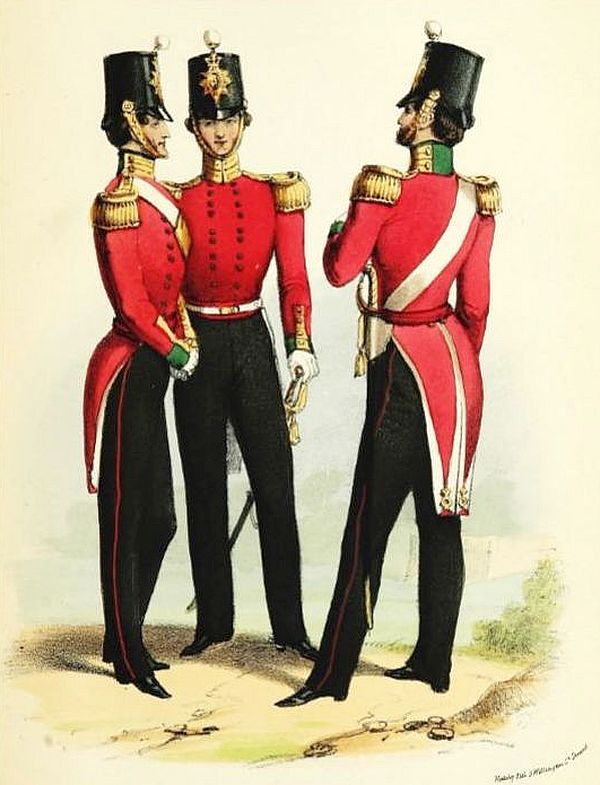
THIRTY SIXTH REGIMENT. For Cannon’s Military Records.