HISTORICAL RECORD (continued 2)
Reading edition
For the services connected with the passage of the river Nive, the Thirty-ninth subsequently received the royal authority to bear the word “Nive” on the regimental colour and appointments. Medals were also granted to Colonel the Honorable Robert William O’Callaghan, commanding the battalion, and to Brevet-Lieut.-Colonel Charles Bruce, commanding the light companies of the brigade.
2nd Batt.
During the year 1813 the second battalion continued to be stationed at Weymouth; and having completed its ranks from the militia, and by means of recruiting parties, it sent several large drafts to the first battalion in the Peninsula.
1814. 1st Batt.
On the 13th of February 1814, the division moved forward, and on the evening of the 15th of that month fell in with the enemy posted on some strong heights near the town of Garris; after halting a few minutes to observe him, an order was received from the Marquis of Wellington “to take the hill before dark,” when the first battalions of the Twenty-eighth and Thirty-ninth regiments, composing Major-General William Henry Pringle’s brigade, were instantly put in motion, and after crossing a deep ravine, steadily and briskly ascended the hill in contiguous close columns. The Twenty-eighth meeting with some little delay in the ascent, Major-General Pringle left them, and put himself at the head of the Thirty-ninth, who gained the summit under the continued fire of the enemy without returning a single shot. The French retired from the brow of the hill, and the battalion, wheeling to the right, continued to drive them along the ridge until it reached a spot where their principal force appeared to be concentrated: here they made an obstinate resistance. The other brigades of the division not being so soon in motion, and having a greater distance to proceed to their points of attack, did not gain the heights for some time, and the Twenty-eighth having proceeded in a different direction, the Thirty-ninth had to sustain, in this place, the whole efforts of the enemy for about twenty minutes. During this time the French made three attempts to drive the battalion from the position it had gained, and repeated instances occurred of personal conflict, and bayonets crossing: the battalion, however, maintained its ground, and charging in its turn, the enemy was eventually forced to retire in confusion with the loss of several prisoners.
On the following morning Lieut.-General the Honorable Sir William Stewart, K.B., who commanded the division, assembled the officers in front of the battalion, and expressed to them his high satisfaction at the gallant conduct of the corps on the preceding evening; and at the same time offered to recommend to the notice of the Marquis of Wellington any officer or non-commissioned officer that Colonel the Honorable Robert William O’Callaghan might point out: upon which Captain Duncan Campbell was recommended for the brevet rank of Major, which he obtained on the 3rd of the following month.
The battalion had also the proud satisfaction of being mentioned by the Marquis of Wellington, who was an eye-witness of its conduct, as having particularly distinguished itself on this occasion. In his Lordship’s despatch of the 20th of February, it was stated, “Much of the day had elapsed before the attack could be commenced, and the action lasted till after dark, the enemy having made repeated attempts to regain the position, particularly in two attacks, which were most gallantly received and repulsed by the Thirty-ninth regiment under the command of the Honorable Colonel O’Callaghan, in Major-General Pringle’s brigade. The Major-General and Lieut.-Colonel Bruce, of the Thirty-ninth, were unfortunately wounded. We took ten officers and about two hundred prisoners.”
In addition to Brevet-Lieut.-Colonel Charles Bruce, who was severely wounded, the battalion had two serjeants and eleven rank and file killed; one serjeant and twenty-eight rank and file were wounded.
The battalion moved forward without interruption until its arrival in the neighbourhood of Orthes on the 25th, and was present at the battle there of the 27th of February; but the division being employed in turning the enemy’s left, the Thirty-ninth did not suffer any loss. Brevet-Major George D’Arcy, who commanded the battalion on that day, was presented with a medal for the battle of Orthes.
The royal authority was subsequently granted for the Thirty-ninth to bear the word “Orthes” on the regimental colour and appointments.
The battalion moved forward on the road to Toulouse, and on the 18th of March fell in with the rear-guard of the enemy, near the village of Castillon, which was driven in. On this occasion Lieutenant Charles Cox was wounded.
The Thirty-ninth having arrived in the neighbourhood of Toulouse, nothing particular occurred until the battle of Toulouse on the 10th of April, when the operations of the division being confined to the left bank of the Garonne, the battalion was only occupied in driving in the enemy’s outposts, and taking some field-works which had been thrown up to defend the entrance to the town. In accomplishing this, Captain Samuel Thorpe, one serjeant, and a few men were wounded.
During the night of the 11th of April the French troops evacuated Toulouse, and a white flag was hoisted. On the following day the Marquis of Wellington entered the city amidst the acclamations of the inhabitants. In the course of the afternoon of the 12th of April intelligence was received of the abdication of Napoleon; and had not the express been delayed on the journey by the French police, the sacrifice of many valuable lives would have been prevented.
A disbelief in the truth of this intelligence occasioned much unnecessary bloodshed at Bayonne, the garrison of which made a desperate sortie on the 14th of April, when Lieut.-General Sir John Hope (afterwards Earl of Hopetoun) was taken prisoner, Major-General Andrew Hay was killed, and Major-General Stopford was wounded. This was the last action of the Peninsular war.
A treaty of peace was established between Great Britain and France; Louis XVIII. was restored to the throne of France, and Napoleon Bonaparte was permitted to reside at Elba, the sovereignty of that island having been conceded to him by the Allied Powers.
In addition to the other distinctions acquired during the war in Spain, Portugal, and the south of France, the Thirty-ninth received the royal authority to bear the word “Peninsula” on the regimental colour and appointments.
Shortly after the termination of the war in Europe, the first battalion of the Thirty-ninth was ordered to proceed to North America in consequence of the hostilities between Great Britain and the United States. The battalion accordingly marched to Bourdeaux under the command of Brevet-Lieut.-Colonel Charles Bruce, and embarked for Canada on the 8th of June.
While the battalion was on its voyage to North America, the Duke of Wellington, prior to the breaking up of the Peninsular army, issued the following General Order:—
“Bourdeaux, 14th June 1814.
“General Order.
“The Commander of the Forces, being upon the point of returning to England, again takes this opportunity of congratulating the army upon the recent events which have restored peace to their country and to the world.
“The share which the British army have had in producing those events, and the high character with which the army will quit this country, must be equally satisfactory to every individual belonging to it, as they are to the Commander of the Forces, and he trusts that the troops will continue the same good conduct to the last.
“The Commander of the Forces once more requests the army to accept his thanks.
“Although circumstances may alter the relations in which he has stood towards them for some years so much to his satisfaction, he assures them he will never cease to feel the warmest interest in their welfare and honor, and that he will be at all times happy to be of any service to those to whose conduct, discipline, and gallantry their country is so much indebted.”
The first battalion of the Thirty-ninth regiment arrived at Quebec on the 5th of August, and marched from thence to Chambly.
After the arrival of the reinforcements from Europe, the Governor-General of Canada, Lieut.-General Sir George Prevost, Bart., assembled all the disposable forces in the lower province for an attack upon the state of New York. On the 2nd of September the first battalion of the Thirty-ninth, with the other corps employed on this service, proceeded towards the United States to co-operate with the naval force on Lake Champlain. As the troops approached the line of separation, the Americans abandoned their entrenched camp on the river Chazy, and this post was occupied by the British on the 3rd of September.
The first battalion remained at Chazy to keep up the communication, having sent forward the light company to Plattsburg, a fortified place on Lake Champlain; two officers and sixty men of the Thirty-ninth were detached on board the fleet to act as marines. The attack was made on the morning of the 11th of September; but the defeat of the British naval force on the lake rendered it necessary to abandon the enterprise, as the most complete success on shore would have proved unavailing after the loss of the shipping. The troops accordingly retired to Lower Canada.
1815. 1st Batt.
After the failure of these operations the first battalion returned to Chambly, where it remained until the 27th of May 1815, and then proceeded to embark at Quebec under the command of Brevet-Lieut.-Colonel Patrick Lindesay, its services being again required in Europe in consequence of the return of Napoleon Bonaparte to France, who resumed his former title of Emperor of the French, but which assumption the Allied Powers refused to recognise.
The first battalion sailed from the river St. Lawrence on the 12th of June, and arrived at Portsmouth on the 15th of July. Meanwhile the destiny of France had been decided on the field of Waterloo, and Louis XVIII. had been again restored to the throne. The battalion proceeded on the 18th of July for Ostend, disembarked on the 21st, and immediately marched to join the British army at Paris. On the 26th of August it was reinforced by a strong detachment from the second battalion under Lieut.-Colonel Cavendish Sturt, who assumed the command.
2nd Batt.
In April 1815 the second battalion was removed from Weymouth to Winchester Barracks, and, after having transferred all the effective men to the first battalion, was disbanded at the latter place on the 24th of December following.
The regiment remained near Paris until the Army of Occupation was formed, and on the 27th of December 1815 marched to take up the cantonments appointed for it in the Pas-de-Calais, between the towns of Arras and St. Pol, moving annually to the camps of St. Omer and Valenciennes until the breaking up of the Army of Occupation in 1818.
1818.
On the 30th of October 1818, the regiment embarked at Calais, disembarked at Dover on the 31st, and marched to Portsmouth, where it arrived on the 11th of November. The Thirty-ninth regiment embarked for Ireland on the 17th of December following, arrived at Cork on the 24th, and disembarked on the 26th of that month.
1819.
The regiment proceeded on its route for Castlebar in the county of Mayo, where it arrived on the 7th of January 1819.
1820.
The Thirty-ninth marched from Castlebar to Dublin in August 1820, and arrived at its destination on the 17th of that month.
1821.
In March 1821, the regiment was removed from Dublin to Cork.
On the 24th of August 1821, the establishment of the regiment was reduced from ten to eight companies, of three serjeants and seventy-two rank and file each; and on the 26th of November it marched from Cork to Tralee.
1822.
In January 1822, some detachments of the regiment were employed in suppressing a partial insurrection of the Whiteboys. Brevet-Major George D’Arcy was attacked at Millstreet, in the county of Cork, and beat off considerable bodies of the insurgents. Brevet-Major Charles Carthew was also engaged with a large body of them near Bantry, when one private of the regiment was killed.
1823.
The regiment marched, on the 1st of October 1823, from Tralee to Limerick.
Lieut.-General Sir George Airey, K.C.H., was appointed colonel of the Thirty-ninth regiment on the 28th of October 1823, in succession to General Nisbett Balfour, deceased.
1824.
On the 12th of August 1824, Brevet Lieut.-Colonel Patrick Lindesay, C.B., was appointed Lieut.-Colonel of the Thirty-ninth regiment, in consequence of the retirement of Colonel Cavendish Sturt; Brevet-Major Donald McPherson succeeded to the vacant majority.
The regiment marched to Buttevant, in the county of Cork, in the beginning of October 1824, and in this place was at length brought together, having been continually broken into small detachments during the whole of its service in Ireland, with the exception of a few months while stationed in Dublin.
1825.
On the 25th of March 1825, the regiment, in common with the rest of the infantry, received an augmentation of two companies, raising its establishment to forty-two serjeants, fourteen drummers, and seven hundred and forty rank and file. These companies were given to the two senior subalterns, Lieutenants Simon Newport and Francis Henry Hart, whose commissions as captains were dated 7th and 8th of April 1825. At this period it was directed that each battalion of infantry in the United Kingdom, as well as those on foreign stations (the East Indies excepted), should consist of six service companies of eighty-six rank and file each, and four dépôt companies of fifty-six rank and file each, making seven hundred and forty in all. The dépôts of such regiments as were serving at home, continued united with their respective corps.
An order was received on the 10th of July 1825, intimating that the regiment was destined to proceed to New South Wales, and ultimately to India. On the 19th of July, it marched to Cork to be embarked for Chatham, from whence it was ordered to proceed to New South Wales, as guards over convicts. The first division left Cork on the 19th, and the head-quarters on the 30th of September.
A detachment, consisting of one captain, one subaltern, one serjeant, and twenty rank and file, embarked in the “Woodman” convict ship on the 4th of November 1825, and proceeded to Van Diemen’s Land and Sydney.
The last division of the regiment arrived at Chatham from Cork, on the 25th of November 1825.
1826.
Several detachments of the regiment proceeded to New South Wales during the year 1826.
In the latter part of 1826, Captain Joseph Wakefield proceeded to assist in establishing a settlement at King George’s Sound on the southern coast of New Holland; and in the beginning of the following year, Captain Henry Smyth was despatched to effect a similar purpose on the northern coast, and succeeded in forming a settlement named Fort Wellington, in Raffles’ Bay.
1827.
The head-quarters under the command of Colonel Lindesay, were embarked for New South Wales in the ship “Cambridge” on the 26th of April 1827, and arrived at their destination on the 17th of September following.
From the 4th of November 1825, to the 5th of May 1827, the whole of the men of the service companies, together with two officers and fifty-nine men drawn from the dépôt, were embarked for New South Wales.
1828.
In consequence of the breaking-up of the reserve or dépôt companies of the regiment in the beginning of 1828, the officers and men composing those companies proceeded by detachments to the head-quarters in New South Wales, leaving a dépôt company in England, on the 24th of August 1830, of two captains, two lieutenants, one ensign, five serjeants, six corporals, four drummers, and thirteen privates. The first detachment embarked for New South Wales on the 1st of February 1828, and the last sailed on the 30th of August 1830.
During the period the regiment was employed in New South Wales, detachments were stationed at Van Diemen’s Land, at King George’s Sound, and on the northern coast, which were distant six hundred, fifteen hundred, and two thousand miles from the head-quarters.
1829. 1830.
The attention of Lieut.-General Ralph Darling, governor of the colony, having for some time been drawn to the importance and advantages which would result from a greater knowledge of the interior of the country, yielded to the entreaties of Captain Charles Sturt of the Thirty-ninth, and permitted him to proceed for the purpose of prosecuting the discoveries already commenced by other travellers. This officer departed from Sydney on his first expedition, on the 6th of November 1828, proceeding in a westerly direction, and remained absent until the 2nd of April 1829, when he rejoined the regiment, having performed the task allotted to him in a manner highly satisfactory to the government; so much so, that having again most particularly requested permission to proceed once more for the purpose of exploring the country in another direction, his request was readily acceded to by the governor, and he accordingly departed from Sydney on the 3rd of November 1829. Proceeding southerly, he had the good fortune to make the coast at Spencer’s Gulf, having traced a large and important river through a vast tract of country, until it discharged its waters into the ocean, on the point of which he emerged. Captain Sturt returned from this expedition on the 26th of May 1830, and was subsequently detached to Norfolk Island; but his health having received a severe shock from the fatigue incident to his labours, he received permission to return to England in 1832.
Serious disturbances having arisen amongst the convicts in the Bathurst district in August 1830, large detachments of the regiment were ordered to proceed thither, where Major Donald McPherson was stationed in command, and Captain Horatio Walpole was directed to pursue a body of those deluded men, who had fled from their employment, and furnishing themselves by plunder with arms and horses, bade defiance to all law and authority. He succeeded in ascertaining the direction which they had taken, and following them for several days over a large tract of country, finally succeeded in capturing the whole gang without any loss on the part of his detachment.
In the month of October of the same year, Lieut.-General Ralph Darling addressed a letter to Colonel Lindesay, to ascertain if the immediate services of Captain John Douglas Forbes could be dispensed with by the regiment, as it was his wish to place him in command of the mounted police; to which a reply was sent by Colonel Lindesay, stating his consent to Captain Forbes being withdrawn from his regimental duties; “for that, although he could ill be spared, yet he did not wish to deprive the colonial government of the services of an officer who, he had every reason to believe, would prove both valuable and efficient.” The result fully realized his anticipations; and on the 16th of October, Captain Forbes was by a general order placed in command of this corps; a body of men drawn in equal numbers from the regiments in garrison, and mounted by government, for the more effectually assisting of the civil power, by dispersing them over the various settled parts of the colony. They had, at the time of Captain Forbes’s appointment, no recognized commanding-officer, but were nominally under the superintendence of the Major of Brigade, whose various avocations rarely allowed him to examine into their interior economy; consequently, their discipline had become relaxed, and their duties were but too often performed with carelessness.
Soon after Captain Forbes assumed the command, a manifest change took place; the mounted police rapidly became an efficient and highly disciplined body of men, and their utility and zeal in the discharge of their duty were universally acknowledged.
1831.
New colours were presented to the Thirty-ninth by Lieut.-General Ralph Darling, in the Barrack Square of Sydney, on the 16th of May 1831, being the anniversary of the battle of Albuhera, in which engagement the second battalion of the regiment had twenty years before distinguished itself. On this occasion the following speech was delivered by the Lieut.-General, the ceremony of consecration having been first performed by the Venerable Archdeacon Broughton:—
“Thirty-ninth! It is highly gratifying to me to present you, on the part of your Colonel, with these colours, henceforth the proud record of your general and distinguished services.
“It is unnecessary for me, Thirty-ninth, to emblazon your achievements; your friends will ever remember, and your enemies can never forget, that during the Peninsular War, which in its results was as glorious to the British Arms as it was important to the general interests of Europe, you, led on by your present gallant Commander, fought at Albuhera, of which battle this is the twentieth anniversary; that you were also engaged with, and defeated, the enemy at Vittoria, at the Pyrenees, the Nivelle, the Nive, and at Orthes. You have indeed, Thirty-ninth, nobly redeemed the pledge which your predecessors in arms first gave at the battle of Almanza[29], now one hundred and twenty-four years ago, which was as admirably seconded in the glorious field of Plassey, as it was successfully followed up at the memorable defence of Gibraltar!
“Soldiers! It is not necessary to the fame of your corps, that you should augment the honors which it has so gallantly acquired; but I am sure, whenever your King and country shall require your services, you will add fresh laurels to the noble wreath which now so proudly adorns your banners.
“Gentlemen! In addressing you more particularly to whom this sacred trust, the immediate charge of these colours is especially confided, I need only point out, that they will be the objects to which the eyes of your corps will be directed. You will protect them with your lives; and may the Almighty, who alone can shield you in the day of battle, guide and preserve you in the faithful discharge of this sacred duty!”
Colonel Lindesay having made a suitable reply to the foregoing address, the ceremony was concluded in the usual manner.
The festivity consequent on the presentation of colours was damped by the melancholy intelligence of the death of Captain Collett Barker, who was barbarously murdered on the 30th of April 1831, by the native tribes on the southern coast of New Holland, near the spot at which Captain Sturt had made the coast on his second expedition. Captain Barker had served in the Thirty-ninth regiment for a period of twenty-five years, and was highly esteemed. At the time of his death he was returning from King George’s Sound, where he had been for some time commandant, but which settlement he had been ordered to deliver over to the government of Western Australia, and had landed for scientific purposes near the spot where he was murdered. Captain Barker had also for a considerable period been commandant at the settlement of Fort Wellington, in Raffles’ Bay, on the northern coast of New Holland, where his services were highly estimated by the Colonial Government.
On the 30th of May 1831, a general order was issued, acquainting the regiment that it was destined to proceed to India, upon the arrival of the Fourth foot in New South Wales.
Lieut.-General Darling embarked for England on the 22nd of October 1831, leaving the administration of the government of the colony in the hands of Colonel Lindesay, who continued to act as governor until the arrival of Major-General Richard Bourke, C.B., on the 2nd of December. During this period the command of the regiment devolved upon Major McPherson, who was withdrawn from the Bathurst district for that purpose.
1832.
On the 5th of July 1832, a general order was issued, directing the head-quarters of the regiment to embark for Madras; upon which occasion an address was unanimously voted by the civil officers of the colony to Colonel Lindesay on his departure, as a mark of sincere esteem and respect; and he, together with the officers of the Thirty-ninth, received an invitation to a dinner, immediately after which the address, most numerously signed, and highly complimentary to the Colonel and to the regiment, was read by Chief-Justice Forbes. Colonel Lindesay, in reply, expressed his thanks for the honor conferred upon him and upon the Thirty-ninth regiment.
Six companies of the regiment embarked at Sydney on the 21st of July 1832, in three divisions, and disembarked at Madras on the 22nd of September, 10th and 14th of October. The remaining four companies embarked at Sydney on the 3rd of December, and arrived at Madras on the 21st of February of the following year.
The regiment was for a short period stationed at Poonamallee, about thirteen miles from Madras.
1833.
After receiving several contradictory orders as to its final destination, the regiment marched on the 22nd of January 1833, for Bangalore in the Mysore territory, where it arrived on the 14th of February. On the following day, Colonel Lindesay assumed the command of the cantonment of Bangalore, and that of the regiment devolved on Lieut.-Colonel McPherson. A week afterwards the remainder of the corps, with the exception of forty men left behind, had disembarked at Madras from New South Wales, under the command of Major Thomas Poole, and joined the head-quarters on the 15th of April; the strength of the corps had also been increased by one hundred and fifteen volunteers received from the Forty-sixth regiment. Lieutenant Charles Cox, who had been detached under the command of Captain Wakefield, to take charge of these volunteers, died of cholera while on the route to Hyderabad.
Lieut.-General the Honorable Sir Robert William O’Callaghan, K.C.B., was removed from the colonelcy of the Ninety-seventh to that of the Thirty-ninth regiment, on the 4th of March 1833, in consequence of the decease of Lieut.-General Sir George Airey, K.C.H.
Cholera broke out among the European troops at Bangalore about the 22nd of March 1833; and in the course of fire weeks the regiment lost Captain Thomas Meyrick, four serjeants, forty-two rank and file, two women, and eleven children. Captain Meyrick had served twenty-two years in the Thirty-ninth, fourteen of which he had been adjutant of the regiment.
In consequence of Lieut.-Colonel McPherson proceeding to England on the 15th of December 1833, on two years’ leave of absence, Major Poole became the commanding officer of the regiment.
1834.
Early in 1834, the regiment was called upon to take part in active field operations against the Rajah of Coorg. This prince, a dependent ally of the British, had for some time excited the attention of the government by a series of cruelties and oppression towards his subjects, and had made open preparations to resist its authority. Confiding in the natural difficulties of his country, he presumed to defy the arm of British power, and encouraged proclaimed rebels to take refuge in his jungles and mountains; he finally reached the climax of misconduct, by the outrageous act of arresting an accredited envoy from the government, who had been sent to endeavour to re-establish amicable relations.
A field force, consisting of upwards of seven thousand men, was formed and divided into four columns; the command of the whole was assigned to Colonel Patrick Lindesay, C.B., who received the temporary rank of Brigadier, and Captain John Douglas Forbes, of the Thirty-ninth, was appointed deputy assistant adjutant-general of the force.
The regiment was directed to furnish four hundred rank and file to form the European force of the Eastern Column; and on the 17th of March, the following detail, under the command of Major Thomas Poole, marched from Bangalore in light service order:—
Field Offr. Captns. Subs. Staff. Serjts. Drms. Rk. & File
1 6 12 1 25 6 400
The column rendezvoused at Periapatam, within a few miles of the hostile country, where final arrangements were made for the attack.
It having been decided that the column should move on two points, it was divided into two divisions, and a part of the regiment attached to each. On the 1st of April, the head-quarters, consisting of four companies, with the part of the column under the personal direction of the Brigadier, marched for Bedalapoor; and Major Poole was nominated to the command of the Infantry Brigade, while Captain Horatio Walpole succeeded to the charge of that portion of the regiment. Captain Smyth, with the other three companies of the regiment, remained with the division under Lieut.-Colonel Stewart, of the East India Company’s service.
On the 2nd of April, the Cavery was crossed, and the Coorg country entered by both divisions; the opposition made by the enemy was trifling, and the casualties in the regiment were very few. Captain Smyth and one serjeant were wounded.
On the following day the troops advanced, and succeeded in carrying all the barriers and positions opposed to them; one private was wounded at the stockade, near Harringharry.
The difficulties of the country, both natural and artificial, became excessive, and demanded, as they received, the very utmost exertions of the troops to bring forward the artillery. In one day’s march of continued labour, for upwards of fourteen hours, a distance was gained of only five miles.
On the evening of the 4th, a flag of truce arrived from the rajah, proposing that the troops should halt until he could conclude a negotiation, into which he proposed entering. The Brigadier received the flag, and consented to a truce so far as regarded actual hostilities, provided the enemy refrained from them; but he signified his determination to advance until the rajah surrendered himself an unconditional prisoner.
No further opposition was experienced, and the increasing strength of the stockades and positions, rendered it evident that, if adequately defended, they could only have been carried at an enormous sacrifice. The head-quarter division reached Mercara, the capital, on the 6th; and the British ensign displayed on the walls of its fort, speedily announced the addition which the force had made to British power. The rajah, who had retreated to a country palace, surrendered his person on the 10th of April, and the war was considered at an end.
The conduct of the regiment had throughout this short campaign met with the unqualified praise and approval of the Brigadier, who concluded one of his despatches by saying:—
“It remains, therefore, for me only to bring to the notice of His Excellency the excellent conduct of that part of the Eastern Column which has been acting under my orders. To Major Poole of His Majesty’s Thirty-ninth regiment, whom I placed in immediate command of the Infantry Brigade, I have been indebted for the most zealous and able assistance; and I do but justice in reporting that the officers and soldiers, of every rank and degree, have under all circumstances, and in all respects, merited my most perfect approbation.”
The following is an extract from the despatch of Lieut.-Colonel Stewart, commanding the second division of the Eastern Column:—
“The detachment of His Majesty’s Thirty-ninth regiment surmounted all difficulties with the characteristic behaviour of British soldiers.”
On the 11th of April, the three companies with Captain Smyth, who had been latterly employed in opening the communications, rejoined, and the regiment remained in camp at Mercara until the 11th of May, when, in consequence of an order for the reduction of the force, it marched for Bangalore, and arrived there on the 28th of May.
The casualties by war have already been shown to be trifling; those by sickness, notwithstanding the fatigue and exposure, were also singularly few. The regiment returned to Bangalore but six men weaker than it left that place.
Upon the Forty-eighth regiment being ordered to embark for England, thirty men of that corps volunteered to the Thirty-ninth, and joined the head-quarters on the 14th of November.
1835.
Early in the year 1835, the following general order was received at the regiment, marking His Majesty’s extreme approbation of the conduct of Brigadier-General Lindesay, C.B., whilst commanding the force employed in the expedition against the Rajah of Coorg.
“Head-Quarters, Madras, 17th April 1835.
“General Order.
“His Excellency Lieut.-General The Honorable Sir Robert William O’Callaghan, commanding His Majesty’s Forces in India, has much satisfaction in publishing the following extract of a letter from the Right Honorable the General Commanding-in-chief, expressive of His Majesty’s approval of the conduct of Brigadier-General Lindesay, and the troops employed under his orders, during the late operations in Coorg, and of His Majesty having been graciously pleased in consequence to nominate that officer to be a Knight Commander of the Royal Hanoverian Guelphic Order.”
Extract of a letter from General the Right Honorable Lord Hill, Commanding-in-chief, dated Horse Guards, 22nd October, 1834, to the Right Honorable Lord William Bentinck, G.C.B., Commander-in-chief in India.[30]
“I have had the honor to receive your Lordship’s letter on the 22nd of May, transmitting a copy of your General Order, on the termination of the war against the Rajah of Coorg; and I beg leave to offer to your Lordship my best congratulations on the success of that operation.
“Having felt it my duty to lay your communication before the King, and to solicit His Majesty’s attention to the terms in which you speak of the conduct of Colonel Lindesay, of His Majesty’s Thirty-ninth Regiment, to whom you confided the command of the Field Force, I have the honor to acquaint you, that the King has remarked with much satisfaction, that the ability and judgment of Colonel Lindesay in the performance of his important service, have been eminently conspicuous; and in testimony of His Royal approbation His Majesty has been pleased to nominate him a Knight Commander of the Royal Guelphic Order, the decoration of which will be duly transmitted to him by the Hanoverian minister at this court.
“By order of His Excellency Lieut.-General the Hon. Sir Robert William O’Callaghan, Commanding His Majesty’s Forces in India. (Signed) “R. Torrens, “Colonel, Adjutant-General H. M.’s Forces in India.”
Colonel Lindesay had, previously to the receipt of this communication, been removed from the command of the cantonment of Bangalore, and appointed on the 3rd of January to that of the southern division of the Madras army, with the temporary rank of Brigadier-General. He accordingly proceeded to Trichinopoly, the head-quarters of that division. From this place he made application that the Thirty-ninth might be permitted to resume the following distinctions, which had been borne on the regimental colour and appointments for many years, but which had been discontinued about the year 1807, namely the motto “Primus in Indis,” and the word “Plassey;” also the device of the “Castle and Key,” in addition to the word Gibraltar and the motto “Montis Insignia Calpé.” His Majesty King William the Fourth was graciously pleased to approve of these distinctions being resumed by the Thirty-ninth, and the result was communicated by the Adjutant-General on the 24th of November 1835, to Lieut.-Colonel Sir Robert William O’Callaghan, Colonel of the regiment.
On the 14th of December 1835, the regiment was reviewed at Bangalore by Major-General Hawker, commanding the Mysore division of the army, who after a minute inspection expressed to Major Poole his perfect approbation of its appearance, movements, and discipline.
1836.
In February 1836, Colonel Lindesay embarked for Europe, having been relieved in the command of the southern division of the Madras army by Major-General Sir John Forster Fitzgerald, K.C.B., in the preceding October.
Colonel Lindesay, on his departure, was presented by the officers with a gold snuff-box, value nine hundred rupees, bearing the distinctions of the regiment, in which he had served for upwards of forty years.
1837.
A gold snuff-box, value five hundred rupees, was also presented, in January 1837, to Arthur Hamilton, Esq., surgeon of the regiment, on his return to Europe.
A detachment, consisting of two captains, seven subalterns, nine serjeants, four drummers, and two hundred rank and file, marched from Bangalore on the 10th of April 1837, under the command of Captain Walpole, to assist in quelling an insurrection which had taken place in Canara and Malabar.
Directions were given to Captain Walpole to proceed with all expedition to the French Rocks, there to place himself under the orders of Lieut.-Colonel William Williamson, commanding the force moving towards Bisley Ghaut. On arriving at the former place, Captain Walpole received instructions to continue his march in the direction of Mercara; and came up with Colonel Williamson’s force, consisting of a brigade of horse artillery, one squadron of native cavalry, and the Twenty-seventh Native Infantry, five miles to the west of Seringapatam, after a march of twenty-five miles. This force then marched to Frazerpet, and from thence (its movement to Mercara having been countermanded) along the Cavery river to Bisley, where it arrived on the 23rd of April, after thirteen days of very harassing marching from Bangalore, upon an average of nineteen miles a day, and with only one halting-day.
The Pass of the Bisley Ghaut was cleared after some slight resistance offered by the insurgents at the barriers which they had erected, and the force descended upon the Canara country and encamped at Cuddal, until tranquillity was restored.
Captain Walpole’s detachment was then ordered back to Bangalore, where it arrived on the 20th of May without any casualties, and only sixteen sick, although the men had been exposed in small tents in the jungle to the heat of the sun, and had performed a succession of forced marches, besides the laborious duty of assisting in drawing the artillery guns up the difficult ascent of the Ghaut. Lieut.-Colonel Williamson, of the East India Company’s army, who commanded the force, was in the following year nominated a Companion of the Order of the Bath.
1838.
On the 6th of January 1838, the regiment received a very handsome piece of plate from their late Lieut.-Colonel, Major-General Sir Patrick Lindesay, C.B. and K.C.H.
The right wing marched to Bellary on the 20th of October 1838, to replace the Forty-first regiment, and was followed by the left wing and head-quarters on the 16th of January 1839.
1839.
Upon the head-quarters leaving Bangalore, the following order was issued by Major-General Sir Hugh Gough K.C.B. (now Viscount Gough), then commanding the Mysore division of the army:—
“Division Orders.
“Bangalore, 15th January 1839.
“Major-General Sir Hugh Gough on parting with Her Majesty’s Thirty-ninth Regiment feels great satisfaction in being able to record his unqualified approbation of the soldier-like, creditable, and uniformly correct conduct of the corps during the sixteen months it has been under his immediate command at the head-quarters of the Mysore division; and he requests Lieut.-Colonel Poole will, himself, accept the Major-General’s best thanks for his judicious arrangements and unceasing attention to the various duties attendant on his situation as commanding-officer, and that he will also convey to the officers, non-commissioned officers, and privates of Her Majesty’s Thirty-ninth regiment his best thanks and good wishes, with the assurance that the Major-General will consider it a most gratifying event again to have this distinguished corps under his orders, the more particularly should his services be required in the field.
“The Major-General cannot avoid at the present moment noticing the circumstance so confirmatory of the good feeling and high state of discipline of Her Majesty’s Thirty-ninth regiment; namely, that for the six years it has been quartered at Bangalore, not one solitary instance of complaint has been preferred against an officer, or a soldier, by an inhabitant for insult or injury of any kind.
“By Order, (Signed) “G. C. Whitelock, “Deputy Assistant Adjutant-General, “Mysore Division of the Army.”
The head-quarters arrived at Bellary on the 5th of February, and the regiment was stationed there at the end of March when the cholera broke out in the regiment, and raged for some time with considerable violence. One of the last victims to the disease was the Senior Lieut.-Colonel Thomas Poole, who died on the 23rd of April, and was succeeded in the command of the regiment by Lieut.-Colonel Joseph Wakefield. Lieut.-Colonel Poole entered the service on the 4th of September 1803, as Ensign in the Twenty-second regiment, and was promoted to the rank of Lieutenant on the 20th of June 1805, and served for some time as Adjutant; he was appointed Captain in the same regiment on the 26th of December 1811, and was advanced to the rank of Major on the 14th of February 1828; he exchanged from the Twenty-second to the Thirty-ninth regiment on the 21st of February 1828, and was promoted Lieut.-Colonel in the latter corps on the 10th of January 1837. Major Thomas Wright was promoted to the vacant Lieut.-Colonelcy on the 24th of April 1839.
On the 30th of August 1839, the regiment left Bellary for field service under Major-General Wilson, C.B. The intended destination of the force was at that time unknown to the Major-General himself. The troops reached Adoni, which had formerly been a favourite stronghold of one of the minor branches of the Mogul dynasty, and the ruins of which attest its former strength and magnificence, on the 3rd of September.
The regiment was halted there until the 21st, during the greater part of which time it rained heavily, but the men were very healthy. On the 27th it reached Coodamoor, where the whole force was assembled, consisting, in addition to the Thirty-ninth, of two squadrons of the Thirteenth light dragoons, the Seventh regiment of Native cavalry, the Third, Sixteenth, Thirty-fourth, Thirty-ninth, and Fifty-first regiments of Native infantry. The head-quarters of the Sappers and Miners, a troop of horse and two companies of foot artillery, with four eighteen-pounders, four twelve-pounders, several mortars, howitzers, and a large and well equipped park. A formidable resistance was, therefore, expected by the Government; and subsequent inquiries proved that the intended antagonist was supplied with most numerous and well constructed implements of destruction, and that a part of his force consisted of brave and determined soldiers.
At Coodamoor the regiment remained halted for many days; and on the 1st of October the cholera unfortunately broke out, and lasted with considerable violence for about ten days, during which time Lieut. Samuel Philips, Assistant Surgeon Robert Martin Davis, M.D., of the Thirty-ninth regiment (a most valuable and excellent medical officer), and six men died therefrom.
On the 3rd of October, an order was received from the Commissioners for the affairs of Kurnool to detach a portion of the force in advance; two companies of the Thirty-ninth, under the command of Captain Henry Clarence Scarman (who died of cholera in the Fort of Kurnool on the 12th of the same month), with a detachment of the artillery, and the Fifty-first Native infantry, marched on the 4th of October. This force was led into the Fort of Kurnool by the Nuwaub’s head minister, Numder Cawn, who subsequently was proved to have been a traitor to both parties. The Nuwaub and his party vacated the fort by an opposite gate. This apparent surrender turned out to be a ruse de guerre, as the Nuwaub, it is believed, fully expected to re-occupy the fort; for there were no visible symptoms of preparations, all munitions of war being buried or built up, and the whole wore a peaceful aspect; subsequent discoveries proved that peace was not his object, but that he contemplated lulling the Company into security, until he was prepared for active operations. On the 9th of October, the Commissioners applied for a reinforcement; and two companies of the Thirty-ninth, the whole of the Thirty-fourth Native infantry, with a detachment of cavalry and artillery, were despatched under the orders of Lieut.-Colonel Thomas Edward Wright. These two companies were encamped outside the Fort of Kurnool for some days; but on the morning of the 18th, Lieut.-Colonel Wright was privately informed that his two companies would be required to assist in endeavouring to force the Nuwaub to surrender, and to make his followers, principally composed of Arabs, Rohillahs, and Patans, lay down their arms. It is well known that Arabs particularly have a great objection to do this, and will rather fight under very adverse circumstances than comply; resistance was, therefore, expected. Negotiations were soon seen to be unavailing, as some of the Rohillah chiefs (a brave people, whose sole and only occupation is mercenary fighting) accused their opponents of cowardice.
A fire of artillery and musketry of twenty minutes’ duration was opened upon, and returned by the Nuwaub’s party, when an order was given to the Thirty-ninth to charge, which they did, and after a well contested struggle obtained possession of the person of the Nuwaub, and made prisoners a great number of his followers. Several escaped, and were pursued by a party of the Thirteenth light dragoons, which guarded the ford of the river; about three hundred are supposed to have fallen on the side of the enemy. The two companies of the Thirty-ninth were about eighty strong in rank and file. Lieut. Thomas White, one colour-serjeant, and one private were killed; and Lieut.-Colonel Wright was most dangerously wounded. Four privates were dangerously wounded, two of whom died, and one had his arm amputated; five privates were slightly wounded.
The conduct of Lieut.-Colonel Wright, and that of the officers and men of his detachment, was highly commended in the public despatch on the occasion. Captain William Wood, Lieut. Edward Croker, and Ensign Owen Wynne Gray, were the officers present, together with Lieut. Thomas White, who was killed.
In the despatch of Lieut.-Colonel Dyce, commanding the detachment of the Kurnool field force, giving an account of the affair at Zorapore, near Kurnool, on the 18th of October, it was stated “that the conduct of the detachment of the Thirty-ninth was such as always characterises British soldiers;” and he added,
“I beg particularly to bring to the notice of superior authority the conspicuously gallant conduct of Lieut.-Colonel Wright, of Her Majesty’s Thirty-ninth regiment, who has been dangerously wounded.”
The loss of the enemy was severe; several chiefs were among the slain, and a number of elephants, horses, and treasure were captured.
The Governor of Madras in Council stated in general orders, dated Fort George, 25th October 1839, in publishing Lieut.-Colonel Dyce’s despatch, that “while he laments the humane efforts of that officer to prevent bloodshed have been defeated by the infatuation of the Nuwaub of Kurnool’s followers, he cannot refrain from expressing the high sense he entertains of the gallantry and soldier-like conduct displayed by Lieut.-Colonel Dyce, and the officers and men of the detachment in the attack upon the durgah at Zorapore.”
The regiment returned to Bellary on the 8th of November 1839, leaving two companies to garrison the Fort at Kurnool. Shortly afterwards intimation was received that it was to march for Kamptee, and accordingly on the 24th of December the regiment quitted Bellary.
1840.
The two companies which had been left at Kurnool, rejoined the head-quarters at Nagumpilly, near Secunderabad, on the 12th of January 1840, and the regiment arrived at Kamptee by the route of Secunderabad and Hingolee, a distance of six hundred and forty miles, without a single casualty. Previously to quitting Bellary the regiment received from Major-General Francis W. Wilson, C.B., in orders, the expression of his entire approbation of its “excellent discipline, efficiency, and exemplary behaviour both in garrison and the field.”
Lieut.-Colonel Wakefield died of fever on the 17th of May 1840, and Lieut.-Colonel Wright assumed the command of the regiment. Major Horatio Walpole was promoted to the vacant Lieut.-Colonelcy.
Lieut.-General Sir Frederick Philipse Robinson, G.C.B., was removed from the colonelcy of the Fifty-ninth to that of the Thirty-ninth regiment on the 15th of June 1840, in succession to Lieut.-General the Honorable Sir Robert William O’Callaghan, G.C.B., deceased.
1841.
From the unsettled state of India, rumours were constantly stirring that the regiment would be ordered to march in the direction of Bombay; it remained quiet, however, until November 1841, when two companies were ordered at a few hours’ notice to join a small force under Lieut.-Colonel Dowker, of the Madras army, for the purpose of pursuing and chastising a pretender to the name and person of Appa Sahib, who had been deposed from the Nagpore throne in 1818, and had made his escape from the escort of British troops, and, although frequently heard of, had never been seen by the British authorities.
These two companies did not fall in with the rebels, and their return to Kamptee was hastened by an order for the regiment to march to Cawnpore, in the Bengal presidency, with the least possible delay. On the 27th of December 1841, the regiment left Kamptee, and on approaching Jubbulpore received orders to change its route to Agra, which it accordingly did, and reached its destination, viâ Sangor, Jhansi, and Gwalior, a distance of five hundred and twenty miles, on the 1st of March 1842, with only two casualties.
1842. 1843.
On the 8th of October 1842, the regiment marched, viâ Muttra, Delhi, and Kurnaul, to join the army of reserve assembled at Ferozepore, on the return of the troops from Affghanistan, where it remained until the army was dissolved in January 1843, when it marched to Delhi, and formed part of the Governor-General’s escort there, returning to Agra by way of Allyghur, on the 4th of March following.
On the morning of the 23rd of March 1843, at six o’clock, Lord Ellenborough, the Governor-General of India, presented new colours to the regiment.
The corps received his Lordship with a general salute, after which the ranks were closed. It then formed three sides of a square, and the new colours were deposited in front, where they were consecrated with a prayer every way suited to the solemnity of the occasion, by the Rev. Mr. Rice, Chaplain at Agra. His Lordship then affably desired that sufficient space might be afforded for his voice to be heard by all the regiment, and spoke as follows:—
“Lieut.-Colonel Wright, officers, non-commissioned officers, and privates of Her Majesty’s Thirty-ninth regiment, I present to you new colours, consecrated with all the solemn ceremonies of religion, to be borne, as your colours always have been, with honor before the enemy.
“These colours have already inscribed on them the names of many victories, wherein those who have preceded you in the Thirty-ninth, and some amongst yourselves, have borne part.
“There is yet space for more inscriptions to commemorate other victories; and be assured that, if the necessity for action should occur, I shall afford you the opportunity of acquiring distinctions similar to those which have been obtained by your predecessors, with the conviction that you will display courage like that which distinguished them upon the field of battle, that these colours will never retreat before the enemy, but that every one of you would give his life to bear them on to victory.
“In England and in the colonies, and in other parts of the world, Her Majesty’s Thirty-ninth regiment may stand in the same line with other regiments which have gained glory in the field. In India you are the first. Your predecessors laid, at Plassey, the foundation of the glorious empire you now behold; an empire won by arms, and by arms alone to be preserved.
“Other inscriptions on your colours commemorate victories in which your predecessors participated in Spain, under the immediate eye and direction of the greatest of generals, of him who now again in the command of the army in England, watches over the interest and honor of those he so often led to victory. Loyalty to our Sovereign is the first duty of us all. It has at all times been the virtue of the British soldier; but how much is there to animate our loyalty, to give the character of enthusiasm to our feelings for our Sovereign, when the Queen evinces, as Her Majesty always has done, the deepest personal interest, the warmest zeal and regard for the honor of the army!
“Eleven regiments of Her Majesty’s army have, in this last year, obtained from Her Majesty’s gracious favour, for their services in Affghanistan and China, medals commemorative of those services, to be for ever worn upon their breasts.
“I know that whenever your services may be required in the field, you will follow these colours, not with any thought of pecuniary advantage to be gained by success, but with the one absorbing thought, that, through the success you may obtain by your courage, you may return to your families, to your friends, and to your country, bearing upon your breasts the decorations which evince your Queen’s approval of your devotion to Her Majesty, and of your duty well performed before the enemy.
“My fortune has given to me, and I regret it, a career different from yours. I have been, and must remain, employed in civil duties; but I tell you, as I have already told some of your comrades, the first of all professions is that of a soldier, and the first of all rewards is military honor!!!
“I now deliver to you these colours, in the conviction that they will ever be borne before you with honor, and that there is not a man amongst you who would not give his life to preserve them.”
Lieut.-Colonel Wright replied to his Lordship to the following effect:—
“That both himself and the officers and soldiers of the regiment were deeply sensible of the honor his Lordship had conferred upon them; that he was unable to enlarge on the topics usually advanced on such occasions, as his Lordship’s speech had both anticipated and exhausted his resources; but that his Lordship might rely upon it, every member of the corps would endeavour to maintain the honor of their colours, and the renown of Her Majesty’s arms, unsullied.”
The regiment then reformed line and the audience retired. The colours were trooped in the usual form; and on arriving at the right of the line were brought up by the grenadiers (the band playing their march) along the front of the line, opposite to the old colours, where they were exchanged; the senior ensigns falling in with the new colours in the centre of the line, whilst the old colours fell in respectively on the flanks of the grenadier company, which were faced outwards by sub-divisions, and conveyed (music playing) round the flanks of the regiments to the rear of the centre, when they were sent away. The grenadiers then resumed their post in line, and the regiment then marched past in slow and quick time, reformed line, and presented arms.
A ball and supper were given by the officers to commemorate the event, to which every member of society in and around Agra was invited. These festivities were attended by his Lordship, and were subsequently followed by others on succeeding evenings, in which the serjeants, corporals, and privates of the regiment participated.
In the month of August 1843, cholera appeared with great virulence. Brevet Lieut.-Colonel Donald Urquhart, Surgeon Robert Stark, M.D., two serjeants, two corporals, forty-eight privates, women, and children, died of this disease in the course of a month, after a few hours’ seizure. The hospital was crowded with patients. All the officers, Lieut.-Colonel Wright with about five others excepted, were attacked with cholera symptoms. Captain Charles T. Van Straubenzee of the Thirty-ninth regiment, was promoted to the rank of Major on the 27th of August, in succession to Brevet Lieut.-Colonel Urquhart.
The regiment was encamped at Rambaugh, near Agra, for ten days, in consequence, until the disease disappeared.
The Thirty-ninth regiment formed part of the fifth brigade of the “Army of Exercise,” assembled at Agra on the 25th of November 1843. This force had been assembled in consequence of affairs in the state of Gwalior, which had for some time required the attention of the Indian Government, although it was not anticipated that actual hostilities would take place. The events which led to the collision between the Anglo-Indian troops and those of the once powerful Mahratta kingdom, are as follow:—Upon the decease of Maharajah Jhunkojee Rao Scindia, the British Government promptly acknowledged as his successor the Maharajah Jyajee Rao Scindia, who was nearest in blood to the late sovereign of Gwalior, and whose adoption by the Maharanee, his Highness’s widow, was approved by the chiefs. During the minority of the Maharajah, the office of regent was to be held by Mama Sahib. In a short period the regent was compelled by force to quit the Gwalior state, and the Dada Khasgee Walla succeeded to the confidence of the Maharanee without possessing generally that of the chiefs, and by his influence various acts were committed insulting and injurious to the British Government. The delivery of the Dada being peremptorily insisted upon as a necessary preliminary to the re-establishment of the customary relations with the Gwalior state, the Maharanee at length complied with the request. The Governor-General, in order to give friendly support to the youthful Maharajah, directed the immediate advance of forces sufficient for the purpose. The Anglo-Indian troops entered the dominions of Scindia, and a strong government having been established at Gwalior, they received orders to withdraw; but were not destined to return to their own territory without a severe conflict. They had quitted Agra in the early part of December, immediately after the arrival there of the Governor-General of India, The Right Honorable Lord Ellenborough. His Lordship accompanied the troops, and on the 23rd of December they crossed the Chumbul river, and halted at Hingona, about twenty miles from Gwalior, where the army rested for five days.
During this interval the Mahratta vakeels, or agents for the Gwalior durbar, had an interview with the Governor-General, and the negotiations appeared proceeding to an amicable issue. The design of the enemy was, however, merely to gain time to concentrate his forces, and this at last became so evident that his Lordship determined upon active measures of hostility. While the main body of the army, of which the Thirty-ninth formed part, moved on from Agra under General Sir Hugh (now Viscount) Gough, Bart., G.C.B., Commander-in-Chief in India, another division under Major-General John Grey, C.B., advanced on Gwalior from Bundlekund.
The Thirty-ninth, with the main division, crossed the Koharee river early in the morning of the 29th of December, and found the Mahratta forces drawn up in front of the village of Maharajpore, in a very strong position, which they had occupied during the previous night, and which they had carefully entrenched. The British were about fourteen thousand strong, with forty pieces of artillery, while the enemy mustered eighteen thousand men, including three thousand cavalry with a hundred guns. Notwithstanding the extreme difficulty of the country, intersected by deep and almost impassable ravines, the whole of the Anglo-Indian troops were in their appointed positions by eight o’clock in the morning of the 29th of December. The action commenced by the advance of Major-General Littler’s column, which was exactly in front of Maharajpore; and although the Mahratta troops fought with desperate bravery, nothing could withstand the rush of British soldiers. The part taken by the Thirty-ninth in the victory which ensued, is shown in the accompanying extracts from the despatch of General Sir Hugh Gough, Bart., G.C.B. “Her Majesty’s Thirty-ninth foot, with their accustomed dash, ably supported by the Fifty-sixth Native infantry, drove the enemy from their guns into the village, bayonetting the gunners at their posts. Here a most sanguinary conflict ensued; the Mahratta troops, after discharging their matchlocks, fought sword in hand with the most determined courage.
“Major-General Littler, with Brigadier Wright’s brigade, after dispersing the right of the enemy’s position at Maharajpore, steadily advanced to fulfil his instructions of attacking the main position at Chonda in front, supported most ably by Captain Grant’s troop of horse artillery, and the First regiment of light cavalry. This column had to advance under a very severe fire over very difficult ground; but when within a short distance, again the rush of the Thirty-ninth regiment, us before, under Major Bray, gallantly supported by the Fifty-sixth regiment of Native infantry under Major Dick, carried every thing before them, and thus gained the entrenched main position of Chonda. In this charge the Thirty-ninth regiment lost the services of its brave commanding-officer, Major Bray, who was desperately wounded by the blowing up of one of the enemy’s tumbrils in the midst of the corps, and were ably brought out of action by Major Straubenzee. This gallant corps on this occasion captured two regimental standards.
“A small work of four guns on the left of this position was long and obstinately defended, but subsequently carried, and the guns captured by the grenadiers of the Thirty-ninth, under Captain Campbell, admirably supported by a wing of the Fifty-sixth Native infantry under Major Phillips.”
Major-General Grey, who had been directed to push on with the left wing as rapidly as practicable to Punniar, twelve miles south-west of Gwalior, gained also a complete victory on the same day as the battle of Maharajpore was fought, namely, 29th of December. The Mahratta army were thus placed between two corps capable of supporting each other, should it remain in the vicinity of its capital; or of subdividing that army to repel, or attack, these two columns; the latter alternative was adopted by the enemy, and the consequence was most decisive and honorable to the British arms, and the mutinous troops which had overawed and controlled the government of His Highness the Maharajah Jyajee Rao Scindia, were signally defeated.
These victories were not gained without severe loss, owing to the enemy’s force considerably outnumbering the British, particularly in artillery, and to the commanding position of his guns, which were well served and determinedly defended both by the gunners and infantry; the peculiar difficulties of the country gave also additional advantages to the gallantry of the Mahratta troops, whose loss was exceedingly great;—in the battle of Maharajpore fifty-six guns were captured, together with the whole of the enemy’s ammunition waggons.
The Thirty-ninth had Ensign Theodore David Bray, two serjeants, one drummer, and twenty-six rank and file killed. The following officers were wounded:—Major Edward William Bray (severely), Captains Robert Newport Tinley (severely), and Charles Campbell; Lieutenant and Adjutant William Munro (severely); Lieutenants James S. Atkinson (severely), Humphrey Gray (very severely), Robert Hamilton Currie, and Hugh George Colvill (very severely); Ensigns Simon George Newport, and Thomas Scarman (severely); seventeen serjeants, and one hundred and fifty-seven rank and file were wounded.
Lieut.-Colonel Thomas Wright, of the Thirty-ninth, who served os a Brigadier-General, and commanded the brigade of which his regiment formed part, was particularly noticed in the official despatch. Major Bray, who commanded the regiment, Major Charles T. Van Straubenzee, Captain Marmaduke George Nixon (Major of Brigade), Captain Charles Campbell, and Lieutenant Edward Croker, Assistant Quartermaster General, fifth brigade of infantry, were all honorably mentioned.
Lieut.-Colonel Wright and Major Bray were subsequently nominated Companions of the Order of the Bath: the latter officer with Major Straubenzee, received the brevet rank of Lieut.-Colonel; Captains Nixon and Campbell were promoted to the rank of Major in the army.
The Thirty-ninth also received the Royal authority to bear the word Maharajpore on the regimental colour and appointments, in commemoration of this victory.
The Governor-General in his proclamation thus alluded to the Thirty-ninth regiment:—
“The Governor-General’s especial thanks are due to Her Majesty’s Thirty-ninth and Fortieth regiments, to the Second and Sixteenth regiments of Native Grenadiers, and to the Fifty-sixth Native Infantry, which took with the bayonet the batteries in front of Maharajpore.
“Her Majesty’s Thirty-ninth regiment had the peculiar fortune of adding to the honor of having won at Plassey the first great battle which laid the foundation of the British empire in India, the further honor of thus nobly contributing to this, as it may be hoped, the last and crowning victory by which that empire has been secured.
“Her Majesty’s Fortieth regiment, and the Second and the Sixteenth regiments of Native Grenadiers, again serving together, again displayed their pre-eminent qualities as soldiers, and well supported the character of the ever victorious army of Candahar.
“The Government of India will, as a mark of its grateful sense of their distinguished merit, present to every general and other officer, and to every soldier engaged in the battles of Maharajpore and Punniar, an Indian Star of bronze, made out of the guns taken in these battles; and all officers and soldiers in the service of the Government of India will be permitted to wear the Star with their uniforms.
“A triumphal monument commemorative of the campaign of Gwalior will be erected at Calcutta, and inscribed with the names of all who fell in the two battles.”
Major Thomas Ryan, of Her Majesty’s Fiftieth regiment, was attached to the Thirty-ninth, and distinguished himself by his cool and gallant conduct at the battle of Maharajpore. Major Ryan and Lieut.-Colonel Wright had their horses shot under them.
1844.
The “Army of Gwalior” was broken up on the 28th of January 1844. The Thirty-ninth remained at Gwalior from the 29th of January until the 4th of March, when the right brigade, with the regiment, commanded by Lieut.-Colonel Wright, returned to Agra, where it arrived on the 10th of that month.
In addition to the star manufactured from the ordnance captured at Maharajpore, a donation of six months’ batta was granted by the Governor-General in Council to the army employed during the campaign in Gwalior.
The regiment remained at Agra until the 20th of October, when it marched for Dinapore, and arrived at that station on the 13th of December following.
1845.
On the embarkation of the Thirteenth light infantry at Kurrachee for England, two hundred of the men volunteered to the Thirty-ninth regiment. These formed a portion of Major-General Sir Charles Napier’s force in his expedition against the mountain desert robbers of Beloochistan in the spring of 1845.
In storming the nearly inaccessible heights of Truckee a serjeant’s party of fifteen men pre-eminently distinguished themselves by their undaunted gallantry, in forcing their way, after a lengthened and sanguinary struggle, to the summit of a hill, which was defended by about a hundred and eighty of the enemy.
This exploit called forth the following letters from His Excellency Sir Charles Napier, and His Grace the Duke of Wellington.
“Sukkur, 30th March, 1845.
“Sir,
“It will gratify you, and be just to some brave men, who volunteered from the Thirteenth for your regiment, to send to you a copy of my letter to the Commander-in-Chief, relative to a gallant action performed by them on the 8th instant.
“The whole of the volunteers for your regiment have behaved admirably during the five months they have been serving under my own immediate observation; they have shown themselves worthy of the regiment they have left, and of that which is under your command. I have, &c.,
(Signed) “C. J. Napier, Major-General, “Governor of Scinde.
“Officer commanding H. M. 39th regiment.”
“Camp Sukkur, 25th March 1845.
“Sir,
“It is with regret I have to say that, misled by the report of Captain Beatson, I stated that the six soldiers, who, on the 8th instant, fell on the heights of Truckee, were killed in consequence of their own imprudence. This was incorrect and unjust. They acted in obedience to their orders, and died in the fulness of glory, worthy of the brightest names in our military annals. The enclosed return, received from the orderly room, is more eloquent than any thing I can say. I am convinced that one who has so often witnessed the gallantry of soldiers, will not read unmoved this proud but distressing record of heroism and death.
“The survivors of those who reached the top, merit the honor to have their names laid before His Grace the Duke of Wellington, and it would be very grateful to their feelings if your Excellency would do this. They are men of excellent character; most of them had two, and some three medals. The bold Sepoy of the camel corps is highly praised by them for his courageous conduct.
“Hoping that some mark of approbation may be bestowed on these admirable soldiers, I have, &c.
(Signed) “C. J. Napier, Major-General, “Governor of Scinde.”
“His Excellency, “General Sir Hugh Gough, Bart., G.C.B., “Commander-in-Chief in India. “&c. &c. &c.”
Nominal roll of the serjeant’s party of a detachment of Her Majesty’s Thirty-ninth, volunteers, which stormed the hill at Truckee on the 8th of March 1845:—
Rank. Names. Remarks.
Serjeant John Power Reached the summit of the hill, and was slightly wounded.
Corporal Thomas Waters Did not quite reach the summit of the hill.—Three medals.
” John Kenny Did not quite reach the summit of the hill.—Three medals.
Private John Action Reached the top, killed three of the enemy, and was then killed himself.—Two medals.
” Robert Adair Reached the top, killed two of the enemy, and was then killed himself.—Two medals.
” Hugh Dunlap Reached the top, killed two of the enemy, and was then killed himself.
” Patrick Fullon Reached the summit of the hill, and was killed.—Two medals.
” Samuel Lowrie Reached the top, killed the Commander of the enemy and another man, and was then killed himself.—Two medals.
” William Lovelace Reached the top, and was killed.
” Anthony Burke Reached the top, killed three of the enemy (shot one, bayonetted another), broke his musket on the head of the third.—Two medals.
” John Malony Reached the top, bayonetted two of the enemy, saved Burke and Rohan’s lives, and was severely wounded.—Three medals.
” Bartholomew Rohan Reached the top, bayonetted one of the enemy, and was very severely wounded.—Two medals.
” George Campbell Reached the top, and killed two of the enemy.
” Phillip Fay Did not quite reach the summit.—Two medals.
” Mark Davis Did not quite reach the summit.—Two medals.
” Charles Hawthorn Did not quite reach the summit.—Two medals.
Camel Corps Ruinzan Aheer Did not quite reach the summit.
“Horse Guards, “12th June 1845.
“Sir,
“I have had the honor to receive your letter on the 15th of April, with a letter and its accompanying return from Major-General Sir Charles Napier, setting forth the conspicuous gallantry of a party of Volunteers from the Thirteenth Light Infantry to the Thirty-ninth regiment, in storming the almost inaccessible hill position of Truckee, occupied by a strong force of the Mountain Desert Robbers; and having laid these papers before the Commander-in-Chief, I am instructed to request that you will cause the expression of his highest approbation to be conveyed to such of these brave men as have survived the attack; and that you will further be pleased to recommend them specially to the notice and protection of the commanding officer of the Thirty-ninth regiment, and ascertain and report for His Grace’s information whether the Serjeant is qualified to hold a commission in Her Majesty’s service.
“The Duke of Wellington deeply laments the loss of those who fell on this memorable occasion.
“I have, &c. (Signed) “Fitzroy Somerset.
“General Sir Hugh Gough, Bart., G.C.B., “Commander-in-Chief in India. “&c. &c. &c.”
In the month of October 1845, four companies, under the command of Captain Wood, were detached to garrison Fort William.
1846.
In the beginning of 1846, in consequence of the great demand for fighting men on the north-west frontier, the regiment was directed to volunteer to the extent of five hundred men: the detached wing rejoined the head-quarters at Dinapore in March. In October 1846, the Thirty-ninth again volunteered, preparatory to embarkation for England, when two hundred and seventeen men were transferred to other corps.
On the 30th of December following the remainder of the corps, consisting of about three hundred men, embarked in boats for Calcutta.
1847.
The regiment arrived at Calcutta on the 27th of January 1847; and on the 7th of February, the head-quarters, under the command of Lieut.-Colonel Wright, consisting of seven officers, seven serjeants, five corporals, six drummers, and one hundred and eleven privates, embarked in the “Tudor,” and landed at Gravesend on the 9th of June following, losing one serjeant, one corporal, and three privates, during the passage.
The remainder of the regiment, consisting of ten serjeants, nine corporals, eight drummers, and one hundred and forty-five privates, with six officers, under the command of Captain Wilbraham, embarked in the “Pekin” on the 23rd of February, and arrived in England on the 13th of July 1847, losing only one man during the voyage.
On the departure of the Thirty-ninth, with other corps, from India, the Right Honorable Lord Gough, Commander-in-Chief in that country, issued the following complimentary orders:—
“Head-Quarters, “Camp Seharunpore, “9th February 1847.
“GENERAL ORDER.
“The Right Honorable the Commander-in-Chief in India avails himself of the opportunity which the approaching departure from India of those distinguished regiments, the Ninth, Thirty-ninth, and Sixty-second foot affords, of recording the high sense he entertains of their respective merits, and the admiration with which he has witnessed their uniform good conduct in quarters, and their gallantry in the field.
“Each regiment bears on its colours the names of many hard-fought battles in the “Peninsula,” and each regiment will carry home the record of victories achieved in the wars of this country, nobly gained by their indomitable bravery under his Lordship’s immediate command.
“The Ninth regiment has completed a service abroad of upwards of fourteen years. In 1842 it formed part of the force under Major-General Sir George Pollock in the second campaign of ‘Affghanistan,’ and subsequently had the good fortune to partake in the memorable battles of the Sutlej. The despatches of the former period have testified to its gallantry, its noble bearing, and high spirit under extreme sickness and privation; and upon the latter, Lord Gough has recently in orders and by his despatches, expressed his sense of its valuable services.
“The Thirty-ninth regiment, ‘Primus in Indis,’ having obtained imperishable renown in the earlier wars in India, bearing upon its colours the record of its gallantry at ‘Plassey,’ quitted this country in 1758; and after a lapse of seventy-four years, during which it reaped a rich harvest of glory in the ‘Peninsula,’ again returned to India, and has again profited by the opportunities, which a long service in this country has afforded, of adding fresh lustre to its fame. The victory of ‘Maharajpore’ is already recorded on its colours, and nobly did it earn that badge. The distinguished conduct of the Thirty-ninth regiment on the 29th of December 1843, could not be surpassed for bravery and determination.
“The Sixty-second regiment gallantly aided in the defence of Ferozepore, when that station was invested by an overwhelming force; and when called into action in the late brilliant campaign, it evinced that indomitable bravery and obedience to orders, for which the British army is justly renowned.
“Lord Gough feels happy in having it in his power to state, that the conduct of these regiments throughout their Indian service has always been such as to merit his warmest commendation. He feels a pride in recording all that he has said in praise of these gallant corps; and in parting with them, begs to assure them that he will always feel a lively interest in their welfare.
“By order of the Right Honorable the Commander-in-Chief. (Signed) “C. R. Cureton, Colonel, “Adjutant-General H. M. Forces in India.”
The Thirty-ninth regiment, on arrival in England, was stationed at Canterbury, and on the 13th, 14th, and 15th of December 1847, proceeded to Gosport by railway.
1848.
On the 15th of March, 1848, the regiment moved over to Portsmouth, and at the end of the same month proceeded to the northern and midland districts, the head-quarters and three companies occupying the citadel at Hull, with detachments at Leeds, Bradford, Sheffield, and Halifax.
The regiment proceeded by railway on the 22nd and 23rd of June to Preston, in Lancashire.
1849.
During the year 1849 the regiment remained at Preston.
1850.
On the 25th, 26th, and 27th of April, 1850, the regiment proceeded from Preston, in three divisions, by railway to Fleetwood, and embarked for Belfast. Previous to the departure of the Thirty-ninth from Preston for Ireland, the mayor of that borough forwarded a complimentary resolution to Lieut.-Colonel Wright from the magistrates, relative to the excellent conduct of the regiment while stationed in the neighbourhood of Preston.
The regiment was stationed at Belfast from the 28th of April to the 16th of November 1850, when it proceeded to Newry.
1851.
On the 17th of July 1851 the regiment proceeded from Newry to Dublin, and was quartered in the Linen Hall barracks.
1852.
Lieut.-General George Burrell, C.B., was appointed Colonel of the Thirty-ninth regiment on the 11th of February 1852, in succession to General Sir Frederick Philipse Robinson, G.C.B., deceased.
In February and March nine companies were removed to Richmond barracks, Dublin; in consequence of the want of accommodation at the head-quarters, a portion of the regiment proceeded to Island Bridge barracks.
On the 15th of July five companies of the regiment, under the command of Major William Munro, proceeded from Dublin to Cork, there to be stationed during the elections. A company of the regiment, under Major Robert Newport Tinley, detached at Drogheda, proceeded on the 21st of July to Balbriggan, in aid of the civil authorities during the elections in that town, and subsequently joined the head-quarters at Dublin.
Towards the end of July the head-quarters received orders to move from Dublin to Clonmel, and proceeded to that station by railway on the 5th of August, where they arrived on the same day.
The five companies on election duty at Cork were detached, on the removal of the head-quarters from Dublin to Clonmel, to the following stations: two companies to Carrick-on-Suir, one to Clogheen, one to Dungarvon, and one to Cappoquin; the latter returned to head-quarters on the 23rd of September.
1853.
Major-General Richard Lluellyn, C.B., was appointed Colonel of the Thirty-ninth regiment on the 17th of January 1853, in succession to Lieut.-General George Burrell, C.B., deceased.
The regiment proceeded from Clonmel to Cork in February 1853, where it was stationed on the 30th of June, the date to which this Record has been brought.
Note.—The compiler of the Regimental Records feels it his duty to acknowledge the assistance which he has received in the compilation of the History of the Thirty-ninth and certain other regiments, from Mr. Thomas Carter, of the Adjutant-General’s Office, who, by much labour and research, has endeavoured to supply the deficiencies in the manuscript narratives transmitted by regiments, particularly in the details of their earlier services.
1853.
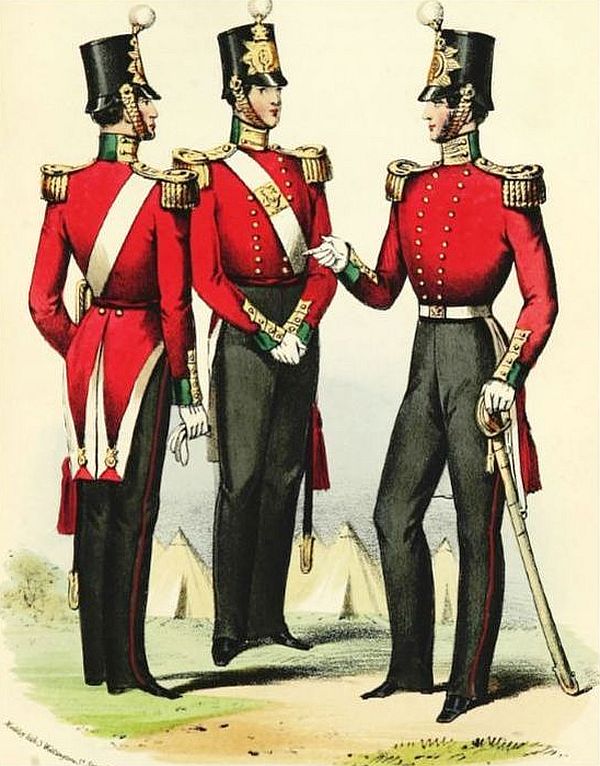
THIRTY-NINTH REGIMENT. For Cannon’s Military Records