HISTORICAL RECORD (continued 2)
Reading edition
1818 1819
The regiment remained at the islands of Guernsey and Alderney during the two following years. In October, 1818, the establishment was reduced to seven hundred and forty-six officers and soldiers. In May and June, 1819, the regiment embarked by detachments for Portsmouth.
On quitting Guernsey, the following letter was received, dated 4th May, 1819:—
‘Sir,
‘The Royal Court of this island have desired me, as their president, to express the high regard which they in common with its inhabitants entertain for the officers of His Majesty’s Thirteenth regiment of foot; as well as their approbation and admiration of the general good conduct of the men of that corps, while quartered among us; and I feel much pleasure, in being thus enabled to assure you, Sir, that from all classes I have heard no other sentiments but those of regret, at the approaching departure of the Thirteenth regiment, which under your command, and that of Lieut.-Col. Sir William Williams, has shown itself throughout so orderly, and worthy of the esteem of this and the neighbouring islands; and the officers in particular, by their gentlemanly and social manners, have so thoroughly gained the good will of those who had the pleasure of their acquaintance, that one and all unite in the best wishes for the happiness and prosperity of the whole corps, in which none is more sincere than he who has the honour to be,
‘Sir, yours, &c., ‘Peter De Havilland, ‘Bailiff of Guernsey.’
In acknowledging the receipt of this letter, Lieut.-Colonel R. B. Hancock, stated,—‘It will, no doubt, be extremely gratifying to Sir William Williams, as it is to all ranks of the regiment now here, to find that their conduct has been thought deserving of so great an honour. Penetrated by the repeated proofs of esteem and affection, which they have received from the inhabitants of Guernsey, the officers request me to offer their sincere wishes for the general prosperity of the island, and for the individual happiness and welfare of those friends to whose polite and marked attention they are so deeply indebted.’
In September the regiment embarked for Scotland, and landing at Leith, proceeded from thence to Stirling castle, with detachments to Dumbarton castle, Paisley, Callender, and Buchlivie.
1820
The regiment marched to Edinburgh castle in September, 1820: towards the end of October it proceeded to Port Patrick, where it embarked for Ireland, landing at Donaghadee, marched from thence to Dublin, with detachments to Stranorlane, Carndonagh, Greencastle, Buncrana, Rethinilton, and Letterkenny.
1821
After occupying these stations ten months, the regiment called in its detachments, and marched to Richmond barracks, Dublin, where it arrived on the 21st of September, 1821.
1822
From Dublin the regiment embarked, on the 18th of July, 1822, for England, and two days after landing at Liverpool, orders were received from the Horse Guards for the regiment to embark for Greenock, proceed from thence to Edinburgh, and do duty there during the visit of His Majesty King George IV. to that city.
The regiment arrived at Edinburgh on the 31st of July and 1st of August: it had the honour of mounting guard over the royal person, when the King visited that city, and Captain Ellard, who commanded the guard of honor assembled to receive His Majesty on landing, obtained the brevet rank of major.
After His Majesty’s departure, the regiment embarked for Chatham, where it arrived on the 21st, 23rd, and 24th of September.
The regiment having been selected to proceed to India, made preparations for transferring its services to that part of the British dominions. Previous to embarking, it was constituted a corps of Light Infantry, to take date as such from the 25th of December, 1822; and the usual augmentation was made to its numbers.
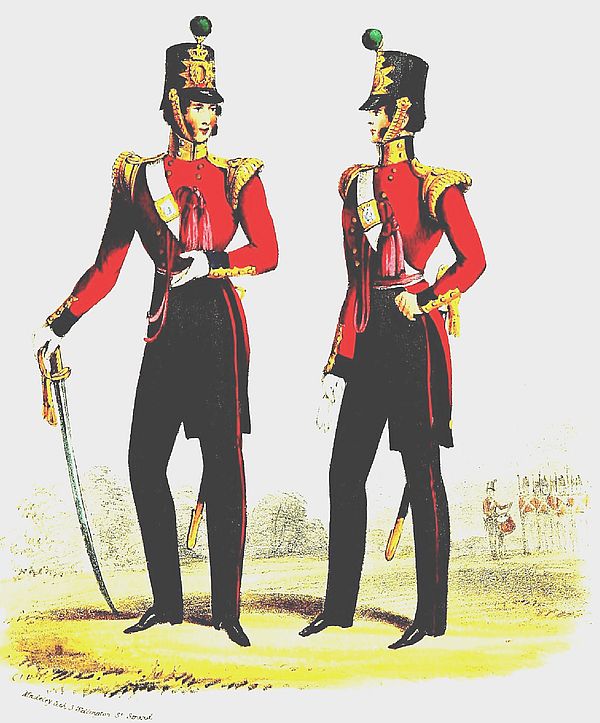
THIRTEENTH, PRINCE ALBERT’S REGIMENT OF LIGHT INFANTRY.
1823
On the 1st and 3rd of January, 1823, the regiment embarked on board the ‘General Kydd’ and ‘Kent’ Indiamen, under Lieut.-Col. M‘Creagh and Major Robert H. Sale, and landed in May at Calcutta, where it received six hundred and twenty volunteers from corps about to return to England.
1824
Soon after the arrival of the regiment in India, the tranquillity of the eastern dominions of Great Britain was interrupted by the sovereign of Ava, who governed a numerous nation of Burmans, inhabiting an extensive territory, lying in one direction, between the Chinese dominions and Bengal. For many years the Burmese officers, in the country contiguous to the British territory, had been guilty of acts of encroachment and aggression, which at length became of so outrageous a character, as to render it necessary to call upon the court of Ava for an explanation. No answer was given; but after overcoming several petty tribes by which his kingdom was surrounded, the King of Ava made preparations for invading the British territory. Troops were assembled to penetrate the Burman empire, and to put an end to these acts of aggression, and an armament was prepared at Port Cornwallis, under the command of Brigadier-General Sir Archibald Campbell and Commodore Grant, for the capture of Rangoon, a city, and the principal part of the Burmese empire, situate on the north bank of the river Irawaddy, thirty miles from the sea. The Thirteenth light infantry embarked on this service, on the 5th of April, 1824; their commanding officer, Lieut.-Colonel M‘Creagh was appointed to the command of a brigade, with the rank of Brigadier-General, and the command of the regiment devolved on Major Sale. The fleet entered the Irawaddy on the 10th of May: the Burmese made a feeble attempt to defend the city, but their batteries were soon silenced, and the place was captured without the loss of a man; the inhabitants quitting their houses and seeking refuge in the thickly-wooded country.
Brigadier-General M‘Creagh was detached with three companies against the island of Cheduba, on the Arracan coast, where he landed on the 14th of May, captured the Burmese stockade by storm on the 17th, made the rajah, or governor, prisoner, and reduced this fertile and productive island to submission: in which service the Thirteenth had Brevet Major Thornhill, Ensign Kershaw, one serjeant, one bugler, and eighteen rank and file wounded.
The Burmese army continued in great force in the neighbourhood of Rangoon, under the protection of fortifications of wood, called stockades, and of the thick jungle which covered the face of the country.
On the 28th of May, a hundred rank and file of the Thirteenth regiment, commanded by Major William H. Dennie, with a detachment of the thirty-eighth, advanced, under Sir Archibald Campbell, and attacked two stockades by storm, without ladders, captured the works with the bayonet, and killed about five hundred of the enemy. The Thirteenth had Lieutenant A. Howard killed; one bugler, and nine rank and file wounded.
When driven from one series of stockades, the Burmese erected another at a greater distance. On the 10th of June, two companies of the Thirteenth, under Major Robert Henry Sale, advanced with other troops, to attack the enemy’s stronghold at Kemmendine; when about two miles from the town, the head of the column was stopped by a strong stockade, full of men, against which the British artillery opened a well-directed fire, and in half an hour a breach was made. The forty-first, and part of the Madras European regiment, stormed the works in front; and the detachments of the Thirteenth and thirty-eighth assaulted the rear face which was ten feet high. The soldiers being encouraged and animated by the spirited conduct of Major Sale, who showed an example of valour and personal agility, climbed the works, one helping another up, and entering simultaneously with the party by the breach, they bayoneted every man that opposed them. The loss of the Thirteenth was limited to one private soldier killed; Lieutenant Petry, and ten soldiers wounded.[12]
This point being gained, the column advanced about a mile, and at four o’clock in the afternoon, took up a position against the enemy’s principal stockade; batteries were erected during the night, the artillery opened a heavy fire at daylight, and the Burmese forsook their works and fled.
On the 17th of June, Brigadier-General M‘Creagh joined with the three companies from the island of Cheduba.
In the beginning of July numerous columns of Burmese warriors were seen in front of the British position, when four companies were ordered to make a reconnoissance under the command of Major Dennie: they discovered the enemy in force on the plains of Kumaroot, and returned with the loss of one man wounded. On the same day, the Burmese attacked the British posts, but were repulsed: the Thirteenth had two men wounded.
The Burmese position in the rear of the great pagoda was attacked on the 5th of July, when the regiment had one private soldier killed; Lieutenant Knox Barrett, one serjeant, and sixteen rank and file wounded.
A general attack was made on the 8th of July, and three hundred men of the Thirteenth, under Brigadier-General M‘Creagh, formed part of the force detached, under Brigadier-General M‘Bean, to storm the enemy’s works. The attack was led by Major Sale, at the head of the soldiers of the Thirteenth regiment, with heroic gallantry, and seven stockades were carried in rapid succession. Major Sale encountered the Burmese commander-in-chief in the works, and slew him in single combat, taking from him a valuable gold-hilted sword and scabbard. Three other stockades were captured by other portions of the armament; and the men, under Brigadier-General M‘Bean, fell in with a number of Burmese flying from a stockade attacked by the shipping, of whom they bayoneted a great number. Eight hundred Burmese were killed on this occasion, and thirty-eight pieces of artillery, forty swivels, and three hundred muskets were captured.[13]
Two serjeants of the Thirteenth were killed; Captain Johnson, two corporals, and five private soldiers were wounded.
The terror of these attacks caused the Burmese troops to remove to a greater distance; and the difficult character of the country, rainy weather, inundations, and the necessity for procuring a large supply of provisions before the army advanced, detained the British some time in the neighbourhood of Rangoon.
Meanwhile the Burmese recovered from the consternation into which they had been thrown, and a veteran chief, named Maha Bandoola, was appointed commander of the army of Ava. This chief approached the British position on the 1st of December, with upwards of fifty thousand foot, a body of Cassay horse, and three hundred pieces of artillery, and commenced forming entrenchments. The British beheld the legions of Ava, ten times more numerous than themselves, without dismay; and the left of the Burmese line presenting a favourable opportunity for an attack, Major Sale advanced with two hundred of the Thirteenth Light Infantry, under Major Dennie, and two hundred and fifty of the eighteenth Native Infantry, under Captain Ross, and stormed the entrenchments with distinguished gallantry, in sight of the whole army. The soldiers of the Thirteenth led the charge with great intrepidity; they burst through the entrenchments, overthrew all opposition, and spread terror and dismay on the enemy’s flank. The native infantry followed the example; the Burmese fled, and the victorious British soldiers returned to their posts laden with trophies.[14]
The Thirteenth foot had Lieutenant O’Shea, one serjeant, and three rank and file killed; Captain Clark died of his wounds: Ensigns Blackwall and Croker, one serjeant, and twenty rank and file wounded.
This victory was followed by a decisive triumph over the left wing of the Burmese army, on the 5th of December, on which occasion two hundred and forty-five rank and file of the Thirteenth, under Major Dennie, formed part of the first column of attack, under Major Sale, which penetrated the enemy’s lines, and routed the legions of Ava with a facility which proved the superior prowess of British soldiers. The first advantage was followed up, the powerful army of the enemy was overthrown, and of the three hundred pieces of ordnance which the enemy had in position, two hundred and forty were brought into the British camp.[15] The loss of the regiment was six rank and file wounded.
Anxious to retrieve his disgrace, the Burmese commander rallied his broken legions, called reinforcements to his aid, and took up another position, which he fortified with great labour and art. These formidable works were attacked on the 15th of December, when two hundred of the Thirteenth, under Major Sale, formed part of the column of attack under Brigadier-General Cotton, which made a detour round the enemy’s left to gain the rear of his position at Kokien, which was to be attacked in front by another column. On arriving in front of the position it presented a very formidable appearance; but the English general knew from experience the character of the troops he commanded, and he gave the signal for the attack, when the soldiers rushed forward with the most determined and enthusiastic bravery, and in less than fifteen minutes they were in full possession of these stupendous works. The Thirteenth met with very determined resistance; their commanding officer, Major Sale, received a severe wound in the head; he was succeeded by Major Dennie, who was wounded in the hand, but who continued at the head of the regiment until the action was over. The Burmese only resisted a short time, and then fled in a panic, leaving their camp standing, all their baggage, and a great portion of their arms and ammunition behind them.
Lieutenants Darby, Petry, and Jones, two serjeants, and seven rank and file, of the Thirteenth, were killed; Majors Sale[16] and Dennie, Captains Thornhill (Brevet Major) and James M‘Pherson, Lieutenants M. Fenton and Pattisson, Ensigns Wilkinson and Blackwell, two serjeants, and forty rank and file wounded.
1825
These splendid successes, connected with the services of the royal navy, had produced important results; the maritime provinces of Mergui, Tavoy, Yeb, and Martuban, had been captured, and seven hundred pieces of artillery had been taken from the Burmese. To wrest additional territory from the court of Ava, the Thirteenth regiment was detached, under Major Dennie, with other troops, the whole under Major Sale, against the city of Bassein, in the south-west part of the ancient kingdom of Pegu, which constituted part of the Burmese empire. The regiment embarked on this service on the 10th of February, and after a tedious passage arrived, on the evening of the 14th, off Pagoda Point, Great Negrais. On the 26th the expedition entered the river, and the Thirteenth, thirty-eighth, and twelfth Native Infantry landed and captured a stockade. The troops afterwards re-embarked, and proceeded to the next stockade, which the Burmese abandoned as the soldiers went on shore to storm the works; and so great was the consternation of the enemy, that the city of Bassein was set on fire and abandoned. The expedition anchored opposite the smoking ruins on the 3rd of March, when the troops landed and took post in the area of the principal pagoda: many private houses were not destroyed, and the inhabitants were induced to return to their homes. On the 13th of March, Major Dennie made a reconnoissance up the Bassein river; he was afterwards joined by another party under Major Sale, and the whole proceeded one hundred and twenty miles up the river, to Lanrince, and returned to Bassein on the 23rd, having had two men wounded.
No resistance being met with in the province of Bassein, the Thirteenth regiment embarked for Rangoon, where it arrived on the 2nd of May; meanwhile the army under Lieut.-General Sir Archibald Campbell had advanced up the country, and had captured several strong towns.
On the 8th of August, the regiment embarked from Rangoon, to join the army at Prome, where it arrived in boats on the 25th. Soon afterwards overtures of peace were made by the Burmese, but hostilities were resumed in the middle of November; and the army of Ava having repulsed the attack of three bodies of sepoys, became suddenly elevated with a high idea of its own power, and advanced to envelop the British troops at Prome.
About sixty thousand Burmese environed six thousand British and native Indian troops; but undismayed by this formidable host, the English general left four native regiments for the defence of Prome, and advanced, on the 1st of December, to attack the enemy’s left wing at Simbike. This post was stormed by the troops under Brigadier-General Cotton,[17] and the works were carried, in gallant style, in ten minutes. The Thirteenth were engaged in the operation, but did not take part in the assault.
After a harassing march of about twenty miles, the troops bivouacked at Ze-ouke, and at daylight on the following morning (2nd December) they were again in motion, to attack the formidable position occupied by the enemy’s centre division on the Napadee Hills. Arriving in the vicinity of the position, the British artillery commenced a sharp cannonade; Brigadier-General Elrington’s troops drove the enemy from the jungle, six companies of the eighty-seventh regiment carried the posts at the bottom of the ridge, and the Burmese were driven from the valley to their principal works on the hills, which appeared very formidable; the heights could only be ascended by a narrow road, commanded by artillery, and defended by stockades crowded with men armed with muskets. As soon as the artillery had made an impression on the works, the Thirteenth and thirty-eighth regiments sprang forward with astonishing resolution and steadiness, rushed into the enemy’s works, overthrowing all opposition with the bayonet, and driving the Burmese from hill to hill, over precipices that could only be ascended by a narrow stair, until the whole of the position, nearly three miles in length, was captured. Lieut.-Colonel Sale and Major Thornhill, of the Thirteenth regiment, distinguished themselves.
On the 5th of December, the enemy’s right wing was driven from its post; the immense army of Ava was thus forced from its positions by the fierce attacks of the British soldiers; and the Burmese legions sought safety in flight.
After this success, the army continued to advance; the Burmese evacuated Meeday, and took post at Melloon, at the same time they renewed their offers for terminating the war; but this appears to have been done with the view of gaining time to re-organize their army for a more determined resistance.
1826
The conditions of peace not being ratified by the stipulated time, hostilities were resumed on the 19th of January, 1826, on which day the Thirteenth and thirty-eighth regiments embarked in boats under Lieut.-Colonel Sale, to assault the main face of the enemy’s fortifications at Melloon; at the same time other corps embarked to storm the works at different points. The whole of the boats quitted the shore together; but the current and breeze carried the Thirteenth and thirty-eighth to their point of attack, before the other divisions could reach the opposite bank of the river, and Lieut.-Colonel Sale was wounded in his boat; but the two regiments landed, formed under the command of Major Frith of the thirty-eighth, and rushed forward with such intrepidity and resolution, that they overpowered all resistance, and were speedily masters of these formidable works.[18] Major Frith was wounded in the assault, and the command of the brigade devolved on Major Thornhill, of the Thirteenth regiment, who distinguished himself.
The loss of the regiment was one man killed; Major Sale and three men wounded.
The army advanced upon the capital of the Burmese empire, and the legions of Ava resolved once more to try their fortune in battle; they met the British in the open fields near Pagahm Mew, where an action took place on the 9th of February. The Thirteenth led the right attack in their usual gallant style, the Burmese troops soon gave way before the superior prowess of the British soldiers, and another victory was gained. The regiment had one soldier killed; Captain Tronson and six soldiers wounded.
After this victory, the army continued its advance upon Ummerapoora, the capital, situated upon the shores of a romantic lake; and when within four days march of that city, the King of Ava sent the ratified treaty, paying the expenses of the war and giving up a considerable portion of territory.
On the conclusion of this splendid undertaking, the following statement appeared in orders:—‘While the Governor General in Council enumerates, with sentiments of unfeigned admiration, the achievements of the first, or royals, the 13th, 38th, 41st, 45th, 47th, 87th, and 89th regiments, the Honorable Company’s Madras European regiment, and the Bengal and Madras European artillery, as the European troops which have had the honour of establishing the renown of the British arms in a new and distant region, His Lordship in Council feels that higher and more justly-merited praise cannot be bestowed on those brave troops than that, amidst the barbarous hosts with which they have fought and conquered, they have eminently displayed the virtues, and sustained the character of the British Soldier.’
Lieut.-Colonel Sale, and Majors Dennie and Thornhill, were rewarded with the honour of being constituted Companions of the Bath: and the word “Ava,” on the colours of the regiment, commemorates its gallantry during these campaigns.
The regiment embarked in boats, from Yandaboo, on the 7th of March, arrived at Rangoon on the 22nd, proceeded on board of transports on the 23rd, and arrived at Calcutta in the middle of April.
After remaining a few days at Calcutta, the regiment embarked by divisions for Berhampore, where it was stationed several months.
1827
On the 15th of November, the regiment commenced its march from Berhampore, for Dinapore, where it arrived on the 3rd of January, 1827.
1831 1832
The regiment remained at Dinapore nearly five years, and towards the end of 1831, commenced its march for Agra, a city situate on the river Jumnah, the capital of a province of the same name, where it arrived in January, 1832.
1835 1836
At the city of Agra, which exhibits numerous marks of its ancient greatness, the regiment was stationed four years. From Agra the regiment marched, in December, 1835, for Kurnaul, where it arrived in January, 1836.
1837
Early in the year 1837, the regiment furnished a detachment, under the command of Captain N. Chadwick, to accompany the commander-in-chief, General Sir Henry Fane, G.C.B, on a visit to the ruler of the Sikhs, Maharajah Runjeet Singh, at Lahore, the capital of his dominions. After a journey of several weeks, General Sir Henry Fane arrived at Lahore on the 10th of March, and was greeted at the court of the ruler of the Sikhs by a gorgeous display of oriental magnificence, for which Asiatic potentates have been celebrated. The British troops which accompanied the commander-in-chief, were reviewed, on the 17th of March, by the Maharajah, who expressed great admiration of their appearance and discipline, and in a general order published immediately after the review, it was stated,
‘The Commander-in-Chief has much pleasure in communicating to the officers, non-commissioned officers, and soldiers of the escort, that their appearance and steadiness under arms, this morning, met with much approbation, and their performance of the various movements will leave in the Punjaub a very favourable impression of their discipline.’
Very valuable presents were made to the officers of the escort, and the Maharajah also gave eleven thousand rupees (1100l.) to be distributed among the non-commissioned officers and soldiers.
The Commander-in-Chief remained seven weeks at the capital of the ruler of the Sikhs, and afterwards commenced his journey back to the British dominions, and the officers and soldiers of the Thirteenth Light Infantry rejoined the regiment at Kurnaul.
1838
Events occurred in the years 1837 and 1838, which appeared to render a temporary departure from those pacific councils, which have marked the British policy in India, necessary, and which occasioned the Thirteenth Light Infantry to take the field, under the following circumstances. Shah Shoojah-ool-Moolk had been driven from the throne of Affghanistan, and his kingdom divided among several chiefs. A Persian army besieged Herat, on the frontiers of Affghanistan, and the court of Persia claimed an extensive portion of that kingdom, which lying between India and Persia appeared to menace the safety of the British dominions in the East Indies. These circumstances, and the unprovoked attack made on an ancient British ally, Runjeet Singh, by Dost Mahomed Khan, who relied on Persian encouragement and assistance, were followed by the conclusion of a tripartite treaty, between the British, Runjeet Singh, and Shah Shoojah, for the purpose of effecting the restoration of the dethroned monarch of Affghanistan, and a British force was assembled to achieve this important change in the aspect of affairs beyond the river Indus; this force was called the “Army of the Indus,” and the Thirteenth Light Infantry having been selected to take part in this enterprise, left Kurnaul in November, and proceeded to the rendezvous of the army at Ferozepore, where they arrived before the end of the month. They encamped within four miles of the Gharra, beyond which river the crimson tents and pavilions of the army of the Punjaub, designed to co-operate in the enterprise, presented a splendid and imposing appearance. The ruler of the Sikhs was with his forces; the governor general arrived at the camp, and grand interviews, entertainments, and reviews, took place, which were conducted with great magnificence. In the meantime the Persians had raised the siege of Herat, and the strength of the army was, in consequence thereof, reduced.
From the gala scenes on the banks of the Gharra the troops were called to the more arduous duties of the field, and they advanced upon the capital of the Daoodpootra state; the country was open, the roads good, the air clear and healthful, the river contiguous, and this pleasant march was completed before the end of December, 1838, when the army pitched its tents at the city of Bhawalpore.[19]
1839
After a short halt, the Thirteenth resumed their march in the beginning of January, 1839, and after passing the boundary of Bhawul Khan, they entered the territory of the Khyrpore Ameer, where the inhabitants evinced a disposition bordering on hostility, and withheld aid of every kind. Towards the end of January they arrived at Roree, and beheld the river Indus, which they were about to pass, upwards of half a mile broad, with its banks clothed with groves of date trees covering hills, which presented a striking contrast to the plains near them, green with corn and tamarisk bushes. After some delay, the fortress of Bakkur was delivered up to the British, as a place of arms during the war in Affghanistan.
The troops from Bombay having met with some interruption in their advance through Lower Scinde, part of the Bengal force, including the Thirteenth, quitted the Indus, to menace the city of Hyderabad; but returned to Roree in the middle of February, in consequence of the submission of the rulers of Lower Scinde. A bridge of boats had, in the meantime, been placed across the great river Indus, and the Thirteenth Light Infantry crossed this celebrated stream, to traverse regions which a British army had never before penetrated, but which are interesting from their association with ancient history, being the scene of the operations, and reverses of Alexander the Great, upwards of two thousand years since: after a march of four days they arrived at Shikarpore, when the difficulties of the enterprise began to assume a formidable character.
Advancing from Shikarpore the regiment proceeded through a desert country to Usted, and afterwards continued its route through the arid plains of Beloochistan, occasionally suffering inconvenience from the want of water, and from the predatory habits of the Beloochees, and arrived in the middle of March, at Dadur, situated a few miles from the Bolan Pass.
From Dadur the regiment continued its route; and penetrating the Bolan Pass, marched between mountains covered with snow: in some places the pass was not more than seventeen yards wide, with gloomy crags rising perpendicularly in awful grandeur on each side. In these wild regions bands of Beloochees lurked to avail themselves of every opportunity to follow their predatory habits, and they murdered several camp followers, and plundered some baggage. Issuing from this gloomy defile of more than fifty miles in length, the regiment entered the Dusht-i be-doulut, or the unhappy-desert, and halted a short time at Quettah, situated in the centre of the valley of Shawl, of which it is the capital. Supplies of provisions could not be procured for the army in these sterile regions; the issue of grain for the horses ceased, the soldiers were placed upon half rations, the native followers upon quarter, and several men, who were searching for forage at a distance from the camp, were murdered by the ferocious natives, who hovered round the army to avail themselves of every opportunity of destroying small parties.
The soldiers bore all the hardships to which they were subjected with fortitude, and in the early part of April the army commenced its march through the vale of Shawl; it descended the picturesque height of Kotul full one thousand feet, into the valley of Koochlak; forded rivers; traversed a difficult country spangled with flowers of every hue, and passed the height of Kozak, where the soldiers had to drag the artillery over the precipice with ropes. The army, surmounting every obstacle with patient perseverance, continued to press forward; the rulers of western Affghanistan were struck with dismay at the appearance of the formidable British host, and they fled from the capital, leaving the country to the Sovereign whom the British were advancing to restore. As the army continued its march, various classes of individuals tendered their submission, and on the 27th of April the British troops arrived at Candahar, the capital of western Affghanistan, where the soldiers obtained provisions and repose. The tents were pitched in the grassy meadows, among enclosures covered with crops of grain. The watery exhalations from the low grounds proved injurious to the health of the men, and the great heat experienced in the tents, with a saline impregnation in the water, augmented the number of the sick.
Breaking up from Candahar on the 27th of June, to reduce the remainder of the Shah’s dominions to obedience to his authority, the army advanced along a valley of dismal sterility to the Turnuk river; then proceeding up the right bank, traversed the country of the Western Ghilzees, and arrived in the vicinity of Ghuznee, a strong fortress garrisoned by three thousand Affghans under Prince Mahomed Hyder Khan, who were well provided with stores, and had determined on a desperate defence: they had blocked up every gate by masonry excepting one.
The army having arrived before Ghuznee without a battering train of sufficient power to proceed by the regular method of breaching the walls, &c., the commander of the forces, Lieut.-General Sir John Keane, resolved to storm the place without delay. On the 21st July, a company of the Thirteenth under Captain Sutherland accompanied Captain Thomson, Bengal Engineers (Chief Engineer) on his reconnoitre, and had one man killed, and two wounded. During the night of the 22nd of July a quantity of gunpowder was brought secretly to the gate which was not blocked up by masonry, and which was destroyed by an explosion before daylight on the following morning.
To the Thirteenth was assigned the duty of covering the operations, in blowing open the gate, and they paraded at two o’clock, A.M. The regiment proceeded in advance of the storming party to the causeway of the gate, under cover of the darkness of the night, and the fire of the batteries of the assailants. Six men of the leading company were told off to assist in carrying the powder bags. On reaching the causeway, the Thirteenth extended in light order, along the ditch, and by their fire distracted the enemy’s attention from the gate. After the explosion a company of the regiment, under Lieutenant Jennings, moved up with the Engineer Officer to ascertain if the operation had been attended with success; on which the light company of Her Majesty’s Second regiment of foot, No. 9 company of the Thirteenth under Captain Vigors,—the light companies of Her Majesty’s seventeenth and of the Bengal European Regiment, which had been named to form the advance of the storming column, immediately pressed forward under the command of Brigadier Dennie of the Thirteenth, and under a heavy fire, gallantly gained an entrance into the fort. These were quickly followed by the main storming column under Brigadier Sale (who was severely wounded on this occasion), of which the Thirteenth formed part, having been ordered to close on the advance of the four companies; and the whole were soon established in possession of the fort.
The Thirteenth and seventeenth regiments were directed against the citadel, which was found evacuated by the enemy. Large supplies of grain, ammunition of all kinds, and several guns and military weapons, with about two thousand horses, fell into the hands of the victors. A company of the regiment under Lieutenant Arthur Wilkinson succeeded in capturing the redoubt (or outwork), and took two standards and about sixty prisoners.
The distinguished conduct of Brigadier Sale was highly commended by the Commander in Chief Lieut.-General Sir John Keane; and Brigadier Dennie, Major Tronson, and Captain Kershaw were distinguished in the despatches. The regiment had one man killed, and three serjeants and twenty-seven rank and file wounded.
When the Affghan horsemen, who had assembled in the neighbourhood, learnt the fate of the fortress, they abandoned their camp equipage and baggage, and fled towards Cabool, the capital of eastern Affghanistan, in the direction of which city the British forces immediately advanced.
Dost Mahomed Khan, the ruler of the country, assembled a formidable host in position near Ughundee; but ascertaining that his soldiers had resolved to abandon him, he fled with a body of select cavalry, leaving his artillery in position; and the British army, advancing by triumphant marches to the capital, replaced Shah Shoojah-ool-Moolk in the possession of the palace of his forefathers, from which he had been an exile many years. The conquest of a kingdom was thus achieved, by British skill and enterprise, with trifling loss, and the army pitched its tents in a rich valley near the capital.
The services of the Thirteenth Light Infantry were afterwards rewarded with the royal authority to bear on their regimental colour the words “Affghanistan” and “Ghuznee.” A medal was given by the restored monarch to the officers and soldiers present at the storming of Ghuznee, which Her Majesty Queen Victoria authorized them to receive and wear. An order of merit was also instituted by the Shah, called the Order of the “Dooranée Empire,” the decorations of which were conferred on’ the general and field officers; and Her Majesty was graciously pleased to grant permission to Sir Robert Sale, of the Thirteenth, to accept and wear the insignia of the first class, and Brevet Major James Kershaw and Captain Hamlet Wade the insignia of the third class of the order. Colonel Robert Henry Sale, was promoted to the rank of Major-General in Affghanistan, and was appointed by Her Majesty to be a Knight Commander of the Most Honorable Military Order of the Bath; Major Edward T. Tronson was promoted to the rank of lieut.-colonel in the army, and Captain James Kershaw to that of major, for their services in this campaign; the promotions taking place from the 23rd July, 1839, the date of the capture of Ghuznee.
Names of the officers of the Thirteenth who received the Ghuznee Medal:—
Brigadier Robert Henry Sale. Major Edward Tronson.
—— William Dennie. —— Tristram Squire.
Captains.
George Fothergill. John Taylor.
William Sutherland. Horatio Vigors.
James Kershaw. Henry Havelock.
Robert Pattisson.
Lieutenants.
Arthur Wilkinson. Rollo Burslem.
James Fenwick. John Wood.
John Foulston. Frederick Holder.
Peter Jennings. William Sinclair.
Philip Von Streng. Hon. Emilius Forester.
Alexander Holcombe. Thomas Oxley.
George King. David Rattray.
Ensigns.
Edward King. Richard Frere.
George Mein. George Wade.
Paymaster Harry Carew.—Adjutant Hamlet Wade.
Assistant Surgeons J. Robertson, M.D. and G. Barnes, M.D.
A complete change had been achieved in the aspect of affairs beyond the Indus; the chiefs of Cabool and Candahar, who had entertained hostile designs against the British interest, had been deprived of power, and the territories they ruled had been restored to a friendly monarch. These splendid results accomplished, part of the army was withdrawn from the country; but the Thirteenth Light Infantry were selected to remain in Affghanistan, to support the government of the restored Shah, against the machinations of the chiefs who had usurped his authority during his exile.
The regiment was encamped near Cabool until November, when it marched into garrison at the Bala Hissar, or citadel of Cabool, in which stands the palace, with the thirty-fifth native infantry, and a detail of artillery, and remained there during the winter, which was an unusually severe season. Brigadier Dennie commanded the garrison, and Lieutenant Hamlet C. Wade, who had been selected by Lieut.-General Lord Keane to serve on the general staff of the army, was appointed major of brigade to this force.
1840
In May, the regiment moved into camp much reduced in numbers, having suffered very severely from disease. On the 24th September it was again called upon to take the field, having been attached to the force, under Sir Robert Sale, directed against Dost Mahomed in the Kohistan of Cabool; and it marched that day.
On the 29th September, the regiment under Lieut.-Colonel Tronson assisted in carrying the town and forts of Tootumdurra, at the entrance of the Ghorebund Pass, occupied by Ali Khan, a refractory chief of the Kohistan. The loss of the Thirteenth was limited to two privates wounded; one mortally.
On the 3rd October, the regiment was again engaged with the enemy at Julgar, about sixteen miles from Charekar, and although the attack of the storming party on the fort was not successful, yet Lieut.-Colonel Tronson, commanding the storming party, and Brevet Major Kershaw, Lieutenant and Adjutant Wood, Lieutenants Edward King, and George Wade (the four latter officers having at one time attained the crest of the breach) highly distinguished themselves, and were particularly mentioned by Major-General Sir Robert Sale in his despatch, who also acknowledged the assistance he received from his major of brigade, Captain Hamlet Wade. The scaling-ladders, hastily constructed from the poles used in carrying the litters for the sick, were of little use; no sooner did the soldiers attempt to ascend them, than they sank into the soft débris on which they were planted: under these circumstances the storming party retired, leaving the Serjeant-Major of the Regiment (Airey) and fourteen men lying dead under the walls. Serjeant Hurst, of the Thirteenth, unable to move from his wounds, was carried off by Lieutenant King; and a Sepoy was, in like manner, conveyed to the rear by private Thomas Robinson of the regiment, under a most terrific fire. Lieutenant and Adjutant Wood, three serjeants, two corporals, and twelve privates were wounded.
It was subsequently determined to renew the attack, when it might be made by a combined movement against the breach, gateway, and wicket, with better chances of success, but the enemy, however, notwithstanding the precautions taken to intercept them, succeeded in escaping from the fort before seven o’clock P.M., at which hour the British took possession of it, and measures were taken for its destruction.
The Thirteenth came again in contact with the enemy on the 19th October at Babookooshghur, when they were attacked in camp at night, but experienced little loss. On the 2nd November, the regiment was engaged with the Affghans at Purwan, where they had taken up a strong position under Dost Mahomed, who however retired from the field, and delivered himself up to the authorities at Cabool, when the purposes for which the force commenced operations being effected, it was directed to return to Cabool, and the Thirteenth took possession of the new cantonments there on the 8th November.
1841
After having been nearly three years on active service, the regiment was in expectation of commencing its march back to India, in October 1841; but at this period the government of Shah Shoojah became so unpopular, that the Affghans appeared determined to effect, by violence or circumvention, the expulsion of the British, by whose aid he had been reinstated in the sovereignty of Cabool.
A body of insurgents having possessed themselves of the Khoord Cabool pass, about ten miles from the capital, impeded the communication with India, when the first Lieut.-Colonel of the regiment, Major-General Sir Robert Sale, K.C.B., was detached with a small force, of which the Thirteenth Light Infantry formed part, to expel the rebels and re-open the communication. The regiment left Cabool on the 11th of October; the pass was forced on the following morning, and the troops penetrated to Khoord Cabool.[20] The regiment had three men killed and twenty-four wounded on this occasion:—Major-General Sir Robert Sale, Captain H. C. Wade (Major of Brigade), Lieutenant George Mein, and Ensign Oakes were wounded. Lieutenant Mein being dangerously wounded, was obliged to be sent back in a litter to Cabool. Upon Sir Robert Sale being obliged to quit the field from the severity of his wound, the command of the troops devolved on Lieut.-Colonel Dennie, C.B. of the Thirteenth. The regiment then faced about, to return through the pass according to the plan for executing the operation, leaving the other corps at Khoord Cabool. Possession was then taken of Bootkhak, where the regiment was stationed from the 12th to the 18th of October. During this delay, the corps was much harassed by incessant night-attacks from the enemy, called by them Shub Khoon (Night Slaughter), which caused it some loss, but by Sir Robert Sale’s precaution in ordering the men to lie down on their alarm posts, as soon as the enemy’s fire was opened on the camp, much loss was prevented. The orders prohibiting any return-fire from the troops saved much, and all the attempts of the enemy to force an entrance into camp were successfully resisted by the bayonet alone. Meanwhile the rebellion continued of a formidable character, and the Thirteenth Light Infantry were ordered to march to Tezeen, where they arrived on the 22nd of October and were engaged with a body of insurgents, whom they drove from some heights and strong positions. The regiment on this duty had the misfortune to lose Lieutenant Edward King, who fell at the head of his company, while gallantly charging the enemy. Lieutenant R. E. Frere was wounded: the other casualties were three privates killed, and nine rank and file wounded.
In consequence of orders from Cabool, the force under Major-General Sir Robert Sale marched for Gundamuck, and were continually pressed day and night, by insurgent bands hovering on their flanks and rear, which occasioned the fatigues and duties of the troops to be particularly harassing; the way led along defiles and over mountains, and when the soldiers halted, breast-works had to be thrown up to defend the bivouac ground from sudden attacks of the Affghan cavalry.
On the 29th of October the rebels were found in force at the Jugdulluck Pass, and for some time they checked the advance of the column; but the skirmishers of the Thirteenth Light Infantry, sprang forward with distinguished gallantry, and driving the Affghans from almost inaccessible heights protected by breast-works, enabled the British force to surmount every obstacle in the defile, and to arrive at Gundamuck on the following day. Lieutenants P. R. Jennings, A. E. F. Holcombe, and David Rattray were severely wounded on this service; four privates were killed, and forty-two wounded. Lieut.-Colonel Dennie, Captains Wilkinson, Havelock, Wade, (Brigade-Major) and Fenwick, were specially mentioned by Major-General Sir Robert Sale in his despatch.
The troops under Major-General Sir Robert Sale remained at Gundamuck until the 5th November, when they proceeded and captured the fort of Mamoo Khail in the neighbourhood, and returned on the 6th to Gundamuck; there intelligence was received of the breaking out of a violent insurrection at Cabool, on the 2nd of November, and of the probability that the rebellion would become general. Under these circumstances, two forced marches on Jellalabad were made, with a numerous enemy pressing on the flanks and rear; a body of insurgents were beaten at Futtehabad by the rear-guard under Lieut-Colonel Dennie; and Jellalabad, the chief town in the valley of Ningrahar, was seized by the British troops on the 12th November, to establish a post upon which the corps at Cabool might retire, if necessary, and to restore a link in the chain of communication with India. The Affghan irregulars, left at Gundamuck, revolted, and a general rising took place among the tribes.
Major-General Sir Robert Sale, on taking possession of Jellalabad, found the fortress in a very dilapidated state, and the inhabitants disaffected to the government of the Shah. The Affghans collected to about ten thousand, and the walls of the fort being without parapets, and the garrison having only one day and a half supplies, on half rations, a sally was made on the 14th November, which routed the enemy, and enabled the troops to collect provisions, and erect works for the defence of the fortress. On this latter duty, the Thirteenth Light Infantry were conspicuous for the alacrity and indefatigable perseverance they evinced under circumstances of the most disheartening and trying character. The demolition of ruinous forts and old walls, filling up ravines, destroying gardens, cutting down groves, raising the parapets to six or seven feet high, repairing and widening the ramparts, extending the bastions, retrenching three of the gates, covering the fourth with an outwork, and excavating a ditch ten feet in depth and twelve in width round the whole of the walls, were works of great labour, which called forth the efforts of every individual. While thus employed another array of many thousands of Affghans on the 27th of November again invested the place, but they were completely routed and dispersed by a sally of the garrison on the 1st December.
1842
On the 9th of January, 1842, the garrison was summoned to give up the fortress, by the leader of the Affghan rebellion, in fulfilment of a convention entered into at Cabool; but Major-General Sir Robert Sale, being fully assured of the bad faith of the insurgents, refused; the annihilation of the troops from the capital, in the Ghilzie defiles, by the severity of the climate, and the basest treachery on the part of those in whose promises they had confided, proved the correctness of the major-general’s estimation of the Affghan character.
By the indefatigable exertions of the troops, under the direction of Captain Broadfoot, garrison engineer, and Captain Abbott, commissary of ordnance, the works were brought into a state of defence against any Asiatic enemy not provided with siege-artillery; but the place was kept in a continual state of alarm by the occurrence of one hundred shocks of an earthquake in the course of a month, and on the 19th of February a tremendous shock occasioned the parapets to fall, injured the bastions, made a breach in the rampart, destroyed the guard-houses, reduced other portions of the works to ruins, and demolished one-third part of the town. With that unconquerable spirit of perseverance for which the troops had already been distinguished, they instantly turned to the repair of the works. Sirdar Mahomed Akbar Khan, Barukzye, the assassin of the late Envoy, and the treacherous destroyer of the Cabool force, flushed with success, approached with a numerous body of troops to overwhelm the little garrison of Jellalabad: he attacked the foraging parties on the 21st and 22nd of February; but was astonished at finding the works in a state of defence, and he established a rigorous blockade. From that time to the 7th of April, the reduced garrison was engaged in a succession of skirmishes, in which the Thirteenth Light Infantry had opportunities of distinguishing themselves; particularly detachments under Captains Pattisson and Fenwick, Lieutenants George Wade and W. Cox.
On the 5th April, 1842, information was received that the force under Major-General Pollock had experienced reverses in the Khyber, and had retraced its steps towards Peshawur; and on the 6th a feu-de-joie and salute of artillery were fired by Mahomed Akbar, which were stated to be in honour of the event. It was also reported that the Affghans were sending reinforcements to assist in defending their frontier passes. These reports were accompanied by others of a fresh revolution at Cabool, which was considered by some as the cause of the rejoicing; and it was also rumoured that the Ghazees had been defeated in Khyber, and that the Sirdar had retreated into Lughman. Major-General Sir Robert Sale resolved to anticipate the last-mentioned event, by a general attack on the Affghan camp, with the hope of relieving Jellalabad from blockade, and facilitating General Pollock’s advance to its succour. Directions were accordingly given to form three columns of infantry, the central consisting of the Thirteenth (mustering five hundred bayonets) under Colonel Dennie, C.B.; the left consisting of a similar number of the thirty-fifth native infantry under Lieut.-Colonel Monteath, C.B.; and the right composed of one company of the Thirteenth, one of the thirty-fifth native infantry, and the detachment of Sappers under the command of Lieutenant Orr (the severity of Captain Broadfoot’s wound still rendering him non-effective), amounting to three hundred and sixty men, was commanded by Captain Havelock of the Thirteenth; these were to be supported by the fire of the guns of number 6 field battery under Captain Abbott, the whole of the small cavalry force being under Captain Oldfield and Lieutenant Mayne.
At daylight, on the morning of the 7th April, the troops issued from the Cabool and Peshawur gates. The Sirdar, Mahomed Akbar Khan, with his force of about six thousand men, was formed in order of battle for the defence of his camp; its right resting on a fort, and its left on the Cabool river; even the ruined works within eight hundred yards of the place, recently repaired, were filled with Ghilzie marksmen, who were evidently prepared for a stout resistance. The attack was led by the skirmishers and column under Captain Havelock, which drove the enemy in the most satisfactory manner from the extreme left of his advanced line of works, which it pierced at once, and proceeded to advance into the plain; the central column at the same time directed its efforts against a square fort, upon the same base, the defence of which was obstinately maintained. Colonel Dennie of the Thirteenth, while nobly leading his regiment to the assault, received a shot through his body, which, to the deep regret of officers and men, shortly after proved fatal.
The rear of the work having been finally gained by passing to its left, orders were given for a combined attack upon the enemy’s camp; this was brilliant and successful. The artillery advanced at the gallop, and directed a heavy fire upon the Affghan centre, while two columns of infantry penetrated his line near the same point, and the third forced back his left from its support on the river, into which some of his horse and foot were driven. The Affghans repeatedly attempted to check the advance by a smart fire of musketry,—by throwing forward heavy bodies of horse, which twice threatened in force the detachments of infantry under Captain Havelock, and by opening three guns, screened by a garden wall, which were said to have been served under the personal superintendence of the Sirdar; but in a short time the Affghans were dislodged from every point of their positions, their cannon taken, and their camp involved in a general conflagration.
The battle was over, and the enemy in full retreat in the direction of Lughman by about seven, A.M. Two cavalry standards were taken from the enemy, besides four guns lost by the Cabool army and Gundamuck forces, the recapture of which was a matter of much honest exultation. A great quantity of matériel and stores were, together with the enemy’s tents, destroyed, and the defeat of Mahomed Akbar, in open field, by the troops he had boasted of blockading, was complete.
The regiment had Colonel Dennie killed, and Lieutenant Jennings and Assistant-Surgeon Barnes wounded; eight privates killed, and thirty-one rank and file wounded.
Captain Wilkinson, of the Thirteenth, on whom the charge of one of the infantry columns devolved on the lamented fall of Colonel Dennie, and Captain Hamlet Wade (Brigade-Major), were highly commended in Major-General Sir Robert Sale’s despatch, in which it was also stated ‘that Lieutenant and Adjutant Wood, Her Majesty’s Thirteenth Light Infantry, made a dash at one of the enemy, and in cutting him down, his charger was so severely injured as to have been since destroyed. Captain Havelock reports in the most favourable manner the gallant conduct, throughout the day, of Lieutenant Cox, Her Majesty’s Thirteenth Light Infantry, and he was the first of the party which captured them to seize two of the enemy’s cannon.’
Armourer Serjeant Henry Ulyett, of the Thirteenth, captured Mahomed Akbar’s standard, which he took from a cavalry soldier, whom he killed.
The force employed in this successful enterprise amounted to about eighteen hundred men of all arms. The safety of the fortress was entrusted, during the action, to the ordinary guards of its gates, and one provisional battalion of followers of every description armed with pikes and other weapons, who manned the curtains, and made a respectable show of defence. Captain Pattisson, of the Thirteenth, was left in command of this diminished garrison. Towards the conclusion of the engagement a sally was made from the Cabool gate by Lieutenant George Wade, of the Thirteenth, into the fort before which Colonel Dennie had fallen, when it was observed that the enemy were abandoning it; all it contained was set on fire, and some of its defenders were bayoneted.
The enemy’s loss was very severe; the field of battle was strewed with the bodies of men and horses, and the richness of the trappings of some of the latter denoted that chiefs of rank (several being present and taking part in the action) had fallen.
The following Notification of this victory was issued by the Government of India from Benares on the 21st April, 1842:—
‘The Governor General feels assured that every subject of the British Government will peruse with the deepest interest and satisfaction the report he now communicates, of the entire defeat of the Affghan troops under Mahomed Akbar Khan, by the garrison of Jellalabad.
‘That Illustrious Garrison, which, by its constancy in enduring privation, and by its valour in action, has already obtained for itself the sympathy and respect of every true soldier, has now, sallying forth from its walls, under the command of its gallant leader, Major-General Sir Robert Sale, thoroughly beaten in open field an enemy of more than three times its numbers, taken the standards of their boasted cavalry, destroyed their camp, and recaptured four guns, which, under circumstances which can never again occur, had during the last winter fallen into their hands.
‘The Governor General cordially congratulates the army upon the return of victory to its ranks.
‘He is convinced that there, as in all former times, it will be found, while, as at Jellalabad, the European and native troops mutually supporting each other, and evincing equal discipline and valour, are led into action by officers in whom they justly confide.
‘The Governor General directs that the substance of this notification, and of Major-General Sir Robert Sale’s report, be carefully made known to all the troops, and that a salute of twenty-one guns be fired at every principal station of the army.’
On the 20th February following, the thanks of Parliament were accorded to the Governor General of India, and to the officers and troops employed in Affghanistan, the resolutions being moved in the House of Lords by the Duke of Wellington, and in the House of Commons by Sir Robert Peel, who, after eulogising the gallant conduct of Sir Robert Sale and the garrison of Jellalabad, proceeded to deplore the death of Colonel Dennie, in the victory of the 7th April, in the following terms:—
‘That victory would have been the cause of almost unqualified rejoicing if it had not been purchased at the cost of the life of one of the most noble and gallant spirits, whose actions have ever added brilliance to their country’s military renown. Need I mention the name of the lamented Colonel Dennie? With his accustomed valour,—a valour which was unquenchable,—he led the British troops against the enemy. The attack which he headed was successful, but he fell in the conflict; and a spirit as gallant as his own has offered to his family and his friends that which he thinks,—and justly thinks,—the highest consolation that can be afforded them. “True it is,” he says, “he has lost his life; but he lost his life on the field of battle, and in the hour of victory!” Such is the consolation which Sir Robert Sale offers to his bereaved family and friends. I wish it had been possible—but it was not—I wish it had been possible that the dying moments of Colonel Dennie could have been consoled, as I believe they would have been, by the knowledge that, on account of the former valour and intrepidity he had displayed,—he having no other interest or influence than that just interest and influence which such courage and devotion ought always to command,—the Queen of England had signified her personal wish that Colonel Dennie should be appointed one of her aides-de-camp. I sincerely wish that Colonel Dennie could have been made acquainted with this fact.’[21]
The defence of Jellalabad, situated amid scenery of wild and savage grandeur, against an undisciplined but desperate enemy, who used his rude implements of war with deadly precision, will ever excite the highest admiration, and the British nation owes a lasting debt of gratitude to Major-General Sir Robert Sale, and the gallant band of heroes composing the garrison. These successes, contrasting so forcibly with the unforeseen disasters at Cabool, which partook more of the character of a hideous dream than of stern reality, may well make the Thirteenth refer with honest pride to the part they bore in these achievements.
On the 16th June, 1842, the Queen was graciously pleased to appoint Colonel Sir Robert Henry Sale (serving with the rank of Major-General in Affghanistan) to be a Knight Grand Cross of the Most Honorable Military Order of the Bath.
Major Edward T. Tronson was promoted to the rank of Lieut.-Colonel, in succession to Lieut.-Colonel Dennie, and Captain Robert Pattisson was advanced to the Majority. Lieut.-Colonel Tronson retired on full pay on the 2nd August, 1842, and was succeeded by Major Squire, and Captain John Taylor was promoted to the vacant rank of Major.
In a few days after this victory, the privations and sufferings of the garrison, from incessant toil and the deficiency of provisions, were terminated by the arrival of the force under Major-General Pollock, who, in his despatch of the 19th April, 1842, stated that, ‘I have had an opportunity of inspecting the works thrown up for their protection by the indefatigable exertions of Sir Robert Sale’s force, and my surprise at their strength and extent has been only equalled by my admiration of the excellent arrangements which must have pervaded all departments, since, after a siege (by greatly superior numbers) of upwards of five months’ duration, I find the garrison in excellent health and spirits, and in an admirable state of discipline, with a good supply of ammunition, ready and anxious to take the field, and most willing to advance on Cabool.’
Major-General Sir Robert Sale’s report of the transactions in which the garrison of Jellalabad had been engaged, gives the following interesting particulars:—
‘From the time that the brigade threw itself into Jellalabad, the native troops have been on half, and the followers on quarter rations, and for many weeks they have been able to obtain little or nothing in the bazaars to eke out this scanty provision. I will not mention, as a privation, the European troops from the same period having been without their allowance of spirits, because I verily believe this circumstance and their constant employment have contributed to keep them in the highest health and the most remarkable state of discipline. Crime has been almost unknown amongst them, but they have felt severely, although they have never murmured, the diminution of their quantity of animal food, and the total want of ghee, flour, tea, coffee, and sugar: these may seem small matters to those who read of them at a distance, but they are serious reductions in the scale of comfort of the hard-working and fighting soldier in Asia. The troops have also been greatly in arrears of pay, besides their severe duties in heat and cold, wind and rain, on the guards of the gates and bastions. The troops, officers and men, British and Hindoostanee, of every arm, remained fully accoutred on their alarm posts every night from the 1st of March to the 7th April. The losses of officers and men, in carriage and cattle, camp equipage and baggage, between Cabool and Jellalabad were heavy; and their expenditure, during the siege and blockade, in obtaining articles of mere subsistence and necessity, has been exorbitant.
‘It is gratifying to me to forward the opinion of my second in command, Lieut.-Colonel Monteath, C.B., placed on record without solicitation, of the merits of the Thirteenth Light Infantry, of which corps I am proud of being a member. * * * I must express my gratitude to Providence for having placed so gallant and devoted a force under my command; in every way it has exceeded my most sanguine expectations, and I beg leave, in the strongest manner, to solicit the interposition of Major-General Pollock, C.B., who has nobly labored and fought to relieve it from its critical position in the midst of a hostile empire, in now committing it to the protection and favour of the Right Honorable the Governor General in Council, and through him to the Court of Directors, and of our Sovereign.’
Lieut.-Colonel Monteath stated in his report,—‘As doing but due justice on this occasion to Her Majesty’s Thirteenth Light Infantry might be looked upon as a highly-coloured record of the merits of your own regiment, and seeing that no such partial bias can possibly be supposed to guide my feelings in the estimate I have formed of their deserts, I have pleasure in sincerely declaring, that their conduct, throughout the painful and perilous position in which we have so long been placed, has been such as fully to deserve the applause and admiration of their country, and the confidence and best consideration of our well-beloved Sovereign.
‘On our throwing ourselves, on the 12th November last, into the old and ruined town of Jellalabad, without money, without food, and almost without protection, with a nation of highly excited and barbarous enemies in arms against us, our situation seemed as hopeless a one as British troops were ever called upon to confront; notwithstanding which, the enemy was twice attacked within twenty days, and on both occasions defeated with signal success.
‘You, yourself, will doubtless detail the works performed by the regiment; let it then be only my province, who have witnessed their exertions, almost hourly during a period of five months, to record, that their devoted perseverance and cheerfulness amidst all the gloom that surrounded them, after the destruction of their comrades of the Cabool force, could not have been surpassed by any troops in the world; and that after months of extreme toil, when an earthquake, such as man is not often in the habit of experiencing, in a moment left scarcely a vestige of their labour standing; their flying as they did with redoubled zeal to the work, and completing it in ten days, (so that on the arrival of the enemy before Jellalabad, they declared that the calamity which had befallen the valley arose from nothing but English witchcraft, it being the only place that had escaped uninjured) was what none but British soldiers could have performed, and what no price could have purchased, for it was the labour of the heart, work of all others most deserving of distinction and reward.’
The distinguished conduct of the regiment was appreciated, and Her Majesty thus alluded to it in her most gracious speech on proroguing Parliament on the 12th August, 1842:—‘Although I have had deeply to lament the reverses which have befallen a division of the army to the westward of the Indus, yet I have the satisfaction of reflecting that the gallant defence of the city of Jellalabad, crowned by a decisive victory in the field, has eminently proved the courage and discipline of the European and Native troops, and the skill and fortitude of their distinguished commander.’
On the 26th of August, the pleasure of Her Majesty the Queen Victoria, was officially announced in the London Gazette:—
‘War Office, 26th August, 1842.
‘In consideration of the distinguished gallantry displayed by the Thirteenth Light Infantry during the campaigns in the Burmese empire and in Affghanistan, Her Majesty has been graciously pleased to approve of that regiment assuming the title of the Thirteenth or Prince Albert’s Regiment of Light Infantry; and of its facings being changed from yellow to blue.
‘Her Majesty has also been pleased to authorize the Thirteenth Regiment of Light Infantry to bear on its colours and appointments a ‘Mural Crown,’ superscribed ‘Jellalabad,’ as a memorial of the fortitude, perseverance, and enterprise, evinced by that regiment, and the several corps which served during the blockade of Jellalabad.
‘Her Majesty has been likewise pleased to permit the Thirteenth regiment to receive and wear a silver medal, which has been directed by the Governor General of India to be distributed to every officer, non-commissioned officer, and private, European and Native,—who belonged to the garrison of Jellalabad on the 7th April, 1842;—such medals to bear on one side a ‘Mural Crown,’ superscribed ‘Jellalabad;’ and on the other side ‘April 7th, 1842.’’
The medal for Jellalabad was granted to the following officers of the Thirteenth:—
Lieutenant-Colonels. Major.
Colonel Sir Robert Sale, G.C.B. Robert Pattisson.
—— William H. Dennie, C.B.[22]
Captains.
Henry Havelock. James H. Fenwick.
Arthur P. S. Wilkinson. Peter R. Jennings.
Hamlet C. Wade.
Lieutenants.
Alex. E. F. Holcombe. John Wm. Cox.
George King. William Williams.
John S. Wood, (Adjutant.) Fred. Van Straubenzee.
Wm. A. Sinclair. Thos. B. Speedy.
Hon. E. J. W. Forester. J. Francis Scott.
David Rattray. G. Chetwynd Stapylton.
Richard E. Frere. Robt. S. Parker.
George Wade.
Ensigns.
Arthur Oakes. Geo. Talbot.
Surgeon, Jno. Robertson, M.D. Assist.-Surg. G. W. Barnes, M.D.
The regiment remained in garrison at Jellalabad until the 6th August, when it moved forwards to Futtehabad for change of air, having suffered severely from the extreme heat of the weather. So great was the heat, that six men fell dead in the ranks of apoplexy the first march. On the 1st of September, the Thirteenth received orders to join the force under Major-General Pollock at Gundamuck, to which place the regiment marched on the following morning, and joined on the 3rd. It remained there until the 7th, when it moved towards Cabool, forming part of the first division of the advance, which was placed under the command of Major-General Sir Robert Sale. On the 8th, upon nearing Jugdulluck, the Affghans were observed in position, and the Thirteenth under Captain Wilkinson were directed to carry the left centre of the enemy, which was done in gallant style. The enemy were dispersed in every direction, a large body of them retiring to the summit of a high mountain. On this rugged and almost inaccessible height they planted their standards, but as the achievements of the day would have been incomplete were they suffered to remain, it was decided to dislodge them. The lofty heights were assaulted in two columns, the Thirteenth being led by Captain Wilkinson, and the Ghilzies fled from their last and least assailable stronghold. Major-General Sir Robert Sale was again wounded. The other casualties of the regiment were one private killed and two serjeants and twelve privates wounded.
The Thirteenth bivouacked in the valley of Jugdulluck, which was strewn with the blackened remains of their unfortunate comrades of the Cabool force. Near this place Brevet Major Kershaw and Lieutenant Hobhouse of the Thirteenth were killed in January 1842, while retiring with the force from Cabool. The enemy showed no opposition to the advance of the army until nearing the valley of Tezeen, when some skirmishing took place, and the troops halted in the valley a day to allow the rear division of the advance to close up. The road from Tezeen to Khoord Cabool was through a succession of lofty hills, called the Huft Kotul, or Eight Hills. Dispositions for the attack of the Huft Kotul Pass having been made on the 12th of September, the force moved off on the following morning, and three companies of the Thirteenth formed part of the advance guard under Sir Robert Sale. To them was allotted the duty of clearing the right of the Pass, which was effectively done. A company under Lieutenant W. A. Sinclair, which formed part of the force placed under Major Skinner of the thirty-first regiment, and which was detached on the right of the pass, also distinguished itself.
The regiment lost one rank and file killed, and had five wounded. The enemy’s loss was heavy; he was completely defeated, and left his artillery in the possession of the victors. The army re-occupied Cabool on the 15th September, and on the 18th, part of the regiment received sudden orders to march with the force under Major-General Sir Robert Sale in order to meet the prisoners lately in possession of the enemy, then on their way to Cabool, it being supposed that Akbar Khan would attempt to re-capture them. On the morning of the 20th, the troops met the prisoners (Lady Sale and Lieutenant Mein[23] being among them), and on the 21st returned with them to Cabool, without being annoyed by the enemy. The regiment remained at Cabool until the 12th of October,[24] when the army broke ground on its return to India. The regiment shared in the many skirmishes on quitting the Affghan territory, but sustained little loss, and on the 24th, it reached Jellalabad; previously to proceeding further, it was considered advisable to destroy the fortress, and in a few days not a wall was left standing. On the south face of the fort was a large bastion, close to which was an open space which had been converted into a burial-ground; here the remains of Colonel Dennie, with many other gallant soldiers, were laid, and the Engineer Officer in mining the bastion, caused the whole mass to be thrown by the explosion over the graves, thus leaving a lasting monument over them, and what was of more importance, effectually preventing the bodies being disturbed by the Affghans. The regiment thence proceeded to Peshawur, and across the Punjaub en route to Ferozepore.
According to the wish of the Governor-General (Lord Ellenborough), the garrison of Jellalabad had received orders to proceed in advance of the rest of the troops, in order that they should make a triumphant entry into the British Provinces by themselves, and the medals granted for the defence of, and general action near, Jellalabad, had been forwarded a few days previously, so that they might be worn on the entry of the garrison into Ferozepore. On the 14th December, the Thirteenth arrived at the right bank of the Sutlej, where they halted until the 17th, when they crossed the river by a bridge of boats. At the opposite side was erected, for the garrison to pass under, a triumphal arch, where they were met by Lord Ellenborough; the distance from the river to the camp was about six miles, and for the first three miles a sort of street was formed for the garrison to pass through, by placing elephants decked in their gayest trappings at intervals of about twenty paces; the remainder of the road was lined by the army of reserve encamped at Ferozepore, who presented arms as the garrison passed, the bands playing the “National Anthem:” in the evening the officers of the garrison were entertained at a magnificent banquet given by the Governor General.
These honours were rendered, agreeably to the concluding paragraph of the General Order by the Right Honorable the Governor General of India, dated Allahabad, 30th of April, 1842, which stated that—
‘The Governor General will request His Excellency the Commander-in-Chief of the army to give instructions, in due time, that the several corps composing the garrison of Jellalabad may, on their return to India, be received at all the stations on their route to their cantonments, by all the troops at such stations, in review order, with presented arms.’
The regiment received the Queen’s permission to bear on its colours and appointments the word “Cabool, 1842,” to commemorate its important services. Major Pattisson was promoted to the brevet rank of Lieut.-Colonel; Captains Havelock, Wilkinson, Wade, and Fenwick were promoted to the brevet rank of Major, and, with the following officers, received the silver medal for Cabool:—
Colonel Sir Robert Sale, G.C.B.
Captains.
Major Henry Havelock. Captain Peter Jennings.
—— Arthur Wilkinson. —— Alex. Holcombe.
—— Hamlet Wade. —— George King.
—— James Fenwick.
Majors Havelock, Wilkinson, and Wade were subsequently appointed by Her Majesty Companions of the most Honorable Military Order of the Bath.
Lieutenants.
John S. Wood (adjutant). Fred. Van Straubenzee.
William A. Sinclair. Thomas B. Speedy.
Hon. Emilius J. Forrester. J. Fran. P. Scott.
David Rattray. Granville Geo. C. Stapylton.
Richard E. Frere. Robert S. Parker.
Geo. Wade. Arthur Oakes.
John W. Cox. George Talbot.
Surgeon, J. Robertson, M.D.—Asst.-Surgeon, Geo. Barnes, M.D.
1843.
On the 16th January, 1843, the regiment marched from Ferozepore, and arrived at Mowbarukpore on the 5th of February, where it remained encamped until the 9th of March, when it proceeded on its route to Kussowlie, at which station it remained until the 21st October. Fatigue parties were here daily employed for two hours in the cool of the morning or evening cutting and repairing roads, etc. On the 21st October, the regiment marched to Ferozepore en route to Scinde. On the 6th November, the regiment reached Loodianah, where percussion muskets were issued to it for the first time, and the old flint arms were given into store. It arrived at Ferozepore on the 15th November, embarked in boats for Sukkur, on the 24th, and reached its destination on the 20th December.
General Edward Morrison died on the 3rd December, 1843, and the vacant colonelcy of the Thirteenth was conferred on the 15th of that month on Sir Robert Sale; Major Horatio Nelson Vigors was promoted to the rank of Lieutenant-Colonel; and Captain R. M. Meredith succeeded to the Majority.
1844
On the 13th January, 1844, Lieut.-Colonel Squire joined with a draft of officers and men from England, and assumed the command of the regiment.
The Thirteenth moved from Sukkur, by wings, en route to Kurrachee during September, 1844; the left wing on the 4th and the head-quarter division on the 24th. The former arrived at Kurrachee on the 21st of September, and the latter on the 8th of October. The regiment suffered severely from sickness during the movement, owing to the malaria of Sukkur, having continually from two to three hundred in hospital daily. Preparatory to the regiment leaving Scinde, four hundred and forty-six of the men volunteered to corps serving in India. It embarked at Kurrachee for Bombay on board the Honorable East India Company’s steamers Pluto and Sesostris on the 4th of December, arrived in the harbour of Bombay on the night of the 7th, and disembarked in the afternoon of the 8th of that month, being received by the Governor and military authorities of Bombay; the guard of honor presenting arms as the regiment passed, and the band striking up “See the conquering hero comes.”—While the regiment was stationed at Bombay, it had the misfortune to lose Captain Sinclair, who had served throughout the campaign: he died of cholera after an illness of a few hours: the soldiers however continued generally healthy.
1845
The head-quarter division of the Thirteenth embarked in the freight ship Cornwall, at Colaba, Bombay, under the command of Lieut.-Colonel Tristram C. Squire, on the 20th March, 1845, and the second division in the freight ship Boyne, on the same day, under the command of Lieut.-Colonel Horatio Vigors. The right wing disembarked at Gravesend on the 28th July, and the second division arrived there on the 8th August following, from whence it proceeded to Walmer Barracks, in order to join the head-quarters, which had marched thither from Chatham.
1846
On the 10th March, 1846, Lieut.-General Sir William Maynard Gomm, K.C.B., Governor and Commander-in-Chief of the Mauritius, was appointed colonel of the Thirteenth, in succession to Sir Robert Sale, who was killed at the battle of Moodkee, on the 18th December, 1845.
The regiment proceeded from Walmer to Portsmouth on the 27th April, 1846. Previous to the march of the Thirteenth, a high testimonial of their conduct, while stationed at Walmer, was received from the Mayor and Magistrates of Deal. On Thursday, the 13th August, the Thirteenth had the gratification of being presented with new colours by His Royal Highness the Prince Albert. The “United Service Gazette” of Saturday, the 15th August, gave the following account of this interesting ceremony, which took place on Southsea Common:—‘His Royal Highness Prince Albert, wearing a Field Marshal’s uniform, came over from Osborne-house in the royal yacht, accompanied by Colonel Wylde and a small retinue, all in uniform, and landed at the King’s-stairs, in the Dockyard, at about a quarter to four o’clock. The Commander-in-Chief, Admiral Sir Charles Ogle, Bart., the Lieut.-Governor, Major-General the Hon. Sir Hercules Pakenham, K.C.B., and a brilliant staff of officers of both services, received his Royal Highness on landing, who immediately entered General Pakenham’s carriage, and was driven to the field, escorted by General Pakenham and staff on horseback, receiving the shouts of welcome from the immense concourse of spectators who lined the road as he passed. Soon after three o’clock, the regiment took up its position on Southsea Common, in line, at open order, with the old colours in the centre. On the arrival of the Prince he was received with the customary honors. The regiment then formed three sides of a hollow square, the company told off as a guard for the new colours remaining in the centre of the open face. The Prince having alighted from the carriage, mounted his charger (which, together with five other beautiful animals, came down from the Royal mews to the George Hotel last night), rode along the line, inside and out, inspecting the troops, as they covered the ground, after which the Prince dismounted and entered the hollow square, accompanied by General Pakenham, Sir Charles Ogle, and staff, and stood uncovered while the Rev. G. R. Gleig, Chaplain General to the Forces, consecrated the colours, which, after this ceremony, were handed to the Prince by Lieut.-Colonel C. T. Van Straubenzee and Major Meredith. The Prince then handed them to the two senior ensigns (J. D. Longden and Melville Browne), who received them kneeling, and continued in that position whilst His Royal Highness addressed them in a brief but most spirited and soldierly manner, enjoining them to preserve their colours, never to allow them to be captured, but to emulate the conduct exhibited by the departed hero, Sir Robert Sale, whose absence was the only alloy to the gratification he felt in performing the august ceremony of the day. His Highness, in the course of his address, passed some high and well-deserved encomiums on Colonel Squire and the Thirteenth regiment, to which that gallant veteran replied—“I beg most respectfully to return my most sincere though humble thanks for the distinguished honor your Royal Highness has just conferred upon this corps in the presentation of new colours, and for the highly flattering manner in which your Royal Highness has been pleased to mention my name, in connection with its services in India, and also for the gratifying encomiums which you have passed on our late honored and respected Commanders, Sir Robert Sale and Colonel Dennie. Your Highness may be assured that your gracious condescension will ever be esteemed by all ranks in the regiment as the greatest stimulant to the loyal and faithful discharge of their duty, under whatever circumstances of trial they may hereafter be placed, in supporting the honor and interest of our beloved Queen and country. God save the Queen!”
‘His Highness appeared much gratified with the sentiments of the gallant Colonel, and having bowed, retired with General Pakenham and Sir Charles Ogle, and remounted his charger. The sides of the square which were wheeled up then wheeled back, and the regiment formed a line. The new colours were now “trooped,” followed by the guard in charge, the band playing “The Grenadiers,” slow march.
‘On arriving at the left of the line, the colours were carried, and the officers marched up in the front of the line, one rank of the guard marching between the ranks of the line, and the other rank in rear of the rear rank. On arriving at the place where the old colours were stationed, the new colours took up their place, whilst the old ones were paraded up the remaining portion of the line, the “trooping” still proceeding, and were then delivered over to the escort on the right of the line; their military existence, as standards of the regiment, then ceasing.
‘The ceremony having terminated, the Prince re-entered the carriage of General Pakenham, and, accompanied by Admiral Sir Charles Ogle, Bart., and escorted by General Pakenham and staff, returned to the Dockyard, whence he embarked for Osborne-house, under salutes from the ships in harbour, the Platform Battery, and the Contest, Columbine, and Sardinian corvette at Spithead. A magnificent entertainment was given in honor of the event in the evening, by the officers of the Thirteenth, at the King’s rooms, Southsea-beach.’
On the 3rd November, 1846, Lieut.-Colonel Squire retired from the service, and Lieut.-Colonel A. A. T. Cunynghame succeeded to the command of the regiment; in the following month he exchanged with Captain and Lieut.-Colonel Charles Stuart, of the Grenadier Guards.
1847
The regiment proceeded from Portsmouth to Ireland in two divisions, on the 12th and 13th January, 1847, and arrived at Dublin on the 16th of that month. Towards the end of September it proceeded to Birr.
1848
On the 18th of April, 1848, the regiment marched from Birr to Newry, and on the 1st of June, to which period the Record has been continued, the head-quarters, under the command of Lieut.-Colonel Charles Stuart, remained at Newry, two companies being stationed at Drogheda, and four companies being distributed at Belturbet, Carrickmacross, Dundalk, and Monaghan.
The preceding pages show that the Thirteenth, or Prince Albert’s Regiment of Light Infantry, has gained laurels in Europe, Asia, Africa, and America. From the period of its declaration in favour of the Protestant interest at the Revolution, it has run a career of glory. Leaving the army in Flanders, in 1703, after a short campaign under the renowned Duke of Marlborough, it next formed part of the force in the Peninsula, and highly distinguished itself in the first defence of Gibraltar in 1704-5, a few months after its capture from the Spaniards. While serving in Spain, the chivalrous Earl of Peterborough formed the greater portion of the corps into a cavalry regiment;—an event unprecedented in the military history of the British army;—in which character it proved its bravery at the disastrous battle of Almanza.
The second defence of Gibraltar in 1727, the battle-fields of Dettingen, Fontenoy, Falkirk, Culloden, Roucoux, and Val, all attest its valour; while in later times the expeditions against St. Domingo, the campaign in Egypt under the immortal Abercromby, and the capture of Martinique, added to its ancient renown.
Recent times presented the Burmese war, in which the regiment sustained a prominent part; latterly the campaigns in Affghanistan, the capture of the stronghold of Ghuznee; and the advance upon Cabool, testify the valuable services performed; but on none of these events will the eye rest with greater interest than the defence of Jellalabad: deservedly was the garrison termed “Illustrious” by the Governor General in his proclamation!
Gallant deeds in all parts of the globe for upwards of a hundred and sixty years, combined with excellent conduct in quarters, have obtained for the regiment the respect of the country, and Her Majesty has graciously named it after the Royal Consort, in testimony of approbation of its many and varied services.
1848.
Description of the Flags captured from the Affghans by the Thirteenth Light Infantry in the Action at Jellalabad, on the 7th April, 1842.
The Scarlet Standard is of fine cloth, and is in tolerable preservation; it has a green border, with a crimson and yellow fringe; on the join, about the centre, a patch of light blue cloth is introduced, on which are neatly sewn some characters in yellow cloth, which probably form an extract from the Koran, the Affghans being known to attach great faith in such inscriptions, which are supposed to ensure victory. The flag is triangular in shape, and swallow-tailed; two of the sides are about eight and nine feet in length, the shortest side being about four feet. The staff, which is the branch of a tree with the bark on, is spear-headed, but is broken at the lower extremity.
The two other Flags are but fragments; like the above they are triangular. They have pointed iron-ends to plant them in the ground. The Crimson flag has a green piece of cloth, with red characters, sewn in. The Blue flag is a sort of coarse printed cotton stuff, and has a rude shawl pattern border. There is about five feet of the flag on both the staffs, which are from eight to nine feet in length. Their appearance betokens that they have seen service, and borne the brunt of battle.
STANDARDS CAPTURED FROM THE AFFGHANS BY THE 13TH LIGHT INFANTRY, 1842
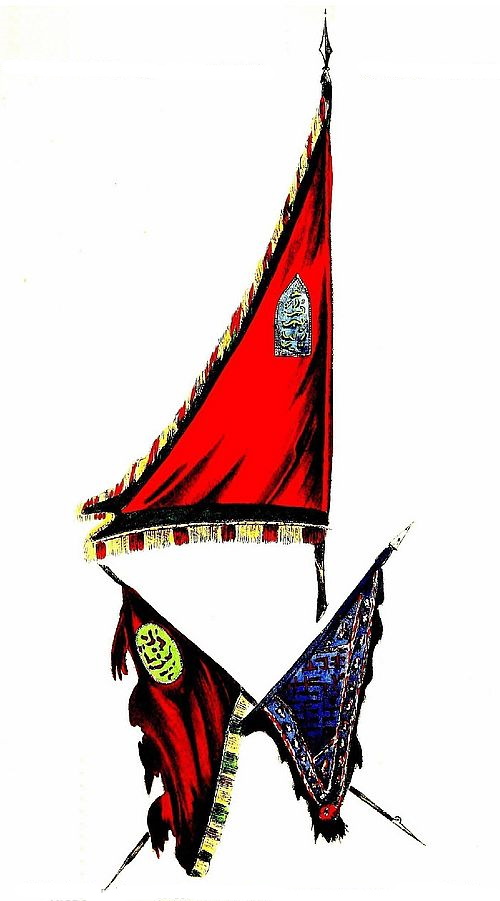
DEPOSITED IN THE ROYAL HOSPITAL AT CHELSEA