HISTORICAL RECORD OF THE THIRD, OR THE KING'S OWN, REGIMENT OF LIGHT DRAGOONS. (continued 2)
Reading edition
On the 8th of April the current subsided, and the pontoons were again laid down. On the 9th the troops were passing the river, and on Easter Sunday (the 10th), Soult was attacked in his position. In this attack the brigade, then commanded by Colonel Lord Charles Manners, was at different periods employed in supporting the Spanish forces, the hussar brigade, and General Clinton's division. It was not a cavalry action, and the only casualties were—Captain Burn, one trumpeter, four privates, wounded: two horses killed. The enemy abandoned his entrenchments before dusk, and took post behind the canal. The King's Own were rewarded for their conduct on this occasion with the royal permission, dated 20th September, 1821, to bear the word "Toulouse" on their guidons.
Marshal Soult retired down the canal on the 12th towards Carcasonne, and on the 13th, hostilities were terminated by the arrival of the news of the abdication of Napoleon, and of the accession of Louis XVIII. to the throne of France; Marshals Soult and Suchet, after a short delay, gave their assent to the new order of affairs, and a line of demarcation between the armies was agreed upon. The King's Own went into quarters at Lanta and Caraman, and remained there until the end of May.
On the 10th of June, the brigade, having embarked its dismounted men at Bourdeaux, commenced its march to the north by the following route:—
June 1, Toulouse,
" 2, Grissoles,
" 3, Montauban,
" 4, Caussade,
" 5, Cahors,
" 7, Frechisse,
" 8, Souillac,
" 9, Brives,
" 11, Uzorches,
" 12, Pierre Buffiere,
" 13, Limoges,
" 15, Bessines,
" 16, St. Burnot,
" 17, Argenton,
" 18, Chateauroux,
" 20, Vatan,
" 21, Vierzon,
" 22, Salbris,
" 23, Lafecte,
" 24, Orleans,
" 26, Artenay,
" 27, Angerville,
" 28, Etampes,
" 30, St. Aumal,
July 1, Montfort,
" 2, Mantes,
" 4, Gisors,
" 5, Gournay,
" 6, Neufchatel,
" 7, Blangy,
" 8, Abbeville,
" 10, Rue,
" 11, Montreuil,
" 12, Boulogne.
At Boulogne Major-General Sir Henry Fane inspected the three regiments, and expressed his satisfaction at the efficiency of the brigade after so long a march. He congratulated the commanding officers on the excellent condition of their horses, and selected a number, of which the King's Own furnished fifteen, to be given up to the French government for the purpose of mounting the royal guard. On the 19th of July, the brigade, having received the highest praise from Major-General the Hon. W. Ponsonby,[38] embarked at Boulogne and arrived at Dover on the following day, the King's Own having been absent three years, from the time of their embarkation on the 25th of the same month, 1811.
From Dover the King's Own marched through Maidstone to Brentford, and, on the 28th of July, were reviewed on Hounslow Heath by His Royal Highness the Commander-in-Chief, immediately afterwards commencing their march to Northampton and joining the depôt (which had marched thither from Canterbury) on the 3rd of August. On the 13th two troops were reduced, and on the 16th, the regiment marched for Newcastle-on-Tyne, arriving there on the 1st of September; two troops were detached to Carlisle, and one to Durham.
On the 26th of September, the head-quarters marched into York barracks,[39] troops being left at Newcastle, Morpeth, Carlisle, and Workington. In these quarters the Regiment was reviewed by Lieutenant-General Wynyard in the summer of 1815, and afterwards marched for St. Albans.
1815
In the meantime Napoleon Bonaparte had returned to France; a British army had assembled in Belgium under the command of the Duke of Wellington; the battle of Waterloo had been won, and the King's Own were ordered to form ten troops, four of which marched to Coventry, and the remaining six, consisting of thirty-two officers, thirty-four serjeants, six trumpeters, three hundred and seventy-one rank and file, and three hundred and eighty-two horses, proceeded to Dover and Ramsgate, where they immediately embarked for Ostend to reinforce the British army in France.
The King's Own disembarked at Ostend on the 24th of July, and moving up the country into France, were, on their arrival in the vicinity of Paris, placed in cantonments at Chaton, near Malmaison. On the 2nd of September, the Emperor of Russia reviewed the first and eighth brigades of cavalry, consisting of the first and second life guards, royal horse guards, first, second, and third dragoon guards, and Third dragoons. On the 22nd of the same month, the allied army was reviewed by the Duke of Wellington on the plain of St. Denis, and on the 11th of October, the whole of the British, Hanoverian, Danish, and Saxon contingents, were reviewed between Paris and St. Denis, by the Duke of Wellington, the Emperor of Russia, and the King of Prussia; after the review the King's Own marched to Nantes, where they remained several months.
1816
On the 25th of January, 1816, the King's Own forming part of the Army of Occupation left in France after the restoration of Louis XVIII. left Nantes, and after successively making short halts at Bonnieres, Ligny, and Bailleul, took up quarters at Steenvoorde, on the 1st of June. Here the regiment remained till the 1st of August, and then marched to Theronenne, where it was twice reviewed; on the 12th of October by the Duke of Wellington, and on the 22nd by His Royal Highness the Duke of Kent, and the Duke of Wellington. At this last review the whole of the British army was assembled on the plains of Denain. After the review the regiment marched to Audricq, and remained there all the following year; occasionally, however, moving to different towns, as Bouberg, Louches, and the vicinity of St. Omer, for the purpose of reviews and inspections, or to make room for troops marching to the coast for embarkation.
1818
In the year 1818 the reviews went on in the same way and on the same ground, until October 18th, on which day the King's Own, being ordered to return to England, embarked at Calais for Dover, landed there on the following day, and marched to Canterbury. On the 24th, a considerable reduction took place in the regiment, two troops being disbanded, and the remaining eight ordered to consist of one serjeant-major, two serjeants, three corporals, one trumpeter, one farrier, forty-two privates, and thirty-four horses each.
In October, 1818, His Royal Highness the Prince Regent, in the name and on the behalf of His Majesty, was pleased to direct, that the Third and Fourth Regiments of Dragoons should be mounted, clothed, and equipped as Light Dragoon Regiments; the alteration of title, &c., to take effect from the 25th December, 1818.
1819
On the 26th October, two squadrons, under the command of Major Davenport, marched to Salt Hill, to attend the funeral of Her Majesty Queen Charlotte, and on the 7th of December, the remaining troops marched for Bristol, on their route to Ireland, disembarked at Waterford, and detaching one squadron to Tullamore, marched into Newbridge barracks on the 7th of February, 1819. In these stations the regiment was reviewed by Lieutenant-General Sir Edward Paget, who was pleased to express his approbation of its appearance and discipline.
1820
In January, 1820, in consequence of the disturbed state of the province of Connaught, two squadrons of the regiment were hastily ordered to march thither; one troop was quartered at Ballinasloe, one at Tuam, and the other two at Ballinrobe. In March, Generals Sir Edward Paget and Sir John Elley arrived with all the disposable force, and from their exertions the country assumed some appearance of tranquillity.
The King's Own returned to Newbridge, and was there, on the 22nd of May, inspected by Major-General Sir Colquhoun Grant, who was pleased to give them the highest praise.
On the 18th of June, the King's Own marched to Dublin, and on the next day was reviewed, for the first time, as a "Light Regiment;" other reviews took place on the 21st and 30th, before Lieut.-General Sir David Baird, and the regiment returned to Newbridge.
On the 16th of August, the King's Own marched into Dublin, relieving the royal dragoons, who sailed for England, and in October, the regiment was inspected by Major-General Sir Colquhoun Grant, who issued the following order:—
'October 14th, 1820.
'The half-yearly inspection of the King's Own Light Dragoons affords Major-General Sir C. Grant an opportunity of again expressing his approbation of that corps. The interior arrangements, field movements, attention of the officers, and steadiness of the men, all enable him to make the most satisfactory report to the Commander of the Forces.'
1821
The regiment remained in Dublin during the winter, and in January, 1821, the colonelcy was conferred on Lieut.-General Stapleton Cotton, Viscount Combermere, K.C.B., G.C.H., in succession to General Cartwright, who was removed to the first dragoon guards.
On the 17th of August the regiment had the honour of forming the personal escort of His Majesty King George the Fourth, on his public entry into Dublin. On the 18th, His Majesty reviewed the garrison, then consisting of the Third and sixth dragoons, seventh hussars, twelfth and nineteenth lancers, of the twenty-third, thirty-third, forty-third, fifty-second, and seventy-eighth regiments of infantry. The King remained in Dublin until the 2nd of September, on which day, having been escorted to Powerscourt by a detachment of His Own regiment of dragoons, His Majesty embarked at Dunleary, the remainder of the regiment forming a guard of honour at the harbour.
On the 4th and 5th of September, the King's Own marched out of Dublin, and took up quarters in the counties of Waterford and Wexford, at Cahir, New Ross, and Fethard.[40] Here, however, they remained only a short time, being ordered to Newcastle and Limerick, in consequence of the disturbances which agitated that part of Ireland, particularly the county of Limerick.
1822
In these quarters the regiment was inspected on the 22nd of October, by Major General Sir John Elley, and in January, 1822, the head-quarters marched to Limerick, troops and detachments being stationed at nine different places in the south of Ireland. The regiment was, in June, again inspected by Sir John Elley, and being ordered to embark for England, had the honour of receiving an order from Major-General Sir John Lambert, commanding the district, in which the major-general was pleased to state that 'he could not allow the regiment to leave the district without expressing his entire satisfaction at the manner in which most harassing duties had been performed by the head-quarters and detachments in the disturbed part of the country.'
1823
On the 19th and 22nd of June, the regiment embarked at Waterford, and landing at Bristol, proceeded to Brighton, and on the 28th of October, having marched to Chichester, was reviewed by Major-General Lord Edward Somerset, one troop being detached to Hastings. On the 7th of November, the regiment marched to Romford, where it remained till June, 1828, and hence proceeded to Hampton Court and its vicinity. Here, on the 15th of July, a grand cavalry review took place. The brigades were a cuirassier brigade, first and second life guards, and royal horse guards, commanded by Colonel Sir Robert Hill; a light brigade, King's Own light dragoons, seventh and fifteenth hussars, commanded by Colonel Lord Charles Manners; and a brigade of horse artillery, commanded by Colonel Sir Augustus Frazer. These troops, being commanded by Major-General Lord E. Somerset, were reviewed by His Royal Highness the Duke of York, Commander-in-Chief, and on the 22nd, an order was issued highly flattering to the whole of the regiments present.
1824
The King's Own remained at Hounslow for some months, in the course of which, on leaving the station of Hampton Court, the troops received a most honourable testimonial of their character and conduct from His Royal Highness the Duke of Clarence.[41]
On the 7th of July, 1824, the same brigades under the same officers, were again reviewed by His Royal Highness the Commander-in-Chief, and on the 12th the head-quarters of the King's Own marched for Coventry, troops being detached to Birmingham, Hinckley, and Abergavenny.
1825
In May, 1825, the regiment having been inspected by Major-General Lord Edward Somerset, the head-quarters moved to Newcastle-on-Tyne, a squadron being detached to Carlisle. On the 22nd of July, a party was detached to Sunderland, in consequence of the riots there, in which the associated keelmen had gained such power as to prevent any vessels putting to sea. On the 3rd of August, these disturbances grew to such a height that it became necessary for the military, under the direction of the magistrates, to make use of their arms, when seven lives were unfortunately lost; but of so good effect was this salutary severity, that from that time order was restored, and the troops returned to Newcastle, receiving from Major-General Harris, commanding the district, from the Horse-guards, and from the magistrates and inhabitants of Sunderland, the highest praise for their coolness and forbearance, under very trying circumstances.[42]
On the 27th of May, 1825, Colonel Lord Charles S. Manners was promoted to the rank of Major-General, and was succeeded in the Lieutenant-colonelcy of the Third, King's Own, Light Dragoons by Colonel Lord Robert Manners, from the half-pay of the Tenth Royal Hussars.
1826
1827
On the 3rd of March, 1826, the King's Own commenced their march for Portpatrick, embarked there for Ireland, and took up their quarters at Dundalk, Belturbet, and Longford, the squadron from which latter place afterwards marched to Belfast. On the 23rd of September, the regiment assembled at Dundalk, and was there inspected by Major-General Sir Colquhoun Grant, the detached squadrons immediately returning to their former quarters, and the whole marching into Dublin, in June 1827, and occupying Portobello barracks. The regiment remained at Dublin nine months, and then marched into Connaught, receiving the highest praise from Lieutenant-General Sir George Murray. It was then quartered as follows: one troop and head-quarters at Ballinrobe, two troops at Athlone, two troops at Gort, and one at Loughrea.
1828
1829
The five detached troops received orders on the 30th of June to proceed to Ennis, to assist in preserving the peace during the Clare election. Two troops were quartered in a ruined distillery, two in the yards of the infirmary, and one at Clare Castle, where Major-General Sir Charles Doyle, who had arrived from Limerick, established his head-quarters. The troops remained at Ennis ten days, and then returned to their former stations, the regiment being stationed in Connaught for fifteen months, and receiving on three several occasions the highest character from Major-General Taylor, and Major-General Sir Thomas Arbuthnot, K.C.B., the inspecting general officers; the latter of whom was pleased to express 'his regret at losing from his district a regiment which had done itself such credit by its excellent conduct, while under his command.' This order is dated 30th April, 1829; and in the beginning of the next month, the regiment embarked at Dublin for England, being ordered to proceed to Exeter; but on landing at Liverpool, it was detained in the north, in consequence of some disturbances there, and ordered to march on the evening of debarkation to Prescot, one squadron being directed upon Manchester, and troops to Bury, Bolton, Blackburn, and Haslingden. On the 15th of June, the head-quarters moved to Sheffield, the troops from Bolton occupying Rochdale; and on the 5th of July, in consequence of riots in the town of Barnsley, a troop was sent thither, and remained there till the following spring.
In September General Viscount Combermere was removed to the first life guards; and the colonelcy of the King's Own was conferred on Lieut.-General Lord George Thomas Beresford, G.C.H.
In the course of this year a squadron was detached to Doncaster, in consequence of riots at the races there; and the regiment was inspected by Major-General Sir H. Vivian, when Colonel Lord Robert Manners received the directions of the Major-General to express his approbation of the state of the regiment, and in addition to the flattering terms in which the General expressed his opinion of the officers and men on the parade, he directed the commanding officer to issue an order, entirely approving of all he had seen, which order he desired might not only be entered in the regimental order book, but likewise inserted in the regimental records.
1830
On the 6th of April, 1830, the King's Own marched into York, detaching one troop to Newcastle-on-Tyne: and on the 21st of May, they were reviewed by Major-General Sir H. Bouverie, commanding the northern district.[43] On the 25th of November, the regiment left York en route to Nottingham, being ordered there to replace troops employed in quelling disturbances in the south of England. On the 6th of December, one troop was detached to Loughborough, in consequence of riots there, and returned on the 17th, receiving a vote of thanks from the magistrates of Leicestershire for their readiness and promptitude. On the 22nd, the regiment was ordered to complete its establishment to the full numbers, and accordingly detached parties to Loughborough and Derby; and on the 29th, the first division, immediately followed by the others, left Nottingham and returned to York. At York an increase in the number of horses took place, the number per troop being fixed at forty-five.
1831
In consequence of a sudden order received on the night of the 2nd of March, 1831, for the regiment to march on the following morning, one squadron moved to Leeds, and the second to Burnley; but on the 4th of April, the latter squadron returned to Leeds to succeed the first, which had marched to Newcastle. On the 25th of the same month, a troop marched to Chester-le-Street, near Durham; and on the 5th and 6th of May, the remaining part of the regiment left Leeds for Newcastle. In this quarter the regiment was employed in the suppression of riots among the colliers, and was inspected by Major-General Dalbiac.
1832
On the 23rd of September, the King's Own marched in three divisions to Edinburgh, where they remained for eight months; and in April, 1832, proceeded to Glasgow and Hamilton.
1833
1834
1835
Returning to England in the spring of 1833, the regiment was stationed at Ipswich and Norwich; in the summer of 1834 it was removed to Hounslow and took the King's duty; and in the summer of 1835 it embarked for Ireland, and occupied quarters at Cork, Ballincollig, and Limerick.
1836
1837
In June, 1836, the King's Own were stationed at Cahir and Clonmel; and returning to England in the spring of 1837, they proceeded to Canterbury. On the 19th May, 1837, Colonel Joseph Thackwell, late of the 15th Hussars, exchanged from the half-pay with Lieutenant Colonel Stisted.
The regiment, having been selected to proceed to the East Indies, embarked in July, 1837, for Bengal, and landed at Calcutta on the 13th of November following, under the command of Colonel Thackwell.
1838
The regiment was encamped in January, 1838, at Calcutta; in February at Burkee; in March at Kusseah; in April at Cawnpore, where it continued until the end of the year.[44]
1839
In February, 1839, the regiment was encamped at Chibbermold; in March at Meerut, at which station it remained until December, when it returned to Cawnpore.
The decease of Lieutenant-General Lord George Thomas Beresford, G.C.H., having taken place on the 26th October, 1839, Her Majesty was pleased to confer the colonelcy of the Third, or King's Own Light Dragoons, on Lieutenant General Lord Charles Somerset Manners, K.C.B., on the 8th November, 1839: Lord Charles Manners had commanded the regiment as Lieutenant-Colonel from 1812 to 1825, when he was promoted to the rank of Major-General.
On the 13th December, 1839, Lieut.-Colonel Michael White was promoted by purchase in succession to Lieut.-Colonel G. G. Tuite.
1840
1842
The regiment remained at Cawnpore until October, 1840, when it proceeded to Kurnaul. It marched from thence on 28th January, 1842, en route for Ferozepore, having been selected to form part of the force which had been ordered to proceed under Major-General Pollock to relieve the troops under Colonel Sir Robert Sale, who had gallantly defended Jellalabad; and also for the purpose of inflicting retribution upon the Affghans, whose treachery had caused the loss of so many brave officers and soldiers.
The Third Light Dragoons continued their advance on Peshawur, and a squadron of the regiment, under Lieutenant Unett, protected the column of attack under the command of Lieutenant-Colonel Taylor, of Her Majesty's Ninth Regiment of Foot, which captured the heights on the right entrance to the Khyber Pass, on the 5th April, 1842. Major-General Pollock, in his despatch announcing the successful advance of the troops into the Khyber Pass, states: 'there were some of the enemy's horse in the vicinity of Ali Musjid, but I regret they did not wait for Brigadier White (Lieutenant-Colonel of the King's Own) and his brigade to make an example of them.'
The regiment arrived at Jellalabad in April, 1842, where it remained until the 14th August following, when it proceeded to Futteabad, detaching one squadron to Mammoo Khail on the 23rd of that month. The Third Light Dragoons left Futteabad on the 2nd September, and on arriving at Jugdulluck, the summits of the hills, which command the road through the pass, were perceived to be occupied by a considerable number of the enemy, who were assembled in bodies under different chieftains, each having a distinguishing standard; their position was one of singular strength and difficulty of approach. The heights occupied by the Ghilzies formed an amphitheatre, inclining towards the left of the road, on which the troops were halted, while the guns opened; and the enemy were thus enabled, on this point, to fire into the column, a deep ravine preventing the troops coming in contact with them.
The British troops, however, on attacking one of their hill-forts, gave an animated and enthusiastic cheer, which so dismayed the enemy, that they fled down the heights without waiting the collision, and were thus enabled to escape chastisement by the nature of the ground, which was so well calculated to favour their retreat. At this moment, Major Lockwood with the Third, King's Own Light Dragoons, galloped up, and nearly succeeded in overtaking the enemy's cavalry, who effected their safety by flight.[45]
The loss of the regiment at the storming of the heights of Jugdulluck on the 8th of September, 1842, was limited to two men wounded.
Major-General Pollock, in his despatch, speaks of the conduct of the troops employed in the following terms:—
'It gratifies me to be enabled to state, that we have thus signally defeated, with one division of the troops, the most powerful tribes, and the most inveterate of our enemies, the original and principal actors in those disturbances which entailed such disasters on our troops last winter.'
The regiment was also engaged with the enemy in the Tezeen valley, which is completely encircled by lofty hills; the pass of Tezeen affords great advantages to an enemy occupying the heights, and Mahomed Akbar-Khan neglected nothing to render its natural difficulties as formidable as possible; accordingly on the morning of the 13th September, the Affghans appeared in great force on every height which had not been occupied by the British army. Two squadrons of the Third Light Dragoons, a party of the first light cavalry, and of the third irregular cavalry, with two guns, were left to guard the mouth of the Tezeen pass. The enemy's horse appeared in the valley with the intention of falling upon the baggage; but the Light Dragoons and native cavalry made a most brilliant charge, and completely routed the whole body of the enemy's force, cutting down a great number of them. The fight continued during the greater part of the day, the Affghans appearing resolved to prevent our ascending the Huft Kotul; one spirit, however, pervaded all, and the determination to conquer overcame the obstinate resistance of the foe, who were at length forced from their numerous and strong positions, and the British troops mounted the Huft Kotul, giving three cheers on reaching the summit. Here Lieutenant Cunningham, with a party of sappers, pressed the enemy so hard, that they left in their precipitation a twenty-four pounder howitzer and limber, carrying off the draught bullocks. Information being received that another gun had been seen, a squadron of cavalry under Captain Tritton, of the Third Light Dragoons, and two horse artillery guns, under Major Delafosse, were detached in pursuit; the gun (a twelve-pounder howitzer) and bullocks sufficient for the two guns, were soon captured. The Light Dragoons again got among the enemy, and succeeded in destroying many of them. Captain Broadfoot, with the sappers, advanced, and with the dragoons happened to fall in with another party of Affghans, of whom upwards of twenty were killed. It was ascertained, that the enemy numbered sixteen thousand, a considerable portion being cavalry; and that Mahomed Akbar-Khan, with several other powerful chiefs, was present[46].
The British thus gained a complete victory, and the enemy must have suffered severely, several hundreds of them having been killed, and their guns, and three standards, captured from them. A detachment of the Third Light Dragoons formed part of the rear-guard of the army under the command of Lieut.-Colonel Richmond, of the 33rd Native Infantry, and it being resolved to anticipate the evident intention of the Affghans, by attacking them in the valley of Tezeen, on the 13th September, the guns were moved forward within range of the enemy, supported by the front squadron of the Third Light Dragoons under Captain Unett, with other corps, in order to charge the foe if the ground proved favourable, and an opportunity offered; this soon occurred, the guns having made good impression, and the other squadron of cavalry, under Major Lockwood, was hurried forward as a support, thus ensuring the success achieved by the spirited and gallant charge of their comrades in front, which completely dispersed the enemy, who left about fifty men on the field.[47]
Major-General Pollock, in his despatch of the action at Tezeen, expresses his satisfaction with the exertions of Lt.-Colonel White of the Third Light Dragoons, commanding the cavalry brigade, and also of Major Lockwood, who commanded the regiment. The Third Light Dragoons sustained but trifling loss in the Tezeen valley, and on the Huft Kotul, on the 12th and 13th September, having only one serjeant and four rank and file wounded; two horses killed, and eleven wounded.
After these successes, the army moved on without opposition, and arrived at Cabool on the 15th September, where they encamped on the race course. The Third Light Dragoons, under Major Lockwood, proceeded with other corps to plant the British colours in the Bala Hissar, on the spot most conspicuous from the city. On the colours being hoisted, the band of Her Majesty's Ninth Regiment of Foot struck up 'God save the Queen,' and a royal salute was fired from the guns of the horse artillery, the whole of the troops present giving three cheers. The colours in the Bala Hissar were hoisted daily as long as the army remained at Cabool.
The head-quarters and two squadrons of the regiment, under Major Lockwood, formed part of the force which was detached under Major-General McCaskill (Lieutenant-Colonel of the Ninth Foot), for the purpose of dispersing the enemy collected in the vicinity of Charekar, and took part in the operations against the strong and populous town of Istalif, which was considered by the Affghans as totally inaccessible, but which was captured on the 29th September 1842; the numerous levies collected for its defence were totally defeated, and property of every description (much of it plundered from the army in 1841) was recovered; two brass field-pieces were captured, one of which was seized with such promptitude, that its captor, Lieutenant Elmhirst, of Her Majesty's Ninth Foot, turned its fire upon the fugitives with some effect[48].
Among the gratifying results of these successes was the release of several ladies and officers who had been detained prisoners by Akbar-Khan.
The regiment, having been present during the whole of the operations west of the Indus, leading to the occupation of Cabool, has received the Royal permission to bear on its appointments the word 'Cabool 1842.'
1843
1844
The regiment left Cabool on the 12th October, 1842, and arrived at Ferozepore on the 18th December, from whence it marched to Kurnaul, where it arrived on the 27th January 1843; it remained at Kurnaul until November, when it marched for Umballa, and continued at that station during the year 1844, and until the end of the following year.
1845
On the 11th December, 1845, the regiment, consisting of 518 men, under the command of Lieut.-Colonel Michael White, marched from cantonments at Umballa, and formed a part of the leading division of the Army of the Sutlej, hastily assembled, under the personal command of General Sir Hugh Gough, G.C.B., Commander-in-Chief in India, for the purpose of repelling an invasion by the Sikhs.[49]
On arriving at the village of Moodkee, a distance of one hundred and fifty miles, on the 18th December, the army had just taken up its encampments, when intelligence was received, that the enemy's forces, consisting of twenty thousand cavalry, and about the same number of infantry and artillery, were close at hand, and intended to surprise the British camps. The cavalry were immediately turned out, and advanced to cover the formation of the infantry, and the distinguished part which the Third, or King's Own Regiment of Light Dragoons, took in the sanguinary and memorable battle of the evening of that day may be best judged from the words of His Excellency the Commander-in-Chief in his despatch of the 19th December 1845:—'I directed the cavalry, under Brigadiers White and Gough (of the King's Own), to make a flank movement on the enemy's left, with a view of threatening and turning that flank, if possible.
'With praiseworthy gallantry, the Third Light Dragoons, and the second brigade of cavalry, consisting of the body-guard and Fifth Light cavalry, with a portion of the Fourth Lancers, turned the left of the Sikh army, and sweeping along the whole rear of its infantry and guns, silenced for a time the latter, and put their numerous cavalry to flight.'
In this action the regiment suffered severely, owing to the nature of the ground, and the immense body of cavalry opposed to it. The loss, out of four hundred and ninety-four men, on this occasion, was as follows:—killed, 3 officers, 58 men; 5 officers' chargers, and 100 troop horses; wounded, 3 officers, 34 men; 2 officers' chargers, and 21 troop horses.
Brevet Major W. R. Herries, Captain G. Newton, and Cornet E. Worley, were killed.
Lieutenant S. Fisher (Acting Major of Brigade), E. G. Swinton, and E. B. Cureton, were severely wounded.
On the 21st December, the army again advanced; the Third Light Dragoons had about four hundred men; and came up with the enemy, said to consist of 70,000 men, who were strongly posted in and around the village of "Ferozeshah" their camp intrenched, and defended by a numerous and powerful artillery.
At about four o'clock in the afternoon the action became general. The Third Light Dragoons were ordered to attack the enemy's position at a point defended by some of the heaviest batteries, most of the guns being of battering calibre: as the regiment advanced, it was assailed with round shot and shell from several batteries. On arriving within about two hundred and fifty yards of the guns, the regiment moved on at top speed, under a most destructive fire of grape and musketry, whilst their infantry held the trenches at the point of the bayonet. Nothing dismayed, but determined on victory, the regiment pressed forward, and never for a moment was checked in its career until it finally entered the enemy's camp, and captured the whole of the batteries opposed to it; many of the Sikh artillerymen remaining to be cut down at their guns. Night having fallen, while the conflict was everywhere raging, and several mines having been sprung, together with the exploding of their field magazines, by which several men and horses were destroyed, the regiment was withdrawn a short distance from the burning camp, where it bivouacked for the night.
The enemy having held a portion of his position, and being strongly reinforced in the night, the battle was renewed the next morning, and the Third Light Dragoons at daybreak joined the remainder of the cavalry, and participated in the action of the 22nd of December, when about three o'clock, P. M., the Third Light Dragoons were again ordered to charge the enemy, which he did not wait to receive, and he was finally driven from the field, and the army bivouacked on the ground they had won. The men and horses of the Third Light Dragoons were upwards of forty hours without food or water, nearly the whole of the time exposed to, and in conflict with, a powerful enemy; the days were hot and the nights intensely cold.
In this great battle the regiment lost as follows:—killed, 2 officers and 53 men; wounded, 7 officers and 86 men; total, 9 officers and 139 men: killed, 9 officers' chargers and 98 troop horses: wounded, 60 troop horses; total killed and wounded, 9 officers' chargers and 158 troop horses.
The officers killed, were Captain J. E. Codd and Cornet H. Ellis; wounded, Colonel M. White, slightly: Major C. W. M. Balders, slightly: Lieutenants, H. C. Morgan, severely; J. G. A. Beeston, slightly: Cornets, W. H. Orme, severely; J. D. White and J. Rathwell, slightly.
The Commander-in-Chief, in his despatch of the 22nd December, 1845, observes as follows: 'Although I brought up Major-General Sir Harry Smith's division, and he captured and long retained another point of the position, and Her Majesty's Third Light Dragoons charged and took some of the most formidable batteries, yet the enemy remained in possession of a considerable portion of the great quadrangle, whilst our troops, intermingled with theirs, kept possession of the remainder, and finally bivouacked upon it, exhausted by their gallant efforts, greatly reduced in numbers, and suffering extremely from thirst, yet animated by an indomitable spirit. In this state of things, the long night wore away!'
The Right Honourable the Governor-General, (Lord Hardinge), who personally witnessed the prowess of the regiment on the battle-field, makes honorable mention thereof in his Orders, dated 30th December, 1845.
'The Governor-General offers his thanks more especially to Her Majesty's Third Light Dragoons, who, on all these occasions, sought opportunities of useful conflict with the enemy, and fought with that superiority over their opponents which skill and discipline impart to brave and determined men.'
The regiment was detached from the army at Sultan-Khan-Wallah, and sent to Ferozepore, where it arrived on the 31st December 1845.
1846
It remained at Ferozepore until the 18th January, 1846, and again proceeded to, and joined, the head quarters of the army at Jelliwallah, on the 20th of January.
The glorious action at Aliwal took place on the 28th of January, 'when the enemy's camp was carried by storm; the whole of his cannon and munitions of war were captured, and his army driven headlong across the Sutlej; even on the right bank of which he found no refuge from the fire of our artillery.'
The Third Light Dragoons were assembled on parade on the morning of the 29th of January to celebrate the victory of Aliwal, when the Right Honourable the Governor-General, in the presence of the whole army, was pleased to make use of the following words, most gratifying to the feelings of every soldier:—'Colonel White, your regiment is an honour to the British army; and I wish you to make known these my sentiments, as head of this Government, to your officers and men.'
On the 10th of February, 1846, the regiment had the proud satisfaction of sharing and taking a conspicuous part in that glorious and mighty combat, the Battle of Sobraon, when the Sikhs were driven from their stronghold, and precipitated in masses into the Sutlej, and those proud invaders were expelled the soil of British India.
The Right Honourable the Governor-General, in his Order of Thanks to the Army, was pleased to pass the following high encomium on the conduct of the regiment in this fight:—
'Her Majesty's Third Light Dragoons, as usual, were in the foremost ranks, and distinguished themselves under their commanding officer, Lieut.-Colonel White.'
His Excellency the Commander-in-Chief, in his despatch, dated 13th February, 1846, thus expresses his unqualified approbation of the conduct of the regiment on this occasion:—'The Sikhs, even when at particular points their intrenchments were mastered by the bayonet, strove to regain them by the fiercest conflict sword in hand; nor was it until the cavalry of the left, under the command of Major-General Sir Joseph Thackwell,[50] had moved forward and ridden through the openings in the intrenchments made by our Sappers, in single files, and reformed as they passed them, and the Third Light Dragoons, whom no obstacle usually held formidable by horse, appears to check, had on this day, as at Ferozeshah, galloped over, and cut down the obstinate defenders of batteries and field-works, and until the full weight of three divisions of infantry with every field artillery gun which could be sent to their aid, had been cast into the scale, that victory finally declared for the British.[51]
'The fire of the Sikhs first slackened, and then nearly ceased; and the victors then pressing them on every side, precipitated them in masses over their bridge, and into the Sutlej, which a sudden rise of seven inches had rendered hardly fordable. In their efforts to reach the right bank through the deepened water, they suffered from our horse-artillery a terrible carnage: hundreds fell under this cannonade; hundreds upon hundreds were drowned in attempting the perilous passage. Their awful slaughter, confusion, and dismay, were such as would have excited compassion in the hearts of their generous conquerors, if the Khalsa troops had not, in the earlier part of the action, sullied their gallantry by slaughtering and barbarously mangling every wounded soldier, whom, in the vicissitudes of attack, the fortune of war left at their mercy.
'I must pause in this narrative to notice, especially, the determined hardihood and bravery with which our two battalions of Ghoorkhas, the Sirmoor and Nusseeree, met the Sikhs, wherever they were opposed to them: soldiers, of small stature but indomitable spirit, they vied in ardent courage in the charge with the grenadiers of our own nation; and armed with the short weapon of their mountains, were a terror to the Sikhs throughout this great combat.
'Sixty-seven pieces of cannon, upwards of two hundred camel-swivels (zumbooruks), numerous standards, and vast munitions of war, captured by our troops, are the pledges and trophies of our victory.
'The battle was over by eleven in the morning; and in the forenoon I caused our engineers to burn a part, and to sink a part, of the vaunted bridge of the Khalsa army, across which they had boastfully come once more to defy us, and to threaten India with ruin and devastation.
'The consequences of this great action have yet to be fully developed. It has at least, in God's providence, once more expelled the Sikhs from our territory, and planted our standards on the soil of the Punjaub. After occupying their entrenched position for nearly a month, the Khalsa army had perhaps mistaken the caution, which had induced us to wait for the necessary materiel, for timidity: but they must now deeply feel, that the blow, which has fallen on them from the British arm, has only been the heavier for being long delayed.'
The following are the losses sustained by the Third Light Dragoons in the action of Sobraon: killed, 5 men, 1 troop horse; wounded, 4 officers and 22 men, 2 officers' chargers and 13 troop horses.
The officers wounded were, Lieutenant-Colonel J. B. Gough (Acting Quarter-Master General), very severely; Lieutenant J. B. Hawkes, slightly; Cornet Kauntze, severely; and Quarter-Master A. Crabtree, slightly.
The Third Light Dragoons crossed the Sutlej on the 13th February, 1846, and marched on Lahore, where the British army arrived on the 20th, and encamped on that soil held sacred by the Khalsa troops, the 'Plains of Myan Meer,' where it remained until the 24th March. The object for which the army was assembled having been attained, the Third Light Dragoons returned to their former quarters at Umballa on the 7th April, having, in less than four months, marched upwards of six hundred miles, and taken a conspicuous part in three of the greatest actions recorded in the annals of British India.
On the 22nd of February, 1846, the Right Honourable the Governor-General made the following announcement in General Orders:—
'The British Army has this day occupied the gateway of the Citadel of Lahore, the Badshahee Mosque, and the Huzzooree Bagh.
'The Army of the Sutlej has now brought its operations in the field to a close, by the dispersion of the Sikh army, and the military occupation of Lahore, preceded by a series of the most triumphant successes ever recorded in the military history of India.
'The British government, trusting to the faith of treaties, and to the long subsisting friendship between the two states, had limited military preparations to the defence of its own frontier. Compelled suddenly to assume the offensive, by the unprovoked invasion of its territories, the British Army, under the command of its distinguished leader, has, in sixty days, defeated the Sikh forces in four general actions; has captured two hundred and twenty pieces of field artillery; and is now at the Capital dictating to the Lahore Durbar the terms of a treaty, the conditions of which will tend to secure the British Provinces from the repetition of a similar outrage.'
On the 4th March, 1846, the Governor-General made the following further announcement:—
'Early on the morning of the 22nd February, a brigade of British troops took formal possession of the Citadel of Lahore, the Badshahee Musjed, and the Huzzooree Bagh.
'I considered the occupation of Lahore, and the close of active operations in the field, a proper opportunity for marking, by substantial reward, the gratitude of the British Government to its faithful and brave army, which had fought so gloriously, and so successfully; and I was glad at being able thus to bring into prominent contrast, the just reward of discipline and obedience, with the certain penalty of insubordination and violence, as exemplified in the fate of the two armies, which had been so long the objects of mutual observation; the one, victorious in the field, and honoured and bountifully rewarded by its Government; the other, in spite of its exceeding numbers and advantageous positions, vanquished in every battle, abandoned by a government it had coerced, and, with its shattered remains, left, but for the intercession of its conquerors, to disperse with no provision of any kind, and to seek a precarious subsistence by rapine and crime.'
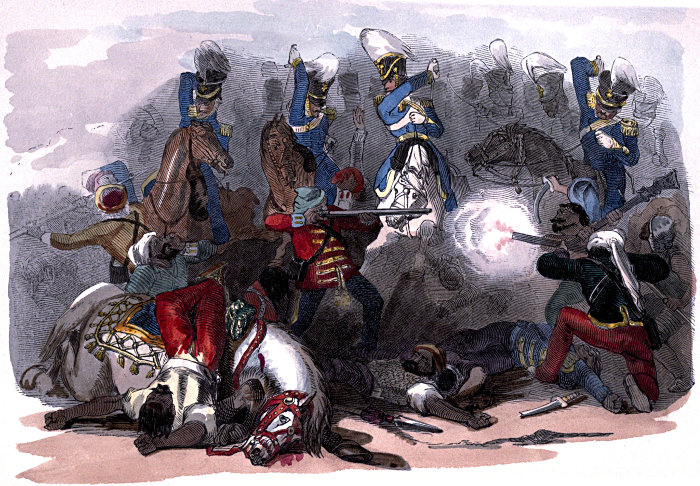
3rd Light Dragoons in India.
[To face page 106.
The following Regular Regiments formed part of the Anglo-Indian Army engaged in the Punjaub in 1845 and 1846:—
Actions at which each Regiment was engaged. Total.
Moodkee, 18th Dec. 1845. Ferozeshah, 21st & 22nd Dec. 1845. Aliwal, 28th Jan. 1846. Sobraon, 10th Feb. 1846.
3rd Light Dragoons 1 1 .. 1 3
9th Lancers .. .. .. 1 1
16th " .. .. 1 1 2
9th Foot 1 1 .. 1 3
10th " .. .. .. 1 1
29th " .. 1 .. 1 2
31st " 1 1 1 1 4
50th " 1 1 1 1 4
53rd " .. .. 1 1 2
62nd " .. 1 .. 1 2
80th " 1 1 .. 1 3
The King's Own Regiment of Light Dragoons, from the period of its formation in 1685, to the present time, has performed upwards of one hundred and sixty years' faithful and meritorious service in the reign of nine successive monarchs. It was employed in the several wars on the continent of Europe during the reigns of King William III.,—of Queen Anne,—and of King George II. It was again employed in Portugal, Spain, and France, from 1811 to 1818. It has been since engaged in most arduous duties in Affghanistan, and on the banks of the Sutlej, where it has acquired additional honours by its bravery; it continues to be employed in guarding the possessions of the British Crown in the distant clime of India.
Whether confronting a foreign enemy in the field, or performing duties of a painful character at home, its conduct has, on all occasions, been such as to procure the acknowledgments of the Civil Authorities by whom its assistance was required;—the commendations of the General Officers under whose immediate command it has served;—the thanks of Parliament; and the approbation of its Sovereign.
The compiler of the Records of the Army feels it his duty to acknowledge, that his labours have been greatly assisted by a memoir of the services of the Third, or the King's Own, Light Dragoons, which was printed, in 1833, by Lieutenant Colonel Charles Stisted, then lieutenant-colonel of the regiment. King William IV. expressed himself much satisfied with the manner in which the Colonel had executed a task, to which His Majesty attached great importance, and gave him credit for the zeal and industry with which he had undertaken and prosecuted it; a notification to the above effect was made to Lieutenant-Colonel Stisted by Lieutenant-General Sir Herbert Taylor, G.C.H. Lieutenant Colonel Stisted entered the Army in May, 1794, as an ensign in the 39th Regiment.—He was appointed to a lieutenancy in the 13th Light Dragoons in January, 1803, and was promoted to be captain of a troop in February, 1804: he exchanged to the Third Light Dragoons on the 7th of February, 1811; and was promoted to a majority on the 14th of October, 1819, and to the Lieutenant-Colonelcy of the Regiment on the 22nd of July, 1830: he continued in command of the Regiment until the 19th of May, 1837, when he exchanged to the half-pay: he was reappointed to the full pay in September, 1841, and retired from the service by the sale of his commission; he died at Torquay on the 24th of July, 1842.