HISTORICAL RECORD (continued 2)
Reading edition
The combined French armies, commanded by Marshals Soubise and the Duke de Broglio, advanced against the allies; frequent skirmishes took place in the early part of July, and on the 15th of that month a furious attack was made upon the post occupied by the Marquis of Granby; but the enemy were repulsed and driven back to the woods, where the fire of the skirmishers was kept up throughout the night. The division of the allied army commanded by the Prince of Anhalt having been removed to support the Marquis of Granby, a body of British troops, under Lieutenant-General Conway, took possession of the ground vacated by the Prince, being an eminence, between Illingen and Hohenover; and here the brigade of Dragoon Guards, commanded by Major-General Douglas, was posted. On the following day the French drove in the skirmishers, and renewed the attack with additional forces, at the same time extending the sphere of their operations; and an attempt was made upon the post occupied by the brigade of Dragoon Guards. The assailants were, however, everywhere repulsed, and they were eventually driven back with the loss of above 5000 men, 9 pieces of cannon, and 6 colours. Unfortunately the nature of the ground prevented the cavalry from taking part in the engagement.
In August the Third Dragoon Guards were engaged in a general attack upon the enemy's posts, near the Dymel; and afterwards crossed that river and advanced to the vicinity of Cassel. In the early part of November they were engaged in dislodging a French corps from its post near Capelnhagen. On the 6th and 7th of that month they skirmished with the enemy's advanced posts at Eimbeck, in the Electorate of Hanover. On the same evening the Dragoon Guards, with several other corps, marched through a heavy snow, and the following morning arrived at Foorwohle, where they erected their tents; but just as the encampment was formed, an alarm was given by the out-posts of the advance of the enemy in force. The British horsemen instantly formed, attacked the enemy with their accustomed gallantry, and drove them back with loss. Prince Ferdinand was a spectator of this act of gallantry, and expressed great admiration of the spirited conduct of the officers and men.[50] This warfare by detached parties, which occasioned considerable loss in men and horses from fatigue and exposure to inclement weather, produced no decisive results; and in the beginning of November the Third Dragoon Guards went into quarters in East Friesland.
1762
In the spring of 1762 the allies made an excursion into the country of Berg, where they raised contributions. On the 18th of June the main army encamped at Brakel, where the First and Third Dragoon Guards formed a brigade under the command of Major-General the Earl of Pembroke. On the 20th of the same month the army advanced towards the Dymel; and the French, under Marshals d'Etrées and Soubise moved forward and encamped at Groebenstien; when a favourable opportunity presenting itself, Prince Ferdinand immediately made dispositions for attacking the enemy.
Moving from their camp at an early hour on the morning of the 24th of June the Third Dragoon Guards, forming part of the centre column, crossed the Dymel between Libenau and Silen, and took part in surprising the enemy in their camp, and in driving them from their ground, with the loss of their camp equipage and many prisoners. At the same time a French corps, consisting of the grenadiers of France, the Royal Grenadiers, the Regiment of Aquitaine, and other troops, under the command of General Stainville, threw themselves into the woods near Wilhelmsthal, to cover the retreat of the army; when the Third Dragoon Guards, with the main body of the allied army, surrounded the wood, and nearly every man of this French corps was either killed or taken prisoner, two battalions only escaping.
The Third Dragoon Guards afterwards pursued the main body of the French army in the direction of Cassel, and at night encamped on the heights between Holtzhausen and Weimar.
In the middle of July the regiment took part in an attack on the enemy's posts on the Fulda; and was subsequently engaged in several military operations on that river, and also on the Eder. By a succession of combined operations the allies compelled the enemy to evacuate a considerable portion of territory, and the campaign ended with the taking of Cassel. The success of the British army was followed by a suspension of hostilities, which took place in November, and the troops went into quarters in the Bishopric of Munster.
1763
The Third Dragoon Guards having received, in common with the whole army, the thanks of Parliament for their eminent and meritorious services during the war, commenced their march on the 27th of January, 1763, through Holland to Williamstadt, where they embarked for England: the numbers of the regiment on embarkation appear to have been 14 officers, 328 men, and 434 horses, with 32 officers' servants, and 33 women who had accompanied their husbands through these long and toilsome campaigns.[51]
After its arrival in England the regiment was stationed at Canterbury; and its establishment was reduced to 28 private men per troop. At the same time the LIGHT TROOP, which had not been on service with the remainder of the regiment, was relieved from the King's duty at Windsor by the 15th Light Dragoons, and disbanded. Eight men per troop of each of the old troops were, however, subsequently equipped as LIGHT DRAGOONS, a practice which appears to have been general in the heavy cavalry regiments.[52]
In consequence of a representation of the increase of smuggling, and of the inability of the officers of the revenue and civil authorities to resist, successfully, the organized gangs which infested the maritime towns and villages, the Third Dragoon Guards were dispersed in detachments along the Kentish coast, the head-quarters being at Canterbury.
1764
In April, 1764, the regiment was ordered to call in its detachments and march into quarters near London; and on the 14th of May it was reviewed in Hyde Park, by His Majesty King George III., who was pleased to express his approbation of the uniform and compact appearance of the regiment, and of the manner in which the various evolutions were executed. After the review the regiment marched to Leicester, Northampton, and Kettering.
This year His Majesty commanded the recruiting and remounting of the several cavalry corps to be submitted to the consideration of a Board of General Officers; and in consequence of its report, orders were issued for the recruits received into the regiments of dragoon guards to be from five feet eight inches to five feet ten inches in height; and that the remount horses should not be under fifteen hands, nor above fifteen hands one inch: at the same time the several regiments were ordered to be remounted with long-tailed horses: jacked leather boots were also laid aside, and boots of a lighter description were adopted; and the men were ordered to wear epaulettes on the right shoulder instead of aiguillettes.
1765
The reputation which the regiment had acquired in the field, and its uniform good conduct on all occasions, attracted the attention of the King, and in 1765 his Majesty was pleased to confer upon it the title of The Prince of Wales' Regiment of Dragoon Guards, in honour of the heir apparent to the throne (afterwards King George IV.), who was then in the third year of his age: at the same time it obtained,—as a regimental badge,—a coronet, with a plume of three feathers, a rising sun, and a red dragon, with the motto 'Ich Dien.' In the month of March of the same year, it proceeded to Scotland; and in September Major-General Lord Robert Manners was appointed its Colonel in succession to Sir Charles Howard, deceased.
1766
In the spring of 1766 the regiment returned to England, and was stationed at Manchester and its vicinity. In July the Drummers were taken off the establishment, and Trumpeters were appointed in their place.
1767 1768
The regiment left Manchester in April 1767, and proceeded to Coventry, Warwick, and Birmingham. In March of the succeeding year, the several troops assembled at Coventry, from whence they proceeded to Newbury and Speenham-Land, and after having been reviewed by His Majesty on Bagshot Heath, marched to quarters at Dorchester, Sherbourn, and Blandford.
1769 1770 1772
In 1769 the Third Dragoon Guards were on coast duty in Sussex, with their head-quarters at Lewes. After calling in the detachments, the regiment assembled at Chichester in 1770, from whence it proceeded to the vicinity of London, and had the honour of passing in review before His Majesty on Blackheath. In May it marched to Colchester, Chelmsford, and Ingatestone; and in the spring of 1772 proceeded to Scotland.
1773 1777
After remaining in Scotland twelve months, the Third Dragoon Guards returned to England and occupied quarters in South Britain, until the spring of 1777, when they again proceeded to the north.
1778
The nation was at this period engaged in a war with its North American colonies, and the French monarch having agreed to assist the revolted provincials, the army was augmented, and during the time this regiment was in Scotland, an addition of one serjeant, one corporal, and fifteen private men was made to the establishment. It returned to England in April, and in May a squadron was in attendance on the King and Queen at Portsmouth, whither their Majesties proceeded to witness a naval review, &c. In August, a further addition of eight men, who were to be equipped as light dragoons, was made to its numbers. During the summer it was encamped on Salisbury Plain.
1779
In 1779 the men of the Prince of Wales' Dragoon Guards equipped as light dragoons, with the men of the 1st, 6th, and 11th Dragoons were formed into a regiment, which was numbered the 20th regiment of Light Dragoons; and from this period the heavy regiments ceased to have a portion of their men equipped as light cavalry.
During the summer the Third Dragoon Guards with the 1st Royal Dragoons, and the 15th, 20th, and 21st Light Dragoons, were encamped on Lexdon Heath, near Colchester.
1780
During the summer of 1780 the regiment was stationed at Shrewsbury, and on the breaking out of the memorable riots in London, it was suddenly called upon to proceed thither. Severe measures being found absolutely necessary to preserve the metropolis from destruction, the suppression of these riots was a painful service to the troops, and the violence of the misguided people was so great, that about 300 rioters fell victims to their own folly, before order was restored.
The Prince of Wales' Dragoon Guards returned to their quarters at Shrewsbury in July, where they continued for some time.
1782
On the 7th of June, 1782, his Majesty conferred the Colonelcy on Lieut.-General Philip Honeywood from the 4th Regiment of Irish Horse (now 7th Dragoon Guards), in the place of Lord Robert Manners, deceased.
1783
After the British Government had recognised the independence of the United States of America, the strength of the army was reduced, and the establishment of the Prince of Wales' Dragoon Guards was decreased 154 men.
1785
The decease of General Honeywood having occurred in January, 1785, his Majesty appointed Major-General Richard Burton Philipson Colonel of the Third Dragoon Guards.
1788 1789
The regiment continued in England until the spring of 1788, when it again proceeded to Scotland, and remained in that kingdom the usual period of one year. After its arrival in England, in 1789, the establishment was increased nine men per troop.
1792
In August, 1792, the Colonelcy of the Prince of Wales' Dragoon Guards, vacant by the decease of General Philipson, was conferred on Major-General Sir William Fawcett, K.B., then Adjutant-General of the Forces.
1793
A further augmentation was made in the establishment in the spring of 1793, with a view to its being employed in actual warfare against the revolutionary party in France, who had seized the reins of government in that country, and beheaded their sovereign.
A French army under General Dumourier, having attacked the frontiers of Holland, a British force was sent to the continent under the command of His Royal Highness the Duke of York, to co-operate with the Austrians, Prussians, and Dutch; and on the 25th of May, four troops of the Prince of Wales' Dragoon Guards embarked at Northfleet for this service. Having landed at Ostend, they advanced to the vicinity of Tournay, and formed part of a corps of reserve to the covering army during the siege of Valenciennes, which place surrendered to His Royal Highness the Duke of York on the 26th of July. The siege of Dunkirk was next undertaken, with the view of replacing that fortress under the dominion of England, and the Third Dragoon Guards formed part of the force employed in covering the operation. The enemy having brought forward an immense body of troops, attacked the covering army with great fury; when some severe fighting occurred, during which the Third Dragoon Guards, owing to the nature of the ground, had to dismount and act as infantry; and the covering army, being eventually driven from its ground by the superior numbers of the enemy, the Duke of York raised the siege. The British troops afterwards returning to the vicinity of Tournay, were engaged in several skirmishes with the enemy; and towards the end of the year the Third Dragoon Guards proceeded to Ghent and Bruges for winter quarters.
1794
Early in 1794 the regiment was again in the field; and it was engaged in the general attack on the enemy's positions at Vaux, Premont, Marets, and Catillon, on the 17th of April; and was subsequently encamped, with nearly the whole of the British army, on the heights of Cateau, to cover the siege of Landrécies, which was undertaken by the Austrians.
On the evening of the 25th of April a French corps of about 30,000 men, commanded by Lieut.-General Chapuy, marched out of Cambray, and on the following morning advanced against the British troops. At day-break the enemy formed line, and being concealed by a thick fog, took possession of a village in front of the British position. At length their movements being plainly seen, His Royal Highness detached the Third Dragoon Guards and other cavalry of the right wing, to turn the enemy's left flank; and this movement having been executed, the British squadrons charged with their characteristic gallantry, overthrew the troops of the enemy, and pursued them to the gates of Cambray. In the midst of the conflict the Third Dragoon Guards, ever emulous of glory, were seen carrying destruction and defeat through the enemy's ranks; and in their victorious career, the allies captured thirty-five pieces of cannon, with a number of prisoners, amongst whom was the French commander, Lieut.-General Chapuy, who surrendered his sword to Major Tiddieman, the commanding-officer of the Third Dragoon Guards.
The regiment, however, purchased its laurels with the loss of Captain Pigot, Lieutenant Fellowes, 1 quarter-master, 1 serjeant, 36 private men, and 46 horses killed, besides a great number wounded. His Royal Highness the Duke of York expressed his admiration of its conduct,[53] and inserted the following paragraph in the General Orders issued on this occasion.
'The Austrian Regiment of Cuirassiers of Zetchwitz, the Blues, the 1st, 3rd, and 5th Dragoon Guards, the Royals, Archduke Ferdinand's Hussars, and the 16th Light Dragoons, who attacked and defeated the principal column of the enemy on the right, HAVE ALL ACQUIRED IMMORTAL HONOUR TO THEMSELVES.'
After the surrender of Landrécies, the Third Dragoon Guards marched to the vicinity of Tournay, and on the 10th of May were engaged in repulsing the attack of the enemy, whose troops were forced across the Marque, with the loss of thirteen pieces of cannon. The regiment behaved on this occasion with its accustomed gallantry; and sustained a loss of 2 officers, 1 serjeant, and 14 private men, with 25 horses killed; and 2 officers, 2 serjeants, 6 men, and 2 horses wounded.
The allies subsequently sustained several severe losses in actions with the enemy, and the Austrians having resolved to abandon the Netherlands, the Duke of York, who had maintained his position in front of Tournay against all opposition, was obliged to make a corresponding movement. The Third Dragoon Guards shared, in common with the other regiments, the hardships which this event occasioned. In the subsequent retreat through Holland, which was occasioned in a great measure by the defection of the Dutch people, the incessant fatigue, the inclemency of the season, and the difficulty experienced in procuring supplies, reduced the British troops to a most distressing state of ill health, and occasioned the death of hundreds of brave men. At length the Maese and the Waal were frozen; the French, with their cannon and all the matériel of their army, passed these rivers on the ice: some hard fighting occurred, but the British, in their reduced condition, were unable to oppose effectual resistance. The army retired in the midst of a rigorous winter, through a hostile country covered with ice and snow, without necessaries, and without accommodation: consequently numbers perished from want, and others were frozen to death; yet the survivors preserved a firm and undaunted countenance, and defeated the attacks of the pursuing army. 'Such was the fate of as brave a body of men as ever Great Britain sent into the field. Both men and officers behaved themselves throughout the whole of the campaigns of 1793 and 1794, with a spirit that distinguished them wherever they were employed, and that fully corresponded with that idea of British valour, so justly entertained by foreign nations. It was, however, in the last stages of this unsuccessful campaign that their courage appeared with the most lustre. The undesponding perseverance with which they met and surmounted every hardship and obstacle, arising from the various incidents of war, was the more remarkable, that they contended against an enemy in full possession of every advantage occurring from victory, and whom they could only expect to impress with a sense of their valour. Herein they certainly succeeded.'[54]
1795
Having arrived at Bremen, in Lower Saxony, the troops there obtained provision and rest. The infantry embarked for England in April, 1795; but the Third Dragoon Guards, and several other cavalry regiments, remained in Germany until November, when they returned to England.
1799
In the summer of 1799 the regiment was encamped near Swinley, under the command of Lieut.-Colonel Payne, and was this year ordered to be mounted on nag-tailed horses.
1800
It was again encamped at Swinley in the summer of 1800, and was reviewed on the downs by his Majesty King George III., who was pleased to express to Lieut.-Colonel Payne, through Sir William Fawcett, the colonel of the regiment, his high approbation of the appearance of the officers and men, and of the superior description and high condition of the horses.
1803 1804
In 1803 it proceeded to Scotland, and was stationed at Piershill Barracks, near Edinburgh; from whence it marched, in February, 1804, to Portpatrick, and embarked for Ireland. After debarking at Donaghadee, it occupied quarters at Londonderry, Enniskillen, Dundalk, and Belturbet.
On the 2nd of April, 1804, His Majesty appointed Major-General Richard Vyse to the Colonelcy of the Third or Prince of Wales' own Regiment of Dragoon Guards, in succession to General Sir William Fawcett, K.B., deceased.
1805
In the summer the regiment marched to Dublin, from whence it subsequently proceeded to Limerick, Fermoy, Mallow, and Bandon, and returned to Dublin in December, 1805.
1808
Orders having been given for the Third Dragoon Guards to join the intended expedition to the Continent, one-half of the regiment embarked from Dublin and sailed to Liverpool, but the expedition, having been countermanded, on the arrival of the remainder of the regiment, the whole proceeded to Exeter, where the head-quarters were stationed until June, 1808, when the regiment marched to Dorchester; and shortly afterwards to Chichester and Arundel.
The Third Dragoon Guards were present at the review which took place at Brighton on the 12th of August, 1808, in honour of the birth-day of his Royal Highness the Prince of Wales. They afterwards occupied quarters at Brighton and Lewes, and in the autumn they were called upon to hold themselves in readiness to proceed on foreign service, to participate in the victories gained by the British forces in Portugal and Spain serving under that illustrious commander, now Arthur Duke of Wellington, whose splendid achievements are interwoven with the history of Europe.
The regiment embarked at Portsmouth on the 5th of December, but afterwards disembarked and returned to its former quarters, from whence it proceeded to Hastings and other places in that part of the country.
1809
In March, 1809, it again proceeded to Portsmouth, where eight troops, of eighty-eight horses each, embarked on the 3rd and 4th of April, under the command of Lieutenant-Colonel Sir Granby Calcraft, leaving two troops at Blatchington, where the dépôt was established under the command of Lieutenant-Colonel Watson.
The Fleet sailed on the 17th of April, and two days afterwards the Doris transport was run down by the Bonne Citoyenne, in the Bay of Biscay, and thirty troop horses and two officers' horses were lost.
Having landed at Lisbon on the 26th and 27th of April, the Third Dragoon Guards proceeded to Belem barracks, and were formed in brigade with the Fourth Dragoons, under the command of Brigadier-General Henry Fane. From Belem they proceeded on the 4th of May up the country, and on the 10th of that month occupied quarters at Golegon and Torres Novas. On the 22nd the head-quarters were at Thomar, and on the 11th of June they encamped on the picturesque grounds near the banks of the Tagus at Abrantes, where Lieutenant-General Sir Arthur Wellesley had recently arrived from a successful expedition on the Douro.
Towards the end of June the army advanced. The Third Dragoon Guards left Abrantes on the 28th of that month, and, having entered Spain, were encamped, on the 10th of July, at Plasencia. Advancing from thence on the 18th of July, the army crossed the Tietar, and proceeding along the romantic valley of the Tagus, formed two columns on the 22nd, with the view of attacking the French posts at Talavera de la Reyna. A body of Spanish troops came up with the enemy's rear-guard near the village of Gamonal, when 2000 French dragoons obliged the Spanish general to display his whole line of 15,000 infantry and 3000 cavalry; nor did the French horsemen attempt to fall back until they perceived the scarlet uniforms of the British cavalry on their right, when they retired; and the Third Dragoon Guards took a conspicuous part in the pursuit. They afterwards crossed the Alberche to Cazalegas, and took post in front of the army to sustain the Spanish corps.
The advance of a French force, commanded by Joseph Buonaparte, being immediately followed by the defeat and precipitate retreat of the Spaniards in front, the British commander took up a position,—his right on Talavera de la Reyna, and his left on the steep hills which bounded the woody plain; when the Third Dragoon Guards took their station in rear of the left.
The action commenced on the 27th of July, and was renewed on the following day. A great part of the Spanish army fled at the commencement of the battle; the English, however, maintained their ground, and many of the Spaniards were induced to return to their posts. The several attacks were made with the usual impetuosity of the French soldiers. The advancing columns were, however, met with a firmness and constancy which confounded the assailants, and in every instance the enemy was repulsed and driven back with loss. On the 28th the Third Dragoon Guards and Fourth Dragoons, having moved into the plain to the left, advanced to charge a column of the enemy's infantry, but the attack was countermanded, and the two regiments, after supporting the charge of Major-General Anson's brigade, were ordered to resume their former position. On this occasion Captain Brice, of the regiment, was severely wounded by a cannon ball. At length the enemy, repulsed in every attack by the British infantry, and driven back with dreadful carnage, retired, leaving seventeen pieces of cannon in possession of the English. The gallant bearing of the Third Dragoon Guards in this action procured them the royal permission to bear the word Talavera on their standards.
Little advantage resulted from this splendid display of valour, the enemy having so great a superiority of numbers that, at the time the action took place, a French army, commanded by Marshal Soult, was advancing upon the rear of the allies. Information having been received that this force had entered Plasencia, Sir Arthur Wellesley, leaving the greater part of the Spanish force at Talavera, proceeded on the 3rd of August with the British troops to meet the advancing enemy. The Spaniards, however, ascertained that a French force was advancing on Talavera, and they instantly retired, leaving the British sick and wounded to the mercy of the enemy. At the same time Sir Arthur Wellesley ascertained that the force in his front was far more numerous than he expected, and he found himself in a critical situation.
The allied army did not exceed 47,000 men, and the greater part of these were Spaniards: the British, owing to the neglect and apathy of the Spanish authorities, had been some time without a regular supply of provision, and the strength of the men was exhausted. In front was Marshal Soult, with 53,000 men, in the rear was a French army of about 40,000, on the right were impassable mountains, and on the left the river Tagus. Under these circumstances the British commander resolved not to attack the enemy, but to cross the bridge of Arzobispo, and take up a defensive line behind the river. The bridge was accordingly crossed on the 4th of August, and by two o'clock the army was in position on the opposite banks. From Arzobispo the army proceeded towards Deleytoza, the Third Dragoon Guards covering the retreat, and on the evening of the 4th of August they joined the camp near Truxillo. On the 10th they were again in motion, and having arrived at Merida on the 20th they encamped on the banks of the Guadiana on the 26th of that month, where they remained nine weeks. Extraordinary fatigue, added to a want of food, had already reduced the British troops to a very weak and unhealthy state, and whilst in this condition they were attacked by a malignant fever, which proved fatal to great numbers both of officers and men. The Third Dragoon Guards lost on this occasion one major, two captains, two lieutenants, and many non-commissioned officers and private men.
The regiment was removed from the camp on the 28th of October, to quarters in the town, and it subsequently retired into the valley of the Mondego. During the winter the Spanish army was defeated, captured, or dispersed. The British remained in Portugal, and their commander was created Baron Douro and Viscount Wellington.
1810
Before the opening of the following campaign the French army in the Peninsula was considerably reinforced; fresh troops, flushed with their recent German victories, were crowding into Spain, to the amount of nearly 100,000 men; and in the spring of 1810 the enemy's force in the Peninsula exceeded 300,000 men. The British commander could no longer calculate upon offensive operations: he, however, resolved to attempt the preservation of Portugal, and made his admirable arrangements accordingly. The ground fixed upon for a final stand was near Lisbon; but the troops continued in advance of this position as long as possible. The Third Dragoon Guards were in motion on the 18th of February, 1810, and they arrived at Coimbra on the 23rd; advancing from thence on the 29th of April, they reached Mongauldo and Viseu on the 3rd of May, where a remount of thirty-five men and thirty-three horses joined from England, under the command of Captain Watts.
On the 13th of May Brigadier-General the Honourable G. de Grey was appointed to the command of the brigade composed of the Third Dragoon Guards and Fourth Dragoons.
The French army designed to act against Portugal advanced, under the command of Marshal Massena, Prince of Esling, who, meeting with no force capable of resisting his numerous legions, soon took Ciudad Rodrigo, and invested Almeida. Lord Wellington, having resolved to retire, sent the cavalry forward to Freixedas, and, on the 28th of July, the Third Dragoon Guards took post at Minncae, while the infantry retired behind the Mondego, except the fourth division, which remained at Guarda. The explosion of the magazine at Almeida having decided the fate of that place, and accelerated the advance of the enemy, Lord Wellington fixed his cavalry at Celerico, with posts of observation at Guarda and Trancoso. The enemy advancing in force, the Third Dragoon Guards, and other corps, retired on the 15th of September, passed the Mondego, and on the 19th encamped on a plain in front of Montagao. In the mean time a remount of twenty-three men and forty-seven horses joined the regiment under Cornet Homewood. The retreat was continued, and on the 23rd of September the regiment arrived at Busaco, and encamped at Villa Nova, in rear of the main body of the army.
The French army was marching upon Lisbon, and Marshal Massena vaunted that he would drive the English into the sea, and the imperial eagles should triumph in the capital of Portugal, when suddenly the rocks of Busaco were seen bristling with bayonets and streaming with British colours. On the 27th of September the French attacked the heights: ascending, with wonderful alacrity the mountain sides, they stormed the position; but were repulsed and driven back with immense slaughter. The Third Dragoon Guards were in reserve in the rear, the conflict being on the steep and rugged sides of rocks and mountains, where cavalry could not engage. The enemy having failed in the attack, endeavoured to turn the left flank of the position, when Lord Wellington immediately retired. The inhabitants in the vicinity were all required to quit their homes and proceed with their provisions and movable property in front of the army, and the population (all orders, sexes, and ages) retired like a cloud behind the lines of Torres Vedras, where a series of works, connected with ranges of rocks and mountains, formed something like a fortified citadel of vast extent, which covered Lisbon.
The first range of defence extended about twenty miles; the second, and principal range, was from six to ten miles in rear of the first, and it extended about twenty-nine miles; and, at a considerable distance in the rear of the second, was formed a third range of defences: one flank was protected by a flotilla of gun-boats on the Tagus, manned by British seamen; and the other flank by the sea.
Here Lord Wellington resolved to make a decisive stand. The French commander was astounded when he discovered this formidable barrier, against which his superior numbers could not prevail. After making several reconnoissances, and skirmishing with the advanced posts, he relinquished his design and commenced retiring upon Santarem, when the Third Dragoon Guards advanced in pursuit, and succeeded in capturing several prisoners.
1811
After arriving at Santarem the enemy collected his means, called to his aid additional forces, and prepared to make a mighty effort. The British army was also augmented, and the defences increased. At length the French army was so reduced from sickness and other causes, that Marshal Massena was under the necessity of retreating, and having destroyed a great quantity of stores and artillery, which he could not remove, he retired on the night of the 5th of March, 1811. The allied army moved forward in pursuit, harassing and attacking the enemy's rear with varied success. The French were guilty of the most enormous acts of barbarity and cruelty upon the unfortunate Portuguese peasantry; and, when occasion offered, the latter retaliated, so that the line of march presented a mingled spectacle of horror, carnage, and devastation.[55]
On the 15th of March the Third Dragoon Guards had arrived at Condeixa, from whence Captain E. R. Story, (now Lieut.-Colonel,) of the regiment, was ordered to reconnoitre with his troop, and ascertain if the enemy were in possession of Coimbra, and while performing this service he fell in with a party of French dragoons, and took six men and horses prisoners. Captain Story ascertained that the Portuguese were in possession of Coimbra and of the bridge, and that the enemy had retired up the left bank of the Mondego: the troop then returned to head-quarters. On the following day the Third Dragoon Guards were despatched across the Tagus towards Badajoz, which place had recently been taken by a division of the French army, commanded by Marshal Soult. Continuing their route, they had an encounter with the enemy near Badajoz on the 25th of March. The French sustained considerable loss, but the Third Dragoon Guards had only two men killed and one wounded. On the 1st of April they were at Villa Vicosa, and on the 7th they crossed the river Guadiana at Juramenha.
On the 16th of April the camp broke up from Santa Martha, on which day the Third Dragoon Guards, after marching five leagues, came up with a corps of French cavalry near Los Santos, and, notwithstanding the disparity of numbers, immediately charged, defeated, and pursued them above two leagues, taking nearly 200 prisoners: in this gallant affair the regiment sustained but trifling loss.
On the 20th of the same month the regiment was again in motion, and took post at Villa Franca. In the mean time Badajoz had been invested by the allies, and Marshal Soult was advancing with a powerful army, to the relief of the place. Marshal Beresford, who commanded this portion of the allied army, resolved to take up a position at Albuhera; when the Third Dragoon Guards proceeded by Almendralejo to Santa Martha, and were at their post in the army when the French attacked the allied forces on the morning of the 16th of May. In the early part of the action the enemy gained considerable advantage: a powerful effort was, however, made by the allies, and 'then was seen with what a strength and majesty the British soldier fights.'[56] The French, repulsed and driven back, relinquished the contest, leaving thousands of their hostile legions stretched along the plain. The allied army also sustained great loss, particularly the English infantry. The Third Dragoon Guards, commanded by Lieutenant-Colonel Sir Granby Calcraft, contributed materially to the success of the day: they lost one lieutenant, thirteen men, and twenty-one horses; and His Majesty King William IV. was graciously pleased, on the 5th of May, 1837, to grant permission to the regiment to bear on its standards and appointments the word 'Albuhera,' in commemoration of the gallantry displayed in that battle.
On the 18th of May the enemy retired, followed by part of the army, and by the cavalry, under Major-General Lumley. On the 25th the Third Dragoon Guards and Fourth Dragoons were formed up in front of Usagre, when three of the enemy's 'chosen regiments (the Fourth, Twentieth, and Twenty-sixth) dashed through the town and formed rapidly on the flank of the Third Dragoon Guards and in front of the Fourth Dragoons, themselves presenting two fronts. A charge of the Third Dragoon Guards was at this moment ordered on the right, and a simultaneous movement of the Fourth Dragoons on the left.'[57] Major Weston, who commanded the Third Dragoon Guards on that day (Lieutenant-Colonel Sir Granby Calcraft having been left sick in the rear) led the regiment forward with admirable gallantry. The charge was irresistible. The French, notwithstanding their superiority of numbers, were overthrown, pursued, many of them sabred, and one lieutenant-colonel, two majors, and several other officers, with ninety-six non-commissioned officers and men were made prisoners; a great number of horses were also captured, the French dragoons having dismounted to effect their escape across a ravine. In this brilliant affair the regiment only lost four men; and, on the 27th of May, it returned to Villa Franca, having been nearly without forage the two preceding days.
Badajoz was again invested by the allies; and the enemy collected another immense body of troops, and advanced to relieve the place; when the siege was raised and the troops were withdrawn across the Guadiana. The Third Dragoon Guards marched from Villa Franca on the 13th of June, crossed the Guadiana on the 17th, and encamped on the small river Caya, near Campo Mayor. In July the establishment of that part of the regiment which was on foreign service was reduced to six troops, making a total of 495 rank and file; and the supernumerary officers and men of the two transferred troops were sent to England.
On the 21st of July the regiment proceeded to Evora, from whence it marched, on the 1st of August, crossed the Tagus at Villa Velha, and proceeded by Castello Branco to Fondao, and subsequently to Alverça. On the 4th of September it occupied Ansale and adjacents; on the 25th it advanced to Guinaldo, to support the piquets; and in the night the whole retired to Quadrasages. On the 2nd of October it went into quarters at Avelans de Bon; and on the 3rd of December occupied Momento and Cea.
1812
Lord Wellington having resolved to besiege Ciudad Rodrigo, the Third Dragoon Guards were ordered to advance and cover the investing army. They accordingly marched from Cea and Momento, on the 1st of January, 1812, arrived at Santo Spirito on the 15th, and established posts on the river Yeltes. Ciudad Rodrigo was taken by storm on the 19th; and for this distinguished service the Spanish Government elevated the British commander to the rank of grandee of the first class, with the title of Duke of Ciudad Rodrigo.
The siege of Badajoz was next undertaken. On the 27th of January the Third Dragoon Guards marched for Freiz and Leomil, near the Douro, and arrived there on the 7th of February. On the 18th they were again in motion, and proceeding by Mysando de Corvo, and Thomar, crossed the Tagus at Abrantes, and the Guadiana, near Olivenza, and arrived at Rebeira on the 19th of March. Seven days afterwards they were again on the march, forming part of a force under Lieutenant-General Sir Thomas Graham, destined to surprise a body of French troops at Llecena: when the enemy, after some resistance, retired to Azuaga, from whence they were driven on the 29th of March.
The regiment formed part of the army of observation under Lieutenant-General Sir Thomas Graham, and accompanied the movements of this force until after the capture of Badajoz, when Lord Wellington marched with the main body of the army towards Castile. The Third Dragoon Guards were stationed at Villa Franca and Rebeira, being formed in brigade with the First Royal Dragoons, under the orders of Major-General Slade, and were attached to a separate corps of the army, commanded by Lieutenant-General Sir Rowland Hill: subsequently the regiment advanced to Llera.
On the 11th of June the enemy's General, L'Allemand, advanced upon Llera, with the 17th and 29th regiments of French dragoons. Major-General Slade moved forward with the Third Dragoon Guards and Royal Dragoons, when the two regiments made a brilliant charge, and defeated and pursued the enemy nearly three leagues. On arriving within a short distance of Maguilla the two British regiments had an opportunity of making a second charge, which they executed in gallant style, and having broken the enemy's first line, slew a number of men, and took many others, with one of General L'Allemand's aides-de-camp, prisoners. At length the enemy brought forward a strong support; and the two regiments being eager in the pursuit, each vying with the other which should most distinguish itself, were attacked by the enemy, forced to relinquish a number of prisoners, and to retire upon Llera. Major-General Slade concluded his despatch with observing, 'Nothing could exceed the gallantry displayed by the officers and men on this occasion. Colonel Sir Granby Calcraft and Lieutenant-Colonel Clifton, commanding the two regiments, particularly distinguished themselves, as well as all the officers present. I beg particularly to report the conduct of Brigade-Major Radcliffe, to whom I feel particularly indebted for his assistance on this occasion.' The Third Dragoon Guards had thirteen men killed; and Lieutenant Homewood, sixty-seven men, and eighty-five horses were taken by the enemy.
On the following day a detachment from the Third Dragoon Guards and Royal Dragoons, consisting of about twenty men of each regiment, commanded by Lieutenant Strenuitz (aide-de-camp to Sir William Erskine) formed an ambush to intercept a strong foraging party of the enemy's cavalry. The party of the Third Dragoon Guards was destined to commence the attack, and was placed, for that purpose, under the command of troop-serjeant-major M'Clelland (who had formerly distinguished himself); and the Royals formed the reserve. The detachment came in contact with the French at a village near Belango; the Third Dragoon Guards charged with all the spirit and fire of Britons. The fury of the onset threw the enemy into confusion; they at once gave way and fled in all directions, leaving several officers and men, and a great number of horses, in the hands of the victors. The success of this gallant affair enabled the regiment to retrieve, by exchange with the enemy, the greatest part of the loss sustained on the preceding day.
The French having considerable reinforcements at hand, Sir Rowland Hill retired by Santa Martha to Albuhera, where the Third Dragoon Guards were joined by a remount from England, consisting of two serjeants, forty-two private men, and sixty horses.
On the 1st of July the regiment had another opportunity of signalizing itself in conflict. A strong body of French cavalry having succeeded in driving in the Spanish out-posts, was threatening the safety of the British camp at Albuhera, which was covered by the Third Dragoon Guards, when a picquet of about twenty men of the regiment, under the command of Captain E. R. Story, who perceived the extreme danger of the camp and the necessity of a check, stood the charge of the French squadrons; and having ultimately received a reinforcement of a squadron of the regiment, under Captain Watts, repulsed the attack, charged in turn, and finally compelled the enemy to retreat, recovering, at the same time, the prisoners which the French had taken in the first onset. On this occasion Lieutenant Ellis, one serjeant, one trumpeter, and two private men of the picquet, were killed; and Captain Watts, whose squadron reinforced the picquet, was wounded. This important and valuable service, performed at so critical a moment, occasioned an order for every man of the Third Dragoon Guards to be supplied with an extra ration of rum; and the following brigade order was published on the same day.
'Major-General Slade is most happy in the opportunity which the Third Dragoon Guards have afforded him of thanking them for the gallantry and steadiness with which they repulsed an attack made by the enemy's cavalry this afternoon; particularly the picquet under the command of Captain E. R. Story, and the supporting squadron, commanded by Captain Watts. He requests those officers, with the officers and men under their command, will be pleased to accept his grateful acknowledgments.
'The Major-General particularly regrets the loss of Lieutenant Ellis, who nobly fell at the head of his men: he has also to lament Captain Watts being wounded, but he hopes not dangerously so, and that the regiment will not be deprived of his services long.'
The camp at Albuhera broke up on the following day, and the troops advanced upon the enemy, who retired upon Cordova. The Third Dragoon Guards proceeded by Los Santos to Llerena; and occupied Fuente del Mastre on the 24th of July, on which day they were suddenly called upon to make a flank movement with the view of gaining the rear of two regiments of French dragoons and one of chasseurs, who had driven in the Portuguese picquet, and were advancing upon Villa Franca. The regiment passed through Los Santos, and, advancing at a quick pace, soon reached Hinojosa; but the French had made a precipitate retreat, and had quitted the town a short period before the Dragoon Guards arrived.
After the main army had gained a signal victory at Salamanca (for which Lord Wellington was advanced to the dignity of Marquis), the French hastily retired before the troops commanded by Lieutenant-General Hill, who took up a position on the Tagus. The Third Dragoon Guards marched by Usagre, Balangur, and Villa, crossed the Tagus at Almaraz on the 19th of September, and occupied Belois: from whence they moved on the 26th, re-crossed the Tagus at Talavera de la Reyna, and arrived at Tombleque, in La Mancha, on the 8th of October; and, on the 21st, occupied some villages on the right bank of the Tagus.
The French army opposed to the Marquis of Wellington having been considerably reinforced, his lordship retired from Burgos, and Sir Rowland Hill collected the troops under his command on the Jacamah, from whence he retired upon Anvalo. Having crossed the Manzanarus by the bridge Ponto Largo, near Arranheuse, the army took up a position, on the 27th of October, on the right bank of the river; and the light brigade of infantry was employed during the afternoon in defending the bridge, which had been mined for destruction, but the attempt did not succeed. During the night the Third Dragoon Guards relieved the infantry at the bridge, two-thirds of the regiment having been dismounted for that purpose.
The troops retreating by Madrid, through the Guadarama pass, formed a junction with the army commanded by the Marquis of Wellington at Salamanca, the Third Dragoon Guards, on this occasion, forming part of the rear-guard. During the retreat the regiment was joined by a remount from England, consisting of four lieutenants, two serjeants, two corporals, twenty private men, and forty-six horses.
On the 15th of November the army retired on Ciudad Rodrigo, when the Third Dragoon Guards were again employed in covering the retreat, and suffered much from the inclemency of the weather, but more especially from the scarcity of forage and provisions. On the 20th they went into quarters at Herquera, and on the 27th proceeded to Membrio, where a remount, consisting of one lieutenant, one cornet, two serjeants, fifty-seven private men, and fifty-horses, joined on the 29th of November.
In a warrant, dated the 12th of August, 1812, the facing of the regiment was changed from white to blue; cocked hats were replaced by brass helmets; jacked boots and breeches by cloth overalls and short boots; and the skirts of the coats were shortened.
1813
On the 25th of January, 1813, the six troops on foreign service marched to St. Vincent, where the forage being good and plentiful, the horses soon recovered their condition. On the 5th of March they re-crossed the Tagus at Alcantara, and on the 11th went into quarters at Gigo de Coria, where a draught of ninety-four horses joined from the Fourth Dragoon Guards.
Arrangements having been made for the advance of the army against the enemy, the Third Dragoon Guards left Gigo de Coria on the 16th of May, and accompanying the second division, under Sir Rowland Hill, advanced through the mountains by the pass of Banos, and crossed the river Tormes below Salamanca. On the 26th of May they came up with the rear-guard of the enemy, covering the retreat from Salamanca, and being supported by the Royal Dragoons, and a troop of horse artillery, succeeded in taking upwards of 500 prisoners.
The enemy continuing to retreat, the allied army directed its march on Valladolid. The Third Dragoon Guards crossed the Douro at Toro on the 3rd of June, and continued to press upon the rear of the French army in its retreat.
On the 21st of June the regiment, commanded by Lieutenant-Colonel Holmes, marched early in the morning towards Vittoria, where the French army, commanded by Joseph Bonaparte and Marshal Jourdan, was concentrated and formed in position. A general engagement immediately commenced. During the early part of the day the Third Dragoon Guards manœuvred in conjunction with, and supported the attacks of, the infantry; but towards the evening they moved forward and made a brilliant and decisive charge on a corps of French cavalry and a column of infantry, which were covering the retreat of several pieces of cannon and a number of waggons laden with ammunition and treasure: the enemy was defeated, driven from his ground, and the guns and waggons were captured by the regiment. This was followed by the entire overthrow and defeat of the French army, with the loss of its cannon, ammunition, and baggage. The Third Dragoon Guards had four men and six horses killed; Lieutenant Stewart was wounded in the body by a musket ball, but subsequently recovered; two men of the regiment were also wounded. Lieutenant-Colonel Holmes received a gold medal for his distinguished conduct in this action; and His Royal Highness the Prince Regent commanded the word 'Vittoria' to be placed on the standards of the regiment.
The Third Dragoon Guards were next engaged in the blockade of Pampeluna; and they were formed up in reserve at the foot of the mountains during the severe contest in the Pyrenees, on the 29th and 30th of July, but the scene of action was too mountainous for cavalry to engage.
The regiment remained in front of Pampeluna until the 17th of September, when it moved to Milagro, on the Ebro, where a remount, consisting of three officers, two serjeants, twenty-four private men, and fifty-five horses, joined from England, under the command of Major Watts. On the 20th of November the regiment occupied Valtierra and Arquedas, on the Ebro, where it remained in reserve during the winter.
1814
The movements of the allies were now attended with success in every quarter, and part of the army had already entered France. Early in the spring of 1814 the Third Dragoon Guards advanced, by Pampeluna and Toloso, through the Pyrenean mountains, to St. Jean de Luz, in France, where they arrived on the 11th of March, and were there joined by a further remount of three officers, two serjeants, eleven private men, and fifty-four horses.
The regiment was now actively engaged in operations against the enemy, and on the 22nd of March had an affair with a body of French troops at St. Guadens, in which it captured many prisoners. Advancing up the country it was almost constantly confronting the enemy. The battle of Toulouse was fought on the 10th of April; but the brigade, of which this regiment formed a part, being attached to Sir Rowland Hill's division, was not engaged. The enemy having retired from Toulouse, the Third Dragoon Guards marched through that city, and on the 13th of April, being the regiment in advance, received the last shot of the enemy. The armies of the Continental Powers having penetrated France by the opposite frontier, had advanced to the capital, Napoleon Bonaparte was compelled to abdicate the throne of France, and the brilliant achievements of the British troops were crowned with the restoration of peace.
The Third Dragoon Guards were quartered at Viellevigne; on the 25th of April they were at Nalloux and the neighbouring villages; and on the 25th of May occupied Venargne and adjacents. On the 2nd of June they commenced their march from the southern to the northern extremity of France, passing through many of the principal cities and towns, and finally arrived at Calais, where they embarked for England on the 20th of July, and landed at Dover and Ramsgate on the following day, after an absence of five years and three months. The loss which the regiment sustained from fatigue, privation, disease, and the various incidents of war, may be estimated by reference to the number of men and horses sent out from time to time to replace those which had fallen, or were become unfit for service.
On the 22nd of July the regiment assembled at Canterbury, and marched from thence to Huntingdon; where two troops were reduced, and the numbers of the remaining eight troops considerably decreased. On the 12th of August it marched for York, where it arrived on the 23rd, and occupied Leeds and Sheffield as out-stations.
1815
His Royal Highness the Prince Regent, appreciating the gallant and important services of the regiment, which, in connexion with the other corps of the army, and of the forces of the Allied Sovereigns, had been so conducive to the restoration of peace, was graciously pleased to direct that the word 'Peninsula' should be borne as an honorary distinction on the standards of the Third, or Prince of Wales' Regiment of Dragoon Guards, in commemoration of its services in Portugal, Spain, and France, under the command of Field-Marshal his Grace the Duke of Wellington. The Prince Regent's pleasure on this subject was communicated to the regiment by the Adjutant-General in a letter dated the 6th of April, 1815.
The return of Bonaparte to France, and the sudden breaking out of the war in 1815, occasioned an augmentation of two troops to be made to the establishment; and immediately after the battle of Waterloo the regiment received orders to proceed on foreign service.
From York it marched to Northampton, where it arrived on the 5th of July, and having established a dépôt of four troops at that place, under the command of Major Watts, the remaining six troops proceeded to Ramsgate and Dover, where they embarked on the 21st of July, under the command of Lieutenant-Colonel Holmes.
Having landed at Ostend on the 23rd and 24th (with the loss of one horse only on the passage), the regiment marched from thence to Drouges, near Ghent, where it arrived on the 25th. Advancing up the country it entered France, and proceeding to the vicinity of Paris, took part in several grand military spectacles and reviews, at which the sovereigns of Russia, Prussia, Austria, and France were present.
On the 29th of October the regiment marched to Fontenoy, occupying also Guitrancourt and St. Cyr; and while stationed there it transferred 108 horses to the 1st and 2nd Dragoon Guards, 3rd Dragoons, and 13th Light Dragoons; also exchanged 54 others. Leaving Fontenoy on the 17th of December, the regiment marched for Abbeville, where it arrived on the 28th of that month.
1816
After the definitive treaties between France and the allied powers were settled, the British troops withdrew from France, excepting a small army of occupation. The Third Dragoon Guards left Abbeville on the 15th of January, 1816, arrived at Calais on the 24th, where they immediately embarked, and landed at Dover and Ramsgate on the following day, from whence they proceeded to Romford, and a reduction of two troops was again made in the establishment. On the 12th of February the service troops marched for Leicester, where they arrived on the 19th, and joined the regimental dépôt. On the 23rd the regiment marched for Manchester, where the head-quarters arrived on the 29th, and detachments occupied Sheffield, Huddersfield, Leeds, and Liverpool. In May a draft of 184 horses was received from the Royal Artillery.
Towards the end of June the regiment embarked at Liverpool for Ireland, and having landed at Dublin, marched to Ballinarobe, Gort, Sligo, Castlebar, Roscommon, and Dunmore; and in August a further reduction was made in the establishment.
1817
In March, 1817, Lieutenant-Colonel Holmes received the ribbon and badge of a Companion of the most Honourable Military Order of the Bath, which was transmitted to him, in compliance with the commands of his Royal Highness the Prince Regent, by the Duke of York, in a letter bearing date the 11th of March, 1817.
1818 1819
In June, 1818, the regiment marched to Dublin, Philipstown, and Tullamore. In the early part of the following year the several troops assembled at Dublin, and a further reduction was made in the establishment. During the summer the regiment marched to Cahir, Carrick-on-Suir, Clogheen, Fethard, and Newross.
1820
On the 25th December the facing was altered from blue to yellow, and the lace from yellow to white: but the officers were subsequently allowed to retain the gold lace as previously worn.
The regiment embarked at Donaghadee in August, 1820, landed at Portpatrick, and proceeded from thence to Hamilton, Glasgow, and Paisley.
1821
During the summer of 1821, it marched to Newcastle-upon-Tyne, Carlisle, and Penrith; but returned to Hamilton, Glasgow, and Paisley in August; when the establishment was reduced to six troops—total, 27 officers, 335 non-commissioned officers and privates, and 253 troop horses.
In November the regiment proceeded to Piershill barracks, Ayr, Greenock, and Perth.
1822
The whole assembled at Edinburgh in June, 1822, for the purpose of attending his Majesty King George IV., on his visit to Scotland; on the 18th of August had the honor of being present when his Majesty landed at Leith; and the King was graciously pleased to promote Captain Story (who was the senior captain in garrison) to the rank of Brevet-Major. His Majesty afterwards reviewed the regiment on the sands near Musselburgh, and expressed his approbation of its appearance and discipline.
In September of the same year the regiment returned to England, and was stationed at Newcastle-upon-Tyne and Carlisle; where it was frequently called upon to suppress tumults and disorders, and to protect the coal and shipping interests during the disturbances amongst the keelmen of the river; which service it performed to the entire satisfaction of Major-General Sir John Byng, who was in command of the district; and also of the civil authorities of the place.[58]
1823 1824
During the summer of 1823 the regiment marched to York and Leeds, and subsequently to Manchester, Nottingham, and Sheffield. In the spring of the following year three troops and head-quarters were removed to Liverpool, where they remained about a week, after which the head-quarters returned to Manchester. In April the silk-weavers at Macclesfield manifested a disposition to riot, but by the timely appearance of a detachment of the Third Dragoon Guards tranquillity was restored.
In this year the regiment was supplied with helmets and bear-skin crests. In June it proceeded to Ireland, and having landed at Dublin, marched to Cahir, Limerick, and Clogheen.
1825
The Colonelcy of the Third Dragoon Guards having become vacant by the decease of General Vyse, His Majesty conferred the appointment on General Sir William Payne, Baronet, who afterwards took the name of Galway, his commission bearing date the 2nd June, 1825.
1826
Towards the end of the same month the regiment marched to Dublin, where it remained until the following spring, when it returned to Cahir, Limerick, and Clogheen. Several changes of quarters were made during the summer, and eventually the troops were stationed at Cork and Fermoy, with detachments in aid of the civil authorities and officers of the revenue.
1827 1828
In the autumn of 1827 the regiment marched to Newbridge. In the early part of the following year four troops proceeded to Dublin, and subsequently to Dundalk and Belturbet. In April it embarked at Donaghadee, landed at Portpatrick, and marched to Piershill barracks and Glasgow, and subsequently occupied Perth, with detachments in aid of the officers of the revenue at Forfar and Cupar Angus.
1829 1830
During the summer of 1829 the regiment marched to Birmingham and Coventry. In October one troop was employed in assisting the civil power at Atherstone; and in the beginning of April, 1830, another troop was similarly employed at Pamswick. In the middle of April the regiment marched to Exeter, Trowbridge, Dursley, and Wotton-under-Edge. Towards the end of the year several changes of quarters took place, and detachments were furnished in aid of the civil authorities during the election of Members of Parliament. Eventually the regiment was stationed at Dorchester and Blandford; and an addition of three horses was made to the establishment of each troop.
1831
On the 22nd of April, 1831, his Majesty conferred the Colonelcy of the Third Dragoon Guards (vacant by the decease of General Sir William Payne) on Lieut.-General Sir Samuel Hawker, G.C.H.
In June one troop was actively employed in suppressing the violent proceedings of the pit and ironfoundry men at Merthyr-Tidvil and its vicinity. During the remainder of this year the regiment was almost constantly in motion to support the civil power, and to prevent the occurrence of serious breaches of the peace. The labouring classes, being strongly excited by designing men, frequently violated the laws, and burnt great quantities of agricultural property.
The subject of a reform in parliament had created considerable discussion and interest throughout the country, and the resistance of certain members to the extensive changes proposed in the representation and elective franchise had excited the indignation of the populace in various places, particularly at Bristol, of which city one of the members, Sir Charles Wetherall, was recorder. He arrived at Bristol on Saturday the 29th of October, to open the King's commission, when he was assailed by an outrageous rabble, with insult, menace, and showers of stones. The tumult increasing, the Riot Act was read, when the mob became more violent than before,—broke open the Mansion-house, demolished the windows, doors, and furniture, and prepared to set the building on fire. At this moment a troop of the 14th Light Dragoons arrived, and the Mansion-house was saved, and the rioters dispersed. On Sunday the mob again assembled, and plundered the Mansion-house, where they found a quantity of wine and spirits, and they soon became intoxicated. In this state the rioters became more furious than before. They broke open the Bridewell, liberated the prisoners, and set fire to the building. The new gaol and the Gloucester county prison were treated in like manner. The Bishop's palace, the Mansion-house, the Excise-office, the Custom-house, and many private dwellings, were plundered and set on fire, and several of the drunken rioters perished in the flames. In the midst of this scene of tumult and conflagration a detachment of the Third Dragoon Guards was seen endeavouring to arrest the progress of the mobs. Unfortunately the magistrates did not give the necessary instructions; and as the soldiers were proceeding in one direction, destruction was going on in another, and property to an immense amount was destroyed, before the exertions of the civil and military powers restored order. About one hundred of the rioters were killed or wounded before the tumult was suppressed; and one hundred and eighty were committed to prison, of whom fifty were capitally charged with rioting and burning.
1832
In 1832 the regiment was stationed at Brighton, Chichester, and Worthing; and in August four troops proceeded to London, occupied Regent's Park barracks, and performed the duties of the metropolis during the absence of the Life Guards for the purpose of being reviewed by His Majesty. After performing this duty, the four troops returned to Brighton and Chichester.
In the early part of November, King William IV. and Queen Adelaide arrived at Brighton, and on the 30th of that month the officers of the regiment had the honour of dining with their Majesties at the Royal Pavilion: the band was in attendance during the evening, and also on several other occasions.
1833
The regiment received orders to march to Dorchester in January, 1833; and, before it quitted Brighton, Lieut.-Colonel Story was honoured with the King's most gracious commands—'To make known to the officers, non-commissioned officers, and privates, His Majesty's entire approbation of their conduct while at Brighton.'
1834
From Dorchester the regiment proceeded, in March of the same year, to Birmingham, where it remained the succeeding twelve months. In April, 1834, it marched to Liverpool, and, having embarked at that port for Ireland, landed in Dublin on the 1st of May.
1835 1836
After passing one year at Dublin, the regiment marched, in May, 1835, to Longford; remained at this station during the following twelve months, and proceeded, in May, 1836, to Ballincollig.
1837 1838
Having spent a period of three years in Ireland, the regiment marched to Cork; embarked from thence on the 14th of June, 1837, for England; landed at Bristol on the following day, and proceeded to Ipswich; where it has remained until the spring of 1838, which brings the record of this distinguished corps to a conclusion.
Few cavalry regiments have been favoured with a greater number of opportunities of acquiring honour by deeds of valour in action with the enemies of the British nation than the Third, or Prince of Wales' Regiment of Dragoon Guards: it has served under Marlborough and Wellington—names immortalized in the history of Europe. As a regiment of Horse, it fought at Blenheim, Ramilies, and Malplaquet—battles which shed lustre on the British arms. As a corps of Dragoon Guards, it gained immortal fame at Corbach and Warbourg, and signalized itself in other actions in Germany. In Flanders, under his Royal Highness the Duke of York, it earned new laurels; and, in the Peninsular War, it added to its previous reputation by its gallant bearing on all occasions, particularly at the battle of Albuhera. On this subject, Viscount Beresford observed, in a letter to the Adjutant-General, 'The conduct of this regiment, during the period it was under my command, deserved, on all occasions, and especially at the battle of Albuhera, my highest encomiums.' On home service, it has acquired the confidence and approbation of its sovereign, and the commendations of the general officers under whose command it has been placed.
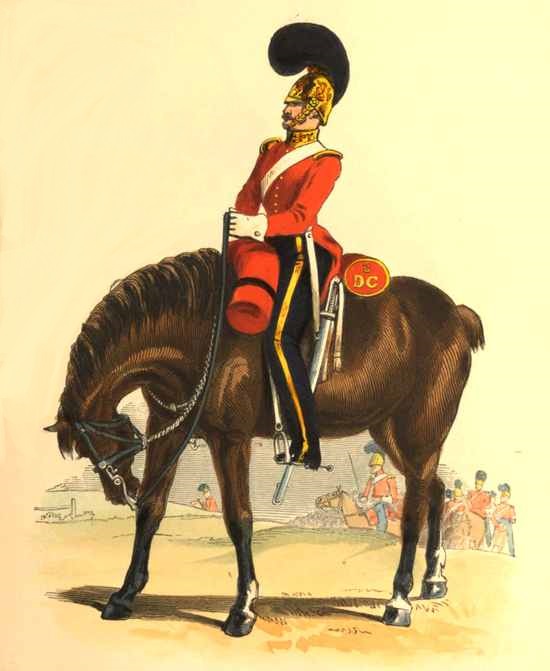
Third Dragoon Guards, 1838. [To face page 112.