HISTORICAL RECORD (continued 2)
Reading edition
Lieutenant-General Lord William Bentinck continued in command of this division of the army until the 23rd September, 1813, when his Lordship issued the following General Order, dated Tarragona, 23rd September, 1813:—
"The Commander of the Forces deeply laments that he is compelled to leave the army. It is a pleasing part of his duty to express his perfect satisfaction with the subordination and perseverance displayed by the troops upon all occasions.
"He only regrets that the part assigned to this army in the plan of the campaign has not permitted the troops to partake in those brilliant triumphs, which would have been the just recompense of their valour and discipline."
Lieutenant-General William Clinton succeeded Lord William Bentinck in the command of this division of the army on the 23rd September, 1813.
The battle of Vittoria, on the 21st June, gained by the army under the Marquis of Wellington, changed the aspect of affairs in Spain, and the French troops in Murcia made some retrograde movements. The Anglo-Sicilian army advanced; the Tenth left their cantonments on the 5th of July, and, advancing into Catalonia, they once more appeared before the fortress of Tarragona, which was again invested. While before Tarragona, Assistant-Surgeon Rolston lost a leg, and a private soldier lost both feet from cannon-shot. The opposing armies in Catalonia made several movements, and the regiment withdrew from before Tarragona and proceeded to Balaguer.
On the 22nd of August, five hundred men of the Tenth were sent into the interior to cut wood for the use of the army; during their absence a fire was accidentally kindled to the windward of the bivouac ground, and communicating rapidly to the dry grass and shrubs, the ground occupied by the Tenth regiment was soon enveloped in flame. The exertions of the few men of the regiment left in the lines were impeded by the explosions of the cartridges, and few of the arms and appointments of the corps were saved: four hundred stand of arms, and about the same number of sets of accoutrements, knapsacks, and suits of clothing were destroyed. By this accident the regiment was rendered unfit for the field; it embarked for Salo, and on arriving there, all the tailors and other mechanics were employed to refit it. Arms were also procured, and it was so speedily re-equipped, that it returned to the seat of war in the beginning of September: having landed at Villa Nova on the 5th of that month, it went into cantonments at Villa Franca.
On the evening of the 12th of September, the advanced corps of the Anglo-Sicilian army posted at Ordal were attached and overpowered by the superior numbers of the enemy. The Tenth were suddenly ordered out at two o'clock on the following morning, and they formed across the road, covering the retreat of the broken remains of the corps in advance. At daybreak the French cavalry appeared, advancing rapidly and in great force, when the regiment commenced retiring, and skirmishing with the enemy during the retrograde movement; the army falling back towards Tarragona. In the evening the regiment took post on a height near Vendrills, where it halted several hours, and afterwards continued its retreat to the vicinity of Tarragona.
On the 24th of September, the regiment marched into quarters at Valls, and in October it was removed to Vendrills.
The brilliant success of the allied army under the Marquis of Wellington, and the disasters of Napoleon in Germany, had a great effect upon the war in Catalonia, and the troops under Marshal Suchet withdrew from several posts. The Tenth marched, in February, 1814, to the vicinity of Barcelona, and formed part of the force employed in the blockade of that fortress.
1814
Hostilities were terminated in April by a treaty of peace; Buonaparte was removed from the throne of France, and the Bourbon family restored.[8] The Tenth withdrew from before Barcelona, marched to Tarragona, and embarked at that port on the 25th of April; on the 19th of May they landed at the beautiful city of Palermo, situate in a bay on the northern coast of Sicily, where they went into barracks.
In March, 1814, the second battalion embarked from Sicily, and landed on the island of Malta on the 24th of that month.
1815
The return of Napoleon Buonaparte to France from Elba, and the declaration of war against the usurper by the allied sovereigns, in the spring of 1815, occasioned the Tenth to be removed from Sicily. They proceeded, in the first instance, by sea, from Palermo to Melazzo, and were stationed in the castle; at the same time the grenadier and light companies joined the flank battalion formed at Melazzo. The battalion companies afterwards sailed for Naples, where they landed on the 25th of May; three days after landing they went on board of two Neapolitan line of battle ships, "Geochinria" and "Carpi," and proceeded to Malta, where they landed on the 9th of June, and occupied Fort St. Elmo barracks.
The battle of Waterloo was succeeded by the flight of Buonaparte from France, and his surrender to the captain of a British man-of-war. Three hundred men of the Tenth, commanded by Lieut.-Colonel J. O. Beyer were detached to Fort Emanoel, in charge of the Duke of Rovigo, Lieut.-General L'Allemand, and six other French officers who had belonged to the suite of Buonaparte: these officers had been sent to Malta as state prisoners.
1816
Peace being restored, the army was reduced; the two battalions of the Tenth regiment, at Malta, were incorporated, and the invalids and limited-service men were sent to England; this took place in January, 1816.
The good conduct of the regiment during the period it was employed on the eastern coast of Spain, in 1812, 1813, and 1814, was rewarded with the royal authority to bear the word "Peninsula" on its colours.
1817
In August, 1816, the regiment commenced embarking by detachments from Malta, for Corfu, where it was stationed until the end of August, 1817, when the head-quarters and five companies, under Colonel Travers, embarked for the islands of Cephalonia and Zante.
1818
On the 21st of March, 1818, five companies embarked from Corfu, under the orders of Major Trickey, for Malta, and occupied the barracks in the Cottonera district.
1819
In March, 1819, the head-quarters embarked from Cephalonia, and the detachment from Zante, for Malta, where the regiment was assembled, and occupied the lower St. Elmo barracks at Valetta, under the command of Lieut.-Colonel Mathew Stewart, who was appointed from half-pay in succession to Colonel Travers, nominated an Inspecting Field-officer of Militia in the Ionian Islands.
1820
During the year 1820, the regiment occupied the barracks in the Cottonera district, with detachments at Floriana, forts Manvel and Tigni, and the island of Giza.
1821
From Malta, the regiment embarked, in April, 1821, for England, and landing at Portsmouth in June, was stationed at that fortress three months; it afterwards sailed to Plymouth, and occupied the citadel and Stonehouse barracks.
1822
In April, 1822, the regiment embarked from Plymouth for Deptford, and after several changes of quarters it was stationed at Chatham and Sheerness.
1823
On the 28th of May, 1823, the regiment embarked at Chatham, for Ireland; after landing at Cork, it proceeded to Fermoy, and in October it was removed to Rathkeale, with detachments at twelve other stations.
1824
On the decease of Lieut.-General the Honorable Sir Thomas Maitland, G.C.B. and G.C.H., King George IV. conferred the colonelcy of the Tenth on Major-General Sir John Lambert, K.C.B. by commission dated the 18th of January, 1824. On the 8th January, 1824, Colonel Sir Robert Travers, was reappointed, in succession to Lieut.-Colonel Stewart, who retired from the service.
1825
In April, the regiment was removed to Fermoy, and Lieut.-Colonel James Payler was appointed on the 2nd June, 1825, from the half-pay, unattached, in succession to Sir Robert Travers, promoted to the rank of Major-General. Lieut.-Colonel Payler assumed the command in June, 1825, and in September following the head-quarters were removed to Templemore.
1826
From Templemore, the regiment was removed, in February, 1826, to Castlebar, where a pair of new colours, bearing a "Sphinx," with the words "Egypt," and "Peninsula," was presented to it by Lieut.-Colonel Payler, the commanding officer, on the 19th of May.
After several changes of quarters, in the autumn of this year the regiment was formed into six service and four depôt companies, at Buttevant, from whence the service companies marched to Cork, where they embarked, in December, for Portugal, the government of which country had solicited British aid, in consequence of an apprehended insurrection, and an invasion from Spain, which threatened to oppose the introduction of a constitution conferring more liberty on the Portuguese people than they had previously possessed.
1827
The service companies, under Lieut.-Colonel Payler, landed at Lisbon, in January, 1827; they formed part of the first brigade under Major-General Sir Edward Blakeney, and advanced up the country to Coimbra. The apprehension of invasion and insurrection ceasing to exist, the regiment left Coimbra, and occupied the palace and convent at Mafra, during the winter.
1828
In March, 1828, the service companies embarked from Lisbon, for Corfu, where they landed on the 31st of that month, and were stationed at Port Raymond barracks. In December a detachment joined from the depôt in Ireland.
1829
During the summer of 1829, the regiment was removed from Corfu to Zante, with detachments at the islands of Cerigo and Paxo.
1830 1831 1832
The head-quarters remained at Zante during the years 1830 and 1831; in May, 1832, they were removed to Corfu, and in July to Vido; but returned to Corfu in December.
1833
Lieut.-Colonel John Henry Belli was appointed on the 17th May, 1833, in exchange with Lieut.-Colonel Payler; and Lieut.-Colonel William Gardner Freer was promoted by purchase on 24th May, in succession to Lieut.-Colonel Belli, who retired.
1836
Lieut.-Colonel W. G. Freer died at Corfu on the 2nd August, 1836, where he was in command of the regiment: he was succeeded by Brevet Lieut.-Colonel William Cochrane.[9]
1837
Lieut.-Colonel W. Cochrane was appointed Assistant Adjutant-General at head-quarters on the 16th June, 1837, and was succeeded by Lieut.-Colonel Holman Custance from the half-pay.
1838
The head-quarters continued to be stationed at Corfu and Vido alternately, until November, 1837, when the service companies of the Tenth were relieved from duty in the Ionian Islands, and embarked for Ireland, where they arrived in December, 1837, and January, 1838, and landed at Cork.
1839
The regiment was stationed in Ireland until May, 1839, when it embarked at Dublin for England; it landed at Liverpool, and was afterwards quartered in Lancashire.
1840
During the year 1840 the regiment was stationed at Burnley and Manchester.
1841
The regiment proceeded to Newcastle-on-Tyne on the 25th June, 1841, and marched from thence to Scotland; it arrived at Edinburgh on the 21st, 24th, and 27th July, and proceeded to Glasgow on the 9th August following.
1842
On the 29th March, 1842, Colonel James Considine was appointed from the half-pay unattached, in succession to Colonel Custance, who was nominated to the command of the Depôt Battalion in the Isle of Wight.
In March, 1842, the regiment left Glasgow, and proceeded in divisions to Winchester. On the 1st April, it was augmented to the India establishment, preparatory to its embarkation for Bengal. It proceeded to Gravesend, and embarked in freight ships for Calcutta in April and May, 1842, under the command of Colonel Considine, K.H. The regiment disembarked at Calcutta in August and September of that year.
Lieut.-Colonel Gervas Power was promoted on the 8th April, 1842, on the augmentation of the regiment: he died at Calcutta on the 30th December following; and was succeeded by Lieut.-Colonel John Luard, who was promoted from the twenty-first Royal North British Fusiliers on the 31st December.
1843 1844
The regiment remained at Fort William, Calcutta, until the 15th November, 1844, when it marched for Meerut under the command of Major Franks.
1845
The head-quarters arrived at Meerut on the 22nd February, 1845.
Lieut.-Colonel Luard exchanged to the half-pay on the 28th March, with Colonel Sir George Couper, Bart., who retired from the service, and Lieut.-Colonel Thomas H. Franks was promoted by purchase, on the 28th March, 1845. Colonel James Considine died at Meerut on the 4th September, from an attack of cholera, and was succeeded by Lieut.-Colonel C. L. Strickland on the 5th September.
1846
The regiment marched from Meerut, under the command of Lieut.-Colonel Franks, on the 16th December, 1845, and joined the Army of the Sutlej on the 8th January, 1846, both officers and men animated with the laudable desire to share the dangers, and to reap some of the laurels already acquired by the army in this brief but exciting campaign.
A month, however, passed without the main army being employed in any occurrence of note, the Governor-General and Commander-in-Chief taking advantage of the interval to collect the munitions of war; while on the other hand, the Sikhs, having been strengthened by reinforcements, continued to hold strong positions on the banks of the Sutlej; and notwithstanding their defeat in the battles of Moodkee and Ferozeshah on the 18th, 21st, and 22nd December, 1845, they subsequently formed a strongly entrenched camp at Sobraon. Although the intelligence of the victory of Aliwal on the 28th January, 1846, and the sight of the numerous bodies which floated from the vicinity of that battle-field to the bridge of boats at Sobraon, apparently disheartened the enemy, and caused many of them to return to their homes, yet in a few days they appeared as confident as ever of being able in their entrenched position to defy the Anglo-Indian army, and to prevent the passage of the Sutlej.
The heavy ordnance having arrived on the 8th February, the day on which the forces under Major-General Sir Henry Smith, who had been detached to Loodiana, and had obtained a signal victory over the enemy at Aliwal, rejoined the main body of the army, it was determined on coming at once to a battle with the Sikhs, to storm their entrenchments, and finally to drive them out of Hindoostan. This was an undertaking of some magnitude. From observations made during the time the head-quarters of the army were stationed at the village of Nihalkee, it was ascertained that the position at Sobraon was covered with formidable entrenchments, and defended by thirty thousand of the élite of the Khalsa troops; besides being united by a good bridge to a reserve on the opposite bank of the river, on which was stationed a considerable camp, with artillery, which commanded and flanked the enemy's field-works on the British side of the Sutlej.
About daybreak on the 10th February, the mortars, battering guns, and field-artillery were disposed on the alluvial land, embracing within its fire the enemy's works. As soon as the sun's rays cleared the heavy mist which hung over the plain, the cannonade commenced, but notwithstanding the admirable manner in which the guns were served, it would have been visionary to expect that they could, within any limited time, silence the fire of seventy pieces of artillery behind well-constructed batteries, or dislodge troops so strongly entrenched. It soon became evident to the Commander-in-Chief, General Sir Hugh Gough, that musketry and the bayonet must ultimately decide the contest.
Accordingly the seventh brigade, in which was the Tenth foot, reinforced by the fifty-third regiment, and led by Brigadier Stacy, was ordered to head the attack, to turn the enemy's right, to encounter his fire before his numbers were thinned, or spirit broken, and (to use the soldier-like expression of the Commander-in-Chief General Sir Hugh Gough) "to take off the rough edge of the Sikhs in the fight." An opportunity was now afforded for the Tenth to distinguish itself, and the regiment nobly availed itself of this opportunity. At nine o'clock the brigade moved on to the attack over the sandy flat in admirable order, halting to correct, when necessary, any imperfections in its line. For some moments, notwithstanding the regularity and coolness of the assault, so hot was the fire of the Khalsa troops, that it seemed almost impracticable to gain the entrenchments. A brief halt ensued, the brigade again advanced, and persevering gallantry triumphed. The Tenth foot, under Lieutenant-Colonel Franks, now for the first time brought into serious contact with the enemy, greatly distinguished itself. With cool and steady courage, the regiment marched on with the precision of a field-day, and never fired a shot until within the works of the enemy[10]—a forbearance much to be commended, and worthy of constant imitation, to which the success of the first effort, and the small loss sustained by the regiment, may be attributed.[11]
Other brigades, at the moment of this successful onset, were ordered forward in support. The thunder of upwards of one hundred pieces of ordnance reverberated through the valley of the Sutlej, and it was soon perceived, that the weight of the whole force within the enemy's camp was likely to be thrown upon the two brigades (sixth and seventh) that had passed the trenches.[12] The Sikhs fought with the energy of desperation, and, even when some of their entrenchments were mastered with the bayonet, endeavoured to recover with the sword the positions they had lost. It was not until the weight of all three divisions of infantry, in addition to several regiments of cavalry, with the fire of every piece of field-artillery that could be sent to their aid, had been felt, that the enemy gave way. The Sikh regiments retreated at first in tolerable order, but the incessant volleys of the British soon caused them to take to a rapid and discomfited flight. Masses of them precipitated themselves on to their bridge, which being broken by the fire of the British, was incapable to sustain the multitude pressing forward, and the sudden rise of the Sutlej rendered the ford almost impassable, adding another obstacle to the escape of the enemy. A dreadful carnage ensued. The stream was red with the bodies of men and horses, the bridge in many places had given way, and it is considered, that, at least a third of the Sikh army perished in this battle; sixty-seven of their guns fell into the hands of the victors, together with two hundred small camel-swivels (zumboo-rucks), numerous standards, and vast munitions of war.
In this manner ended the Battle of Sobraon; at six in the morning it commenced; at nine it became a hand-to-hand conflict; and by eleven the victory was gained.
The Tenth regiment had Lieutenant Walter Yonge Beale, one serjeant, and twenty-eight rank and file killed. Lieutenants Henry R. Evans and Charles J. Lindam, two serjeants, and ninety-eight rank and file wounded.
Her Majesty has been graciously pleased to authorise the Tenth regiment to bear on its colours and appointments the word Sobraon, in commemoration of its gallantry in that battle; and Lieutenant-Colonel Thomas Harte Franks was nominated a Companion of the Most Honourable Military Order of the Bath.
The regiment left Nihalkee on the 11th February, crossed the Sutlej on the 13th, and on the 20th of the same month arrived before Lahore, where it was present at the occupation of that city, and at the signing of the treaty, which, while it convinced the world of the moderation and justice of the paramount power of India, is calculated to add to the stability of the Anglo-Indian empire, and also to provide for the future tranquillity of the Punjaub, by maintaining a Sikh government at Lahore, capable of controlling its army, protecting its subjects, and securing the British frontier against similar acts of aggression.
On the 23rd of March, 1846, the regiment marched from Lahore, recrossed the Sutlej on the 26th of that month, and arrived at Meerut on the 15th of April following. It marched again from Meerut, en route to Ferozepore, on the 27th of October, 1846, and arrived in cantonments on the 20th of November, where it remained encamped until the 28th of December, when it again proceeded to Lahore, under the charge of Lieutenant-Colonel Strickland, with a body of troops under the command of Lieutenant-Colonel Franks, and occupied quarters in the garrison of that city on the 2nd of January, 1847.
1847
The Tenth regiment continued in the occupation of Lahore, as a part of the garrison of that city, to the end of the year 1847, at which period this record is concluded.
Notes to Pages 45 and 59.
Page 45.—In 1783, the regular regiments of infantry were authorised to assume "County Titles," in order to promote the recruiting service, and the Tenth was directed to bear the title of North Lincolnshire Regiment in addition to the numerical title.
Page 59.—Lieutenant-General Lord William Bentinck returned to Sicily in October, 1813, and in February, 1814, he proceeded with a body of English and Sicilian troops, amounting to 6,500 men, from that island to Leghorn, from whence he published a Proclamation, inviting the Italians to shake off the French yoke: he subsequently landed his combined troops, and after a few slight actions made himself master of Genoa, on the 18th April, 1814. On the termination of the War in 1814 His Lordship retired for some time to Rome.
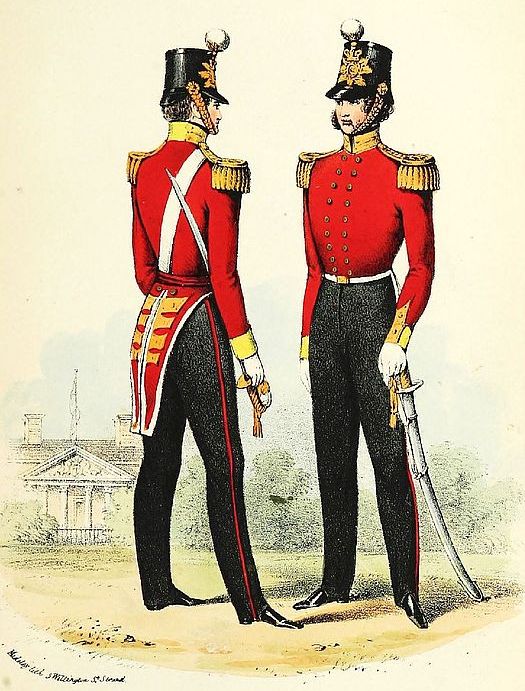
Madeley lith. 3 Wellington St. Strand.
TENTH FOOT.
1848.
For Cannon's Military Records.