HISTORICAL RECORD (continued 2)
Reading edition
1810 1811 1813 1814
While the British troops were triumphant over the legions of Napoleon, in Portugal, Spain, and the south of France, the Inniskilling dragoons were detained on home service in Ireland. In the summer of 1810 they marched to Dublin; in November, 1811, to Ballinasloe; in March, 1813, to Belturbet; in May following, to Tullamore, and in April, 1814, to Dublin, from whence they embarked for Liverpool, where they arrived on the 3rd of May, and proceeding to York, halted there three months, and afterwards marched to Nottingham.
While the regiment was in Ireland, the cocked hats and feathers were replaced by brass helmets, and the high boots and breeches by cloth trousers and short boots.
Meanwhile the victories of the British army had been followed by the removal of Napoleon from the throne of France, and the re-establishment of tranquillity in Europe: the numbers of the regiment were consequently reduced from ten to eight troops.
1815
The return of peace was followed by public rejoicings throughout the country; but scarcely had these subsided, when news arrived of the return of Bonaparte to France; of the flight of Louis XVIII. from the capital; and of the re-assumption of the imperial dignity by the usurper. Preparations for war immediately commenced; the establishment of the Inniskilling dragoons was augmented, and six troops, mustering four hundred and fifty officers and men, under the command of Colonel Joseph Muter, were selected to proceed on foreign service; the depôt troops commanded by Brevet Lieutenant-Colonel Ellice, were stationed at Ipswich.
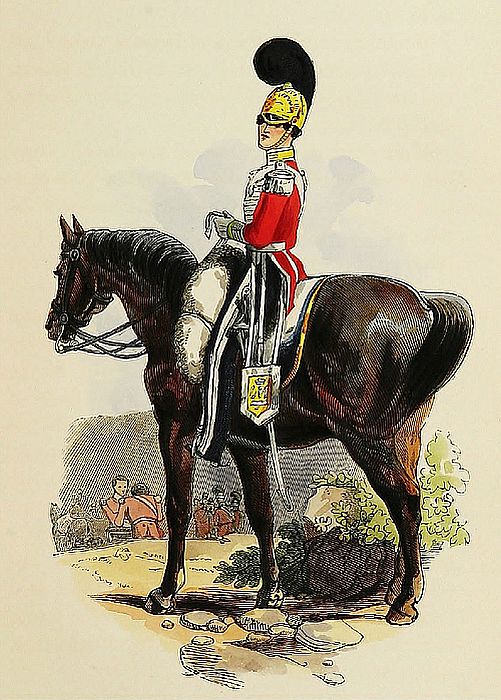
Sixth (Inniskilling) Dragoons, 1815.
[To face page 80.
The six troops destined for service abroad proceeded, in April, 1815, to Gravesend, where they embarked for Ostend; some delay was occasioned by contrary winds; but the whole reached Flanders in safety, and on the first of May they were in quarters beyond Bruges, from whence they removed a few stages further up the country. A British, Hanoverian, and Brunswick force was assembled in Belgium under Field-Marshal His Grace the Duke of Wellington, and the King of the Netherlands placed his troops under the orders of the British commander. The Sixth were formed in brigade with the royal dragoons and Scots greys, commanded by Major-General Sir William Ponsonby, K.C.B. They were reviewed by the Prince of Orange, and Lieutenant-General the Earl of Uxbridge, commanding the cavalry, on the 24th of May; and on the 29th of that month they were seen, together with the other cavalry corps and the royal horse artillery, by the Duke of Wellington, who was accompanied by Marshal Von Blucher, the commander of the Prussian army.
The Inniskilling dragoons reposed in cantonments among the Belgic peasantry about six weeks; being stimulated by the fame acquired by several corps in the Peninsular campaigns, from 1808 to 1814, they were eager for an opportunity to signalize their intrepidity and prowess against the enemies of their country, and this opportunity was soon afforded them. About four o'clock on the morning of the 16th of June, they were suddenly aroused by the notes of the bugle summoning them to assemble, mounted, at the alarm posts. Springing from their beds with alacrity, they were speedily equipped, and, as the Belgic husbandmen commenced their labours in the field, the Inniskilling dragoons were seen directing their march towards Quatre Bras, where the French divisions, under Marshal Ney, had suddenly attacked the advance-posts, while Bonaparte assailed the Prussians at Ligny with the main body of his army. Continuing its route by Enghien, Brain-le-Conte, and Nivelles, the regiment arrived at the scene of conflict a little before midnight; the hostile forces were reposing on their arms; and the Sixth bivouacked behind the position, in a corn-field on the left of the road from Charleroi to Brussels.
The Prussians having retreated, the Duke of Wellington made a corresponding movement, and the Inniskilling dragoons were employed in covering the retreat of the infantry and artillery to the position of Mont St. Jean, in front of the village of Waterloo. On passing through Genappe, a heavy thunder-storm deluged the country and put a stop to the firing; but as the atmosphere cleared, the scene became particularly interesting; the cavalry brigades were manœuvring in the face of the adverse army; the loud tones of the artillery, the fire of skirmishers in the fields, the seventh hussars and first life guards charging the French lancers in the streets, while Bonaparte urged forward his numerous squadrons, thinking to overwhelm the British horsemen, presented to the eye an animating and splendid spectacle. On arriving at the heights of Mont St. Jean, an opposition was presented to the French emperor, which he despaired to overcome that evening, and the hostile forces confronted each other during the night, the men and horses being exposed to a continual rain.
On the morning of the memorable 18th of June, the army appeared in order of battle. The Royals, Greys, and Inniskilling dragoons, were formed on the left of the road leading from Brussels to Charleroi, to support Lieutenant-General Sir Thomas Picton's division of infantry, which crowned the heights in front of the brigade. At ten o'clock the French appeared on the opposite heights, from whence a cloud of skirmishers was sent forward; the artillery gradually opened its fire, and about noon the enemy's columns traversed the intervening space, and one of the most sanguinary, hard-contested, and important battles recorded in the annals of war commenced: a battle in which the fate of kingdoms, and the destiny of millions, was decided by British skill, and by British valour.
After failing in reiterated assaults on the post of Hugomont, simultaneous attacks were formed; one of cuirassiers against the centre, which was defeated by the British household cavalry; and one of infantry against the left of the position occupied by the allied army. The formation of columns was partly concealed by the nature of the ground; but the glistening of bayonets was seen at intervals, above the undulations which form the features of this sanguinary field.
Twenty thousand infantry appeared on the heights opposite the spot where the Inniskilling dragoons were formed, and rushing forward with that eager velocity which characterizes the first attack of French soldiers, they traversed the intervening space with astonishing expedition, dispersed a Belgic brigade with which they first came in contact, broke through parts of the British supporting infantry, and ascended the position occupied by the allied army. A favourable opportunity for the Royals, Greys, and Inniskilling dragoons to charge presented itself; the Earl of Uxbridge galloped up to the three regiments, and they instantly deployed and advanced against the dark masses of the enemy. A spirit of emulation, and a thirst for glory, beamed in the countenances of the officers and men, as they moved forward in firm array, presenting a noble spectacle of nine squadrons of superb heavy cavalry, whose warlike appearance and resolute bearing excited admiration. The French columns were urging forward with rapid steps as to certain victory; crowds of infantry and artillery fled before them; and as they ascended the crest of the position, they presented a menacing and alarming aspect. An important crisis in the battle had arrived, and stupendous results depended on the valour of the Royals, Greys, and Inniskilling dragoons. The three regiments advanced steadily to meet these numerous and formidable bands of opponents, who were concealed from their view by the rising ground: they paused a short time to permit the retreating infantry and artillery to pass through the intervals of squadrons, and the next moment these powerful horsemen raised a loud and terrific shout, and rushed furiously upon the adverse ranks of war. The spectacle was grand, and the result glorious to the British arms. The French masses being unable to deploy, the heads of columns were instantly broken and forced back; confusion ensued, the firing ceased, a general flight commenced, and as the smoke cleared away the British dragoons were seen plunging their horses into the midst of the broken columns, and cutting down the French musketeers with a terrible carnage, until the slope of the position was literally covered with slain. Crowds of French soldiers threw down their arms and surrendered; while others cast themselves on the ground to escape the victorious troopers. The Royals and Greys took each an eagle: the Inniskilling dragoons cut off from their own lines and made prisoners a numerous body of French infantry, with whom part of the regiment was detached to the rear. The brigade continued its victorious course, spreading terror, carnage, and dismay over the field: it crossed the ravine, carried several batteries, and penetrated to the rear of the enemy's position. Pursuing their opponents too far, the Inniskilling dragoons were, on returning, charged by a numerous body of the enemy's lancers, and sustained considerable loss.
Major-General Sir William Ponsonby having been killed by the lancers, the command of the brigade devolved on Colonel Muter of the Inniskilling dragoons; and that of the regiment on Lieutenant-Colonel Fiennes Miller, who had previously had his horse killed under him, and had received several bayonet wounds, but having had his wounds dressed, and procuring a horse which had belonged to a French officer of lancers, he kept his post at the head of the regiment.
The brigade having re-formed, was stationed behind a little wood, where it remained, protected from the enemy's incessant fire of shot and shells by some high ground and by the trees, until about four o'clock in the afternoon, when it was ordered to the right of the position, and there suffered severely from a heavy cannonade.
Lieutenant-Colonel Miller was again wounded about five o'clock, and withdrew, leaving the regiment under the command of Captain Madox. About half-past five Colonel Muter was wounded, and the command of the brigade devolved on Lieutenant-Colonel Clifton, of the royal dragoons.
In the general attack made on the French army at the close of the day, the brigade had another opportunity of distinguishing itself, and, although it was reduced to a very small number of officers and men by casualties and parties detached to the rear with prisoners, yet it proved victorious over every description of force which opposed its advance. The French army sustained a decisive overthrow. The troops under the Duke of Wellington halted on the field, surrounded by cannon and other trophies of victory, while the Prussians, who had arrived at the close of the action, pursued Bonaparte's discomfited legions throughout the night.
Thus ended a battle, the greatest of past or present times, the character and importance of which may be estimated by the splendid results, and by the continued peace which has followed. The brigade, of which the Inniskilling dragoons formed part, was commended by the Duke of Wellington in his public despatch.
The regiment had Lieutenant and Adjutant Clusky, two troop-serjeant-majors, three serjeants, four corporals, one trumpeter, seventy-five privates, and one hundred and sixty-four horses killed; Colonel Muter, Lieutenant-Colonel Miller, Captains W. F. Browne, and the Honourable S. Douglas, Lieutenant Hassard, and Cornet Ruffo, three serjeant-majors, six serjeants, five corporals, two trumpeters, eighty-five men, and twenty-seven horses wounded.
Colonel Muter and Lieutenant-Colonel Miller had the honour of receiving the riband and badge of companion of the order of the Bath. Colonel Muter was further rewarded with the decoration of the fourth class of St. Wladimir of Russia, Captain Madox was promoted to the rank of major in the army.
Serjeant-Majors William Seney, John Laws, and Matthew Marshall, Serjeants Hugh M'Mahon, and Johnston Marlow, with Privates William Penfold and Robert Potters, particularly distinguished themselves.
Every officer and soldier present at this engagement received a silver medal; and the subaltern officers, with the non-commissioned officers and privates, were allowed to reckon two years' service for that battle[16].
The royal authority was also given for the regiment to bear the word "Waterloo" on its guidons and appointments.
The regiment advanced in pursuit of the wreck of the French army on the following day; on the 22nd of June it bivouacked at Malplaquet, a village which is celebrated in history as the scene of a desperate engagement, on the 11th of September, 1709, when the army commanded by the Duke of Marlborough gained a victory over the French under Marshals Villars and Boufflers.
Continuing the pursuit of the French army, the Inniskilling dragoons arrived, in the beginning of July, at the vicinity of Paris, and after the surrender of the capital, they went into quarters at the village of Nanterre, where they remained three weeks, and subsequently marched to Rouen. They took part in several reviews of the army commanded by the Duke of Wellington, at which the sovereigns of Russia, Austria, Prussia, and France, were present.
1816
The war having terminated with the restoration of the Bourbon dynasty to the throne of France, and the conclusion of a treaty of peace, the regiment marched to Calais. It embarked for England on the 1st of January, 1816, and after landing at Dover, proceeded to Salisbury, and subsequently to Exeter. At the same time its numbers were reduced to a peace establishment.
1817 1818 1819
In October, 1817, the regiment marched to Birmingham; during the summer of 1818 it proceeded to Scotland and was stationed at Piershill barracks, near Edinburgh. Leaving this station in June, 1819, for Portpatrick, it embarked for Ireland,—arrived at Donaghadee on the 1st of July, and marched into quarters at Gort, in the county of Galway.
1820 1821
The Inniskilling dragoons passed the four succeeding years in Ireland. In 1820 their head-quarters were removed to Longford; and in July, 1821, to Dublin, on the occasion of the auspicious visit of His Majesty King George IV. to this part of his dominions. In August the regiment marched to Newbridge, for the purpose of attending His Majesty at the race-ground of Kildare.
1822
On the 9th of November the Sixth dragoons left Newbridge for Fermoy; in February, 1822, they proceeded to Cahir, and in June following returned to Newbridge, where they remained till December, when they proceeded to Dublin and occupied the royal barracks.
1823
Leaving Dublin in May, 1823, the regiment proceeded to Donaghadee, where it embarked for Scotland on the 6th of June, landed on the same day, and proceeded to Glasgow, where it passed the succeeding twelve months.
1824 1825 1826 1827
From Glasgow the regiment marched in July, 1824, for York; in the summer of 1825 the head-quarters were removed to Manchester; in April, 1826, to Dorchester; and in the following year to Nottingham.
The Earl of Pembroke died in the autumn, and was succeeded in the colonelcy by the Hon. Sir William Lumley, G.C.B., by commission dated the 3rd of November, 1827.
1828 1829
Leaving Nottingham in March, 1828, the regiment proceeded to Ipswich, but returned to Nottingham in October following; and in the summer of 1829 proceeded to Liverpool and embarked for Ireland. After landing at Dublin, it proceeded to Dundalk, where it passed the winter.
1830 1831 1832
In the summer of 1830 the regiment proceeded to Dublin; in July, 1831, the head-quarters were at Longford; and in 1832 at Cahir, many detachments being furnished in aid of the civil power during these years.
1833
The Regiment proceeded, in March, 1833, to Dublin, where it embarked for England, and after landing at Liverpool, marched to Scotland, and was stationed at Edinburgh.
1834 1835 1836 1837
From Scotland the regiment marched in the summer of 1834 to England, the head-quarters, proceeding to Nottingham; in 1835 to Ipswich; in 1836 to Brighton; and in 1837 to Dorchester.
1838 1839
In the summer of 1838 the regiment marched to Bristol and embarked for Ireland; it landed at Cork on the 4th of June, and proceeded from thence to Cahir. In April, 1839, it was removed to Newbridge, and in July to Dublin.
1840
In April, 1840, General the Honourable Sir William Lumley, G.C.B., was removed to the first dragoon guards, and was succeeded in the colonelcy of the Sixth dragoons by Lieutenant-General Sir Joseph Straton, K.C.H., from the eighth hussars; and this officer dying in October following, the colonelcy was conferred on Lieutenant-General Sir George Pownall Adams, K.C.H., by commission dated the 26th of October, 1840.
In the summer of this year the head-quarters were removed to Newbridge, and several detachments were furnished in aid of the civil power.
1841
The regiment proceeded to Dublin in the spring of 1841, embarked for Liverpool, and the head-quarters were afterwards established at Birmingham.
1842
In May, 1842, the regiment commenced its march for Scotland, and was quartered at Glasgow and Edinburgh; the whole assembling at Edinburgh in August.
On the visit of Queen Victoria to Scotland in September of this year, the Inniskilling dragoons had the honour to receive Her Majesty on landing at Granton Pier, and to furnish guards of honour, and all the Royal escorts at Edinburgh, and as far as Perth, on Her Majesty's journey to the north of Scotland. The regiment also attended the Queen to Granton Pier, when Her Majesty re-embarked for London on the 15th of September.
1843
Routes were received in the spring of 1843, for the regiment to march to England, when the following general order was issued, dated
"Edinburgh, April 1, 1843.
"Major-General Sir Neil Douglas cannot permit the Inniskilling dragoons to quit the North British district without expressing to Lieutenant-Colonel White, the officers, non-commissioned officers, and soldiers of that regiment, his perfect satisfaction with their conduct during the time they have been under his command. It appears very evident that the exertions of the officers have succeeded in instilling into the minds of their men, that, next to distinguished valour in the field, nothing can more fully establish the character of a British soldier than quiet, peaceable, and subordinate behaviour in quarters, which the Sixth dragoons have so eminently displayed while stationed in North Britain. Nor can the Major-General forget the manner in which the regiment performed the honorable duties assigned to it during Her Majesty's visit to her northern dominions, which called forth approbation from the highest authorities. In taking leave of the regiment the Major-General begs to assure the officers, non-commissioned officers, and men of the Sixth dragoons, that they carry with them his sincere and hearty wishes for their prosperity and honour, wherever their country may require their services.
"By order of Major-General Sir Neil Douglas, K.C.B. and K.C.H.
(Signed) "Rt. Kerr, Colonel, "Assistant Adjutant-General."
On arriving in England the head-quarters of the regiment were established at Leeds; in October the regiment marched from that station to Nottingham.
1844 1845
The Regiment remained at Nottingham until June 1844, when it proceeded to Brighton, and remained there until April 1845, when it marched to Birmingham.
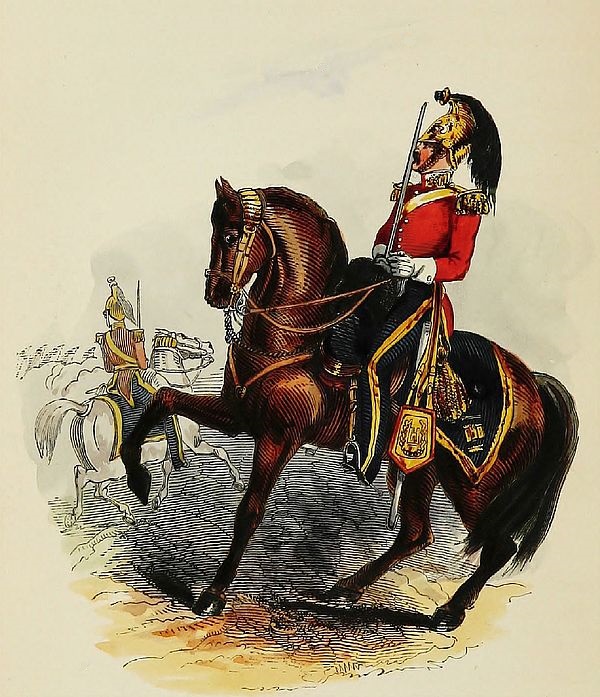
Sixth (Inniskilling) Dragoons, 1843.
[To face page 95.
1846
In April, 1846, the regiment embarked at Liverpool for Ireland, and on its arrival at Dublin it proceeded to Newbridge, from whence it marched in May to Longford, where the head-quarters are now stationed.
The Sixth, or the Inniskilling Regiment of Dragoons, was originally composed of men who evinced an example of valour, constancy, and devotion to the interests of civil and religious liberty, as established by law, at a period of peculiar difficulty and danger, such as seldom has been witnessed in the United Kingdom; and their heroic gallantry ensured to their country the blessings of constitutional monarchy. Loyalty, courage and obedience, have been evinced by the officers and soldiers of the regiment from that period to the present time; and whether in the war of the Austrian succession,—in the seven years' war in Germany,—the early campaigns of the war of the French revolution,—or on the memorable field of Waterloo, the same valour and constancy have been displayed, which shone so brilliantly in the first members of the corps. Being equally conspicuous for good conduct on home service, the regiment has always possessed the confidence, and ranked high in the estimation, of the sovereign and of the country.
1846.
FOOTNOTES:
SUCCESSION OF LIEUTENANT-COLONELS
OF
THE SIXTH, or THE INNISKILLING REGIMENT of DRAGOONS.
NAMES.Date of Appointment.REMARKS.
Robert EchlinDec. 31, 1689{Promoted Colonel of the Regiment in 1691
Henry CunninghamDec. 30, 1691{Promoted Colonel of the 8th Dragoons in 1693
Sir Richard Vernon
John Upton
Alexander MontgomeryMarch 30, 1711
James GardinerJan. 24, 1730{Promoted Colonel of the 13th Dragoons in 1743
Cuthbert EllisonApril 19, 1743
Sir John Whitefoord, Bart.March 19, 1745{Promoted Colonel of the 12th Dragoons in 1750
Charles William TonynJan. 3, 1750Died May, 1754
Edward HarveyMay 29, 1754{Promoted Colonel of the 12th Dragoons in 1763
Robert Rickart HepburnMarch 18, 1763Retired in 1768
John WhitemoreJune 24, 1768
Lord Robert KerrJuly 23, 1773Died in 1781
Francis Augustus Eliott, afterwards second Lord Heathfield}March 23, 1781{Promoted Colonel of the 29th Dragoons in 1795
William GunnMarch 1, 1794Augmentation—Retired in 1796
John PrinceMarch 25, 1795Promoted Major-General in 1809
Ralph BatesOct. 26, 1796Retired in 1799
George Richard MartinJune 12, 1799Retired in 1800
Richard O'DonovanMay 2, 1800Promoted Major-General in 1813
Joseph Muter, afterwards Sir Joseph Straton, K.C.H.}June 4, 1813{Promoted Major-General in 1825, afterwards Colonel of the Regt.
Edward KeaneJune 2, 1825Appointed to the 7th Hussars in 1830
Lord George LennoxJune 15, 1830Retired in 1832
Edmund Meysey Wigley Greswolde}July 27, 1832Died in 1833
Henry Madox, K.H.Jan. 18, 1833Exchanged to half-pay in 1838
Jeremiah Ratcliffe, K.H.June 9, 1838Exchanged to half-pay in 1840
Raymond WhiteJuly 17, 1840Exchanged to half-pay in 1843
Willoughby MooreJuly 28, 1843