HISTORICAL RECORD (continued 2)
Reading edition
1812
On the 1st of January, 1812, the first battalion mustered upwards of thirteen hundred officers and soldiers, and it was immediately afterwards employed in the siege of Ciudad Rodrigo, which was undertaken in the winter. This fortress was captured by storm during the night of the 19th of January, 1812, while the French marshal was assembling an army to advance to its relief. The loss of the Royal Fusiliers, during the siege, was limited to two men killed and eight wounded. After the capture of Ciudad Rodrigo the regiment remained at the village of Cileçes el Chico, where it was detained several days by the swelling of the Agueda from heavy rains: it subsequently retired and went into cantonments.
After withdrawing from before Ciudad Rodrigo, the regiment was allowed only a short period of repose before it was called upon to march to Spanish Estremadura, to take part in wresting the strong fortress of Badajoz from the enemy. Leaving its cantonments near Fuentes d'Onor on the 27th of February, it proceeded southwards; boats were laid over the Guadiana on the 15th of March, and on the following day Badajoz was invested by the third, fourth, and light divisions; the Royal Fusiliers, forming part of the fourth division, were engaged in the siege. The batteries were opened, and, notwithstanding the sallies of the French garrison under the resolute General Phillipon, inundations from heavy rains, and other obstructions, practicable breaches were ready in the early part of April; and on the evening of the 6th of that month the Royal Fusiliers were under arms to take part in the storming of that stupendous fortress. The fourth and light divisions were to march against the breaches; the light division was to assault the bastion of Santa Maria, and the fourth, the Trinidad, with the breach in the curtain connecting the two bastions; one body of the grenadiers of the fourth division, under Captain John Mair, of the Royal Fusiliers, led the attack against the bastion of Trinidad; and another body, under Captain William Francis Cholwick, also of the Seventh, led the assault on the breach in the curtain.
Moving silently from their camp-ground along the left of the river Rivillas and the inundations, the fourth and light divisions made a short detour, and arrived at the glacis at the moment the third division attacked the castle. Ladders were placed, and about five hundred men of the light division had descended into the ditch with the most heroic bravery, cheering as they went, when suddenly a loud report like thunder was heard, and the storming parties were blown to pieces by the explosion of hundreds of shells and powder barrels. Undismayed by this terrific destruction, the men of the light and fourth divisions raised a loud shout and plunged into the ditch, where many men perished in the inundations; others, after overcoming numerous difficulties, approached the breach exposed to a most destructive fire. As they ascended, loose planks studded with sharp iron points wounded their feet and produced great mischief, and a range of sword-blades with sharp points and keen-edges, firmly fixed in beams chained together and set deep in the ruins, arrested the progress of the soldiers; at the same time a terrible fire of musketry thinned their ranks. Again the assailants rushed up the breaches with the most determined resolution; but the sword-blades stopped their career, and the thundering powder-barrels and hissing shells exploded continually. Numerous and astonishing efforts of valour and intrepidity were made, and the most heroic bravery displayed, yet the obstacles were such as could not be overcome; and about midnight, when two thousand brave soldiers had fallen, the survivors received orders to retire, and re-form for a second attack. In the meantime the third division had captured the castle, and a brigade had carried the bastion of San Vincente; the town was thus forced; partial actions afterwards took place in various places; and the governor escaped to the fort of St. Christoval, where he surrendered. Thus, by the union of ability, energy, and valour, two important fortresses were captured in three months, in the face of two French armies: the British commander was enabled to enlarge the sphere of his operations, and these successes appeared as the first rays of the coming glory which was about to shine resplendently on the British arms.
The Royal Fusiliers were subsequently honoured with the royal authority to bear the word "Badajoz" on their colours; Lieutenant-Colonel Blakeney and Captain John Mair received medals; but the regiment had to regret the loss of many brave men; the casualties among the officers were so great that the command of the division devolved on a major, all the general officers and lieutenant-colonels being wounded. The loss of the Seventh may be seen in the following returns.
List of the Officers of the Royal Fusiliers at the siege of Badajoz.
Lieutenant-Colonel Edward Blakeney, wounded.LieutenantPaul St. Paul, killed.
Major James Singer, killed."T. Moses, wounded.
CaptainWm. F. Cholwick, killed."A. Baldwin, wounded.
"George King."James Anderson.
"A. C. Wylly."H. F. Devey, wounded.
"John Mair, wounded."G. Henry, wounded.
"W. M. Hamerton."Pitt Hannam.
"[21]Robt. Cuthbert, killed."W. A. Pyke, killed.
Lieutenant Charles Barrington, wounded."John George, wounded.
"T. F. Wray, killed.Adjutant James Hay.
"T. Hartley, wounded.Quarter-Master John Hogan.
"R. F. Fowler, killed.Surgeon Wm. Armstrong.
"H. R. Wallace.Assistant-Surgeon Martin Mahony.
"T. Y. Lester, wounded."William Williams.
"R. Knowles, wounded.
"Honourable F. Russel, wounded.
Officers.Serjeants.Drummers.Rank & File.Total.
Killed72..5766
Wounded1112..143166
——————————
Total1814..200232
From Estremadura the Royal Fusiliers retraced their steps to the Agueda, and the army, advancing into Spain in June, drove the French from Salamanca. The inhabitants of this city illuminated their houses, shouted, sang, and wept for joy as the British troops took up a position on the mountain of St. Christoval, about five miles in advance; at the same time the forts (fortified convents) at Salamanca were besieged.
The French general, Marmont, advanced with a powerful army, and a series of manœuvres followed; but he was unable to relieve the forts, and they fell into the hands of the allies towards the end of June, when he withdrew beyond the Douro, followed by Lord Wellington.
On the night of the 16th of July the Royal Fusiliers marched to Castrejon, to which place the fourth and light division and a brigade of cavalry proceeded, preparatory to the assembling of the army on the Guarena; but the French commander, having been reinforced, passed the Douro, and attacked the troops at Castrejon on the morning of the 18th of July. Some sharp skirmishing occurred, and the Royal Fusiliers had two men killed and fourteen wounded; but this small body of British, being opposed to the whole French army, withdrew behind the Guarena. A series of manœuvres brought the allied army back to the position of St. Christoval, in front of Salamanca, in the vicinity of which city the two armies confronted each other on the 22nd of July.
In the early part of this day about five hundred French gained possession of a village in front of the fourth division, and Captain John Crowder advanced with two companies of the Royal Fusiliers to dislodge them, which service was performed with such distinguished firmness and resolution, that Lord Wellington, who witnessed the affair, requested to know the name of the officer, and Captain Crowder was rewarded with the rank of major in the army.
During the day, as the enemy attempted to gain the road leading to Ciudad Rodrigo, his left wing was separated, during a complicated manœuvre, from the remainder of his army; Lord Wellington was watching the movements of his opponents from the summit of a rock, and, detecting the fault, ordered his divisions to attack. Thus the two armies came in contact under circumstances which proved the superior abilities of the British commander; the Royal Fusiliers, under Major John Walwin Beatty, were soon hotly engaged, and they steadily gained ground on the French forces opposed to them, driving their opponents from one height to another. Eventually a numerous body of French made a determined stand against the fourth division; but after a severe contest they were obliged to give way. An eminence in the centre of the enemy's position, on which he had planted thirty pieces of artillery, was carried by the Fusilier Brigade with the most distinguished gallantry. Finally the French were overthrown and driven from the field with great loss; and they were indebted to the darkness of the night, the advantage of a thick wood, and other circumstances, for the safety of those who escaped the field of battle.
List of Officers of the Royal Fusiliers at the Battle of Salamanca.
MajorJ. W. Beatty.LieutenantR. Nantes, wounded.
"Geo. King."H. R. Wallace, wounded.
CaptainJno. Crowder."J. Hutchinson, wounded.
"Geo. Prescott, killed."D. Cameron.
"H. English."R. Knowles, wounded.
"W. M. Hamerton, wounded."E. W. Bell.
LieutenantA. Baldwin.Adjutant James Hay, wounded.
"Jas. Anderson.Surgeon J. Williamson.
"G. Henry, wounded.Assistant Surgeon M. Mahony.
"P. Hannam, wounded."W. Williams.
"Johnson, wounded.
"T. Hartley, wounded.
Officers.Serjeants.Drummers.Rank & File.Total.
Killed12..1720
Wounded116..162179
——————————
Total128..179199
The distinguished bravery of the regiment on this occasion was subsequently rewarded with the royal authority to bear the word "Salamanca" inscribed on its colours; and Major Beatty was presented with a gold medal.
Following up the advantages gained on the plains of Salamanca, the army advanced boldly into the heart of Spain, and the French were driven from Madrid, at which city Lord Wellington arrived on the 12th of August amidst the joyful acclamations of the people. The Royal Fusiliers were stationed at Madrid, and afterwards occupied quarters for about eight weeks at the fine palace of the Escurial, about twenty-two miles from Madrid, from whence they were removed in the early part of October to Val de Moro and Campo; meanwhile the siege of Burgos had been undertaken by the main body of the allied army. The concentration of the enemy's forces having given him so great a superiority of numbers that a retrograde movement was necessary on the part of the British commander, the Royal Fusiliers quitted Val de Moro and Campo, and the troops retired on Salamanca. The army went into position; but on the enemy menacing the communication with Ciudad Rodrigo, the allies withdrew to the Agueda, the soldiers suffering extreme hardship from the want of food and inclement weather. The fourth division moved to St. Joā de Pisquiera, where the Royal Fusiliers remained until the beginning of the following year.[22]
1813
On the 1st of January, 1813, the battalion mustered upwards of twelve hundred men, including about three hundred in hospital from wounds, &c. On the 3rd of that month sixteen serjeants and three hundred and eleven rank and file joined from England; on the 7th the battalion moved to Arvidiza, and in February to Castello Melhor on the right bank of the Coa, where it remained until the army took the field in May.
Advancing from the banks of the Coa towards the interior of Spain, the Royal Fusiliers once more confronted the legions of Napoleon; the battalion was strong in numbers, bringing into the field a fine body of men on whose natural strength and valour the qualities of order, subordination, and discipline had been engrafted, which rendered them fit for any service.
By a daring advance the French were once more driven from Salamanca; by combinations evincing consummate skill, and by efforts of an extraordinary character, the enemy's positions on the Douro were turned; the field was then clear for the shock of battle, and the British commander, seeing the way of victory open, ordered forward his divisions; but the French evaded the torrent of war, and withdrew behind the Pisuerga, and afterwards behind the Ebro. Pressing onward with a conquering violence, the allied army traversed rocks and mountains, and marched through regions deemed impracticable for an army, and the French were forced back upon Vittoria, where they prepared for a determined effort to stem the tide of war.
Arriving at the Bayas on the 19th of June, the British found a division of the French army posted behind the river, and an action was commenced. The Royal Fusiliers were directed to attack the village of Montevite. Approaching this rural seclusion through a rocky mountainous country, abounding with trees, the foliage of which concealed their advance, they arrived close to the village unperceived; a few musket-shots alarmed the French, who instantly fled, leaving their cooking utensils and dinner on the fire, and some arms and accoutrements. The Royal Fusiliers pursued, some skirmishing took place, and several men fell in the conflict. The loss of the Seventh was limited to three wounded. The enemy was driven from the position on the Bayas, and forced back upon the Zadora.
From the banks of the Bayas the allied army advanced on the morning of the 21st of June, to fight the French under Joseph Buonaparte in position in front of Vittoria. The Royal Fusiliers formed part of the force destined for the attack of the enemy's centre under the immediate direction of Lord Wellington. They moved from Montevite down by Olabarre, along the valley in the centre. The Royal Fusiliers advanced in line under fire, through fields of corn more than breast high, the French retreating before them; and they overcame numerous obstructions and difficulties with a regularity which excited great admiration. Arriving at the Zadora, they were posted opposite the bridge of Nanclares; and when ordered to cross the bridge they sprang forward with cheerful alacrity and perfect order. The French were eventually driven from the field with the loss of their artillery, baggage, and an immense quantity of treasure. Many soldiers of different corps quitted their ranks to plunder; but it was observed that, when the Royal Fusiliers, pursuing the enemy, passed the French baggage and treasure-waggons, they were so impressed with a sense of the necessity of preserving order, so accustomed to perfect obedience, and jealous of the honour of their corps, that they refrained from irregularities, and followed the enemy with unbroken ranks. A decisive victory was gained: and the excellent conduct of the regiment was rewarded with the honour of bearing the word "Vittoria" on its colours. Lieutenant-Colonel Blakeney was also rewarded with an honorary distinction. The loss of the battalion was only two men killed and two wounded.
The Royal Fusiliers pursued the French army in the direction of Pampeluna, and when the enemy had effected his escape through the Pyrenean mountains, they were employed in the blockade of Pampeluna, a fortress of great strength, and provided with an efficient garrison. They were, however, soon relieved from this duty, and detached against a French division under General Clausel, which was at Logroño when the battle of Vittoria was fought; after a forced march of six days the Fusiliers halted;—the enemy having effected his escape by the pass of Jaca. The regiment afterwards returned to the vicinity of Pampeluna, where it remained a few days, and subsequently penetrated the Pyrenean mountains; the fourth division taking post at Viscayret, in the valley of Urroz, and the Royal Fusiliers being at Espinal, two miles in advance.
Thus the British army, after years of toil and conflict, endured to procure liberty for the oppressed inhabitants of the Peninsula, had forced the intrusive monarch of Spain from his throne, and stood triumphant on the lofty pinnacles of the Pyrenees; but another mighty struggle was at hand, in which the innate valour and hardihood of the British soldiers were about to be tested. The French army had been re-organized by Marshal Soult, who pushed his divisions boldly forward to drive the British from the mountains. The enemy having made a demonstration of an attack on the front posts, two companies of the Royal Fusiliers advanced on the 24th of July to a height westward of Roncesvalles, where they were joined by the remainder of the battalion during the night; on the following morning the enemy attacked Major-General Byng's post in Roncesvalles, and the fourth division was ordered to advance. A detachment of the twentieth regiment evinced signal gallantry in its attacks on the head of a French column; but was forced back by superior numbers. Some sharp fighting occurred during the day, and the Royal Fusiliers had Lieutenant Knowles and six men killed; one serjeant and twenty-three rank and file wounded. The British maintained their positions during the day; but being opposed to very superior numbers, they withdrew after sunset: the Fusilier Brigade being in the rear of the column, under Major-General Ross, the Seventh underwent a night of incessant toil and intense anxiety among the mountains. At day-light they fell in with posts of Major-General Byng's brigade, and the retrograde movement was continued, with short intermissions, until the allies gained a position in front of Pampeluna, where a determined stand was made.
Posted on the heights in front of the village of Villalba, the Royal Fusiliers awaited the approach of their opponents, resolving to perform their duty to their King and country in whatever circumstances they might be placed. Privations, and violent rains soaking the bleak hills, on which the soldiers were posted without any shelter, did not damp their courage, and on the 28th of June they witnessed the approach of the massy columns of the enemy without dismay. The heights occupied by the fourth division were attacked with great fury: the Royal Fusiliers were hotly engaged, and sternly, and with sanguinary tenacity, was the ground contested. Appalling shouts smote the ears of the French soldiers as they stormed the position, and the next moment ranks of British bayonets met them in mid-onset, and in the shock of steel the French soldiers were forced back with a horrid carnage. Four times the Royal Fusiliers precipitated themselves on the hosts of opponents which assailed their post, and on every occasion they proved victorious. The Marquis of Wellington observed in his despatch:—"In the course of this contest the gallant fourth division, which has so frequently been distinguished in this army, surpassed their former good conduct. Every regiment charged with the bayonet,—the fortieth, the Seventh, twentieth, and twenty-third, four different times. Their officers set them an example; and Major-General Ross had two horses killed under him." The battle was renewed on the 29th and 30th of July, and the French commander, being foiled in every attempt by superior skill and unconquerable valour, retired towards France, closely pursued by the victorious allied army.
Officers present at the battle of the 28th of July.
Lieutenant-Colonel E. Blakeney.LieutenantJ. B. Fraser, killed.
Major William Despard, killed."W. Dalgairnes.
CaptainJ. Crowder, wounded."C. Lorentz.
"A. Fernie, killed."Martin Orr.
"Jno. Orr, wounded."J. L. Nunn, wounded.
"Hy. Tarleton."A. L. Estrange.
"C. J. Wemyss, killed."D. Cameron.
"W. M. Hamerton, wounded."R. Haggup.
LieutenantJ. Anderson."J. D. King, wounded.
"W. Wilkinson"Hon. F. Russel.
"R. Johnson."R. Garrett, wounded.
"G. Loggan, wounded.Adjutant Jas. Hay.
"Wm. Payne.Quarter-Master Jno. Hogan.
"Thos. Hartley.Surgeon Mahony.
"J. Huchinson.Assistant-Surgeon W. Williams.
"H. Fisher.
Officers.Serjeants.Drummers.Rank and File.Total.
Killed43..4047
Wounded711..148166
——————————
Total1114..188213
This display of valour on the part of the Royal Fusiliers was rewarded with the honour of bearing the word "Pyrenees" on their colours as a mark of royal favour and approbation; and their commanding officer, Lieutenant-Colonel Edward Blakeney, was also rewarded with an honorary distinction.
The Royal Fusiliers took part in the movements by which the enemy was driven through the Pyrenean mountains back to France; they were also engaged, on the 7th of October, in the operations connected with the passage of the Bidassoa, when the French were forced from several strong mountain positions defended with field-works. The light and fourth divisions advanced against the posts of Vera and Liran, and the attack was successful.
After the passage of the Bidassoa the Seventh were encamped about a month near the bridge of Lezaca and heights of Liran; and drafts amounting to about two hundred serjeants and rank and file were received from the second battalion, then quartered in the isle of Jersey.
On the 10th of November the allied army drove the enemy from his positions on the river Nivelle; the British now stood triumphant and firmly established in France, and the admirers of unprincipled aggression beheld the day of retribution overtake a country which had been vainly styled "sacred;" the deep wrongs of insulted nations were, however, not avenged on the French peasantry, who received less harsh treatment from the allies than from their own countrymen in arms; but the tyrant who had hurled the thunders of war against the unoffending nations of the Peninsula saw them recoil with accumulated fury upon his own head.
Major-General the Honourable Edward Michael Pakenham, Lieutenant-Colonel of the Royal Fusiliers (an officer of such distinguished valour and ability that the regiment was truly proud of its lieutenant-colonel), was promoted on the 21st May, 1813, to the colonelcy of the sixth West India regiment, Lieutenant-Colonel Edward Blakeney, who had so often and so nobly headed the regiment in the field of battle, obtained permission to return to England, and the command devolved on Major John Beatty.[23]
1814
A train of military and political events, not immediately affecting the fame or testing the valour of the Royal Fusiliers, took place in December, 1813, and January 1814. The passage of the Adour and Gave d'Oleron, with the blockade of Bayonne, took place in February, and the French withdrew to a position at Orthes, where they were attacked on the 27th of February. The Royal Fusiliers advanced against the enemy's right at St. Boës, and were thrown forward to commence the action as light troops, and to cover the advance of the columns of attack, a service which the nature of the ground particularly favoured. The brigade, composed of the Seventh, twentieth, and twenty-third regiments, was warmly engaged until two in the afternoon, when the fifth division arrived and took the brunt of the action at that point. Finally the French Marshal was forced to retire with severe loss.
The Royal Fusiliers had one serjeant and five rank and file killed; Lieutenants Burke, Nantes, Lorentz, and Cameron, four serjeants, and fifty-two rank and file wounded; and their gallantry procured them the honour of bearing the word "Orthes" on their colours. Major John Walwin Beatty, commanding the battalion, was rewarded with a gold clasp.
In March the Royal Fusiliers were detached, with other corps, towards Bourdeaux: the French garrison fled at the approach of the British, and the inhabitants declared in favour of the Bourbon dynasty.
The Royal Fusiliers returned to the army, and had the honour to take part in the battle of Toulouse on the 10th of April, when the French were once more defeated. The battalion was not seriously engaged on this occasion, and its loss was limited to one man killed and three wounded. Its gallant bearing was conspicuous, and was rewarded with the word "Toulouse" on its colours, and an honorary distinction for its commander, Major John W. Beatty, who was also promoted to the rank of lieutenant-colonel. Major S. B. Auchmuty, commanding the light companies of the brigade, was rewarded with a medal and the rank of lieutenant-colonel.
The French army withdrew within the town, with the view of defending the place to the last extremity, but subsequently retired, and hostilities were soon afterwards terminated by the abdication of Napoleon and the restoration of Louis XVIII. to the throne of France.
Thus years of toil and bloodshed, which had developed—in vast combinations—in astonishing exhibitions of skill, firmness, iron hardihood, heroic valour—the true character of Wellington and the soldiers he led from kingdom to kingdom, from victory to victory, and had forced all the nations of Europe to confess the glory of the British arms, terminated in the restoration of peace to the troubled states of Europe. The Royal Fusiliers had fought and toiled for the good of other countries; at this glorious termination of their labours, they were placed in quarters of refreshment among the French peasantry, and they received the blessings of the people they had delivered from usurpation and tyranny.
Among the numerous instances in which a very excellent spirit had been displayed by individuals during this arduous struggle, the Record Book of the Royal Fusiliers bears extraordinary testimony of the most laudable and indefatigable exertions of Adjutant James Hay, who, making the duties of his appointment the business of his life, aided with praiseworthy zeal his commanding officer in maintaining the efficiency, discipline, and reputation of his corps, in which he took a lively interest; he was never absent from his regiment during the whole of the Peninsular campaigns, excepting from wounds, and he thus earned an imperishable fame in the annals of the Royal Fusiliers.
At the end of May the regiment was withdrawn from its cantonments, and, proceeding towards Bourdeaux, was encamped a few days near that city; on the 14th of June it was embarked at Pouillac in transport brigs, and conveyed down the Garonne to the "Clarence" (a British seventy-four), lying in Verdun roads. In this ship the regiment sailed to England, where it arrived, after an absence of nearly seven years, towards the end of June, and on landing at Plymouth was greeted with the hearty cheers of crowds of countrymen assembled on the occasion, who testified their admiration of the brilliant career of the regiment in a most lively manner.
After landing, the regiment occupied quarters at Totness for several weeks; it subsequently proceeded to Portsmouth, where both battalions were stationed in garrison; the second battalion having returned in August from Jersey, where it had been stationed since November, 1811.
At the termination of the Peninsular War, Lieutenant-Colonel Edward Blakeney was honoured with the dignity of Knight of the Tower and Sword by the Prince Regent of Portugal; he was also rewarded with a cross and clasp for his services at Martinique, Albuhera, Badajoz, Vittoria, and in the Pyrenees.
The Royal Fusiliers were not long permitted to enjoy repose, before an order from the Horse Guards summoned them to engage in scenes of conflict beyond the Atlantic ocean. The impressing of British seamen on board of American vessels, with the enforcing of certain Orders in Council, designed to counteract the decrees of Buonaparte, who, in the height of his power, endeavoured to destroy the commerce of Great Britain, had been followed by a war with the United States, and the Seventh were selected to proceed with the forty-third light infantry under Major-General Lambert, to join the troops engaged in active service against the American coast. The first battalion was completed to a thousand rank and file from the second, and embarked on the 4th of October, under the command of Lieutenant-Colonel Edward Blakeney; it proceeded, in the first instance, to Plymouth, from whence it sailed to the West Indies.[24]
1815
From the West Indies the regiment sailed towards the southern states of North America, and arrived, on the first of January, 1815, off the coast of Louisiana; it was there removed into small boats, to proceed along Lake Barque to join the army commanded by Major-General the Honourable Sir Edward Michael Pakenham, K.C.B., near New Orleans, a place of some note, situate on the eastern bank of the Mississippi. After a difficult navigation of eighty miles in small boats, the regiment landed (having lost a serjeant and sixteen men by the sinking of a boat on the lake); and on the following day joined the army at its camp on the bank of the Mississippi. Arrangements had previously been made for the attack by storm of a line of entrenchments and redoubts which the Americans had constructed behind a canal to cover the approach to New Orleans, and behind which they had collected an army treble the numbers of the British. A short time before day-light, on the morning of the 8th of January, the Royal Fusiliers were at their post, and forming, with the forty-third, the reserve to the storming party. Some delay occurred; the ladders were not ready at the proper moment; and when the soldiers rushed forward to storm the enemy's works, difficulties were encountered which it was found impossible to overcome. A serious loss had been sustained in killed and wounded; the commander-in-chief had fallen;[25] and no chance of ultimate success remained: when the storming parties fell back, the Seventh and forty-third, deploying into line, and making a forward motion, presented the appearance of a renewed attack, by which the Americans were so much awed that they did not venture to pursue the retreating soldiers; at the same time the two regiments presented so steady and confident a front under a heavy fire as to excite great admiration, and the storming parties rallied and formed in support. No prospect of ultimate success appearing, the troops withdrew to their camp. The loss of the Seventh on this occasion was Major King, Captain Henry, one serjeant, and twenty-three rank and file killed; Captains Mullins and Page, Lieutenant Lorentz and Higgins, six serjeants, and sixty-two rank and file wounded.
The Royal Fusiliers were subsequently employed in occupying posts close to the enemy's position; meanwhile a temporary road was constructed through a morass to the lake, and the British, withdrawing by a night march, embarked in boats and returned to the fleet: the Fusiliers and piquets remained before the enemy until the morning of the 19th of January, when they retired. During the few days the Royal Fusiliers had been before New Orleans, privations and sufferings of every kind had been endured with a cheerfulness which redounded to the honour of the officers and soldiers.
The Fusiliers were afterwards landed on Isle Dauphin, north of Mobile Bay, West Florida. An attack on Mobile was resolved on, and Fort Bowyer, which commanded the entrance to the harbour, was besieged and captured, and two companies of the Seventh garrisoned the fort. Further hostilities were, however, prevented by a treaty of peace; and in March the regiment embarked from the Isle Dauphin, West Florida, for England; two vessels were delayed on the voyage; the remainder, landing at Deal, occupied the barrack at that place until the middle of June. Napoleon Buonaparte had, in the meantime, regained the throne of France: a British army had assembled in the Netherlands, under the Duke of Wellington, to wage war against the usurper; and the Royal Fusiliers were ordered to embark for Flanders to share in the conflict. The first division of the regiment, consisting of the head-quarters and four companies, landed at Ostend on the 18th of June, the day the French army was overthrown at Waterloo, and proceeded in boats up the canal to Bruges. These companies were afterwards assembled at Ghent, from whence they advanced up the country, in charge of treasure for the allied army, and arrived in the vicinity of Paris on the 6th of July. The war had terminated; the Bourbon dynasty was restored; and the Royal Fusiliers were encamped near Paris three months, during which time the remainder of the battalion arrived at the camp. The regiment was present at several reviews of the British forces, in the presence of the Emperor of Russia, King of Prussia, and other sovereigns. In September the regiment occupied a temporary barrack beyond the town and forest of St. Germain. In December it returned to Paris and occupied a large public building, which was fitted up for a barrack, the officers being quartered on the inhabitants.
On the 24th of December the second battalion transferred its men fit for service to the first, and was disbanded at Dover; at the same time a recruiting company was added to the establishment of the first battalion.
Honorary distinctions were this year conferred on many officers of the army. Colonel Sir Edward Blakeney, of the Royal Fusiliers, was honoured with the dignity of Knight Commander of the Order of the Bath, and the following officers were appointed Companions of the Order of the Bath:—Lieutenant Colonels John Walwin Beatty, Samuel Benjamin Auchmuty, and Alexander Campbell Wylly.
1816
On the 1st of January, 1816, the effective strength was one thousand and twenty-eight; the regiment left Paris on the 16th of January, and marching to the Pas de Calais, was placed in village-cantonments in the vicinity of Bapaume, forming part of the Army of Occupation in France.
The Royal Fusiliers were highly commended at the half-yearly inspection on the 22nd of May: they were reviewed by Lieutenant-General Lord Hill in August, and obtained his lordship's approbation; and in September Lieutenant-General Sir Lowry Cole made a minute inspection of the regiment, and expressed his entire satisfaction of its appearance and discipline.
In September the regiment was removed to the vicinity of Cambray, and was subsequently encamped near Denain, with the remainder of the first division, the other divisions being encamped about two miles distant. On the 22nd of October the British, Saxon, and Danish contingents of the Army of Occupation were reviewed by the Duke of Wellington, in presence of their Royal Highnesses the Dukes of Kent and Cambridge, who expressed their admiration of the appearance and discipline of the troops. After the review the regiment returned to its village cantonments, and at the half-yearly inspection in November, Major-General Sir James Kempt expressed his satisfaction at its appearance and condition.
1817
In the early part of 1817 the establishment was reduced to eight hundred and sixty seven non-commissioned officers and private soldiers; and in April the regiment marched to the city of Valenciennes, and with the twenty-third, forty-third, fifty-seventh, and ninety-first, formed the garrison of that fortress.
On the 6th of September the Royal Fusiliers were present at the review of the British and Danish contingents by the King of Prussia; on the 9th of that month they were reviewed by Lieutenant-General Lord Hill; and on the 15th of October, by his Grace the Duke of Wellington.
1818
Having passed the winter at Valenciennes, the Seventh were reviewed, in June, near that fortress with the British, Danish, and Saxon contingents, by the Grand Duke Michael of Russia, for whom the regiment furnished a guard of honour. The British troops were subsequently reviewed by Lieutenant-General Lord Hill on the 3rd of September; by the Duke of Wellington in presence of their Royal Highnesses the Duke and Duchess of Kent, on the 10th of that month; and on the 23rd of October by the Emperor of Russia, King of Prussia, Prince of Orange, &c. &c.
Soon after this review the establishment was reduced to seven hundred and forty-six officers and soldiers; and the Army of Occupation being withdrawn from France, the regiment marched to Calais, where it embarked for England, and landed at Dover on the 2nd of November.
After occupying Dover Castle barracks a few days, the regiment marched to Deal, where it embarked for Ireland, and landed on the 26th and 27th of November at the Cove of Cork, from whence it proceeded to Fermoy, and, in December, to Dublin.
1819 1820 1821
The regiment remained at Dublin until August, 1820, and its appearance, discipline, and interior economy were commended at the half-yearly inspections made by Major-Generals White, Buller, and Sir Colquhoun Grant. It subsequently occupied extensive cantonments, the head-quarters being at Londonderry, where it was inspected by Lieutenant-General Sir David Baird, and Major-General Sir Sidney Beckwith, and obtained the approbation of these distinguished officers. In November it embarked at Belfast for Scotland, and landing at Port Patrick, marched from thence to Edinburgh and Glasgow: its appearance and discipline were commended at the half-yearly inspection made by Major-General Sir Thomas Bradford; and in June, 1821, when it was ordered to march to England, this general-officer "expressed his warmest approbation of the uniform good conduct and regularity in quarters, as well as of the high state of discipline in the field and excellent interior economy;" at the same time requesting "Colonel Sir Edward Blakeney to convey these sentiments to the officers, non-commissioned officers, and soldiers."
Leaving Scotland in July, the regiment proceeded to Newcastle-upon-Tyne, Carlisle, Tynemouth, and Sunderland; and in August the establishment was reduced to six hundred and fifty officers and men.
1822
In the spring of 1822 the regiment marched to Chatham and Sheerness; from whence it was removed in June and July to Brighton and Windsor, and had the honour of performing the King's duty during the residence of King George IV. at the Royal Pavilion, Brighton.
1825 1828
In the summer of 1825 the regiment was divided into six service and four depôt companies; the service companies embarked at Gosport on the 14th and 15th of June for the Ionian Islands, where they were stationed until September 1828, when they were removed to Malta.
1832
On the decease of General Sir Alured Clarke, the colonelcy of the Royal Fusiliers was conferred on Major-General Sir Edward Blakeney, K.C.B., G.C.H., by commission dated the 20th of September, 1832.
1833 1834 1835
In December, 1833, the depôt companies embarked at Portsmouth for Ireland, where they arrived in January, 1834; they returned to England in October, 1835, and landed at Portsmouth.
1836
The service companies remained at Malta until the early part of 1836, when they returned to England, and landing at Portsmouth, were stationed at that fortress until June, when they removed to Winchester.
In July the regiment marched to Windsor, and had the honour of performing the King's duty during the residence of His Majesty King William IV. at Windsor Castle.
While on duty at Windsor, a superb piece of plate for the officers' mess-table was directed by His Majesty King William IV. to be presented to the regiment, with the following inscription:—
"The Gracious Gift of King William the Fourth, July 1836."
"His Majesty remembers with satisfaction, that he became a member of the Mess of the Royal Fusiliers at Plymouth in the year 1786, and he has directed his son, Colonel Lord Frederick Fitz Clarence, who had the advantage of commanding the Regiment during some years,[26] to present this piece of plate as a mark of His Majesty's approbation;—of his high sense of the gallant and admirable services, and of the exemplary discipline and gentlemanly conduct, which have uniformly distinguished the Royal Fusiliers."
1837 1838 1839
Leaving Windsor in August, the regiment proceeded into Lancashire, and the head-quarters were stationed at Bolton until the autumn of 1837, when the regiment proceeded to Ireland. During the year 1838 the Royal Fusiliers were stationed at Dublin; in May, 1839, they were removed to Kilkenny, and in August following to Cork.
In the autumn six companies of the regiment embarked for Gibraltar, and arrived at that fortress in November, leaving four depôt companies in Ireland.
1840 to 1844
The service companies remained at Gibraltar until the 19th December, 1844, when they embarked for the West Indies, under the command of Lieutenant-Colonel Farquharson, on board of Her Majesty's Troop Ship "Resistance," and arrived at Barbadoes on the 18th January, 1845.
1845
The depôt companies remained in Ireland from the embarkation of the service companies for Gibraltar until November, 1841, when they proceeded from Cork to Dover, and remained in England until June, 1845, when they returned to Ireland, where they have remained to the present year, 1846.
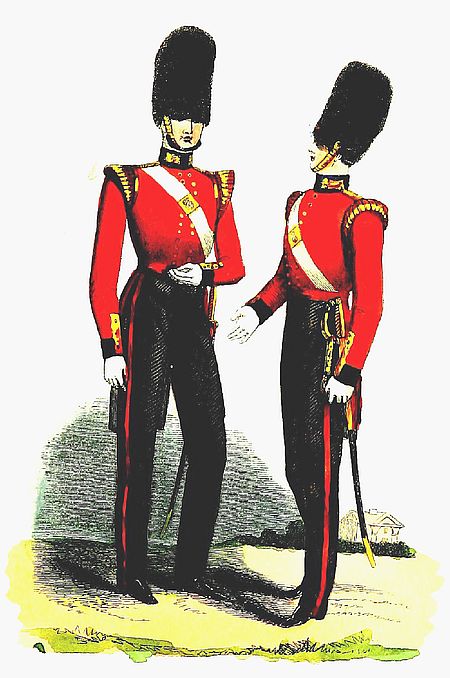
7th Fusiliers, 1846.
1846
The service companies at the end of the year 1846, when this Record concludes, were in the West Indies, the head-quarters at St. Vincent.
The foregoing pages contain a faithful history of the Royal Fusiliers from the period of their formation in the year 1685, and of the peculiar service for which this Regiment was originally established. The introduction of artillery, and the expert and proper management of field-guns, rendered it necessary that a suitable description of officers and men should be selected for such an important and scientific branch of the service, in order to ensure its usefulness; hence it may be inferred, that as qualifications of a superior kind were requisite, the Subaltern Officers in the Royal Fusiliers obtained, on their first appointment, the rank of Lieutenant, a distinction which is continued to the present time.
During a period exceeding one hundred and sixty years, the Royal Fusiliers have proved themselves to be a faithful and zealous Regiment in the cause of Royalty, and in the interests of their country. Their services in various parts of Europe and America, when war has required their presence and exertions, have, on all occasions, been conspicuous; and their conduct on home-service, when relieved from their tour of duty abroad, has been marked by a strict adherence to the rules of order and discipline: these qualities have rendered them a valuable corps to the Government of the country, and have obtained for them a continuance of the approbation of their Sovereign.
1846.