HISTORICAL RECORD
Reading edition
OF
THE NINETY-SECOND REGIMENT,
(HIGHLANDERS.)
1793
The French Revolution, which commenced in the year 1789, by its destroying and sanguinary course, menaced Europe with universal anarchy. On the 21st of January, 1793, Louis XVI. was decapitated, and on the 1st of February the National Convention declared war against Great Britain and Holland.
Augmentations were in consequence made to the army; volunteer companies were formed by the patriotism of the British people, and every exertion was made to defend those institutions which had raised England to a high position among the nations of Europe.
1794
To these events the NINETY-SECOND regiment owes its origin. A letter of service was addressed to the Duke of Gordon on the 10th of February, 1794, authorizing him to raise a regiment in Scotland, and the commission of Lieut.-Colonel Commandant was conferred upon his son the Marquis of Huntly.
The establishment of the regiment was directed to consist of one lieut.-colonel commandant, two majors, ten captains, one captain-lieutenant, twenty-one lieutenants, eight ensigns, one adjutant, quarter-master, surgeon, assistant-surgeon, chaplain, serjeant-major, quarter-master serjeant, forty serjeants, twenty drummers, two fifers, and one thousand rank and file.
On the 24th of June, 1794, the regiment was embodied at Aberdeen, and was generally known as “The Gordon Highlanders;” the regiment was inspected on the following day by Lieut.-General Sir Hector Munro, K.B., who expressed himself highly pleased with the general appearance of the corps.
The following officers were present, namely:—
Lieut.-Colonel Commandant George Marquis of Huntly.
Major Charles Erskine.
Captains.
Alexander Napier. William McIntosh.
John Cameron. Alexander Gordon.
Honorable John Ramsay. Simon McDonald.
Andrew Patton. John Gordon (Capt.-Lieut.)
Lieutenants. Ensigns.
Peter Grant. Charles Dowie.
Archibald McDonell. George Davidson.
Alexander Stewart. Archibald McDonald.
John McLean. Alexander Fraser.
Patrick Gordon. William Todd.
James Mitchell.
Adjutant John Henderson. Surgeon William Findlay.
Quarter-Master Peter Wilkie. Assistant-Surgeon John Clark.
Chaplain William Gordon.
On the 9th of July, the regiment embarked at Fort George for England, and landed at Southampton on the 16th of August, when it was encamped on Netley Common. About this period it was numbered the Hundredth regiment.
The uniform of the officers was as follows:—
Jacket.—Scarlet, facings yellow, with lappels turned back, and laced two and two; lace, silver, with a blue silk-worm in the centre; flat buttons, silver or plated, with the number of the regiment ‘100’ in the centre.
Epaulets.—Two for all ranks, of silver bullion, having two stripes of yellow silk in the centre of the strap, with a thistle, and a binding of blue round the edge.
Waistcoat.—Scarlet, with regimental buttons, and laced with silver.
Belted Plaid.—Twelve yards of blue, black, and green tartan, with a narrow yellow stripe.
Purse, Shoes, and Hose.—Badger skin, ornamented with six white tassels, mounted with silver, and having a rim of silver round the top. The shoes were low-quartered, with silver buckles. The rosettes and garters were of red tape. The hose were tartan of white and red chequer.
The sword was the Highland claymore; the sword belt of buff leather, and the breastplate oval, of silver, ornamented with a crown and thistle, encircled by the words “Gordon Highlanders.”
The sash was of crimson silk, and was worn across the left shoulder. The bonnet was ornamented with black ostrich feathers, and the dirk was silver mounted.
The dress of the serjeants and privates was similar, the arms of the former being the claymore and halbert, and the latter had muskets; queues were worn by officers and men.
On the 5th of September, the regiment embarked at Southampton for Gibraltar, where it landed on the 27th of October: at this station the drill of the regiment was completed, and it was immediately placed on the garrison roster. The effective strength consisted of three field officers, seven captains, nine lieutenants, six ensigns, four staff, twenty-nine serjeants, twenty-one drummers, and seven hundred and twenty-seven rank and file.
In December the regiment received its colours on Windmill Hill, after being consecrated by the garrison chaplain; the regiment was marched under them by files in ordinary time, previously to which the Marquis of Huntly made a very impressive address, calling the attention of the officers and men to the duties which their King and Country expected from them, and to the honors which he trusted they would acquire under these banners.
The first or King’s Colour was, as usual, the Great Union. The second, or Regimental Colour, was composed of yellow silk; in the centre of both, the number ‘100,’ surmounted with a crown, and the words “Gordon Highlanders,” the whole within a wreath of thistles and roses.
1795
On the 11th of June, 1795, the regiment embarked for Corsica, and landed at Bastia on the 11th of July.
In February of the previous year a landing was effected in Corsica by the allied troops, and, through the influence of General Paoli, the Commander-in-Chief of the island, a decree was made by the Assembly of Deputies, declaring the separation of Corsica from France, and its union to the British dominions.
In December, 1795, Lieut.-Colonel the Marquis of Huntly obtained leave of absence, and the command of the regiment devolved on Major Erskine.
1796
The regiment was inspected on the 14th of April, 1796, at Bastia, by Lieut.-General Thomas Trigge, commanding at Corsica, who expressed his gratification at the appearance of the men, and the very correct manner in which they performed the different movements.
On the 14th of May, His Excellency the Viceroy, Lieut.-General Sir Gilbert Eliott reviewed the regiment, and signified his highest approbation of its appearance.
On the following day, the greater portion of the regiment, under the command of Major Alexander Napier, to which rank he had been promoted in March of this year, proceeded to Corte, in order to suppress a serious rebellion which broke out in that part of the island, and upon the return of the troops, a general order was issued by Lieut.-General the Honorable John Thomas De Burgh, who had succeeded to the command of the forces in Corsica, expressive of his best thanks for the exertions and good conduct displayed during the above fatiguing service.
Lieut.-Colonel Commandant the Marquis of Huntly was promoted to the rank of colonel of the regiment on the 3rd of May, 1796; Major Charles Erskine was also promoted to the rank of Lieut.-Colonel, the commission of the latter being ante-dated 1st May of the previous year.
In July Lieut.-Colonel Erskine obtained leave of absence, and the command of the regiment devolved upon Major Napier.
On the 14th of August, a detachment, consisting of one field officer, two captains, four subalterns, seven serjeants, eight corporals, and two hundred privates, was ordered to be held in readiness at a moment’s notice, to embark upon a secret expedition. The zeal and spirit of the corps showed itself in a most conspicuous manner, by the unanimous wish of the whole to be employed upon it; and in consequence of which, Major Napier, then commanding the regiment, made an offer to that effect to the Commander-in-Chief, who was pleased to give the following answer:—
“The Commander-in-Chief is sensible of the zeal and laudable motive, which have induced the officers and men of the Hundredth regiment to offer their services on the present occasion, and he desires Major Napier to express his best thanks to them, as well as his assurance, that he will be ready at all times to testify his satisfaction at their general good conduct and appearance, although circumstances will not at this time allow him to avail himself of their services to the extent they offer them.”
This expedition proved to be against Porto Ferrajo, in the Isle of Elba, and was completely successful, without any loss on the part of the troops employed.
Meanwhile the brilliant career of General Bonaparte in Italy had produced a change of sentiment among the inhabitants of Corsica, of which island he was a native. The Corsicans, therefore, gloried in him as a man who reflected honor on their country, and they regretted that the island had been annexed to Great Britain, as this event placed them in hostility to their victorious countryman, and they began to concert measures to effect its separation. It appearing evident that the expense of the defence would exceed the advantage derived from the possession of the island, the British troops were withdrawn, and on the 6th of September the regiment embarked for Gibraltar.
The regiment mustered one major, five captains, seven lieutenants, five ensigns, three staff, thirty-seven serjeants, twenty-one drummers, and seven hundred and six rank and file.
The following General Order was issued upon this occasion:—
5th September, 1796.
“The Hundredth regiment being to embark for Gibraltar, Lieut.-General De Burgh cannot suffer them to leave Corsica, without testifying his approbation and satisfaction of their general good conduct and soldier-like behaviour, since he had the honor to command them; at the same time he desires they will accept of his best wishes for their success and welfare on all occasions.”
During the voyage, the British Admiral fell in with a large fleet of Spanish men-of-war, and the first intimation he had of Spain being at war with Great Britain, was their firing upon his ships. Perceiving this, and the enemy being so superior in force, he made signal to crowd all sail. The Spaniards, however, captured the “Granby” transport, having on board two staff officers, three serjeants, and forty-eight rank and file of the regiment.
The regiment landed at Gibraltar on the 4th of October, and on the 10th of that month was inspected by the Lieut.-Governor, who was much pleased with its appearance.
In the previous year, Prussia had concluded a peace with the French Republic, and in consequence of the United Provinces of Holland having leagued with France, England had taken possession of the Cape of Good Hope and of Ceylon. The former allies of England now became converted into enemies. War was declared by Holland, which had been constituted the Batavian Republic, against Great Britain, in May, and Spain followed the example in October. In the same month, Lord Malmsbury was sent to Paris to negociate a peace on the part of the British Government; but the French insisted upon retaining, as integral parts of the Republic, the conquests lately made; these terms could not be acceded to consistently with the general interests of Europe, and the negociation was discontinued.
1797
In April, 1797, Lieut.-Colonel Erskine arrived at Gibraltar, and assumed the command of the regiment.
In April, the preliminaries of peace were signed at Leoben, in Styria, between Austria and the French Republic, so that Great Britain was left to continue the contest single-handed with France and her allies. In July Lord Malmsbury was sent a second time to negociate a peace, but the demands of the French Directory rendered the attempt abortive. On the 17th of October the definitive treaty of peace between Austria and the French Republic was signed at Campo Formio.
1798
The regiment embarked in transports for England on the 16th of March, 1798. The ships put into the Tagus on the 9th of April, and sailed again on the 15th. After a tedious and boisterous passage, the regiment disembarked at Portsmouth on the 15th of May, and occupied Hilsea Barracks.
The effective strength of the regiment at this period consisted of two field officers, four captains, eleven subalterns, three staff, thirty-seven serjeants, twenty-two drummers, and seven hundred and forty-two rank and file.
By a General Order, dated 26th of May, 1798, it was directed that the coats of the army should be worn buttoned over the body down to the waist.
On the 31st of May, the regiment embarked in ships of war at Southsea Beach, Portsmouth, for Ireland, and arrived at Dublin, on the 15th of June, where it went into barracks.
His Majesty King George III., appointed Colonel the Marquis of Huntly to serve as a Brigadier-General upon the Staff of the Army in Ireland, in which country a spirit of discontent had been fomented by a party of unprincipled men, who had expected aid from France to carry out their designs. On the 21st of June, Lieut.-General Lake defeated the main body of the rebels at Vinegar hill, and the troubles in Ireland would have subsided, had it not been for the expected aid to be derived from France.
On the 2nd of July, the regiment marched at a moment’s notice, in consequence of the disturbed state of the country, the urgency of the service being such that the troops were conveyed in carriages.
The regiment encamped in the vicinity of Gorey on the 7th of July, and on the 18th marched suddenly to Blessington, where it encamped. On the 29th it marched and encamped at the Glen of Emall.
On the 10th of August, Lieut.-Colonel Erskine and three hundred men were detached and encamped at Torbay.
The following letter, expressive of the good conduct of the regiment during their stay at Gorey, was addressed by the Dean of Ferns, to Colonel the Marquis of Huntly:—
“My Lord,
“I have the honor of enclosing to you that part of the proceedings in the last vestry, held in Gorey, wherein your Lordship and your regiment are mentioned. This mark of our respect and gratitude should have been sooner expressed and conveyed to you, had not our calamitous situation delayed the calling of a vestry, which we conceived the most regular mode of expressing our sentiments collectively.
“It may be pleasing to your Lordship to hear that, in the attendance of my parish, I have heard all the poor loud in the praise of the honesty and humanity of the privates of your regiment. They not only did not rob them of the wretched pittance that was left by the rebels, but refused such trifling presents (of provisions, &c.,) as were offered them, saying their King paid them nobly, and enabled them to supply every want at their own expense.
“I have the honor to be, “With great respect, “Your Lordship’s obedient Servant, (Signed) “Peter Brown, “Dean of Ferns.”
“We the loyal inhabitants of the parish and vicinity of Gorey, in vestry assembled, beg leave thus publicly to acknowledge the goodness and humanity evinced by the Marquis of Huntly, during his short stay amongst us. We are proud to add, that during that short stay, rapine ceased to be a system, and the confidence of the people in the honor of government began to revive. We should be wanting in gratitude if we omitted our testimony, that the humanity of the colonel was emulated by the soldiers, and we request the Hundredth regiment to accept our thanks for the moderation and honor which marked the conduct of every individual officer and private who composed it.
(Signed) “Peter Brown, Rector. “J. Jerman, Churchwarden.”
The French, to the number of about nine hundred men, commanded by General Humbert, landed at Killala, and being joined by a few malcontents marched to Castlebar.
On the 24th of August the regiment marched to Blessington; on the 26th encamped at Kilbeggan; on the 28th at Athlone; on the 29th at Ballymore, in a position in front of the town; on the 1st of September it encamped at Crophill, and moved every day until the 16th, when it encamped near Moat.
Meanwhile the united French and rebel force had been attacked by Lieut.-General Lake, at Ballinamuck, on the 8th of September, and the French troops were compelled to surrender at discretion.
Major-General John Moore, in brigade orders, dated 25th of September, 1798, after detailing some irregularity on the part of the troops, added—
“The Major-General must, in justice to the Hundredth regiment, state, that hitherto he has had no complaint of any one of them, nor has he ever met them in town after the retreat beating.”
The thanks of both Houses of Parliament were, on the 15th of October, conveyed to the troops, “for their meritorious exertions on the present important crisis.”
While the regiment was encamped near Moat, the following order was received, by which the corps was numbered the NINETY-SECOND regiment.[6]
Adjutant-General’s Office, Dublin, 16th October, 1798.
“It is His Majesty’s pleasure, that the Hundredth regiment shall in future be numbered the NINETY-SECOND, and that it be placed on the same establishment with regard to field officers as other regiments of the line.
(Signed) “G. Hewitt, Adjutant-General.”
On the 30th of October, 1798, the regiment broke up from camp, and went into quarters at Athlone.
Napoleon Bonaparte, against whose legions in Egypt and the Peninsula, the NINETY-SECOND regiment, in subsequent years, acquired great renown, was now rising, step by step, to that imperial sway which he afterwards attained. The National Convention had been succeeded in October, 1795, by the French Directory, and the latter, jealous of Bonaparte’s popularity, sent him, in May, 1798, on the expedition to Egypt. Napoleon took Alexandria by storm, and soon established himself at Cairo. The Sublime Porte, incensed by the invasion of Egypt, declared war against France, and formed an alliance with Russia. The fleet which had conveyed the expedition to Egypt, was almost destroyed by Admiral Nelson in Aboukir Bay, on the 1st of August. So large a portion of the French army, being thus secluded in a distant land, gave fresh impulse to the allies, and in November the island of Minorca surrendered to the British arms. In December, 1798, the co-operation of Russia against France was secured by Great Britain.
1799
War was declared by the French Directory against Austria, in March, 1799, and the combined Austrian and Russian armies recovered the greater portion of Italy.
Great Britain now determined to make a corresponding attempt, in conjunction with Russia, to recover Holland from the dominion of France, and a numerous army was selected to proceed to that country under His Royal Highness the Duke of York, previous to whose arrival, the troops were to be commanded by Lieut.-General Sir Ralph Abercromby.
A plan of co-operation was concerted between Great Britain and Russia, in the expectation that the Dutch would rise in arms against the French, in favour of the Prince of Orange, and, aided by the Anglo-Russian force, would exert themselves to effect their emancipation.
On the 15th of June, the NINETY-SECOND regiment, which had been selected to embark on the expedition to Holland, commenced its march by divisions for Cork, on which day the following address was received by the commanding officer:—
“At a numerous meeting of the inhabitants of Athlone and its vicinity on the 15th June, 1799, Thomas Mitchell, Esq., in the chair: the following Address to Lieut.-Colonel Erskine, commanding His Majesty’s NINETY-SECOND regiment in this garrison, was unanimously agreed to:—
“Sir,
“We heard with concern, that His Majesty’s NINETY-SECOND regiment, which you have commanded in this garrison, has been ordered to march for the purpose of joining those troops intended for a foreign expedition: but however we may regret your departure, we are not surprised that a regiment, so eminently conspicuous for its steadiness and discipline, should be selected for an arduous enterprise.
“We have during your continuance amongst us, experienced a polite attention from the officers of your regiment, and the uninterrupted peace and tranquillity, which have prevailed in this town and neighbourhood, evince the attention of the soldiers under your command.
“Permit us, therefore, to return you our thanks, and to request that you will convey the same to the officers, non-commissioned officers, and soldiers of your regiment.
“By order of the meeting, (Signed) “Thomas Mitchell.”
The regiment arrived at Cork on the 24th and 25th of June, and encamped at Monkstown, until orders for its embarkation should arrive. On the 19th of July, the regiment embarked at Cove, and arrived at Dover on the 30th, when it encamped on Barham Downs, where the troops were assembling for the expedition to Holland under the orders of Lieut.-General Sir Ralph Abercromby.
The NINETY-SECOND regiment was placed in the fourth brigade, commanded by Major-General, afterwards Sir John Moore, which consisted of the Royals (second battalion), twenty-fifth, forty-ninth, seventy-ninth, and NINETY-SECOND regiments.
The regiment marched for Ramsgate on the 7th of August, and on the following day embarked in transports, which sailed on the 11th for the coast of Holland. Its effective strength consisted of one colonel, one lieut.-colonel, two majors, six captains, twelve lieutenants, seven ensigns, five staff, forty serjeants, twenty-one drummers, and seven hundred and thirty rank and file.
The British troops landed on the Dutch coast, near the Helder, on the 27th of August. A considerable body of French and Dutch troops assembled near the point of debarkation; some sharp fighting occurred, and in the evening the enemy retreated to a position six miles in his rear. Although one of the first to get a footing on the Dutch shores, it did not fall to the lot of the NINETY-SECOND to be materially engaged this day in the affairs on the sand-hills. The regiment had one serjeant and fourteen rank and file drowned in the landing on the Dutch coast. The enemy having abandoned his fortifications, and evacuated the town during the night, the regiment moved into Helder on the 28th of August. A numerous train of heavy and field artillery was found in this important post; two days afterwards the Dutch fleet surrendered without striking a blow, and hoisted the colours of the Prince of Orange.
On the 1st of September, the regiment marched out of Helder, and on the 2nd advanced to Oude Sluys, on the Zuyder Zee, where the army took up a position, along which the troops were placed in cantonments, the NINETY-SECOND being in advance of the right.
The Dutch did not manifest a disposition to rise against the French. At daylight, in the morning of the 10th of September, the united French and Dutch forces, under General Brune, attacked the piquets; the troops repaired to their alarm-posts, and the action soon became general: the British troops repulsed the attack, and the orders of that day directed the regiment to its cantonments at Oude Sluys, and conveyed the thanks of General Sir Ralph Abercromby[7] for its “noble and steady conduct during the day.”
Captain the Honorable John Ramsay was wounded in this action, which was fought near the villages of Crabbendam and Schagen.
Field Marshal His Royal Highness the Duke of York arrived at the Helder on the 14th of September, and, having been reinforced by a corps of twelve thousand Russians, under Lieut.-General Hermann, resolved on attacking the French position in advance of Alkmaar, reaching from Zuyder Zee, on the right, to Camperdown on the left, and embracing the town of Bergen. The attack was made on the 19th of September, in four columns, but the Russians having failed in holding Bergen, after having entered it in gallant style, the places, which had been acquired by the other columns, were abandoned, and His Royal Highness withdrew his army to its former position on the Zuype.
From the 20th of September until the 1st of October both armies remained within their entrenchments, strengthening their lines of defence: the French had received reinforcements, and had inundated a large tract of country on their right by cutting the sluices, thus contracting the ground of operations to six or seven miles.
The Duke of York, on the 2nd of October, made another attempt on the French position, between Bergen and Egmont-op-Zee. The combined attacks were made in four columns: the division under General Sir Ralph Abercromby being on the right, marched along the beach. The left of the French army was posted and concentrated about Bergen, a large village surrounded by extensive woods, through which passed the great road leading to Haarlem; between which and the sea was an extensive region of high sand-hills, impassable for artillery. Behind the sand-hills, and to the enemy’s right, through the whole extent of North Holland, lies a wet and low country, intersected with dykes, canals, and ditches.
The army advanced before daylight to attack the enemy. The NINETY-SECOND regiment was ordered to escort twenty pieces of artillery to the front, along the sea-shore. In the performance of this duty it was attacked by a column of nearly six thousand men at Egmont-op-Zee, where a most sanguinary conflict ensued, immediately under the eye of General Sir Ralph Abercromby.
Trusting to their superior numbers the French advanced with resolution, and fairly met the bayonets of the regiment, now commanded by Lieut.-Colonel Erskine, Colonel the Marquis of Huntly having been wounded in the charge, which completely overthrew the enemy, and preserved the guns.[8]
The French centre was supported by the town of Alkmaar, and General Sir Ralph Abercromby had passed Bergen in order to turn the French position at Alkmaar, to which place the NINETY-SECOND, immediately after the brilliant affair, before recorded, advanced. As the men fought hand-to-hand, the conflict was signalized by many feats of individual bravery and devoted courage.
The action was maintained with great obstinacy on both sides until night, when the enemy retired, leaving the British masters of the field of battle.
In the despatch of His Royal Highness the Duke of York, dated Zuyper Sluys, 4th of October, it was stated that, “the points where this well-fought battle were principally contested, were from the sea-shore in front of Egmont, extending along the sandy desert, or hills, to the heights above Bergen, and it was sustained by the British columns, under those highly distinguished officers, General Sir Ralph Abercromby, and Lieut.-General Dundas, whose exertions, as well as the gallantry of the brave troops they led, cannot have been surpassed by any former instance of British valour.”
The NINETY-SECOND had Captain William McIntosh, Lieutenants George Fraser, Gordon McCardy, and sixty-five rank and file killed; Colonel the Marquis of Huntly, Captains John Cameron, Alexander Gordon, John McLean, and Peter Grant, Lieutenants Norman McLeod, Charles Chad, Donald McDonald, Charles Cameron, and John McPherson, Ensigns George William Holmes, James Bent, and two hundred and eight rank and file wounded.
The gallant conduct evinced by the NINETY-SECOND on this occasion was afterwards rewarded with the Royal authority to bear the word Egmont-op-Zee on the regimental colour and appointments.
His Royal Highness the Commander-in-Chief, in the General Order of the 5th of October, at Alkmaar, expressed “his warmest thanks for the steady persevering gallantry of their conduct in the general action of the 2nd instant, and to which he ascribes the complete victory gained over the enemy;” and, with the rest of the army, the regiment received the thanks of both Houses of Parliament.
The regiment, commanded by Lieut.-Colonel Erskine, subsequently shared in the general operations of the army, but was not engaged in any very serious affair.
The gallant exertions made on behalf of the Dutch were not seconded by them; and in the meantime the French army had been reinforced. Instead, therefore, of fighting for a people who were not resolved to be free, it was decided that the British troops should be withdrawn from Holland. A convention was ultimately concluded with General Brune at Alkmaar on the 18th of October, and on the following day a cessation of hostilities was proclaimed.
The regiment marched on the 28th of October to Colenzugby, near the Helder, embarked the same day on board of His Majesty’s ships “Kent” and “Monarch,” and landed at Yarmouth on the day following. Its effective strength consisted of twenty-four serjeants, twenty drummers, and four hundred and forty-six rank and file.
During the campaign from the 27th of August to the 28th of October, the regiment sustained a loss of three officers and ninety-three rank and file, several of the wounded soldiers having died.
On the 4th of November the regiment marched en route to Chelmsford, where it arrived on the 10th, and was placed in the eighth brigade, the command of which Major-General Moore assumed on the 25th of December 1799.
Here the regiment received canvas knapsacks, painted yellow, having a circle of red in the centre, in which the Crown and Thistle, with the words “Gordon Highlanders,” were inserted.
1800
Napoleon Bonaparte having returned from Egypt to Paris in the previous year, had been appointed First Consul of France, and made overtures for peace; but the British Ministry, considering that the French government had not acquired sufficient stability, showed no desire to accede to the proposal.
On the 10th of April, 1800, orders were issued for the regiment to hold itself in readiness to march at the shortest notice; the first division marched on the 12th, and was followed by the others on the 14th and 15th, for the Isle of Wight, where it arrived on the 23rd of April.
The regiment, under the command of Lieut.-Colonel Erskine, marched for Cowes on the 27th of May, and embarked on the same day in vessels of war. The head-quarters, and five companies in His Majesty’s ship “Diadem,” sailed on the 30th. The officers and men present with the regiment consisted of one lieut.-colonel, two majors, seven captains, sixteen lieutenants, six ensigns, six staff, thirty-six serjeants, twenty-two drummers, and six hundred rank and file.
The regiment disembarked at the Isle de Houat, on the coast of France, on the 7th of June, where it encamped, under the command of Brigadier-General the Honorable Thomas Maitland.
On the 18th of June, the NINETY-SECOND regiment embarked on board His Majesty’s ship “Terrible,” destined with others to make an attack on Belle-Isle, but which was abandoned; on the 20th the regiment disembarked, and occupied its former encampment on the Isle de Houat.
The NINETY-SECOND embarked on the 23rd of June, with other regiments for the Mediterranean, under the command of Colonel the Earl of Dalhousie, of the Second, or the Queen’s Royals, in His Majesty’s ship “Diadem,” and arrived at Port Mahon, in the Island of Minorca, on the 20th of July.
General Sir Ralph Abercromby, K.B., arrived at Minorca on the 4th of August, and took the command of the troops there assembled. The regiment disembarked on the 7th, and was inspected, on the 11th of August, by Sir Ralph Abercromby.
The NINETY-SECOND regiment embarked at George’s Town on the 30th of August, and sailed on the following day. After touching at Gibraltar, it proceeded to Cadiz, arrived in the bay on the 3rd of October,—and made preparations to land. The enemy, however, sent a flag of truce, but a disease was ravaging the city at the time, and the fleet quitted the coast in order to avoid infection, proceeding afterwards to Gibraltar, where it arrived on the 29th of October.
The regiment arrived at Minorca on the 6th of November, sailed again on the 21st, and anchored at Malta on the 1st of December. This island, after a blockade of two years, had been compelled by famine, to surrender in September, 1800, to Great Britain.
The British Government having resolved to effect the expulsion of the French from Egypt, an army[9] amounting to about fifteen thousand men, of which the NINETY-SECOND formed part, was assembled under General Sir Ralph Abercromby, at Marmorice Bay, on the coast of Asiatic Turkey. The regiment sailed from Malta on the 26th of December, and arrived at Marmorice Bay on the 29th. During the foregoing period, the regiment was occasionally landed for exercise and practice, as if before an enemy.
1801
Some weeks were lost at Marmorice, in expectation of receiving reinforcements of Greeks and Turks; and the expedition did not proceed to its final destination until the 23rd of February, 1801. On the 2nd of March, it anchored in the Bay of Aboukir, eastward of Alexandria; but notwithstanding all the exertions of the navy, under Admiral Lord Keith’s orders, the necessary arrangements could not be made for landing the troops, until a week afterwards, in consequence of unfavorable weather, and other obstructions.
A landing was effected on the 8th of March; a body of French troops, supported by several batteries, awaited the arrival of their opponents, but were forced to give way in defiance of every exertion, and after severe loss on both sides.
The NINETY-SECOND, under the command of Lieut.-Colonel Erskine, landed during the action, and took up a position for the night on the heights of Aboukir. The regiment mustered one lieut.-colonel, two majors, six captains, ten lieutenants, six ensigns, six staff, fifty serjeants, twenty-two drummers, and six hundred and seventy-two rank and file.
On the 9th of March, the regiment advanced about a mile further towards Alexandria. On the day following, it marched to the heights of Mandora, and remained in position, while the artillery and stores were being landed. Nothing of importance occurred this day, beyond a smart skirmish, as the enemy slowly retired.
The army again moved forward on the 12th of March, and came in sight of the enemy, who was strongly posted with his right to the canal of Alexandria, and his left to the sea.
About six o’clock in the morning of the 13th of March, the British army advanced to attack the enemy’s position on the heights in front of Mandora, the NINETY-SECOND being directed to lead the left column into action. The enemy having opened a most destructive fire from his artillery, enfiladed the column to its whole depth: orders were consequently given to deploy into line. The enemy thought this a favorable moment, and immediately advanced to the attack. The NINETY-SECOND, being in advance of the line, was exposed to a very galling fire of grape-shot, and at the same time was attacked by the 61st Demi-Brigade; the regiment, however, continued unshaken in its advance to the very muzzles of the guns, and succeeded in taking two field-pieces, and one howitzer, completely routing the enemy who defended them, and possessing itself of the right of his position. He was forced, therefore, to retire to the fortified heights of Nicopolis, under the walls of Alexandria, to which they form the principal defence from that side.
Lieut.-Colonel, afterwards General Sir Robert Thomas Wilson, in his History of the British Expedition to Egypt, stated that—
“The British had not advanced out of the wood of date trees, which was in front of Mandora Tower, before the enemy left the heights on which they had been formed, and moved down by their right, commencing a heavy fire of musketry, and from all their cannon, on the NINETY-SECOND regiment, which formed the advanced guard of the left column.” After eulogising the gallantry of the ninetieth regiment, which formed the advanced guard of the right column, Lieut.-Colonel Wilson, added:—
“The conduct of the NINETY-SECOND had been no less meritorious. Opposed to a tremendous fire, and suffering severely from the French line, they never receded a foot, but maintained the contest alone, until the marines and the rest of the line came to their support.”
The gallantry and good conduct of the regiment this day were most conspicuous, and in commemoration thereof, the NINETY-SECOND afterwards received the Royal Authority to bear the word “Mandora” on the regimental colour and appointments.
His Majesty’s service, and the NINETY-SECOND regiment in particular, sustained a great loss in the death of Lieut.-Colonel Charles Erskine, who was mortally wounded early in the action, when the command of the regiment devolved on Major Alexander Napier.
The following officers were wounded: Captains Hon. John Ramsay and Archibald McDonell; Lieutenants, Norman McLeod, Charles Dowle (mortally), Donald McDonald, Tomlin Campbell (mortally), Alexander Clarke (mortally), and Ronald Macdonald; Ensigns, Peter Wilkie and Alexander Cameron; twenty-two rank and file were killed, and seventy-seven were wounded.
On the 14th of March, the army occupied the position, from which the enemy was driven the day before, and the troops were employed in throwing up works. On this day, General Sir Ralph Abercromby thanked the troops for their soldier-like and intrepid conduct, in the action of yesterday, and particularised the NINETY-SECOND regiment. It may not be irrelevant to state, that he selected the regiment to furnish the guard at his head-quarters from his first landing in Egypt, to the hour of his death; and the regiment was continued by Lieut.-General (afterwards Lord) Hutchinson, on that duty, until its final departure from that country.
In consequence of the reduced state of the regiment from sickness, and the casualties of the 13th of March, it was ordered on the 20th of March (with the exception of the Commander-in-Chief’s Guard), to march at three o’clock next morning to relieve the battalion of marines at Aboukir Castle; where the following Brigade Order was issued:—
“Major-General Coote feels extreme concern, that the NINETY-SECOND regiment is ordered to march to Aboukir; he hopes they will soon return to the army, and cannot part with that corps without requesting, that the officers and men will accept his best thanks, for their attention to their duty since they have been under his command.”
About half an hour after the regiment commenced its march on the 21st of March for Aboukir, when the French forces at Alexandria, having been augmented by the arrival of additional troops from the interior, advanced under General Menou, to attack the British position. Major Alexander Napier, upon hearing the firing, immediately countermarched the regiment, and resumed his former station in the line, in which it was hotly engaged throughout the day: no sooner had the enemy retired from this struggle, and resigned the victory to the British army, than the army became aware of the loss it had sustained in the Commander-in-Chief, General Sir Ralph Abercromby, who received a mortal wound at the commencement of the action, but which he concealed until the battle was decided. Sir Ralph Abercromby died on the 28th of March, and was buried at Malta.
The NINETY-SECOND had Captain John Cameron, and Lieutenant James Stewart Mathison wounded; three rank and file killed; and forty-four wounded.
Orders were again issued for the march of the regiment on the following morning, provided no attack was made by the enemy, and it accordingly marched to Aboukir.
On the 2nd of May, the regiment marched from Aboukir for Rosetta, where a Turkish force joined the British; on the 5th it advanced along the banks of the Nile, and continued in motion until the 16th of June, when it arrived before Grand-Cairo.
The regiment moved to the right on the 21st of June, and encamped before the town of Gizeh; one of the gates of which place was delivered up by the French on the 28th of June.
A convention with the garrison of Cairo, was on the following day announced as finally adjusted, by which that place was to be delivered up to the allied army, and the French troops to be transported to France.
On the 14th of July, Lieut.-General Hutchinson communicated to the army the thanks of His Majesty, and of both Houses of Parliament, for its determined bravery at the landing, and in the actions of the 13th, and 21st of March, and concluded by a warm eulogium from himself.
The army marched, and retraced its steps towards Rosetta. The promotion of Major Alexander Napier to the Lieutenant-Colonelcy, in succession to Lieut.-Colonel Erskine, killed in the action of the 13th of March, was announced in a manner most flattering to the corps on the 15th of July, as will appear from the following extract of a letter from His Royal Highness the Duke of York, the Commander-in-Chief, dated—
“Horse Guards, 30th May, 1801.
“My Lord,
“I need not assure you how sincerely I unite with you in regretting the loss of so deserving an officer as Lieutenant-Colonel Erskine, of the NINETY-SECOND regiment. I have ever entertained too high a sense of the gallant services of that corps, not to have recommended upon this occasion, that the succession should go in the regiment, of which His Majesty has been pleased to approve.
“I am, &c. (Signed) “Frederick, “Commander-in-Chief.
“Major-General The Marquis of Huntly.”
The regiment arrived on the heights of Aboukir on the 8th of August, and on the following day marched to the same position which it had left on the 22nd of March, and encamped before Alexandria.
The brigade under the orders of Brigadier-General John Doyle, Colonel of the eighty-seventh regiment, advanced before daylight on the 17th of August to attack two redoubts, situated on the green-hill in front of the enemy’s right, which the thirtieth and fiftieth regiments were directed against, while the NINETY-SECOND was placed as a reserve, and ready to support either. This service was successfully performed with little loss to the regiment.
Troops having been sent in boats on the 26th of August to land, and break ground to the westward of Alexandria, the enemy this day sent out a flag of truce, and hostilities ceased; on the 2nd of September, Alexandria surrendered by capitulation, which event terminated the campaign in Egypt.
The British troops received the thanks of both Houses of Parliament, and His Majesty King George III., conferred upon the NINETY-SECOND, and other regiments, which had thus exalted the military fame of Great Britain, by the expulsion of the “invincible” legions of Bonaparte from Egypt, from whence he had expected to extend his conquests throughout Asia, the honor of bearing on their colours and appointments the “Sphinx,” and the word “Egypt,” as a distinguished mark of His Majesty’s royal approbation of their conduct during the campaign.[10]
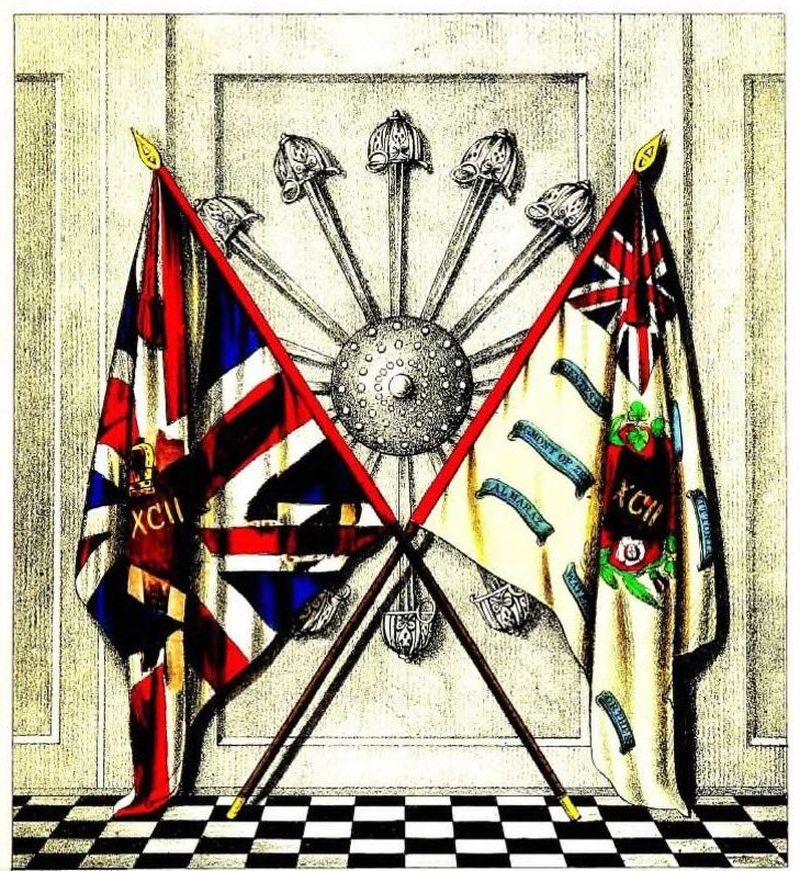
Mssr McDonald delt
Madeley Lith. 3 Wellington St.
92
ND
REGIMENT (GORDON HIGHLANDERS.)
For Cannon’s Military Records
The Grand Seignior established the Order of Knighthood of the Crescent, of which the General Officers were made members; and large gold medals were presented to the field officers, captains, and subalterns. As a further proof of the estimation in which the Grand Seignior held the services of the British soldiers in Egypt, he ordered a palace to be built at Constantinople, for the future residence of the British Ambassadors.
Names of the officers of the NINETY-SECOND regiment, who received gold medals for service in Egypt.
Lieutenant-Colonel Alexander Napier.
Major John Gordon.
Captains.
John Cameron. Archibald McDonell.
The Hon. John Ramsay. Peter Grant.
Andrew Patten. Patrick Gordon.
Lieutenants.
Norman McLeod. James Bent.
Charles Dowle. Ronald Macdonald.
Donald McDonald. James Stewart Mathison.
John Forman. Charles Straubenzie.
James Lee. William Phipps.
George W. Holmes.
Ensigns.
Peter Wilkie. Charles Duddingstone.
William Mackay. Alexander Cameron.
Alexander Anderson. William Logie.
Paymaster Archibald Campbell. Surgeon Archibald Hamilton.
Adjutant Dugald Campbell. Assist.-Surgeons. { Wm. Cook.
Quarter-Master Peter Wilkie. { J. R. Hume.
The regiment marched for Aboukir on the 6th of October, 1801, and embarked in ships of war, which sailed on the following day.
Upon the guard of the NINETY-SECOND, which had been doing duty at head-quarters, being ordered to rejoin, the officer commanding the regiment received a letter expressive of Lieut.-General Hutchinson’s “entire approbation of the exemplary conduct of the guard, and of Serjeant Mark in particular.”
On the 19th of October, the regiment arrived at Malta, and remained in harbour until the 15th of November, when the ships sailed for the shores of Great Britain.
1802
The regiment arrived at Cork on the 30th of January, 1802, and remained under quarantine at Cove, until the 12th of February, when it landed and marched to Kilkenny. The effective strength consisted of one lieut.-colonel, two majors, four captains, fifteen lieutenants, five ensigns, six staff, forty-two serjeants, twenty-two drummers, and five hundred and fifty-nine rank and file.
On the 27th of March, 1802, a definitive treaty of peace was signed at Amiens between the French Republic, Spain, and the Batavian Republic, on the one part, and Great Britain on the other. The principal features of the treaty were, that Great Britain restored all her conquests during the war, excepting Trinidad and Ceylon, which were ceded to her, the former by Spain, and the latter by the Batavian Republic. Portugal was maintained in its integrity, excepting that some of its possessions in Guiana were ceded to France. The territories of the Ottoman Porte were likewise maintained in their integrity. The Ionian Republic was recognised, and Malta was to be restored to the Knights of St. John of Jerusalem. The French agreed to evacuate the Neapolitan and Roman States, and Great Britain all the ports that she held in the Adriatic and the Mediterranean.
The regiment on the 5th of April received orders to fire a feu-de-joie, in consequence of the treaty of peace concluded at Amiens. On the 12th of April, the regiment marched from Kilkenny, and arrived at Belfast on the 28th of that month, where it remained until the 2nd of June, when it embarked for Scotland.
On the 4th of June, the regiment arrived in Scotland for the first time since it was raised, and proceeded to Glasgow.
1803
The peace of Amiens was of short duration; it inspired no confidence of ultimate tranquillity, and both parties remained prepared to renew the contest. The chief complaint on the part of France was the non-evacuation of Malta by the British troops, and the asylum afforded to the enemies of the French government. Circumstances had, however, occurred which would have rendered the restoration of Malta to the Knights of St. John of Jerusalem equivalent to ceding that island to France. Other grounds of irritation existed, and the designs of Napoleon Bonaparte to raise the power of France by an extension of territorial dominion, to which England appeared a barrier, caused the struggle to be renewed; and the contest was not settled until the final defeat of the French at the battle of Waterloo, on the memorable 18th of June, 1815, by the allied troops under the Duke of Wellington.
On the 18th of May, 1803, war was declared against France; Hanover was overrun by the French, and severed for a time from the British crown; and the First Consul ordered the arrest of all British subjects in the territories of the French and Batavian republics.
Preparations were made by the British Government to meet the emergency; the “Army of Reserve Act” was passed in June, 1803, for raising men for home service by ballot, by which a second battalion was added to the NINETY-SECOND regiment. The second battalion was to be composed from the balloted men raised in Scotland for limited service, and was placed on the Establishment from the 9th of July following.
In June, the regiment was removed from Glasgow to Colchester, and on the 1st of July it marched to Weeley, where it encamped while the barracks were being prepared, which were occupied by the regiment during the winter.
The second battalion of the regiment was formed at Weeley, on the 24th of November, 1803; officers and non-commissioned officers, with a proportion of old soldiers, being posted to it from the first battalion for the purpose of instruction. Both battalions were commanded by Lieut.-Colonel Napier.
Each battalion was to have ten companies, consisting of fifty-four serjeants, twenty drummers, two fifers, and a thousand rank and file.
At this period Bonaparte was making preparations for the invasion of England, for which purpose he collected an immense flotilla at Boulogne. The threat of invasion aroused the patriotism of the British people, and the most strenuous measures were pursued to defeat the designs of the French Ruler; volunteer and yeomanry corps were formed in every part of the kingdom, and all parties united in one grand effort for the preservation of Great Britain.
1804
In May, 1804, Napoleon was invested with the dignity of Emperor of the French, and on the 26th of May, of the following year, he was crowned at Milan as King of Italy.
Further measures of defence were adopted by Great Britain, and the “Additional Force Act” was passed on the 14th July, 1804.
Both battalions marched to Colchester on the 24th of July, and on the 6th of August were encamped on Lexden Heath.
On the 24th of October orders were issued for the march of one captain, one subaltern, four serjeants, four corporals, and one drummer to Elgin, from the second battalion, to receive the men to be raised under the “Additional Force Act.”
Both battalions broke up from Lexden camp on the 26th of October, and marched to Weeley barracks.
Orders were received on the 25th of November for the second battalion to be held in readiness to march from Weeley barracks, and proceed by the inland navigation to Liverpool, from whence it was to embark for Ireland. The second battalion accordingly marched in three divisions, on the 29th of November and on the two following days.
The first battalion, under the command of Lieut.-Colonel Napier, remained in Weeley barracks during the winter.
1805
During the summer of 1805, the first battalion was brigaded with the forty-second, ninety-first, and ninety-fifth (Rifle) regiments. On the 2nd of September, the battalion marched from Weeley to Colchester; on the 4th of September the first battalion was ordered to hold itself in readiness for embarkation, but on the 6th of September it returned to Weeley barracks.
The first battalion marched, on the 7th of October, to Colchester with other troops, and was reviewed by His Royal Highness the Duke of York, the Commander-in-Chief, who expressed himself particularly pleased with the appearance of the battalion, which returned to its quarters at Weeley on the 18th of October.
While the French were pursuing their victorious career in Germany, they experienced great reverses from the British navy. On the 21st of October, the combined fleets of France and Spain were defeated off Cape Trafalgar; but the victory was purchased with the loss of Admiral Viscount Nelson, whose remains were honored with a public funeral at St. Paul’s Cathedral, and the first battalion of the NINETY-SECOND regiment attended the ceremony.
On the 29th of October, the first battalion marched from Weeley, and arrived at Ospringe barracks on the 6th of November; on the 26th of November it marched to Canterbury.
1806
The first battalion marched, on the 2nd of January, 1806, to London, to attend the public funeral of Admiral Viscount Nelson, whose remains were interred, on the 9th of January, in St. Paul’s Cathedral, where a monument was erected by authority of Parliament at the public expense.
Major-General the Hon. John Hope, from the sixtieth regiment, (afterwards the Earl of Hopetoun,) was appointed by His Majesty King George III. to be colonel of the NINETY-SECOND regiment, on the 3rd of January, 1806, in succession to Major-General the Marquis of Huntly, who was removed to the forty-second, or the Royal Highlanders, on the decease of General Sir Hector Munro, K.B.
The first battalion marched, on the 11th of January, from London for Colchester, where it arrived on the 15th of that month: it marched to Weeley barracks on the 29th of May, where it remained stationary, with the exception of occasional marches to and from Colchester, for the purpose of being exercised with other brigades.
1807
On the 3rd of February, 1807, the first battalion marched from Weeley for Harwich, with the view of checking the infection of ophthalmia, which then prevailed among the troops at Weeley. The first battalion returned to Weeley on the 27th of April.
Information having been obtained that Napoleon purposed employing the navy of Denmark against Great Britain, an armament was prepared for obtaining possession of the Danish fleet by treaty or force, on the assurance that it should be restored at the conclusion of the war with France. The first battalion was destined to share in this enterprise, and it received orders, on the 22nd of July, to be in readiness for foreign service.
The battalion, commanded by Lieut.-Colonel Napier, marched for Harwich on the 26th of July, and embarked on the same day, after being inspected by Lieut.-General Sir David Baird. On the 27th a draft of one hundred and three rank and file joined from the second battalion: the effective strength of the first battalion consisted of forty-eight serjeants, nineteen drummers, and nine hundred and eighty-one rank and file.
On the 1st of August, the expedition sailed, and on the 8th anchored in the Sound near Elsineur. On the following day, Lieut.-General Harry Burrard[11] directed the army assembling in the Sound to be formed in brigades and divisions, and that the forty-third, fifty-second, NINETY-SECOND, and ninety-fifth (Rifle) regiments should compose the reserve, under Major-General Sir Arthur Wellesley, until the arrival of the Commander-in-Chief.
Lieut.-General Lord Cathcart arrived on the 12th of August, and assumed the command of the army; on the 14th the fleet sailed towards Copenhagen, and on the 16th of August the army landed at Vedeck, in Zealand, situated about half-way between Elsineur and Copenhagen, without opposition, and on the following day the regiment went into cantonments in Hassan, and Broomskoy. Its movements were various, and dependent upon circumstances during this period.
The NINETY-SECOND regiment advanced towards Roeskelde on the 26th of August, in consequence of the enemy collecting a large force at the town of Kioge and its vicinity, for the purpose of being thrown into Copenhagen, which was at this time invested by the British army.
On the 29th of August, the division under Major-General Sir Arthur Wellesley advanced to attack the Danes in their position. The NINETY-SECOND regiment, under the command of Lieut.-Colonel Alexander Napier, was appointed to lead the infantry against the enemy’s camp, in which the regiment charged him, driving him out of it, and through the town of Kioge, with the loss of his artillery. The regiment had two rank and file killed, and one wounded.
On the 30th of August, the British troops marched to Osted, and went into cantonments. On this day, after expressing in orders his satisfaction at the conduct of the troops in the action of the 29th, Major-General Sir Arthur Wellesley, in particularizing those who had an opportunity of distinguishing themselves, alluded to the conduct of the NINETY-SECOND regiment, and of Lieut.-Colonel Napier, in the attack of the enemy in his camp, and to the regular and orderly manner in which the troops marched through Kioge, and formed beyond the town.
The conduct of the troops employed in the action before Kioge was thus alluded to in General Orders by Lieut.-General Lord Cathcart:—
“Head Quarters, Hellerup, “1st September, 1807.
“The Commander of the Forces desires to express, in the strongest manner, his thanks to Major-General Sir Arthur Wellesley, and to the officers and men of the division under his command, for the judgment, valour, and discipline exhibited in the two attacks made upon the enemy in the general action of the 29th of August at Kioge.
“The details of this affair, as reported by the Major-General, will be laid before His Majesty by the earliest opportunity.”
The bombardment of Copenhagen induced the Crown Prince to listen to terms; and on the 7th of September the Danish fleet and stores were surrendered to the British government on condition of being restored, when a general pacification should take place.
The following General Order was issued to the troops on the same day:—
“7th September, 1807.
“The Commander of the Forces congratulates the army on the capitulation of Copenhagen, which includes the surrender of the Danish fleet.”
A detachment of grenadiers took possession of the citadel, and hostilities ceased.
The object of the expedition having been accomplished, Copenhagen was evacuated, and the NINETY-SECOND regiment marched from Osted to Roeskelde Kroe on the 23rd of September, and on the next day joined the army before Copenhagen, and went into cantonments.
The approbation of His Majesty, King George III., for the services performed during the expedition, was expressed in the following extract from a despatch, dated 16th September, 1807, addressed to Lieut.-General Lord Cathcart by Viscount Castlereagh, Principal Secretary of State for the War Department:—
“His Majesty has received, with great satisfaction, the account of the particular services rendered in their detached commands by Major-General the Right Hon. Sir Arthur Wellesley, Major-General Von Linsingen, and Brigadier-General Von Decken.
“I am further to express His Royal pleasure, that you do convey to the general officers under your command His Majesty’s full approbation of the zeal, ability, and valour they have displayed in their several departments; and your Lordship will make it known to the army, that the conduct of all his troops, both British and Hanoverian, who have so much distinguished themselves by their valour and good conduct, is highly acceptable to His Majesty.[12]
“It is also a matter highly pleasing to His Majesty, that through the whole of this expedition, such a perfect harmony, and such a zealous spirit of co-operation, have pervaded all departments of the naval and military service.”
Lieut.-General Lord Cathcart in communicating the above to the army under his command, on the 28th of September, 1807, added,—
“The Commander of the Forces cannot make this communication, without renewing his thanks to the army, for the assistance he has received from the zeal, advice, and active services of the generals, staff, and commanding officers, and for the patience, discipline, and exertions of all regiments, corps, and departments, to which, under the blessing of Providence, he is indebted for the complete success of the expedition, and for the most gracious approbation, which His Majesty has been pleased to declare of the whole service.”
On the 17th of October, the first battalion of the NINETY-SECOND regiment embarked for England in the Minotaur, Neptunis, and Iris, ships of war, and sailed on the 21st. During the passage they encountered very boisterous weather, in which the ships parted company: unfortunately the Neptunis, of ninety-eight guns (one of the captured Danish ships), with six hundred of the NINETY-SECOND regiment on board, got aground, and was totally lost. The men were landed on the island of Hewan, where they remained for fourteen days, until vessels arrived for them from England.
The men on board the head-quarter ship landed in England on the 12th of November; and on the arrival of the different detachments, orders were waiting for them to proceed to Weeley barracks. The effective strength of the first battalion at this period consisted of forty-nine serjeants, twenty-two drummers, and nine hundred and sixty-four rank and file.
1808
The first battalion marched to Colchester barracks on the 23rd of March, 1808. Volunteers from the militia of the northern counties were, about this time, received, and taken on the strength of the second battalion, which continued in Ireland.
On the 19th of April, the first battalion of the regiment was directed to be held in readiness for immediate embarkation for foreign service, and on the 29th of April, it marched from Colchester, and embarked in transports at Harwich, under Lieut.-Colonel Napier.
The battalion sailed for Yarmouth on the 4th of May, and arrived there on the 6th, where an armament, under the command of Lieut.-General Sir John Moore, was assembling, destined to proceed to Sweden.
The armament sailed from Yarmouth on the 10th of May, and anchored off Gottenburg on the 17th. The Swedes did not show any inclination to avail themselves of British assistance on shore, consequently the troops did not disembark, but during their stay were occasionally exercised in practising to land from launches and flat-bottomed boats.
The fleet sailed for England on the 3rd of July, with orders to rendezvous at Yarmouth. A vessel, with orders from England, however, changed the place of rendezvous to the Downs, where the fleet arrived on the 20th of July, and proceeded to Spithead. A draft of seventy rank and file was received from the second battalion.
Spain was at this period the centre of political interest. Portugal, deserted by her government, and Spain betrayed, the people of each rose in arms to recover the national independence. Dissensions had arisen in the royal family of Spain, occasioned by the sway of Emanuel Godoy, who bore the title of Prince of Peace. This minister was dismissed, but the Court was unable to restore tranquillity. In this emergency, the French Emperor was solicited to be umpire; and Napoleon ultimately seized the crown of Spain, which he placed on the head of his brother Joseph, who was transferred from the throne of Naples. Europe was indignant, and Spain furious, at this usurpation. The Spaniards flew to arms, and the British government resolved to aid the Spanish and Portuguese patriots; a British army accordingly proceeded to the Peninsula in June, 1808, the command of which was held by Lieut.-General Sir Arthur Wellesley.
On the 31st of July, having received on board a fresh supply of provisions and water, the first battalion sailed for Portugal, and on the 19th of August arrived in Mondego Bay. Marshal Junot and the French army having been defeated by the troops under Lieut.-General Sir Arthur Wellesley, in the battles at Roliça on the 17th, and Vimiera on the 21st of August, sued for a cessation of hostilities.
The battalion landed at Maciera Bay on the 27th of August, and the convention of Cintra was signed on the 30th of that month, by which it was stipulated that the French should evacuate Portugal.
Portugal, being thus rescued from the presence of hostile troops, orders arrived from England for Lieut.-General Sir John Moore to take the chief command of a part of the army, which was to be employed in Spain; with a notification that a force from England, under the command of Lieut.-General Sir David Baird, was to land at Corunna, and co-operate with him. The first battalion of the NINETY-SECOND regiment was immediately put in motion towards the frontiers, and arrived at Portalegre on the 11th of October, 1808.
On the 26th of October, the first battalion, being placed in the division commanded by Lieut.-General Sir John Hope, moved from Portalegre, and on the 2nd of November entered Spain, at Badajoz; marching by Merida, Truxillo, and Talavera, it arrived at the Escurial on the 22nd of November, and halted.
The enemy having pressed forward to Valladolid and Tordesillas, thereby threatening to cut off Lieut.-General Sir John Hope’s communication with the army under Lieut.-General Sir John Moore, who was then at Salamanca, the battalion marched from the Escurial, on the 27th of November, across the Guadarama mountains, and moving by Villa Castin and Avila, it arrived at Alva de Tormes on the 4th of December.
The battalion advanced from Alva de Tormes towards Tordesillas, on the 11th of December, and Lieut.-General Sir John Moore, learning that the French were moving upon him from the direction of Madrid, which had by this time surrendered, while another column was advancing from the direction of Burgos, moved to the left, to form a junction with Lieut.-General Sir David Baird, crossed the Douro at Toro, and arrived at Vallada on the 21st of December. On the 24th of that month, the battalion marched by Benevente, Astorga, and Villa Franca, arriving at Lugo on the 4th of January, 1809.
1809
The troops took up a position in front of Lugo, on the 6th of January, 1809, and remained bivouacked, in order of battle, until the 8th, when they marched in the night, and arrived at Corunna on the 11th. During these marches, in common with the rest of the army, the battalion suffered from fatigue and the severity of the weather.
On the 12th of January, the battalion was placed in position in front of Corunna; and on the 14th and 15th the women, sick men, and baggage, were embarked for England.
The British army having accomplished one of the most celebrated retreats recorded in modern history, repulsing the pursuing enemy in all his attacks, and having traversed two hundred and fifty miles of mountainous country under very disheartening circumstances, accompanied by severe privation, was not destined to embark for England without a battle.
Marshal Soult, Duke of Dalmatia, having taken up a position above the town of Corunna, made arrangements for attacking the British army as soon as the troops should commence their embarkation. The sick men, women, and baggage having been conveyed on board ship, preparations were made for embarking the troops on the 16th of January, 1809. The French instantly descended from the heights in three columns, and advanced about two o’clock to attack the British position in front of Corunna; a sanguinary action ensued, and before dark, the French were defeated in all their attacks. Lieut.-General Sir John Moore was killed; and the battle was scarcely ended, when, wrapped in a military cloak, his remains were interred in the citadel of Corunna, over which Marshal Soult, with the true feeling of a soldier, erected a monument.
This victory enabled the British troops to be embarked without further molestation. In this battle the first battalion of the NINETY-SECOND was posted towards the left of the army, on the road leading to Betanzas, and throughout the day supported its former reputation.
The NINETY-SECOND, together with the rest of the army, had not only to lament the death of Lieut.-General Sir John Moore, but also that of their own commanding officer, Lieut.-Colonel Alexander Napier, who was killed at its head: the command therefore devolved on Brevet Lieut.-Colonel John Lamont, who was afterwards promoted lieut.-colonel in the regiment. Lieutenant Archibald McDonald was severely wounded on this occasion, and died shortly afterwards. Only two rank and file of the battalion were killed, and four wounded.
This army received the thanks of both Houses of Parliament, “for its distinguished discipline, firmness, and valour, in the battle of Corunna,” which were communicated to the regiment, with the following letter, addressed to the commanding officer by Lieut.-General Sir David Baird:—
“Portsmouth, 30th January, 1809.
“Sir,
“In communicating to you this most signal mark of the approbation of the Parliament of the United Kingdom of Great Britain and Ireland, allow me to add my warmest congratulations upon a distinction, which you, and the corps under your command on that day, had a share in obtaining for His Majesty’s service.
“I have, &c., (Signed) “David Baird, Lieut.-General.
“Officer Commanding First Battalion, NINETY-SECOND regiment.”
The conduct of the battalion during the expedition, and its gallantry at the battle of Corunna, were rewarded by the Royal authority for the word “Corunna” to be borne on the regimental colour and appointments of the NINETY-SECOND, in common with the army employed under Lieut.-General Sir John Moore.[13]
On the 17th of January, the battalion embarked at Corunna, and on the 26th disembarked at Portsmouth, marching immediately for Weeley Barracks, where the several divisions arrived on the 13th, 14th, and 15th of February.
On the 16th of February, orders were issued that every exertion should be made to clothe and equip the regiment again for foreign service. The regiment received black painted canvas knapsacks, having the Sphinx and number on the back.
About this period, Lieut.-Colonel John Cameron joined from the second battalion, which continued in Ireland.
The first battalion marched on the 29th of June for Dover, where it arrived on the 6th and 7th of July, and was joined by two hundred and twenty rank and file from the second battalion.
During the summer of 1809 great preparations were made by the British Government for fitting out the most formidable armament that had, for a long time, issued from England. It consisted of an army of forty thousand men, commanded by Lieut.-General the Earl of Chatham, and of thirty-nine ships of the line, thirty-six frigates, and numerous gun-boats, bomb-vessels, with other small craft, under Admiral Sir Richard Strachan. The object of the expedition was to gain possession of the islands at the mouth of the Scheldt, and to destroy the French ships in that river, with the docks and arsenals at Antwerp.
On the 14th of July, the first battalion marched to Deal, and embarked in ships of war with other troops there assembled, under Lieut.-General the Earl of Chatham. The battalion, under the command of Lieut.-Colonel Cameron, was placed in Major-General Sir William Erskine’s brigade, and in the division commanded by Lieut.-General Sir John Hope. The NINETY-SECOND mustered forty-four serjeants, twenty drummers, and nine hundred and seventy-four rank and file.
The expedition sailed from the Downs on the 28th of July, and landed on the 1st of August on the Island of South Beveland, near Goes, and went into cantonments in that place and Capelle. Flushing surrendered on the 15th of August; but during the siege Marshal Bernadotte had arrived at Antwerp, put the place in a posture of defence, and removed the ships higher up the river. In consequence of these preparations, the reduction of Antwerp was deemed impracticable by a Council of War, and on the 1st of September the NINETY-SECOND embarked for England.
The battalion landed at Landguard Fort near Harwich, and proceeded to Woodbridge barracks. During the time it was in South Beveland, it suffered much from fever and ague, with other diseases peculiar to that place; consequently every attention was now paid to restore the men, and to render them again fit for service.
1810
On the 11th of July, 1810, the first battalion of the NINETY-SECOND embarked at Landguard Fort, landed at Ramsgate, and arrived at Canterbury on the 20th of that month.
The battalion was shortly afterwards destined to proceed a second time to the Peninsula, and it embarked from Deal for Lisbon on the 24th of September. Since its embarkation at Corunna, in January, 1809, great events had occurred in Spain, and the French had obtained possession of Corunna, Bilboa, and all the important places on the northern coast of that country. Saragossa, after a gallant defence, had also fallen, and Marshal Soult having overrun Gallicia, marched into the northern provinces of Portugal, and obtained possession of Oporto. The small British force which had been left in Portugal, when Lieut.-General Sir John Moore advanced into Spain, was concentrated by Lieut.-General Sir John Cradock for the defence of Lisbon.
The British Government resolved to make another effort to save Portugal from invasion, and also to assist the Spaniards in their struggle for independence. Accordingly in April 1809, Lieut.-General Sir Arthur Wellesley was sent with reinforcements to Portugal, and was appointed to the command of the British army in the Peninsula. His first object was to dislodge Marshal Soult from Oporto. The famous passage of the Douro led to the fall of Oporto, and the French Marshal was compelled to retreat. The Spanish General Cuesta having been defeated, with great loss, by the division of the French army under Marshal Victor, Lieut.-General Sir Arthur Wellesley was obliged to desist from the pursuit of Marshal Soult.
In the beginning of July, the British army advanced into Spain, and a junction being effected with General Cuesta, the combined forces occupied a strong position at Talavera. Here they were attacked on the 27th and 28th of July, 1809, and the French army, commanded by Joseph Bonaparte in person, was defeated; for which victory Lieut.-General Sir Arthur Wellesley was raised to the peerage by the title of Viscount Wellington.
After this victory it was deemed necessary to make a retrograde movement on Badajoz, information having been received that Marshals Soult, Ney, and Victor had united their forces, and were advancing to fall on the rear of the allied army.
Viscount Wellington now became occupied with the defence of Portugal. The French armies in Spain had been reinforced during the winter of 1809-10 with troops from Germany, peace having been concluded between France and Austria; and in April, 1810, the Emperor Napoleon espoused the Archduchess Maria Louisa, daughter of the Emperor of Austria.
Spain having been reduced to French domination, Napoleon resolved to subjugate Portugal, and Marshal Massena, Prince of Essling, assumed the command of the “Army of Portugal” in May. Ciudad Rodrigo and Almeida were captured by the French, who were, however, gallantly repulsed at the Sierra de Busaco on the 27th of September, 1810, after which Viscount Wellington occupied the strong position of Torres Vedras, about thirty miles from Lisbon.
This was the state of affairs in the Peninsula when the NINETY-SECOND arrived in the Tagus. On the 8th of October, the battalion landed, and the necessary camp equipage, on taking the field, was immediately issued.
1811
The NINETY-SECOND, under the command of Lieut.-Colonel John Cameron, marched from Lisbon to join the army under Viscount Wellington, then in the fortified lines of Torres Vedras, and arrived at Cruzandera on the 15th of October, where the battalion remained until the 15th of November. At this period it was attached to the first division of the army, and was brigaded with the fiftieth and seventy-first regiments, under Major-General Howard.
Marshal Massena having abandoned his position in front of the British, and retired upon Santarem, the NINETY-SECOND advanced on the 15th of November, and occupied the village of Almostal on the 19th of November, moving on the 28th to Alcantrinha, the enemy occupying a strong position at Santarem, immediately in front of the British army.
At the commencement of the year 1811, Lisbon was the point on which the interests of the British nation in foreign affairs were concentrated, and the question whether Portugal should remain independent, or become subject to France, was to be decided by the two great armies posted near Lisbon, the one for attack, the other for defence.
The difficulty of supplying his troops with necessaries in a devastated country, and the impracticability of forcing the fortified lines of Viscount Wellington, at Torres Vedras, at length compelled Marshal Massena to consult the safety of his army by a seasonable retreat.
During the night of the 5th of March, the enemy broke up from his position near Santarem, and retreated in the direction of Almeida. Viscount Wellington immediately pursued Marshal Massena by Thomar, Pombal, Redinha, and Espinhal, at each of which places some sharp affairs took place, honorable to the British arms, as well as at Sabugal on the 3rd of April, immediately after which the French continued their retreat into Spain.
The first battalion of the NINETY-SECOND regiment entered Spain on the 9th of April, and was cantoned in Albergaria, where a detachment of one lieutenant and forty-four rank and file joined from the second battalion, then in Ireland. At this period, the sixth division of the British army invested Almeida, and a force of British and Portuguese under Marshal Beresford was employed in the Alemtejo and Spanish Estremadura, which compelled the enemy to abandon Campo Mayor. Olivenza was next besieged by Marshal Beresford, and retaken on the 15th of April, after which he broke ground before Badajoz.
Marshal Massena had reached Ciudad Rodrigo on the 25th of April, and, having concentrated his forces, crossed the Agueda on the 2nd of May, and advanced towards the allied army, posted between that river and the Coa, in order to relieve Almeida. On the approach of the French, the British light division and cavalry fell back upon Fuentes d’Onor, where three other divisions were posted, and in which Viscount Wellington determined to receive the attack of the enemy.
The village of Fuentes d’Onor is situated on low ground, at the bottom of a ravine, with an old chapel and some buildings on a craggy eminence which overhang one end. In the afternoon of the 3rd of May, the enemy attacked the village with a very large force, and was repulsed with loss. On this occasion, the light company of the NINETY-SECOND distinguished itself. Lieutenant James Hill was wounded; nine rank and file were likewise wounded.
The main body of the British army was concentrated in the vicinity of Fuentes d’Onor in the course of the evening and following day. On the 5th of May, the enemy, very superior to the British in numbers, made an attack on the right of the allied position early in the morning, and also on the village, which he repeated during the day, and the action became general. Each of his attacks was successively repulsed, and towards the evening, the victory being decidedly in favour of the British, the French retired to their original position.
On this occasion, the first battalion of the NINETY-SECOND regiment, commanded by Lieut.-Colonel Cameron, was stationed to the right of Fuentes d’Onor, covering a brigade of nine-pounders, and was exposed to a very heavy cannonade. The light company, and a subdivision of each of the others in its front, were warmly engaged throughout the day, and eminently distinguished themselves. Major Archibald McDonnell, who commanded them, was in consequence promoted to the brevet rank of Lieut.-Colonel. Major Peter Grant and Lieutenant Allan McNab were severely wounded; the latter died two days afterwards. The battalion had also seven rank and file killed and thirty-five wounded.
The NINETY-SECOND afterwards received the Royal Authority to bear the words “Fuentes d’Onor” on the regimental colour and appointments, in commemoration of the gallantry displayed by the first battalion in that battle.
Both armies continued in their positions during the 6th and 7th of May without any particular occurrence, and on the morning of the 8th, the rear of the enemy’s columns was seen retreating on the road towards Ciudad Rodrigo. The NINETY-SECOND still remained bivouacked near Fuentes d’Onor.
The French crossed the Agueda and left Almeida to its fate. That place was evacuated by General Brennier at midnight of the 10th of May, when the enemy blew up the works, and the greater part of the garrison succeeded in effecting its escape during the night.
On the 14th of May, the battalion returned to its former cantonments in Albergaria, where orders were received increasing its establishment to twelve hundred rank and file.
Marshal Beresford, in the meantime, was continuing the blockade of Badajoz; but receiving information that Marshal Soult was advancing from Seville to its relief, he raised the siege on the 15th of May, and having concentrated his force, marched to meet the enemy. On the following day, the battle of Albuhera was fought, and the British gained a brilliant but hard-earned victory. In the night of the 17th, Marshal Soult left Badajoz to its fate, and commenced his retreat towards Seville.
Viscount Wellington now gave orders for Badajoz to be again closely invested. To assist in these operations, the brigade, of which the NINETY-SECOND formed part, was appointed the first in the second division of the army, under Lieut.-General Rowland (afterwards Viscount) Hill, at this time in Spanish Estremadura, covering the siege of Badajoz.
The battalion, under Lieut.-Colonel Cameron, marched, on the 25th of May, from Albergaria for the Alemtejo, crossed the Tagus at Villa Velha, and the Guadiana above Badajoz, and joined the second division in front of Albuhera, on the 10th of June, about ten days after the second siege of Badajoz had been commenced. Its effective strength consisted of fifty-six serjeants, sixteen drummers, and eight hundred and twenty-five rank and file.
Marshal Marmont, with the French army of Portugal, having effected a junction with that of the south, under Marshal Soult, they advanced to relieve Badajoz; Viscount Wellington found it therefore necessary to relinquish the siege, and to withdraw the allied army across the Guadiana.
Accordingly, the second division, on the 16th of June, broke up from its bivouac in front of Albuhera, marched by Valverde, recrossed the Guadiana, and arrived at Torre do Mouro on the 20th of June, where the principal part of the British army was drawn up in position, with its right upon Elvas and the left on Campo Mayor. The division broke up from the bivouac at Torre do Mouro on the 21st of July, marched to Elvas, and on the following day went into quarters in Borba, from whence it marched on the 1st of September, arriving on the 3rd of that month at Portalegre.
Meanwhile the main body of the army, under Viscount Wellington, had crossed the Tagus and invested Ciudad Rodrigo. Towards the end of September, Marshal Marmont, having received large reinforcements, advanced to Ciudad Rodrigo, and, after a partial engagement at El Bodon on the 25th of September, Viscount Wellington withdrew his army to his former position on the Coa.
On the 7th of October, a draft of one hundred and ninety-nine rank and file was received from the second battalion.
The second battalion embarked at Belfast on the 10th of October, and arrived on the following day at Irvine in North Britain.
General Girard’s division of the fifth French corps having taken post at Caceres, Lieut.-General Rowland Hill determined to drive the enemy from thence, and on the approach of the British troops the French retired, halting at Arroyo-del-Molinos.
On the 22nd of October, the first battalion of the NINETY-SECOND marched from Portalegre to Codesiera; on the 23rd to Albuquerque; on the 24th to the Sierra de San Pedro; on the 25th to Aliseda; on the 26th to Malpartida; on the following day to Alcuesca, and bivouacked without fires about a league from Arroyo-del-Molinos. During the whole of this fatiguing march, the weather was extremely severe, with constant rain.
The British troops, under Lieut.-General Hill, marched about two o’clock in the morning of the 28th of October, towards Arroyo-del-Molinos, a village situated in a plain at the foot of a ridge of rocks rising in the form of a crescent, their approach being concealed by a thick mist with heavy rain. The French infantry were assembling outside the village to commence their march to Merida, the baggage was being loaded, and General Girard was waiting at his quarters for his horse, when suddenly the seventy-first and NINETY-SECOND regiments charged into the village, capturing much baggage and many prisoners; at the same time the twenty-eighth and thirty-fourth regiments made a detour, supported by the thirty-ninth, to cut off the enemy’s retreat.
The French formed two squares and commenced retreating. The NINETY-SECOND attacked, and broke one of the enemy’s squares, which was formed on the other side of the village, and thereby completed his overthrow.
In this brilliant affair the enemy lost all his artillery and baggage; and several officers of rank and consideration, with about fourteen hundred men, were taken prisoners. General Brun and Colonel the Prince d’Aremberg were among the prisoners. The ninth and thirteenth light dragoons, and the second Hussars, King’s German Legion, also shared in the action.
The NINETY-SECOND had Lieut.-Colonel John Cameron, Captains Donald McDonald, John McPherson, and Robert Nugent Dunbar (Brevet-Major), wounded; three rank and file were killed and seven wounded.
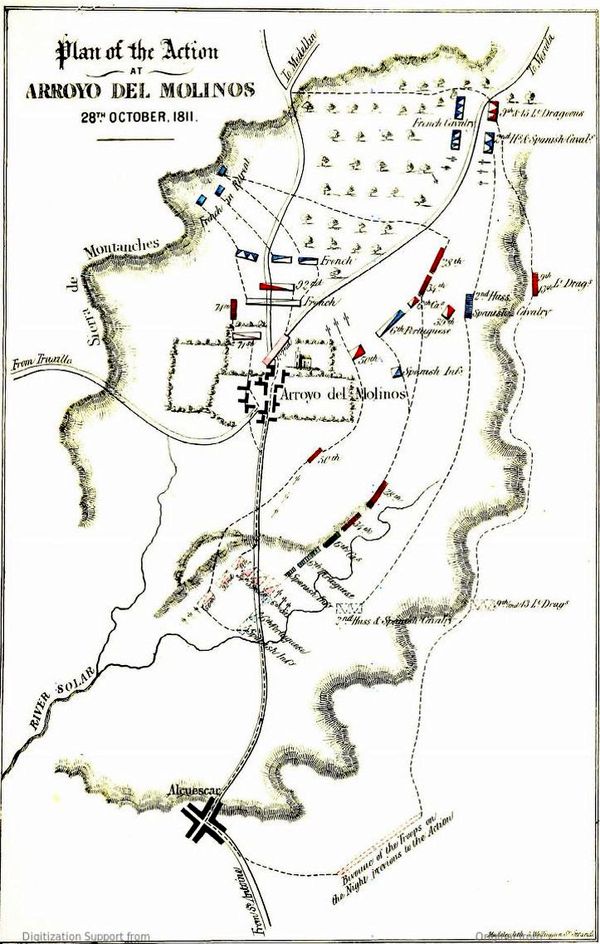
Madeley Lith. 3, Wellington St. Strand.
Plan of the Action
at
ARROYO DEL MOLINOS
28
TH
OCTOBER, 1811.
In the evening the battalion marched to San Pedro, and on the 29th of October proceeded to Merida; on the 31st to Montejo; on the 1st of November to Campo Mayor; on the 3rd to Arronches; and arrived at Portalegre on the 4th of November.
Lieut.-General Hill, on the 7th of November, issued the following General Order:—
“Portalegre, 7th November, 1811.
“Lieut.-General Hill has great satisfaction in congratulating the troops on the success which has attended their recent operations in Estremadura, and in so doing, he cannot but endeavour to do justice to the merits of those through whose exertions it has been obtained. A patient willing endurance of forced and night marches, during the worst of weather and over bad roads, of bivouacs in wet weather, oftentimes without cover and without fire, and a strict observance of discipline, are qualities, however common in British soldiers, which the Lieut.-General cannot pass unnoticed. Having on this occasion witnessed the exertion of them in no ordinary degree, he feels that nothing but the most zealous attention of commanding officers, the good-will and zealous spirit of the non-commissioned officers and soldiers, could produce such an effect, and he requests they will, generally and individually, accept his warmest thanks, particularly those corps which were engaged in the action of Arroyo-del-Molinos, whose silent attention to orders, when preparing to attack, and when manœuvring before the enemy, could not but excite his notice, and give them an additional claim on him.”
Letters from the Secretary of State, dated the 2nd, and from His Royal Highness the Commander-in-Chief, dated the 6th December, were promulgated, expressive of His Royal Highness the Prince Regent’s approbation and thanks to Lieut.-General Hill, and the troops under his command, for their brilliant operations on the recent expedition in Spanish Estremadura, in having totally surprised and defeated the enemy under General Girard.
Viscount Wellington having made preparations for the recapture of Ciudad Rodrigo, concentrated the main body of the army in that neighbourhood, and the troops under Lieut.-General Hill were therefore ordered to divert the enemy’s attention in the south.
Lieut.-General Hill marched from Portalegre on the 26th of December, and proceeded on the 29th to a bivouac about a league beyond La Nava, at which village about three hundred French infantry were discovered running to their arms upon the approach of the head of the British cavalry column. They, however, effected their escape to Merida, from which place they had been that morning detached, and acquainted General Dombrouski of the approach of the British troops.
On the 30th of December, the NINETY-SECOND and other British troops entered Merida, the French having retreated during the night, where they halted during the following day.
1812
On the 1st of January, 1812, the British troops moved upon Almendralejos, beyond which, and close to the town, the enemy’s columns were formed, and seen immediately retreating to Azauchal. On the 3rd, Lieut.-General Hill matched his force to Villa Franca. A brigade of infantry, and the cavalry, were pushed forward to Fuentes del Maestre, where a smart affair took place, the enemy retreating upon Llerena with the loss of some prisoners.
Lieut.-General Hill’s division returned to Almendralejos on the 4th of January, and the NINETY-SECOND marched on the following day to Merida, where the troops went into quarters. The siege of Ciudad Rodrigo, which commenced on the 8th of January, being in a state of forwardness, it was expected that the French would make an effort to relieve the place. Lieut.-General Hill was therefore directed to throw a part of his force across the Tagus.
The troops accordingly marched on the 13th of January from Merida to La Nava; on the 14th to Zogalla; on the 15th to Albuquerque; on the 16th to Codesiera; on the 17th to Portalegre; on the 19th to Alpalhao; on the 20th to Niza; and on the following day they crossed the Tagus at Villa Velha; marched from thence to Sarnadas, and on the 22nd to Castello Branco. During this march intelligence was received of the storm and capture of Ciudad Rodrigo by the British on the 19th of January.
On the 2nd of February, the NINETY-SECOND and other regiments under Lieut.-General Hill, were directed to return to Portalegre, where they arrived on the 5th of that month.
The strength of the first battalion at this period consisted of forty-three serjeants, sixteen drummers, and seven hundred and thirty rank and file. On the 4th of March the battalion marched to Alegrete, and on the following day to Albuquerque.
Previously to this time, a large quantity of artillery stores and the battering train had been embarked at Lisbon for the Mediterranean (as it was then reported), but the vessels put into the Bay of Setuval; the whole being landed at Alcacer de Sal, and conveyed up the Alemtejo, soon appeared moving on the plains in front and to the right of Elvas, in one long and continued chain towards the Guadiana. The army now became aware that the third siege of Badajoz was to be undertaken.
Lieut.-General Hill’s corps marched from Albuquerque on the 15th of March, and arrived at La Nava on the 16th;—proceeded on the following day to Merida, where some officers and men of the enemy were made prisoners. The division continued its march to Almendralejos on the 18th of March, where the NINETY-SECOND and other troops were stationed to cover the siege of Badajoz, before which ground had been broken on the previous day.
The division proceeded on the 21st of March from Almendralejos to Merida, and on the 26th advanced towards Medellin and Don Benito, from which places it forced the enemy to retire. Advices were here received, that the enemy, under Marshal Soult, was advancing to Llerena, with a view to relieve Badajoz, to the vicinity of which place the covering army was directed to retire.
On the 31st of March, the division proceeded towards Merida, where it arrived on the 2nd of April; it marched on the 5th to a position near Talavera Real. On the night of the 6th of April, Badajoz was assaulted and carried by the troops under the Earl of Wellington, Marshal Soult consequently retraced his steps towards Seville.
The battalion marched into quarters in Almendralejos on the 13th of April. A French force having made an irruption into the province of Beira, the Earl of Wellington, with the main body of the army, crossed the Tagus immediately after the fall of Badajoz.
On the 12th of May, the battalion marched from Almendralejos, and bivouacked near Merida; on the 13th near Arroyo-del-Molinos; on the 14th near Villa Mesias; on the 15th entered Truxillo, and marched again about midnight; on the 16th bivouacked near Jaraicejo, and on the following day proceeded to the mountains near Casas del Puerto.
On the 18th of May, the NINETY-SECOND marched at night to attack the enemy’s fortifications covering the bridge of Almaraz. The ruggedness of the footpath through the mountains, and the darkness of the night, presented serious obstacles to a rapid march; it was consequently daylight before the troops were formed in the Valle de Canas.
The fiftieth regiment and a wing of the seventy-first were formed in one column, and were destined to assault Fort Napoleon on the 19th of May; while the NINETY-SECOND under Lieut.-Colonel Cameron, and the other wing of the seventy-first, were formed in a second column, ready to support the attack on Fort Napoleon, or to carry the tête-de-pont at the same moment, both columns being provided with scaling ladders.
Fort Napoleon was carried in gallant style by the column sent against it, the enemy flying from it towards the tête-de-pont; the NINETY-SECOND dashed forward and entered with him. The commandant of Fort Ragusa, on the opposite bank of the Tagus, being seized with a panic, had cut away the bridge of boats; many of his countrymen consequently were either drowned or made prisoners.
The attention of all was now directed to the passage of the river. Some of the NINETY-SECOND immediately leaped in, and swam to the opposite side, bringing the boats back with them.[14] Thus was the bridge secured, together with Fort Ragusa, which the enemy immediately abandoned.
The enemy attached great importance to his establishment at this place, which secured the only direct communication between his two armies, and its destruction had the effect of placing them several days’ march more distant from each other, and over mountainous roads hardly passable by artillery. The works and bridge at Almaraz having been destroyed, and about five hundred prisoners secured, the troops returned to Jaraicejo.
To commemorate the gallantry of the NINETY-SECOND in the above enterprise, the Royal Authority was afterwards received for the word “Almaraz” to be borne on the Regimental Colour and Appointments.
On the 21st of May, the troops marched to Truxillo, where they halted for two days. At this period intelligence was received that the French had pressed forward towards Almendralejos.
On the 24th of May, the corps under Lieut.-General Sir Rowland Hill marched to a bivouac near Villa Mesias; on the 25th proceeded to the vicinity of Rio del Agua; on the 26th to near San Pedro, and occupied quarters in Merida on the day following.
The NINETY-SECOND marched from Merida on the 5th of June, and went into quarters in Almendralejos. On the 12th of June it marched to Fuentes del Maestre, and on the following day proceeded to Puebla de Sancho Perez. The enemy having moved from Andalusia in some force, evinced an inclination to bring on an action in this advanced position, probably to divert the Earl of Wellington from his operations upon Salamanca, with which place Marshal Soult had no direct communication since the loss of the bridge of Almaraz, and every movement in advance threw him farther from co-operating with Marshal Marmont.
The battalion retired to Los Santos on the 16th of June; on the 17th to Santa Martha; and on the 18th to a wood in front of Albuhera, where all the infantry under Lieut.-General Sir Rowland Hill were assembled; some field-works were immediately thrown up to strengthen the position, and enable the Earl of Wellington, without apprehension for the safety of that corps, to prosecute his attack upon the enemy’s forts at Salamanca, which were captured on the 27th of June.
On the 2nd of July, the battalion advanced to Santa Martha; on the 3rd it marched to a bivouac near Villa Alva, where the enemy brought up some guns, and cannonaded the troops; on the 4th it bivouacked near Feria; on the 5th near Bienvenida; on the 6th near Villa Garcia; and on the 7th it entered Llerena.
The NINETY-SECOND marched from Llerena, by Arlones, on the 8th of July to Berlenga, where some cannonading and a cavalry skirmish took place, after which the enemy retired, and the battalion returned on the following day to Llerena.
The battalion again marched from Llerena on the 20th of July to Bienvenida, and on the following day to Zafra. The enemy at this time moved to his right, and had a force near Fuentes del Maestre.
During the night of the 26th of July, the NINETY-SECOND marched towards Villa Franca, near which place the battalion bivouacked about daylight. The French were about a league in front at Fuentes del Maestre. Between nine and ten o’clock in the morning of the 29th of July, a brigade of French guns was drawn up on a height, in front of their position, and fired a royal salute. Many were the surmises as to the cause of this rejoicing, until some of the British officers ascertained at the outposts, that the salute was in honor of a victory supposed to have been gained by the French at Salamanca.
Lieut.-General Sir Rowland Hill, however, received more authentic intelligence from the scene of action, and immediately afterwards issued the following order:—
“Villa Franca, 29th July, 1812.
“Captain Maxwell’s brigade of artillery will fire a salute of twenty-one guns at twelve o’clock, being in honor of the glorious and important victory gained over the enemy at Salamanca, by the army under the immediate command of the Earl of Wellington, on the 22nd instant.
“An extra ration of wine or spirits is to be issued to the British and Portuguese troops, to enable them to drink the Earl of Wellington’s health.
(Signed) “J. C. Rook, “Assistant Adjutant-General.”
The troops were under arms, and after the salute, Lieut.-General Sir Rowland Hill advanced; the enemy, however, did not await this proof that the victory was on the side of the Allies, but immediately retired, and Fuentes del Maestre was occupied by the British troops.
On the 1st of August, the battalion went into quarters in Villa Franca.
The allied army under the Marquis of Wellington, which title was conferred upon him after the victory of Salamanca, entered Madrid on the 12th of August, and was received with every demonstration of joy by the inhabitants. Marshal Soult, in consequence of this movement, raised the blockade of Cadiz, and abandoning Western Andalusia, moved towards Grenada.
Lieut.-General Sir Rowland Hill’s corps, of which the NINETY-SECOND formed part, advanced on the 28th of August to Usagre; on the 29th to Villa Garcia; on the 30th proceeded to the left to Maquilla; on the 31st to El Campillo; on the 1st of September the troops marched to Zalamea; on the 2nd to Quintana; on the 3rd to La Nava; and on the 4th to quarters in Don Benito.
On the 13th of September, Lieut.-General Sir Rowland Hill crossed the Guadiana, and marched to Mojadas; on the 14th to Villa Mesias; and on the 15th to Truxillo, where the troops halted.
The troops resumed their march from Truxillo to a bivouac near Jaraicejo on the 19th of September, and on the day following crossed a pontoon bridge thrown over the Tagus, where that of the enemy formerly stood, and bivouacked near Almaraz; on the 21st the division proceeded to Naval Moral; on the 22nd marched to Calzada de Oropeza; on the 23rd to La Gartera, and there halted.