HISTORICAL RECORD
Reading edition
OF
THE FOURTH,
OR
THE KING'S OWN, REGIMENT OF FOOT.
1680
The city of Tangier on the coast of the kingdom of Fez, in Africa, having been ceded in 1661, by Portugal, to King Charles II., as part of the marriage portion of the Infanta, Donna Catherina, this fortress, with a portion of the adjoining territory, had constituted a part of the possessions of the British crown for a period of nearly twenty years, when circumstances occurred, which gave rise to the formation of the REGIMENT which is the subject of this memoir, for service in that part of His Majesty's dominions.
This ancient and renowned city had been successively in the power of the Phœnicians, Romans, Vandals, Saracens, Portuguese, and Spaniards, and it had been the scene of armed contentions and sanguinary wars, in remote ages as well as in modern times. It had formerly been celebrated as one of the most splendid cities in that quarter of the world, but had fallen from its ancient power and magnificence; and when it came into the possession of the British crown, fragments of ruins were all that remained to indicate its former grandeur. It had been much strengthened and improved by the English after their possession of it; detached forts had been constructed, and large sums of money had been granted by the parliament for improving the harbour and enlarging the defences. Much opposition had, however, been met with from the native chiefs, who availed themselves of all the means within their power for exterminating the Christian occupants of this part of Africa. The garrison had already resisted many attempts of its daring and inveterate enemies, particularly in the time of Gaylan, the usurper of Fez; but in 1680 the city was besieged by an immense force, and the Moors had the advantage of having several European renegades in their army, by whom they had been taught the art of mining and of carrying on approaches under ground. Not only the national honour and the credit of His Majesty's arms were concerned in the preservation of this fortress, but, in the event of its capture by the Moors, the Levant trade was likely to suffer some interruption from its harbour becoming the resort of pirates.
King Charles II., therefore, sent thither a battalion of foot guards and sixteen companies of Dumbarton's regiment, (now first royals,) and issued, in July, 1680, warrants for raising six independent troops of horse and a regiment of foot, to augment the garrison, and to enable it to chase from under the walls the native forces by which it was menaced.
The first troop of horse was raised by Major-General the Earl of Ossory, who was nominated governor of His Majesty's possessions in Africa; and the others by Lieut.-Colonel Sir John Lanier, and Captains Robert Pulteney, John Coy, Charles Nedby, and Thomas Langston.
The regiment of foot was ordered to consist of sixteen companies of sixty-five private men each, besides officers and non-commissioned officers; and the colonelcy was conferred on Charles Fitz-Charles, Earl of Plymouth, a daring aspirant to military fame, who had already distinguished himself against the Moors in the character of a volunteer, and was serving at Tangier at the time the regiment was raised.
The royal authority for raising this regiment was given on the 13th of July, 1680, and the sixteen companies of which it was composed, were raised by the following officers; Lieut.-Colonel Piercy Kirke,[6] Major Charles Trelawny, and Captains Zachariah Tiffin, Henry Trelawny, Edward Hastings, Charles Fox, Edward Griffin, John Strode, Edward Saville, Roger Pope, Walter Fitzgerard, John Grimes, Robert Ansley, Arthur Cheffors, and John Southcote, and the captain-lieutenant of the colonel's company. Eight companies were raised in London and in its vicinity under the immediate superintendence of Lieut.-Colonel Kirke, and had their general rendezvous in Clerkenwell; and the other eight companies were raised in the west of England, with their general rendezvous at Plymouth, under the superintendence of Major Trelawny.
The corps thus raised obtained the title of the Second Tangier Regiment,[7] and after serving the British crown in various parts of the world, through the eventful period of one hundred and fifty-eight years, it continues a distinguished corps, and bears the designation of the Fourth, or the King's Own, Regiment of Foot. Although the particulars of its origin and formation have been distinctly given, yet it was in some measure connected with another corps, of whose services a few words are introduced into this record.
On the breaking out of the war between England and Holland in the early part of 1672, a regiment of foot was raised, of which James Duke of Monmouth was appointed colonel. This regiment was sent to France, and taken into the pay of Louis XIV.; it served during the campaigns of 1672 and 1673, under the Duke of Monmouth, in the Netherlands, and during the four succeeding years it served with the French army in Alsace and on the Rhine, together with Douglas's or Dumbarton's regiment, now first royals, Churchill's, and Hamilton's. In these campaigns Monmouth's regiment distinguished itself on several occasions under Marshals Turenne, De Crequi, and Luxemburg. In 1678 it was ordered to return to England, and after the peace of Nimeguen it was disbanded.
When the Earl of Plymouth's regiment was raised, many of the officers of Monmouth's late regiment were appointed to commissions in this new corps, through whose influence many of the non-commissioned officers and soldiers, who had served in the Netherlands, France, and Germany, were induced to enter the same regiment. By these means, and by the aid of a few men from the Holland regiment, now third foot, or the buff's, the Earl of Plymouth's, or Second Tangier Regiment, was completed in numbers, equipped,[8] instructed in the simple exercises practised at the time, and ready to embark for foreign service in less than four months after the order for its being raised was issued.
The service for which these forces were raised being urgent, three of the troops of cavalry (Langston's, Nedby's, and Coy's) were provided with horses from the life guards and royal regiment of horse guards, and sailed as soon as possible; the Earl of Plymouth's regiment also embarked with all possible expedition, and sailed in November.
In the mean time the garrison of Tangier had overpowered the Moorish army in a sharp action under the walls, and a truce had been agreed upon for six months; and when information of this event arrived in England, the other three troops of horse (viz. Ossory's, Lanier's, and Pulteney's) were disbanded.
This truce was in operation when the Earl of Plymouth's regiment arrived at Tangier; and the officers and men learned that their colonel had died a few weeks previously of dysentery. He was succeeded in the colonelcy by the lieut.-colonel, Piercy Kirke, who was also appointed commander-in-chief of the garrison.
Shortly afterwards an ambassador from the court of Fez arrived, and made his public entry into the city of Tangier on the 2nd of December; his reception is thus described in the London Gazette:—"Colonel Kirke, our commander-in-chief, went out to meet him between eleven and twelve. Four troops of horse marched first;—after them fifty chosen grenadiers of the Earl of Dumbarton's regiment; then thirty gunners with their linstocks; followed by thirty negros in painted coats, with their brown-bills (a sort of battle-axe); and after these rid Colonel Kirke, surrounded with twenty gentlemen well mounted, and having six men of the tallest stature, with long fusils, on each side of his horse; in which order, having proceeded a good distance beyond Fountain Fort, the party of Moors, which was about two hundred horse with their lances, being now within musket shot of us, made a halt. The ambassador with about thirty persons advanced towards Colonel Kirke, who received him with those compliments which are customary. Colonel Kirke then went to make his salutations to the alcaid, Aley Benanbdala, vice roy of those countries, who remained at the head of the Moorish party; which being ended, the alcaid and the ambassador with each of their parties began a skirmish, it being their manner of rejoicing and expressing their satisfaction. Having shown their horsemanship and skill in managing their lances and fusils, they parted, the alcaid going off with his men, and the ambassador with his train proceeding with Colonel Kirke to the town; where all the regiments in garrison were formed up to augment the splendour of his public entry."
1681
In the succeeding year Colonel Kirke proceeded on an embassy to the court of the vice-roy of Fez, and also to that of the Emperor of Morocco, and a treaty of peace between the English and Moors was concluded. A diary of Colonel Kirke's journey, with a description of his reception, and of the court of the African potentate, was published at the time, and appears more like an airy vision of the imagination, or a few pages from an eastern romance, than a narrative of facts.
1682
After the decease of Sir Palmes Fairborne (who was killed in an engagement with the Moors on the 24th of September, 1680), Colonel Kirke was removed to the colonelcy of the first Tangier (now the second or queen's royal) regiment, and was succeeded by the lieut.-colonel, Charles Trelawny, by commission dated the 23d of April 1682.
The improved military system of the Moors, introduced by the employment of European renegades, having rendered it necessary to maintain a much stronger garrison at Tangier than formerly, His Majesty brought the subject before parliament; but the people of England were more alarmed at the prospect of a popish successor to the throne than at the danger of losing this fortress, which they considered as an asylum for popish recusants, and consequently no further grant was voted.
1683
A free intercourse had been established with the Moors, and a traffic by barter was carried on to the benefit of the town; but all the advantages expected to be derived from the possession of this fortress had not been realized, and King Charles II. was unwilling to bear, without any pecuniary aid from parliament, the expense of the fortifications and troops. He accordingly sent, towards the end of 1683, Admiral Lord Dartmouth with a fleet, to destroy the fortifications, and to bring away the British inhabitants and garrison.
1684
The regiment arrived in England from Tangier in February, 1684, and was placed in garrison at Portsmouth, where it remained upwards of twelve months; and its establishment was reduced from sixteen to twelve companies.
In the autumn of this year His Majesty conferred upon the regiment the title of Her Royal Highness the Duchess of York and Albany's Regiment. What its distinguishing colour, or livery (which is now called facing), was on its formation, has not been ascertained; but in October of this year it was YELLOW. This appears to have been a favourite colour of the Duke of York, (afterwards James II.) as his troop of life guards had yellow horse furniture, belts covered with yellow velvet, yellow ribands on the horses' heads and tails, and also yellow ribands in the men's hats; and his marine regiment, called the Admiral's Regiment, was clothed in yellow.
The colours of the regiment were of yellow silk, with the red cross of St. George bordered with white; the rays of the sun issuing from each angle of the cross, or; and Her Royal Highness's cypher in the centre.
1685
On the 6th of February, 1685, King Charles II. died, and was succeeded by his brother, James Duke of York; and the Duchess of York having become Queen of England, this regiment was styled the Queen's Regiment of Foot: the first Tangier regiment had previously been styled the Queen's, and was now designated the Queen Dowager's regiment.
The much dreaded event—the accession of a papist to the throne—had now occurred; but the minds of the people were partially set at ease by the King's declaration of his determination to maintain the protestant religion as by law established. This did not, however, prevent several rash adventurers from urging James Duke of Monmouth, to make an attempt to gain the throne. This nobleman was the illegitimate son of the late king,—was of prepossessing appearance and address,—a steady advocate for the protestant religion,—had gained a reputation for military virtues,—and had become a favourite with the people. Being urged to this enterprise by his desperate associates, he raised the standard of rebellion in the west of England in June, 1685; and, having been joined by a number of miners and other persons, proclaimed himself king.
The Queen's Regiment of Foot was reposing in quarters at Portsmouth and performing the duties of the garrison, when the news of Monmouth's rebellion produced an electric sensation throughout the country. The regular army was augmented; the militia was called out; and this regiment was ordered to recruit its numbers to one hundred men per company. Soon afterwards five companies, under the command of Lieut.-Colonel Charles Churchill, were ordered to march in charge of a train of artillery, consisting of seven field-pieces, to join the army under the command of Lieut.-General the Earl of Feversham, which was assembling to oppose the rebels.
The five companies of the Queen's Regiment having joined the other forces with the artillery, the army advanced to the village of Weston, and the infantry encamped on Sedgemoor, the two Tangier regiments taking the left of the line. The rebel army lay at Bridgewater, and during the night of the 5th of July the Duke of Monmouth advanced with the view of surprising the King's troops in their camp; but his approach was discovered, and the camp was alarmed by the cavalry out-guards. The rebels, however, rushed forward, and a fierce conflict of musketry ensued in the dark. The first attack was made against the royals on the right; and extending along the front to the left, the companies of the Queen's Regiment became sharply engaged, and "performed good service." Soon after day-break the King's cavalry charged the flanks of the rebel army and put it into confusion. An entire rout ensued, and the insurgents were pursued across the moor and adjoining fields with great slaughter; many were taken prisoners; and their leader, the Duke of Monmouth, was captured two days afterwards near Ringwood, in Hampshire, and was removed to London, and beheaded.
After the suppression of the rebellion, the five companies of the Queen's Regiment returned to Portsmouth: their conduct was highly approved by his Majesty, and soon afterwards the regiment was presented with a set of new colours—one to each company; and it continued to display TWELVE COLOURS for several years from that period. Two of the new colours were presented by the Queen, and the other ten by his Majesty: of the expense of the former no account has been met with; but some idea may be formed of the splendid appearance of these colours, from the fact that the ten presented by the King cost upwards of twenty pounds each.[9] A copy of the bill, amounting to £206 5s. 6d., is preserved in the official records in the War Office. A copy of the royal warrant, dated 21st of August, 1686, for the payment of this sum, is inserted below.[10]
During the summer ten companies of the regiment were ordered to proceed from Portsmouth to Taunton in Somersetshire, to attend the Lord Chief Justice Jeffreys, who was appointed by King James II. to try the prisoners taken at the battle of Sedgemoor, and a number of other persons who were charged either with being concerned in the rebellion, or with countenancing or aiding the ill-fated duke and his adherents. The narrative of the proceedings of the Lord Chief Justice, and of the painful duties which the troops who attended on him had to perform, forms one of the black pages of the history of this country; and the remorseless and sanguinary character of the judge has occasioned him to be held up to deserved execration. Colonel Kirke and his regiment have also been charged with acts of cruelty, although the accounts may have been exaggerated; but the conduct of the ten companies of the Queen's Regiment escaped censure, as their services appear to have been limited to the guarding of prisoners, and the preserving of order at executions, which were so numerous that these were termed the BLOODY ASSIZES.
1686 1687
The Queen's Regiment remained in extensive cantonments in the western counties until the spring of 1686, when it was ordered to march to Plymouth, where it passed the succeeding twelve months. It was withdrawn from Devonshire in March, 1687, and was stationed a short time at Salisbury and Wilton, from whence it marched to Hounslow in June of the same year, and pitched its tents on the heath. After having been twice reviewed by King James II., the regiment struck its tents on the 5th of August, and marched to Bristol, Bath, and Keynsham.
1688
In the spring of 1688, the regiment proceeded to Portsmouth, and passed the summer months in that garrison; but in September it was ordered to march to London.
The short period during which King James II. had occupied the throne, had been pregnant with events of a most alarming character to the nation, and every evil which the people had feared would follow the accession of a popish prince to sovereign power, appeared on the eve of transpiring. The rebellion of the Duke of Monmouth had furnished the King with a pretext for augmenting the regular army, which he continued on a high establishment, and increased, from time to time, without the consent of parliament. The troops were embodied by the authority of the crown only, and were paid, either from the civil list, or by diverting moneys, intended for other objects, to that purpose; and the King even appeared to have formed the design of governing without parliaments, of rendering himself absolute, and of subverting the reformed religion. His Majesty's principal dependence for the success of his unconstitutional projects was placed in the devotedness of his troops; but his conduct disgusted the military as well as his other subjects; and the cheers of the soldiers on Hounslow Heath at the acquittal of the bishops, whom the King had imprisoned and brought to trial for opposing his measures, proved that he had entirely lost their sympathy, and could no longer trust to them for support.
The King's proceedings having filled the nation with alarm and consternation, the Prince of Orange, who was the King's nephew and son-in-law, and a zealous advocate for the Protestant interest, was solicited to come to England with a body of troops to assist the nobility and gentry in opposing the proceedings of the court. At the same time, many of the superior officers of the English army, who were most zealous for the welfare of the kingdom and the preservation of the reformed religion, seeing the danger to which the constitution in church and state was exposed, formed themselves into a secret association, and engaged not to fight in the cause of papacy and arbitrary power, but to further the objects of the Prince of Orange; and Brigadier-General Charles Trelawny, Colonel of the Queen's regiment of foot, was one of the members of this association.
When the Prince of Orange had landed at Torbay (5th of November) the regiment proceeded by forced marches to Salisbury, and afterwards to Warminster, which was the most advanced post of the King's army, and was occupied by the third troop of life guards, the Queen's, and Major-General Werden's regiments of horse, the Queen's regiment of dragoons, with two battalions of the royals, and the Queen Dowager's and Queen Consort's regiments of foot,[11] commanded by Major-General Kirke and Brigadier-Generals Trelawny and Maine.
The King arrived at Salisbury on the 20th of November, and on the 21st reviewed his forces stationed in and near that city; and a number of officers and soldiers having already deserted to the Prince of Orange, His Majesty addressed the troops on the subject, and gave liberty to all who were unwilling to serve him, to depart without molestation. This appeal to their loyalty was followed with such shouts and assurances of attachment, that the King's confidence, which had been much shaken, was in a great measure restored. On the following day His Majesty designed to have visited the advanced post at Warminster, but was prevented by a bleeding at the nose, to which he was constitutionally subject. The Duke of Berwick states in his memoirs,—"The King intended to go from Salisbury in my coach to visit the quarter commanded by Major-General Kirke; but was prevented by a prodigious bleeding of the nose, which seized him on a sudden, and it is said, that a scheme was laid and measures taken by Churchill and Kirke, to deliver up the King to the Prince of Orange; but this accident frustrated the design." Brigadier-General Trelawny is also charged with participating in this design; but no direct proof on the subject has been adduced by any historian.
The number of desertions increasing, the King ordered the army to retire towards London, when the cavalry was withdrawn from Warminster by Brigadier-General Maine of the third troop of life guards; and orders were sent to Major-General Kirke to march with the infantry to Devizes, but he refused, and was placed in arrest and sent under a guard to London. Brigadier-General Trelawny, expecting a similar fate, withdrew, with his lieut.-colonel, Charles Churchill, and about thirty non-commissioned officers and soldiers, and joined the Prince of Orange. The King sent Lieut.-General the Earl of Dumbarton to Warminster with two squadrons of horse, and he brought off the remaining officers and men of the four battalions without interruption.
After Brigadier-General Trelawny had joined the Prince of Orange, the King gave the colonelcy of the Queen's regiment of foot to Sir Charles Orby from the commission of lieut.-colonel in the third troop of life guards. But His Majesty, finding the army, on which he had depended, would not be subservient to his designs, fled from London with the view of escaping to France; the Prince of Orange assumed the reins of government, and ordered the regiment to march to Hertford and Ware; and His Highness restored Brigadier-General Trelawny to the colonelcy, and promoted Lieut.-Colonel Charles Churchill to the command of the Holland regiment, now the third foot.
1689
The regiment continued to occupy quarters in the south of England after the accession of William and Mary, and passed the winter of 1689 at Exeter.
1690
In the mean time Ireland had become the scene of conflict between the Roman Catholics and Protestants, and King James, having proceeded thither with a body of French troops, had reduced the greater part of that kingdom under his sway, and had maltreated the Protestants in various ways. In 1689 King William sent Duke Schomberg, with a body of troops, to aid the Protestants, and in 1690 His Majesty resolved to take the field in person. The Queen's regiment of foot was selected to form part of the army in Ireland, and having embarked from Barnstaple in the middle of April, put to sea, but was driven by severe weather to Pembroke. Here the regiment remained about a week, and having again put to sea on the 30th of April, landed at Belfast on the 2d of May. King William arrived in Ireland on the 14th of June, and placing himself at the head of the army, advanced to the banks of the Boyne, on the opposite side of which river King James's army was formed in order of battle.
At day-break on the morning of the 1st of July, the regiment was under arms, every man displaying a green branch in his hat, to distinguish him from the enemy, who wore pieces of white paper in their hats, and the cheerful countenances of the musketeers, pikemen, and grenadiers seemed to give presage of victory. About six o'clock the regiment, with the remainder of Brigadier-General Trelawny's brigade, forming part of the force under Count Schomberg and Lieut.-General Douglas, filed to the right, and having marched about two miles up the river, forded the stream between the King's camp and Slane bridge. Sir Neal O'Neal's regiment of Irish dragoons, in the service of King James, offered some opposition; but was speedily routed and its commanding officer was mortally wounded. After passing the river, Trelawny's brigade halted a short time until additional forces arrived; then advancing through corn fields, over deep ditches, and across a difficult bog, drove the enemy's left wing from its ground in a spirited manner, and forced it to make a precipitate retreat towards Duleek. When the enemy's left flank was thus turned, King William passed the river with the other divisions of his army, and King James's forces were overpowered and chased from the field. Thus a decisive victory was gained, and the troops halted during the night near Duleek.
The regiment advanced with the army upon Dublin, and at the review at Finglass, on the 7th and 8th of July, it mustered (according to the official rolls) five hundred and fifty-three private men, besides officers and non-commissioned officers. The enemy having fled from Dublin, the regiment was stationed several weeks in garrison in that city, of which its colonel was appointed governor.
Meanwhile the combined English and Dutch fleets, commanded by Lord Torrington and Admiral Evertsen, had engaged (30th of June) the French fleet under the Count de Tourville, off the Beachy, and the Dutch, being in the van, suffered so severely, that the enemy not only claimed the victory, but actually gained the ascendancy at sea, and menaced England with an invasion. A body of French landed on the western coast, and destroyed a village, and this event having produced considerable alarm, King William ordered this regiment and several other corps to return to England.[12]
After its arrival in England the regiment was encamped on Southsea common, near Portsmouth, and in the autumn, the danger of foreign invasion having passed away, it was selected to form part of an expedition to Ireland under the Earl of Marlborough, (afterwards the great Duke of Marlborough.) The troops employed on this service[13] embarked about the middle of September, and arrived in Cork roads on the 21st of that month. The fleet entered the harbour on the following day, and the co-operation of part of the army on shore having been secured, the troops landed on the 23d and besieged the city of Cork. A breach having been made, four English regiments, under Brigadier-General Churchill and a body of Danes, passed the river on the 28th of September, wading up to the arm-pits to the east marsh, in order to storm the city wall on that side. The grenadiers under Lord Colchester led the attack, and, while advancing, the Duke of Grafton, who accompanied the storming party in the character of a volunteer, received a mortal wound. Before the storming party gained the breach, the enemy hung out a white flag, and agreed to surrender.
Kinsale was afterwards besieged, and the enemy immediately vacated the town and retired into the Old and New Forts. The Old Fort was taken by storm on the 2d of October; and a breach having been made in the New Fort, the garrison surrendered on the 15th of October.
After the capture of these fortresses the regiment was placed in garrison in Cork, where it remained during the winter.
1691
In the spring of 1691, when the army took the field under General De Ginkell, (afterwards Earl of Athlone,) this regiment was left in reserve in the county of Cork, to secure the garrisons, and to keep in check the bands of armed Roman Catholic peasantry, who prowled about the country committing every description of depredation; and, while employed in this service, detachments of the regiment had occasional encounters with the enemy's parties. After the overthrow of the Irish and French forces at Aughrim, the regiment was ordered to march from the county of Cork, and it joined the main army in the wild and desolate part of the country called Shalley. Advancing from thence to Limerick, it was engaged in the siege of this place, which was terminated by the surrender of the garrison in September, on condition of being permitted to proceed to France. Indemnity was also granted to the Roman Catholics who had engaged in this contest, and the power of King James was finally suppressed in Ireland.
After so many of the Irish regiments as were willing had proceeded to France, where they were taken into the service of Louis XIV., the other Irish corps which had fought in King James's cause were disbanded, and the regiment which forms the subject of this memoir returned to England, and immediately commenced recruiting its numbers.
1692
On the 1st of January, 1692, the colonelcy was conferred on the lieut.-colonel, Henry Trelawny, vice Major-General Charles Trelawny, who was appointed Governor of Plymouth.
The regiment was allowed but a short period for the purpose of recruiting, before it was ordered to hold itself in readiness to proceed to the Netherlands, and having embarked at Portsmouth, sailed on the 31st of March, 1692; contrary winds, however, forced the transports to anchor in the Downs until the middle of April, when they sailed to Ostend. After landing, the regiment went into cantonments among the Belgic peasantry, and subsequently took the field with the army commanded by King William in person.
The regiment took part in the operations of the main army and in the advance to relieve the siege of Namur, which was frustrated by heavy rains. On the 29th of June, it was reviewed by King William and the Elector of Bavaria at the camp on the undulating grounds between Genappe and the forest of Soignies.
It was also present at the battle of Steenkirk, fought on the 24th of July, when the army of King William was repulsed in an attempt to force the position occupied by the French under Marshal Luxemburg. This regiment formed part of the main body, and, owing to the narrow and difficult defiles which lay between the two armies, it was not brought into action, and consequently had no opportunity of distinguishing itself. A detachment of the regiment, sent forward on the preceding evening, joined the advance-guard, and was sharply engaged. The loss on both sides was nearly equal.
The Queen's regiment of foot formed part of a detachment of ten battalions sent from the main army on the 22d of August, under Lieut.-General Talmash, to join a body of troops which had arrived at Ostend from England, under the orders of the Duke of Leinster. These forces were afterwards joined by a body of cavalry, and, having summoned between two and three thousand of the country people with spades and shovels, took and repaired the fortifications of Furnes, a small town situated upon the canal, two leagues from Nieuport and five from Dunkirk. After placing this town in a condition to resist an assault, the troops proceeded to Dixmude, and fortified and garrisoned the town. The regiment subsequently marched to Bruges, and went into cantonments in the villages near the banks of the canal between that place and Ghent; but the French having advanced to Charleroi, the regiment quitted its village cantonments and joined the main army at Drongen. The French Marshal, Boufflers, bombarded the lower town of Charleroi, and afterwards retreated, when this regiment returned to its former quarters.
1693
During the winter a detachment was ordered to advance to the relief of Furnes, which was besieged by a French force under Marshal Boufflers; but the roads were so bad from heavy rains that, according to D'Auvergne, "several soldiers sunk almost to the middle in mud, and several horses remained stuck in it." This occasioned some delay, and the garrison surrendered on the 4th of January, 1693. The Dutch garrison at Dixmude, being alarmed at having the enemy so near them, withdrew from the place.
The detachment afterwards returned to its quarters, and in May the Queen's regiment took the field with the army, and was posted in the second line at the celebrated position of Parck camp, the possession of which enabled King William to defeat the enemy's designs on Brabant.
In the movements which preceded the battle of Landen, which was fought on the 19th of July, 1693, the regiment also took part; and on the night before the battle it was posted in the village of Neer-Landen, on the left of the position; but on the following morning, when the French columns were seen advancing to the attack, the Queen's and Prince George of Denmark's (now third) regiments were withdrawn from Neer-Landen, and ordered to take post in the village of Laér, to reinforce Brigadier-General Ramsay's brigade.
Scarcely had the regiment gained its post, when the glistening of bayonets and pikes, perceived at intervals above the undulations, gave indication of the approaching enemy; a cloud of light musketeers and grenadiers soon cleared the intervening space and attacked the village with great fury; and the defenders opened a most galling and destructive fire on their assailants. The enemy, by continually reinforcing the corps engaged, succeeded, after a severe struggle, in gaining some advantage; but the British troops renewed the conflict and regained their lost ground. Again the enemy brought forward his rallied forces, and a brigade of dragoons dismounting and joining in the attack, the village of Laér was carried. Brigadier-General Ramsay rallied his brigade, and after a short address, led the regiments to the attack. The French were exulting in their success, when suddenly a loud British huzza burst like a clap of thunder on their astonished ears, and the next moment the charging Britons broke through all opposition, forced the village, and in a short time cleared it of opponents.
The enemy, by his great superiority of numbers, was enabled to bring forward fresh troops, and he eventually succeeded in forcing the position at the village of Neer-Winden. The village of Laér was then no longer tenable, and the regiments were forced to retire, fighting, across the river Gheet. The King ordered the army to make a retrograde movement, which was not effected without considerable confusion and loss. The Queen's regiment had Captain Crofts and Lieutenant Woodstock killed; Captain Wharton wounded; and Captain Carroll and Lieutenant Cole wounded and taken prisoners: of its loss in non-commissioned officers and private men, no account appears to have been preserved.
The enemy's loss in killed and wounded was so great that he derived little advantage from the victory.
The Queen's regiment continued with the main army until the autumn, when it marched into garrison at Malines.
1694
The regiment marched out of Malines in May 1694, and pitched its tents near the cloister of Terbank, where three English and thirty-six Dutch battalions were encamped. During the campaign of this year two magnificent armies manœuvred on the plains of Flanders and Brabant, but no general engagement occurred. In September the Queen's regiment of foot formed part of the covering army during the siege of Huy, which place was taken by capitulation, and the regiment subsequently marched to its former station at Malines.
1695
In 1695 the regiment again took the field, and was employed in the movements which preceded the siege of the important fortress of Namur. The attack of this city excited universal attention throughout Europe. The strength of the place both by nature and art,—the extent of the castle, situated on a rock, with the works by which it was surrounded,—the number of veteran troops in the town,—the character of their commander (Marshal Boufflers),—the fact that this was one of the most important of the French king's conquests, and consequently strenuous exertions would be used for its preservation,—with the immense armies employed in covering and carrying on the siege, or in attempting to relieve the garrison, gave an important character to this undertaking, which produced a lively feeling of interest throughout Christendom; and the Queen's was one of the regiments which had the honor of taking part in the enterprise.
When Namur was first invested, this regiment remained with the covering army under the veteran Prince of Vaudemont; but it formed part of the force detached on the 24th of June under Lord Cutts, and joined the besieging troops on the 1st of July. During the night of the 8th of that month a detachment from the grenadier company was engaged in storming the covered way which the enemy had constructed on the hill of Bouge, in which service Captain Selby was wounded, and several private men were killed and wounded.
The regiment was on duty in the trenches on the 9th, and also on the 13th of July; on the 17th the grenadiers were engaged in storming the counterscarp. The assaulting party of 500 grenadiers was commanded by Colonel Collingwood, with Major Carryle of the Queen's regiment second in command. The attack was made about five o'clock in the evening; the enemy defended their post with great bravery; every inch of ground was disputed; but the counterscarp was eventually carried. The regiment lost many men on this occasion; Captain Carter (son of Rear-Admiral Carter who was killed at Barfleur) was killed in the covered-way, and Major Carryle was wounded.
On the night of the 23rd of July a detachment of the regiment was engaged in extending the lodgement on the right of the bastion of St. Roche, and had Ensign Nuby killed; also Captain Mitchell and Lieutenant Cole wounded. On the succeeding day the batteries kept up an incessant fire, and preparations were made for a general assault; but this was prevented by the enemy agreeing to surrender the town, which they vacated on the 25th, and retired into the castle.
This regiment having sustained considerable loss during the siege of the town, marched from the lines of circumvallation on the 27th of July towards Brussels, forming part of the division under Lieut.-General Count Nassau, sent to reinforce the covering army under the Prince of Vaudemont, to enable him to oppose the immense French army commanded by Marshal Villeroy. The enemy advanced to Brussels and bombarded the city, and subsequently marched towards Namur; when this regiment was withdrawn from its camp between Genappe and Waterloo, and advanced to oppose the enemy's design of relieving the castle of Namur. The position which the army took up before Namur frustrated the purposes of the French marshal; and on the 20th of August, a detachment of the regiment was engaged under Lord Cutts in storming the counterscarp and breach of Terra Nova, in which service it had Lieutenant D'Arneau and several men killed. Preparations were subsequently made for a second assault on the castle; when Marshal Boufflers agreed to surrender on honourable terms, and thus this stupendous fortress was captured; the achievement reflected glory on the British arms and those of the several nations composing the army commanded by King William. The most brilliant feature in this enterprise, however, derived its lustre from the fact, that other monarchs had made conquests for themselves, to oppress their neighbours, or to raise a powerful monarchy out of the ruins of other states; but the King of England waged war for the good of Europe, and to establish liberty and peace upon a lasting foundation. After the damage done to the works of Namur had been repaired, the regiment returned to its former quarters at Malines.
1696
The King of France finding that not only had an effectual stop been given to his arms, but that he was likely to lose many of his conquests, endeavoured to weaken the confederates by causing England to become the theatre of civil war. A party favourable to the Stuart dynasty still remained in England; the Duke of Berwick and several French officers were sent across the Channel to persuade the friends of King James to rise in arms; at the same time a plot for the assassination of King William was formed; and a French army marched to the coast to be in readiness to embark with King James for England.
Information of these events having been obtained, the Queen's regiment of foot was suddenly ordered from its cantonments in the city of Malines to embark for England. It marched to Sas Van Ghent, where it went on board of transports, and sailed to Flushing, from whence a convoy of Dutch men-of-war accompanied the fleet to England. In the mean time the conspirators had been discovered, a British fleet was sent to blockade the French ports, and the designs of Louis XIV. were frustrated. The greater part of the forces which were ordered home on this occasion returned to Flanders without landing in England; but the Queen's was one of the corps which disembarked at Gravesend, and was selected to remain on home service that year.
1697
In the summer of 1697 the regiment again embarked for the Netherlands; and having joined the army commanded by King William near Brussels on the 14th of July, was reviewed by His Majesty on the 16th. Soon afterwards the King had the satisfaction of seeing his exertions in behalf of the liberties of, and balance of power in, Europe, crowned with a treaty of peace, which was concluded at Ryswick in September; and in the succeeding month this regiment was ordered to return to England. It landed in the beginning of December at Woolwich; from whence it marched to Plymouth and Penryn, where its establishment was reduced from nine hundred and twenty-five to five hundred and seventy-two officers and soldiers.
1698
The danger arising from the exercise of so unconstitutional a prerogative as the raising of troops and the maintaining of a large army on the authority of the Crown only, as practised in the reign of King James II., was provided against at the Revolution. In the Bill of Rights, the raising or keeping of a standing army within the kingdom, in time of peace, unless with the consent of parliament, was declared to be contrary to law, and from that period to the present time the army has been maintained under the authority of an Act, annually renewed, called an "Act for punishing mutiny and desertion, and for the better payment of the army and their quarters." This Act specifies the number of soldiers to be kept up; the conditions under which they are enlisted, paid, billeted, &c.; and lays down a system of martial law for their government. Owing to the jealousy with which a standing army was regarded, and the cost of its maintenance, it was confined, after the peace of Ryswick, within very narrow limits; and in 1699 it was reduced, in opposition to the most obvious considerations of expediency, and in despite of the efforts of the King, to so few as seven thousand men. These troops were limited to "His Majesty's natural born subjects," and King William, who had been the instrument, under Divine Providence, of establishing a free government in these realms, and of fixing the balance of power in Europe, was obliged to submit to the mortification, which he felt most acutely, of dismissing his favourite regiments of Dutch guards and French refugees. When this reduction took place, the establishment of the Queen's regiment was decreased to ten companies of thirty-six private men each. It continued to occupy Plymouth and Penryn, with one company detached to the Isle of Scilly.
1701
The success which had attended the exertions of King William to prevent the aggrandizement of France by conquest, and to establish the balance of power in Europe upon an apparently solid foundation, was suddenly countervailed by the accession of the Duke of Anjou, grandson of Louis XIV., to the throne of Spain; and two years had scarcely elapsed, before the signs of approaching war appeared, and the short-sighted policy of placing the army upon so low an establishment proved a source of great inconvenience.
1702
The strength of the Queen's regiment of foot was again increased to twelve companies, and in February, 1702, King William conferred the colonelcy on Brigadier-General William Seymour from the twenty-fourth regiment.
His Majesty having died in the following month, was succeeded by Queen Anne,[14] who declared war against France; and the first service in which the Queen's regiment of foot was called upon to engage in this reign, was the expedition to the coast of Spain under the command of General the Duke of Ormond, a nobleman more remarkable for generosity and personal bravery, than for ability as commander-in-chief of an army.
Information had been received in England that the garrison of the city of Cadiz was weak in numbers, the fortifications out of repair, and that the inhabitants of that part of Spain were favourable to the house of Austria. This fortress had been captured by a British armament in the reign of Queen Elizabeth,[15] and, in the anticipation of a similar result, an expedition was fitted out, and the Queen's (now fourth) regiment of foot embarked[16] from Plymouth (mustering upwards of eight hundred men) to join in the enterprise.
When the fleet arrived on the Spanish coast, some delay was occasioned by the Admiral, Sir George Rooke, on pretence of seeking for information; but the troops landed in the middle of August, and dispersed a body of Spanish cavalry which was drawn up to oppose them, on which occasion the grenadier company of this regiment was engaged.
After landing, the Queen's regiment took part in the operations by which the capture of the towns of Rota and Port St. Mary's, and also Fort St. Catherine, was effected; it also took part in the siege of the fort of Matagorda; but the delay in landing had given the Spaniards time to recover from their first surprise, and Cadiz was found better prepared for resistance than was expected. The expedition proving too weak for the capture of this fortress, the troops retired to Rota, where they re-embarked, and afterwards sailed for England.
Nothing gives rise to more painful feelings in the breasts of British soldiers than the failure of an attempt of this nature. Though their honour and fame were untarnished, and their personal bravery had been conspicuous throughout, yet their fondly cherished hopes and sanguine expectations were blighted; the palm of victory and glory of conquest, which had appeared almost within their grasp, had vanished, and they were returning to England (where the anticipations of the people had been incautiously heightened by paragraphs in the Gazette expressive of the certainty of success) without having achieved anything to answer the expectations of their sovereign and country. The remembrance of their disappointment, however, suddenly vanished on the receipt of information of the arrival of a Spanish fleet from the West Indies, under a French convoy, at the harbour of Vigo in Gallicia. The prospect of capturing this prize gave new life to the seamen and troops, and the squadron immediately bent its course thither.
The French Admiral, M. Chateaurenaud, had placed his shipping and the galleons within a narrow passage, the entrance to which was defended by a castle on one side, and by platforms mounted with cannon on both sides of the river; and a strong boom was laid across the entrance. These obstructions, instead of daunting the British and Dutch, raised their energies and gave new vigour to their movements. The fleet passed Vigo under a heavy cannonade from the works, and anchored within four miles of Rondendella. The Duke of Ormond landed with two brigades, in one of which was the Queen's regiment of foot, in a sandy bay on the south side of the river, two leagues from Vigo; and captured the platforms and castle by storm in a most intrepid and gallant manner; while the fleet forced the boom, and bore down upon the enemy's men-of-war and galleons, which were all captured or destroyed. In this brilliant enterprise the troops had only two officers and forty men killed, and four officers and thirty men wounded; among the latter was Colonel Seymour of the Queen's regiment.
The Duke of Ormond took possession of the town of Rondendella, and being inspired with confidence from this success, he was desirous of capturing Vigo, and of passing the winter with the troops in Spain, in order to follow up the advantage he had acquired in the spring; but the admiral could only supply the troops with two months' provision, and could not leave more than six frigates on the coast; the design was consequently laid aside and the expedition returned to England with its booty. Queen Anne went in state to St. Paul's cathedral to return thanks for this success, and each of the regiments of infantry received £561 10s. prize money.
1703
After its return to England, the regiment was again stationed at Plymouth with four detached companies in village cantonments; a thirteenth company was added to its establishment, and in the summer of 1703 the nature of its services was changed, and it became a corps of Marines.
A corps was raised for SEA service by King Charles II., in 1664, and designated the admiral's regiment; and during this reign battalions for sea service were formed as the occasions of the state required, of drafts from the land forces, and embarked on board the fleet. In 1689 King William III. incorporated the admiral's regiment in the second foot guards, and two marine regiments were established for service on board the fleet. These regiments were disbanded in 1698; but on the breaking out of the war of the Spanish succession, six regiments of marines were raised, and six regular regiments of foot were placed on the establishment of the navy for sea service.[17] In May, 1703, the Queen's regiment, commanded by Colonel Seymour, was constituted a corps of Marines; and its colonel was appointed to the care and command of Her Majesty's marine forces.
The uniform of the regiment underwent some alteration on this occasion, and the three-cornered cocked hats, worn by the officers and men, were replaced by high-crowned leather caps, covered with cloth of the same colour as the facing of the regiment, and ornamented with devices, the same as the caps worn at this period by the grenadiers.[18]
The first service in which the Queen's (now fourth) regiment was called upon to engage after it was constituted a corps of Marines, was embarking on board the fleet commanded by Admiral Sir George Rooke, for the purpose of conducting to Portugal the Archduke Charles of Austria, who had been acknowledged by the British, Dutch, Imperial, and Portuguese governments as sovereign of Spain by the title of Charles III., an event which excited a lively interest at the time, and from which most important results were anticipated.
His Catholic Majesty arrived at Portsmouth on the 26th of December, and was received by the fleet and town with the honours paid to crowned heads; after visiting Queen Anne at Windsor, he went on board, and put to sea, but was driven back by a storm.
1704
The fleet again set sail on the 12th of February, 1704, arrived at Lisbon on the 25th of that month, and was followed by transports having a British and Dutch force on board under the command of Duke Schomberg, which force was designed to assist King Charles in his attempt to gain the throne of Spain.
It was customary at this period to employ marines occasionally in the field; but this regiment did not land. It remained on board the fleet, which, having put to sea, proceeded to the city of Barcelona, and expecting the Catalonians would declare in favour of King Charles III. as soon as they should be assured of protection and support, the governor was required to surrender; but he refused to receive the summons. Although the fleet was not prepared to capture the place, yet a body of Marines was landed, and the town was bombarded. This producing no alteration in the governor's resolution, and the people exhibiting no marks of attachment to the house of Austria, the Marines were re-embarked. The British and Dutch squadron subsequently proceeded in quest of the French fleet under the Count of Thoulouse, and, although the latter had the advantage in point of numbers and other particulars, yet the French admiral avoided an engagement.
Being unable to force the enemy to fight, the British and Dutch admirals resolved to make a sudden attempt on Gibraltar, and the Queen's Regiment of Marines, now the Fourth or King's Own Regiment of Foot, had the proud distinction of taking part in the capture of this stupendous fortress, a conquest from which the kingdom has probably derived as much advantage as from any previous achievement of the British arms, and which remains a monument of the national glory. The combined fleet arrived in the bay of Gibraltar on the 21st of July; a body of English and Dutch Marines were landed on the neck of land northward of the town under the orders of the Prince of Hesse d'Armstadt, to cut off the communication of the garrison with the country, and the governor was summoned to surrender the fortress for His Catholic Majesty King Charles III. This being refused, a heavy cannonade was opened on the 23d, by which the Spaniards were driven from their guns at the head of the south mole. The boats were manned, a body of men from the fleet, climbing up the difficult acclivity, with signal gallantry captured the fortifications on the mole, but had two lieutenants and forty men killed, and sixty wounded, by the explosion of a mine. Another body of men landed, and, urged forward by their innate valour and thirst for glory, captured a detached bastion between the mole and the town; and the governor, having been again summoned, agreed to surrender on condition of being permitted to march out with all the honours of war. On taking possession of the fortress, the seamen and Marines were astonished at their own success; and they viewed, with a mixed feeling of wonder and delight, fortifications which a comparatively small number of men might have defended against a numerous army. The capture of Gibraltar gave rise to new hopes and expectations to the friends of the house of Austria, and it derived additional interest from the fact that it preceded, but a very few days, the glorious victory gained by the Duke of Marlborough at Blenheim.
The loss of Gibraltar disconcerted the measures of Philip II., and his grandfather Louis XIV. Eight thousand men, under the Marquis de Villadarias, were immediately detached from the Spanish army to retake the fortress; and the French admiral received orders to engage the British and Dutch fleet, and to co-operate in the re-capture of Gibraltar.
At this period the French monarch possessed a naval force of considerable magnitude, and his fleet under the Count of Thoulouse exceeded in numbers and power the combined British and Dutch squadron. The hostile fleets engaged on the 24th of August, about eleven leagues south of Malaga, and, after both sides had suffered severely, they were separated in the night.
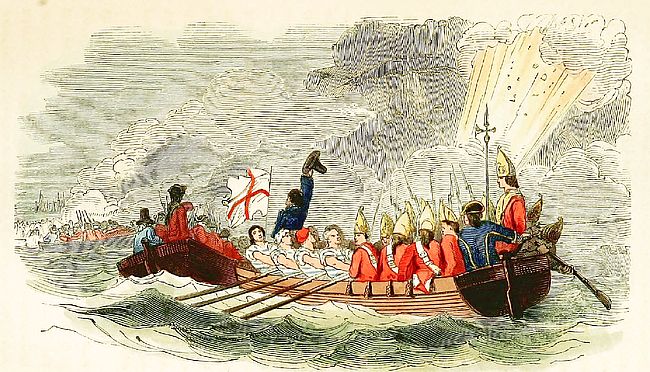
Landing of the British and Dutch troops at Gibraltar on the 21st July, 1704.
[To face page 34, in 4th Foot.
The Marquis de Villadarias, having been joined by four thousand French from the fleet, commenced the siege of Gibraltar on the 22d of October; and part of the Queen's Regiment of Marines, being in garrison, had now the honour of defending that magnificent fortress which they had so nobly assisted to capture. The garrison was weak in numbers; but Sir John Leake and Rear-admiral Vander Dussen arrived in the bay from Lisbon, with thirteen English and six Dutch men-of-war, and, thus securing the besieged from an attack from the sea, gave them an opportunity to direct all their energies to the repulsing of the attacks from the land side.
During the night of the 11th of November, five hundred of the enemy contrived, by means of rope-ladders and other inventions, to ascend the mountain by a way which was deemed impracticable, and were supported by another body of three thousand men. The men engaged in this daring enterprise were, however, soon discovered, and were charged by five hundred of the Marines in garrison with such resolution, that two hundred of the enemy were killed on the spot, upwards of two hundred were taken prisoners, and the remainder, endeavouring to escape, fell down the rock and were dashed to pieces.
The fire of the enemy's batteries having damaged the works, a body of men was landed from the fleet to assist in the defence, and Brigadier-General Fox with several other officers and a number of men having been killed, (5th of December, 1704,) aid was solicited from the army in Portugal. Meanwhile the enemy had made several breaches, and the garrison was held in constant readiness to resist an attack on the works by storm. British courage and endurance were now sternly proved. The governor, the Prince of Hesse d'Armstadt, spent his days in the works, and the greatest part of every night in the covered way, and his example produced so good an effect, that the conduct of the troops exceeded all expectation, and "The English Marines gained immortal honour."[19] New works were constructed within those already damaged, mines were prepared, and every means used to give the French and Spaniards a warm reception if they attempted to assault the fortress. In the midst of these preparations the garrison was reinforced by a battalion of foot guards, part of the English regiments of Barrymore (thirteenth foot) and Donegal (thirty-fifth foot), and of the Dutch regiment of Waes; and during the night of the 22d of December, a body of men issued from the fortress in the dark, forced the Spanish lines, routed a body of cavalry, levelled part of the works, burnt the fascines and gabions, and retired with little loss. The success which attended this display of British intrepidity, with the discovery of a conspiracy which several residents in the garrison had entered into with the enemy, disconcerted the measures of the besiegers and retarded their operations.
1705
The siege was, however, prosecuted with vigour, and the Marquis of Villadarias, having received a considerable reinforcement, attacked the round tower in the beginning of February, 1705. On this occasion a chosen band of French grenadiers climbed the rock with hooks in one hand and their swords in the other, but were repulsed with loss.
A second attempt was made about four days afterwards. Six hundred select French and Walloon grenadiers, supported by a large body of Spaniards, ascended the hill with great silence during the night, and concealed themselves in the cliffs and hollow grounds until day-break. When the night-guard had been withdrawn from the breach near the round tower, they made a sudden rush at the wall, and with a shower of hand-grenades drove the ordinary guard from its post. At the same time two hundred French grenadiers attacked the round tower by storm. The troops in garrison were soon alarmed. Captain Fisher of the Queen's Regiment of Marines, an officer of a most daring and heroic spirit, charged the enemy at the head of seventeen men; but his small party was soon overpowered and himself taken prisoner. Major Moncall, of Lord Barrymore's regiment, rushed to the scene of the conflict at the head of four hundred men, and being seconded by Colonel Rivett of the foot guards, who had climbed the rock on the right of the covered way with twenty grenadiers, he charged the enemy sword in hand, retook the round tower, and liberated Captain Fisher of the Queen's Marines. Additional troops were brought forward, and the French and Walloon grenadiers were chased from the works with the loss of more than half their numbers; but the gallant Captain Fisher, being foremost in the pursuit, was again made prisoner.
The French and Spaniards continued their attempts against this fortress with unavailing assiduity, until their formidable army was half ruined, and towards the end of March, 1705, they raised the siege, and retired. "And thus," observes the author of the Annals of Queen Anne, "the siege of that important place, after six months' toil and fruitless attempts, was at last raised, by the obstinate and valiant defence of our brave Englishmen;" and the Queen's Marines had their share in the glory of this brilliant success. The importance of Gibraltar occasioned the siege to become a subject of great interest throughout Christendom, but especially in England; the result gave rise to the most lively feelings of joy and exultation; and the conduct of the British troops was the subject of merited commendation.
1706 1707 1708
In the subsequent actions during this war, the regiments of Marines gained additional honour. They had their share of the glory acquired in the capture of Barcelona in the autumn of 1705, and in the gallant defence of that city in 1706; they fought at the unfortunate battle of Almanza in 1707; took part in the capture and defence of several fortified towns in Spain, and in the capture of the island of Minorca in 1708. In some of these services, detachments of the Queen's Marines were probably engaged; but, after the defence of Gibraltar, the regiment appears to have been employed, generally, on board the fleet.
1709 1710
Six companies of the regiment, having landed from on board the fleet, were stationed, during the winter of 1709, in Devonshire, and after reposing a few months in quarters, were removed, in March, 1710, to garrison duty at Plymouth. In July of the same year, the other seven companies, having arrived at Spithead, landed on the Isle of Wight, where they encamped until September, and afterwards proceeded to Portsmouth.
About this period the regiment was removed from the establishment of the navy, its title of Marines was discontinued, and it resumed its station among the regular regiments of infantry; it was, however, included in the estimate for 1711, in the list of regiments for sea-service; but this did not prevent its being employed on other duties.
1711
In January, 1711, the six companies at Plymouth having been relieved by Colonel Andrew Windsor's (now twenty-eighth) regiment, marched to Portsmouth; and on the 23d of that month the regiment received orders to hold itself in readiness to proceed to Portugal; but its destination was soon afterwards changed.
During the nine years which this war had been raging in Europe, British blood and treasure had been expended in making conquests for the house of Austria. The only advantage which had accrued to Great Britain was, that the power of the house of Bourbon had been diminished and that of Austria augmented: even Gibraltar and Minorca, though subsequently ceded to Great Britain, had been captured for the house of Austria. The new ministry chosen by Queen Anne in 1710 resolved to act upon a different principle. Colonel Nicholson having made a successful attack on Port Royal in Nova Scotia, on his return to England he submitted to the government a plan for the reduction of Placentia and Quebec, as a preparatory measure in order to secure Canada to the British Crown, to drive the French out of Newfoundland, and regain the fishery.
Canada is stated to have been discovered by the famous Italian adventurer, Sebastian Cabot, who sailed under a commission from Henry VII., and as the English monarch did not make any use of the discovery, the French soon attempted to derive advantage from it. Several small settlements were established, and in the early part of the seventeenth century the city of Quebec was founded for the capital of the French possessions in this part of the world. Although the colony continued in a very depressed state for some time, and the settlers were often in danger of being exterminated by the Indians, yet, in the beginning of the eighteenth century, it had become of such importance, that its capture was considered one of the best means of weakening the power of the ambitious Louis XIV. An expedition was placed under the orders of Brigadier-General Hill, with a naval force under Commodore Sir Hovenden Walker; and the Queen's regiment was selected to take part in this enterprise. On arriving at North America the fleet called at Boston for a supply of provisions, and the troops landed and encamped a short time on Rhode Island; but on the 20th of July they re-embarked, and, having been joined by two regiments of provincial troops, sailed on the intended expedition.
While the brave men who adopt the profession of arms are engaged in the service of their sovereign and country, they are exposed to numerous dangers; their hopes of conquest and prospects of fame are often suddenly terminated by adverse fortune, and such was the case in the expedition to Quebec. As the fleet was proceeding up the river St. Lawrence, it became enveloped in a thick fog, and encountered a severe gale of wind; and the veterans who had fought the battles of their country found themselves in the dangerous navigation of this immense river, in a dark and stormy night, with inexperienced men collected on a sudden to act as pilots. Eight transports crowded with men were dashed upon the rocks, and a number of officers and soldiers, who but a few hours before had meditated scenes of conquest, victory, and glory, were entombed in the deep. At the head of the list of officers and men lost by the regiment which forms the subject of this memoir, is Major Fisher,[20] who is probably the same officer who displayed such heroism in the defence of Gibraltar. The other officers lost by the Queen's regiment were,—Brevet Major Walker; Captains Stringer and Bush; Captain-Lieutenant L'Hulle; Ensigns Hyde, Hawker, Richardson, and Loggan; Quartermaster Redix; and Surgeon Jones; with ten serjeants, eighteen corporals, thirteen drummers, one hundred and sixty-seven private soldiers, and twenty women. This lamentable disaster occasioned all thoughts of prosecuting the enterprise to be laid aside. The fleet returned to England, and the Queen's regiment, having landed at Portsmouth on the 10th of October, marched into dispersed quarters in Hampshire, and commenced recruiting its diminished numbers.[21]
1712
In the autumn of 1712 the regiment was removed from country quarters to garrison duty at Portsmouth and Plymouth, where it passed the succeeding year.
1713
From Portsmouth the regiment proceeded in September, 1713, to the islands of Jersey, Guernsey, and Scilly, with two companies at the town of Pendennis. A treaty of peace having been concluded at Utrecht, its establishment was reduced to ten companies of three officers, two serjeants, two corporals, one drummer, and thirty-six private men, each; but after several of the newly-raised corps had been disbanded, its numbers were augmented to forty private men per company.
1714
While the regiment occupied these stations Her Majesty Queen Anne died, and was succeeded by King George I., on the 1st of August, 1714.
1715 1716
In the autumn of 1715 the regiment was withdrawn from the islands of Jersey, Guernsey, and Scilly, and proceeded to the town of Windsor, and the adjacent villages; and for several months it furnished the guard at Windsor Castle. While on this duty His Majesty was graciously pleased to confer upon it the title of The King's Own, an honorary distinction which it has continued to bear to the present time. The regiment occupied these quarters during the rebellion of the Earl of Mar, and in July, 1716, marched into garrison at Portsmouth.
1717
The regiment remained at Portsmouth until May, 1717, when it proceeded to Jersey, Guernsey, and the Isle of Wight; with two companies detached, one to Windsor, and one to Hampton Court. These companies were, however, relieved from duty at the residence of their Sovereign in November, by the foot guards, and joined the head-quarters at Jersey in the same month.
Lieut.-General William Seymour, after commanding the regiment nearly sixteen years, was succeeded by Colonel the Hon. Henry Berkeley, third son of Charles second Earl of Berkeley, by a commission dated the 25th of December, 1717.
1718 1719
The King's Own remained at the islands of Jersey, Guernsey, and the Isle of Wight during the succeeding year, and in the spring of 1719 they were removed to Plymouth. While at this station, their Colonel, the Hon. Henry Berkeley, was removed to the second, or Scots, troop of horse grenadier guards; and was succeeded by the Hon. Charles Cadogan, afterwards Lord Cadogan, Baron of Oakley, by commission dated the 21st of April, 1719.
1720 1721 1722
In June of the same year the regiment was removed from garrison duty at Plymouth, and marched to Exeter; and it occupied various stations in the south and west of England until the summer of 1722, when, the government having received information that the friends of the Stuart dynasty were conspiring to effect the elevation of the Pretender to the throne, it formed part of a body of troops encamped on Salisbury Plain, to be in readiness to act on any emergency. It was reviewed with the other forces encamped on the plain, by King George I. and His Royal Highness the Prince of Wales (afterwards George II.) on the 30th of August, and in September struck its tents and marched into quarters at Exeter.
1723 1724 1725
In the following summer the King's Own were encamped near Newbury; and in 1724 they occupied quarters at Newbury and Reading; from whence they occasionally furnished detachments for duty at Windsor Castle and Hampton Court Palace. In the summer of 1725 they marched to Berwick, and from thence proceeded to Perth, and were placed under the orders of the commander-in-chief in North Britain.
1731 1732 1733
Returning to England in 1731, the regiment was stationed that year at Bristol: from whence it marched in July, 1732, to Exeter. In 1733, and the two succeeding years, it furnished detachments on coast duty in Sussex, and also in Cornwall.
1734
In the summer of 1734 Lord Cadogan was removed from the King's Own to the sixth or Inniskilling regiment of dragoons, and was succeeded by Brigadier-General William Barrell from the twenty-second regiment of foot, by commission dated the 8th of August, 1734.
1736 1737
Having called in its detachments, the regiment marched to the north of England in May, 1736; and after halting two months at Newcastle and Durham, proceeded to Edinburgh; but returned to England in July, 1737, and was stationed at York.
1739 1740
The regiment continued to be employed on home service: its establishment in this year was seven hundred and five officers and men; and in 1739 it was augmented to eight hundred and fifteen officers and men; at which number it continued until after the decease of Charles VI., Emperor of Germany, in 1740, when a war broke out between the Archduchess Maria Theresa and the Elector of Bavaria, respecting the kingdoms of Bohemia and Hungaria, and England became involved in the contest. During the summer of that year the regiment was encamped near Newbury, and in the autumn marched into quarters in Lancashire and Cheshire.
1741 1742 1744
France took part with the Elector of Bavaria, and Great Britain with the house of Austria, and in 1742 a British army proceeded to Flanders; but the King's Own were employed on home service until June, 1744, when they embarked for Flanders, and joined the allied army at its camp near the banks of the Scheldt. The regiment served the campaign of this year under Field-Marshal Wade, and was employed in several operations; but no general engagement occurred, and it had no opportunity of distinguishing itself.
1745
In the following year, when the French besieged Tournay, and the allied army commanded by His Royal Highness the Duke of Cumberland advanced to the relief of the town, the King's Own were left in garrison at Ghent, and were consequently not at the battle of Fontenoy. The Duke of Cumberland, having failed in his attempt to relieve Tournay, retreated; and the King's Own were relieved by one of the regiments which suffered severely at Fontenoy, and joined the army at its camp on the plains of Lessines on the 21st of May.
The King's Own remained in Flanders until the rebellion broke out in Scotland, and Charles Edward, eldest son of the Pretender, advanced at the head of several highland clans and captured Edinburgh. The regiment was then ordered to return to England, and it formed part of the army under the veteran Field-Marshal Wade, which was assembled in Yorkshire.
When the young Pretender and his adherents penetrated into England, this regiment was employed in covering Yorkshire, and, after the retreat of the rebel army from Derby, the regiment marched in pursuit of the enemy towards Scotland, and arrived at Newcastle-on-Tyne on the 26th of December.
1746
The King's Own were afterwards ordered to march to Edinburgh, where they arrived on the 10th of January, 1746, and the appearance of the royal forces at that city was hailed with illuminations and public rejoicings.
The rebels undertook the siege of Stirling Castle, and a detached party of Highlanders under Lord George Murray advanced to Linlithgow, from whence they were driven on the 13th of January by a body of troops under Major-General Huske. On the following day the Buffs, King's Own, and Pulteney's (now thirteenth) regiment, advanced to Barrowstownness; and on the 16th, these troops having pitched their tents near Falkirk, were joined by the remainder of the army under Lieut.-General Hawley.
On the 17th of January, as the King's troops were at dinner in the camp, the advance of the enemy was discovered; the royal forces seized their arms, and proceeded along some rugged and difficult grounds to a large moor, where the rebel army appeared in order of battle.
Success or failure in the hour of battle has sometimes been found to depend upon accidental circumstances over which the commanders of armies have no control. Such was the case at the battle of Falkirk, where a tempest of wind and rain beat so violently in the faces of the royal forces at the moment when they engaged their adversaries, that the ammunition was spoiled in the act of loading; the soldiers could not see their opponents, and several regiments gave way. The King's Own, however, evinced the same valour and intrepidity which were so successfully displayed at the fortress of Gibraltar; they were formed in brigade with Price's (now fourteenth) regiment under the orders of Brigadier-General Cholmondeley, and these two corps withstood the fury of the charging Highland host with a firmness which redounded to their honour.[22] Having been joined by the Royals, Buffs, and Ligonier's (now forty-eighth), these five regiments repulsed one wing of the rebel army, and continued on the field of battle until night, when they returned to the camp, and subsequently proceeded to Edinburgh.
The King's Own formed part of the army under His Royal Highness the Duke of Cumberland which advanced from Edinburgh, on the 31st of January, towards Stirling, when the Highlanders made a precipitate retreat. The royal forces followed in pursuit, but were delayed in their advance by severe weather. The King's Own formed part of the advance-guard under Major-General Bland which proceeded to Inverary on the 12th of March, and on the 17th advanced towards Strathsbogie to attack a thousand rebel foot and sixty hussars, posted at that place under Roy Stewart; but the enemy fled on the approach of the King's troops, and were pursued for several miles: the Marquis of Granby, Colonel Conway, Captain Holden, and several other officers, displayed their zeal for the royal cause by the spirited manner in which they pursued the Highlanders.
On the 12th of April the army crossed the river Spey, and on the 16th of that month the King's Own were engaged in the action with the rebels on Culloden Moor. The regiment was posted on the left of the front line of the royal army. After a sharp cannonade several select clans of mountaineers sprang forward, and with shouts and dismal yells attacked the King's forces sword in hand. This regiment had to bear the brunt of the furious onset of the clans: for a moment it was disordered by the weight of the attacking column, and the men staggered; but only for a moment: two battalions advanced to sustain them, and recovering, they rushed upon their kilted adversaries with a resolution and valour which proved they were not unworthy of their distinguished title of the King's Own. A furious conflict ensued; the Highlanders with their swords and targets were unable to withstand the ruthless charge of the royal forces; the carnage was dreadful, and the ground was literally covered with slaughtered rebels.[23] A decisive victory was gained; and the rebellion was effectually suppressed. When the news of this event reached England, the nation was transported with joy; both houses of parliament addressed His Majesty on the subject, and passed a vote of thanks to the Duke of Cumberland and the brave troops who had fought under his orders.
The regiment lost in this action Captain Lord Robert Kerr and seventeen men killed; and had Lieut.-Colonel Rich, Captain Romer, Lieutenant Edmonds, Ensigns Campbell and Brown, and one hundred and eight non-commissioned officers and private men, wounded.
1747
After halting a short time at Inverness, the army advanced into the highlands, and encamped in the gloomy valley surrounded by rugged precipices near Fort Augustus, from whence detachments were sent out to search for arms, and for persons who had been engaged in the rebellion, and also to execute summary punishment on the guilty clans. This regiment afterwards marched back to Stirling; and it was employed in home duties for a period of eight years.
1749
Lieut.-General Barrell died on the 9th of August, 1749; and King George II. conferred the colonelcy of the regiment on the lieut.-colonel, Robert Rich, who highly distinguished himself at the battle of Culloden, where he was wounded.
1751
In 1751 a warrant was issued regulating the clothing and colours of the regiments of the line. In this warrant the regiment is styled the "Fourth, or the King's Own Royal Regiment;" and the facing is directed to be blue; the King's Own are also authorized to bear—
"In the centre of their colours the King's cipher on a red ground within the garter, and crown over it; in the three corners of their second colour the Lion of England,[24] being their ancient badge.
"On the grenadier caps the King's cypher, as on the colours, and crown over it; white horse and motto on the flap.
"The drums and bells of arms to have the King's cypher painted on them, in the same manner, and the rank of the regiment underneath."
1754
The regiment remained in Great Britain until the year 1754, when it proceeded to the island of Minorca to relieve the thirty-third regiment, which returned to England.
1755 1756
The island of Minorca, at which the King's Own were stationed, and where they were eventually called upon to perform most arduous and trying services, is the second of the Balearic islands, situated in the Mediterranean near the coast of Spain. This island had fallen successively under the dominion of the Carthaginians, the Romans, the Vandals, the Moors, the Arragonese, and the Castilians, and in 1708 it was captured by the British for the house of Austria; but at the peace of Utrecht, when the Austrian family was excluded from the throne of Spain, it was ceded to Great Britain; it had remained a part of the possessions of the British crown, and was garrisoned by a company of artillery and four regiments of foot. In this small island, which is diversified with hills and valleys, and in some parts rich in vegetation and abounding with the necessaries and many of the luxuries of life, the King's Own passed two years, during which time a dispute between the governments of France and England, respecting the extent of their possessions in North America, had occasioned a war between the two kingdoms, and in the early part of 1756 the French made preparations at Toulon and Marseilles for the capture of Minorca.
At this period the King's Own occupied extensive quarters in the several towns on the island, and their regimental head-quarters were at Ciudadella, the capital. The other corps were at Port-Mahon, which is stated to be one of the finest harbours in the world, and at Fort St. Philip; and the brave Lieut.-General Blakeney was lieut.-governor and commander-in-chief on the island. The regiments on the island were not discouraged at the preparations making in France; on the contrary, an officer, in a letter published at the time, observed,—"Our spirits are so good, our garrison so hearty, and our supplies so ample, that if our works do not defend us, and we defend our works until we can be relieved by a strong hand, we deserve to be buried in their ruins."
The French armament, commanded by Marshal Duke de Richelieu, arrived at Minorca in the middle of April, and effected a landing at Ciudadella on the 18th of that month; and as no part of the island was fortified to resist so powerful a force, excepting Fort St. Philip, situate on a rocky promontory at the entrance to the harbour of Port Mahon, the King's Own were withdrawn from the interior, and effected their retreat to the fort with the loss of one corporal taken prisoner by the enemy.
Preparations were made for a vigorous defence of the fort, and the French commander encountered so gallant and determined a resistance, that he was obliged to send for additional forces. The perseverance and endurance of the garrison became the subject of much admiration, and the vigilance and bravery of the officers inspired the troops with confidence. On the 19th of May the British fleet was descried bearing towards the island, and the men having become much exhausted by hard duty, looked forward for the expected relief with anxiety; but were disappointed: Admiral Byng, after skirmishing with the French squadron, retired, and was afterwards brought to trial for his conduct and shot. Lieut.-General Thomas Fowke, then commanding at Gibraltar, was also brought to trial for not sending a reinforcement from that garrison to Minorca, and was sentenced to be suspended from his appointment for one year. King George II. confirmed the sentence, but directed Lieut.-General Fowke to be dismissed from the service.
Although abandoned to their fate, Lieut.-General Blakeney and the four regiments under his orders defended their post with great gallantry; the men were nearly worn out with incessant duty and watching, so that they frequently fell asleep under a heavy cannonade; yet they persevered with astonishing resolution. About midnight on the 27th of June, a general assault was made at several different points; the garrison met the assailants with great courage, and repulsed them several times with much slaughter; many of the sick and wounded men came out of the hospital to join in the defence. Though repulsed at several points, the enemy, after much hard fighting, gained three of the out-works. Upon this subject a military historian observes,—"So many attacks made at one time against so small a body of men, who had such a variety of works to defend, it is rather a matter of surprise that the enemy were repulsed at so many, and succeeded at so few places."[25]
On the following day conditions of capitulation were tendered. "Thus did four regiments, and one company of artillery, maintain the fort against such numbers of the enemy by sea and land for such a length of time as can, perhaps, scarcely be paralleled in history. The terms on which the fort was at last surrendered by a handful of men, so distressed, so shattered, and so neglected, remain a lasting monument to their honour."[26]
The following is an extract from the articles of capitulation.
"The noble and vigorous defence which the English have made, having deserved all the marks of esteem and veneration which every military man ought to show to such actions, and Marshal Richelieu, being desirous also to show to General Blakeney the regard due to the defence he has made, grants to the garrison all the honours of war they can enjoy under the circumstances of going out for an embarkation; to wit, firelock on their shoulders, drums beating, colours flying, twenty cartridges each man, and also lighted match. He consents also that General Blakeney and his garrison carry away all the effects that belong to them."
During the period the King's Own were engaged in the defence of Fort St. Philip, the colonelcy of the regiment was conferred on Alexander Duroure from the thirty-eighth regiment, by commission dated the 12th of May, 1756.
The regiment embarked from Minorca immediately after the surrender of Fort St. Philip, and proceeded to Gibraltar, where it remained a few weeks, and subsequently embarked for England. It landed at Torbay in November, and immediately on its arrival it was augmented to two battalions.
1758
On the 21st of April, 1758, the SECOND BATTALION of the King's Own was constituted the Sixty-second Regiment, under the command of Colonel William Strode.
The war with France being continued, an armament was fitted out in the autumn of 1758 for the attack of the French settlements in the West Indies; the King's Own were selected to take part in this service, and embarked nine hundred strong under the command of Lieut.-Colonel Crump, an officer of distinguished merit, whose services proved of great value to his king and country: the land forces were under the orders of Major-General Hopson, and the navy under Captain Hughes.
This expedition sailed from England in November, and arrived at Carlisle bay in the island of Barbadoes in the beginning of the following year.
1759
In the middle of January, 1759, the fleet arrived off the French island of Martinico, and a landing was effected between the bay of Cas des Navieres and Point Negro; but numerous difficulties were experienced; the enemy had ten thousand men, including the militia, to oppose an invading army of about four thousand five hundred men, and the nature of the ground facilitated the defence.
On the 17th of January, the grenadiers, under the command of Colonel Crump of the King's Own, attacked a large body of the enemy, who retired into a thick wood, from whence the colonel could not force them. The sixty-first regiment (late second battalion of the third foot) advanced to support the grenadiers; but the trees and bushes afforded such excellent cover, that after repeated attempts, it was found impracticable to dislodge the enemy.
The numerous obstructions occasioned the King's Own and other corps to be re-embarked; and the fleet subsequently bent its course to Guadaloupe, one of the Caribbee or Leeward islands, settled by the French in 1635. Basse Terre, the capital of the island, with the batteries near the shore, having been destroyed by the fleet, the King's Own and other troops landed on the 24th of January: the French governor, M. Nadan D'Etreil, abandoned the citadel, and trusting to the natural strength of the country and the unwholesomeness of the climate, retired to the mountains, and summoned the militia of the island, with all the settlers and their armed negroes, to join him. An irregular warfare of detachments followed, in which the British troops were usually victorious; but they purchased every advantage at an immense sacrifice of life. At length Major-General Hopson died, and the command devolved on Major-General Barrington, who embarked the troops on board of transports, (excepting the sixty-third regiment, late second battalion of the eighth foot, and a detachment of artillery left in garrison,) to attack other parts of the island.
Colonel Crump of the King's Own landed, and took St. Anne and St. François, and reduced both towns to ashes; and the strong post of Gosier was carried by another part of the army.
The King's Own having afterwards re-embarked, were detached, with other forces, under the command of Brigadier-Generals Clavering and Crump, to a bay near Arnonville, where they landed without opposition; the enemy retiring to a very strong position behind the river Le Corn. This post covered the whole country to Bay Mahaut, where provisions were landed for the inhabitants from St. Eustatia, and it was strengthened by every means the enemy could devise, though its situation was such as to require little assistance from art. The river, on account of a morass covered with mangroves, was only accessible at two narrow passes, and those places were occupied with a redoubt, and well-pallisaded entrenchments, defended with cannon, and all the militia of that part of the island.
The King's Own, and a battalion of Highlanders, advanced to attack this difficult post with coolness and resolution, and the intrepid bearing of the two corps intimidated the enemy, who abandoned the first entrenchment after a few vollies; the Highlanders and part of the King's Own rushed forward and chased their adversaries into the redoubt, and the post was eventually carried.
The King's Own, and Highlanders, afterwards advanced against another fortified post at Petit Bourg; the enemy kept about two hundred yards in front, and setting fire to the sugar canes, obliged the troops occasionally to leave the road to avoid accidents to their ammunition. Arriving at the river Lezard, the enemy was found strongly entrenched behind the ford; but the troops having procured two canoes, a body of men passed the river in the night, and advanced at daybreak to attack the enemy in flank, while the remainder prepared to attack the front, and the enemy instantly fled in dismay.
Pursuing their adversaries to Petit Bourg, the King's Own there encountered fortified lines, and a redoubt filled with cannon; but the regiment diverging to the right and left to gain the heights round the lines, the enemy fled from the post.
Two days afterwards the lieut.-colonel of the King's Own was detached with seven hundred men against Bay Mahaut, and he took the batteries and town, which he reduced to ashes, and rejoined the division on the following day.
From Petit Bourg the King's Own advanced with their division against St. Maries, where the enemy had collected their whole force, and had thrown up entrenchments and constructed barricades on the road; but from these works the British troops forced their opponents to retire, and also from the town; and the army entered a part of the island said to be the most rich and beautiful of any part of the West Indies.
The inhabitants, being convinced of the superior bravery and discipline of the British troops, and seeing the best part of their country on the point of being given up to fire and sword, capitulated, and their possessions, with their civil and religious privileges, were granted them.
Thus this valuable island came into the possession of the British crown in May, 1759; and throughout these arduous and trying services the King's Own and other corps forming the expedition, evinced all the qualities of good soldiers. The commanding officer of the King's Own signalized himself on various occasions, and was appointed governor of the island; his conduct, which reflected honour on his corps, is thus spoken of by Major-General Barrymore in his public despatch.
"I have appointed Colonel Crump to the government, who, since governor Haldane left us, I have made act as a brigadier; his merit is very great, both as a soldier and a man of judgment; he is of this part of the world; understands the trade, customs, and genius of the people; and as he thinks nobly and disinterestedly, he would not have accepted of the government, but in hopes of advancing himself in the army by that means. I cannot express how very useful he has proved, and how much our successes are owing to his good conduct and great zeal."
1760 1761
After the reduction of Guadaloupe the regiment was stationed at that island; and in 1761 a detachment was employed under Colonel Lord Rollo in the capture of Dominico. The troops landed on the 6th of June on the beach near Roseau, under cover of the guns of the fleet, and while part of the army took possession of the town, the grenadier companies of the King's Own and twenty-second regiments seized a flanking battery and part of an adjoining entrenchment. During the night the grenadiers, supported by the battalion companies, stormed and carried with the bayonet the entrenchments on the heights above the town, and took the governor and several of the principal inhabitants prisoners. The whole island immediately submitted; and Captain Robert Douglas of the King's Own was the bearer of the news of this conquest to England. The detachment of this regiment afterwards returned to Guadaloupe.
1762
The British government having resolved to make a powerful attack upon such of the West India islands as still remained subject to the French monarch, four companies of the King's Own were selected to take part in the enterprise, and proceeded for this purpose from Guadaloupe to the general rendezvous of the expedition at Barbadoes; where the several corps were assembled under the orders of Major-General Monckton. The armament sailed from Carlisle bay on the 5th of January, 1762, and another attack was made on Martinico, which place was settled by the French about the year 1635. This island is extremely mountainous in the centre, from whence issue numerous streams of water, which, in the hurricane months, are swelled to violent torrents; these have, in their way to the sea, worn deep channels, so that the country is intersected with a great number of deep ravines, with steep rocky sides, having water running at the bottom; and these ravines are rendered difficult to pass from the number of stones which the torrents have rolled from the sides of the mountains. Thus, in attacking the island, difficulties almost insurmountable are met with in transporting cannon, ammunition, and stores across the country. With these obstructions the army had to contend; but they were overcome by British skill, discipline and valour.
After several attempts on other parts of the island, a landing was effected on the 16th of January in Cas des Navieres bay, and the troops pitched their tents on the heights above the landing place. Advancing from thence through a country fortified by nature, an attack was made on the heights of Morne Tortenson on the 24th of January, and the four companies of the King's Own had the glory of taking part in the capture of these formidable works; also in the capture of Morne Garnier on the 27th of that month; and in the reduction of the citadel of Fort Royal, which surrendered on the 4th of February: these captures were followed by the surrender of the opulent city of St. Pierre, and the submission of the whole island to the British crown.
The capture of Martinico was succeeded by that of Grenada, St. Lucie, and St. Vincent; and the acquisition of these islands gave additional honour to the expedition of which the four companies of the King's Own formed part.
These achievements were followed by another enterprize of a most important character, in which a detachment of the King's Own had the honour to share; namely, the reduction of the Havannah, a wealthy and important city in the island of Cuba.
The island of Cuba was first discovered by the celebrated Columbus, but was not conquered by the Spaniards until the early part of the sixteenth century, from which period it had continued rising in wealth and importance. St. Jago was the capital; but the city of Havannah held the first place in point of wealth and commerce. During the early part of this war, Spain had continued neutral; but in 1762 His Catholic Majesty united his interests with France, and war was declared between Great Britain and Spain. This was immediately followed by a resolution of the British government to attack the important city of Havannah, and an expedition was prepared for this purpose under the orders of General the Earl of Albemarle.