HISTORICAL RECORD (continued 2)
Reading edition
The regiment embarked at Glasgow in steam-vessels for Belfast, and, after landing, occupied quarters at Dundalk, Belturbet, Ballyshannon, and Monaghan. On the 11th of May Major-General Macdonell made the usual half-yearly inspection.
During the summer and autumn of this year, the election riots, and other disturbances which occurred in Ireland, occasioned the regiment much harassing duty, detachments being almost constantly on the march to aid the civil power.
On the 20th of September Lieut.-General Sir Hussey Vivian inspected the regiment, and complimented the officers and men very highly on their appearance after the harassing duties they had lately performed. On the 7th of October the regiment was again inspected by Major-General Macdonell.
Ireland continued in a disturbed state, and during the autumn and winter the regiment was employed in most fatiguing and painful services. In one month the regiment furnished fifty-one parties to assist the civil power in making tithe-collections, quelling riots at fairs, dispersing illegal meetings, or suppressing election riots; and each of these parties was under the command of one or more officers.
1833
In the spring of 1833 the head-quarters were removed to Cahir, and the regiment occupied also Limerick, Clonmell, and Carrick-on-Suir; and on the 16th of April Lieut.-Colonel Chatterton had the satisfaction to receive a letter from Major-General Macdonell, expressing 'his perfect approbation of the exemplary and excellent conduct of the regiment during its service in the northern district.'
The half-yearly inspection was made by Major-General Sir James Douglas in the beginning of June. In September a squadron was employed in suppressing the riots at Cahir races, where two violent parties attacked each other, and the Dragoon Guards separated the combatants; but unfortunately several lives had been lost, and many of the peasantry dangerously wounded.
On the departure of the Marquis of Anglesey from Ireland the following order was issued.
'Adjutant-General's Office,
'26th September, 1833.
'General Order.
'Lieut.-General Sir Hussey Vivian has the greatest satisfaction in publishing to the troops in Ireland the accompanying expression of the Lord Lieutenant's approbation of their conduct and services, on the occasion of his Excellency's departure from this country.
'The Lord Lieutenant cannot quit these shores without reiterating to the army of Ireland the high sense he entertains of its admirable and truly soldier-like conduct.
'To the Lieut.-General commanding the forces he need hardly express his approbation and esteem, a feeling won for him by forty years' knowledge of his excellent qualities as a soldier and a man.
'Of the zeal, intelligence, and assiduity of the general officers and staff of the army he cannot speak in terms of too high praise. He desires that the officers, non-commissioned officers, and soldiers, as well of the army now present, as of those corps which have served here during the government of the Lord Lieutenant, will be assured he feels he cannot too highly appreciate and applaud their excellent conduct.
'Their patience, firmness, and forbearance (under circumstances that it may reasonably be hoped will never occur again), while they have salutarily supported the administration of the laws, have, with their mild demeanour, won the approbation and applause of all parties.
(Signed) 'Anglesey.
'Phœnix Park, 25th September, 1833.
'By command of the Lieut.-General Commanding,
'George D'Aguilar, D.A.G.'
Major-General Sir James Douglas inspected the regiment on the 11th of October.
1834
On the 27th of April, 1834, the following gratifying address was presented to Lieut.-Colonel Chatterton, K.H., and the assembled Officers of the regiment, by James Archer Butler, Esq., attended by a large deputation of the gentlemen of the town and neighbourhood of Cahir.
'At a meeting of the inhabitants of the town and neighbourhood of Cahir, held at Cahir Castle Hotel on the 27th of April, 1834; James Archer Butler, Esq., in the Chair, the following address to Lieut.-Colonel Chatterton, K.H., the officers, non-commissioned officers, and privates of the Fourth Royal Irish Dragoon Guards, was unanimously agreed to.
'Whilst we consider your departure from Cahir barracks with unfeigned regret, permit us to express our high admiration of the gentlemanly and soldier-like conduct of every officer in your gallant corps. Of the non-commissioned officers and privates we feel the utmost pleasure in bearing testimony to their orderly conduct, evidently the result of inclination as well as of the high state of discipline, and the good feeling which so happily subsisted between them and the inhabitants of every class during their stay in these quarters.
'When we recollect the unexampled exertion of yourself and the officers to promote the amusement and good fellowship of this neighbourhood (which it fell to the lot of most of us to enjoy), it is but natural that your removal should cause pain and sorrow; but we have the consoling hope that events may occur to cause your speedy return to these barracks.
'In taking leave of you, Lieut.-Colonel Chatterton, the officers, non-commissioned officers, and men of the truly distinguished Fourth Royal Irish Dragoon Guards, we wish you, in the sincerity of our hearts, every happiness and prosperity.
(Signed)
'James Archer Butler, Chairman.
'To Lieut.-Colonel Chatterton, K.H., &c. &c. &c.'
The regiment marched from Cahir and the out-stations on the 28th and 29th of April, and proceeded to Cork, where the head-quarters were established with detached parties at Ballincorrig and Buttevant; and on the 4th of May a communication was received from Major-General Sir James Douglas, K.C.B., expressing his 'perfect satisfaction at the conduct and high state of discipline of the regiment whilst under his orders in the South-western district.'
On the 23rd and 24th of May, the regiment was inspected by Major-General Sir Thomas Arbuthnot, K.C.B., and again, by the same officer, on the 22nd of October; also by Lieut.-General Sir Hussey Vivian, K.C.B., on the 3rd of the latter month.
The lawless resistance of the peasantry to the collection of tithes gave rise to additional duty during the autumn and winter of this year; and their violent conduct brought on collisions, which had the painful result of producing loss of life. Several persons were wounded at Ballincorrig on the 18th of December. On the 20th a large and tumultuous assembly of the peasantry at Gortroe, near Rathcormac, showed much obstinacy and lawless violence, attacking the military with sticks and stones, and were fired upon, when ten were killed and several wounded. The greatest excitement prevailed, and the military were obliged to assemble again on the 21st of December, and for several days afterwards.
This year a new-pattern brass helmet with bear skin crest was adopted, and the trumpeters' clothing was directed to be Scarlet, distinguished by lace.
1835
The elections which took place in January, 1835, occasioned the regiment much extra duty and many harassing marches; and its conduct, with that of the other regiments in Ireland, elicited the following communications.
'DISTRICT MEMORANDUM.
'Adjutant-General's Office,
'Cork, 30th January, 1835.
'The Major-General is most happy to notify to the commandants of corps, that it appears from communications which he has received from the magistrates of this district, that the conduct of the detachments called out in aid of the civil power during the late elections, was, without exception, remarkably good. That the troops, to their praise be it said, never entered into party spirit on one side or the other, and that they never were employed except to protect the voters, and acting under the magistrates for the preservation of the peace.
(Signed) 'Charles Turner,
'Asst. Adjutant General.'
'Adjutant-General's Office,
'Dublin, 30th January, 1835.
'General Order.
'Lieut.-General Sir Hussey Vivian experiences the greatest gratification in communicating to the troops serving in Ireland the subjoined letter, received from His Excellency the Lord-Lieutenant, expressive of His Excellency's approbation of their conduct during the late elections.
'To a testimony so valuable, and emanating from so high a quarter, the Lieut.-General feels that any addition on his part must be quite unnecessary; but he cannot refuse himself the satisfaction of uniting with it his own individual acknowledgments to the general officers and men serving under his orders, and of congratulating them on the possession of a tribute so honourable to themselves, and so calculated to confirm their zeal in the service of their King and Country.'
'By command of the Lieut.-General commanding,
(Signed) 'G. D'Aguilar, D.A.G.'
'Dublin, 30th January, 1835.
'Sir,—The elections being now over, and the service on which so many of the troops under your command have been for some weeks past engaged being now nearly at an end, I feel myself called upon to express to you the high sense I entertain of the admirable conduct of both officers and men, while employed in the performance of a duty in its very nature harassing and unpleasant.
'According to all the reports which have been under my cognizance, nothing could have exceeded their coolness, patience, and forbearance.
'Their presence in aid of the police and civil power (whose conduct is also above all praise) generally insured the peace, where, but for their the few occasions on which they were called upon to act, they did so, strictly, in self-defence, and not till they had been themselves assailed, and in many instances severely injured.
'I have to beg you will convey to them my best acknowledgments, and the assurance that I will, without loss of time, lay before His Majesty their claims to His Royal approbation.
'I cannot conclude this letter without offering you my best thanks for the readiness with which you have attended to every call made upon you, for your judicious arrangements of the force under your command, and for the zeal, promptitude, and ability by which your conduct has been distinguished.
'The same thanks are due to the general commanding the garrison of Dublin, and to the general and superior officers in the different military divisions, for the able manner in which their duty was performed, whether in giving orders upon the spot when called upon by the civil power for protection, or in obeying the orders they received from head-quarters.
'I am, &c.,
(Signed) 'Haddington.
'To Lieut.-General the Right Honourable
'Sir Hussey Vivian, &c. &c. &c.'
The regiment having completed three years' service in Ireland, embarked at Cork on board of steam-vessels in May, 1835, for Bristol, from whence it marched to Brighton, with detached troops at Canterbury, Chichester, and Horsham; and relieved the Grenadier Guards in the duty at the Royal Pavilion.
In July the regiment was inspected by Major-General Sir Charles Dalbiac, who expressed himself much pleased with its steadiness and discipline; and on the 10th of August it was inspected by Lieut.-General Lord Hill, the General Commanding-in-Chief, who was pleased to direct Lieut.-Colonel Chatterton to issue an order, stating that 'the appearance of the men and horses, and the discipline and interior economy of the regiment were such as to merit his fullest approbation; and that the squadron he had lately inspected at Canterbury was also in the most perfect order.'
A riotous assemblage of people having taken place at Steyning in opposition to the poor-laws, one troop marched thither on the 11th of September, and its timely arrival rescued the magistrates and relieving officer from a situation of very great danger. A troop also marched to Horsham for a similar purpose on the 15th of September; and another troop from Canterbury to Bath on the 20th of October.
The Colonel of the Fourth Dragoon Guards Lieut.-General Sir George Anson, G.C.B., inspected the regiment on the 26th of October, and directed the following paragraph to be inserted in the orderly books.
'Lieut.-General Sir George Anson has the greatest satisfaction in expressing his entire approbation of the general appearance of his regiment, and of the zeal and attention manifested by all ranks to good order and discipline.'
Their Majesties King William IV. and Queen Adelaide having arrived at the Royal Pavilion, the Fourth Dragoon Guards had the honour of being on the King's duty for the first time since the reign of William III. His Majesty heard the records of the regiment read in the early part of November, and expressed great interest and gratification at hearing their contents.
In December a detachment of the regiment was employed in aiding the civil power at Horsham; and a letter of thanks was received from the Duke of Richmond and magistrates assembled at that town, 'for the conduct of the detachment of the regiment there when called upon to assist the civil power, as well as for their excellent behaviour since quartered in that town.'
1836
On the 17th of December Colonel Lord Frederic Fitz-Clarence, with a number of noblemen and general officers from the Pavilion, saw the regiment; and on the 27th of January, 1836, it was inspected by His Serene Highness Prince Ernest of Hesse Phillipstal, who was pleased to say to Lieutenant-Colonel Chatterton—'I have heard from every quarter the greatest praise of your regiment, but what I have seen has surpassed my utmost expectation, and I shall not fail to mention to His Majesty the pleasure I have experienced in seeing so fine a corps.' His Majesty was afterwards pleased to express his royal satisfaction at what Prince Ernest had reported; and also his approbation, and that of the Queen, at the excellent performance of the band at all times when playing at the Pavilion; and at the good conduct of the regiment during their Majesties' sojourn at Brighton.
A change of quarters took place in May, and the regiment was stationed at Dorchester, Trowbridge, and Weymouth, and was inspected on the 11th and 12th of July by Major-General Sir Charles Dalbiac.
1837
During the following summer the regiment marched for Manchester, and was stationed at Hulme barracks; and on the 29th of May took part in a grand procession and spectacle at Manchester in honour of His Majesty's birth-day.
The decease of King William IV. having taken place on the 20th of June, the Fourth Dragoon Guards, 48th regiment, and artillery, took part in a grand procession on the 23rd of that month, at Manchester, on the occasion of the proclamation of the accession of Her Majesty Queen Victoria to the throne. On the following day the regiment assumed the usual mourning for His late Majesty.
In July the regiment marched out of Manchester, during the election, and on two or three occasions the troops were called upon to assist the civil power at Salford, and also at Prescot; and on the 26th of July a subaltern and 20 men marched to Bury on a similar duty. On the 9th of August the regiment returned to Hulme barracks, and on the 10th and 11th was inspected by Major-General Sir Charles Dalbiac.
After the termination of the elections the following communication from Lord John Russell to the general commanding-in-chief was communicated to the regiment by Major-General Sir Richard Jackson.
'My Lord,
'I have received the Queen's commands to signify to your Lordship Her Majesty's entire approval of the conduct of the military employed during the elections in England and Wales, where their assistance has been called for by the magistrates for the preservation of the public peace; and to desire your Lordship will communicate to the military, whose services have been so required, Her Majesty's gracious approval of their conduct.'
On the 4th of October Major-General Sir Richard Jackson, K.C.B., inspected the regiment. In December detachments were employed in supporting the civil power at Halifax and Bradford against persons resisting the poor-laws.
1838
The regiment took part, with the royal artillery, 98th foot, and magistrates, clergy, &c., in a solemn procession in honour of Her Majesty's birth-day at Manchester on the 17th of May. During the following month it marched to the vicinity of London, and was quartered at Islington and Clerkenwell; and on the 28th of June two squadrons occupied stations near Westminster Abbey during the ceremonial of Her Majesty's coronation.
On the 8th of July the regiment took the Queen's Guard at the Horse Guards; and on the following day furnished two squadrons to keep the ground in Hyde Park during the time the Household Cavalry Brigade, Tenth Royal Hussars, Twelfth Royal Lancers, three troops of Royal Horse Artillery, three batteries of Field Artillery, four battalions of Foot Guards, and two battalions of the Rifle Brigade, commanded by General the Marquis of Anglesea, K.G. and G.C.B., were reviewed by Her Majesty. A letter was afterwards received from Lieutenant-General Sir Willoughby Gordon, G.C.B., Quartermaster-General, expressive of his 'perfect satisfaction at the very attentive and soldierlike conduct of, and the great assistance afforded by, the detachment of the regiment, whilst keeping the ground in Hyde Park.'
After the review, the regiment marched to Ipswich and Norwich, where it was inspected by Major-General Sir Charles Dalbiac, K.C.H., on the 23rd of July: the regiment had not been stationed in the county of Suffolk since the year 1688.
Her Majesty Queen Victoria was graciously pleased to approve of this regiment bearing on its standards and appointments the Harp and Crown, in addition to the Star of the most illustrious Order of St. Patrick, with the motto Quis separabit? as a national badge connected with its title of "Royal Irish Dragoon Guards."
On the 24th September a detachment of the regiment marched from Norwich to Stanfield Hall, where its presence was required to assist the civil power in securing some persons who were illegally assembled, and who bade defiance to the magistrates. After some resistance the rioters were secured, and eighty-four of them lodged in Norwich Jail. The Magistrates transmitted to the General Commanding in Chief a letter, explanatory of the circumstances which had occasioned them to call for the aid of the troops, and expressive of their thanks for the promptitude with which assistance was granted, as well as for the steadiness and good conduct of the detachment, and for the valuable aid afforded by the officers and soldiers.
The Fourth Dragoon Guards, under a well-regulated system of discipline and the direction of intelligent officers, in whom the men have confidence, have evinced their usefulness to the country by their firm and temperate conduct on home duty, as well as by their bravery in the field when called upon to combat a foreign enemy. Instances frequently occur, in which the magistrates call for the aid of the military, without whose co-operation the civil police would sometimes be unequal to repress and control the violence of a lawless mob. On these occasions, the conduct of the troops has been such as to draw forth the commendations and thanks of the civil authorities, which have been communicated to the General Commanding in Chief, and by his authority signified in orders to the troops who have been so employed, and whose conduct has merited such commendations.
FOOTNOTES:
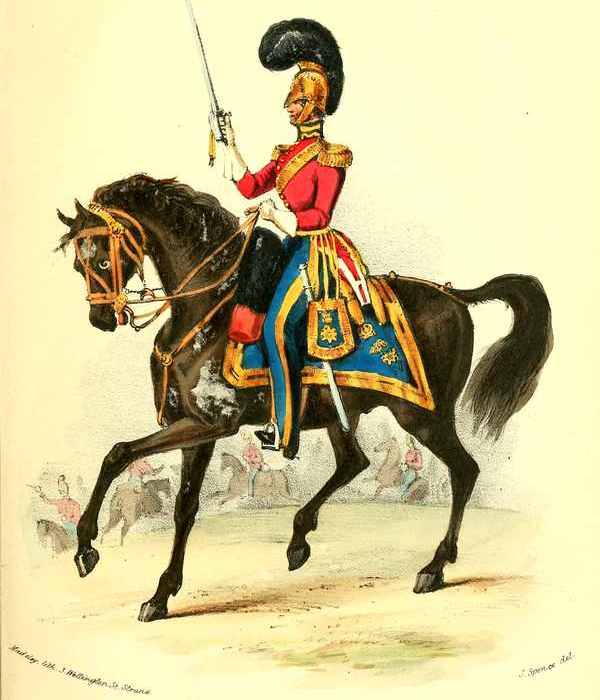
Madeley, lith. 3, Wellington St. Strand.
J. Spence det.
FOURTH, or ROYAL IRISH DRAGOON GUARDS.