HISTORICAL RECORD (continued 2)
Reading edition
The unhealthy climate of Walcheren produced a serious loss of life among the troops left on that island, and the soldiers of the Fourteenth having recovered from the effects of the epidemic, embarked a second time for that station; they formed part of the covering brigade when the stores, sick soldiers, &c., were removed, on the final evacuation of that island.
1810
In March, 1810, the second battalion embarked for Malta, but on arriving at Gibraltar, it was ordered to land at that fortress, and two companies, under Captain Everard and Captain Ramsay, were detached to Tariffa, for the defence of that town against the French: the two companies returned to Gibraltar in June, and the battalion continued its voyage to Malta, where it arrived on the 23rd of that month.
In the autumn of this year the first battalion was withdrawn from Bengal, to take part in the reduction of the Isle of France, or the Mauritius, an important island belonging to France, and situate in the Indian sea. The battalion sailed to Rodriguez, which was the appointed rendezvous of the expedition, and on the 28th of November the fleet came in sight of the Isle of France. The troops landed in the bay of Mapou, and advanced through a thick wood, skirmishing occasionally with the French. On diverging into the open country, the British marched direct upon Port Louis, but the soldiers suffering much from the want of water, the army halted at the streams at the powder mills, five miles from the town. Resuming the march on the following day, the troops were opposed by the enemy in force, when some sharp fighting occurred, in which the British soldiers were triumphant. The Fourteenth had one man killed, and two wounded, on this occasion.
Having overcome all opposition, the British continued their march, and took post in front of the enemy's lines before the town. On the following morning the governor, General de Caen, agreed to surrender the place to the British troops, under Major-General John Abercromby. This valuable island was thus added to the possessions of the British crown, and the Fourteenth were thanked in orders for their conduct on this service.
After the capture of the Isle of France, the first battalion of the Fourteenth Regiment proceeded to Madras, where it was stationed several weeks.
1811
In January, 1811, the flank companies of the second battalion proceeded from Malta, to the island of Sicily, under the orders of Captain Ramsay and Captain Light, to serve under Major-General Lord William Bentinck.
After the capture of the Isle of France, the British government resolved to complete its dominion in the East, by the conquest of the island of Java, of which the Dutch had held undisturbed possession for more than one hundred years. The extent of the island,—six hundred and forty miles long, and about a hundred broad; the luxuriant and fertile character of the soil, the mountain districts yielding the vegetables and grain of Europe, and the plains the delicious fruits and other valuable productions of the East in abundance, without the necessity of laborious tillage, and to so great an extent as to occasion it to be sometimes called the granary of the East; rendered the island of Java a valuable acquisition to the United Provinces, and its principal city, Batavia, was the capital of the Dutch settlements in the East Indies. Holland having become a part of that empire which Napoleon was forming to prepare the way for universal dominion, it became necessary to deprive the Dutch of the large and fertile island of Java, and a body of troops was placed under the orders of Lieutenant-General Sir Samuel Auchmuty for that purpose. In this enterprise the first battalion of the Fourteenth Regiment was employed, and the greater part of the officers and men were re-embarked in March on board of the men-of-war ordered to cruise off the island, in which service they had various opportunities of distinguishing themselves, in destroying gun-boats, and in other enterprises on the coast. On one occasion Lieutenant Gillman, who commanded a party on board the boats of His Majesty's ship "Sir Francis Drake," was killed. The conduct of a detachment under Lieutenant J. H. Heyland, embarked in the sloop "Procris," engaged in the boarding of some of the enemy's gun-boats, was highly commended in the public despatch of Captain Maunsell, R.N.
Detachments consisting of the Fourteenth and Eighty-ninth Regiments, Royal Marines, and seamen, were landed from His Majesty's ship "Minden," near Bantam, on the coast of Java, and, in two contests, defeated five hundred of the enemy's chosen troops, which had been sent to Batavia to attack them. Captain Watson, Lieutenants Rochfort, McLean, and L'Estrange, and Ensign Jennings, of the Fourteenth, and Lieutenant Dunscombe of the Eighty-ninth, particularly distinguished themselves on these occasions.
The head-quarters sailed from Madras on the 18th of April, 1811, and landed on the 4th of August, at the village of Chillingching, about twelve miles east of Batavia, towards which city the army directed its march. The French and Dutch troops set fire to the magazines in Batavia, and abandoned the city, which was taken possession of by the British.
On the 10th of August the British advanced from Batavia, and found three thousand select men of the Gallo-Batavian troops in a strong position, defended by abattis behind Weltefreden; and this post was stormed and carried at the point of the bayonet, many of the enemy being killed, and the remainder retreating to the entrenched position at Cornelis, between the great river Jacatra, and the deep aqueduct of Slaken. The conduct of Captain Stannus commanding the light infantry company of the Fourteenth, and of Lieutenant Coghlan, commanding the rifle company, was highly commended in Colonel Gillespie's report of this action. The regiment had Ensign Nickisson and three rank and file wounded.
In the strong position of Cornelis more than ten thousand Gallo-Batavian troops were assembled, and they were greatly superior in numbers to the British force. This formidable position was, however, stormed on the 26th of August, and the invincible prowess of the assailants overcame all opposition; the British were triumphant at every point; nearly two thousand of the enemy were killed, and about five thousand prisoners were taken, including three general officers. The remainder of the enemy dispersed, excepting a few men, who accompanied the Gallo-Batavian commander, General Jansens, in his flight. The Fourteenth distinguished themselves on this occasion, and the conduct of their commanding officer, Lieutenant-Colonel Watson, was commended in the official account of the action given by Colonel Gillespie.
The victory of Cornelis terminated the Dutch sovereignty of Java; General Jansens was pursued up the country; and on the 16th of September, the Fourteenth were engaged in storming the fortified position at Jattoo, when the remainder of the Gallo-Batavian force was routed; General Jansens was afterwards forced to surrender, and this valuable island was annexed to the dominions of the British Crown. It was restored to Holland, at the termination of the war, by the Treaty of Vienna in 1814.
The loss of the Fourteenth Foot at the storming of Fort Cornelis was Captain Marinus Kennedy, two serjeants, and nine rank and file, killed; Major George Miller, Captain Trevor Stannus, Lieutenants W. H. Coghlan and Kenneth McKenzie, seven serjeants, and eighty-three rank and file, wounded; one rank and file missing.
Lieutenant-General Sir Samuel Auchmuty stated in his public despatch, "The superior discipline and invincible courage which have so highly distinguished the British army, were never more fully displayed, and I have the heartfelt pleasure to add, that they have not been clouded by any acts of insubordination."
The commanding officer of the Fourteenth, Lieutenant-Colonel Watson, (now Lieutenant-General Sir James Watson, K.C.B., colonel of the regiment,) was rewarded with a gold medal; and the word "Java" was placed, by royal authority, on the colours of the regiment to commemorate its distinguished services at the capture of that island, which was the most splendid acquisition made by the British arms in 1811. The strength of the first battalion at the capture of Java was forty-eight officers, and one thousand one hundred and forty-five non-commissioned officers and soldiers.
1812
After the capture of Java the Fourteenth remained on the island for some time. The Sultan of Mataram, who governed a portion of the interior, trusting to his power, and the strength of his fortified palace, at Djoojocarta, meditated the expulsion of all Europeans from the island, and committed aggressions of which it became necessary to stop the progress. To effect this, his palace was captured by storm on the morning of the 20th of June, 1812; on which occasion the Fourteenth had another occasion of distinguishing themselves. Lieutenant-Colonel Watson commanded the main attack, and the grenadiers of the regiment headed the assault in their usual gallant style[15]. Colonel Gillespie, commanding the forces in Java, stated in orders,
"To Lieutenant-Colonel Watson, who commanded the leading column, the commander of the forces cannot convey the sense he entertains of his distinguished bravery, and of the quickness and celerity with which he conceived and executed the attack.
"The animated style in which Captain Johnstone and Lieutenant Hunter crossed the ditch, at the head of the Fourteenth grenadiers, and escaladed the ramparts, under the fire of the east bastion, could only be equalled by the order and zeal of their followers."
The conduct of Lieutenant Hill, and of Lieutenant McLean, of the regiment was also commended.
Eight rank and file of the regiment were killed. Lieutenant McLean died of his wounds, and thirty rank and file were wounded.
1813
An expedition was fitted out, in 1813, consisting of a detachment of the Fourteenth Regiment, and of the troops in the service of the Honourable the East India Company; and placed under the orders of Lieutenant-Colonel Watson of the Fourteenth, for the attack of the piratical state of Sambas, on the western coast of the island of Borneo, which terminated in the surrender of the town, after a sharp conflict in which Captain Watson and Lieutenant Jennings were wounded; the capture of all the batteries, fortified posts, and defences of the Sultan, and the complete discomfiture of Pangerang Anom and his adherents. The first battalion proceeded to Bengal in October, 1813.
In the mean time the war in Europe was prosecuted with great vigour; the British troops were victorious in the Peninsula, and every effort was made to bring a powerful army into the field. At this period a third battalion was added to the Fourteenth Regiment of Foot; it was raised by volunteers from the Militia and assembled at Weedon under the command of Lieutenant-Colonel the Honorable James Stewart, and was soon in a condition fit for active service.
1814
After a contest of twenty years, the period of the downfall of that gigantic power, which had sprung out of the French revolution, arrived; the snow storms of the winter of 1812–13, had annihilated the French army in Russia; the British army, which had delivered Portugal and Spain from the tyrannical rule of Napoleon, was following up its career of victory in the heart of France; at the same time the forces of Russia, Prussia, Austria, and other continental states, were invading France. Thus a favourable opportunity presented itself; one powerful effort appeared likely to overthrow Napoleon and his adherents, and at this important juncture, (the spring of 1814,) the third battalion of the Fourteenth Regiment received orders to hold itself in readiness for foreign service, and commenced its march for the coast; at the same time the second battalion was withdrawn from the island of Malta, to join the expedition, under Lieutenant-General Lord William Bentinck, against the north-west coast of Italy. This expedition captured several places, including the maritime city of Genoa, once a celebrated republic, now the capital of a province in the Sardinian States. The progress of the British arms in Italy was suddenly arrested by the termination of the war: Napoleon Bonaparte abdicated; Louis XVIII. ascended the throne of France; and the nations of Europe hailed the event as the great jubilee of Christendom. The embarkation of the third battalion of the Fourteenth Regiment was countermanded, and after some delay, the second battalion was placed in quarters at the city of Genoa, where it remained twelve months.
Towards the end of the year the third battalion was held in readiness to embark for North America; circumstances connected with the trade of neutral nations, during the war with France, having involved Great Britain in hostilities with the United States. Before the battalion quitted England, peace was concluded with the United States, when the order for its proceeding abroad was countermanded, and directions were given for its being disbanded on the 24th of March, 1815.
1815
In the spring of 1815, while the Congress at Vienna was deciding on the boundaries of kingdoms, and the people of all countries were looking forward to a period of peace, Bonaparte suddenly violated his engagements, re-appeared in France, and the French army declaring in his favour, he reascended the throne he had abdicated. War was immediately declared against the usurper; the order for disbanding the third battalion of the Fourteenth Regiment was consequently rescinded, and on the 21st of March, (three days before the date fixed upon for its being disbanded,) the battalion received directions to embark for Flanders: it landed at Ostend on the 31st of March, and formed part of the army commanded by His Royal Highness the Prince of Orange.
Additional forces were sent to Flanders, Field Marshal his Grace the Duke of Wellington assumed the command, and the third battalion of the Fourteenth Regiment, commanded by Lieutenant-Colonel Francis S. Tidy, (Major of the regiment,) was formed in brigade with the Twenty-third Royal Welsh Fusiliers, and Fifty-first Light Infantry under Colonel Mitchel, and constituted part of the fourth division, commanded by Lieutenant-General the Honorable Sir Charles Colville, K.C.B.
Bonaparte attempted, by one of those rapid advances for which he had always been celebrated, to interpose between the British and Prussian armies, and on the 16th of June the battles of Ligny and Quatre Bras were fought: the British were victorious; but the Prussians were defeated; and the Duke of Wellington retreated, on the 17th of June, to the position in front of the village of Waterloo, to preserve his communication with Prince Blucher.
On the 18th of June the third battalion of the Fourteenth Regiment had the honour to take part in the memorable battle of Waterloo, the character and importance of which engagement, distinguish it as the greatest event of the age, and mark it as the brightest era in the history of the British army. The battalion was composed of young soldiers, who had never before been under fire, but their bearing reflected honour on the corps to which they belonged. During the heat of the conflict, when the thunder of cannon and musketry, the occasional explosion of caissons, the hissing of balls, shells, and grape shot, the clash of arms, the impetuous noise and shouts of the soldiery, produced a scene of carnage and confusion impossible to describe, a staff officer rode up to Lieutenant-Colonel Tidy, and directed him to form square; this was scarcely completed when the glittering arms of a regiment of cuirassiers were seen issuing from the smoke. The French horsemen paused for a moment at the sight of the scarlet uniforms of the Fourteenth, and then turned to the right to attack a regiment of Brunswickers; but a volley from the Brunswick square repulsed the enemy, and Lieutenant-Colonel Tidy, with the view of giving confidence to the young soldiers of the Fourteenth, drew their attention to the facility with which infantry could repulse cavalry. The French cuirassiers rallied, and appeared inclined to charge the Fourteenth, but were intimidated by the steady and determined bearing of the battalion.
The cavalry attacks on the British line were particularly severe, and were supported by large bodies of troops of all arms; the infantry pressing forward, while dragoons, lancers, carabineers, and cuirassiers advanced in overwhelming numbers, threatening to bear down all opposition; masking at times the advance of infantry; charging the British squares, and when repulsed, quickly re-forming; while individuals, spurred on by an ardent but unavailing intrepidity, were observed searching for an opening in the British battalions by which to penetrate, and usually perishing in the vain attempt. Repulsed at all points, Bonaparte resolved to make a last desperate effort, and brought forward his reserve, consisting of the old imperial guards; but these chosen bands were overthrown and annihilated; and the whole British army rushing forward upon the enemy, completed the overthrow of the legions of Bonaparte, which were driven from the field of battle with the loss of all their cannon, baggage, and the materiel of their army.
Thus was a victory, the most complete and decisive, achieved by the army under the Duke of Wellington: the British soldiers halted on the field of battle surrounded by their ensanguined trophies: they had decided the political destiny of the world, and ensured national independence to the kingdoms of Europe!
In congratulating the regiments of the fourth brigade, in the share they had in achieving the glorious victory at Waterloo, Lieutenant-General Sir Charles Colville observed,—"the Twenty-third and Fifty-first Regiments fully maintained their former high character, whilst the very young third battalion of the Fourteenth, in this its first trial, displayed a steadiness and gallantry becoming of veteran troops." The loss of the battalion was seven rank and file killed; Ensign Alfred Cooper, four serjeants, and sixteen rank and file, wounded.
The royal authority was afterwards given for the regiment to bear the word "Waterloo" on its colors, to commemorate the share it had in gaining this splendid victory. Lieutenant-Colonel Tidy was rewarded with the dignity of Companion of the Bath; and every officer and soldier received a silver medal, with the privilege of reckoning two years' service for that day.
The names of the officers of the Fourteenth Regiment of Foot, who received medals, for the battle of Waterloo, on the 18th of June, 1815, are contained in the following list:
Major Francis S. Tidy, (Lieut.-Colonel,) commanding the battalion.
Major Keightley.
Captains.
Wm. Turnor.George Marlay.Richard Adams.
Wm. Ross.Thomas Ramsay.J. L. White.
Christian Wilson.
Lieutenants.
Wm. Akenside.Wm. Buckle.L. Westwood.
Ch. M. Brannan.Geo. Baldwin.Jas. C. Hartley.
Samuel Beachcroft.John Nicholson.
Ensigns.
Geo. Mackenzie.Jas. Ramsay Smith.Richard J. Stacpoole.
Robert B. Newenham.Alfred Cooper.Richard B. Holmes.
Wm. Keowen.Joseph Bowlby.Hon. G. T. Keppel.
John Manley Wood.John P. Matthews.Montague Burrows.
Arthur Ormsby.
Adjutant.—William Buckle.
Assistant-Surgeons.—Alexander Shannon; Henry Terry.
On the morning of the 19th of June, the British troops advanced in pursuit of the wreck of the French army; and on entering France, the Duke of Wellington invited Louis XVIII. to repair to Cateau Cambresis. Being desirous of not exposing the King's person, the British commander directed Cambray to be summoned; but this fortress refused to surrender, and repulsed the troops which approached the town on the 23rd of June. On the following day orders for attacking the place by escalade were issued, and the third battalion of the Fourteenth, with the Twenty-third and Fifty-first Regiments, were directed to make a feint attack on the Paris gate; but the gallantry of the officers and soldiers turned the feint into a real attack, and they were in possession of the town before the other brigades of the fourth division could force an entrance. The citadel of Cambray surrendered on the 25th of June.
The army continued its advance upon Paris, which city surrendered in the early part of July, and the war was terminated with the restoration of Louis XVIII. to the throne of France.
During this period, the second battalion had remained at the city of Genoa, on the north-west coast of Italy, from whence it was ordered to Marseilles, in France, under the command of Major-General Lowe, and it landed at that port on the 12th of July. At this period Bonaparte was at Rochefort, endeavouring to effect his escape to North America; but being prevented by the British cruizers, he surrendered to Captain Maitland, commanding the "Bellerophon" man of war, thus closing his political career. On the conclusion of the treaties of peace which followed these events, the battalion embarked from Marseilles for the island of Malta, where it arrived in January, 1816.
The third battalion remained in the vicinity of Paris several months; it was present at the reviews of the army, in the plain of St. Denis and Champs Elysees, by the Emperors of Russia and Austria, and the Kings of Prussia and France, and on the formation of the army of occupation, it returned to England: it was disbanded at Deal, on the 17th of February, 1816; the non-commissioned officers and soldiers fit for duty being transferred to the first and second battalions.
The first battalion of the Fourteenth Regiment was stationed at the military cantonment of Berhampore, from whence it marched, in the beginning of 1815, and joined the army assembled under Major-General George Wood, in consequence of the war with the kingdom of Nepaul. The Nepaulese were soon reduced to submission, and in April, the Fourteenth proceeded to the military cantonment of Dinapore, situated on the south bank of the river Ganges, in the province of Bahar, where they remained until October, when they embarked in boats, and proceeded to the cantonments near the ancient Hindoo town of Cawnpore, on the west bank of the Ganges, in the province of Allahabad.
1816
On the 26th of April, 1816, the second battalion embarked from Malta, for the Ionian Islands, where it was stationed during the following seventeen months.
The first battalion remained at Cawnpore during the whole of this year.
1817
In the mean time the resistance made by a powerful Hindoo Zemindar, or landholder, who possessed the town and fort of Hatrass, in the province of Agra, occasioned the regiment once more to take the field in India, in the beginning of 1817. This Zemindar was named Dyaram; during the troubles in the province of Agra, he only paid his rents when threatened with a large military force, and in the year 1803, when the country between the rivers Jumna and Ganges, called the Dooab, was taken possession of by the British, he expressed himself willing to pay his assessment, but objected to any interference in what he called his territory. This was not agreed to, but he was not then molested. His refusing to acknowledge the authority of the civil law, afterwards rendered it necessary to bring him to obedience by force of arms, and he had the presumption to defy the British power. To reduce this refractory Zemindar, a body of troops was placed under Major-General Sir Dyson Marshall, and the first battalion of the Fourteenth Regiment took part in the enterprise. The fortified town of Hatrass was reputed of great strength, and when the troops arrived before it, in February, 1817, some inquiry was made respecting the depth of the ditch, which a soldier of the Fourteenth, volunteered to ascertain, and fastening a large stone to the end of a cord, he proceeded alone after dark, and gained the necessary information, with a cool intrepidity, exposed to such great danger, as created great surprise. The fire of the batteries soon forced the town to submit, when it was taken possession of by Lieutenant-Colonel Watson, and the Fourteenth; but the castle held out several days; at length the principal magazine exploded, and during the following night the refractory Dyaram escaped at the head of a hundred horsemen all in complete armour. The castle was afterwards taken possession of without opposition; and this was followed by the submission of all the zemindars of the Dooab. After the performance of this service the Fourteenth returned to Cawnpore, where they remained several months.
The second battalion embarked from Cephalonia in the autumn of this year, and proceeded to Malta, where it remained a few days. The peace of Europe appearing to be established upon a firm basis, a reduction in the army took place, which occasioned the second battalion to receive orders to return to England for the purpose of being disbanded; it landed at Portsmouth on the 24th and 25th of November, and was reduced at Chichester on the 23rd of December, transferring four hundred and twenty rank and file to the first battalion.
1818
The aggressions of the bands of Pindarees, who made incursions into the territory subject to Great Britain, and committed great depredations, occasioned the regiment to be again called into the field in October of this year. Colonel Watson having received the appointment of Brigadier-General, and been nominated to a command under Major-General Sir Dyson Marshall, the command of the regiment devolved on Major Johnstone. The Pindarees were a community of professed marauders, and they were encouraged to make ravages in the British dominions in India, by the Mahratta states. Being all horsemen subsisting by plunder, the services of the corps employed against them were of an arduous and trying character:—traversing extensive districts by forced marches, passing rivers and thickets, and attempting to surprise these bands of plunderers, were duties calculated to exhaust the strength of European soldiers, when performed under an Indian sun. The regiment continued actively employed on these services until April, 1818, when it proceeded to the military cantonment of Meerut.
1819 1825
At the pleasant quarters of Meerut, situated on an extensive grass plain, the regiment was stationed during the seven following years, and it preserved a high reputation for good conduct in quarters, while employed in this part of India. Events, however, occurred in 1825, which occasioned it to take the field, when it had another opportunity of gaining laurels in combat with the enemies of Great Britain, under the following circumstances:
The Rajah of Bhurtpore, Baldeo Singh, had become attached to the English government, with which he formed an alliance, offensive and defensive, and procured a guarantee for the succession of his youthful son, Bhulwunt Singh, to the throne; but amongst many of the rajah's subjects, a strong feeling of hostility to the British existed, particularly in the army, and his nephew, Doorjun Sal, was at the head of the party opposed to the British alliance. After the rajah's decease his nephew excited a rebellion, gained possession of the capital, and assumed the sovereign power. To fulfil the engagements made with the deceased rajah, by removing the usurper, and placing the youthful prince on the throne, a British army was assembled under General Viscount Combermere, and in November, 1825, the Fourteenth Foot, mustering upwards of nine hundred officers and soldiers, were withdrawn from Meerut, to join the division assembling at Muttra, for the purpose of engaging in this enterprise. The most important part of this war, it was well known, would consist in the siege of the capital, the fortified city of Bhurtpore; and great confidence being placed by the natives in the strength of this place, from which a British army under Lord Lake had been forced to retire in 1805, after a short siege, a body of troops was assembled, and a train of artillery brought forward, such as have seldom taken the field in Indian warfare. The Fourteenth, commanded by Major Matthias Everard, were formed in brigade with the Twenty-third and Sixty-third Regiments of Native Infantry, under Lieutenant-Colonel John M'Combe, of the Fourteenth, who had the rank of brigadier-general; Lieutenant-Colonel W. T. Edwards, of the Fourteenth Regiment, also commanded a brigade, with the rank of brigadier-general.
On the 10th and 11th of December the British army appeared before the celebrated city and fortress of Bhurtpore, which contained a garrison nearly equal in numbers to the besieging force. The Bhurtporees had cut a sluice into the embankment of a lake near the town, to fill the ditch round the works with water, but they were speedily driven from the spot; the sluice was stopped, the embankment was turned into a military post, which was intrusted to a company of the Fourteenth Foot, and some Sepoys: about eighteen inches of water, only, had flowed into the ditch, and this sudden seizure of the embankment facilitated the progress of the siege by keeping the ditch nearly empty. The several corps took up their ground; the investment became complete, several reconnoisances were made, and working parties cut down orange and date trees from the groves, and converted them into fascines and gabions. At an early hour on the morning of the 24th of December the fires of two batteries were opened on the town; additional works were constructed, the batteries became more numerous, and the siege was prosecuted with vigour; each successive day giving birth to fresh undertakings, and the progress, though tardy, becoming hourly more and more perceptible. It was, however, found particularly difficult to effect practicable breaches in the singularly constructed walls of Bhurtpore, which were thickly studded, in many places, with large trees of a peculiarly tough description of timber, which resisted shot with remarkable pertinacity. The process of mining was adopted, several explosions took place, and the result soon rendered it evident to every one present that the horrors of an assault were drawing near. The Bhurtporees, however, evinced great bravery and perseverance, exposing themselves to the fire of the besieging force with singular resolution; they built up in the night the works which were knocked down during the day, labouring under a ceaseless fire, and evincing a firm determination to persevere in the defence. The roar of cannon and musketry continued day and night like a ceaseless peal of thunder; and the explosions of the mines deafened, for an instant, all who were near the place.
1826
Considerable progress having been made towards effecting practicable breaches, the Fourteenth Regiment received orders to prepare to lead one of the attacks at the storming of this celebrated fortress, and at two o'clock on the morning of the 18th of January, 1826, it marched to the front opposite the left bastion, to await the explosion of a mine. The Fourteenth and Fifty-ninth Regiments had the honour of being selected to head the two attacks, and they were directed to wheel as soon as they had entered the breaches, one to the right and the other to the left, and, continuing their career round the ramparts, to drive the enemy before them till they met. Some delay occurred in the mine, and the soldiers stood seven hours anxiously waiting for the moment to commence the assault, during which time the thunder of the artillery was tremendous. General Lord Combermere arrived at the spot where the Fourteenth were formed, and seeing the mouth of the mine near, he anxiously enquired if all was safe, to which the engineer replied in the affirmative. His lordship returned soon afterwards, and repeated the question, when he was again assured that all was safe. In a few minutes afterwards the bastion, beneath which the mine had been formed, heaved, as if by the power of an earthquake; the ponderous wall rocked to and fro, and then sunk down again, when, with a sound far exceeding the loudest thunder, the exploding mine rent the massive bastion into fragments, forcing stones, logs of wood, guns, men, and earth, into the air, with a violence which it is impossible to describe, and filling the atmosphere for a considerable distance with so dense a cloud of smoke, dust, and fragments of the ruined bastion, that it was difficult to breathe. Brigadier M'Combe was stunned, and several soldiers of the Fourteenth were injured by the falling fragments and bursting mine. As soon as the tremendous crash was over, the soldiers rushed through the cloud of smoke and dust, and began to ascend the breach, led by Majors Everard and Bisshopp; they encountered some opposition, but nothing could withstand the bayonets of the Grenadiers of the Fourteenth,—their valour soon overpowered all resistance, and the regiment gained the summit with little loss. The native corps appointed to support the regiment not being near, a short pause ensued, when the enemy opened a heavy fire from the buildings near the breach. Undaunted by this, the Fourteenth dashed forward, cleared the walls as they went, and, turning to the right, they drove the enemy from bastion to bastion, and from tower to tower, with astonishing intrepidity and success, capturing a colour which was on one of the bastions. The enemy sprang a mine, which killed several soldiers of the regiment; the Bhurtpore artillerymen fought with great desperation, and the defenders of the walls evinced much personal bravery, but they could not withstand the superior prowess and discipline of the British troops.
As the Fourteenth were scouring the ramparts, and overcoming all opposition in gallant style, they arrived at the Anah gate, where they met the soldiers of the Fifty-ninth, who had turned to the left at the breach, and proved victorious over every opponent; it was a moment of intense interest, and a scene of glorious emotions: Bhurtpore was won! the stain of a former repulse was wiped from the British arms, and they hailed each other with a hearty and cordial cheer.
The light company of the Fourteenth, which mounted the breach with the grenadiers, pursued, with other troops, a body of the enemy towards the citadel, which they nearly entered with the fugitives; four hundred Bhurtporees were shut out, and bayonetted at the gate. The citadel surrendered a few hours afterwards; the commander-in-chief entered it at the head of the Fourteenth Regiment, which he placed in garrison, as a compliment to the corps for its extraordinary gallantry: thus was accomplished the capture of this celebrated city, which was regarded throughout the East as impregnable, the natives being accustomed to remark that India was not subdued, because Bhurtpore had not fallen. That boast was rendered futile, and every native prince had a clear evidence that neither the number of his troops, nor the strength of his fortresses, would avail against the superior valour and discipline of the British forces.
The usurper, Doorjun Sal, was captured while attempting to escape, and was sent prisoner to Allahabad; the young Rajah, Bhulwunt Singh, was taken to the palace of his ancestors, and seated on the throne, in the presence of the Fourteenth Regiment; and the other towns of his dominions submitted. Thus was the cloud which darkened the horizon of British India dispersed, and the splendour of the British arms received additional lustre in the East. Lord Combermere stated in his public despatch,—"I have the pleasure to acquaint your lordship, that the conduct of every one engaged was marked by a degree of zeal which calls for my unqualified approbation; but I must particularly remark the behaviour of His Majesty's Fourteenth Regiment, commanded by Major Everard, and Fifty-ninth, commanded by Major Fuller; these corps having led the columns of assault, by their steadiness and determination decided the fate of the day."
In division orders it was stated,—"Major-General Reynell congratulates the troops of his division, European and Native, engaged in the storming of Bhurtpore this morning, upon the brilliant success which attended their gallant exertions. It is impossible for him to convey half what he feels in appreciating the conduct of His Majesty's Fourteenth Regiment, that led the principal storming column. It has impressed his mind with stronger notions of what a British Regiment is capable of, when led by such officers as Major Everard, Major Bisshopp, and Captain Mackenzie, than he ever before possessed. The Major-General requests that Major Everard will assure the officers and soldiers of the Fourteenth Regiment, that they more than realized his expectations."
Lieutenant-Colonel W. T. Edwards, of the Fourteenth, an officer of high character and lofty promise, fell at the head of the second brigade, pierced by many wounds; Captain Henry B. Armstrong was also mortally wounded while leading his men to victory on the ramparts. The regiment had likewise two serjeants, twenty-nine rank and file, and three Lascars, killed; Lieutenant-Colonel John M'Combe, Lieutenants Richard Stack, Robert Daly, and Edward C. Lynch, Volunteer W. Tulloh, two serjeants, ninety-eight rank and file, and three Lascars, wounded.
Colonel John M'Combe[16], who commanded the first brigade, and Major Matthias Everard, who commanded the regiment, were rewarded with the dignity of Companion of the Bath; and the Royal authority was afterwards given for the word "Bhurtpore" to be borne on the regimental colour, to commemorate its gallantry on this occasion.
The war having terminated, the regiment returned to the cantonment of Meerut, where it was stationed upwards of six months.
General Sir Harry Calvert, Baronet, G.C.B., died in September, 1826, when King George IV. conferred the colonelcy of the regiment on General Thomas Lord Lynedoch, G.C.B.
1827
The regiment left Meerut in October; it subsequently embarked in boats, and, after a tedious passage down the river Ganges, arrived at Fort William in the beginning of 1827; and was stationed at that fortress twelve months.
1828 1829
Early in 1828 the regiment quitted Fort William, and proceeded to the cantonment at Berhampore, where it was stationed during the year 1829.
1830 1831
After performing the important duty of guarding the colonial possessions of Great Britain in India twenty-three years, the Fourteenth Regiment received orders to prepare to return to England; it left Berhampore in November, and proceeded to Fort William; the men who volunteered to remain in India were transferred to other corps; and in December, 1830, and January, 1831, it embarked from Calcutta for England. It landed at Gravesend in May and July,—was stationed at Chatham until September,—and at Albany Barracks during the remainder of the year.
1832
In the early part of 1832, the regiment was stationed at Haslar Barracks, from whence it proceeded to Portsmouth, where it remained five months. In the middle of July it embarked for Ireland, and after landing at Cork, marched from thence to Buttevant.
1833 1834
In 1833 the head-quarters were removed to Athlone; in 1834 to Dublin, and afterwards to Mullingar.
1835
General Lord Lynedoch having been removed to the First, the Royal, Regiment of Foot, King William IV. conferred the colonelcy of the regiment on Lieutenant-General the Honorable Sir Charles Colville, G.C.B., G.C.H., by commission, dated the 12th of December, 1834. This officer was removed to the Fifth Fusiliers in March, 1835, and was succeeded in the colonelcy of the Fourteenth Regiment by Lieutenant-General Sir Alexander Hope, G.C.B., who, as lieutenant-colonel, commanded the regiment in 1795.
The head-quarters were removed to Dundalk in the summer of 1835.
1836
Five years had not elapsed from the period of the return of the regiment from India, when it received orders to prepare for embarkation for the West Indies. It was divided into six service and four depôt companies; the service companies embarked from Cork in February, 1836, arrived, in March, at Barbadoes, and were removed, in April, to the island of St Kitt's.
1837
In February, 1837, the service companies were removed to Antigua.
On the 19th of May, General the Honorable Sir Alexander Hope, G.C.B., Lieutenant Governor of the Royal Hospital at Chelsea, died, and was succeeded in the colonelcy by Lieutenant-General Sir James Watson, K.C.B., who had commanded the regiment in India, as lieutenant-colonel, from the year 1807 to 1821, when he was promoted to the rank of major-general.
In June the depôt companies embarked from Waterford for England, and, landing at Bristol, proceeded from thence to Brecon.
1838
During the year 1838, the service companies remained at Antigua.
The distinguished services of the Fourteenth Regiment in India, from 1807 to 1831, having been, at the special request of Lieutenant-General Sir James Watson, brought before Her Majesty by the Commander-in-Chief, the Royal authority was given for the badge of the "Royal Tiger," superscribed "India," to be borne upon the regimental colour and appointments, to commemorate its services in that part of Her Majesty's dominions.
1839 1840
In December[17] orders were received for the removal of the service companies from Antigua to St. Lucia, where they arrived in the beginning of January, 1839: in April, 1840, they proceeded to Barbadoes, and in June to Trinidad. They suffered severely on these stations from yellow fever and other effects of a tropical climate.
The depôt companies proceeded from England to Ireland in June, 1840.
1841
The regiment remained at Trinidad until the early part of 1841, when it was removed to Barbadoes. On the 27th of April it embarked from Barbadoes for Lower Canada, and landed at Quebec on the 2nd of June following.
1845
The depôt companies were removed from Ireland to England, in December, 1844; and the service companies have remained in Canada until the year 1845, the period of the completion of this Record.
Among the splendid achievements of valour with which the annals of the British army abound, the gallant behaviour of the Fourteenth Foot, on several occasions, appears conspicuous for those bright qualities of intrepidity and heroism which distinguish the inhabitants of Great Britain and Ireland when arrayed under the standard of their Sovereign; and the conduct of this corps in quarters has been marked by those excellent features of order, subordination, and discipline, which adorn the character of the British soldier, procuring for him the admiration of the inhabitants of all countries. The inscriptions on the colour of the regiment bear testimony of the estimation in which its services have been held by its Sovereign; and the reports of the general officers, under whom it has served, have procured for it the confidence of the Government and the Country.
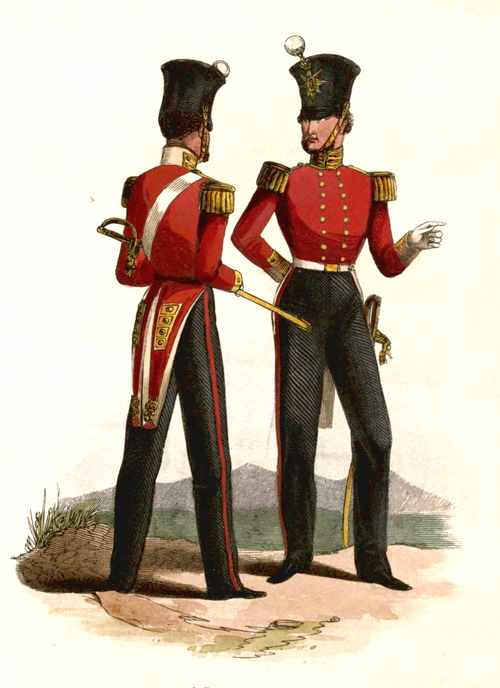
14th Regiment of Foot.