HISTORICAL RECORD (continued 2)
Reading edition
The Royal Dragoons lost in this action eight men and twenty-one horses killed; and twelve men and thirteen horses wounded.
The regiment was subsequently encamped on the banks of the Dymel, and on the 1st of October was despatched towards the Lower Rhine, forming part of a separate corps under the Hereditary Prince, which invested Wesel, a town in the duchy of Cleves.
The enemy advanced in force to relieve the besieged, and encamped, on the 14th of October, behind the convent of Campen. Immediately after dark on the evening of the same day, the Royal Dragoons and other corps advanced towards the enemy, the Hereditary Prince designing to surprise him in the night; but it was found necessary to dislodge a corps which occupied the convent of Campen, and this occasioned some firing, which alarmed the French camp, and the troops were immediately formed in order of battle.
The action commenced before daybreak, and a succession of attacks, repulses, and charges were kept up until nine at night, in which the Royal Dragoons took an active part, and they are reported to have "behaved extremely well." Two pieces of cannon and a pair of colours were captured; but at length the Prince perceived that it was impossible to drive the enemy out of a wood of which he had possessed himself, and, the allied infantry having expended all their ammunition, his Highness ordered a retreat.
The Royal Dragoons had eight men and ten horses killed; Lieut.-Colonel Johnston, two men, and four horses, wounded; Captain Wilson, Lieutenant Goldsworthy, Cornet Duffe, and twenty-five men, taken prisoners. The regiment repassed the Rhine on the 18th of October, and was cantoned in the principality of Hesse, where the officers received orders to wear mourning for his late Majesty King George II.
1761
In February, 1761, the regiment was engaged in an incursion into the French cantonments, and took part in several skirmishes with the enemy. In the spring a remount joined from England.
After much manœuvring, the allied army took post in Prussian Westphalia, on the rivers Asse and Lippe, and the Royal Dragoons were encamped on the heights between Illingen and Hohenover.[51] On the 15th of July the enemy attacked the troops under the Marquis of Granby at Kirch Denkern, when the Royal Dragoons marched across the Asse by the bridge at Hans Hohenover, and advanced to support the corps attacked. After a sharp action the enemy was repulsed with loss. The fire of the skirmishers was, however, kept up throughout the night, and on the following morning the enemy renewed the engagement with great fury. During this day the Royal Dragoons were posted near Vellinghausen, and, when the enemy's columns of attack were repulsed, advanced to charge, but were prevented by the hedges and marshy hollows which intersected the country. They were subsequently employed in military operations on the Dymel, and afterwards marched into the electorate of Hanover, and were engaged in a skirmish near Eimbeck in the early part of November. On the same night they marched through a heavy snow to Foorwohle, where they encountered and drove back some French cavalry. On the 9th of November they had another skirmish at Foorwohle, and subsequently marched into quarters in East Friesland.
1762
The Royal Dragoons left their winter quarters in May, 1762, and on the 18th of June joined the army encamped at Brackel, in the bishopric of Paderborn, from whence they marched to the heights of Tissel. The French army, commanded by Marshals d'Estrées and Soubise, took post at Groebenstien, where Prince Ferdinand resolved to attack them on the 24th of June, and the army was ordered to move forward in several columns for that purpose.
Moving from their camp-ground at daybreak, the Royal Dragoons passed the Dymel at Liebenau about four in the morning, and advanced against the enemy's camp. The manœuvre was conducted with such address, that the army was in presence of the French before they had the least apprehension of an attack, and, being instantly assaulted in front, flank, and rear, they retired in confusion, leaving all their equipage behind them. The Royal Dragoons had advanced against the enemy's front, and they were subsequently employed in surrounding a division of the French army commanded by General Stainville in the woods of Wilhelmsthal, where several corps were made prisoners. The pursuit was continued, and the French took refuge under the cannon of Cassel; the Royal Dragoons then retired a few miles, and encamped near Holtzhausen.
During the remainder of the campaign the Royal Dragoons were employed in operations on the Fulde, the Eder, and the Lahn, which were attended with such signal success, that a considerable portion of territory was wrested from the power of the enemy, and the allies took Cassel.
These successes were followed by a treaty of peace, and the Royal Dragoons proceeded into quarters in the bishopric of Munster.
At the close of the military operations of the year, when the army marched into winter quarters, Colonel James Johnston, of the Royal Dragoons, who had commanded the regiment since the 7th of April, 1759, and during the campaign of 1762 had commanded the brigade composed of the Royals and second dragoon guards, received a most flattering mark of the approbation of the Hereditary Prince of Brunswick (afterwards reigning Duke, who married Princess Augusta, sister to George III.; he died of the wounds he received at the battle of Jena in 1808), namely, a valuable gold snuff-box, embellished with highly-chased military trophies, accompanied by an autograph letter, of which the following is a copy:—
"Munden, ce 17 de Nov. 1762.
"Monsieur,
"Vous m'obligerez sensiblement en acceptant la babiole que je joins ici, comme une marque de l'estime et de la considération parfaite que je vous porte, et comme un souvenir d'un ami qui jamais ne finera d'être,
"Monsieur, "Votre très humble et très dévoué serviteur, "Charles Pr. Her. de B.
"A Mons. le Col. Johnston."
1763
During the winter shipping arrived from England to convey the troops home. The Royal Dragoons commenced their march for Williamstadt in February, 1763, and embarked at that port for England. According to the official returns, the strength of the regiment was fourteen officers, three hundred and twenty-nine men, and four hundred and twenty-three horses, with twenty-four servants and thirty-five women.
After their return from Germany the Royal Dragoons were ordered to proceed to Scotland; at the same time the light troop was disbanded, and the establishment was reduced to two hundred and thirty-one officers and soldiers. Eight men per troop were equipped as light dragoons, and mounted on small horses for skirmishing and other light services; the remainder of the regiment was mounted on large horses of superior weight and power.
1764
In 1764 the regiment marched to South Britain; and an order was received to remount with long-tailed horses. On the 9th of May in the same year the colonelcy was conferred on Henry Earl of Pembroke, who had recently distinguished himself in the campaigns in Germany.
1766 1767 1768 1769 1770 1771 1772 1773
The six drummers borne on the establishment were, in 1766, ordered to be replaced by trumpeters; and on the 4th of May in the following year King George III. reviewed the regiment in Hyde Park, and expressed his approbation of its appearance and high state of discipline.[52] After the review it marched to the north of England; and in 1769 was stationed in Scotland; but returned to England in the following year, and, after occupying various quarters in the southern and western counties, was again reviewed by his Majesty on the 17th of May, 1773, on Finchley Common; and, according to the journals of that period, its excellent condition and correct manœuvring procured the approbation of the King, and excited the admiration of the princes, noblemen, general officers, and other spectators.
1774 1775 1777
During the summer the Royal Dragoons again proceeded to the north, and, after occupying quarters for a short period in Yorkshire, marched to Scotland, where they were stationed during the summer of 1774; but returned to England in the succeeding year; and on the 24th of May, 1777, were reviewed in brigade with the second dragoon guards, on Wimbledon Common, by the King, accompanied by several of the young princes, and attended by a retinue of noblemen and general officers.
1778
Hostilities having commenced between Great Britain and the colonies in North America, an augmentation was made in the strength of the regular army; and in 1778 six serjeants, six corporals, and one hundred and twenty-six private men were added to the Royal Dragoons. During the summer they were encamped, with several other corps, on Coxheath, near Maidstone, where they were reviewed by the King.
1779
In 1779 the men of the Royal Dragoons, equipped as light dragoons, with the light troops of the third dragoon guards, and sixth and eleventh dragoons, were incorporated into a regiment which was numbered the twentieth light dragoons.[53] During the summer the third dragoon guards, Royals, fifteenth, twentieth, and twenty-first dragoons were encamped on Lexden Heath, near Colchester.
1780 1781 1783
During the great riots in London in 1780 the Royal Dragoons were ordered to march thither. In the following year they proceeded to Scotland; and at the termination of the American war, in 1783, the establishment was reduced to two hundred and thirty-one officers and soldiers.
1784 1789 1790 1791
The regiment left Scotland in 1784, and occupied various quarters in the western and northern counties of England six years. On the breaking out of the revolutionary proceedings in France, the establishment was augmented nine men per troop, and in the spring of 1790 the six troops proceeded to Scotland; they, however, returned to England in the following year, and were employed in suppressing riots at Birmingham.
1792 1793
A further augmentation was made to the establishment in 1792, and again in the spring of 1793, when four troops were ordered to be held in constant readiness for foreign service.
The enormities committed by the French republicans occasioned another war; Holland was attacked; a body of British troops was sent to assist the Dutch; and on the 10th of June, 1793, four troops of the Royal Dragoons embarked for the Netherlands to join the army commanded by his Royal Highness the Duke of York. After landing at Ostend the four troops marched up the country, and formed part of the force which drove a body of French from the Camp de Cæsar, behind the Scheldt, on the 8th of August. The Royal Dragoons were also with the covering army during the siege of Dunkirk, and after the attempt on that place was abandoned, they were employed in operations near the frontiers of Flanders, where they had a sharp encounter with a corps of French cavalry on the 27th of October.
1794
On the 28th of January, 1794, the colonelcy of the regiment, being vacant by the decease of the Earl of Pembroke, was conferred on Major-General Philip Goldsworthy.
In April the four troops on foreign service were assembled with the army near Cateau, and were engaged in the general attack made on the enemy's positions at Prémont, &c. on the 17th of April, when Captain-Lieutenant the Honourable Thomas Carlton, of the regiment, was killed. The siege of Landrécies was immediately undertaken: the Royal Dragoons formed part of the covering army, and on the 24th of April were engaged in an affair with the enemy at Villers en Couché, when the French lost twelve hundred men and three pieces of cannon: the Royals had one man and two horses killed, and two men and three horses wounded.
The Royal Dragoons had another opportunity of distinguishing themselves on the 26th of April at Cateau. The enemy had marched out of Cambray, and at daybreak attacked the British army. The Duke of York detached the Royals and seven other cavalry regiments to turn the left flank of the French army: this movement was attended with the most brilliant success; the enemy was overthrown with immense slaughter; the rout became general—cavalry and infantry, mingled in promiscuous crowds, were scattered over the plains, and the fugitives fell beneath the sabres of the British dragoons, who captured the French commander, Lieut.-General Chapuy, and thirty-five pieces of cannon. The Duke of York, in his account of this action, observes, "The behaviour of the British cavalry has been beyond all praise." The Royal Dragoons were among the corps which were declared in general orders to have "ACQUIRED IMMORTAL HONOUR." Their loss on this occasion was six men and twelve horses killed; with Lieutenant Froom, two serjeants, eleven men, and fourteen horses wounded.
After the capture of Landrécies the Royal Dragoons marched to the vicinity of Tournay, where they were again engaged with the enemy on the 10th of May; and the Duke of York observed in his public despatch, that the troops had "well supported the reputation acquired on the 26th of last month." The loss of the Royals was only two horses killed, and one man and three horses wounded.
The Royals were in reserve when the attack was made on the French positions on the 17th of May. The army afterwards resumed its post before Tournay, where it was attacked on the 22d of May by General Pichegru with an immense force. The British heavy cavalry had, it appears, become a terror to the enemy, for Brown, in his Journal, observes (22d May), "A column of five or six thousand men made its appearance towards our left, on which account the brigade of guards and the British heavy cavalry remained ready for action on their camp ground; but the French, observing our advantageous situation, and dreading the thought of meeting the British cavalry a second time on an open plain, thought proper not to approach." Finally the French were repulsed at every point of attack, and retreated in the evening.
At length the enemy defeated the Austrians, and brought forward such immense numbers that the English army had no chance of success: the Duke of York retreated, and the final evacuation of Flanders followed.
In the mean time another squadron of the Royals embarked for foreign service; but having been driven back by severe weather, the officers and men were ordered to disembark and remain in England. In July that part of the regiment which was in England marched from Salisbury to Weymouth, in consequence of his Majesty visiting that place; and in October, when the King returned to London, they marched to Dorchester barracks.
During the winter the four troops on foreign service were exposed to privations and inclement weather, which occasioned the death of many men and horses. The winter was particularly severe, the Dutch people were favourable to the French, and the British troops, in their retreat through Holland during a hard frost and storms of snow and sleet, were treated as enemies by the inhabitants; at length the troops arrived in the duchy of Bremen, where they had repose and kind treatment.
1795
The Royal Dragoons were not engaged in any further hostilities on the continent. During the summer of 1795 they were encamped on one of the plains of Westphalia, and in the winter embarked for England.
1796
Meanwhile, that part of the regiment which was on home service was again employed on King's duty at Weymouth, during his Majesty's stay at that place, and afterwards proceeded to Dorchester, where the four troops returning from the continent arrived in January, 1796. In July of the same year the regiment encamped on Barham Downs, near Weymouth, and in September marched into quarters at Canterbury.
1797 1798 1799
In October, 1797, the regiment marched for Birmingham and Coventry; in July, 1798, for Exeter and Taunton; and in the following summer proceeded to Radipole barracks, Weymouth; but marched from thence, in November of the same year, for Salisbury, Warminster, &c.
In August, orders were received for the regiment to be mounted on nag-tailed black horses;[54] and the horse's tails were consequently cut.
1800
During the summer of 1800 an encampment of about thirty thousand men was formed on Swinley common, near Windsor; the Royal Dragoons joined the camp in July; the troops were frequently exercised in the presence of the royal family, and the King reviewed the several corps previous to their departure. On the 11th of August the regiment quitted the camp, and proceeded to Croydon barracks and Epsom, with a squadron detached on coast duty in Sussex.
1801
On the 7th of January, 1801, his Majesty conferred the colonelcy of the regiment on Major-General Thomas Garth, in succession to Lieut.-General Goldsworthy, deceased.
Towards the end of May the regiment marched to Canterbury, and furnished numerous detachments on the revenue duty at the maritime towns and villages on the coast of Kent, where they assisted in making large seizures of smuggled goods, for which they received a reward of upwards of one pound per man.
1802
A treaty of peace with the French republic having been signed at Amiens, a reduction of two troops was made in the establishment, and the officers were placed on half-pay.
1803
In July, 1802, four troops were ordered to Trowbridge to aid the civil power in the suppression of riots. In October following the regiment proceeded to Exeter and Taunton, with detached troops on coast duty in Cornwall; and in April, 1803, it was removed to Dorchester, Radipole, and Wareham barracks, from whence it marched in July following to Arundel and Chichester. At the same time, the war with France having recommenced, the establishment was augmented from eight to ten troops.
1804
A change of quarters took place in April, 1804, and the regiment was stationed at Ipswich and Woodbridge; from whence it proceeded, in November following, to Colchester, where it passed the winter.
1805 1806
The regiment quitted Colchester in April, 1805, and proceeded to York, Newcastle-on-Tyne, and Birmingham. In January, 1806, it returned from the north, and was again stationed at Woodbridge; and in March of the same year it once more proceeded northward, and, on arriving in Scotland, its head-quarters were established at Edinburgh, with detached troops at Dunbar, Haddington, and Perth, having marched upwards of six hundred miles in three months.
1807 1808
Embarking from Scotland in January, 1807, the regiment proceeded to Ireland, from which country it had been absent one hundred and fifteen years; and on its arrival the head-quarters were stationed at Dundalk, with detached troops at Belturbet, Lisburn, Monaghan, Enniskillen, Sligo, and Londonderry. In June, 1808, it proceeded to Dublin, with detached troops at Carlow and Athy.
In the mean time important events had transpired in the Peninsula. Napoleon Buonaparte (whom the French had elevated to the throne) had obtained possession of the kingdoms of Portugal and Spain by treachery; had placed his brother Joseph on the throne of Spain, and supported these usurpations by an immense French army. The Spaniards and Portuguese, being impatient of the bondage into which they were brought, made energetic struggles for liberty, and, a British force proceeding to their aid, Portugal was delivered from the power of Buonaparte. Lieut.-General Sir John Moore advanced from Lisbon into Spain to aid the patriots; and the Royal Dragoons were directed to proceed on foreign service to reinforce the army in the Peninsula; but, on arriving at Cork for embarkation, news of the result of Sir John Moore's expedition occasioned the order to be countermanded.
1809
The regiment remained at Cork barracks until April, 1809, when it proceeded into extensive cantonments (head-quarters at Clonmell), from whence it was withdrawn in August following, and eight troops, of eighty rank and file and eighty horses per troop, embarked at Cork for Portugal. The transports sailed on the 2nd of September, and on the 12th and 13th of that month the regiment landed at Lisbon, and occupied the barracks at Belem.
1810
The British army in Portugal, commanded by Lord Wellington, was occupying quarters on the Mondego. The Royal Dragoons marched a few stages up the country in January, 1810, and were stationed at Santarem and Torres Novas, in the province of Estremadura; from whence they marched, in February, to Niza and Alphalo, in the Alentejo.
The enemy having an immense superiority of numbers, the British commander was reduced to the necessity of acting on the defensive, and his ultimate object was the protection of Lisbon. He, however, resolved to maintain a frontier position as long as possible; and, Ciudad Rodrigo being menaced in the end of April, the Royal Dragoons were ordered to advance to Belmonte, in the province of Beira, where they arrived on the 5th of May. The French army, commanded by Marshal Massena, Prince of Esling, proved so numerous, that all hope of preserving Ciudad Rodrigo was abandoned. The Royal Dragoons left Belmonte on the 9th of June, and proceeded to Villa Velha, from whence they marched, on the 1st of July, to Ville de Touro, and towards the end of the same month to Alverca; the enemy having taken Ciudad Rodrigo and besieged Almeida, the advanced posts of the British army were removed to Frexadas.
The French took Almeida on the 27th of August, and on the following day attacked a squadron of the Royals and a squadron of the fourteenth light dragoons on piquet at Frexadas, under the command of Major Dorville. The enemy brought forward a superior force of cavalry, supported by infantry; but the two British squadrons, undaunted by superior numbers, charged the French horsemen with signal gallantry, and drove them from the field with the loss of many men killed and wounded, and five taken prisoners.[55] The Royals lost, in this encounter, two men and one horse killed, and two men and one horse wounded.
The allied army retired a short distance. The Royal Dragoons continued to be actively employed, and, in a skirmish with the enemy on the 2nd of September at Alverca, on the main road to Almeida, they had a serjeant wounded. The regiment retired from its advanced position on the same day, and on the 19th of that month was stationed at Santa Comba Dão.
The enemy continued to press upon the rear of the British army, and a party of the Royal Dragoons had another encounter with the French on the 21st of September, and had one man wounded, and another wounded and taken prisoner.
Lord Wellington having resolved to make a stand on the heights of Busaco, the army retired to that position, covered by the Royals and fourteenth light dragoons. During the severe contest in the mountains on the 27th of September, the Royals were formed in reserve behind the position; and when the army retired to the celebrated lines of Torres Vedras, the Royals once more occupied the post of honour in the rear of the line of march. The French pressing upon the retiring army near Pombal on the 5th of October, their audacity was punished by a piquet of the Royals commanded by Lieutenant Carden, who charged the enemy and drove them back with loss; but, having advanced too far in pursuit, the lieutenant and one man, who were both wounded, were taken prisoners: the piquet, however, captured and brought off a French cavalry officer. The enemy's leading corps, being supported by immense columns, continued to hover round the rear of the allied army; and the temerity of their cavalry was again chastised on the 9th of October, near Quinta de Torre, by a squadron of the Royal Dragoons, which made a gallant charge, driving the French horsemen back with loss, and forcing them to take shelter behind a corps of infantry. This corps was too strong to be attacked by the squadron, and the Royals, having received a volley, retired with the loss of six horses killed, and one serjeant-major and two men wounded, with four men wounded and taken prisoners.
On the following day the allied army was in position in the fortified lines, where it opposed to the advance of the enemy a barrier so formidable that Marshal Massena, after several reconnoisances, declined to attack it, and retired during the night of the 14th of November. On the 15th the Royal Dragoons were despatched after the enemy, and a piquet of the regiment took a serjeant and five French dragoons prisoners.
The French army took post on the heights of Santarem; and the Royal Dragoons were stationed at Cazal Diera, Quinta, St. Christol, and Porto de Mugem, from whence they sent out detachments on piquet and outpost duty.
1811
The French Marshal, having consumed his resources and wasted the numbers and physical power of his army, retired from Santarem on the night of the 5th of March, 1811. The Royals were again despatched in pursuit, and in the series of brilliant exploits which followed they took a distinguished part. They had a skirmish with the enemy near Pecoloo on the 7th of March, when they took three prisoners, and had one man and one horse wounded. They had another encounter with the French on the 8th of March, and had two men and one horse wounded. They again came in contact with the enemy on the 11th of March, near Pombal, and took two serjeants and seventy-six men prisoners.
Resuming the pursuit on the following day the allies discovered in their front a body of French cavalry, infantry, and artillery, posted on a high table land near Redinha. Lord Wellington ordered the troops to form in line, and the Royal Dragoons were directed to support the attack of the infantry. Three shots from the British centre was the signal to advance, and suddenly a most splendid spectacle of war was exhibited. The woods seemed alive with troops, and in a few moments thirty thousand men, forming three lines of battle, were stretched across the plain, bending in a gentle curve, and moving majestically onwards, while the horsemen and guns, springing forward simultaneously from the centre and left wing, charged under a general volley from the French battalions: the latter were instantly hidden by the smoke, and when that had cleared away, no enemy was to be seen, the French having made a precipitate retreat to Condeixa.
The British again moved forward in pursuit, and on the 14th of March the Royal Dragoons supported a successful attack of the infantry on a French force posted in the mountains at Casal Nova: they also supported the attack on the French position at Foz d'Aronce on the 15th; and on the 18th they encountered a party of the enemy near Sernadilla, when they took a serjeant and twelve men prisoners, and captured twelve mules: the Royals had only one man wounded on this occasion. They continued hovering near the French army; and on the 26th of March a patrole of the Royals, commanded by Lieutenant Foster, with a patrole of the sixteenth light dragoons, attacked a detachment of French cavalry near Alverca with distinguished gallantry, sabred several dragoons, and took an officer and thirty-seven men prisoners.[56]
The Royals had another affair with a party of the enemy on the 28th of March, when they captured a car laden with officers' baggage near Ardés, and had one man wounded. On the third of April they were posted in reserve during the action at Sabugal; and, on the retreat of the French, they were detached in pursuit, and captured several mules laden with baggage near Alfayates.
On the 7th of April the Royals were sent to the relief of a corps of Portuguese militia, commanded by Colonel Trant, who had taken post near Fort Conception. A brigade of French infantry was within half a mile of the militia, whose destruction appeared inevitable, when suddenly two cannon shots were heard to the southward,—the French formed squares in retreat,—and in a few minutes six squadrons of British cavalry and a troop of horse artillery came sweeping up the plain in their rear. The Portuguese were rescued from impending danger. The enemy, however, contrived to effect their escape, with the loss of about three hundred men killed, wounded, and taken prisoners, and part of their baggage: among the other captures the Royal Dragoons took a drove of fourteen bullocks and a horse.
The French army having been driven out of Portugal, the allies blockaded Almeida. Marshal Massena advanced to relieve that place, and he found the allied army posted on a fine table land, the left at Fort Conception, and the right at the beautiful village of Fuentes d'Onor. The village was attacked on the 3rd of May, and on the 5th a general assault was made on the British army. The French drove in the cavalry out-guards, and by the impetuosity of their attacks gained some advantage; when two squadrons of the Royals, commanded by Lieutenant-Colonel Clifton, made a gallant and successful charge on the enemy's cavalry, took a serjeant and twenty-three men, and released a party of the foot guards who had been made prisoners by the French. A party of the enemy's cavalry made a gallant charge, and captured two guns belonging to Captain Bull's troop of horse artillery; when a squadron of the Royals dashed forward, routed the enemy, and retook the guns, which they brought back to the British line, with several French prisoners. Finally, the French were repulsed at every point of attack, and forced to relinquish their design of relieving Almeida. The Royal Dragoons had four men and nineteen horses killed; also two serjeants, thirty-four men, and twenty-four horses wounded; and they subsequently occupied their former quarters at Villa de Ceirva.
About midnight on the 10th of May the French garrison in Almeida blew up the works, then rushed in one column out of the town, forced their passage through the blockading troops, and directed their march on Villa de Ceirva; but finding it occupied by the Royals they changed the direction of their march and moved on Barba del Puerco. A party of the Royal Dragoons having been suddenly called out in the night, overtook the rear of the French column, which they attacked, and took a serjeant and nine men prisoners. The fourth and thirty-sixth foot also pursued the enemy; but the main body of the garrison made good their retreat. The regiment had two men wounded on this occasion.
After this affair Lord Wellington proceeded to Estremadura, to besiege Badajoz: but the Royal Dragoons remained with the forces left on the frontiers of Portugal, near Ciudad Rodrigo; and they were stationed in advance to cover the front from Villa de Egua to Espejo.
The French army, having been reinforced, and placed under the command of Marshal Marmont, advanced at daybreak on the morning of the 6th of June in two columns, when the light division was directed to retire from Gallegos upon Nave d'Aver, and subsequently upon Alfayetes; and the Royals, commanded by Lieutenant-Colonel Clifton, with a troop of the fourteenth light dragoons, were assembled at Gallegos to cover the retreat. The French brought forward about two thousand cavalry, six thousand infantry, and ten guns; and the Royals confronted this immense force with a degree of fortitude and valour seldom equalled.[57] That celebrated French cavalry officer, General Montbrun, manœuvred to outflank the Royals; but his squadrons were attacked and defeated twice, and the retreat was effected with little loss. For their distinguished conduct on this occasion the Royals were publicly thanked by Lieutenant-General Sir Brent Spencer, who commanded, in the absence of Lord Wellington in Estremadura. They lost on this occasion a troop-serjeant-major, three men, and six horses killed; and nine men wounded.
The Royals subsequently bivouacked near Sabugal, from whence they proceeded to Arronches, and were encamped at the conflux of the Caya and Algrette: towards the end of July they marched to Idanha a Nova, on the frontiers of Portugal; and in August to Villa de Toura and Iteura. Meanwhile Lord Wellington returned from Estremadura, and afterwards blockaded Ciudad Rodrigo. Marshal Marmont advanced; when his lordship raised the blockade, and took up a defensive position, and the Royal Dragoons were posted on the 22nd of September on the Upper Azava. A series of attacks and manœuvres followed, and on the 25th the Royals were in the position of Fuente Guinaldo: from whence they were ordered to retire on the following day; and on the 27th were posted near Alfayates, with a piquet at Aldea de Ponte, which was attacked by the enemy, when Lieutenant Ross had his horse killed under him, and three men and six horses were wounded. On the following day the Royals were with the army in position behind Soito; and Lord Wellington offered battle, but the enemy retired, and the allied army went into cantonments. The Royals were stationed at Adão; subsequently at Espejo, and towards the end of November marched for Meda.
1812
Lord Wellington having resolved to besiege Ciudad Rodrigo, the Royal Dragoons marched to the vicinity of that city in January, 1812, and took post at Villa Turpina, to cover the troops employed in the siege. This city was taken by storm on the 19th of that month, and, when the works were put in a state of defence, the Royals marched to St. Jao de Presquere. The siege of Badajoz—the capital of Spanish Estremadura, situate on a beautiful plain on the banks of the Guadiana, was next determined upon: the army was accordingly put in motion for the south, and the Royal Dragoons, proceeding by way of Abrantes into Spanish Estremadura, were placed under the command of Lieutenant-General Sir Thomas Graham; and, having crossed the Guadiana on the 16th of March, advanced upon Valverde and Santa Martha, and thence towards Llerena,—an old town of Estremadura, which once belonged to the knights of St. John. On the 19th of March the Royals were at Villa Franca; but on the advance of Marshal Soult, with a considerable force, they retired. Badajoz was taken on the 6th of April, and Lord Wellington afterwards proceeded to the north; but the Royal Dragoons remained in Estremadura, forming part of the force left in the south under the command of Lieutenant-General Sir Rowland Hill.
On the 25th of May a squadron of the Royals, commanded by Major Dorville, proceeded on out-post duty to Llera. On the 27th, at night, the commanding officer ascertained that a French brigade had advanced within a short distance of his post: he therefore retired to a wood about a mile behind the village, and having placed a small piquet on an eminence, with a support at the ford of a rivulet in front of the wood, the squadron bivouacked for the night. In the mean time a brigade of French cavalry, commanded by Brigadier-General L'Allemand, advanced to Llera, and surrounded the village at midnight, expecting to surprise the squadron in its quarters; but on discovering that it had marched, he advanced towards the wood, and, attacking the piquet, wounded and took prisoners one serjeant and five men. Meanwhile the support commenced a brisk fire, and gallantly defended the passage of the ford, and the squadron, not having drawn bit, immediately mounted and formed; when the French, being foiled in their object, retired: the squadron followed, and continued skirmishing with the enemy until they had passed Llera, and then resumed its former post.
On the 11th of June the seventeenth and twenty-ninth regiments of French dragoons, commanded by Brigadier-General L'Allemand, again proceeded to the vicinity of Llera, when Major-General Slade advanced with the Royals and third dragoon guards, and having attacked the French, routed them, and continued the pursuit about nine miles. On arriving at the vicinity of Maguilla the British regiments had another opportunity of charging, when they broke the enemy's first line, sabred many of the men, and took one of General L'Allemand's aides-de-camp prisoner. The British regiments rushed forward in pursuit with too much eagerness, each vying with the other which should most distinguish itself; and in a moment of confusion the French brought forward a reserve, and charged the broken squadrons with such fury that they were obliged to retire.[58] The Royals lost in this encounter one serjeant, eleven men, and six horses killed; also nineteen men, and eight horses wounded; and Lieutenant Windsor, with four serjeants and thirty-nine men, taken prisoners. Lieutenant Windsor and most of the men were wounded before they were taken.
Patroles were afterwards sent on the road to Maguilla, and on the 14th of June a serjeant and twenty-five men of the Royals, with the like number of the third dragoon guards, encountered a squadron of French dragoons, which they charged with distinguished gallantry, and having sabred a number of men, took a captain (the commanding officer of the squadron), with a serjeant and twenty men, prisoners; and captured twenty-three horses.
On the 18th of June the Royals marched for Albuhera: they were subsequently encamped near Llerena, from whence they marched to Los Santos. Meanwhile the forces under Lord Wellington had defeated the French at Salamanca; and on the news of this success Lieutenant-General Sir Rowland Hill advanced. The Royals were in motion on the 30th of July, and proceeded to Villa Franca, and subsequently to Fuente del Maestre.
The main army having marched to Madrid, Sir Rowland Hill advanced to act in concert with Lord Wellington. The Royals advanced on the 27th of August, and on the 6th of September were at Villa Nova; left that place on the 13th of September; crossed the pontoon bridge at Almarez on the 19th, and arrived at Talavera, in the valley of the Tagus, on the 28th; from whence they proceeded to Tembleque, in New Castile. Lord Wellington having left Madrid and besieged the castle of Burgos, Lieutenant-General Sir Rowland Hill took up a position on the Tagus, and the Royals marched by Aranjuez,—a beautiful palace of the kings of Spain,—to Morata. The enemy, however, concentrated his forces, and advanced, with an immense superiority of numbers, to relieve Burgos, when Lord Wellington raised the siege and retired, and Lieutenant-General Sir Rowland Hill made a corresponding movement. The Royals commenced retiring on the 27th of October by Madrid and the pass of the Guadarama mountains, and arrived, on the 12th of November, at Salamanca; from whence they proceeded on the 15th to Arguilla, and on the 17th had an encounter with the enemy, when four men and one horse were wounded. Leaving Arguilla on the 28th of November they proceeded to Zelreira, and towards the end of December to Alcantara.
1813
The Royal Dragoons passed the winter and spring of 1813 in Spanish Estremadura, from whence they advanced, in the middle of May, to turn the enemy's position on the northern bank of the Douro; and, arriving at Salamanca on the 26th of that month, they forded the river Tormes above the town, and encountered a body of French infantry and a few cavalry under General Villatte, who was retiring from Salamanca in the direction of Alba de Tormes, when the right squadron, led by Lieutenant-Colonel Clifton, charged the enemy with signal gallantry, sabred a number of men, and took one hundred and forty-three prisoners, with four tumbrils. In this action the Royals had five horses killed, and ten men and three horses wounded: Major Purvis's charger was also killed under him.
After this action the Royals bivouacked near La Orbado until the 3rd of June, when they advanced, with the army, on Valladolid. The enemy withdrew his troops from Madrid, and retired on Burgos; and on the approach of the allied army blew up the castle and fell back towards the Ebro, and subsequently to Vittoria, where he prepared to give battle. The allied army followed in pursuit; and in this long and toilsome march the Royals were subjected to much fatigue and privation,—frequently marching from daybreak in the morning until dusk in the evening, through a romantic and difficult tract of country, and climbing mountains and passing defiles and rugged precipices heretofore deemed impracticable. The horses, from practice, ascended and descended the mountains with astonishing facility; and on the 20th of June the troops were in front of the enemy's position.
At daylight on the morning of the 21st of June the Royal Dragoons left their bivouac, and advanced to support the attack of the infantry on the heights in front of Vittoria. The face of the ground was so rugged that the operations of the cavalry were impeded, and for some time the services of the Royals were limited to supporting the columns of attack: towards the evening they, however, advanced to charge, but the enemy fled in confusion, leaving behind them cannon, ammunition, baggage, and the military chest of the army. The Royals moved forward in pursuit, and bivouacked about three miles beyond Vittoria: their loss was only one man and two horses killed, and one horse wounded. On this occasion the regiment was commanded by Major Purvis, Lieutenant-Colonel Clifton being in command of the brigade.
The Royals advanced in pursuit of the enemy on the following morning, and on the 2nd of July they were at Suista and other villages near Pampeluna, which place was blockaded by the allied army. They left that quarter, however, on the 18th of July, for Sanguesa, a town of Navarre, on the river Arragon, twenty-five miles from Pampeluna. Towards the end of that month the French army advanced to relieve Pampeluna, when the Royals were immediately ordered to return to the vicinity of that place, and they were formed in column at the foot of the mountains during the battle of the Pyrenees. They remained with the blockading force near Pampeluna until the 10th of August, when, forage becoming scarce, they again proceeded to the plains of the Arragon, where they remained, together with General Mina's division of Spaniards, as a corps of reserve and support to the blockade, until after the surrender of that fortress. They were subsequently stationed at Villa Franca during the winter.
1814
In the mean time the main army had entered France. On the 3rd of February, 1814, the Royal Dragoons marched to Tauste: from whence they proceeded, in the beginning of March, through the Pyrenean mountains, and entered France on the 9th of that month. For a short period they were stationed near Bayonne, which place was blockaded by the allied army; but they subsequently advanced up the country, and on the 10th of April were at the battle of Toulouse, when they were employed in covering the light brigade of guns, and in driving the piquets of the enemy under the walls of the city, which was immediately besieged. The French, having retired, the Royals were ordered forward to Villa Franche, and afterwards to Gardouch. These brilliant successes of the British troops were followed by the abdication of Buonaparte, and the restoration of peace.
The Royal Dragoons returned to Villa Franche on the 23rd of April, where they remained about a month, and then moved to Montguiscarde; and on the 2nd of June commenced their march through France to Calais, where they arrived on the 17th of July. They embarked on the following day, landed at Dover on the 19th, and marched from thence to Bristol, where they arrived on the 11th of August; and shortly afterwards the establishment was reduced from ten to eight troops. In November the quarters were removed from Bristol to Exeter; and the brilliant services of the regiment were rewarded with permission to bear the word "Peninsula," as an honorary distinction, on the standards and appointments.
1815
The prospect of a lasting peace soon vanished, and unexpected events brought the Royal Dragoons again into the field of conflict. The return of Buonaparte to France, the flight of Louis XVIII. from Paris, and the appearance of a British army near the frontiers of France, followed in rapid succession. An express arrived at the quarters of the Royals on the morning of the 24th of April, 1815, with orders to march on the following morning for Canterbury, and afterwards to Dover and Ramsgate, and to embark for the Netherlands. An augmentation of two troops was at the same time ordered; a hundred horses were received at Canterbury by transfer from the fifth dragoon guards; and about the middle of May the Royals were in Belgium, in quarters in the villages between Ghent and Brussels, where, to pass away the time unemployed by military duties, the officers amused themselves with horse-races and athletic sports.[59]
On the morning of the 16th of June the Royals were suddenly aroused before daybreak by the loud notes of the bugle sounding "to horse." The summons had a highly exhilarating effect on the spirits of the men: they turned out with alacrity, not doubting but the day was big with events, and in a short time they were advancing on Quatre Bras, where the enemy had commenced a furious attack on the advanced-posts. After continuing the march about fifty miles, the Royals arrived at the scene of conflict about dusk in the evening:[60] the fighting had ceased, and the troops bivouacked on the field of battle.
The Prussians had been defeated at Ligny and forced to retire; the Duke of Wellington made a corresponding movement; and the Royal Dragoons, after passing the night under arms in the open fields, were formed in line, on the forenoon of the 17th of June, with the other cavalry regiments, to cover the retreat of the infantry. The British cavalry, manœuvring, and, by their varied evolutions, masking and covering the retreat of the infantry, exhibited a splendid spectacle of war. One squadron of the Royals, commanded by Major Radclyffe, was sent to the front to skirmish. "I was detached," observes the major, in his narrative, "with my squadron to cover the brigade by skirmishing, and Major-General Sir William Ponsonby, and the brigade generally, were pleased to applaud the style in which we acquitted ourselves. It rained with greater violence than I ever witnessed before, which I found to my advantage when it was my turn to skirmish. The enemy had two squadrons of Chasseurs opposed to me, and as they could not overpower us by their fire, they huzzaed and endeavoured to excite each other on with 'Vive l'Empereur!' and once actually charged towards my skirmishers, but they stopped short, not daring to come to daggers with us." Towards the evening the Royals arrived at the position in front of Waterloo, where they halted, and again passed the night in the open fields, without provisions, without drink, and exposed to continued rain.
On the morning of the 18th of June the army was formed in order of battle. "We" (the Royals) "found ourselves," states the Major, in his journal, "in our place in close column behind the second line of infantry, fetlock deep in mud; no baggage for the officers, and neither provision nor water for the men (though some stray cattle had been killed and eaten, and a small supply of spirits had, a short time before, been found on the road), so that we might be said to go coolly into action, for every man was wet to the skin." Notwithstanding these disadvantages the Royals proved "true Britons."
At ten o'clock the French army was seen forming on the opposite heights, from whence a cloud of skirmishers rushed forwards: the fire of the artillery gradually opened, and about noon the columns of attack came sweeping through the valley in all the pomp and majesty of war. A succession of attacks was made at various points, and the Royals were formed in column, awaiting the moment when their services should be required. At length, twenty thousand French infantry (Count d'Erlon's corps) suddenly appeared on the opposite heights, and rushing forward, such was the celerity of their course, that, scarcely seeming to traverse the intermediate space, they quickly ascended the position,—dispersed a Belgic brigade with which they first came in contact,—forced the artillery-men, posted in the rear of the double hedge and narrow road, to abandon their guns,—broke through parts of the British supporting infantry,—and several thousand of French foot having passed La Haye Sainte, had actually crowned the allied position, when Lieutenant-General the Earl of Uxbridge came galloping to that part of the field. A few words issued from his lips: speedily the Royals, the Scots Greys, and Inniskillen dragoons were seen advancing in line; the noble bearing of these distinguished horsemen was characteristic of the innate valour of the officers and men, and the spectacle was singularly imposing. The three regiments halted a few moments to permit the broken battalions to pass through the intervals of squadrons, and then rushed forward, with terrific violence, upon the enemy's infantry. The effect was magical: the heads of the French columns were instantly broken and forced back,—a general flight commenced; the firing ceased, and the smoke having cleared away, those formidable masses, a moment before so menacing and conspicuous, had almost disappeared, or left only the traces of a dispersed rabble flying over the plain. Some, despairing to escape, abandoned their arms, and threw themselves on the ground, and the Royals, Greys, and Inniskillen dragoons were seen trampling down and sabring the French infantry with uncontrollable power. Crowds of French soldiers appeared at different points, surrendering as prisoners: many, however, defended themselves to the last; and others again, rising up, after being ridden over or passed by the dragoons, were observed firing on their rear, the slope of the position being left literally covered with dead.
During the heat of this conflict, Captain Alexander Kennedy Clark,[61] commanding the centre squadron of the Royal Dragoons, having led his men about two hundred yards beyond the second hedge on the British left, perceived in the midst of a crowd of infantry the Eagle of the French 105th regiment, with which the bearer was endeavouring to escape to the rear. Against this body of men, Captain Clark instantly led his squadron at full speed, and plunging into the midst of the crowd, overtook and slew the French officer who carried the Eagle; and several men of the Royal Dragoons coming up at the moment, the Eagle was captured, and Captain Clark, giving it to Corporal Stiles,[62] directed him to carry it to the rear.[63]
Another Eagle was captured by the Greys; and the three regiments, animated by this tide of success, pursued their advantage too far. They crossed the ravine; carried several batteries; and continued their course even to the rear of the enemy's position. The latter, recovering confidence from the disorder too apparent in the movements of this insulated and unsupported brigade, fell upon it with a large body of lancers and some cuirassiers. The three regiments being broken and dispersed in the pursuit, were forced back, and they sustained considerable loss. Their gallant leader, Major-General Sir William Ponsonby was killed,[64] and the command of the brigade devolved on Colonel Muter[65] of the Inniskillen dragoons.
In this attack the Royals took an immense number of prisoners: their conduct excited great admiration, and has been commended by historians. The following is an extract from one of the numerous accounts of the battle of Waterloo:—"The Marquis of Anglesey, galloped up to the second brigade (1st, 2nd, and 6th dragoons), and the three regiments, wheeling into line, presented a beautiful front of about one thousand men. The noble Marquis ordered a charge, which was most gallantly executed. They took the enemy in flank and a most tremendous fight commenced. Every man fought with unparalleled heroism, for every man had his own individual task to perform. The Royals, fired with a noble emulation, rushed into a column of four thousand men, where they captured the Eagle of the 105th regiment and bore it off in triumph. The greater part of this column then threw down their arms, and were immediately conducted to the rear. The Greys also captured an Eagle. Thus the great attack of the enemy on the left was finally overthrown, and two thousand men made prisoners."
After returning from the charge, the Royals resumed their post in position, and were exposed to a heavy cannonade. In the afternoon the brigade was moved to its right; and, Colonel Muter having been wounded, Lieut.-Colonel Clifton of the Royals took the command of the three regiments; when the command of the Royals devolved on Brevet Lieut.-Colonel Dorville. The enemy made several attacks on various points, but was uniformly repulsed. At length the Duke of Wellington assumed the offensive. The Royals again advanced, and the allied army made a simultaneous rush upon the enemy, who was overthrown, cut down, and pursued with dreadful slaughter from the field of battle. Thus ended a day glorious to the British arms beyond precedent. The distinguished services of the Heavy Cavalry did not fail to excite admiration:—by their powerful attacks they more than once restored the battle; and they were especially noticed by the Duke of Wellington in his despatch.
The Royal Dragoons had Captain Windsor, Lieutenant Foster, Cornets Magniac and Sykes, Adjutant Shepley, six serjeants, eighty-six men, and one hundred and sixty-one horses killed: Brevet Major Radclyffe[66], Captain Clark, Lieutenants Gunning, Keily, Trafford, Wyndowe, Ommaney, Blois, and Goodenough, with six serjeants, eighty-two men, and thirty-five horses, wounded; also two men wounded and taken prisoners.
On the following morning the allied army advanced, directing its march upon Paris, which city was surrendered in the early part of July. The Royals accompanied the army, and on the 7th of July marched into quarters at Nanterre, a village situate about seven miles from the French capital. The Bourbon dynasty was restored to the throne, and the campaign terminated.
1816
The Royals left Nanterre on the 30th of July, and proceeded to Rouen, and in October to Montevilliers; from whence they marched, in December, to the vicinity of the coast; and in the early part of January, 1816, embarked at Calais. The regiment landed at Dover and Ramsgate on the 15th of that month, and proceeding from thence to Ipswich barracks, arrived there on the 23rd; and, on the 25th, the establishment was reduced from ten to eight troops. For their distinguished gallantry on the 18th of June, 1815, permission was granted for the Royal Dragoons to bear the word "Waterloo" and an "Eagle" on their standards and appointments: every officer and man present at that engagement received a silver medal to be worn on the left breast, and the subaltern officers and soldiers had the privilege of reckoning two years' service for that day, towards increase of pay and pension.
The following officers of the Royal Dragoons received medals and marks of royal favour for their services during the war:—
Lieutenant-Colonel. Colonel Arthur Benjamin Clifton.
Medal and one clasp for Fuentes d'Onor, and Vittoria. Companion of the order of the Bath. Medal for Waterloo. The second class of the Russian order of St. Anne. The fourth class of the order of Wilhelm of Holland.
Majors. Lieutenant-Colonel Philip Dorville.
Companion of the order of the Bath. Waterloo Medal.
Charles Purvis.
Medal for Vittoria.
MEDALS FOR WATERLOO.
Captains.Lieutenants.
Major Charles E. RadclyffeCornthwaite Ommaney
Alexander Kennedy ClarkCharles Blois
Paul PhippsStephen Goodenough
Lieutenants.Cornets.
Henry Robert CardenC. B. Stephenson
Sigismund TraffordHonourable John Massey
George GunningQuarter-Master W. Waddell
Townshend Richard KeilySurgeon George Steed
Samuel WindoweVeterinary-Surgeon W. Ryding
1817 1818
Towards the end of August, 1817, the Royal Dragoons marched for Scotland, and were stationed at Hamilton, Ayr, Dumfries, Stirling, and Glasgow. In June, 1818, they embarked at Portpatrick for Ireland, and, having landed at Donaghadee, proceeded to Ballinrobe, Sligo, Longford, Roscommon, and Dunmore. In November a reduction of eight serjeants, ninety-six men, and fifty-six horses, was made in the establishment.
1819 1820
In June, 1819, the regiment proceeded to Dublin, where it remained on garrison duty until August of the following year, when it embarked for England; and, after landing at Liverpool, marched to Manchester, Oldham, Ashton, and Altringham.
1821
On the 19th of March, 1821, the Royals commenced their march for Radipole barracks, from whence a number of parties were detached on revenue duty; and, for the seizure of smuggled goods made whilst on this duty, the regiment received upwards of £200. In September the establishment was reduced to six troops, of three officers, three serjeants, one trumpeter, one farrier, fifty rank and file, and forty-two horses each.
1822
The regiment marched, on the 13th of June, 1822, from the west and south-west districts, to Richmond and other villages near the metropolis, and was reviewed on Wormwood Scrubbs by His Royal Highness the Duke of York on the 6th of July. Two days after the review it marched for Canterbury, detaching troops and parties on the revenue duty.
1823
Having called in the detachments, the regiment marched from Canterbury, on 1st of July, 1823, for the cavalry barracks near the Regent's Park, London, and on their arrival took the King's duty—the life guards and royal horse guards having marched into quarters near Hounslow, preparatory to a review, which took place on the 15th of July, when the Royals furnished a guard of honour for His Royal Highness the Duke of York, and a squadron to assist in keeping the ground. They were relieved from the King's duty on the following day, and marched for York barracks, where they arrived on the 29th of July.
1824
From York the Royals marched, on the 24th of May, 1824, for Scotland, and occupied Piershill barracks, Edinburgh, and Perth,—with detachments at Cupar, Angus, and Forfar; and were employed, during the calamitous fire in Parliament Square, Edinburgh, in November, on three successive days, in preserving order, protecting property, and rendering assistance to the unfortunate sufferers; and the dismounted men, with the barrack engine, assisted materially in extinguishing the fire in the Tron church. The services of the regiment, on this occasion, were commended in a general order, issued by the commander of the forces in Scotland; and in a vote of thanks from the lord provost, magistrates, and town council of Edinburgh.
1825
In the early part of March, 1825, the regiment proceeded to Hamilton, and Glasgow, and in the following month embarked for Ireland; after landing at Donaghadee, it marched to Dundalk and Belturbet, from whence several strong escorts were detached for the safe-conduct of specie,—the currency of the two kingdoms having been assimilated.
1826 1827 1828
On the 30th of March, 1826, the Royals marched for Dublin, where they remained until April, 1827, and then marched for Newbridge; and in October following proceeded to Cork, Fermoy, and Bandon. The whole assembled at Cork in March, 1828, and proceeded from thence to Ballincollig.
1829
The regiment commenced its march for Dublin on the 28th of April, 1829, embarked for England in the early part of May, and, after disembarking at Liverpool, proceeded into quarters in the town of Manchester,—the barracks at that place having been pulled down for the purpose of being rebuilt. During their stay at this place the Royals furnished a number of piquets and parties for the prevention of riot and open violation of the law by the operatives, who were in a state of disaffection: detachments were also sent to Blackburn and Bolton for the same purpose.
The death of Lieutenant-General Garth having taken place on the 18th of November, 1829, on the 23rd of that month, His Majesty conferred the colonelcy on Lieut.-General Lord R. E. H. Somerset, G.C.B. from the seventeenth lancers.
1830
In the summer of 1830 the regiment marched to Norwich and Ipswich; at the same time the establishment was reduced to two hundred and seventy rank and file. In the autumn of this year the agricultural labourers, having been excited by designing men, committed numerous acts of incendiarism and effected the destruction of property to a most alarming extent in several counties. The Royal Dragoons were, in consequence, called upon to furnish a number of detachments to assist the civil authorities in suppressing these outrages. A resolution of thanks from the magistrates of Norfolk, acknowledging the very effective services rendered by the officers, non-commissioned officers, and privates, was forwarded by the lord-lieutenant of the county, to the general commanding-in-chief, who was pleased to express the satisfaction he experienced in being presented with so honourable a testimonial of their behaviour.
1831 1832 1833 1834 1835
The regiment remained at Norwich and Ipswich during the whole of the year 1831. In the spring of 1832 it marched to Canterbury[67]; in 1833 to Dorchester; and in 1834 to Brighton. During the following winter it proceeded to Bristol, from whence it embarked, in January, 1835, for Ireland; and, after landing at Dublin, was stationed at Newbridge for sixteen months.
1836
On the removal of Lieutenant-General Lord Edward Somerset to the fourth dragoons in March, 1836, the colonelcy of the Royals was conferred on Major-General Sir Frederick Cavendish Ponsonby, K.C.B., G.C.M.G., and K.C.H., from the eighty-sixth foot.
1837
During the summer of 1836 the regiment proceeded to Dublin; and, while stationed at that place, its colonel, Sir Frederick Cavendish Ponsonby, died; and was succeeded, on the 20th of January, 1837, by Lieutenant-General the Right Honourable Sir Hussey Vivian, K.C.B. and G.C.H.
1838 1839
The regiment left Dublin in the autumn of 1837, and was stationed during the following year at Cork; from whence it embarked, in May, 1839, for Liverpool; and, after landing at that port, was removed to Sheffield, where it has remained until the conclusion of this memoir.
In taking a retrospective view of the services of the Royal Regiment of Dragoons, its conduct cannot fail to excite admiration. The details given in the preceding pages afford numerous instances of determined bravery, steady discipline, and constant efficiency. These qualities were eminently displayed when charging the Moorish legions on the confines of Africa, and bearing away in triumph the Mahomedan colours in 1664 and 1680;—when routing the insurgent bands at Sedgemoor in 1685;—forcing the passage of the Boyne in 1690;—on detached services in Ireland in 1691; and opposing the troops of Louis XIV. in the Netherlands from 1694 to 1697. Nor were they less conspicuously evinced when serving on the frontiers of Holland under the great Duke of Marlborough in 1702 and 1703;—skirmishing in the mountains of Catalonia and in the valleys of Valencia, under the Earl of Peterborough, in 1705 and 1706;—and charging the Spanish forces at Almanara, and at Saragossa in 1710.
The Royal Dragoons also distinguished themselves under the eye of their sovereign when fighting the French cuirassiers at the battle of Dettingen in 1743, where they captured the standard of the mousquetaires noirs; they again displayed signal valour at Warbourg in 1760; and under the Duke of York in Flanders in 1794. In numerous fights with the legions of Napoleon in the Peninsula, from 1810 to 1814, they acquired new honours: they were also engaged at the glorious battle of Waterloo on the 18th of June, 1815, where they captured one of the two French Eagles taken on that day.
On all occasions the Royal Dragoons have evinced a dauntless bearing, united with steady valour, and unshaken firmness, the characteristics of a British corps. These qualities, as well as the temper, patience, and forbearance which have distinguished their conduct, when employed in aiding the civil power on duties at home, have rendered the regiment a valuable acquisition to the crown, and have afforded the strongest proofs of its usefulness to the country.
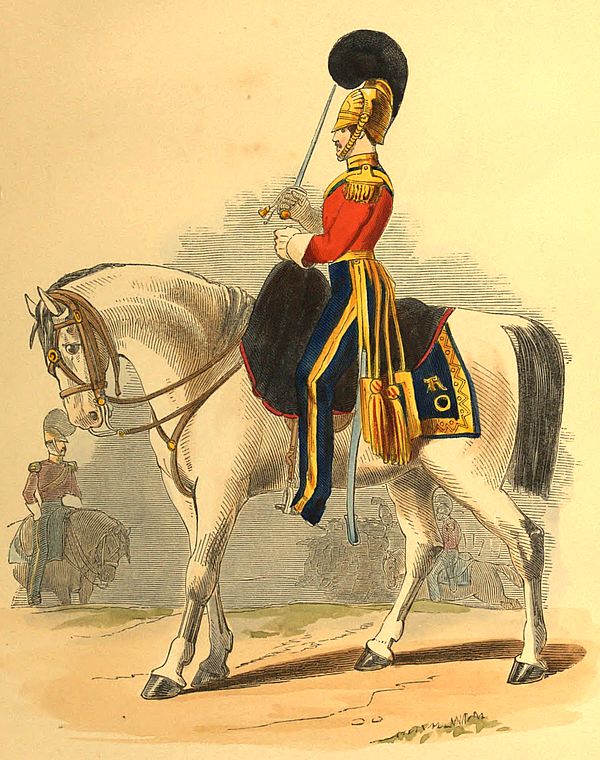
First, or Royal Dragoons, 1839.
[To face page 116.