HISTORICAL RECORD OF THE FIRST, OR ROYAL REGIMENT OF FOOT. (continued 2)
Reading edition
Hostilities again commenced in September, when the garrison quitted the town, and encamped under the walls; and the Lieut.-Governor, Sir Palmes Fairborne, is reported to have made the following speech to Dumbarton's Scots:—"Countrymen and fellow-soldiers, let not your approved valour and fame in foreign nations be derogated at this time, neither degenerate from your ancient and former glory abroad; and as you are looked upon here to be brave and experienced soldiers (constant and successive victories having attended your conquering swords hitherto), do not come short of the great hopes we have in you, and the propitious procedures we expect from you at this time. For the glory of your nation, if you cannot surpass, you may imitate the bravest, and be emulous of their praises and renown."[61]
The expectations of the Lieutenant-Governor, with regard to these celebrated Scots, appear to have been realised; and in the various skirmishes and actions which followed, they always signalised themselves. In the account of a sharp action fought on the 20th of September, it is reported that "The grenadiers under Captain Hodges behaved themselves very bravely." On the 22nd of the same month, "Some of the Moorish horse advanced resolutely to the very line where our men were lodged, but were repulsed, and several of them killed. Several of the Scots grenadiers, who were very active and daring, advancing a little too far, were killed, and others, advancing to their relief, were likewise hard put to it." A sharp skirmish was afterwards kept up throughout the day, and "The Scots and the seamen from the fleet were hotly engaged, having beat the Moors out of several trenches." While retiring, Captain Fitzpatrick was attacked by a Moorish chieftain, but was delivered by a shot which brought the barbarian down at the moment he was about to spear the captain. A Scots grenadier, of undaunted bravery, being desirous of possessing the Moor's charger, leaped over the trenches and seized the horse; but this brave man was immediately afterwards cut to pieces by a party of Moors, who came galloping forward at the moment he was about to retire with the horse. On the same day it was resolved, in consequence of a newly-erected fort being completed, to retire within the walls, when Sir James Hackett, at the head of Dumbarton's Scots, covered the retrograde movement, and repulsed several charges made by the Moorish lancers.
A sally was made from the town on the 24th of September, when the Scots again distinguished themselves, and had Captain Forbes and eight men killed. The Lieut.-Governor, Sir Palmes Fairborne, also received a mortal wound, and was succeeded in the command of the garrison by Lieut.-Colonel Sackville of the Foot Guards.
On the 27th of September, a general sally of the garrison was made on the Moorish lines, where between fourteen and fifteen thousand barbarians were encamped. About three in the morning, the troops issued in silence from the town, and formed in order of battle. Soon afterwards the signal for the attack was given, when Dumbarton's[62] company of Scots grenadiers, led by Captain Hodges, and followed by the remaining companies of the regiment, rushed towards the Moorish lines with the velocity of lightning. The Moors, who were reposing beyond their trenches, were suddenly aroused by the sound of a trampling multitude rushing to battle; and the next moment a shower of hand-grenades bursting amongst them put them in some confusion; yet they sprang to their arms, and, standing firm to receive the charge, disputed the ground with firmness. Soon the action became general, and "Nothing was heard but the roaring of cannon, the firing of muskets, and the loud acclamations of the Christians, who, ever and anon, when they gained any trench of the enemy, raised a shout which pierced the clouds, and echoed in the sky.[63]" Dumbarton's veterans quickly carried the first trench, then mixing in fierce combat with the Moors, soon proved that a valiant Scot was more than a match for one of the dusky sons of Africa. The first trench having been won, a portion of it was levelled for the cavalry, and the British and Spanish horsemen charged the Moors, and plunging amidst the dark masses, trampled and cut down the astonished Africans. At the same time the British grenadiers were seen using their hatchets with dreadful execution on one side, the pikemen were bearing down all before them on another, and, the musketeers, having slung their muskets, were fighting, sword in hand, with an impetuosity which the Moors could not withstand. The waving masses of barbarians were broken, and they fled like a scattered swarm over the land; the British troops pursued, and a number of single combats followed, for the Moors were more expert in personal conflicts than in fighting in large bodies. These combats, however, generally terminated in favour of the British; and the Scots, particularly Captain Hodges and his grenadier company, were distinguished for the number they slew. Thus the siege of Tangier was raised, and Dumbarton's veteran Scots captured a splendid colour[64] from the Moors. The regiment lost[65] in this action, Lieutenants Scott and St. Leger; Ensigns Farrell, Murray, Bell, and Rhue; six serjeants, and thirty private soldiers killed; Captains Lockart, Lundy, Hume, Douglas, and Percy; Lieutenants Glascock, Murray, Ennis, Corson, Bainesman, Macrohen, Stuart, Aukmooty, and Butler; with Ensign Mowast, and one hundred serjeants and private men wounded.
In a few days after this engagement a truce was concluded with the Moors for six months; and in the early part of December a regiment of foot (now the Fourth, or King's own), with 200 recruits for Dumbarton's Regiment, arrived from England.
1681
During the winter, Lieut.-Colonel Kirk was sent on an embassy to Muley-Ismael, Emperor of Morocco. In the spring of 1681, a treaty of peace for four years was concluded and sent to England by Captain Thomas Langston.
1682
1683
King Charles II., however, found the maintenance of a sufficient garrison at Tangier too expensive to be continued without the aid of a grant from parliament. At the same time the nation was more alarmed at the prospect of a popish successor to the throne than at the apprehension of losing this fortress, which they feared would become a nursery for popish soldiers. The advantage derived from the Levant trade, and other arguments, were brought forward in favour of maintaining Tangier; but the parliament refused the necessary supply; and towards the end of 1683, Admiral Lord Dartmouth was sent with a fleet to demolish the fortress, and to bring away the garrison and British inhabitants.
1684
One company of Dumbarton's Regiment arrived from Tangier, in November, 1683, and landed at Gravesend; and the remainder arrived in the river Thames in February, 1684, and, having landed at Rochester, were quartered—eight companies at Rochester and Chatham, six at Winchester, and two at Southampton. At the same time directions were sent to the Duke of Ormond, the Lord-Lieutenant of Ireland, to send the five companies of the regiment in that country to England.
In June of this year four companies attended the Duchess of York (afterwards Queen of England) at Tunbridge Wells; and in the autumn King Charles II. conferred upon this celebrated regiment the title of The Royal Regiment of Foot.[66]
On the 1st of October, sixteen companies of the Royal Regiment, commanded by Lieut.-Colonel Sir James Hackett, were reviewed, with a number of other corps, by King Charles II., on Putney Heath. "The Coldstream, my Lord Dumbarton's, and the Admiral's Battalions, successively exercised all three by beat of drum, the military postures of pike, sword, and musket, every man dexterously discharging his duties with an exact and general readiness, to the great delight of their Majesties and Royal Highnesses, who vouchsafed, all the time of exercise, to grace the arms with their presence. The other two battalions of the Royal Regiment[67] had not fallen short of the like performance, if illness of weather, when they just intended it, had not prevented: the day proving wet and showery was a general impediment from proceeding at that time to any other motions customary upon the like reviews; and all decamped sooner than otherwise they would have done." In the Army List, published by Nathan Brooks, in October, 1684, the Royal, or Dumbarton's Regiment, is stated to "consist of twenty-one companies, two lieutenants to each company, three serjeants, three corporals, and two drums, established; distinguished by red coats lined with white; sashes white, with a white fringe; breeches and stockings light grey; grenadiers distinguished by caps lined white, the lion's face, proper, crowned; flys St. Andrew's cross, with thistle and crown, circumscribed in the centre, 'Nemo me impunè lacessit.'"
1685
After the review, the regiment was stationed in extensive cantonments in the county of Kent, where it remained until the death of King Charles II., on the 6th February, 1685, when it was suddenly ordered to march into quarters in London and the adjacent villages.[68] Although King James II. was known to be a papist, yet no opposition was made to his accession to the throne; and in March four companies proceeded to Yarmouth, and four to Rochester, leaving thirteen companies in quarters in the metropolis.
The tranquillity of the kingdom was, however, suddenly disturbed in June, 1685, by the rebellion of James, Duke of Monmouth, who appeared on the western coast with a band of followers, and asserted his pretensions to the throne, when orders were issued for the Royal Regiment to be augmented to one hundred men per company, and five companies were sent from London to Portsmouth, to increase the strength of that garrison.
Shortly afterwards, Brigadier-General Lord Churchill (afterwards the Great Duke of Marlborough) was sent to the west of England with a body of troops to oppose the rebels; and another division of the army followed under the direction of Lieut.-General the Earl of Feversham, who was appointed to the command of the royal forces. At the same time five companies of the Royal Regiment of foot, under the orders of Lieutenant-Colonel Archibald Douglas, and a troop of the Royal Horse Guards, commanded by Sir Francis Compton, were sent from London with the train of artillery to be employed on this service. The four companies of the Royal Regiment at Yarmouth were at the same time ordered to march to London; so that during Monmouth's rebellion the regiment was employed as follows:—Five companies with the army; five in garrison at Portsmouth; seven attending the court in London; and four at Rochester.[69]
The five companies of the Royal Regiment, under the orders of Lieut.-Colonel Douglas, with nine field-pieces,[70] having joined the army under the Earl of Feversham, the rebels found it necessary to move to Bridgewater. The King's forces advanced to the village of Weston, where they arrived on the 5th of July, and the cavalry having been quartered in the village, the infantry encamped on Sedgemoor. The Royals, being formed in one small battalion, took the right of the line, and were posted behind a deep ditch; a squadron of horse and fifty dragoons were sent forward as an advanced guard, and one hundred of the Royals were kept under arms in readiness to support the cavalry out-guards. During the night the rebels marched out of Bridgewater, with the design of surprising the King's forces; but the guard having given an alarm, the five companies of the Royal Regiment were formed in order of battle in a few moments, and opening their fire upon the advancing rebels with good effect, held them in check, and gave time to the other battalions to form, and for the cavalry to draw out of the village.[71] The rebel cavalry, under Lord Grey, first attempted to charge the Royals, but being unable to cross the ditch, they were driven back by the steady fire of the veteran Scots. The rebel infantry, headed by the Duke of Monmouth, directing their march by the fire, first attacked the Royals, and extending along the moor, a sharp combat of musketry ensued in the dark. The rebel foot, consisting principally of miners, fought with desperation; but their cavalry was soon chased out of the field by the King's horsemen; and when daylight appeared, the Life Guards, Royal Horse Guards, and Royal Dragoons, charged the right flank of the rebel infantry, and put Monmouth's untrained battalions into disorder. A complete rout ensued; the insurgents fled from the moor; and numbers were slain and made prisoners in the adjoining fields. The companies of the Royal Regiment were foremost in the pursuit, and captured the Duke of Monmouth's standard with his motto in gold letters,—"Fear none But God."[72]
The Duke of Monmouth was taken prisoner soon afterwards, and was beheaded on the 15th of July on Tower-Hill, London.
Thus the rebellion was suppressed; and the sum of 397l. was paid to the officers and soldiers of the Royal Regiment of foot who were wounded in this service, as is set forth in the following warrant, copied from the public accounts of that period:—
"James R.
"Whereas by the establishment of our forces, we have been graciously pleased to direct that an allowance be made to such officers and soldiers as should be wounded or hurt in our service; our will and pleasure is, that out of such monies as are or shall come to your hands for the contingent use of our guards, &c., you cause the sums following to be paid to the officers, non-commissioned officers, and soldiers, of our Royal Regiment of Foot, hereunder mentioned, viz.:—
£. s. d.
Capt. Jas. Moncrief 40 0 0
Lieut. Jno. Stirling 20 0 0
" Rob. Dury 20 0 0
" Thos. Bruce 20 0 0
" Jno. Livingston 35 0 0
" Jno. M'Kullock 25 0 0
" Jas. Law. 15 0 0
£175 0 0
Serjeants.
Murdo Mackenzie 8 0 0
John Henderson 2 0 0
James Ferchardson 2 0 0
Will. Conn 8 0 0
Corporals.
Andrew Kennedy 8 0 0
Andrew Duncomb 4 0 0
Drummer.
William Murray 5 0 0
Privates.
Thomas Powell 4 0 0
John Mackintosh 4 0 0
David Campbell 3 0 0
David M'Cloud 4 0 0
Allan M'Cullough 3 0 0
Edwd. Correll, jun. 8 0 0
Duncomb Grant 4 0 0
John Mackenzie, jun. 2 0 0
Alex. Mackintosh 2 0 0
Alex. M'Dowgall 4 0 0
John Pendrick 3 0 0
John Brown 4 0 0
John Shepheard 2 0 0
John Chambers 7 0 0
James Hall 7 0 0
Thomas Shepheard 2 0 0
John Lowry 2 0 0
David Jekenbur 4 0 0
John Richy 3 0 0
James Ratt 2 0 0
James Cormagh 2 0 0
Thomas Gouthar 2 0 0
James Johnston 3 0 0
John Adams, jun. 8 0 0
James Johnston. 2 0 0
John Mackiver 4 0 0
James Mosey 5 0 0
John Gorden 4 0 0
James Factor 5 0 0
Thomas Baker 2 0 0
James Contie 3 0 0
Robert Miller 4 0 0
Dunie Ferguson 2 0 0
Dune Mackenzie 2 0 0
John Young 4 0 0
Nicholas Farland 3 0 0
John Clark 2 0 0
Alex. Wilson 2 0 0
Andrew Singleton 2 0 0
William Symins 2 0 0
George Robinson 4 0 0
David Arrott 4 0 0
Thomas Mackgowne 2 0 0
John M'Garth 2 0 0
John Mackenzie 3 0 0
John Burne 3 0 0
Jno. Robinson 2 0 0
Jas. Ramskin 3 0 0
Will. Lowder 3 0 0
John Davison 2 0 0
Charles Johnson 3 0 0
Charles Gelly 3 0 0
Willm. Bayon 2 0 0
James Watson 2 0 0
Charles Jolley 5 0 0
Peter Constable 5 0 0
222 0 0
Officers 175 0 0
£397 0 0
"Which sums, amounting to three hundred and ninety-seven pounds, are to be paid to the said persons, in satisfaction for their wounds received in our service during the late rebellion; provided none of them be already admitted to the allowance appointed for our Royal Hospital, near Chelsea. And for so doing, this, together with the acquittances of the said persons, or their assigns, shall be your discharge.
"Given at our Court at Whitehall this 16th day of May, 1686.
"By his Majesty's command,
"William Blathwayte.
"To our trusty and well-beloved Cousin and Councillor Richard, Earl of Ranelagh, our Paymaster-General, &c. &c. &c."
The following men of the Royal Regiment, who were admitted into the Royal Hospital at Chelsea, received the sums set down against their names:—
£. s. d.
J. Batchelor, 10 marks 6 13 4
Martin Bryer 6 13 4
Jas. Bennerman 6 13 4
John Dannine 6 13 4
Arch. Eastwood 6 13 4
John Murray 6 13 4
Angus Macleod 6 13 4
Arch. Nicholson 6 13 4
Thomas Jarvis 6 13 4
Robert Thomas 6 13 4
John Harris 6 13 4
Godfrey Twiddy 6 13 4
Serjeant Weems of the Royal Regiment particularly distinguished himself; and a warrant of James II. directs that he should be paid "Forty pounds for good service in the action at Sedgemoor, in firing the great guns against the rebels."
A few days after the battle, the establishment of the Royal Regiment was reduced from 100 to 50 private men per company; and in August eleven companies were encamped on Hounslow Heath, where they were reviewed by the King. In September, thirteen companies marched to Winchester, to attend the court at that city; and the regiment passed the winter at Portsmouth and Exeter, with one company detached to Lynn.
1686
At this period the establishment of the regiment consisted of 1 colonel, 1 lieutenant-colonel, 1 major, 18 captains, 1 captain-lieutenant, 41 lieutenants, 21 ensigns, 1 adjutant, 1 chaplain, 1 quarter-master and marshal, 1 chirurgeon, 1 chirurgeon's mate, 1 drum-major, 1 piper, 42 drummers, 63 serjeants, 63 corporals, and 1050 private soldiers. The privilege of having two lieutenants and three serjeants to each company appears to have been peculiar to this regiment; and a warrant of King James II., dated the 1st of January, 1686, directs that "As any of the lieutenants of the Royal Regiment shall die, or be displaced, their number be reduced to one lieutenant only in each company of this regiment; and that as the serjeants shall die, or be displaced, they be in the same manner reduced to two in each company."[73]
On the 1st of March, 1686, a second adjutant and a second surgeon's mate were added to the establishment, and the regiment was again divided into two battalions; the first battalion consisting of eleven, and the second of ten companies; and in April the second battalion embarked at Gravesend for Scotland. At the same time the whole of the first battalion was placed in garrison at Portsmouth, from whence it marched in June following to the vicinity of Hounslow, and on the 24th of that month erected its tents on the heath, where about twelve thousand men were encamped, under the orders of Lieut.-Generals the Earls of Feversham and Dumbarton, and were frequently exercised in presence of the royal family. In July, four companies marched from Hounslow Heath, and encamped near Tunbridge Wells, to attend the Princess Anne (afterwards Queen Anne) during her residence at that place; and in August the battalion struck its tents, and marched to Yarmouth and Bungay, with a detachment at Landguard-Fort, where it passed the winter.
1687
From these quarters the first battalion was removed in the spring of 1637 to the vicinity of London, where it halted a few days, and afterwards proceeded to Portsmouth, and passed the summer months in that garrison. In the autumn it marched into Yorkshire; and the men were employed dining the winter in working on the fortifications at Hull.
1688
In April, 1688, the first battalion was recalled from Yorkshire, and was stationed at Greenwich, Woolwich, and Deptford, until the 26th of June, when it encamped on Hounslow Heath.
In the meantime the second battalion had marched from Scotland to York. In August it proceeded to Hertford and Ware; and in September to Gravesend, where the first battalion had previously arrived from Hounslow Heath; and the two battalions being again united, occupied Gravesend, Tilbury-Fort, Sheerness, and other places along the banks of the Thames and the coast of Kent.
At this period the nation was violently agitated by political events. The King, being a roman catholic, and being guided by jesuitical councils, and countenanced and encouraged by a few families of the same persuasion, was attempting to effect the subversion of the established religion and laws. At the same time many noblemen and gentlemen who felt the greatest concern for the welfare of their country had invited the Prince of Orange to come to England with a Dutch army to aid them in resisting the proceedings of the court. Thus the kingdom was divided against itself, and men were looking forward, with a mixed feeling of hope, terror, and consternation, to the great convulsion which threatened the State. The King made preparations to avert the danger, and augmented his army, when the Royal Regiment was increased to 26 companies, and the total strength to 1858 officers and soldiers, each battalion having now a grenadier company.
In the early part of November, the Dutch fleet having sailed past Dover, the Royal Regiment was ordered to the west; and when the Prince of Orange had landed at Torbay and advanced to Exeter, it proceeded to Warminster, which was the most advanced post of the royal army. The head-quarters were at Salisbury, and King James reviewed his army on Salisbury Plain on the 21st of November. But his Majesty found that his conduct had alienated the affections not only of his subjects in general, but of the officers and soldiers of his army, many of whom forsook his camp and joined the Prince of Orange. Yet, while many of the nobility and gentry, with officers and soldiers from almost every regiment in the army, were quitting the King's standard daily, the Royal Regiment of Foot was an exception; it preserved its ranks entire, and stood with an unshaken loyalty amidst the general defection which prevailed in the kingdom.
When the King ordered his forces to retire towards London, the Royal Regiment marched, first to Devizes, and afterwards to Windsor, where it arrived on the 29th of November. The desertions continuing, the King sent orders to Lieut.-General the Earl of Feversham to make no further resistance to the Prince of Orange, and his Majesty afterwards attempted to effect his escape to France. These orders produced much confusion. Several corps were disbanded; and the men spreading themselves in parties over the country, committed many disorders. The Royal Regiment, however, appears to have been equally conspicuous for good order as for loyalty, and continued at its post of duty until directed by the Prince of Orange to march to Oxford.
Although the King failed in his first attempt to escape to France, yet he afterwards succeeded, and having been followed by the Earl of Dumbarton, the Colonel of the Royal Regiment, the Prince of Orange conferred the Colonelcy on one of his most distinguished officers, Marshal Frederick De Schomberg, afterwards Duke Schomberg.
1689
After these events had transpired, a convention was assembled, which declared the throne abdicated and vacant, and conferred the sovereignty on William and Mary, Prince and Princess of Orange. Many of the officers and men of the Royal Regiment were, however, not satisfied with the new arrangements. Their regiment had been King James's favourite corps, on account of its antiquity, valour, and good conduct, and its having served with his Majesty in France, when he was an exile. Having preserved their loyalty to the last, the officers and men did not expect much favour from the new king. At the same time they were not pleased that a foreigner, Marshal Schomberg, though an officer of distinguished merit, should be placed at the head of a national Scots corps. While these feelings were prevalent in the breasts of the officers and men, the regiment received orders to embark for the Netherlands to replace the Dutch troops which were in England. This order was considered premature: the national assembly in Scotland had not declared for King William, and the Scots officers and soldiers did not consider themselves bound to obey the commands of a king who had not been acknowledged in Scotland. Under this impression a number of officers and men mutinied, and, seizing the money appointed for their pay, marched with four pieces of cannon towards Scotland. At the same time the Royal Regiment of Scots Horse, commanded by Major-General Viscount Dundee, deserted from its quarters at Abingdon, and proceeded in the same direction.[74] The King sent Major-General Sir John Lanier with his own (now the First Dragoon Guards), and Colonel Langston's regiment of horse, and Lieut.-General De Ginkell (afterwards Earl of Athlone) with three regiments of Dutch dragoons, in pursuit of the mutineers; and these troops having overtaken the men of the Royal Regiment in Lincolnshire, about twenty officers and five hundred men, who had previously become convinced of their error, laid down their arms and submitted themselves to the King's clemency. King William III. is reported to have repeatedly expressed his admiration of the firm loyalty and attachment evinced by the officers and soldiers of the Royal Regiment to their former sovereign, when he was forsaken by almost every other person; and the King, after dismissing three or four officers, pardoned the remainder of the regiment, and ordered the first battalion to be completed to its establishment from the second, and to proceed to its original destination.
The second battalion of the Royal Regiment having transferred its serviceable men to the first, proceeded to Scotland; and the first battalion embarked for the Netherlands, where it arrived in the beginning of May, 1689, and joined the Dutch camp at Tongres in the early part of June. The British troops were commanded by the Earl of Marlborough,[75] and the combined army by Prince Waldeck. The Royals were employed in several operations; and on the 25th of August they took part in a sharp action with the French troops commanded by Marshal d'Humieres, at Walcourt, in the province of Namur. The enemy attacked a foraging-party, and this brought on a sharp action, in which the British infantry evinced firmness and intrepidity, particularly a detachment under Colonel Robert Hodges;[76] and the French were repulsed with considerable loss.
1690
During the winter, the second battalion of the Royal
Regiment, having recruited its ranks, was sent from Scotland to Holland; and in the summer of 1690 both battalions took the field. On the 21st of June, the regiment was on its march to Brussels; but Prince Waldeck, without waiting for the arrival of the British troops, engaged the French at Fleurus, and was defeated. This disaster reduced the combined army to the necessity of limiting its operations, and acting on the defensive during the remainder of the campaign.
1691
On the 1st of July, 1690, Marshal Duke Schomberg was killed at the battle of the Boyne in Ireland; and the Colonelcy of the Royal Regiment remained vacant until the 5th of March, 1691, when it was conferred by King William III. on Lieut.-Colonel Sir Robert Douglas.
The regiment having been withdrawn from its winter quarters in the month of March, 1691, was encamped at Halle, in South Brabant, where the first battalion was formed in brigade with the Scots Foot Guards, and the regiments of Ramsay, Angus, Mackay, and Hodges; and the second battalion was posted, with O'Ffarrel's regiment, between two divisions of Dutch infantry.[77] The French besieged Mons, and the confederates being unable to relieve the place, the garrison surrendered on the 31st of March, when the French troops went into quarters.
After the surrender of Mons, the Royal Regiment was sent into garrison, from whence it was withdrawn in May, and was encamped near Brussels, and both battalions were formed in one brigade with the Scots regiments of Mackay, Ramsay, O'Ffarrel, and Angus, under the orders of Brigadier-General Ramsay. The summer was passed by the opposing armies in manœuvring on the rich plains of the Netherlands; and in October the troops marched into quarters for the winter.
1692
In the spring of 1692, Louis XIV. marched into the Netherlands with an immense army and besieged Namur, when the Royal Regiment was called from its cantonments, and advanced with the army, commanded by King William III. in person, to the relief of the place; but the march having been delayed by heavy rains, the garrison surrendered on the 20th of June. On the 23rd of that month, Colonel Sir Robert Douglas, with 2 captains, 2 lieutenants, 2 ensigns, and 120 private men, of the Royal Regiment, was detached, with other troops, to attempt the surprise of Mons. After marching all night, the detachment arrived about one o'clock on the following morning within a short distance of the town, when the troops were ordered to halt, and Sir Robert Douglas and Colonel O'Ffarrel, having proceeded to consult with the Prince of Wirtemberg, who commanded the party, mistook their way in the dark, and fell into the hands of a detachment of French cavalry, and were made prisoners. The enemy being found prepared to resist, the detachment returned to the camp at Mellé, and Sir Robert Douglas was released on payment of the regulated ransom, and rejoined the regiment on the 29th of June.
After several changes of position, King William resolved to attack the French army commanded by Marshal Luxembourg, at its camp, near Steenkirk. On the evening of the 23rd of July (O.S.), the first battalion of the Royal Regiment, commanded by Sir Robert Douglas, the second battalion of the 1st Foot Guards, with the regiments of Fitzpatrick and O'Ffarrel, and two battalions of Danes, were ordered forward to commence the attack on the French army, and were accompanied by a detachment from each battalion of Brigadier-General Churchill's brigade, with hatchets and spades to make a passage through the woody grounds between the two armies. Between ten and eleven o'clock on the following morning these troops arrived in front of the French camp, and took post in a thick wood, beyond which there was a small valley intersected with hedges lined with French infantry, and on the opposite side of the valley appeared the French camp. About eleven o'clock two batteries opened their fire upon the enemy; and when the main body of the army had arrived within a mile of the wood, the leading regiments issued from amongst the trees and commenced the attack. "Certainly never was a more dreadful and at the same time bolder firing heard, which for the space of two hours seemed to be a continued thunder. Our van-guard behaved in this engagement to such wonder and admiration, that though they received the charge of several battalions of the enemy, one after another, yet they made them retreat almost to their very camp."[78] Amongst the foremost in this action was seen the brave Sir Robert Douglas at the head of the first battalion of the Royal Regiment, emulating the noblest actions recorded in the annals of war. Having led his battalion against the troops behind the first hedge, he soon cleared it of French combatants, and drove one of the enemy's battalions from the field in confusion. A second hedge was attacked and carried by the gallant Scots in a few moments:—a third was assaulted,—the French stood their ground,—the combatants fought muzzle to muzzle,—and again the Royals proved victorious, and the third hedge was won. The toil of conflict did not cool the ardour of the veteran Scots; but forward they rushed with a loud huzza, and attacked the troops which lined the fourth hedge. Here the fighting was severe; but eventually the Royals overthrew a fourth French battalion, and drove a crowd of combatants from their cannon.[79] In this conflict the first battalion lost one of its three colours. Sir Robert Douglas, seeing the colour on the other side of the hedge, leaped through a gap, slew the French officer who bore the colour, and cast it over the hedge to his own men; but this act of gallantry cost him his life, a French marksman having shot him dead on the spot while in the act of repassing the hedge. "Thus the Scots commander improved upon the Roman general; for the brave Posthumius cast his standard in the middle of the enemy for his soldiers to retrieve; but Douglas retrieved his from the middle of the enemy, without any assistance, and cast it back to his soldiers to retain."[80] While the leading regiments were thus carrying all before them, the main body of the army was a mile in the rear, and could not be brought up in time to sustain the corps in advance: the Royals and other regiments of the advance-guard, after displaying a degree of constancy and valour seldom equalled, were forced to retire; and eventually the army retreated to its camp.
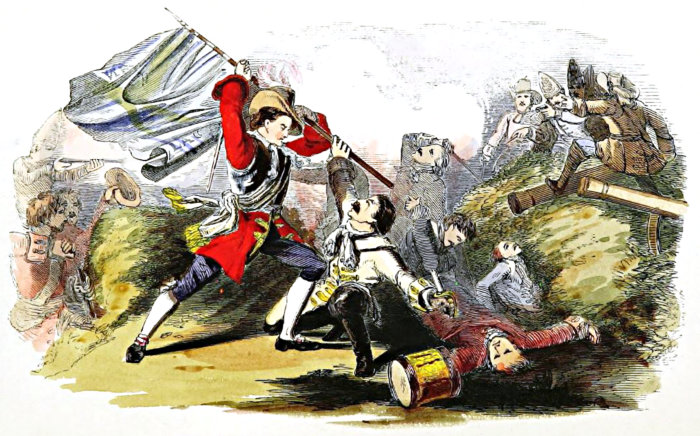
Sir Robert Douglas of Glenbervie, Colonel of the Royal Regiment of Foot, killed at the Battle of Steenkirk, July 24th, 1692.
[To face page 83.
The loss of the regiment in this action has not been ascertained. Mention has, however, been made in history of two Captains, viz. Mackraken and Levingston, of the Royal Regiment, who were killed; and from the returns published at the time, the brigade to which the regiment belonged lost 6 field officers, 14 captains, 24 subalterns, and 507 men killed; and 6 field officers, 20 captains, 32 subalterns, and 608 men wounded[81]; and doubtless a number of these belonged to the Royal Regiment.
A few days after the battle, King William conferred the Colonelcy on Lord George Hamilton (afterwards Earl of Orkney) from the Royal Regiment of Fusiliers.
On the 2nd of August, a detachment of the Royal Regiment, commanded by Captain Rowland Mackenzie, was engaged with a party of French troopers in a wood near the camp, and took twenty prisoners.[82] Towards the end of September the regiment marched from the camp to Bruges, from whence parties were detached to Scotland to procure recruits.
1693
Having passed the winter at Bruges, where the losses of the preceding campaign were replaced by recruits from Scotland, the regiment marched out of its quarters towards the end of April, 1693, and pitched its tents on the levels near the town, from whence it proceeded to the villages near Brussels, where it arrived on the 13th of May. On the 17th, it marched out of its village cantonments and joined the camp at Dieghem, from whence it subsequently marched to Parck camp in front of Louvaine, and had its post on the heights near Birbeck. Here it was stationed until the early part of July, when the army advanced, and, after several marches, the regiment was in position on the 18th of July, near the village of Neer-Winden, in South Brabant. The first battalion had its post in the village of Neer-Landen, near the left of the line, and its grenadier company occupied a strong building at the head of the village. The second battalion was stationed on the right of the village, where a slight entrenchment was made during the night.
On the morning of the 19th of July, when the first rays of light appeared, a French army, commanded by Marshal Luxembourg, of nearly double the numbers of the confederates under King William, was discovered in order of battle within cannon-shot of the position. The batteries instantly opened their fire, and, about eight o'clock, six French brigades attacked the post at Laér and Neer-Winden, but were repulsed. The enemy next attacked the village of Neer-Landen with four brigades,[83] and the first battalion of the Royal Regiment stood its ground manfully. The French came rushing to the attack with great fury, but the head of their column was pierced by a shower of musket balls, and the killed and wounded crowded the street, while the grenadiers of the Royal Regiment threw their grenades, with unerring aim, from the windows of the house they occupied. The French, however, pressed forward, and the battalion, being unable to resist the host of combatants which assailed it, was forced to retire; at the same time the house occupied by the grenadiers was set on fire. At this moment the Queen Dowager's Regiment (now 2nd Foot, or Queen's Royal) advanced to the assistance of the Royals, and the two battalions renewed the fight with great bravery. Prince Frederick's and Fagel's Dutch regiments also advanced to support the two British battalions; at the same time King William came galloping to that part of the field, and his presence inspired the combatants with new ardour. The French disputed the ground for some time, but after a fierce conflict of about two hours' duration, they gave way, and were driven through the defile into the plain; and the Royal and Queen Dowager's battalions, which had fought together at Tangier in Africa, stood triumphant at the end of the village, and were thanked for their gallantry by the King. Notwithstanding this success, the fortune of the day turned eventually in favour of the French, who carried the village of Neer-Winden, and broke into the King's camp, when their superiority of numbers gave them a decided advantage. The Royals were withdrawn from their post; and the King ordered a retreat, which was effected with difficulty, and was attended with great loss. The loss of the enemy was, however, so great, that he derived little advantage from this victory, excepting the power of besieging Charleroi, which was taken in the autumn. The loss of the Royal Regiment does not appear to have been great; the only officers of this corps mentioned by D'Auvergne amongst the killed and wounded are—Captain Young died of his wounds, with Captain Sir James Cockburn, Lieutenants Brown and Blake, and Ensign White wounded. In October the regiment marched to Bruges, and parties were again sent to Scotland to procure recruits to replace the loss sustained during this campaign.
1694
On the 18th of May, 1694, the first battalion marched out of its winter quarters, and on the following day encamped near Ghent; and, resuming its march on the 21st, proceeded to the general rendezvous of the army near Louvaine, where it arrived on the 28th of that month.
Meanwhile, the second battalion remained in garrison at Bruges, and in June it marched out of the town and encamped along the banks of the canal towards Ghent, where a small army of observation was assembled under the orders of the Spanish general, Count de Merode Thian.
The first battalion marched with the army commanded by King William in person, from the vicinity of Louvaine, on the 13th of July, and was afterwards encamped at Mont St. André. In the middle of August the King attempted by a forced march to cross the enemy's lines and penetrate into French Flanders; but the French, by extraordinary exertions, gained the pass first, and thus preserved their country from an invasion.
Towards the end of August the second battalion quitted its post on the Bruges Canal, and joined the first battalion at the camp at Rousselaér; and both battalions formed part of the covering army during the period the Prussians and Dutch were engaged in the siege of Huy, and the men, having to remain in the fields in wet weather, erected huts of wood and straw. Huy surrendered on the 17th of September, and in October the Royal Regiment returned to its former station at Bruges.
1695
Having passed the winter and spring in convenient quarters, the Royal Regiment again took the field on the 26th of May, 1695; and on the 21st of June the first battalion, commanded by Colonel Lord George Hamilton, was detached to engage in the siege of the strong fortress of Namur; at the same time, the second battalion remained with the covering army, commanded by the Prince of Vaudemont, encamped near the river Lys.
Namur was, at this period, deemed almost impregnable, and the garrison, consisting of twenty battalions of infantry, and twenty-four squadrons of dragoons, was commanded by Marshal Boufflers, an officer celebrated for bravery and perseverance; a vigorous defence was consequently anticipated.
The first battalion of the Royal Regiment was stationed for several days at Templeux, a post about five miles from Namur, and on the 8th of July it took its station in the lines of circumvallation, and was ordered to take part in an assault upon the covered-way near the hill of Bouge, on the same evening. The signal for the attack was given about seven o'clock, when the Foot Guards advanced boldly up to the enemy's palisades, and placed the muzzles of their muskets between the staves, fired a volley which put the French into some confusion. The palisades were afterwards broken, and the troops rushed forward to attack the second covered-way. During the first attack the Royals supported the Dutch Foot Guards, but when the first palisades were broken down, the Scots rushed furiously forward with the Foot Guards, the second covered-way was carried, the French were overpowered, driven from their works, and chased amongst the batteries on the brow of the hill, and many of them sought a refuge from the fury of their assailants in the stone pits. The Royals gained great credit for their conduct on this occasion; and had Captains Sanderson and Dixon, Lieutenant Penefather, and Ensign Cockburn, killed; and Colonel Lord George Hamilton, Captain Hamilton, and Ensigns Carre and Vernal, wounded.
On the 10th of July the battalion was on duty in the trenches, and as it marched out on the following day Major Macilivan was killed by a cannon-ball from the castle of Namur: on the same day its Colonel was promoted to the rank of Brigadier-General. The battalion was again on duty in the trenches on the 13th of July; and on the evening of the 17th it was engaged in storming the counterscarp. The attack was commenced by the grenadiers, who rushed to the glacis, cast their grenades over the palisades into the covered-way, and, following up this attack with spirit, the troops carried the counterscarp in gallant style.
An assault was made on the 23rd of July, on the covered-way and traverses between the bastion of St. Roche and the Porte de Fer, and the first battalion of the Royal Regiment formed part of the storming party. The attack was made a little before sunset, and, after a sharp contest, a lodgment was effected. The only loss sustained by the battalion in this service appears to have been Lieutenant Archibald Hamilton and a few private men wounded. The Dutch and Brandenburgers were also successful at their points of attack, and on the 24th of July, when preparations were making for another assault, the garrison hoisted a white flag, and agreed to surrender the town, which was delivered up on the following day, when the garrison retired into the castle, where they resolved to defend themselves to the last extremity.
After the surrender of the town of Namur the first battalion of the Royal Regiment marched from the lines of circumvallation to Genappe, where a small force was assembled under the Earl of Athlone to co-operate with the covering army; Captain Burgh and Lieutenant Wallis of the Royals, however, remained with the forces engaged in the siege of the castle, in the capacity of engineers. From Genappe the first battalion marched to the village of Waterloo, and there pitched its tents. Meanwhile, the second battalion had been engaged in several movements for the preservation of Ghent, Bruges, and the maritime towns of Flanders, and was, at this period, encamped near Brussels. The confederate army being thus divided, part carrying on the siege of the castle of Namur, and the remainder stationed in various places in the Netherlands, the French commander, Marshal Villeroy, having assembled an immense army, advanced to Brussels and bombarded the city; he afterwards marched towards Namur, with the design of raising the siege of the castle; when both battalions of the Royal Regiment, with the remainder of the covering army, proceeded to the vicinity of Namur, and took up a position to cover the siege. This position the French commander did not venture to attack, and the siege of the castle was prosecuted with vigour. On the 20th of August, the grenadier companies of the Royal Regiment quitted the covering army to take part in an assault upon the castle, and were engaged in storming the counterscarp and breach of the Terra Nova, under the orders of Lord Cutts. This proved a severe and sanguinary service; the assailants and defenders fought with distinguished bravery, and, although the castle was not carried, yet several lodgments were effected. The Royals had Lieutenant William Hamilton and several men killed, and others wounded; Lieutenant Archibald Hamilton, who was wounded in the third attack on the town, was again wounded on this occasion. Preparations were afterwards made for a second assault, when the garrison surrendered, and marched out on the 26th of August (O.S.) Thus this important conquest was effected, and the military reputation of King William was elevated; at the same time, new lustre was reflected on the confederate arms. The summer having been spent in making this capture, after the works were repaired, the Royals marched back to Bruges.
1696
In this city they passed the winter, and the losses of the preceding campaign were replaced. On the 9th of May, 1696, they marched out of Bruges, and pitched their tents along the banks of the canal towards Ghent; and having received their new clothing from England a few days before, they were reviewed, with several other corps, on the 16th of May, by the Prince of Vaudemont, and on the 28th by King William, and their appearance and discipline excited admiration.
The regiment passed this summer in camp along the banks of the Bruges canal, having its post on the right of the bridge at Mary-Kirk; and in the autumn it again proceeded into quarters at Bruges, where five regiments of cavalry and eleven of infantry were stationed during the winter.
1697
In the spring of 1697, when the Royal Regiment took the field, four companies were left in garrison at Bruges, where they remained during the summer. The remainder of the regiment marched to Brussels in the early part of March, and advanced from thence on the 12th of April to Waterloo, where a camp was formed of four English and eight Dutch battalions. The regiment was subsequently engaged in the several operations of the main army under King William; during the latter part of the month of May and the beginning of June it was encamped, with the army, on the plain of Bois-Seigneur-Isaac, and was stationed in front of the King's quarter; in the middle of June it marched to the vicinity of Brussels, and was encamped before that city until the war was terminated by the treaty of Ryswick, which was signed during the night between the 10th and 11th of September, 1697.
1698
1699
After the conclusion of the peace of Ryswick the Royal Regiment marched from Brussels to Ghent, and during the winter it embarked for Ireland; at the same time a reduction of four companies was made in the establishment. A further reduction was subsequently made, and in a warrant under the sign manual, bearing date the 1st of May, 1699, the numbers of the regiment are fixed at 22 companies of 3 officers, 2 serjeants, 2 corporals, 1 drummer, and 34 private men each.[84]
1700
Events transpired in Europe at the close of the year 1700 which occasioned the regiment to be again placed on a war establishment and sent on foreign service.
These events were the decease of Charles II., King of Spain, on the 1st of November, 1700, without issue, and the accession of Philip Duke of Anjou, grandson of Louis XIV. of France, to the throne of Spain, in violation of existing treaties, and to the prejudice of the house of Austria. Several European states being averse to the accession either of an Austrian or Bourbon prince to the throne of the Spanish monarchy, a partition had been contemplated; but the sudden acquisition of the dominions of Spain by a grandson of the most potent and ambitious monarch in Europe, with the prospect of France and Spain being eventually united under one sovereign, rendered the partition-treaty abortive, agitated the public mind, and produced a sensation of alarm throughout the greater part of Christendom.
1701
The interest of every state being affected by the change in the dynasty of Spain, the standing armies were augmented, and, while the din of hostile preparation was heard on every side, negotiations were commenced with the view of preventing a war. The French monarch, however, sent a body of troops to take possession of the Spanish Netherlands, and detained 15,000 Dutch, who, in virtue of a convention with Spain, formed the garrisons of the barrier towns. The loss of so large a body of their best troops, with the advance of a French army towards their frontiers, alarmed the States General of the United Provinces, and King William sent thirteen British battalions to Holland to assist the Dutch.
The Royal Regiment, having been augmented to 24 companies of 3 officers, 3 serjeants, 3 corporals, 2 drummers, and 59 private men each, was one of the corps selected to proceed on foreign service; it accordingly embarked at the Cove of Cork on the 15th of June, 1701, in two ships of war, and sailing on the following day, arrived at Helvoetsluys, on the island of Voorn, in South Holland, on the 8th of July. Here the English troops were removed from the ships of war on board of Dutch vessels, and sailed up the river Maese to the several garrisons of Breda, Gertruydenberg, Huesden, Worcum, Gorcum, and Borsch. From these stations they were recalled in the middle of September to the vicinity of Breda, and encamped on Breda Heath, where they were reviewed on the 21st of that month by King William, and afterwards returned to their former stations.[85]
Meanwhile the death of King James II. had occurred at St. Germain in France, and Louis XIV. caused the Pretender to be proclaimed King of England, Scotland, and Ireland. This indignity offered to the British sovereign and nation aroused the indignation of the people; the army was again augmented, and in the following spring additional forces were sent to Holland.
1702
The Royal Regiment, having passed the winter amongst the Dutch, quitted its cantonments on the 10th of March, and proceeded to Rosendael, where the British infantry assembled and encamped under the orders of Brigadier-General Ingoldsby. Here the troops received information of the death of King William III. on the 8th of March, and of the accession of Queen Anne. They also learnt that Her Majesty was resolved to prosecute the war with vigour, and the officers and soldiers took the oath of allegiance to the Queen.
In the middle of April a strong fortress on the Lower Rhine called Kayserswerth, which was occupied by the French, was besieged by the Germans, and a few days afterwards the Royal and other British corps quitting their camp at Rosendael, marched across the country to the Duchy of Cleves, where they joined a body of Dutch and Germans under the Earl of Athlone, and encamped at Cranenburg on the Lower Rhine to cover the siege. While the Royal Regiment lay with the army at this camp, a French force of superior numbers, commanded by the Duke of Burgundy and Marshal Boufflers, traversed the forest of Cleves, and advanced through the plains of Goch to cut off the communication of the allied army with Grave and Nimeguen. In consequence of this movement, the allied army struck its tents a little before sunset on the 10th of June, and having continued its retreat throughout the night, arrived about eight o'clock on the following morning within a few miles of Nimeguen, at the same time the French columns appeared on both flanks and in the rear, marching with all possible expedition to surround the allies. Some sharp skirmishing occurred; the Royals, Foot Guards, and other British corps forming the rear guard, behaved with distinguished gallantry, and having taken possession of some hedges and buildings, held the enemy in check while the army effected its retreat under the works of Nimeguen: in three days afterwards Kayserswerth surrendered.
In the meantime additional forces had arrived from England, and the Earl of Marlborough assumed the command of the British, Dutch, and auxiliary troops. The French had, at this period, overrun the Duchy of Cleves, and were menacing the frontiers of Holland; but when the Earl of Marlborough had assembled the troops of the several nations, he advanced against the enemy, and by skilful movements forced the French commanders to retire. The Royals formed part of the force under the Earl of Marlborough, and were engaged in several movements designed to bring on a general action, which the enemy avoided. In September the regiment was encamped a few miles from Maestricht, and formed part of the covering army during the siege of Venloo, a town in the province of Limburg, on the east side of the river Maese, which surrendered on the 25th of September. In a few days after the capture of this place, the siege of Ruremonde was undertaken; at the same time one battalion of the Royal Regiment, commanded by Brigadier-General the Earl of Orkney, was detached, with other troops, from the main army near Maestricht to besiege Stevenswart, or Fort St. Etienne, situated on a small island in the river Maese, nineteen miles from Maestricht. Two batteries opened a sharp fire against the fort in the beginning of October, and at day-break on the morning of the third of that month the troops reared their ladders against the walls and began to ascend to attack the place sword in hand, when the garrison beat a parley and surrendered. The battalion of the Royal Regiment rejoined the army on the 6th of October, and Ruremonde surrendered on the same day. On the tenth, at one o'clock in the morning, the main army struck its tents and advanced in two columns towards the city of Liege, and at four in the afternoon encamped near the works. The French set the suburb of St. Walburgh on fire, and retired into the citadel and Chartreuse, when the magistrates delivered up the city, and the army commenced the siege of the citadel, which was taken by storm on the 23rd of October; the British grenadiers and fusiliers engaged in the assault highly distinguished themselves, and had 154 officers and soldiers killed, and 380 wounded. The Chartreuse surrendered a few days afterwards; and these conquests terminated the campaign. The British troops quitted the pleasant valley of Liege on the 3rd of November, and marched to Tongres, where they halted one day, and afterwards continued their route to Holland; the Royal Regiment proceeded to Breda, in which city it appears to have passed the winter in garrison, together with a battalion of Foot Guards and two or three other corps.
1703
Leaving these quarters towards the end of April, 1703, the Royal Regiment traversed the country to the vicinity of Maestricht. Meanwhile the Dutch and Germans were besieging Bonn, a strong town on the Rhine; and the French commanders, Marshal Villeroy and Boufflers, thinking to take advantage of the dispersed state of the army, made a sudden advance to surprise the troops in their quarters. The first attack was made on two British regiments[86] at Tongres, a town surrounded by a wall and defended by a few dilapidated towers; these regiments, however, defended themselves upwards of twenty-four hours before they surrendered. While the contest was in progress at Tongres, the Royals, with a number of other corps, struck their tents, and proceeding to Maestricht, formed in order of battle near the works; the French commanders advanced and reconnoitred the position, and, after a sharp cannonade, retreated to Tongres.
Bonn surrendered in the middle of May, and the army was afterwards assembled in the vicinity of Maestricht, where the first battalion of the Royal Regiment was formed in brigade with the battalion of Foot Guards, and the regiments of Stewart, Howe, Ingoldsby, and Marlborough,[87] under the orders of Brigadier-General Withers; and the second battalion with the regiments of North and Grey, Derby, Row, and Ferguson,[88] under the command of Brigadier-General the Earl of Derby. On the 24th of May the army advanced towards Tongres, when the French quitted their post and made a precipitate retreat, and the confederates encamped at Thys. The army subsequently made several movements for the purpose of bringing on a general engagement, which the French avoided, and took post behind their fortified lines, where the Duke of Marlborough was desirous of attacking them, but was prevented by the Dutch generals and field deputies. In August the army advanced to Huy, a strong fortress on the Maese above the city of Liege, which was besieged and captured in ten days. Another proposal to attack the French lines was declined by the Dutch; and the main army afterwards advanced to St. Trond; at the same time a detachment invested Limburg, a city of the Spanish Netherlands situated on a pleasant eminence amongst the woods near the banks of the little river Wesdet. The siege of this place was commenced on the 10th of September, and on the 27th the governor, with a garrison of 1400 men, surrendered at discretion. Thus Spanish Guelderland was delivered from the power of France, and the Dutch were freed from the dread of an invasion. The capture of Limburg was followed by the separation of the army for the winter; the Royal Regiment struck its tents on the 10th of October, and proceeded to the neighbourhood of Tongres, where it halted ten days, and afterwards continued its march through the province of Limburg to Holland.
While the army, of which the Royal Regiment formed part, was engaged in operations in the Netherlands, the Elector of Bavaria took arms against the Emperor of Germany; and a French force commanded by Marshal Villiers having traversed the Black Forest and joined the Bavarians, the united armies were making considerable progress in the heart of Germany. This event occasioned the Royals, with a great portion of the English and Dutch forces under the Duke of Marlborough, to transfer their services from the Low Countries to Germany, to arrest the progress of the French and Bavarians.
1704
Previous to quitting the Netherlands, the regiment sent a detachment of six hundred men to Maestricht to garrison that city, while the Dutch troops were working at the entrenchments on the heights of Petersberg. In the early part of May, 1704, the remainder of the regiment marched from its winter quarters towards the Rhine, and was joined at Bedburg by the detachment from Maestricht. On the 19th of May the army directed its march from Bedburg along the course of the Rhine towards the Moselle, and traversed both rivers at Coblentz on the 25th and 26th of that month; thence proceeding towards the Maine, arrived at the suburbs of Mentz in the beginning of June; the cavalry being in advance with the Duke of Marlborough, the infantry and artillery a few stages in the rear under General Charles Churchill. From the Maine the infantry directed its march through the Landgraviate of Hesse, towards the Neckar, passed this river on the 15th of June, and proceeding in the direction of the Danube, was soon afterwards at the seat of war in Germany, and co-operating with the forces of the empire.
On the 2nd of July, at three o'clock in the morning, the army marched in the direction of Donawerth, to attack a body of French and Bavarians under the Count d'Arco, in an entrenched camp on the heights of Schellenberg, on the left bank of the Danube. After traversing a difficult tract of country, the troops crossed the river Wernitz and arrived in front of the enemy's camp, and about six in the evening the leading division, consisting of a detachment from each British regiment, with the Foot Guards, Royals, and Ingoldsby's regiment (23rd), commanded by Brigadier-General Fergusson, and a Dutch force under General Goor, advanced under cover of a heavy cannonade, to attack the enemy's entrenchments. When these brave troops arrived within the range of the enemy's cannon they were assailed by a volley of grape, which produced a dreadful carnage. General Goor and many brave officers fell; Lieut.-Col. White of the Royals was severely wounded; yet the assailants moved forward with a firm tread until they arrived at a ravine which they were unable to pass, when they shrunk back before the shower of bullets which assailed them. At this moment the enemy issued from the entrenchments and charged the British and Dutch with great fury, but were gallantly opposed by the English Foot Guards. The Royals and Ingoldsby's regiment also confronted the charging Bavarians with firmness, and the enemy was repulsed and driven back into the entrenchments. A second attack was soon afterwards made on the heights, and the Royals were again sharply engaged. The French and Bavarians made a vigorous resistance, and sallying from the trenches attacked the leading regiments of the allies; the British and Dutch infantry being exhausted by a continued struggle up a rising ground, and their ranks thinned by a destructive fire, once more shrunk back; they were, however, supported by the cavalry under Lieut.-General Lumley, and having rallied, they returned to the attack with great resolution. This protracted contest shook the strength and weakened the resistance of the enemy. The Imperialists, commanded by the Margrave of Baden, arrived at the scene of conflict and attacked the enemy's left; at the same time the British and Dutch made another furious attack. Three field-officers of the Royals had already been carried from the field wounded, yet the regiment was seen pressing upon the enemy, and making a desperate effort to force the entrenchments; the Scots Greys dismounted to join in the attack; and the French and Bavarians were overpowered and driven from the heights with dreadful carnage. The cavalry under General Lumley charged the fugitives, and completed the overthrow of the enemy. Sixteen pieces of artillery, a number of standards and colours, with the enemy's tents, and the equipage, and the plate of Count d'Arco, fell into the hands of the confederates.
Thus the Royals were triumphant near the same ground where the regiment, when forming part of the Green Brigade in the service of Gustavus Adolphus, distinguished itself in March 1632.
The first battalion of the Royal Regiment had Captain Murray, Ensigns M'Dugal and M'Ilroy, one serjeant, and 38 rank and file killed; and Lieut.-Colonel White, Major Cockburn, Captains Hume, Irwin, and Brown; Lieutenants Kid and Ballatine; Ensigns Stratton, Cunningham, and Stewart; with 3 serjeants, and 103 rank and file, wounded.
The second battalion had Captain Baily and Lieutenant Levingston, with 1 serjeant and 76 private men, killed; and Major Kerr, Captain Carr, Lieutenants Pearson, Moore, Vernel, Hay, Dickson, and Hamilton, Ensigns M'Queen, M'Onway, Moremere, Elliot, Inglis, and Moore, with 12 serjeants, and 184 rank and file, wounded.
The victory at Schellenberg was immediately followed by the flight of the enemy from Donawerth, which place was taken possession of by the allies. At the same time the Royal Regiment crossed the Danube, and advancing into Bavaria, was engaged in operations with the army; while the French and Bavarians, having made a hasty retreat to Augsburg, formed an entrenched camp near that city. The enemy also abandoned several small towns, which were taken possession of by the allies, and Rayn was captured after a short siege. The army afterwards advanced towards Augsburg, and halted a short time within sight of the enemy's fortified camp. In the mean time each regiment sent out parties to plunder the country. This occasioned the Elector of Bavaria to engage in a treaty with the view of an accommodation; but he soon afterwards received information that another reinforcement of French troops had traversed the Black Forest, when he broke off the treaty, which so incensed the Imperialists that they laid a great part of Bavaria in ashes.
The fortified camp at Augsburg being found too strong to be attacked with any prospect of success, the troops retired a few stages, and the siege of Ingoldstadt was undertaken by a detachment of Germans, at the same time the Royal Regiment formed part of the covering army.
The Elector of Bavaria quitted his entrenched camp, and having formed a junction with the reinforcements which Louis XIV. had sent to his aid, the united armies encamped in the valley of the Danube, near the village of Blenheim. At the same time the allied army, commanded by the Duke of Marlborough and Prince Eugene of Savoy, had advanced to the village of Minster, and was encamped with its left to the Danube.
At three o'clock on the morning of the eventful 13th of August, 1704, the allies advanced to attack the French and Bavarians. About seven the heads of columns arrived in presence of the enemy, and a pause ensuing, the chaplains performed the usual service at the heads of their respective regiments. About mid-day, a column, of which one battalion of the Royal Regiment formed part, advanced under the direction of Lieut.-General Lord Cutts and Major-General Wilks, to attack the village of Blenheim, where the French commander, Marshal Tallard, had posted a considerable number of troops, and entrenchments and pallisades had been constructed. This column, consisting of the two British brigades, commanded by Brigadier-Generals Row and Fergusson, a brigade of Hessians, and a brigade of Hanoverians, proceeded to the banks of the little river Nebel, and took possession of two water mills, which the enemy evacuated, and set on fire. Thence advancing towards the inclosures, the leading brigade received the fire of the troops in Blenheim, and many officers and men fell; but the gallant Row struck his sword in the enemy's pallisades before he gave the word "fire." His brigade was, however, unable to force the entrenchments against the superior numbers of the enemy; and while retiring it was charged by the French cavalry, but the enemy was repulsed by the Hessians. Soon afterwards, Fergusson's brigade and the Hanoverians traversed the Nebel, near the lower water-mill, and attacked the front of the village, but were repulsed three successive times; the firing was, however, continued against Blenheim; and the remainder of the forces traversed the rivulet, and attacked the main body of the French army. The other battalion of the Royal Regiment was now brought into action; the blaze of musketry extended along the whole front; and the troops of the several nations fought with distinguished bravery. The combat of musketry, and the charges of the cavalry, were continued for some time with varied success. Eventually the main body of the enemy was overpowered, and chased from the field with great slaughter; many prisoners were also captured, and amongst them the French commander, Marshal Tallard.
When the main body of the French army was defeated, the troops posted in Blenheim attempted to escape by the rear of the village, but were repulsed. A second attempt was made in another direction, but was checked by the Scots Greys. A third attempt was also made, but the French were again driven back, and forced to take shelter behind the houses and inclosures. Though encompassed and intercepted on every side, the French obstinately defended their post. Additional forces were brought against them; the batteries opened a tremendous fire; Lieut.-General the Earl of Orkney attacked the French troops posted in the churchyard with eight battalions; Lieut.-General Ingoldsby attacked the right side of the village with four battalions, supported by the Royal Irish (late 5th) Dragoons; and both battalions of the Royals were now engaged. A sharp struggle ensued, which ended in a parley, and eventually twenty-four French battalions of infantry, and twelve squadrons of cavalry, surrendered prisoners of war. The Germans who attacked the enemy's right were also triumphant. Thus the struggle of this eventful day ended in a complete victory, which reflected lustre on the confederate arms, and showed in its native colours the true character of the British soldier. The French and Bavarians are reported to have lost in killed, wounded, prisoners, and from other causes, about forty thousand men, with nearly all their tents, cannon, and ammunition, and a great number of standards, colours, and kettle-drums.
The Royal Regiment lost in this action[89] Lieut.-Colonel White, Ensigns M'Conway and Craig, killed; Captain Lord Forbes died of his wounds; and Captains Montgomery, Bruce, and Lindsay, with Lieutenants Harrowby and Lisle, and Ensign Hume, wounded.
The number of French and Bavarians taken on this occasion was so great that the second battalion of the Royals, with the regiments of Prince George of Denmark, Lords North and Grey, Row and Meredith, commanded by Brigadier-General Fergusson, were sent to Holland in charge of the prisoners. These troops marched with the prisoners to Mentz, where they embarked in boats and sailed to Holland, and, having delivered them into the charge of other corps, were placed in garrison for the remainder of the year.
Meanwhile the first battalion continued with the army in Germany; and the enemy abandoned several important cities, which were occupied by the allies. The battalion of the Royal Regiment proceeded through the circle of Swabia and directed its march to Philipsburg, where it crossed the Rhine on the 7th of September, and subsequently formed part of the covering army during the siege of Landau, a town in the Bavarian circle of the Rhine, situated in a beautiful valley on the river Queich. On the 13th of October this battalion, with the regiments of Hamilton, Ingoldsby, and Tatton, marched from the covering army encamped at Croon-Weissemberg to Germersheim, and embarking in boats, sailed down the Rhine to Holland, and were placed in garrison for the winter.
1705
In the following spring, the losses of the preceding campaign were replaced with recruits from Scotland; and in April the regiment quitted its quarters, and directed its march towards Maestricht, passed that city on the 13th of May, and proceeded to Juliers. From Juliers the regiment proceeded through a mountainous country to the valley of the Moselle, in the midst of which stands the ancient city of Treves, where both battalions encamped on the 28th of May. The British and Dutch, with several German corps, having assembled in the neighbourhood of Treves, the army passed the Moselle and the Saar on the 3rd of June, and advanced towards Syrk, near which place a French army of superior numbers, commanded by Marshal Villiers, was encamped. The allied army halted a short distance from the enemy, and awaited the arrival of the Imperialists under the Margrave of Baden, who had promised to co-operate with the Duke of Marlborough in carrying on the war in this direction: but this co-operation was delayed so long that the British commander was forced to return to the Netherlands, where the French were making considerable progress.
The retreat was commenced during the night of the 17th of June; and on the 20th, Lieut.-General the Earl of Orkney was detached with all the grenadiers, and one hundred men of each battalion, to observe the motions of a detachment which Marshal Villiers had sent towards the Netherlands.
The approach of the army towards the Maese alarmed the French, and they raised the siege of the citadel of Liege and retired. On the 4th of July the first battalion of the Royal Regiment was detached, with other forces under General Schultz and Lieut.-General the Earl of Orkney, to besiege Huy, which had been captured by the French during the absence of the army up the Moselle. On the 6th a battery of twelve cannon and six mortars opened a sharp fire upon Fort Picard; and during the afternoon of the same day the troops forced the covered-way and reared their ladders against the walls, when the French quitted this fort and also Fort Rouge, and fled to the castle. On the 10th the batteries were brought to bear on the castle and on Fort Joseph, and on the following day the garrison surrendered.
Meanwhile the French army, commanded by Marshal Villeroy and the Elector of Bavaria, having taken refuge behind their fortified lines, the Duke of Marlborough had formed a scheme for forcing these stupendous barriers, and the first battalion of the Royal Regiment rejoined the army in time to take part in this splendid enterprise. The lines were menaced by a detachment on the south of the Mehaine, which drew the greater part of the French army to that quarter; and during the night of the 17th of July the allied army marched to its right, and at four o'clock on the following morning the leading regiments approached the works at Neer-Hespen and Helixem. Both battalions of the Royal Regiment were in the leading division. Their advance was concealed by a thick fog, and under the cover of this obscurity one column cleared the village of Neer-Winden and Neer-Hespen, another gained the bridge and village of Helixem, and a third carried the castle of Wange, which commanded the passage over the Little Gheet. Then rushing through the inclosures and marshy grounds, the troops forded the river, and crowded over the defences with an ardour which overcame all opposition. The French guards were surprised and overpowered, and a detachment of dragoons fled in a panic. Thus the lines were forced; the pioneers were instantly set to work, and in a short time a passage was made for the cavalry. While this was in progress, the Marquis d'Allegre advanced with twenty battalions of infantry, and fifty squadrons of cavalry, and opened a sharp cannonade; but his advance was retarded by a hollow way, which gave time for more troops to pass the lines; and eventually his forces were attacked and defeated, and the allies took many prisoners, and also captured a number of standards and colours. Speaking of this action, the Duke of Marlborough observes in a letter published in his memoirs,—"It is impossible to say too much good of the troops that were with me, for never men fought better."
The enemy made a precipitate retreat, and took up a position behind the river Dyle. The Duke of Marlborough advanced with the design of passing the river, but was prevented by heavy rains. On the 21st of July, a small body of French troops passed the Dyle, when the first battalion of the Royal Regiment was ordered forward, and a slight skirmish ensued. The French fled to their lines, and a few companies of the Royals pursuing too far, were fired upon from the works, and had one captain killed and several men wounded. Major General Wood was also wounded.
The Royal Regiment was subsequently engaged in several manœuvres; but the designs of the British commander were frustrated by the inactivity and want of co-operation on the part of the Dutch generals. The French lines were demolished in the autumn; and a detachment was sent to invest a small town and fortress on the Scheldt, called Sandlivet, which surrendered on the 29th of October. In the early part of November the regiment marched back to Holland, and was placed in garrison for the winter.
1706
The Royal Regiment again took the field in May, 1706, and proceeding to the province of Limburg, arrived at the general rendezvous of the army at Bilsen, near Tongres, on the 19th of that month. Advancing from Bilsen, the army proceeded in the direction of Mont St. André; and on Whit-Sunday, the 23rd of May, as the troops were on the march, the enemy's army, commanded by Marshal Villeroy and the Elector of Bavaria, was discovered forming in order of battle in the position of Mont St. André, with their centre at the village of Ramilies, which was occupied by a considerable body of troops.
The allied army, diverging into the open plain of Jandrinœuil, formed line, and advanced against the enemy. The Royal Regiment, having its post near the right of the first line, formed on the heights of Foulz; then descending, with several other British, Dutch, and German corps, into the low grounds near the river, menaced the villages of Autreglise and Offuz with an attack. This movement occasioned the enemy to weaken his centre to support his left flank, when the duke of Marlborough made a powerful attack on the enemy's centre and right. The Royals were spectators of the fight for above an hour; at length a critical period in the engagement arrived, and the regiment was brought forward. The veterans of Schellenberg and Blenheim fought like men resolved to die rather than lose their reputation; and the French, Spaniards, and Bavarians, were overthrown and driven from the field with a terrible slaughter. The fugitives were pursued many miles, and an immense number of prisoners, with cannon, standards, and colours, was captured. Thus a complete and decisive victory was gained over an army of superior numbers in less than three hours.
The wreck of the French army continued its precipitate flight to Louvain, and immediately afterwards abandoned that city, and also Brussels. The States of Brabant, and the magistrates of Brussels, renounced their allegiance to the Duke of Anjou. The principal towns of Brabant, and several others in Flanders, were immediately delivered up, and others surrendered on being summoned, or in a few days afterwards. Dendermond held out, and was blockaded in the early part of June; and Ostend was afterwards besieged by a detachment from the main army, and surrendered on the 6th of July. Menin was besieged on the 25th of July, and surrendered in August; and Dendermond was delivered up in the early part of September. During these sieges the Royals continued to form part of the covering army; but after the surrender of Dendermond, one battalion of the regiment was detached under Marshal d'Auverquerque and Lieut.-General Ingoldsby, to besiege Aeth, a town and fortress on the river Dender. This place was invested on the 16th of September: the several attacks were carried on with vigour, and the garrison surrendered on the 3rd of October. The capture of Aeth was the last important event of this glorious campaign: and in the early part of November the Royal Regiment marched into garrison at Ghent.
1707
Here the regiment passed the succeeding winter and spring, and again took the field on the 16th of May, 1707, when the first battalion was formed in brigade with the Foot Guards and the regiments of Godfrey and Sabine (now 16th and 23rd), commanded by Brigadier-General Meredith; and the second battalion with the regiments of Webb, Ingoldsby, and Tatton, (now 8th, 18th, and 24th), and Temple's (since disbanded), under the command of Brigadier General Sir Richard Temple, afterwards Viscount Cobham. The opposing armies, however, passed the campaign in manœuvring, and observing each other's movements; the French avoided a general engagement; and in October the Royals returned to Ghent.
In this year, the Union of Scotland with England having taken place, the Cross of St. Andrew was placed on the colours of the English regiments in addition to the Cross of St. George—previously displayed; and the Royal Regiment obtained as a regimental badge—the Royal Cypher, within the circle of St. Andrew, surmounted with a crown; instead of St. Andrew's Cross, which it had formerly borne on its colours.
1708
While the regiment was reposing in winter quarters in Flanders, the King of France fitted out a fleet and embarked a body of troops at Dunkirk for the purpose of making a descent on the British coast in favour of the Pretender; and the Royals, with the Foot Guards and seven other corps, were ordered to return to England to repel the invaders. The Royal Regiment marched from Ghent on the 8th March, 1708 (O.S.), embarked at Ostend on the 15th, and arrived at Tynemouth on the 21st. Meanwhile the French fleet, with the Pretender on board, had sailed from Dunkirk; but being chased by the British men-of-war, the enemy returned to Dunkirk without effecting a landing. The Royals were then ordered back to Flanders, and having landed at Ostend on the 20th of April, proceeded in boats along the canal to Ghent.
The regiment remained at Ghent until the 22nd of May, when it took the field and engaged in the general operations of the army, and soon afterwards the French obtained possession of Ghent and Bruges by treachery. A more important advantage was, however, gained on the 11th of July by the allied army commanded by the Duke of Marlborough, who crossed the Scheldt and defeated the French army, commanded by the Duke of Burgundy and Marshal Vendôme, near Oudenarde. The Royals formed part of the division of twenty battalions commanded by the Duke of Argyle, and having traversed the Scheldt by the pontoon bridge between Oudenarde and the Abbey of Eename, they ascended the heights of Bevere; then, inclining to the right, engaged the enemy in the fields and open grounds beyond the rivulet. A fierce conflict of musketry ensued, and charge succeeded charge, until the shades of evening gathered over the scene of conflict, and the combatants could only be discerned by the flashes of musketry which blazed in the fields and marshy grounds. The French, having been driven from hedge to hedge, and from thicket to thicket, were eventually overpowered. Part of their army being separated from the remainder was nearly surrounded and destroyed, and the work of destruction was continued until the darkness became so intense that it was impossible to distinguish friends from foes, when the troops were ordered to cease firing. Night favoured the enemy; many of the corps, which were nearly surrounded, escaped in the dark, and the wreck of the French army made a precipitate retreat to Ghent, leaving the allies in possession of the field of battle, with many prisoners, standards, colours, and other indisputable marks of victory.
The Royals were subsequently employed in covering the siege of Lisle, the capital of French Flanders, which was captured by Louis XIV. in 1667, and ceded to France by the treaty of peace in 1668. This city being situated on a plain watered by several streams, and protected by a series of stupendous works constructed under the superintendence of Vauban, the celebrated French engineer, and being defended by a garrison of 15,000 men commanded by the veteran Marshal Boufflers, who was prepared with everything requisite for a protracted defence, the siege was considered an undertaking of great magnitude, and it excited universal attention. The French made strenuous exertions to preserve the place, and an immense body of troops advanced against the covering army, of which the Royal Regiment formed a part; but the French Marshals were dismayed by the determined countenance of the allies, and frustrated by the superior tactics of the Duke of Marlborough. The enemy next attempted to cut off the supplies of military stores and provision from the army; and a quantity of stores having been sent from England to Ostend, and there placed in waggons, one battalion of the Royal Regiment, commanded by Lieut.-Colonel Hamilton, was detached from the covering army to protect the stores from Ostend to the camp. This battalion was sent, in the first instance, to Oudenburg, with orders to wait there until the convoy had passed, and afterwards to join the escort at Turout. The waggons left Ostend on the 27th of September, and continued their route towards the army; at the same time the French commanders sent a detachment of 22,000 men under the orders of Count de la Motte to intercept the convoy. After the waggons had proceeded a considerable distance on their way, the battalion of the Royal Regiment quitted Oudenburg and proceeded to Turout, where information was received of the movements of the enemy, when the battalion marched with all possible expedition to succour the convoy, and arrived at the wood of Wynendale at the moment when Major-General Webb was forming the few troops he had with him in an opening beyond the wood. The French had to pass through the wood, and Major-General Webb placed a battalion in ambush amongst the trees on each side of the defile, and drew up the main body of his detachment, which consisted of about 8000 men, in an open space at the end of the defile. The French advanced in full confidence to overwhelm a force which did not amount to half their own numbers; but, when passing through the wood, they were assailed by the ambush on their left, which put them in some confusion. They, however, continued to advance and broke through two of the battalions of the allies posted at the end of the defile; but the battalion in ambush on the enemy's right having opened its fire, and the head of their column being attacked, the French were repulsed and driven back through the wood. They soon rallied and returned to the attack, and were again assailed by a destructive fire in front and on both flanks, and they shrunk back in dismay. The attack was repeated, and the destructive cross fire was again opened with the same results; and Count de la Motte, being unable to induce his men to return to the charge, he was forced to relinquish the contest and retire. At this moment Lieut.-General Cadogan arrived with a few squadrons of cavalry, and the convoy was conducted in safety to the army. This gallant exploit excited great admiration, and Major-General Webb was honoured with the thanks of parliament, and the approbation of the Queen, for his conduct on this occasion.
The Royal Regiment continued to form part of the covering army, and was employed in several services connected with the procuring of provision and stores for the besieging troops. In November, the Elector of Bavaria besieged Brussels, and the Royals formed part of the force which advanced to relieve the place. The strong positions of the enemy behind the Scheldt were forced on the 27th of November; and when the troops advanced upon Brussels, the Elector of Bavaria raised the siege, and made a precipitate retreat.
The citadel of Lisle, being vigorously pressed, surrendered on the 9th of December. The period for military operations had passed away; but notwithstanding the lateness of the season the Duke of Marlborough resolved to besiege Ghent, and the Royal Regiment was one of the corps selected for this service. An attack was made on the out-posts of the town on the night of the 24th of December, when a detachment of the Royals formed part of the forlorn-hope, and had several men killed and wounded. The trenches were opened during the same night, and the siege being prosecuted with spirit and vigour, the garrison surrendered on the 2nd of January, 1709. Bruges was also vacated by the French; and the Royal Regiment, having marched into Ghent when that city was delivered up, remained there during the winter.
1709
The regiment, having reposed for a few months in convenient quarters, and obtained a body of fine recruits from Scotland, advanced from Bruges to the plain of Lisle, and was afterwards encamped with the army on the banks of the Upper Dyle. The French had constructed a new line of entrenchments and forts: the allies advanced with the apparent design of attacking the enemy, when Marshal Villars drew a number of troops out of the neighbouring garrisons, and prepared to make a determined resistance. This was what the Duke of Marlborough wished; and no sooner had a considerable detachment of French troops quitted the garrison of Tournay, than the allies struck their tents, marched to the left, and invested the town. Both battalions of the Royal Regiment were in the besieging army, and took an active part in the several attacks on the works, and in repulsing the sallies of the garrison. On the 29th of July, while preparations were making to attack the town by storm, the governor surrendered. The citadel still held out; but five British regiments, which had not taken part in the siege of the town, were selected for the siege of the citadel, and the Royal Regiment joined the covering army.
During the period the siege of the citadel of Tournay was in progress, Lieut.-General the Earl of Orkney was detached, with the grenadier companies of the Royal and several other regiments, and twenty squadrons of cavalry, towards St. Ghislain, to seize on certain passes, and to facilitate the subsequent operations of the campaign; and the citadel having surrendered on the 3rd of September, the army afterwards proceeded towards Mons, the capital of the province of Hainault, which the allies intended to besiege. While the troops were on the march, Marshal Villars made several movements with the view to prevent the loss of Mons; and on the 10th of September the French army was in position in front of Taisniere and the hamlet of Malplaquet, and having thrown up entrenchments and constructed abatis de bois and other defences, until their camp resembled a fortified citadel, they there awaited the attack of the allies.
At three o'clock on the morning of the 11th September, the forces of the several nations which composed the army commanded by the Duke of Marlborough and Prince Eugene of Savoy, were under arms. The two battalions of the Royal Regiment appeared on parade on the ground where they had passed the night, and divine service was performed by the chaplain. The French camp was a short distance in front; but a thick mist overspread the woods and open grounds, and concealed the armies from each other. Under cover of the fog, the artillery was brought forward, and dispositions made for the attack: the French heard the din of hostile preparations, and seized their weapons, and two powerful armies, headed by commanders of renown, stood arrayed against each other. The troops of both armies had confidence in their leaders, and were anxious for the combat; the one to acquire new laurels under their favourite chiefs, and the other to retrieve the disasters of eight successive campaigns. The fog lingered on the ground until about half-past seven, when the sun broke forth. The fire of the artillery instantly opened on both sides, and the columns of attack moved forward, and commenced one of the most sanguinary and hard-contested battles on record, in which there was a greater sacrifice of life than at the battles of Blenheim, Ramilies, and Oudenarde, put together. "It is impossible to express the violence of the fire on either side. Besides the enemy's advantageous situation, they defended themselves like brave men, and made all the resistance that could be expected from the best of troops; but then nothing could be a finer sight than to see our foot surmount so many obstacles, resist so great a fire, force the enemy's entrenchments, beat them from thence, and drive them quite out of the wood, and after all, to draw up in good order of battle on the plain, in sight of our enemies, and before their third entrenchments[90]."
The Royals formed part of the division commanded by General Count Lottum, and were engaged in the assault of the entrenchments in the wood of Taisniere. Two battalions of Foot Guards led the attack, and, having overcome several local difficulties, they commenced ascending the enemy's breastwork, but were repulsed and driven back. The Royals seconded the Foot Guards; Argyle's regiment (3rd Buffs), and several other corps, prolonged the attack to the left; and these troops, rushing forward with the native energy and resolution of Britons, forced the entrenchments in gallant style, and the French fell back fighting and retreating into the woods. The Royals, and other corps, pressed forward: the trees and foliage being thick, the ranks were broken; every tree was disputed, and the wood echoed the turmoil of battle on every side.
When the fighting in the wood of Taisniere, where the Royals were engaged, had assumed the character of a series of skirmishes, a most sanguinary conflict was raging in other parts of the field, particularly in the centre, where the Prince of Orange led the Dutch infantry against the enemy's treble entrenchments, and at the points of attack allotted to the Germans. Eventually the enemy's position was broken, and a conflict of cavalry ensued, in which the allies proved victorious. Meanwhile the Royals, and other corps engaged in the woods, continued to gain ground, and the French were forced to retreat. The allies captured a number of prisoners, colours, standards, and cannon; but this victory was purchased at an immense expense of human life, especially of Germans and Dutch. The Royals having fought a great part of the day in the wood, where the men were partly covered by the trees, the regiment did not sustain a very severe loss. Lieutenant Haley and a few private men were killed; and Lieutenants J. Stratton, Dixon, and W. Stratton, were wounded[91].
The victory at Malplaquet was followed by the siege and capture of Mons, which was terminated by the surrender of the garrison on the 20th of October. The Royals formed part of the covering army during the siege, and afterwards marched back to Ghent.
1710
The regiment having passed the winter in its former quarters, quitted Ghent on the 14th of April, 1710, and directing its march towards the frontiers of France, arrived at the rendezvous of the army, in the vicinity of Tournay, on the 19th of that month. The allies, by a forced march, succeeded in passing the French lines at Pont-a-Verdun without opposition, and invested Douay. The Royals formed part of the covering army during the siege. The French army advanced and menaced the allies with an attack, but retreated after a sharp cannonade, and Douay surrendered on the 27th of June.
After the capture of Douay, the Royals marched in the direction of Aubigny, and formed part of the covering army encamped at Villers-Brulin during the siege of Bethune. This place having surrendered on the 28th of August, the Royals were afterwards detached from the main army, and sent under the command of the Prince of Anhault, to besiege the town of Aire, which is situated on the banks of the river Lys. The governor of this place made a vigorous defence; and the regiment was sharply engaged several times in carrying on the attacks and storming the outworks, and had a number of men killed and wounded. The garrison having surrendered on the 9th of November, the regiment afterwards marched back to its former winter-quarters at Ghent, where it arrived on the 23rd of November.
1711
The Royals again took the field towards the end of April, 1711, and, advancing up the country, joined the army near Douay, and were reviewed with the remainder of the British infantry, on the 8th of June, by the Duke of Marlborough, at the camp at Warde. On the 14th the army advanced to the plains of Lens. The enemy had thrown up a new line of entrenchments; and the French army, commanded by Marshal Villars, was posted behind these formidable works, which were deemed impregnable. But the British commander, by menacing the enemy's left, occasioned the French troops to be drawn to that quarter; then, by a forced march, passed the lines at an unguarded part at Arleux, and afterwards invested Bouchain, a fortified town of Hainault, situated on both sides of the river Scheldt. The Royals formed part of a division of twenty battalions, commanded by Lieut.-General the Earl of Orkney, which took post on the north and north-west side of the town and river.