FOUR: RAMBLES ABOUT THE CITY OF BROTHERLY LOVE
Reading edition
In that delightful land which is washed by the Delaware's waters, Guarding in sylvan shades the name of Penn the apostle, Stands on the banks of its beautiful stream the city he founded. There all the air is balm, and the peach is the emblem of beauty, And the streets still re-echo the names of the trees of the forest, As if they fain would appease the Dryads whose haunts they molested. There from the troubled sea had Evangeline landed, an exile, Finding among the children of Penn a home and a country. There old Rene Leblanc had died; and when he departed, Saw at his side only one of all his hundred descendants. Something at least there was in the friendly streets of the city, Something that spake to her heart, and made her no longer a stranger; And her ear was pleased with the Thee and Thou of the Quakers, For it recalled the past, the old Acadian country, Where all men were equal, and all were brothers and sisters. Henry Wadsworth Longfellow.
FOUR: RAMBLES ABOUT THE CITY OF BROTHERLY LOVE
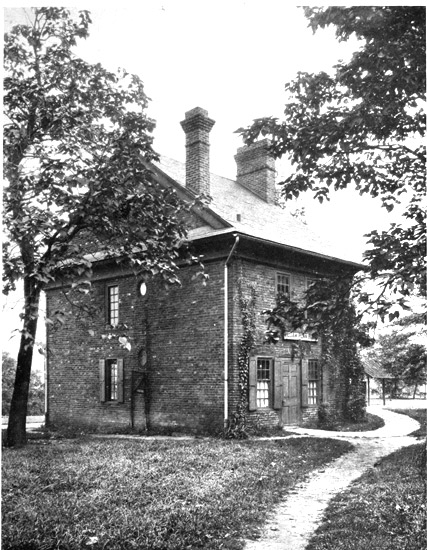
Photo by Ph. B. Wallace LETITIA PENN HOUSE, PHILADELPHIA
XXXI
THE LETITIA PENN HOUSE, PHILADELPHIA
WILLIAM PENN'S FIRST AMERICAN HOME
When William Penn, English Quaker, met Guli Springett, he fell in love with her at once. In 1672 they were married.
Ten years later when, as Proprietor of Pennsylvania, Penn was about to sail in the Welcome for America, he wrote a letter of which the following is a portion:
"My dear wife and children, my love, which neither sea, nor land, nor death itself, can extinguish or lessen toward you, most tenderly visits you with eternal embraces and will abide with you for ever.... My dear wife, remember thou wast the love of my youth and the joy of my life, the most beloved as well as the most worthy of all my earthly comfort, and the reason of that love were more thy inward than thy outward excellencies, which were yet many. God knows, and thou knowest it, that it was a match of Providence's making, and God's image in us both was the first thing and the most amiable and engaging ornament in our eyes. Now I am to leave thee, and that without knowing whether I shall ever see thee more in this world."
Penn landed at New Castle, Delaware, in October, 1682. He had already sent forward the plot of his new country village; his cousin, Lieutenant Governor Markham, had come to America in 1681, bringing with him instructions for the beginning of the settlement. On this plot there was evidence of his thought for his wife and his daughter Letitia; two lots were set apart for the family, on one of which he planned to build, while the other he designed for Letitia.
When he reached America, he found that, by some mistake, Letitia's lot had been given to the Friends for a meeting house. He was vexed, but nothing could be done. So he decided that the lot reserved for his own use should be made over to her. He did not carry out his purpose for some time, however.
For a time Penn remained at Upland (now Chester), but in 1684, he went to Philadelphia to oversee the erection of the houses for the settlers. His own house he built on a large plot facing the Delaware River and south of what is now Market Street. The house was of brick, which was probably made nearby, though many of the interior fittings had been brought from England in the John and Sarah in 1681. It was the first brick house in the new settlement, the first house which had a cellar, and was built in accordance with the request the Proprietor had made:
"Let every house be placed, if the person pleases, in the middle of the plat, as to breadth way of it, that so there may be ground on each side for garden or orchard, or fields, that it may be a green country town, which will never be burnt and always wholesome."
For a few months the Quaker kept bachelor's hall in his new house. Then he went to England, intending to return before long. Before his departure he arranged that the house should be used in the public service. Probably it was the gathering place for the Provincial Council for many years. Thus it was the first state house of Pennsylvania.
During the fourteen years' stay in England many misfortunes came to Penn. He was accused of treason, and his title to the American lands was taken away from him. Later he was acquitted, and his lands were returned.
In 1692 Guli Penn died, and in 1696 Penn married Hannah Callowhill. In 1699, when he returned to America, he brought with him his wife and Letitia, who was then about twenty-five years old.
Evidently the old house was not good enough for the ladies of the family. At any rate they occupied for a time the "slate-roof house," one of the most pretentious buildings in the Colony. When the manor, Pennsbury, twenty miles up the Delaware, was completed, the family was taken there. Great style was maintained at the country estate in the woods. The house had cost £5,000, and was "the most imposing house between the Hudson and Potomac rivers."
The Philadelphia house was transferred to Letitia on "the 29th of the 1st month 1701." At once extravagant Letitia tried to dispose of it. She succeeded in selling a portion of the generous lot, but it was some years before she was able to sell the whole.
In the meantime the Proprietor felt that he must return to England because of the threat of Parliament to change the government of the American Colonies. Mrs. Penn and Letitia, who did not like America, pleaded to go with him. He thought he would be returning soon, and he urged them to remain. They insisted. In a letter to James Logan he wrote: "I cannot prevail on my wife to stay, and still less with Tish. I know not what to do." Later he wrote: "The going of my wife and Tish will add greatly to the expense.... But they will not be denied."
In 1702 Letitia married William Aubrey, who had all of Penn's keenness and none of his genial qualities. Almost from the day of the marriage both husband and wife pestered Penn for money. Aubrey insisted on a prompt payment of his wife's marriage portion. His father-in-law was already beginning to feel the grip of financial embarrassment that later brought him to the verge of bankruptcy, but, on this occasion as well as later, he felt compelled to yield to the insistent demands of the grasping Aubrey.
The only members of the Penn family who ever returned to America were the children of the second wife, to whom most of the property descended.
The Letitia Penn House, as it came to be known, fell on evil days. It was an eating house in 1800, and in 1824 it was the Rising Sun Inn. Later it was called the Woolpack Hotel.
In 1882 funds were raised by public subscription, and the venerable house was taken down and rebuilt in Fairmount Park. Visitors who enter the city by the Pennsylvania Railroad from New York City may easily see it from a right-hand car window, for it is the only house in the corner of the park on the west side of the river.
XXXII
CARPENTERS' HALL, PHILADELPHIA
CALLED BY BENSON J. LOSSING "THE TEMPLE OF FREEDOM"
Philadelphia was but forty-two years old when a number of builders in the growing town decided to have a guild like the journeymen's guilds of London. Accordingly they formed, in 1724, "The Carpenters' Company of the City and County of Philadelphia," whose object should be "to obtain instruction in the science of architecture; to assist such of the members, or the widows and children of members, as should be by accident in need of support," as well as "the adoption of such a system of measurements and prices that every one concerned in a building may have the value of his money, and every workman the worth of his labor."
At first the meetings were held here and there, probably in taverns. In 1768 the Company decided to build a home. A lot was secured on Chestnut Street, between Third and Fourth streets, for which an annual ground rent of "176 Spanish milled pieces of eight" was to be paid. The sum of three hundred pounds necessary to begin operations was subscribed in about a week.
The Company's annual meeting of January 21, 1771, was held within the walls, though the building was not entirely completed until 1792.
Three years after the opening of the hall came the first event that linked the building with the history of America. A general meeting of the people of Philadelphia was held here to protest against the failure of Governor Penn to convene the Assembly of the Colony. A committee of three was appointed to wait on the Speaker and ask him for "a positive answer as to whether he would call the Assembly together or not."
The Assembly was then called to meet on the "18th day of the 6th month." Three days before the time fixed, another meeting was held in Carpenters' Hall to consider what measures for the welfare of the Colony should be proposed to the Assembly. At this meeting the necessity of holding "a general Congress of delegates from all the Colonies" was voiced. Later the Assembly approved of the idea of such a conference, and a call was issued.
On September 5, 1774, the delegates from eleven provinces met in the City Tavern. Learning that the Carpenters' Company had offered the hall for the use of the Continental Congress, the delegates voted to inspect the accommodations. John Adams, one of their number, said after the visit: "They took a view of the room and of the chamber, where there is an excellent library. There is also a long entry, where gentlemen may walk, and also a convenient chamber opposite to the library. The general cry was that this was a good room."
When this First Continental Congress met, it was decided that the session of the second day should be opened with prayer. Rev. Jacob Duché of Christ Church and St. Peter's was asked to be present and conduct an opening service. This historic account of the service was written by John Adams:
"Next morning he appeared with his clerk and having on his pontificals, and read several prayers in the established form, and then read the Psalter for the seventh day of September, which was the thirty-fifth Psalm. You must remember that this was the next morning after we had heard of the horrible cannonade of Boston (the account proved to be an error). It seemed as if heaven had ordered that Psalm to be read on that morning. After this, Mr. Duché, unexpectedly to everybody, struck out into extemporary prayer, which filled the bosom of every man present. I must confess, I never heard a better prayer, or one so well pronounced."
In part, this prayer was as follows:
"Be thou present, O God of wisdom! And direct the councils of this honorable assembly, enable them to settle things on the best and surest foundation, that the scene of blood may be speedily closed, that order, harmony, and peace may be effectually restored, and truth and justice, religion and piety, prevail and flourish amongst Thy people."
On October 26 the Congress was dissolved. The second Congress was called to meet on May 10, 1775, at the State House, later known as Independence Hall.
When the British took possession of the city in 1777, a portion of the army was quartered in the building. Officers and men alike borrowed books from the Library Company of Philadelphia, which had quarters here, invariably making deposits and paying for the use of volumes taken in strict accordance with the rules.
In 1778 the United States Commissary of Military Stores began to occupy the lower story and cellar of the building. From 1791 to 1821 various public organizations sought quarters here, including the Bank of the United States, the Bank of Pennsylvania, the United States Land Office, and the United States Custom House. The Carpenters' Company therefore, in 1791, erected a second building on this lot, which they occupied until 1857.
When Benson J. Lossing visited the historic hall, on November 27, 1848, he wrote of his great disappointment because the banner of an auctioneer was on the front of the building. He said:
"I tried hard to perceive the apparition ... to be a classic frieze, with rich historic trigliphs, but it would not do.... What a desecration! Covering the façade of the very Temple of Freedom with the placards of grovelling Mammon! If sensibility is shocked with this outward pollution, it is overwhelmed with indignant shame on entering the hall where that august Assembly of men—the godfathers of our Republic—convened to stand as sponsors at the baptism of infant American liberty—to find it filled with every species of merchandise, and the walls which once echoed the eloquent words of Henry, Lee, and the Adamses, reverberating with the clatter of the auctioneer's voice and hammer. Is there not patriotism strong enough in Philadelphia to enter the temple, and 'cast out all them that buy and sell, and overthrow the tables of the money-changers?'"
At length the Carpenters' Company decided that the time had come to do what the historian pleaded for. In 1857 they returned to the building, and since then they have held their meetings within the walls consecrated by the heroes of Revolutionary days. The rooms were restored to their original condition, and relics and mementoes of early days were put in place. The Hall has ever since been open to visitors "who may wish to visit the spot where Henry, Hancock, and Adams inspired the delegates of the Colonies with nerve and the sinew for the toils of war."
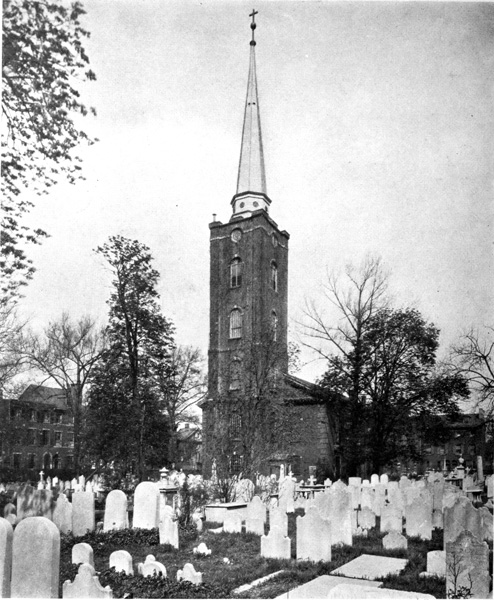
Photo by Ph. B. Wallace ST. PETER'S PROTESTANT EPISCOPAL CHURCH, PHILADELPHIA
XXXIII
ST. PETER'S CHURCH, PHILADELPHIA
WHOSE BUILDING IS PRACTICALLY UNCHANGED AFTER MORE THAN ONE HUNDRED AND FIFTY YEARS
There were but fifteen thousand people in Philadelphia when, on March 19, 1753, the suggestion was made to the vestry of Christ Church that a new church or Chapel of Ease of Christ Church be built for the accommodation of the people in the southern part of the city. Thomas and Richard Penn gave a site for the building of the new church, and on September 21, 1758, the corner stone was laid. In 1761 the church was opened, though it was not completed until March, 1763. To the new organization was given the name St. Peter's, and it was ordered by the vestry of Christ Church, "that the said church ... in every respect whatever shall be upon an equal footing with Christ Church, and be under the same government with it."
At the same time, in view of the gift of the site, it was ordered that "the first and best pew in the said Church shall be set apart forever for the accommodation of the Honorable Proprietary's family."
When the building was completed the building committee reported that the cost was £4,765, 19 s. 6½ d. Added to this report were statements that sound quite modern. "The sudden rise in the prices of materials and labor," and "the inability of some subscribers to meet their engagements," had added to the burdens of the committee.
From the beginning prayers were read in the church for the king and all the royal family, but on July 4, 1776, the vestry ordered that patriotic prayers be substituted. While the British were in Philadelphia the prayers for the king were renewed by order of Dr. Duché, rector of Christ Church and St. Peter's. The official history of St. Peter's refers to Dr. Duché, who ordered this, in the following sentences:
"From an advocate of the Colonies, he became an advocate of the King, and on the Sunday following the occupation of Philadelphia by the British, he restored the prayers for the King to the Liturgy. This compromise with conditions availed him nothing, and he was arrested for serving as chaplain to Congress after the adoption of the Declaration of Independence. The influence of his loyalist friends secured his speedy release.... Not long afterward he went to England, where he remained practically an exile for twelve years, returning to Philadelphia several years before his death, when, it is said, no truer American could have been found in the City. He ... was buried in St. Peter's Churchyard."
During the occupation of the church by British troops in 1777 the pews were burned for fuel, but the building was never closed for lack of fuel or for any other reason, until the late winter of 1917-18, when coal could not be secured.
The wooden fence that surrounded the property originally was burned by the British for fuel, and the brick wall that is now in place was built in 1784.
Washington frequently occupied a pew in St. Peter's, and many other men who were prominent in the early history of the country worshipped here. The building is practically as it was when they lived. "It is the same church to which the colonists in their knee-breeches and rich coats came to attend the first service in 1761," a member of the vestry said in 1891. "The pulpit, reading desk, and chancel rails were built in 1764, and the present organ loft was put up over the chancel in 1789. In all other respects the plain, austere interior of this old church ... remains unchanged, the only relic in Pennsylvania, and one of the very few in the country at large, of the church in colonial days. Bishop De Lancey, in his centennial sermon, preached September 4, 1861, said: 'We enter by the same doors—we tread the same aisles—we kneel where they knelt—we sit where they sat; the voice of prayer, instruction, and praise ascends from the same desk from which it reached their ears, in the privacy and seclusion of the same high, strait unostentatious pews.'"
In the crowded churchyard are the graves of many colonial worthies as well as many leaders in the early history of America. Stephen Decatur is buried here, and Charles Wilson Peale, who painted a famous portrait of Washington.
The Pennsylvania Evening Post of January 18, 1777, told of the burial of one of the patriots whose bodies were laid here:
"Yesterday the remains of Captain William Shippen, who was killed at Princeton the third instant, gloriously fighting for the liberty of his country, were interred in St. Peter's Churchyard. His funeral was attended by the Council of Safety, the members of Assembly, officers of the army, a troop of Virginia light horse, and a great number of inhabitants. This brave and unfortunate man was in his twenty-seventh year, and has left a widow and three children to lament the death of an affectionate husband and a tender parent, his servants a kind master, and his neighbors a sincere and obliging friend."
Captain Shippen, before joining Washington's army, was captain of the privateer Hancock, which, between July 1 and November 1, 1776, sent to American ports ten prizes captured at sea.
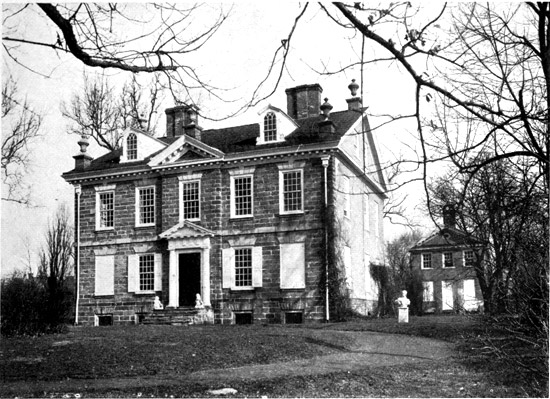
Photo by Ph. B. Wallace CLIVEDEN, PHILADELPHIA
XXXIV
CLIVEDEN, GERMANTOWN, PHILADELPHIA
ON THE FIELD OF THE BATTLE OF GERMANTOWN
In the days before the Revolution there were many residents of Philadelphia who had, in addition to a sumptuous town house, a country house, to which they could resort in the summer or at other times when they wished relief from the cares of daily life. Germantown, the straggling village five miles from the town of William Penn, was one of the popular places for such establishments.
Samuel Chew's town house was at Front and Dock streets when he built Cliveden at Germantown in 1761. At that time he was Attorney-General of Pennsylvania, though in 1774 he became Chief-Justice of the Supreme Court of Pennsylvania.
Both in Philadelphia and in Germantown he maintained the hospitable traditions he had learned at Maidstone, near Annapolis, where he was born, in 1722, of a family whose first American ancestor, John Chew, came to Virginia a century earlier.
During the days of the Continental Congress Judge Chew seemed to sympathize with the colonists in their protests against the aggression of Great Britain, but when independence was proposed, he let it be known that he was unwilling to act with the patriots. Accordingly he was arrested by order of Congress, together with John Penn, and when he refused to sign a parole, he was banished from the State.
During his absence the battle of Germantown was fought. On October 3, 1777, the British forces were disposed on nearly all sides of the Chew mansion. Washington planned to attack these scattered forces by four columns, which were to advance from as many directions. General Wayne's column successfully opened the attack at daybreak October 4, driving before him the enemy encountered at Mount Airy. Colonel Musgrave checked the retreat of the soldiers at Cliveden. With six companies he took possession of the mansion, prepared to defend themselves behind hastily barricaded doors and windows. Wayne and the leaders who were with him pushed on past the house, continuing the pursuit of that portion of the enemy which had continued its retreat; he did not know that he was leaving an enemy in his rear. When Washington came to Cliveden, he was surprised by the fire of the entrenched enemy. After a hasty conference with others, it was decided not to pass on, leaving a fortress behind. Cannon were planted so as to command the door, but they were fired without much effect.
The next attempt was made by a young Frenchman who asked others to carry hay from the barn and set fire to the front door. Thinking they were doing as he asked, he forced open a window and climbed on the sill. From this position he was driven back, and he found that he had not been supported by those on whom he had counted.
In the meantime the artillery fire continued, but with little effect. General Wilkinson, who was present, afterward wrote:
"The doors and shutters of the lower windows of the mansion were shut and fastened, the fire of the enemy being delivered from the iron gratings of the cellars and the windows above, and it was closely beset on all sides with small-arms and artillery, as is manifest from the multiplicity of traces still visible from musket-ball and grape-shot on the interior walls and ceilings which appear to have entered through the doors and windows in every direction; marks of cannon-ball are also visible, in several places on the exterior of the wall and through the roof, though one ball only appears to have penetrated below the roof, and that by a window in the passage of the second story. The artillery seem to have made no impression on the walls of the house, a few slight indentures only being observable, except from one stroke in the rear, which started the wall."
In a few minutes Washington, realizing that precious time was being lost in the attack on the thick walls of the house, ordered a regiment to remain behind to watch Cliveden, while his main force hastened on.
It has been claimed that this brief delay was responsible for the defeat at Germantown. Wilkinson, on the contrary, insists that this delay saved Washington's army from annihilation, since he would otherwise have hurried on in the thick fog until he was in contact with the main body of the British army. The result, he thinks, would have been a far greater disaster than actually overtook the American arms that day.
The damage done to the house was so great that five carpenters were busy for months making repairs. Evidently Judge Chew was not satisfied with the result, for in 1779 he sold Cliveden for $9,000, only to buy it back again in 1787 for $25,000.
The property descended to Benjamin Chew, Jr., on the death of his father. During his occupancy of Cliveden, Lafayette was a guest there in 1825.
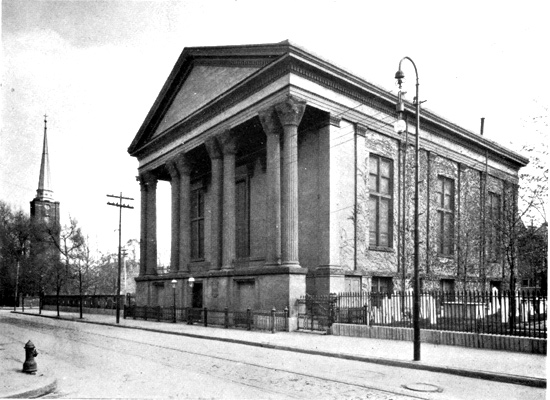
Photo by Ph. B. Wallace THIRD (OLD PINE STREET) PRESBYTERIAN CHURCH, PHILADELPHIA
XXXV
OLD PINE STREET CHURCH, PHILADELPHIA
WHOSE PASTOR INSPIRED JOHN ADAMS TO PLEAD FOR INDEPENDENCE
There were four thousand, seven hundred and seventy-four houses in Philadelphia in 1767 when the Pine Street Presbyterian Church, the third church of this denomination in the city, was built. The subscription paper, still in existence, shows that £1,078 "in money or otherwise" was subscribed for the purpose. The sum needed to complete the building was raised by a lottery, which yielded £2,500. In the proceeds of the lottery the Market Street Church and the Second Church shared, £1,035 going to the Pine Street building.
The original building was of but one story, with gable ends. When alterations were made in 1837 the top of the church was raised bodily, while a larger roof was built over the old roof. The visitor who climbs to the loft is able to see the old walls and windows. The floor was raised one step above the street level, and was paved with brick.
Rev. George Duffield, D.D., who was pastor from 1772 to 1790, was a prominent figure during the Revolution. He was chaplain of the Continental Congress and of the Pennsylvania militia during the period of the war, and he delivered fiery messages that stirred patriots to action. John Adams, who was a member of the church, called him a man of genius and eloquence. On May 17, 1776, after listening to a sermon in which Dr. Duffield likened the conduct of George III to the Americans to that of Pharaoh to the Israelites, and concluded that God intended the liberation of the Americans, as He had intended that of the Israelites, he wrote to his wife:
"Is it not a saying of Moses, Who am I that I should go in and out before this great people? When I consider the great events which are passed, and those greater which are rapidly advancing, and that I may have been instrumental in touching some springs, and turning some small wheels, which have had and will have such effects, I feel an awe upon my mind, which is not easily described. Great Britain has at last driven America to the last step, complete separation from her; a total, absolute independence...."
Headley, in "Chaplains and Clergy of the Revolution," says:
"The patriots of the first Congress flocked to his church, and John Adams and his compeers were often his hearers.... In a discourse delivered before several companies of the Pennsylvania militia and members of Congress, four months before the Declaration of Independence, he took bold and decided ground in favor of that step, and pleaded his cause with sublime eloquence, which afterwards made him so obnoxious to the British that they placed a reward of fifty pounds for his capture."
Later on in the same sermon he prophesied:
"Whilst sun and moon endure, America shall remain a city of refuge for the whole earth, until she herself shall play the tyrant, forget her destiny, disgrace her freedom, and provoke her God."
As chaplain of the Pennsylvania militia, Dr. Duffield was frequently in camp, where "his visits were always welcome, for the soldiers loved the eloquent, earnest, fearless patriot."
Headley gives this incident of the courageous chaplain's work:
"When the enemy occupied Staten Island, and the American forces were across the river on the Jersey shore, he repaired to camp to spend the Sabbath. Assembling a portion of the troops in an orchard, he climbed into the forks of a tree and commenced religious exercises. He gave out a hymn.... The British on the island heard the sound of the singing, and immediately directed some cannon to play on the orchard, from whence it proceeded. Soon the heavy shot came crashing through the branches, and went singing overhead, arresting for a moment the voices that were lifted in worship. Mr. Duffield ... proposed that they should adjourn behind an adjacent hillock. They did so, and continued their worship, while the iron storm hurled harmlessly overhead."
In spite of his almost constant service in the field, Dr. Duffield was in Philadelphia among his people every little while. The church records show that he baptized children every month during the Revolution, except for the period of the British occupation of Philadelphia, when the church was occupied as a hospital, and more than one hundred Hessian soldiers were buried in the churchyard.
Another remarkable fact is that of the one hundred and ten men who had signed the call to George Duffield in 1771, sixty-seven served in the army during the war. Colonel Thomas Robinson, whose portrait is in Independence Hall, was a member of the church; Captain John Steele, who was field officer on the day of the surrender of Cornwallis, and Colonel William Linnard, whose company attempted to keep the British from crossing the Brandywine, were also members. Many other officers and private soldiers were on the rolls; the stones and vaults in the cemetery tell of many of them.
One of the original trustees of Pine Street was Dr. William Shippen, Jr., first Professor of Medicine in America and Director General of all the hospitals during the war. Benjamin Rush, Signer of the Declaration, was an attendant at the services, and his mother was a member.
XXXVI
INDEPENDENCE HALL, PHILADELPHIA
WHERE AMERICAN INDEPENDENCE WAS BORN
William Penn was a man of vision. When, in 1682, Thomas Holme surveyed for him the site of Philadelphia, the Quaker pioneer gave instruction that "the Centre Square," one mile from the Delaware, be set apart for the public buildings of the city and colony.
But for many years after the founding of the city, Centre Square was far out in the country. During these years temporary public buildings were provided for official meetings, including the Assembly, but in 1728 steps were taken to erect a suitable public building within reach of the people of the young city. Ground was bought on Chestnut Street, between Fifth and Sixth streets, and the State House was begun in 1730. The total cost of the building was $16,250. Two wings were added in 1739 and 1740; these cost some $12,000 more.
Two years after the completion of the main building the Pennsylvania Assembly passed an act in which this statement was made:
"It is the true intent and meaning of these Presents, that no part of the said ground lying to the southward of the State House, as it is now built, be converted into or made use of for erecting any sort of Building thereupon, but that the said ground shall be enclosed and remain a public open Green and Walks forever."
Eighty years after the passage of the act an attempt was made to divert the State House yard to other purposes. In a curious old document, dated February 6, 1816, W. Rawle and Peter S. Duponceau made an argument against this diversion, showing conclusively that the State House Square had been "irrevocably devoted to the purpose of an open and public walk." Thanks to their efforts and the efforts of others who have labored to the same end, the grounds are to-day, and must forever remain, open to the use of the people.
The first public function held in the new State House was a banquet, given in the "long room," in the second story. Of this Franklin's Pennsylvania Gazette of September 30, 1736, said:
"Thursday last William Allen, Esq., Mayor of this city for the past year, made a feast for his citizens at the State House, to which all the strangers in town of note were also invited. Those who are judges of such things say that considering the delicacy of the viands, the variety and excellency of the wines, the great number of guests, and yet the easiness and order with which the whole was conducted, it was the most grand, the most elegant entertainment that has been made in these parts of America."
The builders were dilatory. It was 1736 before the Assembly was able to hold its first session in the chamber provided for it, and not until 1745 was the room completed. Three years more passed before the apartment intended for the Governor's Council was ready for its occupants.
In 1741 the tower was built, and on November 4 Edmund Wooley sent to the Province of Pennsylvania an interesting bill, "for expenses in raising the Tower of the State House":
95 loaves of Bread £0 19 9
61¾ lb. Bacon, at 7d 1 14 1
148½ lb. Beef at 3½d 2 8 1
Potatoes and Greens 0 7 1
800 Limes at 4s 1 12 0
1½ Barrels of Beer at 18s 1 7 0
44 lb. Mutton at 3½d 0 12 8
37¾ lb. Veal at 3½d 0 11 0
30 lb. Venison at 2d 0 5 0
Turnips 0 1 6
Pepper and Mustard 0 1 5
2 Jugs and Candles, Pipes and Tobacco 0 6 0
Butter 9s. 8d. Turkey 4s. 4 pair Fowls 9s 1 2 8
¼ of a hundred of Flour 0 3 6
Two former Hookings at getting on two Floors, and now for raising the Tower, Fire Wood, etc. 3 0 0
Provision was made in 1750 for the extension of the tower for the accommodation of a bell, and on October 16, 1751, the Superintendent of the State House sent a letter to the colonial agent in London. In this letter he said:
"We take the liberty to apply ourselves to thee to get us a good bell, of about two thousand pounds weight, the cost of which we presume may amount to about one hundred pounds sterling, or, perhaps, with the charges, something more.... Let the bell be cast by the best workmen, and examined carefully before it is shipped, with the following words well-shaped in large letters round it, viz:—
"'By order of the Assembly of the Province of Pennsylvania, for the State House in the city of Philadelphia, 1752,'
"And underneath,
"'Proclaim Liberty throughout all the land to all the inhabitants thereof—Levit. XXV. 10.'"
When the new bell was hung it was cracked by a stroke of the clapper. Isaac Norris wrote:
"We concluded to send it back by Captain Budden, but he could not take it on board, upon which two ingenious workmen undertook to cast it here, and I am just now informed they have this day opened the Mould and have got a good bell, which, I confess, pleases me very much, that we should first venture upon and succeed in the greatest bell cast, for aught I know, in English America. The mould was finished in a very masterly manner, and the letters, I am told, are better than [on] the old one. When we broke up the metal, our judges here generally agreed it was too high and brittle, and cast several little bells out of it to try the sound and strength, and fixed upon a mixture of an ounce and a half of copper to one pound of the old bell, and in this proportion we now have it."
But when the bell was in place it was found to contain too much copper, and Pass & Stow, the founders, "were so teazed with the witticisms of the town," that they begged to be allowed to recast it. In June, 1753, this third bell was hung, and in the following September the founders were paid £60 13s. 5d.
In 1752 arrangements were made for a clock. The works were placed in the middle of the main building, immediately under the roof. These were connected by rods, enclosed in pipes, with the hands on the dial plates at either gable. Early views of the State House show these dials. The cost of the clock, which included care for six years, was £494 5s. 5½d.
During the twenty years that followed the installation of the clock and the bell the State House became a civic centre of note; but not until the stirring events that led up to the Revolution did it become of special interest to other colonies than Pennsylvania. On April 25, 1775, the day after news came to Philadelphia of the battles of Lexington and Concord, the great bell sounded a call to arms that was the real beginning of making the building a national shrine. In response to the call eight thousand people gathered in the Yard to consider measures of defence. On April 26 the newspapers reported that "the company unanimously agreed to associate for the purpose of defending with arms their lives, liberty, and property, against all attempts to deprive them of them." This determination of the people was soon sanctioned by the Assembly, and Pennsylvania prepared to raise its quota towards the Army of the Revolution.
On May 10, 1775, the Second Continental Congress met in the Assembly Chamber, and took action that made inevitable the adoption of the Declaration of Independence the next year. On Friday, June 7, 1776, in the Eastern Room on the first floor of the State House, Richard Henry Lee of Virginia introduced the following:
"Resolved, That these United Colonies are, and of right ought to be, free and independent States, that they are absolved from all allegiance to the British Crown and that all political connection between them and the State of Great Britain is, and ought to be, totally dissolved."
At the same time the Pennsylvania Assembly was considering, in the chamber upstairs, what instruction to give to its delegates. When the Assembly adjourned the Continental Congress removed to the upper room. There, on July 2, the Virginian's motion was carried. Later the Declaration itself was adopted, and on July 4, it was
"Resolved, that Copies of the Declaration be sent to the several assemblies, conventions, and committees or councils of safety, and to the several commanding officers of the Continental troops; that it be proclaimed in each of the United States and at the head of the army."
It was ordered that the Declaration be proclaimed from the State House on Monday, July 8, 1776. On that day the State House bell sounded its glad call; for the first time did it indeed "proclaim liberty throughout all the land unto all the inhabitants thereof." And in the hearing of those who gathered in response to its call the Declaration was read.
From that day the State House has been known as Independence Hall, while the State House Yard has become Independence Square.
The sittings of Congress in Independence Hall were interrupted by the approach of the British. For five months the building was used as a British prison and hospital. But on July 2, 1778, Congress returned; the building once more belonged to the nation.
The building became more than ever a national shrine when, in 1787, the Constitutional Convention met there. On September 17, 1787, the votes of eleven States were recorded in favor of the Constitution, and Benjamin Franklin, looking toward a sun which was blazoned on the President's chair, said of it to those near him, "In the vicissitudes of hope and fear I was not able to tell whether it was rising or setting; now I know that it is the rising sun."
In 1790, the Congress of the United States met in the western portion of the buildings on the Square, erected in 1785 for the Pennsylvania Assembly.[1] This building was, by that body, offered to Congress and accepted for the term of ten years, until the Capital should be removed to the shore of the Potomac.
During these ten years, and for thirty-five years more, the Liberty Bell continued to sound notes of joy and of sorrow. On July 8, 1835, it was tolling for Chief Justice Marshall. When the funeral procession was on Chestnut Street, not far from Independence Hall, the bell cracked. Since that day it has been mute.
The passing years have brought many changes to Independence Hall, as well as to the Liberty Bell. The bell cannot be renewed, but the historic building and the Square have been restored until they present essentially the appearance of the days of 1776. The chief difference is in the steeple. The present steeple was built in 1828. It is much like the old steeple, but a story higher.
As the visitor passes from room to room of the venerable building, and examines the relics and studies the portraits of the great men who gathered there so long ago, his heart is stirred to thankfulness to those who dared to call a nation into being, and he cannot but think that it is good to live for one's country.
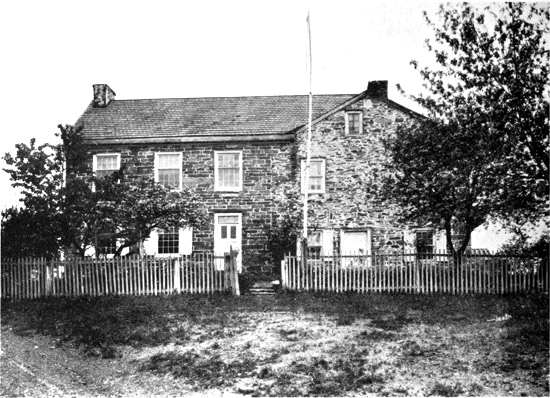
Photo by Ph. B. Wallace DAVID RITTENHOUSE'S HOUSE, NORRITON, PENNA.
XXXVII
THE DAVID RITTENHOUSE HOME, NEAR PHILADELPHIA
THE HEADQUARTERS OF BENJAMIN FRANKLIN'S FRIEND AND CO-LABORER
"See the sage Rittenhouse with ardent eye Lift the long tube and pierce the starry sky! He marks what laws the eccentric wanderers bind, Copies creation in his forming mind, And bids beneath his hand in semblance rise With mimic orbs the labors of the skies."
This was Barlow's way of telling of the achievement of David Rittenhouse, the colonial astronomer, in fashioning the marvellous orrery, the mechanical representation of the movements of the planetary system. Thomas Jefferson's prose description was a little more readable:
"A machine far surpassing in ingenuity of contrivance, accuracy and utility anything of the kind ever before constructed.... He has not indeed made a world, but he has by imitation approached more its Maker than any man who has lived from the creation to this day."
The father of the maker of the orrery was a paper manufacturer near Germantown, but when David was three years old he moved to a little farm in Norriton, nineteen miles from Philadelphia, where, in 1749, he built the stone house in which his son spent the rest of his life.
It was his purpose to make a farmer of David, and he might have succeeded if he had not invested in a few mathematical books. The twelve-year-old boy was fascinated by these volumes. Samuel W. Pennypacker has told the result:
"The handles of his plough, and even the fences around the fields, he covered with mathematical calculations.... At seventeen he made a wooden clock, and afterward one in metal. Having thus tested his ability in an art in which he had never received any instruction, he secured from his somewhat reluctant father money enough to buy in Philadelphia the necessary tools, and after holding a shop by the roadside, set up in business as a clock and mathematical instrument maker."
Dr. Benjamin Rush once said that "without library, friends, or society, and with but two or three books, he became, before he had reached his four-and-twentieth year, the rival of two of the greatest mathematicians of Europe."
The skilled astronomer was soon called upon to render a service to several of the Colonies. By means of astronomical instruments he did such accurate work in marking out the boundary between Delaware and Pennsylvania that Mason and Dixon later accepted his results, and he settled the dispute between New Jersey and New York as to the point where the forty-first degree of latitude touches the Hudson River. Perhaps, however, the achievement that won for him greatest fame was the observation, made in 1769, of the transit of Venus. The importance of the observation is evident from the facts that it provides the best means for calculating the distance between the heavenly bodies, which had never been satisfactorily made, and that the opportunity would not occur again for one hundred and five years. After months of preparation, which included the making of delicate instruments, Rittenhouse, one of a committee of three appointed by the American Philosophical Society, succeeded. In the words of Pennypacker, "The first approximately accurate results in the measurement of the spheres were given to the world, not by the schooled and salaried astronomers who watched from the magnificent royal observatories of Europe, but by unpaid amateurs and devotees to science in the youthful province of Pennsylvania."
Benjamin Franklin found in him a kindred spirit, and the Philadelphian was frequently a visitor at the Norriton farmhouse. On Sunday the two friends often went to the old Norriton Presbyterian Church, which had been built on the corner of the Rittenhouse farm, within sight of the house. This church, which probably dates from 1698, is still standing in good repair.
Some years after the successful observation of the transit of Venus brought fame to the American astronomer, he moved to Philadelphia. There, among other duties, he had charge of the State House clock.
At the beginning of the Revolution the Council of Safety asked that he should "prepare moulds for the casting of clock weights, and send them to some iron furnace, and order a sufficient number to be immediately made for the purpose of exchanging them with the inhabitants of this city for their leaden clock weights." The leaden weights were needed for bullets. Later he was sent to survey the shores of the Delaware, to choose the best points for fortifications.
When he became Engineer of the Council of Safety "he was called upon to arrange for casting cannon of iron and brass, to view the site for the erection of a Continental powder mill, to conduct experiments for rifling cannon and muskets, to fix upon a method of fastening a chain for the protection of the river, to superintend the manufacture of saltpeter, and to locate a magazine for military stores on the Wissahickon."
This was but the beginning of service to Pennsylvania during the Revolution. His activities were so valuable to the Colonies that a Tory poet published in the Pennsylvania Evening Post of December 2, 1777, a verse addressed "To David Rittenhouse," of which the first stanza read:
"Meddle not with state affairs, Keep acquaintance with the stars; Science, David, is thy line; Warp not Nature's great design. If thou to fame would'st rise."
The following year Thomas Jefferson wrote to him:
"You should consider that the world has but one Rittenhouse, and never had one before.... Are those powers, then, which, being intended for the erudition of the world, are, like light and air, the world's common property, to be taken from their proper pursuit to do the commonplace drudgery of governing a single State?"
To the call of the nation Rittenhouse responded in April, 1792, when President Washington appointed him the first Director of the Mint.
His closing years were full of honors, but his strength was declining rapidly; he had spent himself so fully for his country that his power of resistance was small. Just before he died, on June 26, 1796, he said to a friend who had been writing to him, "You make the way to God easier."
XXXVIII
THE HEADQUARTERS AT VALLEY FORGE, PENNSYLVANIA
WHERE WASHINGTON LIVED DURING THE WINTER OF 1777-78
A few rods from the beautiful Schuylkill River, at Valley Forge, Pennsylvania, twenty-four miles from Philadelphia, is the quaint stone house where Washington spent nearly six months of the most trying year of the Revolution.
While the British troops were occupying Philadelphia Congress was in session at York, Pennsylvania. Valley Forge was accordingly a strategic location, for from here it was comparatively simple to guard the roads leading out of Philadelphia, and to prevent both the exit of the British and the entrance of supplies designed for the enemy.
The eleven thousand men who marched to the site selected for the camp were miserably equipped for a winter in the open. Provisions were scarce, and clothing and shoes were even more scarce. But the men looked forward bravely to the months of exposure before them.
Washington did everything possible to provide for their comfort. Realizing that the soldiers needed something more than the tents in which they were living at first, he gave orders that huts should be built for them. The commanding officers of the regiments were instructed to divide their soldiers into parties of twelve, to see that each party had the necessary tools, and to superintend the building of a hut for each group of twelve soldiers, according to carefully stated dimensions. A reward was offered to the party in each regiment which should complete its hut in the quickest and best manner. Since valuable time would be lost in preparing boards for the roofs, he promised a second sword to the officer or soldier who should devise a material for this purpose cheaper and more quickly made than boards.
Some of the first huts were covered with leaves, but it was necessary to provide a more lasting covering. After a few weeks fairly acceptable quarters were provided for the men, in spite of the scarcity of tools. Colonel Pickering, on January 5, wrote to Mrs. Pickering, "The huts are very warm and comfortable, being very good log huts, pointed with clay, and the roof made tight with the same."
At first, Washington sought to encourage his soldiers by assuring them that he would accept no better quarters than could be given them; he would set the example by passing the winter in a hut. But officers and men alike urged that it would be unwise to risk his health in this way, and he consented to seek quarters in a near-by house. However, he refused to make himself comfortable until the men were provided for.
His headquarters were finally fixed in the two-story stone house of Isaac Potts. There he met his officers, received visitors, planned for the welfare of the army, and parried the attacks of those who could not understand the difficulties of the situation. Once he wrote to Congress: "Three days successively we have been destitute of bread. Two days we have been entirely without meat. The men must be supplied, or they cannot be commanded."
To the objections of those who thought that the army should not be inactive during the winter weather, he wrote:
"I can assure these gentlemen, that it is a much easier and less distressing thing to draw remonstrances in a comfortable room by a good fireside, than to occupy a cold, bleak hill, and sleep under frost and snow, without clothes or blankets. However, although they seem to have little pity for the naked and distressed soldiers, I feel superabundantly for them, and, from my soul, I pity those miseries which it is neither in my power to relieve or prevent."
The heavy hearts of Washington and his officers rejoiced when, on February 23, 1778, Baron Steuben and Peter S. Du Ponceau called at headquarters. Du Ponceau wrote later:
"I cannot describe the impression that the first sight of that great man made upon me. I could not keep my eyes from that imposing countenance—grave, yet not severe; affable, without familiarity.... I have never seen a picture that represents him to me as I saw him at Valley Forge.... I had frequent opportunities of seeing him, as it was my duty to accompany the Baron when he dined with him, which was sometimes twice or thrice in the same week. We visited him also in the evening, when Mrs. Washington was at head-quarters. We were in a manner domesticated in the family."
An order was sent from headquarters, dated March 28, that Baron Steuben be respected and obeyed as Inspector General. The need of his services is revealed by his description of the condition of the army when he arrived in camp:
"The arms at Valley Forge were in a horrible condition, covered with rust, half of them without bayonets, many from which a single shot could not be fired. The pouches were quite as bad as the arms. A great many of the men had tin boxes instead of pouches, others had cow-horns; and muskets, carbines, fowling-pieces, and rifles were to be seen in the same company.... The men were literally naked.... The officers who had coats, had them of every color and make. I saw officers, at a grand parade in Valley Forge, mounting guard in a sort of dressing-gown, made of an old blanket or woolen bed-cover...."
Mrs. Washington joined the circle at headquarters on February 10. She was not favorably impressed. "The General's apartment is very small," she wrote. "He has had a log cabin built to dine in, which has made our quarters much more tolerable than they were at first."
The most joyful day at Valley Forge was May 7, 1778, when a fête was held to celebrate the conclusion of the treaty of alliance between France and the United States. After religious service, the army was reviewed, and Washington dined in public with his officers. "When the General took his leave, there was a universal clap, with loud huzzas, which continued till he had proceeded a quarter of a mile."
On June 18 the glad tidings came to headquarters that the British were evacuating Philadelphia. Next day the camp was left behind. Washington did not see it again for nine years.
In 1879 the Isaac Potts house was bought by the Continental Memorial Association of Valley Forge. And in 1893 the Pennsylvania Legislature created the Valley Forge Park Commission, which has since acquired the entire encampment, has laid it out as a park, and has arranged for the erection of many monuments and markers and a number of memorial structures. But the house in which Washington lived must always be the central feature of the grounds.
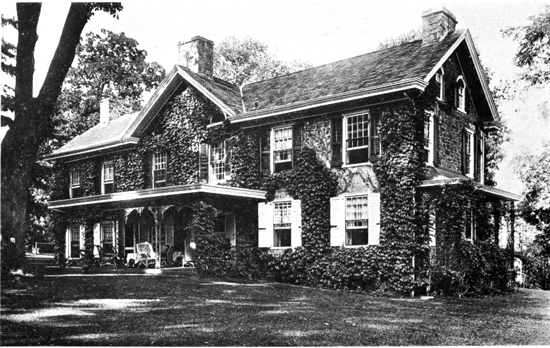
Photo by H. C. Howland, Philadelphia DAWESFIELD, NEAR PHILADELPHIA, PENNA.
XXXIX
THREE HEADQUARTERS OF WASHINGTON
PENNYPACKER'S MILLS, DAWESFIELD, AND EMLEN HOUSE, NEAR PHILADELPHIA
During the closing months of 1777, one of the darkest times of the Revolution, Washington made famous by his occupancy three houses, all located within a few miles of Philadelphia. The first of these, Pennypacker's Mills, is the only building used by the Commander-in-Chief during the war that is still in the hands of the family that owned it when he was there.
Pennypacker's Mills is delightfully situated in the angle formed by the union of the two forks of the Perkiomen, the largest tributary of the Schuylkill. Hans Joest Heijt, who built the grist mill and house on the land in 1720, sold the property in 1730 to John Pauling. He was succeeded in 1757 by Peter Pannebecker. His son Samuel was the owner of the house by the creek when, on September 26, 1777, Washington reached the Mills.
The orderly book of the following days and letters written from the house shed light on the events of the stay here.
On the day he reached the Mills, Washington wrote to William Henry at Lancaster:
"You are hereby authorized to impress all the Blankets, Shoes, Stockings, and other Articles of Clothing that can be spared by the Inhabitants of the County of Lancaster, for the Use of the Continental Army, paying for the same at reasonable Rates or giving Certificates."
The entry in the orderly book on September 28 read:
"The Commander-in-Chief has the happiness again to congratulate the army on the success of the Americans to the Northward. On the 19th inst. an engagement took place between General Burgoyne's army and the left wing of ours, under General Gates. The battle began at 10 o'clock, and lasted till night—our troops fighting with the greatest bravery, not giving an inch of ground.... To celebrate this success the General orders that at 4 o'clock this afternoon all the troops be paraded and served with a gill of rum per man, and that at the same time there be discharges of 13 pieces of artillery from the park."
On the same day there was a council of war. It was found that there were in camp, fit for duty, 5,472 men. The whole army in all the camps then contained about eight thousand Continental troops and three thousand militia.
Next day Washington wrote:
"I shall move the Army four or five miles lower down to-day from whence we may reconnoitre and fix upon a proper situation, at such distance from the Enemy, as will entitle us to make an attack, should we see a proper opening, or stand upon the defensive till we obtain further reinforcements...."
Later in the day the army marched to Skippack, within about twenty-five miles of Philadelphia. The next stage in the advance was Methacton Hill, and from there the army began to move, on October 3, at seven o'clock in the evening, to the attack on the British at Germantown.
After the battle of Germantown Washington wrote to the President of Congress:
"In the midst of the most promising appearances, when everything gave the most flattering hopes of victory, the troops began suddenly to retreat, and entirely left the field, in spite of every effort that could be made to rally them."
The Commander's marvellous ability to handle men was shown by the entry made in his orderly book the next day, when he was back at Pennypacker's Mills. Instead of reprimanding the soldiers for their strange retreat, he "returned thanks to the generals and other officers and men concerned in the attack on the enemy's left wing, for their spirit and bravery, shown in drawing the enemy from field to field, and although ... they finally retreated, they nevertheless see that the enemy is not proof against a vigorous attack, and may be put to flight when boldly pursued."
The good results of this message were evident from the letter of a soldier written from the Mills on October 6. He said:
"Our excellent General Washington ... intends soon to try another bout with them. All our men are in good spirits and I think grow fonder of fighting the more they have of it."
To the joy of the soldiers the word was given on October 8 to march toward Philadelphia. In three short stages the army arrived, on October 21, at Whitpain, where Washington took up his headquarters in the house of James Morris, Dawesfield. From here messages were sent that tied his men still closer to him. On October 24 he issued a proclamation of full pardon to deserters who should return before a specified date, and next day he congratulated the troops on the victory at Red Bank.
The chief event of the stay at Dawesfield was the court-martial convened October 30, to try Brigadier-General Wayne, at his own request, on the charge that his negligence was responsible for the defeat at Paoli, September 20. The verdict was that "he did everything that could be expected from an active, brave, and vigilant officer, under the orders he then had."
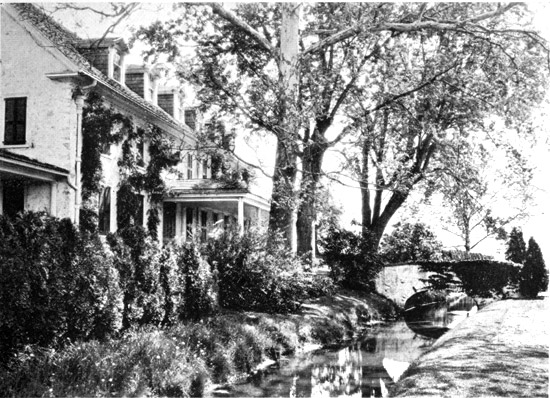
Photo by Ph. B. Wallace EMLEN HOUSE, NEAR PHILADELPHIA, PENNA.
Three days after the trial the army moved to Whitemarsh, near the junction of the Skippack and Bethlehem roads. There Washington lived at Emlen House, of which Lossing says, "At the time of the Revolution it was a sort of baronial hall in size and character, where its wealthy owner dispensed hospitality to all who came under its roof."
The house was modernized in 1854, but it still retains many of the original features. Among these is the moat at the side of the house.
Washington followed the example of the owner of the house by welcoming guests, in spite of the handicaps mentioned in the orderly book on November 7:
"Since ... the middle of September last, he [the General] has been without his baggage, and on that account is unable to receive company in the manner he could wish. He nevertheless desires the Generals, Field Officers and Brigadier-Major of the day, to dine with him in the future, at three o'clock in the afternoon."
It was from Emlen House that Washington gave the first intimation that he knew of the infamous attempts to discredit and displace him which later became known as the "Conway Cabal." To General Conway himself he wrote saying that he had heard of Conway's letter to General Gates in which he had said, "Heaven has been determined to save your country, or a weak General and bad counsellors would have ruined it."
A few glimpses of the awful condition of privation that were to prevail that winter at Valley Forge were given on November 22:
"The Commander-in-Chief offers a reward of ten dollars to any person, who shall, by nine o'clock on Monday morning, produce the best substitute for shoes, made of raw hide."
The movement to Valley Forge was begun on December 1. The army went by way of "Sweeds" Ford (Norristown), where, as the quaint diary of Albigence Waldo says:
"A Bridge of Waggons made across the Schuylkill last night consisted of 36 waggons, with a bridge of Rails between each. Sun Set—We are order'd to march over the River. The Army were 'till Sun Rise crossing the River—some at the Waggon Bridge, & some at the Raft Bridge below. Cold and Uncomfortable."
XL
SWEETBRIER-ON-THE-SCHUYLKILL, PHILADELPHIA
THE HOME OF THE FATHER OF THE FREE SCHOOLS OF PENNSYLVANIA
When Samuel Breck was fifty-eight years and six months old—on January 17, 1830—he wrote:
"My residence has been ... for more than thirty years ... on an estate belonging to me, situated on the right bank of the Schuylkill, in the township of Blockley, county of Philadelphia, and two miles from the western part of the city. The mansion on this estate I built in 1797. It is a fine stone house, rough cast, fifty-three feet long, thirty-eight broad, and three stories high, having out-buildings of every kind suitable for elegance and comfort. The prospect consists of the river, animated by its great trade, carried on in boats of about thirty tons, drawn by horses; of a beautiful sloping lawn, terminating at that river, now nearly four hundred yards wide opposite the portico; of side-screen woods; of gardens, green-house, etc. Sweetbrier is the name of my villa."
Mr. Breck spent his boyhood in Boston, but his parents removed to Philadelphia in 1792 to escape what they felt was an unjust system of taxation. During the first years of their residence in the city of William Penn it had "a large society of elegant and fashionable and stylish people," Mr. Breck said in his diary. "Congress held its sessions in Philadelphia until the year 1800, and gave to the city the style and tone of a capital. All the distinguished emigrants from France took up their abode there."
Among the associates of the Brecks were some of the leaders of the new nation. Samuel Breck was frequently at the Robert Morris house, and later, during the four years' imprisonment of Mr. Morris, he "visited that great man in the Prune Street debtors' apartment, and saw him in his ugly whitewashed vault."
The diarist's comment was bitter: "In Rome or Greece a thousand statesmen would have honored his mighty services. In a monarchy ... he would have been appropriately pensioned; in America, Republican America, not a single voice was raised in Congress or elsewhere in aid of him or his family."
There is not a more striking passage in the diaries than that written on August 27, 1814, during the second war with England:
"I was in town to-day ... at half past twelve o'clock I went with an immense crowd to the post-office to hear the news from the South. The postmaster read it to us from a chamber window. It imported that the navy-yard had been burnt (valued at from six to eight millions of dollars) including the new frigate Essex, sloop-of-war Argus, some old frigates, a vast quantity of timber, from five to eight hundred large guns, and many manufactories of cordage, etc., by our people; that the President's House, Capitol, and other important buildings had been destroyed, and all this by a handful of men, say, six thousand!"
The diary told also of some interesting experiences at the mansion on the Schuylkill. In 1807 "a newly invented iron grate calculated for coal" was installed at Sweetbrier. After less than three weeks' trial Mr. Breck wrote, "By my experiment in coal fuel I find that one fireplace will burn from three to three and a half bushels per week in hard weather and about two and a half in moderate weather. This averages three bushels for twenty-five weeks, the period of burning fire in parlors." The coal cost forty-five cents a bushel, and Mr. Breck decided that wood was a cheaper fuel.
Even in those early days city families had their troubles with servants. "This is a crying evil, which most families feel very sensibly at present," was Mr. Breck's sorrowful statement. Fifteen years after this entry was written, a bitter complaint was made:
"In my family, consisting of nine or ten persons, the greatest abundance is provided; commonly seventy pounds of fresh butcher's meat, poultry and fish a week, and when I have company nearly twice as much; the best and kindest treatment is given to the servants; they are seldom visited by Mrs. Breck, and then always in a spirit of courtesy; their wages are the highest going, and uniformly paid to them when asked for; yet during the last twelve months we have had seven different cooks and five different waiters.... I pay, for instance, to my cook one dollar and fifty cents, and chambermaid one dollar and twenty-five cents per week; to my gardener eleven dollars per month; to the waiter ten dollars; to the farm servant ten dollars, etc., etc. Now, if they remain steady (with meat three times a day) for three or four years, they can lay by enough to purchase two or three hundred acres of new land."
On one occasion, learning that the ship John had arrived from Amsterdam, Mr. Breck visited it in search of men and women. He wrote:
"I saw the remains of a very fine cargo, consisting of healthy, good-looking men, women and children, and I purchased one German Swiss for Mrs. Ross and two French Swiss for myself.... I gave for the woman seventy-six dollars, which is her passage money, with a promise of twenty dollars at the end of three years, if she serves me faithfully, clothing and maintenance of course. The boy had paid twenty-six guilders towards his passage money, which I have agreed to give him at the end of three years; in addition to which I paid fifty-three dollars and sixty cents for his passage, and for two years he is to have six weeks' schooling each year."
It was like Mr. Breck to make the provision for schooling. He was an ardent friend of education in an age when too many were indifferent. In 1834, when the fortunes of a proposal for free schools in Pennsylvania were in doubt, he consented to become a member of the State Senate. There he bent every effort to secure the passage of a generous provision for common schools. On the first day of the session he moved successfully for the appointment of a Joint Committee on Education of the two Houses, "for the purpose of digesting a general system of education." Of this committee he was made chairman.
After seven weeks of unremitting labor the bill incorporating the committee's report, a bill drafted by Mr. Breck, was introduced. In six weeks more it became a law, four votes only having been cast against it. Wickersham, in his "History of Education in Pennsylvania," says that the passage of the bill was "the most important event connected with education in Pennsylvania—the first great victory for free schools."
At the close of the session the author of the bill retired to Sweetbrier, in accordance with his intention to decline any further public honors. He felt that his work for the State and the Nation was done.
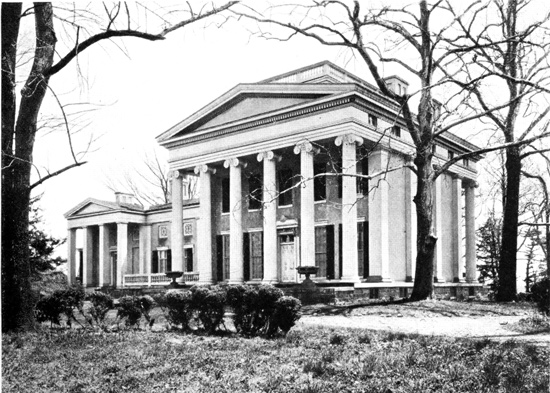
Photo by Ph. B. Wallace FATLANDS, NEAR PHOENIXVILLE, PENNA.
XLI
MILL GROVE AND FATLANDS, NEAR PHILADELPHIA
THE HOMES OF JOHN J. AUDUBON AND OF HIS BRIDE, MARY BAKEWELL
About two hundred years ago, there lived in France a poor fisherman named Audubon, who had nineteen daughters and two sons. One of the sons was sent away to make his fortune when he was twelve years of age. His entire patrimony was a shirt, a suit of clothes, a cane, and a blessing. For five years he was a sailor before the mast. Then he bought a boat. He prospered and bought other vessels. After many years he had large wealth, and was trading to the distant quarters of the earth.
When he was an old man he paid a visit to America. In two widely separated places, attracted by the country, he bought land. One estate was on Perkiomen Creek, near Philadelphia; the other was in Louisiana. In Louisiana he spent much of his time; and there, on May 4, 1780,[2] his son, John James Audubon, was born.
Commodore Audubon wanted his son to be a seaman, and he took him to France that he might be educated for the navy. But the boy's tastes were in another direction altogether. One of the teachers provided for him was an artist, who gave him lessons in drawing that were intended as a part of his training for the profession the father had chosen for him. But the boy put it to a use of his own. On his holidays he used to take a lunch into the country, and would return loaded down with all kinds of natural history specimens. These he would preserve in a cabinet of his own devising, and drawings of many of them would be made and treasured.
Commodore Audubon was not pleased with his son's habits, and he thought he would give him something to do that would distract his mind. The estate in Pennsylvania needed a superintendent. So he sent the would-be naturalist to America, with instructions to look after the estate.
But the wild woods about Philadelphia offered so many opportunities for tramping and nature investigation that the estate was neglected. The house on the estate, Mill Grove, which is still standing, is near the mouth of the Perkiomen. Along this pleasing stream he could ramble for hours, with his gun or his fishing rod or his collecting instruments. Before long the attic room which he occupied was a treasure house of birds and animals and natural-history specimens. He was his own taxidermist. He would do his work seated at a window that looks toward the Valley Forge country, where Washington spent the winter of 1777-78 with his faithful soldiers. The marks of his work are still to be seen on the old boards beneath the window. These boards came from the sawmill on the estate which gave the house its name.
Here in this attic room the young naturalist dreamed of making careful, accurate drawings of all the birds of America. He knew that this would be a difficult matter, but he was not deterred by thought of hardship and poverty.
While he was dreaming of what he would do for the world, something was happening in London that was to have an effect on his life. An official named Bakewell refused to be silent about a matter that the king felt should be forgotten. Bakewell was a conscientious man, and he did not feel that silence would be proper. The king rebuked him, and he resigned his office. At once he made up his mind to leave England and make a home in America, taking with him his wife and daughter.
After many investigations, he found an estate near Philadelphia that pleased him—Fatlands, on the Schuylkill, near the Perkiomen, so named because every year the latter stream overflows and deposits rich sediment on the surrounding lands. The mansion house at Fatlands was built in 1774, and there Washington as well as the British commander had been entertained by the Quaker owner who felt that he could not show partiality. Here the English immigrant made his home.
Of course Audubon heard of the coming of the strangers to the house across the road, not half a mile from his own quarters. But he did not go to call on them. He was French and they were English; he felt sure they would be undesirable acquaintances, and that he had better keep to the woods and follow his own pursuits, without reference to others.
Then came a day when he was having a delightful stroll through the woods. He was carrying specimens of many kinds. A stranger, also a hunter, encountered him and made a remark about his burden that touched a responsive chord. Soon the two were on good terms. "You must come and see me," the stranger said. The invitation was accepted with alacrity. Then came the question, "Where do you live?" To his surprise, Audubon heard that this pleasing man was his new neighbor at Fatlands.
Deciding that an Englishman was not so bad, after all, he made it convenient to call very soon. Then when he saw Mary Bakewell, the daughter of the house, he was sure he liked the English. She showed great sympathy for his pursuits, and he liked to talk with her about them. Before long she decided to help him in his great life work, the American ornithology.
The marriage was postponed because of the death of Mrs. Bakewell, who pined away, homesick for her native England. But the time came when, on April 8, 1808, the two nature lovers became husband and wife. Then they began the long wanderings in the West and the South, the fruit of which was what has been called one of the most wonderful ornithological treatises ever made, Audubon's "Birds of America."
Mr. and Mrs. Audubon floated down the Ohio River, spent a season in Kentucky and Missouri, had narrow escapes from the Indians, and finally found their way to Louisiana. There for a time the wife supported herself by teaching at the home of a planter. Friends and acquaintances thought the husband was a madman to continue his quest of birds when his family was in straitened circumstances. But Mrs. Audubon believed in him, urged him to go to Europe and study painting in oils, that he might be better equipped for the preparation of his bird plates. She secured a good situation as teacher at Bayou Sara, and was soon enjoying an income of three thousand dollars a year.
Finally, with some of his own savings, as well as some of his wife's funds, he went to England, where he was well received. Plans were made to publish the bird plates, with descriptive matter, at one thousand dollars per set. He had to have one hundred advance subscribers. These he secured by personal solicitation.
At last the work was issued. Cuvier called it "the most magnificent work that art ever raised to ornithology."
Many years later, Audubon, after the death of his wife, returned to the scenes of his early life as a naturalist. "Here is where I met my dear Mary," he said, with glistening eyes, as he looked into one of the rooms of the old mansion.
Mill Grove was built in 1762. Five years after Audubon's marriage the estate was bought by Samuel Wetherill, the grandfather of the present owner, W. H. Wetherill.
Fatlands, which is one of the most beautiful old houses in the vicinity of Philadelphia, was built in 1774. During the Revolution it was occupied by a Quaker named Vaux, who entertained many officers of both armies. It is related that one day General Howe, the British commander, was entertained at breakfast, while Washington was in the house for tea the same evening.
The house was rebuilt in 1843, on the old foundations, according to the original plan.
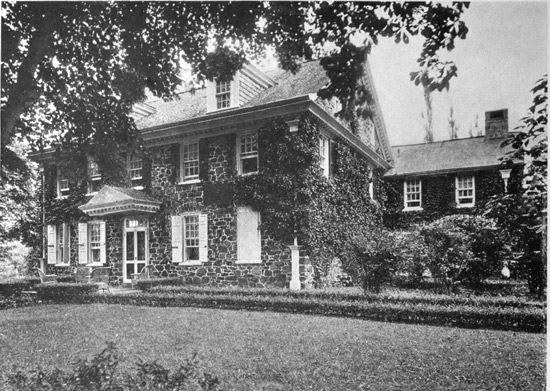
Photo by H. C. Howland WAYNESBOROUGH, NEAR PAOLI, PENNA.
XLII
WAYNESBOROUGH, NEAR PAOLI, PENNSYLVANIA
THE HOME OF "MAD ANTHONY" WAYNE
Captain Isaac Wayne, who commanded a company at the Battle of the Boyne, came from Ireland to Pennsylvania in 1722. Two years later he bought sixteen acres of land in Chester County and built Waynesborough.
His son Isaac, who was a captain in the French and Indian War, enlarged the mansion in 1765. While a wing was added in 1812, it presents much the same appearance to-day as it did at the time Anthony Wayne left it to go to war with General Washington, even to the crooked hood above the entrance door. The present owner, William Wayne, is as unwilling as were his ancestors to have this hood straightened.
On the front of the house is a tablet which reads:
The Home of General Anthony Wayne, Born in this House, January 1, 1745. Died at Erie, Pennsylvania, December 15, 1796. A Leader of the American Revolution in Pennsylvania and a soldier distinguished for his Services at Brandywine, Germantown, Valley Forge, Monmouth, Stony Point, and Yorktown. Subdued the Indians of Ohio, 1794. Commander-in-Chief of the United States Army 1792-1796. Marked by the Chester County Historical Society.
To this record the statement might have been added that General Lafayette visited the home of his old commander when he was in the United States in 1824. Reverently the General bowed his head in Wayne's favorite sitting-room, to the right of the entrance hall, where nothing had been disturbed since the death of the patriot. The furnishings and ornaments of the room are the same to-day as then.
Anthony Wayne was a delegate to several of the conventions which took the preliminary steps leading to the Revolutionary War. In 1775 he was a member of the Committee of Safety, and in the same year he organized a regiment of "minute men" in Chester County.
His first active service was as colonel with troops sent to Canada in January, 1776, and from November, 1776, to April, 1777, as commander of twenty-five hundred men at Ticonderoga. "It was my business to prevent a junction of the enemy's armies and ... to keep at bay their whole Canadian force," he wrote in a private letter.
Here, in the midst of difficulties with soldiers who wanted to desert, he heard that the British were threatening Waynesborough. But, like a true soldier, he stuck to his work, and urged his wife to be brave. "Should you be necessitated to leave East-town, I doubt not but you'll meet with hospitality in the back parts of the Province," he wrote to her.
His fidelity and resourcefulness were recognized in February, 1777, by a commission as brigadier general. Washington, who was then in New Jersey, wrote to him a little later, saying that his presence with him was "materially needed," to guard the country between West Point and Philadelphia. And when the British fleet sailed out of New York Harbor, Washington sent him to Chester, to organize the militia of Pennsylvania. A few weeks later he was in charge of a division at Brandywine. Historians say that his steadfastness on the left prevented the advance of Knyphausen, and saved the right from entire destruction.
Less than a week later, within a mile of his own house, he was surprised by the enemy near Paoli, in consequence, it is said, of the act of an inn-keeper who betrayed Wayne's presence to the British. The result was the only defeat of his brilliant career. Eighty of his men were killed. The engagement has been called "the Paoli Massacre," because of the conduct of the victors. Wayne escaped. A squad of soldiers searched for him at Waynesborough. When they could not find him in the house, they thrust their bayonets into the great boxwood bush that is still to be seen in the rear of the mansion.
Because some said that the General was responsible for the defeat, he demanded a court-martial. The court-martial was held soon after, and he was acquitted with the highest honor, and was declared to be "an active, brave, and vigilant officer."
Washington's letters and orderly book are full of references to Wayne. He was a trusted commander, and his advice was followed many times. He it was who first proposed that the army should "hut" during the winter of 1776-77, some twenty miles from Philadelphia. He was always eager to do his Commander's bidding. On one occasion, when he was in Philadelphia, on his way to greet his family, he was met by a fast rider who handed him a despatch in which Washington said, "I request that you join the army as soon as you can."
During his long absence from Waynesborough his wife Polly and his children were continually in his thoughts. Once he wrote:
"I am not a little anxious about the education of our girl and boy. It is full time that Peggy should be put to dancing school. How does she improve in her writing and reading? Does Isaac take learning freely? Has he become fond of school?"
Just before the storming of Stony Point, he prepared for death, sending to a friend a letter which was not to be opened until the author was dead. The letter said:
"I know that your friendship will induce you to attend to the education of my little son and daughter. I fear that their mother will not survive this stroke. Do go to her."
On the way up the mount he was grievously wounded and fell senseless. Soon he roused himself and cried, "Lead me forward.... Let me die in the fort." Several hours later he was able to send word to Washington, "The fort and garrison are ours."
In this spirit he served through the war. And when the action was won he continued to fight for his country. On February 6, 1796, Claypool's Daily American Advertiser told of his return from his successful campaign against the Indians of Ohio:
"Four miles from the city, he was met by the entire Troop of Philadelphia Light Horse, and escorted by them to town. On his crossing the Schuylkill, a salute of fifteen guns was fired from the Centre-square, by a party of Artillery. He was ushered into the city by the ringing of bells and other demonstrations of joy."
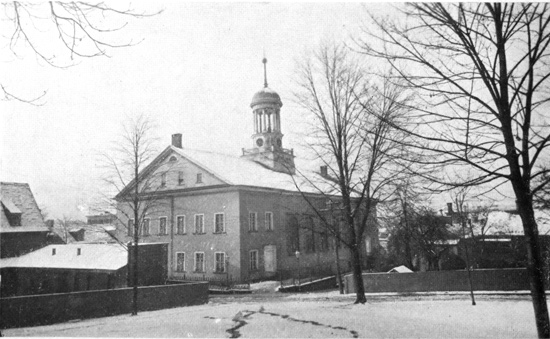
Photo by Rev. A. D. Therelar, Bethlehem MORAVIAN CHURCH, BETHLEHEM, PENNA.
XLIII
THE MORAVIAN CHURCH, BETHLEHEM, PENNSYLVANIA
A RELIGIOUS COMMUNITY WHOSE FOUNDERS WERE TRUE PATRIOTS
The Unitas Fratrum or Church of the Brethren arose in the fifteenth century in Bohemia and Moravia. In 1727 intolerance led its leaders to begin to plan an emigration to America. A colony was sent to Pennsylvania in 1734, while a second colony went to Georgia in 1735. Late in the year 1740 the remnant of the emigrants to Georgia joined forces with the Pennsylvania contingent, and settled on five thousand acres of land in the "Forks of the Delaware," as the locality just within the confluence of the Delaware River and the Lehigh or "West Fork of the Delaware" was called. The object of the settlers was to preach to the Indians, and they began at once to win the confidence of the Delawares.
The first house was built in 1741. This was twenty by forty feet, one story high, with sleeping quarters for a number of persons in the attic under the steep pitched roof. The cattle were kept in a portion of the house partitioned off for them. The common room in which they lived was also the place of worship for more than a year. The site of this house is marked by a memorial stone, which was put in place in 1892.
The foundation for the Gemeinhaus, or Community House, was laid in September. For many years this was to serve as home and hospice, manse and church, administration office, academy, dispensary, and town-hall. As "The House on the Lehigh," it became known through all the countryside.
The event of the year 1741 was the coming of Count Zinzendorf. The Community House was not yet finished, but two rooms in the second story were hurriedly prepared for the guest.
No name had yet been given to the settlement, but on Christmas Eve, after Zinzendorf had celebrated the Holy Communion in the building, the only fitting name suggested itself. Bishop Levering of the Moravian Church tells the story:
"This humble sanctuary, with beasts of the stall sharing its roof, brought the circumstances of the Saviour's birth vividly before their imagination.... Acting upon an impulse, the Count rose and led the way into the part of the building in which the cattle were kept, while he began to sing the quaintly pretty words of a German Epiphany hymn which combined Christmas thoughts and missionary thoughts.... Its language expressed well the feeling of the hour.... The little town of Bethlehem was hailed, its boon to mankind was lauded.... With this episode a thought came to one and another which gave rise to a perpetual memorial of the occasion.... By general consent the name of the ancient town of David was adopted and the place was called Bethlehem."
The chapel of the Gemeinhaus was used by the congregation for nine years. During this period many of the Indians were baptised there. In 1752 and again in 1753 councils were held here with the representatives of the Nanticoke and Shawnee Indians from the Wyoming Valley.
The second place of worship was an extension of the Gemeinhaus, completed in 1751. Here congregations gathered for fifty-five years. Here the gospel was preached by some of the most eminent ministers of colonial days, while the records show that famous visitors sat in the pews. Among them were Governor John Penn; Generals Washington, Amherst, Gage, Gates, and Lafayette; John Hancock, Henry Laurence, Samuel and John Adams, Richard Henry Lee, and many other delegates to the Continental Congress.
During the Revolution there were no more earnest patriots than the members of the Moravian Community at Bethlehem. At one time the Single Brethren's House was used for eight months as a hospital, and no charge was made, though in 1779 a bill for repairs was sent which amounted to $358.
A letter from David Rittenhouse, received on September 16, 1778, caused great excitement, for he told of the despatch to Bethlehem of all the military stores of Washington's army, carried in seven hundred wagons. This was done because Washington's army had been compelled to fall back on Philadelphia. It was also thought wise to send the bells of Christ Church and of Independence Hall to Allentown, by way of Bethlehem. The wagon on which Independence Bell was loaded broke down on descending the hill in front of the hospital, and had to be unloaded while repairs were being made.
The most distinguished patient cared for in Bethlehem was the Marquis de Lafayette, who was brought from Brandywine, and was nursed by Sister Liesel Beckel.
Twenty years after the close of the war it was decided that the time had come for the building of a permanent church. The first estimate was made in 1802. At that time it was thought that the total cost would be $11,000. "It is interesting to note how very modern they were in underestimating the probable cost of a church," Bishop Levering says. The actual cost, including the organ, was more than five times the estimate.
The excavation for the building was made in March, 1803, by volunteer laborers, to whom the residents of the Sisters' House furnished lunch. The work was completed in two weeks. Then the great foundation walls were laid, six feet thick.
For the services of consecration, held from May 18 to May 26, 1806, six thousand people gathered in the village of five hundred inhabitants. On the first day, "at five o'clock in the morning the jubilant note of trombones, trumpets, and other wind instruments from the belfry of the church broke the stillness of the awaking village with a musical announcement of the festival day."
The Moravian Community at Bethlehem has grown. But those who worship in the old church are animated by the same missionary enthusiasm that characterized those who founded the institution so long ago.