Front matter (continued 3)
Reading edition
There are a great many books that I would like to read of a winter's evening if I could stay awake—all of the histories, certainly, of Fiske. And Rhodes, perhaps. I might even read "The Four Horsemen," "Trilby" and "The Education of Henry Adams," so as not to be alone. It is snug by the fire, and the very wind taps on the window as if it asked for invitation to share the hearth. I could compile a list, a five-foot shelf, for these nights of tempest. There is a writer in a Boston paper who tells us every week the books that he would like to read. His is a prospect rather than a review, for it is based on his anticipation. But does he ever read these books? Perhaps he, too, dozes. His book slips off his knee and his chin drops to comfort on his front. Let me inform him that a wood fire—if the logs are hardly dry—is a corrective. Its debility, as water oozes at the end, requires attendance every five minutes. Even Wardle's fat boy at Manor Farm could have lasted through the evening if the poker had been forced into his hand so often. "I read," says Tennyson, "before my eyelids dropt their shade." And wasn't Alice sitting with her book when she fell asleep and down the rabbit-hole? "And so to bed," writes Pepys. He, too, then, is one of us.
I wonder if that phrase—he who runs may read—has not a deeper significance than lies upon the surface. Perhaps the prophet—was it Habakkuk who wrote the line?—it does not matter—perhaps the bearded prophet had himself the sleepy habit, and kept moving briskly for remedy around his study. I can see him in dressing-gown and slippers, with book in hand—his whiskers veering in the wind—quickening his lively pace around the kerosene lamp, steering among the chairs, stumbling across the cat—
In ambition I am a night-hawk. I would like to sit late with old books and reconstruct the forgotten world at midnight. These bells that I hear now across the darkness are the mad bells of Saint Bartholomew. With that distant whistle—a train on the B. & O.—Guy Fawkes gathers his villains to light the fuse. Through my window from the night I hear the sounds of far-off wars and kingdoms falling.
And I would like, also, at least in theory, to sit with a merry company of friends, and let the cannikin clink till dawn.
I would like to walk the streets of our crowded city and marvel at the windows—to speculate on the thousand dramas that weave their webs in our common life. Here is mirth that shakes its sides when its neighbors sleep. Here is a hungry student whose ambition builds him rosy castles. Here is a light at a fevered pillow where hope burns dim.
On some fairy night I would wish to wander in the woods, when there are dancing shadows and a moon. Here Oberon holds state. Here Titania sleeps. I would cross a silver upland. I would stand on a barren hill-top, like the skipper of the world in its whirling voyage.
But these high accomplishments are beyond me. Habakkuk and the fat boy, and Alice and Pepys and I, and all the others, must be content. Even the wet wood and the poker fail. The very wind grows sleepy at the window. Our chins fall forward. Our books slip off our knees.
And now, at last, our buoyant bed floats among the stars. I have cast off the moorings of the sluggish world. Earth's harbor lights are at the stern. The Pleiades mark the channel to the moon—
Poof! Sleep draws again its dark curtain across the glittering pageant.
Who Was Jeremy?
WHO was Jeremy Bentham? I have run on his name recently two or three times. I could, of course, find out. The Encyclopedia—volume Aus to Bis—would enlighten me. Right now, downstairs in the bookcase—up near the top where the shabby books are kept—among the old Baedekers—there is a life of him by Leslie Stephen. No! That is a life of Hobbes. I don't know anything about Hobbes either. It seems to me that he wrote the "Leviathan," whatever that was. But there is a Bentham somewhere around the house. But I have not read it.
In a rough way I know who Bentham was. He lived perhaps a hundred years ago and he had a theory of utility. Utility was to clean the infected world. Even the worst of us were to rise out of the tub white and perfect. It was Bentham who wished to revisit the world in a hundred years to see how sweet and clean we had become. He was to utility what Malthus was to population. Malthus! There is another hard one. It is the kind of name that is cut round the top of a new City Hall to shame citizens by their ignorance.
I can go downstairs this minute and look up Bentham. Is it worth while? But then I might be called to dinner in the middle of the article, or I might be wanted to move the refrigerator. There is a musty smell, it seems, in the drain pipe, and the stubborn casters are turned sidewise. It hardly seems worth the chance and effort.
There are a great many things that really do stir my curiosity, and even those things I don't look up. Or tardily, after my ignorance has been exposed. The other day the moon arose—as a topic—at the round table of the club where I eat lunch. It had really never occurred to me that we had never seen its other side, that we never could—except by a catastrophe—unless it smashed into a planet and was thrown heels up. How does it keep itself so balanced that one face is forever hid? Try to roll an apple around a pumpkin and meanwhile spin the pumpkin. Try this on your carpet. I take my hat off to the moon.
I have been very ignorant of the moon. All of these years I have regarded it as a kindly creature that showed itself now and then merely on a whim. It was just jogging around of an evening, so I supposed, and looked us up. It was an old neighbor who dropped in after dinner, as it were, for a bit of gossip and an apple. But even the itinerant knife-grinder—whose whirling wheel I can hear this minute below me in the street—even the knife-grinder has a route. He knows at what season we grow dull. What necessity, then, of ours beckons to the moon? Perhaps it comes with a silver brush to paint the earth when it grows shabby with the traffic of the day. Perhaps it shows itself to stir a lover who halts coldly in his suit. The pink god, they say, shoots a dangerous arrow when the moon is full.
The extent of my general ignorance is amazing. And yet, I suppose, by persistence and energy I could mend it. Old Doctor Dwight used to advise those of us who sat in his classroom to read a hard book for half an hour each day. How those half hours would mount up through the years! What a prodigious background of history, of science, of literature, one would gain as the years revolved! If I had followed his advice I would today be bursting with knowledge of Jeremy Bentham; I would never have been tripped upon the moon.
How ignorant most of us are of the times in which we live! We see the smoke and fires of revolution in Europe. We hear the cries of famine and disease, but our perception is lost in the general smudge. How are the Balkans parceled? How is the nest of nationalities along the Danube disposed? This morning there is revolt in Londonderry. What parties are opposite in the quarrel? Trouble brews in Chile. Is Tacni-Arica a district or a mountain range? The Åland Islands breed war in the north. Today there is a casualty list from Bagdad. The Bolsheviki advance on Warsaw. Those of us who are cobblers tap our shoes unruffled, tailors stitch, we bargain in the market—all of us go about on little errands without excitement when the news is brought.
And then there is mechanics. This is now so preeminently a mechanical world that no one ought to be entirely ignorant of cylinders and cogs and carburetors. And yet my own motor is as dark as Africa. I am as ignorant of a carburetor as of the black stomach of a zebra. Once a carpenter's bench was given me at Christmas, fitted up with all manner of tricky tools. The bookshelves I built in my first high enthusiasm have now gone down to the basement to hold the canned fruit, where they lean with rickets against the wall. Even the box I made to hold the milk bottles on the back steps has gone the way of flesh. Any chicken-coop of mine would topple in the wind. Well-instructed hens would sit around on fence-posts and cackle at my efforts with a saw. Certainly, if a company of us were thrown on a desert island, it would not be I who proved the Admirable Crichton. Not by my shrewdness could we build a hut. Robinson Crusoe contrived a boat. If I tied a raft together it would be sure to sink.
Where are the Virgin Islands? What makes a teapot bubble? What forces bring the rain and tempest?
In cooking I go no farther than an egg. Birds, to me, are either sparrows or robins. I know an elm and a maple, but hemlocks and pines and firs mix me up. I am not to be trusted to pull the weeds. Up would come the hollyhocks. Japanese prints and Chinese vases sit in a world above me.
I can thump myself in front without knowing whether I jar my stomach or my liver. I have no notion where my food goes when it disappears. When once I have tilted my pudding off its spoon my knowledge ceases. It is as a child of Israel on journey in the wilderness. Does it pass through my thorax? And where do my lungs branch off?
I know nothing of etchings, and I sit in gloomy silence when friends toss Whistler and Rembrandt across the table. I know who our mayor is, but I scratch my head to name our senator. And why does the world crumple up in hills and mountains?
I could look up Jeremy Bentham and hereafter I would know all about him. And I could look up the moon. And Hobbes. And Leslie Stephen, who wrote a book about him. And a man named Maitland who wrote a life of Stephen. Somebody must have written about Maitland. I could look him up, too. And I could read about the Balkans and tell my neighbors whether they are tertiary or triassic. I could pursue the thorax to its lair. Saws and chicken-coops, no doubt, are an engaging study. I might take a tree-book to the country, or seek an instructive job in a garage.
But what is the use? Right in front of Jeremy Bentham, in Aus to Bis, is George Bentham, an English botanist. To be thorough I would have to read about him also. Then following along is Bentivoglio, and Benzene—a long article on benzene. And Beowulf! No educated person should be quite ignorant of him. Albrecht Bitzius was a Swiss novelist. Somehow he has escaped me entirely. And Susanna Blamire, "the muse of Cumberland"! She sounds engaging. Who is there so incurious that he would not give an evening to Borneo? And the Bryophyta?—which I am glad to learn include "the mosses and the liverworts." Dear me! it is quite discouraging.
And then, when I am gaining information on Hobbes, the Hittites, right in front, take my eye. Hilarius wrote "light verses of the goliardic type"—whatever that means. And the hippopotamus! "the largest representative of the non-ruminating artiodactyle ungulate mammals." I must sit with the hippopotamus and worm his secret.
And after I have learned to use the saw, I would have to take up the plane. And then the auger. And Whistler. And Japanese prints. And a bird book.
It is very discouraging.
I stand with Pope. Certainly, unless one is very thirsty and has a great deal of vacant time, it is best to avoid the Pierian spring.
Jeremy can go and hang himself. I am learning to play golf.
A Chapter for Children.
ONCE upon a time—for this is the way a story should begin—there lived in a remote part of the world a family of children whose father was busy all day making war against his enemies. And so, as their mother, also, was busy (clubs, my dear, and parties), they were taken care of and had their noses wiped—but in a most kindly way—by an old man who loved them very much.
Now this old man had been a jester in his youth. For these were the children of a king and so, of course, they had a jester, just as you and I, if we are rich, have a cook. He had been paid wages—I don't know how many kywatskies—merely to stand in the dining-room and say funny things, and nobody asked him to jump around for the salt or to hurry up the waffles. And he didn't even brush up the crumbs afterward.
I do not happen to know the children of any king—there is not a single king living on our street—yet, except for their clothes, they are much like other children. Of course they wear shinier clothes. It is not the shininess that comes from sliding down the stair rail, but a royal shininess, as though it were always eleven o'clock on Sunday morning and the second bell of the Methodist church were ringing, with several deacons on the steps. For if one's father is a king, ambassadors and generals keep dropping in all the time, and queens, dressed up in brocade so stiff you can hear them breathe.
One day the children had been sliding down hill in the snow—on Flexible Flyers, painted red—and their mittens and stockings were wet. So the old man felt their feet—tickling their toes—and set them, bare-legged, in a row, in front of the nursery fire. And he told them a story.
"O children of the king!" he began, and with that he wiped their noses all round, for it had been a cold day, when even the best-mannered persons snuffle now and then. "O children of the king!" he began again, and then he stopped to light a taper at the fire. For he was a wise old man and he knew that when there is excitement in a tale, a light will keep the bogies off. This old man could tell a story so that your eyes opened wider and wider, as they do when Annie brings in ice-cream with raspberry sauce. And once in a while he said Odd Zooks, and God-a-Mercy when he forgot himself.
"Once upon a time," he began, "there lived a king in a far-off country. To get to that country, O children of a king, you would have to turn and turn, and spell out every signpost. And then you climb up the sides of seventeen mountains, and swim twenty-three streams precisely. Here you wait till dusk. But just before the lamps are lighted, you get down on all-fours—if you are a boy (girls, I believe, don't have all-fours)—and crawl under the sofa. Keep straight on for an hour or so with the coal-scuttle three points starboard, but be careful not to let your knees touch the carpet, for that wears holes in them and spoils the magic. Then get nurse to pull you out by the hind legs—and—there you are.
"Once upon a time, then, there lived a king with a ferocious moustache and a great sword which rattled when he walked around the house. He made scratches all over the piano legs, but no one felt like giving him a paddy-whack. This king had a pretty daughter.
"Now it is a sad fact that there was a war going on. It was between this king who had the pretty daughter and another king who lived near by, on an adjoining farm, so to speak. And the first king had sworn by his halidome—and at this his court turned pale—that he would take his enemy by his blasted nose.
"Both of these kings lived in castles whose walls were thick and whose towers were high. And around their tops were curious indentings that looked as your teeth would look if every other one were pulled. These castles had moats with lily pads and green water in them, which was not at all healthful, except that persons in those days did not know about it and were consequently just as well off. And there were jousting fields and soup caldrons (with a barrel of animal crackers) and a tun of lemonade (six glasses to a lemon)—everything to make life comfortable.
"Here's a secret. The other king who lived near by was in love with the first king's daughter. Here are two kings fighting each other, and one of them in love with the other's daughter, but not saying a word about it.
"Now the second king—the one in love—was not very fierce, and his name was King Muffin—which suggests pleasant thoughts—whereas the first king with the beautiful daughter was called King Odd Zooks, Zooks the Sixth, for he was the sixth of his powerful line. And my story is to show how King Muffin got the better of King Zooks and married his daughter. It was a clever piece of business, for the walls of the castle were high, and the window of the Princess was way above the trees. King Muffin didn't even know which her window was, for it did not have any lace curtains and it looked no better than the cook's, except that the cook sometimes on Monday tied her stockings to the curtain cord to dry. And of course if King Muffin had come openly to the castle, the guards would have cut him all to bits.
"One day in June King Muffin was out on horseback. He had left his crown at home and was wearing his third-best clothes, so you would have thought that he was just an ordinary man. But he was a good horseman; that is, he wasn't thinking every minute about falling off, but sat loosely, as one might sit in a rocking-chair.
"The country was beautiful and green, and in the sky there were puffy clouds that looked the way a pop-over looks before it turns brown—a big pop-over that would stuff even a hungry giant up to his ears. And there was a wind that wiggled everything, and the noise of a brook among the trees. Also, there were birds, but you must not ask me their names, for I am not good at birds.
"King Muffin, although he was a brave man, loved a pleasant day. So he turned back his collar at the throat in order that the wind might tickle his neck and he dropped his reins on his horse's back in a careless way that wouldn't be possible on a street where there were trolley-cars. In this fashion he rode on for several miles and sang to himself a great many songs. Sometimes he knew the words and sometimes he said tum tum te tum tum, but he kept to the tune.
"King Muffin enjoyed his ride so much that before he knew it he was out of his own kingdom and at least six parasangs in the kingdom of King Zooks. My dear, use your handkerchief!
"And even then King Muffin would not have realized it, except that on turning a corner he saw a young man lying under a tree in a suit that was half green and half yellow. King Muffin knew him at once to be a jester—but whose? King Zooks's jester, of course, his mortal enemy. For jesters have to go off by themselves once in a while to think up new jokes, and no other king lived within riding distance. Really, the jester was thinking of rhymes to zithern, which is the name of the curious musical instrument he carried, and is a little like a mandolin, only harder to play. It cannot be learned in twelve easy lessons. And the jester was making a sorry business of it, for it is a difficult word to find rhymes to, as you would know if you tried. He was terribly woeful.
"King Muffin said 'Whoa' and stopped his horse. Then he said 'Good morning, fellow,' in the kind of superior tone that kings use.
"The jester got off the ground and, as he did not know that Muffin was a king, he sneezed; for the ground was damp. It was a slow sneeze in coming, for the ground was not very wet, and he stood waiting for it with his mouth open and his eyes squinting. So King Muffin waited too, and had a moment to think. And as kings think very fast, very many thoughts came to him. So, by the time the sneeze had gone off like a shower bath, and before the pipes filled up for another, some interesting things had occurred to him. Well! things about the Princess and how he might get a chance to speak with her. But he said:
"'Ho, ho! Methinks King Zooks's jester has the snuffles.'
"At this, Jeppo—for that was the jester's name—looked up with a wry face, for he still kept a sneeze inside him which he couldn't dislodge.
"'By my boots and spurs!' the King cried again, 'you are a woeful jester.'
"Jeppo was woeful. For on this very night King Zooks was to give a grand dinner—not a simple dinner such as you have at home with Annie passing dishes and rattling the pie around the pantry—but a dinner for a hundred persons, generals and ambassadors, all dressed in lace and eating from gold plates. And of course everyone would look to Jeppo for something funny—maybe a new song with twenty verses and a rol-de-rol-rol chorus, which everyone could sing even if he didn't know the words. And Jeppo didn't know a single new thing. He had tried to write something, but had stuck while trying to think of a rhyme for zithern. So of course he was woeful. And King Muffin knew it.
"All this while King Muffin was thinking hard, although he didn't scowl once, for some persons can think without scowling. He wished so much to see the Princess, and yet he knew that if he climbed the tallest tree he couldn't reach her window. And even if he found a ladder long enough, as likely as not he would lean it up against the cook's window, not noticing the stockings on the curtain cord. King Muffin should have looked glum. But presently he smiled.
"'Jeppo,' he said, 'what would you say if I offered to change places with you? Here you are fretting about that song of yours and the dinner only a few hours off. You will be flogged tomorrow, sure, for being so dull tonight. Just change clothes with me and go off and enjoy yourself. Sit in a tavern! Spend these kywatskies!' Here King Muffin rattled his pocket. 'I'll take your place. I know a dozen songs, and they will tickle your king until, goodness me! he will cry into his soup.' King Muffin really didn't give King Zooks credit for ordinary manners, but then he was his mortal enemy, and prej'iced.
"Well, Jeppo was terribly woeful and that word zithern was bothering him. There was pithern and dithern and mithern. He had tried them all, but none of them seemed to mean anything. So he looked at King Muffin, who sat very straight on his horse, for he wasn't at all afraid of him, although he was a tall horse and had nostrils that got bigger and littler all the time; and back legs that twitched. Meanwhile King Muffin twirled a gold chain in his fingers. Then Jeppo looked at King Muffin's clothes and saw that they were fashionable. Then he looked at his hat and there was a yellow feather in it. And those kywatskies. King Muffin, just to tease him, twirled his moustache, as kings will.
"So the bargain was made. There was a thicket near, so dense that it would have done for taking off your clothes when you go swimming. In this thicket King Muffin and Jeppo exchanged clothes. Of course Jeppo had trouble with the buttons for he had never dressed in such fine clothes before, and many of a king's buttons are behind.
"And now, when the exchange was made, Jeppo inquired where he would find an expensive tavern with brass pull-handles on the lemonade vat, and he rode off, licking his lips and jingling his kywatskies. But King Muffin, dressed as a jester, vaulted on his horse and trotted in the direction of King Zooks's castle, which had indentings around the top like a row of teeth if every other one were pulled.
"And after a little while it became night. It is my private opinion, my dear, which I shall whisper in the middle of your ear—the outer flap being merely ornamental and for 'spection purposes—that the sun is afraid of the dark, because you never see him around after nightfall. Bless you, he goes off to bed before twilight and tucks himself to the chin before you or I would even think of lighting a candle. And, on my word, he prefers to sleep in the basement. He goes down the back stairs and cuddles behind the furnace. And he has the bad habit, mercy! of reading in bed. A good half hour after he should be sound asleep, you can see the reflection of his candle on the evening clouds."
At this point the old man paused a bit, to see if the children were still awake. Then he wiped their noses all around, not forgetting the youngest with the fat legs, and began again.
"During all this time King Zooks had been getting ready for the party, trying on shiny coats, and getting his silk stockings so that the seams at the back went straight up and didn't wind around, which is the way they naturally do unless you are particular. And he put a clean handkerchief into every pocket, in case he sneezed in a hurry—for King Zooks was a lavish dresser.
"His wife was dressing in another room, keeping three maids busy with safety pins and powder-puffs, and getting all of the snarls out of her hair. And, in still another room of the castle, his daughter was dressing. Now his wife was a nice-looking woman, like nurse, except that she wore stiff brocade and didn't jounce. But his daughter was beautiful and didn't need a powder-puff.
"When they were all dressed they met outside, just to ask questions of one another about handkerchiefs and noses and behind the ears. The Queen, also, wished to be very sure that there wasn't a hole in the heel of her stocking, for she wore black stockings, which makes it worse. King Zooks was fond of his wife and fond of his daughter, and when he was with them he did not look so fierce. He kissed both of them, but when he kissed his daughter—which was the better fun—he took hold of her nose—but in a most kindly way—so that her face wouldn't slip.
"Then they went down the marble stairs, with flunkies bowing up and down.
"But how worried King Zooks would have been if he had known that at that very moment his enemy, King Muffin, was coming into the castle, disguised as a jester. Nobody stopped King Muffin, for wandering jesters were common in those days.
"And now the party started with all its might.
"King Zooks offered his arm to the wife of the Ambassador, and Queen Zooks offered hers to the General of the army. There was a fight around the Princess, but she said eenie meenie minie moe, catch a nigger by the toe and counted them all out but one. And so they went down another marble stairway to the dining-room, where a band was blowing itself red in the face—the trombonist, in particular, seeming to be in great distress.
"And where was King Muffin?
"King Muffin came in by the postern—the back stoop, my dear—and he washed his hands and ears at the kitchen sink and went right up to the dining-room. And there he was standing behind the King's chair, where King Zooks couldn't see him but the Princess could. You can see from this what a crafty person King Muffin was. Queen Zooks, to be sure, could see him, but she was an unsuspicious person, and was very hungry. There were waffles for dinner, and when there were waffles she didn't even talk very much.
"King Muffin was very funny. He told jokes which were old at his own castle, but were new to King Zooks. And King Zooks, thinking he was a real jester, laughed until he cried—only his tears did not get into his soup, for by that time the soup had been cleared away. A few of them, however—just a splatter—did fall on his fish, but it didn't matter as it was a salt fish anyway. But all the guests, inasmuch as they were eating away from home, had to be more particular. And when the rol-de-rol-rol choruses came, how King Zooks sang, throwing back his head and forgetting all about his ferocious moustache!
"No one enjoyed the fun more than King Muffin. Whenever things quieted down a bit he said something even funnier than the last. But during all this time it had not occurred to King Zooks to inquire for Jeppo, or to ask why a new fool stood behind his chair. He just laughed and nudged the wife of the Ambassador with his elbow and ate his waffles and enjoyed himself.
"So the dinner grew merrier and merrier until at last everyone had had enough to eat. They would have pushed back a little from the table to be more comfortable in front, except for their manners. King Zooks was the last to finish, for the dinner ended with ice-cream and he was fond of it. He didn't have it ordinary days. In fact he was so eager to get the last bit that he scraped his spoon round and round upon the dish until Queen Zooks was ashamed of him. When, finally, he was all through, the guests folded their napkins and pushed back their chairs until you never heard such a squeak. A few of them—but these had never been out to dinner before—had spilled crumbs in their laps and had to brush them off.
"And now there was a dance.
"So King Zooks offered his arm to the wife of the Ambassador and Queen Zooks offered hers to the General of the army, and they started up the marble stairway to the ballroom. But what should King Muffin do but skip up to the Princess while she was still smoothing out her skirts. (Yellow organdie, my dear, and it musses when you sit on it.) Muffin made a low bow and kissed her hand. Then he asked her for the first dance. It was so preposterous that a jester should ask her to dance at all, that everyone said it was the funniest thing he had done, and they went into a gale about it on the marble stairway. Even Queen Zooks, who ordinarily didn't laugh much at jokes, threw back her head and laughed quite loud—but in a minute, when everybody else was done. And then to everyone's surprise the Princess consented to dance with King Muffin, although the General of the army stood by in a kind of empty fashion. But everybody was so merry, and in particular King Zooks, that no one minded.
"King Muffin, when he danced with the Princess, looked at her very hard and softly, and she looked back at him as if she didn't mind it a bit. Evidently she knew him despite his disguise. And naturally she knew that he was in love with her.
"Now King Muffin hadn't had a thing to eat, for jesters are supposed to eat at a little table afterwards. If they ate at the big table they would forget and sing sometimes with their mouths full and you know how that would sound. So he and the Princess went downstairs to the pantry, where he ate seven cream puffs and three floating islands, one after the other, never spilling a bit on his blouse. He called them 'floatin' Irelands,' having learned it that way as a child, his nurse not correcting him. Then he felt better and they returned to the ballroom, where the dance was still going on with all its might.
"King Muffin took the Princess out on the balcony, which was the place where young gentlemen, even in those days, took ladies when they had something particular to say. He shut the door carefully and looked all around to make sure that there were no spies about, under the chairs, inside the vases. He even wiggled the rug for fear that there might be a trapdoor beneath.
"Did the Princess love King Muffin? Of course she did. But she wasn't going to let him know it all at once. Ladies never do things like that. So she looked indifferent, as though she might yawn at any moment. Despite that, King Muffin told her what was on his mind, and when he was finished, he looked for an answer. But she didn't say anything, but just sat quiet and pretended there was a button off her dress. So King Muffin told it again, and moved up a bit. And this time her head nodded ever so little. But he saw it. So he reached down in his side pocket, so far that he had to straighten out his leg to get to the bottom. He brought up a ring. Then he slipped it on her finger, the next to the longest one on her left hand. After that he kissed her in a most affectionate way.
"This was all very well, but of course King Zooks would never consent to their marriage. And if he discovered that the new jester was King Muffin, his guards would cut him all to slivers. For a minute they were woeful. Then a bright idea came to King Muffin—
"Meanwhile the dance had been going on with all its might. First the General of the army danced with Queen Zooks. He was a very manly dancer and was quite stiff from the waist up, and she bounced around on tip-toe. Then the Ambassador danced with her, but his sword kept getting in her way. Then both of them, having done their duty, looked around for the Princess. They went to the lemonade room, for that was the first place naturally to look. Then they went to the cardroom, where the older persons were playing casino, and were sitting very solemn, as if it were not a party at all.
"Then they went to King Zooks, who was jiggling on his toes, with his back to the fire, full and happy. 'Where is your daughter, Majestical Majesty?' they asked. But as King Zooks didn't know he joined the search, and Queen Zooks, too. But she wasn't much good at it, for she had a long train and she couldn't turn a corner sharp, although her maids trotted after her and whisked it about as fast as possible.
"But they couldn't find the Princess anywhere inside the castle.
"After a while it occurred to King Zooks that the cook might know. She had gone to bed—leaving her dishes until morning—so up they climbed. She answered from under the covers, 'Whajuwant?' which shows that she didn't talk English and was probably a Spanish cook or an Indian princess captured very young. So she got up, all excited. My! how she scuffed around, looking for her slippers, trying to find her clothes and getting one or two things on wrong side out! She was so confused that she thought it was morning and brushed her teeth.
"By this time an hour had passed and King Zooks was fidgety. He told his red-faced band to lean their trombones and other things up against the wall, so that he could think. Then he stroked his chin, while the court stood by and tried to think also. Finally the King sent a herald to proclaim around the castle how fidgety he was and that his daughter must be brought to him. But the Princess was not found. Meantime the band ate ice-cream and cocoanut macaroons, and appeared to enjoy itself.
"In a tall tower that stands high above the trees there was a great clock, and, by and by, it began to strike the hour. It did not stop until it had struck ten times. So you see it was growing late and the King had the right to be getting fidgety. When the clock had done, those guests who were not in the habit of sitting up so late, began to grow sleepy; only, of course, they did not yawn out loud, but behind fans and things.
"Meanwhile King Muffin had gone downstairs to the stable. He brought out his horse with the flaring nostrils and another horse also. He took them around to the Princess, who sat waiting for him on a marble bench in the shadow of a tree.
"'Climb up, beautiful Princess,' he said.
"She hopped into her saddle and he into his. They were off like the wind.
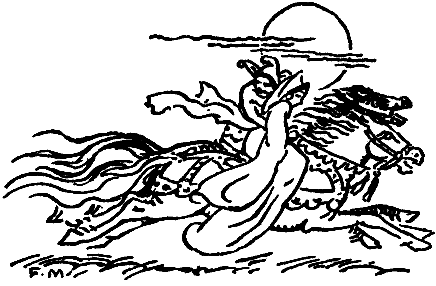
"They heard the clock strike ten and they saw the great tower rising above the castle with the silver moon upon it, but they galloped on and on. Through the forest they galloped, over bridges and streams. And the moon climbed off the tower and kept with them—as it does with all good folk—plunging through the clouds like a ship upon the ocean. And still they galloped on. Presently they met Jeppo returning from the tavern with the brass pull-handles. 'Yo, ho!' called out the King, and they passed him in a flash. Clackety-clack-clack, clackety-clack-clack, clack-clack, clackety-clack!
"And peasants, who usually slept right through the night, awoke at the sound of their hoofs and although they were very sleepy, they ran and looked out of their windows—being careful to put on slippers so as not to get the snuffles. And King Muffin and the Princess galloped by with the moonlight upon them, and the peasants wondered who they were. But as they were very sleepy, presently they went back to bed without finding out. One of them did, however, stumble against a chair, right on the toe, and had to light a candle to see if it were worth mending.
"But in the morning the peasants found a bauble near the lodge-gate, a cap and bells on the ravine bridge, and on the long road to the border of King Muffin's land they found a jester's coat.
"And to this day, although many years have passed, their children and their children's children, on the way from school, gather the lilies of the valley which flourish in the woods and along the roads. And they think that they are jesters' bells which were scattered in the flight."
Whereupon the old man, having finished his story, wiped the noses of the children, not forgetting the youngest one with the fat legs, and sent them off to bed.
The Crowded Curb.
RECENTLY I came on an urchin in the crowded city, pitching pennies by himself, in the angle of an abutment. Three feet from his patched seat—a gay pattern which he tilted upward now and then—there moved a thick stream of shoppers. He was in solitary contest with himself, his evening papers neglected in a heap, wrapped in his score, unconscious of the throng that pressed against him. He was resting from labor, as a greater merchant takes to golf for his refreshment. The curb was his club. He had fetched his recreation down to business, to the vacancy between editions. Presently he will scoop his earnings to his pocket and will bawl out to his advantage our latest murder.
How mad—how delightful our streets would be if all of us followed as unreservedly, with so little self-consciousness or respect of small convention, our innocent desires!
Who of us even whistles in a crowd?—or in the spring goes with a skip and leap?
A lady of my acquaintance—who grows plump in her early forties—tells me that she has always wanted to run after an ice-wagon and ride up town, bouncing on the tail-board. It is doubtless an inheritance from a childhood which was stifled and kept in starch. A singer, also, of bellowing bass, has confided to me that he would like above all things to roar his tunes down town on a crowded crossing. The trolley-cars, he feels, the motors and all the shrill instruments of traffic, are no more than a sufficient orchestra for his lusty upper register. An old lady, too, in the daintiest of lace caps, with whom I lately sat at dinner, confessed that whenever she has seen hop-scotch chalked in an eddy of the crowded city, she has been tempted to gather up her skirts and join the play.
But none of these folk obey their instinct. Opinion chills them. They plod the streets with gray exterior. Once, on Fifth Avenue, to be sure, when it was barely twilight, I observed a man, suddenly, without warning, perform a cart-wheel, heels over head. He was dressed in the common fashion. Surely he was not an advertisement. He bore no placard on his hat. Nor was it apparent that he practiced for a circus. Rather, I think, he was resolved for once to let the stiff, censorious world go by unheeded, and be himself alone.
On a night of carnival how greedily the crowd assumes the pantaloon! A day that was prim and solemn at the start now dresses in cap and bells. How recklessly it stretches its charter for the broadest jest! Observe those men in women's bonnets! With what delight they swing their merry bladders at the crowd! They are hard on forty. All week they have bent to their heavy desks, but tonight they take their pay of life. The years are a sullen garment, but on a night of carnival they toss it off. Blood that was cold and temperate at noon now feels the fire. Scratch a man and you find a clown inside. It was at the celebration of the Armistice that I followed a sober fellow for a mile, who beat incessantly with a long iron spoon on an ash-can top. Almost solemnly he advanced among the throng. Was it joy entirely for the ending of the war? Or rather was he not yielding at last to an old desire to parade and be a band? The glad occasion merely loosed him from convention. That lady friend of mine, in the circumstance, would have bounced on ice-wagons up to midnight.
For it is convention, rather than our years—it is the respect and fear of our neighbors that restrains us on an ordinary occasion. If we followed our innocent desires at the noon hour, without waiting for a carnival, how mad our streets would seem! The bellowing bass would pitch back his head and lament the fair Isolde. The old lady in lace cap would tuck up her skirts for hop-scotch and score her goal at last.
Is it not the French who set aside a special night for foolery, when everyone appears in fancy costume? They should set the celebration forward in the day, and let the blazing sun stare upon their mirth. Merriment should not wait upon the owl.
The Dickey Club at Harvard, I think, was fashioned with some such purpose of release. Its initiation occurs always in the spring, when the blood of an undergraduate is hottest against restraint. It is a vent placed where it is needed most. Zealously the candidates perform their pranks. They exceed the letter of their instruction. The streets of Boston are a silly spectacle. Young men wear their trousers inside out and their coats reversed. They greet strangers with preposterous speech. I once came on a merry fellow eating a whole pie with great mouthfuls on the Court House steps, explaining meantime to the crowd that he was the youngest son of Little Jack Horner. And, of course, with such a hardened gourmand for an ancestor, he was not embarrassed by his ridiculous posture.
But it is not youth which needs the stirring most. Nor need one necessarily play an absurd antic to be natural. And therefore, here at home, on our own Soldiers' Monument—on its steps and pediment that mount above the street—I offer a few suggestions to the throng.
Ladies and gentlemen! I invite you to a carnival. Here! Now! At noon! I bid you to throw off your solemn pretense. And be yourself! That sober manner is a cloak. Your dignity scarcely reaches to your skin. Does no one desire to play leap-frog across those posts? Do none of you care to skip and leap? What! Will no one accept my invitation?
You, my dear sirs, I know you. You play chess together every afternoon in your club. One of you carries at this moment a small board in his waistcoat pocket. Why hurry to your club, gentlemen? Here on this step is a place to play your game. Surely your concentration is proof against the legs that swing around you. And you, my dear sir! I see that you are a scholar by your bag of books. You chafe for your golden studies. Come, sit alongside! Here is a shady spot for the pursuit of knowledge. Did not Socrates ply his book in the public concourse?
My dear young lady, it is evident that a desire has seized you to practice your soprano voice. Why do you wait for your solitary piano to pitch the tune? On these steps you can throw your trills up heaven-ward.
An ice-wagon! With a tail-board! Is there no lady in her forties, prim in youth, who will take her fling? Or does no gentleman in silk hat wish a piece of ice to suck?
Observe that good-natured father with his son! They have shopped for toys. He carries a bundle beneath his arm. It is doubtless a mechanical bear—a creature that roars and walks on the turning of a key. After supper these two will squat together on the parlor carpet and wind it up for a trial performance. But must such an honest pleasure sit for the coming of the twilight? Break the string! Insert the key! Let the fearful creature stride boldly among the shoppers.
Here is an iron balustrade along the steps. A dozen of you desire, secretly, to slide down its slippery length.
My dear madam, it is plain that the heir is naughty. Rightfully you have withdrawn his lollypop. And now he resists your advance, stiff-legged and spunky. Your stern eye already has passed its sentence. You merely wait to get him home. I offer you these steps in lieu of nursery or woodshed. You have only to tip him up. Surely the flat of your hand gains no cunning by delay.
And you, my dear sir—you who twirl a silk moustache—you with the young lady on your arm! If I am not mistaken you will woo your fair companion on this summer evening beneath the moon. Must so good a deed await the night? Shall a lover's arms hang idle all the day? On these steps, my dear sir, a kiss, at least, may be given as a prelude.
Hop-scotch! Where is my old friend of the lace cap? The game is already chalked upon the stones.
Is there no one in the passing throng who desires to dance? Are there no toes that wriggle for release? My dear lady, the rhythmic swish of your skirt betrays you. A tune for a merry waltz runs through your head. Come! we'll find you a partner in the crowd. Those silk stockings of yours must not be wasted in a mincing gait.
Have lawyers, walking sourly on their business, any sweeter nature to display to us? Our larger merchants seem covered with restraint and thought of profit. That physician with his bag of pellets seems not to know that laughter is a panacea. Has Labor no desire to play leap-frog on its pick and go shouting home to supper? Housewives follow their unfaltering noses from groceries to meats. Will neither gingham nor brocade romp and cut a caper for us?
Ladies and gentlemen! Why wait for a night of carnival? Does not the blood flow red, also, at the noon hour? Must the moon point a silly finger before you start your merriment? I offer you these steps.
Is there no one who will whistle in the crowd? Will none of you, even in the spring, go with a skip and leap upon your business?
A Corner for Echoes.
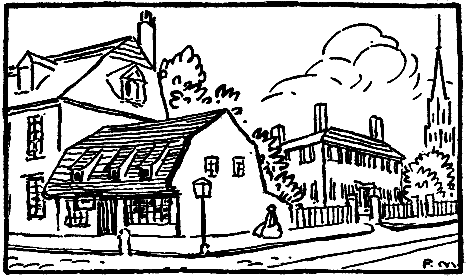
SOMETIMES in a quiet hour I see in the memory of my childhood a frame house across a wide lawn from a pleasant street. There are no trees about the yard, in itself a defect, yet in its circumstance, as the house arises in my view, the barrenness denotes no more than a breadth of sunlight across those endless days.
There was, indeed, in contrast and by way of shadowy admonishment, a church near by, whose sober bell, grieving lest our joy should romp too long, recalled us to fearful introspection on Sunday evening, and it moved me chiefly to the thought of eternity—eternity everlasting. Reward or punishment mattered not. It was Time itself that plagued me, Time that rolled like a wheel forever until the imagination reeled and sickened. And on Thursday evening also—another bad intrusion on the happy week—again the sexton tugged at the rope for prayer and the dismal clapper answered from above. It is strange that a man in friendly red suspenders, pipe in mouth as he pushed his lawn-mower through the week, should spread such desolation. But presently, when our better neighbors were stiffly gathered in and had composed their skirts, a brisker hymn arose. Tenor and soprano assured one another vigorously from pew to pew that they were Christian soldiers marching as to war. When they were off at last for the fair Jerusalem, the fret of eternity passed from me. And yet, for the most part, we played in sunlight all the week, and our thoughts dwelt happily on wide horizons.
There was another church, far off across the housetops, seen only from an attic window, whose bells in contrast were of a pleasant jangle. Exactly where this church stood I never knew. Its towers arose above a neighbor's barn and acknowledged no base or local habitation. Indeed, its glittering and unsubstantial spire offered a hint that it was but an imaginary creature of the attic, a pageant that mustered only to the view of him who looked out through these narrow, cobwebbed windows. For here, as in a kind of magic, the twilight flourished at the noon and its shadows practiced beforehand for the night. Through these windows children saw the unfamiliar, distant marvels of the world—towers and kingdoms unseen by older eyes that were grown dusty with common sights.
Yet regularly, out of a noonday stillness—except for the cries of the butcher boy upon the steps—a dozen clappers of the tower struck their sudden din across the city. It appeared that at the very moment of the noon, having lagged to the utmost second, the frantic clappers had bolted up the belfry stairs to call the town to dinner. Or perhaps to an older ear their discordant and heterodox tongue hinted that Roman infallibility had here fallen into argument and that various and contrary doctrine was laboring in warm dispute. Certainly the clappers were brawling in the tower and had come to blows. But a half mile off it was an agreeable racket and did not rouse up eternity to tease me.
Across from our house, but at the rear, with only an alley entrance, there was a building in which pies were baked—a horrid factory in our very midst!—and insolent smoke curled off the chimney and flaunted our imperfection. Respectable ladies, long resident, wearing black poke bonnets and camel's-hair shawls, lifted their patrician eyebrows with disapproval. Scorn sat on their gentle up-turned noses. They held their skirts close, in passing, from contamination. These pies could not count upon their patronage. They were contraband even in a pinch, with unexpected guests arrived. It were better to buy of Cobey, the grocer on the Circle. And the building did smell heavily of its commodity. But despite detraction, as one came from school, when the wind was north, an agreeable whiff of lard and cooking touched the nostrils as a happy prologue to one's dinner. Sometimes a cart issued to the street, boarded close, full of pies on shelves, and rattled cityward.
The fire station was around the corner and down a hill. We marveled at the polished engine, the harness that hung ready from the ceiling, the poles down which the firemen slid from their rooms above. It was at the fire station that we got the baseball score, inning by inning, and other news, if it was worthy, from the outside world. But perhaps we dozed in a hammock or were lost with Oliver Optic in a jungle when the fire-bell rang. If spry, we caught a glimpse of the hook-and-ladder from the top of the hill, or the horses galloping up the slope. But would none of our neighbors ever burn? we thought. Must all candles be overturned far off?
Near the school-house was the reservoir, a mound and pond covering all the block. Round about the top there was a gravel path that commanded the city—the belching chimneys on the river, the ships upon the lake, and to the south a horizon of wooded hills. The world lay across that tumbled ridge and there our thoughts went searching for adventure. Perhaps these were the foothills of the Himalaya and from the top were seen the towers of Babylon. Perhaps there was an ocean, with white sails which were blown from the Spanish coast. On a summer afternoon clouds drifted across the sky, like mountains on a journey—emigrants, they seemed, from a loftier range, seeking a fresh plain on which to erect their fortunes.
But the chief use of this reservoir, except for its wholly subsidiary supply of water, was its grassy slope. It was usual in the noon recess—when we were cramped with learning—to slide down on a barrel stave and be wrecked and spilled midway. In default of stave a geography served as sled, for by noon the most sedentary geography itched for action. Of what profit—so it complained—is a knowledge of the world if one is cooped always with stupid primers in a desk? Of what account are the boundaries of Hindostan, if one is housed all day beneath a lid with slate and pencils? But the geography required an exact balance, with feet lifted forward into space, and with fingers gripped behind. Our present geographies, alas, are of smaller surface, and, unless students have shrunk and shriveled, their more profitable use upon a hill is past. Some children descended without stave or book, and their preference was marked upon their shining seats.
It was Hoppy who marred this sport. Hoppy was the keeper of the reservoir, a one-legged Irishman with a crutch. His superfluous trouser-leg was folded and pinned across, and it was a general quarry for patches. When his elbow or his knees came through, here was a remedy at hand. Here his wife clipped, also, for her crazy quilt. And all the little Hoppies—for I fancy him to have been a family man—were reinforced from this extra cloth. But when Hoppy's bad profile appeared at the top of the hill we grabbed our staves and scurried off. The cry of warning—"Peg-leg's a-comin'"—still haunts my memory. It was Hoppy's reward to lead one of us smaller fry roughly by the ear. Or he gripped us by the wrist and snapped his stinging finger at our nose. Then he pitched us through the fence where a wooden slat was gone.
Hoppy's crutch was none of your elaborate affairs, curved and glossy. Instead, it was only a stout, unvarnished stick, with a padded cross-piece at the top. But the varlet could run, leaping forward upon us with long, uneven strides. And I have wondered whether Stevenson, by any chance, while he was still pondering the plot of "Treasure Island," may not have visited our city and, seeing Hoppy on our heels, have contrived John Silver out of him. He must have built him anew above the waist, shearing him at his suspender buttons, scrapping his common upper parts; but the wooden stump and breeches were a precious salvage. His crutch, at the least, became John Silver's very timber.
The Circle was down the street. In the center of this sunny park there arose an artificial mountain, with a waterfall that trickled off the rocks pleasantly on hot days. Ruins and blasted towers, battlements and cement grottoes, were still the fashion. In those days masons built stony belvederes and laid pipes which burst forth into mountain pools a good ten feet above the sidewalk. The cliff upon our Circle, with its path winding upward among the fern, its tiny castle on the peak and its tinkle of little water, sprang from this romantic period. From the terrace on top one could spit over the balustrade on the unsuspecting folk who walked below. Later the town had a mechanical ship that sailed around the pond. As often as this ship neared the cliffs the mechanical captain on the bridge lifted his glasses with a startled jerk and gave orders for the changing of the course.
Tinkey's shop was on the Circle. One side of Tinkey's window was a bakery with jelly-cakes and angel-food. This, as I recall, was my earliest theology. Heaven, certainly, was worth the effort. The other window unbent to peppermint sticks and grab-bags to catch our dirtier pennies. But this meaner produce was a concession to the trade, and the Tinkey fingers, from father down to youngest daughter, touched it with scorn. Mrs. Tinkey, in particular, who, we thought, was above her place, lifted a grab-bag at arm's length, and her nostrils quivered as if she held a dead mouse by the tail.
But in the essence Tinkey was a caterer and his handiwork was shown in the persons of a frosted bride and groom who waited before a sugar altar for the word that would make them man and wife. Her nose in time was bruised—a careless lifting of the glass by the youngest Miss Tinkey—but he, like a faithful suitor, stood to his youthful pledge.
Beyond the shop was a room with blazing red wall paper and a fiery carpet. In this hot furnace, out-rivaling the boasts of Abednego, the neighborhood perspired pleasantly on August nights, and ate ice-cream. If we arose to the price of a Tinkey layer-cake thick with chocolate, the night stood out in splendor above its fellows.
Around the corner was Conrad's bookstore. Conrad was a dumpy fellow with unending good humor and a fat, soft hand. He sometimes called lady customers, My dear, but it was only in his eagerness to press a sale. I do not recall that he was a scholar. If you asked to be shown the newest books, he might offer you the "Vicar of Wakefield" as a work just off the press, and tell you that Goldsmith was a man to watch. A young woman assistant read The Duchess between customers. In her fancy she eloped daily with a duke, but actually she kept company with a grocer's clerk. They ate sodas together at Tinkey's. How could he know, poor fellow, when their fingers met beneath the table, that he was but a substitute in her high romance? At the very moment, in her thoughts, she was off with the duke beneath the moon. Conrad had also an errand boy with a dirty face, who spent the day on a packing case at the rear of the shop, where he ate an endless succession of apples. An orchard went through him in the season.
Conrad's shop was only moderate in books, but it spread itself in fancy goods—crackers for the Fourth—marbles and tops in their season—and for Saint Valentine's Day a range of sentiment that distanced his competitors. A lover, though he sighed like furnace, found here mottoes for his passion. Also there were "comics"—base insulting valentines of suitable greeting from man to man. These were three for a nickel just as they came off the pile, but two for a nickel with selection.
At Christmas, Conrad displayed china inkstands. There was one of these which, although often near a sale, still stuck to the shelves year after year. The beauty of its device dwelt in a little negro who perched at the rear on a rustic fence that held the penholders. But suddenly, when choice was wavering in his favor, off he would pitch into the inkwell. At this mischance Conrad would regularly be astonished, and he would sell instead a china camel whose back was hollowed out for ink. Then he laved the negro for the twentieth time and set him back upon the fence, where he sat like an interrupted suicide with his dark eye again upon the pool.
Nor must I forget a line of Catholic saints. There was one jolly bit of crockery—Saint Patrick, I believe—that had lost an arm. This defect should have been considered a further mark of piety—a martyrdom unrecorded by the church—a special flagellation—but although the price in successive years sunk to thirty-nine and at last to the wholly ridiculous sum of twenty-three cents—less than one third the price of his unbroken but really inferior mates (Saint Aloysius and Saint Anthony)—yet he lingered on.
Nowhere was there a larger assortment of odd and unmatched letter paper. No box was full and many were soiled. If pink envelopes were needed, Conrad, unabashed, laid out a blue, or with his fat thumb he fumbled two boxes into one to complete the count. Initialed paper once had been the fashion—G for Gladys—and there was still a remnant of several letters toward the end of the alphabet. If one of these chanced to fit a customer, with what zest Conrad blew upon the box and slapped it! But until Xenophon and Xerxes shall come to buy, these final letters must rest unsold upon his shelves.
Conrad was a dear good fellow (Bless me! he is still alive—just as fat and bow-legged, with the same soft hand, just as friendly!) and when he retired at last from business the street lost half its mirth and humor.
Near Conrad's shop and the Circle was our house. By it a horse-car jangled, one way only, cityward, at intervals of twelve minutes. In winter there was straw on the floor. In front was a fare-box with sliding shelves down which the nickels rattled, or, if one's memory lagged, the thin driver rapped his whip-handle on the glass. He sat on a high stool which was padded to eke out nature.
Once before, as I have read, there was a corner for echoes. The buildings were set so that the quiet folk who dwelt near by could hear the sound of coming steps—steps far off, then nearer until they tramped beneath the windows. Then, as they listened, the sounds faded. And it seemed to him who chronicled the place that he heard the persons of his drama coming—little steps that would grow to manhood, steps that faltered already toward their final curtain. But there is no plot to thicken around our corner. Or rather, there are a hundred plots. And when I listen in fancy to the echoes, I hear the general tapping of our neighbors—beloved feet that have gone into darkness for a while.
I hear the footsteps of an old man. When he trod our street he was of gloomy temper. The world was awry for him. He was sunk in despair at politics, yet I recall that he relished an apple. As often as he stopped to see us, he told us that the country had gone to the demnition bow-wows, and he snapped at his apple as if it had been a Democrat. His little dog ran a full block ahead of him on their evening stroll, and always trotted into our gateway. He sat on the lowest step with his eyes down the street. "Master," he seemed to say, "here we all are, waiting for you."
John Smith cut the grass on the Circle. He was a friend of children, and, for his nod and greeting, I drove down street my span of tin horses on a wheel. Hand in hand we climbed his rocky mountain to see where the waterfall spurted from a pipe. Below, the neighbors' bonnets, with baskets, went to shop at Cobey's. I still hear the click of his lawn-mower of a summer afternoon.
Darky Dan beat our carpets. He was a merry fellow and he sang upon the street. Wild melodies they were, with head thrown back and crazy laughter. He was a harmless, good-natured fellow, but nurse-maids huddled us close until his song had turned the corner.
I recall a crippled child—maybe of half wit only—who dragged a broken foot. To our shame he seemed a comic creature and we pelted him with snowballs and ran from his piteous anger.
A match-boy with red hair came by on winter nights and was warmed beside the fire. My father questioned him—as one merchant to another—about his business, and mother kept him in mittens. In payment for bread and jam he loosed his muffler and played the mouth-organ. In turn we blew upon the vents, but as music it was naught. Gone is that melody. The house is dark.
There was an old lady lived near by in almost feudal state. Her steps were the broadest on the street, her walnut doors were carved in the deepest pattern, her fence was the highest. Her furniture, the year around, was covered in linen cloths, and the great chairs with their claw feet resembled the horses in panoply that draw the chariot of the Nubian Queen in the circus parade. With this old lady there lived an old cook, an old second-maid, an old laundress and an old coachman. The second-maid thrust a platter at you as you sat at table and nudged you in the ribs—if you were a child—"Eat it," she said, "it's good!" The coachman nodded on his box, the laundress in her tubs, but the cook was spry despite her years. In the yard there was a fountain—all yards had fountains then—and I used to wonder whether this were the font of Ponce de León that restored the aged to their youth. Here, surely, was the very house to test the cure. And when the ancient laundress came by I speculated whether, after a sudden splash, she would emerge a dazzling princess.
With this old lady there dwelt a niece, or a daughter, or a younger sister—relationship was vague—and this niece owned a little black dog. But the old lady was dull of sight and in the dark passages of her house she waved her arm and kept saying, "Whisk, Nigger! Whisk, Nigger!" for she had stepped once on the creature's tail. Every year she gave a children's party, and we youngsters looked for magic in a mirror and went to Jerusalem around her solemn chairs. She had bought toys and trinkets from Europe for all of us.
Then there was an old neighbor, a justice of the peace, who, being devoid of much knowledge of the law, put his cases to my grandfather. When he had been advised, he stroked his beard and said it was an opinion to which he had come himself. He went down the steps mumbling the judgment to keep it in his memory.
It was my grandfather's custom in the late afternoon of summer, when the sun had slanted, to pull a chair off the veranda and sit sprinkling the lawn with his crutch beside him. Toward supper Mr. Hodge, a building contractor and our neighbor, went by. His wagon usually rattled with some bit of salvage—perhaps an iron bath-tub plucked from a building before he wrecked it, or a kitchen sink. His yard was piled with the fruitage of his profession. Mr. Hodge was of sociable turn and he cried whoa to his jogging horse.
Now ensued a half-hour's gossip. It was the comedy of the occasion that the horse, after having made several attempts to start and been stopped by a jerking of the reins, took to craftiness. He put forward a hoof, quite carelessly it seemed. If there was no protest, in time he tried a diagonal hoof behind. It was then but a shifting of the weight to swing forward a step. "Whoa!" yelled Mr. Hodge. "Yes, yes," the old horse seemed to answer, "certainly, of course, yes, yes! But can't a fellow shift his legs?" In this way the sly brute inched toward supper. My grandfather enjoyed this comedy, and once, if I am not mistaken, I caught him exchanging a wink with the horse. Certainly the beast was glancing round to find a partner for his jest. A conversation, begun at the standpipe, progressed to the telegraph pole, and at last came opposite the kitchen. As my grandfather did not move his chair, Mr. Hodge lifted his voice until the neighborhood knew the price of brick and the unworthiness of plumbers. Mr. Hodge was a Republican and he spoke in favor of the tariff. To clinch an argument he had a usual formula. "It's neither here nor there," and he brought his fist against the dashboard, "it's right here." But finally the hungry horse prevailed, Mr. Hodge slapped the reins in consent and they rattled home to supper.
Around this corner, also, there are echoes of children's feet—racing feet upon the grass—feet that lag in the morning on the way to school and run back at four o'clock—feet that leap the hitching posts or avoid the sidewalk cracks. Girls' feet rustle in the fallen leaves, and they think their skirts are silk. And I hear dimly the cries of hide-and-seek and pull-away and the merriment of blindman's buff. One lad rises in my memory who won our marbles. Another excelled us all when he threw his top. His father was a grocer and we envied him his easy access to the candy counter.
And particularly I remember a little girl with yellow curls and blue eyes. She was the Sleeping Beauty in a Christmas play. I had known her before in daytime gingham and I had judged her to be as other girls—creatures that tag along and spoil the fun. But now, as she rested in laces for the picture, she dazzled my imagination; for I was the silken Prince to awaken her. For a week I wished to run to sea, sink a pirate ship, and be worthy of her love. But then a sewer was dug along the street and I was a miner instead—recusant to love—digging in the yellow sand for the center of the earth.
But chiefly it is the echo of older steps I hear—steps whose sound is long since stilled—feet that have crossed the horizon and have gone on journey for a while. And when I listen I hear echoes that are fading into silence.
PRINTED IN THE UNITED STATES OF AMERICA