APPENDIX
Reading edition
Note A (From Clement’s “Handbook of Modern Japan”) PROVINCES BY CIRCUITS
The following list gives in detail the divisions of Japan into Provinces (Kuni), according to “Circuits”:
Go-Kinai (Five Home Provinces). Yamashiro, Yamato, Kawachi, Izumi (or Senshiu), Settsu (or Sesshiu).
Tōkaidō (Eastern Sea Road). Iga, Ise, Shima, Owari, Mikawa, Tōtōmi, Suruga, Kai, Izu, Sagami, Musashi, Awa (or Bōshiu), Kazusa, Shimōsa, Hitachi.
Tōsandō (Eastern Mountain Road). Ōmi, Mino, Hida, Shinano (or Shinshiu), Kōzuke (or Jōshiu), Shimozuke, Iwaki, Iwashiro, Rikuzen, Rikuchū, Mutsu, Uzen, Ugo.
Hokurikudō (North Land Road). Wakasa, Echizen, Kaga, Noto, Etchū, Echigo, Sado Island.
Sanindō (Mountain Shade Road). Tamba, Tango, Tajima, Inaba, Hōki, Izumo, Iwami, Oki Islands.
Sanyōdō (Mountain Sunlight Road). Harima (or Banshiu), Mimasaka, Bizen, Bitchū, Bingo, Aki, Suwō, Nagata (or Chōshiu).
Nankaidō (Southern Sea Road). Kii (or Kishiu), Awaji Island, Awa, Sanuki, Iyo, Tosa (or Toshiu), of which the last four are in the island of Shikoku.
Saikaidō (Western Sea Road). Chikuzen, Chikugo, Buzen, Bungo, Hizen, Higo, Hyūga, Ōsumi, Satsuma (or Sasshiu), Iki Island, Tsushima Island, of which all except the last two are on the island of Kyūshiu.
Hokkaido (Northern Sea Road). Ōshima, Shiribeshi, Iburi, Ishikari, Hitaka, Tokachi, Teshio, Kushiro, Nemuro, Kitami (all on the island of Yezo), and Chishima, or the Kurile Islands.
Ryūkyū (Loo Choo or Lew Chew) Islands.
Note B BIBLIOGRAPHY
Murray: “The Story of Japan” in the “Stories of the Nations” series.
Bird (Miss): “Unbeaten Tracks in Japan.”
Griffis: “Japanese Fairy World”; “Japan in History, Folk-lore and Art”; “Honda the Samurai”; “The Religions of Japan.”
Hearn: All his books, but especially “Glimpses of Unfamiliar Japan” (2 vols.); “Kokoro”; “Japan—An Interpretation.”
Lowell: “Noto, An Unexplored Corner of Japan”; “The Soul of the Far East.”
Nitobe: “Bushido—The Soul of Japan.”
Gulick: “The Evolution of the Japanese.”
Mitford: “Tales of Old Japan.”
Knox: “Japanese Life in Town and Country.”
Bacon (Miss): “Japanese Girls and Women” (illustrated edition).
Scherer: “Young Japan.”
Knapp: “Feudal and Modern Japan.”
Shigemi: “A Japanese Boy.”
Bramhall (Mrs.): “The Wee Ones of Japan.”
Chaplin-Ayrton (Mrs.): “Child Life in Japan.”
Riordan and Takayanagi: “Sunrise Stories.”
Ozaki (Miss): “The Japanese Fairy World.”
Morse: “Japanese Homes.”
Hartshorne (Miss): “Japan and her People” (2 vols.).
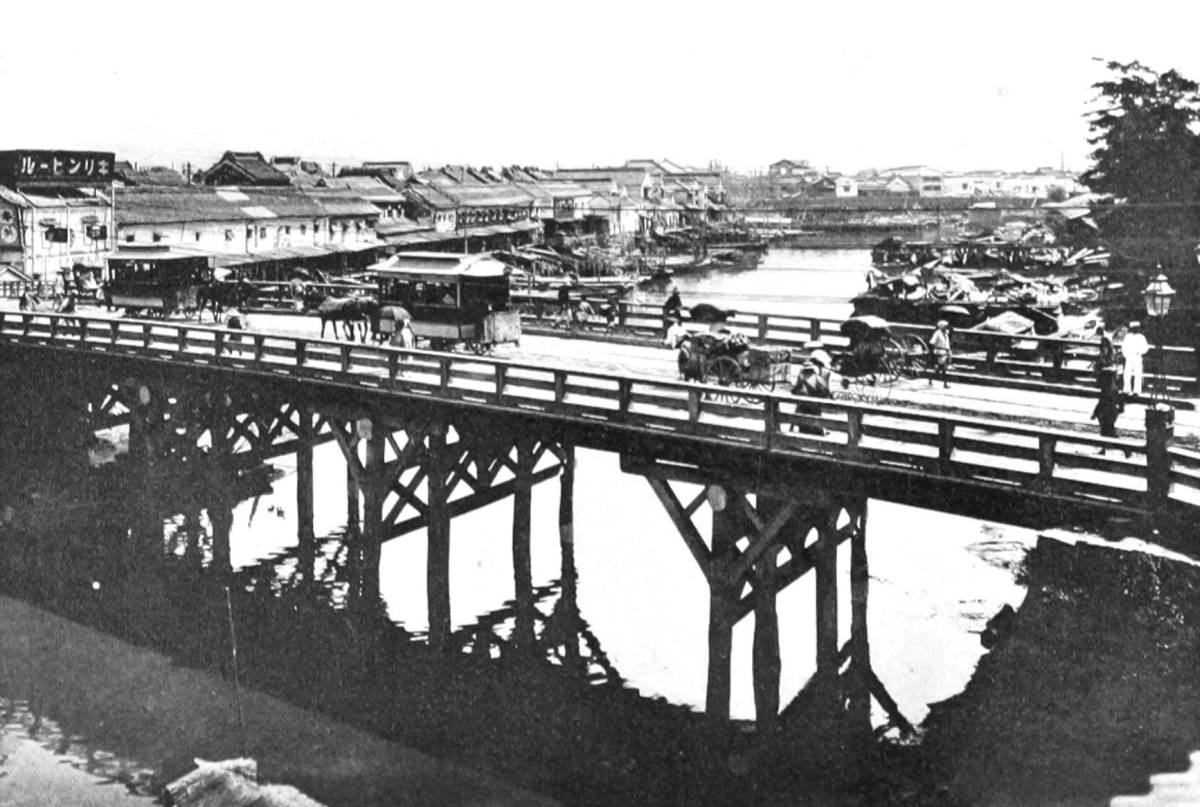
Nihombashi, Tōkyō
Reed: “Japan” (2 vols.).
Dickson: “Japan.”
Aston: “History of Japanese Literature.”
Chamberlain: “Classical Poetry of the Japanese.”
McClatchie: “Japanese Plays.”
Maclay: “Mito Yashiki.”
Kitchin: “Parli, the Last of the Missionaries.”
Gruy: “A Captive of Love.”
Suyematsu: “Genji Monogatari.”
Purcell: “A Suburb of Yedo.”
Harris (Mrs.): “Log of a Japanese Journey.”
Dickins: “Chiushingura, the Loyal League.”
Asakawa: “Early Institutional Life of Japan.”
Mackay: “From Far Formosa.”
Campbell: “Formosa under the Dutch.”
Davidson: “The Island of Formosa.”
Batchelor: “The Ainu of Japan”; “The Ainu and their Folk-lore.”
Kinos[h]ita: “The Past and Present of Japanese Commerce.”
Huish: “Japan and its Art.”
Regamey: “Japan in Art and Industry.”
Okakura: “The Ideals of the East.”
Dresser: “Japan, Its Architecture, Art and Art Manufactures.”
Jarves: “A Glimpse at the Art of Japan.”
Hartman: “Japanese Art.”
Dick: “Arts and Crafts of Old Japan.”
Anderson: “The Pictorial Arts of Japan.”
Audsley and Bowes: “Keramic Art of Japan.”
Alcock: “The Capital of the Tycoon” (2 vols.).
Adams: “History of Japan” (2 vols.).
Black: “Young Japan” (2 vols.).
Dixon: “The Land of the Morning.”
Mossman: “New Japan.”
Hecr: “The Narrative of a Japanese” (2 vols.).
Official: “History of the Empire of Japan”; “Japanese Education.” “Kojiki,”—English version by Chamberlain, Vol. X, Appendix, of the “Transactions of the Asiatic Society of Japan.”
Note C USE OF FIRE-ARMS IN THE EAST
Even the inhabitants of southern India, notwithstanding the long intercourse carried on with them by Arab traders from the Persian Gulf and the Red Sea, and the invasions of their country by Mahometans from the north, seem to have been mainly indebted for their first possession of fire-arms to Europeans; as witness the following extract from Rickard Eden’s translation, first published in 1576, of the “Navigations and Voyages of Lewis Vertomanus, Gentleman, of the city of Rome, to the Regions of Arabia, Egypt, Persia, Syria, Ethiopia, and East India, both within and without the river Ganges, &c., in the year of our Lord, 1503,” contemporary, that is, with the earliest Portuguese expeditions: “Entering into the city of Calicut, we found there two Christians, born in the city of Milan; the one named John Maria, the other Peter Antonio. These were jewellers, and came from Portugal with the king’s license to buy precious stones. When I had found these men I rejoiced more than I am able to express. At our first meeting them, seeing to be white men (for we went naked, after the manner of the inhabitants), I asked them if they were Christians. They said yea. Then said I that I was also a Christian, by the grace of God. Then, taking me by my hand, they brought me to their house, where, for joy of our meeting, we could scarcely satisfy ourselves with tears, embracing and kissing; for it seemed now to me a strange thing to hear men speak mine own language, or to speak it myself. Shortly after, I asked them if they were in favor with the king of Calicut. We are, said they, in great favor with him, and very familiar. Then again I asked them what they were minded to do. We desire, said they, to return to our country, but we know not the means how. Then, said I, return the same way that you came. Nay, said they, that may not be; for we are fled from the Portugals, because we have made many pieces of great ordinance and other guns for the king of Calicut, and therefore we have good cause to fear; and now especially, for that the navy of Portugal will shortly be here. I answered that if I might escape to the city of Canonor, I doubted not but that I would get their pardon of the governor of the navy. There is small hope of mercy, said they, we are so famous and well known to many other kings in the way, which favor the Portugals, and lay wait to take us. In which their talk I perceived how fearful a thing is a guilty conscience, and called to remembrance the saying of the poet:
‘Multa male timeo, qui feci multa proterve.’
That is, ‘I fear much evil because I have done much evil.’ For they had not only made many such pieces of artillery for the infidels, to the great damage of Christians, and contempt of the holy name of Christ and his religion, but had also taught the idolaters both the making and use of them; and at my being there I saw them give a model or mould to certain idolaters, whereby they might make brazen pieces, of such bigness that one of them may receive the charge of a hundred and five tankards (cantoros) of powder. At the same time, also, there was a Jew, which had made a very fair brigantine, and four great pieces of artillery of iron. But God shortly afterwards gave him his due reward; for, when he went to wash him in the river, he was drowned.”
Nor did the two Christians escape much better. The Portuguese commander agreed to pardon them; but, in attempting to escape to him, they were killed. Maffei, in his Indian History, refers to the aid which the native princes derived from these and other Christian renegadoes.
Note D FERNAM MENDEZ PINTO
The ill fortune of which Pinto complained as having pursued him through life did not spare him even after he was laid in the grave, the narrative of his adventures which he left behind him having been assailed by the wits and critics with hardly less ferocity than poor Pinto himself was while alive by the corsairs, infidels, and barbarians, with whom he came in contact. He is indeed chiefly known to English readers by an ill-natured fling of Congreve, who, in his “Love for Love,” makes one of his characters address another in those oft-quoted words: “Ferdinand Mendez Pinto was but a type of thee, thou liar of the first magnitude!” It is said also that Cervantes, three or four years before whose death Pinto’s book was published, speaks of him somewhere as the “prince of liars.” I have not been able to find the passage; but likely enough Cervantes might have been a little vexed to find his “Persiles and Sigismunda,” a romance, under the guise of a book of travels, first published about the time with Pinto’s book, so much outdone by what claimed to be a true narrative of real adventures.
As Pinto, however, in spite of all his ill luck, found, in writing his memoirs, some topics of consolation, so also his character as an author and a narrator has by no means been left entirely in the lurch. Though little read now, he has enjoyed, in his day, a popularity such as few authors attain to. To the first edition of his “Peregrinations,” in the original Portuguese, succeeded others in 1678, 1711, and 1725; and second, third, and fourth editions are compliments which Portugal very rarely pays to her authors. A Spanish translation appeared at Madrid in 1620, in which, however, great and very unwarrantable liberties were taken by the translator. A French translation was published at Paris in 1628, and an English translation in 1663. To the Spanish and French translations defences of Pinto’s veracity are prefixed, and both passed through several editions. Purchas, who gives a synopsis of that part of Pinto’s book relating to China and Japan, strongly defends his credibility, observing that he little spares his own company and nation, but often and eagerly lays open their vices. “I find in him,” says Purchas, “little boasting, except of other nations, none at all of himself, but as if he intended to express God’s glory, and man’s merit of nothing but misery. And, however it seems incredible to remember such infinite particulars as this book is full of, yet an easy memory holdeth strong impressions of good and bad, especially new-whetted, filed, furbushed, with so many companions in misery, their best music in their chains and wanderings being the mutual recounting of things seen, done, and suffered. More marvel is it, if a liar, that he should not forget himself and contradict his own relations.
“I would not have an author rejected for fit speeches framed by the writer, in which many historians have taken liberty; nor if sometimes he doth mendacia dicere (say false things), so as that he doth not mentiri (lie); as I will not sware but of himself he might mistake, and by others be misled. The Chinese might, in relating their rarities to him, enlarge and de magnis majora loqui (exaggerate things really great), so as he still might be religious in a just and true delivery of what himself hath seen, and belei not his own eyes.... All China authors, how diversified in their lines, yet all concur in a certain centre of Admiranda Sinarum (admirable things of the Chinese)[131], which if others have not so largely related as this, they may thank God they paid not so dear a price to see them; and, for me, I will rather believe, where reason evicts not, ejectione firma (with a firm ejection), than seek to see at the author’s rate; and if he hath robbed the altars of truth, as he did those of the Calumplay idols, yet, in Pekin equity, we will not cut off his thumbs (according to Nanquin rigor), upon bare surmise, without any evidence against him.”
The countries in which Pinto’s adventures chiefly lay, still remain, for the most part, very little known; but the more they have been explored, the more has the general correctness of Pinto’s statements been admitted. The editor of the great French collection, “Annales des Voyages,” who gives a full abstract of Pinto, remarks that, having had occasion, in preparing the volume of that work on China, to consult all accessible works about that country, he had been more and more confirmed in his opinion of the reality of Pinto’s adventures and the general correctness of his memory. Rémusat, the eminent Chinese scholar, cites Pinto as good authority for facts, and it was, I believe, by his procurement, or that of the “Société Asiatique,” that the French translation of his travels was reprinted at Paris in 1830.
Note E EARLIEST ENGLISH AND DUTCH ADVENTURERS IN THE EAST—GOA
Prior to the first Dutch and English India voyages, both Englishmen and Dutchmen had reached India, some by way of Lisbon and the Cape of Good Hope, others over land. Pinto speaks of Christians of various nations as among the adventurers with whom he acted. Hackluyt gives (Vol. II) a letter written by Thomas Stevens, an English Jesuit, dated in 1579, at Goa, which he had reached by way of Lisbon and the Cape of Good Hope. This curious letter was addressed by Stevens, who was attached to that very seminary of St. Paul (or the Holy Faith), of which we have had occasion to make mention, to his father in England. Hackluyt also gives in the same volume some very interesting memorials of the adventures of John Newbury, who, attended by Ralph Fitch, Story, a painter, Leeds, a jeweller, and others, was sent over land in 1583, simultaneously with the first English attempts at exploration and settlement in North America, by some London merchants of the Turkey company, as bearer of letters from Queen Elizabeth to Zelabdim Echabar, king of Cambia (Ackbar, the Great Mogul) and to the king of China—both which letters, proposing trade and commerce, Hackluyt gives at length. Newbury proceeded by way of Ormus, which he had visited before, and where he found merchants of almost all nations, not Portuguese only, but Frenchmen, Flemings, Germans, Hungarians, Greeks, Armenians, Turks, Arabs, Jews, Persians, Muscovites, and especially Italians, who seem by this time to have recovered a great share of the trade to the East. By one of these Italians Newbury and his company were accused as spies of Don Antonio (the claimant as against Philip II, of the Portuguese throne, and at that time a refugee in England). The fact also that Drake, in his recent voyage round the world, had, while at the Moluccas, fired two shots at a Portuguese galleon, was alleged against them. They were sent prisoners to the viceroy at Goa; but, by the good offices of the English Jesuit, Stevens, above-mentioned, and of John Huigen Van Linschoten, a Dutchman in the service of the archbishop, they were released on giving sureties not to depart without leave of the viceroy, which sureties they procured by placing goods in the hands of certain parties who became bound for them.
Story, the painter, had indeed previously procured his discharge by joining the Jesuits of St. Paul, where he was admitted as a probationer, and was employed in painting the church. The others, finding that the viceroy would not discharge their sureties, left secretly, or, as Fitch expresses it, “ran from thence,” April, 1585, and, passing to Golconda, travelled north to Agra, then the capital of the Great Mogul. Here Leeds, the jeweller, entered into the Mogul’s service, who gave him “a house, five slaves, and every day six S. S. (qu. sequins?) in money.” Newbury went from Agra to Lahore, expecting to go thence to Persia, and, by way of Aleppo and Constantinople, to reach England; and he sent Fitch meanwhile to Bengal and Pegu, promising to meet him in Bengal in two years in a ship from England. Fitch passed on to Benares, and thence to Bengal, and November 28, 1586, sailed for Pegu, whence the next year he proceeded to Malacca. Returning again, in 1588, to Pegu, he went thence to Bengal in the following November; whence, in February, 1589, he took shipping for Cochin, touching at Ceylon on the way, a “brave island,” where he spent five days. At Cochin he stayed eight months before he could get a passage to Goa. From Goa he proceeded to Ormus, whence, by way of Basora, Mosul, and Aleppo, he reached England April 29, 1591.
Linschoten, mentioned above, who had arrived at Goa in 1583, from Lisbon, as one of the archbishop’s suite, returned to Holland in 1589, where he published his travels in 1595,—the first Dutch account of the East. From him we learn that Story, the painter, after the departure of his companions, grew sick of the cloister of St. Paul, and, as he had not yet taken the vows, left and set up as a painter in Goa, where he had abundant employment, and, “in the end, married a mestizo’s daughter of the town, so that he made his account to stay there while he lived,”—the first permanent English resident in Hindoostan.
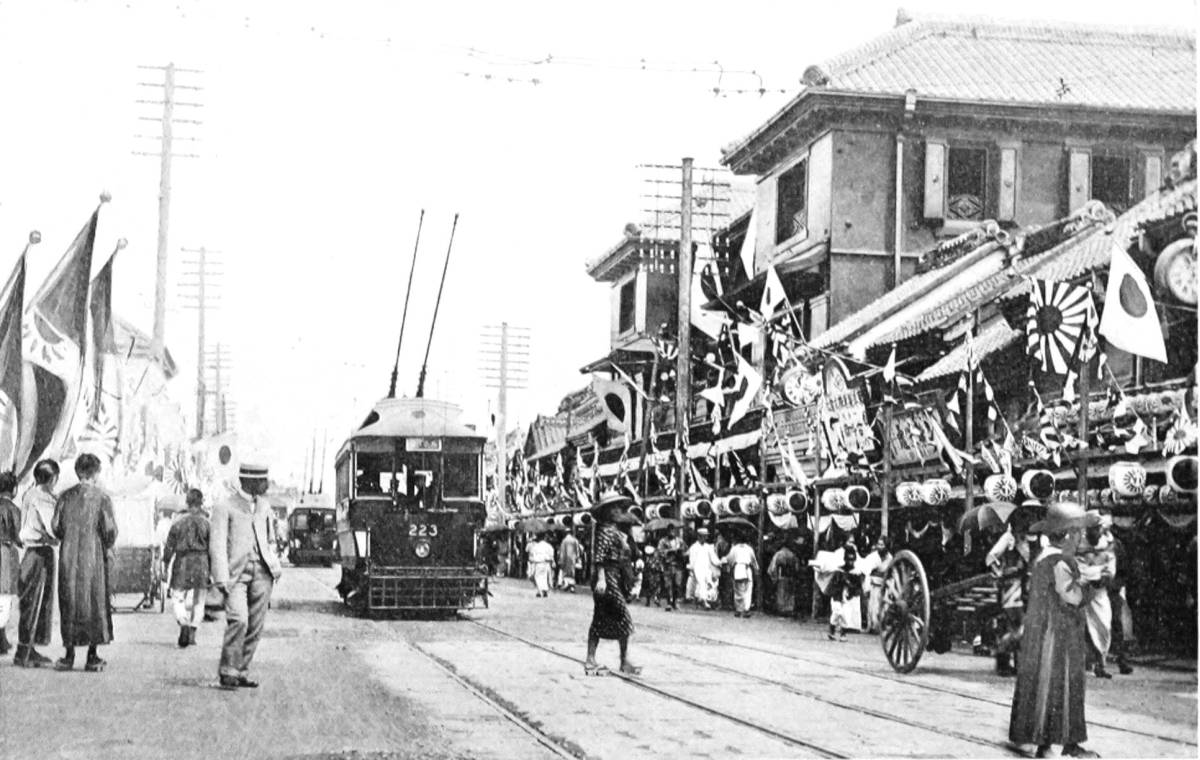
A Modern Street Scene in Tōkyō
There is in the “Asiatic Journal,” for December, 1838, a very striking description of the present ruinous state of the once splendid and magnificent city of Goa. It has been abandoned for Pongi, now known as New Goa, six miles nearer the sea, and the present seat of the shrunken Portuguese viceroyalty. The only inhabitants of Old Goa are a few hundred monks, nuns, and their attendants, attached to the splendid churches and monasteries still standing, among which towers conspicuous the church of the Jesuits, in a beautiful chapel attached to which is the monument of St. Francis Xavier. His body, removed thither from the college of St. Paul, in which it was first placed, reposes upon a sarcophagus or bier of Italian marble, faced with bronzes, representing his missionary labors, and enclosed in a shrine of brass and silver. It is alleged still to be in as good preservation as ever, and is occasionally exhibited in public. The last of these exhibitions was in 1783.
Note F JAPANESE DARING AND ADVENTURE EXTERIOR TO THE LIMITS OF JAPAN
The same Davis who had been Houtman’s pilot in the first voyage to the East Indies sailed from England in 1604, as master of the “Tiger,” a ship of two hundred and forty tons. While on her course from Bantam to Batavia, the “Tiger” encountered a little junk of seventy tons, with ninety Japanese on board, “most of them in too gallant a habit for sailors.” They had left home, as it turned out, in a larger vessel, which had been “pirating along the coast of China and Cambodia,”—much the same business, by the way, in which the “Tiger” was herself engaged,—but, having lost their vessel by shipwreck, they had seized upon this little junk, laden with rice, and were trying to reach Japan in it. In hopes to get some information out of them, they were entertained for two days with “gifts and feasting”; but, at the same time, their junk was searched for treasure which might be concealed under the rice. While part of the “Tiger’s” men were employed in this search, the Japanese made a desperate attempt to get possession of that ship. Davis himself was killed in the first surprise, but the Japanese were finally forced into the cabin, where, by breaking down a bulkhead, some of the ship’s guns, loaded with bullets and case shot, were brought to bear upon them. They disdained to ask quarter, and all perished from effects of the shot except one, who jumped into the sea. The narrative of this affair, given by Purchas (Pilg., Part 1, p. 137), and apparently written by an officer of the “Tiger,” winds up as follows: “The Japanese are not suffered to land in any port of India with weapons, being accounted a people so desperate and daring that they are feared in all places where they come.”
In conformity to this character of the Japanese is the account given by Floris, cape merchant of the “Globe,” an English ship, which touched at Siam in 1612, while performing the voyage mentioned Vol. I, p. 207 of the text. A short time previously, two hundred and eighty Japanese, the slave-soldiers of a principal Siamese noble, who had been put to death by the royal authority, had revenged their master by seizing on the king of Siam, whom they compelled to subscribe to such terms as they dictated, “after which, they had departed with great treasure, the Siamese not being able to right themselves.”[132]
The good service rendered to the Portuguese by Japanese mercenaries at the siege of Malacca, in 1606, is mentioned in the text, Vol. I, p. 182. It appears, from a curious tract concerning the Philippines, preserved by Thevenot, that when De Silva, governor of those islands, undertook, in 1608, to drive the Dutch from the Moluccas, he was obliged to send to Japan for saltpetre, metal, and even for founders to cast cannon. A body of Japanese formed, in 1619, a part of the Dutch garrison in their fort at Jacatara (named about that time Batavia), while besieged by the natives on the island, and blockaded at the same time by an English squadron, as mentioned Vol. I, p. 237 of the text. Of the Japanese settled on the island of Amboyna, and involved with the English in the massacre there, mention is made Vol. I, p. 240. Haganaar, who was at Cambodia in 1637, found among the inhabitants of that city seventy or eighty families of Japanese, whom he describes as not daring to return to their own country, with which, however, they carried on trade, by means of Chinese ships. They were in great favor with the king of Cambodia, to whom they had rendered valiant assistance in suppressing a dangerous rebellion, and were greatly feared by the other inhabitants of the city, whether Chinese or Malays. To this day one of the channels of the great river of Cambodia is known as “Japanese river”—a name given, indeed, on some maps, to the main river itself, and probably taking its origin from this Japanese colony.
The conquest of the Lew Chew [Riūkiū] Islands, by the king of Satsuma, took place about 1610; and, much about the same time, some Japanese made an establishment on the island of Formosa, for the purpose of trading with the Chinese; but in this they were soon superseded by the Dutch. The narrative of Nuyts’ affair, as given in the text (Vol. I, p. 252), is derived from a detailed account appended in “Voyages au Nord,” Tom. IV., to Caron’s Memoir, addressed to Colbert, on opening an intercourse with Japan; but, from a paper embodied in the Voyage of Rechteren (“Voyages des Indes,” Tom. V.), and written, apparently, in 1632, by a person on the spot, it would appear that the conduct of Nuyts, instead of being prompted by personal antipathy, was merely an attempt to exclude the Japanese from the trade with the Chinese, and to engross it for the Dutch East India Company; “a desire good in itself,” so this writer observes, “but which should have been pursued with greater precaution and prudence.”
In the Chinese writings, the Japanese figure as daring pirates; but, as the appellation bestowed on them is equally applied to other eastern and southeastern islanders, it is not so easy to say to whose credit or discredit the exploits referred to by these Chinese writers actually belong.
Note G (From Clement’s “Handbook of Modern Japan”) LIST OF JAPANESE YEAR PERIODS[1]
The names of these periods are made by the various combinations of 68 Chinese words of good omen.
Name. Japanese Era[2] Christian Era
Taikwa 1305 645
Hakuchi 1310 650
(Blank) 1315-1331 655-671
Sujaku 1332 672
Hakuhō 1332 672
Shuchō 1346 686
(Blank) 1347-1360 687-700
Daihō [Taihō] 1361 701
Keiun 1364 704
Wadō 1368 708
Reiki 1375 715
Yōrō 1377 717
Jinki 1384 724
Tembiō 1389 729
Tembiō shōhō 1409 749
Tembiō hoji 1417 757
Tembiō jingo 1425 765
Jingō keiun 1427 767
Hōki 1430 770
Tenō 1441 781
Enriaku 1442 782
Daidō 1466 806
Kōnin 1470 810
Tenchō 1484 824
Jōwa 1494 834
Kajō 1508 848
Ninju 1511 851
Saikō 1514 854
Ten-an 1517 857
Jōgwan 1519 859
Gwangiō 1537 877
Ninna 1545 885
Kwampei 1549 889
Shōtai 1558 898
Engi 1561 901
Enchō 1583 923
Jōhei 1591 931
Tengiō 1598 938
Tenriaku 1607 947
Tentoku 1617 957
Owa 1621 961
Kōhō 1624 964
Anna 1628 968
Tenroku 1630 970
Ten-en 1633 973
Jōgen 1636 976
Tengen 1638 978
Eikwan 1643 983
Kwanna 1645 985
Eien 1647 987
Eiso 1649 989
Shōriaku 1650 990
Chōtoku 1655 995
Chōhō 1659 999
Kwankō 1664 1004
Chōwa 1672 1012
Kwannin 1677 1017
Ji-an 1681 1021
Manjū 1684 1024
Chōgen 1688 1028
Chōriaku 1697 1037
Chōkiū 1700 1040
Kwantoku 1704 1044
Eijō 1706 1046
Tengi 1713 1053
Kōhei 1718 1058
Jiriaku 1725 1065
Enkiū 1729 1069
Jōhō 1734 1074
Jōriaku 1737 1077
Eiho 1741 1081
Ōtoku 1744 1084
Kwanji 1747 1087
Kahō 1754 1094
Eichō 1756 1096
Jōtoku 1757 1097
Kōwa 1759 1099
Chōji 1764 1104
Kajō 1766 1106
Tennin 1768 1108
Ten-ei 1770 1110
Eikiū 1773 1113
Gen-ei 1778 1118
Hōan 1780 1120
[Note 1. From official sources.] [Note 2. Beginning 660 b.c.]
Name. Japanese Era[2] Christian Era
Tenji 1784 1124
Daiji 1786 1126
Tenjō 1791 1131
Chōjō 1792 1132
Hōen 1795 1135
Eiji 1801 1141
Kōji 1802 1142
Ten-yō 1804 1144
Kiū-an 1805 1145
Nimbiō 1811 1151
Kiūju 1814 1154
Hōgen 1816 1156
Heiji 1819 1159
Eiriaku 1820 1160
Ōhō 1821 1161
Chōkwan 1823 1163
Eiman 1825 1165
Nin-an 1826 1166
Ka-o 1829 1169
Jō-an 1831 1171
Angen 1835 1175
Jishō 1837 1177
Yōwa 1841 1181
Ju-ei 1842 1182
Genriaku 1844 1184
Bunji 1845 1185
Kenkiū 1850 1190
Shōji 1859 1199
Kennin 1861 1201
Genkiū 1864 1204
Ken-ei 1866 1206
Jōgen 1867 1207
Kenriaku 1871 1211
Kempō 1873 1213
Jōkiū 1879 1219
Jō-ō 1882 1222
Gennin 1884 1224
Karoku 1885 1225
Antei 1887 1227
Kwangi 1889 1229
Jō-ei 1892 1232
Tempuku 1893 1233
Bunriaku 1894 1234
Katei 1895 1235
Riakunin 1898 1238
En-o 1899 1239
Ninji 1900 1240
Kwangen 1903 1243
Hōji 1907 1247
Kenchō 1909 1249
Kōgen 1916 1256
Shōka 1917 1257
Shōgen 1919 1259
Bun-ō 1920 1260
Kōchō 1921 1261
Bun-ei 1924 1264
Kenji 1935 1275
Kōan 1938 1278
Shō-ō 1948 1288
Einin 1953 1293
Shōan 1959 1299
Kengen 1962 1302
Kagen 1963 1303
Tokuji 1966 1306
Enkiō 1968 1308
Ōchō 1971 1311
Shōwa 1972 1312
Bumpō 1977 1317
Gen-ō 1979 1319
Genkō 1981 1321
Shōchū 1984 1324
Kariaku 1986 1326
Gentoku 1989 1329
Shōkiō [Genkō] 1992 1332
Kemmu 1994 1334
Rekiō 1998 1338[1]
Kōei 2002 1342[1]
Jōwa 2005 1345[1]
Kwan-ō 2010 1350[1]
Bunna 2012 1352[1]
Embun 2016 1356[1]
Kōan 2021 1361[1]
Jōji 2022 1362[1]
Ōan 2028 1368[1]
Eiwa 2035 1375[1]
Kōreki 2039 1379[1]
Eitoku 2041 1381[1]
Shitoku 2044 1384[1]
Kakei 2047 1387[1]
Koō 2049 1389[1]
Engen 1996 1336[2]
Kōkoku 1999 1339[2]
(Note 1: Northern Dynasty.) (Note 2: Southern Dynasty.)
Shōhei 2006 1346[1]
Kentoku 2030 1370[1]
Bunchū 2032 1372[1]
Tenju 2035 1375[1]
Kōwa 2041 1381[1]
Genchū 2044 1384[1]
Meitoku 2050 1390
O-ei 2054 1394
Shōchō 2088 1428
Eikiō 2089 1429
Kakitsu 2101 1441
Bun-an 2104 1444
Hōtoku 2109 1449
Kōtoku 2112 1452
Kōshō 2115 1455
Chōroku 2117 1457
Kwanshō 2120 1460
Bunshō 2126 1466
Ō-nin 2127 1467
Bummei 2129 1469
Chōko 2147 1487
Entoku 2149 1489
Mei-ō 2152 1492
Bunki 2161 1501
Eishō 2164 1504
Dai-ei 2181 1521
Kōroku 2188 1528
Tembun 2192 1532
Kōji 2215 1555
Eiroku 2218 1558
Genki 2230 1570
Tenshō 2233 1573
Bunroku 2252 1592
Keichō 2256 1596
Genna 2275 1615
Kwan-ei 2284 1624
Shōhō 2304 1644
Kei-an 2308 1648
Jō-ō 2312 1652
Meireki 2315 1655
Manji 2318 1658
Kwambun 2321 1661
Empō 2333 1673
Tenna 2341 1681
Jōkiō 2344 1684
Genroku 2348 1688
Hō-ei 2364 1704
Shōtoku 2371 1711
Kiōhō 2376 1716
Gembun 2396 1736
Kwampō 2401 1741
Enkiō 2404 1744
Kwan-en 2408 1748
Hōreki 2411 1751
Meiwa 2424 1764
An-ei 2432 1772
Temmei 2441 1781
Kwansei 2449 1789
Kiōwa 2461 1801
Bunkwa 2464 1804
Bunsei 2478 1818
Tempō 2490 1830
Kōkwa 2504 1844
Ka-ei 2508 1848
Ansei 2514 1854
Man-en 2520 1860
Bunkiū 2521 1861
Genji 2524 1864
Kei-ō 2525 1865
Meiji 2528 1868
(Note 1: Southern Dynasty.)
Note H
(From Clement’s “Handbook of Modern Japan”)
Chronological Table of Emperors and Empresses[1]
1. Jimmu (660-585 B.C.) 2. Suizei (581-549) 3. Annei (548-511) 4. Itoku (510-477) 5. Kōshō (475-393) 6. Kōan (392-291) 7. Kōrei (290-215) 8. Kōgen (214-158) 9. Kaikwa (157-98) 10. Sujin (97-30) 11. Suinin (29 B.C.-70 A.D.) 12. Keikō (71-130 A.D.) 13. Seimu (131-190) 14. Chūai (192-200) [15. Jingō[1] (201-269) 16. Ōjin (270-310) 17. Nintoku (313-399) 18. Richū (400-405) 19. Hanzei (406-411) 20. Ingyō (412-453) 21. Ankō (454-456) 22. Yūryaku (457-479) 23. Seinei (480-484) 24. Kensō (485-487) 25. Ninken (488-498) 26. Muretsu (499-506) 27. Keitai (507-531) 28. Ankan (534-535) 29. Senkwa (536-539) 30. Kimmei (540-571) 31. Bidatsu (572-585) 32. Yōmei (586-587) 33. Sujun (588-592) 34. Suiko (593-628) 35. Jomei (629-641) 36. Kōgyoku (642-645) 37. Kōtoku (645-654) 38. Saimei (655-661) 39. Tenchi (668-671) 40. Kōbun (672) 41. Temmu (673-686) 42. Jitō (690-696) 43. Mommu (697-707) 44. Gemmyō (708-715) 45. Genshō (715-723) 46. Shōmu (724-748) 47. Kōken (749-758) 48. Junnin (758-764) 49. Shōtoku (765-770) 50. Kōnin (770-781) 51. Kwammu (782-806) 52. Heizei (806-809) 53. Saga (810-823) 54. Junna (824-833) 55. Nimmyō (834-850) 56. Montoku (851-858) 57. Seiwa (859-876) 58. Yōzei (877-884) 59. Kōkō (885-887) 60. Uda (888-897) 61. Daigo (898-930) 62. Shujaku (931-946) 63. Murakami (947-967) 64. Reizei (968-969) 65. Enyu (970-984) 66. Kwazan (985-986) 67. Ichijō (987-1011) 68. Sanjō (1012-1016) 69. Go-Ichijō[1] (1017-1036) 70. Go-Shujaku (1037-1045) 71. Go-Reizei (1046-1068) 72. Go-Sanjō (1069-1073) 73. Shirakawa (1073-1086) 74. Horikawa (1087-1107) 75. Toba (1108-1123) 76. Shutoku (1124-1141) 77. Konoye (1142-1155) 78. Go-Shirakawa (1156-1158) 79. Nijō (1159-1165) 80. Rokujō (1166-1168) 81. Takakura (1169-1180) 82. Antoku (1181-1185) 83. Go-Toba (1186-1198) 84. Tsuchimikado (1199-1210) 85. Juntoku (1211-1221) 86. Chūkyō (1222) 87. Go-Horikawa (1222-1232) 88. Shijō (1233-1242) 89. Go-Saga (1243-1246) 90. Go-Fukakusa (1247-1259) 91. Kameyama (1260-1274) 92. Go-Uda (1275-1287) 93. Fushimi (1288-1298) 94. Go-Fushimi (1299-1301) 95. Go-Nijo (1302-1307) 96. Hanazono (1308-1318) 97. Go-Daigo (1319-1338) 98. Go-Murakami (1339-1367) [99. Chōkei (1368-1383)] 100. Go-Kameyama (1383-1392) 101. Go-Komatsu (1392-1412) 102. Shōkō (1413-1428) 103. Go-Hanazono (1429-1464) 104. Go-Tsuchimikado (1465-1500) 105. Go-Kashiwabara (1501-1526) 106. Go-Nara (1527-1557) 107. Ōgimachi (1558-1586) 108. Go-Yōzei (1587-1611) 109. Go-Mizuno-o (1612-1629) 110. Myōshō (1630-1643) 111. Go-Kōmyō (1644-1654) 112. Go-Saiin (1655-1663) 113. Reignen (1663-1686) 114. Higashiyama (1687-1709) 115. Nakano-mikado (1710-1735) 116. Sakuramachi (1736-1746) 117. Momozono (1747-1762) 118. Go-Sakuramachi (1763-1770) 119. Go-Momozono (1771-1779) 120. Kōkaku (1780-1817) 121. Ninkō (1817-1846) 122. Kōmei (1847-1867) 123. Mutsuhito (1867- ) N. B.—Nos. 36 and 38 were the same empress; likewise Nos. 47 and 49. [Note 1: Empresses in Italics. Bracketed names (Nos. 15 and 99) are omitted from some lists.] We append also a list of the sovereigns of the “Northern Court” during the separation, as follows: 1. Kōgon (1332-1335) 2. Kōmyō (1336-1348) 3. Shukō (1349-1352) 4. Go-Kōgon (1352-1371) 5. Go-Enyu (1372-1382) 6. Go-Komatsu (1383-1392) In 1392 Go-Komatsu became emperor over the reunited empire.
[Note 1: Go is a prefix signifying the second of the name.]
Note I OMITTED DOCUMENTS
I. Letter of the Emperor Iyeyasu (Ōgosho-Sama) to the king of England—(James I.).[133]
“Your majesty’s kind letter, sent me by your servant, Captain John Saris (who is the first that I have known to arrive in any part of my dominions), I heartily embrace, being not a little glad to understand of your great wisdom and power, as having three plentiful and mighty kingdoms under your powerful command. I acknowledge your majesty’s great bounty in sending me so undeserved a present of many rare things, such as my land affordeth not, neither have I ever before seen; which I receive not as from a stranger, but as from your majesty, whom I esteem as myself. Desiring the continuance of friendship with your highness, and that it may stand with your good liking to send your subjects to any part or port of my dominions, where they shall be most heartily welcome, applauding much their worthiness, in the admirable knowledge of navigation, having with much facility discovered a country so remote, being no whit amazed with the distance of so mighty a gulf, nor greatness of such infinite clouds and storms from prosecuting honorable enterprises of discoveries and merchandising, wherein they shall find me to further them according to their desires. I return unto your majesty a small token of my love (by your said subject), desiring you to accept thereof as from one that much rejoiceth in your friendship. And whereas your majesty’s subjects have desired certain privileges for trade and settling of a factory in my dominions, I have not only granted what they demanded, but have confirmed the same unto them under my broad seal, for better establishing thereof. From my castle in Suruga, this fourth day of the ninth month, in the eighteenth year of our Dairi, according to our computation. Resting your majesty’s friend, the highest commander in the kingdom of Japan:
“[Signed] Minna. Montono Yer. Ye. Yeas [Minamoto-no-Iyeyasu].”
II. An ordinance of the Emperor of Japan sent to all the governors of the maritime districts to prevent the landing of Portuguese:[134]
“The express and reiterated commandments against the promulgation of the religion and doctrine of the Christians have been duly published and everywhere proclaimed; but it being found that these edicts were not efficacious, they (that is, the Christians) were forbidden to approach the coasts of Japan with their galliots and other sea vessels; and some of them, in contempt of this prohibition, having come to Nagasaki, orders were given, in punishment of this offence, to put them to death. It was commanded, last year, by a special edict, that in case any sea vessel were seen on the coasts of Japan or entered any port, it might be permitted to anchor, with a strong guard on board, till what they proposed was sent to the emperor. This commandment is now revoked; and it is ordered instead that these vessels (that is, Portuguese and Spanish vessels), without hearing a word which those on board have to say, shall be destroyed and burnt, whatever pretence they may set up, and all their crews to the last man be put to death.
“It is also commanded to erect watch-towers on the mountains and all along the coast, and to keep constant watch to discover Portuguese vessels, so that news of their arrival may at once be spread everywhere; and if such a vessel shall first be discovered from a more distant point, it shall be imputed as a crime to those in charge of the nearer watching places, and the governors thus guilty of negligence shall be deprived of their offices. As soon as a Portuguese vessel shall be discovered, news shall be sent express to all the neighborhood, to the governors of Nagasaki and Ōsaka, and to the lord of Arima.
“It is expressly forbidden to attack or molest any Portuguese vessel at sea, but only in some road, port, or haven of the empire, as to which you will conform to the orders that may be sent you from the governors of Nagasaki or the lord of Arima, except where necessity obliges instant action, in which case you will act as already commanded.
“As to vessels of other nations, you will, according to the tenor of former ordinances, visit and examine them; and, after placing a strong guard on board, without allowing a single person to land, send them in all safety to Nagasaki.”
III. Letter from Louis XIV to the Emperor of Japan:[135]
“To the sovereign and highest emperor and regent of the great empire of Japan, over subjects very submissive and obedient, the king of France wishes a long and happy life and a most prosperous reign:
“Many wars, carried on by my ancestors, the kings of France, and many victories gained by them, as well over their neighbors as over distant kingdoms, having been followed by profound peace, the merchants of my kingdom, who trade throughout Europe, have taken occasion very humbly to beg me to open for them the way into other parts of the world to sail and to trade thither like the other European nations; and I have the rather inclined to accede to their request, from its being seconded by the wishes of the princes and nobles among my subjects, and by my own curiosity to be exactly informed of the manners and customs of the great kingdoms exterior to Europe, of which we have hitherto known nothing but from the narratives of our neighbors who have visited the East. I have, therefore, to satisfy as well my own inclination as the prayers of my subjects, determined to send deputies into all the kingdoms of the East; and as my envoy to your high and sovereign majesty, I have selected Francis Caron, who understands Japanese, and who has many times had the honor of paying his respects to your majesty, and of audience from you. For that express purpose I have caused him to come into my kingdom, knowing him very well to be of good extraction, though by misfortunes of war stripped of his property; but re-established by me in his former condition, and even elevated in honor and dignity, to make him more worthy to approach your high and sovereign majesty with all due respect. An additional motive for selecting him was fear lest another person, from ignorance of the wise ordinances and customs established by your majesty, might do something in contravention of them, and so might fall under your majesty’s displeasure; whence I have judged the said Francis Caron the most capable to present my letter and my requests, with such solemnities as might secure for them the best reception on the part of your majesty, and to make known my good affection and my frank desire to grant to your sovereign majesty whatever you may ask of me, in return for the grant of what I ask: which is, that the merchants of my kingdoms, who have united themselves into a company, may have free commerce throughout your majesty’s empire, without trouble or hindrance. I send you the present of trifling value here noted.... I hope it may be agreeable to your majesty, and that some things useful to your majesty may be found in my country, of which I voluntarily leave open and free all the ports.
“At Paris, the twenty-fourth year of my reign [1666].
“The King Louis.”
Note.—What is said above of Caron’s good extraction, of his having lost his fortune by the chances of war, and of his re-establishment in his former position by the favor of the king, was, it is probable, merely intended to reconcile the Japanese to receiving as an envoy from the king of France a man whom they had known only in the—according to their ideas—low character of a Dutch merchant.
In the instructions drawn up for the bearer of this letter, the following curious directions were given as to the answer to be made to the inquiries of the Japanese on the topic of religion: “As to the article of religion you will say, that the religion of the French is of two kinds—one the same with that of the Spaniards, the other the same with that of the Dutch;[136] and that his majesty, knowing that the religion of the Spaniards is disliked in Japan, has given orders that those of his subjects who go thither shall be of the Dutch religion; that this distinction will be carefully attended to; and that no Frenchman will ever be found wishing to contravene the imperial orders.[137] Should they advance as an objection, that the king of France depends upon the Pope, like the king of Spain, you will answer, that he does not depend upon him; that the king of France acknowledges no superior, and that the nature of his dependence upon the Pope may easily be seen in what has happened within two years, in consequence of an outrage at Rome upon the person of his majesty’s ambassador. The Pope not making a sufficiently speedy reparation, his majesty had sent an array into Italy, to the great terror of all the Italian princes, and of the Pope himself, who sent a legate to him charged with the most humble and pressing supplications, whereby his majesty was induced to recall his troops, which already had encamped in the Pope’s territories. So that the king is not only sovereign and absolute in his own domain, but also gives the law to many other potentates; being a young prince, twenty-five years of age, valiant, wise, and more powerful than any of his ancestors; and, withal, so curious that, besides a particular knowledge of all Europe, he eagerly seeks to know the constitution of the other countries of the world.”