Chapter XIV
Reading edition
A HERO'S WELCOME
Rarely has the benefactor of a people been awarded such measure of gratitude as we gave Lafayette, in 1824. Eager crowds flocked into the cities and the villages to welcome this hero. Thousands of children, the boys in blue jackets and the girls in white dresses, scattered flowers before him. If you could get your grandfather or your grandmother to tell you of this visit, it would be as interesting as a storybook.
The conditions in the United States were just right for such an outburst of feeling. Everybody knew the story of the rich French nobleman, who, at the age of nineteen, had left friends, wife, home, and native land, to cast his lot with strange people, three thousand miles away, engaged in fighting for freedom.
It was not until after the battle of Bunker Hill that, at a grand dinner party, the young marquis heard of our struggle for independence. He knew neither our country nor our people, and he did not speak our language; but his sympathies were at once awakened, and he made up his mind to fight for us.
In the spring of 1777, at his own expense, he bought and fitted out a vessel with military supplies, and sailed for America. Seven weeks later, he landed in South Carolina, and at once went to Philadelphia to offer his services to Congress.
He wrote a note to a member of Congress, in which he said, "After the sacrifices I have made, I have the right to exact two favors; one is, to serve at my own expense, the other, to serve as a volunteer."
These manly words and the striking appearance of the young Frenchman, together with letters from Benjamin Franklin, had their effect. His services were accepted, and he was made a major general.
For seven years Lafayette served Washington as an aid and a personal friend. His deep sympathy, his generous conduct, and his gracious ways won all hearts, from the stately Washington to the humblest soldier. Personal bravery on the battlefield at once gained fame for him as a soldier, and made him one of the heroes of the hour. His example worked wonders in getting the best young men of the country to enlist in the army.
During the fearful winter at Valley Forge, the young nobleman suddenly changed his manner of living. Used to ease and personal comforts, he became even more frugal and self-denying than the half-starved and half-frozen soldiers. How different it must have been from the gayeties and the luxuries of the French court of the winter before!
The battle of Monmouth was fought on a hot Sunday in June, 1778. From four o'clock in the morning until dusk, Lafayette fought like a hero. Late at night, when the battle was over, he and Washington lay upon the same cloak, under a tree, and talked over the strange events of the day until they fell asleep.
After the battle of Monmouth, Lafayette went back to France to visit his family, and to plead the cause of his adopted country. He was kindly received at court.
"Tell us all the good news about our dearly-beloved Americans," begged the queen.
To the king, Lafayette spoke plainly: "The money that you spend, Sire, on one of your court balls would go far towards sending an army to the colonies in America, and dealing England a blow where she would most feel it."
In the spring of 1780, Lafayette returned to America with the French king's pledge of help.
At the close of the Revolution, the gallant young marquis went back to France, the hero of his nation, but his interest in America never grew less. When the treaty of peace was signed at Paris, he hired a vessel and hurried it across the ocean, with the good news.
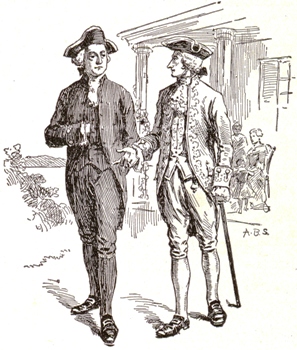
Lafayette's Visit to Washington at Mount Vernon, in 1784
In 1784, the year after peace was declared, Lafayette visited this country for the third time. He made Washington a long visit at Mount Vernon, went over the old battlefields, and met his old comrades.
In 1824, it was known that Lafayette, now an old man, longed to visit once more the American people and the scenes he loved so well. Congress at once requested President Monroe to invite him as the nation's guest.
Forty years had wrought a marvelous change in America. The thirteen colonies, in whose cause the young Frenchman came over the sea, had been united into a nation of twenty-four states. The experiment of laying the foundation of a great republic had proved successful. The problem of self-government had been solved.
The United States had taken its place among the great nations of the world,—a republic of twelve millions of prosperous and happy people. Towns and cities had sprung up like magic. The tide of immigration had taken possession of mountain and valley of what was then the far West.
The people of the young nation were still rejoicing over the glorious victories of Hull, Decatur, Bainbridge, Perry, and other heroes of the sea. Less than ten years before, General Jackson had won his great victory at New Orleans.
Time had dealt heavily with the great generals of the Revolution. Washington had been laid away in the tomb at Mount Vernon, twenty-five years before. Greene, Wayne, Marion, Morgan, Schuyler, Knox, and Lincoln were all dead. Stark had died only two years before. Sumter was still living. Lafayette was the last surviving major general of the Revolution.
The people of this country were familiar with Lafayette's remarkable history since he had left America. They had heard of his lifelong struggle against tyranny in his native land. They knew him as the gallant knight who had dealt hard blows in the cause of freedom. They cared little about the turmoils of French politics, but knew that this champion of liberty had been for five years in an Austrian dungeon.
Do you wonder that the grateful people of the sturdy young republic were eager to receive him as their guest?
In company with his son, George Washington Lafayette, and his private secretary, Lafayette landed at Staten Island, New York, on Sunday, August 15, 1824. He spent the night at the house of Vice President Tompkins. The next day, six thousand citizens came, in a grand procession of gayly decked vessels, to escort the national guest to the city. The cannon from the forts and from the men-of-war boomed a welcome, while two hundred thousand people cheered themselves hoarse.
Within a few days Lafayette went to Washington, and was formally received as the nation's guest by President Monroe, at the White House.
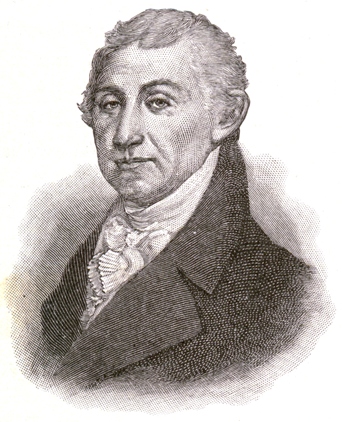
President Monroe, who received the Nation's Guest
As our guest now enters upon an unbroken series of receptions and triumphal ovations in the twenty-four states of the Union, let us take a glimpse at his personal appearance.
Lafayette was tall, rather stout, and had a large head. His face was oval and regular, with a high forehead. His complexion was light, and his cheeks were red. He had a long nose, and well-arched eyebrows overhanging grayish blue eyes. He had lost his hair in the Austrian prison, and in its place wore a curly, reddish brown wig, set low upon his forehead, thus concealing the heavy wrinkles upon his brow.
"Time has much changed us, for then we were young and active," said Lafayette to his old friend, the famous Indian chief Red Jacket, whom he met at Buffalo.
"Alas!" said the aged warrior, who did not suspect the finely made French wig, "time has left my white brother red cheeks and a head covered with hair; but for me,—look!" and, untying the handkerchief that covered his head, the old chieftain showed with a grim smile that he was entirely bald.
The veteran soldiers of the Revolution said they could not see any resemblance to their youthful hero of nearly half a century before. He was always a plain-looking, if not a homely man, but his smile was magnetic, his face singularly attractive, and his manner full of sweet and gracious courtesy. To the people of the Revolution he was always known as "the young marquis."
Lafayette remained in New York four days; but, having promised to attend the graduating exercises at Harvard College, he was forced to hasten to Boston. The trip was made by a relay of carriages, with a large civic and military escort.
Although the party traveled from five o'clock in the morning until midnight, it took five days to reach the city. Every village along the route had its triumphal arch, trimmed with flowers and patriotic mottoes. People came for many miles round, to welcome the great man and his party. At night the long file of carriages was escorted by men on horseback, carrying torches. Cannon were fired and church bells rung, all along the route; while, after dark, huge bonfires were lighted on the hilltops and on every village green.
When Lafayette appeared, there was wild excitement in the staid city of Boston. He rode in an open barouche drawn by six white horses; and was escorted by companies of militia, and by twelve hundred mounted tradesmen, clad in white frocks.
It seems that Dr. Bowditch, the famous mathematician, a man too dignified to smile on ordinary occasions, was caught in the crowd that was waiting for Lafayette. He walked up a flight of steps, that he might with proper dignity let the crowd pass. At the sight of the famous Frenchman, he seemed to lose his senses; for in an instant he was in the front ranks of the crowd, trying to shake hands with the honored guest, and shouting with all his might.
On this trip Lafayette went east as far as Portsmouth, New Hampshire. His tour was then directed by way of Worcester, Hartford, and the familiar scenes of the Hudson, to the South and the Southwest, where he visited all the large cities. From New Orleans, he ascended the Mississippi and the Ohio. He then crossed Lake Erie, and, passing through the state of New York and the old Bay State, visited Portland, Maine. Returning by Lake Champlain and the Hudson, he reached New York in time for the magnificent celebration of the Fourth of July, 1825. The tour was brought to an end in September, by a visit to the national capital.
Lafayette's journey through the country lasted for more than a year, and was one unbroken ovation. Towns and cities all over the land vied with each other in paying him honor. It was one long series of public dinners, patriotic speeches, bonfires, flower-decked arches, processions of school children, and brilliant balls.
The old veterans who had fought under Washington eagerly put on their faded uniforms, and found themselves the heroes of the hour, as they fought their battles over again to crowds of eager listeners. In fact, Lafayette's interviews with the old soldiers and the few surviving officers appear to have been the most interesting and the most pathetic features of the whole journey.
A few weeks after his arrival in this country, Lafayette went to Yorktown, to celebrate the anniversary of that notable victory. He was entertained in the house which had been the headquarters of Cornwallis, forty-three years before. A single bed was found for the marquis; but the little village was so crowded that the governor of Virginia and the great officers of the state were forced to camp on straw spread on the floor.
A big box of candles, which once belonged to Cornwallis's supplies, was found in good order in the cellar. They were lighted and arranged in the middle of the camp, where the ladies and the soldiers danced.
The next day, Lafayette received his callers in the large Washington tent, which had been brought from Mount Vernon for this purpose. Branches cut from a fine laurel in front of the Nelson house were woven into a crown, and placed on the head of the honored guest.
Lafayette at once took it off, and, putting it on the head of his old comrade, Colonel Nicholas Fish, who helped him carry the redoubt at Yorktown, said, "Take it; this wreath belongs to you also; keep it as a deposit for which we must account to our comrades."
"Nick," said Lafayette at another time to this aged man, as the two old friends sailed up the Hudson, "do you remember when we used to slide down that hill with the Newburgh girls, on an ox sled?"
On the trip through the Southwest, one of the grandest ovations took place at Nashville, Tennessee. General Jackson, the hero of New Orleans, with forty veterans of the Revolution, and thousands of people from far and near, gave their guest a rousing welcome.
One old German veteran, who came over with Lafayette in 1777, and who served with him during the whole war, traveled a hundred and fifty miles over the mountains to reach Nashville.
As he threw himself into his general's arms, he exclaimed, "I have seen you once again; I have nothing more to wish for; I have lived long enough."
In the grand procession at New Orleans, one hundred Choctaw Indians marched in single file. They had been in camp near the city for a month, that they might be on hand to see "the great warrior," "the brother of their great father Washington."
It would fill a good-sized book to tell you all the incidents and the courtesies that marked this triumphal tour.
At Hartford, Connecticut, eight hundred school children, who had saved their pennies, gave Lafayette a gold medal, and a hundred veterans of the Revolution escorted him through the city to the boat.
When the grand cavalcade reached Portsmouth, New Hampshire, the rain came down in torrents, but a thousand school children, crowned with flowers, lined the road to greet the far-famed man, and not one left the ranks.
In New York City, there was a firemen's parade with nearly fifty hand engines, each drawn by thirty red-shirted men. A sham house was built and set on fire; then, at the captain's signal, the firemen leaped to the brakes and showed their foreign guest how fire was put out in America.
Sixty Boston boys, from twelve to fourteen years of age, formed a flying artillery company, and, keeping just ahead of the long procession, fired salute after salute as the party neared the city.
While in Boston, Lafayette rode out to Quincy one Sunday, to pay a visit of respect to the venerable John Adams, and dine with him. He was astonished to find this noted man and ex-President of the United States living in a one-story frame house. Although the old statesman was so feeble that his grandchildren had to put the food into his mouth, Lafayette said "he kept up the conversation on the old times with an ease and readiness of memory which made us forget his eighty-nine years."
One beautiful night while Lafayette was the guest of Philadelphia, the whole city was illuminated in his honor. Forty thousand strangers flocked into town for the night. The next morning the mayor called upon the distinguished guest, and told him that although it was "a night of joyous and popular effervescence," perfect order prevailed, and not a single arrest was made.
A word was coined to express this flood tide of popular homage, and, for many years afterwards, whenever special honors were paid to anybody, he was said to be "Lafayetted."
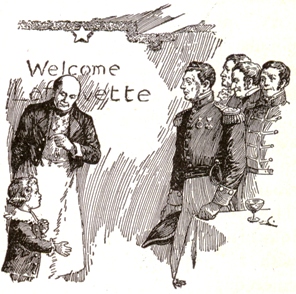
Lafayette's Reception at a Roadside Tavern in Virginia
A touching incident shows the spirit of gratitude which seemed to seize even the humblest of citizens, in trying to please the nation's guest. The party stopped at a small tavern on a byroad in Virginia, to rest the horses. The landlord came out and begged Lafayette to come into his house, if only for five minutes. The marquis, with his usual courtesy, yielded to the request, and entered.
The plain but neat living room was trimmed with fir trees, and upon its whitewashed wall was written, in charcoal, "Welcome, Lafayette." On a small table was a bottle of strong drink, with glasses, as was the custom in those days. There was also a plate of thin slices of bread, all neatly covered with a napkin. The landlord introduced his wife, and brought in his little five-year old boy. The food was served, and the health of the guest was drunk.
The speech for the occasion was recited by the boy: "General Lafayette, I thank you for the liberty which you have won for my father, for my mother, for myself, and for my country."
Lafayette was much moved by the sincerity of it all; and after kissing the boy and getting into his carriage, he said, with tears in his eyes, that it was one of the happiest moments of his life.
While on his way to Yorktown, in October, Lafayette paid a visit to Mount Vernon. Again he passed through the rooms and over the grounds with which he was so familiar. What memories of its owner, his great and faithful friend for twenty-two years, must have crowded upon the old hero!
The remains of Washington then lay in the old tomb near the river. The door was opened, and Lafayette went down into the vault, where he remained some moments beside the coffin of his great chief. He came out with his head bowed, and with tears streaming down his face. He then led his son into the tomb, where they knelt reverently, and, after the French fashion, kissed the coffin.
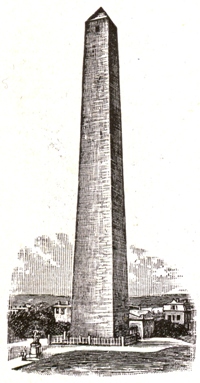
Bunker Hill Monument
Meanwhile, the fiftieth anniversary of the battle of Bunker Hill was near at hand. The prosperous and happy people of the old Bay State were preparing a celebration. The corner stone of Bunker Hill Monument was to be laid by Lafayette.
The weather on this memorable June day was perfect. Never before had such a crowd been seen in Boston.
A Yankee stage driver very aptly said, "Everything that had wheels and everything that had legs used them to get to Boston."
Through the densely crowded streets, a grand civic and military procession of seven thousand people escorted the guests to Bunker Hill.
As one famous man said, "It seemed as if no spot where a human foot could plant itself was left unoccupied."
Two hundred officers and soldiers of the Revolution marched at the head of the procession. One old man, who had been a drummer in the battle of Bunker Hill, carried the same drum with which he had rallied the patriot forces.
How they shouted when the hero of the day came riding slowly along, in an open barouche drawn by six white horses! The women waved their handkerchiefs and the gayly decked school children scattered flowers.
How thrilling it was to see those forty white-haired men, the survivors of Bunker Hill!
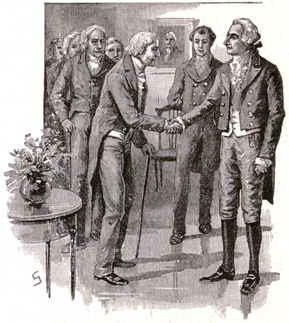
Lafayette's Reception, in Boston, to the Veterans of the Revolution
During the morning, these honored heroes had been presented to Lafayette. He had shaken hands with them, had called them by name, and had spoken a few tender words to each of them, as if to some dear friend.
Not a field officer or a staff officer of the battle was living. Captain Clark, the highest surviving officer, came tottering along under the weight of ninety-five years, to shake hands with the French nobleman.
The young man who introduced the veterans, and who in after years became one of the most honored citizens and mayors of Boston, said of this occasion, "If there were dry eyes in the room, mine were not among them."
What a scene it was for an historical picture, when the brave old minister, the Reverend Joseph Thaxter, who was chaplain of Colonel Prescott's regiment, rose to offer prayer and to give the benediction! As his feeble voice was lifted to ask for the blessing of God, it did not seem possible that fifty years before, on the same spot, this man had stood and prayed for the patriot cause.
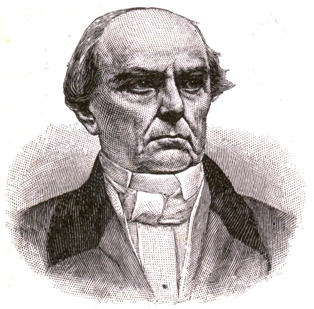
Daniel Webster
Daniel Webster was the orator of the day. A famous Englishman once said that no man could be as great as Webster looked, and on this day the majestic orator seemed to tower above all other men.
Every American schoolboy who has had "to speak his piece" knows by heart the famous passage from this oration, beginning, "Venerable men! you have come down to us from a former generation. Heaven has bounteously lengthened out your lives, that you might behold this joyous day."
Mr. Webster's voice was in such good order that fifteen thousand people are said to have been able to hear him.
At the banquet during the same evening, the great orator said, "I shall never desire to behold again the awful spectacle of so many human faces all turned towards me."
Near the end, Lafayette visited Thomas Jefferson at Monticello. The veteran statesman, now eighty-one years old, drove his old-time friend and guest over to a grand banquet at the University of Virginia. James Madison was present. When the students and the great crowd of people saw Washington's friend seated between the two aged statesmen, a shout went up, the like of which, it was said, was never before heard in the Old Dominion.
When Lafayette arrived in America, in August, 1824, he first visited the national capital, and was formally received at the White House by President Monroe and by many of the great men of the country. On his return to Washington in 1825, he was told that Congress had voted him two hundred thousand dollars and two large tracts of land, for his services during the Revolution.
It was now September, and Lafayette had remained in this country much longer than he had expected. The new President, John Quincy Adams, gave him a farewell dinner at the White House, with a large party of notable men. The President's formal farewell to the country's guest is a classic in our literature.
Amid the blessings and the prayers of a grateful people, Lafayette sailed for France in the new and beautiful frigate Brandywine, which had been built and named in his honor.
For years afterwards, some people used to tell their children, with a peculiar thrill and feeling of awe, that a beautiful rainbow arched the heavens just before Lafayette landed at Staten Island, and that an equally beautiful symbol of peace spanned the broad ocean, as the steamboat moved slowly down Chesapeake Bay, to take the nation's guest on board the Brandywine.
QUESTIONS FOR REVIEW
CHAPTER I THE HERO OF VINCENNES
1. Who was Daniel Boone?
2. When did Boone live?
3. How old was George Rogers Clark at this time?
4. Was Clark brave?
5. Why were the pioneers so long in hearing of the battle of Lexington, which was fought in April?
6. How did Lexington, Kentucky, get its name?
7. What kind of life did the pioneers lead in the wilderness?
8. Did the pioneers have other enemies besides the Indians?
9. Why did Clark go back to Virginia?
10. Who lived north of the Ohio?
11. Why did England try to keep the Americans from going west?
12. Who was Hamilton the "hair buyer"?
13. What made the Indians so hostile to the pioneers?
14. How did Clark plan to defend Kentucky?
15. Where was the Illinois country?
16. Why did Clark go back a second time to Virginia?
17. Did anybody think well of Clark's plan of campaign?
18. How much of an army did Clark have for his campaign?
19. Where did Clark plan to begin his campaign?
20. Why did Clark avoid the Mississippi River?
21. Whom did Clark have as guides?
22. How long a march was it to Kaskaskia?
23. What time of year was it when Clark marched to Kaskaskia?
24. Did Clark have trouble in getting into the town of Kaskaskia?
25. What were the people of Kaskaskia doing?
26. How did Clark introduce himself?
27. Who were the Creoles? (Consult a large dictionary.)
28. Who helped Clark make friends?
29. What sort of man was Clark?
30. What did Hamilton do when he heard of Clark's conquest?
31. Why did not Hamilton march from Vincennes to Kaskaskia?
32. Why did Clark decide to push on to Vincennes?
33. At what time of year did Clark start for Vincennes?
34. What did the little army have for food?
35. What hindered Clark's march?
36. How long did it take to cross the plain of the Wabash River?
37. What is a dugout?
38. How did the army get along in crossing the Horseshoe Plain?
39. Who announced Clark's arrival at Vincennes?
40. At what time did Clark reach the village?
41. Why did not Clark allow his men to storm the fort?
42. How did Clark get possession of the fort?
43. Why was Clark's campaign so important?
44. What states are now in this region of Clark's conquest?
45. Do you think Clark was a hero?
CHAPTER II A MIDWINTER CAMPAIGN
1. Who led the patriots to victory at Saratoga, New York?
2. Why did Arnold's leg deserve to be buried with the honors of war?
3. When the Revolution began, why did Washington wish to attack Canada?
4. Why did Washington like Benedict Arnold?
5. How had Arnold got information about Canada?
6. How did Arnold try to make friends of the Indians?
7. What is wampum?
8. How was the expedition to reach Canada?
9. Why was it easy to get soldiers for this campaign?
10. What time of year was it when the army started?
11. How were the soldiers treated at Newburyport and at Fort Western?
12. Who was Jacataqua?
13. Why did Jacataqua decide to go with the troops?
14. How was the army divided?
15. What trouble did they have with their boats?
16. What is a carrying place?
17. What made the army diminish in numbers?
18. Why was it so hard to reach the Dead River?
19. Why was the ascent of the Dead River so difficult?
20. How many cups of flour in half a pint?
21. What sort of patriot was Colonel Enos?
22. When the flour was gone, what did the army do for food?
23. What did Jacataqua do?
24. What did Arnold do to save his army?
25. What sort of man was Arnold at this time?
26. How far did Arnold have to go to get provisions?
27. When did the army reach Point Levi?
28. What was the condition of the army when it reached Point Levi?
29. What did the Indians do who learned of Arnold's approach?
30. How did Arnold reach the city of Quebec?
31. How did the British treat Arnold and his men?
32. Why did Arnold leave Quebec?
33. What did Sir Guy Carleton do to save Quebec?
34. Why did the patriots wait so long before attacking the city?
35. How was the attack to be made?
36. What happened to Montgomery, Arnold, and Morgan?
37. How did relief finally come to Quebec?
38. How long had this campaign lasted?
CHAPTER III HOW PALMETTO LOGS MAY BE USED
1. Why did the British destroy Norfolk?
2. Why did England wish to punish North Carolina first of all?
3. Why did Sir Henry Clinton delay the attack upon North Carolina?
4. Why did Lord Campbell wish to capture Charleston?
5. What sort of people were the South Carolinians?
6. Why was a fort built on Sullivan's Island?
7. Who was Moultrie?
8. How were the walls of the fort made?
9. How many cannon did Moultrie have?
10. What made the patriots skillful in firing the cannon?
11. What was the difference between General Charles Lee and Governor Rutledge?
12. What sort of man was Colonel Moultrie?
13. How did the British plan to attack the fort?
14. How was the weather on the day of the battle?
15. How many cannon were the British able to fire at one time?
16. What happened to the men-of-war when they were changing their positions?
17. What sort of men were in the palmetto fort?
18. Do you know a good use for palmetto logs?
19. What share in the battle did Sir Henry Clinton and his men have?
20. Did the patriots have plenty of powder?
21. What did McDaniel think about when he was dying?
22. Why did the people of Charleston suppose the fort had surrendered?
23. What did Jasper do to save the flag?
24. Why did not Jasper accept promotion?
25. The people of South Carolina decreed that the fort on Sullivan's Island should forever be called Fort Moultrie. Why do you think they did so?
26. What was the effect of Moultrie's victory?
27. What can you say of Moultrie's after life?
CHAPTER IV THE PATRIOT SPY
1. What condition of affairs was troubling Washington at this time?
2. Were the British well situated at this time?
3. Why did Washington withdraw from New York?
4. What did Washington think should be done?
5. What kind of man was needed to carry out Washington's plan?
6. Why did Knowlton find it hard to get a man for Washington's purpose?
7. What reason did Nathan Hale give for volunteering to act as spy?
8. What kind of home did Hale have?
9. What kind of boy had Hale been?
10. What was Hale doing at the time of the battle of Lexington?
11. What did Hale do when he learned of the battle of Lexington?
12. What kind of life did Hale lead when captain in the army?
13. How did Hale disguise himself?
14. What sort of place was "The Cedars"?
15. Was it wise for Hale to spend the night at "Mother Chick's" tavern?
16. What did the British marines do with Hale?
17. Where did the captain of the Halifax send Hale?
18. Did Hale receive a trial?
19. What do you think of Cunningham?
20. What regret did Hale have?
21. How was Hale executed?
22. Where was Hale buried?
23. Was Hale a patriot?
24. Would you call Hale a hero?
CHAPTER V OUR GREATEST PATRIOT
1. Whom do you consider our greatest patriot?
2. What kind of example has Washington set us?
3. Why do we admire Washington?
4. What was Washington's appearance?
5. What do you know of Washington's strength?
6. What was Washington's favorite amusement?
7. What can you say of Washington's dignity?
8. What was Washington's diet?
9. What do you know of Washington's fondness for fine dress?
10. What can you say of Washington's education?
11. What kind of horseman was Washington?
12. How wealthy was Washington?
13. How did Washington become so wealthy?
14. How much land did Washington have?
15. What did Washington think of slaves?
16. How did Washington treat his slaves?
17. How did Washington's slaves treat him?
18. Why did Washington call his house "a well resorted tavern"?
19. What can you say of Washington's charity?
20. What kept Washington from financial ruin?
21. How did Washington look when at the meeting at Newburgh, New York?
22. How was the first President of the United States dressed when he made his formal visit to Congress?
23. What can you say of Washington's gravity?
24. What do you know of President Washington's public receptions?
25. How did the guests enjoy President Washington's grand dinners?
26. In what did Washington's greatness consist?
CHAPTER VI A MIDNIGHT SURPRISE
1. What sort of general was Washington?
2. What did General Clinton think of Washington?
3. What part of the country did Washington need to protect?
4. What did the British do in May, 1779?
5. Why was it important for the Americans to have possession of King's Ferry?
6. Where did the patriot army now take up its quarters?
7. How did the British soldiers act in Connecticut?
8. Why did General Clinton send out raiders?
9. Why did not Washington follow up Clinton's raiders?
10. What did Washington decide to do?
11. What kind of place was Stony Point?
12. Who had possession of Stony Point?
13. How was Stony Point defended?
14. How many soldiers were in the garrison at Stony Point?
15. What does Washington Irving say of Stony Point?
16. What name did the British give to Stony Point?
17. Who led the attack on Stony Point?
18. How old was General Anthony Wayne at this time?
19. How did Wayne look?
20. Why was Wayne called "Mad Anthony"?
21. What sort of soldier was Anthony Wayne?
22. What was Washington's plan of attack?
23. At what hour was the attack to be made?
24. What weapons were to be used in attacking Stony Point?
25. How many men were chosen to go to Stony Point?
26. What time of year was it now?
27. Why was the soldier put to death for loading his gun?
28. What sort of road was it to Stony Point?
29. When did the men learn where they were going?
30. What was the watchword?
31. What did Wayne write to his friend?
32. What did Pompey do?
33. How did Wayne divide his army to make the attack?
34. What is a "forlorn hope"? (Consult a large dictionary.)
35. How did the Americans show their good discipline?
36. What are pioneers? (Consult a large dictionary.)
37. What was the effect of having Colonel Murfree and his men appear in front of the fort?
38. How long did the fight last?
39. How many of the British escaped from Stony Point?
40. Why did not Washington hold Stony Point?
41. What effect did this victory have on the American soldier?
42. What did the British think of the "rebels"?
43. How did General Clinton take it all?
CHAPTER VII THE DEFEAT OF THE RED DRAGOONS
1. How did the patriots of the South get on in 1780?
2. What have we already learned about Sir Henry Clinton? (See the Index.)
3. What were General Gates's "Northern laurels"? (See Chapter II.)
4. What sort of man was Gates? (Compare Chapter VIII.)
5. What effect did the crushing blows of the British have on the Southern patriots?
6. What orders did Tarleton and Ferguson receive from Lord Cornwallis?
7. What sort of man was Ferguson?
8. What threat did Ferguson send to the backwoodsmen?
9. What was the character of the Franklin and Holston settlers?
10. What is the name of the state that grew out of the Franklin and Holston settlements?
11. What have we already learned about the Holston settlements? (See Chapter I.)
12. What had become of the lawless men of the Franklin and Holston settlements?
13. What did the people do when they heard Ferguson's threat?
14. Where was the money got to buy supplies for the army?
15. What do you know of the gathering at Sycamore Shoals?
16. How were the backwoodsmen dressed?
17. What arms did the backwoodsmen have?
18. Who was Samuel Doak?
19. Why were the bands of pioneers put under one supreme commander?
20. Why did the backwoodsmen not find Ferguson at Gilberttown?
21. What kind of spirit did the pioneers show in their pursuit of Ferguson?
22. How far away were the patriots when Ferguson camped at King's Mountain?
23. Why did Ferguson choose King's Mountain for his camp?
24. How long were the riflemen in getting from Cowpens to King's Mountain?
25. What was the riflemen's plan of attack?
26. How was Ferguson killed?
27. Who succeeded Ferguson in command?
28. Why was this battle so fierce?
29. What was the effect of the victory at King's Mountain?
CHAPTER VIII FROM TEAMSTER TO MAJOR GENERAL
1. What have we already learned of Gates? (See the Index.)
2. Where was Daniel Morgan's home?
3. What kind of education did Morgan have?
4. Why was Morgan well thought of by the village people?
5. What kind of times were at hand?
6. Why did Morgan wish to fight the bully?
7. What is a drumhead court-martial? (Consult a large dictionary.)
8. What do you know of Morgan's strength?
9. Why did Morgan stop driving army wagons?
10. Why did Governor Dinwiddie object to promoting Morgan?
11. How did Morgan escape from the Indian?
12. What effect did the army life have on Morgan?
13. What can you say of Morgan's marriage?
14. What do you know of Morgan's religious life?
15. When was Morgan appointed captain?
16. How many men answered Morgan's call?
17. How long a march was it to Boston?
18. When was Morgan made a colonel?
19. What kind of regiment did Morgan command?
20. What was the duty of Morgan and his sharpshooters?
21. What have we already learned about Morgan at Saratoga, New York? (See Chapter II.)
22. How did the Hessians like Morgan's riflemen?
23. What did Burgoyne think of Morgan's regiment?
24. Why did Morgan leave the army for a while?
25. Why did Morgan return to the army?
26. When was Morgan made a brigadier general?
27. What do you remember about King's Mountain? (See the last half of Chapter VII.)
28. Why did the battle of Cowpens make Morgan so famous?
29. What does John Fiske say of this battle?
30. What do you know of Colonel Tarleton? (See Chapter VII.)
31. Where did Morgan get the names "old wagoner," "wagoner," and "teamster"? (See earlier in this chapter.)
32. Why did not Morgan meet Tarleton at once?
33. Why did Morgan choose Cowpens for his battle ground?
34. What did Tarleton do when the spy told him that Morgan had halted?
35. What was the condition of Morgan and his men when Tarleton appeared?
36. What was the condition of Tarleton's soldiers when they began the battle?
37. What did Tarleton do when defeat came?
38. What did the young ladies say to Tarleton?
39. How did Morgan outwit Lord Cornwallis?
40. Why did Morgan again retire from service?
41. When did Morgan again take part in the war?
42. What do you know about Wayne? (See Chapter VI.)
43. How was Morgan remembered by Washington and other leaders?
44. In how many battles did Morgan take part?
45. What was Morgan besides being a great soldier?
46. What was Morgan's success due to?
47. How is Morgan's valor commemorated?
CHAPTER IX THE FINAL VICTORY
1. What have you already learned about General Greene? (See Chapter VIII.)
2. What was the condition of Lord Cornwallis after his victory over Greene?
3. What did Cornwallis now do?
4. Where is Petersburg, Virginia? (See the map in Chapter VII.)
5. What was the nationality of Lafayette?
6. Where is Yorktown? (See the map in Chapter VII.)
7. Where was Washington at this time?
8. Where was the main part of the patriot army at this time?
9. What was Washington planning to do?
10. Who was Count de Grasse?
11. Why did news travel so slowly in those days?
12. Why did Washington need a fleet?
13. What did Washington hope to do with the assistance of the French fleet?
14. Where was Sir Henry Clinton at this time?
15. Why did Washington send troops to Long Island?
16. Why was the young minister sent through the Clove?
17. How were the Continental and French troops received at Philadelphia?
18. How large an army did Washington have in Virginia?
19. What have we already learned of Rochambeau? (See earlier in this chapter.)
20. When did Sir Henry Clinton begin to open his eyes?
21. How did the British fleet fare at Chesapeake Bay?
22. Why did not Lord Cornwallis retreat from Yorktown?
23. Why did the patriots hasten the siege of Yorktown?
24. What last attempt did Lord Cornwallis make?
25. Where did Lord Cornwallis have his headquarters?
26. What kind of man was Governor Nelson?
27. Where did Lord Cornwallis finally make his headquarters?
28. What message did Sir Henry Clinton send Lord Cornwallis?
29. How long did the siege of Yorktown continue?
30. Why did Lord Cornwallis wish a truce for so long a time?
31. What was Washington's reply to Lord Cornwallis?
32. How many soldiers were there in Cornwallis's army?
33. Why did not Cornwallis take part in the surrender?
34. Whom did Washington send to receive Cornwallis's sword?
35. Why did the armies hurry away from Yorktown?
36. How might Sir Henry Clinton have changed the history of Yorktown?
37. How did the people get news of the surrender?
38. How was the news received by the prime minister of England, and by the king?
39. What did King George say of the Yankees?
40. How is the surrender of Cornwallis commemorated?
CHAPTER X THE CRISIS
1. What battle began the war of the Revolution? (See Chapter I.)
2. How long did the war last?
3. What did Thomas Paine, the author of the pamphlet called "Common Sense," say of the Revolutionary War?
4. What does John Fiske say of our condition after peace was made?
5. Why did the colonies band together in 1774?
6. Why did the Continental Congress decline in power?
7. What is a federation? (Consult a large dictionary.)
8. Why did the people care so little about a federation, or federal government?
9. What did Washington say in his letter to the colonies?
10. What authority did the Continental Congress have?
11. What kind of men were delegates to the Continental Congress?
12. How long did the Continental Congress continue to act?
13. What was done by the Continental Congress?
14. What is a privateer? (Consult a large dictionary.)
15. What can you say of the Articles of Confederation?
16. What power did the Articles of Confederation grant to each state?
17. What power did Congress have under the Articles of Confederation?
18. How obedient were the states to the Articles of Confederation?
19. What was the condition of paper money in 1780?
20. How long had a soldier to serve before he could buy a bushel of wheat?
21. How did the states begin to treat each other?
22. What can you say of imprisonment for debt?
23. How did Washington and others begin to work out the problem of our national existence?
24. How successful was the meeting at Annapolis?
25. What further troubles occurred in 1786?
26. How was England affected by our troubles?
27. What prediction about our nation was made in Parliament?
28. What opinion of us did Frederick the Great, King of Prussia, have?
29. What did the people of the several states at last begin to think?
30. What state took the lead in sending delegates to Philadelphia?
31. How many states were represented at Philadelphia?
32. What kind of men were sent to the Philadelphia convention?
33. Who, next to Washington, was the most noted man at the Philadelphia convention?
34. Can you name some others of the delegates to the Philadelphia convention?
35. Why did not Thomas Jefferson, John Adams, Patrick Henry, and Samuel Adams attend the Philadelphia convention?
36. What do you know of Nathanael Greene? (See Chapter VIII.)
37. Who was chosen president of the Philadelphia convention?
38. How long did the Philadelphia convention continue in session?
39. How did some of the delegates wish to deal with the great problem of the national government?
40. How did Washington convince the delegates of their duty?
41. By what means did the delegates at Philadelphia succeed in agreeing on a form of federal government?
42. What is a compromise? (Consult a large dictionary.)
43. What was the first compromise in framing the Constitution?
44. What was the second compromise in framing the Constitution?
45. What question about the slaves arose?
46. How was it decided to count the slaves?
47. How did Washington and others feel about the second compromise?
48. What was the cause of the third compromise?
49. What was the third compromise?
50. What did Washington think of the Constitution?
51. What was Franklin's opinion of the Constitution?
52. When was the Constitution to become law?
53. To what two political parties did the Constitution give rise?
54. What did many of the people throughout the country think of the Constitution?
55. Which was the first state to sign the Constitution?
56. Why was the Fourth of July in 1788 so glorious?
57. Who was the first President, and who the first Vice President, of the new nation?
58. What did Gladstone say of the Constitution?
59. Why do we owe such a debt of gratitude to the builders of "the good ship Constitution"?
CHAPTER XI A DARING EXPLOIT
1. Who were the Barbary pirates?
2. Why did we buy the good will of the Barbary pirates?
3. What is blackmail? (Consult a large dictionary.)
4. What did Thomas Jefferson think should be done concerning the Barbary pirates?
5. Who was sent to the Mediterranean Sea?
6. What was the exploit of the Enterprise?
7. What is a pasha? (Consult a large dictionary.)
8. What happened to the frigate Philadelphia and her crew?
9. What did Commodore Preble do when the Philadelphia was captured?
10. Why was Stephen Decatur chosen to destroy the Philadelphia?
11. What was Decatur's plan for destroying the Philadelphia?
12. What is a ketch? (Consult a large dictionary.)
13. How many men volunteered for the dangerous undertaking?
14. What kind of time did Decatur and his men have off the shore of Tripoli?
15. What happened to the Siren?
16. How was the Philadelphia guarded?
17. What was the object in dragging sails and buckets in the water?
18. How did Decatur deceive the pirate officer?
19. How did the pirates discover the Americans?
20. What kind of fighters were the Tripolitan pirates said to be?
21. How long did the fight on board the Philadelphia last?
22. How many of Decatur's men were injured?
23. What did the Americans do with the Philadelphia?
24. Why were the Americans obliged to burn the Philadelphia? (Read earlier in this chapter.)
25. How successful were the pirates in firing at the Americans?
26. What did the sailors say afterwards about the burning ship?
27. Why was it the Americans were so successful in burning the Philadelphia?
28. What did Nelson say of Decatur's deed?
29. What promotion did Decatur receive?
CHAPTER XII "OLD IRONSIDES"
1. What did the Secretary of the Navy in 1833 intend to do with the Constitution?
2. Why did Congress decide to rebuild the Constitution?
3. What troubles did we have with other nations during the first twenty-five years of our national life?
4. Why was Washington instructed to add six war ships to our navy?
5. Where was the Constitution built?
6. How does the Constitution compare in size with our modern war ships?
7. Why did England model some of her ships after "Old Ironsides"?
8. When was the Constitution launched?
9. What success did the Constitution have in fighting with Tripoli?
10. How did Commodore Preble treat Decatur after his capture of the Tripolitan gunboats?
11. How did Captain Isaac Hull get away from the British fleet?
12. How did Captain Hull win a hat from Captain Dacres?
13. How is the Constitution said to have received the name "Old Ironsides"?
14. What kind of welcome did Boston have in store for Captain Hull?
15. What was the hardest battle that "Old Ironsides" had?
16. What was done with the wheel of the Java?
17. Why was not a new wheel put on "Old Ironsides"?
18. How did Captain Bainbridge treat the dying Captain Lambert?
19. What was the Constitution's last battle?
20. What is said of Captain Stewart's seamanship in the last battle of "Old Ironsides"?
21. When was "Old Ironsides" taken to Newport?
22. How was "Old Ironsides" used at Newport?
23. What is a receiving ship? (Consult a large dictionary, under the word "receive" or "receiving.")
24. When was "Old Ironsides" taken to Charlestown?
25. How much of the original ship Constitution still exists?
26. Why were the battles of "Old Ironsides" so important to us as a nation?
27. Why should we continue to preserve "Old Ironsides"?
CHAPTER XIII "OLD HICKORY'S" CHRISTMAS
1. Why were both England and France so jealous of us a century ago?
2. What did England and France do to our merchantmen?
3. Why did we not declare war on Great Britain before 1812?
4. How did our navy compare with England's in 1812?
5. What was England's plan in 1814?
6. What was the character of New Orleans?
7. Who was the "Iron Duke"? (Wellington.)
8. When did the British fleet arrive at the delta of the Mississippi?
9. Why was General Jackson so busy just before Christmas?
10. How was the alarm sounded to the people of New Orleans?
11. Who answered Jackson's call for assistance?
12. Who came from outside New Orleans to help defend the city?
13. How did the riflemen look as they came into town?
14. Why did Jackson plan to attack the British at once?
15. What did the war schooner Carolina do?
16. How were the British reënforced on Christmas day?
17. What did Sir Edward Pakenham think of the task before him?
18. How did Pakenham begin his operations?
19. How did Sir Edward fare when he marched out to get a look at the Americans?
20. What were Jackson's first intrenchments made of?
21. What did Pakenham use for making a redoubt?
22. What happened to Jackson's defenses?
23. Of how much use was Pakenham's redoubt?
24. What did the British now decide to do?
25. What was Jackson's main line of defense?
26. How early did Jackson's men go to their posts on that last Sunday morning?
27. What happened to Sir Edward Pakenham, and to Generals Gibbs and Keane?
28. Why did the British lose so many officers in the battle?
29. How long did the engagement on Sunday morning continue?
30. How many men did the British have in the final action, and how many did the Americans have?
31. How many men did the British lose in the final action, and how many did the Americans lose?
32. What did General Lambert do after the battle?
33. How was "Old Hickory" honored?
34. Why is the victory a sad one to think of?
35. What was the result of the war of 1812?
CHAPTER XIV A HERO'S WELCOME
1. What kind of welcome did we give Lafayette in 1824?
2. Who was Lafayette?
3. Why did Lafayette first come to this country?
4. When did Lafayette first come to this country?
5. Why did Congress accept Lafayette's services?
6. What was the effect of Lafayette's manner and example?
7. How did Lafayette live at Valley Forge?
8. What did Lafayette do on his return to France?
9. What did Lafayette do when peace was declared?
10. When did Lafayette make his third trip to this country?
11. How had our country changed when Lafayette came in 1824?
12. What had been Lafayette's career in his own country?
13. Why did it take Lafayette so long to go from New York to Boston?
14. Who was Dr. Bowditch?
15. How much of our country did Lafayette visit?
16. What did Lafayette do with the laurel wreath presented to him at Yorktown?
17. Can you describe some of the incidents of Lafayette's visit?
18. What did "Lafayetted" mean?
19. What occurred at the tavern in Virginia?
20. How did Lafayette show his affection for Washington?
21. What can you say of the scenes connected with the fiftieth anniversary of the battle of Bunker Hill?
22. Who was the orator at the laying of the corner stone of Bunker Hill Monument?
23. How was Lafayette received at the University of Virginia?
24. How did Congress show its gratitude for Lafayette's services during the Revolution?
25. What was the last honor shown the departing guest? (The frigate on which Lafayette sailed for France was named in commemoration of Lafayette's gallantry at the battle of the Brandywine. Although wounded in the leg, Lafayette kept the field till the battle was over. To the surgeon who cared for the injured Lafayette, Washington said, "Take care of him as though he were my son.")
PRONUNCIATION OF PROPER NAMES
A
Abigail, ab'i-gl.
Adair, a-dair'.
Algerine, al-je-reen'.
Alleghanies, al'e-ga-nies.
André, an'dray.
Annapolis, an-nap'o-lis.
B
Bailey, bay'ly.
Bainbridge, bain'bridge.
Barbary, bar'ba-ry.
Belgium, bel'ji-um.
Borgne, born.
Brandywine, bran'dy-wine.
Brazil, bra-zil'.
Burgoyne, bur-goin'.
C
Cahokia, ka-ho'ki-a.
Calhoun, kal-hoon'.
Carleton, karl'ton.
Carolina, kar-o-li'na.
Catalano, kah-tah-lah'no.
Catawba, ka-taw'ba.
Champlain, sham-plain'.
Chaudière, sho-de-air'.
Chesapeake, ches'a-peek.
Connecticut, kon-net'i-kut.
Cornwallis, korn-wall'iss.
Creole, kre'ole.
Cunningham, kun'ing-am.
Cyane, see-ann'.
D
Dacres, day'kers.
Dearborn, deer'burn.
Decatur, de-kay'tur.
De Grasse, de-grass'.
Detroit, de-troit'.
Dickinson, dik'in-son.
Dinwiddie, din-wid'y.
F
Farragut, far'a-gut.
G
Gardiner, gard'ner.
Gerry, ger'y (g as in get).
Ghent, jent.
Gibault, zhe-bo'.
Gibraltar, ji-brall'tar.
Gladstone, glad'ston.
Gloucester, gloss'ter.
Gouverneur, goo-ver-ner'.
Grier, greer.
Guerrière, ger-i-air' (g as in get).
Guilford, gil'ford (g as in get).
H
Hessians, hesh'ans.
I
Illinois, il-i-noi' or il-i-noiz'.
J
Jacataqua, ja-cat'a-quah.
K
Kaskaskia, kas-kas'ki-a.
Keane, keen.
Kennebec, ken-e-bek'.
L
Lafayette, lah-fa-yet'.
Lafitte, lah-fit'.
Levant, le-vant'.
Louisiana, loo-eez-i-an'a.
Louisville, loo'is-vill or loo'y-vill.
M
McDonough, mak-don'oh.
Madeira, ma-de'ra or ma-day'i-ra.
Maltese, mall-tees' or mall-teez'.
Marseillaise, mar-se-layz'.
Maryland, mer'i-land.
Mediterranean, med-i-ter-ra'ne-an.
Megantic, me-gan'tic.
Meigs, megs.
Montaigne, mon-tain'.
Monticello, mon-te-sel'lo.
Montreal, mont-re-all'.
Morocco, mo-rock'o.
Moultrie, moo'try or mool'try.
N
Napoleon, na-po'le-on.
Newburyport, new-ber-y-port'.
Newfoundland, new'fund-land.
Nolichucky, nol-i-chuck'y.
Norridgewock, nor'ij-walk.
O
O'Hara, o-hah'ra.
P
Pakenham, pak'en-am.
Portsmouth, ports'muth.
Preble, preb'el.
Prussia, prush'a.
Q
Quebec, kwee-bek'.
Quincy, kwin'zy.
R
Randolph, ran'dolf.
Rappahannock, rap-a-han'ok.
Rawdon, raw'don.
Rennie, ren'y.
Revere, re-veer'.
Rochambeau, ro-sham-bo'.
S
St. Louis, saint loo'is or saint loo'y.
Saratoga, sar-a-to'ga.
Sartigan, sar'ti-gan.
Schuyler, sky'ler.
Sevier, se-veer'.
Shawnees, shaw-neez'.
Staten, stat'en.
T
Tallmadge, tal'mij.
Ticonderoga, ti-kon-de-ro'ga.
Tilghman, till'man.
Tompkins, tomp'kins.
Tripoli, trip'o-ly.
V
Ville de Paris, vill de (e as in her) pah-ree'.
Villeré, vil-ray'.
Vincennes, vin-senz'.
W
Wabash, waw'bash.
Watauga, wa-taw'ga.
Wayne, wain.
Worcester, woos'ter (oo as in foot).
APPENDIX
BOOKS FOR REFERENCE AND READING IN THE STUDY OF AMERICAN HISTORY
This book is designed to be used either before the formal text-book on American history is begun, or to be read in connection with it. It is also intended to serve as a convenient basis for more extended work on the part of both teacher and pupils. Hence, to the reading of the preceding chapters should be added a systematic course in supplementary reading.
The following plan is suggested, which may be readily modified to meet the needs of any particular class of pupils:
REFERENCE BOOKS FOR TEACHERS
Two books are of special value to teachers. These are Channing and Hart's Guide to American History (Ginn & Company, $2.00), and Gordy and Twitchell's Pathfinder in American History (Lee & Shepard, $1.20. In separate parts, Part I, 60 cents; Part II, 90 cents).
These two works are replete with suggestions, hints, and helps on collateral study, with numerous references, detailed lists of topics, and a wide range of other subjects which make them indispensable to the teacher of American history.
NOTE.—The subject of reference books on American history is treated thoroughly in Montgomery's American History (see "Short List of Books," page xxxiii in Appendix), and Fiske's History of the United States (see Appendix D, page 530, Appendix E, page 539, and Appendix F, page 542).
For original materials pertaining to the colonial period and the Revolution, admirably edited for school use, consult Hart's "Source-Readers in American History": No. 1, Colonial Children; No. 2, Camps and Firesides of the Revolution; No. 3, How our Grandfathers Lived.
In searching libraries for books on the Revolution, the teacher will find Winsor's Reader's Handbook of the American Revolution very useful.
SCHOOL TEXT-BOOKS FOR READING AND REFERENCE
Pupils should have easy access, by means of the school library or otherwise, to a few of the formal school text-books on American history. In connection with this book, Montgomery's Leading Facts of American History, Fiske's History of the United States, Eggleston's History of the United States, and Steele's Brief History of the United States (usually known as "Barnes's History") are especially valuable.
If less difficult and much smaller works are thought desirable, the following five books are recommended: Montgomery's Beginner's American History, McMaster's Primary History of the United States, Tappan's Our Country's Story, Thorpe's Junior History of the United States, and Eggleston's First Book in American History.
These books are useful for additional topics, for dates, maps, illustrations, reference tables, and for filling in subjects which do not come within the scope of this book.
Pupils should also have easy reference to books from which topics may be read, or from which may be read sparingly passages indicated by the teacher. Some of the books which have been suggested are more useful on account of their interesting style than for strict historical accuracy. Read the designated works not as a whole, but only by topics or by selections. They will do much to awaken and maintain a lively interest in American history.
READING AT HOME
While the study of this book is in progress, it is well for the pupils to limit their home reading to such books as bear directly upon the subject. Under this head we have suggested several books which belong to the "storybook" order. Wholesome books of fiction and semifiction may certainly do much to stimulate and hold the attention of young students of American history. Thus, Churchill's Richard Carvel and Cooper's Pilot furnish stirring scenes in the career of Paul Jones.
With the home reading, as with all other collateral reading, the teacher should exercise a careful supervision.
The work in history should be enlivened by reading occasionally, before the class or the school, poems or prose selections which bear directly upon the general topic under consideration.1 For instance, in the appropriate chapters Finch's well-known poem, "Nathan Hale," Simms's "Ballad of King's Mountain," and Holmes's "Old Ironsides" may be read.
1 For a list of books which may be classed as useful under the preceding paragraphs, see Blaisdell's Story of American History, pp. 431-434.
A TOPIC BOOK, OR NOTEBOOK
Teacher and pupil should appreciate the scope and the usefulness of a topic book, or notebook. By this is meant a blank book of a convenient size, with semiflexible or board covers, and of at least forty-eight pages. Into this blank book should be written carefully, with ink, brief notes, as the several chapters of this book are read or studied. It may well be a kind of enlarged diary of the pupil's work.
Make brief notes of the various books read in whole or in part; of topics not treated in this book but discussed in the class, such as the treason of Benedict Arnold, the battle of Bennington, etc.; of references to new books to be reserved for future reading; and of other subjects which will readily suggest themselves.
This notebook should be enlivened with inexpensive photographic copies (sold for about one cent each) of famous pictures illustrating important events in American history. Catalogues giving the exact titles, the cost, and other details are frequently advertised.
The notebook may be illustrated with photographic reproductions of such works as Stuart's "Washington"; Faed's "Washington at Trenton"; Trumbull's "The Surrender of Cornwallis" and "Signing the Declaration of Independence"; Benjamin West's "Penn's Treaty"; Leutze's "Washington crossing the Delaware"; Vanderlyn's "The Landing of Columbus"; Johnson's "Old Ironsides"; Overend's "An August Morning with Farragut"; and many other historical subjects.
Portraits, maps, facsimiles of documents and autographs, etc., etc. are often easily obtained from book catalogues, guide books, advertising pages, and secondhand text-books.
All this illustrative material should be pasted into the notebook at the proper place, neatly and with good judgment, with plenty of space for margins. Such a compilation is, of course, a matter of slow growth. It should be preserved as a pleasant reminder of school days.
REFERENCE BOOKS AND SUPPLEMENTARY READING TO BE USED WITH "HERO STORIES FROM AMERICAN HISTORY"
CHAPTER I THE HERO OF VINCENNES
For two short articles on George Rogers Clark, read Roosevelt and Lodge's Hero Tales from American History, p. 29, and Brady's Border Fights and Fighters, p. 211. For a more extended account, consult Roosevelt's Winning of the West, Vol. II, p. 31.
A novel by Maurice Thompson, Alice of Old Vincennes, gives a graphic description of Clark's campaign.
CHAPTER II A MIDWINTER CAMPAIGN
For an account of Arnold's expedition to Canada, read articles in The Century Magazine for January and February, 1903, by Professor Justin H. Smith. Codman's Arnold's Expedition to Quebec is a fair-sized volume, and full of interest. Read also Lodge's Story of the Revolution, Vol. I, p. 106.
Tomlinson's Under Colonial Colors, the story of Arnold's expedition to Quebec told for boys, is an interesting and stimulating work of fiction.
CHAPTER III HOW PALMETTO LOGS MAY BE USED
The defense of Fort Sullivan is well described in Brady's American Fights and Fighters, p. 5, and Lodge's Story of the Revolution, Vol. I, p. 126.
CHAPTER IV THE PATRIOT SPY
Perhaps the most readable account of Nathan Hale is to be found in Lossing's Two Spies (André and Hale). Consult Partridge's Nathan Hale, a character study.
In connection with this story, Chapter XVII, "The Story of Arnold's Treason," in Blaisdell's Story of American History may be profitably read.
CHAPTER V OUR GREATEST PATRIOT
For the everyday life of Washington, consult Paul Leicester Ford's The True George Washington. Refer to sundry sections in Bolton's The Private Soldier under Washington and in Herbert's Washington: His Homes and his Households.
Read the stirring romance about Washington, A Virginia Cavalier, by Molly Elliot Seawell.
CHAPTER VI A MIDNIGHT SURPRISE
For the capture of Stony Point, read Lodge's Story of the Revolution, Vol. II, p. 130; Brady's American Fights and Fighters, p. 121; and Roosevelt and Lodge's Hero Tales from American History, p. 79. Henry P. Johnston's The Storming of Stony Point is perhaps the best account ever written of this famous exploit.
CHAPTER VII THE DEFEAT OF THE RED DRAGOONS
Read Roosevelt and Lodge's Hero Tales from American History, p. 69, and Lodge's Story of the Revolution, p. 56.
In connection with Chapters VII and VIII, read "The War of the Revolution in the South," in Blaisdell's Story of American History, Chapter XVI, p, 250.
CHAPTER VIII FROM TEAMSTER TO MAJOR GENERAL
Read Brady's American Fights and Fighters, p. 84, for an account of General Morgan; also Chapter IV, "King's Mountain and the Cowpens," in Lodge's Story of the Revolution, Vol. II, p. 56.
CHAPTER IX THE FINAL VICTORY
For a description of the battle at Yorktown, read Brady's American Fights and Fighters, p. 143, and Chapter VII in Lodge's Story of the Revolution, p. 165. Henry P. Johnston's The Yorktown Campaign is excellent for collateral reference.
CHAPTER X THE CRISIS
Very little collateral reading should be allowed in reading this chapter on framing the Constitution. Sundry topics may be sparingly selected for reading from the index to Fiske's Critical Period of American History. Fiske's Civil Government in the United States may be utilized for reference.
Read Brooks's Century Book for Young Americans; Chapter II in Elson's Side Lights on American History (First Series, p. 24), on "The Framing of the Constitution"; and Chapter XII, p. 283, in Higginson's Larger History of the United States, on "The Birth of a Nation."
NOTE.—For the War of the Revolution no more interesting books can be read by pupils than Brooks's Century Book of the Revolution and Coffin's Boys of '76. Lossing's Field Book of the Revolution, in two large volumes, is interesting, and contains hundreds of illustrations.
CHAPTER XI A DARING EXPLOIT
Read "Decatur and the Philadelphia," in Brady's American Fights and Fighters, p. 199, and "The Burning of the Philadelphia," in Roosevelt and Lodge's Hero Tales from American History, p. 103.
Read Seawell's storybook, Decatur and Somers; and Barnes's Commodore Bainbridge, a story.
CHAPTER XII "OLD IRONSIDES"
Consult two chapters in Brady's American Fights and Fighters: "The Constitution's Hardest Fight," p. 215, and "The Constitution's Last Battle," p. 304. Hollis's Frigate Constitution is invaluable for reading and reference. Refer to Lossing's History of the War of 1812 and Lodge's A Fighting Frigate and Other Essays.
In connection with this chapter, read "What our Navy did in the War of 1812," in Blaisdell's Story of American History, Chapter XXI, p. 323.
CHAPTER XIII "OLD HICKORY'S" CHRISTMAS
Read "The Battle of New Orleans," in Roosevelt and Lodge's Hero Tales from American History, p. 139, and "The Last Battle with England," in Brady's American Fights and Fighters, p. 287. Chapter XVIII, p. 431, in Higginson's Larger History of the United States is well worth reading.
CHAPTER XIV A HERO'S WELCOME
Concerning Lafayette's visit to this country in 1824, no books are readily accessible. Consult Quincy's Figures of the Past and Brooks's The True Story of Lafayette.
INDEX
Adair,
John, the historic reply of, to Colonel Sevier,
94
.
Adams, John,
abroad,
147
.
the first Vice President of the United States,
155
.
the visit of Lafayette to, at Quincy, Massachusetts,
209
.
Adams, John Quincy,
gives Lafayette a farewell dinner at the White House,
215
.
Adams, Samuel,
stays at home,
147
.
Alexandria,
Virginia, Washington attends dances at,
65
.
Algerine
pirates, the, in the Atlantic,
170
.
Ames,
Fisher, defends the Constitution,
154
.
André,
Major, the British spy,
61
.
Annapolis,
delegates meet at,
144
.
Anti-Federalists,
the,
153
.
Arnold,
Benedict,
18
.
forfeits his place on the monument at Saratoga,
18
.
sends spies into Canada,
20
.
given command of the expedition to Quebec, in 1776,
20
.
leaves Cambridge,
21
.
given an ovation at Newburyport,
21
.
reaches the Kennebec,
21
.
feasted at Fort Western,
21
.
divides his army,
22
.
ascends the Dead River,
24
.
deserted by Colonel Enos,
24
.
reaches the Chaudière River,
25
.
crosses Lake Megantic,
27
.
starts down the Chaudière River,
28
.
reaches Sartigan,
28
.
arrives at Point Levi,
29
.
before Quebec,
30
.
joins Montgomery,
30
.
leads the attack on Quebec and is wounded,
32
.
in the hospital,
34
.
lays siege to Quebec,
34
.
hears from Washington,
34
.
the death knell to the hopes of,
35
.
in Virginia,
124
.
Articles of Confederation, the,
141
.
the defects of,
141-144
.
B
Bailey,
Abigail, married to Daniel Morgan,
110
.
Bainbridge,
William,
159
,
160
.
in command of the Constitution,
180
.
Barbary
pirates, the,
156
,
157
,
172
.
Barton,
Colonel, captures General Prescott,
143
.
imprisoned for debt,
143
.
Bateaux,
built for Arnold's expedition,
21
.
Bay State,
the, Massachusetts,
144
,
206
,
212
.
Beekman
mansion, the, Hale a captive of Howe at,
58
,
59
.
Bennington,
Vermont, John Stark defeats the British at,
105
.
Boone,
Daniel,
1
,
2
.
Bowditch,
Dr., an anecdote of,
206
.
Braddock,
General, defeated by the French and Indians, in 1755,
107
.
Brazil,
"Old Ironsides" destroys the British frigate Java off the coast of,
180
.
Bristol,
the, a British man-of-war,
45
.
Buford,
used as a watchword,
101
.
Bunker Hill,
the battle of, awakens in Lafayette an interest in us,
199
.
Lafayette visits,
212
.
Burgoyne,
marches down the valley of the Hudson,
114
.
defeated at Freeman's Farm and at Saratoga,
114
.
Burr,
Aaron,
22
.
C
Cahokia,
a Creole village in the country of the Illinois Indians,
8
.
Calhoun,
John C., favors making war on Great Britain,
186
.
Cambridge,
Massachusetts, Arnold's expedition leaves,
21
.
Washington's headquarters at, in the Craigie house,
105
.
Morgan marches to,
112
.
Camden,
defeat of Gates at,
90
.
Campbell, Lord,
royal governor of South Carolina,
37
.
injured in the attack on Fort Sullivan,
46
.
Campbell, William,
rallies the backwoodsmen,
94
.
leads the advance at King's Mountain,
101
.
Canada,
extending to the Ohio and Mississippi rivers,
3
. See the map in
Chapter I
.
the "back door,"
19
.
the winters of,
22
,
29
.
Cape Fear River,
the, Clinton sails for,
36
.
Carleton,
Sir Guy,
19
.
leaves Montreal and slips into Quebec,
31
.
fortifies Quebec,
31
.
Carolina,
the, throws shells into the British camp,
190
.
Carroll,
Colonel, with his riflemen arrives from Nashville,
189
.
in the battle of New Orleans,
194
.
Carrying
places, work at the,
22
.
Catalano,
the Sicilian pilot, used by Decatur,
162
,
164
.
Cedars,
The, Hale passes a night at,
57
.
Champlain, Lake,
Lafayette visits,
206
.
Charleston,
attack on, planned by the British,
37
.
the patriots prepare for the defense of,
38
.
Charleston Harbor,
Sullivan's Island near,
38
.
Charlestown,
a part of Boston, "Old Ironsides" lies in the navy yard at,
169
,
183
,
184
.
Charlotte,
North Carolina, Gates flees to,
90
.
Chaudière River,
the, an army to enter Canada by,
20
.
Arnold's army scattered along,
25
.
the perils of,
28
.
Chesapeake Bay,
De Grasse headed for,
126
.
De Grasse reaches,
129
.
the patriot armies march to,
129
.
Clinton sends a fleet to,
130
.
Admiral Graves forced to withdraw from,
130
.
De Grasse gets control of,
130
.
Lafayette returns to France by,
216
.
Chick,
Mother, the tavern of,
57
.
Clark, Captain,
at Bunker Hill,
213
.
Clark, George Rogers,
1
.
starts for Kentucky,
1
.
tramps back to Virginia,
2
,
5
.
receives help from Virginia,
3
.
plans great deeds,
4
.
sends out spies,
4
.
appointed colonel,
5
.
helped by Jefferson and Madison,
5
.
starts down the Ohio,
6
.
begins his march to Kaskaskia,
7
.
interrupts the dance,
8
.
captures Kaskaskia,
8
.
makes friends of the Creoles,
8
.
shows the kind of man he is,
9
.
visited by Indians,
9
.
shows his contempt for the Indians,
9
.
an incident showing the boldness of,
10
.
decides to recapture Vincennes,
11
.
starts for Vincennes,
12
.
shows brave leadership,
13
.
makes a speech to his men,
13
.
captures an Indian canoe,
14
.
captures a Creole hunter,
14
.
reaches Vincennes,
15
.
punishes some Indians,
16
.
captures Vincennes,
16
.
Clay,
Henry, favors making war on Great Britain,
186
.
Cleveland,
Colonel, rallies the backwoodsmen,
94
.
given the supreme command at King's Mountain,
97
.
leads the left wing at King's Mountain,
101
.
Clinton,
Sir Henry,
18
.
sails for the Cape Fear River,
36
.
at the attack on Fort Sullivan,
44
.
receives orders to bring "Mr. Washington" to a decisive action,
77
.
makes raids along the coast,
78
.
hears of the capture of Stony Point,
87
.
at Charleston,
90
.
hoodwinked by Washington,
127
.
sails for Yorktown,
133
,
135
.
Coffee,
Colonel, and his mounted riflemen at New Orleans,
190
.
Commerce
controlled by Congress,
151
.
Common Sense,
a pamphlet by Thomas Paine,
138
.
Compromises,
the three, in framing the Constitution,
148-151
.
Confederation,
the Articles of,
141
.
the defects of the Articles of,
141-144
.
Congress,
sends General Gates to the South,
90
.
believed in by the people of the South,
93
.
calls for ten companies,
112
.
gives thanks for the surrender of Cornwallis,
136
.
the national, erects a monument at Yorktown,
137
.
the weakness of,
139
,
142
.
the first Continental,
140
.
the second Continental,
140
.
submits the Constitution to the states,
153
.
Connecticut,
54
,
125
,
143
,
146
.
Constitution, the,
the framing of,
138-155
.
the state of the country before,
142-144
.
the convention meets to frame,
145
.
the noted men who helped frame,
146
,
147
.
the three compromises in framing,
148-151
.
Washington signs,
152
.
the witty remark of Franklin about,
152
.
the discussions over the adoption of, by the Federalists and by the Anti-Federalists,
153
,
154
.
the rejoicings over the adoption of,
154
.
Gladstone's opinion of,
155
.
Constitution, the frigate,
commanded by Preble,
158
.
the history of,
169-184
.
the poem on, by Oliver Wendell Holmes,
169
.
built in Boston,
170
.
a description of,
171
.
sport made of, by British naval officers,
172
.
the launching of,
172
.
the battle of, before Tripoli,
173
.
the escape of, from a British fleet,
174
.
the battle of, with the Guerrière,
176
.
the battle of, with the Java,
179
.
the battle of, with the Cyane and the Levant,
182
.
the after history of,
183
.
Constitution Wharf,
in Boston,
170
.
Continentals,
the ragged,
2
,
77
,
129
.
Cornwallis,
Lord, given the command in the South,
90
.
marches north to Virginia,
91
,
123
.
attempts to crush Lafayette,
124
.
retreats to Yorktown,
125
.
attempts to escape from Yorktown,
131
.
attempts to break through the American lines,
132
.
forced to surrender,
134
.
the surrender of, announced in Philadelphia,
136
.
Cowpens,
the battle of,
116-120
.
Craigie
house, the, in Cambridge, Massachusetts, becomes Washington's headquarters,
105
.
Creole
villages, the, north of the Ohio River,
3
,
6
,
7-11
,
14
.
Creoles,
the, at New Orleans,
189
.
Crisis,
the,
138-155
. See
Constitution
.
Cunningham,
the cruelty of, to Hale,
59
,
60
.
Custis,
the adopted son of Washington,
66
.
Custis, Nellie,
Washington's ward,
74
.
Cyane,
the, a British frigate, destroyed by "Old Ironsides,"
182
,
183
.
D
Dale,
Commodore, sent to the Mediterranean Sea,
157
.
captures a Tripolitan war ship,
158
.
Daring
exploit, a,
156-168
. See
Philadelphia, the frigate
.
Davie,
William, a leader in the South,
91
.
Dayton,
Jonathan, of New Jersey, at the Philadelphia convention,
146
.
Dearborn,
Captain, kills his fine dog,
26
.
Decatur,
Stephen,
158
.
chosen to destroy the Philadelphia,
161
.
calls for volunteers,
162
.
sails for Tripoli,
162
.
boards the Philadelphia and sets her on fire,
165
,
166
.
the promotion of,
168
.
how received by Commodore Preble,
173
.
Deckhard
rifle, the, used in the South,
95
.
Declaration of Independence, the,
140
,
141
,
146
,
157
.
De Grasse,
receives orders to act with Washington,
125
.
headed for Chesapeake Bay,
126
.
defeats the British fleet and controls Chesapeake Bay,
130
.
at the blockade of Yorktown,
134
.
Delaware,
the representation of, in Congress,
149
.
the first to adopt the Constitution,
154
.
De Peyster,
Colonel, the bravery of,
103
.
Detroit, Fort,
Hamilton's headquarters,
4
,
11
. See the map in
Chapter I
.
Dickinson,
John, at the Philadelphia convention,
147
.
Dinwiddie,
governor of Virginia,
109
.
Doak,
Rev. Samuel, invokes a blessing before the march to King's Mountain,
96
.
Dragoons,
the defeat of the red,
90-104
. See
King's Mountain
.
Du Loup River,
the, Arnold's men cross,
29
.
Dunmore,
Lord, driven from Virginia,
36
.
E
Ellsworth,
Oliver, at the Philadelphia convention,
146
.
Enos,
Colonel,
22
,
23
.
deserts Arnold,
24
.
Enterprise,
the, fights a Tripolitan man-of-war,
157
.
Experiment,
the, a British man-of-war,
46
.
F
Farragut,
Admiral,
41
.
Federalist,
the,
154
.
Federalists,
the,
153
.
Ferguson,
Colonel, character of,
91
.
enlists Tories and raids the Carolinas,
92
.
threatens the backwoodsmen,
92
.
the rally of the backwoodsmen to attack,
94
.
retreats before the backwoodsmen,
97
.
makes a stand at King's Mountain,
99
.
defeated at King's Mountain,
101-103
.
the death of, at King's Mountain,
102
.
Fish,
Nicholas, with Lafayette at Yorktown,
208
.
Fiske,
John, the historian,
115
,
139
.
Fort Detroit,
Hamilton's headquarters,
4
,
11
. See the map in
Chapter I
.
Fort Pitt,
5. See the map in
Chapter I
.
Fort Sullivan,
the defense of,
36-49
.
built of palmetto logs,
38
.
the mounting of cannon in,
39
.
visited by General Lee,
39
.
Lee advises the surrender of,
39
,
46
.
the British plan of attack on,
41
.
the attack on,
41-48
.
the repulse of the British attack on,
48
.
the moral effect of the defense of,
49
.
Fort Sumter,
43
.
France,
the king of, promises us aid,
201
.
Franklin and Holston
settlements, now Tennessee,
92
.
Franklin, Benjamin,
at the Philadelphia convention,
146
.
work of, in framing the Constitution,
150
,
152
.
the witty remark of, about the Constitution,
152
.
a quotation from the almanac of,
157
.
aids Lafayette,
200
.
Frederick the Great
of Prussia, friendly to us,
145
.
Freeman's Farm,
Burgoyne defeated at,
114
.
French Canadians,
the, help Arnold,
28
.
French fleet,
the, under De Grasse,
125
. See
De Grasse
.
French villages,
the, north of the Ohio River,
3
,
11
,
15
.
G
Gates,
General, the statue of, at Saratoga,
18
.
sent to take command in the South,
90
.
defeated at Camden, South Carolina,
90
.
the character of,
90
,
105
.
George,
King, receives word of Cornwallis's surrender,
137
.
Georgia,
overrun by the British,
90
.
protests against abolishing slavery,
150
.
Germantown,
Pennsylvania, Wayne at,
82
.
Gerry,
Elbridge, at the Philadelphia convention,
147
.
Gibault,
Father, aids Clark,
8
.
Gibbs,
General, leads the British at New Orleans,
195
.
severely wounded,
196
.
Gibraltar,
Dacres gives Hull a dinner at,
179
.
Gibraltar of America,
the, Quebec,
30
,
35
.
the little, Stony Point,
80
,
88
.
Gilmer,
Enoch, spies out Ferguson,
100
.
Gladstone,
William Ewart, how the Constitution was regarded by,
155
.
Gloucester,
Virginia, Cornwallis plans to escape by way of,
132
.
Graves,
Admiral, forced to withdraw from Chesapeake Bay,
130
.
Greene,
Nathanael,
65
.
Washington's right-hand man,
90
.
the ability of,
105
.
left the army for a time,
115
.
defeated at Guilford, North Carolina,
123
.
the death of,
147
.
Grier,
Sergeant, and his wife, with Arnold's expedition to Quebec,
22
,
27
.
Guerrière,
the, a British frigate, destroyed by "Old Ironsides,"
178
.
Guilford,
North Carolina, Lord Cornwallis defeats Greene at,
123
.
H
Hale,
Nathan, the patriot spy,
50-61
.
volunteers to serve as a spy,
53
.
receives his instructions from Washington,
53
.
the parentage and the home of,
54
.
the boyhood of,
54
.
the education of,
54
.
teaches school in New London, Connecticut,
54
.
bids his pupils farewell,
55
.
starts for Cambridge,
55
.
the diary of,
55
.
disguises himself,
56
.
returns in safety from the British lines, but puts up at "Mother Chick's,"
57
.
arrested,
57
.
taken to New York,
58
.
condemned to die,
59
.
the dying speech of,
60
.
hanged,
60
.
Hamilton, Alexander,
the address of, at Annapolis,
144
.
at the Philadelphia convention,
146
.
defends the Constitution,
154
.
Hamilton, Henry,
the "hair buyer,"
4
.
stirs up the savages,
11
.
recaptures Vincennes,
11
.
surrenders Vincennes to Clark,
16
.
Hampton Roads,
Virginia, De Grasse in,
129
.
Harlem Heights,
the patriots retreat to,
51
.
Harrod,
James, one of the leaders in Kentucky,
2
.
Hartford,
Connecticut, Lafayette visits,
206
,
209
.
Hartt,
the naval yard of, in Boston,
170
.
Harvard College,
Lafayette attends commencement at,
205
.
Heights of Abraham,
the, Arnold climbs to,
30
.
Wolfe climbs to, in 1759,
30
.
Helm,
Captain, a prisoner at Vincennes,
15
.
Henry,
Patrick, aids Clark,
5
.
does not attend the Philadelphia convention,
147
.
Hero's
welcome, a,
199-216
. See
Lafayette
.
Hessians,
the, the "ragged Continentals" meet, at Trenton,
77
.
Wayne meets, at Germantown,
82
.
march with Burgoyne,
114
.
Morgan's men a terror to,
114
.
Highlanders,
Scotch, in the battle of New Orleans,
194-196
.
the backwoodsmen compared to a clan of,
104
.
Holmes,
Oliver Wendell, saves "Old Ironsides,"
169
.
at Harvard College,
169
.
Holston
settlements, the, now a part of Tennessee,
1
,
92
.
Hood,
Admiral, at Chesapeake Bay,
130
.
Horseshoe Plain,
the, Clark crosses,
14
.
Howard,
Colonel, commands the Continentals at Cowpens,
118
.
Howe,
General, Hale brought before,
58
.
evacuates Boston,
77
.
Hudson River,
the,
78
,
79
.
Lafayette visits,
206
,
208
.
Hull, Colonel,
82
.
Hull, Isaac,
Captain, in command of the Constitution,
174
.
has an "interview" with Dacres,
176
.
at Gibraltar,
179
.
Humphreys,
Mr., of Philadelphia, the builder of "Old Ironsides,"
170
.
I
Illinois
Indians, the, the country of,
4
,
6
. See the map in
Chapter I
.
Imprisonment
for debt,
143
.
Independence Hall,
the Old State House in Philadelphia,
145
.
Intrepid,
the, used by Decatur to destroy the Philadelphia,
162-168
.
Ironsides, Old,
169-184
. See
Constitution, the frigate
.
J
Jacataqua,
the Indian girl, joins Arnold's expedition to Quebec,
21
.
acts as guide, and cares for the sick and the injured,
26
.
Jackson,
Andrew, in command at New Orleans,
188
.
hears of the advance of the British,
188
.
prepares to defend New Orleans,
189
.
attacks the British by night,
190
.
throws up earthworks,
193
.
at the battle of New Orleans,
194
.
wins a remarkable victory,
196
.
the after history of,
198
.
James River,
the,
78
,
131
.
Jasper,
William, the heroism of,
48
.
Java,
the, destroyed by "Old Ironsides,"
180
.
the wheel of, fitted on "Old Ironsides,"
181
.
Jay,
John, defends the Constitution,
154
.
Jefferson,
Thomas, the narrow escape of, from Tarleton,
124
.
abroad,
147
.
President of the United States, a man of peace,
157
,
186
.
visited by Lafayette,
214
.
Jones,
one of Jackson's officers, guards Lake Borgne and is killed,
187
.
K
Kaskaskia,
6-8
.
Keane,
General, leads the British at New Orleans,
195
.
severely wounded,
196
.
Kentucky,
the founding of Lexington,
1
.
the pioneers in,
1
,
2
.
the fighting in, "the dark and bloody ground,"
4
.
King,
Rufus, at the Philadelphia convention,
147
.
King's Ferry,
on the Hudson River, the British get the control of,
78
.
King's Mountain,
the battle of,
90-104
.
the state of affairs before the battle of,
90-93
.
the rally of the backwoodsmen before the battle of,
93
.
the march of the pioneers to,
96-100
.
the plan of the battle of,
100
.
the battle of,
101-103
.
the victory of the backwoodsmen at,
103
,
104
.
the effect of the victory at,
104
.
Knowlton,
Colonel,
51
.
interviews his officers,
52
.
Knox,
Henry, an American general,
130
,
203
.
L
Lafayette,
in the Yorktown campaign,
124
,
131
,
135
.
hears of our struggle for independence,
199
.
arrives in this country,
200
.
serves under Washington,
200
.
returns to France,
201
.
returns to America with the king's pledge of help,
201
.
returns to France, but remembers us,
201
.
visits America in 1784,
202
.
visits us again in 1824,
202
.
the admiration of our people for,
203
.
the personal appearance of,
204
.
the interview of, with Red Jacket,
204
.
the receptions given to, from New York to Boston,
205
.
the tour of, through the United States,
206
.
visits Yorktown,
207
.
visits New Orleans,
208
.
visits other towns and cities,
208-210
.
goes to Mount Vernon,
211
.
at Boston and Bunker Hill,
212-214
.
the formal reception of, at Washington,
215
.
returns to France,
215
.
Lafayette, George Washington,
visits us with his father in 1824,
203
.
Lafitte,
the "Pirate of the Gulf," aids Jackson,
189
.
Lake Borgne,
near New Orleans, the British cross,
187
.
Lambert, Henry,
Captain, commander of the British frigate Java,
179
.
mortally wounded,
182
.
Lambert, John,
General, leads the British reserve at New Orleans,
195
.
retreats from New Orleans and sails for England,
197
.
Langdon,
John, at the Philadelphia convention,
147
.
Lawrence,
James, with Decatur,
165
,
166
.
Ledge Falls,
Greene's division reaches,
24
.
Enos turns back at,
24
.
Lee, Charles,
advises the abandoning of Fort Sullivan,
39
,
46
.
the character of,
40
.
the cowardice of, at Monmouth,
105
.
Lee, Henry,
or "Light-Horse Harry," defends the Constitution,
154
.
Levant,
the, a British sloop of war, destroyed by "Old Ironsides,"
182
,
183
.
Levi,
Point, the arrival of Arnold at,
29
.
Lewis,
Lawrence, Washington's favorite nephew,
63
.
Lexington, Kentucky,
the origin of the name,
1
.
Lexington, Massachusetts,
the Revolution begins at,
1
,
36
,
112
,
140
.
Lincoln,
General, surrenders Charleston,
90
,
134
.
receives Cornwallis's sword,
134
.
Little Wabash,
the, Clark crosses,
12
.
Long Island, New York,
the patriots defeated in the battle of,
50
.
Hale enters, in disguise,
56
.
Long Island, South Carolina,
north of Sullivan's Island,
41
,
44
.
Long Knives,
the, the backwoodsmen called,
9
,
10
.
Louisiana,
the, an American war vessel, blows Sir Edward's sugar barrels to pieces,
192
.
Lower house,
the, of Congress, or House of Representatives,
148
,
149
,
155
.
Lower Town,
the, at Quebec, Arnold's men attack,
32
.
M
Madeira Islands,
the, "Old Ironsides" fights a great battle near,
182
.
Madison,
James, of Virginia,
146
.
"Father of the Constitution,"
148
.
hated slavery,
149
.
defends the Constitution,
154
.
President of the United States, a man of peace,
186
.
Maltese
sailors, Decatur's sailors dressed like,
161
,
164
.
Manhattan Island,
the patriots retire from,
51
.
Map,
a, showing the line of Clark's march,
7
.
of Arnold's route to Quebec,
23
.
of the military operations in the Carolinas,
99
.
Marion,
Francis, a leader in the South,
91
.
Marseillaise, The,
the national hymn of France,
189
.
Marshall,
John, defends the Constitution,
154
.
Martha's Vineyard,
78
.
Maryland
called on for volunteers,
112
.
Mason,
George, of Virginia, opposed to slavery,
150
.
McDaniel,
an anecdote of,
47
.
McDonough,
Thomas, with Decatur,
166
.
McDowell,
leads the refugees,
94
.
McLane,
Captain, one of Wayne's pickets,
81
.
Meigs,
Major, a commander under Arnold,
22
.
Midnight
surprise, a,
77-89
. See
Stony Point
.
Midwinter
campaign, a,
18-35
. See
Arnold
.
Minutemen,
the, of the Old North State,
36
.
Mississippi River,
the, Lafayette ascends,
206
.
Monmouth,
New Jersey, the battle of,
200
.
Wayne at,
82
.
the cowardice of Charles Lee at,
105
.
Monroe,
President, instructed to invite Lafayette as the nation's guest,
202
.
receives Lafayette at the White House,
204
.
Montgomery,
General,
20
.
joined by Arnold,
30
.
demands the surrender of Quebec,
31
.
despairs of the expedition,
31
.
leads the attack on Quebec,
32
.
the death of,
33
.
Monticello,
the home of Thomas Jefferson, near Charlottesville, Virginia,
124
,
214
.
Montreal,
captured by Montgomery,
30
.
Sir Guy Carleton leaves,
31
.
Monument,
the, at Saratoga,
18
,
122
.
at Yorktown,
137
.
the statues of Schuyler, Gates, and Morgan on, at Saratoga,
18
.
Arnold forfeits his place on, at Saratoga,
18
.
Morgan,
Daniel, the life of,
105-122
.
the statue of, at Saratoga, New York,
18
,
122
.
the statue of, at Spartanburg, South Carolina,
122
.
joins Arnold's expedition,
21
.
leads the advance in Arnold's expedition,
22
.
forced to surrender at Quebec,
34
.
the early life of,
106
.
enlists in the Virginia troops and serves as a teamster,
106
.
takes pride in his company and shows his skill as a boxer,
107
.
enlists as a teamster in Washington's regiment,
107
.
receives one hundred lashes,
108
.
makes his mark as a private,
108
.
drives no more army wagons,
108
.
receives the commission of an ensign,
109
.
severely wounded,
109
.
returns to his farm,
110
.
the marriage of,
110
.
marches to Cambridge,
112
.
at the siege of Quebec,
113
.
made a colonel,
113
.
at Freeman's Farm and at Saratoga,
114
.
leaves the army for a time,
115
.
rejoins the army in the South, under Gates,
115
.
made a brigadier general,
115
.
makes his plan for a battle with Tarleton,
116
.
makes his stand at Cowpens,
116
.
victorious at Cowpens,
119
.
marches to join General Greene,
121
.
retires from the army again,
121
.
takes part in the Virginia campaign of 1780,
121
.
the after life of,
122
.
the valor of, commemorated at Saratoga, New York, and at Spartanburg, South Carolina,
122
.
Morocco,
156
,
158
.
Morris, Gouverneur,
originator of our decimal system of money, attends the Philadelphia convention,
146
.
Morris, Lieutenant,
with Captain Hull on "Old Ironsides,"
174
,
177
.
Morris, Robert,
imprisoned for debt,
143
.
at the Philadelphia convention,
146
.
Morristown,
New Jersey, Morgan reports at,
113
.
Moultrie,
William, ordered to build a fort on Sullivan's Island,
38
.
visited by Charles Lee,
39
.
visited by the master of a privateer,
40
.
defends his fort,
42
.
encourages his men,
45
.
honored for his defense of Fort Sullivan,
49
.
the after life of,
49
.
Mount Vernon,
Washington's home,
68-70
,
76
,
138
.
visited by Lafayette in 1784,
202
.
visited by Lafayette in 1824,
211
.
Murfree,
Colonel, at Stony Point,
86
.
Murray
mansion, the, Washington's headquarters in 1776,
50
.
N
Napoleon,
England struggles against,
185
.
at Elba,
186
.
Nashville,
Tennessee, the riflemen of,
189
.
Lafayette visits,
208
.
Natural Bridge,
the, in Virginia, Washington throws to the top of,
64
.
Nelson, Governor,
of Virginia,
132
.
the house of,
132
,
133
,
207
.
called the "war governor,"
133
.
Nelson, Lord,
England's great admiral,
41
.
praises Decatur's deed in the Mediterranean,
168
.
New Jersey,
Trenton,
77
.
Monmouth,
82
.
Morristown,
113
.
"Old Ironsides," the home of Commodore Stewart,
184
.
Washington plans to go to Yorktown by way of,
127
.
New Orleans,
the battle of,
185-198
.
the events leading to the battle of,
185
.
foreign in character,
187
,
189
.
the British plan to capture,
187
.
the expedition sent against,
187
.
Jackson's headquarters in,
188
.
Jackson plans for the defense of,
189
.
the arrival of the riflemen at,
189
.
Jackson throws up earthworks below,
190
.
the night attack on the British below,
190
.
the beginning of the battle below,
192
.
a description of the battle of,
194-196
.
the British defeated at,
196
.
the retreat of the British after the battle of,
197
.
the sad part of the victory at,
198
.
Lafayette visits,
206
,
208
.
New Roof,
the,
154
.
New York,
the city of,
143
.
Lafayette at,
203
,
209
.
the state of,
142
,
149
.
Nolichucky River,
the, Sevier's home on,
93
.
Norfolk,
shelled and destroyed by a British fleet,
36
.
Norridgewock,
Maine, Arnold's army leaves,
23
.
North, Lord,
receives word of Cornwallis's surrender,
136
.
North State,
the
Old
, North Carolina,
36
,
37
,
91
.
O
O'Hara,
General, sent by Cornwallis to deliver up his sword,
134
.
Ohio,
the representation of, in Congress,
149
.
Ohio River,
the, Clark floats down,
6
.
Lafayette ascends,
206
.
Old Dominion,
the, Virginia,
215
.
Old Hickory's
Christmas,
185-198
. See
New Orleans
.
Old Ironsides,
169-184
. See
Constitution, the frigate
.
origin of the name,
178
.
Old North State,
the, North Carolina,
36
,
37
,
91
.
Old State House,
the, in Philadelphia, now called Independence Hall,
145
.
Orang-outangs,
Arnold's men resemble,
30
.
P
Pakenham,
Sir Edward, arrives at New Orleans on Christmas Day, 1814,
191
.
takes a look at the Americans,
192
.
killed in the battle of New Orleans,
195
.
Palmetto
logs, one way of using,
36-49
. See
Fort Sullivan
.
Parker,
Sir Peter, arrives at Cape Fear,
37
.
takes command of the combined British fleets and sails for Charleston,
37
.
delays his attack on Charleston,
41
.
attacks Fort Sullivan,
42
.
the fleet of, defeated,
48
.
Pasha
of Tripoli, the,
156
.
Patriot,
our greatest,
62-76
. See
Washington
.
spy, the,
50-61
. See
Hale
.
Peace,
the treaty of, with Great Britain signed in Paris, France, in September, 1783,
138
,
202
.
the treaty of, with Great Britain in 1814 was signed at Ghent, Belgium, on Christmas eve, 1814, about two weeks before the battle of New Orleans,
198
.
Pennsylvania
called on for volunteers,
112
.
Perry,
Commodore, the hero of the battle of Lake Erie,
202
.
Petersburg,
Lord Cornwallis arrives at,
123
.
Philadelphia,
the first Continental Congress at,
140
.
the second Continental Congress at,
140
.
the Constitution drafted at, in the Old State House,
145
.
the visit of Lafayette to,
210
.
Philadelphia, the frigate,
the burning of,
156-168
.
the events leading to the capture of,
156-159
.
towed into the harbor of Tripoli,
159
.
plans made for retaking,
160
.
Decatur's plan for the retaking of,
161
.
Decatur starts for the recapture of,
162
.
the capture and the burning of,
166
.
Phillips,
Samuel, carries Ferguson's threat to the backwoodsmen,
92
.
Pickens,
Andrew, a leader in the South,
91
.
at the battle of Cowpens,
117
.
Pinckneys,
the two brilliant, Charles and Thomas, of South Carolina, at the Philadelphia convention,
146
.
Pirates,
the, on the African coast,
156
,
170
.
Pitt, Fort,
5
. See the map in
Chapter I
.
Point Levi,
the arrival of Arnold at,
29
.
Pompey,
Wayne's guide at Stony Point,
84
.
Poor Richard's Almanac,
a quotation from,
157
.
Portland,
Maine, Lafayette visits,
206
.
Portsmouth,
New Hampshire, "Old Ironsides" at,
183
.
Lafayette visits,
206
.
Preble,
Commodore, in command of our fleet in the Mediterranean,
158
,
161
,
172
.
sails for Sicily,
160
.
the quick temper of,
173
.
Prescott, General,
captured by Colonel Barton,
143
.
Prescott, William,
at the battle of Bunker Hill,
213
.
Q
Quebec,
an expedition planned against,
20
.
the "Gibraltar of America,"
30
.
reached by Arnold's expedition,
30
.
the siege of,
31
.
the midnight attack on,
32
.
the siege of, raised,
35
.
Morgan at,
34
,
111
,
113
.
Quincy,
Massachusetts, Lafayette visits, to see John Adams,
209
.
R
Randolph,
Edmund, at the Philadelphia convention,
147
.
defends the Constitution,
154
.
Rappahannock River,
the, Washington throws across,
64
.
Rawdon,
Lord, in South Carolina,
126
.
Red Jacket,
the Indian chief, meets Lafayette,
204
.
Rennie,
Colonel, a British commander at the battle of New Orleans,
195
.
Representatives
in Congress,
149
.
Revere,
Paul, furnishes the copper used in "Old Ironsides,"