William Le Queux (continued 3)
Reading edition
Count Rodolphe d’Egloffstein-Wolfsburg, or as he now preferred to be called, Rodolphe Wolf, was in Paris. He had returned as though from the grave, and was apparently living in seclusion in an exceedingly unfashionable apartment over the fishing-tackle shop beside the Seine. It was over two years since report had declared him to be dead, and I had congratulated myself upon an escape from what had seemed an inevitable disaster; yet that report was false. He was alive, and I had no doubt that he meant mischief.
Yet why did Yolande fear him? This fact puzzled me. They had been acquainted in the old days, it was true, but what cause she had to hate him I could not discern. Something had passed between them of which I had remained in ignorance. Strange, too, that the Austrian Ambassador should introduce him at the Baroness’s reception! With what motive? I wondered. Surely he must know from the Diplomatic List that I was now in Paris, and that at any sign of hostility on his part I should expose him and explain the whole truth. He was playing a dangerous game, whatever it was; and I, too, felt myself to be in deadly peril.
I sat there trying to review the situation with calmness, but could see no solution of the problem. The truth was that, believing him to be dead, I had given no heed to that sealed chapter of my history, and now the ghastly truth had fallen upon me as a thunderbolt. Sibyl had met and liked him. She had in her ignorance declared d’Egloffstein-Wolfsburg to be a charming fellow. There was a touch of grim humour in the situation.
Fate seems sometimes to conspire against us. At such times it is no use kicking against the pricks. The proper course is to accept misfortune with the largest amount of good-humour possible in the circumstances, and just to treat one’s sorrows lightly until they pass. This is, I am aware, counsel excellent in kind, but extremely difficult to follow. At that moment I felt crushed beneath the weight of sudden misfortune. All my future seemed dark and hopeless, without a single ray of happiness.
The mystery surrounding Yolande’s actions, the suspicion resting upon the Countess of having made a dastardly attempt upon her daughter’s life, the manner in which knowledge of our secret despatch had been obtained and our diplomatic efforts thereby checkmated, and the reason of the sudden appearance in Paris of my most bitter enemy, formed a problem which, maddening in its complexity, appeared to admit of no solution.
Two men of my acquaintance came up and shook my hand in passing, but what words I uttered I have no idea. My thoughts were, at that hour, when the Place de l’Opéra was bathed in the crimson afterglow, far away from the busy whirl of central Paris, away in that peaceful forest glade where took place that incident by which I so narrowly escaped with my life. The whole scene came before me now. I remembered every detail of that night long ago.
Bah! My cigar tasted bitter, and I flung it across the pavement into the gutter. Would that I could have put from me all recollection as easily as I cast that remnant away! Alas! I knew that such a course was impossible. The ghost of the past had arisen to overshadow the future.
Next day at noon I sat with the Ambassador in his private room discussing the political outlook. He had exchanged telegraphic despatches with Downing Street during the morning, and I knew from the deciphers which I had made that never in the course of my career as a diplomatist had the European situation been so critical.
Try how we would in Madrid, in Berlin, and in Vienna, we could obtain absolutely no confirmation of our suspicions that Ceuta had been sold by Spain to France. At the first rumours of the impending sale of this strategic point the machinery of our secret service in the various capitals had been set to work, and under the ubiquitous Kaye no stone had been left unturned in order to get at the real truth of this grave menace to England’s power in the Mediterranean.
His Excellency, leaning back in his favourite cane chair, was grave and thoughtful, for again he had declared:
“All this is owing to those confounded spies! Here, in Paris, nothing can be conducted fairly and above-board. I really don’t know, Ingram, what will be the outcome.”
“Do you consider the situation so very critical, then?” I asked.
“Critical? I certainly do. It is more than critical. With this scurrilous Press against us, popular feeling so extremely antagonistic towards England, and the difficulties in the Transvaal, only a single spark is required to produce an explosion. You know what that would mean?”
“The long-predicted European war?”
He nodded, and his grey face grew greyer. I had never seen him more gloomy than at that moment. While we were talking, Harding rapped at the door and asked:
“Will Your Excellency see Mr Grew?”
The Ambassador turned quickly, exchanged a glance with me, and answered at once in the affirmative. For two persons His Excellency was at all times unengaged—for Kaye and for his trusted assistant, Samuel Grew.
A few moments later a rather under-sized, bald-headed, gentlemanly little man entered and seated himself, at the Chief’s invitation. He was well-dressed, round-faced, with longish grey whiskers, and in his manner was the air of a thorough cosmopolitan, with just a trifle of the bon viveur.
“Well, Grew,” inquired His Excellency, “anything fresh?”
“I have come to report to Your Excellency upon my visit to Ceuta.”
“What!” the Ambassador exclaimed in astonishment. “Have you actually been there and returned?”
“Certainly,” the other answered, smiling. “I can move swiftly when necessary. I was in Barcelona when I received my telegraphic instructions, and set out at once.”
“Well, tell us the result of your observations,” urged Lord Barmouth, instantly interested.
“I went down to Algeciras, and crossed to the much-discussed penal settlement by boat. Before I could do so, I was compelled to get a permit from the commander of the Algeciras garrison, and only then was allowed to board the steamship, whose every nut, screw, and chain was screaming for a little oil, whose hands stretched themselves on deck in the sun and left the work to the captain and his engineer, while they sang songs and smoked cigarettes. There were very few passengers, mostly women, who sang until the steamer cut across the Straits in the teeth of the wind; then they ceased to sing and commenced to pray. In little more than two hours we were just off Ceuta—a long, straggling Spanish town, the convict station high up on the eastern hill, with stone-work fortifications, that would hardly endure three hours’ attention from modern guns, down to the water’s edge, and beyond, to the west, well-cultivated fields full of young wheat or barley. Arrived on shore, I was summoned to a shed, where a severe official in uniform examined my papers, recorded my age and other details in a book, returned the passport, and told me that if I wished to leave Ceuta at any time I must go to the commandant and get his written permission to do so. Later on, the native who showed me the way to the Governor’s house made an explanation that was less satisfactory than he intended. ‘You see, señor,’ he said, ‘we have a great many convicts here, and they are very like you. I mean to say,’ he went on, feeling that he had not expressed himself happily, ‘that they are often dressed to look like gentlemen.’ I then changed the conversation.”
“And how about the fortifications?” His Excellency inquired.
“I have full plans and photographs of them,” answered the member of the secret service. “The photographs are on films, as yet undeveloped, and I at once posted them to an address in Bâle, so as to get rid of them from my possession. The plans, on tissue paper, I have here in my walking-stick,” he added, smiling grimly and holding up to our view his rather battered ebony cane with a silver knob.
“Aren’t you afraid of anyone prying into that?” I asked.
“Not at all. The knob is removable, as you see,” and he unscrewed it, revealing a small cavity with a compass set in the top. “But no one ever suspects the ferrule. There is a hidden spring in it;” and, inverting the stick, he opened the ferrule, disclosing a small cavity in which reposed some tiny pieces of tissue closely resembling rolled cigarette papers.
It is against the British principles of openness and fairness to employ secret agents; but in these days, when spies abound everywhere and the whole of Europe is a vast network of political intrigue, we cannot afford to sit inactive and remain in contented ignorance.
“You will make a full report later, with photographs and plans, I presume?” His Excellency suggested.
“Yes. But knowing the importance of the matter I came straight to make a verbal report to Your Excellency. I arrived in Paris only an hour ago. At present Ceuta does not impress the eye of the person who knows something of England’s fortified stations. Gibraltar stands on guard across the water, presenting nothing but a towering, bare rock, honeycombed with hidden batteries, to which all Ceuta lies exposed. While Gibraltar is of solid rock, the vegetation round and in Ceuta hints at a more mixed material, and an immense amount of money would be required to make fortifications that would fulfil all modern requirements. The expenditure might work wonders, for the town has the sea on all sides, and could be completely isolated by flooding the strip of land that fronts the Bay. The present garrison consists of five thousand soldiers, including a regiment of Moors, who in point of physique are the best men in the place. Ceuta itself is rather a pretty town, so thoroughly Spanish that the few Moors and Arabs met in the streets are objects of interest. The houses are small, and often built round the cool patios dear to southern Spain. The balconies stretch so far across the streets that groups of girls sit all day, except in the hours of noon, chatting with their neighbours across the way.”
“And what does your visit lead you to conclude?” inquired His Excellency, all attention to this statement of the well-trained secret agent.
“I am of opinion that the present condition of Ceuta need inspire no uneasiness. Our latest and heaviest guns completely command the town; and if, in an hour of universal commotion, the unexpected happened, and Spain gave up her possession, very long and expensive work would be required to render the position tenable.”
“And have you made arrangements for further information?” asked Lord Barmouth.
“Yes. We shall be at once informed of any fortification of Ceuta conducted at a cost out of proportion to Spanish resources—say at the expense and on behalf of a Power that would hope to acquire it suddenly.”
“Good,” observed the Chief in a tone of approval. “I congratulate you, Mr Grew, upon your smartness in this affair. But you have not told me whether you discovered any French agents there?”
“None. I went in the guise of a Frenchman, with a French passport, and searched for any compatriots, but found none whom I could suspect.”
“Well,” responded the Ambassador, rising, as a sign that the audience was at an end, “it behoves us to be constantly on the alert in face of the network of French intrigue that threatens England in the land of the Moors, and consequently at one end of the Mediterranean.”
Then the keen, bald-headed, little man, highly pleased by the Chief’s word of commendation, bowed and withdrew, taking with him the precious walking-stick in which were concealed the plans of the Spanish fortifications.
His Excellency sighed when the man had gone, and after a pause exclaimed seriously:
“I can’t help regarding the affair, Ingram, as something more than a political ballon d’essai. The silence of our friends both in the Boulevard de Courcelles and the Rue de Lille is very ominous.”
Chapter Fourteen.
Smart Paris.
On the following afternoon, as Lord Barmouth had some business with the Minister of Foreign Affairs over at the Quai d’Orsay, I accompanied Lady Barmouth and Sibyl to a rather queer function. It was a unique opportunity offered to visit in detail one of the most attractive palaces in La Ville Lumière; to while away a few hours very agreeably with a well-chosen variety entertainment presented by some of the most popular artists on the Paris stage; and to aid a philanthropic enterprise, L’Oeuvre Sociale, conceived, I suppose, in a compassionate love of humanity and carried on in a touching spirit of self-abnegation. The palace was that of Prince Roland Bonaparte, in the Avenue d’Jena. Through the galleries, salons, and magnificent library the crush was enormous. The afternoon was hot and the atmosphere stifling; nevertheless, in the cause of charity we of the diplomatic circle must always be en évidence, even though we would rather be away from the crowd in the country or by the sea.
It was evident when we arrived that the visit to the hotel was one of the great attractions of the fête, for many lady visitors, especially the American contingent, examined and admired the handsome staircase, with its green marble columns, its vast collection of pictures, sculpture, bronzes, tapestries, and curiosities, the salons filled with souvenirs of the First Empire and of the Imperial family, and the incomparable library—that of Louis XIV—in exquisitely carved wood.
We mounted to the vestibule on the first floor, where a concert-room had been fitted up, and there with difficulty found seats among the crowded audience.
Aristide Bruant himself was concluding one of his popular songs of the street:
La moral’ de c’tte oraison-là, C’est qu’ les p’tit’s fill’s qu’a pas d’ papa, Doiv’nt jamais aller à l’école, À Batignolles,
and bowed himself off amid thunders of applause. As a Paris singer has not to submit his lines to a paternal County Council, they are frequently a trifle more free than those to which English audiences are in the habit of listening. Nevertheless, it must be remembered that this charity function was a very smart affair, all the best-known people remaining in Paris being present. After Bruant, an outburst of applause greeted the renowned Spanish dancer, La Belle Otero, who danced and sang, followed by pastourelles of the eighteenth century, romances by Florian and Marie Antoinette, and songs by Paulus. Lastly, there bounded upon the stage Eugénie Buffet, the “chanteuse des rues,” together with her troupe. She sang that weird song of Paris life so popular at the cafés, called “À la Villette,” commencing:
Il avait pas encor’ vingt ans, I’ connaissait pas ses parents, On l’app’lait Toto Laripette, À la Villette. Il était un peu sans façon, Mais c’était un joli garçon: C’était l’pus beau, c’était l’pus chouette, À la Villette.
The audience had heard much of the song, but few of those present had ever ventured into the insignificant café where she sang it nightly. Consequently there was distinct novelty in it. She sang it through, to the accompaniment of her street musicians, until she came to the final verse:
La derniér’ fois que je l’ai vu, Il avait l’torse à moitié nu, Et le cou pris dans la lunette, À la Roquette.
Then, with a sudden outburst of enthusiasm, the whole audience threw hundreds of sous and francs to the singer.
Sibyl, seated beside me, her ladyship having found a seat with the Baronne de Chalencon some distance away, turned to me, saying:
“The air is simply suffocating here. Shall we go?”
“Certainly,” I answered, glad myself to escape from the semi-asphyxiation. We rose and passed out together. On the stairs we met Prince Roland, delighted with the success of the entertainment, ascending, with, as usual, hat on the back of his head and hands in pockets.
“Ah, mon cher Ingram!” he cried, greeting us. “And you are here with mademoiselle?”
Sibyl congratulated him upon his great success, whereupon he answered, with a broad smile:
“It seems, mademoiselle, that my hotel is not large enough for charity.”
And he passed on, leaving us to laugh at his rather witty mot. In Paris everyone knows the Prince, for he is one of the central figures in Society. Below we encountered the Baronne de Nouilles, who with Madame Bornier was sharing the feminine literary honours of Paris at the moment. The Baronne’s poems were well known, especially “Il n’y a plus d’îles bienheureuses.” She greeted us merrily, for Sibyl was her especial favourite. She was still quite young, dark, slim, and distinguished-looking. In addition to much originality and charm in her manner of writing, she possessed an insight into, and a power to judge, human nature in its many varied aspects which had been pronounced by the critics to be remarkable. She was very graceful, with auburn hair and a face such as Burne-Jones loved to paint. Indeed, she had sat for the faces of several of that artist’s more recent pictures.
“What!” she cried, “you, too, find the crush too great? And I also. I am returning home. Come with me, both of you, and have a quiet cup of tea. I will explain to her ladyship;” and walking quickly across to where Sibyl’s mother was standing, she uttered a few words to the Ambassador’s wife. Then we all three entered her landau and drove to her house.
The Baronne was, as all Paris knows, in every way an artist, wealthy, chic, and philanthropic to a degree. Her house was, I found, a dream of exquisite taste.
When we entered, Sibyl turned to me, saying:
“These white carpets and delicate hangings make one tremble at the thought of dirty feet or smutty fingers!”
And they certainly did. The effects everywhere were highly artistic—more striking, I think, than I had ever seen in any private house. Her refined taste and rare turn of—mind were shown in every corner of that delightful house, so delicate and restful in every detail. The salon in which tea was served was all white—soft white velvet hangings, white carpet, white wood furniture, and a little gallery also in white. Along the dado-line, in white wood, were painted butterflies in pale opal shades, frail symbols of the flitting gaieties of life.
We had been chatting some little time, and the conversation between the Ambassador’s daughter and the poetess had turned upon frocks, as it so often does between women devoted to La mode. They were discussing the toilette of Madame de Yturbe, one of the prettiest women in Paris, and the tendency of late towards the Empire and Directoire periods in dress, when I asked a question to which I had often failed to get a satisfactory answer.
“Who is really the smartest—the Parisienne, or the American woman, in Paris?”
“Ah, m’sieur!” cried the merry little Baronne, holding up her hands, “the Americans run us so very close in the matter of dress nowadays that I really do not know. Indeed, many Americans are in my opinion more chic than the vraie Parisienne.”
“Well,” observed Sibyl rather philosophically, “there is, I think, more independence and individuality in the American woman’s manner of putting on her clothes. The French woman—forgive me, Baronne—accepts her frock just as it comes from the dressmaker, and looks more or less as though she has just stepped out of a bandbox. But the American knows better what suits her in the first place, and in putting on her clothes adapts them, by a judicious touch here and there, to her own particular style and taste.”
“I thoroughly agree,” observed the Baronne. “We have been actually beaten on our own ground by the Americans. It is curious, but nevertheless true, that we French women are being left behind in the mode, as we have been left behind in the laws. Here, in France, we are twenty years or so behind the age in regard to the laws affecting women.”
“I don’t understand,” observed Sibyl.
“Well, in brief, our modern intellectual young man in Paris is all for woman’s rights. In England you have long been aware that to educate and gradually emancipate the women-folk is one of the most important points in modern progress; but though the Feministe movement in France has been actively pushed by a small minority during the last few years, we in Paris have only just heard of your so-called New Woman.”
“And do you believe, Baronne, that the movement will progress?” I inquired.
“Ah! it is difficult to say, m’sieur,” she answered, with a slight shrug of her well-formed shoulders. “When the reformers’ ideal has once been placed in the category of practical politics it will probably be accorded a welcome and given a deferential attention which has scarcely been vouchsafed to it on your side of the Pas de Calais. At present, as you know, a married woman in France has no right to her own earnings. They belong to the husband. A man can actually imprison his wife for two years if discovered with a lover; while a woman who has been wronged is not allowed the recherche de la paternité. In short, you English respect your womenkind, and are a free and enlightened people in comparison with us. Here, ‘Liberté, Egalité, Fraternité,’ are words which apply solely to the masculine sex.”
We both laughed, but the Baronne was quite serious, and from her subsequent observations it was patent that I had accidentally touched upon one of her pet subjects. To confess the truth, I became rather bored by her violent arguments in favour of the emancipation of women, for when a voluble Frenchwoman argues, it is difficult to get in a word edgewise.
Presently she exclaimed:
“A couple of days ago I had a visit from an old friend who inquired whether I knew you—the Comtesse de Foville. She has left Paris.”
“Yes,” I said, “I think she has. Her visit has been only a brief one. They have gone for their cure at Marienbad, I believe.”
“Very brief. She wrote telling me that she and Yolande would remain in Paris at least a month, and yet they’ve not been here a week!”
“Is this the same Yolande whom you knew in Brussels?” asked Sibyl, turning to me with a glance of surprise.
“Yes,” I answered in a hard voice. Why, I wondered, had this woman brought up a subject so distasteful to me?
“You were her cavalier in Brussels, so I’ve heard,” observed the Ambassador’s daughter. “I was still at college in those days, I suppose. But is it really true that your flirtations were something dreadful?”
“Who told you so?” I inquired, in a tone which affected to scout such an idea.
“Mother said so the other day. She told me that everyone in Brussels knew you had fallen violently in love with her, and prophesied marriage, until one day you suddenly applied for a change of post, and left her. They whispered that it was owing to a quarrel.”
“Well,” I said with a sad smile, “you are really awfully frank.”
“Just as you are with me. You’re always chaffing me about my partners at dances, and making all sorts of rude remarks. Now, when I have a chance to retaliate, it isn’t to be supposed that I shall let it slip.”
“Certainly not,” I laughed. “Now describe all my shortcomings, and make a long list of them. It will be entertaining to the Baronne, who dearly loves to hear a little private history.”
“Now, m’sieur, that is really too bad,” the other protested. “You Englishmen are always so very cynical.”
“We find it very necessary for our existence, I assure you, madame.”
“Just as Yolande was once necessary for your existence—eh?” she added mischievously, as they both laughed in chorus at my discomfiture.
“Well, and if I admit it?”
“If you admit it you will perhaps set our minds at rest as to the reason of her sudden departure from Paris yesterday,” exclaimed the Baronne, with a strange expression upon her face, as though she knew more than she would admit.
“I have no idea of the reason. They have gone for their cure at Marienbad, I believe.” Madame smiled, pushing a little tendril of her auburn hair from off her brow.
“You believe!” she echoed. “Are you not certain?”
“No, I’m not certain. They left hurriedly. That is all I know.”
“And all you care?” asked Sibyl, regarding me very gravely.
“And all I care,” I added.
“What a courteous cavalier!” exclaimed madame, laughing. Then she added: “I’ve known Yolande and her mother for quite a number of years. Yolande is a most charming girl.”
“I’ve heard that she is now engaged,” I observed, resolved upon a ruse. “Giraud, of the Belgian Embassy, told me the other day that she was to marry some German—I think he is—named Wolf. Do you know him?”
“Wolf!” ejaculated the Baronne, her fine eyes fixed upon me with a strange look, as though in a moment she had become paralysed by some sudden fear. The next instant, however, with a woman’s marvellous self-possession, she made shift to answer:
“No, the name is quite unfamiliar to me.”
“Why,” cried Sibyl suddenly, “that was the name of the dark-bearded man who was so charming to me at the de Chalencon’s the other night. Is he the same?”
“Yes,” I said. “His character, however, is none of the best. I would only warn you to have nothing whatever to do with him—that’s all.”
“He was awfully kind to me the other evening,” she protested.
“Well,” I replied earnestly, “but you and I are friends of old standing, and I consider that I have a right to give you warning when it seems to be necessary.”
“And is one actually needed regarding Rodolphe Wolf?” asked the Baronne, evidently much puzzled, for she undoubtedly knew him, even though she had declared her ignorance of his existence.
“Yes,” I said, “he is a person to be avoided. More, I cannot tell you.”
Chapter Fifteen.
Across the Channel.
A week went by, but the war-cloud still hung heavily upon the political horizon.
At my direction Grew, assisted by other members of the secret service, had searched high and low in Paris for Rodolphe Wolf; but in vain. After entering that dingy old house on the Quai, he had suddenly and unaccountably disappeared. The fishing-tackle shop was not, as I had believed, his headquarters, but he had evidently only made a visit there, and had afterwards left Paris suddenly, at almost the same time as the Countess de Foville and Yolande. The ladies had also completely eluded us. They were not in Marienbad, for inquiries had been made in that town without result.
I was in daily expectation of Kaye’s return to Paris; but he did not arrive, and I had heard nothing of his whereabouts. The astute secret agent had a habit of being lost to us for weeks, and of then returning with some important piece of information; not infrequently with a copy of some diplomatic document by means of which our Chief was able to foil the machinations of England’s enemies. Nevertheless, in view of the curious events which had occurred, I was anxious to learn what facts he might have ascertained in Berlin regarding Yolande.
Lady Barmouth was receiving in the grand salon of the Embassy one afternoon, the fine apartment being full to overflowing with the usual chattering cosmopolitan men and women who circle about from one embassy to another, when I suddenly encountered my friend Captain Giraud, the Belgian military attaché. He had been absent on leave for several days, and had only just returned to Paris.
“I’ve been to Brussels,” he exclaimed, after we had exchanged greetings. “A cousin of mine has been married, and I went to the feasting.”
“And now you have the usual attack of liver, I suppose?”
“Yes,” he laughed. “I’m feeling a little bit seedy after all the merry-making. But, by the way, you knew my cousin, Julie Montbazon? She was often a guest of the Countess de Foville at the château.”
“Of course I remember her. She was tall, fair-haired, and spoke English extremely well,” I said.
“The same. Well, she has married the son of Tanchot, the banker, of Antwerp—an excellent match.”
“And the Countess and Yolande, what news of them?”
“They are in Paris, are they not?”
“No, they left suddenly some days ago.”
“Well, they are not to be blamed,” he said, smiling. “No one stays in Paris during this heat if they can possibly avoid it. Yolande told me she was going to Marienbad.”
“She told me so, too. But they have altered their plans, it seems.”
“Oh! So you have met again?” he cried, opening his eyes widely. “I thought your friendship had ended long ago?”
“So it had.”
“Then it has been resumed?”
“No, it has not,” I replied.
“Are you certain?” he inquired, with sudden earnestness. He had been one of my most intimate friends in Brussels in the old days, and knew well the secret of our broken engagement.
“Quite certain.”
“And they have left for some destination unknown to you?”
“Yes.”
“But why did you seek her again, my dear Ingram? It was scarcely wise, was it?”
“Wisdom has to be thrown to the winds in certain circumstances,” I answered. “I was in this instance compelled to see her.”
“Compelled?” he echoed, puzzled. “Then you did not call upon her of your own free will?”
“No. I called, but against my own inclination.”
“And are you absolutely certain, mon cher Ingram, that all is broken off between you—that you have no lingering thought of her?”
“Quite. Why?”
He paused, as though in doubt as to what reply he should make to my question.
“Because,” he said slowly, at last—“well, because if my information is correct, her character has changed since you parted.”
What could he know? His words implied that he was aware of the truth regarding her.
“I don’t quite understand you,” I said eagerly. “Be more explicit.”
“Unfortunately I cannot,” he answered.
“Why?”
“Because I never condemn a woman, either upon hearsay or upon suspicion.”
A couple of merry fellows, attachés of the Russian Embassy, strolled up, and we were therefore compelled to drop the subject. Their chief, they told us, was about to leave Paris for his country house in Brittany—a fact interesting to Lord Barmouth, as showing that the political atmosphere was clearing. One ominous sign of the storm had been the persistent presence of all the ambassadors in Paris at a time when usually they are in the country or by the sea. The representative of the Czar was the first to move, and now without doubt all the other representatives of the Powers would be only too glad to follow his example, for the month was August, and the heat in Paris was almost overpowering enough to be described as tropical.
In the diplomatic circle abroad the most accomplished, the merriest, the most courteous, and the best linguists are always the Russians. Although we at the British Embassy were sometimes in opposition to their policy, nevertheless Count Olsoufieff, the Russian Ambassador, was one of Lord Barmouth’s most intimate friends, and from the respected chiefs downwards there existed the greatest cordiality and good feeling between the staff of the two embassies, notwithstanding all that certain journalists might write to the contrary. Volkouski and Korniloff, the two attachés, were easy-going cosmopolitans, upon whose shoulders the cares of life seemed to sit lightly, and very often we dined and spent pleasant evenings together.
We were gossiping together, discussing a titbit of amusing Paris scandal which Volkouski had picked up at a dinner on the previous night, and was now relating, when suddenly Harding approached me.
“His Excellency would like to see you at once in his private room, sir.”
I excused myself, having heard the dénouement of the story and laughed over it, and then mounted the grand staircase to the room in which my own Chief was standing with his hands behind his back, gazing thoughtfully out of the window. As I entered and closed the door, he turned to me saying:
“The political wind has changed to-day, Ingram, and although the mystery regarding Ceuta remains the same, the outlook is decidedly brighter. I had a chat with de Wolkenstein and Olsoufieff over at the Quai d’Orsay an hour ago, and the result makes it plain that the tension is fast disappearing.”
“Olsoufieff leaves for Brittany to-morrow,” I said.
“He told me so,” answered the Ambassador. “Yet with regard to Ceuta I have learned a very important fact, which I must send by despatch to the Marquess. Anderson, however, left for Rome to-day, and we have no messenger. You, therefore, must carry it to London by the night service this evening. If you object, Vivian can be sent.”
“I’ll go with pleasure,” I responded, glad of an opportunity of spending a day, and perhaps even a couple of days, in town. We who are condemned to exile abroad love our dear old London.
“Then if you will get out the cipher-book I’ll write the despatch.”
I unlocked the safe, handed him the book, and then stood by, watching as he reduced the draft despatch which he had already written to the puzzling array of letters and numerals. The operation of transcribing into cipher always occupies considerable time, for perfect accuracy is necessary, otherwise disastrous complications might ensue.
At last, however, His Excellency concluded, appended his signature, and took from a drawer in his big writing-table a large envelope bearing a formidable red cross. Despatches placed in those envelopes are for the eye of the principal Secretary of State for Foreign Affairs alone, and are always carried by the Royal messengers in the chamois-leather belt worn next their skin. They are essentially private communications, which British ambassadors are enabled to make with the great statesman who, untiring by night and by day, controls England’s destinies. The messengers carry the ordinary despatches to and fro across Europe in their despatch-boxes, but what is known in the Foreign Office as a “crossed despatch” must be carried on the person of the messenger, and must be delivered into the actual hand of the person to whom it is addressed.
When the communication was placed in its envelope, duly secured by the five seals of the Ambassador’s private seal—a fine-cut amethyst attached to his plain watch-guard of black silk ribbon—he handed it to me to lock in the safe until my departure. This I did, and after receiving some further verbal instructions went to my rooms to prepare for the journey. I dined early, called at the Embassy for the despatch, which I placed in my waist-belt, and left the Gare du Nord just as the summer twilight had deepened into dusk.
I was alone in the compartment on that tedious journey by Amiens to Calais. The night service between Paris and London never holds out a very inviting prospect, for there is little comfort for travellers as compared with the saloon carriages of the Chemin de Fer du Nord and the fine buffet cars of the Wagon Lit Company which run in the day service between the two greatest capitals of the world. The boats by the night service, too, are not all that can be desired, especially if a strong breeze is blowing. But on arrival at Calais on the night in question all was calm; and although the boat was one of the oldest on the service, nevertheless, not the most delicate among the lady passengers had occasion to seek the seclusion of a cabin or claim the services of the portly, white-capped stewardess.
In the bright moonbeams of that summer’s night I sat on deck smoking and thinking. What, I wondered, did Giraud know concerning Yolande? It was evident that as my friend he had my interests at heart, and wished to warn me against further association with her, even though he had done it clumsily and without the tact one would have expected of a man so well schooled in diplomacy. I remembered how at one time he was frequently a guest at the Château of Houffalize; indeed, we had been invited there at the same time on several occasions for shooting and wild-boar hunting in the Ardennes forest.
Yes, it seemed apparent that he knew the truth, that Yolande was actually a secret agent. But she had disappeared. Perhaps, after all, it was as well. I had no desire that Kaye and his smart detectives should hunt her through Europe, unless it could be actually proved that through her the secret of our policy towards Spain with regard to Ceuta had been betrayed to those Powers which were ever at work to undermine British prestige.
But how could she possibly have obtained the secret? That was the crux of the whole situation. The despatch from the Marquess of Malvern to Lord Barmouth had been a crossed one, and it had never left the person of the foreign service messenger until placed in my Chief’s hands with the seals intact. The mystery was absolutely inscrutable.
The moonbeams, reflected by the dancing waters, and the many lights of Dover harbour as we approached it, combined to produce an almost fairy-like picture. Indeed, in all my experience of the Channel I had never known a more perfectly calm and brilliant night, for the sea was almost like a lake, and on board the passengers were promenading as they chatted and laughed, pleasantly surprised to find the passage such an enjoyable one.
But as I lolled in my deck-chair, my eyes fixed upon the silver track of the moonbeams, a figure suddenly passed along the deck between my vision and the sea. There were a good many passengers, for a P&O steamer had come in at Marseilles, and about a couple of hundred travellers from the Far East were hurrying homeward. Every moment they were passing and repassing me; therefore I cannot tell what it was that attracted my attention to that particular silhouette dark against the silvery sea.
I only saw it during a single second, for next instant it had passed and become lost in the crowd of promenaders on deck. It was that of a woman of middle height, wearing a long travelling-cloak heavily lined with fur and a small sealskin toque. The fur collar of her coat was turned up around her neck, and thus hid the greater part of her face; indeed, I saw little of her countenance, for it was only a grey blotch in the shadow; yet her dark eyes had glanced at me inquiringly, as though she wished to mark well my appearance. Her height and gait struck me as somewhat unusual. I had seen some person before closely resembling her, but could not remember the occasion. She had passed me by like a shadow, yet somehow a strange conviction had in an instant seized me. That woman had followed me from Paris. She had stood on the platform of the Gare du Nord watching me while I had walked up and down awaiting the departure of the train.
I rose and searched the deck from end to end, but could not rediscover her. I went below, wandering along the gangway, past the engines, where sometimes passengers seek shelter from the chill winds, but she was not there. As far as I dared, I peered into the ladies’ cabin, but saw no one resembling her. In every part of the vessel I searched, but she had disappeared as though by magic. Indeed, a quarter of an hour later I was questioning myself as to whether I had really seen that figure or whether it had been merely a chimera of my excited imagination.
But there was no doubt that a tall, well-dressed woman had passed me and had peered into my face; and equally certain was it that, apparently fearing detection, she had disappeared and hidden herself somehow. Upon a vessel at night there are many dark corners where one can escape observation; besides, the most likely spot for a hiding-place was one or other of the private deck-cabins.
Try as I would, I could not rid myself of the recollection of that face. Now that I reflected, I remembered that when I saw her on the railway-platform I noticed she was dark-eyed, with a thin, elongated, rather striking, careworn face; a figure almost tragic in expression, yet evidently that of a woman of the world Her nationality was difficult to distinguish, but by her tailor-made travelling-dress and her rather severe style, I had put her down as English. Her glance in the semi-darkness had, however, been a curious one, and the reason was rendered the more puzzling by her sudden disappearance.
As we reached the pier at Dover I stationed myself at the gangway, and closely scrutinised every person who went ashore, waiting there until the last passenger had left. But no one resembling her appeared. She seemed to have vanished from the boat like a shadow.
I went ashore, and ran from end to end of both trains, the Chatham and Dover and South Eastern, but could not find her. Then, entering a compartment in the latter train, I travelled to Charing Cross, much puzzled by the incident. I could not doubt but that this thin-faced woman had followed me for some mysterious purpose.
Chapter Sixteen.
Dawn.
When in the early morning I drove into Downing Street and entered the office of the chief of the night staff, I was informed that the Marquess of Malvern was in town; therefore I drove on to Belgrave Square.
The Prime Minister’s house was a large, old-fashioned, substantial-looking mansion, devoid of any outward show or embellishment, and with very little attempt at ornamentation in the interior. Everything was solid and good, but long out of date. The gimcrack painted deal abominations, miscalled art-furniture, had not been invented in the day when the town house of the great family had been renovated in honour of the marriage of the fourth Marquess, the present Prime Minister’s grandfather, and very little had been altered by the two generations who had succeeded him. The time-mellowed stability of the place was one of its greatest charms. The footman led me upstairs through the great reception-room which every foreign diplomatist in London knows so well, where the furniture was at present hidden beneath holland shrouds, and down a long corridor, till we found the valet, who, in obedience to the strict orders of his master, went and awakened him. The Marquess, attentive to the affairs of State by night as well as by day, was always awakened on the arrival of a crossed despatch from any of Britain’s representatives at the Foreign Courts.
“His lordship will see you in his dressing-room in a few moments, sir,” the valet said when he returned, as he ushered me into a small room close at hand.
I had sat there before on previous occasions when I had been the bearer of secret reports from my Chief. I had only to wait a few moments, and the great statesman—a tall, thin, grave-faced gentleman, wrapped in his dressing-gown, opened the door and stood before me.
“Good-morning, Mr Ingram!” he exclaimed affably; for to all the staff of the Foreign Office, from ambassador down to the lower-grade clerk, the Marquess was equally courteous, and often gave a word of encouraging approval from his own lips. Many times had he been heard to say, “Each of us work for our country’s good. There must be neither jealousy nor pride among us.” The esprit de corps in the Foreign Office is well known.
I bowed, apologised for disturbing him at that early hour—it was half-past five—and handed him the despatch.
“You’ve been travelling while I’ve been sleeping,” laughed the director of England’s foreign policy, taking the envelope and examining the seals to assure himself they were intact. Then he scrawled his signature upon the receipt which I handed him, tore open the envelope, and glanced at the cipher.
“Have you any idea of the contents of this?” he inquired.
“No, it is secret. Lord Barmouth wrote it himself.”
“Then kindly come this way;” and he led me down a long corridor to a large room at the end—his library. From the safe he took his decipher-book, and after a few minutes had transcribed the despatch into plain English.
I saw from his face that what he read was somewhat displeasing, and also that he was considerably surprised by the news it contained. He re-read the lines he had written, twisting his watch-guard nervously within his thin white fingers. Then he said:
“It seems, Ingram, that you have some extremely difficult diplomacy in Paris just now—extremely difficult and often annoying?”
“Yes,” I said, “there are several problems of late that have required great tact and finesse. But we at the Embassy have the utmost confidence in our Chief.”
“Lord Barmouth is a man of whom England may justly be proud. Would that there were many more like him in our service!” said the Prime Minister. “Kindly ask him to keep me posted constantly regarding the progress of the matter he has just reported. It is serious, and may necessitate some drastic change of policy. It is for that reason that I wish to be kept informed.”
“Do you require me to return to my post to-day?”
“Certainly not,” he replied quickly. “Now you are in England you may remain a couple of days or so, if you wish. I am well aware how all of you long for a day or two at home.”
I thanked his lordship; and then, after a short and pleasant chat upon the political situation in Paris and the mystery regarding Ceuta, I went out, mounted into my cab, and drove down to the St. James’ Club, where I made myself tidy, and breakfasted.
When I had finished my second cup of tea and glanced through the morning paper, eight o’clock was striking. I rose, went to the window, and looked out upon Piccadilly, bright and brilliant in the morning sun. With hands in my pockets I stood debating whether I should act upon a suggestion that had been constantly in my mind ever since leaving Paris. Should I take Edith by surprise, and go down to visit her?
The fact that the Marquess had given me leave so readily showed that the outlook had become clearer, notwithstanding the fact that my Chief had transmitted, for the eye of the Foreign Minister only, the secret despatch of which I had been the bearer.
At that early hour there was no one in the club, yet as I wandered through those well-remembered rooms my mind became filled with pleasant recollections of merry hours spent there in the days before my duty compelled me to become an exile abroad. I thought of Yolande, and tried to decide whether or no I really loved her. A vision of her face arose before my eyes, but with a strenuous effort I succeeded in shutting it out. All was of the past. Besides, had not Kaye proved her to be a secret agent, or, to put it plainly, a spy? Daily, hourly, I had struggled with my conscience. In the performance of what was plainly my duty I had visited her, and had nearly fallen into the trap she had so cunningly baited, for she no doubt intended, after all, to become my wife; and in this she was acting, I felt confident, in concert with that man who was my bitterest enemy—the man who now called himself Rodolphe Wolf. No, I had treated Edith unfairly, and therefore resolved to run down to Norfolk and visit her. With that object, an hour later I left London for Great Ryburgh, the small village where she delighted to live reposeful days in company with her maiden aunt, Miss Henrietta Foskett. In due course I arrived by the express at Fakenham, drove in a fly to the quiet little village, and descended before the large, low, roomy old house with mullioned windows and tall chimneys, which lay back from the village street behind a garden filled with those old-world, sweet-smelling flowers so much beloved by our grandmothers.
I walked up the garden-path, knocked, and was admitted by the neat maid, Ann, who for fifteen years had been in Miss Foskett’s service.
It has always seemed to me that except by their immediate heirs, maiden aunts are often nearly forgotten among a bustling younger generation always striving and toiling. They are left to dust their own china and sharply to superintend the morals and manners of their general servant, save when the holiday-times of the year come round, when their country houses are more apt to recur to their relatives’ minds; their periodical letters, in the delicate pointed Italian hand, essential in the days of their youth as the hall-mark of gentility, are then more eagerly replied to, for Aunt Jane’s or Aunt Maria’s proffered hospitality will generally furnish an economical change of air.
Edith’s case was not an unusual one. Her father, a wealthy landowner in Northumberland, had died in her youth, while five years ago, just before she left college at St. Leonard’s, her mother, who was constantly ailing, also succumbed. She was left entirely alone; but she had succeeded to a handsome income, derived from property in the city of Newcastle. Her Aunt Henrietta, her mother’s only surviving sister, had constituted herself her guardian. Miss Foskett had been able through stress and change to cling to the old house—the old place, once so full, from which so many had gone out to return no more.
I knew that interior well. There was a haunting sense of pathos in those old rooms, and the ancient furniture was arranged in unyielding precision.
When Ann ushered me into the musty-smelling drawing-room, I glanced round and shuddered. Aunt Henrietta’s rules were the household rules of her mother before her, and she severely reprobated the domestic slackness and craving for mere comfort and luxury of the present generation. Her lace curtains, carefully dressed, were hung up, and fires banished from all her fireplaces, on the first of May. Untimely frost and snow had no power to move the prim old wool-work screen, glazed and framed, that hid the steel bars of the grate; the simpering ladies, in their faded blue and scarlet dresses, looked unsympathetically at the light carpet, the white curtains, the anti-macassared armchairs, the round table with books, miniatures, and a flowering plant, whatever the state of the thermometer.
Through the windows a pleasant vista was presented across a well-kept lawn with broad pasture-lands beyond, and the spire of Testerton church rising in the distance behind the belt of trees. While I sat there awaiting Edith, who was no doubt amazed at the announcement of my presence, and was now rearranging her hair, as women will, I glanced up at the feeble watercolours and chalk drawings traced by the hand of “dear Aunt Fanny, who had a wonderful talent for drawing.” It occurred to me that Fanny’s great-nieces, with perhaps less artistic excuse, now studied at the Slade, copied at the National Gallery, and lived in flats with some feminine friend on tea and pickles. Such girls give lunches and teas to stray bachelors, and own a latchkey. But such doings could hardly be thought of among Fanny’s muddled trees and impossible sunsets, with Fanny’s pictured eyes smiling sweetly, if a trifle inanely, from behind her bunches of fair, hanging curls, at grandmother’s mild face and folded hands on the opposite wall.
Notwithstanding the inartistic character of the place, there was everywhere a tranquillity and an old-world charm. Through the open window came the scent of the flowers, the hum of insects in the noonday sun, and the call of the birds. How different was the life there from my own turbulent existence in the glare and glitter of the gayest circle in Paris! I sighed, and longed for quiet and rest at home in dear old rural England.
Suddenly the door opened, and Aunt Henrietta, a prim, shrunken, thin-faced old lady in stiff black silk, and wearing a cap of cream lace, came forward to greet me.
“Why, you have taken us entirely by surprise, Mr Ingram!” she said in her high-pitched voice. “When Ann told me that it was you, I would scarcely believe her. We thought you were in Paris.”
“I had to come to London on business, so I thought I would run down to see how you all are,” I answered. “I hope my visit is not inconvenient?”
“Oh no,” answered the old lady. “I’ve told Edith, and she will be down in a moment. She’s been worrying for the past week because she has received no letter from you.”
“Well, I’ve come personally, Miss Foskett,” I laughed. “I hope my presence will partly make up for my failure as a correspondent.”
Her grey, wizened face puckered into a smile. I knew that she had not altogether approved of Edith becoming engaged to me. But her niece was of age, mistress of her fortune, and, I shrewdly suspected, contributed handsomely towards the expenses of that small, prim household.
Although Aunt Hetty was of a somewhat trenchant type, and shook her head over the wilful vagaries of a world that had outgrown her philosophy of life, yet she still preserved a motherly instinct of patient love for all mankind. She was, in common with most maiden aunts, a great church-goer and firm supporter of the parish clergy of Great Ryburgh; but in parochial matters I believe she was more dreaded than loved for the uncompromising force of her doctrine and demeanour. She was severe on the faults and failings of her inferiors, and apt to discriminate in her almsgiving. Frequent curtseys and a little adroit flattery from “the poor” were a surer road to her purse than morose merit, however great.
The old lady straightened out an antimacassar that chanced to be a trifle awry, then, spreading out her skirts slowly, seated herself, and began to relate to me gossip concerning people whom I knew in the neighbourhood—the squire, the doctor, the parson, and other local worthies, all of whom, taken together, made up her quiet little world.
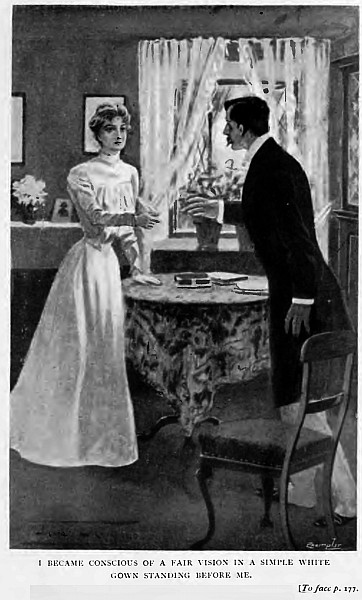
At last the door opened again, and next instant, as I sprang up, I became conscious of a fair vision in a simple white gown standing before me. The touch of her soft, tiny hand, the love-glance of those beautiful eyes, the glad smile of welcome, the music of that voice, came upon me as a sudden revelation. Her perfect type of English loveliness became disclosed to me for the first time. She was absolutely incomparable, although never before that moment had I realised the truth. But in that instant I became aware that she held me irrevocably beneath her spell.
I took her hand, and our eyes met. My gaze wavered beneath hers, and what words I uttered in response to her greeting I cannot tell. All that I knew was that I was unworthy of her love.
Chapter Seventeen.
Edith Austin.
For a time our conversation was somewhat stilted. Then Aunt Hetty rose suddenly, with a loud rustling of her stiff silks, made the excuse that she had to speak with the servants, and discreetly left the room.
The instant the door had closed, Edith moved towards me, and we became locked in one another’s arms. She was full of inexpressible sweetness and perfect grace. The passion that had at once taken possession of her soul had the force, the rapidity, the resistless violence of the torrent; but she was herself as “moving delicate,” as fair, as soft, as flexible as the willow that bends over it, whose light leaves tremble even with the motion of the current which hurries beneath them.
Love lit within my breast a clear fire that burned to my heart’s very core. Edith could scarce speak, so overjoyed was she at my visit; but at last, as I pressed her to me, and rained kisses upon her brow, she said, looking up at me with a glance of reproach:
“You have not written to me for ten whole days, Gerald! Why was that? Last night I sent you a telegram asking if you were ill.”
“Forgive me, dearest,” I urged. “This last week I’ve been extremely busy. There have been serious political complications, and, in addition, I’ve had a perfect crowd of engagements which duty compelled me to attend.”
“You go and enjoy yourself at all sorts of gay receptions and great dinners, and forget me,” she declared, pouting prettily.
“I never forget you, Edith,” I answered. “Don’t say that. You are ever in my thoughts, even though sometimes I may be too much occupied to write.”
“Do you assert then that for the past ten days you have absolutely not had five minutes in which to send me news of yourself?” she cried in a tone of doubt.
“Well, perhaps I had better admit that I’ve been neglectful,” I said, altering my tactics. “But, you see, I knew that I should come here to-day, so I thought to take you by surprise. Are you pleased to see me?”
“Pleased!” she echoed, raising her lips to mine. “Why, of course I am! You seem always so far away, and I always fear—” and she paused without concluding her sentence.
“Well, what do you fear?”
“I fear that amid all that whirl of pleasure in Paris, and amid all those smart women you must meet daily, you will forget me.”
“I shall never do that,” I answered reassuringly.
She was silent for a moment. Her countenance had assumed a very grave expression.
“Ah,” she said, with a slight sigh, “you do not know how I sometimes suffer, Gerald. I am always fearing that some other woman may rob me of you.”
“No, no, dearest,” I answered, laughing. “Never contemplate that, for such a theft is not possible. Remember that my duty in a foreign capital is to represent my country at the various social functions, and to endeavour to promote good feeling wherever I can. A diplomatist who is not popular with the women never rises to the post of ambassador. To be gallant is essential, however one may despise and detest the crowd of voluble females upon whom one must dance attendance.”
“I often sit here and picture you in your smart diplomatic uniform flirting with some pretty foreign woman in a dimly lit arbour or conservatory,” she observed, still very grave. “My life is so very quiet and uneventful in comparison with yours;” and she sighed.
“The charge against me of flirtation is entirely unfounded,” I declared, holding her hand and looking earnestly into her clear eyes, now filled with tears. “It is true that sometimes, for purposes connected with our diplomacy, I chat merrily with some grande dame in an endeavour to pick up information regarding the latest change in the political wind; but with me the art of pleasing women is a profession, as it is with every man in the Diplomatic Service.”
“I know,” she said in a strained tone. “And in those hours of pleasure you forget me. Is not that so?”
“I do not forget a certain summer evening up in Scotland when we walked out after dinner and strolled together down by the rippling burn,” I said in a low voice, pressing her closer to me. “I do not forget what words I uttered then, nor do I forget your response—that you loved me, darling.”
“But there are others, more attractive than myself, whom you must meet constantly at those brilliant receptions of which I read in the newspapers,” she cried, bursting into tears.
“They are foreign women,” I declared, “and I hate them all.”
“Ah,” she cried in a tremulous voice, “if I could only believe what you tell me is the truth!”
“It is the truth, dearest,” I said, kissing her tears away. “We are parted; but the quiet, even life you live here is far happier and more healthful than one passed in the stifling atmosphere of politics and perfume in which I am compelled to exist. The ladies’ newspapers tell you of the various entertainments in Paris, and describe the gay toilettes and all that kind of thing; but those journals say nothing of the unfortunate diplomatists who are compelled to ruin their digestions and wreck their constitutions by late hours in the service of their country.”
She was silent, and I felt her hand trembling in mine. I looked upon her fair face, and lovingly stroked the dark tendrils of hair from her brow. What she had said had aroused within me some qualms of conscience; but, loving her, I strove to reassure her of my perfect and unwavering fidelity. Women, however, are difficult to deceive. They possess a marvellous instinct where love is concerned, and are able to read their lover’s heart at a glance. No diplomatist, however expert in the art of prevarication, can ever hope to mislead a woman who is in love.
“I often doubt, Gerald, whether you really love me as truly as you have declared,” she said in a low tone, at last. “Perhaps it is because you are absent, and I think of you so much and wonder so often what you are doing.”
“My absence is compulsory,” I answered, adding earnestly: “I love you, Edith, however much you may doubt my protestations.”
“Ah!” she answered, smiling through her tears. “If I could only believe that what you say is true! But it is said that you people at the embassies never speak the truth.”
“To you, dearest, I speak the truth when I say that I love no other woman save yourself. You are mine—you are all the world to me.”
“And yet you have neglected to write to me for ten whole days! The man who really loves is not so forgetful of the object of his affections.” She was piqued at my neglect. Such was the simplicity, the truth, and the loveliness of her character that at first I had not been aware of its complexity, its depth, and its variety. The intensity of passion, the singleness of purpose, and the sweetly confiding nature presented a combination which came near to defying analysis. I now saw in her attitude at this moment the struggle of love against evil destinies and a thorny world; the pain, the anguish, the terror, the despair, and the pang unutterable of parted affection. My heart went out to her.
“But I thought you had forgiven,” I said seriously. “I have come myself to spend a few hours with you. I have come here to repeat my love;” and, bending, I kissed the slim, delicate little hand I held.
But she withdrew it quickly; for there was a sudden movement outside in the hall, and Aunt Hetty entered fussily with the news that luncheon was waiting, and that she had ordered an extra cover to be laid for me.
The dining-room was just as antiquated as the musty drawing-room, and just as inartistic, save that the oak beams in the low ceiling were mellowed by age and the dark panelling presented a more cosy appearance than the awful green and red wall-paper of the state apartment. I knew Miss Foskett’s cuisine of old, and seated myself at table with some misgiving. True to my expectation, the meal proved a terribly formal one, with Aunt Hetty seated at the head of the table directing Ann by movements of her eyebrows, talking but little except to intersperse some remarks sarcastic or condemnatory; while to us were served several extremely indigestible specimens of English culinary art.
Aunt Henrietta, a strict observer of all the conventionalities, was never tired of referring to the exemplary youth of her day; but above all she had, in the course of her lonely life, developed the keenest and most obtrusive nose for a lie. She was one of those who would, uninvited, join in a casual conversation and ask the luckless conversationalist to verify his statements with chapter and verse. She would stop in the streets and challenge with soul-searching doubts the remark that it was a “Fine day.” Aristophanes invented an adjective to describe this ancient and modern product; it is a long word, but it describes her: (a Classical Greek phrase), which, being interpreted, is, “early-prowling-base-informing-sad-litigious-plaguey.” She was fond of picking one up in a quotation if one changed a mere “yet” for a “but”; and would nag all round until she had silenced the conversation. Knowing her peculiarities, I hazarded but few remarks at table, and carefully avoided making any distinct statement, lest she should pounce upon it.
At last, with a feeling of oppression relieved, we rose, not, however, before Aunt Hetty had invited me to remain the night, and I had accepted. I should be compelled, I knew, to leave Charing Cross by the night mail on the morrow, much as I desired to remain a few days in that rural retreat beside the woman I loved.
For an hour or so we idled together beneath the trees in the quaint old garden, where Edith had caused the gardener to swing the hammock I had sent her from Paris. When the sun began to lose its power she put on her large flop hat of Leghorn straw trimmed with poppies, and we strolled together through the quiet village, between its rows of homely cottages, many of them covered with creepers and flowering plants, until we came to the winding Wensum river, which we followed by the footpath lined with poplars, past the old mill, and away into the country. Hand-in-hand we wandered, neither uttering a word for some little time, both of us too full of our own thoughts.
Suddenly, in Guist Wood, where the stream with its cooling music wound among the polished stems of the beeches, with the sunshine glinting down upon them through the veil of leaves, we halted, standing ankle deep in soft moss and nodding wild-flowers. Her beauty and her silence had struck a new, intolerable conviction of guilt into my heart.
She turned her flawless face to mine as though with firm resolve, and then in a hoarse, strained voice told me plainly that her love for me was all a mistake.
“A mistake that you love me, Edith!” I repeated, holding both her hands tightly in mine, and looking straight into her clear, dark, fathomless eyes.
“Yes,” she insisted. Her colour went, and her eyes fell away from mine.
“Then why have you so changed?” I asked quickly. “I have always, since that evening beside the burn, regarded you as my affianced wife.”
She closed her lips tightly, and I saw that tears welled in her eyes.
“My happy dream is over,” she said bitterly, “and the awakening has come.”
“No,” I cried, “you cannot say that, Edith. You do not mean it, I’m sure! Remember the early days of our love, and recollect that my affection for you is as strong now as then—indeed, stronger to-day than it has ever been.”
She was silent. In that moment my new-found happiness of those days in Scotland all came back to me. I remembered that summer-time of long lingering beneath the shadowy glades of the glen; of moonlight wanderings along the lanes, of love-trysts under the rising sun, by rose-garlanded and dew-spangled hedgerows. Ah! many had been the vows we had plighted in the deep heart of Scottish hills during those golden summer days, and many were the lovers’ kisses taken and given under the influences of those long balmy evenings, when merely to idle was to be instinct with the soul of passion and of poetry.
“I remember those days,” she answered. “They were the dawning days of our love. No afterglow of passion can ever give back the subtle charm of those sweet hours of unspoken joy. But it is all past, Gerald, and there is now a breach between us.”
“What do you mean?” I asked anxiously. “I do not understand.”
“I have already told you,” she answered in a hard voice. “You love another woman more than you love me. Ah, Gerald! you cannot know how I have suffered these past months, ever since the truth gradually became apparent. All through these summer days I have wandered about the country alone, revisiting our old haunts where we had lingered and talked when you were here twelve months ago. Years seem to have passed over my head since that day in June when you last stood here and held my hand in yours. But now you have slipped slowly from me. I have drunk deeply of the cup of knowledge, and life’s cruellest teachings have been branded upon my heart.”
“But why?” I cried. “I cannot see that you have any cause whatever for sadness. True, we are compelled to be apart for the present, but it will not be so always. Your life is, I know, a rather monotonous one, but soon all will be changed—when you are my wife.”
“Ah,” she sighed, “I shall never be that—never!”
“Why not?”
“Because I see—I see now,” she faltered, “that I am not fitted to become a diplomatist’s wife. I have no tact, no smartness, no experience of the kind that is so absolutely necessary for the wife and helpmate of a man who is rising to distinction. I should only be a burden. You will find some other woman more brilliant, more chic, and thoroughly versed in all the ways of Society. You must marry her;” and with a woman’s weakness she burst into tears.
“No, no!” I cried, kissing her upon the brow and drawing her closely to me in an effort to comfort her. “Who has been putting such ideas into your mind, darling? Who has told you that love can be curbed, trained, and controlled? Love does not stop to question right or wrong; it is spontaneous, irresponsible, and born of itself in one’s heart. And I love you,” I whispered into her ear.
She was silenced, as a true woman must always be by her lover’s voice, no matter how specious may be his protestations; for there is no argument that can withstand the magic of the lover’s touch or the light in the eyes of the man a woman loves, and the glamour of low, caressing words that steal their way to her innermost heart.
“Are you sure, quite sure, that you really love me sufficiently to sacrifice yourself for my sake?” she faltered through her tears.
“Sacrifice myself!” I echoed. “It is no sacrifice, darling. We love each other, and in future the course of our lives must be along the same path, no matter what may be the obstacles.”
“I wish I could think so,” she said; while a faint smile, sweet and tender as the sunshine of May, gleamed for a moment about her eyes and lips.
The heart of a woman who loves is the most complex and subtle thing on earth; and often when most she protests, she most longs to be faithless to the spirit of her own protestation.
I looked at her now fully and firmly. There was, I think, terror in my eyes—the terror of losing her, which her last words had suddenly conjured up.
“But cannot I convince you?” I cried. “Will you not accept what I tell you as the truth, darling? Will you not believe that I love you still?”
I stooped, and taking her fair face in my hands, tenderly kissed her brow, just as I had kissed her in the days when our love had dawned.
“I have tried,” she answered bitterly, “but cannot. Alas! it is a woman’s part to suffer;” and her breast heaved slowly and fell again.
How pathetic were her great dark eyes, how attractive was the delicate face with its refined outline, how tenderly seductive those tremulous lips which no man had kissed save myself! That she suffered an agony of heart because of the suspicion that I no longer loved her truly was more than plain. It became her creed—the creed of the martyr and the enthusiast, which comes to some women by nature with the air they breathe, and is an accentuation of one of the finest instincts of human nature.
“But you shall not suffer thus, my darling!” I cried. “You shall not, for I love you truly, honestly, and well. You shall be my wife. You have already promised, and you shall not draw back, for I love you—I love you!”
Chapter Eighteen.
By Day and by Night.
She put up both her small white hands as though to stay the torrent of passionate words which I poured forth; but I grasped her wrists and held her to me until I had told her all the longings of my soul.
What she had said had caused me a stab of unutterable pain, for my conscience was pricked by the knowledge that I had for a brief moment forsaken her in favour of Yolande. But she could not know the real truth. It was only by her woman’s natural intuition that she held me in suspicion, believing that by my neglect to write I had proved myself attracted by some member of that crowd of feminine butterflies who flit through the embassies, showing their bright colours and dazzling effects.
At last she lifted her face, and in a low, faltering voice said:
“I do not wish that we should part, Gerald. I have no one but you.”
“And God knows—God knows, darling, I have no one but you!” I cried brokenly; and as I uttered these words she cast her arms about my neck, clinging to me, sobbing, with her face lying close against my breast.
“My darling—my own darling!” was all I could murmur as I kissed away the tears that rained down her checks. I could say nothing more definite than that.
“You will not be false, will you?” she implored at last. “You will not break your promise, will you?”
“I will never do that, dearest,” I assured her. “I love you, upon my word of honour as a man. I have loved you ever since that day when we first met at the house-party up in Scotland—the night of my arrival when you sat opposite me at dinner. Do you remember?”
“Yes,” she answered, smiling, “I remember. My love for you, Gerald, has never wavered for one single instant.”
“Then why should you be unhappy?” I asked.
“I really cannot tell,” she answered. She turned her face, and I saw that there was a shadow across it, as though the sunshine of her life had gone behind a bank of cloud. “All I can compare this strange foreboding to is the shadow of an unknown danger which seems of late to have arisen, and to stand in a wall of impenetrable blackness between us.”
“No, no!” I hastened to urge, “the sweet idyll of our blameless love must be preserved. That fancy of yours is only a vague, unfounded one.”
She shook her head dubiously.
“It is always with me. During my long, solitary wanderings here I think of you, and then it arises to overshadow me and crush out all my happiness,” she said in a tone of sorrow.
“Your life is dismal and lonely here,” I said. “You’ve become nervous and melancholy. Why not have a change? Persuade your aunt to bring you to Paris, or, if not, to some place near, where we may meet often.”
“No,” she replied in a harsh tone. “My presence in Paris is not wanted. You are better without me. You must leave England again to-morrow—and you must forget.”
“Forget!” I gasped. “Why?”
“It is best to do so,” she faltered with emotion. “I am unfitted to become your wife.”
“But you shall—you must!” I cried. “You have already given me your promise. You will not desert me now!”
She made no response. I pressed her again for an answer, but she maintained silence. Her attitude was one of firm resolve, and gave me the distinct impression that she had gained some knowledge of the reason of our brief estrangement.
“Tell me the reason of your sudden disbelief in my declarations,” I urged, looking earnestly into her eyes. “Surely I have given you no cause to regard our love as a mere irresponsible flirtation?”
“I have no reason to disbelieve you, Gerald,” she answered seriously; “yet I recognise the impossibility of our marriage.”
“Why is it impossible? We are both controllers of our own actions. You will not remain here with your aunt all your days?”
“We may marry, but we should not be happy, I feel certain.”
“Why?”
“Because if I were your wife I could not bear to think you were out each night dancing attendance upon a crowd of foreign women at the various functions which you are in duty bound to attend.”
I smiled at her argument. Ignorant of the world and its ways, and knowing nothing of Society beyond that gossiping little circle of tea-drinkers and tennis-players which had its centre in the town of Fakenham, and had as leader the portly wife of the estimable incumbent, she saw herself neglected among the brilliant crowd in Paris as described by the so-called “Society” papers.
I hastened to reassure her, and as we strolled on through the wood and, following the meandering of the river, emerged upon the broad grass-lands before Sennowe Hall, I used every argument of which I was capable in order to dispel her absurd apprehensions. My protestations of love I repeated a hundred times, striving to impress upon her that I was actually in earnest; but she repelled me always, until of a sudden I halted beneath the willows, and, placing my arm around her slim waist, narrowly girdled by its crimson ribbon, I drew her again to me, saying:
“Tell me, Edith, plainly, whether or no you love me. These cold words of yours have struck me to the heart, and I feel somehow that in my absence you have found some other man who has your gratitude, your respect, and your love.”
She raised her hand, as though to stay the flow of my words.
“No, no!” I went on passionately. “You must hear me, for you seem to be gradually slipping away from me. You must hear me! Cast away this cold sweetness that is enough to madden any man. Give me a right to your love; give me a right to it! You cannot be indifferent to such a love as mine unless you love someone else.”
“Stop!” she cried, moved by a sudden generous impulse. “I love no one else but you.”
“And you admit that you still love me? You will be the same to me as before?” I cried eagerly.
“If you will swear that there is no thought of another woman in your heart,” she answered seriously.
A pang of conscience smote me; but inwardly I reassured myself that all the fascination of Yolande had been dispelled and that my love was free.
“I swear,” I said; then slowly I bent until our lips touched.
Hers met mine in a fierce, passionate caress, and by that I knew our compact was sealed.
“I admit,” she said, “that my instinct, if it were instinct, was wrong. You have, after all, proved yourself loyal to me.”
“And I shall remain so, darling,” I assured her, kissing her again upon the brow. “For the present you must be content to remain with your aunt; but nevertheless, try to persuade her to come to Paris. Then we can spend many happy days together.”
“She hates the Continent and foreigners,” answered my love with a brightening smile. “I fear I can never persuade her to move from here. She went to Switzerland twenty years ago, and has never ceased condemning foreign travel.”
“If she will not come, then why not engage a chaperon? You surely know some pleasant woman who would be pleased to have a holiday jaunt.”
“Well,” she answered dubiously, “I’ll try, but I fear Aunt Hetty will never hear of it.”
“The life in the profound stillness of that house and the rigid seclusion from all worldly enjoyment are producing an ill effect upon your health, darling,” I said presently. “You must have a change. It is imperative.”
But she only sighed, smiled rather sadly, and answered in a low voice:
“The quietness of life here is nothing to me, as long as I am confident that your love for me is just the same as it was when you first told me the secret of your heart.”
“It is,” I assured her—“it is, darling. I love you—and you alone.”
There was an instant’s hesitation, and then her arms stole gently to my neck, and her lips were pressed to the cheek I bent to them, but only for a second; then my lips were upon hers, clinging to them softly, passionately; and in those moments of ecstasy I drew my soul’s life from that sweet mouth.
Heedless of time, we stood there in each other’s embrace, repeating our vows of love and devotion, until the sun went down behind the low hills beyond Raynham, and the broad pastures were flooded by the purple glow of the dying day. Happy and content in each other’s affection, we were careless of the past, and recked not of the future. Edith loved me, and I wished for naught else in all the world.
Now as I sit committing this strange story of my life—this confidential chapter in the modern history of Europe—to paper, I recall every detail of those hours we spent down by the riverside, and contrast it with the curious events which followed—events which were so strange as to be inexplicable until the ghastly truth became revealed. But I loved, and my affection was reciprocated. That surely was sufficient, for I knew that I had gained the purest, most beautiful, and sweetest woman I had ever met.
At last the fading sunlight impressed upon us the fact that the dinner-hour was approaching; and, knowing Miss Foskett’s punctuality at meals, we were compelled to strike along the footpath over Dunham Hill, and take the shortest cut across the fields through the little hamlet of Gateley, and thence by a grass-grown by-road back to Great Ryburgh, where we arrived just as the gong sounded.
When we re-entered the dining-room, Aunt Hetty glanced at us keenly, as though she wished to make some sarcastic comment upon our long absence; but our pleasant demeanour apparently silenced her, and she contented herself by taking her seat at table and inquiring of me if I had had a pleasant walk, and whether I found the country agreeable after the dusty boulevards of Paris.
“Of course,” I answered, “I always find England charming, and I’m very frequently homesick, living as I do among foreigners always. But why don’t you come abroad for a month or so, and bring Edith?”
“Abroad!” screamed the old lady, holding up her hands. “Never! I went to Lucerne once, and found it horrible.”
“But that was some years ago, was it not? If you went now, you would find that travelling has greatly improved, with a through sleeping-car from Calais to Basle; hotels excellent, and food quite as good as you can obtain in England. During the past few years hotel-keepers on the Continent have awakened to the fact that if they wish to be prosperous they must cater for English visitors.”
“Oh, do let us go abroad, aunt!” urged Edith. “I should so much enjoy it!”
“Paris in summer is worse than London, I’ve heard, my dear,” answered Miss Foskett, in her high-pitched tone.
“But there are many pretty places within easy reach of the capital,” I remarked. “Edith speaks French; therefore you need have no hesitation on that score.”
“No,” said the old lady decisively, “we shall not move from Ryburgh this summer, but perhaps next winter—”
“Ah!” cried Edith joyously. “Yes, capital! Let us go abroad next winter, to the Riviera, or somewhere where it’s warm. It would be delightful to escape all the rain and cold, and eat one’s Christmas dinner in the sunshine. You know the South, Gerald? What place do you recommend?”
“Well,” I said, “any place along the Riviera except, perhaps, Monte Carlo.”
“Monte Carlo!” echoed Aunt Hetty. “That wicked place! I hope I shall never see it. Mr Harbur told us in his sermon the other Sunday about the frightful gambling there, and how people hanged themselves on the trees in the garden. Please don’t talk of such places, Edith.”
“But, aunt, there are many beautiful resorts in the neighbourhood,” her niece protested. “All along the coast there are towns where the English go to avoid the winter, such as Cannes, Nice, Mentone, and San Remo.”
“Well,” responded Miss Foskett with some asperity, “we need not discuss in August what we shall do in December. Ryburgh is quite pleasant enough for me. When I was your age I employed my time with embroidery and wool-work, and never troubled my head about foreign travel. But nowadays,” she added with a sigh, “I really don’t know what young people are coming to.”
“We’ve advanced with the times, and they’ve emancipated women in England,” responded Edith mischievously, glancing merrily across at me.
Miss Foskett drew herself up primly, and declared that she hoped her niece would never become one of “those dreadful creatures who ape the manners of men;” to which my love replied that liberty of action was the source of all happiness.
Fearing that this beginning might end in a heated argument, I managed to turn the conversation into a different channel.
“If all we read in the newspapers is true, it would seem,” observed Aunt Hetty presently, “that you diplomatists have a most difficult task in Paris.”
“All is not true,” I laughed. “Much of what you read exists only in the minds of those imaginative gentlemen called Paris correspondents.”
“I suppose,” remarked Edith, smiling, “that it is impossible for either a diplomatist or a journalist to tell the truth always.”
“Truth, no doubt, is all very well in its place, and now and then in diplomacy, but only a sparing use should be made of it as a rule,” I answered. “But there should be no waste. Only those should be allowed to handle it who can use it with discretion, and who will ladle it out with caution.”
“Mr Ingram, I am surprised!” interrupted Miss Foskett, scandalised.
“It is our creed,” I went on, “that truth should be always spoken in a dead or foreign language, no home-truths being for a moment tolerated. Now think what a happy land this England of ours would be if only we were not so wedded to the bare, cold truth! Suppose for its own good purposes our Government has thought right to make a hasty dash for the back seats in the international scrimmage, and to adhere to them with all the tenacity of a limpet, why, for all that, should the Opposition journals blurt out the fact for our humiliation, when by a few deft scratches of the pen the leader-writer might easily make us believe that no back seat had ever in any circumstances been occupied by Britain, and that the nose of the lion had never been pulled out of any hole into which it had once been inserted? The itch for truth is, judged from a diplomatists point of view, responsible for the ruin of our policy towards our enemies.”
“Shocking, Mr Ingram! I’m surprised to find that you hold such views,” said Miss Foskett in a soured tone; while Edith laughed merrily, declaring that she fully agreed with my argument, much to her aunt’s discomfiture.
The old lady loved the harsh truth as propounded by the precisionist.
And so the dinner proceeded, each of us vying with the other to dispel Aunt Hetty’s deep-seated prejudices and narrow-minded views of the world and its ways.
Coffee was served in the drawing-room, where Edith went to the piano and sang in her sweet contralto several of my favourite songs, after which, at an early hour, as was usual with the household at Ryburgh, we all retired.
To sleep so quickly after dinner was to me impossible; therefore, on gaining my room, I lit a cigar, and, taking a novel from my bag, sat reading. The book proved interesting; and time had passed unnoticed, until of a sudden my attention was attracted by the sound of low voices. I listened, glancing at the clock, and noticed that it was nearly two in the morning.
A suspicion of burglars at once flashed across my mind. I blew out my candles, so as not to attract attention, noiselessly opened the wooden shutters before my window, and cautiously gazed out. The lawn, garden, and wide sweep of country beyond lay bathed in the bright moonlight, and at first I distinguished no one. Peering down, however, until I could see the path running in the shadow just below my window, I distinguished two figures with hands clasped, as though in parting. I looked again, scarce believing my own eyes. But I was not mistaken. One figure was that of a woman, her dark cloak open at the throat, revealing her white dress beneath; while the other was the tall dark figure of a man in a long black overcoat, the collar of which was turned up as though to conceal his features. Even though they stood together in the dark shadow, the astounding truth was plain to me. The woman who had kept that midnight assignation was Edith Austin, my well-beloved.
My heart stood still.
Chapter Nineteen.
Whispered Words.
The revelation held me rigid. I stood there, peering down, watching their movements, and straining my ears to catch the whispered words. As I feared to open the window lest the noise should attract them, I could do no more than remain a spectator of Edith’s perfidy. To me it seemed as though she had been walking with him, and he had accompanied her back to the house. As he held her hand, he was bending, whispering some earnest words into her ear. She did not attempt to withdraw; indeed, it was apparent that she was not unwilling. The conclusion to be made was that they were lovers.
Reader, can you imagine my feelings at this astounding discovery? Only six hours before we had stood beside the river, and she had vowed that for no man save myself had she any place in her heart; yet with my own eyes I was watching her while she believed me sleeping in calm ignorance of her movements. That she had been walking with him was apparent, because of the shawl she wore wrapped about her head; while the fact that the stranger carried a stout stick showed that he had walked, or was about to walk, a considerable distance. Because his hat was drawn over his brow and his coat collar turned up, I could not see his features. To me, as he stood there, he appeared to be slightly round-shouldered, but, nevertheless, a strongly built fellow, seemingly rather above the average height.
How long she had been absent from the house I could not tell. Her light step across the lawn had not attracted my attention. Only his low, gruff voice on their return had caused me to listen. There was a French window near where they were standing, and it was evident that by means of this she had secretly left the house.
Across the moon there drifted a strip of fleecy cloud, hiding the lawn and garden for a few moments; then suddenly all became brilliant again, and, looking down, I saw that she had moved, and was unconsciously in the full white light. I caught sight of her countenance, so that her identity became undeniable. He was urging her to speak, but she remained silent. Again and again he whispered into her ear, but she shook her head. At last she spoke. I heard what she said, for I had contrived to raise the sash an inch or two.
“Very well, I promise,” she said. “He leaves to-morrow.”
“And you will not fail?” asked the gruff voice of her clandestine companion.
“No. Adieu!”
And as I watched I saw his dark figure striding away in the full moonlight across the lawn. He did not glance back, but went straight over to the belt of elms on the left, and a few minutes later was lost to view, while the woman I loved had apparently re-entered the house by the dining-room window, and was creeping silently to her room.
The one thought that gripped my heart and froze my senses was that Edith was false to me. She had a lover whom she met at dead of night and with whom she had a perfect understanding. She had made him a promise, the fulfilment of which was to take place when I had left. Had such things been told to me I would not have believed them, but I had seen with my own eyes and heard with my own ears. The truth was too terribly plain. Edith, the one woman in the world whom I had believed to be pure, honest, and upright, was false to me. I saw it all as I reclosed the shutters, relit the candles in their old silver sconces, and paced that ancient bed-chamber. The reason of her attempt to evade me and to withdraw her promise of marriage was only too apparent. She, the woman whom I loved and in whom I had put all my faith, had a lover.
As I reflected upon our conversation of that afternoon I saw in her uneasiness and her responses a self-condemnation. She dreaded lest I should discover the secret within her breast—the secret that, after all, she did not love me. The dark silhouette of that man standing forth in the brilliant light of the moon was photographed indelibly upon my memory. His outline struck me as that of a man of shabby attire, and I felt certain the hat drawn down upon his face was battered and worn. Indeed, I had a distinct conviction that he was some low-born lout from the neighbourhood—a conviction aroused, I think, by her announcement that I was to leave on the morrow. She would have freedom of action then, I reflected bitterly. And her promise? What, I wondered, had she promised? The fellow had evidently been persuading her until she had at last given him her pledge. His gait was that of a man who knew the place well, the swinging step of one used to walking easily in rough places. His stick, too, was a rough ash, such as a town-bred lover would never carry, while his voice had, I felt certain, just a tinge of the Norfolk accent in it. That they should meet at dead of night in that clandestine manner was surely sufficiently suspicious, but those words I had overheard sounded ever in my ears as I paced from end to end of that old room with its sombre, almost funereal, hangings.