The First Ford Takes to the Road
Reading edition
By the spring of 1896, he was ready to make a trial run with his own horseless carriage. First he had to tear out part of the brick wall of his shed in order to get his machine into the alley. Once in the open, the engine was started, and the car bumped down the cobblestone street and continued successfully on its first short run around the block. A few weeks later, he drove it out to the homestead in Dearborn. His father was not impressed with the contraption.
These first tests meant more labor; hours of changing, adjusting, and repairing were ahead. During the day, Ford was the chief engineer of the Illuminating Company, but in his spare time, he was Ford the experimenter.
The signs of the times were encouraging. The great inventor, Thomas Edison, announced in the newspapers that the horse was doomed. Up in Lansing, R. E. Olds produced his first Oldsmobile. Alexander Winton of Cleveland drove his auto from Cleveland to New York, making what was called a “reliability” run. William K. Vanderbilt bought a car to race. All over the nation, people began to read and hear about the marvels of the new invention, of the men who were building cars, and of the races they held at fairgrounds and parks.
A new field was thus opened up for sportsmen. In Detroit, William H. Murphy, a prominent citizen, heard of Henry Ford’s car. Murphy and his friends saw an opportunity to get into the racing car business; they formed a company, called the Detroit Automobile Company, with Henry Ford as its chief engineer. At last he could leave the Illuminating Company and devote all of 6 his time to automobiles. It was a bold move for a man with a family to give up a good job. Some of his friends and relatives told each other that he should have stayed where he was.
The original investment of Murphy and his friends was not enough. Improvements and changes in the model were made. Even though $68,000 was invested in the company, the hoped for production of many cars never materialized, and in January, 1901, Henry Ford left the Detroit Automobile Company.
Henry Ford went to work on a racer which he hoped would bring him new opportunities to manufacture automobiles. His chance came in 1901. It was announced in Detroit that Alexander Winton would race his world champion car, “The Bullet,” at the Grosse Pointe race track, a few miles from the city; Henry Ford challenged the champion.
When the day of the race arrived, stores and shops closed, and a parade of sixty-eight cars moved out to Grosse Pointe. Three cars lined up for the ten-mile race, but only Winton and Ford got away. At the end of eight miles, Ford was trailing Winton, but then the “Bullet” began to sputter, and it limped to the finish line behind the racer built by Ford. The newspapers the next day reported that Henry Ford was now in the first rank of American “chauffeurs.”
In November, 1901, the Henry Ford Company was organized to manufacture automobiles, but the venture was short-lived, and four months later, Ford was working for himself again. In his small workshop, he went to work on two new racers, the “Arrow” and the “999.” With the help of a draftsman, a mechanic, and a retired bicycle champion, the new cars were made ready for racing.
Ford found a bicycle champion, Barney Oldfield, to pilot his “999” in the Manufacturers Challenge Cup Race at Grosse Pointe. This time his car led the field to a new 7 record, finishing a mile in front of his competitors.
After the race, A. Y. Malcomson, a Detroit coal dealer, became interested in Henry Ford and his automobiles. The two men became partners in a new venture and Henry Ford began work on a “pilot model” for a new car. During the early months of 1903, more investors were found. By spring, a new company was organized to carry out the plans of Ford and Malcomson.
In June, 1903, the Ford Motor Company was incorporated. In addition to Malcomson, the original stockholders included James Couzens, an employee of Malcomson; John and Horace Dodge, the owners of a machine shop; Albert Strelow, a contractor; John S. Gray, a banker; Vernon E. Fry, a real estate dealer; Charles H. Bennett, an air rifle manufacturer; C. J. Woodhall, a clerk; Horace H. Rackham and John W. Anderson, lawyers; and Henry Ford. Together, they had raised $28,000 to start the new venture.
The new company rented a building on Mack Avenue in Detroit for $75 a month and prepared to manufacture its automobiles. The new factory was 250 feet long by 50 feet wide. This was adequate space, since the new company did not attempt to make any of the parts for its cars. The Dodge brothers, who owned a large machine shop, made the Ford chassis, a carriage company built the body, and the wheels were purchased in Lansing. Once the parts were brought together, a dozen men assembled, adjusted, and tested the completed car—the early model A Ford. Soon this car, which sold for $950 f.o.b. Detroit, was advertised as the “boss of the road.” Its two cylinders gave it a maximum speed of thirty miles per hour.
Although Henry Ford’s first two ventures into automobile manufacturing had not been successful, this third attempt showed great promise. At the end of the first year, the Ford Motor Company had sold over seventeen hundred automobiles.
8
The year 1903, which marked a turning point in the life of Henry Ford, now forty years of age, was an interesting year for all Americans. The first successful transcontinental automobile trip was completed in August. A telegraphic cable was completed across the Pacific to Manila in the Philippines. In Washington, Theodore Roosevelt was clearing the way for the building of the Panama Canal, and in New Jersey, the Edison studios completed the first full-length motion picture, called “The Great Train Robbery.” Finally, in December, Orville and Wilbur Wright flew an airplane successfully at Kitty Hawk, North Carolina. During the next few years, those who marveled at progress in 1903 saw even greater changes in their way of living brought about by improved transportation and communication. The twentieth century had started off well.
The Ford Motor Company was also experimenting with changes. Models B, C, and F appeared. When the Mack Avenue plant was no longer adequate to house the activities of the company, a new building was erected, ten times larger than the first one. By 1906, the company announced models N, S, and R, as well as a six-cylinder K. Experimentation went beyond the building of different models of automobiles; for example, a tractor was planned and constructed, but never sold.
During this time, changes were also made in the ownership of the plant. Some of the stockholders sold out, and Henry Ford became the major owner of the Ford Motor Company.
A real danger to Ford and his company during these early years was the threat of a patent suit. Back at the time of the Times-Herald race in 1895, George Selden, a lawyer in Rochester, New York, had patented a “self-propelled vehicle driven by an internal combustion engine.” Although he never built an automobile, all those who did were threatened with infringement suits. This fact made it necessary for the makers of automobiles to pay royalties to the patent holder. The Ford Motor Company refused. The result was a long and involved battle in the federal courts, lasting until 1911 when the case was finally settled in favor of the Ford Motor Company.
9
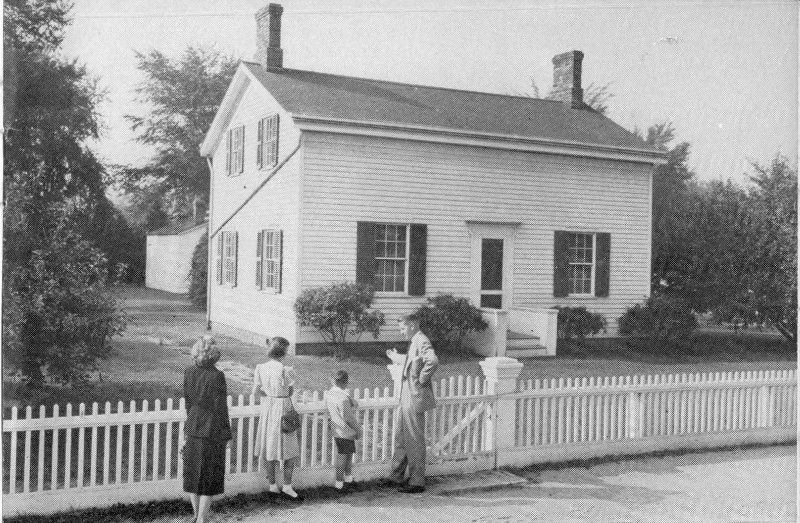
The farmhouse where Henry Ford was born in 1863 stands today in Greenfield Village ...
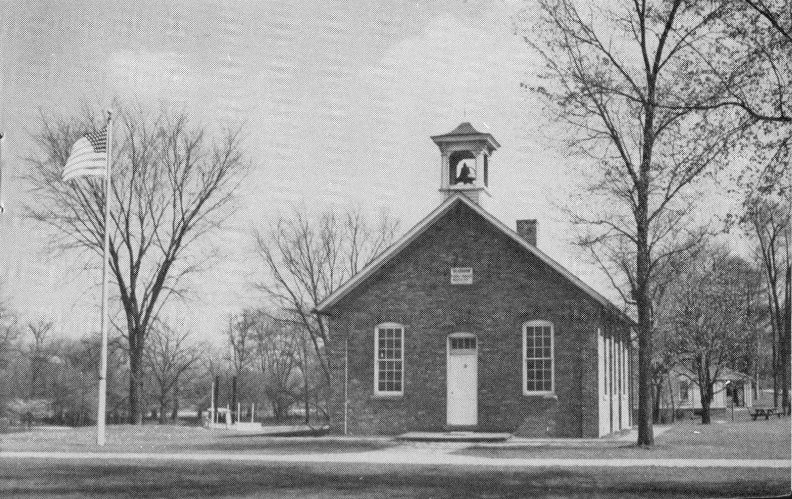
... along with the small brick schoolhouse from the “Scotch settlement” where he began school in 1871.
10
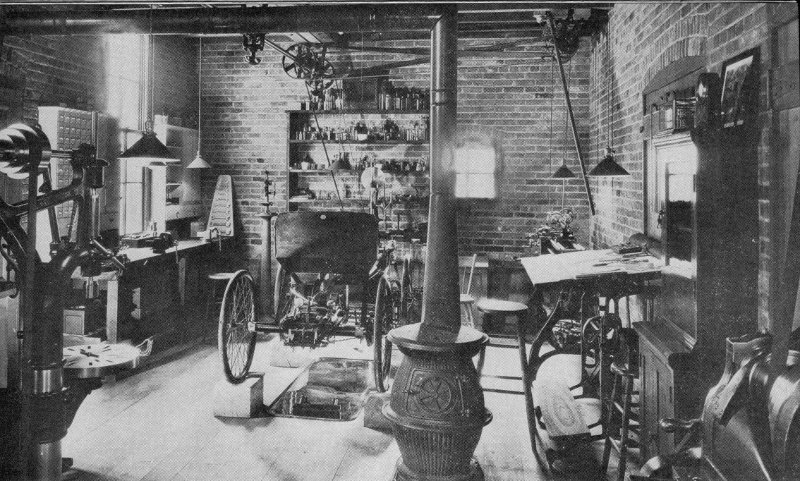
The interior of the 58 Bagley Avenue workshop where Ford built his first car, as restored in Greenfield Village. The car itself is now on display in The Henry Ford Museum.
11
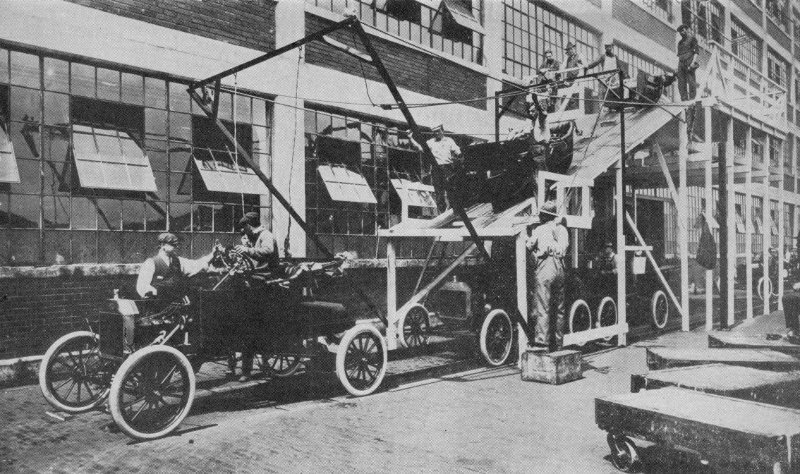
The “body drop” at the Highland Park plant of the Ford Motor Company in 1913. The modern automobile assembly line grew from such operations as this. Photo courtesy Ford Motor Company Archives
12
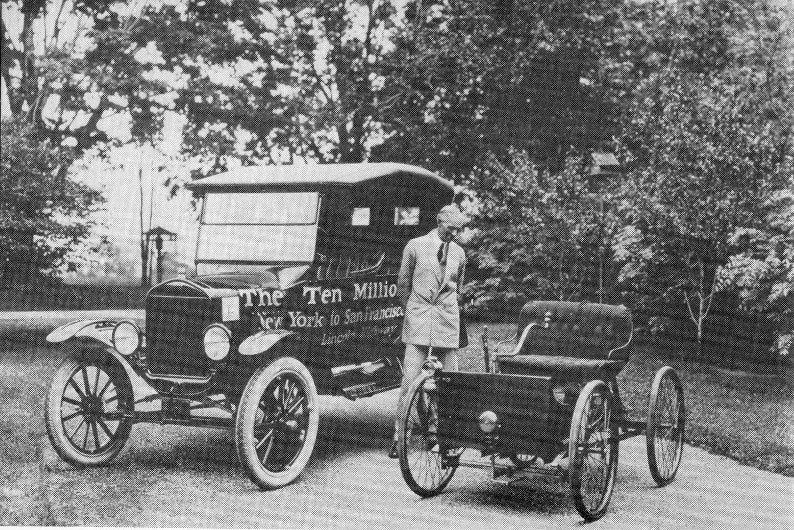
Henry Ford views his first car and the ten millionth Ford in 1924....
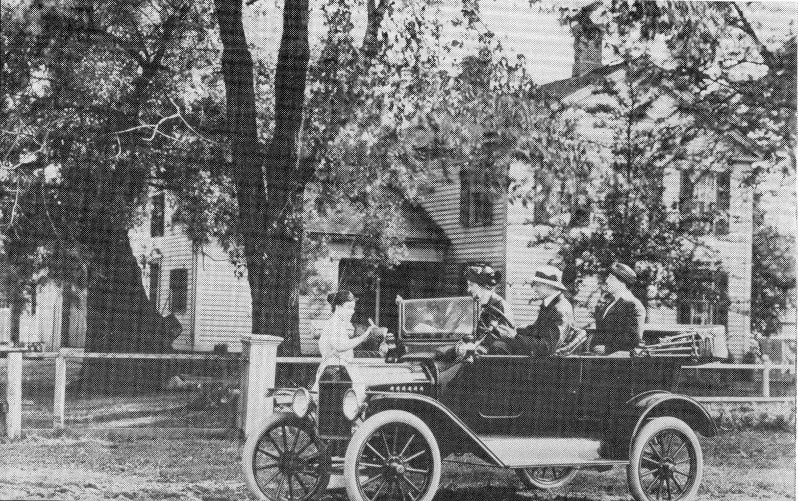
By this time the Model T standing in front of a farmhouse was a familiar sight all over America. Photo courtesy Ford Motor Company
13