Front matter
Reading edition
FARMERS' BULLETIN No. 1935 U. S. DEPARTMENT OF AGRICULTURE
CONTENTS
Page
Caution 2
HEMP 3
What it is 3
It grows well in corn belts 4
How to grow it 5
Soils and Fertilizers 5
Seed 6
When to plant 6
Seeding 6
Culture 7
Varieties to grow 7
Enemies 8
Harvesting 8
Time to Harvest 8
Machinery 9
Retting 10
Underretting and Overretting 11
Sunburning 11
Turning Soils 11
Testing the End Point of the Ret 12
Picking Up the Retted Stalks 14
Extra Care Insures Extra Profits 15
Yeilds 16
Caution
THE HEMP PLANT contains the drug marihuana. Any farmer planning to grow hemp must comply with certain regulations of the Marihuana Tax Act of 1937. This involves registration with the farmer's nearest Internal Revenue Collector and the payment of a fee of $1. Although the fee is small, the registration is mandatory and should not be neglected, as the penalty provisions for not complying with the regulations are very severe. The registration must be renewed each year beginning July 1. This so-called "license" permits a farmer to obtain viable hempseed from a registered firm dealing in hemp, to plant and grow the crop, and to deliver mature, retted hemp stalks to a hemp mill.
Washington, D. C. Issued January 1943 Slightly Revised April 1952
HEMP
By B. B. Robinson, Senior Agrononmist
Division of Cotton and Other Fiber Crops and Diseases Bureau of Plant Industry, Soils, and Agricultural Engineering Agricultural Research Administration
HEMP is a fiber used in making twines and light cordage. It is also used as an extender for imported cordage fibers, particularly abaca, sisal, and henequen, when supplies of these are not adequate to meet domestic demands. The size of the hemp industry, therefore, is greatly influenced by the availability of imported cordage fibers.
Hemp is not a hard crop to grow. It should be planted on the most productive land on the farm—land that would make 50 to 70 bushels of corn per acre.
The crop is planted with a grain drill and harvested with special machinery rented from hemp mills.
It is allowed to lie on the ground until the outer part of the stalks has rotted, freeing the fibers. This process is called dew retting.
The most important step in hemp farming is to stop the retting process at the proper time. (See pp. 12 and 13.)
This bulletin tells how to grow and harvest hemp. For more information write to the Bureau of Plant Industry, Soils, and Agricultural Engineering, United States Department of Agriculture, or to your State experiment station, or consult your county agent.
What it is
Hemp is an annual plant that grows from seed each year, and therefore it can be brought readily into production. It produces twice as much fiber per acre as flax, the only other fiber that is its equal in strength and durability and that is known to be suitable for culture and preparation on machinery in this country.
When hempseed is sown thickly for fiber production, the plants usually grow from 5 to 8 feet tall. However, when the plants are thinly spaced in rows for seed production, they may, under favorable conditions, reach a height of 12 to 16 feet. If the plants are not crowded, they become much branched and are bushy. Uniform stems approximately 3/8 inch in diameter and 5 to 8 feet long are especially desired for fiber production, because they can be handled well by the harvesting and processing machinery available in this country.
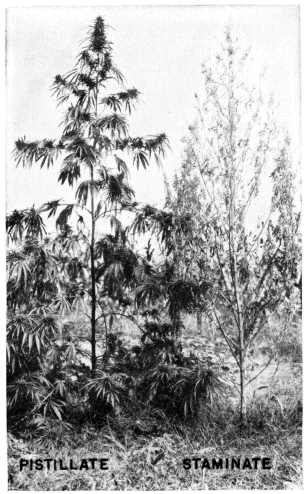
Hemp is a dioecious plant, that is, the staminate (male) and pistillate (female) flowers are borne on separate plants, rather than both on one plant. The flowers of the two types of plants are different, but the male plant is easily distinguished from the female, as the anthers are about the size of a wheat kernel. The male plants die soon after discharging their pollen; this is usually about 3 to 5 weeks before the female plants mature seed and die.
The fiber of commerce ranges from 4 to 8 feet in length and has the appearance of a flat, fine ribbon. It lies very close to the epidermis or skin of the plant. Spinners desire the fiber ribbon 1/16 inch or less in width. The long strands of fiber are called "line" fiber to distinguish them from "tow" fiber, which consists of shorter, broken, tangled pieces.