HELD TO ANSWER (continued 4)
Reading edition
"Nailing up God!" commented John, whose mood had become sardonic.
"What's the story, I wonder," he remarked next, and rising, sauntered across the narrow street and up the wooden walk, till he stopped with one foot on the lower step, gazing casually, with mild curiosity expressed upon his face.
The missionary secretary had noted John's advance and appeared to recognize that his chance interest was legitimate.
"A miserable, squabbling little church," the man remarked, an expression of pain upon his face. "A disgrace to the communion. I'm the District Evangelist. I've had to step in from the outside and close it up, in the interest of peace. Brother Burbeck, here, is a leader of one of the wings. He has tried to bring peace in vain."
"I have stood up for the Lord against the disturber," announced Brother Burbeck over his shoulder, while he dealt a vicious blow, as if the head of the nail were instead the head of the malefactor.
"And who was the disturber?" queried John. "A man of bad character, I suppose."
"No, you couldn't call him that, could you, Brother Burbeck?" ventured the District Evangelist. "Just a young man from the Seminary, with his head overflowing with undigested facts."
"Near facts, they was—only," interjected Brother Burbeck sententiously, as he held another nail between a hard thumb and a knotted finger, and tapped the head gently to start it.
"Rather undermining the faith of the people in the old Gospel," went on the Evangelist.
"Takin' away what he couldn't never put back," amended Brother Burbeck, between blows, and then added accusingly: "He had no respect for the Elders, not a bit."
Brother Burbeck's tones, as he contributed this additional detail, were as sharp as his blows.
"You were one of the Elders?" inquired John, in an even voice that might have been construed to mean respect for the eldership.
"I am one of 'em," corrected the driver of nails. "I preached the old Jerusalem Gospel myself for twenty years," he affirmed proudly, "until my health failed, and I went into undertaking."
"You appear to have got your health back," observed John dryly, noting marks of the hammer upon the plank where the nail heads had been beaten almost out of sight by his slashing blows.
"Yep," admitted that gentleman, just as dryly.
Looking at Elder Burbeck's large head, with its iron-gray hair, at the silk hat, which stuck perilously, but persistently, to the back of it; noticing the folds of oily flesh on his bullock neck, the working of his broad, fat shoulders, and the sweat standing out on his heavy jowls, as if protesting mutely this unusual activity discharged with such vehemence, John made up his mind that he could never like Elder Burbeck. In his heart he took the part of the disturber.
"You know what this reminds me of, somehow?" he asked, with just a minor note of accusation in his tone.
"Not being a mind reader, I don't," replied Elder Burbeck, turning on John a look which showed as plainly as his speech that in the same interval of time when John was deciding he didn't like Burbeck, Burbeck was deciding he didn't like John. "What does it?" and the Elder-undertaker stared fiercely at the book agent.
"Nailing Jesus to the Cross," replied John, shooting a glance at Burbeck that was hard and beamlike.
"Hey!" exclaimed Burbeck, his red face reddening more.
"But," explained the Secretary, interjecting himself anxiously, as a man not too proud of his duty that day, "it is in the interests of peace. We expect to give time a chance to heal the wounds. In six months the disturbing element will have gone away or given up, and then we can open the doors to peace and the old faith."
"Oh, I see," said John, as instinctively liking the Missionary Secretary as he instinctively disliked Brother Burbeck, "it is a movement in behalf of the status quo?"
"Yes," replied the Secretary, smiling faintly, as he noticed the shaft of humor in John's eye.
"And Brother Burbeck?" John twitched his chin in the direction of the tipsy silk hat and the vehemently swinging hammer. "He is the apostle of the status quo?"
"Yes," assented the Missionary, smiling yet more faintly, after which he countered with: "Are you a Christian, my brother?"
"I was a Deacon in the First Church, Los Angeles," answered John, "but I've been traveling round for a year or so. Hampstead's my name."
The Secretary's face lighted with unexpected pleasure.
"How do you do, Brother Hampstead," he exclaimed, putting out his hand quickly. "My name's Harding."
"Glad to meet you, Brother Harding," said John; "I've seen your name in the church papers."
"Brother Burbeck, this is Brother Hampstead, of the First Church, Los Angeles," announced Harding, when that gentleman, having driven his last nail and smashed the plank a parting blow with his hammer, turned to them again.
Elder Burbeck's manner instantly changed. "Oh, one of our brethren, eh, Hampstead? Why, say, I remember hearing you talk one night down there in Christian Endeavor when I was down at the Undertakers' Convention. They told me you were going on the stage. That's how I remember you so well, I guess."
"I got over that nonsense," said John easily. "Sorry to hear you've been having trouble in your little church."
"It's been a mighty sad case," sighed the Elder, heaving his ponderous bosom and mopping his red brow and scalp, for the removal of his hat revealed that his iron-gray hair was only a fringe.
"By the way," asked John, who was contemplating the bulletin board, "what about the Sunday school? I see it's down for nine forty-five."
"Dwindled to a handful of children," declared Burbeck, as if a handful of children was something entirely negligible.
John had a reason for feeling especially tender where the feelings of children were concerned.
"But they'll come next Sunday, and they'll be terribly disappointed," he urged. "It will shake their faith in God himself. They won't understand at all, will they?"
"I reckon they will when they see the church nailed up," answered Burbeck grimly, quite too triumphant over spiking an enemy's guns to consider the mystified, wondering soul of childhood as it might stand before that nailed door four mornings forward from this, for the day of the crucifixion of the door was Wednesday.
Their task completed, the Elder and the Evangelist were turning toward the street. "Good-by, Brother," said Harding, again shaking hands.
"Oh, good-by, Brother Hampstead," exclaimed Burbeck, turning as if he had forgotten something, and offering his stout, once sinewy palm.
John gave it a grip that shook the huge frame of Elder Burbeck, and made him feel, as he seldom felt about any man, that here was a personality and a physical force at least as vigorous as his own.
"Good-by, Brother Burbeck," John responded, with an open smile; and then while the two men took themselves down the street in the direction of the car line, the book-agent went back and sat contemplatively in the park.
It was a marvelously pleasant day. A few fleecy clouds were drifting overhead, revealing patches of the unrivaled blue of California's sky above them. The sun shone warmly when the clouds were not in the way, and when they were, the lazy breeze made its breath seem cooler and more bracing, as if to compensate for the absence. Down the street two or three blocks Hampstead could see the Bay waters dancing in the sunlight. The cottages on both sides of the park were embowered with vines, roses mostly, white roses and red, with here and there a giant bougainvillea, some of its lavender, clusterlike flowers abloom, and some of them still sealed in their transparent pods that looked like envelopes of isinglass.
High in the blue an occasional pigeon circled; off to the left a kite appeared, sailing high, and bounding vigorously when the upper air currents freshened.
On John's own level, the world was faring onward very happily.
About every cottage there was an air of nature's cheer and a suggestion of blooming activity. Only the little church looked hopeless and abandoned of men, the letters of its name staring out big-eyed and lonely from above the glass transom, while the plank of the status quo, nailed rudely across its front, was a brutal advertisement of its dishonored state.
"Some day," mused John, "I think I'll build a church, and I believe I'll build it to look like a cottage, with roses round it and bougainvilleas and palms, with broad verandas, inviting lawns, and bowering vines. I'll make it the most homey looking place in the whole neighborhood, with a rustic sign stuck up somewhere that says 'The Home of God', or something like that."
Still musing, the scornful words spoken to John by Scofield more than a year ago on the steps of the Pacific Union Club, came idling into his mind: "Remember! You're not an actor! You're a preacher." He smiled as he recalled Scofield's irritation at the idea, and his own. How ridiculously impossible it had seemed then and seemed to-day! And it was still so irritating as to stir him into getting up and walking away from the little chapel in the direction of the street car. Yet his mind reverted to the closed door.
"Won't they be disappointed, though? Those children!"
At the corner he turned and looked back as if to make sure. Yes, there was the weather-worn streak upon the door, at that reckless angle which proclaimed the mood of the man who placed it there.
"And they nailed up God!" Hampstead commented grimly, swinging upon his car.
That afternoon at five o'clock he left for Los Angeles.
CHAPTER XVII
WHEN DREAMS COME TRUE
It was three o'clock on Thursday afternoon, and John was sitting happily in the Mitchell living-room in Los Angeles, waiting for Bessie to come from school. Mrs. Mitchell stood on the threshold, dressed for the street save for her gloves, at one of which she was tugging.
"I have always felt, Mr. Hampstead, that you were a very good influence for Bessie," she was saying guilefully, "and I do wish you would talk her out of that university idea. She graduates from High in June, you know; and she talks nothing, thinks nothing, dreams nothing but university, university, uni-v-e-r-s-i-t-y!" Mrs. Mitchell's elocutionary climax was calculated to convey a very fine impression of utter weariness with the word and with the idea; but John, who had flushed with gratification at the crafty compliment, would not be swerved by either guile or scorn from an instinctive loyalty to Bessie and her ideals.
"I'm afraid I couldn't do that," he said soberly. "My heart wouldn't be in it. Bessie has a wonderful mind. You should give her every advantage."
"Well, talk her out of Stanford, then," compromised Mrs. Mitchell, as if in her mind she had already surrendered, as she knew she must. "She's determined to go there. Stanford is a kind of man's school, from what I hear. Lots of the Phrosos are going to U.C."
"But if I rather favor Stanford myself?" suggested Hampstead, feeling his way carefully.
The front door opened and closed, and John's heart leaped at the sound of a light footstep in the hall. As if hearing voices, the owner of the footsteps turned them towards the living room.
Book strap in hand, wearing a white shirt waist and skirt of blue, with the brown crinkly hair breaking out from under a small straw hat worn jauntily askew, Bessie paused upon the threshold, her eyes a-sparkle with expectancy.
"John!" she exclaimed, with a little shriek of joy. "You—you old dear!" and she came literally bounding across the room to greet him as he rose and advanced eagerly.
Hampstead thought he had never seen such a glowing picture of animal health and exuberance of life.
"Well!" exclaimed Mrs. Mitchell, addressing her daughter with chiding in her tones. "Why don't you throw your arms around him and be done with it?"
Bessie blushed, but John covered her confusion by exclaiming:
"I almost did that myself, Mrs. Mitchell, I was so glad to see her!" Whereupon he laughed hilariously, it was such a good joke; and Bessie laughed, turning her face well away from her mother, while Mrs. Mitchell laughed most heartily of all at the thought of John Hampstead putting his arms around any woman, except, of course, as he might have done in the practice of his late profession.
"And now," declared Mrs. Mitchell, as she managed the last button of her glove, "I must abandon you to yourselves; but don't sit here paying compliments. Get out into the air somewhere."
"Oh, let's," assented Bessie, with animation. "Only wait till I change my hat!"
"Don't," pleaded John. "I like that one."
"But I have another you'll like better," called Bessie over her shoulder, for already she was racing out of the room past her mother.
"Good-by. Have a good time!" Mrs. Mitchell lifted her voice toward her daughter racing up the stairs, and then turning, waved her ridiculous folding sunshade at John as she adjured: "Give her your very best advice!"
"Never doubt it," echoed John, with the sudden feeling of a man who is left alone in a house to guard great riches.
"How do you like it?"
Bessie had taken a whole half-hour to change her hat, but her dress had been changed as well, to something white and filmy that reached below the shoe-tops and by those few inches of extra length added a surprising look of maturity to the pliant youthfulness of her figure. This was heightened by a surplice effect in the bodice forming a V, which accentuated the rounded fullness of the bosom and gave a hint of the charm and power of a most bewitching woman, ripening swiftly underneath the artless beauty of the girl.
"Wonderful!" John exclaimed rapturously, rising as she entered.
Bessie's mood was lightly happy. His was deeply reverent, and there was a world of devotion and tenderness in the look he gave her, which thrilled through the girl like an ecstasy.
All the past was coming up to John's mind, all the long past of their friendship with its gradual ripening into normal, all-comprehending love, but still he was searching her uplifted face as if for a final confirmation of the oneness of the vision of his love with this materialization of youth and woman mingling; for he must make no mistake this time.
Yes, the confirmation was complete. It was the true face of his dream. In it was everything which he had hoped to find there. Marien Dounay had made woman mean more to him than woman had ever meant before. But here in the upturned, trusting face of Bessie, with its sparkle in the eyes and its sunny witchery in the dimples, there was something infinitely richer and more satisfying than experience or imagination had been able to suggest.
Here, he told himself reverently, was every blessing that God had compounded for the happiness of man. And it was his,—modestly, trustfully his. Every detail of her expression and her beauty, every subtly playing current of her personality, made him know it. He had but to declare himself and reach out and take her like a lover.
But, strangely, he could do neither. An awe was on him. He felt like falling down upon his knees and thanking God, but not like taking her; not like touching her even, though he could not resist that when Bessie extended frankly both her hands, quite in the old manner of cordial, happy comradeship. John took them in his, and as she returned his touch with the warm frank clasp that was characteristic of her hearty nature, he got anew the sense of the woman in her. It swept over him like an intoxication that was rare and wonderful, like no rapture he had ever known before—half-spiritual but half wholly human—therefore with something in it that frightened him.
"Bessie," he asked, abruptly, "could we get away from here quickly—in a very few minutes—away from men and houses and things?"
Bessie looked surprised. "Of course; we're going out, aren't we?"
"But quickly," urged John, "just a mad impulse, just a romantic impulse; the feeling that I want to get you out of doors. You are like a flower to me, just bursting into beautiful bloom. Better still, a wonderful fruit, which in some sheltered spot has grown unplucked to a rich tinted ripeness. You are so much a part of nature, so utterly unartificial, that it seems I must see you and enjoy you first in a setting of nature's own."
This was the frankest acknowledgment of her beauty and its appeal to him that John had ever made. It seemed to Bessie that he made it now rather unconsciously; but she saw that he felt it and was moved by it. To see this gave her another delicious thrill of happiness. Indeed her girlish breast was all a-tremble with joys, with curiosities, with expectancies. She, too, felt something wonderful and intoxicating in this slight physical contact of her lover's fingers. She felt herself upon the verge of new and mysterious discoveries and recognized the naturalness of the instinct to meet them under the vaulted blue with the warm sun shining and the tonic breezes blowing past.
"Your impulse is right, John," Bessie answered, with quick assent and an energetic double shake of the hands that held her own, and they went out into the sunny street.
Not far from the Mitchell residence, on the western hills of Los Angeles, is a little, painted park, with a maple-leaf sheet of water embanked by closely shaved terraces of green, and once or twice a clump of shrubbery crouching so close over graveled walks as to suggest the thrill of something wild. From one of these man-made thickets a toy promontory juts into the lake. Upon this point, as if it were a lighthouse, is a rustic house, octagonal in shape, with benches upon its inner circumference. Embowered at the back, screened half way on the sides, and with the open lake before, this snug structure affords a delicious sense of privacy and elfin-like seclusion, provided there be no oarsmen pulling lazily or tiny sailboat loafing across the watery foreground.
This day there was none. The stretch of lake in front stared vacantly. The birds twittered in the boughs behind, unguardedly. The perfume of jasmine or orange blossoms or honeysuckle or of love was wafted through the rustic lattices; and here John and Bessie, seated side by side, were able to feel themselves alone in the universe.
But it was so delightful just to have each other thus alone and know that at any moment the great words so long preparing might be spoken, that instinctively they postponed the blissful moment of avowal, with vagrant talk on widely scattered subjects. Indeed, it seemed to each that any word the other spoke was music, and anything was blissful that engaged their minds in mutual contemplation. But nearer and nearer to themselves the subjects of conversation drew until they talked of their careers.
John, they agreed, was going to be something big,—very, very big; though he still did not know what, and in the meantime he was going to make money, yet not for money's sake.
As for Bessie, she, too, had developed an ambition and surprised John into delightful little raptures with her statement of it.
"This country has been keeping bachelor's hall long enough," she dogmatized, placing one slim finger affirmatively in the center of one white palm. "Women are going to have more to do with government. Here in California we'll be voting in a few years. When it comes, John, I'm going to be ready for it."
The idea seemed so strange at first,—this dimpled creature voting,—that John could not repress a smile. But Bessie, her blue eyes round and sober, was too earnest to protest the smile.
"Father's going up the line; you know that, of course," she affirmed. "He'll be a big man and rich almost before we know it; but they're not going to make any social buzz-buzz out of little Bessie. That's why I'm aiming at Stanford. I'm going in for political economy. When woman's opportunity comes, there are lots of women that will be ready for it. I'm going to be one of them."
Bessie nodded her head so emphatically that some crinkly brown locks fell roguishly about her ears, and John was obliged to smile again; but for all that the big man was very proud of the purpose so seriously announced. Besides, with Bessie's manner more than her words there went an impression of the growing depth and dignity of her character that was to John as delightful as some other things his eyes were boldly busy in observing. But presently these busy observations and reflections kindled in him again an overwhelming sense of the wealth of woman in this aspiring, dimpled girl. With this went an exciting vision of the bliss which life holds in store for any mutually adapted man and woman where each is consumed with desire for the other.
"Bessie!" he broke out impulsively, arising quickly and looking down into her upturned, intent face. "Doesn't everything we've just been talking about seem unimportant?"
Bessie's features expressed wonder and delightful anticipation.
"Beside ourselves, I mean," John went on, and then added impetuously: "To me, this afternoon, there is just one fact in the universe, Bessie, and that fact is YOU!"
The light of a shining happiness kindled like a flash on the girl's face, and she threw out her hands to him in the old impulsive way.
"Just one thing I feel," John rushed along, seizing the outstretched hands and playfully but tenderly lifting her until she stood before him, "just one thing that I want to do in the world above everything else, and that is to love you, Bessie, to love you!"
The words as he breathed them seemed to come up out of the deeps of a nature rich in knowledge of what such love could mean.
Bessie, her face enraptured, did not speak, but her dimples behaved skittishly, and there was a sharp little catch of her breath.
"Just one ambition stands out above every other," continued the man with a noble earnestness—"the ambition to make you happy—to protect you, to worship you, and to help you do the things you want to do in the world. For marriage isn't a selfish thing! It doesn't mean the extinction of a woman's career in order that a man may have his. It is the surrender of each to the other for the greater happiness and the higher power of both."
Suddenly a choke came in the big man's voice.
"That's what I feel, my dear girl," he concluded abruptly, with an excess of reverence in his tones, "and that's what I want to do!"
As he spoke, John had lifted her hands higher and higher till one rested on each of his shoulders. Man and woman, they looked straight into each other's eyes, as they had that day upon the cliff, but this time it was his lip that quivered and his eyes that misted over.
Bessie, sobered for a moment almost to a sense of unworthiness, as she felt all at once what it meant for a great-hearted man to so declare himself to a woman, saw something in that growing mist which impelled her to immediately reward the tenderness of such devotion with a frank confession of her own.
"Well," she breathed naïvely, "you have my permission to do all those things. I'm sure, John, the biggest fact, the biggest love, the biggest career in the world for me is just you!"
Bessie accompanied the words with an ecstatic little shrug of the shoulders and a self-abandoning toss of the head.
Reverently John pressed his lips upon hers and held her close for a very, very long time; while a thrill of indescribable bliss surged over and engulfed him. His embrace was gentle, even reverent; but it seemed he could not let her out of his arms. Here at last was one treasure he could never surrender; one renunciation he could never make.
"And to think," sighed Bessie, after a long and blissful silence, finding such rapture in nestling in those strong arms that she was still unwilling to lift her head from where she could feel the beating of his happy heart, "to think how long we have loved each other without expressing it; how loyal we have been to each other's love even before we had grown to recognize it for what it truly was."
Bessie looked up suddenly. It seemed to her that John's heart had done a funny thing; that it staggered and missed a beat.
But John ignored her look. His face was set and stubborn. He changed his position slightly and gathered her yet more determinedly in his arms, so that Bessie felt again how strong he was, and how much it means to woman's life to add a strength like that.
"Do you know, John," she prattled presently, out of the deepening bliss which this enormous sense of security inspired, "do you know that I used to fear for you? For me rather! To fear," she exclaimed with a happily apologetic little laugh, "that you might fall in love with Marien Dounay!"
But the laugh ended in a choke of surprise, when Bessie felt the body of the big man shiver like a tree in a blast.
"Why? Why? What is the matter, John?" she asked in helpless bewilderment, for the odd face with a profile like a mountain had taken on a look of pain, and while she questioned him, he put her from him and with a low groan sank down upon the bench.
* * * * *
The little summer house was still undisturbed by the rude, annoying outer world; but its atmosphere had subtly changed. A chill wind blew through the shrubbery and the fragrance of bush and flower was gone. Even the sun, as if he could not bear to look, had dropped behind the hill; for something had edged between the lovers.
Bessie's artless words made John remember as very, very near, what, during this delicious hour in her presence, had seemed to be worlds and worlds behind him, in fact made him feel his shame and guilt so deeply that he could no longer hold her in his arms. Then the story of his infatuation for Marien Dounay came out, as he had always felt it must, sometime, for the purging of his own soul, even if it were she who would suffer most,—the old, old law of vicarious suffering again!
Bessie listened with white, set face, while John resolutely spared himself nothing in the telling, but when the look of hurt and pain took up its abode permanently in those mild blue eyes, a feeling of yet more terrible misgiving overtook him and he would have checked the story if he could. But once started, his natural shrinking from hypocrisy compelled him to tell the truth.
"You can never know how I have reproached myself for it," he concluded. "I have suffered agonies of remorse. Wild with love of you, and the impulse to declare that love, I have stayed away six months. It seemed to me at first that I could hardly get my own consent to come at all from her to you; that I must doom myself to perpetual loneliness to expiate my sin. And yet, Bessie," John made the mistake of trying to extenuate, "it was probably not altogether unnatural, knowing man as I begin to know him."
To the young girl, facing the first bitter disillusionment of love, it came like a flash of intuition that this last was true; that men were like that—all men! They were mere brutes! This intuition maddened the girl, and her disturbed emotions expressed themselves in a burst of flaming anger.
"You may go back to Marien Dounay," she exclaimed hotly. "I do not want her left-overs."
"But," protested John, with something of that sense of injury which a man is apt to feel if forgiveness does not follow soon upon confession, "you do not understand!"
"I understand," retorted Bessie with blazing sarcasm, "that you fell hopelessly in love with this woman; that you embraced her, kissed her, worshipped the ground she trod on; that you proposed to marry her almost upon the spot; that she refused you and drove you from her; that for a month you wrote me letters of hypocritical pretense; that when she finally not only repulsed you but revealed herself to you as a woman without character, you considerately revived your affections for me."
John felt that in this storm of words some injustice was being done him; yet he could not deny that such an outburst of wrath upon Bessie's part was natural, and he humbled himself before the blast.
In the vehemence of her demonstration, Bessie had arisen, and after the final word stood with her back to her lover, looking out upon the little lake which suddenly seemed a frozen sheet of ice.
"Bessie!" John murmured huskily, after an interval.
"Don't speak to me, don't!" she commanded hoarsely, without turning her head.
John obeyed her so humbly and so completely that she began to wonder if he were still there, or if he had sunk through the ground in the shame and mortification which she knew well enough possessed him.
When she had wondered long enough, she turned and found him not only there but in a pose so abject and utterly remorseful that her heart softened until she felt the need of self-justification.
"You were my god," she urged. "You inspired me! I worshipped you! I thought you were as fine a man as my own father—and finer because you had a finer ambition. I thought you were grand, noble, strong!" Bessie stopped with her emphasis heavy upon the final word.
"Is not the strong man the one who has found in what his weakness lies?" John pleaded humbly.
But as before, his attempt at palliation seemed to anger her unaccountably, and she turned away again with feelings too intense for utterance—with, in fact, a dismal sense of the futility of utterance. She wanted to get away from John. She wished he would not stand there barring the door. She wished he would go while her back was turned. A sense of humiliation greater than had possessed him, she was sure, had come over her. If the lake in front had been sixty feet deep instead of six inches, she might have flung herself into it.
"But you love me!" pleaded John from behind her, his voice coming up out of depths.
"Do you think I would care how many actresses you lost your dizzy head over if I didn't?" retorted Bessie petulantly, and instantly would have given several worlds to recall the speech.
"No! No!" she continued, stamping her foot angrily, "I don't love you, I love the man I thought you were."
"All the same, I love you," groaned John, rising up to proclaim his passion hoarsely and then flinging himself again upon the bench, where with head hanging despondently, he continued: "I love you, and I don't blame you for hating me, and you can punish me as long as you want and in any way you want. You can even try to fall in love with some one else if you like. Marry him if you want to. I love you, and I'll keep on loving you. No punishment is too great for the thing I've done."
The effect of this speech on the outraged Bessie was rather alarming to that indignant young lady. When John began to heap the reproaches higher upon himself, she felt a return to sympathetic consideration for him that was so great she dared not trust herself to hear more of them.
"Take me home!" she commanded hurriedly, walking swiftly by him, but with scrupulous care that the swish of her white skirts should not touch the bowed head as she passed, and no more trusting herself to a second glance at that dejected tawny mop of hair than to hear more of his self-indictment.
CHAPTER XVIII
THE HOUSE DIVIDED
After parting from Bessie at her father's door, John spent twenty-four hours in dumb agony at his hotel, devoting much time to uncounted attempts to frame a letter to her. But the one which finally went by the hands of a messenger was a mere cry that broke out of his heart. All it brought back was an answering cry,—four pages with impetuous words rioting over them. There were splotches of ink where the pen had been urged too recklessly, and as John held it up to the electric light, he tried to imagine there were watery stains upon it.
That night Hampstead left Los Angeles for San Francisco and spent an aimless Saturday brooding upon the ocean beach, needing no sight of the jutting Cliff House rocks upon which his lips had first touched Bessie's to embitter his reflections. Sunday morning, however, as early as nine o'clock, found him threading the graveled paths of the little park in Encina, and taking his place upon the rustic bench across from the dingy chapel. The cleat remained on the door. God was still nailed up!
John could not help thinking that he, too, was rather nailed up. Drawing Bessie's last letter from his pocket, he held it very tenderly for a time in his hand, then opened it to the final paragraph, which his eyes read dimly through a mist that overspread his vision like a curtain of fog.
"I shall always love you, John," her pen had sobbed, "—always; or at least, it seems so now. But you have hurt me in what touches a woman nearest. I have tried to understand—I think I have forgiven—but that full confiding trust!—Oh, John!"
The letter didn't cut off hope exactly; but it didn't kindle any bonfires, either. As John read it, he felt forlorn and helpless, and perceived that he had made rather a mess of things generally.
And, in the meantime, there was absolutely nothing more important for him to do than to sit on the park bench before this wretched-looking, dishonored little church and watch to see whether any children came to Sunday school.
Yes,—two were coming now. One was a little girl of six or seven, in a smock immaculately white. She was bareheaded, but her flaxen locks were bound with a bright blue ribbon that just matched the blue of her eyes. Her stockings were white, and her shoes were patent leather and very shiny. She walked with precise, proud steps, and looked down occasionally at the glinting tips of her toes to make sure that they were still unspotted. Once she stopped and touched them daintily with the handkerchief she carried in her hand, and then glanced up and around swiftly with a guilty look.
By her side walked little brother. He might have been four. He might have been wearing his first pants; his feet might have been uncomfortable; the elastic cord on his hat might have been pinching his throat most irritatingly, and probably was; but for all of that he trudged along sturdily, as careful of his four-year-old dignity as his sister obviously was of her motherly office.
He stretched his legs, too, to take as long steps as she, which was not so difficult, because his sister minced her gait a little.
Together they swung around the corner, and their feet pattered on the board walk leading across the sod to the chapel. Involuntarily they stopped a moment where Elder Burbeck had borrowed the plank, then stepped over the hole and mounted with confident, straining steps to the platform. The sister was now a little in advance, one hand holding her brother's and lifting stoutly as he struggled to surmount the unnatural height.
But the door of the church was closed. This nonplussed the little lady for just a second, after which she thrust up her chubby hand and gave the knob a turn. The door did not respond. She rattled the knob protestingly, and then, looking higher, saw the plank nailed across.
At this the small miss stepped back confounded, to the accompaniment of childish murmurings. Little brother did not understand. He clamored to be admitted to his "Sunny Kool." The little woman tried again, but the door baffled her most indifferently. However, after a moment of wondering dismay, this tiny edition of the feminine retreated no farther than to turn and sit down upon the steps, first dusting them carefully, and inducing little brother to sit beside her. Strength had been baffled, but faith was still strong.
"The eternal woman!" commented John reverently. "So Mary waited at the tomb."
But other children were coming, and soon a fringe of little bodies was sitting around the platform, and soon a border of little feet decorated the second step, the girls' feet neatly, daintily composed; the boys' feet restless, clumsier, beating an insistent tattoo as they awaited the appearance of some grown-up who could admit them or explain.
"Teacher! Teacher!"
One little girl set up the shout, and like a bevy the smaller children swarmed across the street and into the park to meet a very slender girl, perhaps sixteen years of age, with her light brown hair in half a dozen long, rolling curls that, snared at the neck by a wide ribbon, hung half way down her back.
Attended eagerly by this childish court, the babble of their voices rising about her, the girl mounted the steps, stood a moment in confusion before the locked and barred door, then looked about her helplessly, almost as the children had done.
"This is my cue," John declared with decision, rising from his seat and crossing to the chapel.
"My name's Hampstead," he began, taking off his hat to the girl. "I belong to the First Church, Los Angeles."
"How do you do, Brother Hampstead," she responded, in a voice that expressed instant confidence, while her large eyes, blue as the sky, lighted with pleasure and relief. "I am Helen Plummer, teacher of the infant class."
"You seem to be embarrassed," John proceeded.
"Whatever shall I do?" confessed the young lady, looking at the barred door, at her charges about her, and at John.
John laid his hand upon the plank at the end where it projected beyond the edge of the little, coop-like vestibule, and gave it a tentative pull. It did not spring much. Burbeck's nails had been long, and he had driven them deep. But John was strong. He swung his weight upon the end of the plank and it gave a little. He swung harder, and it yielded more. Presently he heard a squeaking, protesting sound from the straining nails, and increased his efforts till the veins knotted on his forehead.
"Bet y' he can't," speculated an urchin whose chubby toes were frankly barefoot and energetically digging into the sod of the lawn.
"Bet yuh he will," instantly countered another, shifting his gum.
"Oh, I do hope you can!" sighed the fairy thing with the curls down her back and the eyes like the sky.
That settled it for John. This plank was coming off. Nevertheless, there was a pause while he mopped his brow and considered. The result of these considerations was to fall back for reinforcement on two cobbles of unequal size chosen from the gutter, the larger of which he used as a hammer while the smaller served as a wedge, till, with a final wrench, the plank came free.
But Elder Burbeck had locked the door.
"A hairpin?" queried John of the sky blue eyes.
"I have not come to hairpins yet," blushed the teacher of the infant class.
John remembered the buttonhook on his key ring, and after a few moments of vigorous attack with that humble instrument the bolt shot accommodatingly to one side and the door swung open.
"Thank you so much!" exclaimed the blue eyes, though the red lips of pliant sixteen said never a word, but framed themselves in a very pretty smile.
John acknowledged the smile with one of his broadest. At the same time, he reflected that Miss Helen's failure to regard as seriously unusual either the barred door or its violent opening was significant of the state to which affairs in the little church had come; and it was with a grim sense of duty well performed that the big man followed the trooping children into the chapel and looked about him.
The building was small, yet somehow it appeared larger inside than out. The utmost simplicity marked its furnishings. The seats were divided by two aisles into a central block of sittings and two side blocks. The pulpit was a mere elevated platform at one side, flanked by lower platforms, one of which supported a cabinet organ. The dull red carpet upon the floor was dreary looking; but the walls and ceilings were neatly white, giving a suggestion of lightness and cheer quite out of harmony with the circumstances under which John had entered it.
The twenty or more children massed themselves, as if by habit, upon the front seats, and presently, with Helen at the organ, Hampstead had them singing lustily one song after another, while the size of the audience increased by occasional stragglers until, during the fourth song, two women appeared, each rather breathless, and one with unmistakable evidences of having got hurriedly into her clothes. John felt the eyes of the women upon him suspiciously, and noticed that neither spoke to the other, and that they took seats on opposite sides of the church.
At the end of the song, he walked over to the older of the two ladies, who somehow had the look of a wife and mother in Israel, and said:
"My name's Hampstead,—First Church, Los Angeles."
"I'm Sister Nelson," replied the lady, a trifle stiffly. "I teach a class of boys. But I thought the church was closed till I heard the organ. Are you a minister?"
"Me? No!" And John smiled at the thought, but he also smiled engagingly. Mrs. Nelson instantly liked and accepted him and allowed her stiffness to melt somewhat.
"I just happened in," John explained, as he turned to cross toward the young lady on the other side, who appeared, he thought, to eye him rather more suspiciously after such cordial exchange with Mrs. Nelson.
"My name's Hampstead," he began. "First Church, Los Angeles. I just happened in."
"I'm Miss Armstrong," replied the lady, with conviction, as if it were something important to be Miss Armstrong. "I was teaching a class of girls before Brother Aleshire left; or rather, was driven away!" and the lady darted a look that ran across the little auditorium like a silver wire straight at the uncompromising figure of Sister Nelson. "I thought there wasn't to be any Sunday school until I heard the organ."
"Guess I'm responsible for that," replied John. "I just kind of butted in."
Miss Armstrong did not ask John if he were a minister. She knew it was unnecessary after he said "butted in." But she also felt the warmth of his engaging smile and yielded to it after a searching moment, for he really did look like a well-meaning young man.
Before the pulpit, and in front of the central block of chairs where the children were gathered, was a huge irregular patch in the carpet. This patch was about mid-way between the two outer plots of chair-backs, in the midst of one of which, like a solitary outpost, sat the watchful Mrs. Nelson, while Miss Armstrong performed grim sentinel duty in the other.
To this patch in the carpet, as to the security of neutral ground, John returned after establishing his identity and status with the two ladies, and from that safely aloof position, after a moment of hesitancy, ventured to announce:
"Since we seem somewhat disorganized this morning, I suggest that Sister Nelson take all the boys, and Sister Armstrong take all the girls, while Miss Helen will take the little folks, as usual."
It was evident from their respective expressions that Mrs. Nelson did not know about this idea, and that Miss Armstrong also had her doubts; but the children settled it. The tots rushed for the small platform on the left of the pulpit which had some kindergarten paraphernalia upon it, while the larger boys charged for Sister Nelson and began to arrange the loose chairs in a circle about her. The larger girls made the same sort of an advance upon Miss Armstrong.
Within five minutes, preliminaries were got out of the way, heads were ducked toward a common center, and there rose in the little church that low buzz of intense interest, possibly more apparent than real, which an old-fashioned Sunday school gives off at recitation period, and which is like no other sound in the world in its capacity to suggest the peaceful, bee-like hum of industry and contentment.
Standing meditatively in the center of the open space before the pulpit, thrilling with pleasure at the situation, feeling somehow that he had created it, John heard with apprehension a quick heavy step in the little entry, saw the swinging inside doors give back, and observed the stern, red face of Elder Burbeck confronting him across the backs of the middle bank of chairs.
The Elder had a fighting set to his jaw; he had his undertaker hat upon his head; and he glared at John accusingly as if he instantly connected him with the policy of the open door. But as if to make sure first just what mischief had resulted, Elder Burbeck's glance swept the room, taking in by turns Miss Armstrong with her girls, Sister Nelson with her boys, and Miss Helen with her kindergarteners.
As the Elder gazed, his expression changed perceptibly, and he reached up and took off his high hat, lowering it slowly, but reverently.
John, who had been standing perfectly still upon the patch, meek but unabashed, experienced an odd sensation as he witnessed this manoeuvre. It was dramatic and as if some presence were in the room which the Elder had not expected to find there. Yet, notwithstanding this, the apostle of the status quo turned level, accusing eyes upon John across the tiers of chairs, and began to advance down the aisle upon the right where Sister Nelson had seated herself. John, at the same moment, began a strategic forward movement upon his own account, so that the two met midway.
"You broke open the house of the Lord," charged Elder Burbeck sternly.
"You nailed it up," rebutted John flatly, his features grave and his whole face clothed in a kind of dignity that to Elder Burbeck was as disconcerting as it was impressive.
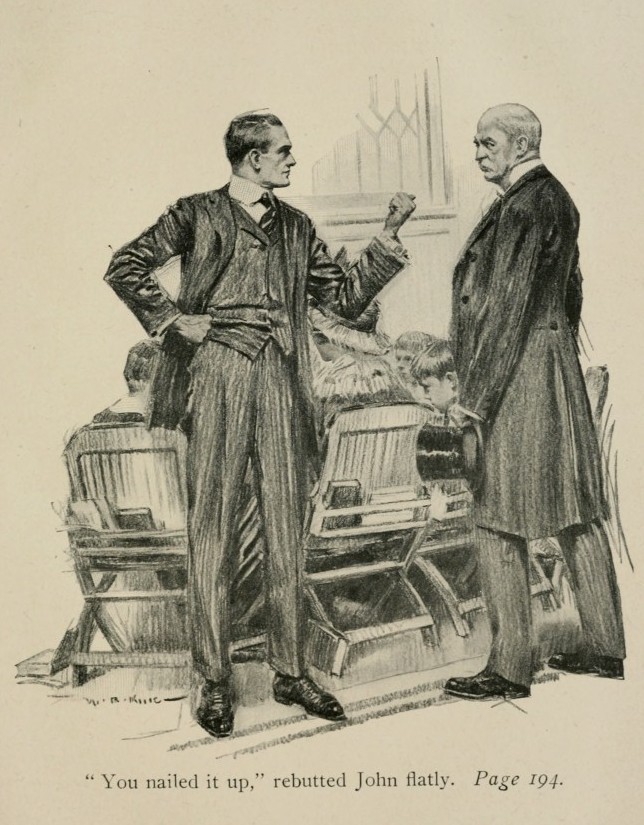
"You nailed it up," rebutted John flatly.
The Elder opened his mouth to speak but closed it again without doing so. Something in the very atmosphere was a rebuke to him. Perhaps it was the presence of the Presence! He had indeed nailed up the house of the Lord! He thought he had done a righteous thing, but under this young man's eyes, burning with an odd spiritual light, before his calm, strong face, and in the presence of these children, the accusation smote the Elder deep. He began to suspect that he had done a doubtful act.
"Keep back thy servant also from presumptuous sins," piped a high voice sharply at his elbow, and Elder Burbeck started guiltily, as if his conscience had shouted the sentiment aloud. It was only one of Sister Nelson's boys singing out the text; nevertheless, the Elder was as shaken as if he had heard a voice from on high.
But at this juncture John Hampstead put out his hand cordially. Elder Burbeck took it—tentatively, almost grudgingly,—and was again dismayed to feel how strong that hand was and to observe how, without apparent effort, it shook him all over, as it had shaken him that day upon the walk outside. Yet the Elder mustered once more the spirit of protest.
"The church was closed by order of the District Evangelist," he urged, but his urging, even to himself, sounded strangely lacking in force.
"It was opened in the name of Him who said 'Suffer little children to come unto me and forbid them not,'" replied the interloper, quietly and emphatically, but not offensively.
In the meanwhile the subtle cordiality of John's manner did not abate but seemed rather to grow, for, still clinging to the Elder's hand, Hampstead walked with him back down the aisle to the open space before the pulpit. Burbeck felt himself strangely subdued. He was minded to rebel, to flame up; but somehow he couldn't. Yet Sister Nelson's eye was upon him, and it would imperil his own leadership to appear beaten by this mild-mannered young man who assumed so much so coolly and executed his assumptions so masterfully. The alternative strategy which suggested itself to the mind of the Elder was to take the lead in showing that he recognized the intrusion of Hampstead as somehow an intervention from which good might come. To make this strategy effective, however, action must be immediate; but the shrewd Elder was easily equal to that. Sniffing the air critically for a moment, he announced, loudly enough to be heard by all, even by Sister Nelson, busy with her boys:
"You need some windows open, Brother Hampstead! You go on with your superintending; I'll attend to that myself."
Immediately the Elder laid his tall hat upon the pulpit steps and busied himself with opening the windows at the top.
John watched him with carefully concealed amazement, until an unmistakable awe settled in upon him; for here was obviously the exhibition of a mystery,—the demonstration of a power within him not his own. Here was something he had not done; yet which had been done through him, through the presence of the Presence.
As the lesson hour proceeded, a trickling stream of adults began to filter in. Their attitude, any more than Burbeck's had been, was not that of people who enter a house of worship. Surprise, excitement, conflict was written on their faces. They took seats in one side section with Elder Burbeck and Miss Nelson, or upon the other side with Miss Armstrong; and then, between fierce looks across the abyss of chair-backs at the "disturbing element,"—the other side in a church quarrel is always that,—they bent a curious watchful eye on Hampstead.
At first the notes of the organ had notified those in the immediate neighborhood that the house of God was no longer nailed up. Members of each party, fearful that the other might gain an advantage, began at once to spread the news in person and by telephone, so that now all over Encina women were struggling with hooks and eyes and curling irons, and men were abandoning Sunday papers and slippers on shady porches, shaving, dressing, and rushing in hot haste to the battle line.
When the children filed out, the opposing groups of adults remained buzzing among themselves like angry hornets, but with no more communication between the two ranks than bitter looks afforded.
John, extremely desirous of getting well out of the zone of hostilities, was actually afraid to leave these belligerent Christians alone together. He thought they might break into pitched battle; the women might pull hair, the men swing chairs upon each other's heads. His fears were abruptly heightened by a series of violent bumps on the steps outside, followed by a trundling sound in the vestibule as if a cannon were being unlimbered. Instantly, too, every face in the little chapel turned at the ominous sounds, but John was puzzled to observe that the expression of even the bitterest was softened at the prospect.
This was explained in part when there appeared through the swinging inner doors not the muzzle of a fieldpiece, but a lady in a wheel chair, who, though her dark hair had begun to silver, was dressed in youthful white and had about her the air of one who refused to allow mere invalidism to triumph over the stoutness of her spirit.
Her vehicle was propelled by a solemn looking Japanese, and as if by long understanding, one man slipped forward immediately from each faction, and the two made a way among the chairs for the Oriental to roll his charge to the exact center of the unoccupied middle bank of sittings.
Bestowing on each helper a look of gratitude from her dark eyes, which were large and luminous, the lady sent a benignant smile before her round the church like one whose presence sweetens all about it. Evidently she was one member of the congregation who observed a scrupulous neutrality while holding the affection and regard of all.
"The Angel of the Chair!" murmured Miss Plummer in John's ear, as she passed to a seat with Miss Armstrong.
John looked again at the form in the chair, so frail and orchid-like, with its delicately chiseled face and its expression of courageous spirituality. Remembering how the features of all had softened at the sound of the wheels, he felt that she well deserved the title. This impression of her saintly character was somehow heightened by a chain of large jet beads ending in a cross of the same material, which the whiteness of the gown outlined sharply upon her breast; so that John found himself instinctively leaning upon her as a possible source of inspiration and relief.
From her position of carefully chosen neutrality, the Angel of the Chair immediately beckoned Miss Armstrong to her from one side and Elder Burbeck from the other. Each approached, without in any way recognizing the presence of the other; and Miss Armstrong was apparently asked to detail what had happened, Burbeck's part, it would seem, being to amend if the narrative did his faction less than justice.
The story finished, and the Elder nodding his assent to it, the Angel of the Chair dismissed her informants and turned a welcoming glance on John, who advanced with extended hand, but judging that his formula of introduction was now unnecessary.
"I am Mrs. Burbeck," the lady said pleasantly in a rich contralto voice.
Hampstead all but gasped. This delicate, spirituelle creature that hard, red-faced partisan's wife! It seemed impossible.
But Mrs. Burbeck was composedly taking from her lap a twist of tissue paper from which she unrolled a simple boutonniere, consisting of one very large, very corrugated and very fragrant rose geranium leaf, upon which a perfect white carnation had been laid.
"Do you know, Mr. Hampstead," she went on placidly, "what I am going to do?" and then, as John looked his disclaimer, continued: "I have always been allowed the privilege of bringing a flower for the minister's button-hole. Brother Ingram would never take his flower from any one else. When the rain kept me away, he would not wear a flower at all. Brother Aleshire also took his flower from me."
"But," protested John, in sudden alarm, "I am not a minister at all, you know. I just happened in, and I assure you that all I am thinking of now is a way to happen out."
The Angel, it appeared, was a woman with deeps of calm strength in her.
"You have been a real minister in what you have done this morning," she said contentedly, entirely undisturbed by John's embarrassed frankness.
"But how am I going to get out from under?" gasped the young man, feeling more and more that he could trust this woman.
The Angel of the Chair smiled inspiringly.
"The Scripture has no rule for getting out from under," she suggested quietly, "but there is something about not letting go of the plow once you have grasped the handles."
The Angel was looking straight up at John now, searching his eyes for a moment, then adding significantly:
"I do not think you are a quitting sort of person."
A quitting sort! John could have blessed this woman. In two sentences she had felt her way to the principle he had tried to make the very center of his character,—loyalty to duty and everlasting persistence. Some people rather thought he was a quitting sort. John knew he was not, and to prove it bent till his buttonhole was in easy reach of the hands uplifted with the flower.
"And what," he asked, "does the minister do when he has received this decoration from the Angel of the Chair?"
It was Mrs. Burbeck's turn to feel a flush of pleasure at this appellation from a stranger.
"Why," she smiled, her large eyes lighting persuasively, "he goes into the pulpit and announces a hymn."
"Which I am not going to do," declared John, "because I should not know what to do next."
"In that hour it shall be given you," quoted the lady.
Now it was very strange, but when Mrs. Burbeck quoted this, it did not seem like an appeal to faith at all, but the simple statement of a fact. It chimed in, too, with that odd suggestion of the presence of the Presence, which had come to John a while ago.
Feeling thereby unaccountably stronger, and endued with a sort of moral authority as if he had just taken Holy Orders because of the carnation which bloomed so chastely white upon his breast, John squared his shoulders and mounted into the pulpit. There was something that God wanted to say to these people, and he accepted the situation as an obvious call to him to say it, but when he essayed to speak, awe came upon him, as it had a while before.
"Brethren," he confessed humbly, in a voice barely audible to all, "I am not a preacher. I haven't got any text, and I don't know what to say, except just perhaps to tell you how I happened to be here this morning."
Then he told them simply and unaffectedly but with unconscious eloquence how he happened to see the church nailed up and how it sounded like the echo of the blows upon the cross; how, this morning, with a sad ache in his own heart, the thought of the faith of little children disturbed by that brutal plank upon the door had brought him all the way over here from his home in San Francisco and led him to do what he had done. He even told them of his meditative comparison between the houses of people that looked so happy and the house of God that looked so unhappy.
But while John was relating this modestly, yet with some of the fervor of unction and some comfortable degree of self-forgetfulness, he was interrupted by a sound like a sob, and looking down beyond Elder Burbeck to where Sister Nelson sat, he was surprised to see a handkerchief before her eyes and her shoulders trembling. Over on the other side, too, handkerchiefs were out, so that John suddenly realized that he or somebody had touched something.
Who had done it? What had caused it? Once more there came to the young man that eerie consciousness of a power within him not himself, and the feeling frightened him.
"That's all I have to say, brethren," he declared abruptly, his voice growing suddenly hollow. "I am terrified. I want to get away!"
Without even the singing of a hymn, John lifted his hand, bowed his head, and murmured something that was to pass for a benediction.
CHAPTER XIX
HIS NEXT ADVENTURE
Yet once out of the pulpit, John's sense of terror seemed to leave him. With some of the people coming forward to press his hand and even to wring it; with the Angel of the Chair giving him a wonderful look from her luminous eyes, he began to feel strangely, happily satisfied with himself,—as though adrift upon an unknown sea but without fear and joyously eager for the next adventure.
That adventure came when blue-eyed Helen of the Infant Class said pleadingly:
"Oh, Brother Hampstead! Will you call on Sister Showalter this afternoon and read a chapter? She is very ill and lonely."
"Yes," assented John recklessly. "But explain who it is that's coming—a book agent—to read to her."
John had no idea who Mrs. Showalter was; but they gave him a number. He had no idea what a professional clergyman reads to a sick woman; but that afternoon he pushed his little New Testament in his hip pocket somewhat as Brother Charles Thompson Campbell used to do, and went out upon his errand.
A faded, hollow-eyed, middle-aged woman met him at the door, with a face so somber that in his instant thought and ever after, John dubbed her the Gloom Woman.
"My name is Hampstead," he explained. "I called to see the sick lady."
"My mother!" answered the woman, in tones as somber as her countenance. "She has been asking for you for an hour. She is very low to-day. The doctor is with her and he is apprehensive."
Through air that was close with a sickish, sweetish smell, accounted for by large vases of flowers and by a small Chinese censer with incense burning in it, past furnishings, that were meager, stuffy, and old-fashioned, John was conducted to a large square room with the blinds drawn low. In the center of this room was a huge black walnut bedstead, with the head rising pompously high. By the far side of the bed sat a professional looking man in the fifties, with his chin buried in his hand and his eyes meditatively fixed upon a very old and dreary face amid the banked-up pillows,—a face of purplish hue that seemed without expression except for a lipless, sunken mouth, and eyes that glowed dully under sagging heavy lids.
"Mother!" said the woman, speaking loudly, as if to waken a soul from the depths, "this is Brother Hampstead!"
The aged eyes roamed the shadows anxiously for a moment, while a withered purple hand felt its way about upon the coverlet till John touched it timidly with his. Instantly and convulsively the old fingers gripped the young, with a pressure that to the caller was damp and deathly.
The woman appeared to John almost lifeless. He felt embarrassment and resentment. Why didn't they tell him she was like this?
The hand was tugging at him, too, like a sort of undertow, pulling him down and over. The watery old eyes were fixed upon him. John's embarrassment increased. What did the poor creature want? To kiss him? What does a minister do in such a case, he wondered, sweat breaking out on his brow.
"I think she wants to say something; bend low so you can hear her," suggested the mournful voice of the Gloom Woman. John bent over till he felt the patient's hectic breath upon his cheek, and shrank from it.
"The minister of God!" croaked the voice so faintly that the words barely traveled the necessary six inches to his ear.
No man ever felt less like the minister of God. Hampstead was hot, flustered, self-conscious, almost irritated.
But again he felt the hand like an undertow, tugging him down.
"Read to me!" croaked the ghost of a voice.
This was something to do. A curtain was raised slightly so that the visitor could see, and he read the twenty-third Psalm and the twenty-fourth.
As Hampstead read, his embarrassment departed. He began to find a joy in what he was doing. He let his rich voice play upon the lines sympathetically and had a suspicion that he could feel the strength of the sick woman reviving as he read.
"She likes to have the minister pray with her," said the voice of the Gloom Woman from the background, when the reading was concluded.
Again John stood gazing helplessly, till the old hand dragged him down, and sinking upon his knees beside the bed, he found that words came to him, and he lost himself in them. His sympathy, his faith, his own sore heart and its needs, all poured themselves into that prayer.
Once or twice as words flowed on, Hampstead felt the old hand tugging, as though the undertow were pulling at it, and then he noticed after a time that he did not feel these tuggings any more; but when the prayer was finished and he rose from his knees, the grip of the hand did not release itself. Instead, the fingers hung on, rather like hooks, so that John darted a look of inquiry at the purplish face upon the pillows. To his surprise, the chin had dropped and the eyes had closed sleepily.
The doctor, who had been sitting with his hand upon the pulse, gently placed the wrist which he had held across the aged breast and stood erect, with an expression of decision which no one could misread.
"Oh!" sobbed a voice from the gloom.
Hampstead felt a sudden sense of shock, and his knees swayed under him sickeningly. That was death there upon the pillow; and that was death with its bony hooks about his palm. Sister Showalter had gone out with the undertow that pulled at her while he was praying.
John lifted his hand helplessly.
"It—it doesn't let go," he whispered.
The doctor glanced at the embarrassed Hampstead searchingly, then reached over and straightened the aged fingers.
"Young man," said the physician earnestly and even reverently. "She clung to you as she went down into the waters. For a time I felt your young strength actually holding her back, and then your words seemed to make her strong enough to push off boldly of her own accord. It is a great thing, my friend," and the doctor seemed deeply affected, "to have strength enough and sympathy and faith enough to rob death of its terror for a feeble soul like that—a very great thing!"
The earnestness of the doctor brought a lump into John's throat.
"Thank you, sir," he murmured, but immediately was lost in looking curiously at the thing upon the pillows.
"You have another duty," said the physician, nodding toward the shadows at the back, where a single heart-broken wail had been followed by a convulsive sobbing.
John went and stood beside the Gloom Woman.
"Mother is go—h-h-gone!" she sobbed.
"Yes," said Hampstead simply.
And somehow he didn't feel embarrassed at all now by the presence of death. He did not hesitate as to what to do. He just put out his hand and laid it in a brotherly way on the woman's shoulder, noticing as he did so that it was a frail, bony shoulder, and that it trembled as much from weakness as with emotion.
"Let the tears flow, sister," he suggested, "it is good for you."
And the tears did flow, like rivers, and all the while John's speech was flowing in much the same way, and with tears in it, until presently the woman looked up at him, surprised both at the manner and the matter of his speech. Was it he who had spoken,—this man who said he was only a book agent?
John too was surprised at his words, at their tone, at the superior faith and wisdom which they expressed. He really did not know he was going to say them. When spoken, it did not seem as if it could have been he that had uttered them, and he had again that awesome sense of a power within him not himself.
"You are a minister of God!" declared the Gloom Woman with sudden conviction.
Hampstead trembled. This was what the dead had whispered to him. It frightened him then, it frightened him now. He was not a minister of God. He was a man misplaced. He wanted to get out and fly. Yet before he could check her, the Gloom Woman had raised his hand and kissed it.
This made him want to fly more than ever; but he managed first to ask: "Is there anything more that I can do?"
There was, it seemed, and he did it; and then, getting into the outside as expeditiously as possible, he filled his lungs with long, refreshing drafts of the sun-filtered ozone and found his footsteps leading him, as if by a kind of instinct of their own, down one of the short side streets to where the waters of the Bay lapped soothingly against the sea-wall.
But the Bay zephyrs could not wash that series of vivid experiences, half-ghastly and half-inspiring, out of mind.
He had blundered, all unprepared, into the presence of death. His sense of the fitness of things revolted. He was unworthy—unable—unclean. He—a book agent! a rate clerk! an actor! who had held Marien Dounay in his arms and felt his body thrill at the beating of her heart!
Yet this old woman had called him a minister of God! This Gloom Woman too had called him the same. Minister! Minister! What was it? Minister meant to serve. A servant of God! But he had not served God! At least not consciously. He had only served humanity a little. He had served the old woman as a prop to her fears, like an anchor to her soul when she drifted out into the deeper running tide that ebbs but never floods. He had served the Gloom Woman when he stood beside her while she opened the tear-gates of her grief.
It was very little! Yet that much he had really served. To reflect upon it now gave him a sense of elation greater than when he had beaten Scofield and his tariff department; greater than when he had quelled the mob at the People's; greater than when he had crushed Marien in his arms like a flower; greater even than when Bessie had looked her love into his eyes.
He began to perceive that his life was surely mounting from one plane to another and reflected that he had reached the highest plane of all to-day when the Angel of the Chair had pinned upon his coat the badge of Holy Orders; when this other saint, sinking into the dark tide, had hailed him a minister of God! Highest of all, when this Gloom Woman, out of her soul's Gethsemane, had wrung his hand and kissed it so purely and also hailed him as Minister of God!
For some weeks the little chapel in Encina, its troubles and its troubled members, continued to exercise a strange fascination over John. Each Sunday he shepherded the Sunday school and talked a blundering quarter of an hour to the older folk who gathered; while between Sundays he devoted an astonishing portion of his time to visiting these wrangling Christians in their homes, for the ambition to heal this disgraceful quarrel had taken hold on him like some knightly passion.
And in the midst of all these busy comings and goings, odd, half-humorous reflections upon his own status used to break in upon John's mind. Not a self-respecting church in the communion, he knew, but would have eyed him askance because he had been an actor. Only this little helpless church, whose condition was so miserable it could not reject any real help, accepted him; and that merely in a relation that was entirely unofficial and undefined. Still a sense of his fitness for this particular task grew upon him continually; and it was really astonishing how every experience through which he had passed had equipped him for his peacemaker task: most of all those pangs endured because of his break with Bessie, which, although eating into his heart like an acid, yielded a kind of ascetic joy in the pain as if some sort of character bleaching and expiation were at work within him.
In the meantime, an arbitration committee consisting of the District Evangelist, Brother Harding, and Professor Hamilton, the Dean of the Seminary, was at work upon the affairs of the little church. Both wings consented to this, but with misgivings, since the one man they were really coming to trust was Hampstead himself; and when the night for the report of the arbitration committee arrived, each faction turned out in full strength, with suspicions freshly roused, and all a-buzz with angry conversation as if the church were a nest of wasps.
"Things are pretty hot," remarked the Dean under his breath, coming up to read the report.
"They are awful," groaned the District Evangelist.
John presided, standing carefully on his neutral patch in the carpet, and was dismayed and sickened by this new and terrible display of feeling. He had come to know a very great deal about these people in the last few weeks; he had seen how some of these men struggled to make a living; how some of these women bore awful crosses in their hearts; how sickness was in some houses, cold despair in others; how much each needed the strength, the joy, the consolation of religion, and how large a mission there was for this church and for its minister.
But the Dean was reading his report now, in a high, lecture-room voice. It was very brief.
"As for the matters at issue," it confessed, "your committee finds it humanly impossible to place the responsibility for this regretful division. It believes the only future for the congregation is in a wise, constructive, forward-moving leadership which can forget the past entirely.
"It finds that such a leadership now exists in one thoroughly familiar with the difficulties of the situation and enjoying the confidence of both factions; and it recommends that this congregation make sure the future by calling to its pastorate the one man whom the committee believes supremely fitted for the task, our wise and faithful brother, John Hampstead."
The congregation had not thought of Hampstead as a minister. He had not permitted them to do so. To them this recommendation was a surprise.
But to John it was a shock! His face turned a faded yellow. His eyes wandered in a hunted way from the face of the Dean to that of the Evangelist, and then slowly they swept the congregation to meet everywhere looks of approval at the Dean's words.
"But," he protested breathlessly, like a man fighting for air, "I am not a minister. I am a book agent. I have been an actor. I am unfit to stand before the table of the Lord, to hold the hand of the dying, to speak consolation to the living beside the open grave! I am unfit—unfit—for any holy office!"
But his desperate protestation sounded unconvincing even to himself. He had been doing some of these things already and with a measure at least of acceptation. All at once it seemed as if there was no resisting, as if a trap had been laid for him and for his liberties; and he struck out more vehemently:
"Think what it means, you young men! I ask you especially—" and John held out his hands towards them, scattered through the audience—"What it means to abandon life and the world by donning the uniform of the professional clergyman! Wherever you go, in a train, in a restaurant, upon a street, you are no longer free, but a slave—to forms and to conventions. You must live up, not to your ideal of what a minister is, but to the popular ideal of how a minister should appear. It is a vow to hypocrisy!
"It is a vow also to loneliness. The minister is cut off from the life of other men. No man thereafter feels quite at ease in his presence, but puts on something or puts off something, and the minister never sees or feels the real man except by accident.
"For a few weeks," and John lowered his voice to a more tempered note, "I have been happy to do some service among you; but I was free! As I walked down the street I wore the uniform of business. No man could say: 'There goes a priest; watch him!'
"Listen!" In the silence John himself appeared to be listening to some debate that went on within himself, and when he began to speak once more it was with the chastened utterance of one who takes his hearers into a sacred confidence.
"I have had ambitions, brethren, and I have given them up. I have had a great love and all but lost it. Failures have humbled me. Disappointment and surrenders have taught me some of the true values of life. I have tried to gain things for myself and lost them. When I think of seeking anything for myself again, after my experiences, I feel very weak and can command no resolution; but when I think of seeking happiness for others, for little children in particular, for wives and mothers, for all women, in fact, with their capacity to love and trust; for striving, up-climbing men—yes, and the weak ones too, for I have learned that the flesh is very weak—when I think of seeking the good of humanity at large, I feel immensely strong and immensely determined. For that I am ready to bury my life in the soil of sacrifice, but not professionally!
"I hate sham. I hate professionalism. I am done with part-playing. I will not do it. I cannot be your minister!"
John's last words rang out sharply, and the audience, seeing that the heart of a man with an experience had been shown to them, sat breathless and still expectant.
In the silence, the voice of the District Evangelist was presently audible.
"Brother Hampstead," he was saying quietly, "is a man I don't exactly understand, but I think in his very words of protest he has given us the reasons why he should be a minister, and he has revealed to us why he has gained your confidence. Because of his humility and his sincerity, I feel that I can trust him. You feel that you can."
"But," protested John, with a gesture of desperation, "I am not educated for the ministry."
"You have something more needed here than education," interjected the Dean of the Seminary, still in his lecture-room voice. "Besides, the seminary is but ten miles away, by street car. You may complete the full three years' course at the same time you are making this little church into a big one!"
Something in John's breast leaped at the prospect of a college course, and the idea of making a little church into a big one appealed to his inborn passion for definite achievement; yet with it all came once more the feeling that he was being hopelessly and helplessly entangled.
"But," he struggled, looking with moist, appealing eyes, first at Hamilton and then at Harding, "I have not been ordained, and I have no call!"
"No call?" queried Dean Hamilton, laughing nervously, as was his way of modifying the intensity of the situation. "Your capacity to do is your call."
"Being honest with yourself, do you not believe that you can save this church?" argued Brother Harding.
John felt that he could, but his soul still strained within him, and his eyes roved over the audience, the corners of the room and the very beams in the ceiling, as if seeking a way of escape.
Suddenly a man stood up in the back of the church.
"Will he take a side?" this man demanded excitedly, with hoarse impatience. "What side is he on?"
The very crassness of this partisan creature, so seething with personal feeling that he understood nothing of the young man's agony of soul, lashed the tender sensibilities of Hampstead like a scourge, so that all his nature rose in protest. From a figure of cowering doubt, he suddenly stood forth bold and challenging.
"No!" he thundered. "I will not take a side! The curse of God is upon sides, and every man and every woman who takes a side in His church! I will take the Lord's side. I challenge every one of you who is willing to leave his or her petty personal feeling in this controversy, for to-night and forever, to come out here and stand beside me. I place my life career upon the issue. I will let your coming be my call. If you call me, I will answer. If you do not, God has set me free from any responsibility to you."
The questioning partisan sank down abashed before such prophetic fervor. John stood waiting. No eye looked at any other eye but his. The silence was electric and pregnant, but brief, broken almost immediately by a low, rumbling sound and the rattle of wheels against chairs. The Angel of the Chair, propelling her vehicle herself, was coming to take her place beside John.
She had barely reached the front when the tall form of Elder Burbeck was seen to advance stiffly and offer his hand to Hampstead.
The venerable Elder Lukenbill, goat-whiskered and doddering, leader of the Aleshire faction, hesitated only long enough to gloat a little at this spectacle of his rival, Burbeck, eating humble pie, and then, prodded from behind, arose and careened on weak knees down the aisle.
Others began to follow, till presently it seemed that the whole church was moving; everybody stood up, everybody slipped forward, or tried to. Failing that, they spoke, or laughed, or sobbed, or shook hands with themselves or some one near; then craned on tiptoe to see what was happening down where half the church was massed about the two elders, about the Dean and the Evangelist and John.
Abruptly the tall forms of these men sank from view; then the front ranks of people, crowding around, also began to sink, almost as ripe grain bows before a breeze, until even the people at the back could see that Brother Hampstead was kneeling, with the yellow crest of his hair falling in abandon about his face.
The long, skeleton hand of Elder Lukenbill was sprawled over John's bowed head, overlapped aggressively by the stout, red fingers of Elder Burbeck, while the dapper digits of the Dean of the Seminary capped and clasped the two hands and tangled nervously in the tawny locks themselves.
"With this laying on of hands," the Dean was saying, still in that high lecture-room cackle, although his tone was deeply impressive, "I ordain thee to the ministry of Jesus Christ!"
When, succeeding this, the voice of the District Evangelist had been heard in prayer, there followed an impressive waiting silence, in which no one seemed to know quite what to do, except to gaze fixedly at the face of John Hampstead, which continued as bloodless and as motionless as chiseled marble; until, bowed in her chair, as if she brooded like a real angel over the kneeling congregation, the rich contralto voice of Mrs. Burbeck began to sing:
"Take my life and let it be
Consecrated, Lord, to Thee,
Take my hands and let them move
At the impulse of Thy love."
Presently her voice changed to "Nearer My God to Thee", while other voices joined until the whole church was filled with the sound, and when the last note had died, the very air of the little chapel seemed tear-washed and clear.
In this atmosphere John Hampstead arose, and when one hand swept back the yellow mass of hair, a kind of glory appeared upon his brow. Once an actor, once a man of ambition, he was now consecrated to the service of humanity.
But he had not surrendered his love for Bessie Mitchell, and Marien Dounay was still in the world, mounting higher and higher toward the goal she had imperiously set for herself.
CHAPTER XX
A WOMAN WITH A WANT
Five years walked along, and great events took place. The earthquake seized the San Francisco Bay district and shook it as a dog shakes a rat. Fire swept the great city on the peninsula almost out of existence; it made rich men poor, and hard hearts soft—for a few days at least—and by shifting populations and business centers, affected the east side of the Bay almost as much as the west, so that in all that water-circling population there was no business and no society, no man or woman or child even, that was thereafter quite as it or he or she had been.
In this seething ferment of change nothing altered more than the circumstances of John Hampstead. He had buried himself and found himself. He had sought relief in a self-abandoning plunge into obscurity, yet never had a minister so humble gained such burning prominence. The town hung on him. Men who never went to church at all leaned upon him and upon the things they read about him from day to day.
He had gone upon a thousand missions of mercy; he had fought for his lambs like a lion; he had faced calumny; he had dared personal assault. He had triumphed in all his conflicts and stood out before this sprawling, half metropolitan, half-suburban community of half a million people as a man whom it trusted—too much almost.
Under his ministry in these five years, the wretched little chapel had grown into the great All People's Church. To attend All People's was a fad; to belong to it almost a fashion. The newspapers daily made its pastor into a hero, and the moral element in the population looked upon him as its most fearless champion and aggressive leader.
But into this situation and into All People's one morning a woman came walking, with power to shake it more violently than an earthquake could have done.
The choir was just disposing of the anthem. The Reverend John Hampstead sat, but not at ease, in his high pulpit chair, which, somehow, this morning reminded him of the throne chair of Denmark upon its stage in that barn of a theater which at this very instant was only five years—and five miles—distant; the chair from which he used to arise suddenly to receive the rapier thrust of his nephew, Hamlet. This morning a vague uneasiness filled him, as if he were about to receive a real rapier thrust.
The minister's sermon outline was in his hand, but his eye roamed the congregation. It took note of who was there and who was absent; it took note of who came in; but suddenly the eye ceased to rove and started forward in its socket.
Deacon Morris was escorting a lady down the right-center aisle. To distinction of dress and bearing the newcomer added a striking type of beauty. Her figure was tall, combining rounded curves and willowy grace. In the regularity of its smooth chiseling, her profile was purely Greek. The eyes were dark and lustrous, the cheeks had a soft bloom upon them, the lips were ripely red; and if art had helped to achieve these contrasts with a skin that was satiny smooth and of ivory creaminess, it was an art contributory and not an art subversive.
"More beautiful than ever!" murmured the minister with the emphasis of deep conviction.
The lady accepted a sitting well to the front. Her head was reverently bowed for an interval and then raised, while the black eyes darted one illuminative glance of recognition at the man in the pulpit, a glance that made the minister start again and confess to himself an error by admitting beneath his breath: "No, not more beautiful—more powerful!"
Lengthened scrutiny confirmed this judgment. Soft contours had yielded, though ever so slightly, to lines of strength. There was greater majesty in her bearing. She was less appealing, but more commanding. John reflected that it was rather impossible it should be otherwise. The man or the woman who fights and conquers always sacrifices lines of beauty to those muscle clamps of strength which seem to sleep but ill-concealed upon the face.
And Marien Dounay had conquered! In five years she had mounted to the top. With the memory of her latest Broadway triumphs still ringing, this very day her name would be mentioned in every dramatic column in every Sunday paper in America. To have uttered that name aloud in this congregation would have caused every neck to crane.
Alone conscious of her presence, John found himself counting the cost of her success. Part of that cost he could see tabulated on her face. Another part of it was the grisly and horrible intimation to the loathsome Litschi, which he had overheard on the unforgetable night in the restaurant. He found himself assuming that she had paid this latter price and experienced a feeling of revulsion at recalling how once this woman's mere presence, the glance of an eye, the touch of a hand, the purring tones of her voice, had been sufficient to melt him with unutterable emotions. This morning, gazing at her through that peculiar mist of apprehension, almost of fear, that had been clouding his mind since before her entry, John knew that she was a more dangerous woman now than then; and yet the same glance showed that she was not dangerous to him, for the dark eyes looked at him hungrily, with something strangely like adoration in them, and there was an expression of longing upon the beautiful face.
When he stood up to preach, she followed his every movement and appeared to drink down his utterance thirstily. Skilled now in spiritual diagnosis, the minister of All People's read her swiftly. She had gained—but she had not gained all. Something was still desired, and, he could not help but believe, desired of him. Having coldly driven him from her with a terrible kind of violence, she had come back humbly, almost beseechingly.
So marked was this suggestion of intense longing that the feeling of horror and revulsion which had come to Hampstead with the entry of the actress gave way entirely to an emotion of pity and a desire to help, and he tried earnestly to make his sermon in some degree a message to the woman's heart.
The position of the Reverend John Hampstead in All People's Church and in the community round about was due to no miracle, but had grown naturally enough out of the strong heart of the man and his experiences.
When, for instance, in the early days at the chapel, John missed the Pedersen children from the Sunday school, and found their mother in tears at home because the children had no shoes, and that they had no shoes because Olaf gambled away his weekly wage in "Beaney" Webster's pool room where race-track bets were made, and poker and other gambling games were played, all in defiance of law,—and when he found the police supine and prosecutors indifferent,—the practical minded young divine sent Deacon Mullin—who, to his frequent discomfiture resembled a "tin can" sport more than a church official—into Beaney's to bet upon a horse. When the Deacon's horse won, and Beaney all unsuspecting paid the winnings over in a sealed envelope, the next Sunday night John took the envelope into the pulpit and shook it till it jingled as he told the story which next morning the newspapers printed widely, while the minister himself was swearing out a warrant for the arrest of Beaney.
That was the beginning, but to John's surprise it was not the end. Beaney did not plead guilty meekly. He fought and desperately, for this meddlesome amateur clergyman had lifted the cover on a sneaking underground system of petty gambling, of illicit liquor selling, and of graver violations of the moral laws, which ramified widely. Attacked in one part, all its members rallied to a defence of the whole that was impudent, determined and astonishingly powerful.
Hampstead was unknown, his church small and wretched and despised. His sole weapon was the newspapers who would not endorse him, but who would print what he said and what he did. What he said was not so much, but what John Hampstead did was presently considerable, for a few public-spirited citizens put money in his hand for detectives and special prosecutors, and he spent more hours that year in police courts than he did in his church.
In the end he won. The lawless element, sore and chastened, acknowledged their defeat, while the forces of good and evil alike recognized thus early the entry into the community of a man whose character and personality were henceforth to be reckoned with.
But while these battlings earned John publicity and high regard, they also won him hate and trouble. The work cost him tremendous expenditure of energy and sleepless nights. It made enemies of men whose friendship he desired. It brought him threats innumerable. A stick of dynamite was found beneath his study window. Yet John's devotion made him careless of personal danger. He trembled for Rose and Dick and Tayna; he trembled for the man who had crept through the shadow of the palms to plant that stick and time that fuse, which mercifully went out; but somehow he did not tremble for himself.
Besides, out of the shadow of danger, there seemed to reach sometimes the flexing muscles of an omnipotent arm. As, for instance, when an arrested gambler, out upon bail, came into his study one night with intent to kill. At first the minister was talking on the telephone, and some chivalric instinct restrained the would-be assassin from shooting his nemesis in the back.
Next John laughed at the preposterous idea of being killed, failing to understand that the threat was earnest or to perceive how much his caller was fired by liquor. Such merriment was unseemly to the man on murder bent; he found himself unable to shoot a bullet into the open mouth of laughter, and fumbled helplessly with his hand behind him and his tongue shamefacedly tied until the minister directed his mind aside with a question about his baby, following quickly with sympathetic talk about the man's wife and mother, until the spirit of vengeance went out of him, and he broke down and cried and went away meekly with a parting handshake from his intended victim.
It was only after the man had gone that John felt strangely weak with fright and bewildered by an odd sense of deliverance.
Yet all these battles were only a part of John's activities; nor did they grow out of a fighting spirit, but out of a sympathetic nature, out of his passion for the hurt and helpless, and his brave pity for the defenceless.
His impulsive boldness, his ready tact, and his disposition to follow an obligation or an opportunity through to the end, no matter where it led, had made him father confessor to men and women of every sort and the unofficial priest of a parish that extended widely on the surface and in the underworld of the life about him.
Naturally, All People's was extremely proud of its pastor, of his broad sympathies and his devoted activities. Impressionable ladies felt that there was something romantic in seeing him stand yonder in the pulpit, so grave and priestly; in seeing him come down at the end of the service, so approachable to all; and in taking his hand, not knowing whether some archcriminal had not wrung it an hour before he entered the pulpit, or whether last night those firm fingers might not have smoothed back the hair from the brow of some dying nameless woman in a place about which nice people could scarcely permit themselves to think.