The Roadmaster's Story
Reading edition
THE SPIDER WATER
Not officially; I don't pretend to say that. You might travel the West End from fresh water to salt—and we dip into both—without ever locating the Spider Water by map or by name.
But if you should happen anywhere on the West End to sit among a gang of bridge carpenters; or get to confidence with a bridge foreman; or find the springy side of a roadmaster's heart; then, you might hear all you wanted about the Spider Water—maybe more; anyway, full plenty, as Hailey used to say.
The Sioux named it; and whatever may be thought of their interpretation of Scriptural views on land-grabbing, no man with sense ever attempted to improve on their names for things, whether birds, or braves, or winds, or waters—they know.
Our General Managers hadn't always sense—this may seem odd, but on the system it would excite no comment—and one of them countenanced a shameful change in the name of the Spider Water. Some polytechnical idiot at a safe distance dubbed it The Big Sandy; and the Big Sandy it is to this day on map and in folder—but not in the lingo of trackmen nor the heart of the Sioux. Don't say Big Sandy to trackmen and hand out a cigar. It will not go. Say Spider Water without any cigar and you will get a word and a stool, and if you ask it, fine cut.
The Spider Water—although ours is the pioneer line—was there when we first bridged it. It is probably as old as sundown, and nothing like as pretty. The banks—it has none to speak of. Its stones—they are whiskered. Its bed—full of sand-burs. Everything about the villain stream has a dilapidate, broken-down air: the very mud of the Spider Water is rusty.
So our people bridged it; and the trouble began. A number of matters bothered our pioneer managements—Indians, outlaws, cabinet officers, congressional committees, and Wall Street magnates—but at one time or another our folks managed all of them. The only thing they couldn't at any time satisfactorily manage was the Spider Water. Bridge after bridge they threw across it—and into it. Year after year the Spider Water toyed with our civil engineers and our material department. One man at Omaha given to asthma and statistics estimated, between spells, that the Spider Water had cost us more money than all the water courses together from the Missouri to the Sierras.
Then came to the West End a masterful man, a Scotchman, pawky and hard. Brodie was his name, an Edinburgh man with no end of degrees and master of every one. Brodie came to be superintendent of bridges on the Western Division, and to boss every water course on the plains and in the mountains. But the Spider Water took a fall even out of Brodie. It swept out a Howe truss bridge for Brodie before he got his bag unpacked, and thereafter Brodie, who was reputed not to care a stringer for anybody, did not conceal a distinct respect for the Spider.
Brodie went at it right. He tried, not to make friends with the Spider, for nobody could do that, but to get acquainted with it. For this he went to its oldest neighbors, the Sioux. Brodie spent weeks and weeks up the Spider Water hunting, summers; and with the Sioux he talked Spider Water and drank fire-water. That was Brodie's shame—the fire-water.
But he was pawky, and he chinned unceasingly the braves and the medicine men about the uncommonly queer water that took the bridges so fast. The river that month in and month out couldn't squeeze up water enough to baptize a pollywog and then, of a sudden, and for a few days, would rage like the Missouri, restore to the desert its own and living image, and leave our bewildered rails hung up either side in the wind.
Brodie talked cloudbursts up country; for the floods came, times, under clear skies—and the Sioux sulked in silence. He suggested an unsuspected inlet from some mountain stream which maybe, times, sent its storm water over a low divide into the Spider—and the red men shrugged their faces. As a last resort and in desperation he hinted at the devil; and the sceptics took a quick brace with as much as to say, now you are talking; and muttered very bad Medicine.
Then they gave him the Indian stuff about the Spider Water; took him away up where once a party of Pawnees had camped in the dust of the river bed to surprise the Sioux; and told Brodie how the Spider, more sudden than buck, fleeter than pony, had come down in the night and surprised the Pawnees—and so well that the next morning there wasn't enough material left for a scalp dance.
They took Brodie out into the ratty bed himself and when he said, heap dry, and said, no water, they laughed, Indianwise, and pointed to the sand. Scooping little wells with their hands they showed him the rising and the filling; the instant water where before was no water. And dropping into the wells feathers of the grouse, they showed Brodie how the current carried them always across the well—every time, and always, Brodie noticed—southeast.
Then Brodie made Hailey dig many holes, and the Spider welled into them, and he threw in bits of notebooks and tobacco wrappers, but always they travelled southeast—always the same; and a bigger fool than Brodie could see that the water was all there, only underground. But when did it rise? asked Brodie. When the Chinook spoke, said the Sioux. And why? persisted Brodie. Because the Spider woke, said the Sioux. And Brodie went out of the camp of the Sioux wondering.
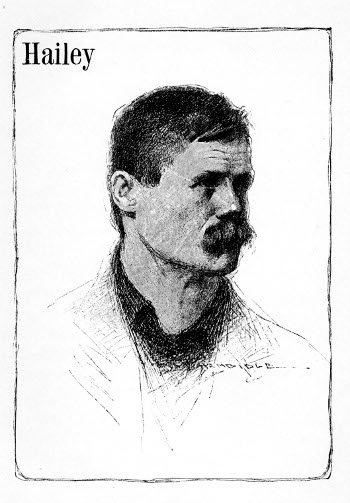
Hailey
And he planned a new bridge which should stand the Chinook and the Spider and the de'il himself, said Brodie, Medicine or no Medicine. And full seven year it lasted; then the fire-water spoke for the wicked Scotchman—and he himself went out into the night.
And after he died, miserable wreck of a man—and of a very great man—the Spider woke and took his pawky bridge and tied up the main line for two weeks and set us crazy—for we were already losing our grip on the California fast freight business. But at that time Hailey was superintendent of bridges on the West End.
I
His father was a section foreman. When Hailey was a kid—a mere kid—he got into Brodie's office doing errands; but whenever he saw a draughtsman at work he was no good for errands. At such times he went all into a mental tangle that could neither be thrashed nor kicked out of him, though both were conscientiously tried by old man Hailey and Superintendent Brodie; and Brodie, since he could do nothing else with him, finally kicked him into learning to read—and to cipher, Brodie called it. Then, by and by, Hailey got an old table and part of a cake of India ink himself, and himself became a draughtsman, and soon, with some cursing from Brodie and a "Luk a' that now!" from his paralyzed daddy, became chief draughtsman in Brodie's office. Hailey was no college man—Hailey was a Brodie man. Single mind on single mind—concentration absolute. Mathematics, drawing, bridges, brains—that was Hailey. But no classics except Brodie, who himself was a classic. All that Brodie knew, Hailey had from him; and where Brodie was weak, Hailey was strong—master of himself. When Brodie shamed the image he was made in, Hailey hid the shame best he could,—though never touched or made it his own—and Brodie, who hated even himself, showed still a light in the wreck by molding Hailey to his work. For, one day, said Brodie in his heart, this boy shall be master of these bridges. When I am rot, he will be here what I ought to have been—this Irish boy—and they will say he was Brodie's man. And better than any of these dough-heads they send me out, better than any of their Eastern graduates he shall be, if he was made engineer by a drunkard. And Hailey was better, far, far better than the graduates, better than Brodie—and to Hailey came the time to wrestle the Spider.
Stronger than any man before or since he was for that work. All Brodie knew, all the Indians knew, all that a life's experience, eating, living, watching, sleeping with the big river had taught him, that Hailey knew. And when Brodie's bridge went out, Hailey was ready with his new bridge for the Spider Water which should be better than Brodie's, just as he was better than Brodie. It was to be such a bridge as Brodie's bridge with the fire-water left out. And the plans for a Howe truss, two pier, two abutment, three span, pneumatic caisson bridge to span the Big Sandy River were submitted to headquarters.
But the cost! The directors jumped their table when they saw the figures. We were being milked at that time—to put it bluntly, being sucked, worse than lemons—by a Wall Street clique that robbed our good road, shaved our salaries, impoverished our equipment, and cut our maintenance to the quick. They talked economy and studied piracy. In the matter of appropriations, for themselves they were free-booters; for us, they were thrifty as men of Hamelin town. When Hailey demanded a thousand guilders for his Spider Water bridge, they laughed and said, "Come, take fifty." He couldn't do anything else; and he built a fifty guilder bridge to bar the Spider's crawl. It lasted really better than the average bridge and since Hailey never could get a thousand guilders at once, he kept drawing fifty at a time and throwing them annually at the Spider.
But the dream of his life—this we all knew, and the Sioux would have said the Spider knew—was to build a final bridge over the Spider Water: a bridge to throttle it for all time.
It was the one subject on which you could get a rise out of Hailey any time, day or night,—the two pier, two abutment, three span, pneumatic caisson Spider bridge. He would talk Spider bridge to a Chinaman. His bridge foreman Ed Peeto, a staving big, one-eyed French Canadian, actually had but two ideas in life: one was Hailey; the other the Spider bridge. When the management changed again—when the pirates were sent out on the plank so many good men had walked at their command—and a great and public-spirited man took control of the system, Ed Peeto kicked his little water spaniel in a frenzy of delight. "Now, Sport, old boy," he exclaimed riotously, "we'll get the bridge!"
So there were many long conferences at division headquarters between Bucks, superintendent, and Callahan, assistant, and Hailey, superintendent of bridges, and after, Hailey went once more to general headquarters lugging all his estimates revised and all his plans refigured. All his expense estimates outside the Spider bridge and one other point were slight, because Hailey could skin along with less money than anybody ever in charge of the bridge work. He did it by keeping everything up; not a sleeper, not a spike—nothing got away from him.
The new president, as befitted a very big man, was no end of a swell, and received Hailey with a considerate dignity unknown on our End. He listened carefully to the superintendent's statement of the necessities at the Big Sandy River. The amount looked large; but the argument, supported by a mass of statistics, was convincing. Three bridges in ten years, and the California fast freight business lost twice. Hailey's budget called, too, for a new bridge at the Peace River—and a good one. Give him these, he said in effect, and he would guarantee the worst stretch on the system for a lifetime against tie-up disasters. Hailey stayed over to await the decision; but he was always in a hurry, and he haunted the general offices until the president told him he could have the money. To Hailey this meant, particularly, the bridge of his dreams. The wire flashed the word to the West End; everybody at the Wickiup was glad; but Ed Peeto burned red fire and his little dog Sport ate rattlesnakes.
The old shack of a depot building that served as division headquarters at Medicine Bend we called the Wickiup. Everybody in it was crowded for room, and Hailey, whose share was what was left, had hard work to keep out of the wastebasket. But right away now it was different. Two extra offices were assigned to Hailey, and he took his place with those who sported windows and cuspidors—in a word, had departments in the service. Old Denis Hailey went very near crazy. He resigned as section boss and took a place at smaller wages in the bridge carpenter's gang so he could work on the boy's bridge, and Ed Peeto, savage with responsibility, strutted around the Wickiup like a cyclops.
For a wonder the bridge material came in fast—the Spider stuff first—and early in the summer Hailey, very quiet, and Peeto, very profane, with all and several their traps and slaves and belongings moved into construction headquarters at the Spider, and the first airlock ever sunk west of the Missouri closed over the heads of tall Hailey and big Ed Peeto. Like a swarm of ants the bridge-workers cast the refuse up out of the Spider bed. The blow-pipes never slept: night and day the sand streamed from below, and Hailey's caissons, like armed cruisers, sunk foot by foot towards the rock; by the middle of September the masonry was crowding high-water mark, and the following Saturday Hailey and Peeto ran back to Medicine Bend to rest up a bit and get acquainted with their families. Peeto was so deaf he couldn't hear himself swear, and Hailey looked ragged and thin, like the old depot, but immensely happy.
Sunday morning counted a little even then in the mountains. It was at least a day to get your feet on the tables up in Bucks's office and smoke Callahan's Cavendish—which was enough to make a man bless Callahan if he did forget his Maker. Sunday mornings Bucks would get out the dainty, pearl-handled Wostenholm that Lillienfeld, the big San Francisco spirit-shipper, left annually for him at the Bend, and open the R. R. B. mail and read the news aloud for the benefit of Callahan and Hailey and such hangers-on as Peeto and an occasional stray despatcher.
"Hello," exclaimed Bucks, chucking a nine-inch official manila under the table, "here's a general order—Number Fourteen——"
The boys drew their briers like one. Bucks read out a lot of stuff that didn't touch our End, and then he reached this paragraph:
"'The Mountain and the Inter-mountain divisions are hereby consolidated under the name of the Mountain Division with J. F. Bucks as Superintendent, headquarters at Medicine Bend. C. T. Callahan is appointed Assistant Superintendent of the new division.'"
"Good boy!" roared Ed Peeto, straining his ears.
"Well, well, well," said Hailey, opening his eyes, "here's promotions right and left."
"'H. P. Agnew is appointed Superintendent of bridges of the new division with headquarters at Omaha, vice P. C. Hailey,'" Bucks read on, with some little surprise growing into a shock. Then he read fast looking for some further mention of Hailey. Hailey promoted, transferred, assigned—but there was no further mention of Hailey in G. O. Number Fourteen. Bucks threw down the order in a silence. Ed Peeto broke out first.
"Who's H. P. Canoe?"
"Agnew."
"Who the hell is he?" roared Ed. Nobody answered: nobody knew. Bucks attempted to talk; Callahan lit his lighted pipe; but Ed Peeto stared at Hailey like a drunken man.
"Did you hear that?" he snorted at his superior.
Hailey nodded.
"You're out!" stormed Peeto.
Hailey nodded. The bridge foreman took his pipe from his mouth and dashed it into the stove. He got up and stamped across to the window and was like to have sworn the glass out before Hailey spoke.
"I'm glad we're up to high water at the Spider, Bucks," said he at last. "When they get in the Peace River work, the division will run itself for a year."
"Hailey," Bucks spoke slowly, "I don't need to tell you what I think of it, do I? It's a damned shame. But it's what I've said for a year—nobody ever knows what Omaha will do next."
Hailey rose to his feet. "Where you going, Phil?" asked Bucks.
"Going back to the Spider on Number Two."
"Not going back this morning—why don't you wait for Four, to-night?" suggested Bucks.
"Ed," Hailey raised his voice at the foreman, "will you get those stay-bolts and chuck them into the baggage-car for me on Number Two? I'm going over to the house for a minute." He forgot to answer Bucks; they knew what it meant. He was bracing himself to tell the folks before he left them. Preparing to explain why he wouldn't have the Sunday at home with the children. Preparing to tell the wife—and the old man—that he was out. Out of the railroad system he had given his life to help build up and make what it was. Out of the position he had climbed to by studying like a hermit and working like a hobo. Out—without criticism, or allegation, or reason—simply, like a dog, out.
Nobody at the Wickiup wanted to hear the telling over at the cottage; nobody wanted to imagine the scene. As Number Two's mellow chime whistle rolled down the gorge, they saw Hailey coming out of his house, his wife looking after him, and two little girls tugging at his arms as he hurried along; old Denis behind, head down, carrying the boy's shabby valise, trying to understand why the blow had fallen.
That was what Callahan up with Bucks at the window was trying to figure—what it meant.
"The man that looks to Omaha for rhyme or reason will beggar his wits, Callahan," said Bucks slowly, as he watched Ed Peeto swing the stay-bolts up into the car so they would crack the baggageman across the shins, and then try to get him into a fight about it. "They never had a man—and I bar none, no, not Brodie—that could handle the mountain-water like Hailey; they never will have a man—and they dump him out like a pipe of tobacco. How does it happen we are cursed with such a crew of blooming idiots? Other roads aren't."
Callahan made no answer. "I know why they did it," Bucks went on, "but I couldn't tell Hailey."
"Why?"
"I think I know why. Last time I was down, the president brought his name up and asked a lot of questions about where he was educated and so on. Somebody had plugged him, I could see that in two minutes. I gave him the facts—told him that Brodie had given him his education as an engineer. The minute he found out he wasn't regularly graduated, he froze up. Very polite, but he froze up. See? Experience, actual acquirements," Bucks extended his hand from his vest pocket in an odd wavy motion till it was lost at arm's length, "nothing—nothing—nothing."
As he concluded, Hailey was climbing behind his father into the smoker; Number Two pulled down the yard and out; one thing Hailey meant to make sure of—that they shouldn't beat him out of the finish of the Spider bridge as he had planned it; one monument Hailey meant to have—one he has.
The new superintendent of bridges took hold promptly; we knew he had been wired for long before his appointment was announced. He was a good enough fellow, I guess, but we all hated him. Bucks did the civil, though, and took Agnew down to the Spider in a special to inspect the new work and introduce him to the man whose bread and opportunity he was taking. "I've been wanting to meet you, Mr. Hailey," said Agnew pleasantly after they had shaken hands. Hailey looked at Agnew silently as he spoke; Bucks looked steadfastly at the grasshopper derrick.
"I've been expecting you'd be along pretty soon," replied Hailey presently. "There's considerable to look over here. After that we'll go back to Peace River cañon. We're just getting things started there: then we'll run up to the Bend and I'll turn the office over."
"No hurry about that. You've got a good deal of a bridge here, Mr. Hailey?"
"You'll need a good deal of a bridge here."
"I didn't expect to find you so far along out here in the mountains. Where did you get that pneumatic process?"
It touched Hailey, the pleasant, easy way Agnew took him. The courtesy of the east against the blunt of the west. There wasn't a mean drop anywhere in Hailey's blood, and he made no trouble whatever for his successor.
After he let go on the West End Hailey talked as if he would look up something further east. He spoke about it to Bucks, but Bucks told him frankly he would find difficulty without a regular degree in getting a satisfactory connection. Hailey himself realized that; moreover, he seemed reluctant to quit the mountains. He acted around the cottage and the Wickiup like a man who has lost something and who looks for it abstractedly—as one might feel in his pockets for a fishpole or a burglar. But there were lusty little Haileys over at the cottage to be looked after, and Bucks, losing a roadmaster about that time, asked Hailey (after chewing it a long time with Callahan) to take the place himself and stay on the staff. He even went home with Hailey and argued it.
"I know it doesn't seem just right," Bucks put it, "but, Hailey, you must remember this thing at Omaha isn't going to last. They can't run a road like this with Harvard graduates and Boston typewriters. There'll be an entire new deal down there some fine day. Stay here with me, and I'll say this, Hailey, if I go, ever, you go with me."
And Hailey, sitting with his head between his hands, listening to his wife and to Bucks, said, one day, "Enough," and the first of the month reported for duty as roadmaster.
Agnew, meantime, had stopped all construction work not too far along to discontinue. The bridge at the Spider fortunately was beyond his mandate; it was finished to a rivet as Hailey had planned it. Three spans, two piers, and a pair of abutments—solid as the Tetons. But the Peace River cañon work was caught in the air. Hailey's caissons gave way to piles which pulled the cost down from one hundred to seventy-five thousand dollars, and incidentally it was breathed that the day for extravagant expenditures on the West End was past—and Bucks dipped a bit deeper than usual into Callahan's box of cross-cut, and rammed the splintered leaf into his brier a bit harder and said no word.
"But if we lose just one more bridge it's good-bye and gone to the California fast freight business," muttered Callahan. "It's taken two years to get it back as it is. Did you tell the president that?" he growled at Bucks, smoking. Bucks put out his little wave.
"I told him everything. I told him we couldn't stand another tie-up. I showed them all the records. One bridge at Peace River, three at the Spider in ten years."
"What did they say?"
"Said they had entire confidence in Agnew's judgment; very eminent authority and that sort—new blood was making itself felt in every department; that, of course, was fired at me; but they heard all I intended to say, just the same. I asked the blooming board whether they wanted my resignation and—" Bucks paused to laugh silently, "the president invited me up to the Millard to dine with him. Hello, Phil Hailey!" he exclaimed as the new roadmaster walked in the door. "Happy New Year. How's your culverts, old boy? Ed Peeto said yesterday the piles were going in down at Peace River."
"Just as good as concrete as long as they stay in," smiled Hailey, "and they do cost a heap less. This is great bridge weather—and for that matter great track weather."
We had no winter that year till spring; and no spring till summer; and it was a spring of snow and a summer of water. Down below, the plains were lost in the snow after Easter even, the snow that brought the Blackwood disaster with three engines and a rotary to the bad, not to speak of old man Sankey, a host in himself. After that the snow let up; it was then no longer a matter of keeping the line clear; it was a matter of lashing the track to the right of way to keep it from swimming clear. Hailey had his hands full; he caught it all the while and worse than anybody, but he worked like two men, for in a pinch that was his way. Bucks, irritable from repeated blows of fortune, leaned on the wiry roadmaster as he did on Callahan or Neighbor. Hailey knew Bucks looked to him for the track and he strained every nerve making ready for the time the mountain snows should go out.
There was nobody easy on the West End: and least of all Hailey, for that spring, ahead of the suns, ahead of the thaws, ahead of the waters, came a going out that unsettled the oldest calculator in the Wickiup. Brodie's old friends began coming out of the upper country, out of the Spider valley. Over the Eagle pass and through the Peace cañon the Sioux came in parties and camps and tribes—out and down and into the open country. And Bucks stayed them and talked with them. Talked the great White Father and the Ghost dance and the Bad Agent. But the Sioux grunted and did not talk; they traveled. Then Bucks spoke of good hunting, far, far south; if they were uneasy Bucks was willing they should travel far, for it looked like a rising. Some kind of a rising it must have been to take the Indians out of winter quarters at such a time. After Bucks, Hailey tried, and the braves listened for they knew Hailey and when he accused them of fixing for fight they shook their heads, denied, and turned their faces to the mountains. They stretched their arms straight out under their blankets like stringers and put out their palms, downward, and muttered to Hailey.
"Plenty snow."
"I reckon they're lying," said Bucks, listening. "There's some deviltry up. They're not the kind to clear out for snow."
Hailey made no comment. Only looked thoughtfully at the ponies shambling along, the squaws trudging, the braves loitering to ask after the fire-water chief who slept under a cairn of stones off the right of way above the yard. Bucks didn't believe it. He could fancy rats deserting a sinking ship, because he had read of such things—but Indians clearing out for snow!
"Not for snow, nor for water," muttered Bucks, "unless it's fire-water." And once more the red man was misunderstood.


Now the Spider wakes regularly twice; at all other times irregularly. Once in April; that is the foothills water: once in June; that is the mountain water. And the June rise is like this [left image]. But the April rise is like this [right image].
Now came an April without any rise; that April nothing rose—except the snow. "We shall get it all together," suggested Bucks one night.
"Or will it get us altogether?" asked Hailey.
"Either way," said Callahan, "it will be mostly at once."
May opened bleaker than April; even the trackmen walked with set faces; the dirtiest half-breed on the line knew now what the mountains held. At last, while we looked and wondered, came a very late Chinook; July in May; then the water.
II
Section gangs were doubled and track-walkers put on. By-passes were opened, bridge crews strengthened, everything buckled for grief. Gullies began to race, culverts to choke, creeks to tumble, rivers to madden. From the Muddy to the Summit the water courses swelled and boiled—all but the Spider; the big river slept. Through May and into June the Spider slept; but Hailey was there at the Wickiup, always, and with one eye running over all the line, one eye turned always to the Spider where two men and two, night and day, watched the lazy surface water trickle over and through the vagabond bed between Hailey's monumental piers. Never an hour did the operating department lose to the track. East and west of us railroads everywhere clamored in despair. The flood reached from the Rockies to the Alleghenies. Our trains never missed a trip; our schedules were unbroken; our people laughed; we got the business, dead loads of it; our treasury flowed over; and Hailey watched; and the Spider slept.
Big Ed Peeto, still foreman of the bridges, hung on Hailey's steps and tried with his staring, swearing eye to make it all out; to guess what Hailey expected to happen, for it was plain he was thinking. Whether smoking or speaking, whether waking or sleeping, he was thinking. And as May turned soft and hot into June with every ditch bellying and the mountains still buried, it put us all thinking.
On the 30th there was trouble beyond Wild Hat and all our extra men, put out there under Hailey, were fighting to hold the Rat valley levels where they hug the river on the west slope. It wasn't really Hailey's track. Bucks sent him over there because he sent Hailey wherever the Emperor sent Ney. Sunday while Hailey was at Wild Hat it began raining. Sunday it rained. Monday it rained all through the mountains; Tuesday it was raining from Omaha to Eagle pass, with the thermometer climbing for breath and the barometer flat as an adder—and the Spider woke.
Woke with the April water and the June water and the rain water all at once. Trackmen at the bridge Tuesday night flagged Number One and reported the river wild, and sheet ice running. A wire from Bucks brought Hailey out of the west and into the east; and brought him to reckon for the last time with his ancient enemy.
He was against it Wednesday morning with dynamite. All the day, the night and the next day the sullen roar of the giant powder shook the ice-jams. Two days more he spent there watching, with only an occasional thunderbolt to heave and scatter the Spider water into sudden, shivery columns of spray; then he wired, "ice out," and set back dragged and silent for home and for sleep—ten hours out of two hundred, maybe, was all he reckoned to the good when he struck a pillow again. Saturday night he slept and Sunday all day and Sunday night. Monday about noon Bucks sent up to ask, but Hailey was asleep; they asked back by the lad whether they should wake him; Bucks sent word, "No."
Tuesday morning the tall roadmaster came down fresh as sunshine and all day he worked with Bucks and the despatchers watching the line. The Spider raced like the Missouri, and the men at the bridge sent in panic messages every night and morning, but Hailey lit his pipe with their alarms. "That bridge will go when the mountains go," was all he said.
Tuesday was his wedding date, old Denis told Peeto; it was Hailey's wooden wedding, and when he found everybody knew they were going to have a little spread over at the cottage, Hailey invited the boys up for the evening. Just a little celebration, Hailey said, and everybody he spoke wrung his hand and slapped his iron shoulders till Hailey echoed good cheer through and through. Callahan was going over; Bucks had promised to look in, and Ed Peeto and the boys had a little surprise for Hailey, had it in the dark of the baggage-room in the Wickiup, a big Morris chair. No one would ever guess how it landed at Medicine Bend, but it was easy. Ed Peeto had pulled it badly demoralized out of a freight wreck at the Sugar Buttes and done it over in company screws and varnish to surprise Hailey. The anniversary made it just right, very hot stuff, Ed Peeto said, and the company had undoubtedly paid a claim voucher, for it—or would.
It was nine o'clock, night, and every star blinking when Hailey looked in again at the office for the track-walkers' reports and the Railway weather bulletins. Bucks, Callahan, and Peeto sat about Duffy, who in his shirt-sleeves threw the stuff out off the sounder as it trickled in dot and dash, dot and dash over the wires. The west wire was good but east everything below Peace River was down. We had to get the eastern reports around by Omaha and the south—a good thousand miles of a loop—but bad news travels even round a Robin Hood loop.
And Wild Hat came first from the west with a stationary river and the Loup creek falling—clear—good night. And Ed Peeto struck the table heavily and swore it was well in the west. Then from the east came Prairie Portage, all the way round, with a northwest rain, a rising river, and anchor ice pounding the piers badly, track in fair shape and—and—
The wire went wrong. As Duffy knit his eyes and tugged and cussed a little the wind outside took up the message and whirled a bucket of rain against the windows. But the wires wouldn't right and stuff that no man could get tumbled in like a dictionary upside down. And Bucks and Callahan and Hailey and Peeto smoked, silent, and listened to the deepening drum of the rain on the roof.
Then Duffy wrestled mightily yet once more, and the long way came word of trouble in the Omaha yards with the river at twenty-two feet and cutting; rising at Bismarck one foot an hour.
"Hell to pay on the Missouri, of course," growled the foreman, staring single-eyed at the inoffensive bulletin. "Well, she don't run our way; let her boil, damn her."
"Keep still," exclaimed Duffy, leaning heavily on the key. "Here's something—from—the Spider."
Only the hum of the rain and the nervous break of the sounder cut the smoke that curled from the pipes. Duffy snatched a pen and ran it across a clip, and Bucks leaning over read aloud from his shoulder:
"Omaha.
"J.F.Bucks.—Trainmen from Number Seventy-Five stalled west of Rapid City—track afloat in Simpson's cut—report Spider bridge out send—"
And the current broke.
Callahan's hand closed rigidly over his pipe; Peeto sat speechless; Bucks read again at the broken message, but Hailey sprang like a man wounded and snatched the clip from his superintendent's hand.
He stared at the running words till they burnt his eyes and then, with an oath, frightful as the thunder that broke down the mountains, he dashed the clip to the floor. His eyes snapped greenish with fury and he cursed Omaha, cursed its messages and everything that came out of it. Slow at first, but bitter, then fast and faster until all the sting that poisoned his heart in his unjust discharge poured from his lips. It flooded the room like a spilling stream and no man put a word against it for they knew he stood a wronged man. Out it came—all the rage—all the heart-burning—all the bitterness—and he dropped, bent, into a chair and covered his face with his hands: only the sounder clicking iron jargon and the thunder shaking the Wickiup like a reed filled the ears about him. They watched him slowly knot his fingers and loosen them, and saw his face rise dry and hard and old out of his hands.
"Get up an engine!"
"Not—you're not going down there to-night?" stammered Bucks.
"Yes. Now. Right off. Peeto! Get out your crew!"
The foreman jumped for the door; Bucks hesitated barely an instant, then turning where he sat cut a telephone plug into the roundhouse; Callahan saw him act and leaning forward spoke low to Duffy. The despatcher snatching the train sheet began instantly clearing track for a bridge special.
In twenty minutes twenty men were running twenty ways through the storm and a live engine boomed under the Wickiup windows.
"Phil, I want you to be careful!" It was Bucks standing by the roadmaster's side at the window as they looked out into the storm. "It's a bad night." Hailey made no answer. "A wicked night," muttered Bucks as the lightning shot the yards in a blaze and a crash rolled down the gorge. But wicked as it was he could not bring himself to countermand; something forbade it. Evans the conductor of the special ran in.
"Here's your orders!" exclaimed Duffy. Evans pulling down his storm cap nodded as he took the tissue. Hailey buttoned his leather jacket and turned to Bucks.
"Good-by."
"Mind your track," said Bucks, warningly to Evans as he took Hailey's hand. "What's your permit?"
"Forty miles an hour."
"Don't stretch it. Good-bye, Phil," he added, speaking to Hailey. "I'll see you in the morning."
"In the morning," repeated Hailey. "Good-by. Nothing more in, Duffy?"
"Nothing more."
"Come on!" With the words he pushed the conductor through the door and was gone. The switch engine puffed up with the caboose. Ahead of it Ed Peeto had coupled in the pile driver. At the last minute Callahan asked to go, and as the bridge gang tumbled into the caboose, the assistant superintendent, Ed Peeto, and Hailey climbed into the engine. Denis Mullenix sat on the right and with William Durden, fireman, they pulled out, five in the cab, for the Spider Water.
From Medicine Bend to the Spider Water is a ninety mile run; down the gorge, through the foothills and into the Painted Desert that fills the jaw of the spur we intersect again west of Peace River. From the Peace to the Spider the crow flies twenty miles, but we take thirty for it; there is hardly a tangent between. Their orders set a speed limit, but from the beginning they crowded it. Hailey, moody at first, began joking and laughing the minute they got away. He sat behind Denis Mullenix on the right and poked at his ribs and taunted him with his heavy heels. After a bit he got down and threw coal for Durden, mile after mile, and crowded the boiler till the safety screamed. When Durden took the shovel Hailey put his hand on the shoulder of Callahan, who was trying to hang to big Ed Peeto on the fireman's seat.
"Callahan," he yelled in his ear, "a man's better off——" And Callahan, though he couldn't, in the pound and the roar, catch the words, nodded and laughed because Hailey fiercely laughed. Then going around to the right the roadmaster covered Denis Mullenix's fingers on the throttle latch and the air with his big hands and good-naturedly coaxed them loose, pushed the engineer back and got the whip and the reins into his own keeping. It was what he wanted, for he smiled as he drew out the bar a notch and settled himself for the run across the flat country. They were leaving the foothills, and when the lightning opened the night they could see behind through the blasting rain the great hulking pile driver nod and reel out into the Painted Desert like a drunken man; for Hailey's schedule was the wind and his limit the wide throttle.
The storm shook them with freshening fury and drove the flanges into the south rail with a grinding shriek, as they sped from the shelter of the hills. The rain fell in a sheet, and the right of way ran a river. The wind, whipping the water off the ballast, dashed it like hail against the cab glass; the segment of desert caught in the yellow of the headlight rippled and danced and swam in the storm water, and Hailey pulled again at the straining throttle and latched it wider. Callahan hung with a hand to a brace and a hand to Peeto, and every little while looked back at the caboose dancing a horn-pipe over the joints; Mullenix, working the injector, stared astonished at Hailey; but Durden grimly sprinkled new blood into the white furnace and eyed his stack.
Notch after notch Hailey drew, heedless of lurch and jump; heedless of bed or curve; heedless of track or storm; and with every spur at her cylinders the engine shook like a frantic horse. Men and monster alike lost thought of care and drunk a frenzy in the deafening whirl that Hailey opened across the swimming plain.
The Peace River hills loomed into the headlight like moving pictures; before they could think it, the desert was behind. Callahan, white-faced, climbed down, and passed from hand to hand by Durden and Mullenix got his hands on Hailey's shoulders and his lips to his ear.
"For God's sake, Phil, let up!"
Hailey nodded and choked the steam a little. Threw a hatful of air on the shoes, but more as a test than a check: the fire was in his blood and he slewed into the hills with a speed unslackened. From the rocks it is a down grade all the way to the cañon, and the wind blew them and the track pulled them and a frenzied man sat at the throttle. Just where the line crosses Peace River the track bends sharply in through the Needles to take the bridge.
The curve is a ten degree. As they struck it, the headlight shot far out upon the river—and they in the cab knew they were dead men. Instead of lighting the box of the truss the lamp lit a black and snaky flood sweeping over the abutment with yellow foam. The Peace had licked up Agnew's thirty-foot piles and his bridge was not.
Whatever could be done—and Hailey knew all—meant death to the cab. Denis Mullenix never moved; no man that knew Hailey would think of trying to supplant him even with death under the ponies. He did what a man could do. There was no chance anyway for the cab: but the caboose held twenty of his faithful men.
He checked—and with a scream from the flanges the special, shaking in the clutches of the air-brake, swung the curve.
Again, the roadmaster checked heavily. The leads of the pile driver swaying high above gravity center careened for an instant wildly to the tangent, then the monster machine, parting from the tender, took the elevation like a hurdle and shot into the trees, dragging the caboose after it. But engine and tender and five in the cab plunged head on into the Peace.
Not a man in the caboose was killed; it was as if Hailey had tempered the blow to its crew. They scrambled out of the splinters and on their feet, men and ready to do. One voice from below came to them through the storm, and they answered its calling. It was Callahan; but Durden, Mullenix, Peeto, Hailey, never called again.
At daybreak wreckers of the West End, swarming from mountain and plain, were heading for the Peace, and the McCloud gang—up—crossed the Spider on Hailey's bridge—on the bridge the coward trainmen had reported out, quaking as they did in the storm at the Spider foaming over its approaches. But Hailey's bridge stood—stands to-day.
Yet three days the Spider raged, and knew then its master, while he, three whole days sat at the bottom of the Peace clutching the engine levers in the ruins of Agnew's mistake.
And when the divers got them up, Callahan and Bucks tore big Peeto's arms from his master's body and shut his staring eye and laid him at his master's side. And only the Spider ravening at Hailey's caissons raged. But Hailey slept.