YOUNG LADIES;
William Combe translation
ILLUSTRATED BY
ELEVEN ELEGANT ENGRAVINGS, FROM DRAWINGS BY J. DUGOURC,
Draughtsman to His Majesty the King of France;
Accompanied by Descriptions,
TRANSLATED FROM THE FRENCH OF MADEMOISELLE ST. SERNIN,
AND INTERSPERSED WITH
ORIGINAL POETRY AND ANECDOTES.
LONDON:
PRINTED FOR R. ACKERMANN, REPOSITORY OF ARTS, 101, STRAND.
BY W. CLOWES, NORTHUMBERLAND-COURT.
PREFACE.
The most eminent physicians dwell particularly upon the necessity there is for young ladies, as they advance towards womanhood, to take active and regular exercise; and to avoid, as much as possible, all sedentary amusements. That love of variety, however, so natural to the human mind, and which is particularly observable in children, renders it a matter of some difficulty to diversify their sports, so as to discover a sufficient number of games that require exertion: we, however, flatter ourselves that this has been accomplished, in the little Work here presented to the reader in an English dress. They will find in it instructions for playing at a great number of games, of such a nature that they cannot fail of being conducive to their health; and which, while
The prose part of the work has been faithfully rendered into English from the French original; but the Proprietor is indebted to the author of the Tours of the original Dr. Syntax, who has enriched this little Repository of Youthful Sports, with some elegant verses, illustrative, in a moral point of view, of the games described.
HEALTHFUL SPORTS FOR YOUNG LADIES.
THE SWING.
Madame D’Hernilly was accustomed to pass, every year, several of the summer months in the country: a particular circumstance obliged her to go there sooner than usual, and her husband, who was one of the chief magistrates in the capital, was not able to accompany her. Her only companions were her two daughters, both young girls. There was very little society to be met with in that part of the country where Madame D’Hernilly’s castle was situated: the nearest town, which was at a distance of two or three leagues, was a small place, with but few genteel inhabitants; and, even were it otherwise, she would not have been tempted to mix with her neighbours. Solitude was her choice and her device, till the time of the vacation: at that period she expected to be joined by her husband and her only son. The visits she received
Adela and Ernestina, the daughters of Madame D’Hernilly, found this lonely life very dull; in fact it suited ill with the vivacity of their age; and, in order to enliven it, they managed to prevail upon the two ladies, their neighbours, to leave behind them at the castle three young persons who accompanied them there on a visit. This addition to the family was delightful to Adela and Ernestina, for they were equally in want of employment and amusement. They had read over and over all the books they brought with them from Paris. As their masters had not accompanied them, they did not pursue their studies regularly, but only took occasionally a few lessons upon the piano-forte, and of singing, so that a great portion of their time was unemployed.
A moralist has said, with much reason, that the mind requires relaxation; and as it is necessary to seek employment, in order to preserve oneself from the evil habits which are the offspring of idleness, so it is equally requisite to relieve the fatigue of labour by recreation; a proper mixture of both keeps up the spirits, and preserves the health of the mind as well as that of the body. In mixing with society we lose
Our five young friends were not obliged to rack their brains to find amusement. In the beginning of the visit the youngest, named Adriana, taught the grown-up girls those dances which they had learned in their childish days, but had already forgotten; “My fine Castle,” “We will not go again to the Wood,” “The Duke de Bourbon,” &c. &c. These are things out of date, we must allow, but they will always be new for children, and our imitations of them are, after all, lifeless copies; they want the spirit of the originals—“The Chevalier de la Marjolaine,” “The Tower,” “Take Care,” “Hands Round,” amused even Madame D’Hernilly, who herself did not disdain sometimes to join in them.
The pleasure which they found in renewing their childish games gave to our young people the idea of taking advantage of a swing, which was already erected in the garden. Persons of a more advanced age, and distinguished by grave occupations,
Satiety would not have interrupted this amusement, but bad weather came on suddenly, and it was impossible for our young folks to frequent the garden. Thus thwarted in their favourite sport, they set their wits to work to find out some other agreeable pastime.
Adriana regretted the swing less than her play-fellows: a new doll, which had been
They were just beginning to tire of the amusement, which making the doll’s clothes had at first afforded them, when one morning, Aglaé, one of the young visitors, happening to open a book by chance, read aloud, that it was by trying the effects of the reflection and the refraction of the light through the fragile partitions of soap bubbles, that the great Newton had discovered the properties of the prism, and decomposed the rays of the sun.
Madame D’Hernilly expressed her admiration of this phenomenon in natural philosophy; but she did not understand the subject sufficiently to give her little auditors much information upon it. “But pray,” cried Adriana giddily, “why should we not try to make some discoveries ourselves, by blowing soap bubbles, they are so pretty?” “Oh fie,” cried the elder girls, very consequentially; but one of them immediately
“It is indeed a very just idea,” said Madame D’Hernilly, “and I think, my children, you will do well to take advantage of Adriana’s proposal.” The matter was then put to the vote, much in the same manner as they had learned from the newspapers, the national affairs are decided in the chamber of deputies. Ernestina, and one of the young visitors, ranged themselves on the left, to shew that they rejected a motion for playing at such a childish game; Adriana, and her companions, took the right side, and they were lucky enough to secure the support of the centre, of which Madame D’Hernilly was the only member; they had consequently a majority, and it was decided that they should play at blowing soap bubbles. “Who knows,” said Aglaé, smiling, “whether we shall not, like the illustrious Newton, make some new and great discovery.” This idea raised their impatience to begin, and luckily, the preparations for their experiment were soon made. A chambermaid brought some soap suds, rather thick in a china basin; Adriana chose among some little bits of straw, the one which suited best with her design, and slit the extremity in four parts, then dipped the end she had slit in the soap suds, and blew in the other extremity of the straw. Each blew in
Madame D’Hernilly astonished the young people very much, by explaining to them the process by which enamellers formed the balls of the thermometer: it is done by blowing through a glass tube, the extremity of which is made red hot, and softened by the fire of a lamp. She added, that they had adopted this method also in glass manufactories, and that goblets, bottles, in a word, almost all the utensils which we use in glass and crystal, are blown in a similar manner.
Our little band now struggled with each other, to see who should form the largest bubble, and who should make it rise highest in the air: one of them waved her pocket-handkerchief to make it rise higher and higher, till the bubble burst, and the illusion was destroyed. Madame D’Hernilly, who recollected some verses on the subject of this amusement, took the opportunity of repeating them, and impressing their moral on the minds of her young audience.
BLOWING BUBBLES.
See how the cherub children play And force the bubbles on their way, Which, as in various course they sail, Borne by the zephyr’s gentle gale, Catch the tints which Phœbus gives While the aërial globule lives; But soon it bursts, and all is gone, The children mourn their pleasure done. Say, do we not too often see Mankind in this same sport agree; Who their intrinsic good forego, For the bright gleams of outward show.
This amusement did not last longer than the morning, and at night our juvenile group were again at a loss for something to do. Adriana was once more the first to find out a new species of amusement. In hunting about, she, at length, discovered some cards, and immediately began, with great alacrity, to arrange files of soldiers
Madame D’Hernilly seized the occasion which the cards presented to her, to give the young people some account of the manner in which they were first introduced. Almost all historians agree in saying, that they imagine games with cards were first invented in the reign of Charles the Sixth of France, in order to procure that prince some amusement during his long illness. As a proof that this is the fact, they cite the register of the chamber of accounts, in which there is the following passage: “the sum of fifty-six sous Parisis, (which was a very considerable sum in those times), was paid to Jacquemin Gringonneur, a painter, for three packs of cards, adorned with gold and divers colours, and different devices.” This passage proves nothing more than that Gringonneur was a card-maker, but not the inventor of any game. In making further researches, we find that Charles the Fifth, predecessor of Charles the Sixth, had prohibited the playing at Naipes.
All the European nations give to the four principal cards of each suit, the names of ace, king, queen, and knave, according to the denominations which correspond in each language; but the names of the four suits vary; hearts and spades are pretty nearly the only ones, the appellations of which are analogous in the different languages. The diamond is called carreau in French, and oros, which means jewel, in Spanish. The club called in French trèfle, and in Spanish bastos, has, like the diamond, a corresponding signification in the Spanish and English languages, because the name in both signifies a stick. In Germany, it was formerly made like a cross, and it still retains the name of kreuz. These little hints may be found worthy of the attention of those persons who seek to discover the origin of cards.
The young ladies questioned Madame D’Hernilly about the rules of the different games at cards: but, upon this point, she did not think it right to satisfy their curiosity. “It must be owned,” she said, “that we find fewer examples among women than men, of an inordinary fondness for cards, but we cannot be too much upon our guard against the love of play: recollect, besides, the observation, unfortunately too just, which one
“Long live our childish games!” cried Ernestina, “these at least do not occasion any remorse.”
THE SHUTTLECOCK AND THE SEE-SAW.
The weather cleared up, and the young people resumed their usual walks in the garden. The swing was out of order, and Madame D’Hernilly would not permit them to make use of it till it was repaired. The imagination of our juvenile group quickly suggested something to supply its place. A plank, placed across a very solid marble bracket, which they happened to find on the ground in the middle of the bower, was fastened to it by iron cramps, in order to render it more secure. The gardener, one of those ingenious fellows to whom we give the name of jack-of-all-trades, because he knew a little of every thing, and was besides a very decent mason, smith, and even blacksmith, seconded the impatience of the young ladies: the see-saw was soon ready, and Adriana and Aglaé were the first to spring upon it. They were both of them of the same height, and about the same weight, conditions quite necessary for the players at this game. Madame D’Hernilly watched that their alternate ascent and descent should be managed without any jerk, which might derange the machine, or, which
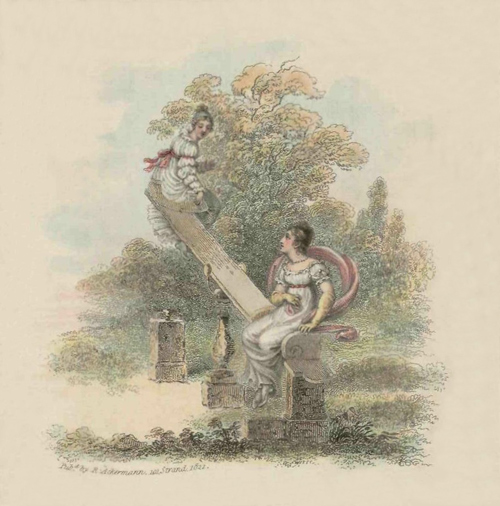
I recollect at this moment some moral lines upon the game of see-saw; they are rather obsolete, and the versification is not distinguished for its elegance, but the lines contain a maxim well worth remembering, the force of which could not be heightened by the finest language:
Behold the play-game; those who rise Seem as they would reach the skies; But soon they find that they descend, And to the earth as quickly tend. Thus Fortune guides the rolling ball, While these ascend, the others fall.
There are some see-saws of a double construction, which are mounted upon a revolving pivot, four persons may balance themselves at the same time upon these machines, two and two; the one who descends touches the ground lightly, with his foot to the right or to the left; it results from this, that the persons who play move continually in rotation in one direction or another; this variety of motion is indispensable, for the head would become giddy if the players moved very long in the same direction.
. This game is too well known to our young readers, for any description of it to be necessary.
Such of our little friends as are curious respecting the manners, customs, and amusements of distant countries, may like to know, that in China, and other countries of Asia, they play at shuttlecock with the foot. The Chinese shuttlecock, like ours, is decorated with feathers, but they place at the bottom a small bit of lead, or some pieces of copper money to render it heavier; they make use of the instep to push it, as is frequently done at the game of football. The following verses were written upon the play of shuttlecock by Pannard, and are thus translated:
Reason, whene’er your humour’s gay, You treat us just as children play, When with their battledores they force The shuttlecock in airy course. About you beat us as you please, Till tir’d, we wish the game to cease; And, when we fall upon the floor, You pick us up to play, as you have done before.
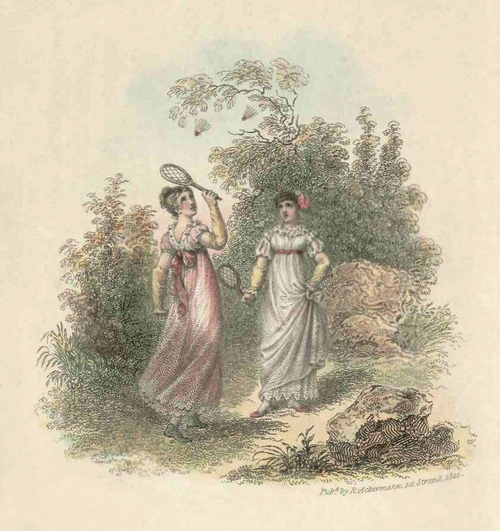
When all the young ladies were tired of the game of see-saw, and that Adriana had taken, or tried in vain to take, a sufficient number of butterflies, the whole party united and continued to play at shuttlecock. It is not impossible for four or five people to amuse themselves together, when they have a sufficient number of battledores, but it is better to do it by turns, or in the following manner. When a player fails to send back the shuttlecock which is sent to her, she should give up her place to another, and if the new player fails, she also should in her turn yield her place to a fresh competitor, and so on, till each enjoys the amusement in rotation. Such was the method pursued by our young players; but we do not know whether disputes might not sometimes have arisen from it, had not Madame D’Hernilly, as we before observed, always mixed in the sports of the children, and, by her presence, prevented squabbles.
The famous Christina, queen of Sweden, was very fond of the game of Shuttlecock. One day, during this queen’s stay in France, in the time of Louis XIV., she asked the learned Bochart, whom she had attracted to her court, to play with her. He did not need much entreaty, but immediately taking off his cloak, began a game with her
Before we quit this subject, we must say a few words respecting sognettes, or, as we call them in English, battledores. They are, as every body knows, little hoops of wood bent in an oval, and the extremities, united to form a handle, are kept together by strips of white leather bound round them. The interior of the battledore is a netting made of catgut, which is stretched lightly.
Those learned people who found fault with Bochart for making use of the battledore, have written several grave dissertations, for the purpose of ascertaining whether the ancients were acquainted with this game; those who are of opinion they were, cite this verse of Ovid:
Reticuloque pilæ leves fundantur aperto.
This passage of the Latin poet evidently means a net-work, upon which not shuttlecocks, but light balls, were tossed backwards and forwards.
As to our young rattle-pates, they were not at all curious to learn whether the amusement was of ancient or modern invention; leaving that to be ascertained by graver heads, they entered with so much ardour into the spirit of the game, that time
On the following day, as there was not a sufficient number of battledores and shuttlecocks for every body, one of the young visitors, named Valeria, contrived a very ingenious means of supplying their place. She took a small hoop, which she had procured from a barrel of oysters, and bound it round with pink and white ribbon; five or six young persons, armed with sticks, stood in a group, one of them threw this hoop to a great height in the air, and each of them caught it and threw it up again in her turn. When any one failed, they were obliged to quit the game for a moment, or to give a forfeit. This is called the game of the “flying ring,” it resembles in many respects the play of the “funnel,” which we shall speak of by-and-by.
Sometimes, in order to heighten the pleasure of the game, the players added three little bells to the ring, and these bells striking while the ring turned in the air, served to announce its approach.
THE GAMES OF THREAD-MY-NEEDLE, AND THE WOLF.
Madame D’Hernilly’s birth-day was celebrated by her family without parade or ceremony: the offerings upon this occasion were those of the heart alone. The neighbouring farmers, and superior class of peasants, presented themselves at the castle, to offer their congratulations to Madame on the return of the day; their little girls, dressed in white, brought her flowers. Madame D’Hernilly received with pleasure the simple offerings of these worthy people, for whom she prepared pleasures suited to their taste. The court of the castle became the theatre of a fête champêtre, which not only lasted the whole day, but was prolonged during the evening, by the light of a number of small lamps. The villagers amused themselves with dancing, and at night they were regaled with a simple collation.
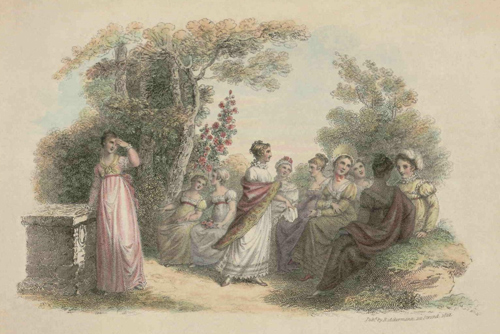
While the villagers were enjoying the dance, their children were diverting themselves in the gardens of the castle with the young ladies and their visitors. As the games which they commonly played would not suffice for the amusement of so many, Who will laugh last?” The mode of playing this game is very simple; they look each other full in the face, using at the same time every effort to preserve their gravity, and the first who smiles, even in the slightest degree, gives a forfeit, or else her companions impose a slight penance upon her.
Ernestina invented a game of this sort, in which a great number of persons might be engaged at once. It was a trial who should remain the longest time motionless in the same place. This play, it must be confessed, did not promise much amusement, but the preparations were entertaining enough. Madame D’Hernilly’s daughters had the greatest trouble to make the young villagers comprehend what they were to do; some of them, as soon as they were placed in proper positions, and desired to remain without moving as long as they possibly could, turned round immediately to the opposite side, and asked, with great simplicity, what they were to do? The confusion which resulted from these blunders was very diverting to the lookers-on. At last every thing was arranged, and the game might have gone on smoothly enough, but Thread-my-needle.” They comprehended with great facility the explanation which she gave them of it, and they began to play at it immediately.
The young ladies, their visitors, and the villagers, took each other by the hand, and formed a long file: they arranged themselves in such a manner that the two tallest girls were at the end of this file, and one of the most active at the opposite extremity. The lot fell to Aglaé to conduct the joyous band; and while the two last remained fixed in their places, with their arms raised, she passed under them, and all those who followed her did the same: after making a circuit, Aglaé returned between the second and the third, then between the third and the fourth, and so on, till by coming nearer and nearer, she found herself obliged at last to make a turn under the arm of the young girl who was next her; this is the termination of the game. Each of them took her turn in this manner to pass under one another’s arms, as a thread drawn through a needle, and, directed by a skilful hand, successively runs through all the meshes of a web.
queue-le-leu, or sometimes more simply termed the wolf.
They tossed up to see who should be wolf; the chance fell upon Adriana, who stood alone on one side during some time; her companions, holding each other by the tails of their gowns, ranged themselves behind a tall and active female villager, who was to play the shepherdess. It was expressly agreed upon, that Adriana should only take the last of the flock, and the shepherdess took all possible care to prevent her getting at that one. The struggle was a little unequal, because the shepherdess’s movements were quicker and more abrupt than those of the poor little wolf. Fortunately, those girls who formed the tail of the flock, had not so much strength or agility as their shepherdess, they relaxed by degrees in their exertions, and Adriana took advantage of it to catch the last; the file was then thrown into disorder, and they suffered themselves to be taken one after another. As fast as Adriana made a captive, it was placed behind her, and the flock of wolves became at last so formidable, that they completely wolf; and when they were tired of this game, they divided into groups, and played at “hide and seek,” “puss in the corner,” “paquets,” and other sports, which the villagers delight to play at in their rustic fêtes.
THE CUP-AND-BALL, THE DEVIL, THE SOLITAIRE, EMIGRANT, DOMINOS, &c.
The Misses D’Hernilly received from their brother a delightful present, and one worthy of the affection which these amiable children bore to each other. Young D’Hernilly had learned by a letter from Ernestina, that the companions whom his sister met with at the castle, were younger than themselves, and that, in conformity to the taste of their little friends, the Misses D’Hernilly had resumed the trifling and puerile amusements of their childish days. Upon receiving this intelligence, Victor D’Hernilly went immediately to one of the most elegant toy-shops, and purchased a complete collection of all sorts of games, which he sent to his sisters by the first opportunity.
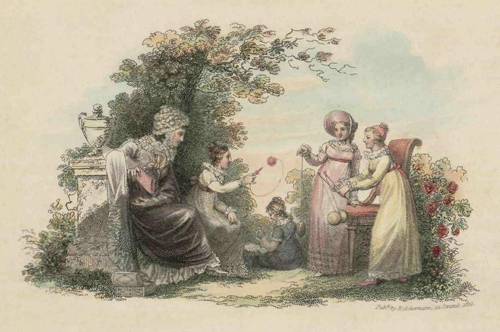
My little readers will easily conceive, that the arrival of this present occasioned a grand rejoicing among the young inmates of the castle. Each vied with the other who should first try the “cup-and-ball,” the “solitaire,” and the other play-things, some of Devil,” and above all, the “Emigrant,” the name of which alone is sufficient to indicate its origin.
Madame D’Hernilly who still continued to share in the amusements of the children, was particularly attentive to them while they were engaged in these new games; she made them keep at certain distances from each other, lest they should be hurt by the ball of the cup-and-ball, or by the fall of the devil.
The cup-and-ball, in the management of which the celebrated Marquis of Bièvre is said to have excelled, is of ancient origin, since mention is made of it in Rabelais. It is composed of two parts, which are united by a small cord, the strongest, and at the same time, the most flexible of its kind that can be procured. One of the parts is a wooden or ivory stick, pointed at one extremity and rounded at the other; the cord fixed in the centre of the stick, supports a large ball, pierced through the middle by a hole, the cord which is passed through the smallest opening, comes out at the large one; then a knot is tied at the end, which secures the ball from falling down.
The player begins by twirling the ball so as to give it a very quick motion in a perpendicular direction; you must wait a few seconds till you feel that the ball begins to move less quickly; this is the moment to throw it up, and if the aim is good, the ball
An ancient historian, named Estoile, tells us that King Henry the Third of France amused himself very frequently at cup-and-ball. This game came suddenly into very great favour in the middle of Louis the Fifteenth’s reign; it was in fact so much the fashion, that the actresses had the cup-and-ball in their hand even upon the stage.
The Emigrant was at one time quite as much in vogue, and it deserved it, on account of its singular mechanism, which though very simple causes it to remount of itself the whole length of the cord from which it descends. The Emigrant is a double disk, made of ebony or ivory; the two parts of this disk are united in the centre by a ball, which is of the same shape, and which forms a single piece; the ball is pierced with a hole, through which a cord is passed, the cord is knotted at the extremity in the same manner as the string of a cup-and-ball. You wind this cord round the ball, and then raising it by one end, you let the toy drop, retaining only the end of the cord; the toy falls, but it has acquired a force of rotation, which obliges it to roll itself round the cord Emigrant descends and ascends without ceasing, unless it gets deranged by the string getting out of the rut, which is formed by the middle of the ball.
You may play with the Emigrant not only by giving it a vertical motion, but also a horizontal one; and you may make it go, if you choose, like a censer, but this last method is not free from inconvenience, for if the string should chance to break, the disk may hurt the people who are near the player, or it may smash the looking-glasses or china.
The Devil is a toy still more dangerous to furniture; it is indeed so much so, that one cannot without imprudence play with it in a room. Most people remember this noisy plaything, for it was much in vogue a few years ago. It is in some respects, the reverse of the Emigrant; but it is moved by the same principle. It consists of two hollow balls, which are cut out of the same piece of wood, and united by a common stalk. Sometimes instead of wood, the toy is composed of tin, pewter, or even crystal; it is hardly Devils of this last substance are the most expensive and the most fragile. Each ball is pierced with a hole into which the air enters, and from which it escapes with impetuosity as the instrument turns round; a continual noise results from this, similar to that made by a German top. The rotation of the Devil is kept up by the alternate play of a small cord, suspended between two sticks placed in each hand of the player. You may throw this plaything very high, even to the distance of fifteen or twenty feet, and yet retain it upon the string; but this cannot be done without exposing the poor Devil to the chance of falling every instant; and it does not long survive repeated falls.
It seems likely that this game has been brought from India by the English, for it has been long known in China, and it is represented in some engravings sent from China, by the missionaries thirty years ago.
Adriana, although the youngest of the girls, had seized upon a toy, the use of which requires both stillness and reflection; consequently, she did not expect much amusement from it. It is called the Solitaire, because it can be played by a single person.
The Solitaire is a sort of octagon table, in which thirty-seven holes are made in the following order; three upon the first row, five upon the second, seven upon the third, fourth, and fifth, five upon the seventh, and three upon the eighth and last row.
The combinations of this game are very varied, and after you have won one game, you find it very difficult to play another exactly in the same manner. This difficulty is a good deal increased by the manner in which players exercise themselves, in leaving at different times a hole empty in various parts of the board, first in one place, and then in another.
There was at this time a continued and heavy fall of rain, which obliged our young friends to remain for some days within doors. Fortunately, Victor’s liberality enabled them to amuse themselves as well in the house as in the open air. In the parcel he had sent to them, there were two sorts of shuttlecock; the one we have already described, and another in which the shuttlecock is received on each side in a sort of funnel attached to a long handle. This exercise is less active than battledore and shuttlecock, because it is necessary that both the players should stand in a straight line. The [1].
Adela and Ernestina laughed very heartily at seeing Tee-totums among their brother’s presents; even Adriana herself thought that this play was somewhat too childish; nevertheless, after they had ridiculed Victor for sending them Tee-totums, they demonstrated at last by playing with them, that his foresight was not useless. When they had played at this game in their infancy, they had never troubled themselves to seek the signification of the letters marked on each side. All their pleasure consisted in trying who should make the totum spin the longest. Sometimes they themselves made a totum of a button-mould into which they drove a nail, a pin, or a little wooden peg. When Madame D’Hernilly explained to them what was meant by the letters engraved in black on the sides, they conjectured that the amusement had been invented by grave professors of science, or at least by some of their pupils, who had made a certain progress; for each of these letters P. A. D. T. is the initial of a Latin word expressing divers chances of the game. The letter P. is the beginning of the Latin word pone, which signifies put accipe, that is to say, receive; the player who throws it gains a counter. D. the first letter of the Latin word da, in English give, obliges you if you turn it up, to pay a counter. If T, the first letter of totum, which signifies all, should turn up, you take all that is in the pool.
We need hardly tell our young readers, that it is from this word totum, that the game takes its name. There are some totums that have a greater number of sides than others; this causes an infinite variety in the game, and greatly increases the chances of gain or loss. The totums with twelve sides, do not differ much from a ball in form; but they are not turned upon a pivot, they are only rolled by the hand. The sides are numbered up to twelve, he who gains the highest point wins the game, and as this play does not require any profound combinations, they have given it the familiar name of Jack.
“It is a pity,” said Adriana, “that Victor did not send us a Jack.” “Oh,” cried Adela, “we may manage to have one with two dice, which will produce the same numbers from two to twelve.” Madame D’Hernilly surprised her daughters very much by proving to them, that at the game of dice, the chances were not equal, and that they would find by calculation, it was probable they might throw one number more frequently than another.
Number 4 may be formed in three ways, by the double 2, by 1 and 3, and by 3 and 1. Number 5 has four chances, namely, 2 and 3, 3 and 2, 4 and 1, 1 and 4.
6 may be thrown in five different ways; first, the double 3; second, 2 and 4; third, 4 and 2; fourth, 5 and ace; fifth, ace and 5.
The chances are most in favour of the number 7; it may be formed first by 6 and ace; second, by ace and 6; third by 5 and 2; fourth, by 2 and 5; fifth, by 4 and 3; sixth, by 3 and 4.
The numbers which follow these, decrease in the same proportion as the preceding ones have augmented; therefore there are five chances for number 8, as there are for number 5; the 9 like the 4 has four chances; the 10 is gained in three ways like the 3; and the 11 is made by two different combinations like the 2; lastly, the number 12 can be produced only by the double 6.
It is very necessary to understand these combinations at the games of tric-trac, or
Players at different games, down even to the very game of goose, have made use of these combinations in order to calculate the probable chances of the different numbers. There is an infinite variety of drawings upon pasteboard designed for these games. The game of the goose, and similar ones, are disposed from 9 to 9; but you cannot stop there, and it is not possible to arrive at the last number 63, till you have surmounted a great number of obstacles. As a proof of this, we need only observe how often it happens, that when a person is nearly at the end of the game, and upon the point of winning it, he throws 6, which is one of the most common throws, and thus going beyond the required number is obliged to begin the game again. The bridge, the well, the prison, and death, that is to say, the figures which represent these quicksands, are arranged in such a manner, that one falls into them by the numbers 6, 7, and 8, which come every instant. In speaking upon this subject, Ernestina said facetiously, that a comic poet was not in the wrong in making one of his personages say:—
These games I prefer, which the spirit amuse, And ’tis a nice game, this same game of the Goose.
Adela, who had seen her parents play at tric-trac, asked the meaning of the words leset; the two trays ternes; the two fours carmes; the two fives, quines; the two sixes sonnez. There is no particular denomination for the double deuce.
With three dice, the chances are still more multiplied, and it would be very easy to calculate them; three points alike are called raffle, that is to say, a raffle of aces, a raffle of trays, a raffle of sixes, &c. &c.
From explaining the chances of the dice, Madame D’Hernilly turned to that of the osselets, or knuckle bones, which the ancients used nearly in the same manner as we do dice. They placed two or three in the dice box, and they reckoned a certain number of points according to what was turned up. The game was, however, looked upon only as a childish amusement. Phrates, king of the Parthians, wishing to reproach Demetrius, king of Syria, for his habitual levity, sent him some golden osselets.
Our children employed the little bone which is found in the leg of mutton, and which we call cramp-bone, or else small pieces of ivory cut to resemble it. The convex side is called the back, the opposite side which is concave, is called the hollow, and the two other sides are called the flat sides. The osselet is thrown up back, the hollow, the wells, the fricassee, the raffle, &c.
The Misses D’Hernilly, and their young friends amused themselves very little with the osselets which Victor had sent them; they declared that such a fatiguing game was fitter for boys than girls. But though they thought little of the osselets, they prized very highly a superb set of dominos, which were made of mother-of-pearl, and had the spots marked with golden nails. Madame D’Hernilly thought that this elegant token of Victor’s affection for his sisters, would not be very long safe in the hands of those little rattle-pates and their giddy associates; she therefore took charge of them herself, and presented the children with a common set in their stead.
Each Domino is divided into two parts, and each part presents seven combinations; namely, the six points of the dice, and the white space: it is for this reason, that the dominos are 28 in number. Each player takes at random a certain number of dominos, sulking. When there are only two, it is called fishing. You take at first very few dominos, for example, three, or at most five. When you sulk, instead of letting your adversary play, you draw from the dominos which remain, until you have drawn the required number; in consequence of this, it sometimes happens, that the player draws more than half the set. The game is won by the player who has first used all his dominos. If the game is closed, and that no one can place their remaining numbers either to the right or the left, he who has the smallest number of points, or if the points are equal, who retains the least number of dominos, wins the game. The winner reckons in his favour the number of points which his adversary has not been able to place, and they begin again until one of the players has gained the number 100 as at picquet.
The young neighbours were obliged to absent themselves for a few days from the abacus, which the ancient Romans made use of in counting; and the souan-pan, which the Chinese employ for the same purpose.
On one side is a large hollow, with four slits to mark the units; on the other side is a mark reckoned equal to fifty, and four others, which are each equal to ten. You might by this means, count beyond ninety-nine, but in multiplying the slits, you might go to several millions, or even millions of millions.
This kind of arithmetic is much more expeditious than that of writing down and adding up columns of figures, but it is attended with one very great inconvenience, that of leaving no trace of detached calculations; so that you cannot ascertain afterwards whether you have not committed some error.
The children’s fondness for dominos, subsided at last like their other whims, and they condescended to play with the onchets. Adriana deceived by the similarity of sound between this word and échecs, the French name for chess, supposed they were
CHESS.
In order due, the king, the queen, The knights and other ranks are seen: A picture true of martial strife, Such as appears in human life. The contest of the mind succeeds, The stratagems, the daring deeds: Queens yield them to the subtle foe, And even monarchs are laid low. The battle’s lost, the battle’s won; The contest o’er, the game is done. } Kings, queens, knights, pawns, whate’er their name, Whate’er is their dignity or fame, Are hustled in the bag from whence they came.
When Madame D’Hernilly had read the verses, they renewed their conversation about the game of onchets. “The grand question,” cried Madame D’Hernilly, “is whether these little ivory fish, or these figures of kings, queens, knaves, and horses, should be called onchets, honchets, or jonchets; those who make very laborious researches after the most trifling things, assure us, that we should say honchets, because the word may be used to signify little men. I am of the opinion of those who call them jonchets, which is derived from the game being originally played with straws, instead of these little sticks of ivory and gold. After all, my children, there is no need to trouble ourselves respecting the name of the game, the only essential thing about the amusement is that it should divert you.”
This game is most amusing when played by two persons only, although it is possible for three or four to join in it. They draw lots to decide who shall begin; the player who gains the chance, holds in his fingers one of these little hooks, the other takes the bundle of fish and figures which he strews over the table; the first then seizes with his hook upon as many of them as he can catch, but it requires a great deal of address to do this
The young people easily comprehended the instructions of Madame D’Hernilly, and soon became proficients in the game; they reckoned the king for fifty, the queen forty, the knave thirty, the horse twenty, and each plain fish for ten. The player who contrives to get together the greatest number of points, wins the game.
In every time, at ev’ry age, By grave and gay, by fool and sage, Or more or less, we’re sure to see The love of dear variety. The Cup-and-Ball thrown to and fro The pious game of Domino[2] Amuse by turns, with various games Of other shapes and other names, While, without meaning any evil, Some may prefer to play the Devil.
HIDE-AND-SEEK.
It is still a question among the players of this game in France, whether one should say hide, hide, Mitoubat, or hide, hide, Nicholas? The frolicksome group whose plays we are describing, did not care a jot which was most proper; in fact, they seldom gave themselves the trouble to reason either upon the names or the choice of their diversions. They were induced to engage in this, from a circumstance which we are about to mention. The amusements which were practised at the castle of D’Hernilly, were very much talked of in the neighbourhood, and the fame of their sports drew a number of youthful visitors to the family. We have before observed, that young ladies alone were admitted; among those who presented themselves were several new-married ladies, who did not blush to join again in the innocent diversions of their childhood. The young ladies and their visitors passed a whole day in juvenile sports, without feeling a moment’s uneasiness, except when the hour came which by summoning them to partake of a repast, interrupted their games.
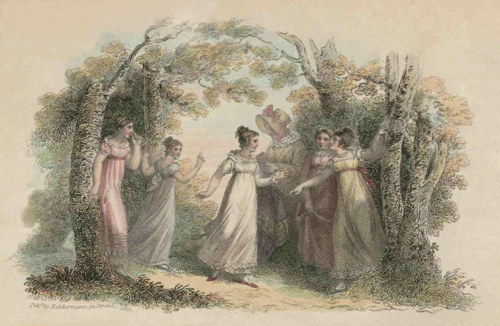
Another way of playing at hide-and-seek, is to form a circle, and to set a person to seek through it for a particular object, which each of the others contrives to conceal from her view; a pocket-handkerchief, a snuff-box, or, in short, any toy or trinket, will serve for this purpose. Formerly they used to make use of a slipper, but always upon the express condition, that it should be very clean: this is, however, a shabby sort of expedient, and ought to be proscribed in good company: when it is adopted the game is called Hunt-the-Slipper.
Our readers will readily conceive, that the Misses D’Hernilly and their companions,
Mademoiselle Valeria, one of the new comers, voluntarily offered to play the dull part of the seeker. A young lady went round the circle holding up the drapery of her shawl, in order that Mademoiselle Valeria, who held her hand before her eyes, promising at the same time not to cheat, might not see to whom she gave the handkerchief.
As soon as she had given it, she cried aloud, “It is done;” at this cry, Mademoiselle Valeria began the round; the pocket-handkerchief which she pursued with ardour, circulated rapidly from hand to hand, and was concealed by the players in the folds of their dress. It is necessary for the seeker to guess exactly who the person is who holds it, and to seize her in the act. Poor Valeria found it very difficult to do this, for at the moment that she thought herself sure of finding the handkerchief, the one who held it slily slipped it to another, and it arrived in the twinkling of an eye, at the very extremity of the circle.
After a long and vain search, Valeria succeeded at last in seizing the handkerchief in
They cried bravo on all sides, and mischievously determining to tease Ernestina, they formed a little plot against her, while she was standing on one side, waiting for the game to begin. The hour approached for leaving off play, and they quickly agreed to finish with a little cheating trick. The pocket-handkerchief for which Ernestina was to seek, was placed at a great distance under a tuft of flowers, and they made believe to pass it from hand to hand. Ernestina was completely duped by this stratagem; her young friends’ hands moved with so much rapidity that she never perceived they passed
II., Empress of Russia. This sovereign was one day surrounded by some of the gravest of her courtiers, and becoming tired of their pedantic dissertations, she said, “Permit me, gentlemen, to interrupt for a moment the important discussion in which you are engaged, in order to consult you about a charade which I have read in the last Mercure de France, and which I cannot solve. It is this; ‘my first is a cavity, my second is a cavity, my whole is a cavity.’”
Our statesmen, with all the suppleness of true courtiers, turned their conversation immediately from politics to the charade. Nothing could be more easy than to find hollow objects, which might be supposed to form one of its three parts; but they tried in vain to discover any term which could be applied to the whole. The Empress made a pretence to slip out of the room, leaving her counsellors profoundly occupied with their endeavours to solve the charade, which they were heartily vexed at being unable to do at last. The next day, however, they discovered that the Empress had merely been amusing herself at their expense, for they found that there was no such charade in the latest Mercure de France, which had arrived at St. Petersburgh.
etiquette. We might relate more than one trick of this sort which she has played, not merely upon different persons, but very often upon the inhabitants of a whole city. On more than one occasion, the people of the capital have tormented themselves during whole days to discover the solutions of problems and enigmas, which in reality had no meaning.
BLINDMAN’S BUFF, AND HOT-COCKLES.
The next day the family were once more alone, and the young people were obliged to find out games which did not require such a considerable number of players. Blindman’s Buff was the first that was chosen by this joyous little group. Adriana, as the youngest, had her eyes bound, and ran after her companions. Madame D’Hernilly took upon herself to call out, in order to warn the one who was blinded, when she approached too near a tree, or any other object that might endanger her safety. Adriana ran about during some time without catching any body; at last Ernestina suffered herself to be caught, out of compassion no doubt, and she pursued her young friends in her turn. This play lasted the greatest part of the day, but a storm coming on towards evening forced them to seek a shelter, and they retired to the drawing-room. As they complained of being obliged to leave off their game, Adela advised them to continue it in the hall, which was very spacious.
Madame D’Hernilly disapproved of this proposal, because she thought the game Blindman’s Buff sitting. This game is not attended with any risk to the furniture, and may be played without inconvenience even in a small room; it is besides more amusing perhaps than the other, particularly if it is played by candle-light.
The young people applauded Madame D’Hernilly’s idea; but they agreed at the same time that they would not begin to play till after dinner. They had scarcely dined when visitors arrived, whose company was almost as tiresome to the mistress of the house, as to the children. Our young readers will easily conceive with what impatience the latter waited for the moment when the departure of the guests, would leave them at liberty to begin their sport. At last it arrived, the visitors retired, and our gay young troop immediately formed themselves into a circle in the middle of the saloon. As Ernestina was to be blinded, they covered her eyes with a muslin handkerchief; every one then changed their place, and she was conducted into the middle of the group, and had the liberty of seating herself upon the knee of whatever person she pleased; but she was obliged, without putting her hands upon the person whom she touched, to guess who it was.
This game amused them during the whole evening, and they liked it so much, that in some days afterwards they began to play at it again, with as much eagerness as the first time; but they varied the manner of playing at it, and by so doing, heightened the amusement it afforded them. This new method, which we must call playing blindman’s buff in shadow, was as follows:—
One of the young ladies stood facing the wall, and she was enjoined not to look behind her: an Austral lamp was placed upon a table at the bottom of the saloon, and there was no other light in the room. All the party then passed between the lamp and the person who stood with her face to the wall, so that their shadows fell upon the wall; the
Madame D’Hernilly’s daughters, and their young companions, exerted all their ingenuity to disguise their figures, that they might avoid being caught. At first they passed pretty quickly in succession, because they were not yet well acquainted with the game; but at the fifth or sixth game, when Madame D’Hernilly occupied the post facing the wall, they made use of all the little artifices they could think of to lead her into error. Ernestina, Adela, and Adriana, vied with each other in endeavours to disguise their shadows most effectually. Their postures were so whimsical, that Madame D’Hernilly could not succeed in discovering any one.
To increase the difficulties, they resolved to put a cheat upon her, and slily brought a young servant girl to take a part in the game without her knowledge. This girl presented herself at first with a gardener’s hat on; and presently afterwards, she put on the pouch and belt of the game-keeper, and clapped a villager’s cap upon her head. After that she crawled along upon her hands and feet with a postilion’s jack-boot upon her arms. Madame D’Hernilly was obliged to say that she “threw her tongue to the dogs.” This phrase is used to signify that you give up; and uncouth as it sounds in our [3].
They deliberated upon the penance which they should inflict upon Madame D’Hernilly; and they agreed that she should be obliged to embrace those of the company whom she loved best, and that she must do it without making the others jealous. She tenderly embraced her daughters and their young friends; and though her preference for her daughters was too natural to be doubted, they did not perceive that there was any difference in her manner of caressing them, and their companions. She therefore fulfilled the express condition of the penance, which was in fact a pleasure, rather than a penance to her.
They then played one more game; Ernestina soon found herself in the same situation as Madame D’Hernilly, and she was consequently obliged to submit to a penance. They gave her a fable to read, of which the following lines form the concluding moral:
Sometimes smooth and sometimes rough, Is the game of Blindman’s Buff. Between the blind and those who see, It oft produces treachery. ’Twere better then, amid the strife That mingles in the scenes of life, As the best guard ’gainst those who flout you, To keep an open eye, and look about you.
These childish amusements were interrupted for some time by the arrival of a new present from Victor, the kind brother of the Misses D’Hernilly: it consisted of some new music. Their father had added several instructive books to Victor’s gift; and the young ladies were delighted with both. Their occupations now became as serious as possible; they were engaged the whole day at the harp, the piano, and the Solfeggio; they hardly allowed themselves even a short interval to walk in the garden, gather flowers, or admire the beauty of the fruits which were approaching to maturity.
If by chance bad weather obliged the company to confine themselves to the drawing-room, the young people read extracts from voyages and travels, written in such a manner
One evening Madame D’Hernilly took her work-basket into the park, where she seated herself at the foot of a majestic oak, surrounded by beautiful plane trees, and began to amuse herself with her work. The young visitors, of whom we have spoken, had left the castle for some days, on account of a slight indisposition of their mamma, but they came to pass this evening with Adela and Ernestina. The young people amused themselves with roving about the park; the evening was delightfully serene, the last rays of the setting sun were gradually disappearing before the brilliant disk of the full moon, which arose at the opposite extremity of the horizon in mild and cloudless majesty. The lovely serenity of the scene invited the young friends to the pursuit of rural pleasures, but the heat of the day was not sufficiently abated, to enable them to run about and give themselves up without restraint to active exercise. Madame D’Hernilly found that it was too dark to pursue her embroidery any longer, when the young people came and grouped themselves about her. Adela proposed to return to the house
Adriana alluded to a little trick which her companions had put upon her. Three weeks before, they played one day at blindman’s buff upon a very extensive lawn, which was surrounded on all sides by gravel walks, where there was no breakneck place to fear. It was expressly settled that they should not go beyond the lawn, and that whoever passed its limits, should be looked upon as caught, and submit to be blinded accordingly.
It was Adriana who was blinded, and on the faith of their agreement, she went quietly groping about for almost a quarter of an hour; meantime, the other rogues all passed the lawn, and mischievously left her to seek them in vain. When she found out the trick she was almost angry, and even Madame D’Hernilly reproached the others gravely for having broken their express agreement.
Ernestina proposed that they should play at a game, the movements of which do not
They hastened to gather from the banks of a little rivulet which ran through a garden laid out in the English taste, a pliant branch of a weeping willow; they stripped it of all its leaves, and left it about a foot and a half long. They were proceeding to draw lots to ascertain in the usual way who should be blinded; when Ernestina, who was very good-natured, offered of her own accord to take the disagreeable part of the blind one: the others accordingly put a bandage over her eyes, and made sure that she could not see, when they gave her the wand to hold. Each of the others then took hold by turns of the opposite end of the wand, they put it to their lips and whispered a few words, endeavouring at the same time to disguise their voices. Ernestina who had proposed the game, and who was supposed to be well acquainted with it, became the victim of her good-nature, for she remained a long time unable to guess at any of the whisperers; she was lucky enough, however, to succeed at last, and each of the others were obliged to submit to be blinded in their turn.
Adriana shewed a good deal of cleverness at this game, and managed for a long time to avoid being caught; at last, the one who was blinded contrived by a little sly trick to
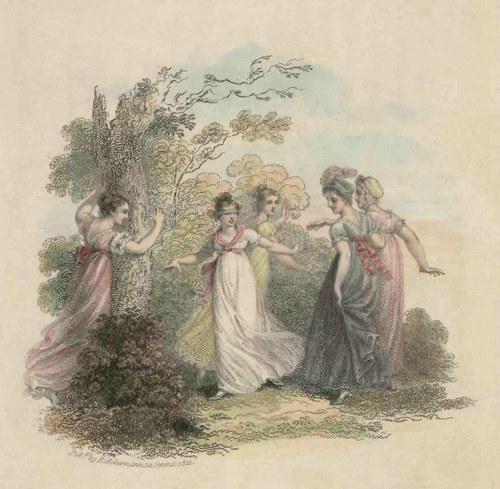
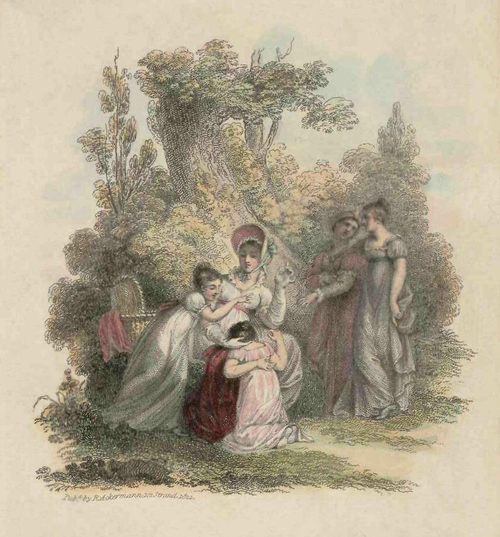
When Ernestina’s eyes were bandaged, Adriana went to Madame D’Hernilly, who had till then remained seated at some distance without taking any share in the game, but at the desire of Adriana, she now drew near and held the wand. While she thus stood facing Ernestina, she remained silent, and the adroit Adriana, who was close to her, muttered a few words, interrupted every now and then by a titter. As Ernestina knew nothing of Madame D’Hernilly’s holding the wand, she guessed repeatedly, but always in vain. At last, wearied out with her ill luck, she declared she gave it up, and Adriana to complete her little revenge, acknowledged the stratagem she had practised, saying, “So you see, Ernestina, the plotter is caught in his own trap.” This joke terminated their sport at blindman’s buff, but as it was yet too early for them to retire to their confessor; each of the young people came in succession, and placing her hand upon Madame D’Hernilly’s lap, spread her right hand upon her back, and remained in this position which is called, being the penitent, till she could guess who struck her.
The rules of this game are extremely simple, but there is one precaution necessary in playing it, that of not striking too violently. Excesses of this sort were not much to be apprehended where the players were all young ladies; however, we must confess, that some of them felt inclined to give heavy blows; Madame D’Hernilly, who saw this, took great care to rein in their impetuosity. She obliged them also to the strict observance of the rules, one of which was, that two persons should never strike at the same time. Whenever this happened, the person who gave the last blow, ought to take the place of penitent; and Madame D’Hernilly took care always to inflict the penalty with inflexible severity.
While they were at play, the nursery-maid came to tell them that supper was ready.
Place this among the golden rules, Which you may learn in moral schools; When you receive a secret blow Be sure that you can name the foe; Nor let Suspicion’s vain pretence, Risque your revenge on Innocence.
There is also another description of hot-cockles, called “Brother, they strike me.” There are two penitents, the one who finds himself touched with the corner of a pocket-handkerchief, calls out to the other, “Brother, they strike me.” The other replies, “Who strikes you?” and the first one must guess. But one of the players is a false brother; sometimes he himself strikes, and sometimes his companion; he takes care not
THE HOOP AND THE SKIPPING-ROPE.
A complete change took place at the Castle of D’Hernilly; the master of the house and his son arrived to pass the vacation at the castle. The gentry of the neighbourhood also hastened there to enjoy the last fine days of autumn. Several young companions of Victor renewed their acquaintance with him, and they gave themselves up to games much less sedentary than those played by the ladies. The young people of both sexes very rarely met during the week-days, but they walked and conversed together on the Sundays and holidays; sometimes during the latter they amused themselves with country-dances in a temporary ball-room raised in a grove. Victor, who played very well on the flute, was occasionally one of the musicians, but more frequently appeared among the dancers.
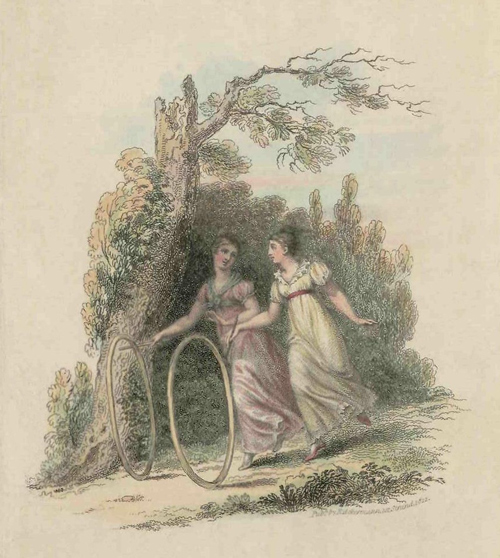
When the boys had a holiday, they amused themselves in the park with noisy sports, such as prison bar, leap frog, le cheval fondu, &c. &c. The little ones played at the poison ball, the skipping-rope, and the hoop. Madame D’Hernilly’s daughters were very
One day, Victor and his friends went with their preceptor, a walk of some miles to join in a village feast. Adriana and Ernestina found in the hall several of their playthings mingled with the books, maps, &c., which they used at their studies. Among the rest they found a hoop, and a skipping-rope. They were impatient to try whether they could use these with any dexterity; though at the same time, they were a little ashamed to be seen at such masculine exercises. Their young neighbour Valeria conquered their scruples; she said, that she had been in a school where the young ladies were permitted to play at these games, because their governess considered that they afforded a healthful exercise, but the players were obliged to observe that moderation, which the delicacy of their sex, as well as their tender age, required.
They found Valeria’s reasoning very good, and they determined to practise the games with that moderation which she recommended. The weather, which till then had been very warm, changed on a sudden; a cold sharp wind had succeeded to the most suffocating heat. Nothing could be more healthful, therefore, than those games which required activity.
This was a matter which could not be managed without great difficulty, on account of the turnings and windings which they had to pass; the trees, hedges, and other obstacles also made the hoop upset every moment. Added to this, the young ladies in imitation of what they had seen their brothers do, were mischievous enough to try to take advantage of those who played with them, and by pushing their hoops a contrary way, to occasion those of their competitors to fall, in order that they themselves might have a better chance of being first at the goal.
While two of them were amusing themselves at this game, the others having seized on a skipping-rope, made their young friends skip alternately. The two young ladies who held the cord moved it circuitously, but gently; a third, and sometimes several of them jumped with their feet close together through it. Sometimes they practised the most difficult steps which they had learned from their dancing-master, or tried who could vinegar, that is the term which they use when they want the rope to go more quickly.
When Victor and his companions returned, they were quite delighted to find that the young ladies had been playing at their games. Victor proposed the next day that they should all play together; but the young ladies very properly refused. They contented themselves with being spectators. The boys, who were some of them first-rate players both at the hoop, and the rope, shewed considerable skill and strength. Victor excelled in the double leaps, the chevaliers or knights’ cross, and he even performed several triplets with infinite grace and lightness.
The player who performed, without interruption, the greatest number of the knights’ double crosses, won the game. The cord turned with so much swiftness in Victor’s hands, that you could hardly believe he held it if you had not heard it whiz in the air, for it passed between his feet and the floor of the apartment without touching either, and it was almost imperceptible to the sight.
When they had each amused themselves singly, as long as they liked with the rope, they formed into groups of six or eight, to dance in the middle of the long skipping-rope.
THE ROPE.
Masters and misses, by your leave, I beg this kind advice to give; Whate’er your games, whate’er your plays, Let them no rival anger raise. But play as sisters should with brothers; For recollect this wholesome truth, To man as useful as to youth; Ambition’s drum, and Fancy’s toy Excite the man and charm the boy; But know, you dear, delightful elves, You ne’er can truly please yourselves, While you give pain to any others.
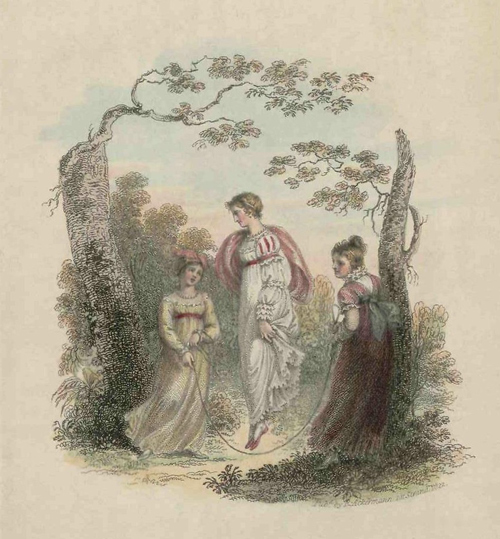
Two may play together with the same rope, each of them holding one end, one with
The Misses D’Hernilly, to whom this idea had been communicated, took advantage of it to run races with the rope. Nothing could be more graceful than their manner of performing those races; several grown-up people, who were lookers-on, agreed that the skipping-rope, thus used, was as conducive to health, as it was useful in giving the young ladies an easy and graceful carriage, and that they might amuse themselves with it not only without impropriety, but with advantage.
BOWLS, NINE-PINS, AND SIAM.
The premature coldness of the air forced the company at the Castle to renounce all sedentary amusements. While the ladies and gentlemen occupied themselves with billiards; the boys played at bowls, ball, humming-top, and German top. The young ladies got hold of the bowls and nine-pins. They were lucky enough to discover three places which had been purposely adapted for this amusement, in a part of the garden which was very little frequented by Victor and his companions. Some of them, who did not like bowls, amused themselves with playing at Puss-in-the-Corner. (See the Frontispiece.)
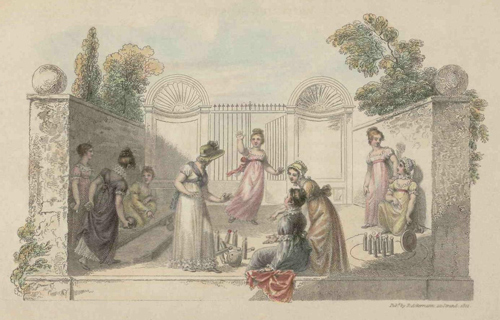
The ground destined for this game was a straight path, which had on each side a small bank, to hinder the bowl from running out of the path. They divided the bowls equally, and they drew lots to determine how they were to play. The lady, who drew Number one, threw the jack, that is to say, the only small bowl at a distance; the jack is regarded as the goal; the player then rolled one of her bowls as near as she could to
Instead of each playing upon their own account, the best method is to form two parties, every member of each party having the same interest. The art of the game consists sometimes in drawing; that is to say, to drive at a distance the adversary’s bowl, if it has approached very near the goal, in order that the player who follows you, may be able to get nearer the goal than your adversary.
While the Misses D’Hernilly and their young companions were playing at this game, they were frequently teased by their nursery governess, who kept calling out to them, “Take care, young ladies, you will dirty your clothes.” They often disputed which had won the game by approaching nearest the goal; and as, on these occasions, there was sometimes less than half an inch difference, the thing was not easily determined.
Speaking of this game, reminds us of a strange circumstance which happened to the celebrated Marshal Turenne. As he was one day walking upon the ramparts of a city in which his troops then were, without servants, or any mark of distinction, he was accosted by a group of workmen who were playing at bowls, and who begged that he
Our young players had very seldom any dispute at nine-pins, for it was easy to reckon the nine-pins that were thrown down, and those which remained standing. Madame D’Hernilly put the young ladies in mind of an anecdote which is related in the memoirs of the younger Racine. The great poet Boileau became disgusted with poetry in his old age, and grew passionately fond of nine-pins. Such was his address, that sometimes he threw down the nine with one stroke. “Acknowledge,” cried he one day, “that I possess two great talents, which are equally useful to the state and to society; that of playing at nine-pins to perfection, and that of writing tolerable verses.”
When the game is played with small nine-pins, and that you throw the bowl only white cabbage, and he gives up the turn to the player on the opposite side. But if he has thrown down one or two pins, and particularly that in the middle, which alone reckons for nine points, he throws a second time, throwing the bowl from the place in which it has previously stopped. He then reckons the points he has gained, and leaves the place to Number two, and so on. The grand difficulty of this game is not to make more points than is necessary: the number is usually 21; and if, after having gained 19 points, you happen to throw down two pins, you win the game; but if you are so unlucky as to throw down three or four, you burst, and are obliged to begin the game again. This occasions great variety, and renders the strength of the two players equal. It requires a great deal of practice to enable you to gain the dexterity necessary to knock down at once a considerable number of nine-pins, and you can never be certain of throwing down one, two, or three, just at the moment you wish.
Ernestina, Valeria, and the rest of the eldest girls, received, about this time, a present of a set of nine-pins, of a different sort from those we have been speaking of. They compose the game called Siam. You lose at it, also, by making too many points; and you are then said, as in the other, to burst. Your fate is decided more frequently by chance at Siam than at nine-pins, for you cannot always guide the quoit at will, which serves to throw down the pins. The quoit is made of a hard close wood, the edge of it is cut a little sloping, so as to describe a curve it is directed circularly either to the right or to the left.
This game is very common in India, and as it was introduced into France during the reign of Louis XIV., by people in the suite of the ambassador of Siam, who was at that time at the Court of Versailles, it has retained the name of their country.
The nine-pins are not all of the same value; those which are ranged in a circle reckon each for one point; three others which form the point of the opposite side count for 5, 4, and 3; the one in the middle is called the Siam, but it is necessary to throw that down by itself, otherwise the player loses all the points he has gained before, and is obliged to begin again.
Our young people amused themselves, for the rest of the autumn, with a review of the games which had delighted them during the spring and summer; they returned to the capital in the beginning of November. The young ladies eagerly resumed the lessons which they took from their different masters. Victor, who for the first time, obtained a prize at the University, entered into a higher class, where he strove with a laudable emulation to surpass his fellow collegians. The Misses D’Hernilly, instructed by the first masters in the knowledge of languages, and in every other accomplishment suitable to their rank, passed their leisure hours in society, selected for them by their mother, and chiefly under her own eye. Between study and relaxation their time flew rapidly, but both the young ladies and their brother, often recollected with pleasure, the amusements they had enjoyed at the castle D’Hernilly, and looked forward with delight,
Thus in their early season, gay, In life’s delightful month of May, Between those necessary hours, When kind instruction gravely pours Its various lessons on the mind, Of knowledge useful or refin’d: Thus female youth their time employ, To strengthen Health or waken Joy, While Reason’s rip’ning state prepares For other pleasures, other cares.
THE END.
LONDON: PRINTED BY W. CLOWEN, NORTHUMBERLAND-COURT.
Transcriber's Note
Dialect, obsolete and alternative spellings were left unchanged. Obvious printing errors, such as backwards, upside down, or partially printed letters, were corrected. Unprinted letters and punctuation were restored. Footnotes were numbered sequentially and moved to the end of the chapter in which the related anchor occurs.
The following were changed:
d’Hernilly to D’Hernilly: …D’Hernilly expressed her admiration…
comma to stop: …another a shuttlecock. This game…
claok to cloak: …taking off his cloak…
stop to comma: …Whenever this happened, the person who…
colon to semi-colon: …Excite the man and charm the boy;…