PART I.
Reading edition
HARVESTING ANTS.
PART I.
HARVESTING ANTS.
It was in May, 1869, that Mr. Bentham in his presidential address to the Linnean Society called attention to the want of reliable information as to the existence of such subterranean accumulations of seeds as are popularly supposed to account for the sudden appearance on railway cuttings, gravel from deep pits, and the like, of crops of weeds hitherto unknown in a district.
He suggested that it might repay the trouble if some accurate observers were to take this in hand, and investigate the matter both by examining samples of undisturbed soil taken from various depths,—when, if any seeds of moderate size were present and undecomposed, it would be tolerably easy to distinguish them,—and also by ascertaining what means of transport exist by which seeds may be scattered over exposed surfaces, and thus explain the difficulty without having recourse to hypothetical supplies of sound though long-buried seeds.[1]
As I listened, the question occurred to me whether the ants, which I had observed carrying seeds to their nests at Mentone, might not be unconscious agents on a small scale, both in the distribution and the subterranean storing of seeds. When at a later time I made this suggestion to some of our leading naturalists, I learned with considerable surprise that the unanimous opinion of our highest modern authorities on the subject is opposed to the belief that European ants ever do systematically collect and make provision of seeds, and that the instances of such occurrences in tropical climates remain as isolated though undoubted facts which it is difficult to explain.
I was not then aware that towards the middle of last century the ancient belief, dating from the time of Solomon, that ants habitually show forethought and husbandry in the collection of supplies of seeds and grain had begun to be called in question, and that our most able observers, such as Huber, Gould, Kirby and Spence, and at the present day Mr. Frederick Smith, had by close scrutiny of the habits of these creatures proved that, wherever personal investigation had enabled them to put the matter to proof, no trace of harvesting was found.[2]
However, just as the ancient writers, judging from their own experience and from the reports of others, had erred in attributing to ants in general the habit of seed-storing possessed by certain species commonly found in the south, so have modern naturalists fallen into the mistake of denying it to any of the European species.
The older authors who lived in Greece and Italy, and the mediæval authors who drew their information in great measure from the former, being familiar with the fact that some ants habitually collect large supplies of seed, went so far as to assert, or to imply, that all European ants do so; the authors of the present day, on the other hand, generalizing too freely from their experience of ants found near their northern homes, maintained and maintain the very reverse.
So long as Europe was taught natural history by southern writers the belief prevailed; but no sooner did the tide begin to turn, and the current of information to flow from north to south, than the story became discredited.
It is interesting now to recall a few of the allusions to the harvesting ants made by ancient authors, some of which contain tolerably accurate accounts of what was to them a familiar sight or a universally accepted fact.
The passages in Proverbs[3] are the following: "Go to the ant, thou sluggard: consider her ways and be wise; which, having no guide, overseer, or ruler, provideth her meat in the summer, and gathereth her food in the harvest." "The ants are a people not strong, yet they prepare their meat in the summer." Hesiod[4] speaks of the time
"When the provident one (the ant) harvests the grain."
ὅτἐ τ ιδρις σωρὀυ ἁμαται.
Horace[5] also alludes to the foresight of the ant, who is "haud ignara ac non incauta futuri." Virgil[6] compares the Trojans hastening their departure to harvesting ants, and the passage has been thus rendered by Dryden:—
T' invade the corn, and to their cells convey The plundered forage of their yellow prey. The sable troops, along the narrow tracks, Scarce bear the weighty burden on their backs; Some set their shoulders to the ponderous grain; Some guard the spoil; some lash the lagging train; All ply their several tasks, and equal toil sustain."
Indeed, it would seem that among the people inhabiting the shores of the Mediterranean it was almost as common to say "as provident as an ant" as it is with us to say "as busy as a bee." Plautus[7] introduces a slave who, when attempting to account for the rapid disappearance of a sum of money of which he had charge, says,
"Confit cito Quam si tu objicias formicis papaverem." "It vanished in a twinkling, Just like poppy seed thrown to the ants."
Any one who has seen the eagerness with which certain southern ants seize upon seeds thrown in their path will appreciate the correctness of this simile.
Claudius Ælianus, who lived in the time of Hadrian, gives a detailed account of the habits which he attributes to ants,[8] from which the following is a translation: "In summer time, after harvest, while the ears are being threshed the ants pry about in troops around the threshing floors, leaving their homes, and going singly, in pairs, or sometimes three together. They then select grains of wheat or barley, and go straight home by the way they came. Some go to collect, others to carry away the burden, and they avoid the way for one another with great politeness and consideration, especially the unburdened for the weight carriers. Now these excellent creatures, when they have returned home, and stored their granaries with wheat and barley, bore through each grain of seed in the middle; that which falls off in the process becomes a meal for the ants, and the remainder is unfertile. This these worthy housekeepers do, lest when the rains come the seeds should sprout, as they would do if left entire, and thus the ants should come to want. So we see that the ants have good share in the gifts of nature, in this respect as well as others." Further on[9] he gives a very interesting account of their mode of collecting and preparing the grain, many details of which I can myself substantiate from personal observation, though I have never seen ants actually at work upon the ears of corn. "But when the ants start a foraging, they follow the biggest, who take the lead as generals. And when they come to the crops, the younger ones stand under the stalk, but the leaders ascending gnaw through the culms, as they are called [ὀυραγοὑς, 'the stalk ends on which the ears grow' (Lid. and Scott, Gr. Lex.)], probably meaning that they detach the separate spikelets of which the ears are composed], of the ears [καρπἱμων], which they throw to the people below. These busy themselves with cutting away the chaff and peeling off the envelopes which contain and cover the grain. So the ants, though they need no threshing time, nor men to winnow for them, nor an artificial draught of wind to separate corn and chaff, yet have the food of men who both plough and sow for it." Ælian appears also to have heard reports of the habits of ants in tropical countries, for he says,[10] "Certainly the Indian ant is also a wise creature.... They leave one opening at the top (of the nest), by which they have their exits and entrances, when they come bearing the seeds which they collect." I have never myself found seeds bored through the centre in the way recorded above, but it is possible that different species of ants may treat the seeds in other ways than those observed by me; or, on the other hand, Ælian may have mistaken the gnawing off the radicle of the seed, a process which I shall describe from personal observation below, and imagined that the seed itself was pierced.
Aldrovandus, writing in the sixteenth century, speaks[11] of the ants as storing seed and of their gnawing, "illud principium seu acumen grani, è quo germen emitti à tritico solet"—that is to say, the radicle. But it is not clear whether Aldrovandus treats of what he has himself seen or refers to the account given by a certain Bishop, Simon Mariolus, who, he says "in his most pleasant and learned work, introduces a philosopher as taking his walks abroad and examining an ant's nest with its seed store," &c.
The lively fable of the ant and the grasshopper, as related by La Fontaine, has done much towards familiarizing and keeping alive in the minds of many of us the idea that ants habitually provide stores against the winter; but we must not infer from this narration that the witty French author had ever cared to examine for himself whether the fable, which he borrowed from Æsop, had its foundation in fact or not. The following translation from, the Greek original[12] bears in a much higher degree the impress of personal and accurate observation.
Μὑρμηκες καἰ Τἑττιξ: The Ants and the Grasshopper. Once in winter time the ants were sunning their seed-store which had been soaked by the rains. A grasshopper saw them at this, and being famished and ready to perish, he ran up and begged for a bit. To the ant's question, "What were you doing in summer, idling, that you have to beg now?" he answered, "I lived for pleasure then, piping and pleasing travellers." "O, ho!" said they, with a grin, "dance in winter, if you pipe in summer. Store seed for the future when you can, and never mind playing and pleasing travellers."[13] It would be easy to multiply instances in which the older authors allude to this habit, but enough have been given to afford a sample of what may easily be found repeated elsewhere, and I will now quote a few instances which illustrate the more modern belief, utterly opposed to that so long maintained by the ancients.
Messrs. Kirby and Spence[14] discuss the matter in the following terms:—"When we find the writers of all nations and ages unite in affirming that, having deprived it of the power of vegetating, ants store up grain in their nests, we feel disposed to give larger credit to their assertions. Writers in general have taken ... (this) ... for granted. But when observers of nature began to examine the manners and economy of these creatures more narrowly, it was found, at least with respect to the European species of ants, that no such hoards of grain were made by them; and, in fact, that they had no magazines in their nests in which provisions of any kinds were stored up."
They then proceed to explain how easily the white pupæ, which the ants carry about in their jaws, may have been mistaken for grains of wheat, and to inform us that the accurate observations of Mr. Gould, published in 1747, were among the first which led to the correction of this error. "However," they continue, "it may be otherwise with exotic ants, for although during the cold of our winters they are generally torpid and need scarcely any food, yet in warmer regions, during the rainy seasons, when they are probably confined to their nests, a store of provisions may be necessary for them."
The author of the article on ants in Smith's Dictionary of the Bible says, in reference to the assertion that ants store seed, that "observation of the habits of ants does not confirm this belief."
Latreille[15] denies it in the following emphatic terms: "N'attribuons pas à la fourmi une prévoyance inutile: engourdie pendant l'hiver, pourquoi formeroit elle des greniers pour cette saison?"
Huber again throws the weight of his great authority into the scale against the ants, when he says,[16] "I am naturally led to speak in this place of the manner in which ants subsist in the winter, since we have relinquished the opinion that they amass wheat and other grain, and that they gnaw the corn to prevent it from germinating." He then goes on to show how the ants are frequently torpid during the winter, and that when it happens that a few warmer days wake them up to life, they can always find a few aphides also on the alert; for, strange to say, the same degree of warmth which rouses the ants calls forth the aphides also. It would appear that ants in the northern parts of Europe feed on the honey-dew of aphides, and on animal matter when they can get it; and up to the present time the belief prevails among our modern naturalists that they are limited to the same diet in all parts of Europe.
It is now well known, however, that exceptions must probably be made in tropical countries, for the observations of Lieut.-Col. Sykes[17] and Dr. Jerdon[18] have shown that many ants in India collect grain in large quantities, robbing the crops and plants cultivated in gardens, and even stealing seeds put away in drawers, the inference being that they employ them for food. The same observers have recorded how the ants may be seen after wet weather bringing out the grain to dry in the sun.
Dr. Lincecum has also given a very interesting account[19] of the habits of the "agricultural ant" inhabiting Texas, Myrmica (Atta) barbata, which not only stores the grain of a particular rice-like grass, but is said to maintain a clean crop of this plant around its nest, suffering no weed to appear among it, and harvesting the crop in its proper season.
The Sauba ant (Œcodoma cephalotes) has been seen by Mr. Bates plundering baskets containing mandioca meal (an impure form of tapioca) in Brazil, and this in so wholesale a manner as shortly to threaten the loss of the entire supply; and Dr. Delacoux records[20] the presence in New Granada of a monstrous ant, called by the natives Arieros, a word which, I am informed, is of Arabic extraction, and means the carrier, which emptied an entire sack of maize belonging to him in a single night.
It seems strange that while travellers have reported the seed-storing habits of ants in far distant countries, our naturalists at home should have not only remained unaware of its existence in Europe, but even strenuously denied it. It is certain, however, that naturalists and others in southern Europe are more or less aware of the fact, but I have been unable to learn that any accurate account of the habits of harvesting ants has hitherto been published, or that any one has taken pains to discover what becomes of the seed so laboriously obtained.
It is true that in the Enciclopedia Popolare[21] extracts are given from the remarks made by M. Gené[22] on the subject, in which he assumes that the fact that ants collect and carry to their nest large supplies of grain and seed is well known, but states that he is at a loss to conceive how they employ them, unless it may be that they use them as materials for the construction of their galleries, for they cannot eat such hard substances, all their food being either liquid or of the nature of juices, "gli alimenti sono sempre materie liquide o materie sugose. Quanto ai corpi duri e secchi che le formiche raccolgono, io non so altrimenti riguardarli che come materiali di costruzione." It will be understood, I think, from what has gone before, that thus far nothing has really been ascertained as to the exact state of the case; for though the Italian author just quoted was aware that certain ants in the Mediterranean region do store seed, his knowledge went no further. Nor am I aware that any French author has published an account of this habit and its object; and in a recent abundantly illustrated volume founded on a work by M. Emile Blanchard, I find, on the contrary, the following very emphatic denial of its existence:—"The curious idea which appears to have commenced in very remote times, and to have been carried down by tradition, and which was assisted by the results of careless observations, concerning the habits of the ants in collecting and storing up provisions, as it were under the influence of a wise foresight, is evidently incorrect."[23] There was, therefore, clearly an opening here for close observation, and this I determined to do my best to supply.
When I set out again from England in October, 1871, on my way to Mentone, I had obtained an idea of some of the leading points which needed to be cleared up, and I was greatly encouraged in my attempt by the interest expressed in the subject by several of our leading naturalists, among whom I may especially mention Mr. Frederick Smith.[24]
Plainly the first thing to do was to determine whether the seeds which I had watched the ants carry to their nests were separately stored in subterranean granaries, as they would be if the ant really provides for the future; or whether they were merely strewed here and there, or used as building materials.
Next I must, if possible, obtain conclusive evidence as to the use to which the ants put the seeds thus collected; whether they eat them or turn them to some other account. Again I must observe whether the seed-collecting ants also search for aphides, and what other kinds of food they obtain. Then another very interesting question remained—namely, whether all southern ants uniformly collect seed, and to the same extent, or whether the habit is peculiar to certain species.
These, and many other subjects of inquiry connected with them, readily suggested themselves to my mind, and it will now be my endeavour to show how far I have been able to throw light upon them.
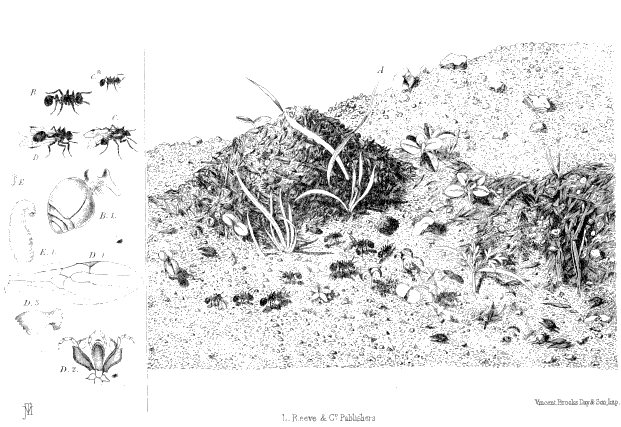
The habits recorded in the following pages refer exclusively, unless special notice is given to the contrary, to Atta barbara, the black ant represented on Plate I. We have, as far as I am aware, only four bonâ fide harvesting ants on the Riviera—namely, Atta barbara under two forms, the one wholly black the other red-headed; Atta structor, a creature very similar to barbara, but of a claret-brown colour; and a minute yellow ant, the large workers of which have gigantic heads, named Pheidole (or Atta) megacephala.
My renewed observations at Mentone were carried on from October, 1871, to May, 1872, and I was able during that interval to become a frequent visitor to a warm and sheltered valley, which lay but a few minutes' walk from the house in which I lived, and in which thirty nests of the most active of the seed-storing ants were to be found.
Full therefore of my intention to resolve this difficulty if possible, I set out on October 29, 1871, immediately after my return to Mentone, to revisit this valley, where, in the previous May, I had seen the ants busily engaged in cutting, carrying, and sorting their harvest.
The spot in question was a rough slope of soft sandstone rock, with accumulations of sandy soil in the hollows, covered with a sparse and scrubby vegetation, composed of Cistus (C. salvifolius), pot-herb thyme, black lavender (Lavandula stæchas), spiny broom (Calycotome spinosa), overshadowed here and there by a few scattered stone and maritime pines, and intermixed with coarse grasses and some smaller plants.
Cultivated lemon terraces lay on the edge of the wild ground lower down in the valley, and at this season, as also in the late spring, these terraces were overgrown with a rank crop of weeds, most of which were in seed.
I had scarcely set foot on the garrigue, as this kind of wild ground is called, to distinguish it from meadows or terraced land, before I was met by a long train of ants, forming two continuous lines, hurrying in opposite directions, the one with their mouths full, the others with their mouths empty.
It was easy enough to find the nest to which these ants belonged, for it was only necessary to follow the line of ants burdened with seeds, grain, or entire capsules, which had their heads turned homewards, and there, sure enough, at about ten yards distance, and partly shaded by some small Cistus bushes, lay the nest, to and from the entrances of which the incessant stream of incomers and outgoers kept flowing.
The proceedings of the ants were the same as those previously observed in the late spring (April and May), the workers usually seeking their harvest at some distance from the nest, and going in search of it as far as the cultivated ground, where the crops of weeds were more abundant and more varied.
In a few cases, however, where the terraces were too far distant, they contented themselves with plundering the grasses, pea-flowers, honeywort, and the other denizens of the garrigue. In one case I was able to follow the thread-like column of workers from the nest to the weedy terrace where the plants grew from which they were gathering the seeds, and found that the nearly continuous double line measured twenty-four yards. Even this gives but an inadequate idea of the number of ants actively employed in the service of this colony, for hundreds of them were dispersed among the weeds on the terrace, and many were also employed in sorting the materials and in attending to the internal economy of the nest. Still this affords some evidence of the systematic and extensive scale on which foraging is carried on by this ant, and of the high importance which these creatures attach to their provision of grain.
It is not a little surprising to see that the ants bring in not only seeds of large size and fallen grain, but also green capsules, the torn stalks of which show that they have been freshly gathered from the plant. The manner in which they accomplish this feat is as follows. An ant ascends the stem of a fruiting plant, of Shepherd's-purse (Capsella Bursa pastoris) let us say, and selects a well-filled but green pod about midway up the stem, those below being ready to shed their seeds at a touch. Then, seizing it in its jaws, and fixing its hind legs firmly as a pivot, it contrives to turn round and round, and so strain the fibres of the fruit-stalk that at length they snap. It then descends the stem, patiently backing and turning upwards again as often as the clumsy and disproportionate burden becomes wedged between the thickly set stalks, and joins the line of its companions on their way to the nest. In this manner capsules of chickweed (Alsine media) and entire calyces, containing the nutlets of Calaminth, are gathered; two ants also sometimes combine their efforts, when one stations itself near the base of the peduncle and gnaws it at the point of greatest tension, while the other hauls upon and twists it. I have never seen a capsule severed from its stalk by cutting alone, and the mandibles of this ant are perhaps incompetent to perform such a task. I have occasionally seen ants engaged in cutting the capsules of certain plants drop them and allow their companions below to carry them away; and this corresponds with the curious account given by Ælian[25] of the manner in which the spikelets of corn are severed and thrown down "to the people below," τω δἡμω κἁτω..
If the incoming and weight-carrying column of ants be closely examined it will be found that though the great majority of workers are bringing seeds in some form to the nest, a few are burdened with other and more miscellaneous materials.
Occasionally one or two may be detected carrying a dead insect, or crushed land-shell, the corolla of a flower, a fragment of stick, or leaf, but I have never seen aphides brought in to the nest or visited by this ant or by Atta structor.
It sometimes happens that an ant has manifestly made a bad selection, and is told on its return that what it has brought home with much pains is no better than rubbish, and is hustled out of the nest, and forced to throw its burden away. In order to try whether these creatures were not fallible like other mortals, I one day took out with me a little packet of grey and white porcelain beads, and scattered these in the path of a harvesting train. They had scarcely lain a minute on the earth before one of the largest workers seized upon a bead, and with some difficulty clipped it with its mandibles and trotted back at a great pace to the nest. I waited for a little while, my attention being divided between the other ants who were vainly endeavouring to remove the beads, and the entrance down which the worker had disappeared, and then left the spot. On my return in an hour's time, I found the ants passing unconcernedly by and over the beads which lay where I had strewn them in apparently undiminished quantities; and I conclude from this that they had found out their mistake, and had wisely returned to their accustomed occupations.
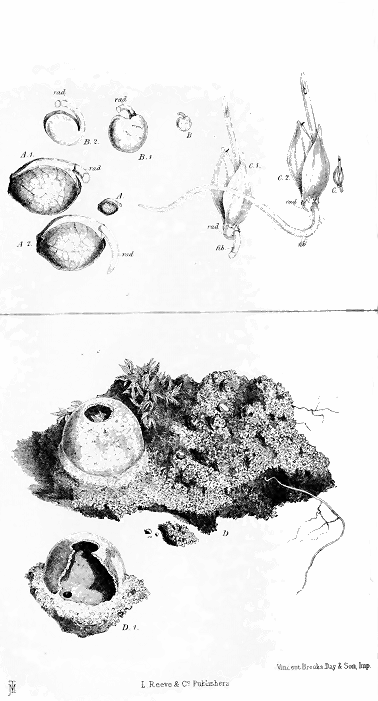
I have often amused myself by strewing hemp and canary seed or oats, all of which form heavy burdens for the ants, near their nests; and it is a curious sight to watch the eagerness and determination with which they will drag them away. It is interesting also to note how on the following day the husks of these seeds will appear on the rubbish-heap, or sometimes, after a shower of rain, they will be brought out by the ants with the point of the little root (the radicle or fibril as the case may be) gnawed off (see Figs. A, B, C, Plate VI., p. 35).
It frequently happens that on the wild hillside the position of a nest of Atta barbara is indicated by the presence of a number of plants growing on or round the kitchen midden, which are properly weeds of cultivation, and strangers to the cistus- and lavender-covered banks of the garrigue. These have sprung from seeds accidentally dropped by the ants, and which they had obtained from the lemon terraces. Thus when you see little patches of ground from one to three feet long and broad, covered with such plants as fumitory (Fumaria), oats (Avena), nettles (Urtica membranacea), four species of Veronica, chickweed (Alsine media), goosefoot (Chenopodium), Rumex Bucephalephorus, wild marigold (Calendula arvensis), Antirrhinum Orontium, Linaria simplex, and Cardamine hirsuta, you may confidently expect to find a colony of these ants close at hand.
Plate I.
Click on image to view larger copy.
These plants are sometimes found along the sides of miniature gullies and crevices in the rock, where they have been washed by little runlets of water formed in seasons of heavy rain, and thus these interloping plants are occasionally dispersed and brought into competition with the rightful occupiers of the ground.
Atta structor and A. barbara do not employ any materials in the construction of their nest, simply excavating it out of the earth itself, or occasionally out of the sandy rock, and the large mounds, in great part composed of vegetable matter, which may frequently be found at the entrances of their nests, are nothing more than the rubbish heaps and kitchen middens of each establishment. These consist in part of the earth pellets and grains of gravel which the ants bring out from their nest when forming the subterranean galleries, but principally of plant-refuse such as the chaff of grasses, empty capsules, gnawed seed-coats, and the like, which would occupy much space if left inside the nest (see Plate I., Fig. A.). While an army of workers are employed in seeking and bringing in supplies, others are busy sorting the materials thus obtained, stripping off all the useless envelopes of seed or grain, and carrying them out to throw away. Thanks to the unwearied activity with which this divided labour is carried on the kitchen middens speedily rise in the harvest season, and in places where they are not exposed to the action of wind and rain, often acquire a considerable size, so much so that sometimes, if collected, one alone might fill a quart tankard.
It was the sight of such a refuse mound, and an examination of the materials which composed it,—many of which show that they were once parts of seeds, &c., the albuminous contents of which had been extracted through holes gnawed in the side,—that gave me the conviction that large stores of seed must lie hidden below in the nest; for if it were true, as some have suggested, that the ants employ the grain and seeds which they collect as materials for the construction of their nest, they would certainly not reject such parts as the chaff of grasses and the like, which are admirably suited for the purpose, and are actually used for this end by other species of ants.
It was therefore with the greatest confidence as to the result that I opened the nests of Atta barbara in search of granaries and seeds. My first attempt was made upon a nest lying in a hollow where there was a rather deep bed of soil, and the galleries extended so far on either side and in a downward direction that, though I removed enough soil to fill a wheelbarrow, I failed to reach the arcana of the nest, and saw neither chambers nor granaries.
Yet I frequently encountered workers carrying seeds downwards along the subterranean passages. I then selected a nest where the coarse and hard rock lay much nearer to the surface, barring their downward course, and compelling the ants to extend their nest in a horizontal direction.
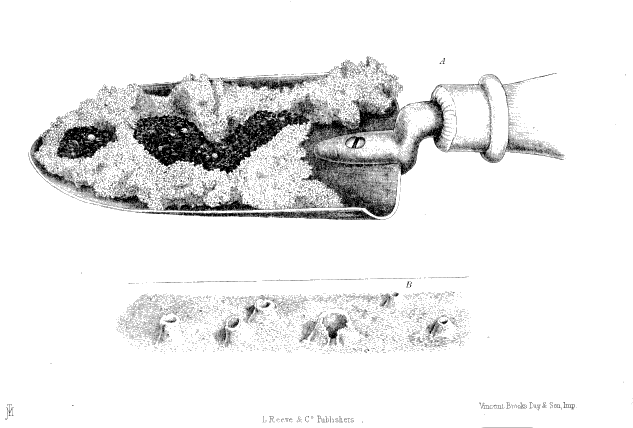
Here, almost at the first stroke, I came upon large masses of seeds carefully stored in chambers prepared in the soil. Some of these lay in long subcylindrical galleries, and, owing to the presence in large quantities of the black shining seeds of amaranth (Amaranthus Blitum, &c.), looked like trains of gunpowder laid ready for blasting. Fig. A, Plate II. represents a trowelful of earth taken from this nest, and lifted with care so as to leave the seeds almost in situ. Others were massed together in horizontal chambers, having a concave roof and a flat and carefully prepared floor.
Plate II.
Click on image to view larger copy.
Plate III.
Click on image to view larger copy.
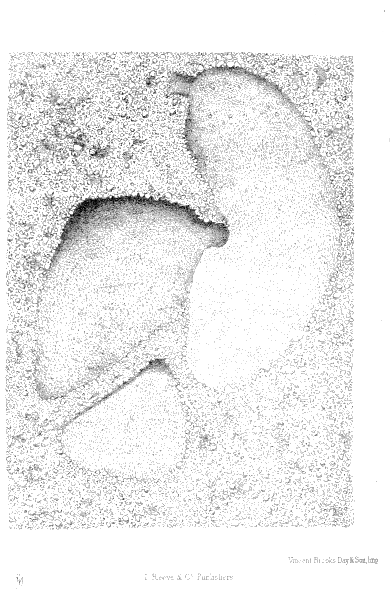
The texture of the floor usually differs markedly from that of the surrounding soil, and the fine grains of silex and mica which are selected for its construction are more or less cemented together, so that the floor will sometimes part, when dry, from the soil about it, as caked and dry mud separates from a gravel path (see Plate III.).
On carefully examining a quantity of the seeds, grain, and minute dry fruits taken from the granaries, I found that they had been gathered from the following plants: fumitory (Fumaria Capreolata, &c.), amaranth (Amaranthus Blitum, &c.), Setaria, and three other species of grasses, honeywort (Alyssum maritimum), Veronica, and from four unrecognised species, one of which was a pea-flower. There were therefore in this nest seeds, &c., which had been taken from more than twelve distinct species of plants, belonging to at least seven separate families. The granaries lay from an inch and a half to six inches below the surface and were all horizontal. They were of various sizes and shapes, the average granary being about as large as a gentleman's gold watch.
I was greatly surprised to find that the seeds, though quite moist, showed no trace of germination, and this was the more astonishing as the self-sown seeds of the same kinds as those detected here, such as fumitory for instance, were then coming up abundantly in gardens and on terraces. The seeds of Odontites lutea afford a curious test of the presence of moisture in the granaries, and it will usually be found that, when they are recently taken out of the nest, they are of a greenish colour and semi-transparent horn-like texture, which changes on exposure to the air to a chalky white and opaque appearance, due to the drying of the coat of the seed.
The fact of the sound condition of the seeds in these granaries seemed to me so very strange and difficult to explain that I determined to pay special attention to the subject, and with this view collected and carefully examined large quantities of the grain and seeds taken at different times from the stores of twenty-one distinct nests, the first of which was opened on October 29th, and the last on May 5th. In these twenty-one nests out of the thousands of seeds taken I only found twenty-seven in seven nests which showed trace of germination, and of these eleven had been mutilated in such a way as to arrest their growth. The sprouting seeds were found in the months from November to February, while in the nests opened in October, March, April, and May, no sprouted seeds were discovered, though these latter months are certainly highly favourable to germination. It is therefore extremely rare to find other than sound and intact seeds in the granaries, and we must conclude that the ants exercise some mysterious power over them which checks the tendency to germinate.
Apparently it is not that moisture or warmth or the influence of atmospheric air is denied to the seeds, for we find them in damp soil, in genial weather, and often at but a trifling distance below the surface of the ground; and I have proved that the vitality of the seeds is not affected by raising crops of young plants, such as fumitory, pellitory, Polygonum aviculare, and grasses, from seeds taken out of granaries.[26]
I have frequently remarked that it is the seeds last collected before a fall of rain which are brought out in a sprouting condition from the nest; for I have observed in cases where I had recently scattered seeds near wild nests, that it is these which are carried out from the nest and placed to dry after a wet night; and so in the case of a nest which I kept in captivity, when a variety of different seeds had been successively supplied to the ants, it was the cabbage, lettuce, and chicory seeds, given the day before the nest was watered, that reappeared after having been carried below, and not the hemp, canary, and mixed seeds of wild plants previously strewed on the nest. It seems possible that the process, whatever it may be, to which the ants subject the seeds which are to remain dormant may require some time, and the construction of the granary chambers is doubtless a long affair, so that when unusually large supplies of grain, &c., are brought in by the workers some part of them may not find the necessary accommodation and attention. When the seeds do germinate in the nests, and it is my belief that they are usually softened and made to sprout before they are consumed by the ants, it is very curious to see how the growth is checked in its earliest stage, and how, after the radicle or fibril—the first growing root of dicotyledonous and monocotyledonous seeds—has been gnawed off, they are brought out from the nest and placed in the sun to dry, and then, after a sufficient exposure, carried below into the nest.
The seeds are thus in effect malted, the starch being changed into sugar, and I have myself witnessed the avidity with which the contents of seeds thus treated are devoured by the ants.
Figs. A, B, C, in Plate VI., p. 35, illustrate the manner in which the ants mutilate the germinating seeds and check their growth. Thus, at Fig. C 2 of Plate VI. a sprouting but uninjured canary seed (Phalaris canariensis) is drawn, magnified, and at Figs. C and C 1 the same of the natural size and magnified, after the ants have gnawed its fibril (fib.), which in this case pierces the undeveloped radicle (rad.). Fig. A 2 represents a sprouting hemp-seed, magnified,[27] and Figs. A, A 1, the same of the natural size and magnified, mutilated, the tip of the radicle being removed.
At Figs. B, B 1, B 2, the same process is shown in the case of a small wild pea.
It is, however, certain that though a few individual seeds may sprout in the nests from time to time either with or without the concurrence of the ants, the great mass remain for many weeks, or even months, quite intact, neither decaying nor germinating, whereas every one knows that if a quantity of seeds are placed in the soil in a moist and warm place, all the seeds that are of one kind will almost simultaneously begin to grow after the lapse of a fixed interval.
Now if this took place in an ant's nest, the provisions would have to be rapidly consumed at stated periods and to be frequently renewed; but this is not the case. This is easily shown by an examination of the seeds contained in the nests in April or May, many of which will prove to belong to plants which fruit in the autumn and are not to be found later than November. Thus, for example, on May 5th at Cannes, I discovered nutlets of Cynoglossum pictum, which can scarcely have been collected later than the preceding October or November. Besides, during the time from the middle of January to the middle of March, scarcely a seed is collected under ordinary circumstances, there being extremely few wild plants in fruit at that season, and yet the granaries will be found well filled if a nest is opened at the end of this period.
A knowledge of the fact that ants in warm climates accumulate large and very varied stores of seeds retaining their power of germination, might at times be of service to travellers, by enabling them to obtain, by a stroke or two of the spade, an interesting collection of the seeds and the seed-like fruits of the country, when time and opportunity failed for obtaining them in a more satisfactory manner. The following list of plants, the grain, seeds, and small dry fruits of which I have found in the subterranean granaries of Atta structor and A. barbara, especially the latter, shows that the ants probably collect almost indiscriminately from any fruiting plant that falls in their way.
Fumitory (Fumaria, three species), honeywort (Alyssum maritimum), narrow-leaved sun rose (Fumaria viscida and F. Spachii), Oxalis corniculata, Silene, Linum gallicum, mallow (Lavatera cretica?), medick (Medicago), wild lentil (Ervum), spiny broom (Cytisus spinosus), Valerianella carinata, Centaurea aspera, Odontites lutea, Calamintha Nepeta, Polygonum convolvulus and P. aviculare, amaranth (Amaranthus Blitum and patulus), pellitory (Parietaria), Euphorbia, pine (Pinus), wild sarsaparilla (Smilax aspera), Setaria verticillata and S. italica, Andropogon Ischæmum, and of eight other plants of which I do not recognise the seeds. This list, comprising plants belonging to eighteen distinct families, might be greatly prolonged if I were to add to it the names of the seeds which I have seen the ants carry towards their nests, but have not actually detected in the granaries. Thus I have seen trains of ants burdened with the long-beaked, spirally-twisted fruits of crane's bill (Erodium), and, as above mentioned, with capsules of chickweed (Alsine media) and shepherd's-purse (Capsella Bursa pastoris), with whole orange pips, and even haricot beans, seeds of the New Zealand veronica (V. Andersonii), of Silene pseudoatocion, and many other garden plants, also with nutlets of the plane tree and seeds of the cypress.
Pliny mentions[28] incidentally having watched the ants carrying away cypress seeds, and comments upon the fact that so small a creature should be able to interfere with the growth of such a noble tree.
I have little doubt that the seed stores of the ants in botanic and other gardens, where rare plants are cultivated in southern Europe and in warm climates generally, contain samples taken from the fruits of a great many of the rarer and more interesting species as well as of the weeds and native plants. Indeed I have been told that this is the case by my friend Dr. Bornet, who complains of the depredations committed by the ants in the gardens of the Villa Thuret, at Antibes. They go so far as to plunder the seed bags which are hung from the branches of the trees and shrubs, unless these are securely closed and tied with string; they carry off wholesale the grass and anemone seeds,[29] which are scattered when the lawns are resown; and Dr. Bornet has seen the seeds of Acacia retinoides lie heaped up by the handful at the entrances of their nests, and disappear below after a few hours.
M. Germain de St. Pierre has observed similar facts at Hyères, where he has detected large stores of cereals in the granaries of the ants, and considers that the robberies committed by these creatures are sufficient in extent to cause a serious loss to cultivators.
It is difficult to estimate the amount of seed stored in a single nest by a colony of ants both on account of the extent of these nests, and because of the number of seeds which are always lost in digging. The nests themselves also vary greatly in size. Perhaps I shall not be very far from the mark however, if I conjecture that average-sized nests contain during the winter months about half a pint of seeds.
Atta structor is more frequently found near houses and in gardens than A. barbara, the latter usually living on wild ground adjoining cultivation. There was a flourishing colony of structor in the main street of Mentone, cleverly placed at the lintel of the door of a corn chandler's store, where they were ever on the look out for stray grains of oats and wheat, which might chance to fall from the sacks. Another nest, in a different part of the town, got its principal subsistence from the grains of canary seed, which were scattered by the birds occupying a cage hanging outside a shop window at a little distance.
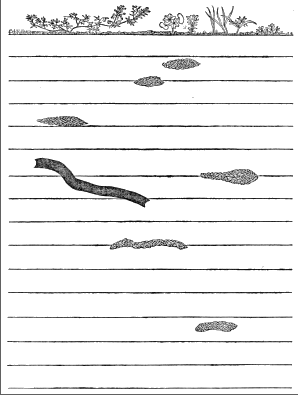
Vertical section of an ant's nest. The horizontal lines represent inches of depth.
The granaries of A. structor are arranged in the same way as those of A. barbara, and may, in like manner, be found stored with seeds, and lying at depths below the surface, varying from one to twenty inches.
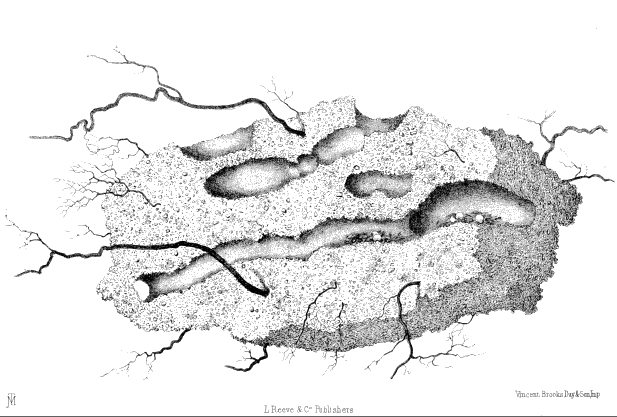
Plate IV.
Click on image to view larger copy.
A diagram is given in the preceding woodcut of a vertical section of a nest of barbara lying in soil sixteen inches deep, the granaries being at 11/2, 2, 4, 6, 9, and 121/2 inches, as determined by actual measurement on the spot.
In some cases, and especially where the soil is shallow, the galleries and granaries are much crowded together, as is shown in Plate IV., which represents a small mass of earth, pierced by the roots of plants, taken out of a nest of barbara, lying at two inches below the surface. When first opened all these granaries were filled with seeds.
The shape of the granary chambers varies considerably, as may be seen by reference to the drawing of three floors given in Plate III., p. 23, and that shown diagrammatically in the woodcut on next page, where the white space represents the granary floor, and the dark circular spot in the centre, the aperture of a gallery leading downwards.
I once had an opportunity of seeing a large portion of a nest of the red-headed variety of barbara laid bare by a cutting recently made through a bank at Cannes in digging the foundations of a house, which exposed a very extensive and complicated series of galleries and granaries. The lowest point at which I detected the workings of the ants was at twenty inches below the surface of the ground, and here granaries containing seeds in abundance were present, and the galleries and granaries extended over a space measuring 5ft. 9in. in a horizontal direction. In two cases I have found nests of Atta barbara at Mentone which were carried far into the living rock in places where it happened to be of an even grain, and not gritty or pebbly as it frequently is. It was quite by chance that I first discovered this very interesting fact, having tracked a train of seed-bearing workers to a part of the sandstone rock where steps had quite recently been hacked out leading to some terraces.
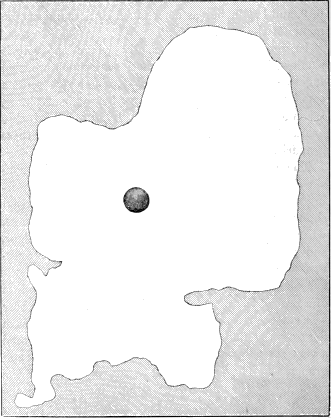
Plate V.
Click on image to view larger copy.
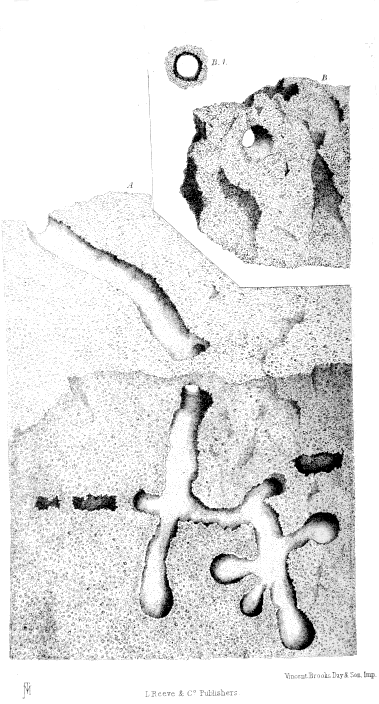
I soon saw that the ants entered and came out from three or four small passages in the cleft surface of the rock, and that their nest actually lay in the sandstone itself. Having contrived to wedge off several large flakes of the rock, which was soft in most places and might be scooped out with a strong knife, I discovered that though some of the passages of the ants followed the lines of cleavage and the cracks made by the fine wiry fibres of the bushes growing on the surface, others were frequently made in the form of tubular tunnels through the living rock. Without the aid of hammer and chisel it was not possible to follow the galleries and to secure specimens of the mined rock; but on the next day (Dec. 7th) I returned armed with tools, and with the assistance of a friend[30] quarried out a portion of the nest, tracing it down eventually to twenty-three inches below the surface of the rock in a vertical, and to about sixteen inches away from the surface in a horizontal direction.
At one point where the rock was almost entirely solid and without flaw or crevice, and where it was clear that the passages were entirely the work of the ants, we measured a tunnel by worming a straw down it, and found it to be ten inches in length. We subsequently traced this tunnel or rock gallery down until it communicated with a chamber filled with winged ants and seeds of several kinds. This granary was horizontal, and merely an enlargement of an ordinary gallery of a compressed spindle-shape, flattened from above downwards, measuring as nearly as I could estimate three inches in length, by a trifle less than an inch in breadth, and half an inch in height. The walls were tolerably smooth, but not prepared or glazed in the way that certain small terminal cells which I shall shortly describe were. The surfaces, however, had a very different appearance to that of the surrounding sandstone, being of a darker and brownish colour, and seeming to be coated with some kind of dressing or cement.
One of these tunnels at first took a horizontal course for two and a half inches, then descended vertically for an inch and a half to a point where it made two horizontal branches, and from these latter several other vertical galleries descended, two of which we were able to trace until they expanded into a cluster of small pear-shaped cells, the walls of which were quite smooth and very carefully laid with plates of mica and cement. I was able to draw this on the spot, Fig. A, Plate V., while Mr. Lightbody worked it out piecemeal with hammer and chisel. It was unfortunately impossible to secure more than very imperfect fragments as specimens. These terminal cells were empty when we came to them, but it is quite possible that the ants may have conveyed away larvæ or winged ants from them, having received abundant notice of the coming danger from the continued jarring of the chisel-work.
One entrance to this nest lay in a small accumulation of soil in a hollow of the rock, and it was at this point that the refuse from the nest was cast out. Indeed, had it not been for the accidental circumstance of my having traced the ants to the newly hewn step in the sandstone, I might never have discovered the fact that the nests are sometimes carried deep into the living rock.
Plate VI.
Click on image to view larger copy.
With this to guide me, however, I succeeded in finding a second nest of the same kind, and here I was able to secure better specimens of the tunnels for drawing (Figs. B, B 1, Plate V., p. 33). These drawings may be taken as representing also the size and shape of the tunnels in the former nest, which were for the most part like these, beautifully cylindrical, as is shown in the front view of the tunnel at B 1. In one nest of barbara I found a curious hollow spherical dome, about an inch in diameter, the walls of which were constructed of hardened earth about two lines thick, and having a large circular aperture at the top and a very small one below (Figs. D and D 1, Plate VI.). This dome was imbedded below in earth which adhered to it, but it was otherwise easily separable from the soil; its inner walls were smoothed with great nicety.
It has been suggested to me that this spherical chamber was originally the work of a scarabæus, which had chanced to bury the ball containing its eggs close to the nest of the ants, and that the latter had appropriated it after the departure of the beetle grubs. This may perhaps have been the case, but the dome was rather larger than the ball usually formed by the scarab beetle, and I have never seen one of these balls surrounded by a hardened case. The chamber thus constructed was employed as a granary, and filled, as well as the adjacent passages, with the grain of a grass (Tragus racemosus), still enclosed in the husks, among which I detected several ants at work, and also some minute white semi-transparent creatures, like spring-tails (Podurus), which abound in these ants' nests. Besides this spring-tail it is common to find in the galleries and granaries of Atta structor and A. barbara, certain silky yellowish-white "silver fish" (Lepisma), a small white woodlouse which does not roll itself into a ball, and at times the larvæ of an elater beetle. I have observed on more than one occasion that when in digging into an ant's nest I have thrown out an elater larva, the ants would cluster round it and direct it towards some small opening in the soil, which it would quickly enlarge and disappear down. At other times, however, the ants would take no notice of the elater, and it is my belief that the attentions paid to it on former occasions were purely selfish, and that they intended to avail themselves of the tunnel thus made down into the soil, with a view of reopening communications with the galleries and granaries concealed below, the approaches to which had been covered up. I have frequently watched the ants make use of these passages mined by the elater on these occasions.
At one time I suspected that the elater larvæ might consume the seeds stored by the ants, and I therefore confined some of them in a tumblerful of earth and seeds; but at the end of three weeks, though the larvæ were strong and healthy-looking, I could not detect that any of the seeds had been touched, and even those which had sprouted remained uninjured. I have searched in vain for the beetles and staphylinidæ which are known to inhabit certain ant's nests. In one nest I found (on Dec. 28) a quantity of small spherical, egg-like galls, slightly larger than but resembling the fruit of Fumaria capreolata, spotted with pink-brown on a yellowish or greyish ground. There was a dark spot at the point at which the mature insect would emerge, and one did escape from the egg-like cocoon while I was watching, and proved to be a Cynips of very small size, but furnished with a terrible dart for puncturing its prey.
It seems difficult to understand how it comes that these galls are systematically placed among the seeds, for it was evidently no chance occurrence, and I can only conjecture that the worker ants may have brought them in and stored them under the impression that they were really seeds! Even ants make mistakes, and of this I have given an example above (p. 19). Though I have frequently found colonies of several distinct species of ants inhabiting nests made in the earth traversed by the widespread galleries of Atta structor and barbara, I have never detected any intermixture of species in the chambers of a nest,[31] and but rarely found even the galleries and entrance used in common by more than one species. On one occasion when opening a nest of structor I cut through a colony of the tiny, large-headed, yellow ant Pheidole megacephala, lying in the midst of, though distinct from, the former. When, however, it chanced that one of the structors fell from the crumbling earth into the midst of the Pheidoles, it was curious to see how fiercely it would be attacked, and with what terrified speed it would scamper off, without attempting any resistance, and often carrying two or three Pheidoles hanging on to its legs.
Accidentally in this way battles do sometimes take place between ants of different species; but by far the most savage and prolonged contests which I have witnessed were those in which the combatants belong to two different colonies of the same species.
Atta barbara, Formica cruentata, F. erratica, and especially Myrmica cæspitum may sometimes be seen fighting in this desperate fashion. Rival colonies of Myrmica cæspitum often gather for the battle into dense masses three or four inches deep, and the place of conflict will be seen on the following day strewn with the dead, and this though the majority of the slain are carried off for food by the victors.
But the most singular contests are those which are waged for seeds by A. barbara, when one colony plunders the stores of an adjacent nest belonging to the same species, the weaker nest making prolonged though, for the most part, inefficient attempts to recover their property.
In the case of the other species of ant which I have watched fighting, the strife would last but a short time—a few hours or a day—but A. barbara will carry on the battle day after day and week after week. I was able to devote a good deal of time to watching the progress of a predatory war of this kind, waged by one nest of barbara against another, and which lasted for forty-six days, from Jan. 18 to March 4!
I cannot of course declare positively that no cessation of hostilities may have taken place during the time, but I can affirm that whenever I visited the spot, and I did so on twelve days, or as nearly as possible, twice a week, the scene was one of war and spoliation such as that which I shall now describe.
An active train of ants, nearly resembling an ordinary harvesting train, led from the entrance of one nest to that of another lower down the slope, and fifteen feet distant; but on closer examination it appeared that though the great mass of seed-bearers were travelling towards the upper nest, some few were going in the opposite direction and making for the lower. Besides this, at intervals, combats might be seen taking place, one ant seizing the free end of a seed carried by another, and endeavouring to wrench it away, and then frequently, as neither would let go, the stronger ant would drag seed and opponent towards its nest. At times other ants would interfere and seize one of the combatants and endeavour to drag it away, this often resulting in terrible mutilations, and especially in the loss of the abdomen, which would be torn off while the jaws of the victim retained their indomitable bull-dog grip upon the seed. Then the victor might be seen dragging away his prize, while its adversary, though now little more than a head and legs, offered a vigorous though of course ineffectual resistance. I frequently observed that the ants during these conflicts would endeavour to seize one another's antennæ, and that if this were effected, the ant thus assaulted would instantly release his hold, whether of seed or adversary, and appear utterly discomfited. No doubt the antennæ are their most sensitive parts, and injuries inflicted on these organs cause the greatest pain.
It was not until I had watched this scene for some days that I apprehended its true meaning, and discovered that the ants of the upper nest were robbing the granaries of the lower, while the latter tried to recover the stolen seeds both by fighting for them and by stealing seeds in their turn from the nest of their oppressors. The thieves, however, were evidently the stronger, and streams of ants laden with seeds arrived safely at the upper nest, while close observation showed that very few seeds were successfully carried on the reverse journey into the lower and plundered nest.
Thus when I fixed my attention on one of these robbed ants surreptitiously making its exit with the seed from the thieves' nest, and having overcome the opposition and dangers met with on its way, reaching after a journey which took six minutes to accomplish, the entrance to its own home, I saw that it was violently deprived of its burden by a guard of ants stationed there apparently for the purpose, one of whom instantly started off and carried the seed all the way back again to the upper nest.
This I saw repeated several times.
After March 4 I never saw any acts of hostility between these nests, though the robbed nest was not abandoned. In another case of the same kind, however, where the struggle lasted thirty-one days, the robbed nest was at length completely abandoned, and on opening it I found all the granaries empty with one single exception, and this one was pierced by the matted roots of grasses and other plants, and must therefore have been long neglected by the ants. Strangely enough, not one of the seeds in this deserted granary showed traces of germination.
No doubt some very pressing need is the cause of these systematic raids in search of accumulations of seeds, and there can be little doubt that the requirements of distinct colonies of ants of the same species are often different even at the same season and date. Thus these warring colonies of ants were active on many days when the majority of the nests were completely closed; and I have even seen these robbers staggering along, enfeebled by the cold, and in wind and rain, when all other ants were safe below ground. It may be that unusual exertions are necessitated by some exceptional demands made by the condition of the larvæ of the winged male and female ants, and I have observed that these latter appear at very various periods. Thus I have seen winged males and females in the nests of barbara on November 10, December 6, February 2, and March 10; and in those of structor on February 23, 29, March 13, and April 6.
Though structor and barbara make seed collecting the business of their lives, they will, at least in times of scarcity, eagerly devour animal food if it happen to fall in their way, and in the harvesting trains a few ants may occasionally be seen carrying small dead insects and the like. Once I threw a dead grasshopper down close to a nest of barbara; it was immediately seized upon, and—after strenuous efforts had been made to dismember it above ground, some ants straining back the legs and wings, while others rushed in to gnaw at the muscles where the tension was greatest,—carried down below. On the following morning the wings of the grasshopper were to be seen on the rubbish heap in front of the nest. Dead house-flies and the larvæ of bees or wasps were at times readily devoured by my captive ants (barbara). I have also seen large numbers of structors engaged in picking the bones of a dead lizard, and was once a witness of the following singular contest between a soft-bodied, smooth, greyish caterpillar, exactly an inch in length, and two medium-sized barbara ants. The ants were mere pigmies in comparison of their prey, for as such I believe they regarded the caterpillar, but they gripped its soft body with set mandibles, showing the most savage determination not to loose their hold.
When I first detected the group the war was being waged in a tuft of grass over one of the entrances to the ants' nest, and the caterpillar was striding along the leaves, or thrusting itself between the culms in the hope to shake off or brush away its little persecutors. From time to time the caterpillar would turn viciously round and endeavour to pluck away its assailants, but though it actually succeeded in stripping off by means of its forelegs and mouth five of the six legs of one of the ants which was within its reach, they never once released their hold.
At length a chance movement of mine shook the grass leaf on which they were, and ants and caterpillar rolled together down a steep and rocky slope to about four feet distant. They tumbled over and over several times, but still the ants gripped their prey as firmly as ever.
The last endeavour of the giant victim was to rub off the ants by burrowing into the soil, but on uncovering its retreat, I saw that their positions were still the same. After watching this struggle for twenty minutes, time failed me, and I returned home, carrying with me, however, the combatants; and when on my return I opened the box in which they were imprisoned, these bull-dog ants were clinging with mandibles locked as firmly as ever, and now as I write, in death they are clinging still, drowned in a sea of spirits of wine.
During the winter and spring I kept two colonies of barbara captive in the house, placed in separate glass jars, each of which might perhaps hold half a gallon. The former of these colonies was taken on December 18; but neither the queen ant nor larvæ were found, though there probably were larvæ in some unexplored part of the nest, and the ants were always restless and miserable, unceasingly trying to escape, and dying in large numbers.
On February 12 I found that all these ants, though abundantly supplied with seeds and all other kinds of food, were dead. Two other colonies of ants, however, which had been taken in a torpid state in the masses of earth which formed part of the original nest, were alive and well, though still torpid.
The second captive colony, taken on December 28, with the wingless queen ant and quantities of larvæ, formed a strong contrast with the previous one. Here the ants at once set to work upon the construction of galleries and safety places for the larvæ below the even surface of garden mould on which I had placed them within the jar; for in this case I did not attempt to preserve any portion of their own nest. This was done at 3.30 P.M., and by 9 that evening I found the ants most busily at work, having in less than six hours excavated eight deep orifices leading to galleries below, and surrounded these orifices by crater-like heaps, made of the earth pellets which they had thrown out. I have observed somewhat similar structures raised by barbara after the nests have been closed on account of rain, and structor frequently raises still more elaborate and distinct craters, such as those represented at Fig. B, Plate II., p. 22 (reduced one-half).
On the following morning the openings were ten in number, and the greatly increased heaps of excavated earth showed that they must probably have been at work all night. The amount of work done in this short time was truly surprising, for it must be remembered that, eighteen hours before, the earth presented a perfectly level surface, and the larvæ and ants, now housed below, found themselves prisoners in a strange place, bounded by glass walls, and with no exit possible.
It seems to me that the ants displayed extraordinary intelligence in having thus at a moment's notice devised a plan by which the superabundant number of workers could be employed at one time without coming in one another's way. The soil contained in the jar was of course less than a tenth part of that comprised within the limits of an ordinary nest, while the number of workers was probably more than a third of the total number belonging to the colony. If therefore but one or two entrances had been pierced in the soil, the workers would have been for ever running against one another, and a great number could never have got below to help in the all-important task of preparing passages and chambers for the accommodation of the larvæ. These numerous and funnel-shaped entrances admitted of the simultaneous descent and ascent of large numbers of ants, and the work progressed with proportionate rapidity. After a few days only three entrances, and eventually only one remained open. Yet for weeks this active work went on, and the ants brought up such quantities of earth from below that it became difficult to prevent them from choking up the bottle containing their water, which they repeatedly buried up to the neck. On January 10 the surface of the earth was raised from an inch and a half at its lowest, to three inches at its highest point above its original level, and this bulk of excavated earth represented the amount of space contained in their galleries and chambers constructed below. It was not, however, until nineteen days after their capture that the ants began to form systematic trains to carry down the seeds which I placed for them on the surface, and I suppose that they had required this time for the construction and consolidation of the granary chambers. From this time forward the ants came out repeatedly in greater or less force to gather in the various seeds with which I supplied them. Indeed, throughout the whole of their captivity they seemed to be perfectly contented with their lot and free from disease, remarkably few ants dying or appearing feeble, and as far as the limited space would permit they reproduced most of the habits which I had noted as belonging to them in a wild state, such as the formation of a rubbish heap; bringing out refuse materials, gnawed and empty seed-coats, the ends of radicles, and root fibres which had penetrated their nest, and laying sprouted seeds in the air to dry after having gnawed off the radicle in order to arrest their growth.
I was also in this way able to see for myself much that I otherwise could not have seen. Thus I was able to watch the operation of removing roots which had pierced through their galleries, belonging to seedling plants growing on the surface, and which was performed by two ants, one pulling at the free end of the root, and the other gnawing at its fibres where the strain was greatest, until at length it gave way. Again the habit of throwing sick and apparently dead ants into the water, the object of which was in part, I imagine, to be rid of them, and partly perhaps with a view to effecting a possible cure, for I have seen one ant carry another down the twig which formed their path to the surface of the water, and, after dipping it in for a minute, carry it laboriously up again, and lay it in the sun to dry and recover; thirdly, the stripping off the coats and husks of seed and grain swelling and on the point of sprouting, previous to eating it; and finally, the actual eating of the contents of the seed.
Most of these operations are usually performed below ground, and even in my captive nest it was but rarely that I could get a glimpse of their subterranean life, as they avoided the glass as much as possible, though it was carefully covered with flannel and black paper; and it was only by having the nest constantly before me on my table, and thus becoming a witness of their operations day and night during four months, that I detected them in positions which permitted me to watch these actions of theirs.
The ants were in the habit of coming out in numbers of an evening to enjoy the warmth and light of my lamp, and it was on one of these occasions that I first observed them in the act of eating. I perceived that in the midst of the black mass of ants gathered together on the side of the glass jar one was holding up a white roundish mass about as big as a large pin's head. Having turned a stream of bright light passed through a condenser on this group, and being permitted by the ants to make free use of my pocket lens, I was able to see the details with great precision. The white mass appeared to be the floury portion of a grain of millet, and I could see that two or three ants at a time would scrape off minute particles with their toothed mandibles, and take them into their mouths, repeating the operation many times, before giving place to other ants, and often returning again. It certainly appeared to be a bonâ fide meal that they were making, and not merely an act performed for the benefit of the larvæ, as when they detach crumbs from a piece of bread and carry them below into the nest. However, I must own that, though I subsequently dissected ants taken in this act, which I suppose to be that of eating, I was unable by the use of the iodine test to detect starch grains in their stomachs.
Still it seems quite possible that this failure may have been due to my not having allowed the ants sufficient time to swallow their food, as I killed them almost immediately after disturbing them at their meal.
After having twice observed the ants eating as above described, I made some experiments in feeding them myself.
They immediately seized and set to work upon a minute ball of flour which I cut out from the centre of a grain of millet, taken from a heap in front of a nest of A. structor, which had begun to sprout and been deprived of its radicle and dried. A similar ball taken from a sprouting grain of millet, but the growth of which had not been arrested, was also partially eaten; but the hard, dry flour taken from a grain of the same in its natural state, not moistened, was at once rejected and thrown on the rubbish heap. The fat, oily seed leaves of the hemp, however, were eagerly taken, though not softened by water, their peculiar texture allowing the ants to scrape off particles, as in the case of the ball of flour of the sprouted millet. Under ordinary circumstances the hard shell of the hemp-seed, and the coats of most other small fruits, grain, and seeds, would prevent the ants from getting at the contents while dry, but in the earliest stage of sprouting the shell parts of itself, allowing the radicle to protrude, and then they find their opportunity. (See Figs. A, A 2, Plate VI., p. 35.)
It has always been supposed that ants, from the delicate nature of their mouth organs, were only able to lap up liquids or to swallow very soft animal tissues, and one of the great difficulties in the way of admitting that they might collect seeds for food, lay in the apparent impossibility of their eating such hard substances. But it has generally been overlooked that not only are all seeds soft when moistened with water and ready to grow, but also that there are certain kinds of seeds the contents of which are naturally soft.
The most important organs in an ant's mouth are shown in Fig. D 2, and D 3, in Plate I., p. 21. D 3 represents one of the horny, toothed mandibles, which serve admirably for scraping off particles of flour from the seeds. Within these are the parts shown at D 2, where the outermost pieces are the maxillæ and their four-jointed palpi or feelers, and the innermost piece the labium and its three-jointed palpi, between which the end of the delicate membranous tongue appears.
I repeatedly placed leaves from the orange trees covered with cocci and aphides from rose-bushes and pine trees, all of which are eagerly sought by several other kinds of ants, in the captive nest, but the ants never looked twice at them, and this corresponds with the fact that I have never seen either structor or barbara attending on or searching for aphides and the like. These captives took part of a small quantity of honey which I placed in the nest, but displayed no eagerness about it, and soon neglected and allowed it to be covered up with earth thrown out from the nest.
The ants work very frequently at night during the dark,[32] and this is the case in the wild as well as in the captive nests. A friend, at my request twice visited a nest of structor ants in the garden of an hotel at Mentone, when it was quite dark (in March, between seven and eight o'clock P.M.) and no moon, but the light of a candle showed that the workers, both large and small, were busily engaged in carrying into the nest seeds which had been purposely scattered in their neighbourhood. I have myself seen Pheidole megacephala similarly engaged at about nine P.M. on a warm night in April, when it was perfectly dark, not even the stars showing; but in this case the ants were collecting from the weeds in the garden. On the same occasion I also observed long and active trains of Formica emarginata [a rather small dusky ant, with a yellow thorax], making for the orange-trees in search of cocci and aphides, just as if it were broad day.
Before leaving Mentone, on May 1, I turned out this second captive nest, and found that the colony appeared perfectly healthy, and did not seem to have diminished materially in numbers. The queen ant and the larvæ seemed to be in just the same state as when they were taken. The earth in the lower part of the jar was honeycombed with galleries, granaries, and cells, constructed quite as in the wild nests, but more crowded together. The granaries were in many instances full of seeds, which, though very wet, [the surrounding soil being extremely moist on account of there being no drainage to carry off the water which I was obliged to sprinkle from time to time over the surface of the nest], still showed no trace of germination that I could detect. The ants were therefore able to exercise the same influence over these seeds, under the strange conditions of their captive state, that they do in their natural homes.
The foregoing remarks, as has been stated above, refer for the most part to only one of the three kinds of harvesting ants which I have observed on the Riviera—that is to say, to Atta barbara, the jet-black ant.
As far as the manner of collecting and storing the seed is concerned, all that has been said of Atta barbara applies with equal truth to A. structor.
A. structor is, however, less frequently seen above ground from December to March than barbara, and is more frequently found in or near the streets and gardens of a town.
The fourth species, on the other hand, the little Pheidole megacephala, differs in several particulars. This ant appears to shun the daylight, and to be most active at night, when, in the warm weather at the end of April, it may frequently be seen carrying large quantities of seeds into its nest. I have rarely observed it at work in the daylight, so that my knowledge of its habits is but small. Nor have I succeeded in discovering its subterranean granaries, though I have opened several nests. Still, I believe that it is a true harvesting ant, and not merely a casual collector of seeds. Of the habits of Pheidole pallidula, a very closely allied and similar species, but one less frequently met with, I cannot speak with certainty, though it is quite possible that it also may be a true harvester, in which case it would add a fifth species to this class.
Both Pheidole megacephala and Ph. pallidula appear to remain inactive, or nearly so, during the months from November to April, and it is probable that they are only to be seen in full activity during the summer when I am not there to watch them.
There can be little doubt that any naturalist who will take the pains to note the habits of ants on the shores of the Mediterranean through June, July, August, and September, might collect a most interesting series of observations on harvesting and other species, and add to, and perhaps modify, those which my limited opportunities have enabled me to make.
There are three other ants[33]—namely, Formica emarginata, F. fusca, and Myrmica cæspitum, which may also occasionally be found carrying a few seeds, but this is the rare exception, as far as my experience goes, these species living on honey dew, sweet secretions, and animal matter, like the great majority of ants all over the world. I have never found seeds in the nests of any ants except those of Atta barbara and A. structor, though I have carefully searched for them in most of the nests of the sixteen species of ants whose habits I have watched.
There is every probability that these harvesting ants will be found all round the shores of the Mediterranean, but the only points at which I have positively heard of the existence of the habit besides Mentone, Cannes, and Marseilles, are Capri[34] and Algiers. I am indebted to Miss Forster for having, during a short visit to Algiers, devoted some time to watching the habits of the ants in a garden at that place. These observations were made in April last (1872), when the three following species were watched:—
(1) Formica (Cataglyphis) viatica, a large, long-legged, blackish ant, with orange-red and semi-transparent thorax, which never carried seeds, but lived on animal food, especially flies. (2) Formica (Tapinoma) nigerrima,[35] a rather small dusky ant, which brought in some seeds to its nest, but principally "animal food, flies, small worms," &c., and which did not carry the hemp and canary seed strewed in their path, though on one occasion when Miss Forster scattered some split hemp seed, they eagerly fastened upon the contents, and ate some on the spot, while they transported the greater part to their nest, and (3) Atta barbara, which, as on the Riviera, was a true and most active harvester, and eagerly seized upon the hemp and canary seed when these were placed in its way.
Recapitulation and Concluding Remarks.
There are some points of interest suggesting openings for future observation, to which I will now allude, making at the same time a partial recapitulation of what has gone before.
We have learned in the first place that the ancients had facts on their side when they said that the ant is one of the very few creatures which lays up supplies of food sufficient to last for months, or even perhaps, as Bochart says, for a whole year; and though we cannot quite accept the statement that "there is no animal except men, mice, and ants, that stores its food,"[36] they were right in saying that the habit is a most singular and interesting one. It is probable, however, that the old writers may have fallen into the error of supposing that all ants were harvesters, though the truth appears to be, that even in hot climates, it is only a very small number of species that are so. The fact that certain ants in Southern Europe do store large quantities of sound seed in damp soil, and check their tendency to germinate, may be thought to favour the possibility of the existence of those deeply hidden supplies of seed which, though they have never been detected, are popularly supposed to explain the sudden appearance of the crops of weeds on soil newly brought out from great depths.
The argument may be stated thus: seeds remain for months undecayed, and still capable of germination, at depths varying from one to twenty inches below the surface of the soil in certain ants' nests, why should they not lie hidden for indefinite periods in ordinary soil?
To answer this positively, experiments should be made[37] in order that we might learn whether these seeds can retain their vitality without sprouting in moist soil; but the general belief is that under these conditions they will do one of two things, they will either grow or rot. Be this as it may, one of the most curious points that we have learned about these ants, is that they know how to preserve seeds intact, even when within from one to three inches of the surface of the ground, that is to say, at the actual depth at which a gardener most frequently sows his seeds, though if these very seeds are taken out of the granary and sowed by hand, they will germinate in the ordinary way. It is possible that this may be in part due to the compact nature of the floors and ceilings of the granaries, these excluding air in some measure, though as moisture freely passes through them, and there are always two or three open galleries leading into the granaries, and which communicate directly with the open air, I can scarcely accept this explanation as complete.
The seeds do occasionally sprout in the nest, though it is extremely rare to find instances of this, and then the ants nip off the little root, and carry each seed out into the air and sun, exactly as the old writers have described, and when the growth has been checked and the seed malted by exposure, they fetch them in again. It is in this condition that the ants like best to eat them, as I have proved by experiments among my captives.
As the ants often travel some distance from their nest in search of food, they may certainly be said to be, in a limited sense, agents in the dispersal of seeds, for they not unfrequently drop seeds by the way, which they fail to find again, and also among the refuse matter which forms the kitchen midden in front of their entrances, a few sound seeds are often present, and these in many instances grow up and form a little colony of stranger plants. This presence of seedlings foreign to the wild ground in which the nest is usually placed, is quite a feature where there are old established colonies of Atta barbara, as is shown at Fig. A in Plate I., p. 21, where young plants of fumitory, chickweed, cranesbill, Arabis Thaliana, &c., may be seen on or near the rubbish heap.
It would be interesting to make a list of all these ant-imported plants, and I think it quite likely that, if a sufficiently large number of nests were visited, some seedlings of cultivated species might be found amongst them, for we have seen that garden plants are frequently put under contribution.
One can imagine cases in which the ants during the lapse of long periods of time might pass the seeds of plants from colony to colony, until after a journey of many stages, the descendants of the ant-borne seedlings might find themselves transported to places far removed from the original home of their immediate ancestors. It is a true cause, but at the same time it may be one which has, like many true causes, exceedingly small effects. One can scarcely look at the teeming population of an ant's nest, without asking whether there are any checks to their increase, and if so, what these checks are. I know very little of what foreign enemies they may have, though I have occasionally seen them captured by lizards, Cicindela beetles, and spiders,[38] and it is well known that the females are eagerly sought for by birds at the season when they are above ground, and about to found new colonies; but I believe that ants are the ants' worst enemies, for fearful slaughter and mutilation often result from the encounter of armies of the same race, but belonging to different nests.
Harvesting ants have nothing to do, as far as I have been able to discover, with aphides, cocci, and the like, nor do they seek for any of those sweet secretions which are the staple food of the generality of ants; they live, however, on very friendly terms with certain yellowish-white and satiny-coated "silver-fish" (Lepisma), which are found in the passages and chambers of the nests; but what their relations are to these creatures and to certain beetles which have been found in the nests of Atta barbara in Spain and Syria is unknown. It is possible that by carefully watching captive ants in company with these creatures under very favourable conditions, something further might be learned on this head. My captive ants constructed all their chambers, granaries, and almost all their galleries away from the glass, and in the interior of the earth, though I tried to tempt them to work in parts more accessible to sight by swathing the jar in flannel.
There is much to be learned, I do not doubt, about the friends and enemies of harvesting ants; and another great desideratum is further information as to the parts of the world in which they are found and what causes may be assigned for the limitation of the habit.
What is the geographical distribution of the harvesting species, and what the geographical distribution of the habit? For instance, to quote Mr. F. Smith,[39] Atta structor, though not "found in England, is scattered over a great part of Europe, having occurred in France, Italy, Germany, Austria, Dalmatia, and Switzerland; it has also been found in Algeria" and Syria; and A. barbara is almost as widely spread. May we then conclude that these species are harvesters wherever they are found, and that they store seed in Germany and Switzerland as freely as they do on the shores of the Mediterranean? If this be really so, then Huber, whose attention was specially directed to this point, and a host of laborious and scrupulous observers of the Continent, have had the very fact under their eyes, though they have been at considerable pains expressly to deny it. I cannot think that this is likely, but it is a matter which could easily be settled by those who travel or reside in Germany, Northern France, or Switzerland.
It seems to me more probable, however, that they do store in the south, but not in the north; for all the difficulties which attend the preservation of the seed in the granaries in the south would be greatly increased in the wet climates of Northern Europe, and there, moreover, the greater cold would render the ants torpid almost throughout the winter, when food would not be required. But the question is plainly an open one. We may also ask why it is that only a very few out of the many species of ants which inhabit the shores of the Mediterranean should possess this habit of collecting seeds, and differ so widely in their manner of living, from their neighbours?
If we wish to put ourselves in the way to answer these queries, the first thing we should do would be to examine and compare the structure of the digestive organs and parts of the mouth in harvesters and non-harvesters, with a view to seeing whether there may not be some capital difference here.
These observations demand some skill in dissection and preparation, and in regretting that it has not been in my power to make them, I can only hope that some one more skilled than I am may undertake the subject.
It seems probable, that in warmer latitudes there are many conditions which favour the rapid increase of ants, so that a given tract of country in Southern Europe, for example, must have on an average more colonies to support than a similar tract in the north, and that to meet this increase of population, it has therefore become necessary for these creatures to seek their subsistence from as many and as dissimilar sources as possible. The fierce conflicts over booty both between rival nests of the same and of distinct species, tend to show that, even as things are, they frequently have to fight for their food.
Hitherto, as far as I have been able to learn, only nineteen true harvesting ants have been detected in the whole world, limiting this term to those species which make the collection of seeds the principal occupation of their outdoor lives, and are evidently in the main dependent upon this kind of food for subsistence.
Now if we compare these nineteen species of ants[40] together a very curious fact forces itself upon our notice—namely, that all of them are closely related, so much so that not only do all belong to the same division of ants (the tribe Myrmicineæ), but that with one exception (Pseudomyrma) all would have been placed by the great Fabricius in one genus, Atta, and the one exception is not far removed from it.
We must not forget, however, that, as has been stated, there are other ants which do occasionally collect seeds, and thus appear to show traces of this remarkable instinct; but as far as I have yet seen, it is always possible to distinguish them readily from true harvesters. Still I think it very likely that in hot climates the division between harvesters and non-harvesters may be bridged over by a complete chain of intermediates. Here two more questions suggest themselves for more complete future solution. (1) Do true harvesters which store seed in granaries ever attend upon aphides and seek for sweet secretions? (2) Do occasional harvesters ever form granaries?
In any case the name of "the provident one" is only, I suspect, fully deserved by a limited number of ants, and Æsop, in his well-known fable, might as properly have made the dialogue which ends in the recommendation to "dance in winter as he piped in summer," take place between two ants as between an ant and a grasshopper, as far at least as their respective foresight is concerned.
Why it is that one ant should require stores of food in the winter of which other ants have no need, is one of the many problems which only patient watching and careful comparison and experiment can help us to solve.
There are not wanting those among the many winter visitors of the south who have time in abundance or superabundance at their disposal, and might help to clear up these and many other mysteries, and to them I would strongly recommend the study of the habits of plants and animals as a pastime, if nothing more.
The way is open: it is not difficult to follow, and it leads to very pleasant places.