WHAT THE BABIES SAID.
Reading edition
BY MRS. E. T. CORBETT.
Lillie Benson and Daisy Brooks sat on the floor in the nursery, and looked at each other, while their delighted mammas looked at them, and each mother thought her own baby the finest. Lillie was ten months old, and Daisy was just twelve. Lillie had great blue eyes, soft flaxen hair curling in little rings all over her head, and pink cheeks. Daisy had brown eyes, golden-brown hair cut straight across her forehead (banged, people call it), and two lovely dimples. One wore a white dress all tucks and embroidery, with a blue sash; the other a white dress all ruffles and puffs, with a pink sash.
Daisy looked at Lillie, and said, "Goo-goo!"
"The dear little thing!" said Daisy's mamma. "She's so delighted to see Lillie to-day."
Then Lillie looked at Daisy, and said, "Goo-goo-goo!"
"Oh, the darling!" exclaimed Lillie's mamma. "She's so fond of Daisy, you know, that she is trying to talk."
Presently Daisy turned her back to Lillie, and crept into the corner of the room. "Now just see that! she wants Lillie to follow her. Isn't it cunning?" said Lillie's mamma.
"Of course she does, and see Lillie trying to do it. Isn't she sweet?" answered Daisy's mother, while Lillie crept to the opposite side of the room.
But after a while the two babies were sleepy; so their mammas laid them down side by side in the wide crib, and then went down stairs to lunch.
"We'll leave the door open, so we can hear them if they cry; but I know they won't wake for a couple of hours," said one of the mothers; and the other one said, "Oh no; of course not; they'll sleep soundly, the darlings!"
But in a very few moments something strange happened—something very strange indeed. The babies opened their eyes, looked around the room, and then at each other.
"We're alone at last, and I'm so glad," said Daisy.
"Yes," said Lillie. "Now we can have a nice little chat, I hope. Isn't it dreadful to be a baby, Daisy?"
"Of course it is," sighed Daisy; "yet I suppose it is very ungrateful to say so, when every one loves us so much, and is so kind to us."
"That's the worst of it; I don't want every one to love me, because they will kiss me, and I hate to be kissed so much," objected Lillie. "Ugh! how horrid some people's kisses are!"
"It's enough to make any baby cross, I think," added Daisy. "I wish no one but mamma would ever kiss me, and even she does too much of it when I'm sleepy."
"Why, Daisy Brooks! what a thing to say about your own dear mamma!" exclaimed Lillie, looking shocked.
"I don't mean to say anything unkind of mamma, for I love her dearly, you know, Lillie; but it is hard to be kissed and kissed when you're hungry or sleepy, or both, and sometimes I have to cry," answered Daisy, quickly.
"Well, I'll tell you something else I hate," continued Lillie, "and that is to have people who don't know anything about it try to amuse me. They have such a dreadful way of rushing at you head-first, and shrieking, 'Chee! chee! chee!' or 'Choo! choo! choo!' that you don't know what may be coming next."
"Yes, or else they poke a finger in your neck, and expect you to laugh at the fun. I do laugh sometimes at the absurdity of their behavior," said Daisy, scornfully.
"Yes, and then they always think you're delighted, and go on until you are disgusted, and have to scream, don't they?" asked Lillie.
"Of course. Oh, babies have a great deal to suffer, there's no doubt of that," said Daisy.
"And there's another horrid thing," Lillie added, after thinking a moment. "I mean the habit people have of talking to babies about their family affairs in public. My mamma don't do that; but I heard Aunt Sarah talking to her baby in the cars the other day, loud enough for every one to hear, and she said: 'Poor grandpa! grandpa's gone away: don't Minnie feel sorry? She can't play with grandpa's watch now. Grandpa wants Minnie to come and see him, and ride on the pony, and Minnie must have her new sacque made, so she can go. Will Minnie send a kiss to grandpa?' and ever so much more. I know poor Minnie was ashamed, for she fidgeted all the time; but what could she do?"
"Well, mamma would talk to me just the same way this morning, as we came here, and I did my best to stop her, too, but it wasn't any use," said Daisy, looking indignant. "She had to tell everybody that we were going to see 'dear little Lillie Benson,' over and over again."
"But I'll tell you what makes me most angry, after all, Daisy," said her cousin, suddenly. "Does your mamma ever give you a chicken bone to suck?"
"Yes, she does, and oh!—I know what you're going to say," interrupted Daisy. "That's another of our trials. You get a nice bone, and you begin to enjoy yourself, when all at once your nurse or your mother fancies you've found a scrap of meat on the bone, and then one or the other just makes a fish-hook of her finger, and pokes it down your throat before you know where you are!"
"That's it exactly," exclaimed Lillie. "I go through just such an experience nearly every day, and it's too aggravating."
"Hark!" said Daisy, listening; "I hear old Dinah coming up stairs now, and I suppose we'll have to listen to her baby-talk for a half-hour at least. I know what I'll do; I'll make faces and scream."
"And get a dose of medicine, maybe, as I did one day," answered Lillie. "I tried that plan to stop an old lady from saying, 'Ittie peshous! ittie peshous! tiss ou auntie!' and mamma got so frightened she sent for the doctor, and he gave me a horrid powder. I can taste it yet."
"That was too bad," said Daisy, compassionately; "but hush, dear, for Dinah is at the door."
And when the old nurse came in the room, she found the two babies wide-awake, smiling at each other, and saying, "Goo-goo," as sweetly as if they hadn't a grievance in the world.
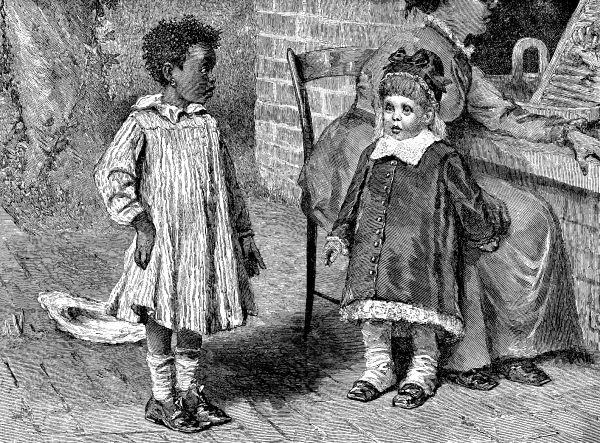
GETTING ACQUAINTED.—Drawn by W. L. Sheppard.

We are compelled to repeat some of our instructions to our young correspondents desiring exchange, in order to save ourselves and them from unnecessary trouble. In the first place, the name must be written very plainly. In some instances we can give only the initials because it is impossible to read the name, and the initials themselves are often very doubtful. Then the address must be given in full. If you have no post-office box, and live in a town too small to have numbered streets, have your letter addressed to the care of your father, or of some one through whom you will be sure to receive it.
Do not write to us that it would give you pleasure to exchange with any particular correspondent whose address has been plainly given in Our Post-office Box, because we can not make room to print a letter which should more suitably be written direct to the correspondent with whom you desire to exchange.
Requests for correspondence, or for exchange of cards or pictures of any kind, will not be noticed, as we do not consider such exchanges as leading to any valuable information, and it is only such that we desire to facilitate. Postmarks, which in themselves are worthless, we consider calculated to develop a knowledge of geography; for no American boy will rest content until he knows the exact locality from which his new postmark comes, and finds out all about it that his geography will tell him. Postage stamps have the same merit, with the advantage of being historical as well, as many of them contain heads of kings, queens, or eminent men, or at least some design typical of the country from which they come.
We shall never print in the Post-office Box letters from correspondents desiring to sell stamps, minerals, or any other things.
These observations are not gratuitous on our part, but we are compelled to make them to save ourselves the labor of reading scores of letters of which we can make no use whatever.
Newbern, Virginia.
We live at the sea-side, and we had never seen mountains before we came here this summer. I thought they were awfully big when I first looked at them.
We amuse ourselves in many ways. Sometimes we ride on horseback, and other times we go to the brook and paddle. We also take lovely walks, and gather ferns, mosses, and lichens for hanging baskets. One morning we went to the barn to see them thresh, and Ally found eight baby mice, and Nora brought them home in her pocket. At the threshing place there are ten little puppies, and we have fine times playing with them.
The other day we drove to see the highest mountain near here, and just before we got there down came a shower. We took shelter in a log-cabin church, but before we got inside we were all wet through. We thought that was all the more fun, because we like to be in the rain.
I am nine years old, and the oldest child of five.
Sue D. T.
Saint Joseph, Tensas Parish, Louisiana.
I am a little Southern girl nine years old, and I like Young People so much! I read all the letters in the Post-office Box.
So many children write about turtles that I thought I would tell them about one my brother had once. He said it was a pet, and one day he went to kiss it, when it put out its head and bit his nose, and hung on. His old black mammy told him that it would never let go until it thundered, so he ran all around, screaming, "I wish it would flunder! I wish it would flunder!" The noise he made frightened the turtle so that it dropped off without waiting for thunder.
My brother is a grown man now, living in New Orleans, and we often laugh at him about his turtle and the "flunder."
Annie Fleming L.
I am a little girl of nine years. My papa has taken Young People for me since the first number. I enjoy reading the children's letters very much.
My grandma is visiting us this summer, and she has her parrot with her. It is twenty-seven years old. It calls "Grandma" and "Mother," and screams for its breakfast. It says "Good-by" and "How do you do?" as plain as I can, and sings two songs, and imitates the cat, the dog, and the rooster, and does a great many other things.
Now I will tell the little girls what I have been doing since the school closed. I have learned to crochet, and have made two tidies and five yards of trimming. I am now making trimming of feathered-edge braid, and if any little girl who can crochet would like the pattern, I will be glad to send her a sample.
Gracie Meads, Platte City, Platte County, Missouri.
San Bernardino, California.
I take Young People, and like it so much! I am ten years old. My papa is out at the mines, and I am going there too when it gets cooler weather. I have a pet kitten here at home, and my papa has got two kittens and a dog for me when I go out to the mines.
I have a doll named Goldie. My aunt sent it to me from New York city.
I go to school, and my reading-book is the History of the United States.
Florence R.
Brooklyn, New York.
I send two easy experiments for the chemist's club: Pour a small quantity of common aqua ammonia in a dish; over this place a funnel, big end down, in the tube of which place a few cut flowers. In a little while the flowers will change color.
A very pretty experiment is this: Take a piece of ice, or in winter a snow-ball, and dig a small cavity in it. In this hole place a little piece of gum-camphor, and touch a lighted match to it. It will burn a good while, and have the appearance of ice or snow on fire.
Fred A. C.
Barton, Maryland.
I am seven years old. I go to school, and am in the Second Reader. Our teacher takes Young People, and we love to hear her read the stories.
I have a pet pig just as white as it can be. It likes to roll in the mud, and then it gets black and dirty like other pigs. Sometimes it bites my brother Harry's toes, and then I think it is a naughty pig.
Gracie W.
Greensburg, Kentucky.
Here is a game for rainy evenings I made up myself. It takes two players to play it. Player No. 1 places a chair or table in the centre of the room, and while Player No. 2 is shut outside, he walks round the object as many times as he pleases. Then Player No. 2 is called in, and will tell how many times his companion has walked round the object.
The way to do it is this: When Player No. 2 is told to go outside, he must hesitate a little, and perhaps say something in a careless way to divert suspicion. Then Player No. 1 will tell him to go three or four times. It is understood between the two players that so many times as Player No. 2 is told to go, so many times will Player No. 1 walk round the object; and if the players are skillful, it is impossible for the spectators to detect in what way they understand each other.
If any one in the audience suspects signs of any kind, Player No. 2 may offer to be blindfolded by the suspicious person.
John H. B.
Atlanta, Georgia.
I live in the suburbs of Atlanta. We have had lots of birds' nests in our yard this summer—mocking-birds, bluebirds, and sparrows. On moonlight nights the mocking-bird sings far into the night.
When Pluto, our black cat, goes under the trees where the little birds are, the old bird flies down, pecks him on the back, and looks very angry. Pluto looks as if he would like to eat her at one bite.
We have another cat, called Charity, because she came to us, and a little black kitten named Potts.
I wish Young People was just full of "The Moral Pirates," but mamma says that wouldn't be fair to the girls.
I have a little brother named Bayard, two years old. Thursday night, when my uncle brings Young People, he says, "Luncle Leddie, give me my Young People; show me my bootiful pictures and Wiggles." Then he sits still while mamma reads him a story. He can tell stories, too. He says: "A humble-bee stung a bluebird out in the flont yard. Can't find me. 'Long come a big turkey and eat me up. That's a big stoly for Young People."
Stewart H.
I live on a farm near the Great South Bay, and have great fun bathing and catching crabs. Will crabs shed their shells in a car if they are fed?
I am collecting birds' eggs and postage stamps, and would like to exchange with any readers of Young People.
Willie R. Wilbur, Sayville, Suffolk County, Long Island.
Long Grove, Iowa.
I am eleven years old. I have taken Harper's Young People from the first number, and like it very much. I have a brother who is just thirteen years old, and he likes it as much as I do, and there is a great rush to see who gets it first when it comes from the office. Papa says we need two copies. Papa has taken Harper's Weekly more than twelve years, and intends to take it always.
We have a pet white calf with black nose and eyes. We call it Creamy. I feed it milk twice a day, and it eats apples from my hand.
I made a white cake for my brother on his birthday from the recipe sent by Altia Austin. It was very nice.
Cosette M. M.
I have a pet dog named Topsy that will sit up, shake hands, kiss, and jump through my arms. My little sister Genie has a cat that tries to imitate my dog. I have the promise of a pair of pigeons, and I have a lot of little chickens.
I am trying to make a scrap-book, and I am starting a collection of stamps. If Paul S., of Bridgeport, Connecticut, will send me a French postage stamp from one of his father's letters, I will send him a Japanese one in return.
Willie D. Vater, Care of S. Vater, Office of the Daily Journal, Lafayette, Indiana.
Sherburne Four Corners, New York.
I have just been reading Young People, and the last piece I read was "Easy Botany." I liked it very much. I think Young People is the best paper I ever saw.
I tried Nellie H.'s recipe for candy, and it was very nice. I would like to know if she pulls it. I did mine, and I burned my fingers.
I tumbled out of a cherry-tree the other day, and almost broke my back.
We had an old dog named Watch, that we liked so much, and two weeks ago he died.
I wish Puss Hunter would let me know if she ever tried my recipe for bread.
Fannie A. H.
I am ten years old. I have a collection of about five hundred postage stamps, and would like to exchange with any readers of Young People.
J. E. A., 700 Court Street, Reading, Pennsylvania.
I am making a collection of stones, one from every State. I try to get them about the size of a hen's egg. If any other correspondent is making such a collection, I will be very glad to exchange a stone from Michigan for one from any other State.
Jessie I. Beal, Agricultural College, Lansing, Michigan.
I would like to exchange pressed flowers for birds' eggs with any of the correspondents of Our Post-office Box.
Belle Ross, Knoxville, Tennessee.
I would like to exchange postmarks of the United States or of foreign countries with any readers of Harper's Young People.
Fred L. B., 337 Belleville Avenue, Newark, New Jersey.
I have a collection of postage stamps, and would gladly exchange with any readers of Young People. I was born in the West Indies, in the island of Curaçao, and I can get a great many stamps from there. Correspondents will please send me a list of what stamps they require, and what kinds they have to exchange.
Elias A. de Lima, 162 East Sixtieth Street, New York city.
I am collecting birds' eggs, and would like to exchange with any of the correspondents of Young People. My sister takes the paper, and I like to read it as well as she does.
Henry A. Ferguson, P. O. Box 339, Rutland, Vermont
I have just written to some of the boys who offer exchange through Our Post-office Box, and I wish to say to any others that if they will send a list of stamps they have to spare, and also of those they would like to get, I will send them my lists in return, and try to effect a satisfactory exchange with them.
Walter S. Dodge, 700 Ninth Street, Washington, D. C.
I have had Young People from the first number, and like it very much.
I have a very nice garden, and would like to exchange seeds with any readers of Young People. I have morning-glories, double lady's-slippers, and wax-plant.
I have been trying to learn how to cook, this vacation, and have succeeded in clam chowder, which all liked very much.
Maggie Simonton, 424 West Twenty-ninth Street, New York city.
B. W. T.—Fire-works were invented by the Chinese at a very early period, and the magnificence of their pyrotechnic exhibitions is still unsurpassed by the most beautiful displays of modern times. In Europe the Italians were the first to cultivate the pyrotechnic art. Exhibitions of rockets and set pieces were given in Italy in the early part of the sixteenth century, and the annual display which takes place at Easter on the ramparts of the Castle of San Angelo at Rome is still famous for its magnificent beauty. Some noted displays took place in France during the seventeenth century, and those given in Paris at the present time are marvels of ingenuity of design and brilliancy and variety of coloring. Filings of copper, zinc, and other metals in combination with certain chemicals are used to produce the brilliant stars which are thrown out by rockets as they explode. Although there is great beauty in many of the combinations of wheels and stars arranged on frames, in the troops of fiery pigeons flying back and forth, and in the wonderful presentations of sea-fights, buildings, and other devices to be seen at every grand pyrotechnic display, there is nothing so majestic as the rockets and bombs which rush upward to the sky, and, bursting, fill the air with showers of golden serpents, floating stars of brilliant, changing hues, and cascades of silver and gold rain.
R. S. A.—The schooner yacht differs from the sloop only in rig, consequently an article on schooner yachts would be but little else than a repetition of that on sloops.
C. A. Savage.—The reason given you as the cause of low water is no doubt correct. If you can take note of the back-water above the mills, you will probably find the increase sufficient to balance the decrease below. The low water is especially noticeable during the present summer, when the long-continued drought of the early part of the season has dried up many of the small streams and springs which usually contribute to the volume of water in the river.
Ed.—A descriptive list of the publications of Messrs. Harper & Brothers will be sent, postage free, to any address in the United States, on the receipt of nine cents.
D. D. Lee.—You will find some useful suggestions concerning catamarans in The Canoe and the Flying Proa, by W. L. Alden, a volume of "Harper's Half-hour Series."
Daisy G.—No article on silk-worms has been published in Harper's Bazar, but there was an interesting paper in Harper's Magazine on that subject, to which reference was made in Post-office Box No. 44.
Alexina N., Carl S. H., Helen R. F., and others.—Write directly to the correspondents with whom you desire to make exchange.
Favors are acknowledged from Fannie W. B., Louie, Frank W., Winnie S. Gibbs, Miriam Hill, G. Y. M., Mary B. Reed, Clyde Marsh, Howard Starrett, Edwin F. Edgett, S. Birdie D., P. T. C., Amelia M. Smith, Helen M. Shearer, Florry and Daisy, Maud Dale, Pearl Collins, Maud Zeamer, Rosa Mary D., May Harvey, George Thomas.
Correct answers to puzzles are received from George D. S., Edward, Maggie Horn, K. T. W., M. E. Norcross, Nena C., Karl Kinkel, Addie Giles, Frank Lomas, Mary E. Fortenbaugh, "Morning Star," Effie K. Talboys, Myra M. Hendley, Charlie Rossmann, Florence E. Iffla, "Chiquot," G. Volckhausen, Ralph M. Fay, H. A. Bent, Daisy Violet Morris.
PUZZLES FROM YOUNG CONTRIBUTORS.
No. 1.
ENIGMA.
My first in white, but not in black. My second in nail, but not in tack. My third in love, but not in hate. My fourth in luck, but not in fate. My fifth in ship, but not in boat. My sixth in atom, not in mote. My seventh in man, but not in boy. My eighth in trouble, not in joy. My ninth in head, but not in tail. My tenth in turtle, not in snail. My eleventh in cake, but not in bread. My twelfth in yellow, not in red. My thirteenth in wrong, but not in right. My fourteenth in squire, not in knight. My fifteenth in run, but not in walk. My sixteenth in chatter, not in talk. My seventeenth in horse, but not in mule. My eighteenth in govern, not in rule, My nineteenth in rain, but not in snow. A warrior I, who long ago In a famous battle won kingdom and crown, And covered my name with high renown. Carrie.
No. 2.
DIAMONDS.
1. In Scotland. A solid, heavy substance which easily changes its character. Something never at rest. A verb. In Scotland.
2. In Constantinople. A bird. Agreeable to the taste. A verb. In Constantinople.
Katie.
No. 3.
WORD SQUARES.
1. First, to beg. Second, a rampart. Third, to suit. Fourth, steam. Fifth, a passageway.
George.
2. First, a place for skating. Second, thought. Third, cleanly. Fourth, a girl's name.
Edwin.
No. 4.
NUMERICAL CHARADE.
I am the title of a celebrated book composed of 16 letters. My 4, 10, 2, 7, 14 is dirt. My 12, 5, 11, 4 is an intoxicating beverage. My 3, 14, 8, 16 signifies smaller. My 13, 6, 9, 1, 3, 14, 15 are undulations. Western Star.
ANSWERS TO PUZZLES IN NO. 42.
No. 1.
SICK
IRON
COME
KNEE
No. 2.
NoW
AnnA
PiloT
OdE
LandseeR
EarL
OthellO
NerO
Napoleon, Waterloo.
No. 3.
Geranium.
No. 4.
1. Madrid. 2. Warsaw. 3. Athens. 4. Connecticut.
No. 5.
Ear, pear, year, bear, dear, gear, tear, fear, near, hear, rear, sear, wear.