PLANTS AND ANIMALS—THEIR DIFFERENCE.
Reading edition
BY MRS. S. B. HERRICK.
Fig. 1.
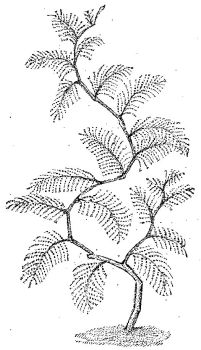
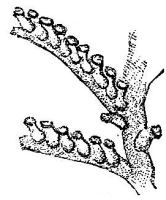
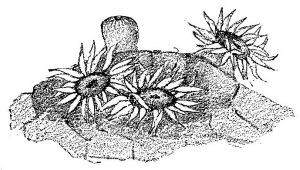
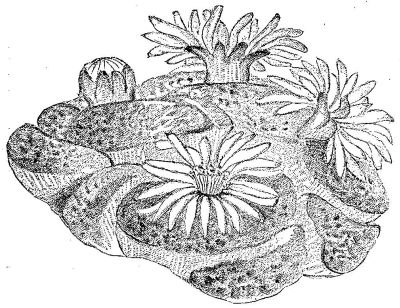
If the question were put to you suddenly, "What is the difference between a plant and an animal?" how do you think you would answer? Stop a minute, and think. Do not be satisfied with saying that a plant has leaves, and an animal has not. Look deeper, and answer more thoughtfully. There are many plants which have no leaves, nor roots, nor flowers, and there are some animals which seem to have all these things (Figs. 1 and 1a). In some cases they are so much alike (Figs. 2 and 3) that it has taken the most careful study to decide whether they are plants or animals.
Fig. 1a.
Look up into the bright blue sky, and then down at the solid earth beneath your feet—you do not find any difficulty in telling, without taking a moment to think, which is sky and which is earth; but if you are so happy as to live in the wide open country, or near the sea, or on a lofty hill, look off and off and off until you see only the delicate blue haze, like smoke, which divides the heavens from the earth. You can often see the same thing by looking from the upper windows of a high house. You will find that many and many a time you can not tell which is earth and which is air.
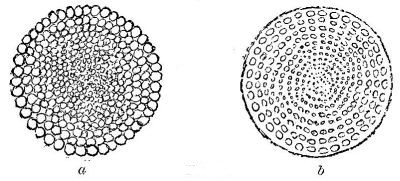
Just so it is in the world of nature. You may look at a group of cows standing under the trees, or watch the merry little grasshoppers skipping about in the weeds, or catch a bee at his early drink in a morning-glory bell, and you would laugh if anybody asked you if you could tell the animal from the plant. But get far enough away from these common things, and study the animals and plants that need your microscope to see them, and you would find things so much alike that you could not tell which was which. Many of these plants have no roots nor leaves, no flowers nor seed, and many of the animals have no heads nor legs, no eyes, nor mouths, nor stomachs. In Fig. 4, a is a plant, and b is an animal. Now how do you suppose anybody knows this? People who study these things do not guess—they know. The real difference lies in what these tiny little creatures do, not at all how they are formed.
Fig. 2.—ANIMAL.
About three-fourths of all the kinds of sea-weed, for instance, are found to be animal—not one animal, but a colony. The other fourth are vegetables. All these used to be considered vegetables; so did the sponge and the coral and the sea-anemones, and they are all now known to be animals. Every time you play the game of "Twenty Questions" you have to think and decide whether the particular thing you have chosen is "animal, vegetable, or mineral." Have you any notion what makes the real difference between them?
I imagine that, sooner or later, you will think and say the difference is that animals can move and plants can not. That will be a very sensible conclusion if you do come to it, though not a correct one, for plants do move, some of them very much as animals do; others, and the greater number, in another way; which all seems very wonderful, and which I want to talk over next time.
Fig. 3.—VEGETABLE.
What makes the real, deep-down difference is this: Plants can live on mineral matters alone, on earth and water and air, and these things they can change into their own flesh and blood, their stems and sap and fruit. Animals can only live on what the plants have already turned from dead into living material. We need water—that is a mineral—and salt and air, which are minerals too, if we are to keep alive and well. But we can not live on these things alone: we should soon die if we had no food; and all really nourishing food, all that keeps our blood warm and makes us grow, has once been vegetable. Not one bird, or fish, or animal, not one single human being, could ever have lived on this earth, in the air, or in the water, if the plants had not come first, and prepared the earth for us to live in.
These are "sure enough" fairies that are forever working their wonders for us. The roots, like elves, grope down in the earth, and gather its treasures; the leaves stretch out into the air, and gather its riches, and out of what they have collected they weave the beautiful flowers and delicious fruits and golden grain.
Fig. 4.
I should like to make very clear just the way they do this: it is very wonderful and beautiful to study how they work their spells. First, the root, as we have seen before, with its little helmet, bores its way down into the earth. If it finds no water or damp earth it soon wilts and dies, but if it finds a wet place it begins to soak up moisture. Besides the water, it sucks up all the parts of the earth that are dissolved in the water. The water it must have, and it will manage to live awhile on that alone, as Dr. Tanner did, but it can not live so very long. Poor ground means ground that has little or no plant food in it.
You know, if you ever did any gardening work, that you can stick a cutting of geranium or begonia into pure sand that has no nourishment at all in it, and that if you keep it well watered the cutting will strike out roots and bear leaves. This is, in fact, the best way to start cuttings, for mould is a little apt to rot the stem, but the sand preserves it. After a while the baby plant is tired of doing nothing but sucking, and cries for some stronger food. Then you must put it into rich earth, still giving it plenty of water. The roots, like the baby's stomach, will at first be satisfied with a very milk-and-watery diet, but after a while it must have a strengthening soup.
Fig. 5.
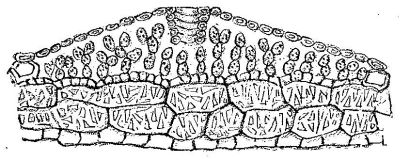
The roots bring the plant a good deal, but the leaves are the principal feeders. You remember, perhaps, reading about the millions of little mouths the plant has all over its leaves. These mouths bring both food to nourish and air to sustain the plant. A fish keeps itself alive by sucking the water it lives in all the while through its gills. It gets out of the water whatever it needs—air and some food. The plants are like fishes; their water is the great ocean of air that lies on the surface of the earth. They draw it in through their mouths, take out of it all they need, and then breathe the rest out again.
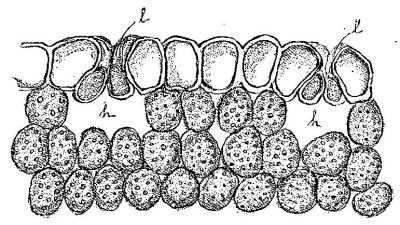
In Fig. 5 you see a piece of a liverwort leaf cut down through the mouth, and in Fig. 6 another kind, a blue-flag (l l, lips; h h, hollow of the mouth).
Fig. 6.
Air is a curious mixture. It is a gas made of several gases stirred together as you stir tea and milk and sugar. One of these gases is called oxygen (don't be afraid of the hard names); that is what keeps us alive. I won't give you the name of the next, because it is only used, like the milk, to weaken the tea. The third is a very disagreeable and dangerous gas, called carbonic acid gas. It is this last that makes your head ache in a crowded room or car. This is what you hear of every now and then as choke-damp, which suffocates people down in mines and deep wells. It is this which comes from burning charcoal, and makes it sure death to burn it in a closed room. There is very little of this dangerous stuff even in close air. Carbonic acid gas, though so poisonous, is made up of two things, which are very good and perfectly harmless when they are separated—carbon and the life-giving oxygen. Carbon is coal, or something like coal. United together, these two harmless things make a dreadfully dangerous one, just as innocent saltpetre, sulphur, and charcoal unite to form the deadly gunpowder.
Now notice how beautifully plants and animals are made to live together and help each other. Animals breathe in the air, and help themselves to the oxygen which keeps them alive, but breathe out the deadly carbonic acid gas. Plants breathing the air separate by some wonderful power of their own the carbonic acid gas into carbon and oxygen, help themselves to the carbon, and breathe out the oxygen. What plants consume we throw away as useless, and what plants breathe out sustains our life. That is the reason why the country is apt to be so much more healthy than the city. The air that is poisoned by people and fires becomes purified by plants.
Unlike the fairies of the story-book, who do all their good deeds by night, these little plant fairies work only by the light. The sun is their master, and his first ray is their call from sleep. They set to work in a minute, separating the dangerous carbonic acid gas into carbon and oxygen; and while they use the carbon and grow by it as you do by your food, they are giving back the sweet pure oxygen to the air. All day long they are at their good work; but when the sun sinks behind the hills, they do not need any sunset gun to tell them their time of rest has come. They drop work at once, and drop their fairy ways; they begin right away to behave as the animals do—to breathe in oxygen and breathe out the hateful carbonic acid. That is the reason it is not healthy to sleep in a room with flowers at night, though they are so good to have in the daytime.
We owe our lives to the plants—the food we eat, the pure air we breathe, as well as much of the rain that falls from heaven. They are ministering angels, and the loving, tender heavenly Father has appointed them their work to do—to beautify the earth and purify the air under the guidance of the glorious sun, which He has created, and which He keeps in its appointed path.