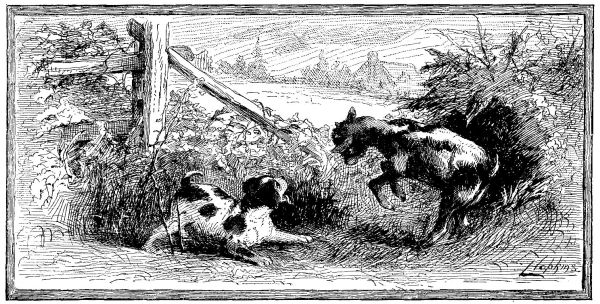
FRANK'S WAR WITH THE 'COONS.
Reading edition
BY GEORGE J. VARNEY.
Last month I spent several weeks at a farm within sight of the White Mountains. One morning the boy Frank came in with a basket of sweet-corn on his arm, and a bad scowl on his countenance.
"What is the matter, Frank?" inquired his mother, coming from the pantry.
Indignation was personified in him, as he answered, "Them pigs has been in my corn."
"I hadn't heard that the pigs had been out. Did they do much harm?"
"Yes, they spoiled a peck of corn, sure; broke the ears half off, and some all off. Rubbed 'em all in the dirt, and only ate half the corn. Left 'most all one side. They didn't know enough to pull the husks clear off."
Just then the hired man came in, and Frank repeated his complaint of the pigs.
"They hain't been out of their yard for a week, I know. I heard some 'coons yellin' over in the woods back of the orchard last night. I guess them's the critters that's been in your corn piece."
"S'pose they'll come again to-night?" inquired the boy, every trace of displeasure vanishing.
"Likely 's not. They 'most always do when they get a good bite, and don't get scared."
"I'll fix 'em to-night," said the boy, with a broad smile at the anticipated sport.
Twilight found Frank sitting patiently on a large pumpkin in the edge of his corn piece, gun in hand, watching for the 'coons. An hour later his patience was gone, and the 'coons hadn't come—at least he had no notice of their coming. As he started from his rolling seat a slight sound in the midst of the corn put him on the alert. He walked softly along beside the outer row, stopping frequently to listen, until he could distinctly hear the rustling of the corn leaves, and even the sound of gnawing corn from the cob. His heart beat fast with excitement as he became assured of the presence of a family of raccoons, and he held his gun ready to pop over the first one that showed itself. There were slight sounds of rustling and gnawing in several places, but they all ceased, one after another, as Frank came near. He listened, but there was nothing to be heard. Then he went to the other side of the piece to cut off their retreat from the woods. He came cautiously up between the corn rows to the midst of the piece, but no 'coon was there.
"Pity they will eat their suppers in the dark," muttered Frank, to relieve his vexation at the disappointment.
He returned slowly to the house, and went up to his room, where he sat down and read awhile. After an hour or more he became too sleepy to read; so he laid aside his book, put out the light, and popped into bed. Just as he was falling asleep he heard several cries over in the woods. They were half whistle, half scream—a sort of squeal. He sprang up in bed to listen. The cries ceased, and for several minutes all was silence. Then there arose a succession of screams, much nearer, and in a different voice. It was interrupted and broken. It seemed something between the squeal of a pig and the cry of a child.
Frank said to his father the next morning that "it sounded as if it was a young one, and the mother was cuffing it and driving it back. At any rate, the last of the cries sounded as if the little 'coon had turned, and was going away."
"Very likely," said his father; "the little 'coon was probably hungry for the rest of his supper, and was going back to the corn sooner than the old 'coon thought was prudent."
Frank heard no more of the 'coons, and soon went to sleep, but in the morning he found that more corn had been spoiled than in the first night. The 'coons had only run off to come back again, and begin their depredations in a new place. He therefore came to the conclusion that he must watch all night, and every night, if at all.
The hired man told how some boys where he worked once caught a 'coon by setting a trap at the hole in a board fence near the corn piece. There was a wall beside the woods not far from Frank's corn, and there were a plenty of holes in it, but which particular hole the 'coons came through nobody could tell.
"FOR A FEW SECONDS THERE WAS A LIVELY BATTLE."
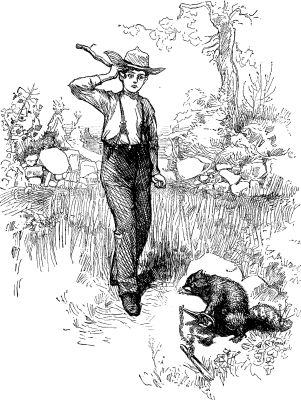
"I'll find out," said Frank. He went to a sand-bank with the wheelbarrow, and shovelled in a load of sand. This he spread at the bottom of every large hole, and on the rocks at every low place in the wall. In the morning he walked along there, and the foot-prints in the sand showed where the path of the 'coons crossed the wall. There he set his steel-trap, and another which he borrowed of a neighbor. In the morning he went over to see what had happened. One trap was sprung, and held a few hairs; the other trap had disappeared. It didn't go off alone, Frank thought; but it had a long stick fastened to its chain that would be sure to catch in the bushes before it went far. He sprang over the wall, and peeped round among the knolls and bushes. Suddenly, as he went around a clump of little spruces, a chain rattled, and a brownish-gray creature, "'most as big as a bear," as Frank afterward said, sprang at him, with a sharp, snarling growl, and mouth wide open. The sight was too much for Frank's nerves, and set them in such a tremor that he ran away. When he came in sight of his corn he began to grow angry, and his courage came up again. He now got him a larger stick than he had first carried, and set out for the animal again. He had considered that, after all, it could be only a 'coon, though bears had been heard of in the corn fields further north. Frank and the corn-eater now met again face to face, and for a few seconds there was a lively battle, in which mingled the snarling of the 'coon, the rattling of the chain, and the blows of the stick. At length the 'coon lay still, and Frank stood guard over him with a broken stick. The next day he ate a slice of roast 'coon for dinner with great relish.
The traps were set again for the next night, but never a 'coon was in them in the morning. The cunning fellows evidently considered the place too dangerous, and chose another entrance. Anyway, the corn was still going away fast. Frank feared that he wouldn't have enough to fill his contract with the canning factory unless the family in the house, or the other family in the woods, left off eating. Something must be done. At length Frank bought a dog. He made a nice kennel for him in the middle of the corn field, and tied him there at night. Just after Frank had fallen into a sound sleep the dog woke him up with his barking. Frank went out, but could find nothing. The dog woke him twice more that night, but he didn't trouble himself to leave his bed again. In the morning he found that the 'coons had destroyed as much corn as before, but it was all about the edges. The next night they ventured a little nearer the kennel. The following night the dog was left in the kennel loose. Probably when the 'coons came he made a charge upon them, and they turned upon him and drove him away, for he was only a little young one. He took refuge in the wood-house, where he barked furiously for an hour or more, and then in occasional brief spells all the night—whenever he woke enough to remember the 'coons. After this Frank gave up the defense of the corn, but began to gather it nightly as fast as the ears were sufficiently full. At length he cut the corn and took it into the barn, excepting a single bunch. About this bunch he sunk traps in the ground, and threw hay-seed over them, and placed nice ears of sweet-corn beside them. The next morning he had another 'coon. The other trap was sprung also, but it held nothing but a little tuft of long gray fur. That sly fellow had again sat down on the trencher. From this time the 'coons troubled Frank's corn no more, having found other fields where there was more corn and fewer traps. Frank's final conflict with the 'coons was late in the autumn, when the leaves were nearly gone from the trees, and the ripe beech-nuts were beginning to drop. He had fired all his ammunition away at gray squirrels the day before, except a little powder; but a meeting of crows in the adjoining woods incited his sporting proclivities, and he loaded his gun, putting in peas for shot, and started for the locality of the noisy birds. They cawed a little louder when they discovered the intruder, then began in a straggling manner to fly away. So when Frank arrived at the scene of the meeting it had adjourned. Looking about in the trees to see if by chance a single crow might still be lingering, a slight movement in a tall maple met his eye.
"Biggest gray squirrel ever I saw," muttered the boy, raising his gun. The position was not a good one for a shot, as the head, which had been thrust out over a large branch close to the trunk was now withdrawn, so that only the end of the nose was visible. Close beside this branch was another, and between the two a large surface of gray fur was exposed.
"I'll send him some peas for dinner," thought Frank, and fired. He heard the peas rattle against the hard bark of the tree, but no gray squirrel came down or went up that he could see. When the smoke cleared away, a black nose was thrust out over the branch, and two keen eyes were visible, peering down at the sportsman, as much as to say, "I like peas for dinner, little boy, but don't take 'em that way."
"That's no squirrel," thought Frank. "I believe it's a 'coon—sure as a gun. And I haven't got a thing to shoot him with."
He thought of putting his knife into his gun for a bullet, but it proved too large. Then he looked for some coarse gravel, but did not find any. Feeling in all his pockets, his fingers clutched a board nail.
"Ah, that's the thing! We'll see, Mr. 'Coon, if you care any more for board nails than you do for peas."
Loading his gun again, he dropped in the nail instead of a knife for a bullet. He took careful aim again at the spot of fur between the branches, and fired. The 'coon was more than surprised this time, and he certainly forgot to look before he leaped, or he never would have sprung right out ten feet from the tree, with nothing between him and the ground, thirty or forty feet below. He struck all rounded up in a bunch, like a big ball, bouncing up two or three feet from the ground. Frank started toward the animal, thinking, "Well, that fall's knocked the life out of him."
He never was more mistaken. When he stepped toward him, the 'coon got upon his feet at once, and offered battle. Frank now used his gun in another manner, seizing it by the barrel, and turning it into a war club. There ensued some lively dodging on the part of the 'coon; but at length he was hit slightly, when he turned and ran for the nearest tree. This happened to be a beech, in whose hard, smooth bark his claws would not hold. He slipped down, and as Frank came up, turned and made a dash for the boy's legs. Frank met him with a blow of the gun on the head, at which the 'coon dropped down, apparently lifeless. Another such blow would have finished him; but Frank was unwilling to give it, for the last one had cracked his gun-stock. So he shouldered the gun, took the 'coon up by the hinder legs, and started for home. Before he got there the 'coon had come to his senses again, and made Frank pretty lively work to keep his own legs safe. As soon as he could find a good stake Frank dropped his dangerous burden, and before the 'coon could run away, he was stunned by a blow of the stake.
With this victory the war between Frank and the 'coons ended for the season. He had been obliged to buy some corn of a neighbor in order to fill his contract with the canning factory; but the 'coon-skins sold for enough to make up the money.
"COME ON!"