CHATS ABOUT PHILATELY.
Reading edition
BY J. J. CASEY.
VI.—BHOPAL.
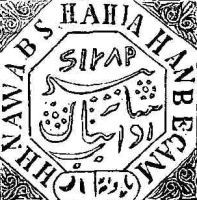
Among the most interesting and curious stamps are those issued by a few of the native states of India. The cut represents one of the stamps issued for the state of Bhopal. The first series, the date of which is not yet settled by collectors, consisted of two values, a quarter-anna, represented in the cut, and a half-anna, similar to it. The central portion of the stamp is embossed without color. The inscription between the lines is "H H Nawab Shah Jahan Begam," or the name and title of the native ruler—Her Highness, Nawab Shah Jahan, Begam (or Begum) of Bhopal—a lady, as will be seen. The characters in the lower part of the octagonal frame represent the value. The quarter-anna was printed in black, the half-anna in red, the central design or seal being, as was stated, without color.
In 1878, this series was replaced by one smaller and rectangular in shape. The inscription given above is arranged in an oval; the oval is filled with what is presumably the signature of the Begum. The value is below. These stamps also have the uncolored embossment as in the first series.
Like its predecessor, this series has also two values, the quarter-anna, green, and the half-anna, red. I believe that these stamps are intended to prepay postage only within the limits of the kingdom of the Begum, and are not officially recognized by the general government of India. Bhopal is a native state in Malwah, in Central India. The length of the state from east to west is 157 miles, breadth from north to south, 76 miles, the estimated area being 8200 square miles. It was founded in 1723 by Dost Mohammed Khan, an Afghan adventurer. In 1818, a treaty of dependence was concluded between the chief and the British government. Since then Bhopal has been steadily loyal to the British government, and during the Mutiny it rendered good services. The present ruler is a lady, and both she and her mother, who preceded her as head of the state, have displayed the highest capacity for administration, and their territory is the best-governed native state in India. The Queen, or Begum, has the power of life and death. She is a Knight Grand Commander of the Order of the Star of India (G. C. S. I.), and is also a member of the Imperial Order of the Crown of India, instituted the 1st of January, 1878, and composed exclusively of ladies of high degree.