THE BARRINGTON TOLL-GATE.
Reading edition
BY ELIOT McCORMICK.
Jennie Bartlett's father and mother had been suddenly called away for the night to Parnassus Centre, where Mrs. Bartlett's sister had been taken very ill, and Jennie was left to keep the toll-gate alone. It was not a difficult task, for scarcely any one travelled over the Barrington Road after nine o'clock, and those who did passed through the open gate without paying toll.
But even if it had been harder, Jennie would have been equal to it. She had lived at the toll-gate ever since she was a baby, and knew perfectly well what to charge, and how to make the proper change. Indeed, she often kept the gate for her father when he was at home, and people passing through would be apt to wonder how so bright and pretty a girl could grow up in so lonesome a place. Jennie, however, did not mind the lonesomeness. Her dearest wish was to go off to boarding-school; but so long as she was at home it mattered little to her that Barrington was three miles off on the one hand, and Leicester ten miles on the other, and that there was scarcely a house between. She even liked the solitude, and was almost sorry when the telephone connecting Barrington with Leicester made a connection by the way with the toll-gate. Before, they seemed to be out of the world, and the people coming through the gate were like visitors from another sphere; now, the frequent ringing of the call-bell reminded her that civilization was not so far distant, after all.
On this particular night there were not likely to be even the usual number of passers-by. It was dark and threatening. Looking out of the door about nine o'clock, Jennie could hardly see more than a hundred feet either up or down the road. It would be a bad night, she thought, for the gate to get accidentally shut; anybody coming along might run into it without warning; for that matter, people might run into the posts on either side. She hung a lantern on one post to prevent this accident, and going in the house, locked the doors and went to bed. The fact that she was alone in the house did not disturb her in the least, and in ten minutes she was fast asleep.
Some time in the night she was suddenly awakened by the ringing of the telephone bell. She listened confusedly to hear if it rang three times, which was the toll-gate signal, or oftener, to call up some of the other people on the same wire. Two of the connections she knew were in Leicester, the third was their own, the fourth was in the Barrington Bank, the fifth in the tannery, and the sixth in the central office at Barrington. In her bewilderment Jennie could not at first determine how many times it did ring; but at last she decided it was six—for the Barrington central office. That did not mean the toll-gate, and Jennie prepared to turn over for another nap, when a sudden thought aroused her. It was certainly after midnight, and the central office did not keep open later than twelve o'clock. The bank, too, was shut up, and so was the tannery; on the whole line she was probably the only person who could hear the bell. What if it should be something important! Indeed, it would hardly ring at that time of night unless it were important. Quickly jumping out of bed, she ran to the instrument, put the receiver to her ear, and called through the transmitter, "Hello! hello!"
A voice came back to her, so distinct that it seemed almost in the same room, saying, "Hello! is that the central office?" The tone was quick and sharp, and Jennie felt sure that something must have happened.
"No, sir," she called; "it's the toll-gate. I'm Jennie Bartlett."
"Tell your father to come here right away," the voice said; "it's very important."
Jennie felt a little sinking at her heart. "Father's away," she said, "and I'm here alone."
She heard the voice exclaim something in an impatient tone, and then the sound of two or three other people talking as though there was some doubt as to what could be done.
"Can I do anything?" she inquired, almost hoping that she could not.
Another conversation followed, which Jennie this time overheard; the speakers were no doubt nearer the telephone.
"Why do you want to let them get into Barrington at all?" one voice asked. "Why not stop them at the toll-gate?"
"To be sure!" said another. "If they get past the gate, like as not they'll turn down the Riverton road, and throw Allen off the track. They can't turn off before they get to the gate; we're sure of them as far as that."
"Tell the girl—" and then the speaker turned away, and Jennie caught only a confusion of sounds.
Presently she heard another "Hello!"
"Hello!" she responded.
"The Leicester Bank has been robbed," the voice went on, hurriedly, "by two men with a wagon and a white horse. They have driven toward Barrington, with Mr. Allen and two constables in pursuit, half an hour behind. You must—" Here the voice stopped as suddenly and completely as though it had had an extinguisher put over it. Even the hum of the electricity was checked, and Jennie knew enough about the telephone to be aware that in some way the connection had been abruptly cut off. It was in vain that she rang the bell and called "Hello!" No one answered. Jennie felt once more the old sense that she was out of the world. Leicester seemed all at once removed hundreds of miles away.
But what was it that she must or must not do? Why had not the connection lasted only a minute longer, when her instructions would have been complete? When were the robbers to be expected? Jennie made a little calculation. If they had been gone thirty minutes before any one started in pursuit, that would carry them, by fast driving, half-way to the toll-gate. If ten minutes had gone by before the telephone bell had rung, she might look for them within a quarter of an hour. What was she to do? The conversation which she had overheard came to her mind. "Stop them at the toll-gate," one of the voices had said. Very likely they would have told her to do that if the telephone had kept on. But how could a little girl arrest two armed and desperate men?
By this time she began to feel chilly. She could not go back to bed with this responsibility upon her, even though she did not know how to meet it; so, dressing herself, she opened the front door, and looked and listened. The night was darker than ever. A little space around the gate was lit up by the warning lantern. It would not help in stopping the burglars, she suddenly thought, to illuminate their way; so, going over to the light, she blew it out, and left the road in total darkness. That was at least one step toward the desired end.
All at once she thought of the gate. "How stupid!" she said to herself. "Why didn't I think of that before?" It was fastened back against the front of the house, but in a moment she had unhooked it and swung it around, until it stretched completely across the road. There was only a latch on the gate, but going in the house she brought out of one place a padlock, and from another a chain, with which she fastened it so securely that no ordinary strength could force it open. "They can't get through that," she said to herself; "and there isn't any way of getting around it." Then she went in the house, locked and bolted the door, rolled a bureau up against it, fastened all the windows, pulled down the shades, and waited in the dark for the sound of wheels.
It was not long before they came, but to Jennie every minute seemed an hour, while every rustling leaf outside sounded like a man's stealthy tread. When at last she heard them coming, far up the road, her heart stood still. Nearer and nearer they came. Would they not see the gate? she wondered. The horse still kept on; and instantly there was a sudden exclamation outside, a crash as though something had come into collision with the gate, the sound of splintering wood, and the noise of a plunging horse. Jennie did not venture to move; she dared not go to the window, but sat in the middle of the room, shaking with fear, and listening anxiously for what might happen next. Presently steps sounded on the planks outside, and in a moment there was a rap on the door.
Jennie remained perfectly quiet, though her heart beat so loud that she thought they must hear it outside. In a moment the knocking ceased.
"Folks asleep," she could hear one of the men say.
"Asleep, or dead, or run away," the other one growled.
"Shall we try the window?"
Jennie trembled all over, but the sash held firm.
"Oh, come on!" exclaimed his companion. "Don't let's waste time here; we can splice the shafts with the halter."
They moved off again, and Jennie breathed more freely. If the shafts were broken, it would be a work of some minutes to mend them, and the pursuing party might yet arrive in time. Mr. Allen, who Jennie knew to be the president of the Leicester Bank, had the fastest horses in the county, and ought to be able to make up at least ten minutes in ten miles. For a while there was quiet outside. The men were evidently working at the shafts, and only the stamping of the horse's feet gave any signs of life. Jennie began to get nervous, and to listen more intently for the pursuers' approach. By this time they could not be far off. Finally, unable to sit still any longer, she crept upstairs, and sitting down on the floor by the open window of the attic, ventured to look out. The white horse was quite distinctly visible as it stood by the gate, but the men, bending over the wagon, were hardly more than an outline. Presently they seemed to have finished, and backing the horse around, proceeded to hitch him in the shafts. Would the others never come? The gate was not yet opened, but Jennie began to fear that burglars would not find that a serious difficulty. Suddenly through the woods came the sound of horses' hoofs galloping as if for life. Did the men hear it too?
Apparently they did.
"Open the gate," she heard one of them say.
His companion went to it and vainly tried to pull it open. "It's padlocked," he exclaimed, after a minute.
The other muttered an angry oath. "Pick it!" he cried. "They've put up a job on us here. I knew we didn't cut that wire quick enough."
It was a minute before the burglar's skill could pick the lock, and by that time the pursuing wagon was dangerously near.
"Open the gate!" shouted the first man, pulling back his horse to escape its sweep.
The other pushed, and the great bar swung slowly back. But before it had opened wide enough to let them through, the other wagon had dashed in upon the scene.
"Stand where you are," Jennie heard Mr. Allen's voice call out, "or I'll shoot you down!"
What immediately followed Jennie did not see, for leaving the window, she rushed down-stairs, lit the lantern, rolled back the bureau, unlocked the door, and went out. When she had gained the road, the two burglars, captured and tied, were being guarded by the constables, while Mr. Allen was investigating the contents of the wagon, and making sure as far as he could in the darkness that all was right. At Jennie's approach he looked up.
"Ah!" he said. "Are you the toll-gate keeper's daughter? Just ask your father to step out here, won't you?"
Jennie smiled. "Father isn't at home, sir," she said.
"Oh, well, your mother, then, or any one who keeps the gate."
"Mother isn't at home either, sir; I am keeping the gate."
The gentleman looked at her in surprise.
"You!" he exclaimed. "What made these fellows stop here?"
"They broke their wagon, sir."
"How did they happen to do that?"
"The horse ran into the gate, sir."
"Was the gate shut?"
"Yes, sir."
"You don't usually shut the gate nights?"
"No, sir, but I did to-night."
He looked at her for a further explanation, and Jennie, who never liked to tell of her own exploits, was obliged to go on.
"They telephoned me about it from Leicester, sir," she said, briefly.
"Did they tell you to shut the gate?"
"No, sir; the telephone stopped before they got as far as that; these men cut the wire, and I had to think for myself what I should do."
"And you thought of that?" he asked.
"Yes, sir," she said, modestly.
"Well," he said, "you are a thoughtful little girl. You've saved me a great deal of money to-night, and I'll never forget it."
And he never did. The directors of the bank passed a vote of thanks, at their next meeting, to Miss Jennie Bartlett "for her prompt and efficient services in arresting the burglars who feloniously entered the bank building on the evening of September —, and abstracted the valuable contents of its vault"; and more than that, sent her a purse of money, with which she was able that winter to carry out her long-cherished plan of going to school. It was a disagreeable experience to go through, but Jennie will always date whatever success she has in the world from that night at the Barrington toll-gate.
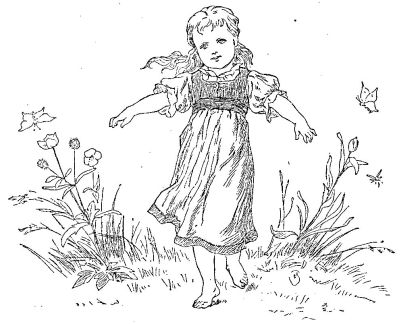
Merrily, merrily dancing away, Who is this dancing the long summer day, Over the meadow and through the lane, Then through the orchard, and then back again? Who is this girlie that's dancing away, Who but our own little Edith, I pray.
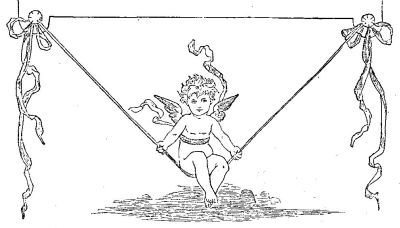
Swinging, swinging, swinging, Here I sit and swing, But I'm only resting, Now each weary wing; Very soon you'll see me fly, Upward, upward, oh, so high; Onward, onward through the air, But I'll never tell you where.
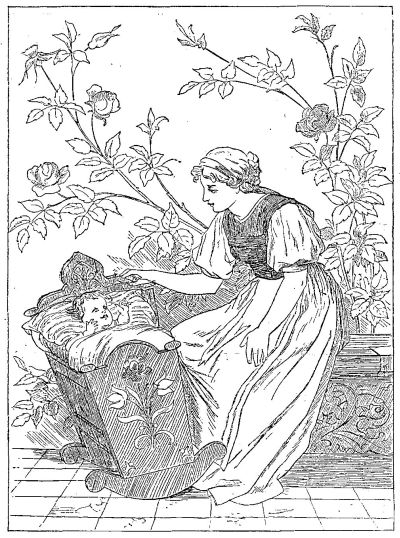
Sleep, my baby, angel forms Are bending now above you, And mother dear is watching here, Who'll always guard and love you. Safe her baby boy she'll keep When the night-fall brings him sleep.
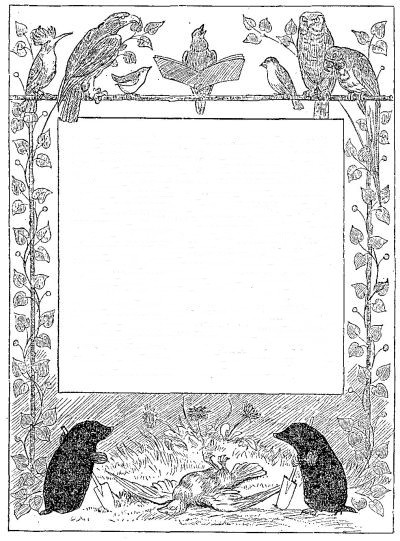
Cuckoo, dear Cuckoo, has fallen so ill, And here on the ground he is lying. Oh, what shall we do the summer night through, When our own darling cuckoo is dying? At the earliest dawn we must send for the mole, And tell him that cuckoo has left us, He'll dig a deep grave where the willow-trees wave, While we mourn the sad fate that bereft us. The owl and the eagle, the parrot and dove, Will watch while the nightingale's singing, And solemn and slow, in tones soft and low, The funeral song will be ringing.