OLD TIMES IN THE COLONIES.
Reading edition
BY CHARLES CARLETON COFFIN.
No. VI.
LOVEWELL'S FIGHT WITH THE PIGWACKETS.
At the southern base of the White Mountains, where the river Saco winds through green meadows, was the home of the Pigwacket Indians. Their chief was Paugus. During the years of peace he visited the English in Maine, New Hampshire, and Massachusetts, and was well acquainted with the settlers, but he liked the French better.
The Jesuit Father Rale, who had converted the Kennebec Indians, made his influence felt over all the surrounding tribes, and Paugus, through his influence, sided with the French. He could always obtain guns, powder, and balls at Quebec and Montreal in exchange for furs.
From their wigwams on the Saco, it was easy for the Pigwackets to go down that stream to the settlements in Maine, or going southwest to the "Smile of the Great Spirit," as they called Lake Winnipiseogee, they could descend the Merrimac to the settlements in Massachusetts.
In 1724 the Pigwackets killed two men at Dunstable. When the alarm was given, eleven men started after them, but the Indians discovering them, shot all but two, took their scalps, and returned to their wigwams on the Saco, where they held a great feast over the successful raid, dancing and howling through the night, and boasting of what they would do on the next raid.
"I will give £100 for every Indian scalp," said the Governor of Massachusetts.
The offer of such a bounty stimulated Captain John Lovewell, of Dunstable, who started with eight men. It was midwinter, but the snow, cold, and hardship did not deter the intrepid men, who made their way up the valley of the Merrimac, and eastward to the country of the Pigwackets. The sun was going down, on the 20th of February, when Captain Lovewell discovered a smoke rising above the trees. He waited till midnight, when, creeping forward alone, he could see ten Indians asleep by a fire on the shore of a pond. He went back to his men, and all moved forward. There was snow upon the ground, which broke the sound of their footsteps. At a signal the guns flashed, and every Indian was killed. It was a party who had just started to fall upon the English settlements. They had new guns, ammunition, and blankets, which they had obtained from the French in Canada.
It was a day of rejoicing in Dover when Captain Lovewell marched into the village with the Indian scalps dangling from a pole.
"We will attack the Pigwackets in their home," said the men.
It was in April. The snow had disappeared, the trees were bursting into leaf, when Captain Lovewell, with forty-six men, started up the valley of the Merrimac once more. Three of the men, after marching about fifty miles, became lame and returned home. The others turned eastward, passed Lake Winnipiseogee, and came to Ossipee Lake—a beautiful sheet of water.
One of the men was taken sick, and could not go on, and Captain Lovewell built a little fort, and left there the surgeon and six men, with a portion of the provisions. The rest of the party, thirty-four in all, shouldered their packs and moved on in search of the Pigwackets. No one knew exactly where their wigwams were located, and they moved cautiously for fear of being surprised.
Captain Lovewell was a religious man, and every morning, before starting, the soldiers kneeled or stood reverently with uncovered heads, while the chaplain, Rev. Jonathan Frye, offered prayer.
The morning of May 19 came. They were on the shore of a pond, and the chaplain was offering prayer, when they heard a gun, and looking across the pond they saw an Indian on a rocky point on the other side of the pond.
"We are discovered," said Lovewell. "Shall we go on, or return?"
"We have come to find the Indians," said the young chaplain. "We have prayed God that we might find them. We had rather die for our country than return without seeing them. If we go back, the people will call us cowards." The company left their packs, and marched cautiously forward.
The Indians had discovered them—not the one who was shooting ducks; he did not mistrust their presence; but a party had come upon their tracks, and were following in their rear, and took possession of their packs.
Captain Lovewell moved toward the one Indian, who quickly fired upon the white. His gun was loaded with shot, and Captain Lovewell and one of his men were wounded. The Indian turned to run, but Ensign Whiting brought him down.
"We will go back to our packs," said Lovewell; but when they reached the place they found that the Indians had seized them, and that their retreat was cut off by more than one hundred Pigwackets. The terrible war-whoop rang through the forest, and the fight began, Indians and white men alike sheltering themselves behind the trees and rocks, watching an opportunity to pick each other off without exposing themselves. All day long the contest went on, the Indians howling like tigers. The white men saw that they were outnumbered three to one. It must be victory or death.
Lieutenant Wyman was their commander in place of Lovewell, who was mortally wounded. He was cool and brave.
"LIEUTENANT WYMAN, CREEPING UP, PUT A BULLET THROUGH HIM."
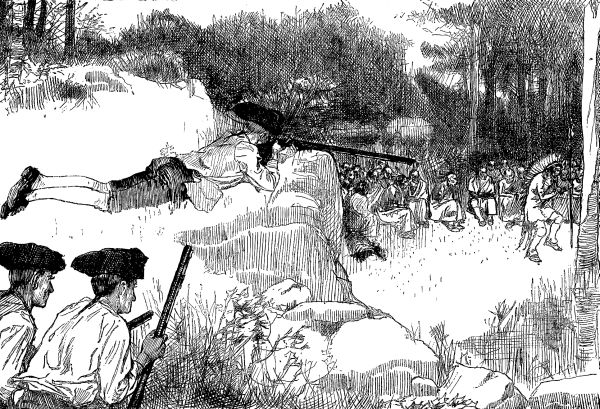
"Don't expose yourselves. Be careful of your ammunition." So cool and deliberate was the aim of the white men that at nearly every shot an Indian fell. They suffered so severely that they withdrew and held a powwow with their "medicine man," who was going through his incantations, when Lieutenant Wyman, creeping up, put a bullet through him. The Indians, howling vengeance, returned to the fight; but the white men, protected on one side by the pond, held their ground.
All through the afternoon the struggle went on.
"We will give you good quarter," shouted Paugus.
"We want no quarter, except at the muzzle of our guns," shouted Wyman.
Paugus had often been to Dunstable, and was well acquainted with John Chamberlain. They fired at each other many times, till at last Chamberlain sent a bullet through Paugus's head, killing him instantly.
"I am a dead man," said Solomon Keys. "I am wounded in three places." He crawled down to the shore of the pond, found an Indian canoe, and crept into it. The wind blew it out into the lake, and he was wafted to the southern shore. The sun went down, and the Indians stole away. Pitiable the condition of the settlers. Lovewell was dead, and also their beloved chaplain, Jonathan Frye, who with his dying breath prayed aloud for victory; Jacob Farrar was dying; Lieutenant Rollins and Robert Usher could not last long; eleven others were badly wounded. There were only eighteen left. The Indians had seized their packs; they had nothing to eat; it was twenty miles from the little fort which they had built at Ossipee; but they were victors. They had killed sixty or more Indians, and had inflicted a defeat from which the Pigwackets never recovered.
"Load my gun, so that, when the Indians come to scalp me, I can kill one more," said Lieutenant Rollins.
They must leave him. Sad the parting. In the darkness, guided by the stars, they started. Four were so badly wounded that they could not go on.
"Leave us," they said, "and save yourselves."
Twenty miles! How weary the way! They reach the fort to find it deserted. They had left seven men there, but when the fight began one of their number fled—a coward—and informed the seven that the party had all been cut off, not a man left. Believing that he had told the truth, they abandoned the fort, and returned to their homes.
Nothing to eat. But it was the month of May; the squirrels were out, and they shot two and a partridge; they caught some fish; and so were saved from starvation.