LITTLE JACK'S DREAM.
Reading edition
Little Jack Jones considered himself the happiest boy in Jonesborough when his father gave him a gun. The fact that it was a weapon with which to shoot peas, and had a spring that did away with the necessity for powder, did not make it any less dangerous in Jack's eyes, and he felt very warlike with it in his hands.
He was positive he could kill birds, and even animals for that matter, provided his aim was true, and the peas could be sent with sufficient force. That the woods in the rear of his house were alive with all kinds of animals he had no doubt, even though he had never seen any, and his father had said rabbits were the largest game to be found there. He felt certain his father was mistaken, for what were woods made for if not to shelter every species of the brute creation?
For a long time Jack had been anxious to go out for a day, and shoot about as many animals as would be necessary to start a large menagerie; but until this gun was given him he could not satisfy his desires. Now, however, all was changed, and he began the most warlike preparations.
He found an old powder-horn which would serve to hold his stock of peas, and make him look like a hunter, and the obliging tinman cut him out one of the most ferocious-looking tin knives that can well be imagined.
That night his gun, carefully loaded, stood by the head of his bed, while his knife and powder-horn of peas were tucked snugly away under the pillow, where he could reach them at a moment's notice.
It was a long time before he fell asleep that night, and as the last idea in his mind when the sand-man closed his eyes was of his hunting expedition, when he thought he awakened he was not surprised at finding himself already in the woods.
His gun was in his hands, his terrible knife in his belt, and his pea-horn slung over his shoulder in the proper manner. He laughed to himself at the thought that he was in the woods without remembering anything about the disagreeable morning task of combing his hair or going for the milk; but he took good care to peep cautiously behind every bush or rock lest an elephant should pop out and trample on him before he had time to kill him.
With his gun ready for instant use, he walked on, but saw nothing, not even a bird, that was anxious to be killed, until he heard a gruff voice just behind him shout,
"Here, young fellow, what are you trying to do?"
Jack turned very quickly, for he had not supposed any one was near, and his surprise was great at seeing an enormous gorilla, armed with a large club, and wearing two feathers on his head, and an apron of leaves, coming directly toward him.
"I wasn't tryin' to do nothin'," said Jack, in greatest alarm, and doing his best to keep his knees from shaking. "I was only walkin' round."
"That's a story," said the old fellow, sternly, as he called up five chimpanzees, all of whom wore aprons and carried clubs, and ordered them to lead Jack away to the court-house.
Frightened as Jack was, he thought how strange it was that animals should have a court-house, and then as he looked at his captors more closely, he fancied they acted something after the manner of policemen.
How frightened he was then, and how he wished he had never seen a pea-gun or a tin knife!
The policemen did not speak to him, but marched him along, the gorilla leading the way in the most dignified manner possible.
The distance was very long and Jack was tired; but he would willingly have walked during the entire day if by such means he could escape going to that court, where he felt certain some terrible punishment awaited him. There was no such good fortune for him, however, for when they reached what it seemed must be the very centre of the woods, they entered a cleared space, which marked the end of the journey.
BEFORE JUDGE LION.—Drawn by F. Bellew, Jun.
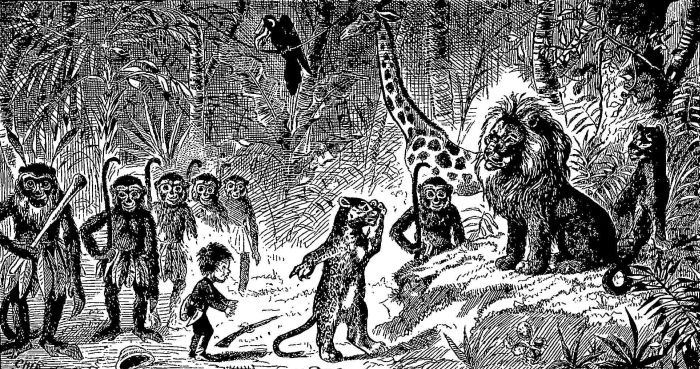
Jack knew he stood in the animals' court-room, for there, on a high bank on which moss had been spread for a carpet, sat a very ferocious-looking and very old lion, wearing an enormous pair of eyeglasses, while just behind him his wife looked over his shoulder curiously at the prisoner. Just below the lion a tiger sat on his haunches as if he was the clerk of the court; at one side stood a giraffe as crier, and on a swinging vine overhead perched an old crow, who, as the shade over his eyes plainly told, was the court reporter.
It was a terrible moment for poor Jack as he stood there before the savage-looking judge, and he resolved from that instant that there was not half so much fun in the so-called sport of hunting as some people seemed to think.
"What's your name?" asked the tiger, with a growl, and Jack's teeth chattered so that he could hardly answer,
"Jack Jones."
"What is the charge against the prisoner, Captain Gorilla?" asked the judge, as he stroked his whiskers and adjusted his eyeglasses.
"Carrying dangerous weapons," answered the old fellow, as he pointed to the pea-shooter, and then he motioned one of the chimpanzees to tell the story, he standing ready to corroborate what his lieutenant should say in case Jack attempted to deny his guilt.
The chimpanzee told the judge that he had been out with Captain Gorilla and his four comrades since six o'clock that morning, looking for some suspicious-acting animals who had been reported as being in that ward; they had discovered the prisoner, who was armed as his honor could see; he was, at the time of his arrest, looking around him in a singularly cautious manner, and was, to the best of his (the officer's) belief, a dangerous person to be at liberty.
The old crow looked down at Jack as if he was about to write a description of him for the next number of the Forest Herald, and the judge wiped his eyeglasses with his tail, as he asked, "Is his gun loaded?"
Captain Gorilla stepped forward, and was about to examine the weapon, when the giraffe put his hoofs in his ears, and insisted that if it was absolutely necessary to go into such slight details, the captain should go at least a mile from the court, since he was very nervous, and afraid of a noise.
The judge thought that perhaps it made no difference whether the charge was actually in the gun or not, since the prisoner had the ammunition in his possession, and then paused as if to consider what the sentence should be.
Jack, who was more frightened than ever before, had had no chance to speak since his trial began, but now he commenced to cry and plead his cause at the same time.
"Dear, kind, good Mr. Lion, if you'll only let me go home, I'll bend the knife all up, an' I won't ever shoot a single pea, except at the side of our barn, where they can't hurt anybody. Do let me go, 'cause I'm afraid I didn't get the milk for mother before I came here."
"If you neglected to do the errands for your mother, your punishment must be all the more severe," said the judge, and his wife nodded her head as if to say she thought that decision exactly correct.
"I'll never come out here again, an' I'll always do everything mother wants me to," pleaded Jack, but all in vain.
The judge considered the case in silence for some moments; the clerk licked his chops hungrily, as if he expected to be called upon to eat the prisoner; the captain of police brandished his club savagely; the crow made preparations for writing down the prisoner's last words; and Jack's hair would have stood straight up, because of his fright, if he had combed the snarls out so it could.
"Tie him up to the tallest tree by the hair, so he may act as scarecrow to other boys who come out pea-shooting in the morning before they have done the chores," said the judge, with a roar, and no sooner had he spoken than the gorilla and the chimpanzees caught Jack up, climbing the tree with him in their arms without the slightest difficulty.
It hurt terribly to hang there by the hair, but the pain was still greater when the branch broke, and he fell to the—floor, now thoroughly awakened, because he had tumbled out of bed.
It was some moments before he could understand that it was all a dream; but it had frightened him so that he bent the tin knife double and threw it out of the window before he crawled back to bed.
The next morning his mother was pleasantly surprised by seeing him do his work without being reminded of it, and that forenoon, when some of the boys asked him why he was not in the woods shooting lions, he simply told them that it was because he was obliged to take care of the baby.
A COUNTRY DAISY.